(3) · also written as a run, 3a xxx 3n
Proton
Also written hydrogen proton · transmitted light source · proton nucleus · energy level · light-beam · wavelength
Where it is first named
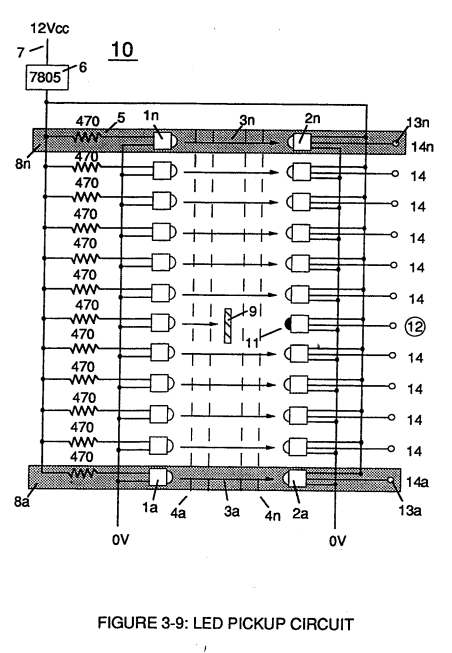
The peak wavelength (3) of Figure (3-9) being transmitted from the infrared emitting diode (led) (1) to the Optoschmitt receiver (2) is typically (935 nm) and allows the Optoschmitt (2) clock frequency (the speed by which the Optoschmitt changes logic state) to be (100 kHz).
How it is written
- (3) 10×
- (3a xxx 3n) 1×
3a xxx 3n is Meyer's shorthand for a run of the same thing: 3a is the first, 3n the last, and the x's stand for however many lie between. Every stage of the run is this one numeral.
Drawings 45
-
Stanley A. Meyer Page 10 of 28 · WFC 417 — WFC 417
-
The Resonant Frequency (F) of an LC circuit in series is given by (Eq 4) · LC Circuit
-
Carries this number · WFC 422DA - Illustrations
-
Carries this number · WFC 422DA - Illustrations
-
3-4 Inner Core Bobbin · Voltage Intensifier Coil Assembly
-
Carries this number · Electronic Circuit Design
-
Carries this number · Electronic Circuit Design
-
Carries this number · Electronic Circuit Design
-
Carries this number · Electronic Circuit Design
-
Carries this number · Water Fuel Injector (Taper Resonant Cavity Chamber)
-
Carries this number · Energy Pumping Action
-
(500) of Figure (5-1) · In Application of Usage
-
(510) of Figure (5-2) · In Application of Usage
-
Carries this number · Illustrations
-
Carries this number · Illustrations
-
Carries this number · WFC 426 - Illustrations
-
(510) of Figure (5-2) · 8-4 - State Space (Sp)
-
Figure (5-2) · Propagating Electrical Stress
-
Carries this number · Voltage to Amp Differential Ratio
-
Carries this number · WFC 429 - Illustrations
-
WFC Figure (5-1) · WFC Atomic Degaussing Process
-
dual unipolar voltage pulse circuit (1010) of Figure (11-1) · Voltage Flexing Process
-
(1030) of figure (11-3) · Voltage Flexing Process
-
Differential Voltage Wave-Guild (1040B) · Electrical Crossover Switching Circuit
-
When (B+/B+ - B-/B- / 1030B) switch function is activated, switch terminals (T1/T2 - T3/T4) are closed. · Electrical Crossover Switching Circuit
-
Led Pickup Circuit (10) of Figure (3-9) · Laser Accelerator Assembly
-
The figure it sits on · WFC 422DA - Illustrations
-
The figure it sits on · Voltage Intensifier Coil Assembly
-
The figure it sits on · Differential Air-Gas Inlet Control
-
Gas Processor Assembly 2 · Differential Air-Gas Inlet Control
-
The figure it sits on · Differential Air-Gas Inlet Control
-
The figure it sits on · Water Fuel Injector (Taper Resonant Cavity Chamber)
-
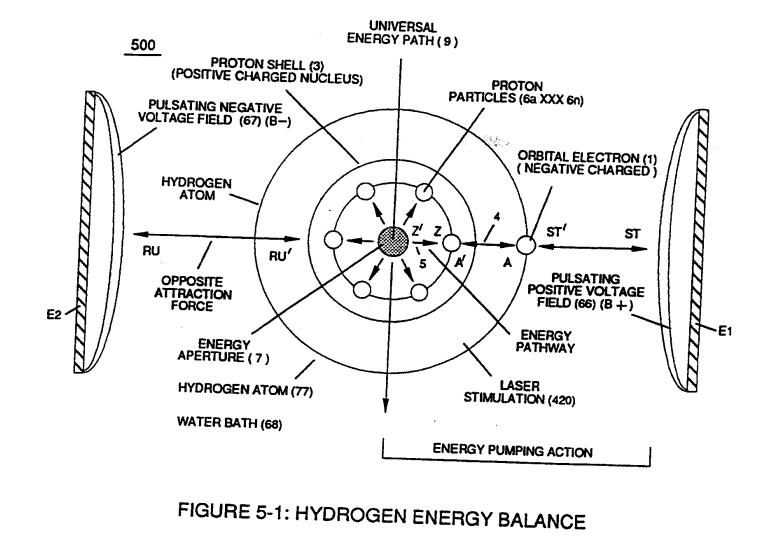
Figure (5-1) · Energy Pumping Action
-
This established increase or decrease in Electrical Pressure (4 / 5 ), now causes Energy Aperture (7) to either enlarge or become smaller as to applied voltage amplitude (VO xxx Vn), respectively. · Energy Pumping Action
-
The figure it sits on · Energy Pumping Action
-
(520) in Figure (5-3) · Resonant Propagation
-
(520) of Figure (5-3) · In Application of Usage
-
(520) of Figure (5-3) · Solar Energy Actuator
-
The figure it sits on · Illustrations
-
Hydrogen Fracturing Process (520) of Figure (5-3) · Voltage Intensifier Coil-Assembly
-
(520) of Figure (5-3) · 8-2 - Traveling Voltage Wave-Guides
-
Energy Pumping Action (520) of Figure (5-3) · WFC Development Objectives
-
Energy Priming Stage (500) of Figure (5-1) · Propagating Electrical Stress
-
energy aperture (7) of Figure (5-1) · Voltage Flexing Process
-
(500) of Figure (5-1) · Voltage Flexing Process
Where it is named · 11
Laser Accelerator Assembly 5×
-
wavelength (3)
The peak wavelength (3) of Figure (3-9) being transmitted from the infrared emitting diode (led) (1) to the Optoschmitt receiver (2) is typically (935 nm) and allows the Optoschmitt (2) clock frequency (the speed by which the Optoschmitt changes logic state) to be (100 kHz).
-
transmitted light source (3)
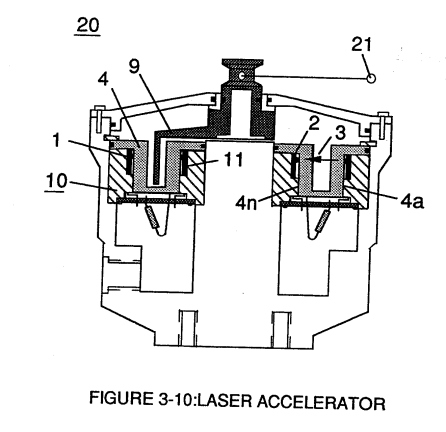
Optical lens (4) of Figure (310) redirects and focuses the transmitted light source (3) of Figure (3-9) (traveling infrared light waves) to the Optoschmitt (2) by passing the light source through a series of concentric lenses (4a xxx 4n) of Figure (3-10) which become progressively smaller from the outer peripheral lens surface (4a) to the inner lens surface (4n).
-
Transmitted light source (3)
Transmitted light source (3) is turned-on when a electrical power source of 5 volts is applied to the led (1) through dropping resister (5) by way of voltage regulator (6) connected to the car electrical system (7).
-
light-beam (3)
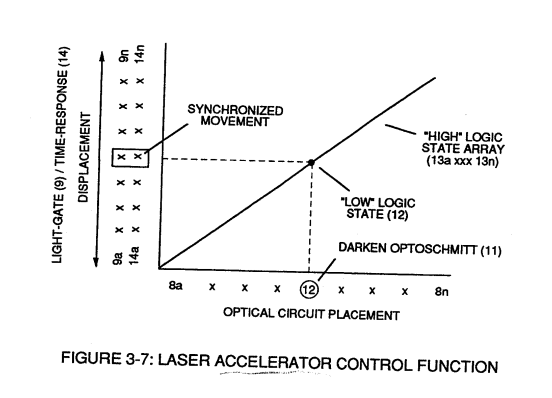
Once light-gate (9) blocks and prevents traveling light-beam (3) from reaching the matched Optoschmitt (8xx), the darken Optoschmitt (11) (non-energized) changes output state since the irradiance energy level (3) is reduced to, or below the release point...triggering opposite logic state (12).
-
energy level (3)
Once light-gate (9) blocks and prevents traveling light-beam (3) from reaching the matched Optoschmitt (8xx), the darken Optoschmitt (11) (non-energized) changes output state since the irradiance energy level (3) is reduced to, or below the release point...triggering opposite logic state (12).
Energy Pumping Action 5×
-
hydrogen proton (3)
...while, simultaneously, positive charged hydrogen proton (3) (Hydrogen Nucleus) is attracted and moved in opposite direction toward stationary voltage field (67)
-
Proton (3)
... applying and superimposing electrical tension (4) onto opposite attraction force (AA') that exist between the negative charged orbital electron (1) and positive charged Proton (3)
-
proton (3)
Once applied voltage pulse of opposite polarity (66/67) is terminated during pulse off-time, then Energy Aperture (7) automatically adjusts to maintain a given energy level since each aperture oscillation (aperture expansion) emits a discrete amount of Universal Energy (9) into proton (3) via energy pathway (ZZ'), as illustrated in Figure (5-1).
-
proton nucleus (3)
Repetitive pulsing of applied voltage fields (66/67), now, oscillates Energy Aperture (7) to emit even a greater amount of Universal Energy (9a xxx 9n) into the energy spectrum of the proton nucleus (3) to be absorbed ... thereby, increasing the energy level of hydrogen atom still further .... deflecting hydrogen electron (1) to a higher energy state, as illustrated in (520) of Figure (5-3).
-
proton (3a xxx 3n)
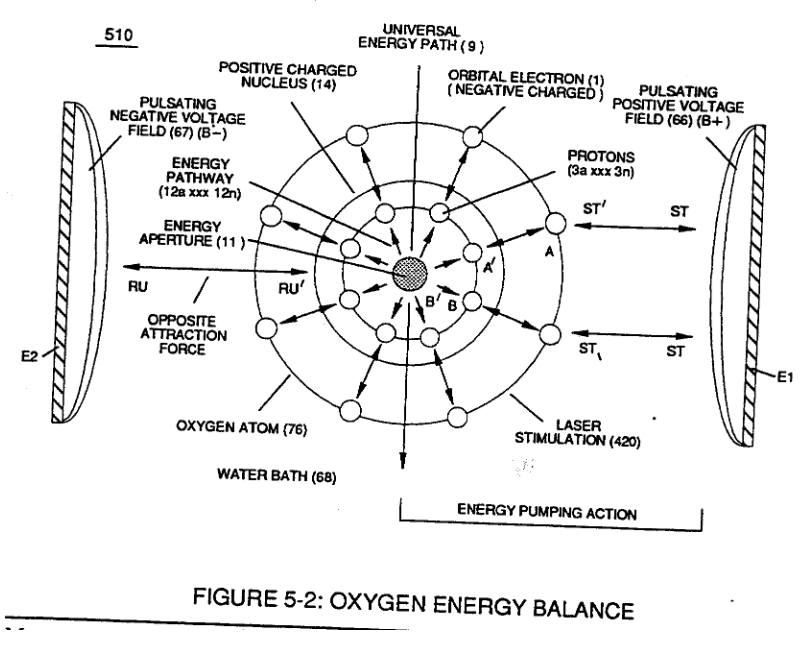
In this phase of application, opposite attraction force (BB') provides a energy transfer path (12) to each respective proton (3a xxx 3n) from energy aperture (11) which is centrally formed during proton grouping ... establishing nucleus (14) of Figure (5-2).
A Technique Called "Easer" 1×
-
Proton (3)
... whereby, atomic electrical attraction force (4) that exists between the deflected orbital negative charged electron -(1) and the pivotal positive charged Proton (3) is attenuated (∆4a xxx ∆4n - ∆5a xxx ∆5n)