patent · US4651324
Method and apparatus for operating a CO2 gas laser
17 March 1987
Page 1 — bibliographic record
United States Patent (19) 11) Patent Number: 4,651,324 Prein et al. 45) Date of Patent: Mar. 17, 1987 54 METHOD AND APPARATUS FOR Sealed CO2 Laser”, J. Appl. Phy, vol. 40, No. 9, 1969, OPERATING A CO2 GAS LASER pp. 3883-3884.
(76) Inventors: Franz Prein, Tulpenweg 3, D6901 Witteman, "High-Output Powers and Long Lifetimes Waldhilsbach; Heinrich Karning, of Sealed-Off CO2 Lasers', APL, vol. 11, No. 11, 1 Dec. Albert-Fritz-Str. 6, D 6900 1967, pp. 337-338.
Heidelberg, both of Fed. Rep. of Primary Examiner-James W. Davie
Germany Attorney, Agent, or Firm-Handal & Morofsky (21) Appl. No.: 447,504 57 ABSTRACT (22) Filed: Dec. 7, 1982 In electrically pumped CO2 gas lasers, there take place (30) Foreign Application Priority Data widely different chemical and physical processes which Dec. 8, 1981 DE Fed. Rep. of Germany ....... 348570 lead, at least partially, to undesirable interactions of the Oct. 30, 1982 EP European Pat. Off. ........ 82110042.7 gases among themselves, and/or of the gases with the electrical and/or the optical field and/or with the mate 51 Int. Cl'................................................ H01S 3/22 rials used in the gas-filled chambers. Bodies that are 52 U.S. Cl. ........................................ 372/59; 372/34; equipped with surface area-enlarging structures are 372/60; 372/61; 372/83 included in the discharge or resonator chamber or in 58) Field of Search ....................... 372/59, 60,33, 34, adjacent secondary chambers. The secondary chambers 372/61, 83 by themselves act as reservoirs or as carriers of reser (56) References Cited voirs for suitable catalysts and gas components and/or
4,150,343 4/1979 Seelig et al. .......................... 372/60 influence over the conditions of volume and/or pres sure and/or temperature. The inclusion of such second
FOREIGN PATENT DOCUMENTS ary chambers and such structures which enlarge surface 2038777 2/1972 Fed. Rep. of Germany . area inside the chambers make possible the attainment 1966271 5/1972 Fed. Rep. of Germany. of at least an approximate state of equilibrium, which 2028571 3/1980 United Kingdom .................. 372/59 leads to uniformly good discharge and long life with high laser efficiency.
OTHER PUBLICATIONS
Kakube et al., "Decomposition of CO2 Molecules in a 14 Claims, 9 Drawing Figures
Page 2
Drawing sheet — no readable text.
Page 3
Drawing sheet — no readable text.
Page 4
Drawing sheet — no readable text.
Page 5
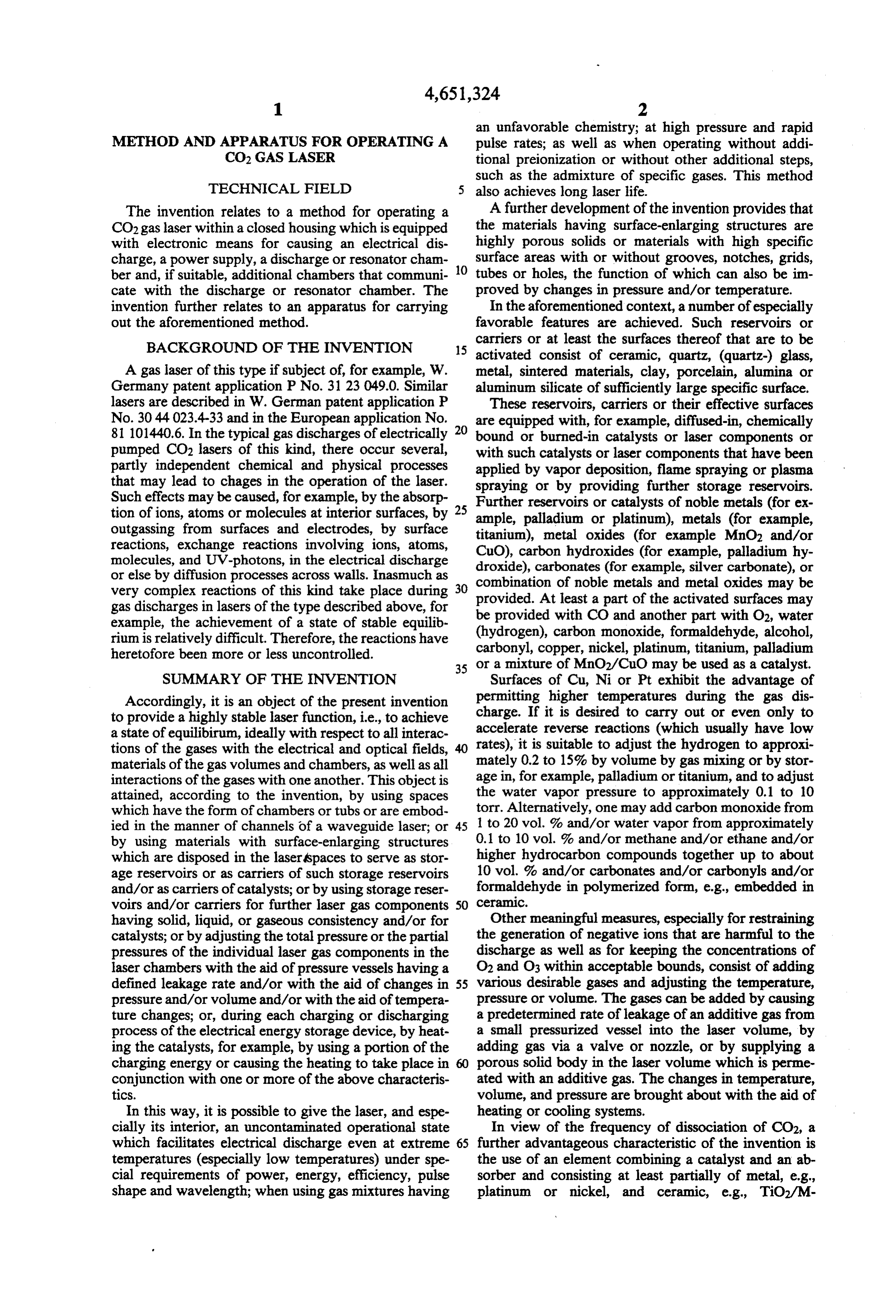
an unfavorable chemistry; at high pressure and rapid
METHOD AND APPARATUS FOR OPERATING A pulse rates; as well as when operating without addi CO2 GAS LASER tional preionization or without other additional steps, such as the admixture of specific gases. This method
TECHNICAL FIELD also achieves long laser life.
The invention relates to a method for operating a A further development of the invention provides that CO2 gas laser within a closed housing which is equipped the materials having surface-enlarging structures are with electronic means for causing an electrical dis highly porous solids or materials with high specific charge, a power supply, a discharge or resonator cham surface areas with or without grooves, notches, grids, ber and, if suitable, additional chambers that communi 10 tubes or holes, the function of which can also be im cate with the discharge or resonator chamber. The proved by changes in pressure and/or temperature. invention further relates to an apparatus for carrying In the aforementioned context, a number of especially out the aforementioned method. favorable features are achieved. Such reservoirs or carriers or at least the surfaces thereof that are to be
BACKGROUND OF THE INVENTION 15 activated consist of ceramic, quartz, (quartz-) glass, A gas laser of this type if subject of, for example, W. metal, sintered materials, clay, porcelain, alumina or Germany patent application P No. 31 23 049.0. Similar aluminum silicate of sufficiently large specific surface. lasers are described in W. German patent application P These reservoirs, carriers or their effective surfaces No. 3044023.4-33 and in the European application No. 20 are equipped with, for example, diffused-in, chemically 81 101440.6. In the typical gas discharges of electrically bound or burned-in catalysts or laser components or pumped CO2 lasers of this kind, there occur several, with such catalysts or laser components that have been partly independent chemical and physical processes applied by vapor deposition, flame spraying or plasma that may lead to chages in the operation of the laser. spraying or by providing further storage reservoirs. Such effects may be caused, for example, by the absorp Further reservoirs or catalysts of noble metals (for ex tion of ions, atoms or molecules at interior surfaces, by 25 ample, palladium or platinum), metals (for example, outgassing from surfaces and electrodes, by surface titanium), metal oxides (for example MnO2 and/or reactions, exchange reactions involving ions, atoms, CuO), carbon hydroxides (for example, palladium hy molecules, and UV-photons, in the electrical discharge or else by diffusion processes across walls. Inasmuch as droxide), carbonates (for example, silver carbonate), or very complex reactions of this kind take place during 30 combination of noble metals and metal oxides may be gas discharges in lasers of the type described above, for provided. At least a part of the activated surfaces may example, the achievement of a state of stable equilib be provided with CO and another part with O2, water (hydrogen), carbon monoxide, formaldehyde, alcohol, rium is relatively difficult. Therefore, the reactions have carbonyl, copper, nickel, platinum, titanium, palladium heretofore been more or less uncontrolled.
35 or a mixture of MnO2/CuO may be used as a catalyst.
SUMMARY OF THE INVENTION Surfaces of Cu, Ni or Pt exhibit the advantage of Accordingly, it is an object of the present invention permitting higher temperatures during the gas dis to provide a highly stable laser function, i.e., to achieve charge. If it is desired to carry out or even only to a state of equilibirum, ideally with respect to all interac accelerate reverse reactions (which usually have low tions of the gases with the electrical and optical fields, rates), mately it is suitable to adjust the hydrogen to approxi 0.2 to 15% by volume by gas mixing or by stor materials of the gas volumes and chambers, as well as all interactions of the gases with one another. This object is age in, for example, palladium or titanium, and to adjust attained, according to the invention, by using spaces the water vapor pressure to approximately 0.1 to 10 which have the form of chambers or tubs or are embod torr. Alternatively, one may add carbon monoxide from ied in the manner of channels of a waveguide laser; or 45 1 to 20 vol. 9% and/or water vapor from approximately by using materials with surface-enlarging structures 0.1 to 10 vol. 26 and/or methane and/or ethane and/or which are disposed in the laserspaces to serve as stor higher hydrocarbon compounds together up to about age reservoirs or as carriers of such storage reservoirs 10 vol. 9% and/or carbonates and/or carbonyls and/or and/or as carriers of catalysts; or by using storage reser formaldehyde in polymerized form, e.g., embedded in voirs and/or carriers for further laser gas components 50 ceramic.
having solid, liquid, or gaseous consistency and/or for Other meaningful measures, especially for restraining catalysts; or by adjusting the total pressure or the partial the generation of negative ions that are harmful to the pressures of the individual laser gas components in the discharge as well as for keeping the concentrations of laser chambers with the aid of pressure vessels having a O2 and O3 within acceptable bounds, consist of adding defined leakage rate and/or with the aid of changes in 55 various desirable gases and adjusting the temperature, pressure and/or volume and/or with the aid of tempera pressure or volume. The gases can be added by causing ture changes; or, during each charging or discharging a predetermined rate of leakage of an additive gas from process of the electrical energy storage device, by heat a small pressurized vessel into the laser volume, by ing the catalysts, for example, by using a portion of the adding gas via a valve or nozzle, or by supplying a charging energy or causing the heating to take place in porous solid body in the laser volume which is perme conjunction with one or more of the above characteris ated with an additive gas. The changes in temperature, t1CS. volume, and pressure are brought about with the aid of In this way, it is possible to give the laser, and espe heating or cooling systems.
cially its interior, an uncontaminated operational state In view of the frequency of dissociation of CO2, a which facilitates electrical discharge even at extreme 65 further advantageous characteristic of the invention is temperatures (especially low temperatures) under spe the use of an element combining a catalyst and an ab cial requirements of power, energy, efficiency, pulse sorber and consisting at least partially of metal, e.g., shape and wavelength; when using gas mixtures having platinum or nickel, and ceramic, e.g., TiO2/M-
Page 6
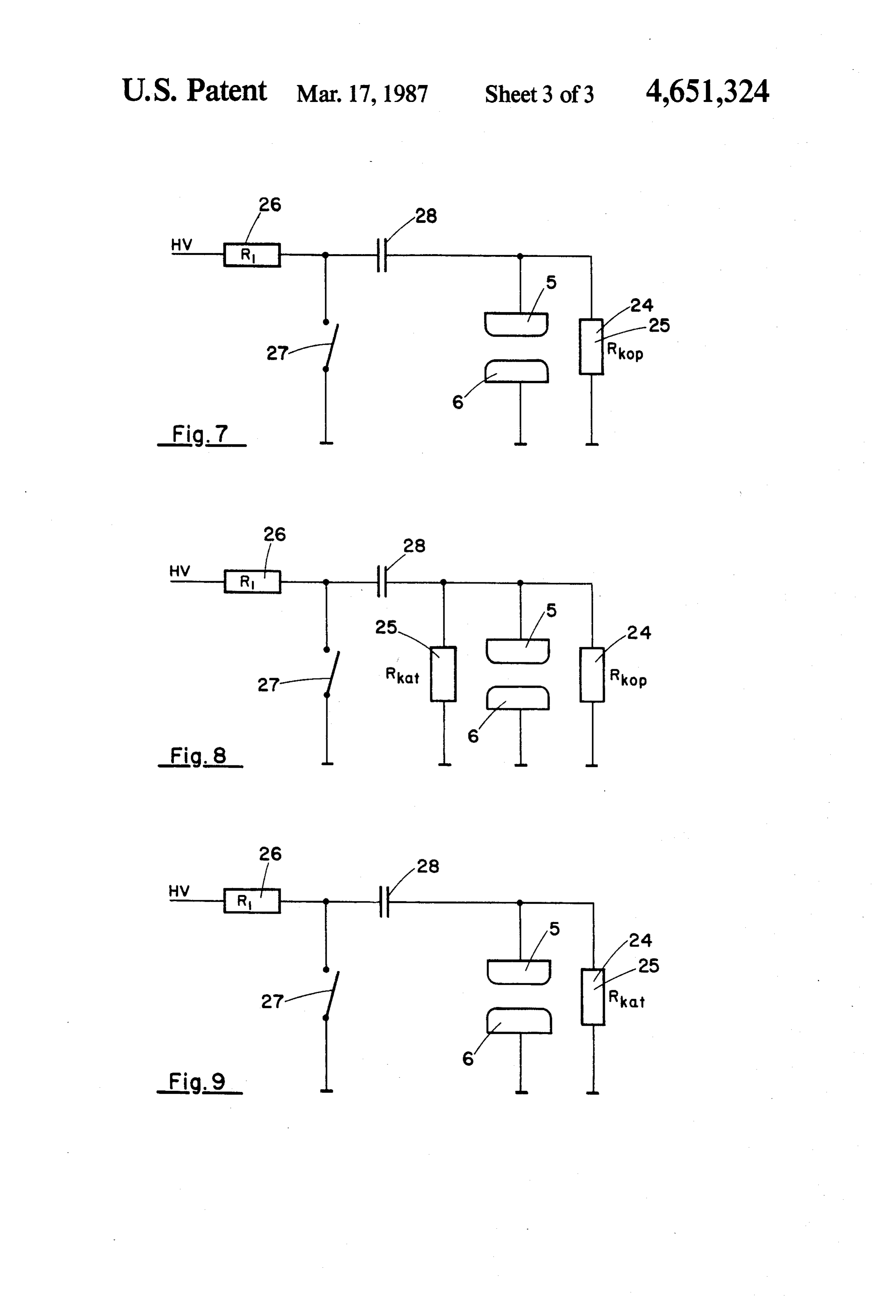
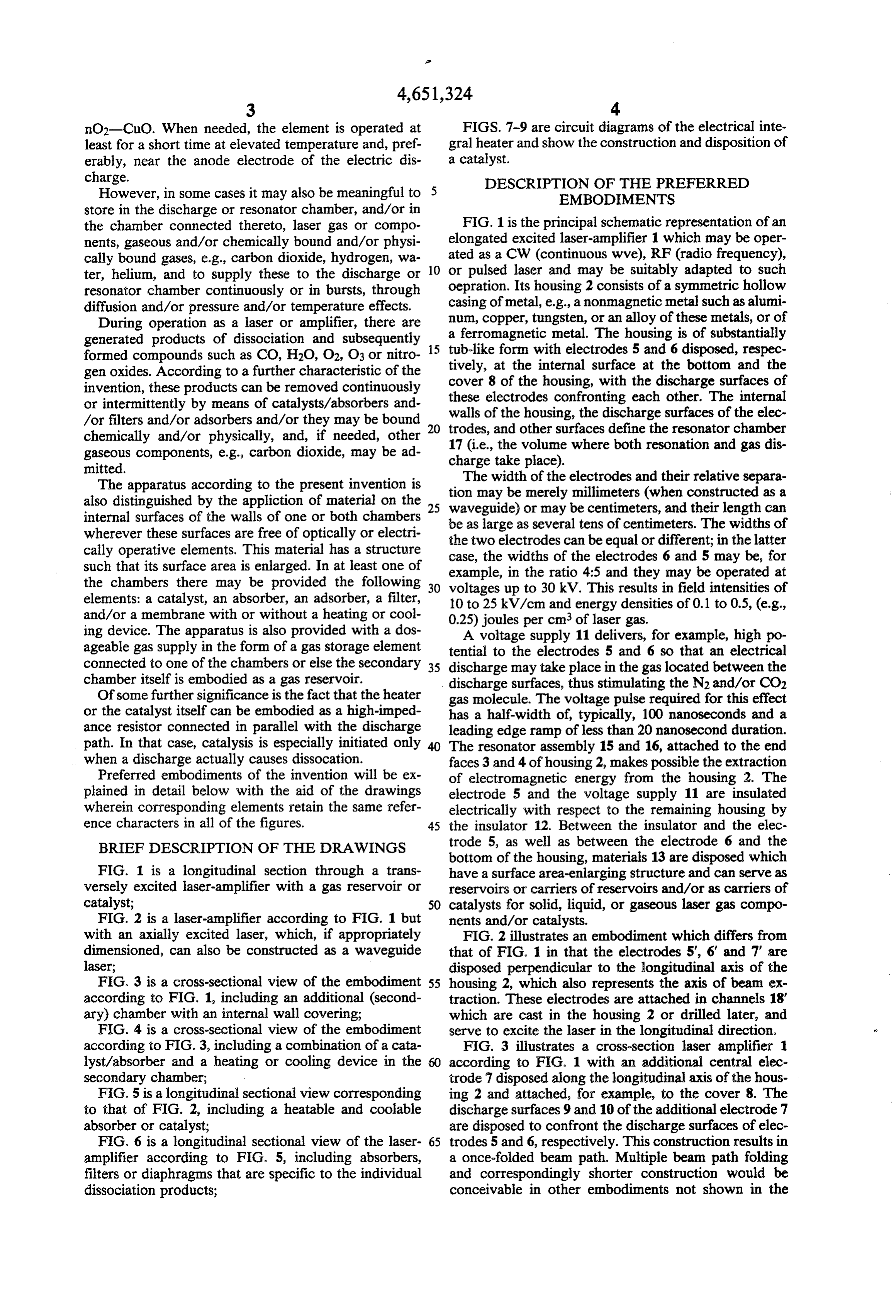
nO2-CuO. When needed, the element is operated at FIGS. 7-9 are circuit diagrams of the electrical inte least for a short time at elevated temperature and, pref gral heater and show the construction and disposition of erably, near the anode electrode of the electric dis a catalyst.
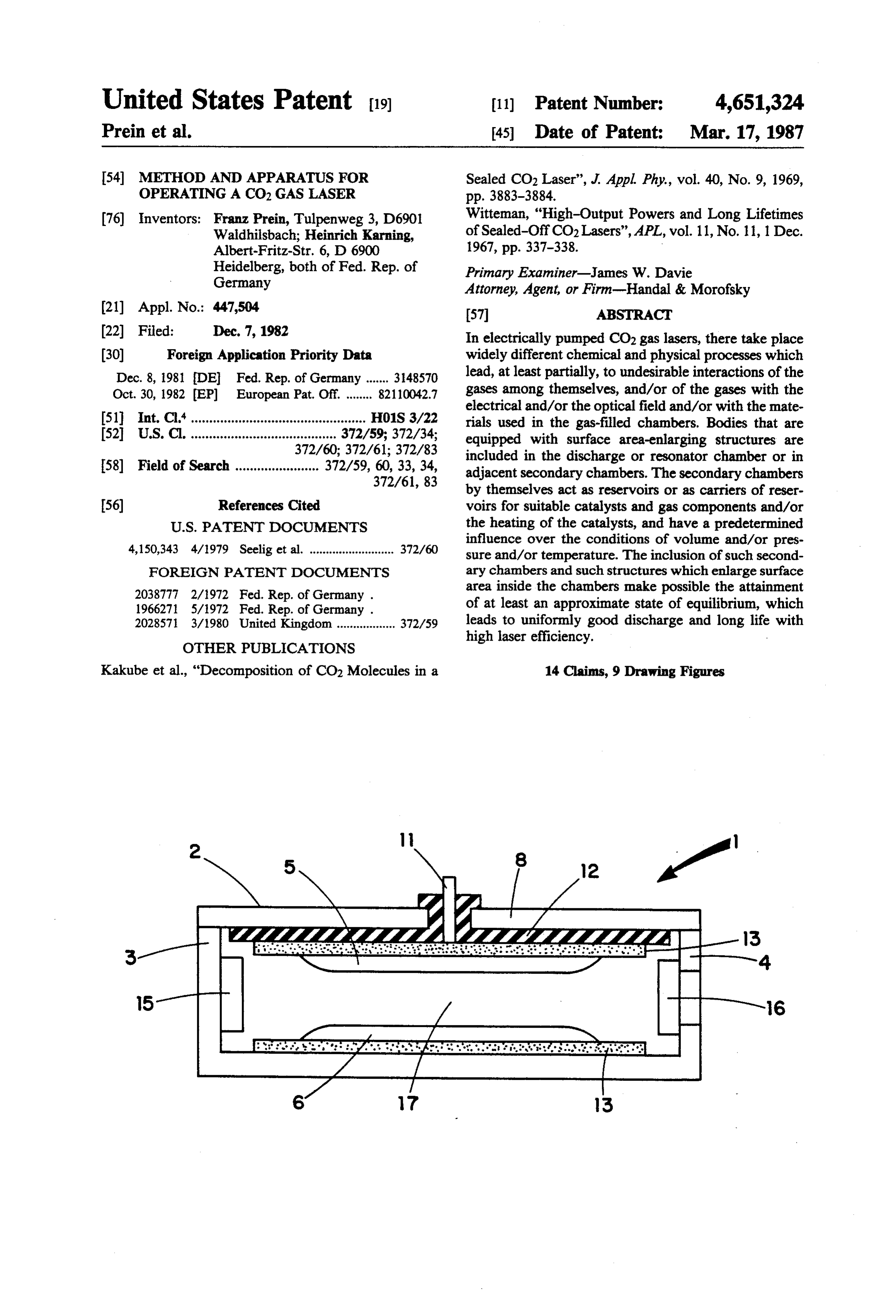
charge. DESCRIPTION OF THE PREFERRED However, in some cases it may also be meaningful to EMBODIMENTS store in the discharge or resonator chamber, and/or in the chamber connected thereto, laser gas or compo FIG. 1 is the principal schematic representation of an nents, gaseous and/or chemically bound and/or physi elongated excited laser-amplifier 1 which may be oper cally bound gases, e.g., carbon dioxide, hydrogen, wa ated as a CW (continuous wive), RF (radio frequency), ter, helium, and to supply these to the discharge or 10 or pulsed laser and may be suitably adapted to such resonator chamber continuously or in bursts, through oepration. Its housing 2 consists of a symmetric hollow diffusion and/or pressure and/or temperature effects. casing of metal, e.g., a nonmagnetic metal such as alumi During operation as a laser or amplifier, there are num, copper, tungsten, or an alloy of these metals, or of generated products of dissociation and subsequently 15 atub-like ferromagnetic metal. The housing is of substantially form with electrodes 5 and 6 disposed, respec formed compounds such as CO, H2O, O2, O3 or nitro gen oxides. According to a further characteristic of the tively, at the internal surface at the bottom and the invention, these products can be removed continuously cover 8 of the housing, with the discharge surfaces of or intermittently by means of catalysts/absorbers and these electrodes confronting each other. The internal walls of the housing, the discharge surfaces of the elec /or filters and/or adsorbers and/or they may be bound trodes, chemically and/or physically, and, if needed, other 17 (i.e., and other surfaces define the resonator chamber gaseous components, e.g., carbon dioxide, may be ad charge take volume the place).
where both resonation and gas dis mitted.
The apparatus according to the present invention is The width of the electrodes and their relative separa also distinguished by the appliction of material on the 25 tion may be merely millimeters (when constructed as a waveguide) or may be centimeters, and their length can internal surfaces of the walls of one or both chambers be as large as wherever these surfaces are free of optically or electri the two electrodes several tens of centimeters. The widths of cally operative elements. This material has a structure case, the widths ofcan be equal or different; in the latter such that its surface area is enlarged. In at least one of example, in the ratio 4:5electrodes
the chambers there may be provided the following 30 voltages up to 30 kV. This results inmay and they be operated at elements: a catalyst, an absorber, an adsorber, a filter, 10 to 25 kV/cm and energy densities of 0.1intensities field
and/or a membrane with or without a heating or cool 0.25) joules per cm3 of laser gas.
ing device. The apparatus is also provided with a dos A voltage supply 11 delivers, for example, high po ageable gas supply in the form of a gas storage element tential to the electrodes 5 and 6 so that an electrical connected to one of the chambers or else the secondary 35 discharge may take place in the gas located between the chamber itself is embodied as a gas reservoir. discharge surfaces, thus stimulating the N2 and/or CO2 Of some further significance is the fact that the heater gas molecule. The voltage pulse required for this effect or the catalyst itself can be embodied as a high-imped has a half-width of, typically, 100 nanoseconds and a ance resistor connected in parallel with the discharge leading edge ramp of less than 20 nanosecond duration. path. In that case, catalysis is especially initiated only The resonator assembly 15 and 16, attached to the end when a discharge actually causes dissocation. faces 3 and 4 of housing 2, makes possible the extraction Preferred embodiments of the invention will be ex of electromagnetic energy from the housing 2. The plained in detail below with the aid of the drawings electrode 5 and the voltage supply 11 are insulated wherein corresponding elements retain the same refer electrically with respect to the remaining housing by ence characters in all of the figures. 45 the insulator 12. Between the insulator and the elec BRIEF DESCRIPTION OF THE DRAWINGS trode 5, as well as between the electrode 6 and the bottom of the housing, materials 13 are disposed which
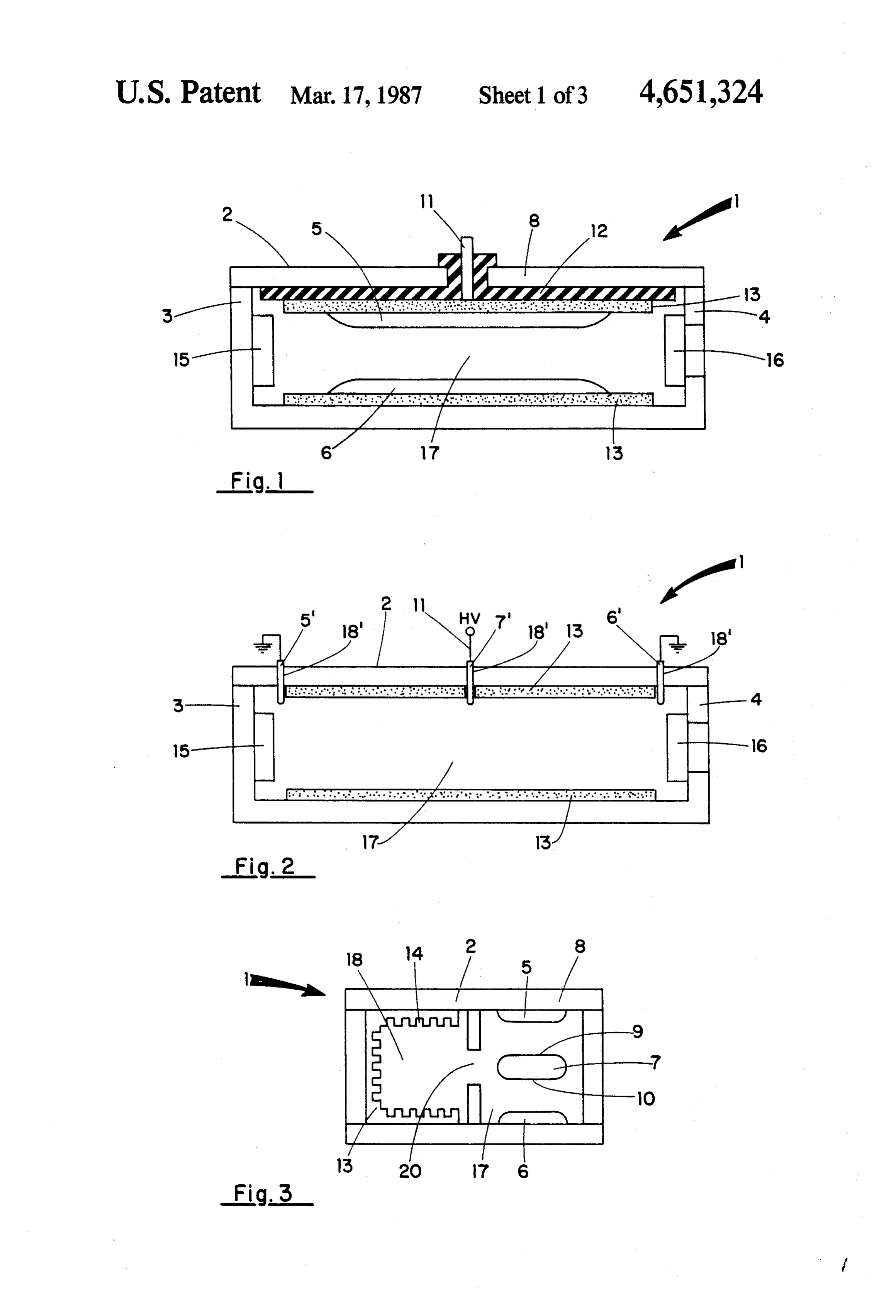
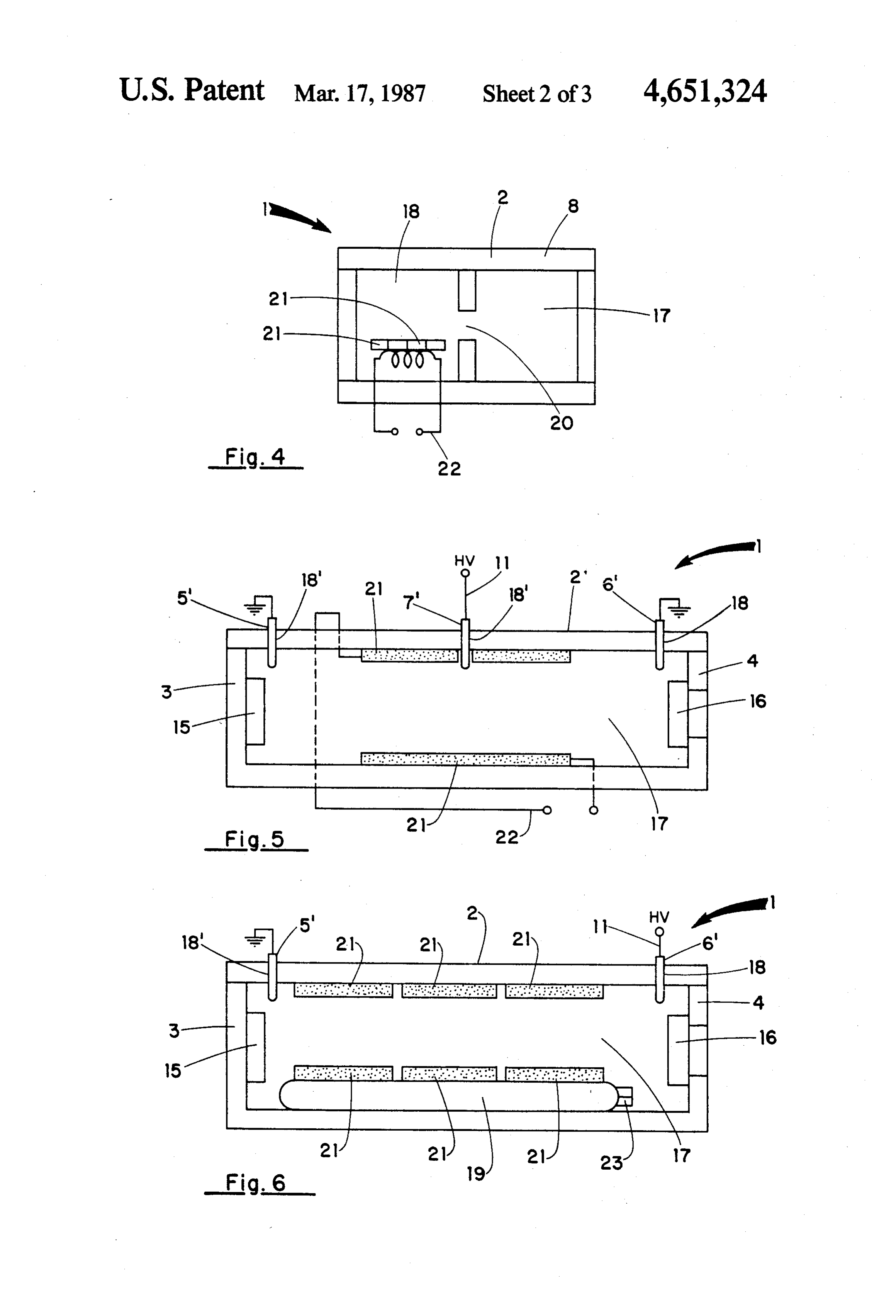
FIG. 1 is a longitudinal section through a trans have a surface area-enlarging structure and can serve as versely excited laser-amplifier with a gas reservoir or reservoirs or carriers of reservoirs and/or as carriers of catalyst; 50 catalysts for solid, liquid, or gaseous laser gas compo FIG. 2 is a laser-amplifier according to FIG. 1 but nents and/or catalysts.
with an axially excited laser, which, if appropriately FIG. 2 illustrates an embodiment which differs from dimensioned, can also be constructed as a waveguide that of FIG. 1 in that the electrodes 5, 6' and 7" are laser; disposed perpendicular to the longitudinal axis of the FIG. 3 is a cross-sectional view of the embodiment 55 housing 2, which also represents the axis of beam ex according to FIG. 1, including an additional (second traction. These electrodes are attached in channels 18' ary) chamber with an internal wall covering; which are cast in the housing 2 or drilled later, and FIG. 4 is a cross-sectional view of the embodiment serve to excite the laser in the longitudinal direction. according to FIG. 3, including a combination of a cata FIG. 3 illustrates a cross-section laser amplifier 1 lyst/absorber and a heating or cooling device in the according to FIG. 1 with an additional central elec secondary chamber; trode 7 disposed along the longitudinal axis of the hous FIG. 5 is a longitudinal sectional view corresponding ing 2 and attached, for example, to the cover 8. The to that of FIG. 2, including a heatable and coolable discharge surfaces 9 and 10 of the additional electrode 7 absorber or catalyst; are disposed to confront the discharge surfaces of elec FIG. 6 is a longitudinal sectional view of the laser 65 trodes 5 and 6, respectively. This construction results in amplifier according to FIG. 5, including absorbers, a once-folded beam path. Multiple beam path folding filters or diaphragms that are specific to the individual and correspondingly shorter construction would be dissociation products; conceivable in other embodiments not shown in the
Page 7
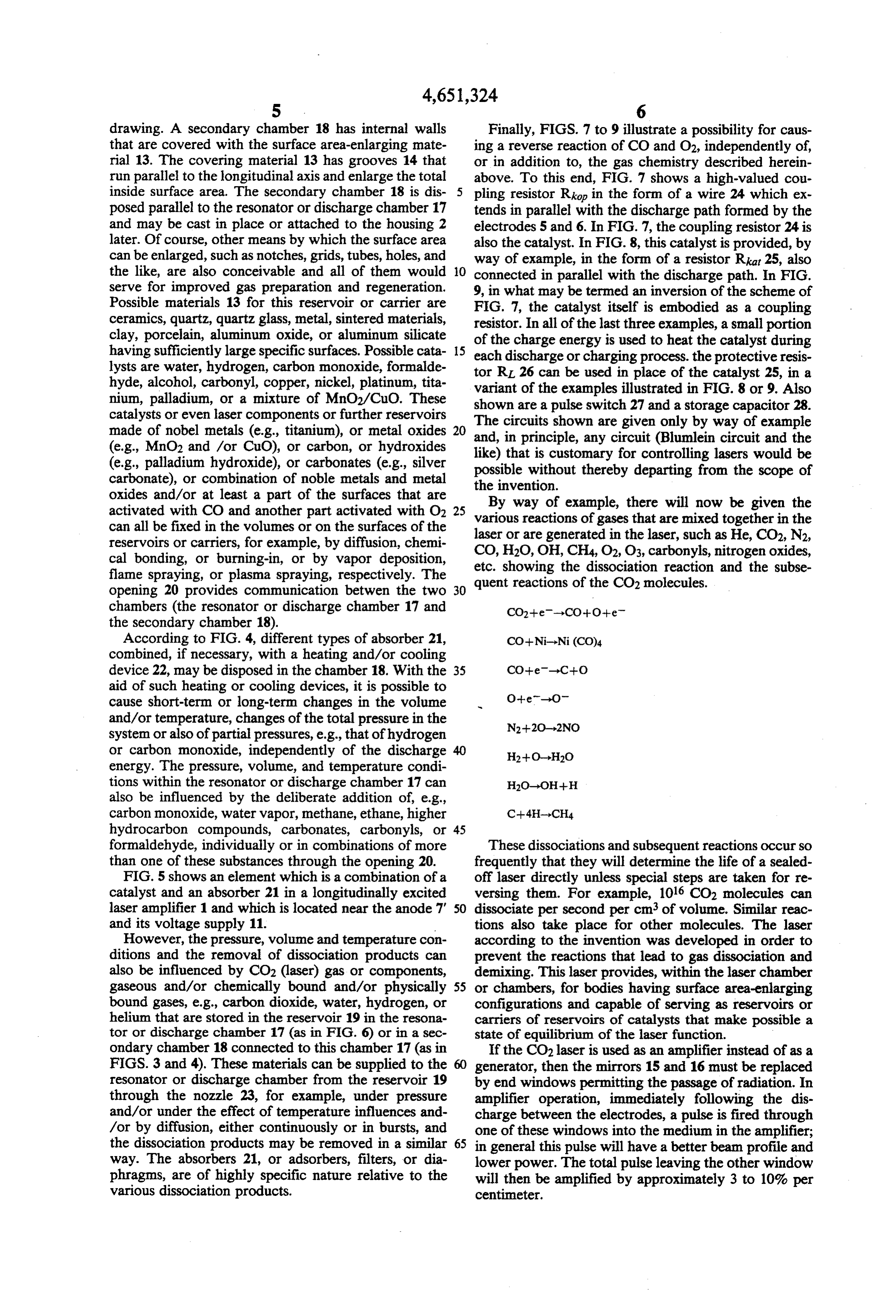
drawing. A secondary chamber 18 has internal walls Finally, FIGS. 7 to 9 illustrate a possibility for caus that are covered with the surface area-enlarging mate ing a reverse reaction of CO and O2, independently of, rial 13. The covering material 13 has grooves 14 that or in addition to, the gas chemistry described herein run parallel to the longitudinal axis and enlarge the total above. To this end, FIG. 7 shows a high-valued cou inside surface area. The secondary chamber 18 is dis pling resistor Riko in the form of a wire 24 which ex posed parallel to the resonator or discharge chamber 17 tends in parallel with the discharge path formed by the and may be cast in place or attached to the housing 2 electrodes 5 and 6. In FIG. 7, the coupling resistor 24 is later. Of course, other means by which the surface area also the catalyst. In FIG. 8, this catalyst is provided, by can be enlarged, such as notches, grids, tubes, holes, and way of example, in the form of a resistor Rkat 25, also the like, are also conceivable and all of them would O connected in parallel with the discharge path. In FIG. serve for improved gas preparation and regeneration. 9, in what may be termed an inversion of the scheme of Possible materials 13 for this reservoir or carrier are FIG. 7, the catalyst itself is embodied as a coupling ceramics, quartz, quartz glass, metal, sintered materials, resistor. In all of the last three examples, a small portion clay, porcelain, aluminum oxide, or aluminum silicate having sufficiently large specific surfaces. Possible cata 15 of the charge energy is used to heat the catalyst during each discharge or charging process. the protective resis lysts are water, hydrogen, carbon monoxide, formalde hyde, alcohol, carbonyl, copper, nickel, platinum, tita tor RL 26 can be used in place of the catalyst 25, in a variant of the examples illustrated in FIG. 8 or 9. Also nium, palladium, or a mixture of MnO2/CuO. These shown are catalysts or even laser components or further reservoirs The circuitsa pulse switch 27 and a storage capacitor 28. made of nobel metals (e.g., titanium), or metal oxides 20 and, in principle, anyarecircuit shown given only by way of example
(Blumlein circuit and the (e.g., MnO2 and /or CuO), or carbon, or hydroxides like) that is customary for controlling lasers would be (e.g., palladium hydroxide), or carbonates (e.g., silver possible without thereby departing from the scope of carbonate), or combination of noble metals and metal the invention.
oxides and/or at least a part of the surfaces that are By way of example, there will now be given the activated with CO and another part activated with O2 25 various reactions of gases that are mixed together in the can all be fixed in the volumes or on the surfaces of the reservoirs or carriers, for example, by diffusion, chemi laser or are generated in the laser, such as He, CO2, N2, cal bonding, or burning-in, or by vapor deposition, CO, H2O, OH, CH4, O2, O3, carbonyls, nitrogen oxides, flame spraying, or plasma spraying, respectively. The etc. showing the dissociation reaction and the subse opening 20 provides communication betwen the two 30 quent reactions of the CO2 molecules.
chambers (the resonator or discharge chamber 17 and CO2-et-CO-O--e.
the secondary chamber 18).
According to FIG. 4, different types of absorber 21, CO--Ni-Ni (CO)4 combined, if necessary, with a heating and/or cooling device 22, may be disposed in the chamber 18. With the 35 CO-et-C--O aid of such heating or cooling devices, it is possible to cause short-term or long-term changes in the volume O-et-O and/or temperature, changes of the total pressure in the N2+2O-2NO system or also of partial pressures, e.g., that of hydrogen or carbon monoxide, independently of the discharge H2--O-H2O energy. The pressure, volume, and temperature condi tions within the resonator or discharge chamber 17 can H2O-OH--H also be influenced by the deliberate addition of, e.g., carbon monoxide, water vapor, methane, ethane, higher hydrocarbon compounds, carbonates, carbonyls, or 45 formaldehyde, individually or in combinations of more These dissociations and subsequent reactions occurso than one of these substances through the opening 20. frequently that they will determine the life of a sealed FIG. 5 shows an element which is a combination of a off laser directly unless special steps are taken for re catalyst and an absorber 21 in a longitudinally excited versing them. For example, 1016 CO2 molecules can laser amplifier 1 and which is located near the anode 7" 50 dissociate per second per cm3 of volume. Similar reac and its voltage supply 11. tions also take place for other molecules. The laser However, the pressure, volume and temperature con according to the invention was developed in order to ditions and the removal of dissociation products can prevent the reactions that lead to gas dissociation and also be influenced by CO2 (laser) gas or components, demixing. This laser provides, within the laser chamber gaseous and/or chemically bound and/or physically 55 or chambers, for bodies having surface area-enlarging bound gases, e.g., carbon dioxide, water, hydrogen, or configurations and capable of serving as reservoirs or helium that are stored in the reservoir 19 in the resona carriers of reservoirs of catalysts that make possible a tor or discharge chamber 17 (as in FIG. 6) or in a sec state of equilibrium of the laser function. ondary chamber 18 connected to this chamber 17 (as in If the CO2 laser is used as an amplifier instead of as a FIGS. 3 and 4). These materials can be supplied to the generator, then the mirrors 15 and 16 must be replaced resonator or discharge chamber from the reservoir 19 by end windows permitting the passage of radiation. In through the nozzle 23, for example, under pressure amplifier operation, immediately following the dis and/or under the effect of temperature influences and charge between the electrodes, a pulse is fired through /or by diffusion, either continuously or in bursts, and one of these windows into the medium in the amplifier; the dissociation products may be removed in a similar 65 in general this pulse will have a better beam profile and way. The absorbers 21, or adsorbers, filters, or dia lower power. The total pulse leaving the other window phragms, are of highly specific nature relative to the will then be amplified by approximately 3 to 10% per various dissociation products. centimeter.
Page 8
We claim: 5. A gas laser according to claim 3, wherein said 1. A gas laser comprising: housing comprises a second chamber, one of said cham (a) a closed metal housing defining at least a first bers having an element comprising a gas reservoir. chamber with opposing endfaces substantially per 6. A gas laser according to claim 4, wherein either pendicular to the longitudinal axis of said housing said first or said second chamber contains means for and containing a gaseous laser medium; controlling the temperature in said chambers. (b) means for producing an electrical discharge in 7. A gas laser according to claim 6, wherein said said gaseous medium in said first chamber; material is disposed in said second chamber in the form (c) a voltage supply connected to said means for O control. of an element attached to said means for temperature producing a discharge;
8. A gas laser according to claim 6, wherein said (d) means for producing resonation in said first cham means ber along said longitudinal axis; for temperature control operates by changing the (e) insulation layer means for insulating said voltage temperature of said material.
9. A gas laser according to claim 4 wherein said sur supply from said housing and covering a first por 15 face tion of the internal surface of said housing; and enlarging layer of material comprises absorbing (f) a layer of material having a surface-enlarging areas, each of said areas being specific to a particular structure, said layer of material covering a second product10. A of gas dissociation.
gas laser according to claim 5, wherein said portion of the internal surface of said housing and element comprises a pressurized vessel connected to said insulating means, wherein said material is said first or second chamber via a port. formed from materials in the group consisting of 11. A gas laser according to claim 8, wherein said catalysts of reverse reactions, absorbents of specific heater comprises a high-impedance resistor connected substances, adsorbents of specific substances and in parallel to the path of said gas discharge. suppliers of desired laser components. 12. A gas laser according to claim 1, wherein said 2. A gas laser according to claim 1, wherein said layer 25 layer of material is selected from the group which con of material comprises a surface enlarging structure se sists of ceramic, quartz, quartz glass, metal, sintered lected from the group consisting of highly porous material, clay, porcelain, aluminum oxide, and alumi solids, materials with high specific surface, and materi num silicate, als having specifically configured surface irregularities. 13. A gas laser acording to claim 1, wherein said layer 3. A gas laser according to claim 2, wherein said layer 30 of material or said catalyst is formed from material of material has been made by having said catalyst and selected from the group which consists of palladium, said desired laser components incorporated therein by a platinum, titanium, MnO2, CuO, carbon, palladium hy technique selected from the group consisting of diffu droxide, and silver carbonate, and at least part of the sion, chemical bonding, burning in, vapor deposition, activated surface is stabilized with CO and another part flame-spraying and plasma spraying on the surface of 35 is stabilized with O2.
said layer. 14. A gas laser according to claim 1, wherein said 4. A gas laser according to claim 3, further compris catalyst is formed from material from the group which ing a second chamber defined by said housing, said consists of water, carbon monoxide, formaldehyde, second chamber communicating with said first chamber alcohol, carbonyl, copper, nickel, platinum, titanium, in a manner that allows gas components to travel from palladium, and a combination
one chamber to the other.
Provenance
- Collection
- Cited prior art
- Original PDF
- patentimages.storage.googleapis.com →
- Filed
- 1982-12-07
- Pages
- 8
- Method
- pdftotext (the PDF's own text layer) + pdftoppm 300dpi page scans
- Source
- Google Patents bibliographic record
- Granted
- 1987-03-17
- Inventors
- Franz Prein; Heinrich Karning
- Transcribed from
- patentimages.storage.googleapis.com →