patent · US4045359
Apparatus for photon excited catalysis
30 August 1977
Page 1 — bibliographic record
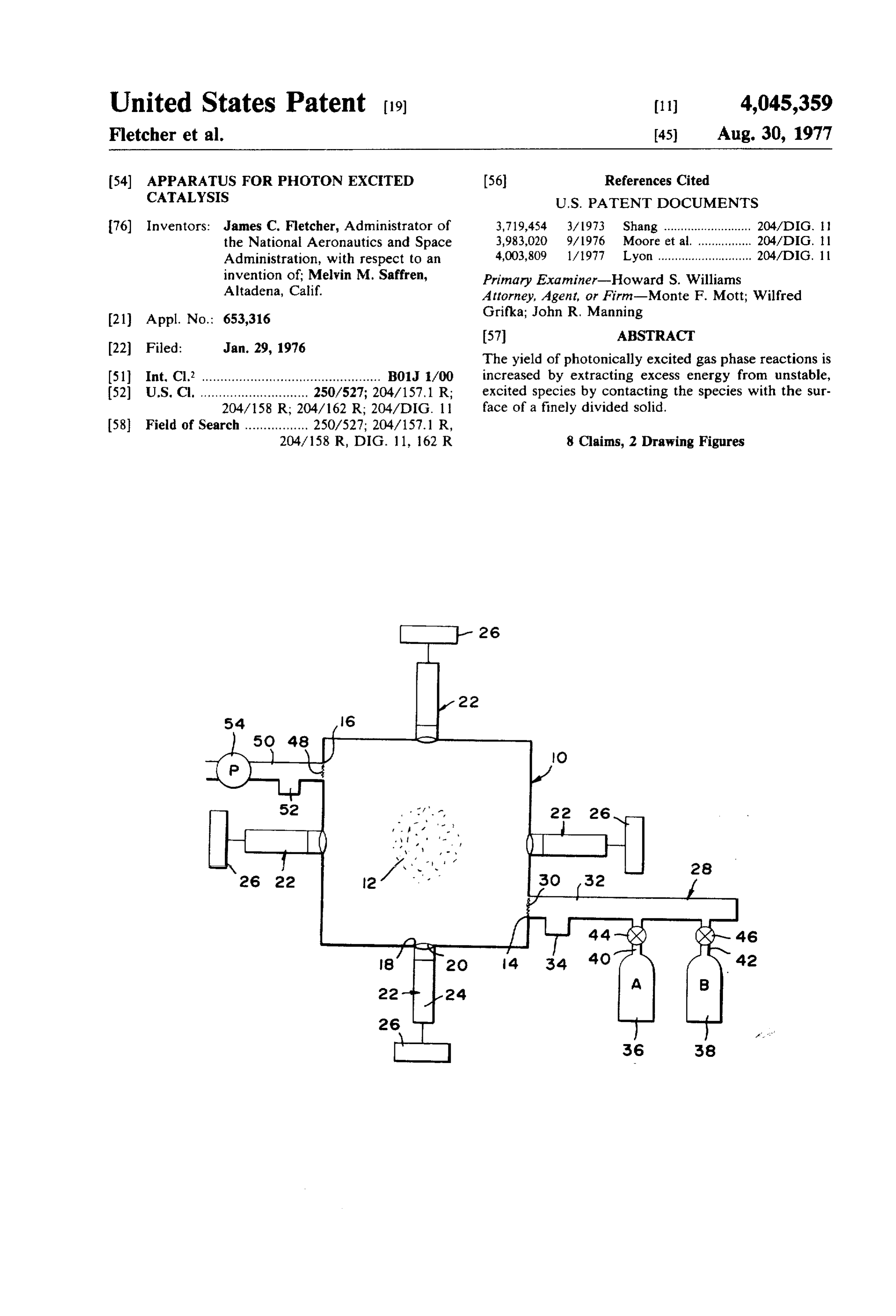
United States Patent (19) 11 4,045,359 Fletcher et al. 45) Aug. 30, 1977 54) APPARATUS FOR PHOTON EXCTED (56) References Cited CATALYSIS U.S. PATENT DOCUMENTS 76) Inventors: James C. Fletcher, Administrator of 3,719,454 3/1973 Shang .......................... 2O4/DIG. the National Aeronautics and Space 3,983,020 9/1976 Moore et al. ... ... 204ADIG. Administration, with respect to an 4,003,809 1/1977 Lyon ............................ 204/DIG. 11 invention of Melvin M. Saffren, Primary Examiner-Howard S. Williams
Altadena, Calif. Attorney, Agent, or Firm-Monte F. Mott; Wilfred (21) Appl. No.: 653,316 Grifka; John R. Manning
The yield of photonically excited gas phase reactions is (51) Int. Cl. ................................................ BOJ AOO increased by extracting excess energy from unstable, (52) U.S. C. ............................. 250/527; 204/157.1 R; excited species by contacting the species with the sur 204/158 R; 204/162 R; 204/DIG. 11 face of a finely divided solid.
(58) Field of Search ................. 250/527; 204/157. 1 R, 204/158 R, DIG. 11, 162 R 8 Clains, 2 Drawing Figures
Page 2
Drawing sheet — no readable text.
Page 3
ciate into the reactants or react with other molecules
APPARATUS FOR PHOTON EXCITED present in the reaction chamber to form undesired prod CATALYSIS ucts. In accordance with this invention the excess en ergy is absorbed from the unstable photonically excited
ORIGIN OF THE VENTION gas species by transferring the excess energy to a finely divided energy absorbing particle which absorbs the
The invention described herein was made in the per excited species. Dissociation is prevented by transfer of formance of work under a NASA contract and is sub the excess energy to the surface and the desired species ject to the provisions of Section 305 of the National is stabilied and can be further reacted if it is still in a Aeronautics and Space Art of 1958, Public Law 83-568 O desired vibrationally excited mode or recovered if it has (72 Stat. 435; 42 USC 2457). been converted to the ground state. BACKGROUND OF THE INVENTION The reaction can be conducted at temperatures and pressures much lower than those at which classical 1. Field of the Invention thermally-induced chemical reactions are practiced. In The present invention relates to heterogenous opti 5 fact, thermal reactions will only proceed at negligible cally initiated gas phase reactions conducted at least rate, if at all. Since the main function of the particle is to partially in the presence of a finely divided energy sink. act as an energy sink, the nature and condition of the 2. Description of the Prior Art surface is not critical and much lower cost materials There are many different methods of catalytically may be utilized as compared to conventional noble initiating chemical reactions. However, in most cases, 20 metal catalysts. Furthermore, poisoning of the surface is the efficiency is very low and there is little or no reac not a consideration since the gaseous product only oc tion selectivity among closely related reactants such as cupies the surface for a short time and is then recovered. isotopes. Thermally induced chemical reactions lead to Even if there is deposition, such as from lead in an the excitation of all degrees of freedom of the molecule, automobile exhaust converter, the coated surface would the translational, vibrational and rotational degrees of 25 still be capable of energy absorption and stabilization of freedom being generally in thermodynamic equilibrium. the excited species.
Thus, there is considerable energy lost non-produc These and many other features and advantages of the tively, and molecules excited at equilibrium are charac invention will be appreciated as the invention becomes terized by a potentiality to acquire activation energy to better understood by reference to the following detailed excite the bond or group with the lowest activation 30 description when considered in conjunction with the energy. accompanying drawings.
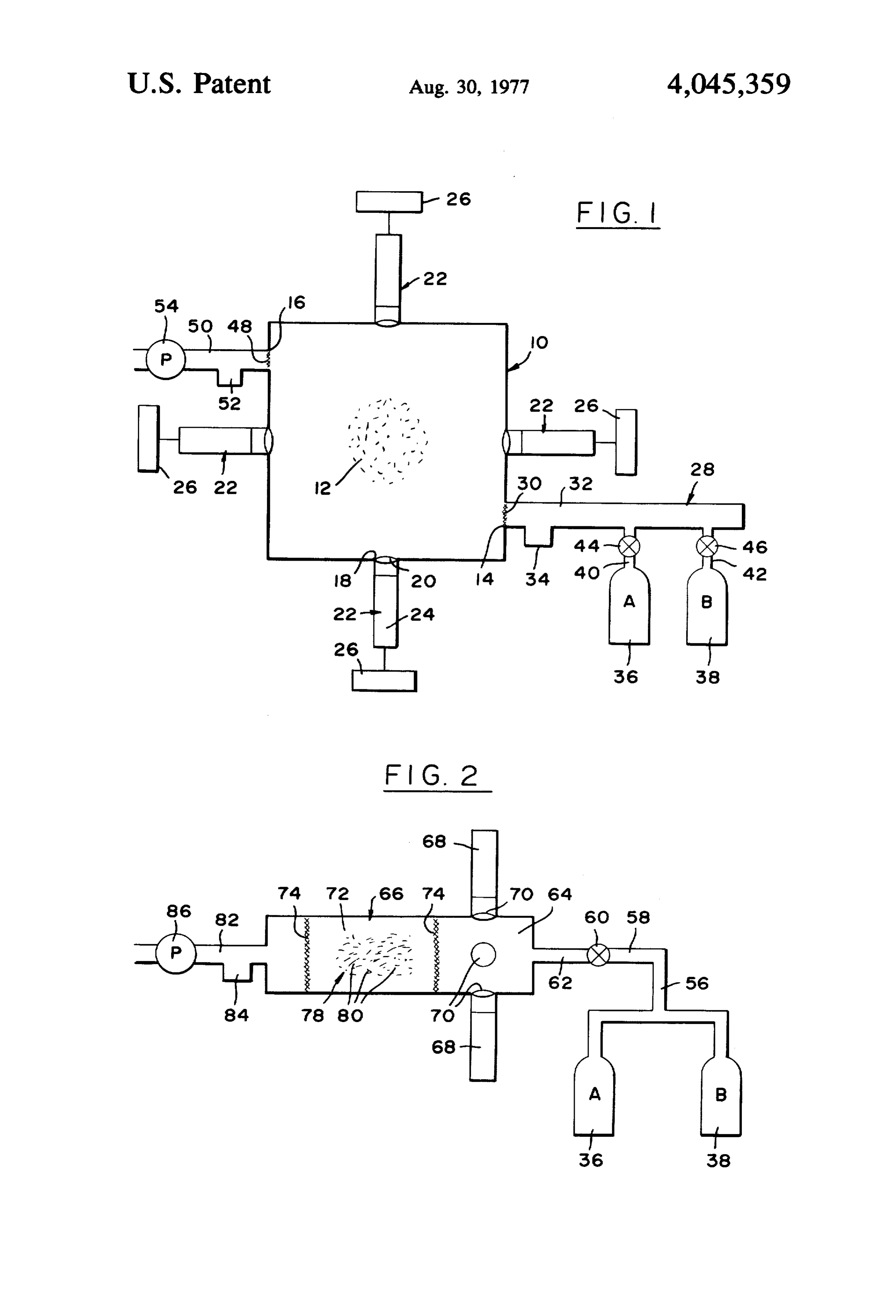
Recently, much progess has been made in photon BRIEF DESCRIPTION OF THE DRAWINGS induced catalysis due to the development of tuning, control and stabilization of laser radiation over a widen FIG. 1 is a schematic view of a first embodiment of a ing range of available wavelengths in the visible, un 35 reactor for practice of this invention; and traviolet and infrared regions of the spectrum. In pho FIG. 2 is a schematic view of a second embodiment of ton activated chemical reactions, the excitation can be a reactor according to this invention. selectively localized to individual bonds. Molecules initiated by laser radiation and having a vibration-mode DESCRIPTION OF THE PREFERRED temperature, for example, reaching tens of thousands of 40 EMBODIMENTS degrees can enter into controlled chemical reactions at Referring now to FIG. 1 a closed reactor 10 includes rates greatly exceeding the rates of the thermal vibra a bed 12 of finely divided particles, an inlet 14 and outlet tional-transational relaxation. Thus, laser initiated 16 and at least one aperture 18 in optical alignment with chemical reactions are characterized not only by selec the particle bed 12. A transparent window or lens 20 tivity but also by the discrete separation of the elec 45 may be provided in aperture 18 for focussing optical tronic, vibrational and translational temperatures. radiation on the bed 12.
Moreover, under controlled conditions, thermody A barrel 22 housing a light source such as a laser 24 is namic equilibrium can be perturbed and internal de connected to each aperture. The laser may be a discon grees of freedom can be selectively excited, the mole tinuous or continuous and may be fixed or variable cule entering the chemical reaction retains an excited 50 frequency. The laser is powered by a power source 26. mode that is resonantly excited by the frequency of the The inlet 14 is connected to a inlet assembly 28 in laser radiation. cluding a screen 30 inlet conduit 32 having a trap 34 for Another advantage of photon generated reactions is removing undesired liquids and solids from the reactant the absence of conventional catalysts which are both gases. A source of first gas A and a source of a second expensive and subject to fouling or poisoning requiring 55 gas B such as metered cylinders 36,38 are connected to shut down of the equipment for reactivation or replace the conduit 32 by means of branch tubes 40, 42 contain ment of the catalyst charge. Heterogenous reactions in ing valves 44, 46.
the gas phase over solid catalysts is involved in two The outlet 16 contains a screen 48 and is connected to critically important technologies; protection of the en outlet conduit 50 containing trap 52 for removing solids vironment by after treatment of stationary and non-sta 60 from the reaction product gases. A vacuum pump 54 tionary pollution emissions and synthetic fuels such as in may be connected to conduit 50. the coal gasification process. Gases A and B mix in conduit 34 by opening valves 44 SUMMARY OF THE INVENTION and 46. Solids and liquids are removed by trap 34 and screen 30. The A and B gas mixture enters the reactor
The present invention is concerned with increasing 65 10 through inlet 14 and suspends the particles to form the yeild of photonically initiated chemical reactions. the suspended bed 12.
Since the photonically excited reactants or products are One or both reactant gases absorb energy to form a in a highly excited, short-lived state, they tend to disso photonically excited species A* and/or B'. The excited
Page 4
gas mixture reacts to form an unstable excited reactant may be run in batch mode or in countercurrent continu C having excess energy. C" is stabilized by transient ous mode with a bed of fluidized particle continuously contact with the passive surface of a finely divided moving toward the gas inlet. Thus, yield or throughout particle 12 during which excess energy is transferred to would be increased as compared to conventional ther the surface. Highly excited C relaxes to a stable form mal catalytic processes by eliminating process interrup C, is swept through the outlet 16 and into outlet conduit tions required for replacing or regenerating the cata 50 for collection or further reaction. Similarly, an ex lytic surface.
cited species A* can dissociate to B" and C." and the For example the current, most widely utilized catalyst particle can absorb energy from B" and/or C" prevent in automobile catalytic exhaust reactors is platinum ing recombination to A. Thus, this scheme can be used 10 which is chosen because of its activity in reducing pol in photon enhanced dissociation. luting emissions. With photon-induced reactions, plati Ideally the excited reactant or reactants are absorbed num is not necessary, the reaction proceeding by pho on to the surface of the energy sink particle, react ton activation. The finely divided solid material is only thereon to form the highly exicted unstable product, the required in the present invention to absorb the reactants product is deexcited and leaves through the outlet as in 15 and also to serve as a sink of energy for the electroni FIG. 1 cally and vibrationally excited reaction products fol In FIG. 2 the reactants are photonically excited in a lowing photon excitation. As explained, the surface of zone preceding the particle bed. The gas cylinders 36, the finely divided solid would be less susceptible to 38 are connected to a manifold 56 which in turn is con poisoning. This could be important in the refining of nected to the inlet tube 58 containing a valve 60. The 20 gasoline from crude oil containing high levels of sulfur inlet 62 leads to a first photon pumping zone 64 of the containing compounds since sulfur is a common crack tubular reactor 66. A plurality of light source such as ing catalyst poison.
lasers 68 are sealingly mounted on the outside of aper The present process will also find use in control of tures 70 provided in the wall of reactor 66 within the gaseous industrial wastes and in coal gasification, shale first zone 64. 25 oil recovery and refining and related processes leading A second deexcitation zone 72 is formed by screens to production of gaseous or liquid fuels such a hydro 74, 76 enclosing a bed 78 of fine energy absorbing parti gen, hydrocarbons and alcohols.
cles 80. The outlet is connected to an outlet tube 82 containing a trap 84 and vacuum pump 86 as in FIG. 1. ized These heterogeneous reactions can best be character The light source is a high energy source, preferably a 30 the reactionby operation in an ultra-high vacuum system with highly monocromatic, collimated, high intensity source As examples products detected by mass spectrometry. such as a laser. The frequency of the laser is selected or tions are the oxidation of CO by photon of heterogeneous,
induced reac in the pres is tuned by filtering or tuning to the optimum frequency ence of finely divided Ir or Ag surfaces, which for inducing the desired reaction. Since there is a possi well characterized crystallographic orientations andhave the bility of loss of excitation energy due to thermalization 35 methanation reaction (Ha -- CO-CH) in the presence by collision with the particles a substantial excess of of finely divided Ru and Nisurfaces. Both reactions are energy is pumped into the reaction chamber. The inside conducted in an ultrahigh vacuum chemical reactor. walls of the chamber can be highly reflective to avoid The surface of the finely divided particle should not absorption of the light energy. The light source can also absorb be a broadband source such as lamps or solar radiation but doesanyabsorb significant energy from the excited reactant or extract sufficient energy from the tuned to a narrow frequency by a filter or a monochro unstable highly excited product to prevent the product nator.
The temperature and pressure within the reaction from dissociating or reverting to the reactant or to an chamber need not to be and preferably are below the undesired by-product. The energy extracted need not conditions at which classical, thermally induced chemi 45 convert the product to the ground state. The deexcited cal reactions occur. If such reactions do proceed, they product may be deenergized to an excited, stable state only preceed at a neglible rate. Thus, less costly materi and may be isolated as an intermediate and utilized in als may be utilized for reactor construction. further reactions. Alternatively, the particles covered The particles are selected to be inert to the reactant with the desired product may be utilized in reactions of and product gases and to be a non-absorber for the light 50 the product with further reactants as a step in a process, energy. The main role of the particle is to stabilize the or the product can be removed by placing the coated reaction product. The nature and condition of the sur particles in a solvent in which the product is soluble. face is not significant. If deexcited reaction product After solution or reaction the particles can be recycled remains on the surface for a period exceeding the rate of or discarded.
generation of excited product, it may be necessary to 55 It is to be realized that only preferred embodiments of replenish the bed, suitable by recycling the particles and the invention have been described and that numerous removing product from the surface, externally of the substitutions, alterations and modifications may be eactor. made without departing from the spirit and scope of the Poisoning of the surface with impurities or reaction invention as defined in the following claims. by-products as in classical heterogenous catalysis is not What is claimed is:
a significant consideration as long as the "poisoned' or 1. An apparatus for increasing the yield of photoni coated surface is still able to absorb excess energy from cally excited gas phase reactions comprising in combi the excited species. Furthermore, since the particles can nation:
be very inexpensive finely divided materials such as a closed gas phase reactor having a reaction chamber, silica, silicates, carbon, metals and the like, cost is not an 65 an inlet for flowing a gas reactant to the reaction important consideration if the particles are replaced chamber, an outlet for removing a stable gaseous when their energy absorption characteristics decrease reaction product from the reactor and at least one below a desired level. In the latter case, the reaction aperture;
Page 5
photon source means disposed outside said reactor 4. An apparatus according to claim 1 in which the including a laser having the output photon emitter reaction chamber includes an illumination portion and end connected to said aperture in optical alignment an energy sink portion.
with said chamber for directing excess light energy 5. An apparatus according to claim 1 in which the onto the inlet gas reactant for forming at least one photon source means includes means for adjusting the highly excited unstable gas species containing ex frequency of the source to a narrow band of wave lengths.
cess energy; and 6. An apparatus according to claim 1 in which the finely divided, solid, energy sink means disposed in energy sink means includes a bed offinely divided solid said reactor between the inlet and outlet for stabiliz 10 particles a first gas pervious screen for separating the ing said unstable, excited species by contacting and bed from the inlet and a second gas pervious screen for absorbing excess energy therefrom to form said separating the bed from the outlet.
stable gaseous reaction product. 7. An apparatus according to claim 1 further includ 2. An apparatus according to claim 1 further includ ing vacuum pump connected to said outlet. ing means for suspending the finely divided energy sink 15 8. An apparatus according to claim 1 in which the into a fluidized bed. reactor includes a plurality of apertures each having the 3. An apparatus according to claim 2 in which the photon emitter end of a laser connected thereto fo inlet further includes a mixing chamber for mixing a cussed onto the reaction chamber. s plurality of reactant gases.
Provenance
- Collection
- Cited prior art
- Original PDF
- patentimages.storage.googleapis.com →
- Filed
- 1976-01-29
- Pages
- 5
- Method
- pdftotext (the PDF's own text layer) + pdftoppm 300dpi page scans
- Source
- Google Patents bibliographic record
- Granted
- 1977-08-30
- Inventors
- with respect to an invention of Fletcher James C. Administrator of the National Aeronautics and Space Administration; Melvin M. Saffren
- Transcribed from
- patentimages.storage.googleapis.com →