(953)
Stationary Voltage Fields
Also written negative charged voltage plate · pulse-voltage wave-form · negative voltage field · Voltage intensity
Where it is first named
... whichever the case may be, the applied stationary voltage fields (952/E13 – 953/E14) or (954/E15 – 956/E16) alternately switch over periodically superimposes electrical stress forces (S-S' and R - R') onto the energy spectrum of the water molecule atom (s )(210) while physical flexing (951) of Figure (11-5) of the water molecule atom (s) occurs
How it is written
- (952/953) 2× with (952) Stationary Voltage Fields
- (953) 2×
- (952 953) 1× with (952) Stationary Voltage Fields
- (952/E13 – 953/E14) 1× with (952) Stationary Voltage Fields, (E13) Stationary Positive Voltage Plate, (E14) Stationary Voltage Fields
- (E14/953) 1× with (E14) Stationary Voltage Fields
Drawings 5
-
dual unipolar voltage pulse circuit (1010) of Figure (11-1) · Voltage Flexing Process
-
(1030) of figure (11-3) · Voltage Flexing Process
-
(990) of Figure (10-3) · Propagating Electrical Stress
-
Figure (10-3) · Voltage to Amp Differential Ratio
-
voltage intensifier circuit (990) of Figure (10-3) · VIC Switchover Circuit
Where it is named · 7
Voltage Flexing Process 2×
-
stationary voltage fields (952/E13 – 953/E14)
... whichever the case may be, the applied stationary voltage fields (952/E13 – 953/E14) or (954/E15 – 956/E16) alternately switch over periodically superimposes electrical stress forces (S-S' and R - R') onto the energy spectrum of the water molecule atom (s )(210) while physical flexing (951) of Figure (11-5) of the water molecule atom (s) occurs
-
pulse-voltage wave-form (952 953)
... emitting the additive/surplus energy away from the excited atom (s) in the form of radiant thermal heat energy (165) when the flexed atom (s) (undergoing physical/electrical stress) returns to stable state of atomic equilibrium once applied electrical pulse-voltage wave-form (952 953) or (954 - 956) is electrically switch off and permitted to collapse back toward electrical ground state of zero volts (0V).
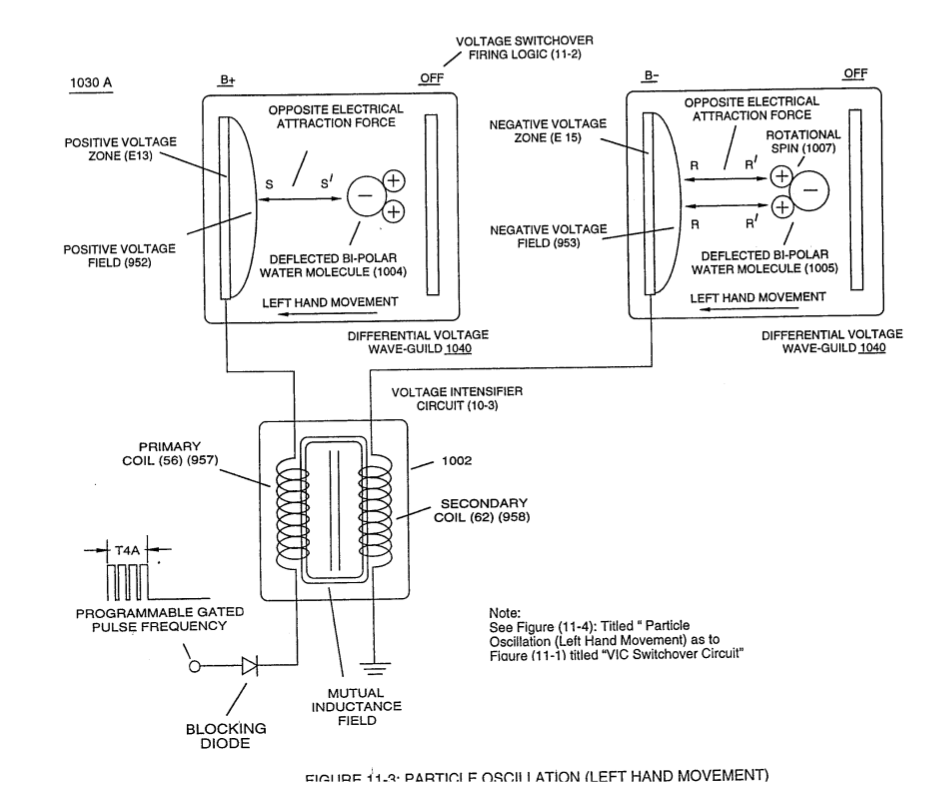
VIC Switchover Circuit 5×
-
negative charged voltage plate (953)
… and displaces another and totally separate bipolar water molecule in an linear movement since opposite electrical attraction force (R-R') also exists between stationary negative charged voltage plate (953) and the, now, moving positive charged hydrogen atom (s) being electrovalently linked to the negative charged atom.
-
stationary voltage fields (952/953)
… relatively at the same displacement velocity since both particle masses of the water molecule (s) are basically identical in volume-size and the electrical intensity on both stationary voltage fields (952/953) are similar due to the fact that both primary coil (957) and secondary coil (958) comprising and forming voltage intensifier circuit (990) of Figure (10-3) are together bifilar wrapped in equal lengt …
-
negative voltage field (953)
The simultaneous formation of both the positive voltage field (952) and the negative voltage field (953) is simply accomplished by the mutual electromagnetic inductance coupling field that is produced between the two bifilar wrapped coils (957/56 - 958/62) when the primary coil (957/56) is electrically energized by incoming voltage pulse train (T4a xxx T4n), as so illustrated in (970) of Figure (10-1).
-
Voltage intensity (952/953)
Voltage intensity (952/953) is, therefore, directly determined by the number of turns of each coil (957/958) as to the applied voltage amplitude of incoming pulse-wave ( ... xxx Vn) (1060) of Figure (11-2c).
-
Pairing together positive voltage zone (E13/952) with negative voltage zone (E16/956) and doing the same with voltage-surfaces (E14/953) to (E15/954) as so graphically shown in (1O1O) of Figure (11-1) and each having an longitudinal axis of identical length, now, individually forms what is called hereinafter a "Differential Voltage Wave-guide" (1040)