patent · US6238931
Fluorescence energy transfer in particles
29 May 2001
Page 1 — bibliographic record
(12) United States Patent (10) Patent No.: US 6,238,931 B1 Buechler et al. (45) Date of Patent: *May 29, 2001
(54) FLUORESCENCE ENERGY TRANSFER IN (58) Field of Search .................................. 435/6, 7.1, 7.5, PARTICLES 435/7.92; 436/518, 528, 529, 520, 531,
(75) Inventors: Kenneth F. Buechler, San Diego; 428/402.24, 407; 252/301.34, 301.35; 530/389.2, Joseph Barry Noar, Solana Beach; 818, 391.3, 811, 815, 812, 402 Lema Tadesse, San Diego, all of CA
(US) (56) References Cited (73) Assignee: Biosite Diagnostics, Inc., San Diego, FOREIGN PATENT DOCUMENTS CA (US) 0285965 10/1988 (EP).
c: 0597389 11/1993 (EP). (*) Notice: This patent issued on a continued pros- 9118007 11/1991 (WO). ecution application filed under 37 CFR 93.19366 9/1993 (WO).
1.53(d), and is subject to the twenty year 9508772 3/1995 (WO).
patent term provisions of 35 U.S.C.
154(a)(2). OTHER PUBLICATIONS
Subiect to anv disclaimer, the term of this Hemmilä, Clin. Chem. 31/3359-370 (1985) “Fluoro immu
patent is extended s or adjusted under 35 noassays and Immunofluorometric ASSays”.
U.S.C. 154(b) by 0 days. * cited by examiner (21) Appl. No.: 08/274,534 Primary Examiner Mary E. Ceperley (74) Attorney, Agent, or Firm-Foley & Lardner
Related U.S. Application Data Particles and methods for the detection or visualization of (63) Continuation-in-part of application No. 08/138,708, filed on analytes using fluorescence energy transfer. Particles com Oct. 18, 1993, now abandoned, and a continuation-in-part of prising an energy donor as a first component and a fluores application No. 08/126,367, filed on Sep. 24, 1993, now cent dye as a Second component positioned in Said particles abandoned. at an energy exchanging distance from one another, wherein (51) Int. Cl." ...................... G01N 33/533; G01N 33/546; the two components have a Stokes shift of greater than or G01N 33/552; CO7K 17/08 equal to 50 nm, Said particle having bound on its Surface, a (52) U.S. Cl. .............................. 436/546; 435/6, 436/525; protein, polypeptide, nucleic acid, nucleotide or protein 436/527; 436/528; 436/531; 436/534; 530/389.2; containing ligand analogue are disclosed and claimed.
530/818; 530/402 57 Claims, 7 Drawing Sheets
Page 2
Drawing sheet — no readable text.
Page 3
Drawing sheet — no readable text.
Page 4
Drawing sheet — no readable text.
Page 5
Drawing sheet — no readable text.
Page 6
Drawing sheet — no readable text.
Page 7
Drawing sheet — no readable text.
Page 8
Drawing sheet — no readable text.
Page 9
FLUORESCIENCE ENERGY TRANSFER IN diagnostics will become more portable and Simpler to use. PARTICLES Therefore, there is a need for portable, Simple fluorometers which can assess fluorescence in an immunoassay for the
This application is a continuation in part of application detection of analytes in biological Samples. Ser. No. 08/138,708 filed Oct. 18, 1993, now abandoned, Another problem associated with the assay of analytes in and of application Ser. No. 08/126,367 filed Sep. 24, 1993, fluids or the Visualization of cellular components with an now abandoned from which priority is claimed. intrinsic fluorescence is that of Selection of the dye which is
FIELD OF THE INVENTION
utilized as the label. The dye is generally chosen for its brightness (the product of fluorescence quantum yield and
This invention relates generally to labels and methods for extinction coefficient) since a certain Sensitivity in the assay the detection or visualization of analytes and more specifi or the Visualization technique is required. However, the cally to fluorescent lateX particles which incorporate fluo selection of the dye used as the label is limited when the rescence energy transfer for the detection of analytes in Sample has an intrinsic fluorescence because the instrument immunoassayS. may not be capable of distinguishing Sample fluorescence 15 from dye fluorescence.
BACKGROUND The current invention provides a methodology for the Various methodologies are available for the Visualization can be tunedoftoamplified development
Specific fluorescent label systems which excitation and emission wave of cells or molecules in cells and for the measurement of lengths. In addition, the methodology analyte concentrations in fluids. Fluorescence microscopy methods for incorporation of dyes into particles teaches improved utilizes fluorescent dyes, generally connected to Specific fluorescence quenching and to maximize fluorescence to minimize probes, Such as antibodies, for the localization of proteins sities of the dye molecules in the particles. The novelinten and complexes in cells. For the measurement of analyte Systems can be utilized for the quantitation of analytesdye in concentrations, immunoassays have become popular over fluids, and in particular, in biological fluids. The novel dye the last 40 years because of the specificity of antibodies 25 Systems can be tuned to Specific exciting and emitting toward the analyte or target ligand. Radioimmunoassays were developed because the high Specific activity of the wavelengths. So that low current Sources, Such as light radionuclide allowed measurement of Very low concentra photo diodes, andand emitting diodes the laser diodes, and detectors, Such as like, can be used in the manufacture tions of analyte. However, because of the concerns for the of fluorometers which can be battery powered and portable, environment and human health, the use of radionuclides in for use, for example, in immunoassays dedicated to near immunoassays is becoming less popular. The use of patient diagnostics.
enzymes in immunoassays to amplify a Signal has been a very important advance in the field of immunoassays SUMMARY OF THE INVENTION because their use does not involve environmental or human health hazards or risks. Enzyme-linked immunoassays, 35 This invention relates to novel particles which exhibit however, can be problematic because the activity of the fluorescence energy transfer (singlet-singlet energy enzyme is temperature dependent and the instability of the transfer). These novel particles can be tuned to specific enzyme or the Substrates can result in inaccurate quantitation excitation and emission wavelengths to accommodate a of the target ligand. Still other immunoassays monitor wide variety of assay or visualization Systems. In yet another fluorescence as the Signal, with or without enzymes, for the 40 aspect of the invention, the methodology teaches improved measurement of analyte concentrations. methods for incorporation of dyes into particles to minimize The characteristics of the fluorescent dyes are very impor fluorescence quenching and to maximize fluorescence inten tant when quantifying analyte concentrations in biological Sities of the dye molecules in the particles through the use of fluids. For example, when the biological fluid is blood, different dye molecules which possess the same or very Serum or plasma, the intrinsic fluorescence of the fluid 45 Similar excitation and emission wavelengths. precludes the use of many dyes. These biological fluids In a first aspect, the invention concerns particles that generally have fluorescence emissions up to 600 nm when comprise an energy donor as a first component and an exciting at various wavelengths above 200 nm. The fluo energy acceptor as a Second component positioned in a rescent Signal is measured by a fluorometer which is tuned particle at an energy exchanging distance from one another, to excite the fluorescent molecule at a specific wavelength 50 the two components having a Stokes shift of greater than or and to measure the emission of fluorescence at another equal to 50 nm, and the particle having bound on its Surface, wavelength. The difference in the excitation and emission a protein, polypeptide, nucleic acid, nucleotide or protein wavelengths is referred to as the Stokes shift. To achieve the containing ligand analogue. In certain embodiments, the most Sensitive measurement, the emission wavelength of the particles also comprise at least one additional fluorescent sample should not interfere with the emission of the dye. 55 dye as a third component that exhibits in the particle Also, the Stokes shift should be as large as possible So that approximately the same excitation and emission wave the excitation light is not seen by the detector as noise. lengths as the Second component. In preferred embodiments, Where the Stokes shift is not large, filters or monochroma the particles are lateX particles.
tors can be utilized in the fluorometer to exclude light near In another aspect, the invention features particles com the emission wavelength; however, the use of filters 60 prising an energy donor as a first component and a fluores decreases the yield of light reaching the detector and gen cent dye as a Second component positioned in a particle at erally one circumvents this problem of light loSS by the use an energy exchanging distance from one another, the two of high intensity lamps. Thus, to avoid problems associated components having a Stokes shift of greater than or equal to with small Stokes shifts and dyes which emit near the 50 nm, and either the first or Second components being intrinsic emission of the biological fluid, a Sophisticated 65 phthalocyanine or naphthalocyanine. In certain instrument is generally built. With the advent of near-patient embodiments, the particles also comprise at least one addi diagnostics in hospitals, instruments which are used for the tional fluorescent dye as a third component that exhibits in
Page 10
the particle approximately the same excitation and emission triethilylammoniumpropyl)-4-(4-(p-dibutylaminophenyl) wavelengths as the Second component. In preferred butadienyl)pyridine, a salt of 1,1,3,3,3',3'-hexamethyl-4,4'- embodiments, the particles are lateX particles. 5,5'-dibenzo-2,2' indotricarbocyanine, or chlorophyll, and In particularly preferred embodiments, the first compo the Second component being Silicon 2,3-napthalocyanine nent is phthalocyanine and the Second component is naph bis(dimethylvinylsilyloxide). In certain embodiments, the thalocyanine; the first component is Styryl and the Second particles also comprise at least one additional fluorescent component is phthalocyanine; the first component is Styryl dye as a third component that exhibits in the particle and the Second component is naphthalocyanine; the first approximately the same excitation and emission wave component is phenylbutadienyl and the Second component lengths as the Second component. In preferred embodiments, is phthalocyanine; the first component is phenylbutadienyl the particles are lateX particles.
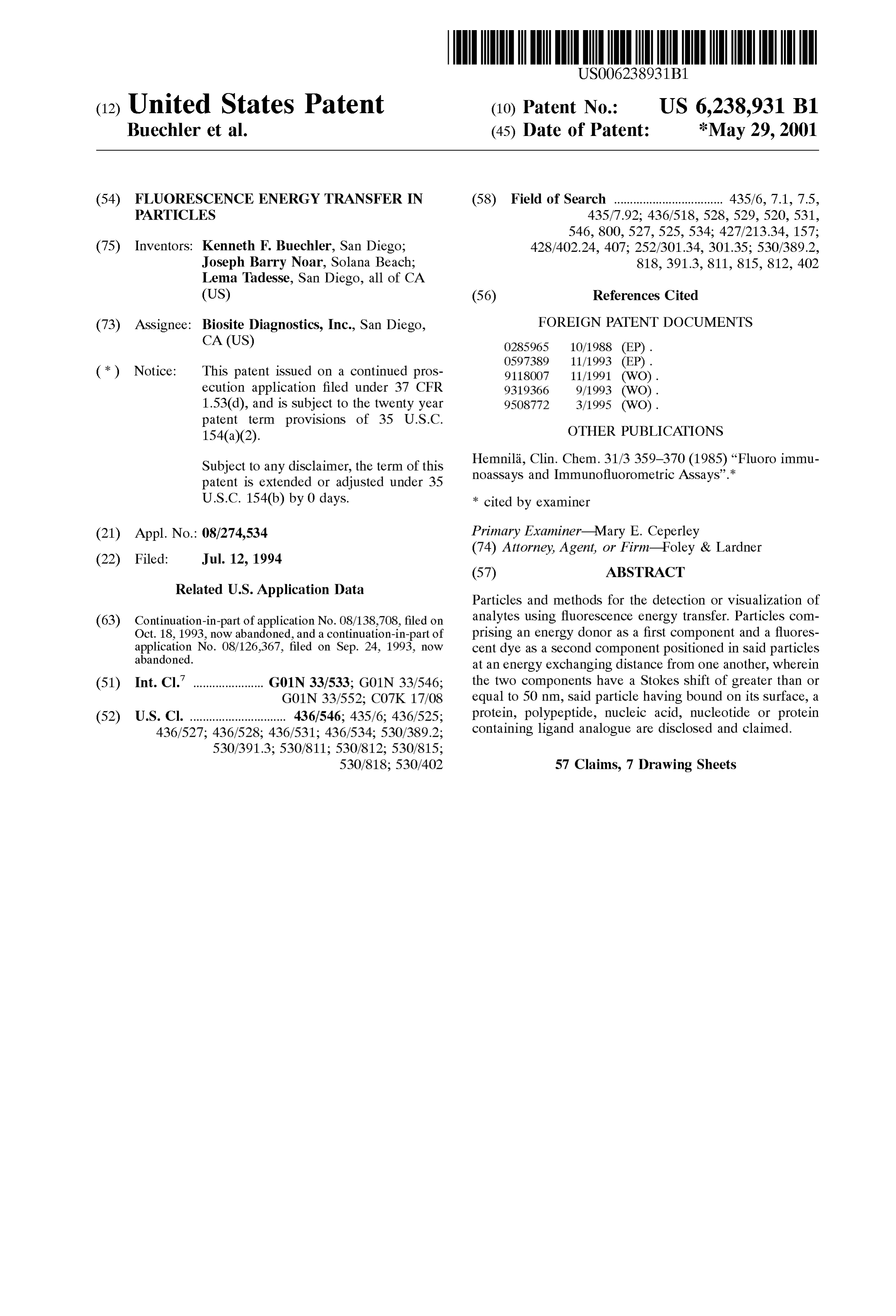
and the Second component is naphthalocyanine; the first In yet other preferred embodiments, the invention con component is phenylhexatrienyl and the Second component cerns is phthalocyanine; the first component is phenylhexatrienyl ponentparticles comprising an energy donor as a first com and the Second component is naphthalocyanine; the first tioned in a particle at an dye and a fluorescent as a Second component posi component is porphine and the Second component is phtha 15 one another, the two componentsexchanging energy distance from locyanine; the first component is porphine and the Second greater than or equal to 50 nm, the first componentshift having a Stokes of being component is naphthalocyanine; the first component is a fluorescein or chlorophyll, and the Second component being carbocyanine dye and the Second component is phthalocya silicon phthalocyanine bis(dimethylvinylsilyloxide). In cer nine; and the first component is a carbocyanine dye and the tain embodiments, the particles also comprise at least one Second component is naphthalocyanine. additional fluorescent dye as a third component that exhibits In other preferred embodiments, the invention relates to in particles comprising an energy donor as a first component Sionthewavelengths particle approximately the same excitation and emis as the Second component. In preferred and a fluorescent dye as a Second component positioned in embodiments, the particles are lateX particles. a particle at an energy exchanging distance from one another, the two components having a Stokes shift of greater 25 DESCRIPTION OF THE DRAWING than or equal to 50 nm, the first component being a Salt of trans-4-4-(dibutylamino) Styryl-1-methyl pyridine, and the FIG. 1 depicts the structures of Phthalocyanine and naph Second component being Silicon phthalocyanine bis thalocyanine.
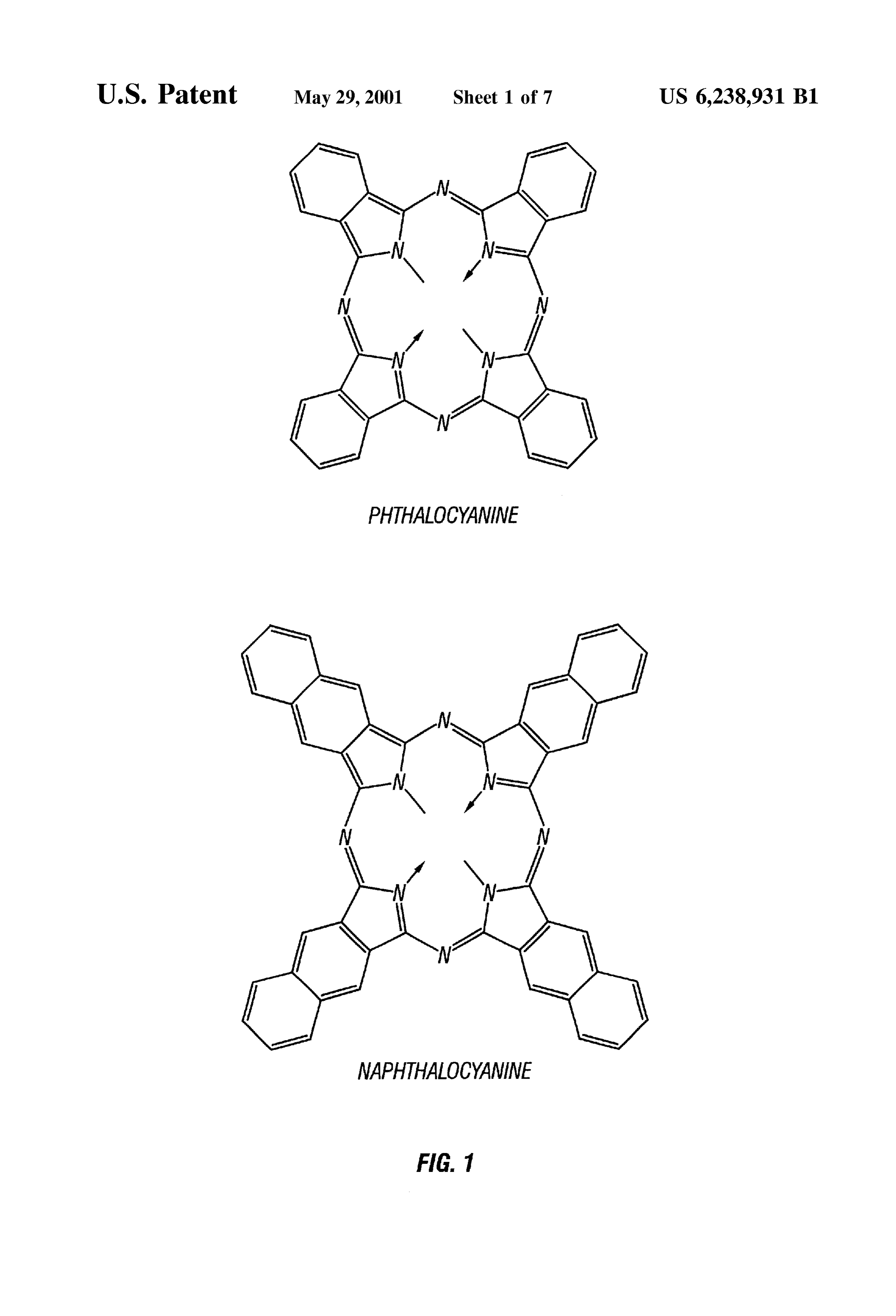
(dimethylvinylsilyloxide), Silicon 2,3-napthalocyanine bis FIG. 2 depicts the structures of Silicon phthalocyanine (dimethylvinylsilyloxide), or a salt of 1,1-dihexyl 3,3,3,3,- and Silicon Naphthalocyanine.
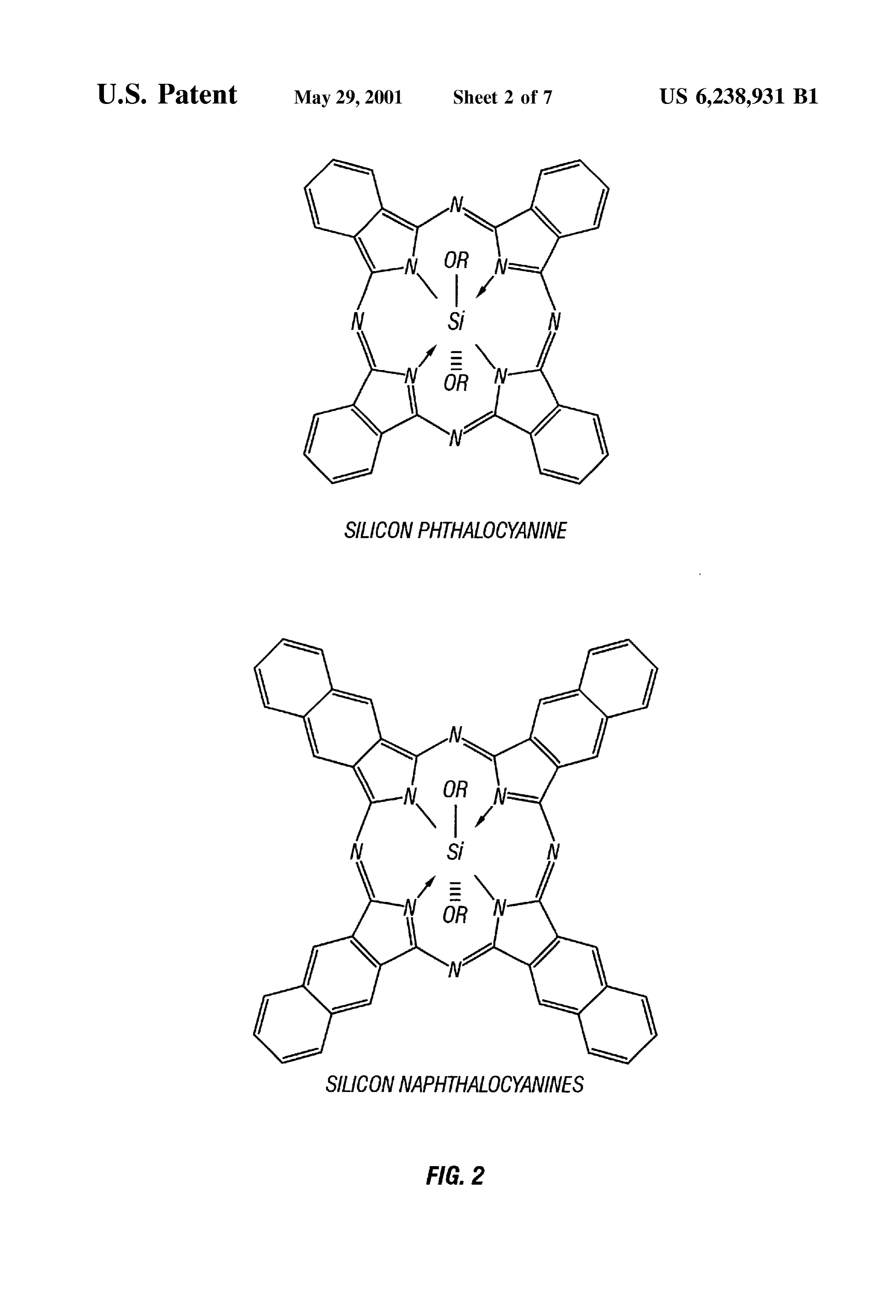
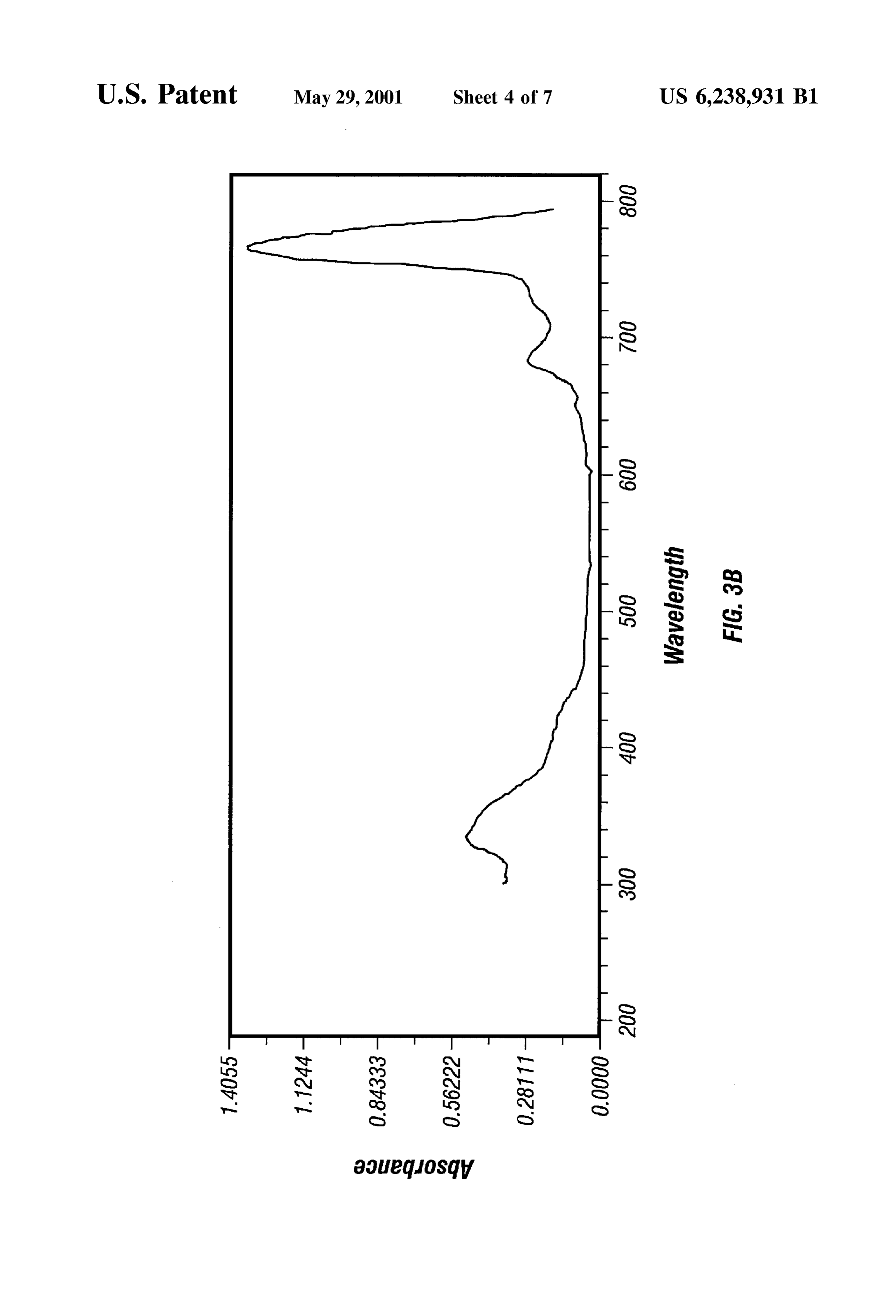
tetramethylindodicarbocyanine. In certain embodiments, the FIG. 3 depicts the spectra of Silicon Phthalocyanine particles also comprise at least one additional fluorescent dihydroxide and the spectra of Silicon 2.3 Naphthalocyanine dye as a third component that exhibits in the particle dihydroxide.
approximately the same excitation and emission wave FIG. 4 depicts the general structure of ethenyl-substituted lengths as the Second component. In preferred embodiments, 35 dipyrrometheneboron difluoro dyes. the particles are lateX particles.
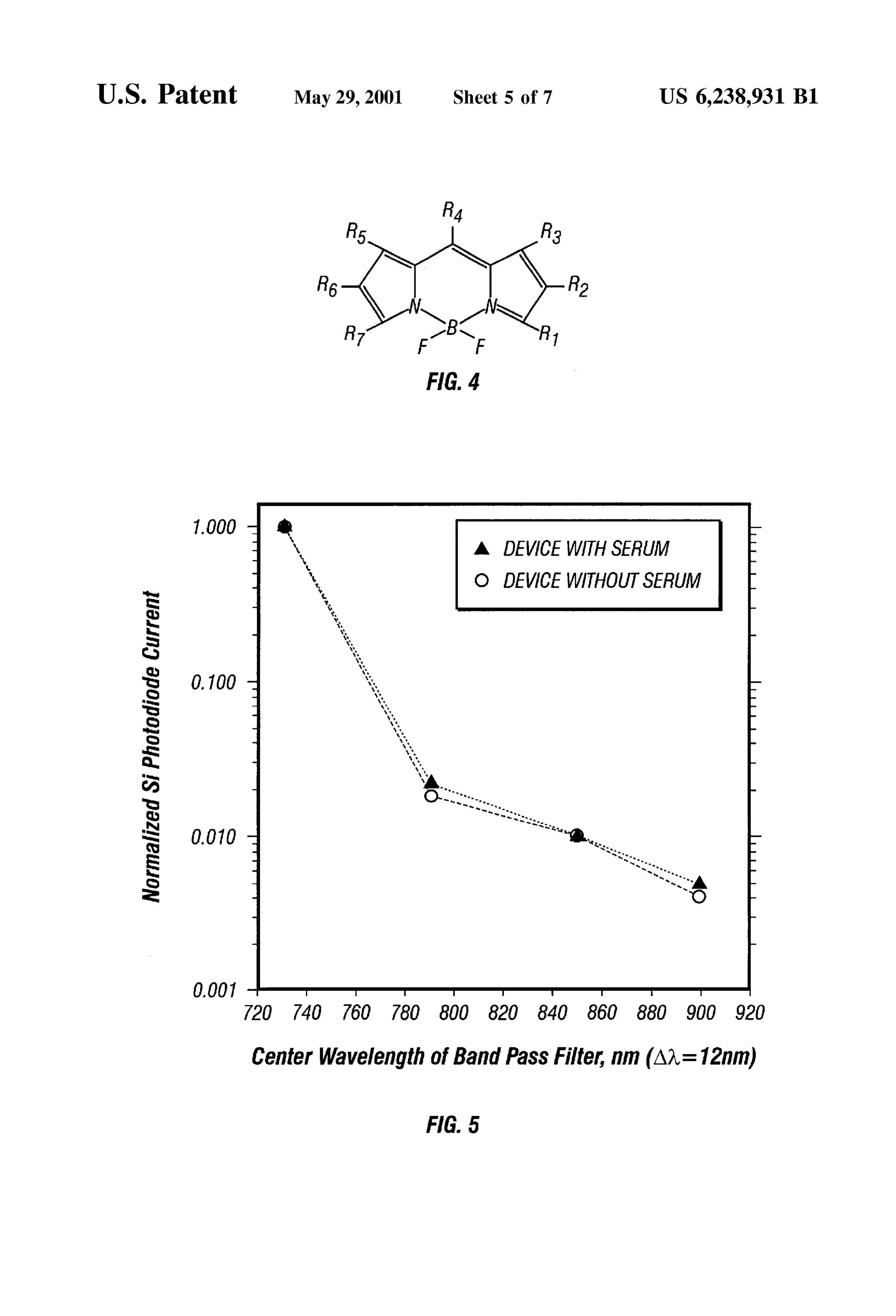
FIG. 5 depicts the attenuation of the background Signal as
In further preferred embodiments, the invention features a function particles comprising an energy donor as a first component using of increasing wavelength. The data was measured and a fluorescent dye as a Second component positioned in 07/887,526 filedas May a device described in Applicant's allowed Ser. No.
a particle at an energy exchanging distance from one 40 852, entitled “Diagnostic another, the two components having a Stokes shift of greater Controlled Movements of Devices Reagents and Apparatus for the
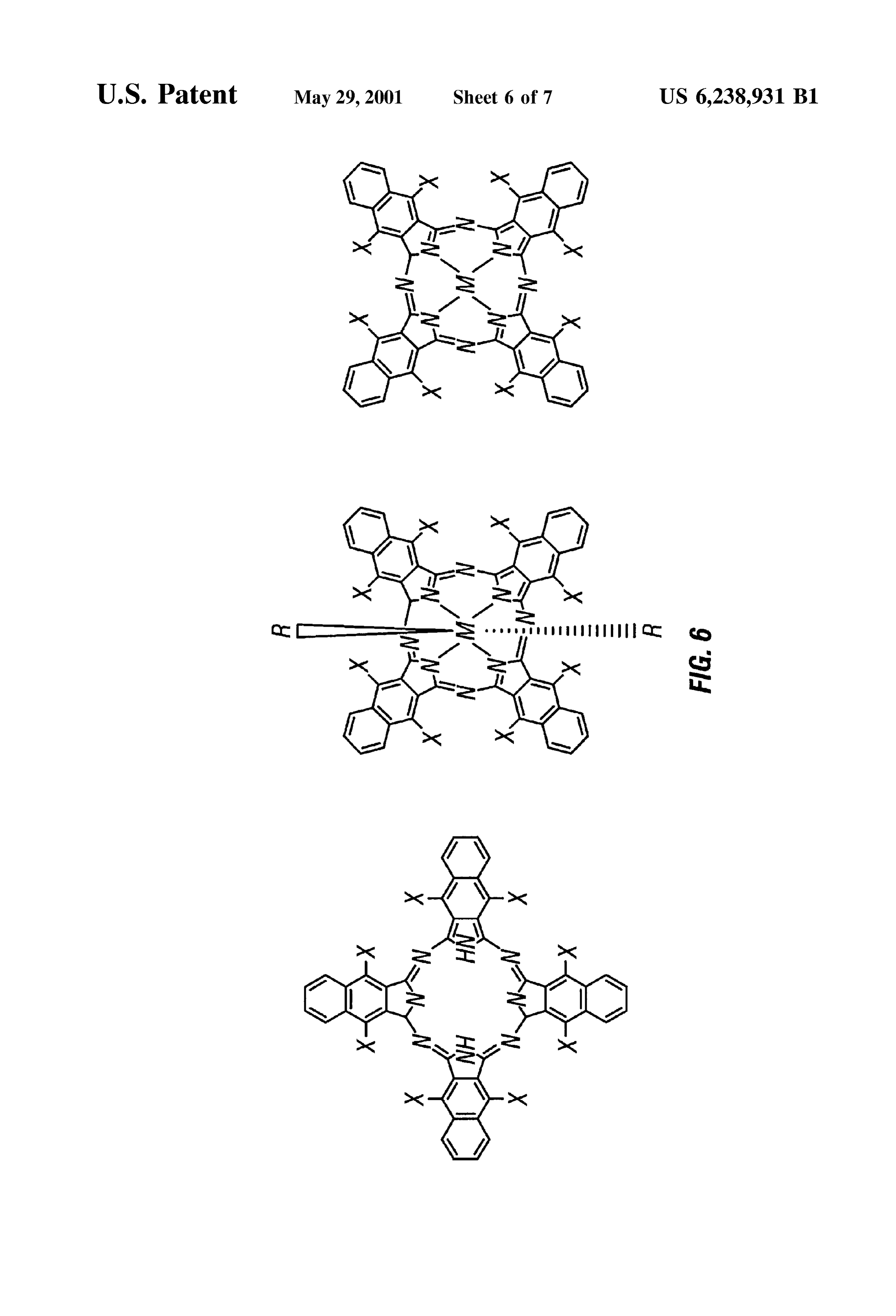
Without Membranes,” than or equal to 50 nm, the first component being meso which is hereby fully incorporated herein. tetra-2-amninophenyl porphine, and the Second component being silicon phthalocyanine bis(dimethylvinylsilyloxide), a in FIG. 6 depicts naphthalocyanine derivatives which emit salt of 1,1-dihexyl3,3,3,3'-tetramethylindodicarbocyanine, 45 the near infrared.
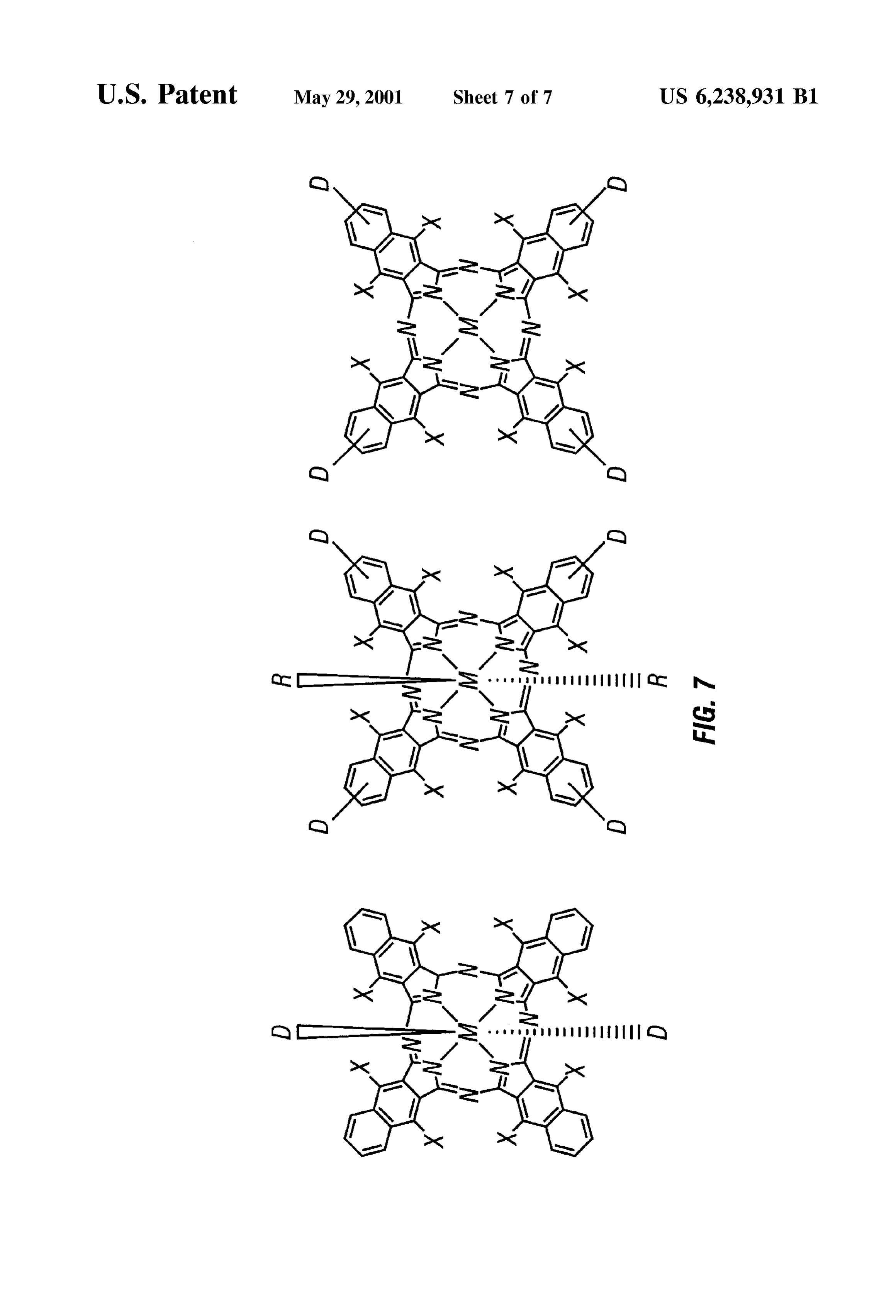
or silicon phthalocyanine bis(dimethylvinylsilyloxide). In FIG. 7 depicts general Structures of fluorescent energy certain embodiments, the particles also comprise at least one transfer naphthalocyanine compounds. additional fluorescent dye as a third component that exhibits DETAILED DESCRIPTION in the particle approximately the same excitation and emis
Sion wavelengths as the Second component. In preferred 50 This invention describes novel particles which exhibit embodiments, the particles are lateX particles. fluorescence energy transfer and diagnostic methods for In other preferred embodiments, the invention relates to their use. Developing a method which utilizes a fluorescent particles comprising an energy donor as a first component dye for the Visualization of a cellular component or a cell or and a fluorescent dye as a Second component positioned in for an assay which quantifies an analyte in a Sample requires a particle at an energy exchanging distance from one 55 the use of a fluorometer. The fluorescent label, the sample another, the two components having a Stokes shift of greater and the instrument must be compatible with each other to than or equal to 50 nm, the first component being a Salt of achieve an accurate measurement. Several criteria for a 3-ethyl-3'-ethyl carboxyethyl thiacarbocyanine, a salt of fluorescent label as it relates to the Sample and instrument 1,1'-dioctadecyl-3,3,3',3'-tetramethlyindodicarbocyanine, a are described below. First, the absorption and emission salt of 1,1'-diethyl-3,3,3,3'-tetramethylindodicarbocyanine, 60 wavelengths of the dye should not correspond to those of the Salt of 1, 1'-dih exyl-3,3,3,3'- Specimen or Sample. Second, the Stokes shift of the dye tetramethlyindodicarbocyanine, a salt of 3,3-diethyl should be as large as possible to minimize the measurement thiatricarbo cyanine, a Salt of 3,3-dipropyl of noise from the excitation wavelength. Third, the dye must thiatricarbocyanine, a Salt of 1,9-dimethylmethylene blue, a be compatible with the phase of the visualization or the fluid salt of N,N-di(3-trimethylammonium propyl)thia 65 phase of the assay; that is, the dye must be water Soluble or dicarbo cyanine, a salt of 1,1,3,3 .3',3'- water insoluble depending on the Visualization or assay hexamethylindotricarbocyanine, a salt of N-(3- format. Fourth, the dye should be as bright as is necessary
Page 11
S 6 to achieve the desired Sensitivity. Brightness is the product ment by using heat SinkS or fans. The complexity of the of the extinction coefficient and the quantum yield of the fluorescence measuring device, both from an optical and a dye. Fifth, the instrument used to detect the fluorescent mechanical perspective, is thus greatly affected by the Signal is generally designed around the Specifications of the inadequacies of the dye system. With the advent of near dye and the Specimen or Sample being visualized or assayed. patient testing in hospitals and emergency rooms, instru These points will be discussed in more detail and illustrate ments which measure fluorescence in immunoassays will be Some of the difficulties in developing a fluorescent visual required to be portable and uncomplicated. Thus, the future ization technique or an assay using fluorescent dyes. One is State of the art for the manufacture of, for example, fluo limited either to dyes which have been synthesized or ones rometers which are employed for immunoassays will be which must be synthesized in order to meet the above required to change to Simple and portable instruments. The criteria. Those skilled in the art will appreciate that the high powered light Sources and expensive optics currently design and Synthesis of dye molecules which have a very incorporated into fluorometers will not meet the require broad range of excitation and emission wavelengths is very ments for Small, portable instruments. The inventive features tedious and generally, only a very limited range of excitation of the current application teach that fluorescent labels can be and emission wavelengths can be planned for a specific 15 prepared with large Stokes shifts and be tuned to wave molecule. The teachings of this invention allow one to lengths which are compatible with any excitation Source and prepare fluorescent labels which can be tuned to any exci emission detector. The excitation and emission wavelengths tation and emission wavelengths allowing for large Stokes of the novel fluorescent particles can be varied indepen shifts. Thus, designing a dye system with the Specifications dently of each other.
of the Sample or Specimen and the instrument is possible The dye must be compatible with the fluid phase of the rather than designing the instrument around the Specifica assay, or in other words, the dye must be water Soluble or tions of the dye. Tuning the dye system to accommodate the water insoluble depending on the Visualization or assay characteristics of the Sample and the instrument results in a format. Many fluorescent dyes are water insoluble or poorly much greater chance of Success of the Visualization proceSS water Soluble and these dyes are not easily used for labelling or the assay and greatly lowerS risk. 25 molecules, proteins or cells. One skilled in the art will The absorption and emission wavelengths of the dye recognize that water insoluble dyes can be incorporated into should not correspond to those of the Sample being assayed latex particles as described in U.S. Pat. Nos. 4,326,008, or visualized, otherwise the Sample can interfere with the 4,609,689 and 5,154,887, which are hereby incorporated by measurement of the fluorescent signal. When absorption or reference. Thus, water insoluble dyes can be made useful by emission wavelengths of the Sample do correspond to those incorporation into lateX particles for Visualization in a vari of the dye, in practice, one dilutes, for example, a Serum or ety of assay formats.
blood Sample So that the interference by the Sample is The dye should be as bright as is necessary to achieve the reduced or the interfering Sample is washed away from the desired sensitivity. If one knows the extinction coefficient detection area. Indeed, currently on the market, no fluores and the quantum yield of the dye and the concentration of cent assay System exists for the measurement of analytes in 35 the target to be measured, it can be estimated whether the neat biological fluids, particularly blood or Serum. One dye is bright enough to achieve the desired Sensitivity. reason for the lack of assay Systems which measure in neat Incorporation of dyes into lateX particles or the utilization of Samples is that no good fluorescent dye exists which meets an enzyme which catalyzes the production of a fluorescent all the criteria listed above, particularly for measuring fluo Substrate are examples of techniques which one skilled in rescence in biological Samples. When the Sample absorbs at 40 the art uses as amplification Systems. the excitation wavelength the amount of light which excites The instrument used to detect the fluorescent signal is the Sample is thus affected by the variation in the Sample generally designed around the Specifications of the dye and characteristics. For example, Serum, plasma, or blood from the Specimen or Sample being visualized or assayed because different individuals will be different in their relative of the limited numbers of dyes which can be successfully absorbtivities, which will translate into different amounts of 45 used. AS discussed above, the components of the instrument excitation light used to excite the fluorescent label. A pre are Selected for a particular dye system Since a Successful ferred excitation wavelength for biological fluids, including instrument must be highly tuned to eliminate background urine, blood, Serum or plasma is 600 nm or greater. Particu noise from the excitation Source.
larly preferred excitation wavelengths are those which cor Each of the conditions described above, taken together, respond to maximum light output of laser diodes and light 50 greatly narrows the development of dye Systems which can emitting diodes. This point will be further discussed as it be employed for measuring Sub-picomolar concentrations of relates to the inventive teachings of this application. analytes, particularly in biological fluids. The limitations The Stokes shift of the dye should be as large as possible also impose restrictions on the design of an instrument to to minimize the measurement of noise from the excitation measure the fluorescence. The novel teachings of this appli Source So that the Signal-to-noise ratio at the limit of 55 cation allow the design and tuning of dye systems to match sensitivity is maximized. The availability of dyes with any instrument design. The concept is to either incorporate Stokes shifts greater than 100 nm is greatly limited. To or adsorb at least two dyes into or onto particles, which, as further limit the usefulness of available dyes, the solubility a pair, exhibit fluorescence energy transfer. The particles of the dyes in aqueous Samples can be a problem because which can be used are those which absorb dyes on the most dyes with large Stokes shifts are water insoluble. The 60 Surface or inside the particle or those which have dyes problem of a dye possessing a Small Stokes shift is usually covalently attached, and include lateX particles, Silica, overcome in the engineering of the fluorometer by the use of alumina, Various colloids and the like. The Selection of the monochromators or expensive optics which filter out the dye pairs is based on their ability to exhibit energy transfer light from the excitation Source. However, to overcome the at the appropriate excitation wavelength of the donor dye loSS in light intensity due to the filters, for example, one 65 and the emission of the acceptor. Fluorescence energy requires the use of high powered light Sources. These light transfer of two molecules is well known to those skilled in Sources produce heat which must be dissipated in an instru the art and the rate of energy transfer was described by F
Page 12
orster (Ann. Physik. (1948) 2.55–75). Fluorescence energy invention, fluorescence quenching of dye molecules in par transfer has been used as a spectroscopic ruler to predict ticles is minimized by employing different dyes with proximity relationships in proteins, RNA and peptides approximately the same excitation and emission wave (Annual Review of Biochemistry (1978), 47,819-846) and lengths. That is, the wavelength maximum for excitation and also to probe geometrical details in particles (Physical emission of the different dyes are within about 10 nm of each Review Letters (1988) 61, 641–644). U.S. Pat. Nos. 4,542, other So that there is Substantial Overlap of the peaks. One 104 and 4,666,862 describe fluorescence energy transfer in skilled in the art can appreciate that the width of excitation phycobiliproteins. These dye complexes are described for and emission spectra of various dyes can vary. The principle use as labels in immunoassays, however, the limited use of here is that different dyes will not Stack in an organized phycobiliproteins and the expense of these natural protein orientation with each other to the same degree as dyes which complexes make them undesirable for use on a commercial are the Same. An analogy to this Stacking principle is the Scale. depression of the melting point of a pure compound by an The novel fluorescent particles of this invention are impurity. It is well known to physical chemists that an composed of at least two dyes which are positioned in the impurity in a Solid compound lowers its melting point interior or on the exterior of particles at an energy exchang 15 because the impurity disrupts the formation of the crystal ing distance. One skilled in the art will recognize that lattice of the pure compound. Incorporating dyes into or onto various particles can be utilized, Such as latex, Silica, alu particles using organic Solvents and then removing the mina and various colloids. Particularly preferred particles Solvent causes the dye to precipitate or crystallize in the are lateX particles. The Selection of the dye molecules for particle. The disruption of the crystalline lattice of dye incorporation into the particles should be related to the molecules in particles will alter the Stacking of the mol Specific use of the particles and the instrument for measuring ecules and thereby reduce quenching. Thus, incorporation of the fluorescence. For example, when developing an assay for dissimilar dye molecules with Similar excitation and emis an analyte in a biological medium, Such as Serum, the Sion spectra improves fluorescence intensities of the par intrinsic absorbance and fluorescence of the Serum must be ticles by decreasing the quenching interactions of the mol considered. Serum absorbs in the ultraViolet spectrum as 25 ecules.
well as in the visible spectrum up to around 500 nm and the In another aspect of this invention, incorporation into intrinsic fluorescence of Serum broadly approaches 600 nm. particles of dissimilar dyes which exhibit fluorescence The ideal dye couple would include the donor dye which energy transfer in the particles will also disrupt the others would absorb at above 500 nm and emit at a wavelength crystalline lattice formation. Thus, the fluorescence intensi which the acceptor dye absorbs, and the acceptor dye should ties of particles exhibiting fluorescence energy transfer will emit at a wavelength above 600 nm. The serum then does not be improved as a result of decreasing quenching in the affect fluorescence of the acceptor dye because the Serum particle because the Stacking of Similar dyes in the particles poorly absorbs at the absorption of the donor dye and the is disrupted by the other dye.
acceptor dye emits at a wavelength where the Serum does not One skilled in the art can appreciate that more than one fluoresce. 35 dye pair which exhibits fluorescence energy transfer can be Fluorescent dye molecules incorporated into or onto par incorporated into or onto particles resulting in a class of ticles will exhibit fluorescence quenching because of the particles which fluoresce at different wavelengths. In close proximity of the dyes to each other and to the matrix addition, with the inventive teachings described herein, of the particle. The dyes are positioned in the particle at an incorporation into or onto particles of 3 or more dyes, which energy exchanging distance from one another which allows 40 together provide a cascade of energy transfer from the Singlet-singlet energy transfer. When loading dyes into or absorber to the intermediate donor to the acceptor (which onto particles, one must optimize the concentration of dye as fluoresces), can result in the production of particles with it relates to quenching. The dyes can be loaded Successively very long Stokes shifts and allows one to produce particles or together. The degree of quenching can be quantified by with nearly an unlimited variety of excitation and emission measuring the fluorescence emission of a dilute Suspension 45 characteristics.
of particles (about 0.001% to 0.1% solids) in water and then FIG. 1 shows preferred acceptor dyes which are phtha also measuring the fluorescence of the same concentration of locyanines and naphthalocyanines. FIG. 2 shows particu particles in solvent which liberates the dyes from the par larly preferred acceptor dyes which are derivatives of Silicon ticle. The ratio of the fluorescence intensities (fluorescence phthalocyanines and naphthalocyanines, where R is hydro intensity of incorporated dyes divided by the intensity of 50 gen or an alkylcarbon chain from 1-20 carbons, either liberated dyes minus 1) is the amount of quenching of the saturated or unsaturated, having 0-10 heteroatoms (N.O.S), dyes in the particle. In practice, one incorporates dyes at and having 0 or 1 silox-ide groups. The best mode com various concentrations and measures the fluorescence inten pounds are those in which R=
Sities of the incorporated and liberated dyes to optimize the Si(CH)CF intensity of fluorescence of the particle while minimizing the 55 Si(CH3)3 quenching of fluorescence in the particle. Si(CH)(CH)CN
The inventive teachings described herein provide for Si(CH)-(CH2)COOCH particles with reduced quenching and improved fluorescence Si(CH),CH=CH, intensities. A large majority of fluorescent molecules are Si(CH)-(CH2)COOH aromatic, that is, they possess 4n+2 pi electrons. The result 60 Si(CH2)(CH2)Cl; and ant aromatic character promotes Stacking of the molecules, Si(CH3)(CH) CH=CH.
especially of water insoluble molecules in aqueous Solutions The parent compounds of phthalocyanines and naphthalo or in particles, which in turn promotes fluorescence quench cyanines are preferred because their emission wavelengths ing. The novel fluorescent particles described in this appli are around 680 nm and 780 nm in latex particles, cation are incorporated with dyes which, through Steric 65 respectively, and their quantum yields approach 70%. These interference of the dye molecules, their propensity to Stack emission wavelengths are particularly useful for quantifying in the particles is minimized. In another aspect of this fluorescence in biological Samples. Those skilled in the art
Page 13
can appreciate that derivatives of the phthalocyanines and groups to maintain water insolubility. In another application naphthalocyanines can be Synthesized, for example, deriv of this novel technology, an instrument System is built which itization of the phenyl or naphthyl rings with various has a Source of maximum intensity at 420 nm and a detector Substitutes, respectively, to yield different molecules but as described in the above example. The dye system here can these variants, also are within the Scope of this application. include the phthalocyanine acceptor; however, a different The choice of the donor dye to excite the phthalocyanine or donor must be employed. A preferred donor for this appli naphthalocyanine dyes is dependent on having a donor dye cation is a meso-tetra-2-aminophenylporphine (Porphyrine emission wavelength which corresponds to the appropriate Products, Inc., Logan Utah) which has a maximum absor range of absorbance wavelengths of the phthalocyanines or bance at 418 nm in dimethylsulfoxide and an emission naphthalocyanines. FIG. 3 shows the absorbance spectra of around 655 nm. This porphyrin will excite the phthalocya the Silicon dihydroxyphthalocyanine and Silicon dihydrox nine derivative in lateX particles and the dye system will ynaphthalocyanine in dimethylformamide. A potential range emit at 680 nm. In yet another application, an instrument of excitation of the these acceptor dyes by the donor dye is System is built to perform immunoassays in Serum or in between approximately 550 nm and 670 nm and 600 nm and various biological Specimens and the excitation Source is 760 nm, respectively. One skilled in the art will recognize 15 around 650 nm to avoid interference by the serum sample. that many dyes would be candidates for the donor dye The detector has good quantum efficiency at 700 to 800 nm because of the wide useful range of wavelengths which can So a preferred acceptor dye is a naphthalocyanine derivative excite the acceptor dyes. The choice of the acceptor dye which has an emission at approximately 780 nm, an emis should meet the criteria outlined above. Several examples Sion wavelength which is generally not in common with are described which illustrate the versatility of this novel Serum Samples or biological Specimens. A donor dye for the approach. ASSume that an instrument is to be built with an naphthalocyanine acceptor should absorb at around 650 nm excitation Source which has a maximum intensity at 480 nm to coincide with the Source and emit between approximately and a detector which has a good quantum efficiency at 600 660 nm and 760 nm. Preferred classes of dyes for this donor to 700 nm. The donor dye should thus be capable of being application are the carbocyanine dyes and the ethenyl excited at 480 nm and further assuming that a phthalocya 25 Substituted dipyrrometheneboron di fluoro dyes, as nine derivative is the acceptor dye for emission at 680 nm, described in U.S. Pat. Nos. 5,187,288, 5,248,782 and 5,274, then the donor should emit in the range of 550 to 670 nm. 113.
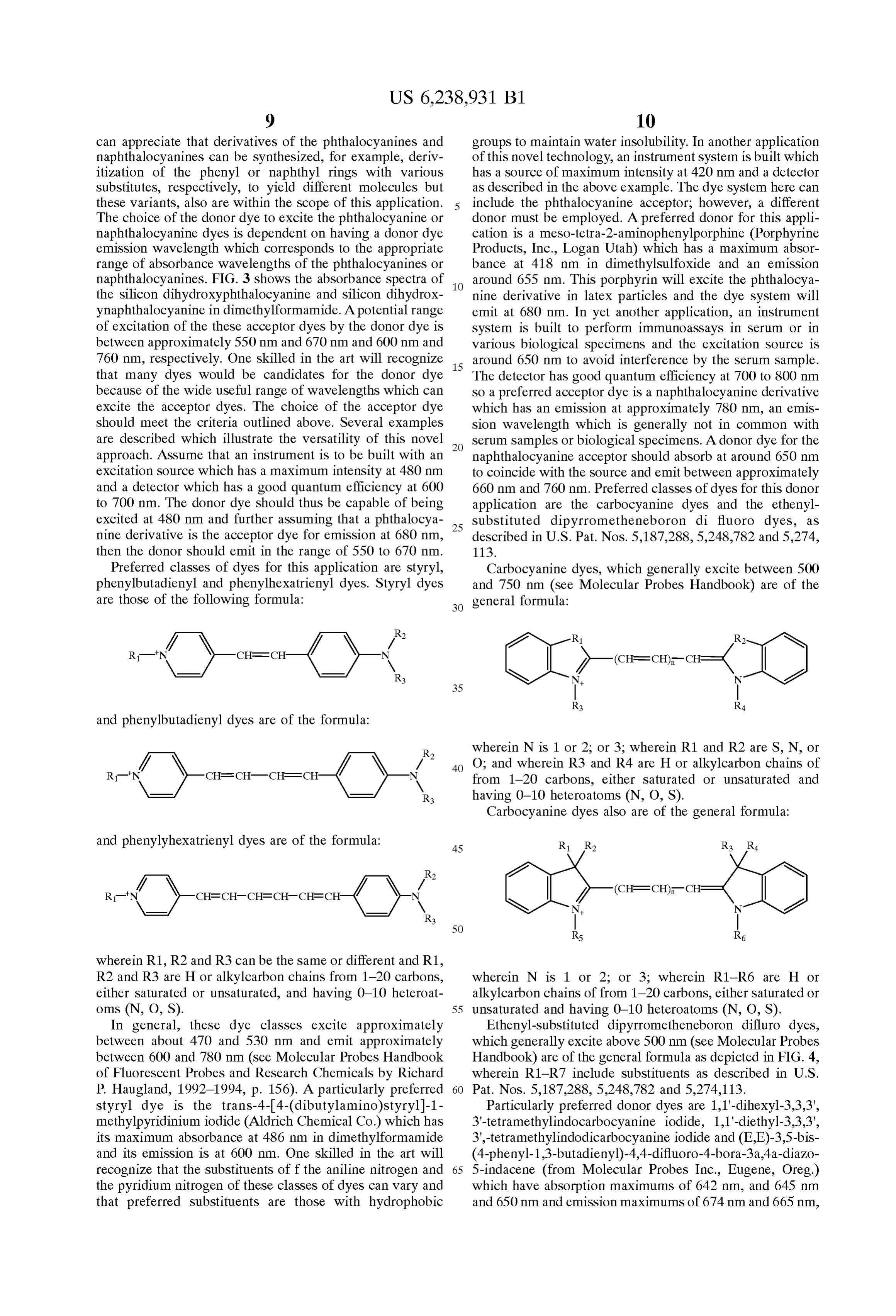
Preferred classes of dyes for this application are Styryl, Carbocyanine dyes, which generally excite between 500 phenylbutadienyl and phenylhexatrienyl dyes. Styryl dyes and 750 nm (see Molecular Probes Handbook) are of the are those of the following formula: general formula:
R2 R1 R2
and phenylbutadienyl dyes are of the formula:
wherein N is 1 or 2; or 3; wherein R1 and R2 are S, N, or 40 O; and wherein R3 and R4 are H or alkylcarbon chains of
R-N CHECH-CHECH N from 1-20 carbons, either Saturated or unsaturated and
having 0-10 heteroatoms (N, O, S).
Carbocyanine dyes also are of the general formula:
and phenylyheXatrienyl dyes are of the formula: 45 R1 R2 R3 R4
wherein R1,R2 and R3 can be the same or different and R1,
R2 and R3 are H or alkylcarbon chains from 1-20 carbons, wherein N is 1 or 2; or 3; wherein R1-R6 are H or either Saturated or unsaturated, and having 0-10 heteroat alkylcarbon chains of from 1-20 carbons, either saturated or oms (N, O, S). 55 unsaturated and having 0-10 heteroatoms (N, O, S). In general, these dye classes excite approximately Ethenyl-substituted dipyrrometheneboron difluro dyes, between about 470 and 530 nm and emit approximately which generally excite above 500 nm (see Molecular Probes between 600 and 780 nm (see Molecular Probes Handbook Handbook) are of the general formula as depicted in FIG. 4, of Fluorescent Probes and Research Chemicals by Richard wherein R1-R7 include Substituents as described in U.S. P. Haugland, 1992-1994, p. 156). A particularly preferred 60 Pat. Nos. 5,187,288, 5,248,782 and 5,274,113. styryl dye is the trans-4-4-(dibutylamino)styryl-1- Particularly preferred donor dyes are 1,1'-dihexyl-3,3,3', methylpyridinium iodide (Aldrich Chemical Co.) which has 3'-tetramethylindocarbocyanine iodide, 1,1'-diethyl-3,3,3', its maximum absorbance at 486 nm in dimethylformamide 3'-tetramethylindodicarbocyanine iodide and (E.E)-3,5-bis and its emission is at 600 nm. One skilled in the art will (4-phenyl-1,3-butadienyl)-4,4-difluoro-4-bora-3a,4a-diazo recognize that the Substituents off the aniline nitrogen and 65 5-indacene (from Molecular Probes Inc., Eugene, Oreg.) the pyridium nitrogen of these classes of dyes can vary and which have absorption maximums of 642 nm, and 645 nm that preferred substituents are those with hydrophobic and 650 nm and emission maximums of 674 nm and 665 nm,
Page 14
and 670 nm, respectively, in dimethylformamide. Particles transfer (“FET) in an efficient manner. The optimized FET incorporated with these particularly preferred dyes and a compound then may be incorporated into particles. Preferred naphthalocyanine derivative will excite with the 650 nm naphthalocyanine copounds are those as depicted in FIG. 7, Source and emit at approximately 780 nm. One skilled in the where X is hydrogen or electron donating groups, Such as art will recognize that the excitation and emission spectra for -OZ, where Z is alkyl or aryl and D is the donor dye any particular dye has a Gaussian form and therefore the covalently attached to the naphthalocyanine derivative at a excitation Source does not need to correspond exactly to the distance which allows for energy transfer between the donor excitation maximum of the donor dye in order to obtain an and acceptor. Generally, the distances between donor and intense fluorescent Signal. Likewise, the donor emission acceptor are about 5 angstroms to 30 angstroms, and pref does not have to coincide with the highest absorption of the erably from 5 angstroms to 15 angstroms. In addition, each acceptor dye in order to achieve efficient energy transfer. naphthalocyanine derivative can have 1-4 donor dyes One skilled in the art will also recognize that the substituents attached, depending on the required application of FET at and on the 1 and 3 positions of the carbocyanines and the compound. Suitable donor dyes are those which emit in the substituents at the R1 and R7 positions of the dipyr absorbance range of the acceptor dye. Example 29 describes rometheneboron difluoro dyes, and the conjugation between 15 the synthesis of a fluorescein-silicon phthalocyanine FET the ring Structures can vary and these variations are also compound. Example 30, item numbered 88, shows the useful in tuning fluorescence Spectra of the particles. fluorescence characteristics of this compound in lateX par Also preferred emission wavelengths of the particles ticles. One skilled in the art will appreciate that with the range from about 800 nm to 1000 nm. This near infra-red is inventive teachings described herein, that many FET com important because the Scattering component of the light pounds may be Synthesized for any particular application of decreases Substantially, thus lowering the background of the excitation and emission.
fluorescent measurement. For example, FIG. 5 illustrates the Another approach to developing particles which exhibit attenuation of the background Signal as the wavelength of fluorescence energy transfer is to Synthesize unsymmetrical the measured light increases from 730 nm to 900 nm in an phthalocyanines or naphthalocyanines, as described, for immunoassay device, as described in allowed application 25 example, in J. Am. Chem. Soc. (1990), 112, 9640-9641, and Ser. No. 07/887,526 (which is herein incorporated by references described therein. These unsymmetrical phthalo reference), now U.S. Pat. No. 5,458,852, containing either cyanines and naphthalocyanines can be Synthesized to opti neat human Serum or no Serum. This figure shows that the mize the excitation and emission wavelengths. The resulting background decreases by a factor of 5 when measuring at compound is then incorporated into particles to yield par 900 nm as compared to 790 nm when the illumination source ticles which have excitation wavelengths above 600 nm and is a 1 milli watt (“mW) 670 nm laser diode. In addition, emission wavelengths above 680 nm.
excitation of neat Serum at 670 nm does not result in a Preferred molar ratios of donor to acceptor dyes in the Significant measurable fluorescence between 730 nm and latex particles generally range from about 20:1 to about 1:20 900 nm. Thus, for example, the signal to noise ratio of the and particularly from about 1:1 to 6:1. The desired fluores measurement of fluorescence emission of a dye which emits 35 cence intensity should be obtained through experimentation at around 900 nm as compared to a dye emitting at around by incorporating various ratioS of donor to acceptor dyes 790 nm would be improved by a factor of 5. Maximizing the into the particles at various dye concentrations. Signal to noise ratio, in general, is commonly Sought in Preferred particle sizes range from about 0.1 nm to 5000 analytical chemistry because the Sensitivity of the measure nm and preferably from about 1 nm to 1000 nm. The choice ment is improved. Preferred dyes, for example as described 40 of particle size should be related to the specific function for in J. Chem. Soc. Perkin Trans. 1, (1988), 2453–2458, which the label. The particle Size may vary for a particular appli emit above 780 nm include derivatives of the naphthalocya cation. For example, in an immunoassay, if the label requires nine class (FIG. 1) and are characterized by the general a more intense fluorescence for measuring very low con formulae, as depicted in FIG. 6, where M is a metal such as centrations of analytes then one would employ larger par Si, Ge, Al, Sn and Ti and the like, and where R is an alkyl 45 ticles because larger particles can incorporate more dye or aryl, and wheree X is an electron donating group or molecules. The Small particle sizes (0.1-1 nm) may be groups which can be the same or different, including, but not employed in fluorescence polarization assays, as described limited to aryl and -OZ, where Z is alkyl or aryl. The for example, in U.S. Pat. Nos. 4,420,568, 4,476229 and electron donating character of the X group or groups red 4,510,251, in in vitro visualization of cellular components or shifts the emission wavelength as compared to the general 50 in in Vivo imaging techniques.
naphthalocyanine compounds (FIG. 1). For example, the The resulting fluorescent dye particles which exhibit the compounds described in examples 26, 27 and 28 are illus appropriate excitation and emission characteristics are fur trative of dyes which have emission wavelengths around 850 ther adsorbed or chemically reacted with various nucleic nm. These preferred dyes would yield an improved signal to acids, nucleotides, proteins or peptides and the like which noise ratio as compared to dyes emitting at 780 nm (See FIG. 55 are required for a Specific purpose. The adsorption of 5). Preferred donor dyes for this class of near infra-red macromolecules to particles, particularly lateX particles is emitting dyes are those which have emission wavelengths well known to those skilled in the art and generally involves which correlate to the absorbance characteristics of the adsorption of the macromolecule at a temperature between acceptor dye. Preferred dyes for this application are the 5° C. and 50° C. and at a pH which is below the pl of the ethenyl-Substituted dipyrrometheneboron difluoride dyes, as 60 molecule. For example, fluorescent particles exhibiting fluo described in U.S. Pat. Nos. 5,187,288, 5,248,782 and 5,274, rescence energy transfer can be adsorbed with either anti 113. bodies for use in non-competitive immunoassays or ligand The geometrical orientation of the donor dye to the analogues for use in competitive immunoassays in reaction acceptor dye will affect the efficiency of energy transfer mixtures of the assays. In the case of non-competitive between the donor and acceptor dyes. Thus, the donor and 65 assays, the reaction mixture would include at least one target acceptor dyes can be Synthesized to form an optimal ligand and at least one class of fluorescent particles having compound, which, in Solution, exhibits fluorescence energy bound thereto at least one receptor Specific for target ligand,
Page 15
forming an antibody (fluorescent) conjugate. In the case of To a Suspension of Silicon phthalocyanine dihydroxide competitive assays, the reaction mixture will include at least (115 mg, 0.2 mmol) in anhydrous pyridine (11 mL) was one target ligand, at least one receptor Specific to the target added (10-carbomethoxydecyl)dimethylchlorosilane (586 ligand, and at least one class of fluorescent particles, having mg, 2 mmol) and the mixture was refluxed with Stirring on bound thereto at least one ligand analogue, forming a ligand an oil bath at 130° C. for 5 h. The dark blue Solution was analogue (fluorescent) conjugate. The antibody conjugates allowed to cool and the solvents were evaporated. The bound to target ligands in the non-competitive reaction residue was purified on a Silica gel 60 column equilibrated mixture and the ligand analogue conjugates not bound by in hexane and the product eluted slowly as a blue band with receptorS Specific to the target ligands in the competitive toluene. The toluene fraction containing product was evaporated, hexane (10 ml) was added to the residue and the reaction mixture can be bound to a Solid phase consisting of blue receptorS Specific to another epitope of the target ligand of affordproduct
was filtered, washed with hexane and dried to of the title compound.
the target ligand-antibody conjugate complexes and of receptorS Specific to ligand analogues of the ligand analogue EXAMPLE 4 conjugates, respectively. The fluorescent conjugates Synthesis of Silic on Phthalo cyanine Bis unbound by the solid phase are removed and the fluores 15 (dimethylvinylsilyloxide) (PcSi Vinyl) To a Suspension of Silicon phthalocyanine dihydroxide cence of the bound conjugates is measured. The measured fluorescence is related to the target ligand concentration. The (115 mg, 0.2 mmol) in anhydrous pyridine (11 mL) was various reagents described above can also be attached added chlorodimethylvinylsilane (276 uL, 20 mmol) and the mixture was refluxed with stirring on an oil bath at 130 C.
covalently to the lateX particles. For example, antibodies or for ligand analogues can be attached through amine or carboxy 5 h. The dark Solution was allowed to cool and was lic acids to carboxylic acids or amines on the Surface of the evaporated. The residue was purified on a Silica gel 60 particles, respectively, to form Stable amide linkages. Those column equilibrated in hexane and the product was eluted skilled in the art will appreciate that the novel fluorescent with toluene as a blue band. The eluate containing product particles described herein have many uses in immunoassays, was evaporated, the residue treated with hexane and the dark fluorescence microScopy, in Vivo imaging, in vitro cancer 25 blue Solid product was filtered, washed with hexane and was therapy and cell Sorters and the like. dried under vacuum to afford 7.5 mg of the title compound.
EXAMPLE 5
EXPERIMENTAL SECTION
Synthesis of Silicon Phthalocyanine Bis(3-cyanopropyl)
Fluorescence measurements were performed on a Perkin dimethylsilyloxide (PcSi Cyano) Elmer model LS 50B Luminescence Spectrometer for dyes To a Suspension of Silicon phthalocyanine dihydroxide emitting around 780 nm. In Some instances, dyes emitting (115 mg, 0.2 mmol) in anhydrous pyridine (11 mL) was above 800 nm were measured according to Example 18. added chloro(3-cyanopropyl)-dimethylsilane (328 uL, 20 Absorbance measurements were performed on a Hewlett mmol) and the mixture was refluxed with stirring on an oil Packard 8452A Diode Array Spectrophotometer. bath at 130° C. for 5 h. The purple solution was allowed to
EXAMPLE 1.
35 cool and was evaporated. The residue was purified on a
Synthesis of Silicon Phthalocyanine Dihydroxide SiPc Silica gel 60 column equilibrated in hexane. The column was washed with toluene and the product was eluted with
A Suspension of Silicon phthalocyanine dichloride (1.83 g, toluenefisopropyl alcohol (90/10, V/v) as a bright blue band. The eluate containing product was evaporated under Vacuum 3.0 mmol) in pyridine (50 mL) and water (50 mL) was 40 to afford 101 mg of the title compound with a mpa260 C. refluxed with stirring on an oil bath at 120° C. for 18 h. After cooling the dark blue Solid product was filtered and the EXAMPLE 6
Synthesis of Silic on Phthalo cyanine Bis residue was washed with water (10 mL), acetone (5 mL) and then dried under vacuum to afford 1.71 g of the title (dimethylpentafluorophenylsilyloxide) (PcSi Pentafluoro)
To a Suspension of Silicon phthalocyanine dihydroxide (115 mg, 0.2 mmol) in anhydrous pyridine (11 mL) was
EXAMPLE 2 added chlorodimethylpentafluorophenylsilane (376 uL, 20 Synthesis of Silicon Phthalocyanine bis(trihexylsilyloxide) mmol) and the mixture was refluxed with Stirring on an oil (PcSi trihexyl) bath at 130° C. for 5 h. The dark green solution was allowed A Suspension of Silicon phthalocyanine dihydroxide (115 to cool and was evaporated. The residue was purified on a mg, 0.2 mmol) in anhydrous pyridine (11 mL) containing 50 Silica gel 60 column equilibrated in hexane. The product chlorotrihexylsilane (733 uL, 2.0 mmol) was refluxed on an was eluted with toluene as a dark blue band. The eluate oil bath at 130° C. for 5 h. The resulting purple solution was containing the product was evaporated, the residue was allowed to cool and was evaporated. The resulting slurry treated with hexane (10 mL) and the dark blue solid product was treated with ice-cold hexane (2 mL) and the dark blue 55 was filtered, washed with hexane and was dried under Solid product was filtered, washed with ice-cold hexane (2 vacuum to afford 73 mg of the title compound. mL) and was dried under vacuum to yield 249 mg of crude product. The crude product in chloroform was purified on an Synthesis of Silicon EXAMPLE 7 2,3-Naphthalocyanine Dihydroxide
Alumina column (Activity 1) equilibrated in hexane and the (NaPcSi Hydroxide) product was eluted with hexane/toluene (2/1, V/v) as a bright 60 A Suspension of Silicon 2,3-naphthalocyanine dichloride blue band. The Solvent containing the product was evapo rated to yield 69 mg of the title compound with a mp 171 (280 mg, 0.34 mmol) in pyridine (10 ml) and water (10 ml) C. (lit mp 175° C). was refluxed with stirring on an oil bath at 130° C. for 24 h. After cooling to room temperature, the dark green Solid
EXAMPLE 3 product was filtered and, the residue was washed,
Synthesis of Silicon Phthalocyanine Bis(10 65 successively, with water (5 ml) and acetone (2 ml). The carbomethoxydecyl)dimethyl Sillyloxide (PcSi Methyl product was dried under vacuum to afford 217 mg of the title Ester) compound.
Page 16
EXAMPLE 8 of one or both dyes at an appropriate concentration in Synthesis of Silicon 2,3-Naphthalocyanine Bis tetrahydrofuran, was added dropwise over 5 min to the (dimethylvinylsilyloxide) (NaPcSi Vinyl) Stirred latex Solution, to give the loading dye concentration To a Suspension of Silicon 2,3-naphthalocyanine dihy (in 2 ml volume) as indicated in Table 1. The latex-dye droxide (87 mg, 0.11 mmol) in anhydrous dimethylforma solution was stirred at room temperature for 30 min in the mide (1 ml) was added chlorodimethylvinylsilane (0.042 ml, dark. The latex solution was then transferred to dialysis 0.3 mmol), followed by imidazole (14 mg., 0.2 mmol). The tubing (Spectra-por, 12-14,000 molecular weight cutoff, mixture was Stirred under argon at room temperature for 24 Spectrum, Houston, Tex.) and the dye-latex Solutions were h. The Solvents were evaporated and the residue was purified dialyzed against water for 12 to 15 hours at 4 C. The on a Silica gel 60 column which was equilibrated in hexane. dye-latex solutions were removed from dialysis and the % Solids of the Solutions was calculated from the final volume
The product was eluted with toluene as a green band. The after dialysis and the Starting Solids concentration. toluene fraction containing the product was evaporated and Method 2 Utilizing Dimethylformamide the residue was treated with hexane. The dark green Solid Dimethylformamide (1.33 ml) was added, dropwise over was filtered, washed with hexane and was dried under a 5 min period, to a stirring solution of 0.6 ml of 6.7% Solids Vacuum to afford 26 mg of the title compound. 15 of lateX particles at room temperature. The latex Suspension
EXAMPLE 9 was stirred at room temperature for an additional 30 minto Synthesis of Silicon 2,3-Naphthalocyanine Bis Swell the latex. The dye solution (0.07 ml), which consists (dimethylpentafluorophenylsilyloxide (NaPcSi Pentafluoro) of one or both dyes at an appropriate concentration in To a Suspension of Silicon 2,3-napthalocyanine dihydrox dimethylformamide, was added dropwise over 5 minto the ide (87 mg, 0.11 mmol) in anhydrous pyridine (5 ml) was Stirred latex Solution, to give the loading dye concentration added chlorodimethylpentafluorophenylsilane (0.188 ml, 1 (in 2 ml volume) as indicated in Table 1. The latex-dye mmol). The mixture was refluxed with stirring on an oil bath solution was stirred at room temperature for 30 min in the at 130° C. for 5 h. After cooling, the solvent was evaporated dark. The latex solution was then transferred to dialysis and the residue was purified on a Silica gel 60 column which tubing (Spectra-por, 12-14,000 molecular weight cutoff, was equilibrated in hexane. The product was eluted with 25 Spectrum, Houston Tex.) and the dye-latex Solutions were toluene as a green band. The toluene fraction containing the dialyzed against water for 12 to 15 hours at 4 C. The product was evaporated and the residue was treated with dye-latex Solutions were removed from dialysis and the t hexane. The dark green Solid was filtered, washed with Solids of the Solutions was calculated from the final volume hexane and was dried under vacuum to afford 23 mg of the after dialysis and the Starting Solids concentration. title compound. EXAMPLE 11
EXAMPLE 10 Effect of Varying Dye Loading Concentration on Fluores
General Procedures for the Preparation of Dye-loaded Latex cence Intensity and Optimization of Fluorescence Intensity Particles of Varying Sizes Latex Particles
The various dyes were loaded into lateX particles of 35 The incorporation of dye into lateX particles must be varying Sizes according to the general procedures outlined optimized in order to achieve the maximum fluorescence below. Two procedures are described and involve Swelling intensity and to minimize the degree of fluorescence quench latex particles with aqueous Solutions of either tetrahydro ing of the dye molecules. Fluorescence quenching can be furan or dimethylformamide prior to addition of the dye Significant because of the close proximity of the dye mol Solutions. Latex particle sizes used range from 67 nm to 783 40 ecules in the particles. The PeSi vinyl was incorporated into nm and one skilled in the art recognizes that Smaller and 67 nm latex particles (polystyrene Sulfate from Interfacial larger particles can be used. The choice of the organic Dynamics Corp., Inc., Portland, Oreg.) using method 1 Solvent used to Swell the particles depends Solely on the (example 10) at various concentrations as indicated in the solubility of the various dyes in either solvent. Tables 1 and table below. The dye latex particles were diluted to 0.0019% 2 of Example 15 below show the aqueous organic Solvent 45 Solids in either water or tetrahydrofuran for each dye con System and the optimum dye concentration which were used centration. The Solutions were excited at 350 nm and the for the loading into particles for each dye pair of a Selected emission at 680 nm was measured. The fluorescence inten number of dyes. One skilled in the art recognizes that many sity in water divided by the intensity in tetrahydrofuran changes can be made to these procedures to prepare particles minus 1 times 100 is the % quenching in the particles. The with different degrees of fluorescence intensities and 50 table below shows the fluorescence intensities as a function quenching by loading higher or lower amounts of dye in the of dye loading concentrations and quenching for each con particles and also by changing the ratioS of each dye pair to dition.
the other. One skilled in the art also recognizes that Similar techniques are useful for incorporation of dyes into lateX particles , for example, as described in U.S. Pat. Nos. 55 Loading 4,199,363 and 4,368,258. Dye Concentration (mg/ml) Intensity (680 nm) Quenching (%) Surfactant-free polystyrene Sulfate lateX particles in sizes ranging from 67 nm to 783 nm and caroxyl-modified latex O.O1 42O 41 (“CML') particles ranging from 200 nm to 400 nm particles O.O25
were obtained through Interfacial Dynamics Corp. Inc., 60 O.O75 4O1 76 Portland Oreg. O1 338 83 Method 1 Utilizing Tetrahydrofuran O.15 197 87 Tetrahydrofuran (0.36 ml) was added, dropwise over a 5 O.3
min period, to a stirring solution of 1.6 ml of 2.5% solids of latex particles at room temperature. The lateX Suspension 65 was stirred at room temperature for an additional 30 minto These results show that an optimum loading dye concen Swell the latex. The dye solution (0.04 ml), which consists tration gives the highest fluorescence intensities and the
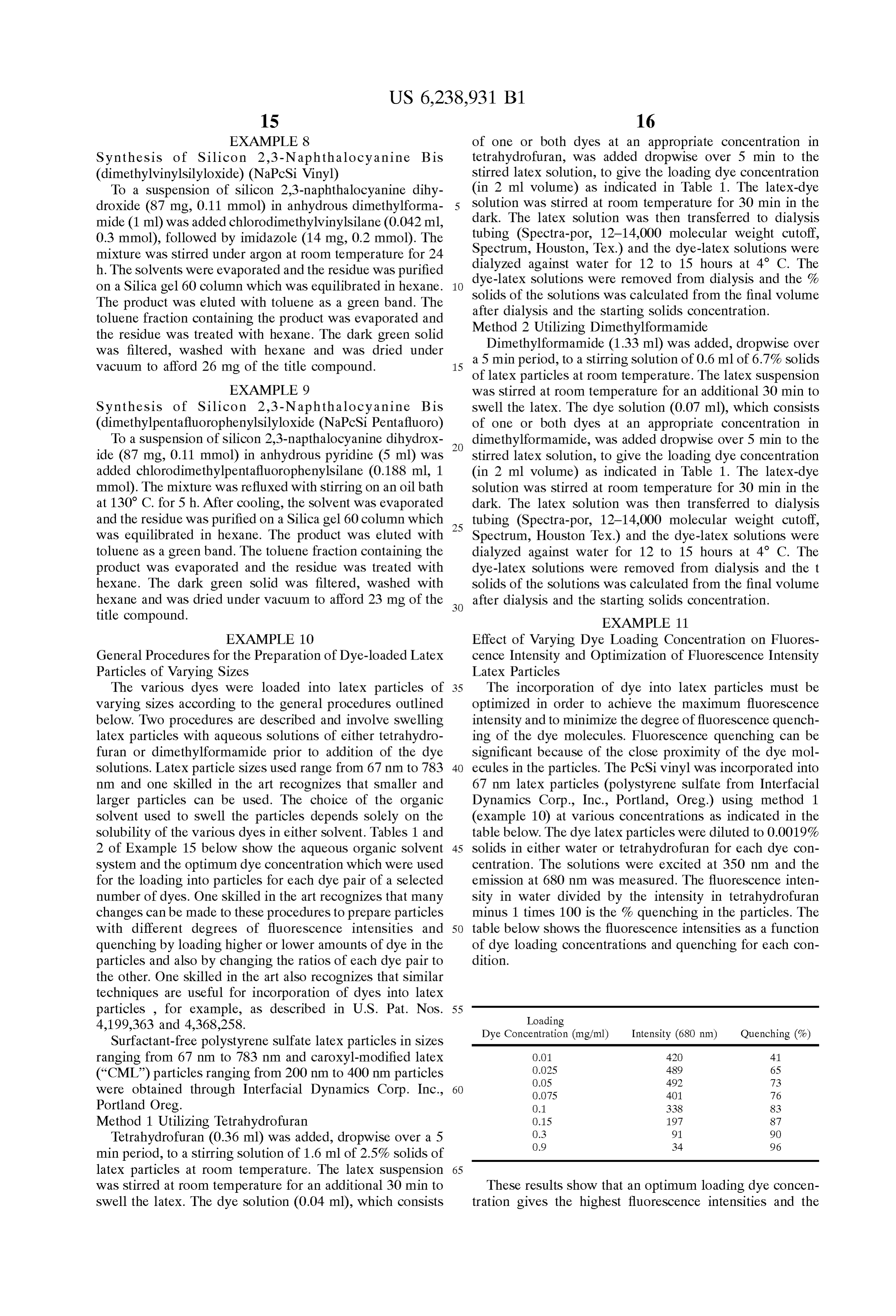
Page 17
lowest quenching. In this case, a dye concentration of between 0.025 and 0.05 mg/ml in the loading solution gives the best intensity and the least quenching. LeSS dye than Fluorescence 0.025 mg/ml gives leSS intensity and less quenching because Tdap/PcSi vinyl Excitation W (nm) Intensity at 680 nm the Spacing of the dyes begins to Significantly increase and more dye than 0.05 mg/ml gives leSS intensity and more 1f1 350 490 quenching because of the increased closeness of the dyes in 1f1 430 83
the particles. This type of experiment illustrates the proce 1f1 470 11 dure for optimization of fluorescence intensity and for 2f1 350 58O minimizing quenching. 2f1 430 830
EXAMPLE 12 2f1 470 22O
Verification of Fluorescence Energy Transfer in Latex Par 6/1 430 18OO ticles 6/1 450 8OO The latex particles which were incorporated with various 15 6/1 470 2OO dyes for energy transfer were diluted to 0.06% to 0.001% solids in water and either tetrahydrofuran or dimethylfor These results show that as the molar ratio of donor to mamide and the Solutions of equal Solids concentrations acceptor in the lateX particles increases from 1/1 to 6/1, the were excited at wavelengths which corresponded to the energy transfer, as measured by the fluorescence intensity of approximate excitation maximum of the donor dye. The the acceptor dye, becomes Significantly more efficient. There particles were diluted into organic Solvents in order to was no observable emission of the Tdap dye in the particles liberate the dyes from the latex, and therefore, disrupt any at the emission maximum of 650 nm Suggesting that the energy transfer process between the dyes in the particles. energy transfer is very efficient. The data indicate that the The fluorescence of the Solutions in water and organic fluorescence intensity of the lateX particles, generated Solvent at the emission maximum of the acceptor dye or dyes 25 through an energy transfer pathway, is affected by the “light were recorded and compared. Fluorescence energy transfer gathering capability of the donor dye. Thus, optimization of was defined as Significant when the emission intensity of the the fluorescence intensity of the lateX particles should acceptor was at least 5-fold higher in water than in the involve changing the molar ratio of donor to acceptor. organic Solvent. EXAMPLE 1.4 Effect of Incorporation of Different Dyes on Quenching and
EXAMPLE 13 Fluorescence Intensity of Latex Particles
Effect of Varying Donor Dye Concentration With Respect to Five different Silicon phthalocyanines, Synthesized as Acceptor Dye Concentration in Latex Particles on the Fluo described in examples 2-6, were incorporated into 67 nm rescence Intensity of the Particles Surfactant-free, polystyrene latex particles (Interfacial Meso-tetra 2-dimethylaminophenyl porphyrin was made 35 Dynamics Corp. Inc. Portland, Oreg.) in sets of 1,3 or 5 dyes as follows. To a stirring Solution of meso tetra according to the following methods. Each Silicon phthalo 2-aminophenyl porphyrin (100 mg, 0.15 mmol) and 37% cyanine derivative had maximum excitation and emission aqueous formaldehyde (500 uL, 6.0 mmol) in tetrahydrofu wavelengths at 350 nm and 680 nm, respectively. After ran (2.5 ml was added Sodium cyanoborohydride (114 mg, preparation of each dye-latex, each Suspension was diluted 1.8 mmol). The mixture was then treated with a glacial 40 to 0.059% solids in either water or tetrahydrofuran. The acetic acid (60 u) over 10 minutes and stirred at room dye-latex solutions were excited at 350 nm and the fluores temperature for 3 hours. More glacial acetic acid (60 uD) cence intensity at 680 nm was measured. The intensity of was added and the mixture stirred a further 1 hour at room fluorescence in water divided by the intensity of fluores temperature. The mixture was evaporated and the residue cence in tetrahydrofuran minus 1 is the degree of quenching was purified on a Silica gel to 60 column which was 45 of the dyes in the lateX particles.
equilibrated in toluene. The product was eluted with tolene/ Preparation of One Phthalocyanine Dye in Latex 1% isopropanol as a dark brown band. The fraction con A solution of PcSi pentafluoro dye (0.02 mg) in tetrahy taining the product was evaporated and the ink-blue Solid drofuran (0.1 ml) was added dropwise over 5 minto a stirred residue dried under vacuum to afford 85 mg of the title 2% solids solution of latex particles (1.0 ml). The latex compound. 50 Suspension was stirred at room temperature for 6 hours, then Meso-tetra-2-dimethylaminophenyl porphyrine (Tdap transferred to dialysis tubing (Spectra-por, 12-14,000 Synthesized from the meso-tetra-2-aminophenylporphyrine molecular weight cutoff, Spectrum, Houston, Tex.) and the which was obtained through Porphyrin Products, Inc. dye-latex Solution was dialyzed against water for 12-15 Logan, Utah) and PcSi vinyl (example 4) were incorporated hours at 4 C. The dye-latex solution was removed from into 67 nm latex particles (polystyrene Sulfate latex from 55 dialysis and the Solids concentration was adjusted to 1.6%. Interfacial Dynamics Inc., Portland, Oreg.) using the tet Preparation of Three Phthalocyanine Dyes in Latex rahydrofuran method 1 of example 10. The molar ratio of the A solution which consists of PeSi pentafluoro, PcSi tri Tdap to the PeSi vinyl varied from 1/1 to 2/1 to 6/1 in the hexyl and PcSi cyano dyes in equimolar amounts to total latex loading Solutions while maintaining a constant mass 0.02 mg dye in tetrahydrofuran (0.1 ml), was added drop (0.1 mg/ml) of PeSi vinyl in each solution. The dialyzed 60 wise over 5 min to a stirred 2% solids Solution of latex particles were diluted to 0.0019% solids in water and the particles (1.0 ml). The latex Suspension was stirred at room fluorescence intensity at 680 nm of the PcSi vinyl was temperature for 6 hours, then transferred to dialysis tubing measured as a function of excitation wavelength between (Spectra-por, 12-14,000 molecular weight cutoff, Spectrum, 350 nm and 470 nm. The excitation maximum of the Tdap Houston, Tex.) and the dye-latex Solution was dialyzed is 430 nm and of the PeSi vinyl is 350 nm. The emission 65 against water for 12-15 hours at 4 C. The dye-latex solution maximum of the Tdap is 650 nm. The table below shows the was removed from dialysis and the Solids concentration was results. adjusted to 1.6%.
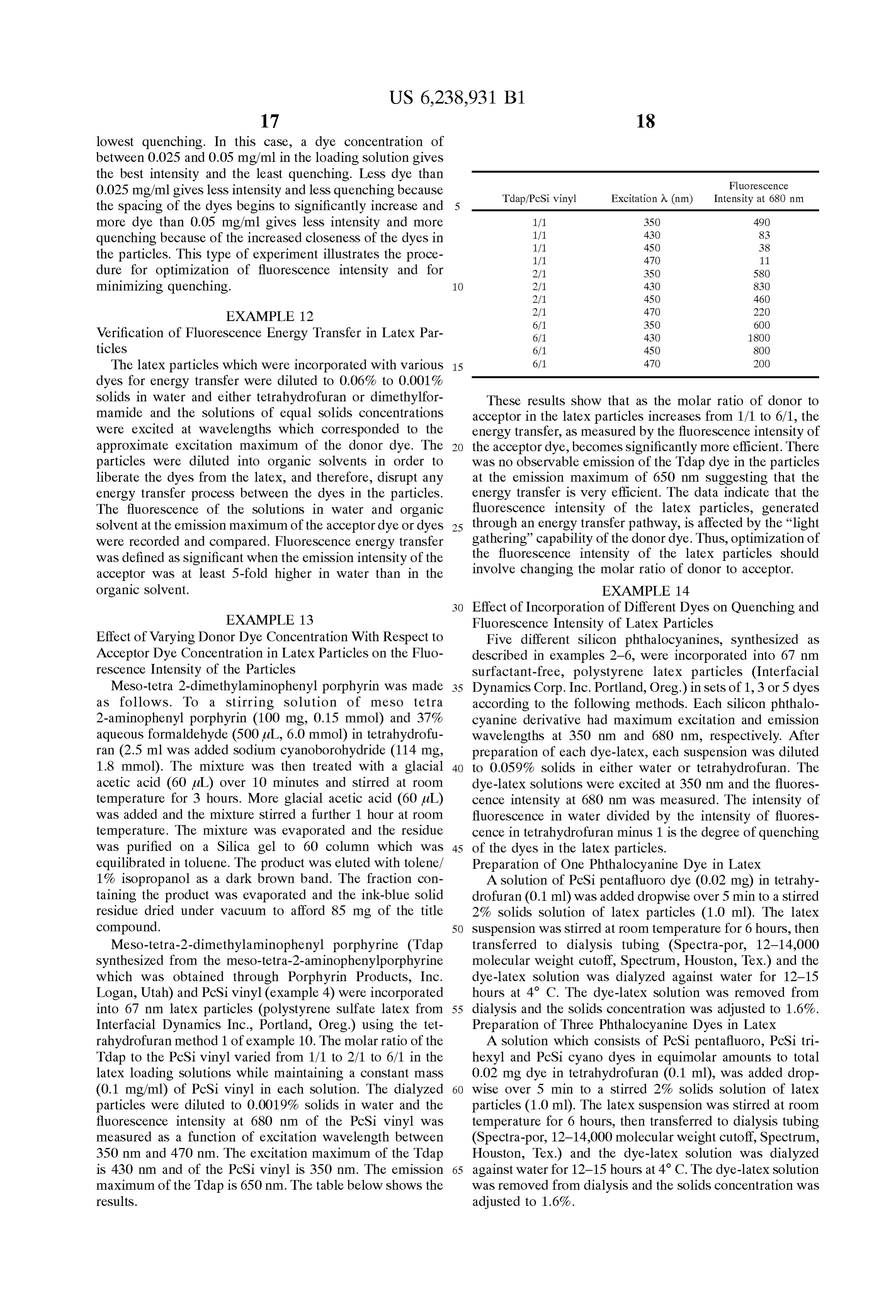
Page 18
Preparation of Five Phthalocyanine Dyes in Latex The data show that as the number of different dyes entrapped A solution which consists of PCSi pentafluoro, PcSi into the latex goes from 1 to 3 to 5, the fluorescence intensity trihexyl, PcSicyano, PcSi vinyl and PcSi methyl ester dyes increases because the quenching in the particles decreases. in equimolar amounts to total 0.02 mg dye in tetrahydrofu ran (0.1 ml), was added dropwise over 5 minto a stirred 2% solids solution of latex particles solution (1.0 ml). The latex EXAMPLE 1.5 Suspension was stirred at room temperature for 6 hours, then transferred to dialysis tubing (Spectra-por, 12-14,000 molecular weight cutoff, Spectrum, Houston, Tex.) and the Preparation and Characterization of Fluorescence Energy dye-lateX Solution was dialyzed against water for 12-15 Transfer Dye Latex hours at 40°C. The dye-latex solutions were removed from dialysis and the % Solids concentration was adjusted to 1.6%. A variety of fluorescent energy transfer latexes were 15 prepared with various donor and acceptor dye molecules.
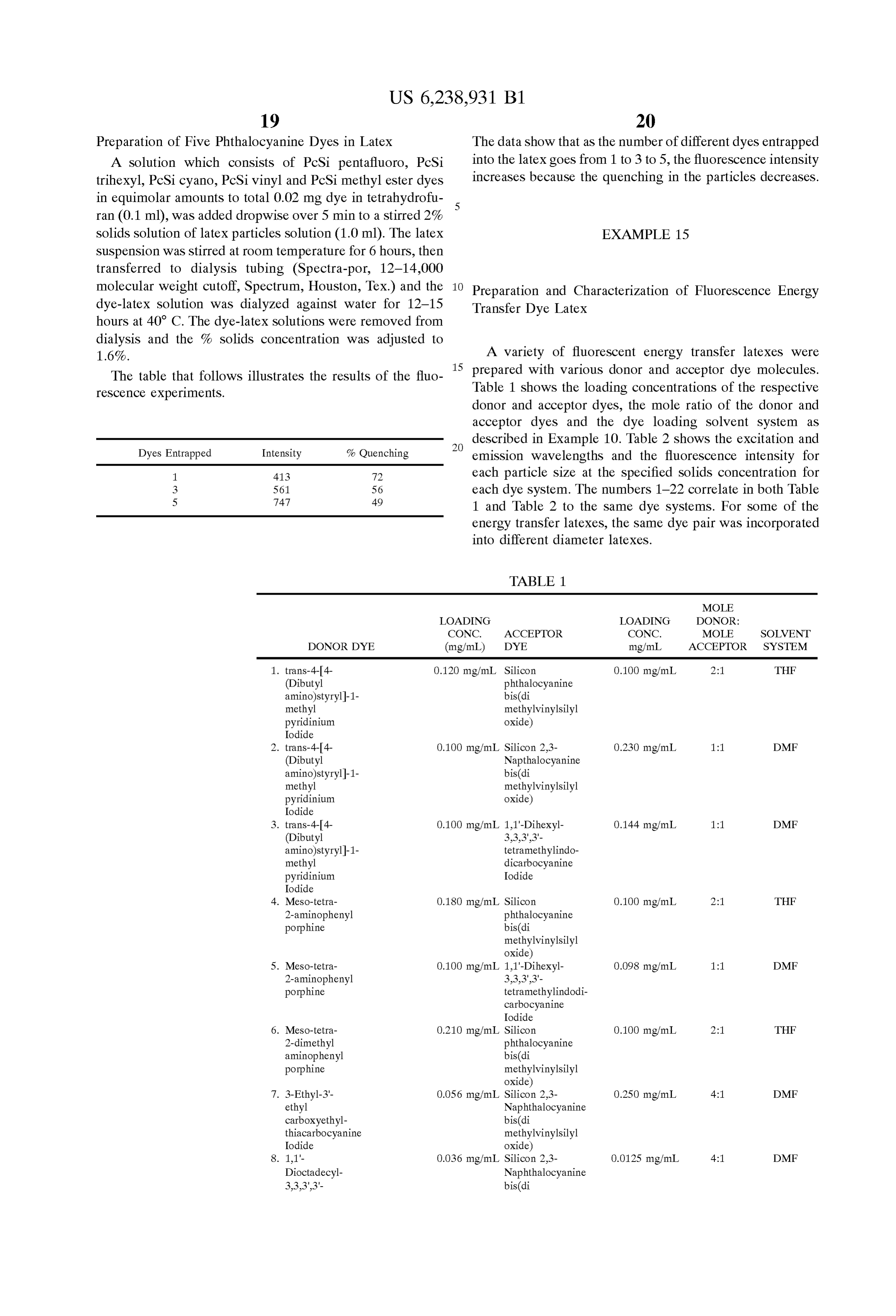
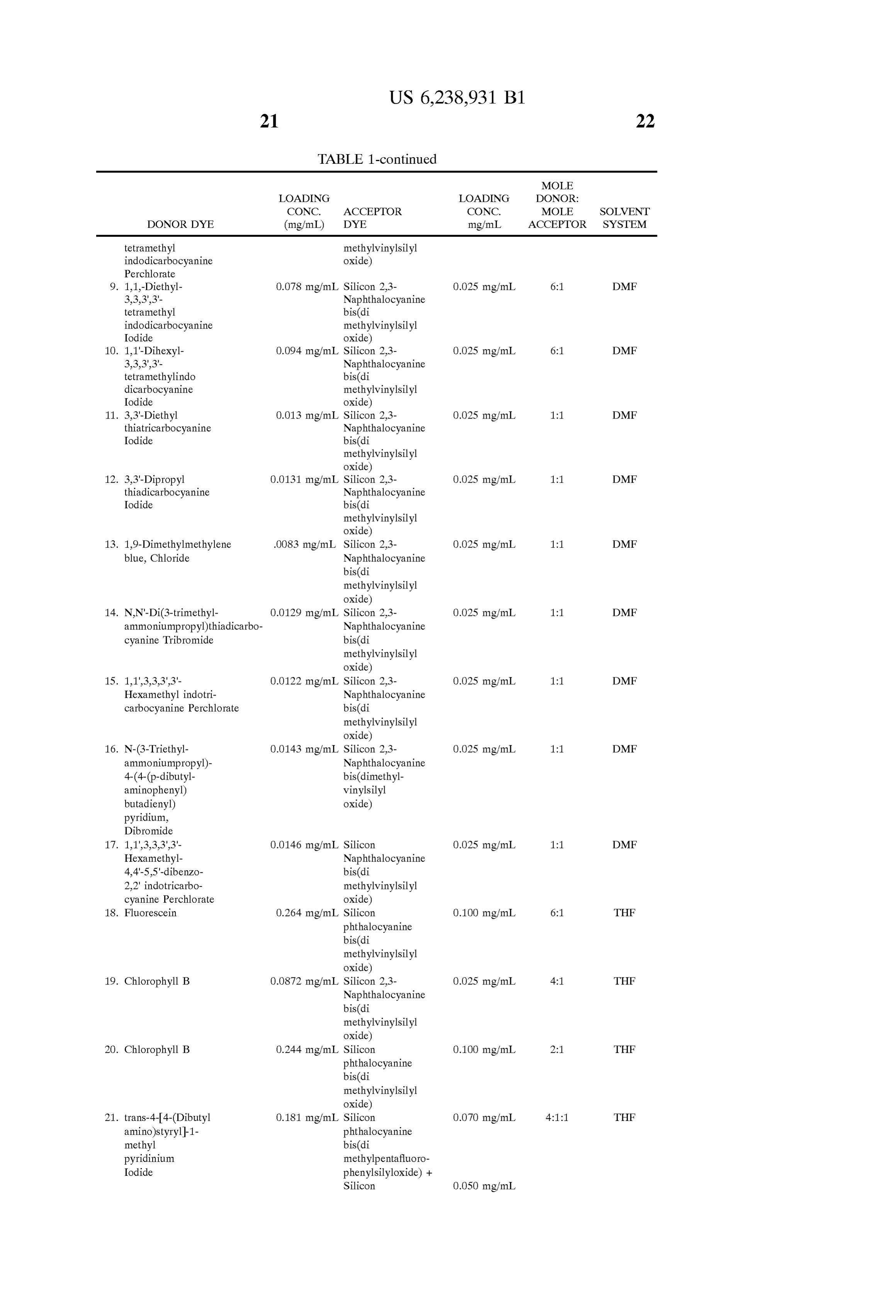
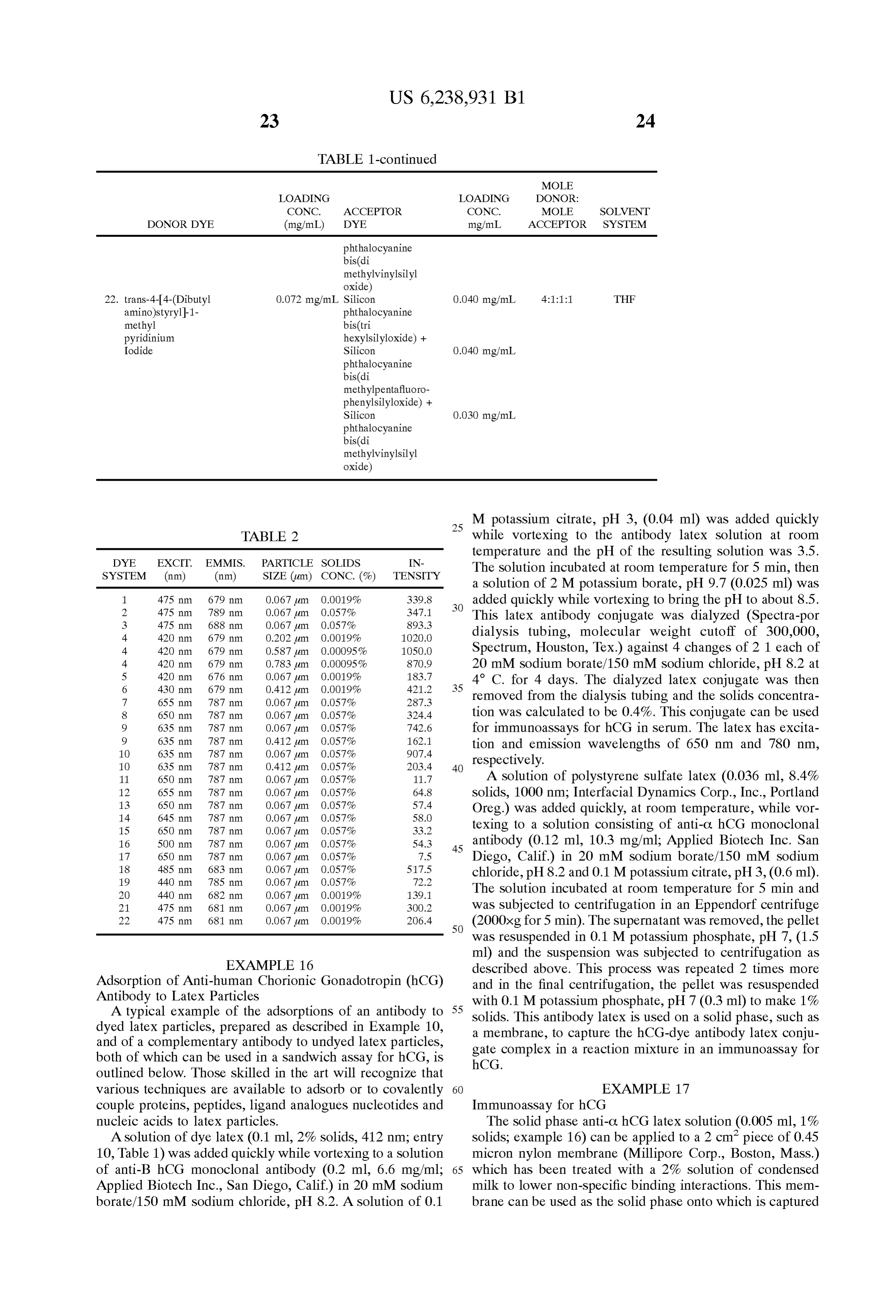
The table that follows illustrates the results of the fluo rescence experiments. Table 1 shows the loading concentrations of the respective donor and acceptor dyes, the mole ratio of the donor and acceptor dyes and the dye loading Solvent System as described in Example 10. Table 2 shows the excitation and
Dyes Entrapped Intensity % Quenching " emission wavelengths and the fluorescence intensity for 1. 413 72 each particle Size at the Specified Solids concentration for 3 561 56 each dye system. The numbers 1-22 correlate in both Table 5 747 49 1 and Table 2 to the same dye systems. For some of the energy transfer latexes, the same dye pair was incorporated into different diameter latexes.
TABLE 1.
MOLE
CONC. ACCEPTOR CONC. MOLE SOLVENT
DONORDYE (mg/mL) DYE mg/mL. ACCEPTOR SYSTEM 1. trans-4-4- 0.120 mg/mL Silicon 0.100 mg/mL 2:1 THF
Iodide 2. trans-4-4- 0.100 mg/mL Silicon 2,3- 0.230 mg/mL 1:1 DMF
Iodide 3. trans-4-4- 0.100 mg/mL 1,1'-Dihexyl- 0.144 mg/mL 1:1 DMF
Iodide 4. Meso-tetra- 0.180 mg/mL Silicon 0.100 mg/mL 2:1 THF
methylvinylsilyl
Oxide) 5. Meso-tetra- 0.100 mg/mL 1,1'-Dihexyl- 0.098 mg/mL 1:1 DMF
carbocyanine
Iodide 6. Meso-tetra- 0.210 mg/mL Silicon 0.100 mg/mL 2:1 THF
Oxide) 7. 3-Ethyl-3- 0.056 mg/mL Silicon 2,3- 0.250 mg/mL 4:1 DMF
thiacarbocyanine methylvinylsilyl
8. 11'- 0.036 mg/mL Silicon 2,3- 0.0125 mg/mL 4:1 DMF
Page 19
TABLE 1-continued
MOLE
CONC. ACCEPTOR CONC. MOLE SOLVENT
DONORDYE (mg/mL) DYE mg/mL. ACCEPTOR SYSTEM
Perchlorate . 1,1,-Diethyl- 0.078 mg/mL Silicon 2,3- 0.025 mg/mL 6:1 DMF
indodicarbocyanine methylvinylsilyl
10. 1,1'-Dihexyl- 0.094 mg/mL Silicon 2,3- 0.025 mg/mL 6:1 DMF
dicarbocyanine methylvinylsilyl
11. 3,3'-Diethyl 0.013 mg/mL Silicon 2,3- 0.025 mg/mL 1:1 DMF thiatricarbocyanine Naphthalocyanine
methylvinylsilyl
Oxide) 12. 3,3'-Dipropyl 0.0131 mg/mL Silicon 2,3- 0.025 mg/mL 1:1 DMF thiadicarbocyanine Naphthalocyanine
methylvinylsilyl
Oxide) 13. 1.9-Dimethylmethylene .0083 mg/mL Silicon 2,3- 0.025 mg/mL 1:1 DMF blue, Chloride Naphthalocyanine
methylvinylsilyl
Oxide) 14. N,N'-Di(3-trimethyl 0.012.9 mg/mL Silicon 2,3- 0.025 mg/mL 1:1 DMF ammoniumpropyl)thiadicarbo Naphthalocyanine
methylvinylsilyl
Oxide) 15. 1,1,3,3,3',3'- 0.0122 mg/mL Silicon 2,3- 0.025 mg/mL 1:1 DMF Hexamethyl indotri Naphthalocyanine carbocyanine Perchlorate bis(di methylvinylsilyl
Oxide) 16. N-(3–Triethyl 0.0143 mg/mL Silicon 2,3- 0.025 mg/mL 1:1 DMF ammoniumpropyl)- Naphthalocyanine
pyridium,
Dibromide 17. 1,1,3,3,3',3'- 0.0146 mg/mL Silicon 0.025 mg/mL 1:1 DMF
2,2' indotricarbo methylvinylsilyl cyanine Perchlorate oxide 18. Fluorescein 0.264 mg/mL Silicon 0.100 mg/mL 6:1 THF phthalocyanine
methylvinylsilyl
Oxide) 19. Chlorophyll B 0.0872 mg/mL Silicon 2,3- 0.025 mg/mL 4:1 THF Naphthalocyanine
methylvinylsilyl oxide 2O. Chlorophyll B 0.244 mg/mL Silicon 0.100 mg/mL 2:1 THF phthalocyanine
methylvinylsilyl oxide 21. trans-4-4-(Dibutyl 0.181 mg/mL Silicon 0.070 mg/mL 4:1:1 THF
Iodide
Page 20
TABLE 1-continued
MOLE
CONC. ACCEPTOR CONC. MOLE SOLVENT
DONORDYE (mg/mL) DYE mg/mL. ACCEPTOR SYSTEM phthalocyanine
methylvinylsilyl
Oxide) 22. trans-4-4-(Dibutyl 0.072 mg/mL Silicon 0.040 mg/mL 4:1:1:1 THF
pyridinium hexylsilyloxide) +
Iodide Silicon 0.040 mg/mL phthalocyanine
methylpentafluoro phenylsilyloxide) +
phthalocyanine
methylvinylsilyl
Oxide)
25 M potassium citrate, pH 3, (0.04 ml) was added quickly
TABLE 2 while Vortexing to the antibody latex Solution at room
DYE EXCT. EMMIS. PARTICLE SOLIDS IN temperature and the pH of the resulting Solution was 3.5.
SYSTEM (nm) (nm) SIZE (um) CONC. (%). TENSITY The solution incubated at room temperature for 5 min, then a solution of 2 M potassium borate, pH 9.7 (0.025 ml) was 1. 475 nm 679 mm 0.067 um 0.0019% 339.8 added quickly while vortexing to bring the pH to about 8.5.
This latex antibody conjugate was dialyzed (Spectra-por 4 420 nm 679 mm. 0.202 um 0.0019% 102O.O dialysis tubing, molecular weight cutoff of 300,000, 4 420 nm 679 mm. 0.587 um 0.00095% 105O.O Spectrum, Houston, Tex.) against 4 changes of 21 each of 4 420 nm 679 mm. 0.783 um 0.00095% 870.9 20 mM sodium borate/150 mM sodium chloride, pH 8.2 at
4 C. for 4 days. The dialyzed latex conjugate was then 7 655 nm 787 mm 0.067 um 0.057% 287.3 removed from the dialysis tubing and the Solids concentra 8 650 nm 787 mm 0.067 um 0.057% 324.4 tion was calculated to be 0.4%. This conjugate can be used 9 635 nm 787 mm 0.067 um 0.057% 742.6 for immunoassays for hCG in Serum. The lateX has excita 9 635 nm 787 mm 0.412 um 0.057% 1621 tion and emission wavelengths of 650 nm and 780 nm, 1O 635 nm 787 mm 0.067 um 0.057% 907.4 respectively.
1O 635 nm 787 mm 0.412 um 0.057% 2O3.4 40 11 650 nm 787 mm 0.067 um 0.057% 11.7 A solution of polystyrene sulfate latex (0.036 ml, 8.4% 12 655 nm 787 mm 0.067 um 0.057% 64.8 solids, 1000 nmi; Interfacial Dynamics Corp., Inc., Portland
Oreg.) was added quickly, at room temperature, while Vor 15 650 nm 787 mm 0.067 um 0.057% 33.2 texing to a Solution consisting of anti-C. hCG monoclonal 16 500 nm 787 mm 0.067 um 0.057% 54.3 45 antibody (0.12 ml, 10.3 mg/ml; Applied Biotech Inc. San
Diego, Calif.) in 20 mM sodium borate/150 mM sodium 19 440 nm 785 nm. 0.067 um 0.057% 72.2 chloride, pH 8.2 and 0.1 M potassium citrate, pH 3, (0.6 ml).
2O 440 nm 682 mm 0.067 um 0.0019% 139.1 The solution incubated at room temperature for 5 min and 21 475 nm 681 mm 0.067 um 0.0019% 3OO.2 was Subjected to centrifugation in an Eppendorf centrifuge 22 475 nm 681 mm 0.067 um 0.0019% 2O6.4
(2000xg for 5 min). The Supernatant was removed, the pellet was resuspended in 0.1 M potassium phosphate, pH 7, (1.5 ml) and the Suspension was Subjected to centrifugation as
EXAMPLE 16 described above. This process was repeated 2 times more Adsorption of Anti-human Chorionic Gonadotropin (hCG) and in the final centrifugation, the pellet was resuspended Antibody to Latex Particles
A typical example of the adsorptions of an antibody to 55 with 0.1 M potassium phosphate, pH 7 (0.3 ml) to make 1% Solids. This antibody latex is used on a Solid phase, Such as dyed lateX particles, prepared as described in Example 10, a membrane, and of a complementary antibody to undyed lateX particles, gate complex toin capture
the hCG-dye antibody latex conju reaction mixture in an immunoassay for both of which can be used in a sandwich assay for hCG, is hCG.
outlined below. Those skilled in the art will recognize that various techniques are available to adsorb or to covalently 60 EXAMPLE 1.7 couple proteins, peptides, ligand analogues nucleotides and Immunoassay for hCG nucleic acids to lateX particles. The solid phase anti-C. hCG latex solution (0.005 ml, 1% A solution of dye latex (0.1 ml, 2% solids, 412 nm, entry solids; example 16) can be applied to a 2 cm piece of 0.45 10, Table 1) was added quickly while vortexing to a solution micron nylon membrane (Millipore Corp., Boston, Mass.) of anti-B hCG monoclonal antibody (0.2 ml, 6.6 mg/ml; 65 which has been treated with a 2% solution of condensed Applied Biotech Inc., San Diego, Calif.) in 20 mM sodium milk to lower non-specific binding interactions. This mem borate/150 mM sodium chloride, pH 8.2. A solution of 0.1 brane can be used as the Solid phase onto which is captured
Page 21
the hCG dye latex conjugate complex. Thus, an hCG assay EXAMPLE 21 can be performed by addition of dye latex conjugate (0.025 Synthesis of SiNcOSi(CH)O(CH) maleimide ml, example 16) to 0.1 ml samples of Serum Suspected of A Suspension of Silicon 2.3 naphthalocyanine dihydroxide containing hCG and also to 0.1 ml Serum Samples containing (39 mg, 0.05 mmol) in DMF (1 mL) containing dichlo known amounts of hCG (10, 100, 300, 500 and 1000 rodimethylsilane (13.5 uL, 0.11 mmol) and imidazole (14 mIU/ml). The serum samples should be incubated about 10 mg, 0.2 mmol) was stirred under argon at RT for 18 h. The min and then the Samples are applied to the Solid phase reaction mixture was then treated with N-(2-hydroxyethyl) membrane containing the Solid phase lateX. The membrane maleimide (35 mg, 0.25 mmol) and stirred for additional 10 should be placed over an absorbent So that the Serum Sample h. The reaction mixture was evaporated and the residue containing the dye latex conjugates flows through the Solid purified on a Silica column equilibrating with hexane, then phase lateX spot. After the Serum Solution has passed through toluene and eluting the product with toluene/10% IPA as a the membrane, Serum (0.5 ml) not containing the dye latex green band. The eluate containing the product was evapo conjugate is applied to the membrane to remove unbound rated to afford 3.5 mg of green solid. dye latex conjugate. The latex Spots on the membranes are then placed in a front Surface fluorescence accessory in a 15 EXAMPLE 22 fluorometer and the spot is excited at 650 nm and the Synthesis of SiNcOSi(CH)OPhCH=CHPh.
fluorescence intensity of the Spot on each membrane is A Suspension of Silicon 2.3 naphthalocyanine dihydroxide measured at 780 nm. The fluorescence intensity as a function (39 mg, 25 0.05 mmol) in DMF (1 mL) containing dichlo of the hCC concentrations of the known Samples is plotted. rodimethylsilane (13.5 uL, 0.11 mmol) and imidazole (14 The fluorescence intensities of the unknown hCG serum mg, 0.2 mmol) was stirred under argon at RT for 2 h. The Samples can be compared to the known hCG concentrations reaction miXutre was then treated with trans-4- from the graph. hydroxyStilbene (49 mg, 0.25 mmol) and stirred for addi
EXAMPLE 1.8
tional 5 h. The reaction mixture was evaporated and the residue purified on a Silica column equilibrating with hexane
Fluorometer for Measuring Near Infrared Emitting Dyes 25 and eluting the product with toluene as a long green band. The dye sample (2 ml sample volume in a 10 mmx10 mm The toluene fraction containing the product was evaporated quartz cuvette) was excited by a diode laser (Sun Laser to afford 4 mg green Solid.
low-pass cutoff filter (Corion LS700, passes wavelengths EXAMPLE 23 less than 700 nm). Fluorescence emission was detected at Synthesis of SiNc OSi(CH)(CH),CH=CH-) 90 to the incident diode laser beam. The emitted light was A Suspension of Silicon 2.3 naphthalocyanine dihydroxide collected and focused on a silicon photodiode (Melles Griot, (39 mg, 0.05 mmol) in DMF (1 mL) containing 7-oct-1- Cat. #13DS1009) by a condenser consisting of two aspheric enyldimethylchlorosilane (32 uL, 0.125 mmol) and imida lenses (Melles Griot, Cat #01 LAG 119). A high-pass cutoff 35 zole (7 mg, 0.1 mmol) was stirred under argon at RT for 18 filter (Schott Glass RG715) in front of the Silicon photo h. The reaction mixture was evaporated and the residue diode blocked scattered laser light at 670 nm but passed purified on Silica column equilibrating with hexane and emitted light at wavelengths larger than 715 nm. The pho eluting the product with toluene as a green band. The toluene tocurrent from the Silicon photodiode was amplified and fraction containing the product was evaporated and the displayed by a current amplifier in nanoamps (“na”), 40 residue treated with hexane to afford a dark green Solid and (Melles Griot, Cat. #13 AMP 003). In some instances, 12 nm light green Supernatant. The mixture was centrifuged, the band filters were placed in front of the silicon photodiode Supernatant removed and the Solid treated with more hexane with center wavelengths at 730 nm, 790 nm, 850 nm, and and centrifuged. The Supernatant was again removed and the 900 nm. solid dried under vacuum to yield 7.3 mg of product.
EXAMPLE 24
Synthesis of SiNc OSi(Ph)-CH=CH-) Synthesis of SiNcOSi(CH)(CH2)CF) A Suspension of Silicon 2.3 naphthalocyanine dihydroxide A Suspension of Silicon 2.3 naphthalocyanine dihydroxide (39 mg, 0.05 mmol) in DMF (0.5 mL) containing diphe (39 mg, 0.05 mmol) in DMF (1 mL) containing nylvinylchlorosilane (28 uL, 0.125 mmol) and imidazole (7 50 (tride cafluoro-1,1,2,2-tetrahydro octyl)-1- mg, 0.1 mmol) was stirred under argon at RT for 18 h. The dimethylchlorosilane (37 uL, 0.1 mmol) and imidazole (7 reaction mixture was evaporated and the residue purified on mg, 0.1 mmol) was stirred under argon at RT for 2 h. The a Silica column equilibrating with hexane and eluting the reaction mixture was evaporated and the residue purified on product with toluene as a long green band. The toluene a Silica column equilibrating with hexane and eluting with fraction containing the product was evaporated to afford 5 55 hexane/20% toluene followed by hexane/40% toluene to mg green Solid. afford the product as a green band. The product eluate was evaporated and the residue treated with hexane to afford a
EXAMPLE 2.0 green Solid. The mixture was centrifuged, the Supernatant
Synthesis of SiNc OSi(Ph) removed and the Solid treated with more hexane and recen A Suspension of Silicon 2.3 naphthalocyanine dihydroxide 60 trifuged. The Supernatant was again removed and the green (39 mg, 0.05 mmol) in DMF (1 mL) containing triphenyl solid dried under vacuum to yield 7.5 mg of product. chlorosilane (37 mg, 0.125 mmol) and imidazole (7 mg, 0.1 EXAMPLE 25 mmol) was stirred under argon at RT for 18 h. The reaction mixture was evaporated and the residue purified on a Silica Synthesis of SiNcOSi(CH)O-retinol column equilibrating with hexane and eluting the product 65 A Suspension of Silicon 2.3 naphthalocyanine dihydroxide with toluene as a green band. The toluene fraction contain (39 mg, 0.05 mmol) in DMF (1 mL) containing dichlo ing the product was evaporated to afford 2.5 mg green Solid. rodimethylsilane (13.5 uL, 0.11 mmol) and imidazole (14
Page 22
mg, 0.2 mmol) was stirred under argon at RT. After 20 EXAMPLE 28 minutes, the reaction mixture was treated with all-trans Synthesis of SiNc(OEt)OSi(CH)(CH),CH=CH-) retinol (72 mg, 0.25 mmol) and stirred for an additional 1 h. A suspension of SiNc(OEt)(OH) (1.0 gm, 0.9 mmol) in The reaction mixture was evaporated and the residue puri DMF (20 mL) containing 7-Oct-1-enyldimethylchlorosilane fied on a Silica column equilibrating with hexane and eluting 5 (0.6 mL, 2.3 mmol) and imidazole (140 mg, 2.1 mmol) was the product with toluene as a long green band. The toluene stirred under argon at RT for 24 h. The reaction mixture was fraction containing the product was evaporated and the evaporated and redisSoved in hexane. The Solution was residue treated with hexane to yield a dark green Solid and purified on a Silica gel column equilibrating with hexane and light green Supernatant. The mixture was centrifuged, the eluting the product with toluene/hexane (1:1). The eluate was evaporated to yield 46 mg of final product.
hexane removed and the Solid dried under vacuum to yield 10 mg of final product. EXAMPLE 29 Synthesis of SiPeOSi(CH-)maleimide-fluorescein
EXAMPLE 26 Fluorescein ATP (0.5 mg, 1.05 umol) was treated with a Synthesis of SiNc(OEt)Cl. 15 solution of 0.12M potassium carbonate in 80% methanol (52 uL). After 5 minutes, the hydrolysis Solution was quenched 4.9-Diethoxy-1,3-diiminobenzfisoindoline (0.6 gm, 2.1 by the addition of 0.5 M potassium phosphate/0.1 M potas mmol) was added under argon to a Solution of quinoline (12 sium borate, pH 7.0 in 1 N HCl(10 uL). The quenched mL). After stirring for 10 minutes, silicon tetrachloride (4.0 hydrolysis Solution was evaporated to dryness, redissolved mL, 35 mmol) was added and the reaction mixture was in DMF(100 uL) and the resulting solution added to SiPe heated at 190 C. for 1 h. The reaction mixture was cooled to OSi(CH) maleimide) in a 1.0 mL serum vial. The RT, and water (120 mL) was added slowly to hydrolyze the reaction was then stirred at RT for 1 h. The crude product unreacted Silicon tetrachloride. The blue-black precipitate was then chromatographed on two 3"x3" Silica plates using was filtered off and washed with methanol and acetone. toluene/20% DMF. After elution, the plates were dried under
Vacuum and rechromatographed for a better Separation. The
EXAMPLE 27 product band was scraped off, and treated with DMF (5 mL), Synthesis of SiNc(OEt)(OH). vortexed 30 seconds and filtered from the Silica. The filtrates A suspension of SiNc(OEt)Cl. (1.96 gm, 1.7 mmol) in were evaporated to give 0.55 mg of greenish fluorescent Solid.
pyridine (15 mL) containing water (15 mL) was refluxed with stirring in an oil bath at 130 C. for 18 h. The suspension EXAMPLE 30 was cooled, the black precipitate filtered and washed with Description of Donor/Acceptor Dye Pairs water (10 mL). The ppt was dried under vacuum over the A chart depicting donor/acceptor dye pairs and their weekend to afford 1.37 gm of purple powder. fluorescence properties follows.
MOLE SOLVENT
LOADING LOADING DONOR: SYSTEM EMISSION
CONC. CONC. MOLE (LATEX INTENSITY MAXIMUM
DONORDYE (mg/mL) ACCEPTOR DYE mg/mL. ACCEPTOR SIZE) (% SOLID) (EXCIT) 1. trans-4-4-(Dibuty O.12O Silicon phthalocyanine O.1OO 2: THF 340 679 mm. amino)styryl-1-methyl mg/mL. bis(di mg/mL. (0.067 um) (0.0019%) (475 nm) pyridinium Iodide methylvinylsilyloxide) 2. trans-4-4-(Dibuty O.1OO Silicon 2,3- O.23O 1: DMF 347 789 mm. amino)styryl-1-methyl mg/mL. Napthalocyanine bis(di mg/mL. (0.067 um) (0.057%) (475 nm) pyridinium Iodide methylvinylsilyloxide) 3. trans-4-4-(Dibuty O.1OO 1,1'-Dihexyl-3,3,3',3'- 0.144 1: DMF 688 688 nm. amino)styryl-1-methyl mg/mL. tetramethylindodicarbo mg/mL. (0.067 um) (0.057%) (645 nm) pyridinium Iodide cyanine Iodide 4. Meso-tetra-2- O.1OO Silicon phthalocyanine O.1OO 2: THF 1OOO 679 mm. aminophenyl porphine mg/mL. bis(di mg/mL. (0.202 um) (0.00095%) (420 nm) methylvinylsilyloxide) 5. Meso-tetra-2- O.1OO 1,1'-Dihexyl-3,3,3',3'- O.O98 1: DMF 157 676 mm aminophenyl porphine mg/mL. tetramethylindodicarbo mg/mL. (0.067 um) (0.0.0019%) (645 nm) cyanine Iodide 6. Meso-tetra-2- O.210 Silicon phthalocyanine O.1OO 2: THF 209 679 mm. dimethy mg/mL. bis(di mg/mL. (0.412 um) (0.00095%) (430 nm) aminophenyl porphine methylvinylsilyloxide) 7. 3-Ethyl-3'-ethyl O.O56 Silicon 2,3- O.250 4: DMF 289 785 nm. carboxyethylthia- mg/mL. Napthalocyanine bis(di mg/mL. (0.067 um) (0.057%) (650 nm) carbocyanine Iodide methylvinylsilyloxide) 8. 1,1'-Dioctadecyl- O.036 Silicon 2,3- O.O125 4: DMF 324 787 in 3,3,3,3',3'-tetramethyl mg/mL. Napthalocyanine bis(di mg/mL. (0.067 um) (0.057%) (650 nm) indodi-carbocyanine methylvinylsilyloxide)
Perchlorate 9. 1,1'-Diethyl-3,3,3',3'- O.078 Silicon 2,3- O.O25 6: DMF 723 787 in tetramethyl mg/mL. Napthalocyanine bis(di mg/mL. (0.067 um) (0.057%) (635 nm) indodi-carbocyanine methylvinylsilyloxide)
Iodide
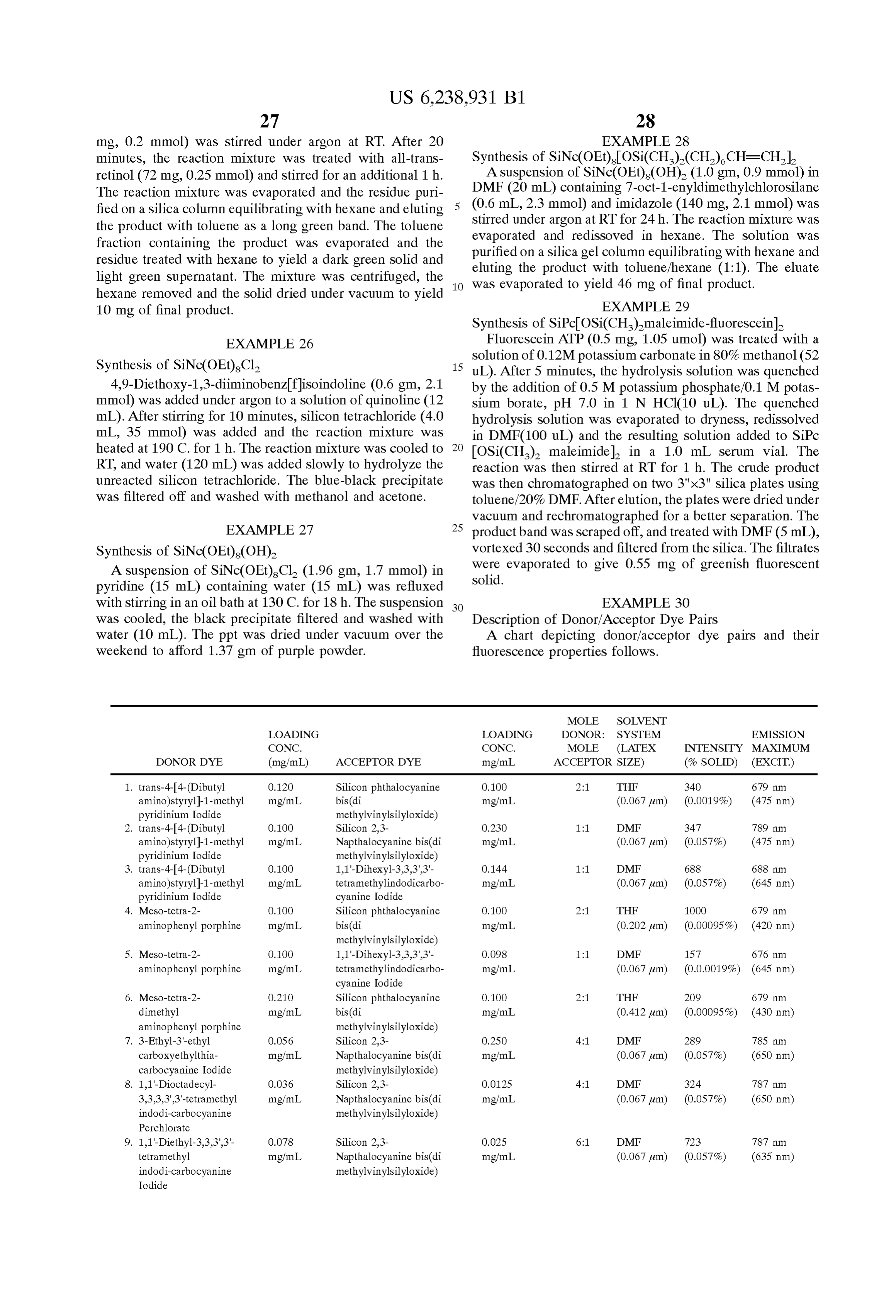
Page 23
Drawing sheet — no readable text.
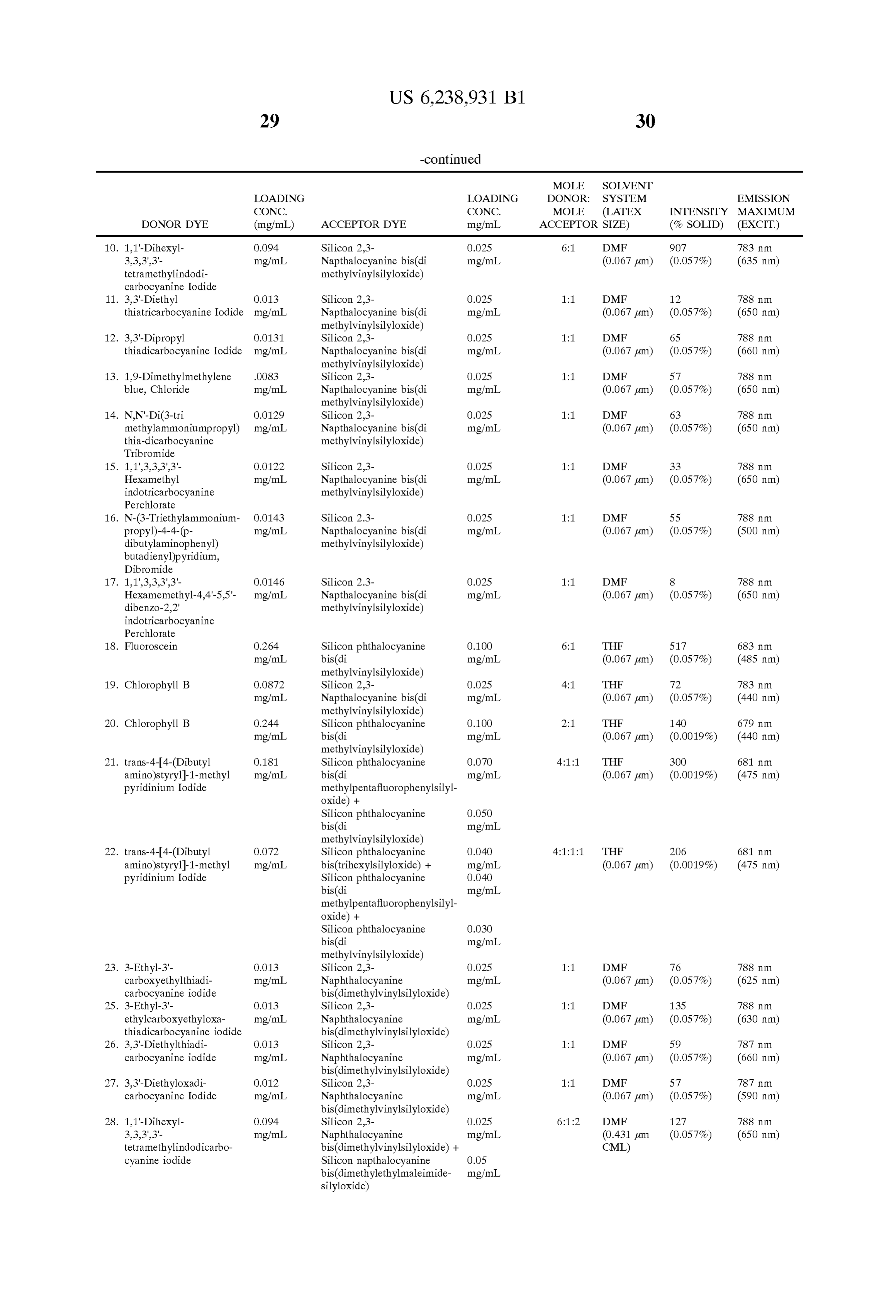
Page 24
Drawing sheet — no readable text.
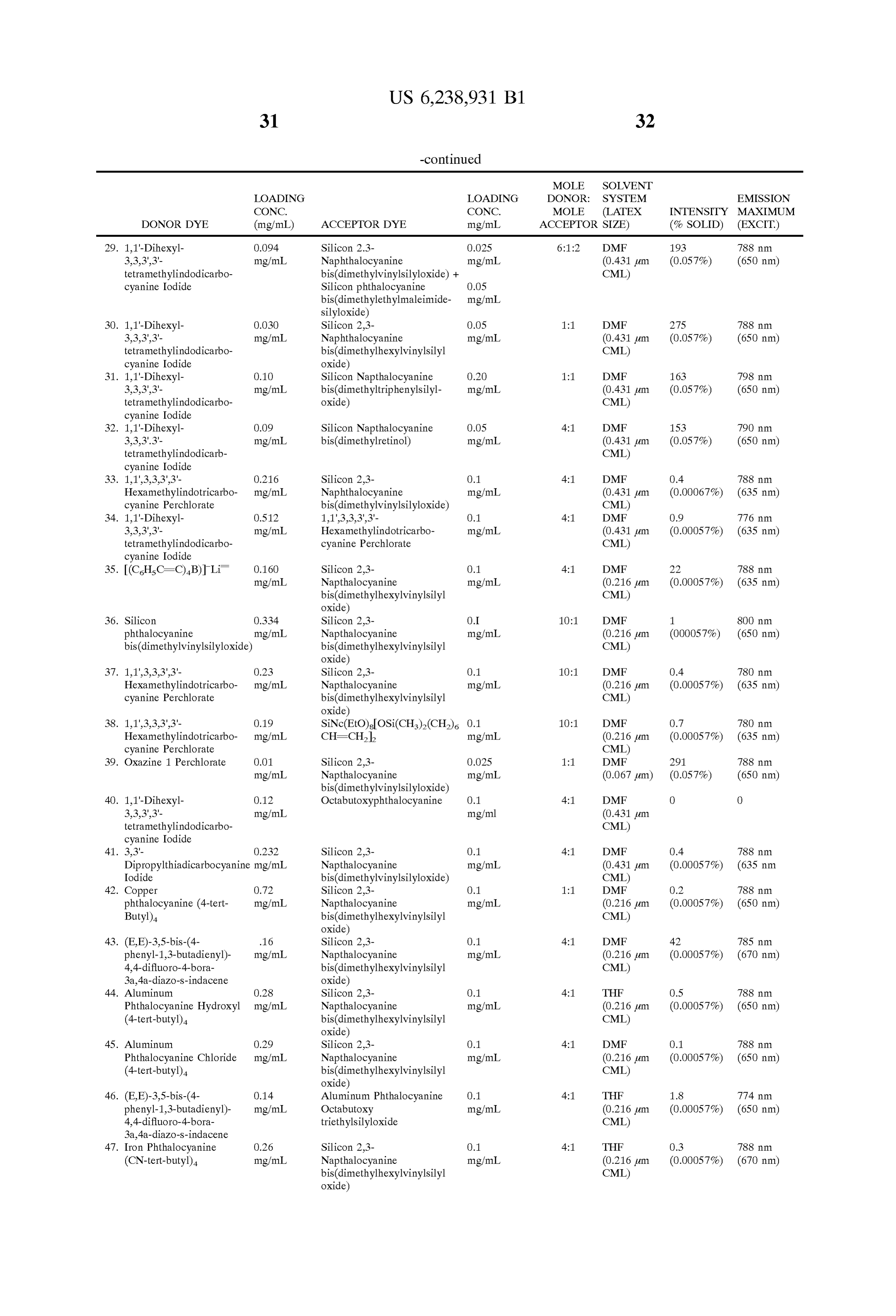
Page 25
Drawing sheet — no readable text.
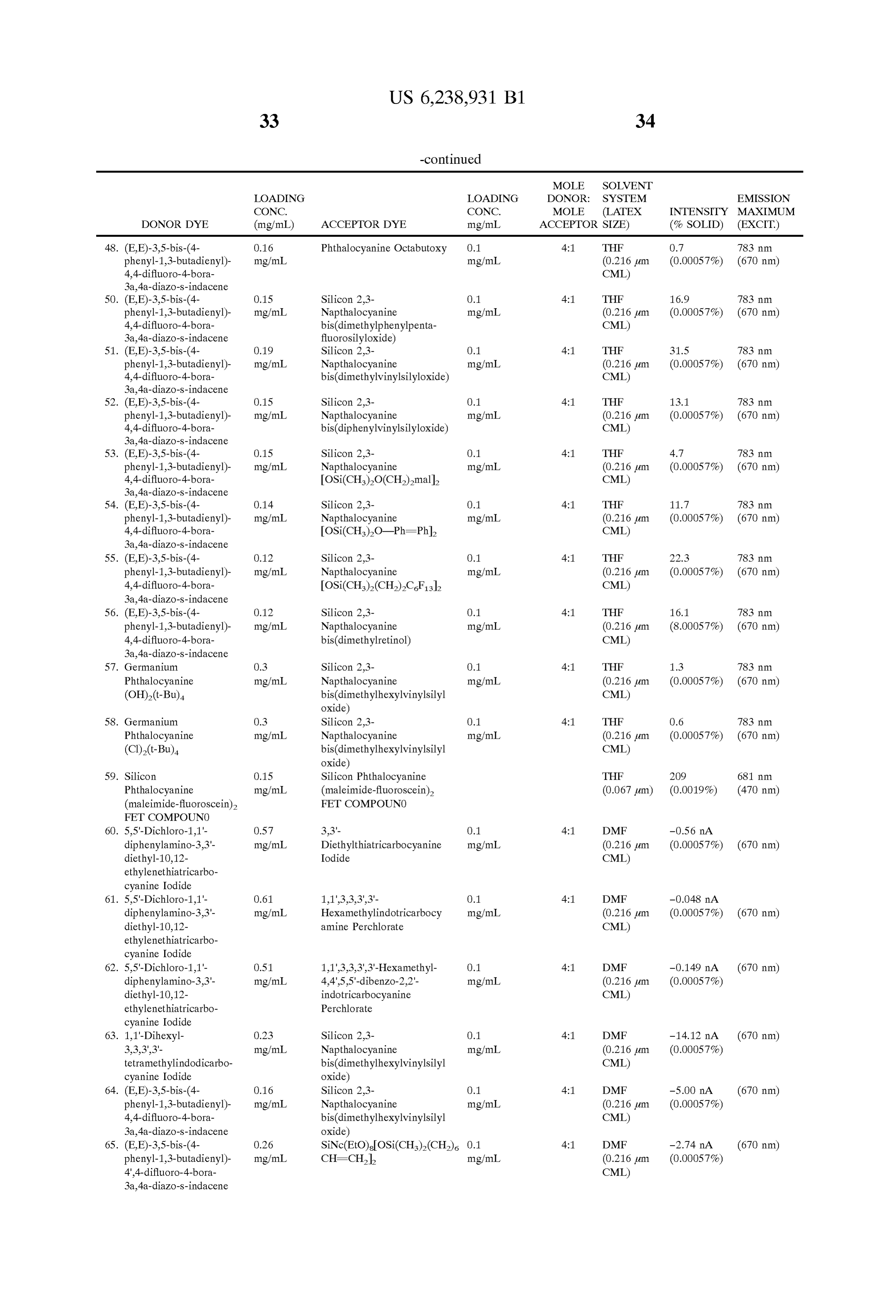
Page 26
Drawing sheet — no readable text.
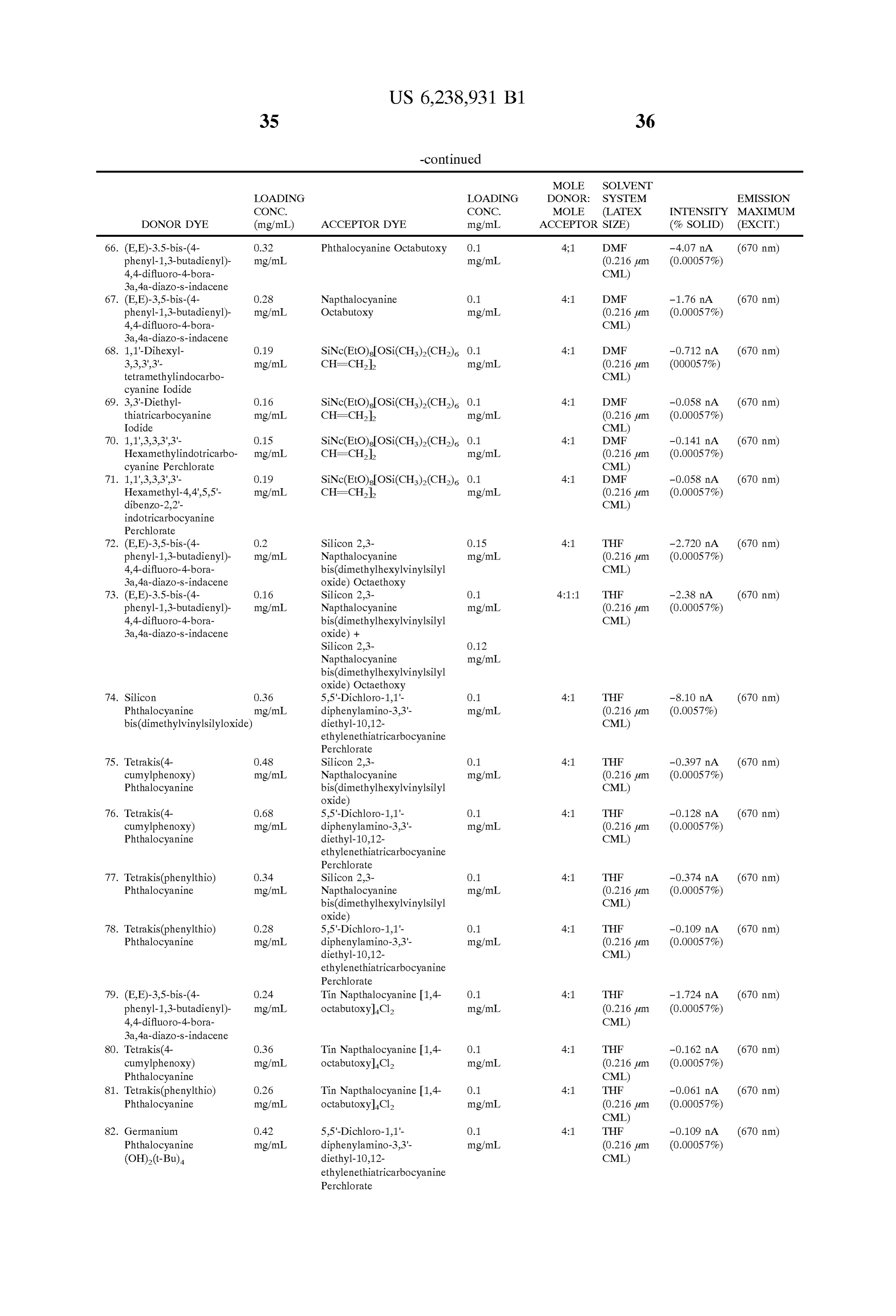
Page 27
MOLE SOLVENT
LOADING LOADING DONOR: SYSTEM EMISSION CONC. CONC. MOLE (LATEX INTENSITY MAXIMUM
DONOR DYE (mg/mL) ACCEPTOR DYE mg/mL. ACCEPTOR SIZE) (% SOLID) (EXCIT) 83. Germanium O.22 Tin Napthalocyanine 1,4- O1 4:1 THF -0.045 in A (670 nm) Phthalocyanine mg/mL. octabutoxy-Cl mg/mL. (0.216 um (0.00057%) (OH)2(t-Bu). CML) 84. Germanium O.2 Tin Napthalocyanine 1,4- O1 4:1 THF -0.042 nA (670 nm) Phthalocyanine mg/mL. octabutoxy-Cl mg/mL. (0.216 um (0.00057%) (OH)(t-Bu). CML) 85. Germanium O.42 5,5'-Dichloro-1,1- O1 4:1 THF -0.081 in A (670 nm) Phthalocyanine mg/mL. diphenylamino-3,3'- mg/mL. (0.216 um (0.00057%) (Cl)2(t-Bu). diethyl-10,12- CML) ethylenethiatricarbocyanine
Perchlorate 86. Germanium O.22 Tin Napthalocyanine 1,4- O1 4:1 THF –0.052 nA (670 nm) Phthalocyanine mg/mL. octabutoxy-Cl mg/mL. (0.216 um (0.00057%) (Cl)2(t-Bu). CML) 87. Germanium O.2 Tin Napthalocyanine 1,4- O1 4:1 THF –0.050 nA (670 nm) Phthalocyanine mg/mL. octabutoxyl (OSiFts), mg/mL. (0.216 um (0.00057%) (Cl),(t-Bu). CML) 88. (E.E)-3,5-bis-(4- O16 Silicon 2,3- O1 4:1:1 THF –0.315 nA (670 nm) phenyl-1,3-butadienyl)- mg/mL. Naphthalocyanine mg/mL. (0.216 um (0.00057%) 4,4-difluoro-4-bora- bis(dimethylhexylvinylsilyl CML)
ethylenethiatricarbocyanine
Perchlorate
We claim: 5. A loadable particle comprising an energy donor as a 1. A loadable particle comprising an energy donor as a first component and a fluorescent dye as a Second compo first component and an energy acceptor as a second com nent positioned in Said particle at an energy exchanging ponent positioned in Said particle at an energy exchanging distance from one another, wherein Said Second component distance from one another, wherein the two components 35 has an emission wavelength greater than approximately 680 have a Stokes shift of greater than or equal to 50 nm, wherein nm, and wherein Said Second component is naphthalocya Said first component has an excitation wavelength greater nine and the two components have a Stokes shift of greater than approximately 550 nm and Said Second component has than or equal to 50 nm.
an emission wavelength greater than approximately 680 nm, 6. A loadable particle comprising an energy donor as a Said particle having bound on its Surface, a protein, first component and a fluorescent dye as a Second compo polypeptide, nucleic acid, nucleotide or protein containing nent positioned at an energy exchanging distance from one ligand analogue. another, wherein Said Second component has an emission 2. A loadable particle comprising an energy donor as a wavelength greater than approximately 680 nm, and wherein first component and a fluorescent dye as a Second compo Said first component is phthalocyanine Substituted with at nent positioned in Said particle at an energy exchanging least one axial ligand and Said Second component is naph distance from one another, wherein Said Second component 45 thalocyanine Substituted with at least one axial ligand and has an emission wavelength greater than approximately 680 the two components have a Stokes shift of greater than or nm, and wherein Said first component is phthalocyanine equal to 50 nm.
Substituted with at least one axial ligand and the two 7. A particle loadable comprising an energy donor as a components have a Stokes shift of greater than or equal to 50 first component and a fluorescent dye as a Second compo . 50 nent positioned at an energy exchanging distance from one 3. A loadable particle comprising an energy donor as a another, wherein Said first component is a Salt of trans-4- first component and a fluorescent dye as a Second compo 4-(Dibutylamino)Styryl-1-methyl pyridine and said sec nent positioned in Said particle at an energy exchanging ond component is Silicon phthalocyanine bis distance from one another, wherein Said Second component (dimethylvinylsilyloxide) and the two components have a has an emission wavelength greater than approximately 680 55 Stokes shift of greater than or equal to 50 nm. nm, and wherein Said Second component is phthalocyanine 8. A particle loadable comprising an energy donor as a Substituted with at least one axial ligand and the two first component and a fluorescent dye as a Second compo components have a Stokes shift of greater than or equal to 50 nent positioned at an energy exchanging distance from one
4. A loadable particle comprising an energy donor as a 60 another, wherein Said first component is a Salt of trans-4- 4-(Dibutylamino)Styryl-1-methyl pyridine and said sec first component and a fluorescent dye as a Second compo ond component is Silion 2,3-Naphthalocyanine bis nent positioned in Said particle at an energy exchanging distance from one another, wherein Said Second component (dimethylvinylsilyloxide) and the two components have a has an emission wavelength greater than approximately 680 Stokes shift of greater than or equal to 50 nm. nm, and wherein Said first component is naphthalocyanine 9. A loadable particle comprising an energy donor as a Substituted with at least one axial ligand and the two 65 first component and a fluorescent dye as a Second compo components have a Stokes shift of greater than or equal to 50 nent positioned at an energy exchanging distance from one . another, wherein Said Second component has an emission
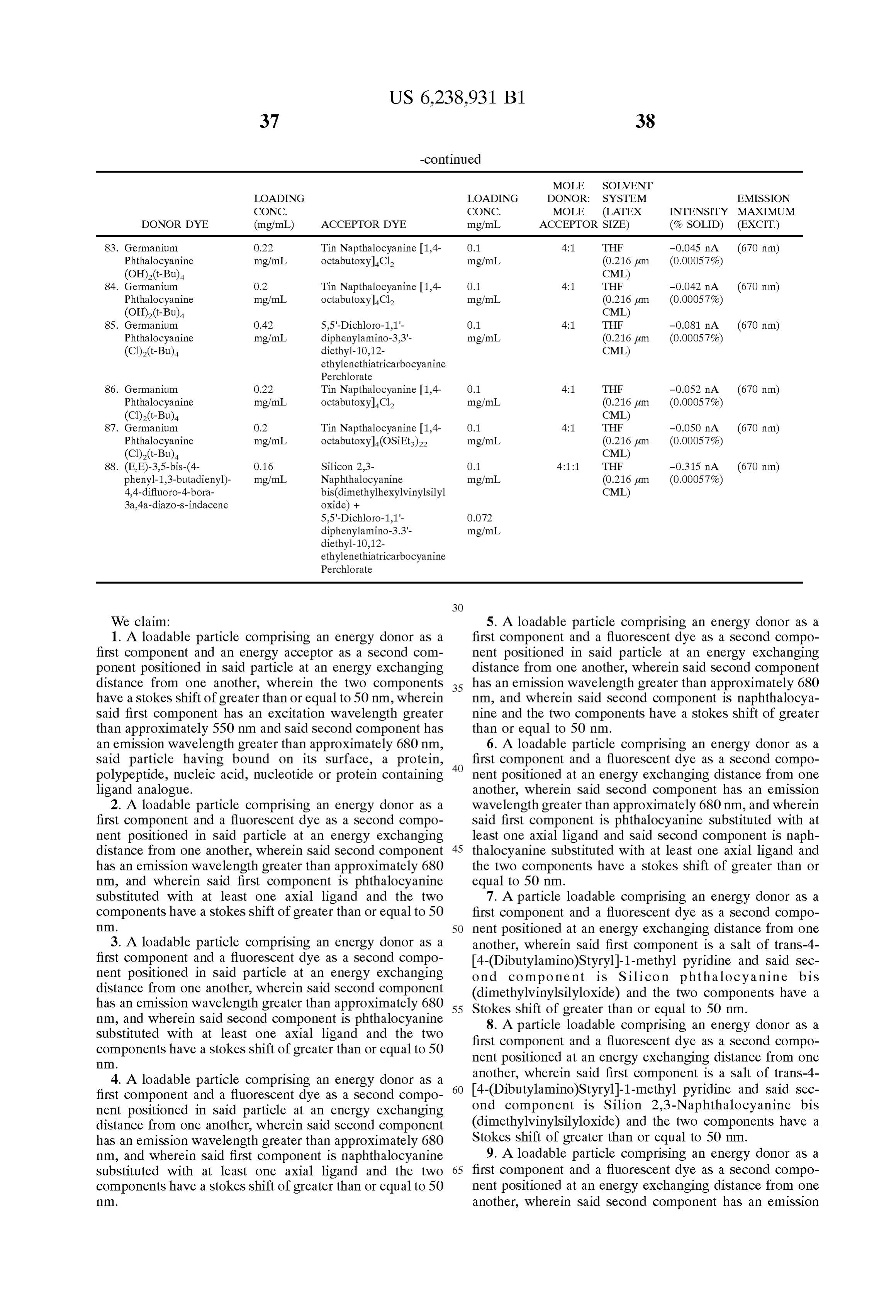
Page 28
wavelength greater than approximately 680 nm, and wherein thiatricarbocyanine and Said Second component is Silicon said first component is a Salt of trans-4-4-(Dibutylamino) 2,3-Naphthalocyanine bis(dimethylvinylsilyloxide) and the Styryl-1-methyl pyridine and said Second component is a two components have a Stokes shift of greater than or equal salt of 1,1-Dihexyl 3,3,3,3'-tetramethylindodicarbocyanine to 50 nm.
and the two components have a Stokes shift of greater than 18. A particle loadable comprising an energy donor as a or equal to 50 nm. first component and a fluorescent dye as a Second compo 10. A loadable particle comprising an energy donor as a nent positioned at an energy exchanging distance from one first component and a fluorescent dye as a Second compo another, wherein Said first component is a Salt of 3,3- nent positioned at an energy exchanging distance from one Dipropylthiatricarbocyanine and Said Second component is another, wherein Said first component is Meso-tetra-2- 1O Silicon 2,3-Naphthalocyanine bis(dimethylvinylsilyloxide) aminophenyl porphine and Said Second component is Silicon and the two components have a Stokes shift of greater than phthalocyanine bis(dimethylvinylsilyloxide) and the two or equal to 50 nm.
components have a Stokes shift of greater than or equal to 19. A particle loadable comprising an energy donor as a 50 nm. first component and a fluorescent dye as a Second compo 11. A loadable particle comprising an energy donor as a 15 nent positioned at an energy exchanging distance from one first component and a fluorescent dye as a Second compo another, wherein Said first component is a Salt of 1.9- nent positioned at an energy exchanging distance from one Dimethylmethylene blue and Said Second component is another, wherein Said Second component has an emission Silicon 2,3-Naphthalocyanine bis(dimethylvinylsilyloxide). wavelength greater than approximately 680 nm, and wherein 20. A loadable particle comprising an energy donor as a Said first component is Meso-tetra-2-aminophenyl porphine first component and a fluorescent dye as a Second compo and Said Second component is a Salt of 1,1-Dihexyl 3,3,3', nent positioned at an energy exchanging distance from one 3'-tetramethylindodicarbocyanine and the two components another, wherein said first component is a salt of N,N-Di(3- have a Stokes shift of greater than or equal to 50 nm. trimethylammoniumpropyl)thia-dicarbocyanine and said 12. A particle loadable comprising an energy donor as a Second component is Silicon 2,3-Naphthalocyanine bis first component and a fluorescent dye as a Second compo 25 (dimethylvinylsilyloxide) and the two components have a nent positioned at an energy exchanging distance from one Stokes shift of greater than or equal to 50 nm. another, wherein Said first component is Meso-tetra-2- 21. A particle loadable comprising an energy donor as a dimethylaminophenyl porphine and Said Second component first component and a fluorescent dye as a Second compo is Silicon phthalocyanine bis(dimethylvinylsilyloxide) and nent positioned at an energy exchanging distance from one the two components have a Stokes shift of greater than or another, wherein Said first component is a Salt of 1,1,3,3, equal to 50 nm. 3',3'-Hexamethylindotricarbocyanine and Said Second com 13. A particle comprising an energy donor as a first ponent is Silic on 2,3-Naphthalocyanine bis component and fluorescent dye as a Second component (dimethylvinylsilyloxide) and the two components have a positioned at an energy exchanging distance from one Stokes shift of greater than or equal to 50 nm. another, wherein said first component a salt of 3-Ethyl-3'- 35 22. A particle loadable comprising an energy donor as a ethyl carboxyethyl thiacarbocyanine and Said Second com first component and a fluorescent dye as a Second compo ponent is Silic on 2,3 - Napthalo cyanine b is nent positioned at an energy exchanging distance from one (dimethylvinylsilyloxide) and the two components have a another, wherein said first component is a salt of N-(3- Stokes shift of greater than or equal to 50 nm. Triethlylammoniumpropyl)-4-(4-(p-dibutylaminophenyl) 14. A particle loadable comprising an energy donor as a 40 butadienyl)pyridine and said Second component is Silicon first component and a fluorescent dye as a Second compo 2,3-Naphthalocyanine bis(dimethylvinylsilyloxide) and the nent positioned at an energy exchanging distance from one two components have a Stokes shift of greater than or equal another, wherein Said first component is a Salt of 1,1'- to 50 nm.
Dioctadecyl-3,3,3,3'-tetramethlyindodicarbocyanine and 23. A particle loadable comprising an energy donor as a Said Second component is Silicon 2,3-Naphthalocyanine 45 first component and a fluorescent dye as a Second compo bis(dimethylvinylsilyloxide) and the two components have a nent positioned at an energy exchanging distance from one Stokes shift of greater than or equal to 50 nm. another, wherein Said first component is a Salt of 1,1,3,3, 15. A particle loadable comprising an energy donor as a 3',3'-Hexamethyl-4,4'-5,5-dibenzo-2,2'indotricarbocyanine first component and a fluorescent dye as a Second compo and Said Second component is Silicon Naphthalocyanine nent positioned at an energy exchanging distance from one 50 bis(dimethylvinylsilyloxide) and the two components have a another, wherein Said first component is a Salt of 1,1'- Stokes shift of greater than or equal to 50 nm. Diethyl-3,3,3',3'-tetramethylindodicarbocyanine and said 24. A particle loadable comprising an energy donor as a Second component is Silicon 2,3-Naphthalocyanine bis first component and a fluorescent dye as a Second compo (dimethylvinylsilyloxide) and the two components have a nent positioned at an energy exchanging distance from one Stokes shift of greater than or equal to 50 nm. 55 another, wherein Said first component is Fluorescein and 16. A particle loadable comprising an energy donor as a Said Second component is Silicon Phthalocyanine bis first component and a fluorescent dye as a Second compo (dimethylvinylsilyloxide) and the two components have a nent positioned at an energy exchanging distance from one Stokes shift of greater than or equal to 50 nm. another, wherein Said first component is a Salt of 1,1'- 25. A particle loadable comprising an energy donor as a Dihexyl-3,3,3',3'-tetramethlyindodicarbocyanine and said 60 first component and a fluorescent dye as a Second compo Second component is Silicon 2,3-Naphthalocyanine bis nent positioned at an energy exchanging distance from one (dimethylvinylsilyloxide) and the two components have a another, wherein Said first component is Chlorophyll and Stokes shift of greater than or equal to 50 nm. Said Second component is Silicon 2,3-Naphthalocyanine 17. A particle loadable comprising an energy donor as a bis(dimethylvinylsilyloxide) and the two components have a first component and a fluorescent dye as a Second compo 65 Stokes shift of greater than or equal to 50 nm. nent positioned at an energy exchanging distance from one 26. A particle loadable comprising an energy donor as a another, wherein said first component is a salt of 3,3-Diethyl first component and a fluorescent dye as a Second compo
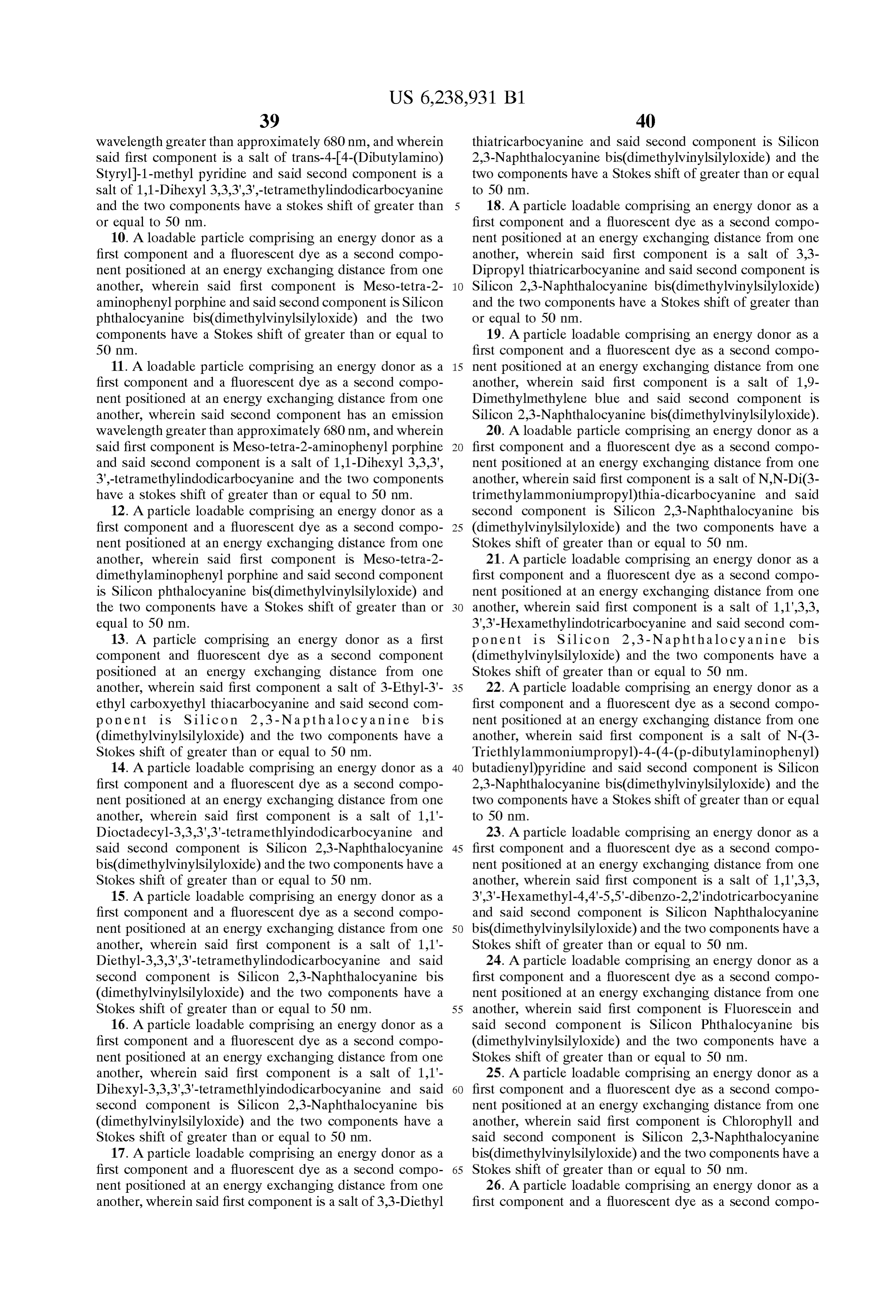
Page 29
nent positioned at an energy exchanging distance from one 34. A loadable particle comprising an energy donor as a another, wherein Said first component is Chlorophyll and first component and a fluorescent dye as a Second compo Said Second component is Silicon phthalocyanine bis nent positioned at an energy exchanging distance from one (dimethylvinylsilyloxide) and the two components have a another, wherein Said Second component has an emission Stokes shift of greater than or equal to 50 nm. wavelength greater than approximately 680 nm, and wherein 27. A particle comprising an energy donor as a first Said first component is a phenylhexatrienyl dye and Said component and Second and third components comprising 2 Second component is naphthalocyanine Substituted with at fluorescent dyes positioned at an energy exchanging dis least one axial ligand and the two components have a Stokes tance from one another, wherein Said first component is a shift of greater than or equal to 50 nm. salt of trans-4-4(Dibutylamino)styryl-1-methyl pyridine 35. A loadable particle comprising an energy donor as a and one of dyes is Selected from the group consisting of first component and a fluorescent dye as a Second compo Silic on phthalo cyanine b is nent positioned at an energy exchanging distance from one (dimethylpentafluorophenylsilyloxide) and Silicon phthalo another, wherein Said Second component has an emission cyanine bis(dimethlylvinylsilyloxide). wavelength greater than approximately 680 nm, and wherein 28. A particle comprising an energy donor as a first 15 Said first component is a porphine dye and Said Second component and 3 fluorescent dyes positioned at an energy component is phthalocyanine Substituted with at least one eXchanging distance from one another, wherein Said first axial ligand and the two components have a Stokes shift of component is a Salt of trans-4-4(Dibutylamino)Styryl-1- greater than or equal to 50 nm.
methyl pyridine and Said three dyes are Selected from the 36. A loadable particle comprising an energy donor as a group consisting of Silicon phthalocyanine bis first component and a fluorescent dye as a Second compo (trihexylsilyloxide), Silicon phthalacyanine bis nent positioned at an energy exchanging distance from one (dimethylpentafluorophenylsilyloxide), Silicon phthalocya another, wherein Said Second component has an emission nine bis(dimethylvinylsilyloxide). wavelength greater than approximately 680 nm, and wherein 29. A loadable particle comprising an energy donor as a Said first component is a porphine dye and Said Second first component and a fluorescent dye as a Second compo component is naphthalocyanine Substituted with at least one nent positioned at an energy exchanging distance from one 25 axial ligand and the two components have a Stokes shift of another, wherein Said Second component has an emission greater than or equal to 50 nm.
wavelength greater than approximately 680 nm, and wherein 37. A loadable particle comprising an energy donor as a Said first component is a Styryl dye and Said Second com first component and a fluorescent dye as a Second compo ponent is phthalocyanine Substituted with at least one axial nent positioned at an energy exchanging distance from one ligand and the two components have a Stokes shift of greater another, wherein Said Second component has an emission than or equal to 50 nm. wavelength greater than approximately 680 nm, and wherein 30. A loadable particle comprising an energy donor as a Said first component is a carbocyanine dye and Said Second first component and a fluorescent dye as a Second compo component is phthalocyanine Substituted with at least one nent positioned at an energy distance from one another, axial ligand and the two components have a Stokes shift of wherein Said Second component has an emission wavelength 35 greater than or equal to 50 nm.
greater than approximately 680 nm, and wherein Said first 38. A loadable particle comprising an energy donor as a component is a Styryl dye and Said Second component is first component and a fluorescent dye as a Second compo naphthalocyanine Substituted with at least one axial ligand nent positioned at an energy exchanging distance from one and the two components have a Stokes shift of greater than another, wherein Said Second component has an emission or equal to 50 nm. 40 wavelength greater than approximately 680 nm, and wherein 31. A loadable particle comprising an energy donor as a Said first component is a carbocyanine dye and Said Second first component and a fluorescent dye as a Second compo component is naphthalocyanine Substituted with at least one nent positioned at an energy exchanging distance from one axial ligand and the two components have a Stokes shift of another, wherein Said Second component has an emission greater than or equal to 50 nm.
wavelength greater than approximately 680 nm, and wherein 45 39. A loadable particle in accordance with any of claims Said first component is a phenylbutadienyl dye and Said 1-11, 20 or 29–38, wherein said loadable particle is latex. Second component is phthalocyanine Substituted with at 40. A loadable particle in accordance with any of claims least one axial ligand and the two components have a Stokes 1-11, 20, or 29–38 wherein said particle comprises two or shift of greater than or equal to 50 nm. more dye molecules having approximately the same exci 32. A loadable particle comprising an energy donor as a 50 tation and emission wavelengths, whereby quenching is first component and a fluorescent dye as a Second compo decreased and fluorescence intensity is increased by the nent positioned at an energy exchanging distance from one combination of Said dye molecules.
another, wherein Said Second component has an emission 41. The particle of any one of claims 1-26 or 29–38 wavelength greater than approximately 680 nm, and wherein comprising at least one additional fluorescent dye as a third Said first component is a phenylbutadienyl dye and Said 55 component, Said third component exhibiting in the particle Second component is naphthalocyanine Substituted with at approximately the same excitation and emission wave least one axial ligand and the two components have a Stokes lengths as Said Second component, whereby quenching is shift of greater than or equal to 50 nm. decreased and fluorescence intensity is increased by the 33. A loadable particle comprising an energy donor as a combination of Said Second and Said additional component first component and a fluorescent dye as a Second compo 60 (s).
nent positioned at an energy exchanging distance from one 42. The particle of claim 27 comprising at least one another, wherein Said Second component has an emission additional fluorescent dye as a fourth component, Said fourth wavelength greater than approximately 680 nm, and wherein component exhibiting in the particle approximately the same Said first component is a phenylhexatrienyl dye and Said excitation and emission wavelengths as one of Said Second Second component is phthalocyanine Substituted with at 65 or third components, whereby quenching is decreased and least one axial ligand and the two components have a Stokes fluorescence intensity is increased by the combination of shift of greater than or equal to 50 nm. Said Second or third and Said fourth components.
Page 30
43. The loadable particle of any of claims 1-11, 20, or 53. An improved particle in accordance with any of claims 29-38 comprising at least one additional fluorescent dye as 7, 8, 12-19, or 21-28 wherein the improvement comprises a third component, Said third component exhibiting in the adding to Said particle two or more dye molecules having particle approximately the same excitation and emission approximately the same excitation and emission wavelengths as Said Second component, whereby quenching wavelengths, whereby quenching is decreased and fluores is decreased and fluorescence intensity is increased by the cence intensity is increased by the combination of Said dye combination of Said Second and Said additional component molecules.
(S). 54. A particle for assaying analytes in a biological 44. A loadable particle in accordance with claim 1 medium comprising an energy donor as a first component wherein the energy donor and/or the energy acceptor are and an energy acceptor as a Second component positioned in incorporated inside the particle.
45. A loadable particle in accordance with claim 1 Said particle at an energy exchanging distance from one another, wherein Said first component has an excitation wherein the energy donor and/or the energy acceptor are wavelength greater than about 600 nm, Said Second compo incorporated at the Surface of the particle.
46. A loadable particle in accordance with claim 40 15 nent has at least one emission wavelength other than the wherein the dye molecules having approximately the same intrinsic fluorescent wavelength of the biological medium, excitation and emission wavelengths are incorporated inside and the two components have a Stokes shift of greater than the particle. or equal to 50 nm, said particle having bound on its Surface, 47. A loadable particle in accordance with claim 40 a protein, polypeptide, nucleic acid, ligand analogue, nucle wherein the dye molecules having approximately the same otide or a protein-containing ligand analogue. excitation and emission wavelengths are incorporated at the 55. A particle comprising an energy donor as a first Surface of the particle. component, an energy acceptor as a Second component, and 48. A lateX particle comprising an energy donor as a first at least one additional energy acceptor as a third component, component and an energy acceptor as a Second component wherein: (1) said first component and said Second compo positioned in Said particle at an energy exchanging distance 25 nent are positioned in Said particle at an energy exchanging from one another, wherein; (1) Said first component has an distance from one another; (2) said first component has an excitation wavelength greater than approximately 550 nm excitation wavelength greater than approximately 550 nm and Said Second component has an emission wavelength and Said Second component has an emission wavelength greater than approximately 680 nm; (2) said first component greater than approximately 680 nm, (3) said first component is a fluorescent dye and Said Second component is and Said Second component have a Stokes shift of greater phthalocyanine-Substituted with at least one axial ligand; than or equal to 50 nm, and (4) said third component is a and (3) the two components have a Stokes shift of greater fluorescent dye, Said third component exhibiting in the than or equal to 50 nm.
49. A particle comprising an energy donor as a first particle approximately the same excitation and emission component and an energy acceptor as a Second component 35 wavelengths as Said Second component, whereby quenching positioned in Said particle at an energy exchanging distance is decreased and fluorescence intensity is increased by the from one another, wherein: (1) Said first component has an combination of Said Second and Said third component. 56. A particle comprising an energy donor as a first excitation wavelength greater than approximately 550 nm and Said Second component has an emission wavelength, component, an energy acceptor having an absorbance wave greater than approximately 680 nm, (2) said Second com 40 length approximately equal to the emission wavelength of ponent is phthalocyanine Substituted with at least one axial Said first component as a Second component, and at least one ligand; and (3) the two components have a Stokes shift of Said additional energy acceptor as a third component, wherein greater than or equal to 50 nm. first component and Said Second component are posi 50. A lateX particle comprising an energy donor as a first tioned in Said particle at an energy exchanging distance from component and an energy acceptor as a Second component 45 one another, wherein Said first component and Said Second positioned in Said particle at an energy exchanging distance component have a Stokes shift of greater than or equal to 50 from one another, wherein: (1) said first component is a nm, and wherein Said third component is a fluorescent dye fluorescent dye having an excitation wavelength greater than exhibiting in the particle approximately the same excitation approximately 550 nm and Said Second component is a and emission wavelengths as Said Second component, fluorescent dye having an emission wavelength greater than 50 whereby quenching is decreased and fluorescence intensity is increased by the combination of Said Second and Said third approximately 680 nm, and (2) the two components have a component.
Stokes shift of greater than or equal to 50 nm.
51. A particle in accordance with any of claims 7, 8, 57. A loadable particle in accordance with any of claims 12-19, or 21-28 wherein said particle is selected from the 1-11, 20, or 29–38 wherein said particle is selected from the group consisting of Silica, alumina, liposomes and colloids. 55 group consisting of Silica, alumina, liposomes and colloids. 52. A particle in accordance with any of claims 7, 8, 12-19, or 21-28, wherein said particle is latex.
Provenance
- Collection
- Cited prior art
- Original PDF
- patentimages.storage.googleapis.com →
- Filed
- 1994-07-12
- Pages
- 30
- Method
- pdftotext (the PDF's own text layer) + pdftoppm 300dpi page scans
- Source
- Google Patents bibliographic record
- Granted
- 2001-05-29
- Inventors
- Kenneth F. Buechler; Joseph Barry Noar; Lema Tadesse; Biosite Diagnostics Inc
- Transcribed from
- patentimages.storage.googleapis.com →