patent · US4588577
Method for generating hydrogen
13 May 1986
Page 1 — bibliographic record
United
Cardinal
States Patent (19) 11) Patent Number: 4,588,577
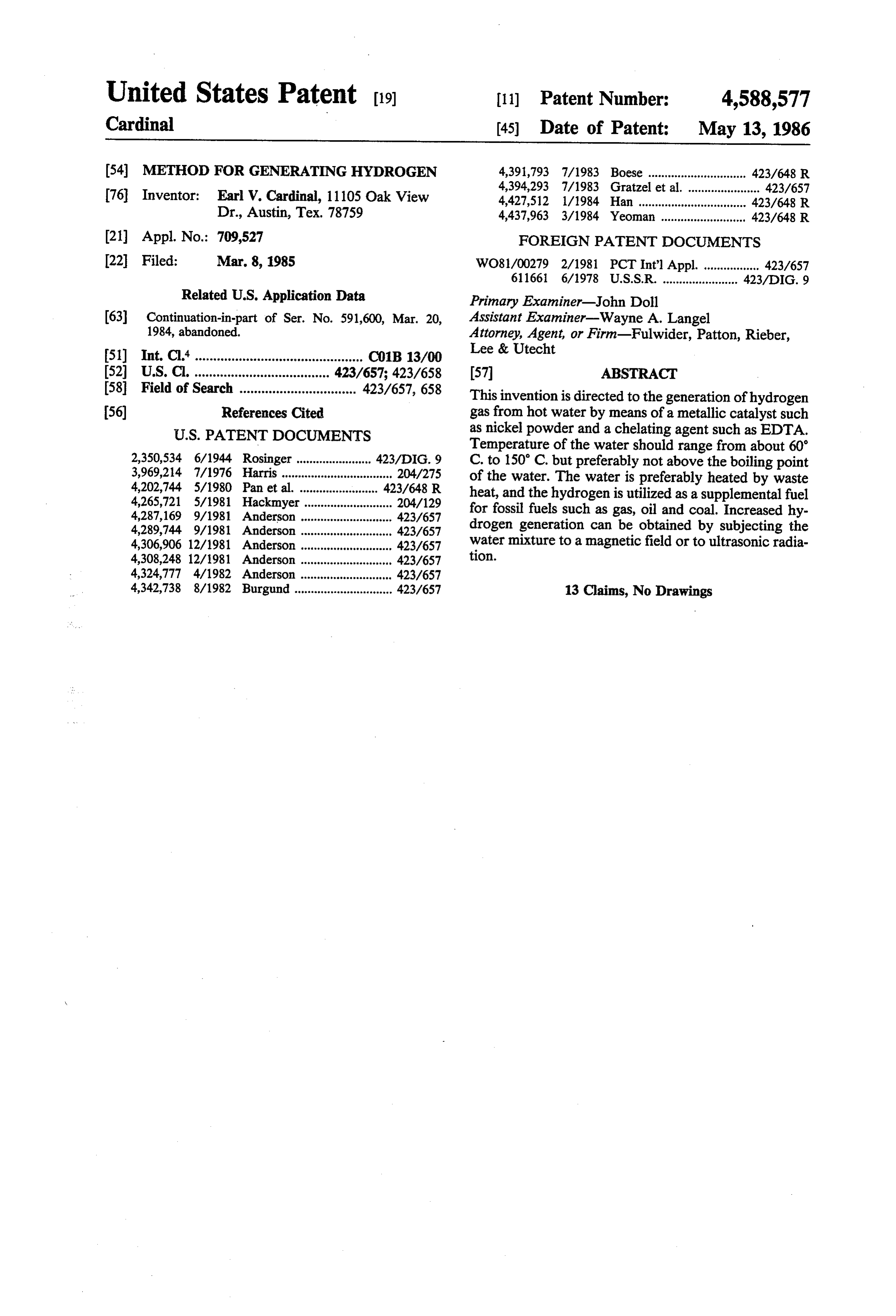
(54) METHOD FOR GENERATING HYDROGEN 4,391,793 7/1983 Boese ............ ... 423/648 R 4,394,293 7/1983 Gratzel et al. ...................... 423/657 76 Inventor: Earl V. Cardinal, 11105 Oak View 4,427,512 1/1984 Han ............... ... 423/648 R Dr., Austin, Tex. 78759 4,437,963 3/1984 Yeoman .......................... 423/648 R (21) Appl. No.: 709,527 FOREIGN PATENT DOCUMENTS 22 Filed: Mar. 8, 1985 WO81/00279 2/1981 PCT Int'l Appl. ................. 423/657
Related U.S. Application Data Primary Examiner-John Doll 63 Continuation-in-part of Ser. No. 591,600, Mar. 20, Assistant Examiner-Wayne A. Langel 1984, abandoned. Attorney, Agent, or Firm-Fulwider, Patton, Rieber, Lee & Utecht 51) Int. Cl." .............................................. COB 13/00 52 U.S. Cl. ................ ... 423/657; 423/658 57 ABSTRACT 58 Field of Search ................................ 423/657, 658 This invention is directed to the generation of hydrogen (56) References Cited gas from hot water by means of a metallic catalyst such
Temperature of the water should range from about 60' 2,350,534 6/1944 Rosinger ....................... 423/DIG. 9 C. to 150° C. but preferably not above the boiling point 3,969,214 7/1976 Harris.................................. 204/275 of the water. The water is preferably heated by waste 4,202,744 5/1980 Pan et al. ..... ... 423/648 R heat, and the hydrogen is utilized as a supplemental fuel 4,265,721 5/1981 Hackmyer ........................... 204/129 for fossil fuels such as gas, oil and coal. Increased hy 4,287,169 9/1981 Anderson ..... ... 423/657 drogen generation can be obtained by subjecting the 4,289,744 9/1981 Anderson ..... ... 423/657 4,306,906 12/1981 Anderson ..... ... 423/657 water mixture to a magnetic field or to ultrasonic radia 4,308,248 12/1981 Anderson ..... ... 42.3/657 tion.
4,324,777 4/1982 Anderson ..... ... 423/657 4,342,738 8/1982 Burgund .............................. 423/657 13 Claims, No Drawings
Page 2
manganese, copper and alloys thereof. Generally, the
METHOD FOR GENERATING HYDROGEN particle size of the catalyst should be small enough to pass through a 20 mesh screen, and preferably through
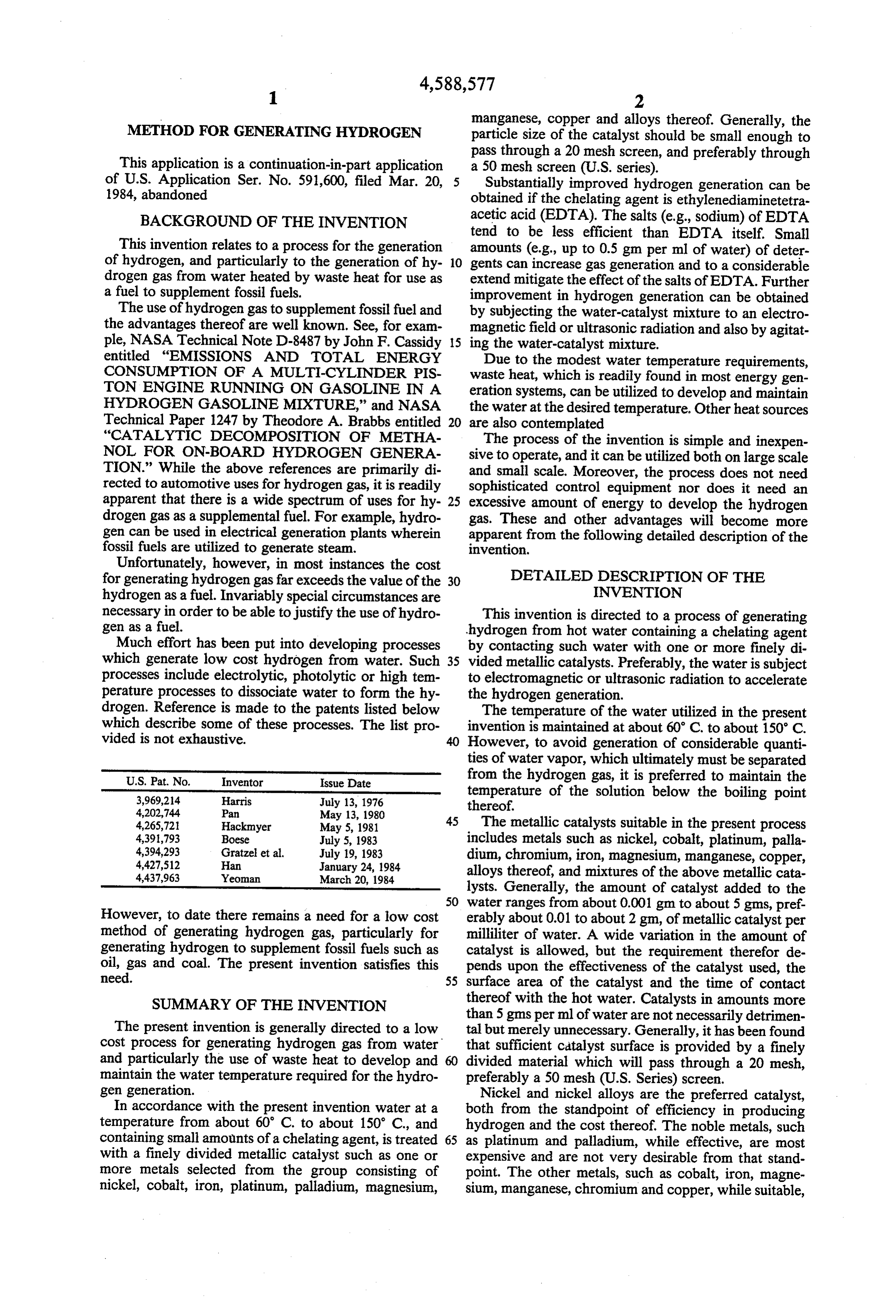
This application is a continuation-in-part application a 50 mesh screen (U.S. series). of U.S. Application Ser. No. 591,600, filed Mar. 20, Substantially improved hydrogen generation can be 1984, abandoned obtained if the chelating agent is ethylenediaminetetra BACKGROUND OF THE INVENTION acetic acid (EDTA). The salts (e.g., sodium) of EDTA tend to be less efficient than EDTA itself. Small
This invention relates to a process for the generation of hydrogen, and particularly to the generation of hy 10 amounts (e.g., up to 0.5gm per ml of water) of deter gents can increase gas generation and to a considerable drogen gas from water heated by waste heat for use as extend mitigate the effect of the salts of EDTA. Further a fuel to supplement fossil fuels. improvement in hydrogen generation can be obtained The use of hydrogen gas to supplement fossil fuel and by subjecting the water-catalyst mixture to an electro the advantages thereof are well known. See, for exam magnetic field or ultrasonic radiation and also by agitat ple, NASA Technical Note D-8487 by John F. Cassidy 15 ing the water-catalyst mixture.
entitled “EMISSIONS AND TOTAL ENERGY Due to the modest water temperature requirements, CONSUMPTION OF A MULTI-CYLINDER PIS waste heat, which is readily found in most energy gen TON ENGINE RUNNING ON GASOLINE IN A eration systems, can be utilized to develop and maintain HYDROGEN GASOLINE MIXTURE,” and NASA the water at the desired temperature. Other heat sources Technical Paper 1247 by Theodore A. Brabbs entitled 20 are also contemplated “CATALYTIC DECOMPOSITION OF METHA The process of the invention is simple and inexpen NOL FOR ON-BOARD HYDROGEN GENERA sive to operate, and it can be utilized both on large scale TION.' While the above references are primarily di and small scale. Moreover, the process does not need rected to automotive uses for hydrogen gas, it is readily sophisticated control equipment nor does it need an apparent that there is a wide spectrum of uses for hy 25 excessive amount of energy to develop the hydrogen drogen gas as a supplemental fuel. For example, hydro gas. These and other advantages will become more gen can be used in electrical generation plants wherein apparent from the following detailed description of the fossil fuels are utilized to generate steam. invention.
Unfortunately, however, in most instances the cost for generating hydrogen gas far exceeds the value of the 30 DETAILED DESCRIPTION OF THE hydrogen as a fuel. Invariably special circumstances are INVENTION necessary in order to be able to justify the use of hydro This invention is directed to a process of generating gen as a fuel. hydrogen from hot water containing a chelating agent Much effort has been put into developing processes by contacting such water with one or more finely di which generate low cost hydrogen from water. Such 35 vided metallic catalysts. Preferably, the water is subject processes include electrolytic, photolytic or high tem to electromagnetic or ultrasonic radiation to accelerate perature processes to dissociate water to form the hy the hydrogen generation.
drogen. Reference is made to the patents listed below The temperature of the water utilized in the present which describe some of these processes. The list pro invention is maintained at about 60° C. to about 150 C. vided is not exhaustive. However, to avoid generation of considerable quanti ties of water vapor, which ultimately must be separated
U.S. Pat. No. Inventor Issue Date from the hydrogen gas, it is preferred to maintain the
temperature of the solution below the boiling point
thereof.
4,265,721 Hackmyer May 5, 1981 45 The metallic catalysts suitable in the present process 4,391,793 Boese July 5, 1983 includes metals such as nickel, cobalt, platinum, palla
Gratzel et al.
Han
dium, chromium, iron, magnesium, manganese, copper, 4,437,963 Yeoman March 20, 1984 alloys thereof, and mixtures of the above metallic cata lysts. Generally, the amount of catalyst added to the 50 water ranges from about 0.001 gm to about 5 gms, pref
However, to date there remains a need for a low cost erably about 0.01 to about 2 gm, of metallic catalyst per method of generating hydrogen gas, particularly for milliliter of water. A wide variation in the amount of generating hydrogen to supplement fossil fuels such as catalyst is allowed, but the requirement therefor de oil, gas and coal. The present invention satisfies this pends upon the effectiveness of the catalyst used, the need. 55 surface area of the catalyst and the time of contact SUMMARY OF THE INVENTION thereof with the hot water. Catalysts in amounts more than 5gms per ml of water are not necessarily detrimen
The present invention is generally directed to a low tal but merely unnecessary. Generally, it has been found cost process for generating hydrogen gas from water that sufficient catalyst surface is provided by a finely and particularly the use of waste heat to develop and 60 divided material which will pass through a 20 mesh, maintain the water temperature required for the hydro preferably a 50 mesh (U.S. Series) screen. gen generation. Nickel and nickel alloys are the preferred catalyst, In accordance with the present invention water at a both from the standpoint of efficiency in producing temperature from about 60° C. to about 150 C., and hydrogen and the cost thereof. The noble metals, such containing small amounts of a chelating agent, is treated 65 as platinum and palladium, while effective, are most with a finely divided metallic catalyst such as one or expensive and are not very desirable from that stand more metals selected from the group consisting of point. The other metals, such as cobalt, iron, magne nickel, cobalt, iron, platinum, palladium, magnesium, sium, manganese, chromium and copper, while suitable,
Page 3
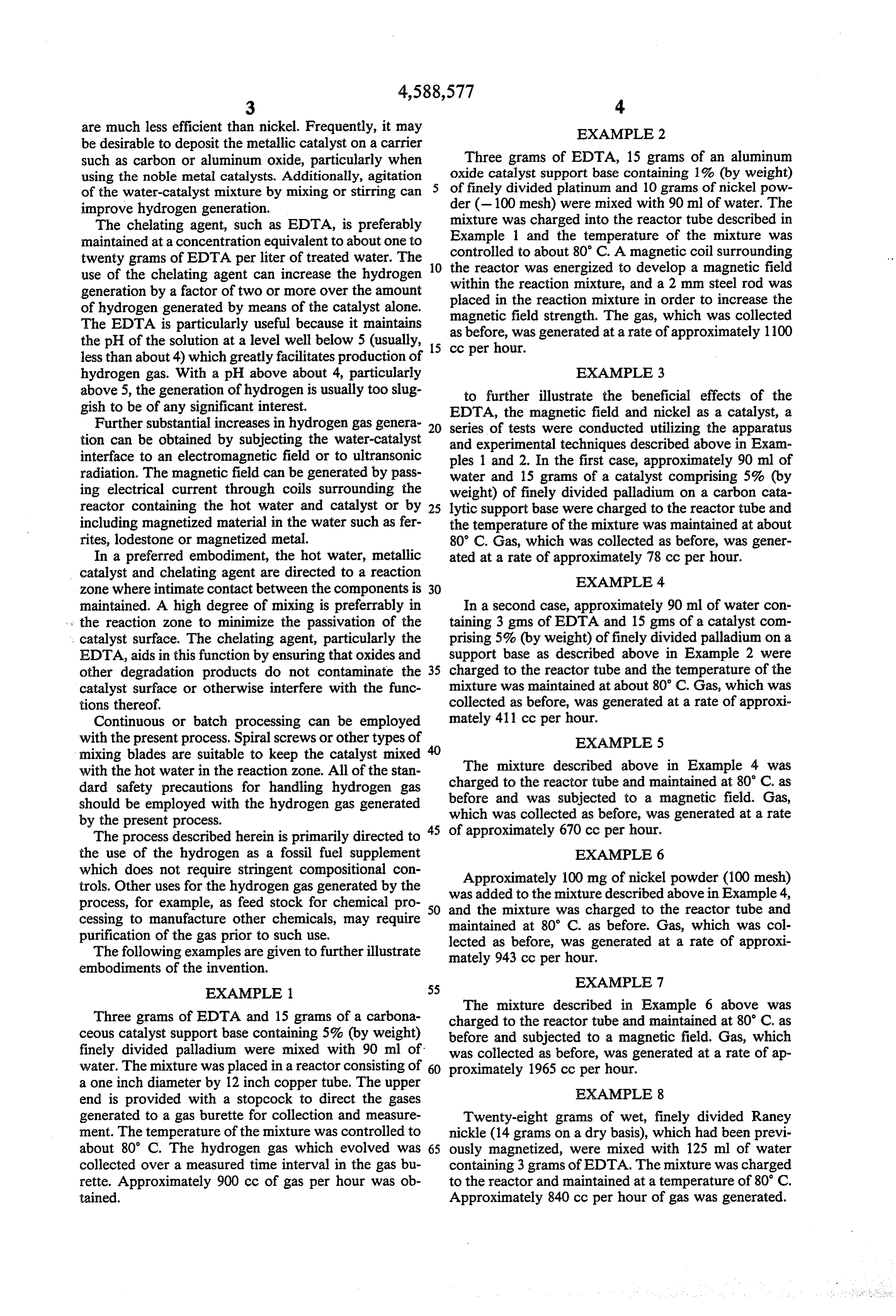
are much less efficient than nickel. Frequently, it may EXAMPLE 2 be desirable to deposit the metallic catalyst on a carrier such as carbon or aluminum oxide, particularly when Three grams of EDTA, 15 grams of an aluminum using the noble metal catalysts. Additionally, agitation oxide catalyst support base containing 1% (by weight) of the water-catalyst mixture by mixing or stirring can of finely divided platinum and 10 grams of nickel pow improve hydrogen generation. der (-100 mesh) were mixed with 90 ml of water. The The chelating agent, such as EDTA, is preferably mixture was charged into the reactor tube described in Example 1 and the temperature of the mixture was maintained at a concentration equivalent to about one to controlled twenty grams of EDTA per liter of treated water. The 10 the reactortowas about 80 C. A magnetic coil surrounding energized to develop a magnetic field use of the chelating agent can increase the hydrogen within the reaction mixture, and a 2 mm steel rod was generation by a factor of two or more over the amount of hydrogen generated by means of the catalyst alone. placed in the reaction mixture in order to increase the magnetic field strength. The gas, which was collected
The EDTA is particularly useful because it maintains as the pH of the solution at a level well below 5 (usually, 5 cc before, per was generated at a rate of approximately 1100 hour.
less than about 4) which greatly facilitates production of hydrogen gas. With a pH above about 4, particularly EXAMPLE 3 above 5, the generation of hydrogen is usually too slug to further illustrate the beneficial effects of the gish to be of any significant interest. EDTA, the magnetic field and nickel as a catalyst, a Further substantial increases in hydrogen gas genera 20 series of tests were conducted utilizing the apparatus tion can be obtained by subjecting the water-catalyst and experimental techniques described above in Exam interface to an electromagnetic field or to ultransonic ples 1 and 2. In the first case, approximately 90 ml of radiation. The magnetic field can be generated by pass water and 15 grams of a catalyst comprising 5% (by ing electrical current through coils surrounding the weight) of finely divided palladium on a carbon cata reactor containing the hot water and catalyst or by 25 lytic support base were charged to the reactor tube and including magnetized material in the water such as fer the temperature of the mixture was maintained at about rites, lodestone or magnetized metal. 80' C. Gas, which was collected as before, was gener In a preferred embodiment, the hot water, metallic ated at a rate of approximately 78 cc per hour. catalyst and chelating agent are directed to a reaction EXAMPLE 4 zone where intimate contact between the components is 30 maintained. A high degree of mixing is preferrably in In a second case, approximately 90 ml of water con the reaction zone to minimize the passivation of the taining 3 gms of EDTA and 15 gms of a catalyst com catalyst surface. The chelating agent, particularly the prising 5% (by weight) of finely divided palladium on a EDTA, aids in this function by ensuring that oxides and support base as described above in Example 2 were other degradation products do not contaminate the 35 charged to the reactor tube and the temperature of the catalyst surface or otherwise interfere with the func mixture was maintained at about 80 C. Gas, which was tions thereof, collected as before, was generated at a rate of approxi Continuous or batch processing can be employed mately 411 cc per hour.
with the present process. Spiral screws or other types of EXAMPLES mixing blades are suitable to keep the catalyst mixed 40 with the hot water in the reaction zone. All of the stan The mixture described above in Example 4 was dard safety precautions for handling hydrogen gas charged to the reactor tube and maintained at 80° C. as should be employed with the hydrogen gas generated before and was subjected to a magnetic field. Gas, by the present process. which was collected as before, was generated at a rate 45 of approximately 670 cc per hour.
The process described herein is primarily directed to the use of the hydrogen as a fossil fuel supplement EXAMPLE 6 which does not require stringent compositional con trols. Other uses for the hydrogen gas generated by the wasApproximately added to the 100 mg of nickel powder (100 mesh) mixture described above in Example 4, process, for example, as feed stock for chemical pro SO and the mixture was charged cessing to manufacture other chemicals, may require maintained at 80 C. as before.to Gas, the reactor tube and which was col purification of the gas prior to such use. lected as before, was generated at a rate of approxi The following examples are given to further illustrate mately 943 cc per hour.
embodiments of the invention.
EXAMPLE 1.
The mixture described in Example 6 above was
Three grams of EDTA and 15 grams of a carbona charged to the reactor tube and maintained at 80 C. as ceous catalyst support base containing 5% (by weight) before and subjected to a magnetic field. Gas, which finely divided palladium were mixed with 90 ml of was collected as before, was generated at a rate of ap water. The mixture was placed in a reactor consisting of 60 proximately 1965 cc per hour. a one inch diameter by 12 inch copper tube. The upper EXAMPLE 8 end is provided with a stopcock to direct the gases generated to a gas burette for collection and measure Twenty-eight grams of wet, finely divided Raney ment. The temperature of the mixture was controlled to nickle (14 grams on a dry basis), which had been previ about 80° C. The hydrogen gas which evolved was 65 ously magnetized, were mixed with 125 ml of water collected over a measured time interval in the gas bu containing 3 grams of EDTA. The mixture was charged rette. Approximately 900 cc of gas per hour was ob to the reactor and maintained at a temperature of 80 C. tained. Approximately 840 cc per hour of gas was generated.
Page 4
EXAMPLE 9 cobalt, iron, palladium, platinum, copper, magnesium, manganese,
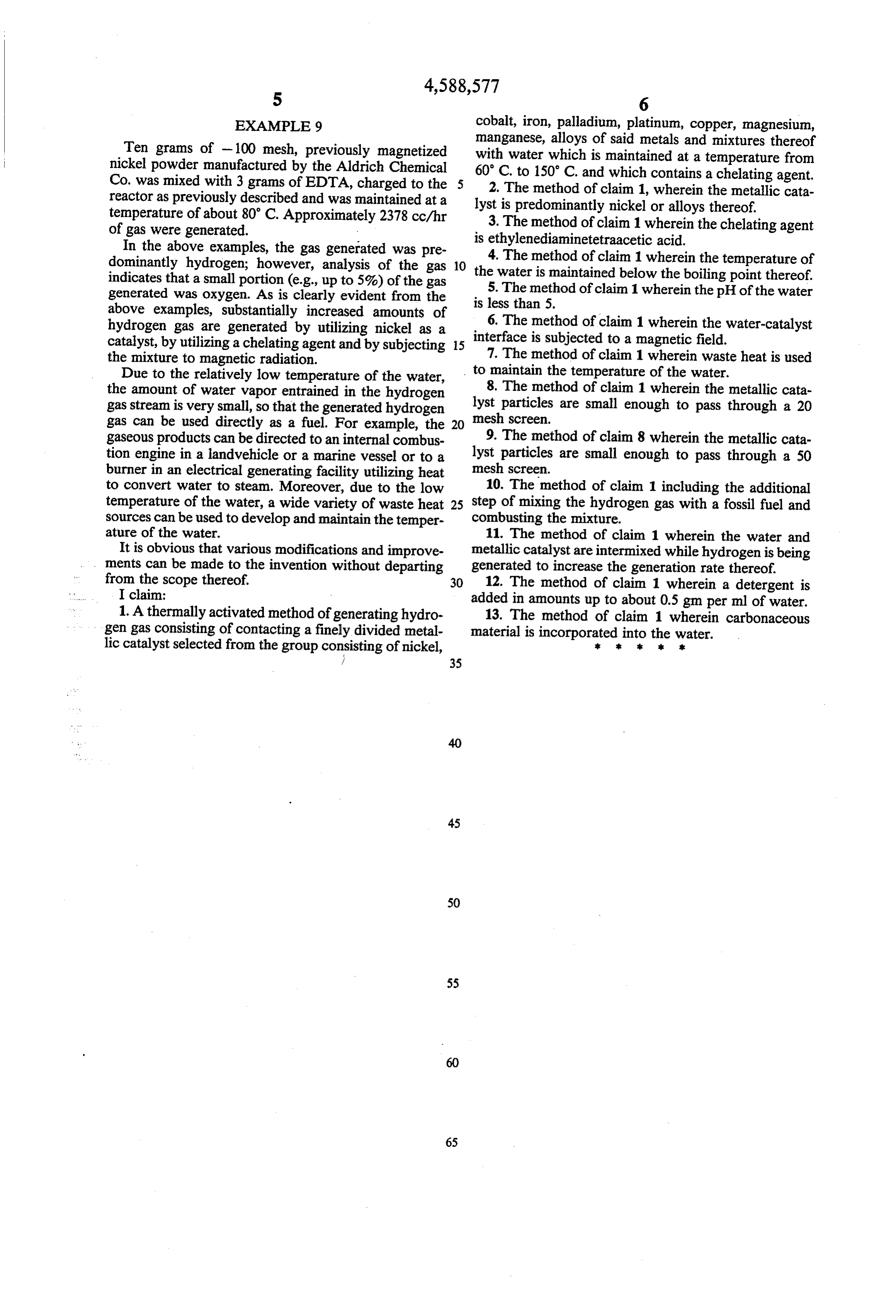
Ten grams of -100 mesh, previously magnetized with water which alloys of said metals and mixtures thereof nickel powder manufactured by the Aldrich Chemical 60° C. to 150° C. and is maintained at a temperature from Co. was mixed with 3 grams of EDTA, charged to the which contains a chelating agent. reactor as previously described and was maintained at a lyst2. isThe method of claim 1, wherein the metallic cata predominantly nickel or alloys thereof.
temperature of about 80° C. Approximately 2378cc/hr 3. The method of claim 1 wherein the chelating agent of gas were generated. is ethylenediaminetetraacetic acid. In the above examples, the gas generated was pre dominantly hydrogen; however, analysis of the gas 10 4. The method of claim 1 wherein the temperature of indicates that a small portion (e.g., up to 5%) of the gas the water is maintained below the boiling point thereof. generated was oxygen. As is clearly evident from the 5. The method of claim 1 wherein the pH of the water is less than 5.
above examples, substantially increased amounts of hydrogen gas are generated by utilizing nickel as a 6. The method of claim 1 wherein the water-catalyst catalyst, by utilizing a chelating agent and by subjecting 15 interface is subjected to a magnetic field. the mixture to magnetic radiation. 7. The method of claim 1 wherein waste heat is used Due to the relatively low temperature of the water, to maintain the temperature of the water. the amount of water vapor entrained in the hydrogen 8. The method of claim 1 wherein the metallic cata gas stream is very small, so that the generated hydrogen lyst particles are small enough to pass through a 20 gas can be used directly as a fuel. For example, the 20 mesh screen.
gaseous products can be directed to an internal combus 9. The method of claim 8 wherein the metallic cata tion engine in a landvehicle or a marine vessel or to a lyst particles are small enough to pass through a 50 burner in an electrical generating facility utilizing heat mesh screen.
to convert water to steam. Moreover, due to the low 10. The method of claim 1 including the additional temperature of the water, a wide variety of waste heat 25 step of mixing the hydrogen gas with a fossil fuel and sources can be used to develop and maintain the temper combusting the mixture.
ature of the water. 11. The method of claim 1 wherein the water and It is obvious that various modifications and improve metallic catalyst are intermixed while hydrogen is being ments can be made to the invention without departing generated to increase the generation rate thereof. from the scope thereof. 30 12. The method of claim 1 wherein a detergent is I claim: added in amounts up to about 0.5gm per ml of water. 1. Athermally activated method of generating hydro 13. The method of claim 1 wherein carbonaceous gen gas consisting of contacting a finely divided metal material is incorporated intok the water. lic catalyst selected from the group consisting of nickel, sk xk 3: K.
Provenance
- Collection
- Cited prior art
- Original PDF
- patentimages.storage.googleapis.com →
- Filed
- 1985-03-08
- Pages
- 4
- Method
- pdftotext (the PDF's own text layer) + pdftoppm 300dpi page scans
- Source
- Google Patents bibliographic record
- Granted
- 1986-05-13
- Inventors
- Earl V. Cardinal; CARDINAL EARL V AND CARDINAL TRUST UTD 2/10/82 A PARTNERSHIP THROUGH FLOYD L CARDINAL AND DOLORES E CARDINAL (CO-TRUSTEES); CARDINAL FAMILY PARTNERSHIP
- Transcribed from
- patentimages.storage.googleapis.com →