patent · US4427512
Water decomposition method and device using ionization by collision
24 January 1984
Page 1 — bibliographic record
United States Patent (19) 11 4,427,512 Han 45) Jan. 24, 1984
54 WATER DECOMPOST ON METHOD AND (56) References Cited DEVICE USING ONIZATION BY PUBLICATIONS
COLLISION
Kurtenkov, Electrochemistry in Industrial Processing
76) Inventor: Tay-Hee Han, 202, 6 dong Gangnam Curl, Int. J. Hydrogen Energy, vol. 4, pp. 13-20 1/79. Apt, Banpo 2 dong, Gangnam-Gu,
Seoul, Rep. of Korea Primary Examiner-F. Edmundson
Attorney, Agent, or Firm-Fleit, Jacobson, Cohn & Price 21 Appl. No.: 404,407 57 ABSTRACT This invention relates to the decomposition of water 22 Filed: Aug. 2, 1982 into oxygen and hydrogen by the effect of ionization by collision among the water. molecules. Water of liquid dielectric characteristics is contained within a solid
Related U.S. Application Data dielectric container having higher dielectric constant 63 Continuation of Ser. No. 167,147, Jul. 8, 1980, aban relative to that of the water, the solid dielectric also doned. having thermostability. A high voltage is then applied to the solid dielectric, creating a strong enough electric (51 Int. Cl................................................. B01K 1/00 field, exceeding the covalent bond of the liquid dielec (52) U.S.C. .................................... 204/164; 422/186; tric, to decompose the water, while the solid dielectric 423/579; 423/648 R container maintains its stability.
(58 Field of Search ................ 422/186, 149; 204/164: 6 Claims, 4 Drawing Figures
Page 2
Drawing sheet — no readable text.
Page 3
Drawing sheet — no readable text.
Page 4
Drawing sheet — no readable text.
Page 5
field strength is formed at the low dielectric of low
WATER DECOMPOSITION METHOD AND dielectric constant.
DEVICE USENG ONIZATION BY COLLESION Then the dielectric intruded receives stronger elec tric field strength than both side of the dielectrics.
This is a continuation of application Ser. No. 167,147 When the electric field strength exceeds the with filed July 8, 1980, now abandoned. standing voitage strength of its own, the molecules of BACKGROUND OF THE INVENTION the liquid dielectric is decomposed by ionization by collision, the dielectric breakdown happens and then
Until now, we have used the electrochemical reac both side of the dielectric layer can be in stable state tion in electrolysis, in which the tons in the electrolyte 10 because it receives weak electric field strength. flow to the opposite electrode to decompose the elec Therefore in the case of passing strong voltage to the trolyte and make pure metals on the surface of the elec complex dielectric layer, the strong electric field trode when the electrode is put into the electrolyte and strength can be formed at a layer and the molecules of the direct current is changed with. the liquid dielectric can be decomposed by the ioniza In addition, in the case of non-electrolyte the electrol 5 tion by collision.
ysis does not happen though equipping the dielectric This invention is illustrated according to the ap with the electrode. And if the higher voltage is given to pended figure.
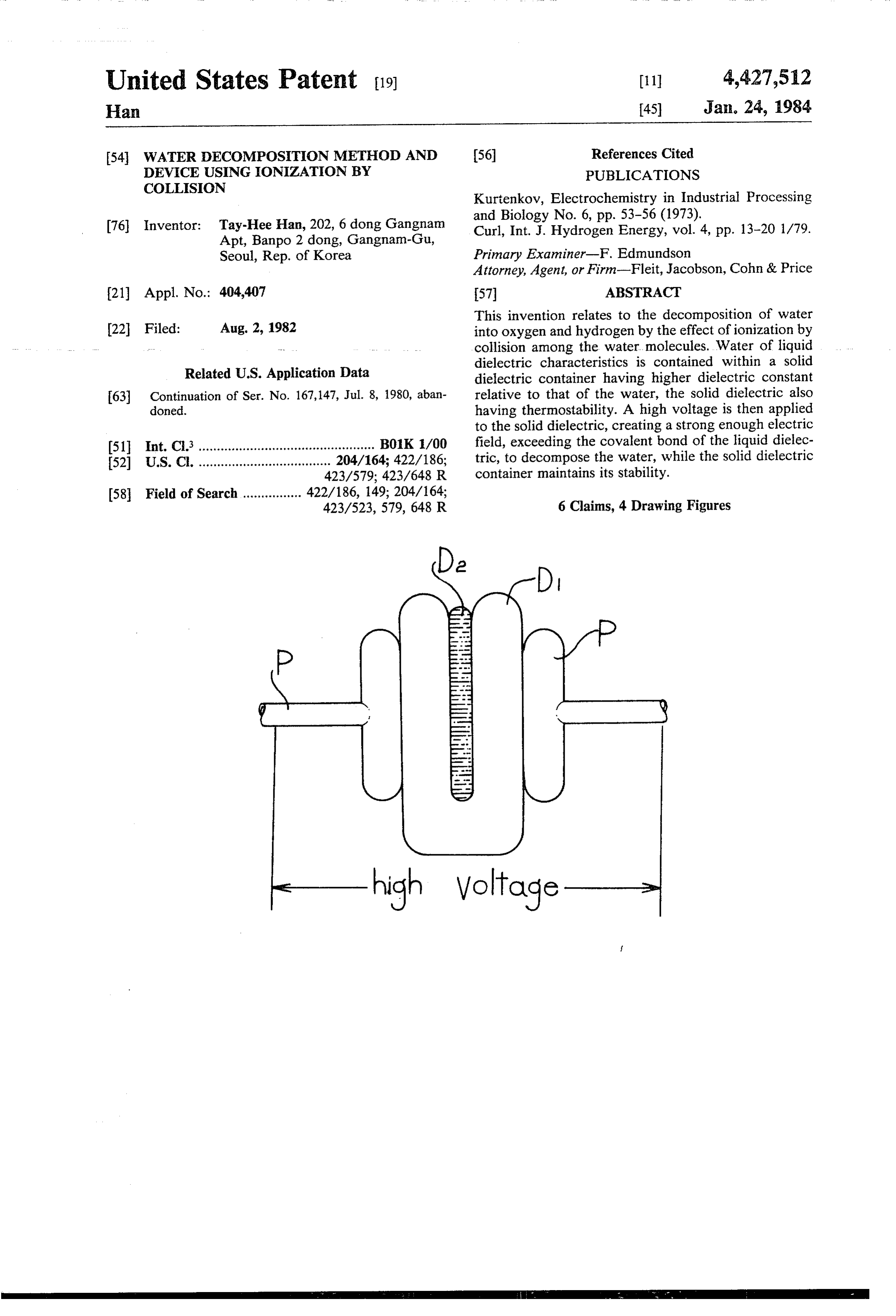
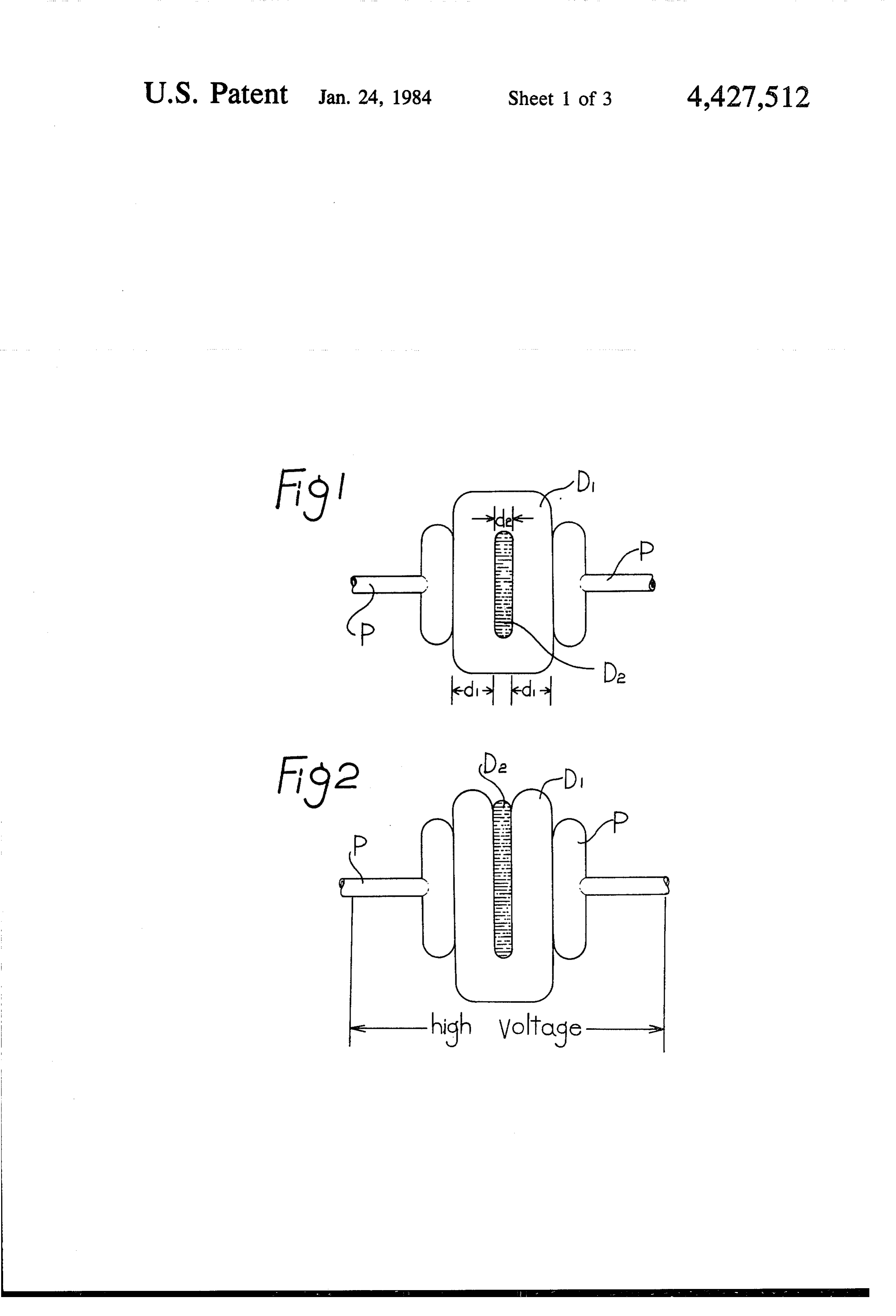
the dielectric than the withstanding voltage strength of BRIEF DESCRIPTION OF THE DRAWING the dielectric, the electrolyte is broken down in the 20 dielectric and the large quantity of electric current is FIG. 1: a cross section for illustration this invention. flowed between the electrodes. FIG. 2: a side-view
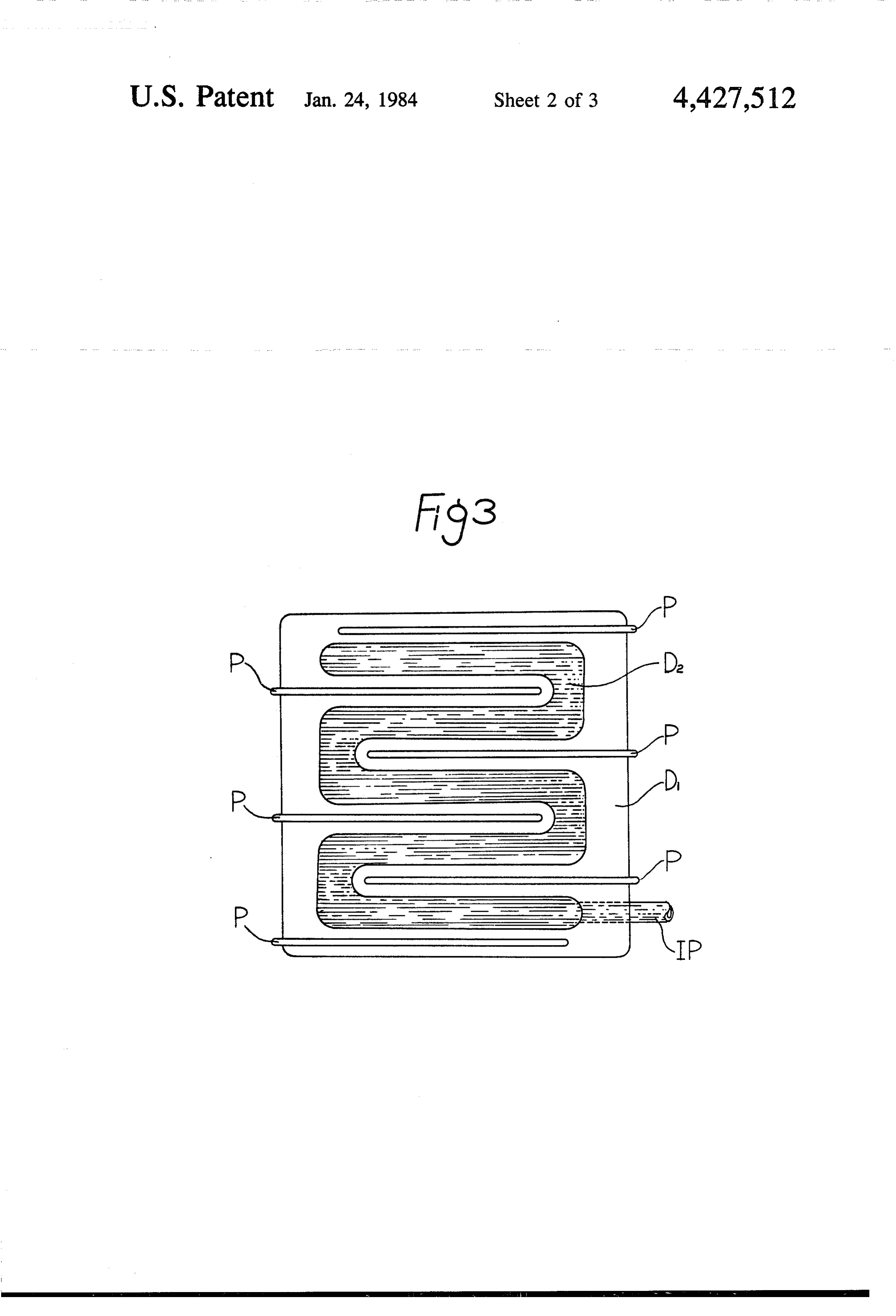
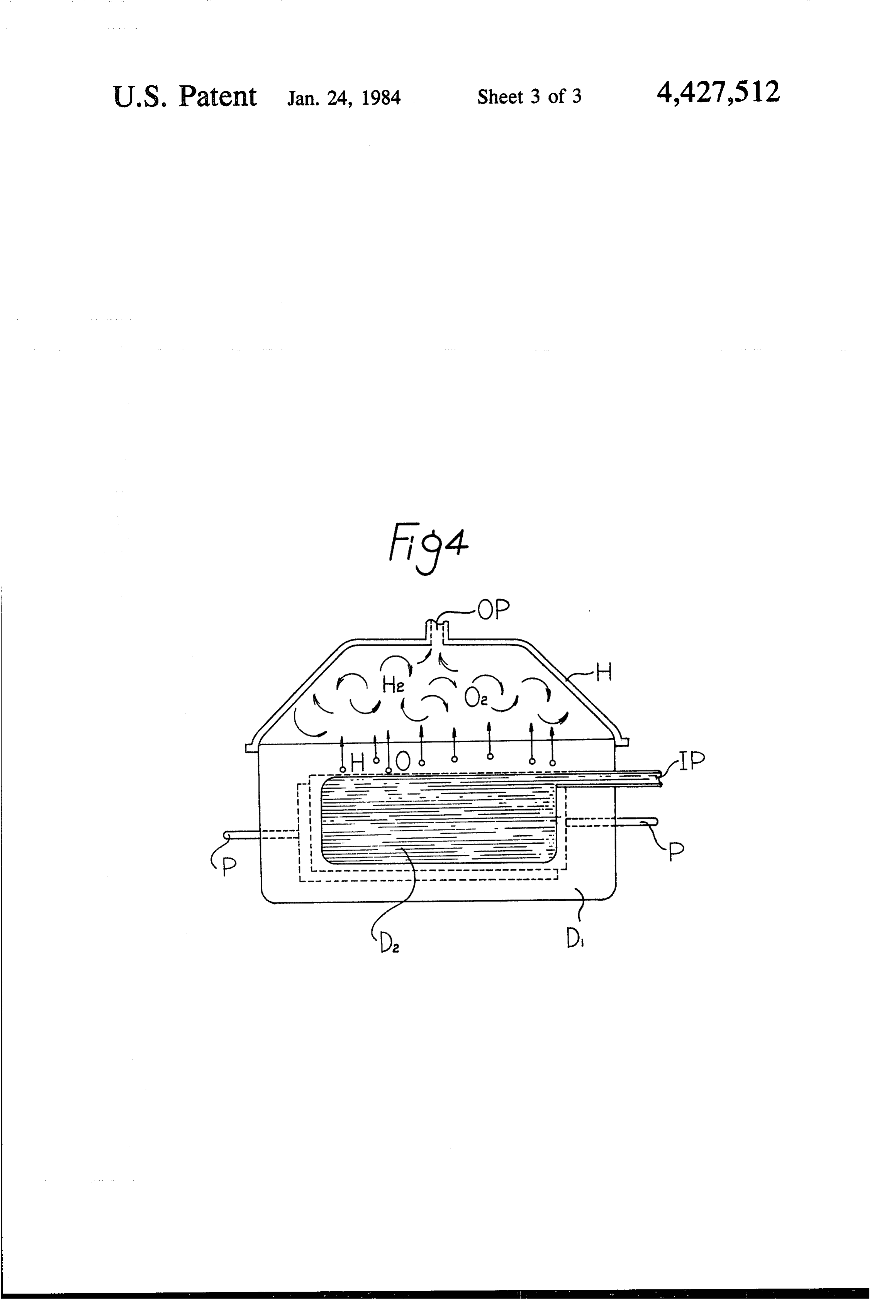
We have only considered the prevention of the di FIG. 3: a cross section for illustration many-step electric breakdown because when these dielectric decomposition device as an example.
breakdown happens, the molecules of the dielectric are 25 FIG. 4: a side-view illustration figure of FIG. 3. often decomposed, but this dielectric and electrical DETAILED DESCRIPTION OF THE machinery become useless. PREFERRED EMBODIMENTS DESCRIPTION OF THE PRIOR ART From the FIG. 1 and FIG. 2, the solid dielectric (D1) U.S Pat. No. 3,674,676 about the electrode used in 30 forms “U', the middle interval (d2) is filled with liquid above electrolysis. The cathod covered with the dia dielectric and the both side of the solid dielectric (D1) phragm is used at a regular interval from the neighbor has the electrode.
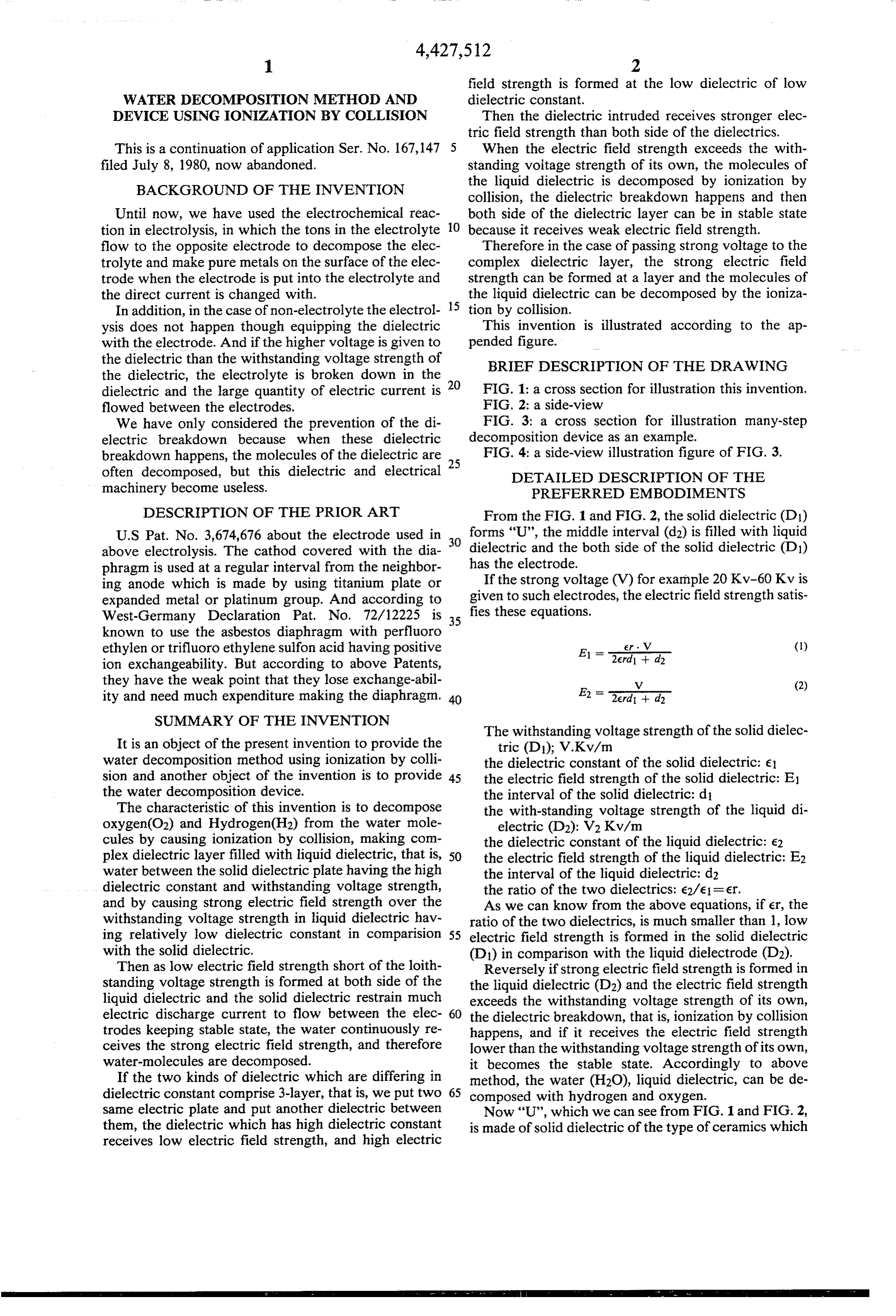
ing anode which is made by using titanium plate or If the strong voltage (V) for example 20 Kv-60 Kv is expanded metal or platinum group. And according to given to such electrodes, the electric field strength satis West-Germany Declaration Pat. No. 72/12225 is 35 fies these equations.
known to use the asbestos diaphragm with perfluoro ethylen or trifluoroethylene sulfon acid having positive er W
ion exchangeability. But according to above Patents, they have the weak point that they lose exchange-abil W (2) ity and need much expenditure making the diaphragm. 40 E2 = 2erd -- d2
SUMMARY OF THE INVENTION
The withstanding voltage strength of the solid dielec
It is an object of the present invention to provide the tric (D1); V.Kv/m water decomposition method using ionization by colli the dielectric constant of the solid dielectric: e. sion and another object of the invention is to provide 45 the electric field strength of the solid dielectric: E1 the water decomposition device. the interval of the solid dielectric: di The characteristic of this invention is to decompose the with-standing voltage strength of the liquid di oxygen(O2) and Hydrogen(H2) from the water mole electric (D2): V2 Kv/m cules by causing ionization by collision, making com the dielectric constant of the liquid dielectric: e2 plex dielectric layer filled with liquid dielectric, that is, 50 the electric field strength of the liquid dielectric: E2 water between the solid dielectric plate having the high the interval of the liquid dielectric: d2 dielectric constant and withstanding voltage strength, the ratio of the two dielectrics: e2/e1=er. and by causing strong electric field strength over the As we can know from the above equations, if er, the withstanding voltage strength in liquid dielectric hav ratio of the two dielectrics, is much smaller than 1, low ing relatively low dielectric constant in comparision 55 electric field strength is formed in the solid dielectric with the solid dielectric. (D) in comparison with the liquid dielectrode (D2). Then as low electric field strength short of the loith Reversely if strong electric field strength is formed in standing voltage strength is formed at both side of the the liquid dielectric (D2) and the electric field strength liquid dielectric and the solid dielectric restrain much exceeds the withstanding voltage strength of its own, electric discharge current to flow between the elec 60 the dielectric breakdown, that is, ionization by collision trodes keeping stable state, the water continuously re happens, and if it receives the electric field strength ceives the strong electric field strength, and therefore lower than the withstanding voltage strength of its own, water-molecules are decomposed. it becomes the stable state. Accordingly to above If the two kinds of dielectric which are differing in method, the water (H2O), liquid dielectric, can be de dielectric constant comprise 3-layer, that is, we put two 65 composed with hydrogen and oxygen. same electric plate and put another dielectric between Now “U', which we can see from FIG. 1 and FIG. 2, them, the dielectric which has high dielectric constant is made of solid dielectric of the type of ceramics which receives low electric field strength, and high electric
Page 6
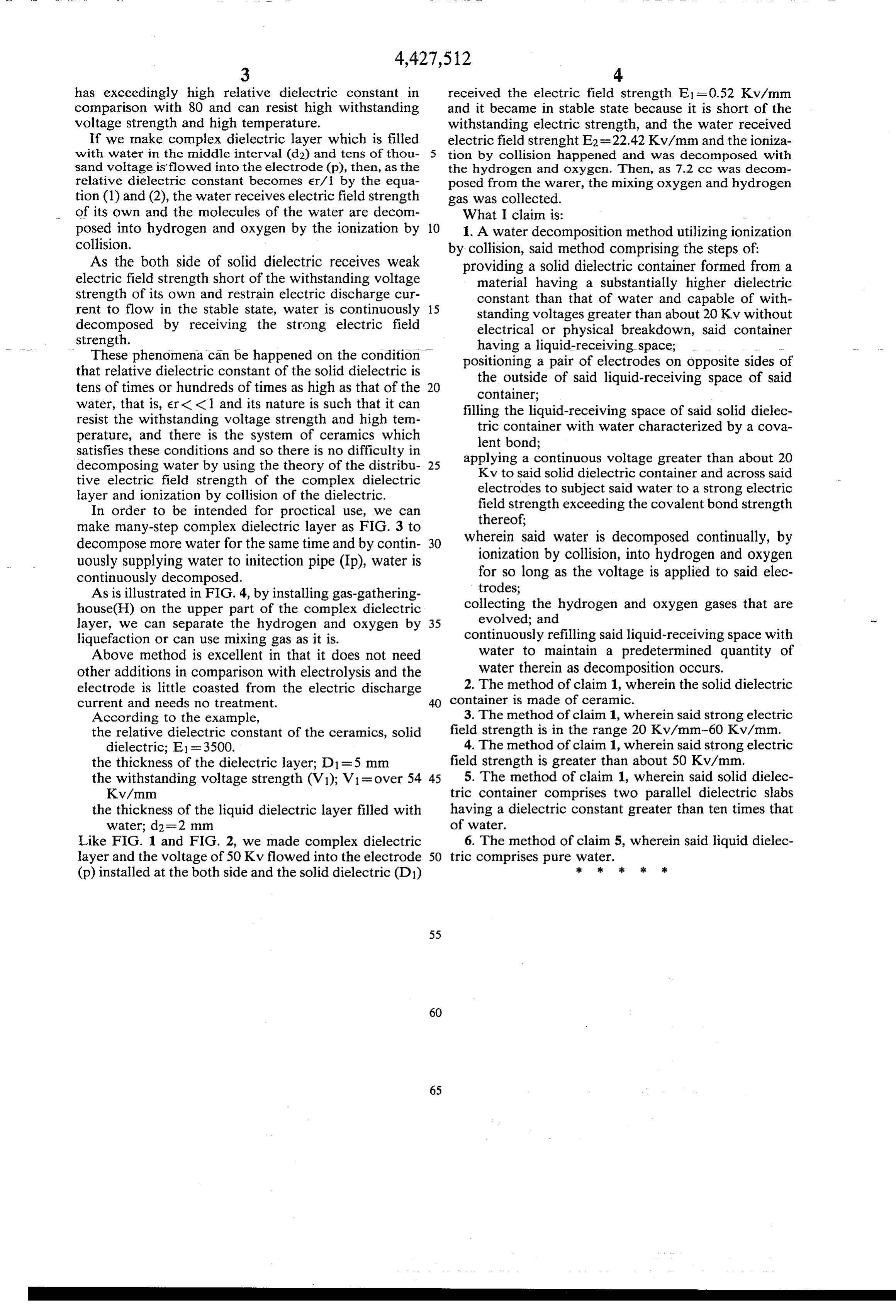
has exceedingly high relative dielectric constant in received the electric field strength E1 = 0.52 Kv/mm comparison with 80 and can resist high withstanding and it became in stable state because it is short of the voltage strength and high temperature. withstanding electric strength, and the water received If we make complex dielectric layer which is filled electric field strenght E2 = 22.42 Kv/mm and the ioniza with water in the middle interval (d2) and tens of thou tion by collision happened and was decomposed with sand voltage is flowed into the electrode (p), then, as the the hydrogen and oxygen. Then, as 7.2 cc was decom relative dielectric constant becomes er/1 by the equa posed from the warer, the mixing oxygen and hydrogen tion (1) and (2), the water receives electric field strength gas was collected.
of its own and the molecules of the water are decom What I claim is:
posed into hydrogen and oxygen by the ionization by O 1. A water decomposition method utilizing ionization collision. by collision, said method comprising the steps of: As the both side of solid dielectric receives weak providing a solid dielectric container formed from a electric field strength short of the withstanding voltage material having a substantially higher dielectric strength of its own and restrain electric discharge cur constant than that of water and capable of with rent to flow in the stable state, water is continuously 15 standing voltages greater than about 20 KV without decomposed by receiving the strong electric field electrical or physical breakdown, said container strength. having a liquid-receiving space; -- --- These phenomena can be happened on the condition positioning a pair of electrodes on opposite sides of that relative dielectric constant of the solid dielectric is the outside of said liquid-receiving space of said tens of times or hundreds of times as high as that of the 20 container;
water, that is, er C < 1 and its nature is such that it can filling the liquid-receiving space of said solid dielec resist the withstanding voltage strength and high tem tric container with water characterized by a cova perature, and there is the system of ceramics which lent bond;
satisfies these conditions and so there is no difficulty in applying a continuous voltage greater than about 20 decomposing water by using the theory of the distribu 25 Kv to said solid dielectric container and across said tive electric field strength of the complex dielectric electrodes to subject said water to a strong electric layer and ionization by collision of the dielectric. field strength exceeding the covalent bond strength In order to be intended for proctical use, we can thereof;
make many-step complex dielectric layer as FIG. 3 to wherein said water is decomposed continually, by decompose more water for the same time and by contin 30 ionization by collision, into hydrogen and oxygen uously supplying water to initection pipe (Ip), water is for so long as the voltage is applied to said elec continuously decomposed.
As is illustrated in FIG. 4, by installing gas-gathering trodes;
house(H) on the upper part of the complex dielectric collecting the hydrogen and oxygen gases that are layer, we can separate the hydrogen and oxygen by 35 evolved; and liquefaction or can use mixing gas as it is. continuously refilling said liquid-receiving space with Above method is excellent in that it does not need water to maintain a predetermined quantity of other additions in comparison with electrolysis and the water therein as decomposition occurs. electrode is little coasted from the electric discharge 2. The method of claim 1, wherein the solid dielectric current and needs no treatment. 40 container is made of ceramic.
According to the example, 3. The method of claim 1, wherein said strong electric the relative dielectric constant of the ceramics, solid field strength is in the range 20 Kv/mm-60 Kv/mm. dielectric; E1 =3500. 4. The method of claim 1, wherein said strong electric the thickness of the dielectric layer; D1 =5 mm field strength is greater than about 50 Kv/mm. the withstanding voltage strength (V1); V = over 54 45 5. The method of claim 1, wherein said solid dielec Kv/mm. tric container comprises two parallel dielectric slabs the thickness of the liquid dielectric layer filled with having a dielectric constant greater than ten times that water; d2 = 2 mm of water.
Like FIG. 1 and FIG. 2, we made complex dielectric 6. The method of claim 5, wherein said liquid dielec layer and the voltage of 50 KV flowed into the electrode 50 tric comprises pure water.
(p) installed at the both side and the solid dielectric (D1)
Provenance
- Collection
- Cited prior art
- Original PDF
- patentimages.storage.googleapis.com →
- Filed
- 1982-08-02
- Pages
- 6
- Method
- pdftotext (the PDF's own text layer) + pdftoppm 300dpi page scans
- Source
- Google Patents bibliographic record
- Granted
- 1984-01-24
- Inventors
- Tay-Hee Han
- Transcribed from
- patentimages.storage.googleapis.com →