patent · US3210157
Method for generating hydrogen
5 October 1965
Page 1 — bibliographic record
. .. 3- Y - 's
United States Patent Office 3,210,157-1 Patented Oct. 5, 1965
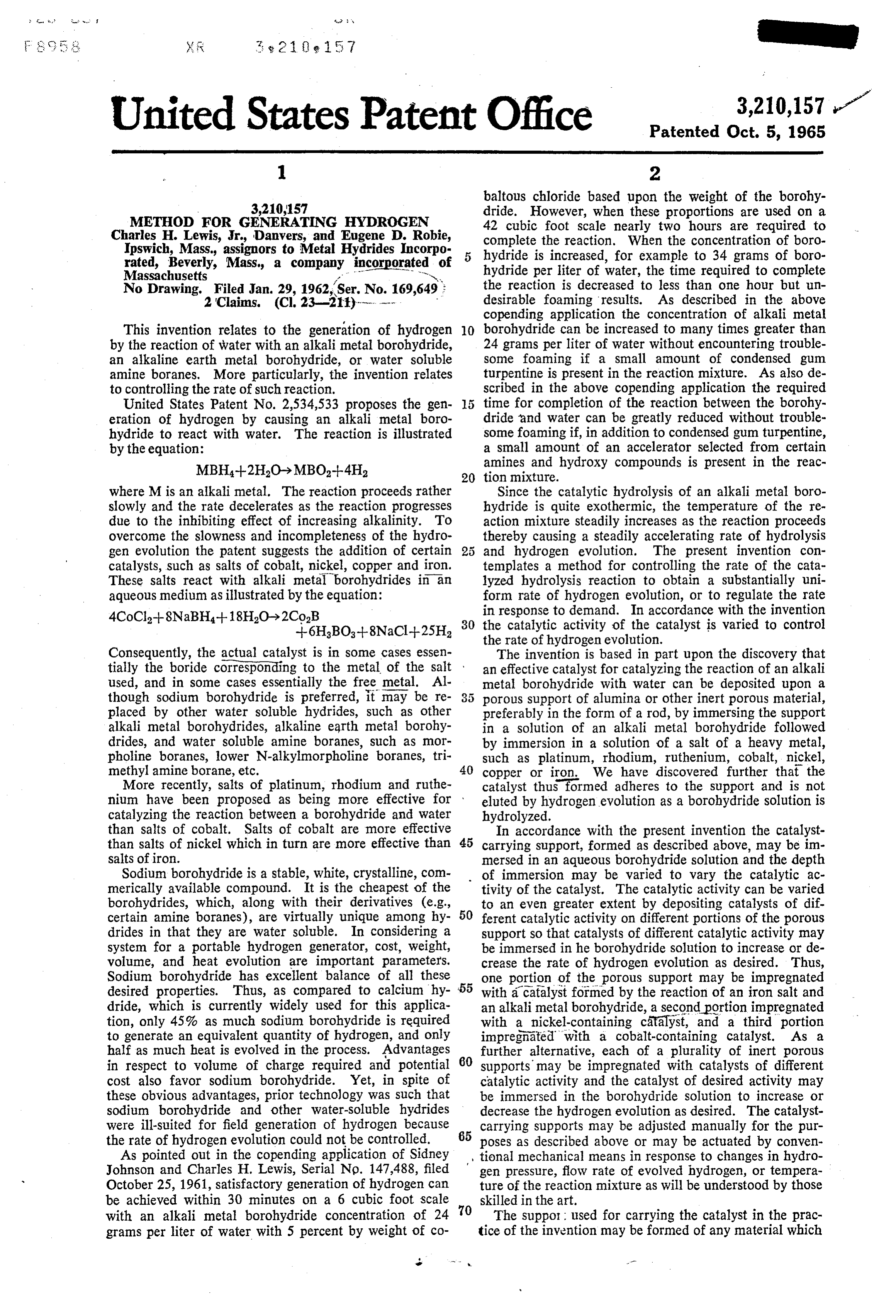
baltous chloride based upon the weight of the borohy 3,210,157 dride. However, when these proportions are used on a METHOD FOR GENERATING HYDROGEN 42 cubic foot scale nearly two hours are required to Charles H. Lewis, Jr., Danvers, and Eugene D. Robie, complete the reaction. When the concentration of boro Ipswich, Mass, assignors to Metal Hydrides Incorpo hydride is increased, for example to 34 grams of boro rated, Beverly, Mass, a company incorporated of hydride per liter of water, the time required to complete Massachusetts /. - the reaction is decreased to less than one hour but un No Drawing. Filed Jan. 29, 1962, Ser. No. 169,649. desirable foaming results. As described in the above
copending application the concentration of alkali metal
This invention relates to the generation of hydrogen 10 borohydride can be increased to many times greater than by the reaction of water with an alkali metal borohydride, 24 grams per liter of water without encountering trouble an alkaline earth metal borohydride, or water soluble some foaming if a small amount of condensed gum amine boranes. More particularly, the invention relates turpentine is present in the reaction mixture. As also de to controlling the rate of such reaction. scribed in the above copending application the required United States Patent No. 2,534,533 proposes the gen time for completion of the reaction between the borohy eration of hydrogen by causing an alkali metal boro dride and water can be greatly reduced without trouble hydride to react with water. The reaction is illustrated some foaming if, in addition to condensed gum turpentine, by the equation: a small amount of an accelerator selected from certain amines and hydroxy compounds is present in the reac 20 tion mixture.
where M is an alkali metal. The reaction proceeds rather Since the catalytic hydrolysis of an alkali metal boro slowly and the rate decelerates as the reaction progresses hydride is quite exothermic, the temperature of the re due to the inhibiting effect of increasing alkalinity. To action mixture steadily increases as the reaction proceeds overcome the slowness and incompleteness of the hydro thereby causing a steadily accelerating rate of hydrolysis gen evolution the patent suggests the addition of certain and hydrogen evolution. The present invention con catalysts, such as salts of cobalt, nickel, copper and iron. templates a method for controlling the rate of the cata These salts react with alkali metal borohydrides in an lyzed hydrolysis reaction to obtain a substantially uni aqueous medium as illustrated by the equation: form rate of hydrogen evolution, or to regulate the rate in response to demand. In accordance with the invention 30 the catalytic activity of the catalyst is varied to control the rate of hydrogen evolution.
Consequently, the actual catalyst is in some cases essen The invention is based in part upon the discovery that tially the boride corresponding to the metal of the salt an effective catalyst for catalyzing the reaction of an alkali used, and in some cases essentially the free metal. Al metal borohydride with water can be deposited upon a though sodium borohydride is preferred, it may be re porous support of alumina or other inert porous material, placed by other water soluble hydrides, such as other preferably in the form of a rod, by immersing the support alkali metal borohydrides, alkaline earth metal borohy in a solution of an alkali metal borohydride followed drides, and water soluble amine boranes, such as mor by immersion in a solution of a salt of a heavy metal, pholine boranes, lower N-alkylmorpholine boranes, tri such as platinum, rhodium, ruthenium, cobalt, nickel, methyl amine borane, etc. 40 copper or iron. We have discovered further that the More recently, salts of platinum, rhodium and ruthe catalyst thus formed adheres to the support and is not nium have been proposed as being more effective for eluted by hydrogen evolution as a borohydride solution is catalyzing the reaction between a borohydride and water hydrolyzed.
than salts of cobalt. Salts of cobalt are more effective In accordance with the present invention the catalyst than salts of nickel which in turn are more effective than 45 carrying support, formed as described above, may be im salts of iron. mersed in an aqueous borohydride solution and the depth Sodium borohydride is a stable, white, crystalline, com of immersion may be varied to vary the catalytic ac merically available compound. It is the cheapest of the tivity of the catalyst. The catalytic activity can be varied borohydrides, which, along with their derivatives (e.g., to an even greater extent by depositing catalysts of dif certain amine boranes), are virtually unique among hy 50 ferent catalytic activity on different portions of the porous drides in that they are water soluble. In considering a support so that catalysts of different catalytic activity may system for a portable hydrogen generator, cost, weight, be immersed in he borohydride solution to increase or de volume, and heat evolution are important parameters. crease the rate of hydrogen evolution as desired. Thus, Sodium borohydride has excellent balance of all these one portion of the porous support may be impregnated desired properties. Thus, as compared to calcium hy 55 with a catalyst formed by the reaction of an iron salt and dride, which is currently widely used for this applica an alkali metal borohydride, a second portion impregnated tion, only 45% as much sodium borohydride is required with a nickel-containing catalyst, and a third portion to generate an equivalent quantity of hydrogen, and only impregnated with a cobalt-containing catalyst. As a half as much heat is evolved in the process. Advantages 60 further alternative, each of a plurality of inert porous in respect to volume of charge required and potential supports may be impregnated with catalysts of different cost also favor sodium borohydride. Yet, in spite of catalytic activity and the catalyst of desired activity may these obvious advantages, prior technology was such that be immersed in the borohydride solution to increase or sodium borohydride and other water-soluble hydrides decrease the hydrogen evolution as desired. The catalyst were ill-suited for field generation of hydrogen because carrying supports may be adjusted manually for the pur the rate of hydrogen evolution could not be controlled. 65 poses as described above or may be actuated by conven As pointed out in the copending application of Sidney tienal mechanical means in response to changes in hydro Johnson and Charles H. Lewis, Serial No. 147,488, filed gen pressure, flow rate of evolved hydrogen, or tempera October 25, 1961, satisfactory generation of hydrogen can ture of the reaction mixture as will be understood by those be achieved within 30 minutes on a 6 cubic foot scale skilled in the art.
with an alkali metal borohydride concentration of 24 70 The suppor: used for carrying the catalyst in the prac grams per liter of water with 5 percent by weight of co tice of the invention may be formed of any material which
Page 2
is insoluble in and substantially inert toward the reac mixture, said borohydride being hydrolyzed and said tion mixture. We have found particularly suitable por borohydride used in forming the catalyst being selected ous materials which are readily available commercially, from the group consisting of water soluble alkali metal such as porous alumina, silica and molecular sieves, ... the borohydrides, water soluble alkaline earth metal borohy latter consisting essentially of calcium aluminum sili 5 drides, and water soluble amine boranes. 2. The method as claimed by claim 1 wherein the rate cate or magnesium aluminum silicate.
If desired, the support may be formed of the solid cata of hydrogen evolution is varied by immersing in the lyst itself. Thus, water may be added to a mixture of an hydrolyzation reaction mixture different portions of the alkali metal borohydride and a heavy metal salt, such catalyst carrying support, said different portions carry as cobaltous chloride, to form a colloidal suspension which O ing a catalyst of different catalytic activity for the hy is essentially the boride of the heavy metal. This colloidal drolyzation reaction, the catalyst on each of said differ suspension may be coagulated, removed from the water ent portions of said support being deposited thereon by and dried. The dried product then may be compacted immersing each portion in a solution of the selected under heavy pressure to the shape of the support desired. borohydride followed by immersion in a solution of a The support thus formed may be used as the catalyst 5 salt of a heavy metal.
in the practice of the invention or catalysts of different catalytic activity may be utilized on different portions of References Cited by the Examiner a composite rod, or in a plurality of rods, in the manner UNITED STATES PATENTS as previously described. 1,255,590 2/18 Ellis -------------- 252-432 X
1. In the method for generating hydrogen which com 1,840,450 1/32 Jaeger et al. -------- 252-432 X prises reacting a borohydride with water in the presence 2, 193,814 3/40 Heard -------------- 252-432 of a hydrolysis catalyst, the improvement wherein the 2,393,240 1/46 Dreyfus ---------------- 23-1 catalytic activity of the catalyst is varied to control the 2,461,661 2/49 Schlesinger ----------- 23-14 rate of hydrogen evolution by varying the area of the 25 2,534,533 12/50 Schlesinger et al. ------ 23-211 X surface of the catalyst in solid form in contact with the FOREIGN PATENTS reaction mixture, said catalyst being deposited in an ad 103,051 2/38 Australia.
herent form on an inert porous support by immersing said support in a solution of a borohydride followed by OTHER REFERENCES immersion in a solution of a salt of a heavy metal, the Ser. No. 357,989, Brendlein (A.P.C.), published May area of the surface of the catalyst in contact with the re 25, 1943.
action mixture being varied by varying the depth of im mersion of the catalyst-carrying support in the reaction MAURICEA. BRINDISI, Primary Examiner.
Provenance
- Collection
- Cited prior art
- Original PDF
- patentimages.storage.googleapis.com →
- Filed
- 1962-01-29
- Pages
- 2
- Method
- pdftotext (the PDF's own text layer) + pdftoppm 300dpi page scans
- Source
- Google Patents bibliographic record
- Granted
- 1965-10-05
- Inventors
- Jr Charles H Lewis; Eugene D Robie; Metal Hydrides Inc
- Transcribed from
- patentimages.storage.googleapis.com →