patent · US4202744
Production of hydrogen
13 May 1980
Page 1 — bibliographic record
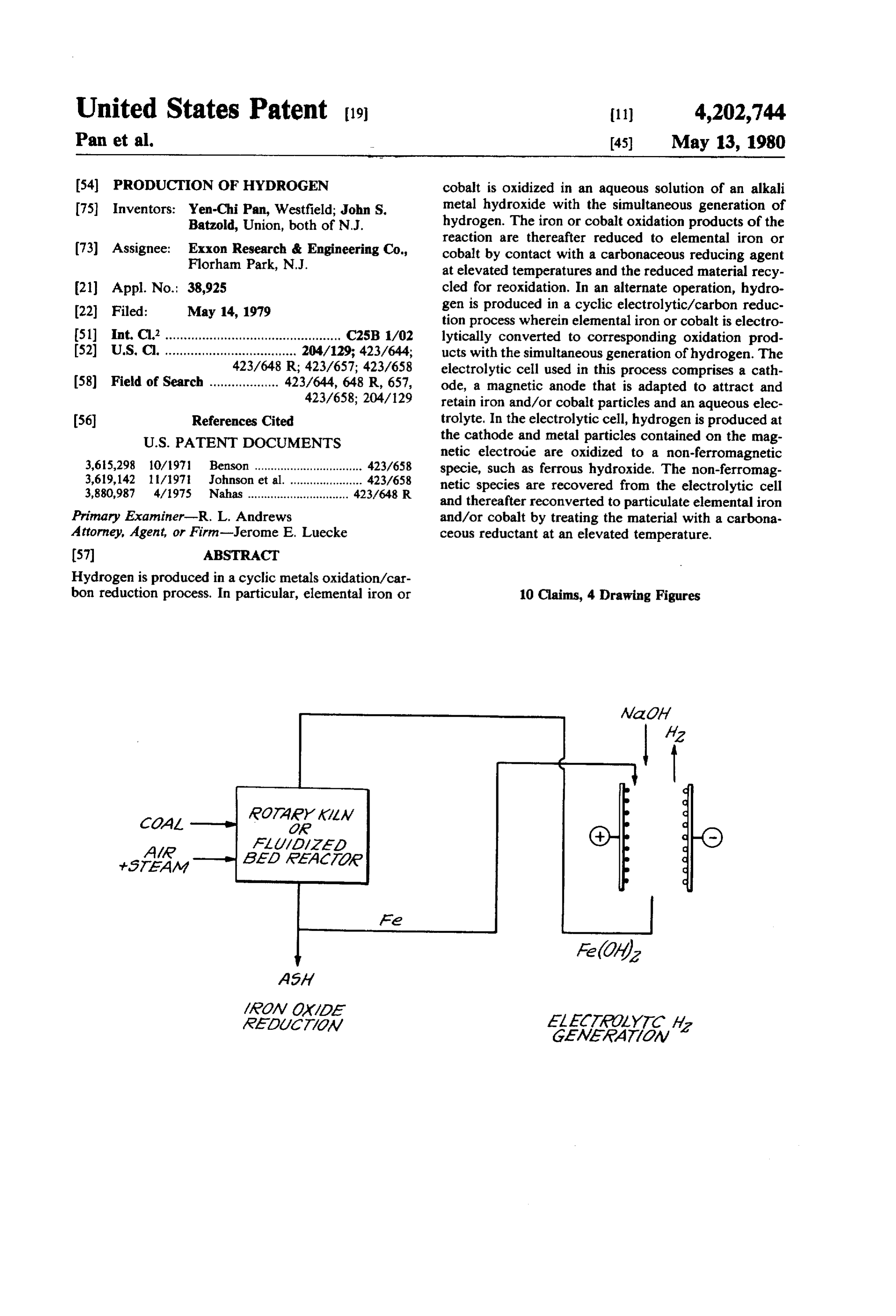
United States Patent (19) (11) 4,202,744 Pan et al. (45) May 13, 1980 (54) PRODUCTION OF HYDROGEN cobalt is oxidized in an aqueous solution of an alkali 75) Inventors: Yen-Chi Pan, Westfield; John S. metal hydroxide with the simultaneous generation of Batzold, Union, both of N.J. hydrogen. The iron or cobalt oxidation products of the reaction are thereafter reduced to elemental iron or 73) Assignee: Exxon Research & Engineering Co., cobalt by contact with a carbonaceous reducing agent Florham Park, N.J. at elevated temperatures and the reduced material recy (21) Appl. No.: 38,925 cled for reoxidation. In an alternate operation, hydro 22 Filed: May 14, 1979 gen is produced in a cyclic electrolytic/carbon reduc tion process wherein elemental iron or cobalt is electro 51) int. Cl. ................................................ C25B 1/02 lytically converted to corresponding oxidation prod 52) U.S. Cl. .................................... 204/129; 423/644; ucts with the simultaneous generation of hydrogen. The 423/648 R; 42.3/657; 423/658 electrolytic cell used in this process comprises a cath 58) Field of Search ................... 423/644, 648 R 657, ode, a magnetic anode that is adapted to attract and 423/658; 204/129 retain iron and/or cobalt particles and an aqueous elec (56) References Cited trolyte. In the electrolytic cell, hydrogen is produced at
netic electrode are oxidized to a non-ferromagnetic 3,615,298 10/1971 Benson ................................. 423/658 specie, such as ferrous hydroxide. The non-ferromag 3,619,142 11/197 Johnson et al. ...................... 423/658 netic species are recovered from the electrolytic cell 3,880,987 4/1975 Nahas............................... 423A648. R.
and thereafter reconverted to particulate elemental iron
Primary Examiner-R. L. Andrews and/or cobalt by treating the material with a carbona Attorney, Agent, or Firm-Jerome E. Luecke ceous reductant at an elevated temperature.
Hydrogen is produced in a cyclic metals oxidation/car bon reduction process. In particular, elemental iron or 10 Claims, 4 Drawing Figures
AAA AAAC/29
AOWOA
aAZOO/CWAAV AAAAAAYAA
Page 2
Drawing sheet — no readable text.
Page 3
Drawing sheet — no readable text.
Page 4
PRODUCTION OF HYDROGEN cobalt in an aqueous alkali metal hydroxide solution, the production of hydrogen proceeds spontaneously at rela
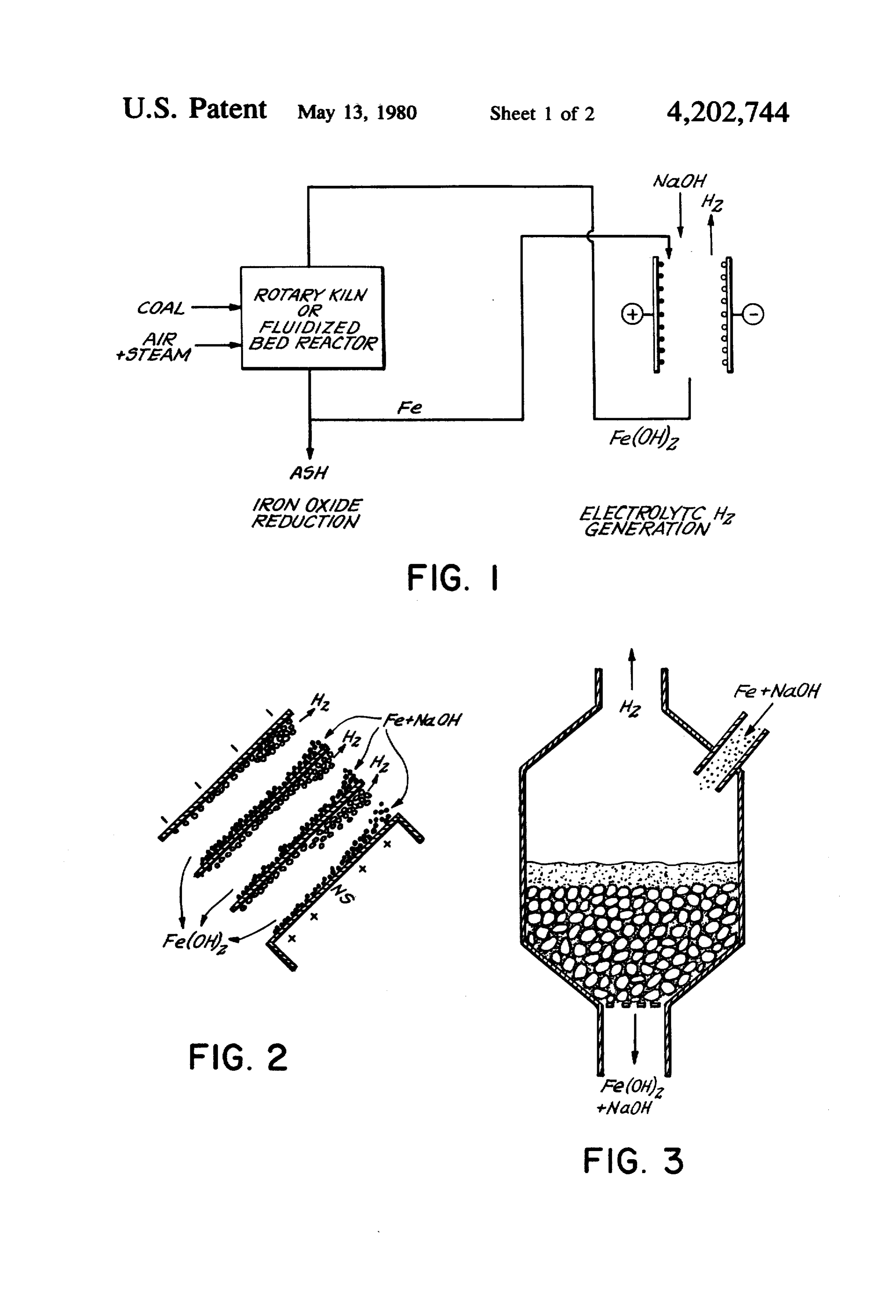
BACKGROUND OF THE INVENTION tively low temperatures. Accordingly, in an electro A. Field of the Invention chemical operation, hydrogen may be generated, de This invention relates to a process for the manufac pending upon process temperature and caustic concen ture of hydrogen. More particularly, the invention is tration, by the chemical oxidation of the metals through concerned with a cyclic technique wherein (i) elemental anodiccontact with an aqueous alkali electrolyte and via the iron or cobalt is oxidized in an aqueous media with the oxidation of the metal. corresponding production of hydrogen and (ii) the re O BRIEF DESCRIPTION OF THE DRAWINGS duction of the iron or cobalt oxidation products with a carbonaceous reductant for subsequent reuse in the The invention will be better understood by reference process. to the appended drawings in which: B. Description of the Prior Art FIG. 1 is a schematic representation of one process Electrolytic cells having magnetic electrodes and/or 15 embodiment of the present invention; means for supplying consumable metallic material to FIG. 2 is a representation of a bipolar cell showing the electrode have been described in U.S. Pat. No. formation of hydrogen and oxidation of elemental iron 38,811,952 and in U.S. Pat. No. 4,095,015. Further, the to ferrous hydroxide;
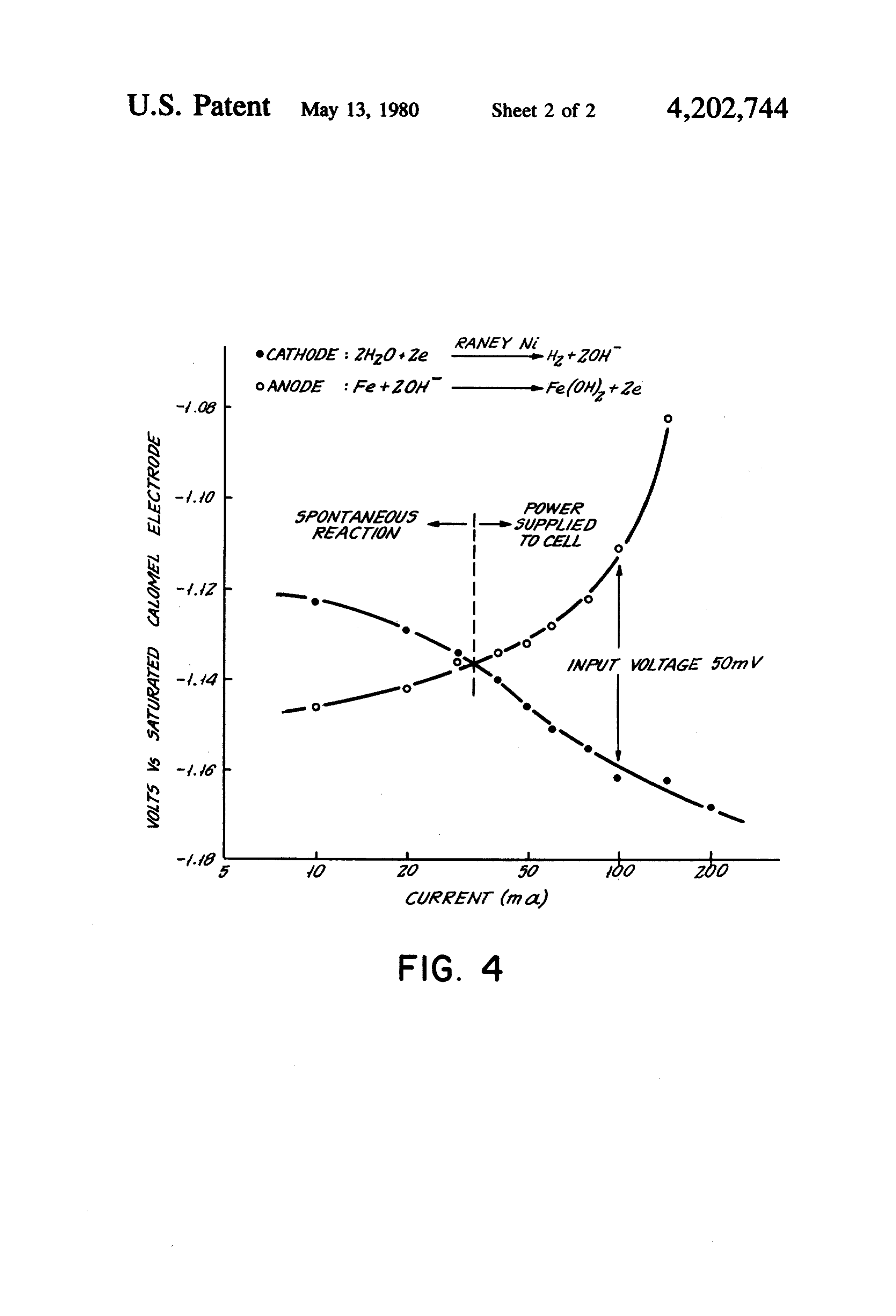
reduction of iron ore or other oxygenated iron species FIG. 3 is a representation of a processing scheme for with carbonaceous reducing agents is well-known. For the production of hydrogen under electrochemical example, iron ore granules have been contacted in a short circuit conditions; and fluidized bed regime with reducing agents derived from FIG. 4 are voltage/current polarization curves for petroleum oils. Examples of such operations are dis hydrogen production by the oxidation of elemental closed in U.S. Pat. Nos. 3,551,215 and 3,615,352. A On.
moving bed scheme for the reduction of iron ore with 25 Exemplary reactions contemplated in an electro coal is described in Japanese Kokai No. 47-31805. chemical system are shown below using the assumption Finally, U.S. Pat. No. 4,081,337 describes an electrolyt that the iron or cobalt particles at the anode are con ic method for the production of hydrogen. In this verted first to Co(OH)2 or Fe(OH)2. In the electro patent, the inventor advocates a process for oxidizing chemical operation the iron materials can be converted an alkali sulfide in an electric cell to the corresponding 30 to various other oxidized species such as Fe2O3 or Fe0. alkali sulfate with the concurrent generation of hydro Cathode Reaction gen at the cathode. The alkali sulfate material is subse quently reduced to alkali sulfide by reaction of the sulfate with a carbonaceous material at elevated 2H2O+2e-20H + H2 000 W/RHE at 25 C. temperatures.
SUMMARY OF THE INVENTION Anode Reactions In accordance with the present invention, hydrogen is produced by (1) passing an aqueous alkali metal hy Fe+2OH-Fe(OH)2+2e-0,049 WARHE at 25 droxide solution and elemental iron or cobalt particles C.
to a reaction Zone; (2) oxidizing a portion of the iron or Co-2OH-Co(OH)2+2e--0,090 W/RHE at 25 cobalt particles to iron or cobalt oxidation products, in C.
particular to iron and cobalt hydroxides, with the simul taneous generation of hydrogen; (3) passing the hydro gen and the iron or cobalt oxidation products from the Reduction Reactions reaction zone; (4) reducing at least a portion of the iron 45 or cobalt oxidation products to elemental iron or cobalt by contacting the same or with a carbonaceous reduc (i. - CoO + H2O tion agent, preferably carbon monoxide; and (5) recy CoO - C - 2Co+ CO2 cling at least a portion of the elemental iron or cobalt derived from the reduction step to the reaction zone for 50 c - Fe0 + H2O subsequent reuse.
In another embodiment of the invention, hydrogen is Fed -- C - 2Fe -- CO2 produced by (1) passing an aqueous electrolyte and elemental iron or cobalt particles to an electrolytic cell Total Reaction comprising a cathode and a magnetic anode that is 55 adapted to attract and retain iron or cobalt particles; (2) anodically oxidizing the iron or cobalt particles to non C+2HO-CO-2H ferromagnetic iron or cobalt containing species with the generation of hydrogen at the cathode; (3) passing the As noted in the above equation, the electrolytic cell generated hydrogen and the oxidized, non-ferromag anode reaction consists of oxidizing elemental iron or netic iron or colbalt containing species from the cell; (4) cobalt to an oxidized species, preferably to a non-ferro reducing at least a portion of the oxidized, non-ferro magnetic oxidized species such as Co(OH)2, Fe(OH)2, magnetic iron or cobalt containing species to elemental Fe0, Fe(OH)3 or Fe2O3. Fe3O4 is undesirable as it is iron or cobalt by contacting the same with a carbona ferromagnetic.
ceous reducing agent at elevated temperatures; and (5) Admixtures of elemental iron with iron sulfide are par recycling at least a portion of the elemental iron or ticularly effective anode materials, even though iron cobalt derived from the reduction step to the electro sulfide is not ferromagnetic since the presence of sulfur lytic cell. In the chemical oxidation of elemental iron or appears to promote the rate of oxidation of the iron at
Page 5
the anode. The elemental iron or cobalt reagent is desir cathode magnetic field. Platinum or palladium, while ably introduced into the electrolytic cell or in the reac effective, are less desired because they tend to be poi tion zone in the form of particles having an average soned by the presence of sulfur species. As noted above, particle size diameter of about 1 to 800 microns, prefera it is preferred to have some sulfur species present in the bly 10 to 100 microns. cell since they tend to promote the rapid anodic oxida The cell electrolyte is an aqueous electrolyte system, tion of an iron feedstock.
preferably an aqueous alkali metal hydroxide solution. As noted above, the oxidation of iron or cobalt in an Spontaneous, non-electrolytic oxidation of the iron or aqueous alkali metal hydroxide solution proceeds spon cobalt reagents are also conducted in an aqueous alkali taneously with the production of hydrogen. Accord hydroxide solution. Aqueous solutions of sodium hy 10 ingly, the electrochemical oxidation of iron or cobalt in droxide or potassium hydroxide are the preferred elec an aqueous alkali metal hydroxide electrolyte proceeds trolyte systems or reaction media. Aqueous NaOH is without the imposition of an input voltage, that is, hy the most preferred material. When alkali metal hydrox drogen is produced with the oxidation of iron or cobalt ides are employed, they are typically present in the under short circuit conditions. The oxidation of iron electrolyte solution or reaction media in amounts rang 5 under short circuit conditions occurs at temperatures as ing from about 10 to 70, preferably 30 to 50 weight low as 25 C.; however, the oxidation of cobalt under percent based on total solution. The precise concentra short circuit conditions proceeds at temperatures tion of alkali metal hydroxide employed is dependent, in greater than about 110 C. Therefore, the rate of hydro part, upon the temperature employed in the electrolytic gen evolution in a short circuit electrolytic environment or spontaneous reaction. 20 :s accelerated with increasing process temperature. Of Electrolytic cell reactions involving either iron or course, the imposition of an input voltage on the system cobalt are typically conducted at temperatures ranging will accelerate the rate of hydrogen formation. from about 80 C. to temperatures in excess of 300 C. FIG. 1 shows one process embodiment of the present Typically, the electrolytic cell operation will be con invention. As shown in the figure, hydrogen is pro ducted at temperatures varying from 80 to 400' C., 25 duced by passing elemental iron and sodium hydroxide preferably 120' to 180' C. Spontaneous non-electrolytic to an electrolytic cell. The anode of the cell is prefera reactions may be conducted at temperatures ranging bly magnetized to retain the incoming iron particles on from about 80 to 400 C. when iron is the process the surface thereof. Incoming iron, in the presence of feedstock and at temperatures ranging from about 110 sodium hydroxide electrolyte, is converted to ferrous to 400 C. when the cobalt is the process feedstock. The 30 hydroxide and hydrogen is evolved at the cathode. The reaction zone or electrolytic cell is pressurized if the ferrous hydroxide is withdrawn from the system and process is conducted at temperatures greater than about passed to a rotary kiln or fluidized bed reactor wherein 140 C., the approximate atmospheric boiling point of it is contacted with a carbon source, preferably coal, in 50 weight percent aqueous alkali metal hydroxide solu the presence of air and steam to reduce the same to tions. Electrolytic cell or reaction zone operating pres 35 elemental iron. As shown in FIG. 1, the elemental iron sures are determined primarily by the ultimate uses of is then returned to the electrolytic hydrogen generation the product hydrogen, and the hydrogen may be gener zone. As shown in FIG. 2, conventional magnetic bipo ated at pressures up to about 200 atmospheres. Generat lar cells can also be used for the generation of hydrogen. ing the product hydrogen at elevated pressure, in the As shown in FIG. 2, elemental iron and sodium hydrox case of electrolytically induced systems, requires the ide are passed through the cell structure with the iron input of relatively little additional electrical energy. being retained on the magnetized anode structures for Many different types of electrolytic cell configura subsequent oxidation to ferrous hydroxide with the tions may be employed in carrying out the metal oxida simultaneous production of hydrogen at the cathode. tion/hydrogen production reactions. Most simply, a The ferrous hydroxide is released from the magnetic suitable cell would possess an electrode configuration of 45 anode structures since it is not ferromagnetic and is woven or expanded metal materials with separators passed from the bipolar cell for subsequent reduction to holding the electrodes apart while permitting the free elemental iron.
circulation of electrolyte and incoming elemental iron Because hydrogen can be produced with the present or cobalt feedstock. Alternatively, the electrolytic cell electrochemical couple at short circuit conditions, the may be composed of a plurality of closely spaced alter 50 electrolytic cell may be a single electrode system. For nating electrode elements, with each electrode element example, the electrode may be composed of a magnetic having an extended surface and designed to efficiently or magnetizable support structure which functions as release and/or circulate the hydrogen generated. The the cathode and a layer of iron or cobalt particles. A anode structure of the electrolytic cell is a magnetic more preferred single electrode structure would be a anode that is adapted to attract and retain ferromagnetic 55 magnetic support material having a thin layer of a hy materials. The magnetic anode may be permanently drogen evolution catalyst, preferably Raney nickel, magnetic or the anode may be made intermittently mag which in turn is contacted by the elemental iron or netic by the imposition of a magnetic field. cobalt anode material. With this type of structure, the The cathode of the electrolytic cell can have the same electrochemical reactions are short circuited "inter structure as the anode. It is preferred that the cathode nally". The magnetic support material of the electrode be prepared from or coated with a material that will need not be electrically conductive and may simply serve to catalyze the dissociation of water to hydrogen. consist of a permanent magnet coated with a polymeric Platinum, palladium and nickel, particularly Raney substance, e.g., polyolefins, polytetrafluoroethylene, nickel, are effective reaction promoters. Raney nickel is polyamides, etc. that is resistant to the process environ the most preferred promoter and the cathode accord 65 ment. A particularly attractive cell structure is depicted ingly may be fabricated from or coated with Raney in FIG. 3 and comprises a plurality of small electrode nickel. The cathode may be a magnetic cathode and the beads, each electrode bead consisting of a permanent Raney nickel promoter retained on the cathode with the magnet coated with Raney nickel and the elemental
Page 6
iron (or cobalt) feedstock. Hydrogen is produced in a reactor are reduced to their elemental form by contact reaction vessel containing a plurality of such beads. The ing the same with a carbonaceous reducing agent at reaction zone is suitably manifolded to maintain reac elevated temperatures. All or a portion of the reduced tion zone pressure and to permit the removal of hydro elemental iron or cobalt feedstock may be returned to gen from the reaction zone. Similar means would be the electrolytic cell or reactor and the cycle repeated. required in the reaction vessel to permit the introduc The reduction operation can be conducted using a vari tion of process electrolyte and elemental iron feed and ety of techniques. For example, the iron oxidation prod the withdrawal of iron oxidation products and electro ucts may be introduced to a fluidized bed reduction lyte from the reaction zone. Of course, with this type of process wherein the iron oxidation products are re system, the rate of hydrogen production would be con O duced substantially to metallic iron by direct contact trolled by process temperature rather than by the impo with a carbonaceous reducing agent, preferably carbon sition of an external voltage on the system as would be monoxide, at temperatures above about 1000 F. Pro the case with a more typical electrochemical cell. Reac cesses of this general type may be carried out in a single tion temperatures could be maintained by passing a heat stage or in a multiple stage operation. When a multiple transfer fluid through coils positioned within or along 15 stage process is used, the iron oxidation products are the outer periphery of the reactor. introduced to a first fluidized bed wherein they are In the operation of the metals oxidation portion of the preheated or preheated and reduced from the ferric or process of the present invention, a flow system is prefer ferrous state to a lower oxidation state and are then ably employed. Typically, aqueous electrolyte is intro further reduced in subsequent beds to elemental iron. duced into the electrochemical cell, which may be a Each of the several stages are operated at the same or single electrode or multiple electrode system and which different elevated temperatures with carbon monoxide may be operated under short-circuit or under imposed being used as the fluidizing and reducing medium. The voltage conditions. In a nonelectrolytic system, aqueous carbon monoxide employed in the process can be pro alkali metal hydroxide is introduced into the reaction duced by steam reforming or partial oxidation of natural zone. Elemental iron or cobalt particles are introduced 25 gas, petroleum liquids or coal. Similar operations may either continuously or intermittently to the cell or reac be used for the reduction of cobalt oxidation products. tor depending upon the rate of its consumption. In ei Another technique that may be employed for the ther system, the metal particles may be introduced as a reduction of the oxidized iron materials using coal as a slurry with the aqueous solution or may be introduced reductant consists of a technique wherein coal and the independently using other means. Depending on the 30 oxidized iron material are admixed, sent to a reaction reaction conditions, the solution withdrawn from the zone (rotary kiln or fluidized bed reactor) and therein electrolytic cell or reactor may contain either dissolved contacted with air alone or in combination with steam or dispersed metal oxidation by-products. With the use to simultaneously gasify the coal to produce the carbo of the magnetic anode electrolytic system, the incoming naceous reducing agent required to convert the oxi iron or cobalt fuel is distributed over the electrode(s) in 35 dized iron material to elemental iron. For example, a such a manner that it will be picked up by the magnetic three stage system can be employed. In stage one the anode and retained on the surface thereof. During the oxidized iron materials will first be preheated to a tem course of oxidation, the ferromagnetic iron particles perature of about 1500' F. by contact in a fluidized bed will be converted to non-ferromagnetic oxidation spe with a hot reducing gas or preheated air. This preheated cies which are released from the anode and passed from 40 material will then be admixed with about one part of the system with the circulating electrolyte or indepen pulverized coal to three parts of iron material and dently using other means. In either a chemical or elec passed to a reducing zone where it is maintained in a trochemical system, the metal oxidation products may fluidized state with incoming superheated steam and be recovered from the aqueous working fluid by using oxygen. The steam and oxygen will serve to fluidize the typical unit operations such as filtration, settling, cen 45 bed to ensure contact of the iron material with the coal trifugation, etc. Depending upon process conditions, in and simultaneously gasify the coal to produce carbon particular process temperature and alkali metal hydrox monoxide reducing agent and by-product spent coal. ide concentration, all or a portion of the metal oxidation This reduction is conducted at temperatures ranging by-products may be dissolved in the electrolyte solu from 1000 to 1800' F. Upon completion of the reduc tion. In these situations, the electrolyte will be treated 50 tion operation, the mixture is cooled below the Curie with a suitable precipitating agent to recover the metal point of iron and the material is separated from the oxidation materials from solution. excess coal or spent char using conventional magnetic Alternatively, the dissolved metal oxidation products separation techniques. In this type of operation, a por such as iron hydroxides and the like may be recovered tion of the iron material could be converted to iron from solution by diluting the aqueous base solution with 55 sulfide due to the presence of sulfur species in the coal. additional water. Typically, elemental iron or cobalt is As noted above, the presence of the iron sulfur species present in a nonelectrolytic system in amounts ranging in the recycle iron to the electrolytic cell does not ad from 10 to 70 wt.%, preferably from about 10 to 30 wt. versely affect a subsequent electrolytic operation since % of the total weight of metals plus aqueous alkali metal the presence of the sulfur tends to promote the facile hydroxide solution. In an electrolytic system, the oxidation of the iron in the electrolytic cell. The reduc amount of metals present within the reaction zone can tion of cobalt oxides and/or hydroxides is secured with vary over a wide range because large portions of the a similar operation or by heating the same mixed with metal may be retained within the system on the mag charcoal at temperatures above about 1000'-1 100° C. netic electrodes. A sufficient quantity of electrolyte is EXAMPLE supplied to the electrolytic system to assure immersion 65 of the anode and cathode in the fluid electrolyte. A test was conducted to demonstrate the electo At least a portion of the nonferromagnetic iron or chemical production of hydrogen via the anodic oxida cobalt oxidation products from the electrolytic cell or tion or iron. An electrode system comprising a magneti
Page 7
cally stabilized anode and cathode was used. The anode with a carbonaceous reducing agent at elevated consisted of a permenent magnet covered with a nickel temperatures; and foil. Iron carbonyl powder was maintained in position (e) recycling at least a portion of the elemental iron or on one surface of the nickel foil by the magnet. The cobalt from step (d) to step (a). 2. The process of claim 1 wherein said electrolyte is cathode was identical to the anode except that Raney 5 an aqueous alkali metal hydroxide solution. nickel powder was dispersed on the nickel foil surface 3. The process of claim 1 wherein said hydrogen is rather than iron carbonyl powder. The electrodes were produced using elemental iron particles. connected across a galvanostat. The reaction was con 4. The process of claim 1 wherein the said anodic ducted at 85 C. and a 30 wt.% aqueous solution of O oxidation is conducted at temperatures ranging from potassium hydroxide was employed as the process elec 80' to 400' C.
trolyte. With this experimental apparatus, the FIG. 4 5. The process of claim 4 wherein said electrolyte is voltage/current polarization curves were generated. an aqueous sodium hydroxide solution. The data indicates that a positive potential was devel 6. The process of claim 5 wherein said hydrogen is oped and a short circuit current of 30 milliamperes 15 produced using elemental iron particles. observed. The short-circuit current increased to more 7. The process for manufacturing hydrogen which than 100 milliamperes when the reaction temperature comprises:
was increased to 91 C. At 85 C, more than 100 milli (a) passing an aqueous alkali metal hydroxide solution amperes of current (hydrogen evolution) could be ob 20 and elemental iron or cobalt particles to a reaction tained when 0.05 volts of external voltage was applied zone;
to the system. (b) oxidizing at least a portion of said iron or cobalt What is claimed is:
particles at a temperature ranging from about 80' 1. A process for manufacturing hydrogen which to 400 C. to iron or cobalt oxidation products with comprises: the simultaneous generation of hydrogen; (a) passing an aqueous electrolyte and elemental iron 25 (c) passing said hydrogen and said iron or cobalt or cobalt particles to an electrolytic cell compris oxidation products from said reaction zone; (d) reducing at least a portion of said iron or cobalt ing a cathode and a magnetic anode, said anode oxidation products to elemental iron or cobalt by adapted to attract and retain said iron or cobalt contacting same with a carbonaceous reducing particles; 30 agent at elevated temperatures; and (b) anodically oxidizing at least a portion of said iron (e) recycling at least a portion of the elemental iron or or cobalt particles to non-ferromagnetic iron or cobalt from step (d) to step (a). cobalt containing species with the generation of 8. The process of claim 7 wherein said hydrogen is hydrogen at said cathode; produced using elemental iron particles. (c) passing said hydrogen and said oxidized, non-fer 35 9. The process of claim 7 wherein said alkali metal romagnetic iron or cobalt containing species from hydroxide solution is an aqueous sodium hydroxide said cell; solution.
(d) reducing at least a portion of said oxidized, non 10. The process of claim 9 wherein said hydrogen is ferromagnetic iron or cobalt containing species to produced using elemental k iron particles.
elemental iron or cobalt by contacting the same 40
Provenance
- Collection
- Cited prior art
- Original PDF
- patentimages.storage.googleapis.com →
- Filed
- 1979-05-14
- Pages
- 7
- Method
- pdftotext (the PDF's own text layer) + pdftoppm 300dpi page scans
- Source
- Google Patents bibliographic record
- Granted
- 1980-05-13
- Inventors
- Yen-Chi Pan; John S. Batzold; Exxon Research and Engineering Co
- Transcribed from
- patentimages.storage.googleapis.com →