patent · US4391793
Plant for thermochemical water dissociation by solar energy
5 July 1983
Page 1 — bibliographic record
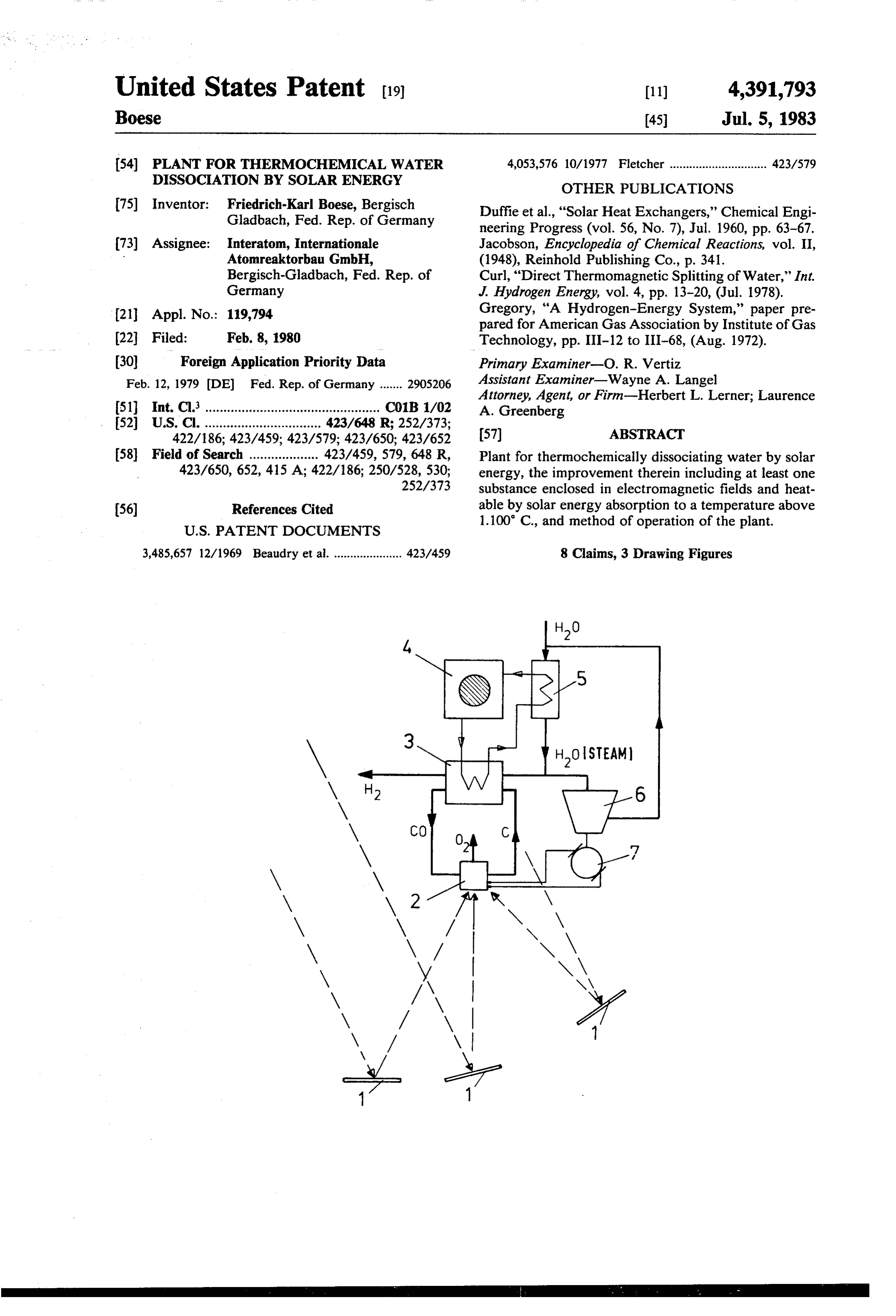
United States Patent (19) (11) 4,391,793 Boese 45 Jul. 5, 1983 (54) PLANT FOR THERMOCHEMICAL WATER 4,053,576 10/1977 Fletcher .............................. 423/579 DSSOCATION BY SOLAR ENERGY OTHER PUBLICATIONS 75) Inventor: Friedrich-Karl Boese, Bergisch Duffie et al., "Solar Heat Exchangers," Chemical Engi Gladbach, Fed. Rep. of Germany neering Progress (vol. 56, No. 7), Jul. 1960, pp. 63-67. 73) Assignee: Interatom, Internationale Jacobson, Encyclopedia of Chemical Reactions, vol. II, Atomreaktorbau GmbH, (1948), Reinhold Publishing Co., p. 341.
Bergisch-Gladbach, Fed. Rep. of Curl, "Direct Thermomagnetic Splitting of Water,” Int. Germany J. Hydrogen Energy, vol. 4, pp. 13-20, (Jul. 1978). 21 Appl. No.: 119,794 Gregory, "A Hydrogen-Energy System,” paper pre pared for American Gas Association by Institute of Gas 22 Filed: Feb. 8, 1980 Technology, pp. III-12 to III-68, (Aug. 1972). (30) Foreign Application Priority Data Primary Examiner-O. R. Vertiz Feb. 12, 1979 IDE Fed. Rep. of Germany ....... 2905206 Assistant Examiner-Wayne A. Langel Attorney, Agent, or Firm-Herbert L. Lerner; Laurence 51 int. Cl. ................................................ COB 1/O2 A. Greenberg 52 U.S. C. ................................ 423/648 R; 252/373; (57) ABSTRACT
58 Field of Search ................... 423/459, 579, 648 R, Plant for thermochemically dissociating water by solar 423/650, 652, 415A; 422/186; 250/528, 530; energy, the improvement therein including at least one 252/373 substance enclosed in electromagnetic fields and heat (56) References Cited able by solar energy absorption to a temperature above
1.100 C., and method of operation of the plant.
3,485,657 12/1969 Beaudry et al...................... 423/459 8 Claims, 3 Drawing Figures
Page 2
Drawing sheet — no readable text.
Page 3
Drawing sheet — no readable text.
Page 4
realized practically only at temperatures above 1,100'
PLANT FOR THERMOCHEMICAL WATER C. Three-and morestage processes, the maximal temper DISSOCATION BY SOLAR ENERGY ature of which is below this threshold, have the disad vantage that the equipment and control expenses are
The invention relates to a plant and method for ther- 5 higher, that individual steps must be carried out with mochemically dissociating water by solar energy. large excess quantities and that forcibly required steps Hydrogen is necessary for preparing many products are carried out at low temperature and only very such as ammonia, for example, and offers advantages slowly.
for use as fuel, especially with respect to minimizing Basically, the attainment of high temperatures by pollution of the environment. The processes for produc- 10 means of solar energy presents no particular difficulties. ing hydrogen by electrolysis have a disadvantage in that In plants of heretofore known construction, wherein they require high-grade secondary energy in the form sunlight incident upon a large surface is reflected by a of electric power which itself must be generated by plurality of mirrors onto a common focal point, temper using considerable quantities of primary energy (it atures of more than 4,500 C. have already been would hardly seen possible to increase the efficiency of 15 achieved.
the conversion much above 40%). This situation re It is an object of the invention to provide a plant for mains unchanged even if sunlight is employed as pri thermochemical dissociation of water which operates mary energy as long as the conventional path via steam with a cyclic two-stage process and utilizes the avail generator-turbine-electric power generator, is adhered able solar energy as completely as possible, yet also to. If sunlight is converted directly into electricity, the 20 allows a coupling-in of low-grade heat. efficiency is lower again by about one-half. The costs of With the foregoing and other objects in view, there is plants converting solar energy into high-grade second provided in accordance with the invention a plant for ary energy can be lowered only by a dramatic improve thermochemically dissociating water by solar energy, ment in efficiency to the point at which they are com the improvement therein comprising at least one sub petitive in accordance with criteria which are valid 25 stance enclosed in electromagnetic fields and heatable today and for the immediately foreseeable future. by solar energy absorption to a temperature above Besides electrolysis, a number of processes for ther 1,100 C.
mochemically dissociating water are known, such as Through the absorption of the solar energy, which is steam gasification according to the reaction advantageously focused in the previously mentioned 30 manner, the solar energy can be utilized almost com
C-H2O-CO-H2. (1) pletely. The high temperature permits the performance of a number of reactions, of which reaction (5) is men
The heat supply required to maintain the reaction tioned as an example which, together with others, for must be made available here, however, by complete example reaction (l), result in a cyclic process. The combustion of part of the applied carbon 35 selected example is also especially advantageous in that reactions (5) and (1)) are endothermic, i.e., no waste
C--O2-CO2 (2) heat has to be removed. Furthermore, a possibility of containing substances at the required high temperatures or, as has likewise been proposed heretofore, by a high is indicated. This type of containment has been used at temperature nuclear reactor. However, the tempera temperatures higher by several orders of magnitude in tures attainable therewith do not exceed 1,000 C. in experiments for performing controlled nuclear fusion. view of the strength of the structural materials used. The non-material reaction vessel formed in this manner The conversion following the reaction (1) which is is pervious or translucent to sunlight. possible in accordance with the reaction. It is advantageous to heat up the reactands of such CO+ H2O-CO2 + H2 (3) 45 reaction directly and, in accordance with another fea ture of the invention, the substance is hot and consists of also yields carbon dioxide and is additionally exother reactands of an endothermic reaction. However, a situa mic so that heat must be removed, which has an adverse tion may also arise wherein the absorption properties of reactands which are suitable as such are insufficient.
effect upon the course of the process. In view of the 50 Then, in accordance with a further feature of the inven limited availability of coal and hydrocarbons, recycling tion, the hot substance is combinable with reactands of processes would be desirable which make the carbon endothermic available again, for example, according to the reaction. radiation. reaction by heat conduction and/or heat 2CO2-2CO-O2 (4) 55 In accordance with an added feature of the invention, the substance to be heated up is pervious to light waves which occurs, however, only at temperatures above in the visible range, i.e. sunlight, but impervious to 3,000 C., or waves in the infrared range, i.e. thermal rays. The so called hothouse effect which then occurs effects an 2CO-2C+O2 (5) especially loss-free heating of the enclosed substance. 60 This requirement need not be met for all substances at temperatures above 3,500 C., since only then is car otherwise suitable for thermochemical dissociation of bon present in the gaseous state of aggregation and are water. In that case, and in accordance with an alterna the entropy values high enough. tive feature of the invention, indirect heating of the hot J. E. Funk and R. M. Reinstrom have shown in their substance or the reactands is accomplished by enclosing paper "Energy Requirements in the Production of Hy- 65 them in an enclosure formed of a substance with good drogen from Water,' I&EC Process Design and Devel heat absorption properties, the latter substance being, in opment 5 (1966), pages 336 to 342, that simple two-stage turn, held in position, like the hot substance or the reac thermochemical water dissociation processes can be tands themselves, by electromagnetic fields.
Page 5
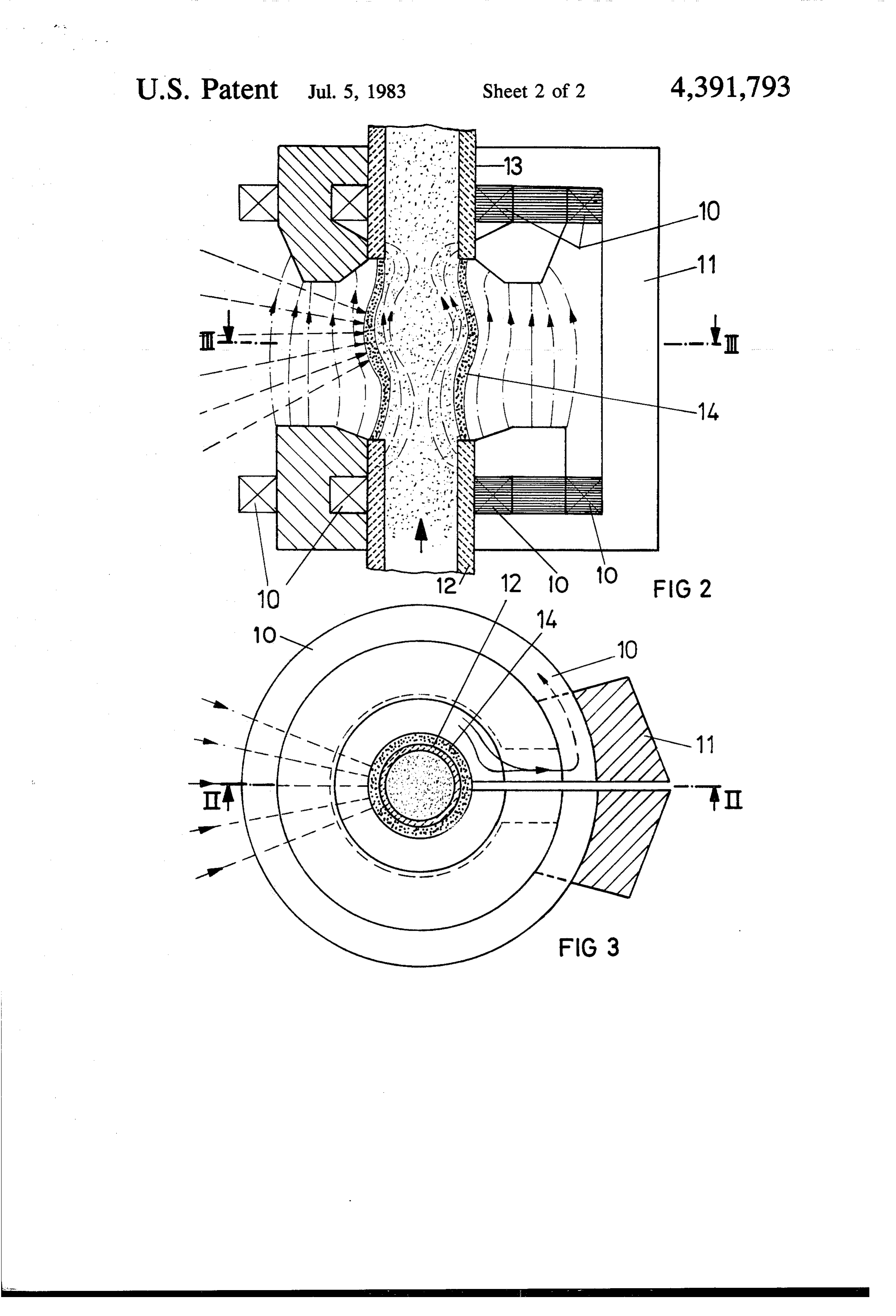
In accordance with yet another feature of the inven The high-temperature reaction vessel 2 (note FIG. 2.) tion, low-grade heat is coupled-in by mixing a fluid at is formed by magnetic lines of force (dot-dash) which low temperature with a fluid heated to a high tempera are produced by coils 10 which are wound on an iron ture due to absorption of solar energy in such a manner core 11 and traversed by electric current; the electrical that the resultant mixed fluid has a temperature pre- 5 leads are not shown in the interest of preserving the cisely sufficient for a given process. clarity of the presentation. The coils 10 and the core 11 In the foregoing example of a cyclic process, the are advantageously mirror-coated to protect then reaction (1) proceeds at relatively low temperatures. It against heat radiation. The reactand or reactands, for can be carried out, in accordance with a concomitant example CO, are fedin through a first pipe 12 formed of feature of the invention, by coupling-in relatively low- 10 ceramic, heat-resistant material. Since carbon monoxide grade heat, i.e., heat with a temperature below 1,000 C. has good absorptivity for thermal radiation and is ioniz such as accrues, for example, as waste heat in other able, it can be heated directly by sunlight striking the processes. Thermodynamic calculations indicate, for reaction vessel 2 to a temperature which results in disso example, that one-third of the heat utilized in the cyclic ciation thereof into carbon and oxygen. These reaction process can be fed-in at a temperature of 600 C. if the 15 products are discharged through a second pipe 13 fluid heated by the solar energy reaches a temperature which is likewise formed of ceramic material. Upon of about 3,730° C. and the pyrolysis temperature of leaving the reaction vessel 2, the temperature of the utilized process is about 1,730 C. reactands drops so quickly that recombination thereof is Other features which are considered as characteristic prevented, and the pipe 13 is protected against destruc for the invention are set forth in the appended claims. 20 tion, if necessary, by a non-illustrated cooling device. Although the invention is illustrated and described If other reactands are used with less heat absorptiv-- herein as embodied in a plant for thermochemical water ity, they can be enclosed in a material hull or shell 14 dissociation by solar energy, it is nevertheless not in which is held together by an electromagnetic field; it tended to be limited to the details shown, since various may consist of a material with good heat absorption modifications and structural changes may be made 25 properties, such as of carbon dioxide, for example, therein without departing from the spirit of the inven which surrenders the absorbed heat to the reactands tion and within the scope and range of equivalents of themselves.
the claims. I claim:
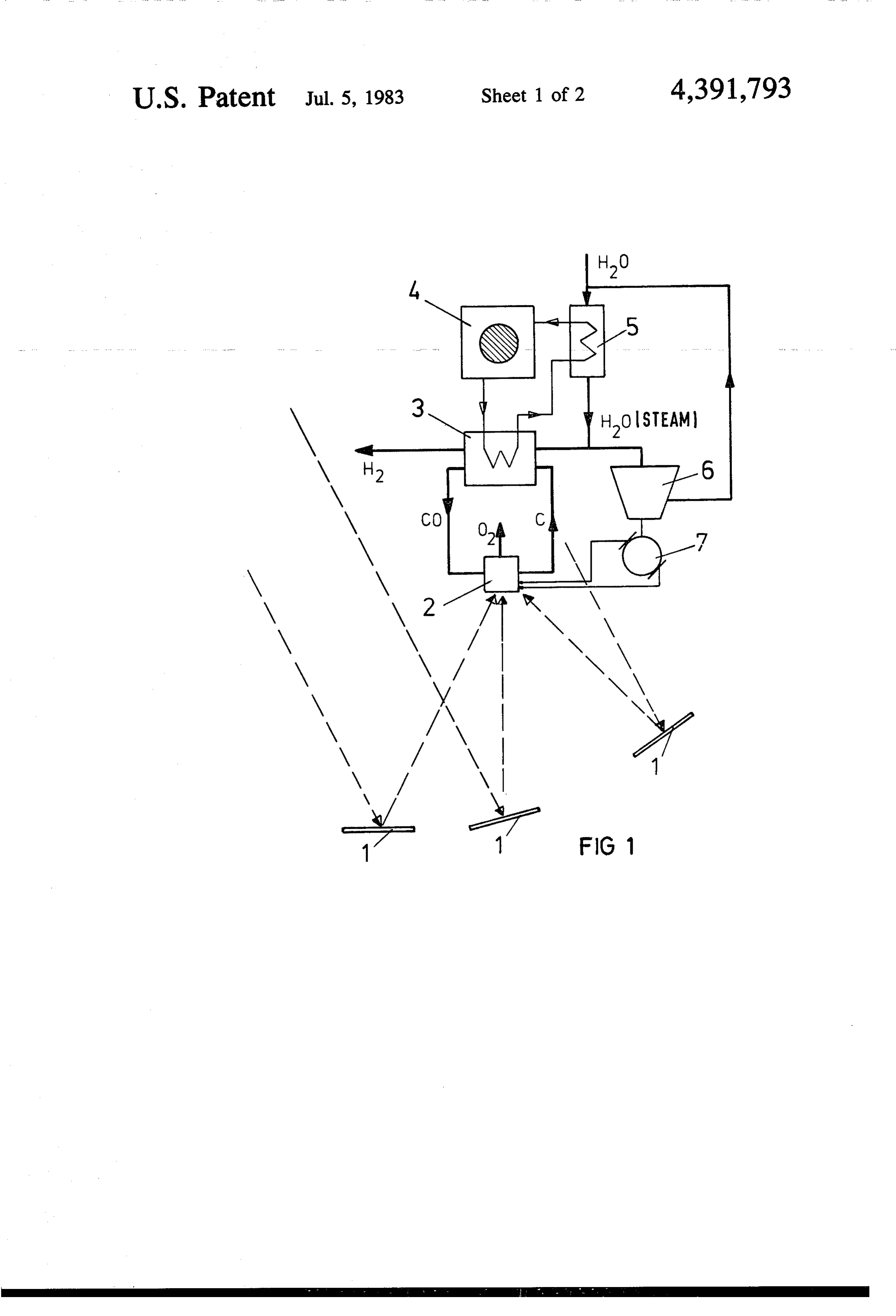
The construction and method of operation of the 1. In a method of thermochemically producing hy invention, however, together with additional objects 30 drogen from water by solar energy, the improvement and advantages thereof will be best understood from the therein which comprises forming electromagnetic fields following description of specific embodiments when containing within an otherwise unenclosed space within read in connection with the accompanying drawings, in a plant a substance thermochemically cleavable into which: two reaction products at a temperature above 1,100 C., FIG. 1 is a circuit diagram of the overall plant, ac- 35 one of said reaction products being reactable in gasify cording to the invention; ing apparatus with steam to produce hydrogen and the FIG. 2 is an enlarged, fragmentary longitudinal sec substance, concentrating the solar energy in the unen tional view of FIG. 1 showing the high-temperature closed space, formed by the electromagnetic fields cir reaction vessel taken along the line II-II in FIG. 3; and culating the reaction products from the space to the FIG. 3 is a cross sectional view of FIG. 2 taken along 40 gasifying apparatus, and circulating the substance from the line III-III. the gasifying apparatus to the space. Referring now to the drawing and first, particularly, 2. Method according to claim 1 wherein the sub to FIG. 1 thereof, there is shown the plant for thermo stance is carbon monoxide, the reaction products are chemically dissociating water which includes a plural carbon and oxygen, and the one reaction product is the ity of mirrors 1 which, by means of non-illustrated de- 45 carbon.
vices, are tilted in accordance with the position of the 3. Method according to claim 1, wherein the sub sun in such a manner that the reflected sunlight (broken stance is hotter than ambient and consists of reactands line) is concentrated in a focal point whereat a high of an endothermic reaction.
temperature reaction vessel 2 is disposed. In the latter, a 4. Method of thermochemically producing hydrogen temperature is attained at which carbon monoxide fed 50 from water according to claim 1 which comprises per to the reaction vessel 2 is split into oxygen and gaseous forming multistage endothermic processes of which carbon. The former is transported to another use out several stages are carried out at temperatures below side the plant, while the carbon is fed to a steam gasifier 1,100° C. and others at temperatures above 1,100 C., 3, wherein it reacts, under a supply of heat, with like and heating by the solar energy the reactands of the wise fed-in steam. Hydrogen is formed and is delivered 55 stages performed at the higher temperatures and, by as desired end product to a non-illustrated consumer; another heating source, the reactands of the stages per carbon monoxide is also formed and is returned to the formed at the lower temperatures. reaction vessel 2 to be split again. The steam gasifier 3 5. Method according to claim 1 wherein the sub can be heated in many conventional ways, known per stance enclosed in the electromagnetic fields is pervious se; In FIG. 1, the possibility is shown of heating the 60 to sunlight, yet impervious to thermal ways. steam gasifier 3 with the coolant from a thermal power 6. Method of thermochemically producing hydrogen plant 4. The temperature range which is below that from water according to claim 1 which comprises heat wherein steam gasification can be carried out, is appli ing part of the reactands of an endothermic reaction by cable to the vaporization of the water fed to the plant as absorption of the solar energy to a higher temperature, raw material in a steam generator 5. Part of the steam is 65 and heating part of the reactands by another heating expanded in a turbine 6 which drives a generator 7 source to a temperature lower than the higher tempera furnishing the power required for maintaining the reac ture and mixing both parts to obtain the substance hav tion vessel 2 as described immediately hereinafter. ing a temperature above 1,100 C.
Page 6
7. In a plant for thermochemically producing hydro for concentrating the solar energy in said space, and gen from water by solar energy, the improvement means for circulating said reaction products from said therein comprising means for forming electromagnetic space to said gasifying apparatus and for circulating said fields within an otherwise unenclosed space within the substance from said gasifying apparatus to said space. plant, said space being capable of containing a substance 5 8. Plant according to claim 1 wherein the enclosure is thermochemically cleavable into two reaction products formed of another substance held together by the elec at a temperature above 1,100° C., one of said reaction tromagnetic fields.
products being reactable in gasifying apparatus with k . . st E steam to produce hydrogen and said substance, means
Provenance
- Collection
- Cited prior art
- Original PDF
- patentimages.storage.googleapis.com →
- Filed
- 1980-02-08
- Pages
- 6
- Method
- pdftotext (the PDF's own text layer) + pdftoppm 300dpi page scans
- Source
- Google Patents bibliographic record
- Granted
- 1983-07-05
- Inventors
- Friedrich-Karl Boese; Interatom Internationale Atomreaktorbau GmbH
- Transcribed from
- patentimages.storage.googleapis.com →