patent · US4270600
Accumulator of energy for conversion to heat
2 June 1981
Page 1 — bibliographic record
United States Patent (19) (11) 4,270,600 Bourdin . .. . . . . 45) Jun. 2, 1981 (54) ACCUMULATOR OF ENERGY FOR 4,142,576 3/1979 Perry et al. .................. 165/104 SX
(75). Inventor: Francis Bourdin, Tournan-En-Brie, FOREIGN PATENT DOCUMENTS .. . . . ., France . .. : 2605953 8/1977. Fed. Rep. of Germany ............. 165/45
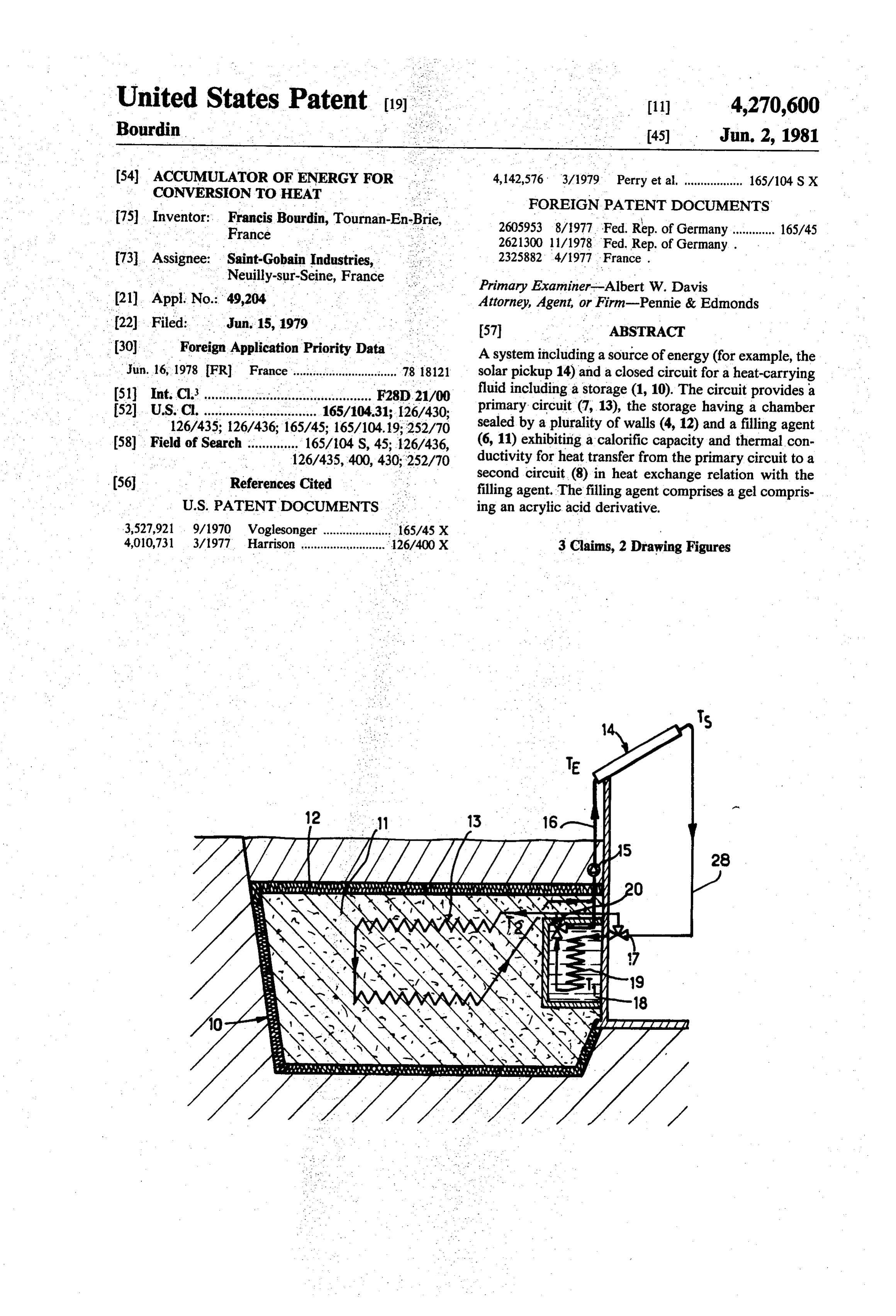
(73) Assignee: Saint-Gobain Industries, 2325882 4/1977 France. Neuilly-sur-Seine, France Primary Examiner-Albert W. Davis (21) Appl. No.: 49,204 Attorney, Agent, or Firm-Pennie & Edmonds (22 Filed: Jun. 15, 1979 57 ABSTRACT (30) Foreign Application Priority Data A system including a source of energy (for example, the Jun. 16, 1978 (FR) France. 78 18121 solar pickup 14) and a closed circuit for a heat-carrying fluid including a storage (1,10). The circuit provides a 51 int. Cl. .................i.......................... F28D 21/00 primary circuit (7, 13), the storage having a chamber 52) U.S. C. ............................. 165/104.31; 126/430; sealed by a plurality of walls (4,12) and a filling agent
58), Field of Search .............. 165/104 S, 45; 126/436, (6, 11) exhibiting a calorific capacity and thermal con 126/435, 400, 430; 252/70 ductivity for heat transfer from the primary circuit to a second circuit (8) in heat exchange relation with the (56) References Cited filling agent. The filling agent comprises a gel compris
4,010,731 3/1977 Harrison. 126/400X 3 Claims, 2 Drawing Figures
VIZ. A WWWW I y
NERS
Sess
SX Shiziz (a N
Page 2
Drawing sheet — no readable text.
Page 3
ACCUMULATOR OF ENERGY FOR CONVERSION DISCLOSURE OF INVENTION TO HEAT The present invention seeks to overcome the prob lems and disadvantages of the prior art in that it is di
DESCRIPTION rected to a storage having greater calorific energy ca pacity and thermal energy conductivity to provide heat 1. Technical Field
The present invention relates to a storage for storing conductingwithin exchange the storage between a primary circuit a heat-carrying fluid and a secondary circuit calorific energy from a source and capable of heat con conducting a fluid to be heated.
duction and transfer between a pair of circuits. One 10 The storage of the present invention is adapted to be circuit provides a closed path for a heat-carrying fluid, supplied heatenergy from any source, such as, for ex while the other circuit carries a fluid to be heated. ample, a solar pickup and includes an insulated enclo 2. Background Art sure which is located below ground. The energy source Because of the increasing costs of energy from con is located in a primary circuit which extends through ventional or traditional energy sources, attention has 15 the storage. A secondary circuit also extends through been directed to other possible sources of energy. Also, the storage and both circuits are in heat transfer relation attention has been directed to increasing the yield and within the storage with a filling agent comprised of a /or efficiency of energy-consuming apparatus which gel, preferably formed from an acrylic acid derivative. may be the heating installation of a dwelling or the The filling agent of the present invention provides a supply of heated water for home or possible other use. 20 surprising calorific capacity and thermal conductivity, One particular source of energy-the sun-has quite comparable to that of water, yet it is not subject to aroused a degree of enthusiasm within technical circles, the disadvantages of water, as will be brought out. and it is known that buildings may be heated by the In a preferred aspect of the invention, the filling agent energy "absorbed' in a solar collector or pickup consists solely of a gel having about 85 to about 90% by adapted to be disposed, for example, on the roof of the 25 weight water and about 15 to about 10% by weight of building. The solar pickup may comprise a body whose acrylic acid derivative base polymers. In another pre front face is usually protected by a plate of transparent ferred aspect of the invention, the filling agent may plastic or glass and whose back face is in contact with a comprise the gel and particulate including both coarse heat-carrying fluid. The heat-carrying fluid may be air 30 and fine particles in total amount to assure (over and or water, for-example, which circulates between the above the volume of space taken by the primary and solar pickup and a thermal insulating element in a heat secondary circuits) that about 35% of the total space remains for gel which is polymerized in the interstices carrying circuit including a storage apparatus. Typi between particles.
cally, the solar pickup may comprise a screen wall The storage, further, may comprise one of a series of placed between support posts which may be an integral 35 two or more storages, the second of which is an auxil part of the building. iary storage to supply daily consumption requirements. The storage apparatus may be connected directly The primary storage is as described onto the circuit or be put in heat exchange relation with included in a system to a heat source,andthethe storages are the heat-carrying fluid, and the circuit thus comprises a capability of control of the heat-carrying fluid having system to the heat exchanger within the storage, as well as to com 40 storage and/or auxiliary storage. prise or constitute a primary circuit for exchange of The storage of the present invention and the overall heat to a secondary circuit through a double heat ex system is particularly adapted for buildings, as well as changer within said storage. ' individual dwellings.
German Printed Publication No. 2,621,300 is typical Other advantages of the present invention will be of the prior art including, generally, a solar pickup, at 45 come clear upon a reading of the mode of operation to least a first tank of water and a circuit for communicat follow.
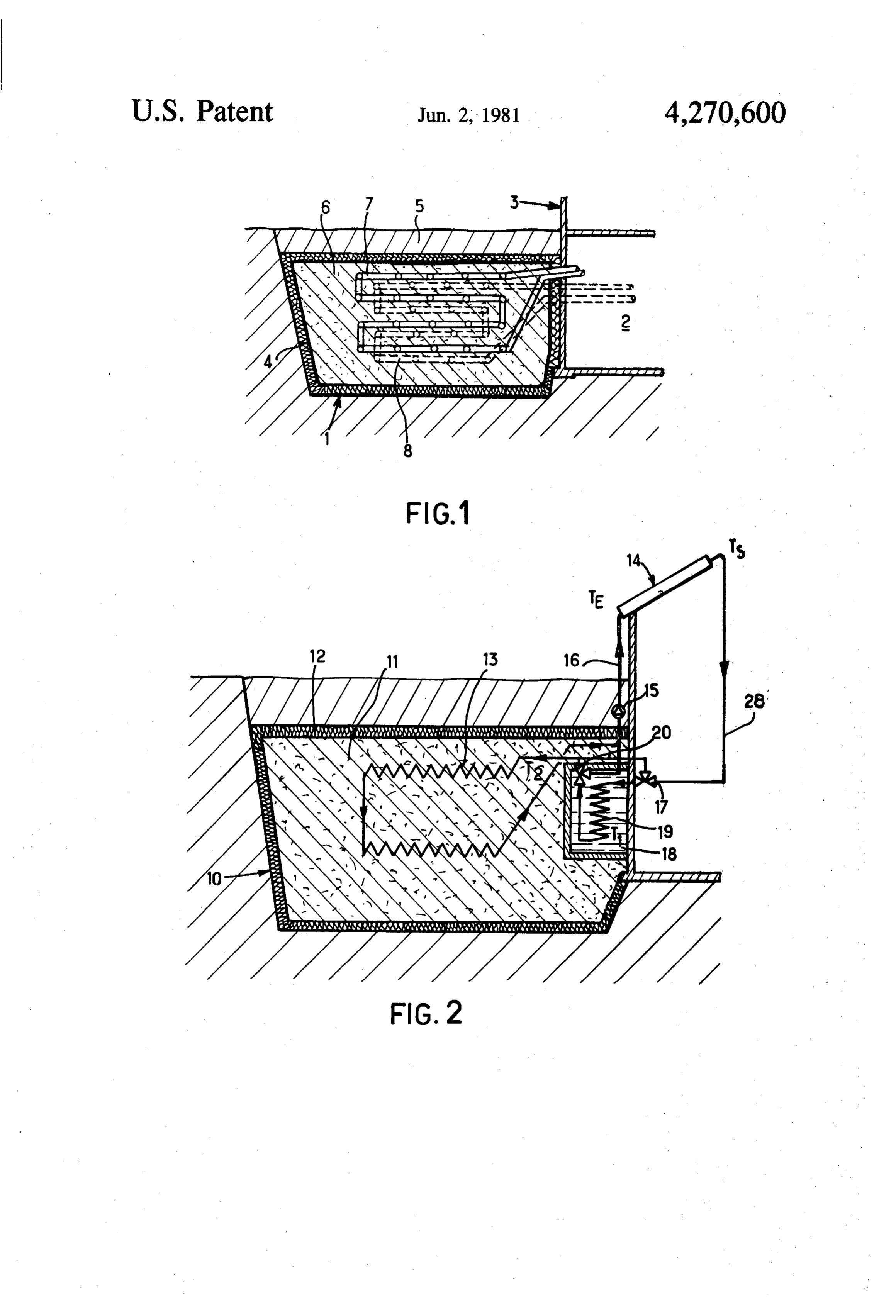
ing a heat-carrying fluid to the tank for heat exchange between the circuit and water. A problem or disadvan BRIEF DESCRIPTION OF DRAWING tage resulted from this form of apparatus, namely, the FIG. 1 is a schematic view in vertical section through system had only slight calorific capacity which might 50 a storage according to one form of the invention; and not be satisfactory for providing heat within a period FIG. 2 is a similar view of another form of storage wherein there is a lack of sun. . . including a two-zone chamber. To overcome this problem or disadvantage, said pub lication proposes to increase the calorific capacity of BEST MODE FORCARRYING OUT THE the system aforementioned by the provision of a sub 55 INVENTION stantially increased capacity (for the period of a week) The present invention is in a storage device, tank or storage together with a smaller capacity storage for reservoir (hereinafter "storage") for storing calorific meeting daily needs. But this proposal has not met with energy. While the source of the calorific energy may either success or acceptance because of the costs in derive from a single one or a series of solar panels, such volved. 60 as those previously described, the invention also con It has also been proposed to provide a storage of templates the use of the storage with other sources of larger capacity in an in-ground location and to fill the calorific energy.
storage with a heat accumulator substance, such as The storage to be described preferably is located in earth, sand or pebbles. It is found, however, that this the vicinity of or closely adjacent to a wall of the base form of heat accumulator substance has poor calorific 65 ment 2 of a dwelling 3, and, as illustrated in the Figures, capacity and poor thermal conductivity. Examples of below ground level. As illustrated, further, the storage this form of prior art is disclosed in French Pat. No. is covered with a layer 5 of fill thereby to be hidden 2,325,882, as well as No. 2,353,021. v from sight. The fill may be a humus material.
Page 4
The storage, as may be seen in FIG. 1, is in the form merized about the solid particles (both sand and peb of an enclosure 1 having walls 4 including top, side and bles) thereby to fill the interstices and provide good bottom walls. These walls describe a closed chamber of conductivity of heat which otherwise, because of the any particular cross-section, such as rectangular. Pref poor heat conductive capability of the solid particles, erably, the chamber is insulated. Thus, the walls either 5 would not be possible.
are formed of a thermal insulating material or else the The primary conductive conduit 7 (hereinafter "pri walls throughout their outer surface are covered with a mary circuit') and the secondary conductive conduit 8 thermal insulating material. Any particular wall mate (hereinafter "secondary circuit”) both are disposed rial, whether or not capable of exhibiting insulative within the chamber of enclosure 1 and supported by the capability, must, of course, be capable of withstanding a 10 filling agent 6. Each circuit includes an inlet to a major prescribed measure of hydrostatic pressure as may be heat transfer length within the chamber and an outlet exerted on the walls because of either the filling agent from that length. As illustrated in FIG. 1, the inlets and within the chamber or the location of the enclosure outlets extend through a wall 4 (the side wall) of enclo relative to the ground, but this measure may be rather sure 1 and the wall of dwelling 3 into the region of the small, as explained hereafter, and materials capable of 15 basement 2. In order to maintain the hermetic seal, a use are well known. sealing structure (not shown) is provided about each of The closed chamber is hermetically sealed, even in its the inlet and outlet conduits.
upper region, by means of a steam-tight material, The gel of the filling agent, described above, has a which, for example, may be a sheet (not shown) of a thermal conductivity and calorific capacity comparable fluid impermeable plastic, preferably sheathed through 20 to that of water, yet it is not subject to the same, possi out the inner surfaces of the walls. bly troublesome convection movements and hydro A filling agent 6 exhibiting calorific capacity and static pressure conditions.
thermal conductivity is carried within the closed cham The storage of the present invention operates in a ber of enclosure 1. The filling agent comprises a gel, manner likened to a heat exchanger. Thus, the primary having an acrylic acid derivative base. As will be de 25 circuit, which is closed to confine a conventional heat scribed, the filling agent is in thermal contact with both carrying fluid, yields calories to the filling agent and the a primary conduit circuit 7 and a secondary conduit 8. secondary circuit, providing a path for fluid to be The gel includes from about 85 to about 90% by heated, takes in calories from the filling agent. The heat weight water and about 15 to about 10% by weight of transfer is achieved in a storage of relatively small vol acrylic acid derivative base polymers. According to the 30 une because of good calorific energy storage capacity. invention, an aqueous solution of acrylic acid deriva Also, the heat transfer is achieved in a storage not sub tive, for example, methyloacrylamide and acrylamide, ject to the same level of hydrostatic pressure as would in equal parts, are mixed and then polymerized in water be exhibited by water. Thus, the filling agent of the either with a peroxide or persalt. An accelerator which present invention overcomes or substantially eliminates may be, for example, diethylaminopropionitrile 35 the drawbacks of loss of filling agent by leakage, even if (DEAPN) and possibly a cross-linking agent, such as the walls of the enclosure becomes fissured, because it N-N' methylenebisacrylamide (NN'-MBA) is then avoids the development of noticeable hydrostatic pres added to the mixture. Ste.
A suitable resin for making such a gel may be the In the form of the invention of FIG. 1, the primary resin sold under the tradename and registered mark and secondary circuits 7 and 8, respectively, are not ROCAGIL 1295. illustrated in any manner of connection to a source of Additional materials for enhancement of various calorific energy. Any energy source may be employed. characteristics of the gel may be added to the mixture In the form of the invention in FIG. 2, the primary within the scope of the invention. circuit 13 of the storage of enclosure 10 is coupled with The filling agent 6 within the closed chamber may 45 a standard hot water storage 18, both of which may be consist solely of the above-described gel, and the poly connected in series, or individually, to an energy source merization of the aqueous resin solution may be carried characterized as a "solar pickup' 14. This provides a out within about 30 minutes' time. More particularly, two-zone storage including that of enclosure 10 and of the polymerization process may be carried out either at the hot water or auxiliary storage 18. According to the the factory or at the site of use of the storage. To avoid 50 invention, the enclosure 10 may have a capacity, for the creation of an inordinate amount of pressure within example, of 150 m and the storage 18 may have a ca the enclosure throughout the polymerization process, it pacity, for example, of 3 m3.
is possible and preferable that the gel be polymerized The enclosure 10 is of the same overall construction within the chamber in successive gel layers, so that the of wall (the walls 12) to provide thermal insulative wall need not be very resistant. 55 capability; it is located below ground, in the vicinity of The filling agent may comprise, additionally, in thor or adjacent to the basement of a dwelling; it is hermeti ough mixture with the gel, a mixture of both sand and cally sealed; and, it includes a filling agent (the filling pebbles. The pebbles may be of a coarse particle size of agent 11) as described in connection with the discussion about 80 to about 130 mm in diameter and the sand may of FIG. 1.
be finely divided, having a size of about 0.5 mm. Dis 60 The solar pickup 14 is connected in the primary cir counting the volume of the chamber taken by the pri cuit 13, and the circuit 19 of the hot water storage 18, by mary and secondary conductive conduits 7 and 8, re a pair of valves 17 and 20 having three-way control spectively, a quantity of pebbles to fill approximately capability. A pump 15 maintains a flow of heat-carrying 50% of the volume of the chamber may be used. The fluid through the closed system. To this end, a conduit open volume remaining may be reduced by approxi- 65 16 provides a return conduit to the solar pickup and a mately 30% through addition of sand, thereby to pro conduit 28 connects the solar pickup to the valve 17. vide about 35% of the initial available volume of the While not shown in the Figure, a secondary circuit chamber for polymerization of the gel. The gel is poly which takes in calories from the filling agent, as yielded
Page 5
by the primary circuit 13, likewise is included in the those skilled in the art to which the invention pertains storage. after understanding the invention, that various changes Various temperature conditions may exist within the and modifications may be made therein without depart overall system. And, pump 15 will be operative to cir ing from the spirit and scope of the invention as defined culate the heat-carrying fluid as long as certain tempera by the claims appended hereto.
ture relationships exist. Thus, pump 15 circulates the I claim:
heat-carrying fluid if either Tse T1 or T2>TE, 1. A storage for storing calorific energy, as may de wherein: Ts is the output temperature at the solar rive from a solar pickup including an insulating casing, pickup; T is the temperature of the water in the hot a filling agent comprising at least partially a gel of an water storage; T2 is the temperature of the filling agent; O acrylic acid derivative base, heat-carrying fluid circuit and, TE is the input temperature at the solar pickup. means extending within said casing in thermal contact If both of the temperature relationships exist, then the with said filling agent, said heat-carrying fluid circuit flow of heat-carrying fluid will be in the series connec means comprising a primary circuit and a secondary tion from the solar pickup 14, to each of the auxiliary circuit of conduits, one of which is for a heat-carrying storage 18 and storage 10, and in return to the solar 5 fluid and the other of which is for a fluid to be heated, pickup.
If, on the other hand, only one of the temperature an cuit auxiliary water storage, said heat-carrying fluid cir means also in contact with water in said water relationships exist, then the flow will by-pass either the storage, storage 10 or the auxiliary storage 18. Particularly, if the ing fluidand in valve means for circulating said heat-carry said storage and/or auxiliary storage as a temperature of the filling agent is greater than the tem 20 perature at the input of the solar pickup, then the flow function rying of the respective temperatures of said heat-car fluid and said storages.
of heat-carrying fluid will circulate through the auxil iary storage. If the temperature at the output of the solar rive from a solarforpickup 2. A storage storing calorific energy, as may de pickup is greater than the temperature of water in the a filling agent comprisingincludingat least an insulating casing, partially a gel contain hot water storage, then the flow of heat-carrying fluid 25 ing from about 85 to 90% by weight of water and about will circulate through the storage 10. The valves 17 and 15 to about 10% by weight or acrylic acid derivative 20 are controlled automatically to provide this circula base polymers, at least a heat-carrying fluid circuit in tion capability, as well known.
By virtue of the series connection capability of stor thermal water contact with said filling agent, an auxiliary storage, said heat-carrying fluid circuit also in age 10 and auxiliary storage 18, assuming the aforemen 30 tioned temperature relationships exist, it is possible that contact with water in said water storage, and valve the auxiliary storage act as a temporary storage for means for circulating said heat-carrying fluid in said hotter water (for household use) while the storage 10, storage and/or auxiliary storage as a function of the having greater size to store calories throughout alonger respective temperatures of said heat-carrying fluid and period, provides a means of transfer of calories to the 35 said storages.
auxiliary storage, and vice versa. 3. The storage according to one of claims 1 or 2 The storage of FIG. 2, likewise, may be supplied by a wherein said filling agent further comprises particulate, source of energy other than the solar pickup within the including pebbles and sand, and wherein said gel is context of the present invention. mixed thoroughly within the interstices of said particu Having described the invention with particular refer late. k t ence to the preferred form thereof, it will be obvious to
Provenance
- Collection
- Cited prior art
- Original PDF
- patentimages.storage.googleapis.com →
- Filed
- 1979-06-15
- Pages
- 5
- Method
- pdftotext (the PDF's own text layer) + pdftoppm 300dpi page scans
- Source
- Google Patents bibliographic record
- Granted
- 1981-06-02
- Inventors
- Francis Bourdin; Saint Gobain Industries SA
- Transcribed from
- patentimages.storage.googleapis.com →