patent · US3483040
Nuclear battery including photocell means
9 December 1969
Page 1
Drawing sheet — no readable text.
Page 2
United States Patent Office 3,483,040 Patented Dec. 9, 1969
emitted alpha particles is converted into electromagnetic 3,483,040 energy by a fluorescent gas that occupies the volume de NUCLEAR BATTERY INCLUDING fined by the sphere. Electromagnetic radiation from the PHOTOCELL MEANS fluorescent gas is then incident on one or more photocells William E. Parkins, Woodland Hiiis, Calif., assignor to that are suitably positioned to cooperate with the per North American Rockwell Corporation forations of the sphere. An outer sphere can be used to Filed June 27, 1966, Ser. No. 560,470 enclose the perforated sphere.
U.S. C. 136-89 12 Claims Further objects, features, and the attending advantages of the invention will be apparent when the following de
O scription is read in connection with the accompanying
ABSTRACT OF THE DISCLOSUIRE drawing.
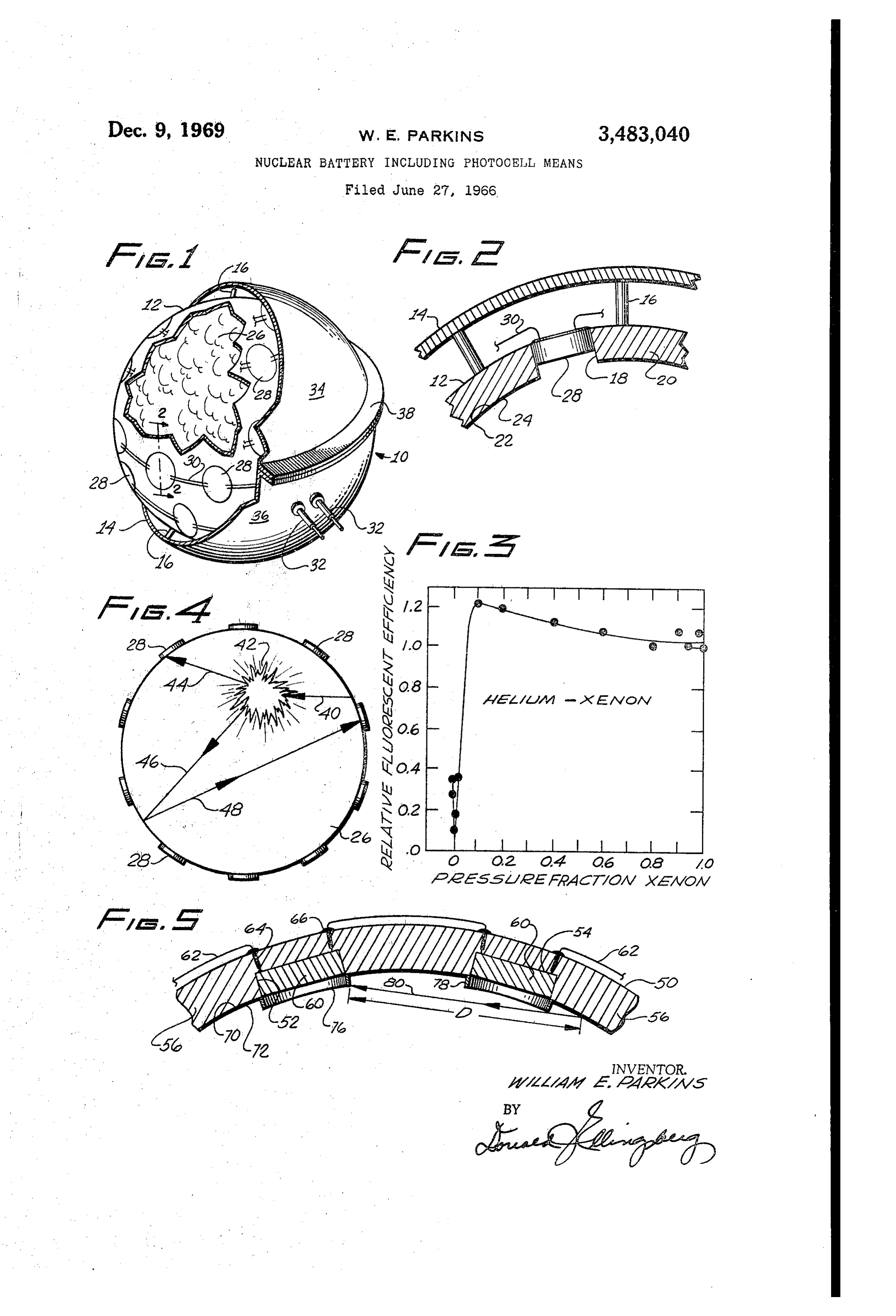
A nuclear battery or electrical power Supply using a Brief description of the drawing radioactive source whose radiation is converted to elec FIGURE 1 is a perspective view, partly broken away, tromagnetic radiation by a fluorescent gas, which is then 5 of a double-conversion nuclear battery of the invention; converted to electrical energy in photocells such as photo FIGURE 2 is an enlarged section of the nuclear bat electric or photovoltaic cells. tery of FIGURE 1 along the line 2-2.
FIGURE 3 is a graphical relationship of the pressure fraction of one fluorescent gas and the relative fluorescent
Background of the invention 20 efficiency of the gas;
One type of nuclear battery is a double-conversion nu FIGURE 4 is a schematic representation of the operat clear battery. A double-conversion nuclear battery con ing principle of the double-conversion nuclear battery of verts radiation that is emitted as particles from a radio the invention; and active energy source into electromagnetic radiation and FIGURE 5 is an enlarged section of a modification of then converts the electromagnetic radiation into electrical the double-conversion nuclear battery of the invention. energy in a photocell. In the double-conversion nuclear Description of the invention batteries of the prior art (for example, see U.S. Patents Referring to FIGURES 1 and 2, one form of double Nos. 3,031,519; 3,037,067; and 3,053,927) a phosphor, conversion nuclear battery 10 is shown. The nuclear bat either solid or liquid, converts the radiation particles into electromagnetic radiation, usually as scintillations of vis 30 tery 10 has a container means which, in the form shown, is an inner sphere 12 positioned within an outer sphere ible light. One or more photoelectric cells then convert the 14. The inner and outer spheres 12 and 14 are maintained electromagnetic radiation to electrical power for an ex in a spaced-apart relationship by a plurality of similar ternal load.
Double-conversion nuclear batteries have a relatively spacers such as rods 16. The rods 16 are circumferentially short operating life because the solid or liquid phosphor 35 distributed so that the inner sphere 12 is positioned within experiences radiation damage from the high velocity radi and supported by the outer sphere 14. The inner sphere ation particles. 12 is suitably formed with a plurality of similar apertures Objects of the invention 18 and connecting ligaments 20, i.e., formed as a per forated sphere.
Accordingly, it is an object of my invention to provide 40 A radioactive source means is positioned within the a new and improved nuclear battery. container means, preferably the inner sphere 12. The Another object of the invention is to provide a light radioactive energy source in the nuclear battery 10 of weight and compact double-conversion nuclear battery FIGURES 1 and 2 is preferably an alpha particle emitter, having a relatively long operating life with an electrical as will be described hereinafter. The radioactive source power output at a useful value. 45 is positioned as a relatively thin layer or coating 24 on A further object of the invention is to provide a double the inner surface 22, i.e., the inner surface of the con conversion nuclear battery having an improved geometry necting ligaments 20, of the perforated inner sphere 12. to prevent radiation damage to the battery. It is desirable for an efficient nuclear battery 10 that the Likewise an object of the invention is to provide a radioactive layer 24 have a mirror-like surface finish; double-conversion nuclear battery having an improved 50 however, the surface finish is not critical to the invention. geometry for increased efficiency. In the complete nuclear battery 10, the inner sphere An additional object of the invention is to provide a 12 defines a spherical volume 26 that contains a fluores double-conversion nuclear battery that has inherent volt cent gas. The fluorescent gas is preferably hermetically age regulation. sealed within at least the outer sphere 14. Still another object of the invention is to provide a 5 A converter means, such as similar photocells 28, are double-conversion nuclear battery that requires no special preferably positioned in the apertures 18. The photocells radiation shielding. 28 are electrically connected by similar electrical leads Summary of the invention 30. The photocells 28 can be electrically connected either Briefly, in accordance with the invention, a new and 60 in series, in parallel, or in series-parallel strings with the electrical power output from the complete nuclear battery improved nuclear battery is provided having a container 10, for example, brought through similar hermetically means, a suitable radioactive energy source positioned sealed and electrically insulated output leads 32. within the container, and a fluorescent gas atmosphere in It is contemplated that the inner sphere 12, for exam the container that converts the kinetic energy of radioac tive particles emitted from the radio-active source into 65 ple, can be formed from several segments which are suit electromagnetic radiation. A photocell positioned in the ably joined, and that the outer sphere can be formed as container and protected from the radioactive particles con shown by FIGURE 1 from separate hemispheres 34 and verts the electromagnetic radiation to electrical energy. 36 that are joined at a conventional flange joint 38. In one embodiment of the invention, alpha particles are The following example is given as an indication of one emitted from a relatively thin film of a radioactive mate 70 nuclear battery formed in accordance with the invention rial positioned on the inner surface of a container such as as described and as shown by FIGURES 1 and 2. This ex a perforated sphere or shell. The kinetic energy of the ample is offered to assure a working understanding of the
Page 3
invention and is not to be interpreted as limiting the scope clear battery of the invention. When the radioactive of my invention. energy source is a layer on the inner Surface of the Spherical volume ----- Approximately 16 in.8. sphere (see FIGURE 2), an alpha particle emitted from Radius (sphere) ------ Approximately 1.5 in. (3.8 cm.). the layer describes a straight-line path 40 into the fluo Weight ------------- Approximately 1 lb. 5 rescent gas that is contained in the spherical volume 26. Package ------------ Hermetically sealed container. The alpha particle interacts with the gas and the kinetic Radioactive material -- Plutonium-238; approximately energy of the alpha particle is converted in an ionizing 1.6 grams. event into a scintillation or flash 42 of electromagnetic
Fluorescent gas ------ Xenon. radiation. Electromagnetic radiation from the flash 42 Output ------------- 5 volts DC across a 4.5X 10⁴ ohm O passes either directly to a photocell 28 after describing load. path 44, or indirectly after describing path 46 to the Sur
External radiation ---- Less than 200 mr./hr. at the ex face of the layer where it is reflected and then describes ternal surface of the package. path 48 to a photocell. All the electromagnetic radiation paths from the flash 42 are not shown by FIGURE 4 for
Plutonium-238 has the following average alpha emis 5 purposes of clarity. While only one flash 42 is shown by sion characteristics: FIGURE 4 for purposes of clarity, it is to be understood Energy --------- 5.9 (mev.) or 9.43X 10⁻³ watts-sec.-l. that multiple flashes occur in the fluorescent gas. Range (in air) --- 1.8 inches (4.5 centimeters). Referring to FIGURE 5, one modification of the nu Decay constant - 2.54X 10⁻¹⁰ sec.-1. clear battery of the invention has a single sphere 50 that Half-life -------- 86.4 (years) or 2.65X10⁹ seconds. 20 is preferably hermetically sealed with a fluorescent gas atmosphere contained therein. The single sphere 50 is
The radioactive source of alpha particles, plutonium suitably formed with a plurality of similar and spaced 238, is deposited as a layer 24 on the inner surface 22 of apart recesses, such as recesses 52 and 54, with inter the perforated inner sphere 12. The layer 24 of plutonium connected or joined land regions 56. Conventional photo 238 has a reflective surface. The layer 24 of plutonium 25 voltaic cells 60 are shown positioned in each of the 238 cooperates with the container means to substantially recesses 52 and 54, and electrically connected by similar eliminate external radiation from the nuclear battery 10. electrical leads 62 that are brought through similar lead The fluorescent gas used in the nuclear battery 0 as apertures 64 formed in the wall of the sphere 50. Each shown by FIGURES 1 and 2 is preferably xenon and is 30 of the lead apertures 64 is hermetically sealed by a suit present at least within the spherical volume 26. It is con able potting material 66. It is contemplated that the elec templated that the volume defined by the space between trical leads can be positioned within the single sphere. the inner sphere 12 and outer sphere 14 would also be A radioactive source material is positioned on the inner filled with Xenon. surface 70, i.e., the inner surface of the land region 56, Xenon is known as an efficient scintillation material, of the sphere 50 as a layer or coating 72. i.e. fluorescent when exposed to radioactive energy such The nuclear battery shown by FIGURE 5 is similar as the high energy alpha particles that are emitted from in operation to the nuclear battery 10 shown by FIG the radioactive layer 24. The number of ion pairs pro URES 1 and 2, and also as schematically shown by duced in Xenon through ionizing events is a linear func FIGURE 4.
tion of the alpha particle energy. For each mev. (million 40 It is known that the conventional photovoltaic cells electron volts) expended by alpha particles in xenon gaS, used in the nuclear battery of the invention, particularly 570 keV. (thousand electron volts) will produce approxi the form of nuclear battery as shown by FIGURE 5, will, mately 3.7X10 ion pairs. The remaining 430 kev. goes when unprotected, experience radiation damage from into excitation of ions and atoms. Since the xenon con approximately 4 kev. or greater energies of alpha parti Verts the kinetic energy of the alpha-particles into elec cles that strike the cells. Alpha particle radiation from tromagnetic radiation, some fraction of the energy ex 45 plutonium-238 has an energy of 5.9 mev. which is sub pended in the production of ion pairs and excitations is stantially in excess of the 4 kev. limit. However, alpha converted into useful energy in the form of electromag particles emitted from plutonium-238 have a range in air netic radiation which can be at visible or near visible at standard conditions of approximately 1.8 inches (4.5 frequencies. centimeters). Therefore, a photovoltaic cell that is posi It is contemplated that conventional wave shifter tech 50 tioned diametrically opposite to a point of alpha particle liques can be used when necessary to shift the wave emission from the plutonium-238 source can be protected length of the fluorescent gas toward the optimum spec by the geometry of the battery container. When the vol tral response of the particular converter means used in ume defined by the container is filled with a xenon-helium the nuclear battery of the invention. The wave shifter mixture at a suitable pressure, the distance between the techniques are desirable to maximize the electrical power 55 emission point and the photovoltaic cell should be at least output of the nuclear battery by matching the Spectral greater than the range of the alpha particles in the xenon sensitivity of the photocells used in the nuclear battery. helium mixture at a given pressure. Helium atoms are formed in the xenon by the alpha The photocells adjacent to a point of alpha particle particles emitted from the plutonium-238 into the fluo emission from the plutonium-238 source, however, must rescent gas. The resulting helium buildup in the xenon 60 be protected. In the nuclear battery shown by FIGURES gas in the form of nuclear battery shown by FIGURES 1 and 2, the photocells 28 are recessed within the aper 1 and 2 is at a gradual rate of approximately one atmos tures 18 below the inner surface 24 so that the alpha phere for every five years. However, this helium buildup particles emitted from points adjacent the photocells do is beneficial. The fluorescent characteristics of xenonim. not strike the cells. In the nuclear battery shown by prove from 100% to about 120% as the gas mixture 65 FIGURE 5, barrier means such as barrier rims 76 and 78 gradually changes from 100% xenon to 20%xenon-80% are positioned around each of the photovoltaic cells 60 helium. The fluorescent characteristics of the Xeole and extend above the inner surface 70. It is contemplated helium gas mixture then drop sharply to zero (see FIG that similar barrier means can be positioned around each URE 3). of the photocells 28 in the nuclear battery shown by FIG The photocells used in the nuclear battery as con 70 URES 1 and 2. An alpha particle emitted from a point Verter means are conventional and can be any one of on the radioactive layer 72 describes a straight-line path Several Well-known types of photoelectric or photovoltaic 80 and hits the barrier rim 78. Therefore, the rim prevents
for example, Selenium photovoltaic cells, and the the alpha particle from damaging the photovoltaic cell 60. The straight-line path 80 is illustrated as a maximum
Operatively, FIGURE 4 schematically shows the nu distange that is approximately equal to the range of
Page 4
alpha particles in air. Any alpha particles emitted from 4. The nuclear battery of claim 1 in which said fluo the radioactive layer at a distance that is greater than the rescent gas means is xenon.
dimension D will not damage the photovoltaic cells since 5. The nuclear battery of claim 1 in which said photo they will have an energy level less than 4kev. It is con cell means are photovoltaic cells. templated that the photocells can have an added trans 6. The nuclear battery of claim 1 in which said photo parent surface (not shown) such as a quartz-glass window cell means are photoelectric cells. which is conventional. 7. The nuclear battery of claim 1 in which said con A nuclear battery formed in accordance with the in tainer means includes a second shell means enclosing said vention maintains a substantially constant electrical power first shell means.
output with inherent voltage regulation because conven O 8. The nuclear battery of claim 1 in which said spaced tional photovoltaic cells have a constant output voltage. apart portions are apertures and said photocell means are Because of the inherent voltage regulation provided by the recessed into said apertures below said internal surface. photovoltaic cells, increased efficiency in the fluorescent 9. The nuclear battery of claim 1 in which said first gas will not adversely affect the electrical voltage output shell means is a sphere having a diameter greater than but will become an additional source of reserve power. 5 the range of said radioactive energy in said fluorescent As will be evidenced from the foregoing description, gas means so that said radioactive energy emitted by said certain aspects of the invention are not limited to the par radioactive source diametrically opposed to said photocell ticular details of construction as illustrated and it is con means is dissipated prior to impinging on said opposite templated that other modifications and applications will photocell means thereby substantially eliminating radio occur to those having skill in the art. It is, therefore, in 20 active energy damage to said photocell means. tended that the appended claims shall cover such modifi 10. The nuclear battery of claim 9 in which said con cations and applications that do not depart from the true tainer means includes a barrier means cooperating with spirit and scope of the invention. said photocell means so that radioactive energy damage I claim:
between adjacent photocell means is substantially elimi 1. A nuclear battery comprising: nated.
(a) a hermetically sealed container means including a 11. The nuclear battery of claim 10 in which said bar first shell means having an internal surface defining a rier means is a rim means extending above said internal plurality of spaced-apart portions and interconnect surface and about said photocell means.
12. The nuclear battery of claim 10 in which said (b) a radioactive source positioned on said intercon spaced-apart portions are recesses. necting lands of said internal surface, said radio active source emitting radioactive energy, References Cited (c) a fluorescent gas means within said container UNITED STATES PATENTS means, said gas means converting a portion of said radioactive energy to electromagnetic radiation, and 2,598,925 6/1952 Linder.
(d) a plurality of photocell means cooperating with 2,858,459 10/1958 Schwarz.
said container means, said spaced-apart portions of 3,037,067 5/1962 Bartolomei ---------- 136-89 said internal surface suitably formed to receive and 3,053,927 9/1962 Viszlocky ---------- 136-89 position respective ones of said photocell means in 40 3,361,866 1/1968 Babigan ----------- 310-3 X associated ones of said spaced-apart portions, said ALLEN B. CURTS, Primary Examiner photocell means converting a portion of said elec tromagnetic radiation to electrical energy. U.S. C. X.R.
2. The nuclear battery of claim 1 in which said radio 310-3 active source is an alpha particle emitter. 45 3. The nuclear battery of claim 1 in which said radio active source has a reflective surface finish.
Provenance
- Collection
- Cited prior art
- Original PDF
- patentimages.storage.googleapis.com →
- Filed
- 1966-06-27
- Pages
- 4
- Method
- pdftotext (the PDF's own text layer) + pdftoppm 300dpi page scans
- Source
- Google Patents bibliographic record
- Granted
- 1969-12-09
- Inventors
- William E Parkins; North American Rockwell Corp
- Transcribed from
- patentimages.storage.googleapis.com →