patent · US20120097550A1
Methods for enhancing water electrolysis
26 April 2012
Page 1 — bibliographic record
(19) United States (12) Patent Application Publication (10) Pub. No.: US 2012/0097.550 A1
Lockhart (43) Pub. Date: Apr. 26, 2012 (54) METHODS FOR ENHANCING WATER (52) U.S. Cl. ......................................... 205/628; 204/273 ELECTROLYSIS (57) ABSTRACT
Apparatus and methods dissociate water into hydrogen and (76) Inventor: Michael D. Lockhart, oxygen gases on a more efficient basis. By modifying the Charlottesville, VA (US) environmental conditions of the water through increased covalent and hydrogen bond movement, increasing the rate of self ionization, and with enhanced induced magnetic Suscep (21) Appl. No.: 12/909,510 tibility, water electrolysis is achieved with reduced energy input. In the preferred embodiments, electrolysis is per formed by the individual and balanced cumulative applica (22) Filed: Oct. 21, 2010 tion of acoustic cavitation, a high-energy magnetic field to Support enhanced magnetic Susceptibility, and specific wave length infrared energy to increase bond vibrational modes of
Publication Classification water molecules. It has been discovered that the combination of acoustic cavitation, vibrational enhancement, and (51) Int. Cl. increased magnetic Susceptibility significantly enhances pro C25B I/06 (2006.01) ton-hopping and electric field fluctuations leading to an C25B 9/00 (2006.01) enhanced return on energy invested water electrolysis.
R LEALASERs
Electrolysis
N52 Wagnets
Acoustic Waves Acoustic
Page 2
Drawing sheet — no readable text.
Page 3
Patent Application Publication Apr. 26, 2012 Sheet 2 of 6 US 2012/0097.550 A1 Hot-spot conditions:
AO - T > 1 OOOK
s - Length scale. 5-500 ya g 30 - Time scale: 50-100s
FIGURE 3
SurroLinding liquid
Increased static pressure
Cavitation bubble imploding cloS8.
to a fixed surface geraatling a let ifth surrLiglerg lull.
FIGURE 4
Page 4
Drawing sheet — no readable text.
Page 5
Drawing sheet — no readable text.
Page 6
Drawing sheet — no readable text.
Page 7
Drawing sheet — no readable text.
Page 8
US 2012/0097.550 A1 Apr. 26, 2012
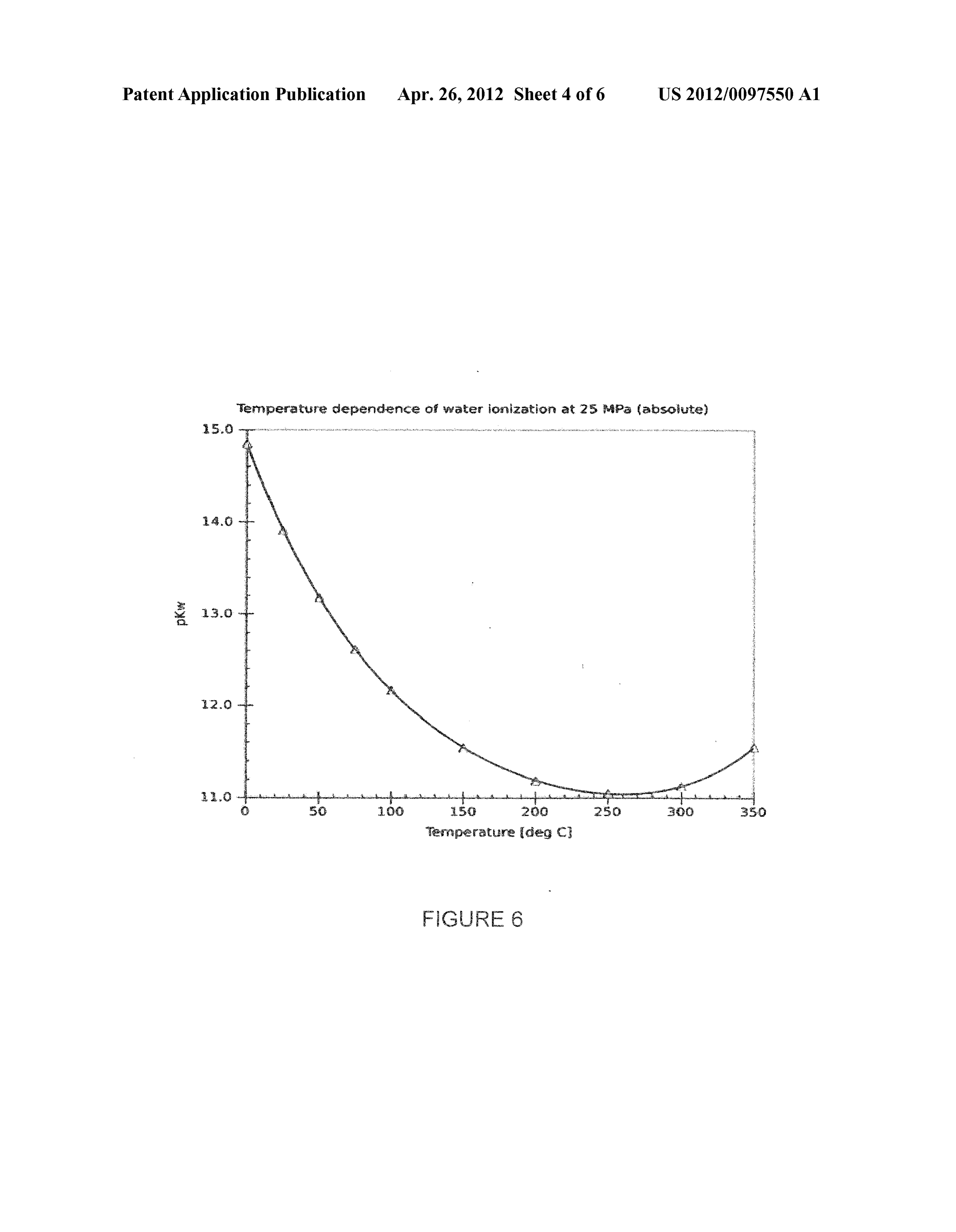
METHODS FOR ENHANCING WATER pressure electrolysis is defined as operating in the 5000 ELECTROLYSIS 10000 psi range. At ultra-high pressures the water solubility and cross-permeation across the membrane of H and O is
FIELD OF THE INVENTION affects hydrogen purity. Modified proton exchange mem 0001. This invention relates generally to the electrolysis of branes (PEMs) are used to reduce cross-permeation in com water and, in particular, to apparatus and methods that use a bination with catalytic H/O recombiners to maintain H combination of acoustic cavitations, molecular vibrational levels in O. and O levels in H at values compatible with hydrogen safety requirements.
enhancement, and increased magnetic Susceptibility to 0008. The United States Department of Energy believes reduce energy dissociation requirements associated with that high-pressure electrolysis will contribute to the enabling water electrolysis, thereby enhancing the process. and acceptance oftechnologies where hydrogen is the energy BACKGROUND OF THE INVENTION carrier between renewable energy resources and clean energy consumers. Many companies are also pursuing high-pressure 0002 Extracting hydrogen gas from water is an important solutions including Mitsubishi with its High Pressure Hydro technology and may become increasingly critical as an alter gen Energy Generator project.
native energy source. The normal basic energies required for 0009 High-temperature electrolysis is reportedly more water electrolysis are: efficient economically than traditional room-temperature 0003. Anode (oxidation): 2 H20(1)->O2(g)+4H--(aq)+ electrolysis because Some of the energy is Supplied as heat, 4e-Eox=-1.23 V which is cheaper than electricity, and because the electrolysis 0004 Cathode (reduction): 2 H+(aq)+2e-->H2(g) reaction is more efficient at higher temperatures. In fact, at Ered=0.00 V 2500° C. electrical input is unnecessary because water 0005. An individual water molecule has a large electric breaks down to hydrogen and oxygen through thermolysis. dipole, some magnetic Susceptibility, and a potential for Such temperatures are impractical; proposed HTE Systems increased self ionization, etc. (see FIG. 1) Liquid water is a operate between 100° C. and 850° C. uniquely stable Substance, owing the majority of its incred 0010. The efficiency improvement of high-temperature ible properties to the combination of covalent and very strong electrolysis is best appreciated by assuming the electricity hydrogen bonding. Liquid water has the same basic structure used comes from a heat engine, and then considering the as solid water, with more motion. Electric field fluctuations in amount of heat energy necessary to produce one kg hydrogen liquid water cause some molecular dissociation. The process (141.86 megajoules), both in the HTE process itself and also takes place in about 150 fs: the bond system of water begins in producing the electricity used. At 100° C., 350 megajoules in a neutral state; random fluctuations in molecular motions of thermal energy are required (41% efficient). At 850° C. occasionally (about once every 10 hours per water molecule) 225 megajoules are required (64% efficient). produce an electric field strong enough to break an oxygen 0011 Given all of these energy delivery challenges, it is hydrogen bond, resulting in a hydroxide (OH) and hydro not Surprising that numerous techniques have developed and nium ion (HO); the proton of the hydronium ion travels tried to enhance water disassociation. U.S. patents have been along water molecules by the Grotthuss mechanism (The granted on processes that use a magnetic field for film/bubble protonic defect, proton-hopping-mechanism, which migrates removal and more efficient mixing during the electrolysis through the hydrogen bond network through a series of process. Other approaches use acoustic energy or heating, hydrogen and covalent bond cleavage/formation); and a including infrared sources.
change in the hydrogen bond network in the solvent isolates (0012 Published U.S. Patent Application No. 2007/ the two ions, which are stabilized by solvation. 0065765, entitled “Energy Converting Device' discloses sys 0006 Unfortunately commercial applications of water tems for generating a hydrogen-oxygen mixture or "Brown electrolysis are inefficient and energy-intensive processes. gas” with a reaction chamber in which electrodes are dis Pure water is a fairly good insulator and under simple/normal posed. The reaction chamber is of a rotationally symmetrical electrolysis conditions creates little dissociated products. shape with respect to an axis and at least certain regions of Currently technologies add a water-soluble electrolyte; the inner boundary Surfaces of the reaction chamber in the region conductivity of the water then rises considerably. The elec of a jacket of the reaction chamber are formed by inner trolyte disassociates into cations and anions; the anions move electrode surfaces of the electrodes of the gas generator. An towards the anode and neutralize the buildup of positively infrared source emits infrared radiation into a region of a charged H+ ions and the cations move towards the cathode reaction chamber to generate Brown gas in the form of and neutralize the buildup of negatively charged OH- ions. bubbles. In one configuration, a magnet is oriented so that the This allows the continued flow of electricity. There are magnetic induction in the region of the axis of the reaction numerous problems associated with electrolytes within the chamber is anti-parallel with respect to the angular Velocity or reaction cell (An electrolyte anion with less standard elec with respect to its direction. The process of forming the trode potential than hydroxide will be oxidized instead of the Brown gas also preferably takes place in conjunction with the hydroxide, and no oxygen gas will be produced; where as a additional effect of acoustic energy, which acts on the work cation with a greater standard electrode potential than a ing medium in the form of ultrasound emitted by an acoustic hydrogen ion will be reduced instead and no hydrogen gas Source. The sound pressure from the acoustic source as well will be produced). In all water electrolysis cases where elec as the intensity of the infrared radiation from the infrared trolytes are used, the gaseous product effluents are extremely Source and the magnetic induction 42 of the magnet are set by corrosive and create numerous application problems. a control system.
0007 Major competitors in the field of water electrolysis 0013 While the 765 application does disclose a combi currently are using both high pressure and high temperature nation of magnetism, infrared energy and acoustics, the as tools for overall electrolytic enhancement. Ultra-high modalities are ineffective and do not exploit advantages to be
Page 9
US 2012/0097.550 A1 Apr. 26, 2012
gained from there use in a symbiotic arrangement. In par 0.018 Method aspects of the invention are also disclosed in ticular, for both the acoustic energy and the magnetic field, detail.
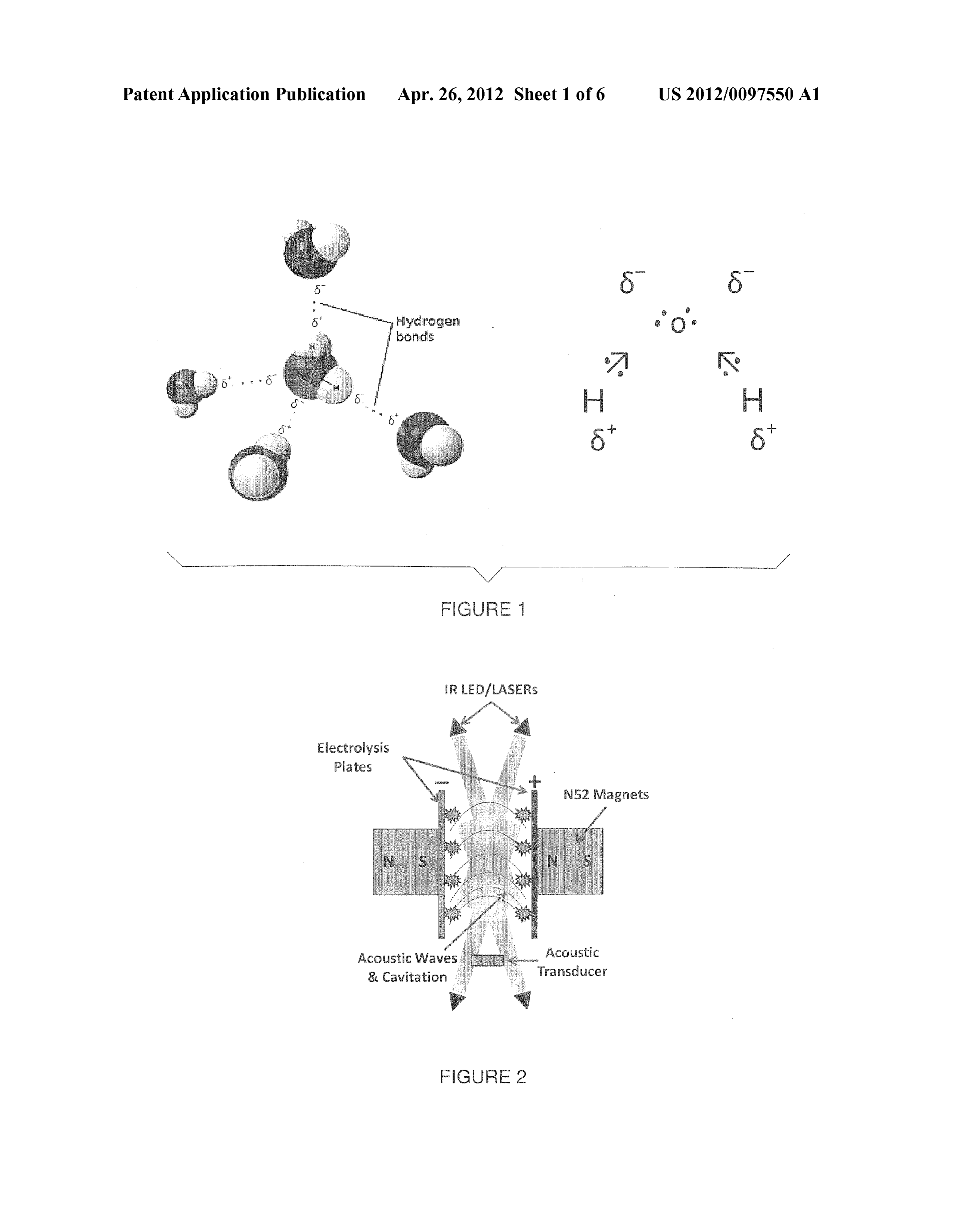
this reference is focused on fluid and gas movement, not on cavitations, micro bursts or enhanced magnetic Susceptibility BRIEF DESCRIPTION OF THE DRAWINGS associated with hydrogen bond breakage. 0019 FIG. 1 drawing of a water molecule and covalent 0014 Indeed, the 765 application is silent in regards to bonding:
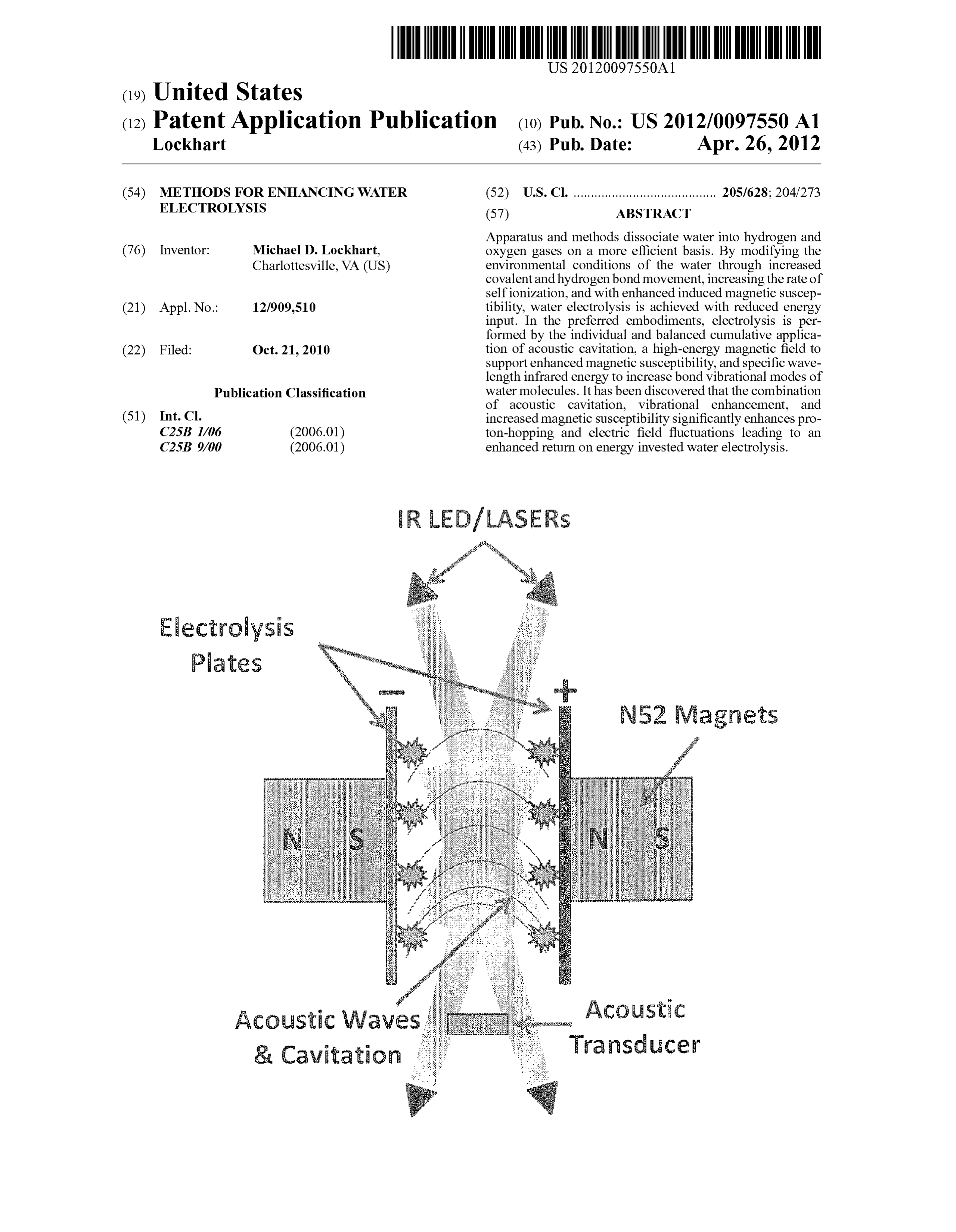
cavitation, focusing instead on a Vortex which is induced and (0020 FIG. 2 is a simplified view of an electrolyzer cell Supported with acoustic waves and magnetic influence on an design in accordance with the preferred embodiment of the electrolyte. The focus is on using an electrolytic Solution as invention;
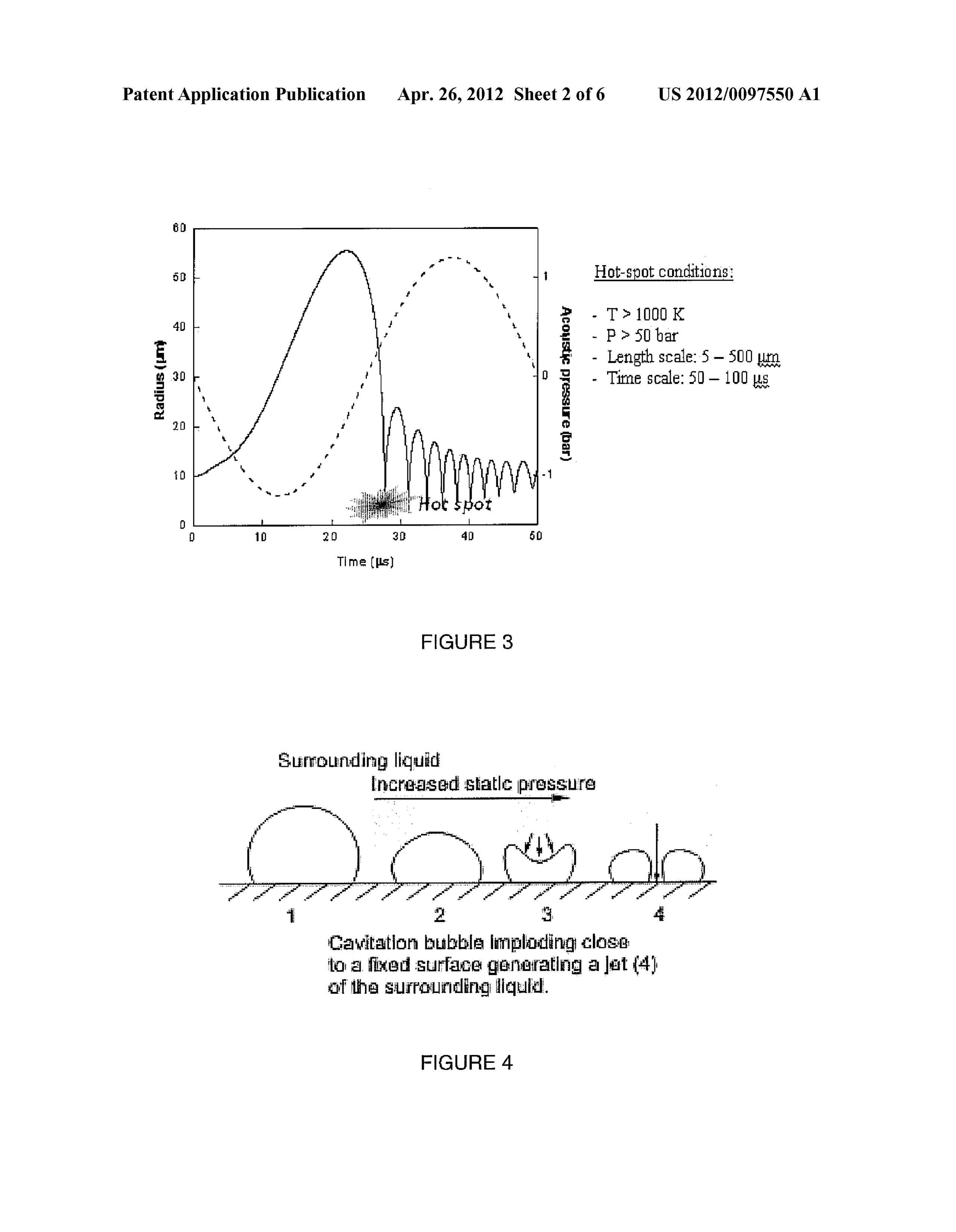
opposed to any acid/base or salt induced ionized electron 0021 FIG. 3 is a graph visualizing when the compression transport mechanism. Where there seems to be some overlap of bubbles occurs during cavitation, the heating is more rapid with respect to the use of infrared (IR), the description is than thermal transport, creating a short-lived, localized hot vague, teaching only that the IR may be responsible for “ion spot;
ization.” which is not the case. The IR exposure would cause 0022 FIG. 4 is a diagram showing how gravity collapse Some wavelength specific molecular motion, UV exposure near an extended Solid Surface becomes non-spherical, creat would cause some ionization and/or very intense VIS/IR ing high-speed jets of liquid and shockwaves at the Surface; where a multi-photon effects could occur may also cause 0023 FIG. 5 is a graph that shows the pressure depen Some ionization. dence of water ionization at 25 degrees C. 0024 FIG. 6 is a graph that shows the temperature depen
SUMMARY OF THE INVENTION dence of water ionization at 25 MPa:
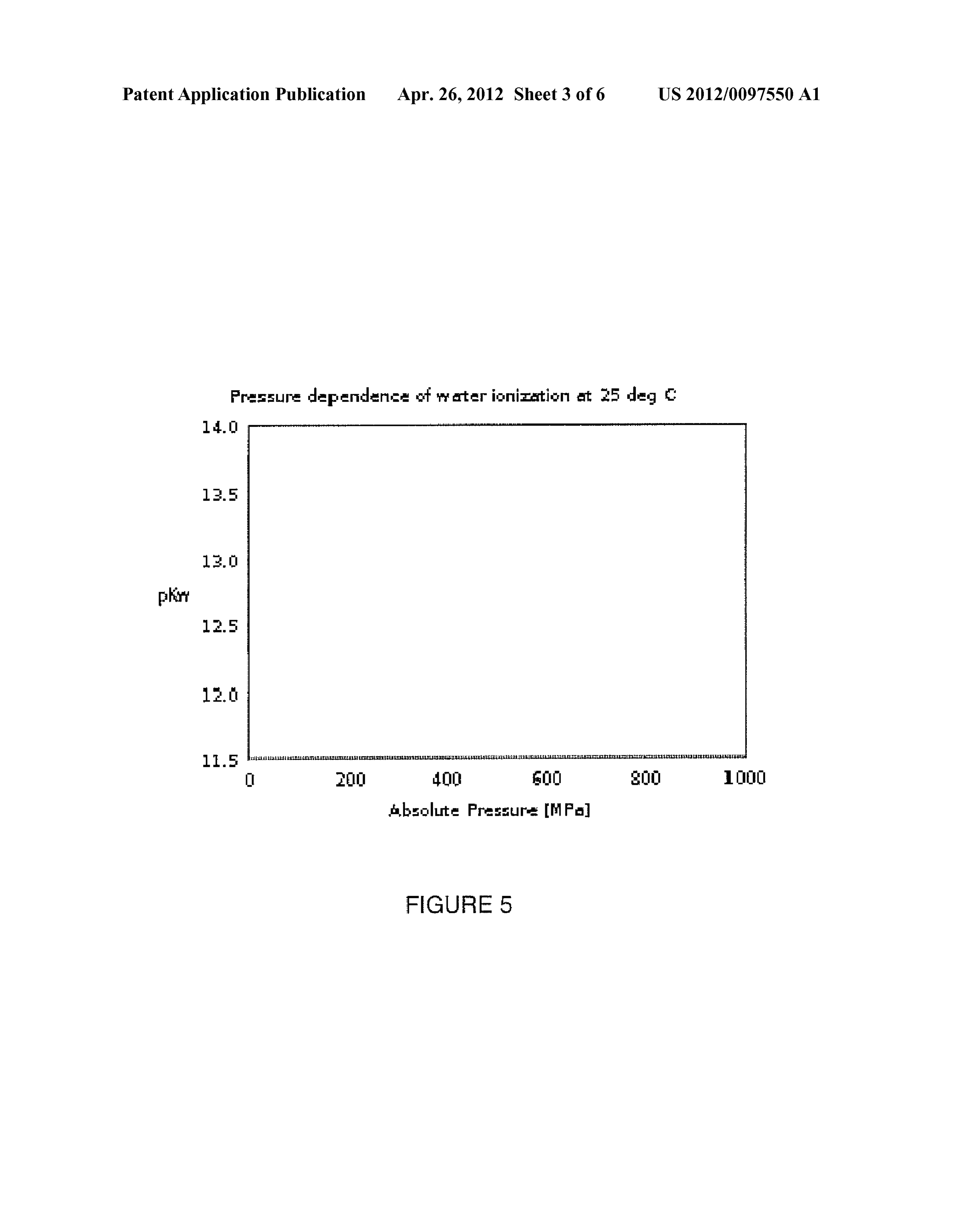
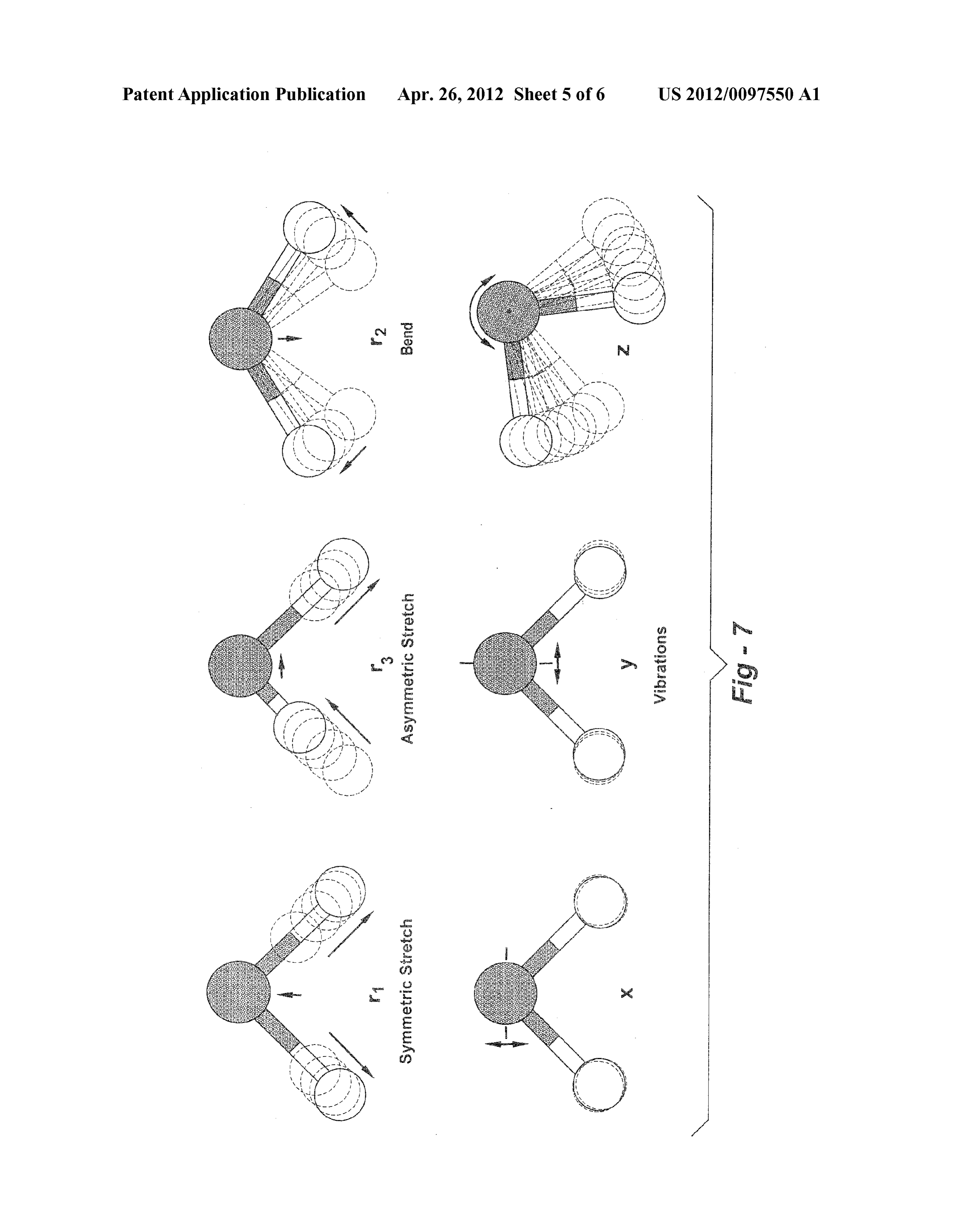
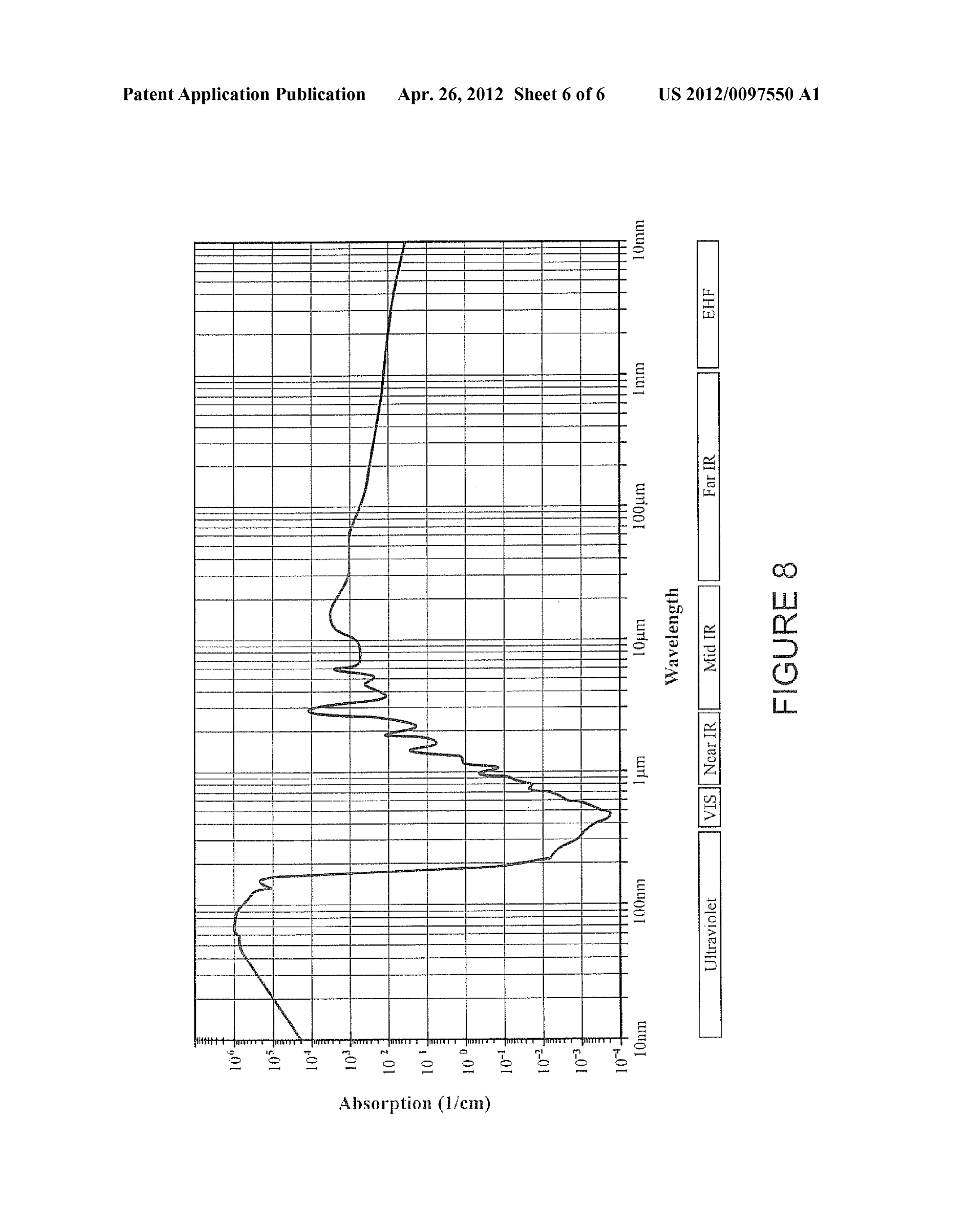
0025 FIG. 7 is a drawing that illustrates a water mol 0015 This invention is directed to apparatus and methods ecule's three fundamental vibrational modes; namely, sym to efficiently dissociate water into hydrogen and oxygen metric stretch, bending and asymmetric stretch; and gases. By modifying the environmental conditions of the 0026 FIG. 8 is a graph that depicts how water shows strong absorptions in the infrared region of the spectrum.
water through increased covalent and hydrogen bond move ment, increasing the rate of self ionization, and with enhanced DETAILED DESCRIPTION OF THE INVENTION induced magnetic Susceptibility, water electrolysis is achieved with reduced energy input. In the preferred embodi 0027 FIG. 2 is a schematic diagram identifying sub ments, electrolysis is performed by the individual and bal systems which will subsequently be described in detail. In anced cumulative application of acoustic cavitation, a high contrast to the usual application electric current/voltage via energy magnetic field to Support enhanced magnetic plates 202, 204 to effectuate electrolysis, the overlapping Susceptibility, and specific wavelength infrared energy to modalities taught herein build on each other's qualities to increase bond vibrational modes of water molecules. It has provide an environment whereby water molecules will more been discovered that the combination of acoustic cavitation, readily dissociate. In other words, the energy reduction con vibrational enhancement, and increased magnetic suscepti cepts are symbiotic in that they each enhance each other. The bility significantly enhances proton-hopping and electric combined use of acoustic cavitation 206, vibrational field fluctuations. As these are the primary processes through enhancement with specific IR exposure 208, a strong sur which water disassociates and enhanced water electrolysis rounding magnetic field 210 together improve mass transport results. near the electrodes (plates) and movement within the elec trolysis reaction chamber. The acoustic transducer placement 0016 Apparatus for enhancing water electrolysis inaccor enhances mass transport by inducing a convective flow within dance with the invention includes a water-holding vessel and the reaction chamber.
a pair of oppositely charged electrolysis plates Supported or in the vessel to initiate the electrolysis process. At least one Acoustic Cavitation strong, permanent magnet Such as an N52 or other rare-earth magnet is used to generate a magnetic field with flux lines 0028. Acoustic cavitation creates micro bubbles. In this penetrating through the water contained in the vessel. An particular application the micro-bubbles form primarily on and around the electrodes. Pressure variations in the water are acoustic transducer generates acoustic energy Sufficient to caused using sound waves in the 16kHZ-100 MHz range. The achieve cavitations of the water molecules, and a source of bubbles are created very rapidly and subsequently collapse wavelength specific infrared (IR) energy is directed through rapidly as well. The bubble collapse in the water results in an the water in the vessel, such that the combined effects of the enormous concentration of energy from the conversion of the oppositely charged electrolysis plates, magnetic field, acous kinetic energy of liquid motion into heating of the contents of tic energy and infrared energy result in an enhanced disasso the bubble (water vapor). When the compression of bubbles ciation of the water into hydrogen and oxygen gasses. occurs during cavitation, the heating is more rapid than ther 0017. In the preferred embodiment, the magnet generates mal transport, creating a short-lived, localized hot spot (see a magnetic field in the range of 6,500 to 15,000 Gauss. A FIG.3).
plurality of magnets, on opposing sides of the vessel, for 0029. The collapse of bubbles in a multi-bubble cavitation example, may be used to enhance field strength. The acoustic field can produce hot spots with effective temperatures of up transducer preferably generates acoustic energy with energy to ~5000 K, pressures of up to ~1000 atmospheres, and densities on the order of 1 to 1018 kW/m3, and the IR source heating and cooling rates above 1000 K/s. Cavitation creates generates energy centered at 970 nm, 1200 nm, 1450 nm, an extraordinary physical and chemical environment in oth 1950 nm, or combinations thereof. erwise cold liquids. Cavity collapse near an extended solid
Page 10
US 2012/0097.550 A1 Apr. 26, 2012
Surface becomes non-spherical; it creates high-speed jets of requirements for electrolytes. This is done by significantly liquid into the Surface, and creates shockwaves at the Surface increasing auto-ionization and radical formation. (see FIG. 4). 0036. As an added benefit according to the invention, 0030 Since energy is only supplied to micro-bubble for acoustic cavitation results in the generation of local turbu mation and the entire water Volume is not energized, the lence and liquid micro-circulation (acoustic streaming, jets) return on energy invested (energy requirements) is excellent. in the reactor, enhancing the rates of mass/ion/gas transport At the elevated temperature and pressures, thermolysis of processes. These jets activate the Surface (catalyst) and water can occur, meaning that the water breaks down on its increase mass transfer from the surface by disruption of the own under extreme heat and pressure. The process focuses on interfacial boundary layers and dislodging the already disso acoustic cavitation energies Sub-thermolysis conditions, ciated gases occupying the active sites. where an energy balance between acoustic energy input, elec Vibrational Enhancement with Specific IR Exposure trical energy input and hydrogen production is established. 0037. The water molecule is strong due its simple and 0031 Cavitation results in very high energy densities of strong covalent and hydrogen bonding network. Disrupting the order of 1 to 1018 kW/m3. Pure water is a good insulator the “normal covalent and relatively very strong hydrogen since it has a low autoionization, Kw-10x10-14 at room bonding network that is responsible for all of waters unique temperature and thus pure water conducts current poorly, properties is key to reducing dissociation energy require 0.055 LS-cm-1. Unless a very large potential is applied to ments. Water shows strong absorptions in the IR (FIG. 8). cause an increase in the autoionization of water, the electroly These IR absorption bands of water are related to molecular sis of pure water proceeds very slowly limited by the overall vibrations involving various combinations of the water mol conductivity. In this case a very large thermal and pressure ecule's three fundamental vibrational modes (FIG. 7): energy is applied well above the autoionization energies 0038 V1: symmetric stretch required for water dissociation, reducing the insulator effect 0039 V2: bending and increasing auto-ionization and electrolysis potential. 0040 V3: asymmetric stretch 0032 For the water monomers in the gas phase (inside the 0041. The absorption feature centered near 970 nm is bubble), the lowest dissociation asymptote of the water mol attributed to a 2V1+V3 combination, the one near 1200 nm to ecule corresponds to the homolytic dissociation (formation of aV1+V2+V3 combination, the one near 1450 nm to a V1+V3 free radicals). The free radicals are generated in the process combination, and the one near 1950 nm to a V2+V3 combi due to the high energy dissociation of vapors trapped in the nation.
cavitating bubbles. This results in the significant intensifica 0042. The spectral absorption features of liquid water are tion of radical formation and Subsequent dissociation in an shifted to longer wavelengths with respect to the vapor fea electric field. tures by approximately 60 nm. The rotations of liquid water tend to be hindered by hydrogen bonds, leading to librations 0033. In the condensed (liquid) phase surrounding the (rocking motions). Stretching vibrations are shifted to a lower frequency while the bending frequency increases due to bubbles, the energetics are significantly lower and the lowest hydrogen bonding.
dissociation asymptote correlates with the heterolytic prod 0043. Both liquid and vapor (inside the acoustically ucts (ion products). induced bubbles) phases of water exist in the acoustic cavi tation environment. Semi-broad spectral (10's to 100's of 0034. Both free radical formation and increased ionization nanometers) excitation of waters vibrational frequencies, promotes enhanced electrolysis. FIG. 5 is a graph that shows especially those which are in response to hydrogen bond the pressure dependence of water ionization at 25 degrees C. induced librations reduces electrical energies required for FIG. 6 is a graph that shows the temperature dependence of water electrolysis.
water ionization at 25 MPa. If electrolysis is looked at from Enhanced Magnetic Susceptibility ionization potential, the pKw=-log 10 Kw, which at
SATP=14. The negative log of the water ion content, pKw 0044 Water is a diamagnetic material. Diamagnetism is varies with temperature. As temperature increases, pKw the property of an object which causes it to create a magnetic decreases; and as temperature decreases, pKw increases, field in opposition of an externally applied magnetic field, indicting an increase in the ionization of water as tempera thus causing a repulsive effect. By applying a strong external tures rise (for temperatures up to about 250° C.). There is also magnetic field, the orbital velocity of electrons around the a Small dependence on pressure where ionization increases water nuclei are changed. These changes affect the magnetic with increasing pressure. Acoustic cavitation can efficiently dipole moment of the water molecule in the direction oppos provide both of these environments (high temperature and ing the external field. In conjunction with vibrational high pressures) in a micro-environment which stabilizes sec enhancement and cavitation, this opposition to the external ondary effects, reduces energy input requirements and magnetic field creates a partial artificial alignment of the now reduces overpotential requirements. vibrationally and electronically stressed water molecule fur 0035 Electrolysis requires more extreme potentials than ther enhancing water electrolysis. what would be expected based on the cell's totally reversible 0045. In electromagnetism the magnetic susceptibility is reduction potentials, or “over potential.” The most common the degree of magnetization of a material in response to an cause of over potential is the reversible reaction of oxygen applied magnetic field. Water has a relative magnetic perme and hydrogen to produce water. This excess potential ability that is less than 1, thus a magnetic Susceptibility which accounts for various forms of over-potential by which the is less than 0, and is repelled by magnetic fields. However, extra energy is eventually lost as heat. Acoustic cavitation since diamagnetism is such a weak property its effects are not also significantly reduce or eliminate in some cases the observable in every-day life.
Page 11
US 2012/0097.550 A1 Apr. 26, 2012
0046. The magnetic susceptibility of water is =-9.05x10 infrared energy result in an enhanced disassociation of 6. Placing the electrolysis cell in a strong (permanent) mag the water into hydrogen and oxygen gasses. netic field (6,500 to 15,000 gauss or more surface field 8. A method of enhancing water electrolysis, comprising strength), in conjunction with vibrational enhancement and the steps of:
cavitation increases the magnetic Susceptibility, decreases the providing a water-holding vessel; energies required for dissociation and again enhances water generating a partial disassociation of the water using a pair electrolysis. of oppositely charged electrolysis plates Supported or in 1. Apparatus for enhancing water electrolysis, comprising: the vessel;
a water-holding vessel; directing a strong magnet field through the water contained a pair of oppositely charged electrolysis plates Supported in the vessel;
or in the vessel; generating acoustic energy Sufficient to cause cavitations a magnet generating a magnetic field with flux lines pen of the water molecules; and etrating through the water contained in the vessel; orienting a source of infrared (IR) energy through the water an acoustic transducer generating acoustic energy causing in the vessel, such that the combined effects of the oppo cavitations of the water molecules; and sitely charged electrolysis plates, magnetic field, acous a source of infrared (IR) energy directed through the water tic energy and infrared energy result in an enhanced in the vessel; and disassociation of the water into hydrogen and oxygen wherein the combined effects of the oppositely charged gasses.
electrolysis plates, magnetic field, acoustic energy and 9. The method of claim 8, wherein the magnet generates a infrared energy result in an enhanced disassociation of magnetic field in the range of 6,500 to 15,000 Gauss. the water into hydrogen and oxygen gasses. 10. The method of claim 8, wherein the magnet is an N52 2. The apparatus of claim 1, wherein the magnet generates or other permanent, rare-earth magnet or electric magnet. a magnetic field in the range of 6,500 to 15,000 Gauss. 11. The method of claim8, including a plurality of magnets 3. The apparatus of claim 1, wherein the magnet is an N52 on opposing sides of the vessel.
or other permanent, rare-earth magnet or electric magnet. 12. The method of claim8, wherein the acoustic transducer 4. The apparatus of claim 1, including a plurality of mag generates acoustic energy densities on the order of 1 to 1018 nets on opposing sides of the vessel. kW/m3.
5. The apparatus of claim 1, wherein the acoustic trans 13. The method of claim8, wherein the IR source generates ducer generates acoustic energy densities on the order of 1 to energy centered at 970 nm, 1200 nm, 1450 nm, 1950 nm, or 1018 kW/m3. combinations thereof.
6. The apparatus of claim 1, wherein the IR source gener 14. A method of enhancing water electrolysis, comprising ates energy centered at 970 nm, 1200 nm, 1450 nm, 1950 nm, the steps of:
or combinations thereof. providing a water-holding vessel; 7. Apparatus for enhancing water electrolysis, comprising: generating a partial disassociation of the water using a pair a water-holding vessel; of oppositely charged electrolysis plates Supported or in a pair of oppositely charged electrolysis plates Supported the vessel;
or in the vessel; directing a magnetic field in the range of 6,500 to 15,000 one or more permanent, rare-earth magnets generating a Gauss through the water contained in the vessel; magnetic field in the range of 6,500 to 15,000 Gauss with generating acoustic energy densities on the order of 1 to flux lines penetrating through the water contained in the 1018 kW/m3 sufficient to cause cavitations of the water vessel; molecules; and an acoustic transducer generating acoustic energy densities orienting a source of infrared (IR) energy through the water on the order of 1 to 1018 kW/m3, resulting in cavitations in the vessel, the IR energy being centered around 970 of the water molecules; nm, 1200 nm, 1450 nm, 1950 nm, or combinations a source of infrared (IR) energy directed through the water thereof, such that the combined effects of the oppositely in the vessel, the IR energy being centered around 970 charged electrolysis plates, magnetic field, acoustic nm, 1200 nm, 1450 nm, 1950 nm, or combinations energy and infrared energy result in an enhanced disas thereof, and Sociation of the water into hydrogen and oxygen gasses. wherein the combined effects of the oppositely charged electrolysis plates, magnetic field, acoustic energy and c c c c c
Provenance
- Collection
- Patents citing this work
- Original assignee
- EVOLUTION TEK LLC
- Pages
- 11
- Method
- pdftotext (the PDF's own text layer) + pdftoppm 300dpi page scans
- Patent office record
- patents.google.com →
- Source
- Google Patents citing-documents table
- Inventors
- Michael D. Lockhart; EVOLUTION TEK LLC
- Published
- 2012-04-26
- Transcribed from
- patentimages.storage.googleapis.com →