patent · US4211744
Process for ultrasonic pasteurization
8 July 1980
Page 1 — bibliographic record
United States Patent (19) 11) 4,211,744 Boucher 45 Jul. 8, 1980 54 PROCESS FOR ULTRASONIC 3,990,906 1 1/1976 Johnston et al. ........................ 134/1 PASTEURIZATION FOREIGN PATENT DOCUMENTS 75 Inventor: Symond M. G. Boucher, New York, 947699 l/1964 United Kingdom ...................... 422/20 73) Assignee: Biophysics Research & Consulting OTHER PUBLICATIONS Corporation, New York, N.Y. Bulat, T. V., "The Present State-of-The-Art in Sonic 21 Appl. No.:s 908,964 Cleaning", J. Amer. Assoc. Contamination Control,
(22 Filed: May 24, 1978 Primary Examiner-Barry S. Richman 51) Int. C.’................................................ A61L 1/00 Attorney, Agent, or Firm-Shoemaker and Mattare, Ltd. 52 U.S. C. ...................................................... 422/20 58) Field of Search ............................... 3.422/26 (57) ABSTRACT A method for pasteurizing, decontaminating or disin 56) References Cited fecting the surfaces of medical, dental, surgical, and
2,510,796 6/1950 Brown............................... 422/20 x phase by placing said objects in hot water or a hot 2,814,575 11/1957 Lange ... ... 134/1 aqueous solution whose temperature is between about 2,970,073. 1/1961 Prange ... ... 134/1 48 C. and 68 C. while irradiating at the same time the 23: ,E. t al. E, : liquid and objects with an ultrasonic cavitating field : 2. E. al. 134/1 whose main frequency is lower than 150 KHz and the 3034,526 5/1962 jewell. "7x average acoustic energy density greater than 5 watts 3,291,640 12/1966 Livingston ............................... 134/1 per liter. According to acoustic intensity and tempera 3,402,075 9/1968 Goldwasser et al. .................... 134/1 ture, the ultrasonic pasteurizing time may vary from 15
TVy ovu voo so assasaw
to 30 minutes. The method is compatible with the-inni use of 3,516,861 6/1970 Menkes et al. ...........................134/1i?X
surfactants and detergents of the anionic, non-ionic, cationic and amphoteric type and can be performed in 362,323 6/1972 Boucher. ... 37: either a continuous or batch process. 3,708,263 1/1973 Boucher ................................. 422/20 3,912,450 10/1975 Boucher ................................. 422/20 10 Claims, 2 Drawing Figures PREFERREd RANGE FOR
UTRASONC PASTEURIZNG
EROSON Pitting N WATER
Te MPERATure N C
Page 2
Drawing sheet — no readable text.
Page 3
SYNERGISTIC ACTION OF ULTRASONCS
IN HOT WATER PASTEURZNG
MICROORGANISM: STAPHYLococcus AUREUS-IOPER cc. A. ULTRASONC RRADATION IN WATER AT 27 KHz (15 WATTS/LITER) TEMPERATURE:250 c (tic)
B. HOT WATER PASTEURZNG AT 65.60 C
NO ULTRASOUND
C. ULTRASONIC HOT WATER PASTEURIZING AT 65.6'c FREQUENCY 27 kHz - ENERGY DENSTY (15WATTS/LTER)
OOOOOO
HHH
NTN
TVIII
INTIII
TNT
HHHNH
||||||||||||||||N|| || || ||
C AUCCCC
HHHH r
INININ
O 2O 3O 4O 5O 6O 7O 8O 9O IOO O
EXPOSURE TIME IN MINUTES
Page 4
effects are a function of cavitation intensity and this is
PROCESS FOR ULTRASONC PASTEURZATION why, today, all large scale industrial processing applica tions are confined to the frequencies below 150 KHz.
BACKGROUND OF THE INVENTION In a cavitating field, microorganisms are submitted to 1. Field of the Invention 5 the large amplitude shock waves released after the col This invention relates to a process of ultrasonic pas lapse of vapor filled resonant bubbles. These shock teurization wherein, the time and temperature needed to waves disrupt agglomerates and damage the protective kill non-sporulated bacteria, vegetative cells fungi and membrane of microorganisms. They can physically viruses, on contaminated surfaces, is reduced. break large molecules or viruses into smaller entities. More specifically, it deals with liquid phase pasteur 10 Essentially, the same mechanism is used in cleaning ization in either heated water or aqueous liquids applications. In this case, the pressure shock waves wherein objects to be pasteurized are placed and irradi clean the surface of a material by jarring or knocking ated with an ultrasonic field below 150 KHz and an the scale or dirt from the surface. If exposing a metal average acoustic energy density greater than 5 watts 15 over extended periods of time in a low frequency cavi per liter for from 15 to 30 minutes. tating field, "pitting' will be observed on the metal 2. Description of the Prior Art interface. The amount of metal removed by shockwave In food science, pasteurization is defined as a heat treatment that kills part but not all of the vegetative erosion is often used to measure the intensity of the microorganisms present in the food and, consequently, cavitation. One also should add that other phenomena is used for foods which are further handled and stored 20 (production of free radicals, H,OH,FHO2, and toxic under conditions which minimize growth (i.e., refriger agents such as ozone or hydrogen peroxide) take place ation). However, in some cases (milk, for instance) pas in a water cavitating field which can also contribute to teurization corresponds to the complete destruction of the death of microorganisms. The denaturization of all pathogenic microorganisms. Minimum legal time enzymes (Macleod R. M., Dunn F. J.; Acous. Soc. Am..., temperature relationships have been established for 25 vol. 42, no. 2:527-529, 1967) such as Trypsid, a-chymo pasteurization of milk. These are (1) the low-tempera trypsin, and Lactate dehydrogenase, has also been men ture, long-time method (Holder process) in which every tioned recently as an important factor to affect microor particle of milk is heated to 62.8 C. and held at that ganism metabolisms.
temperature for 30 minutes; and (2) the high-temper It is apparent, however, that any process which will ture, short-time method (H-T, S-T or "flash' process) 30 reduce the time necessary to decontaminate instruments involving an exposure of milk to 71.7 C, for 15 sec. or containers is most welcome in industry and any pro Another method, that of ultra-high temperature (UHT) cess which will accomplish this at a lower temperature employs temperatures near 93.3 C. or above for a frac will allow the use of a wider variety of materials from tion of a second.
In world-wide practice, one or more of four general 35 which said instruments or containers can be produced. temperature zones are in use for heat-treating milk. SUMMARY OF THE INVENTION These are (1) 62.8 C. for 30 min. and/or 71.7 C. for 15 It is, therefore, an object of the present invention to
C.-100° C., and (4) above 107.2 C. momentarily up to provide a new method or pasteurizing, decontaminating 30 min. 40 or disinfecting, using the combined effect of both heat When handling non-food material, the pasteurization and ultrasonics on the liquid medium containing the method means, in general, the complete destruction of objects.
the various non-spore forming pathogens which can be A further object of the present invention is to de encountered in each particular situation. One, therefore, crease either the time required for pasteurization of must accurately define the type of microorganisms 45 objects or the temperature required to pasteurize said which may be encountered in a specific problem before objects, or both.
claiming complete destruction of all non-spore formers It is a further object of the present invention to show by pasteurization. For instance, it has been shown that that the ultrasonic irradiation of the hot water medium Mycobacterium tuberculosis has a thermal death point of during equipment pasteurization can reduce the thermal 60° C. for 20 minutes, while Staphylococcus aureus has a 50 death time (TDT) of the microorganisms and thus re thermal death point of 65.6 C. for 30 minutes. duce the processing temperature while maintaining the It has recently been established that a satisfactory same biocidal efficacy.
decontamination of anesthesia, resporatory therapy and urology equipment can be achieved by submerging said thatAnother object of the present invention is to show ultrasonic irradiation of the hot water medium equipment into hot water during 30 minutes at a temper- 55 during equipment pasteurization can affect the thermal ature of 76.7° C. (170 F). This particular pasteurization or hot water disinfection technique is said to be based death time (TDT) of the microorganisms to such an extent that at the 76.7°C. (170 F) temperature, one can mainly on the coagulation and denaturization of the decrease the exposure time while maintaining the same microorganism proteins.
Since the early thirties (Schmitt F.O., Uhlenmeyer 60 biocidal efficacy.
B., The Mechanism of the Lethal Effect of Ultrasonic A still further object of the present invention is to Radiation, Proc. Soc. Exptl. Biol. Med., 27:626-628, ous provide a process of treating objects in a liquid or aque 1930), the cidal effects of ultrasonics on microorganisms medium with ultrasound below 150 KHZ and heat, suspended in liquid media has been well-recognized. Yet another object of the present invention is to pro The ultrasonic approach has been widely used both at 65 vide a method of pasteurizing, disinfecting, or decon laboratory and industrial scale to kill microorganisms, taminating objects in liquid or aqueous medium at tem disrupt them or extract valuable compounds (enzymes, peratures or for periods of time less than that used in etc.). Theory and practice have both shown that lethal ordinary treatments.
Page 5
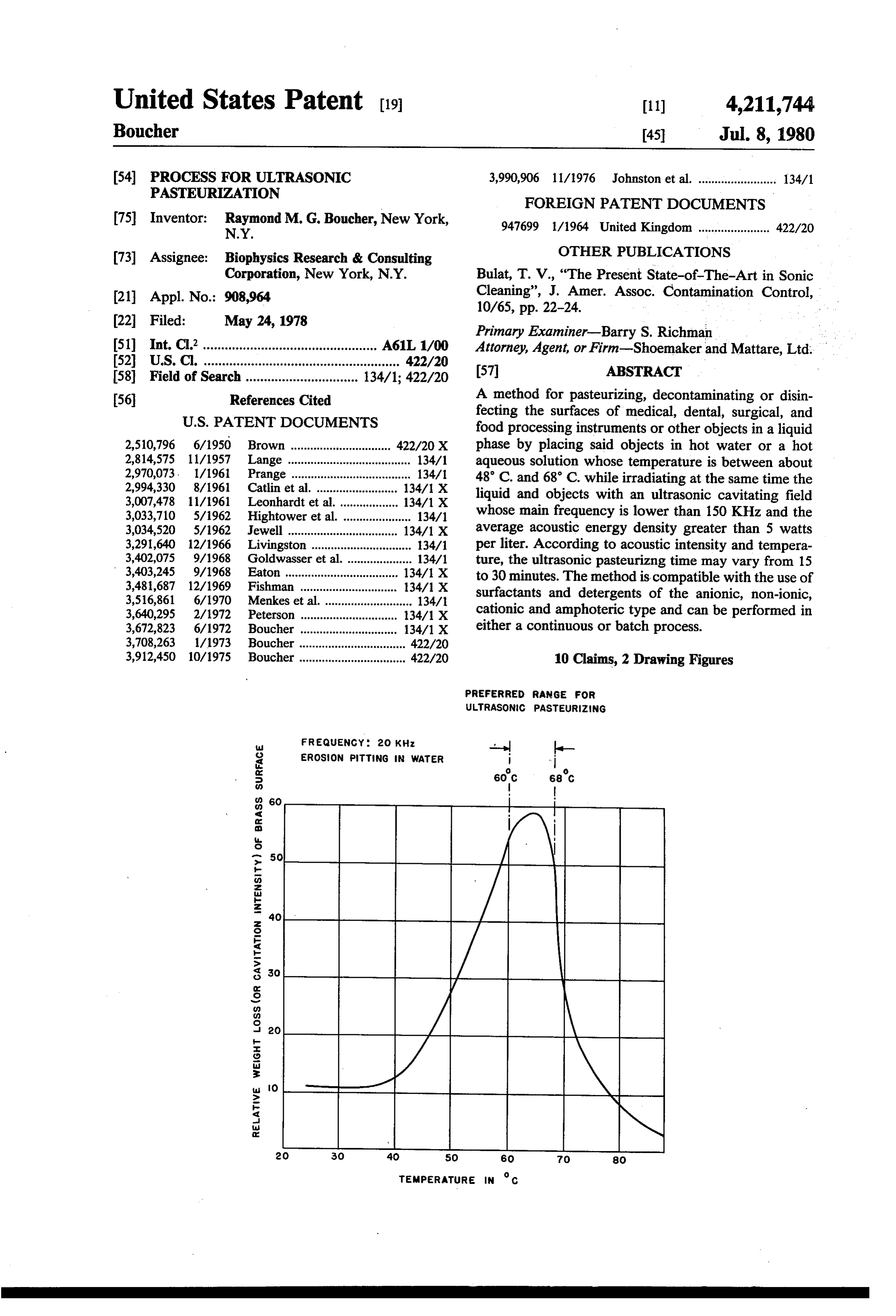
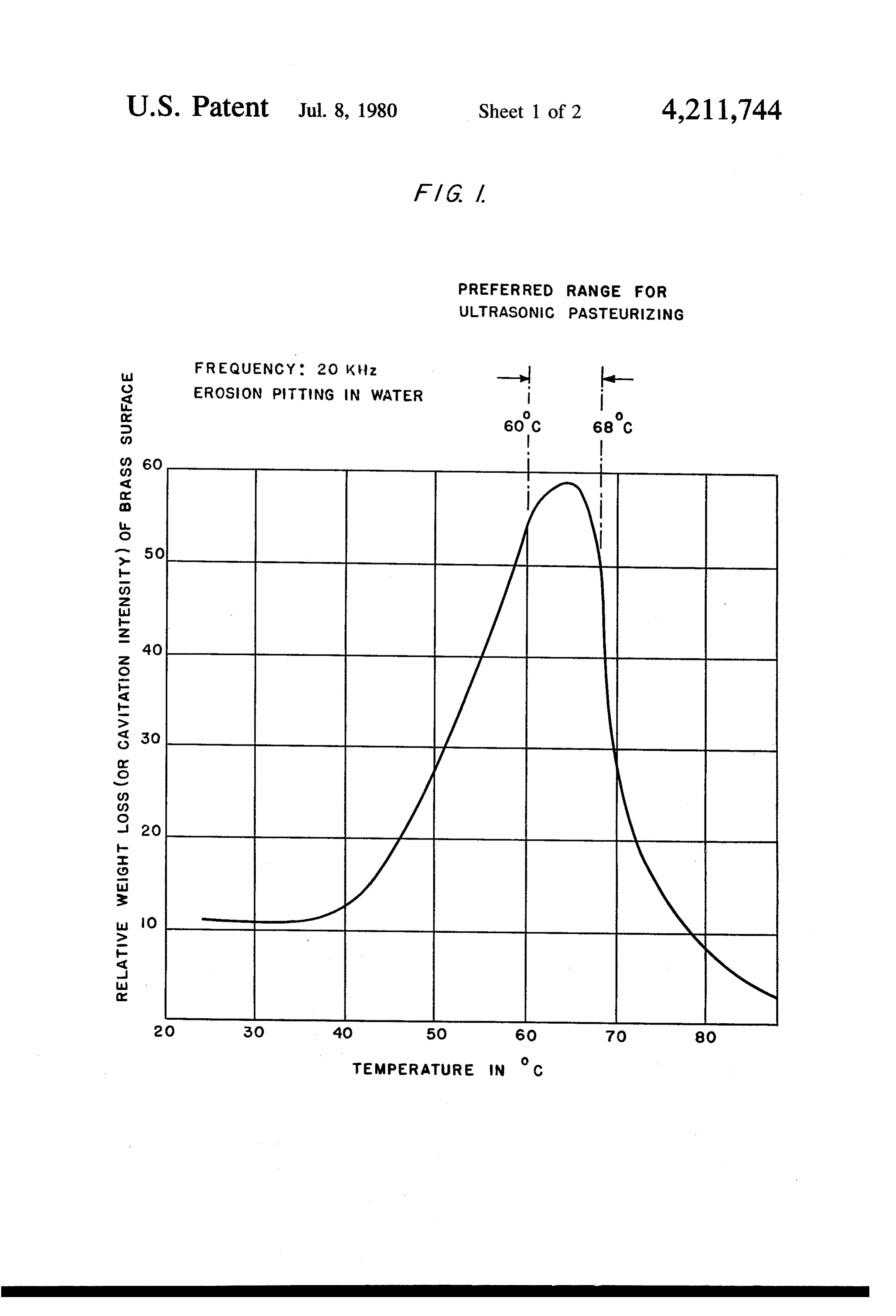
These and other objects of the present invention will direction of propagation. This produces alternate adia become apparent from the following detailed descrip batic compressions and rarefactions, together with cor tion and drawings, wherein: responding changes in density and temperature. FIG. 1 is a graph showing the preferred range for Since there are periodic increases and decreases of ultrasonic pasteurization; and 5 the pressure in the liquid, it is undestandable that during FIG. 2 is a graph showing the synergistic action of the negative pressure phase, one may reach a point ultrasonics in hot water pasteurization. where we can overcome the natural cohesive forces of It has been found that the most ideal range for pro the liquid. Then a new phenomenon known as "cavita ducing cavitation in liquids is below 150 KHz. It has tion' takes place. It corresponds to the formation fol further been found that this cavitation aids in heat disin 10 lowed by a rapid collapse of small cavities through the fection of objects in aqueous mediums. It has further entire liquid. According to the energy density level, the been found that the combination of heat and ultrasonics cavities are filled with gas or vapor. In the latter case, on aqueous disinfecting mediums is of a synergistic their collapse produces very large amplitude shock nature and results in more than the additive effect of waves (several atmospheres) with local temperatures up both heat and ultrasound used separately. The aqueous 15 to a few hundred degrees centigrade or more. Electrical medium can be water or water containing various sur discharges are also believed to occur during the bubbles factants. collapse (sonoluminescence effect). The combination of the use of ultrasound with heat For an equal acoustic energy density level in the lowers the necessary temperature to which a solution liquid phase, one produces larger amplitude variations has to be heated to pasteurize objects contained therein 20 in the low frequency range (15 KHz to 150 KHz) than over the same period of time which would be required in the upper region of the ultrasonic spectrum. One also without the ultrasound, and if the same temperature is needs less energy to reach the "cavitation' threshold at used both with or without ultrasound, the time required the lower end of the ultrasonic spectrum. This is why to produce the same amount of kill is reduced. the present invention is restricted to high energy insona 25 tion at frequencies below 150 KHz in the region where
DETAILED DESCRIPTION OF THE
INVENTION cavitation is maximized. When the frequency increases above 150 KHz, enormous amounts of energy are
As stated above, there has been found a new method needed to reach the cavitation threshold. Syrotyuk of pasteurizing, disinfecting, or decontaminating the (Sov. Acoust., vol. 8, no. 2:216-219, 1962), for instance, surfaces of medical, dental, surgical, food processing 30 showed that intensity levels as high as 6,000 watts/cm2 instruments or other objects in a liquid phase by placing were needed to reach the cavitation threshold at 500 the objects in the liquid and treating them with heat and KHz. At still higher frequencies, it is even debated if ultrasonic radiation. true vaporous cavitation could be reached with very This method considerably reduces the time or tem high densities of acoustic energy. The theoretical limit, perature needed to kill non-sporulated bacteria, vegeta 35 above which cavitation cannot take place under normal tive cells, fungi and viruses which contaminate surfaces, conditions (water medium), was given as 10 MHz by especially on hospital, medical, dental, and surgical Neppiras and Noltingk (Proc. Phys. Soc., 63 B, 9, instruments. Ultrasonic pasteurization also improves the 674-685, 1951). Other authors like Gaertner (J. Acoust. cleanliness of instruments by a faster removal and disin Soc. Am..., 26:6,977-980, 1951) place this limit around 2 tegration of inert organic matter deposits. The method MHz.
is compatible with the use of surfactants and detergents The present invention has been restricted to frequen of the anionic, non-ionic, cationic and amphoteric type cies lower than 150 KHz because higher frequencies and can be performed in either a continuous or batch will correspond to a higher directivity of the transducer process. A particularly efficient biocidal combination beam (Piston type Fraunhoffer diffraction effect) which consists of a mixture of anionic agents with small 45 will make it impossible to create a uniform field in a amounts of inorganic ionizable cation salts. Said ultra large tank of heated water or solvent. To apply the sonic pasteurizing method can also be used to continu method of the present invention, one must create high ously or batch process aqueous liquid suspensions such intensity cavitating fields. This means that one must as food or pharmaceuticals. reach average intensities levels of 1 to 10 watts/cm2 in In the method of the present invention, pasteurization 50 degassed water. If converting these data into practical is defined as a technique which will kill all pathogenic acoustic energy densities radiated per unit of volume, nonspore former bacteria, the hydrophilic and lipo one can see that the process will be best practiced with philic viruses (with the exception of Virus Heptatitis B) energy densities of 15 to 55 watts per liter. The mini and the vegetative forms of yeasts, fungi, and molds, mum average energy density should be comprised be which may contaminate anesthesia, respiratory therapy 55 tween 5 and 10 watts per liter of irradiated water or and urology equipment in normal hospital or medical liquid phase.
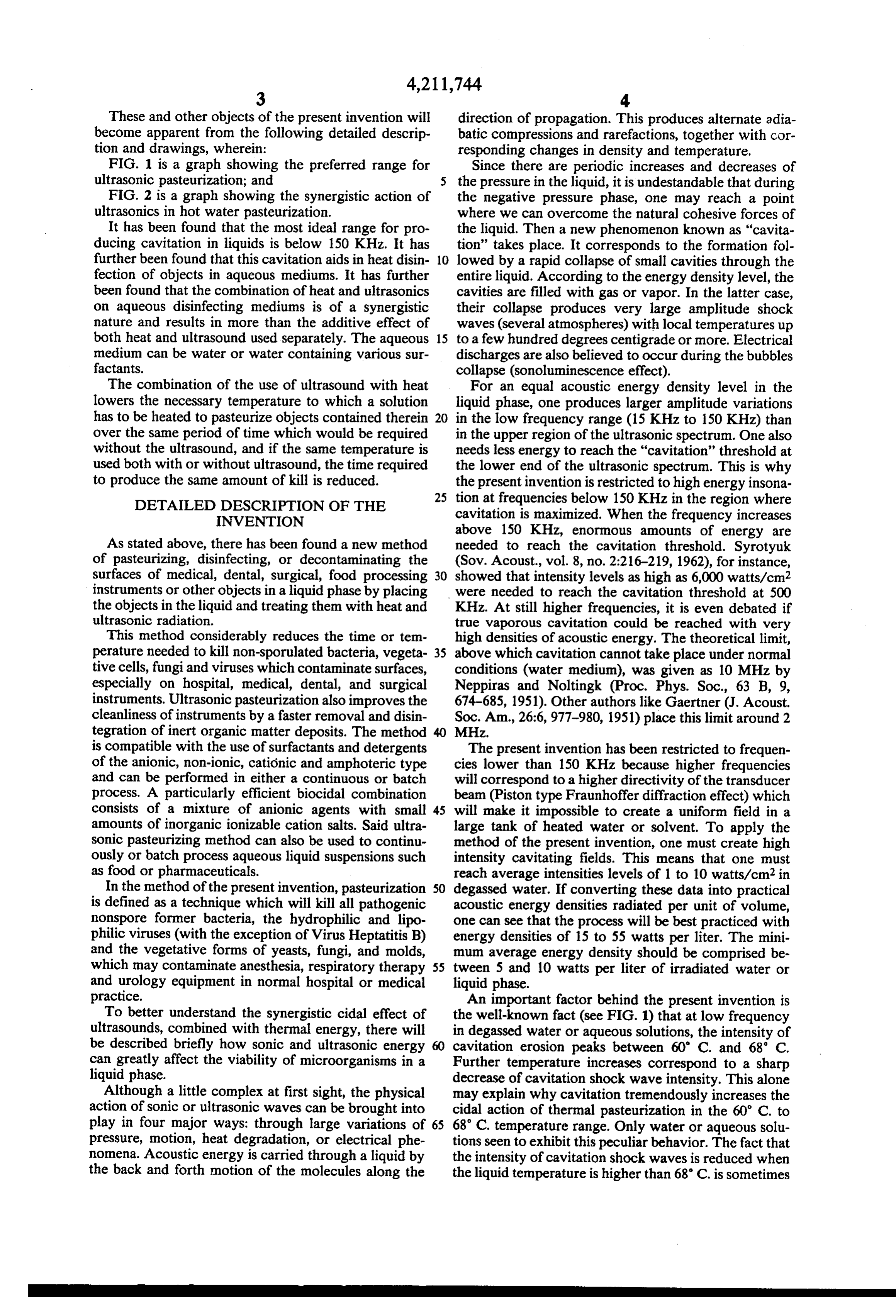
practice. An important factor behind the present invention is To better understand the synergistic cidal effect of the well-known fact (see FIG. 1) that at low frequency ultrasounds, combined with thermal energy, there will in degassed water or aqueous solutions, the intensity of be described briefly how sonic and ultrasonic energy 60 cavitation erosion peaks between 60' C. and 68 C. can greatly affect the viability of microorganisms in a Further temperature increases correspond to a sharp liquid phase. decrease of cavitation shock wave intensity. This alone Although a little complex at first sight, the physical may explain why cavitation tremendously increases the action of sonic or ultrasonic waves can be brought into cidal action of thermal pasteurization in the 60' C. to play in four major ways: through large variations of 65 68 C. temperature range. Only water or aqueous solu pressure, motion, heat degradation, or electrical phe tions seen to exhibit this peculiar behavior. The fact that nomena. Acoustic energy is carried through a liquid by the intensity of cavitation shock waves is reduced when the back and forth motion of the molecules along the the liquid temperature is higher than 68 C. is sometimes
Page 6
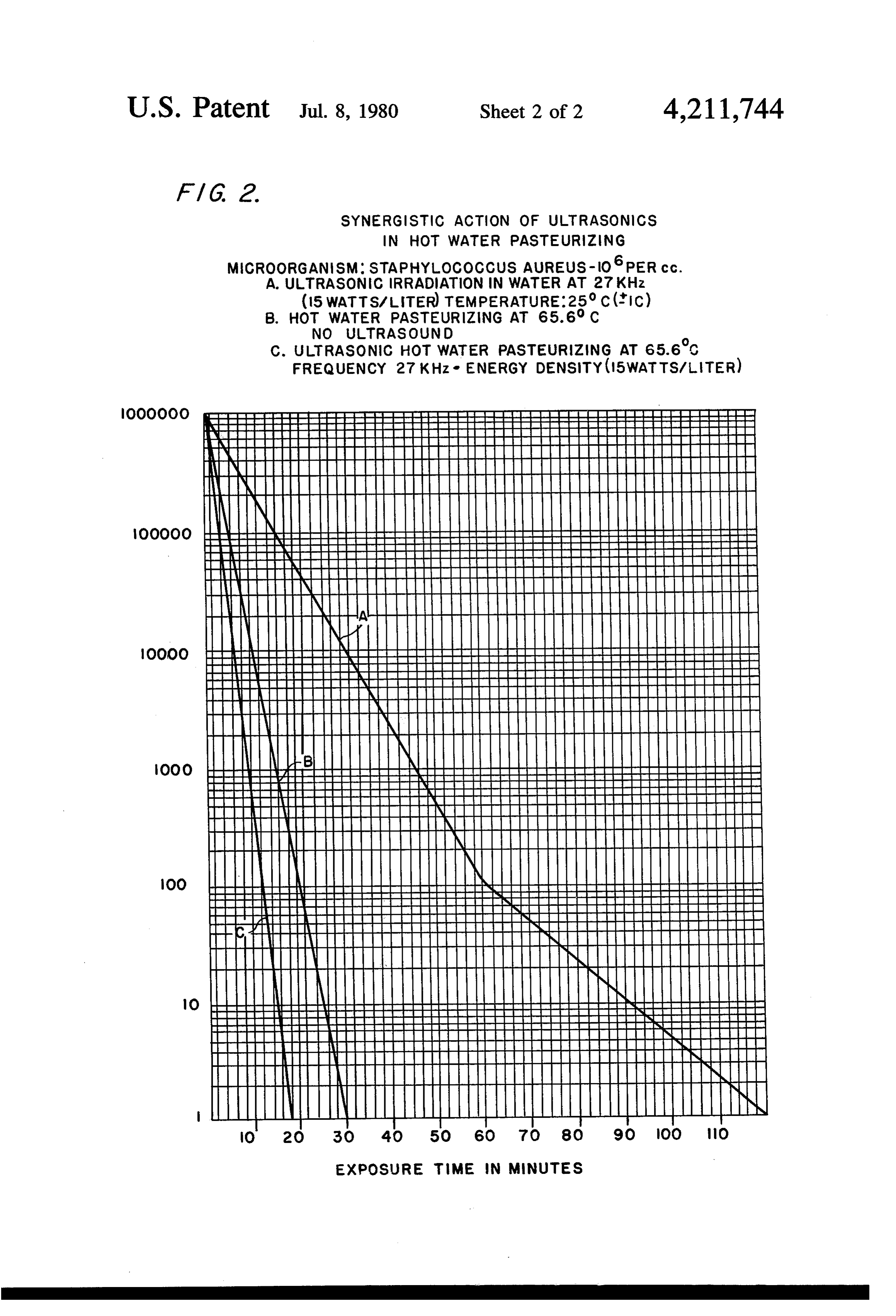
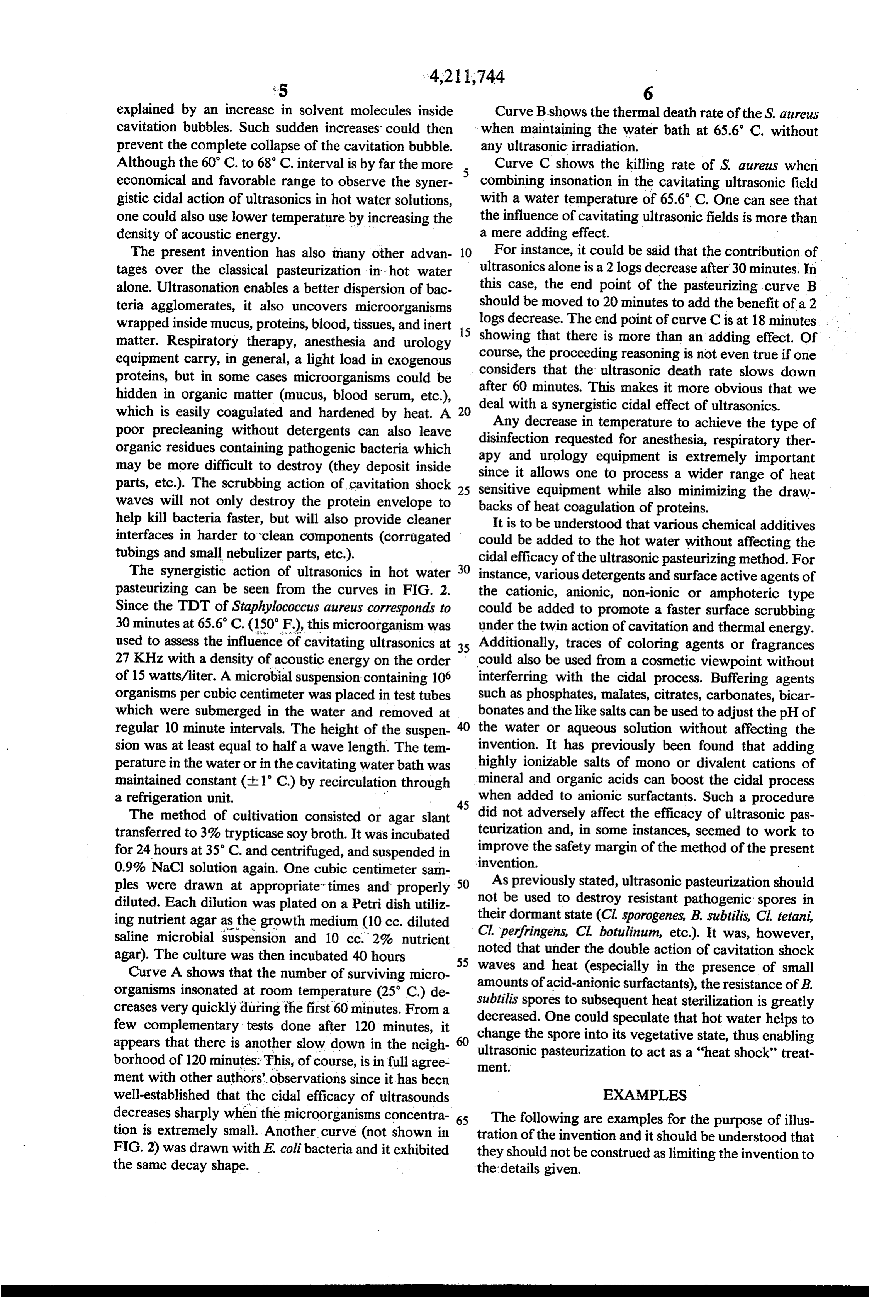
explained by an increase in solvent molecules inside Curve B shows the thermal death rate of the S. aureus cavitation bubbles. Such sudden increases could then when maintaining the water bath at 65.6 C. without prevent the complete collapse of the cavitation bubble. any ultrasonic irradiation.
Although the 60° C. to 68 C. interval is by far the more Curve C shows the killing rate of S. aureus when economical and favorable range to observe the syner combining insonation in the cavitating ultrasonic field gistic cidal action of ultrasonics in hot water solutions, with a water temperature of 65.6° C. One can see that one could also use lower temperature by increasing the the influence of cavitating ultrasonic fields is more than density of acoustic energy. a mere adding effect.
The present invention has also many other advan 10 For instance, it could be said that the contribution of tages over the classical pasteurization in hot water ultrasonics alone is a 2 logs decrease after 30 minutes. In alone. Ultrasonation enables a better dispersion of bac this case, the end point of the pasteurizing curve B teria agglomerates, it also uncovers microorganisms should be moved to 20 minutes to add the benefit of a 2 wrapped inside mucus, proteins, blood, tissues, and inert 15 logs decrease. The end point of curve C is at 18 minutes matter. Respiratory therapy, anesthesia and urology showing that there is more than an adding effect. Of equipment carry, in general, a light load in exogenous course, considers the proceeding reasoning is not even true if one that the ultrasonic death rate slows down proteins, but in some cases microorganisms could be after 60 minutes. This makes it more obvious that we hidden in organic matter (mucus, blood serum, etc.), deal with a synergistic cidal effect of ultrasonics. which is easily coagulated and hardened by heat. A 20
Any decrease in temperature to achieve the type of poor precleaning without detergents can also leave disinfection requested for anesthesia, respiratory ther organic residues containing pathogenic bacteria which apy and urology equipment is extremely important may be more difficult to destroy (they deposit inside since it allows one to process a wider range of heat parts, etc.). The scrubbing action of cavitation shock 25 sensitive equipment while also minimizing the draw waves will not only destroy the protein envelope to backs of heat coagulation of proteins. help kill bacteria faster, but will also provide cleaner It is to be understood that various chemical additives interfaces in harder to "clean components (corrugated could be added to the hot water without affecting the tubings and small nebulizer parts, etc.). cidal efficacy of the ultrasonic pasteurizing method. For The synergistic action of ultrasonics in hot water 30 instance, various detergents and surface active agents of pasteurizing can be seen from the curves in FIG. 2. the cationic, anionic, non-ionic or amphoteric type Since the TDT of Staphylococcus aureus corresponds to could be added to promote a faster surface scrubbing 30 minutes at 65.6°C. (150°F), this microorganism was under the twin action of cavitation and thermal energy. used to assess the influence of cavitating ultrasonics at 35 Additionally, traces of coloring agents or fragrances 27 KHz with a density of acoustic energy on the order could also be used from a cosmetic viewpoint without of 15 watts/liter. A microbial suspension containing 106 interferring with the cidal process. Buffering agents organisms per cubic centimeter was placed in test tubes such as phosphates, malates, citrates, carbonates, bicar which were submerged in the water and removed at bonates and the like salts can be used to adjust the pH of regular 10 minute intervals. The height of the suspen the water or aqueous solution without affecting the sion was at least equal to half a wave length. The tem invention. It has previously been found that adding perature in the water or in the cavitating water bath was highly ionizable salts of mono or divalent cations of maintained constant (-1. C.) by recirculation through mineral and organic acids can boost the cidal process a refrigeration unit. , ' 45 when added to anionic surfactants. Such a procedure The method of cultivation consisted or agar slant did not adversely affect the efficacy of ultrasonic pas transferred to 3% trypticase soy broth. It was incubated teurization and, in some instances, seemed to work to for 24 hours at 35° C. and centrifuged, and suspended in improve the safety margin of the method of the present 0.9% NaCl solution again. One cubic centimeter sam invention.
ples were drawn at appropriate" times and properly 50 As previously stated, ultrasonic pasteurization should diluted. Each dilution was plated on a Petri dish utiliz not be used to destroy resistant pathogenic spores in ing nutrient agar as the growth medium (10 cc. diluted their dormant state (Cl sporogenes, B. subtilis, Cl, tetani, C. perfringens, Cl, botulinum, etc.). It was, however, saline microbial suspension and 10 cc. 2% nutrient noted that under the double action of cavitation shock agar). The culture was then incubated 40 hours 55 waves and heat (especially in the presence of small Curve A shows that the number of surviving micro amounts of acid-anionic surfactants), the resistance of B. organisms insonated at room temperature (25 C.) de subtilis spores creases very quickly during the first 60 minutes. From a decreased. Onetocould subsequent heat sterilization is greatly speculate that hot water helps to few complementary tests done after 120 minutes, it change the spore into its appears that there is another slow down in the neigh ultrasonic pasteurization vegetative to act as a state, thus enabling "heat shock' treat borhood of 120 minutes. This, of course, is in full agree ment, ment with other authors' observations since it has been well-established that the cidal efficacy of ultrasounds EXAMPLES decreases sharply when the microorganisms concentra 65 The following are examples for the purpose of illus tion is extremely small. Another curve (not shown in tration of the invention and it should be understood that FIG. 2) was drawn with E. coli bacteria and it exhibited they should not be construed as limiting the invention to the same decay shape. the details given.
Page 7
TABLE I
IMPROVEMENTS OF THERMAL DEATH TIMES
WITHULTRASONIC IRRADIATION
Ultrasonic Field: Nominal Frequency 27 kHz
Acoustic Energy Density: 15 watts/liter
Medium of Dispersion: Potable Water (Federal Standards)
Microorganism Concentration: 10 to 10 per cubic centimeter.
Standard Hot Water Pasteurization in Hospitals Corresponds to a 30 Minutes Exposure at 76.7 C. Killing Time With
Ultrasonics in Killing Time in Reduction of Processing
Type of Microorganisms Hot Water Hot Water Alone Time
Mycobacterium tuberculosis 15 min. at 60 C. 20 min. at 60 C. 25%
Diplococcus pneumoniae 5 min. at 54.4" C. 10 min. at 54.4 C. 50% Streptococcus pyogenes 20 min. at 63 C. 30 min. at 63 C. 33.3%
Str. faecalis 3 min. at 65.6 C. 5 min. at 65.6 C. 40%
Staphylococcus aureus 18 min. at 65.6 C. 30 min. at 65.6 C. 40% Cornybacterium diphtheriae min. at 60' C. 1 min. at 60 C. 50% Salmonella typhi 1 min. at 60 C. 2 min. at 60 C. 50% Escherichia coli 1 min. 6065.6' C, 2 min. at 65.6' C, 50% Klebsiella pneumoniae min. at 65.6" C. 2 min. at 65.6 C. 50% Proteus vulgaris min. at 65.6 C. 2 min. at 65.6 C. 50%
Pseudomonas aeruginosa 1 min. at 65.6 C. 2 min. at 65.6°C. 50%
Fungi
Trichophyton mentagrophytes 20 min. at 63' C. 30 min. at 63' C. 33.3% Viruses
Hydrophilic - Echo - 25 20 min. at 60' C. 30 min. at 60' C. 33.3% Lipophilic - Herpes simplex 20 min. at 60° C. 30 min. at 60 C. 33.3%
TABLE II
TEMPERATURE LOWERING WITH
ULTRASONICERRADATION
Ultrasonic Field: Nominal Frequency 27 kHz
Acoustic Energy Density: 5 watts/liter
Medium of Dispersion: Potable Water (Federal Standards)
Microorganism Concentration: 10 to 10 per cubic centimeter
Standard Hot Water Pasteurization in Hospitals Corresponds to a 30 Minute Exposure at 76.7' C. Killing Time- Killing Time
Temperature with Temperature in
Type of Microorganisms Ultrasonics in Hot Water Hot Water Alone Reduction of Temperature Bacterial
Diplococcus pneumoniae 10 min. at 48' C. 10 min. at 54.4" C. 6.4 C. Proteus vulgaris 2 min. at 58 C. 2 min. at 65.5 C. 7.6 C. Pseudomona aeruginosa 2 min. at 58 C. 2 min. at 65.5 C. 7.6’ C. Klebsiella pneumoniae 2 min, at 58 C. 2 min. at 65.5 C, 7.6' C. Escherichia coli. 2 min. at 58 C. 2 min. at 65.5 C. 7.6’ C. Staphylococcus aureus 30 min. at 58 C. 30 min. at 65.5 C. 7.6 C. Streptococcus pyogenes 30 min. at 57 C. 30 min. at 63 C. 6 C. Str. faecalis 5 min. at 58 C. 5 min. at 65.5 C, 7.6 C. Mycobacterium tuberculosis 20 min. at 55 C. 20 min. at 60' C. 5 C. Fungi
Candida albicans 30 min. at 57 C. 30 min. at 68' C. 6 C. Viruses
Lipophilic: Influenza A2 30 min. at 53' C. 30 min. at 60 C. 7 C. Hydrophyllic: Polio Virus Type I 30 min. at 53' C. 30 min. at 60" C. 7 C.
TABLE III
INFLUENCE OF ADDITIVES AND ACOUSTICFIELDS
ONULTRASONIC PASTEURIZATION
Microorganism: Staphylococcus aureus
Medium of Dispersion: Potable Water (Federal Standards)
Standard Hot Water Pasteurization in Hospitals Corresponds to a 30 Minute Exposure at 76.7" C. Killing Time- Killing Time
Temperature with Temperature with Acoustic
Additive & ultra- Ultrasonics in Emission Energy
Additives sonics in Hot Water Hot Water Frequency Density C12 ABS" (0.05% w/w) + NaCl (0.15% w/w) 15 min. at 65.6°C. 18 min. at 65.6' C. 27 kHz 15 watts/liter C12 ABS (0.05% w/w) + KCl 15 min. at 65.6 C. 18 min. at 65.6 C. 27 kHz 15 watts/liter C12 ABS (0.05% w/w) + LiCl 15 min. at 65.6 C. 18 min. at 65.6'C. 27 kHz, Swatts/lite C12 ABS (0.05% w/w) -- MgCl2 15 min. at 65.6 C. 8 min. at 65.6 C. 27 kHz 45 watts/liter C12 ABS (0.05% w/w) + NaHCO3 15 min. at 65.6 C. 18 min. at 65.6' C. 27 kHz. 10 watts/liter C12 ABS (0.05% w/w) 16 min. at 65.6" C. 8 min. at 65.6' C. 27 kHz 15 watts/liter Nonionic: TRITON X 100
Alkyl phenoxy polyethoxyethanol (0.25% w/w) 18 min. at 65.6 C. 18 min. at 65.6 C. 10 kHz 5 watts/liter
Page 8
TABLE III-continued
INFLUENCE OF ADDITIVES AND ACOUSTICFIELDS
ONULTRASONIC PASTEURIZATION
Microorganism: Staphylococcus aureus
Medium of Dispersion: Potable Water (Federal Standards)
Standard Hot Water Pasteurization in Hospitals Corresponds to a 30 Minute Exposure at 76.7 C, Killing Time- Killing Time
Temperature with Temperature with Acoustic
Additive & ultra- Ultrasonics in Emission Energy
Additives sonics in Hot Water Hot Water Frequency Density Anionic: SLS
Sodium Lauryl sulfate (0.25% w/w) 18 min. at 65.6 C. 18 min. at 65.6 C. 27 kHz 5 watts/liter Cationic: CAT
Cetylpyridinium chloride (0.5% w/w) 18 min. at 65.6 C. 18 min. at 65.6 C. 55 kHz, 5 watts/liter Ampholytic: DERIPHAT 160 (0.05% w/w)
Disodium N-lauryl Bimino-dipropionate 18 min. at 65.6 C. 18 min. at 65.6 C. 120 kHz 5 watts/liter *Anionic alkylbenzene sulfonate in which the alkyl is a branched chain dodecyl group composed of four propylene units.
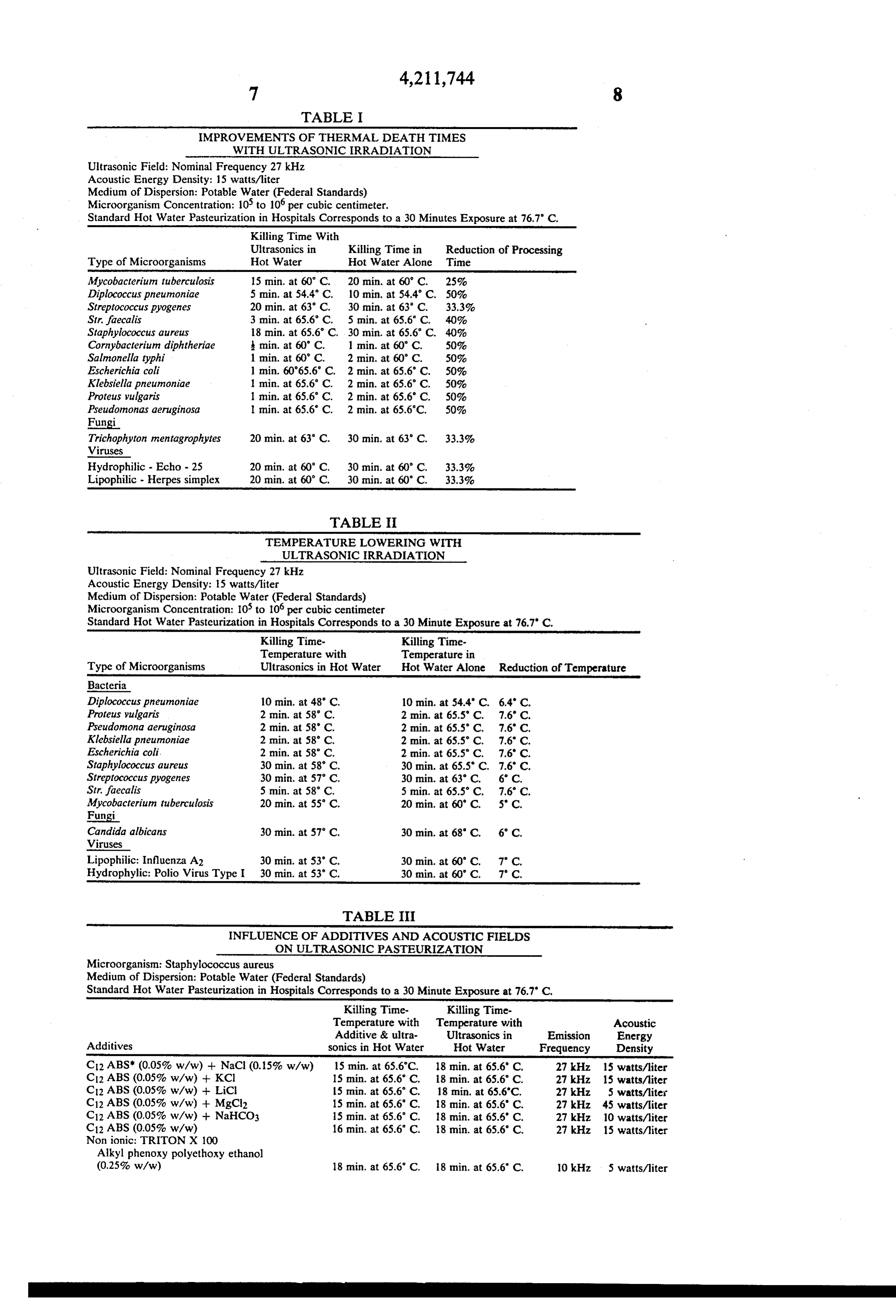
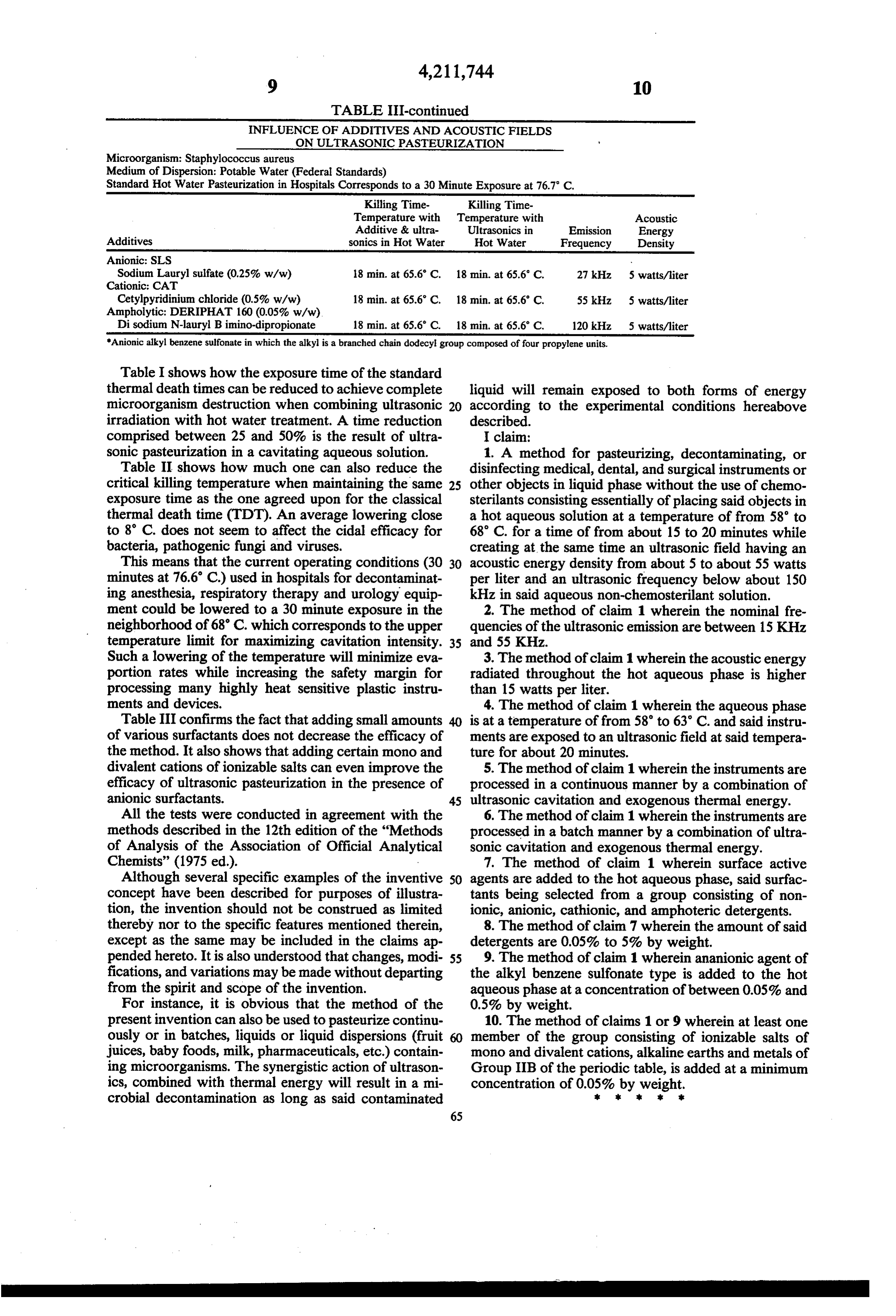
Table I shows how the exposure time of the standard thermal death times can be reduced to achieve complete liquid will remain exposed to both forms of energy microorganism destruction when combining ultrasonic 20 according to the experimental conditions hereabove irradiation with hot water treatment. A time reduction described. comprised between 25 and 50% is the result of ultra I claim: sonic pasteurization in a cavitating aqueous solution. 1. A method for pasteurizing, decontaminating, or Table II shows how much one can also reduce the disinfecting medical, dental, and surgical instruments or critical killing temperature when maintaining the same 25 other objects in liquid phase without the use of chemo exposure time as the one agreed upon for the classical sterilants consisting essentially of placing said objects in thermal death time (TDT). An average lowering close a hot aqueous solution at a temperature of from 58' to to 8° C. does not seem to affect the cidal efficacy for 68 C. for a time of from about 15 to 20 minutes while bacteria, pathogenic fungi and viruses. creating at the same time an ultrasonic field having an This means that the current operating conditions (30 30 acoustic energy density from about 5 to about 55 watts minutes at 76.6° C) used in hospitals for decontaminat per liter and an ultrasonic frequency below about 150 ing anesthesia, respiratory therapy and urology equip kHz in said aqueous non-chemosterilant solution. ment could be lowered to a 30 minute exposure in the 2. The method of claim 1 wherein the nominal fre neighborhood of 68' C. which corresponds to the upper quencies of the ultrasonic emission are between 15 KHz temperature limit for maximizing cavitation intensity. 35 and 55 KHZ.
Such a lowering of the temperature will minimize eva 3. The method of claim 1 wherein the acoustic energy portion rates while increasing the safety margin for radiated throughout the hot aqueous phase is higher processing many highly heat sensitive plastic instru than 15 watts per liter.
ments and devices. 4. The method of claim 1 wherein the aqueous phase Table III confirms the fact that adding small amounts 40 is at a temperature of from 58 to 63 C. and said instru of various surfactants does not decrease the efficacy of ments are exposed to an ultrasonic field at said tempera the method. It also shows that adding certain mono and ture for about 20 minutes.
divalent cations of ionizable salts can even improve the 5. The method of claim 1 wherein the instruments are efficacy of ultrasonic pasteurization in the presence of processed in a continuous manner by a combination of anionic surfactants. 45 ultrasonic cavitation and exogenous thermal energy. All the tests were conducted in agreement with the 6. The method of claim 1 wherein the instruments are methods described in the 12th edition of the "Methods processed in a batch manner by a combination of ultra of Analysis of the Association of Official Analytical sonic cavitation and exogenous thermal energy. Chemists” (1975 ed.). 7. The method of claim 1 wherein surface active Although several specific examples of the inventive 50 agents are added to the hot aqueous phase, said surfac concept have been described for purposes of illustra tants being selected from a group consisting of non tion, the invention should not be construed as limited ionic, anionic, cathionic, and amphoteric detergents. thereby nor to the specific features mentioned therein, 8. The method of claim 7 wherein the amount of said except as the same may be included in the claims ap detergents are 0.05% to 5% by weight.
pended hereto. It is also understood that changes, modi 55 9. The method of claim 1 wherein ananionic agent of fications, and variations may be made without departing the alkyl benzene sulfonate type is added to the hot from the spirit and scope of the invention. aqueous phase at a concentration of between 0.05% and For instance, it is obvious that the method of the 0.5% by weight.
present invention can also be used to pasteurize continu 10. The method of claims 1 or 9 wherein at least one ously or in batches, liquids or liquid dispersions (fruit 60 member of the group consisting of ionizable salts of juices, baby foods, milk, pharmaceuticals, etc.) contain mono and divalent cations, alkaline earths and metals of ing microorganisms. The synergistic action of ultrason Group IIB of the periodic table, is added at a minimum ics, combined with thermal energy will result in a mi concentration of 0.05% kby isweight. crobial decontamination as long as said contaminated is sk
Provenance
- Collection
- Cited prior art
- Original PDF
- patentimages.storage.googleapis.com →
- Filed
- 1978-05-24
- Pages
- 8
- Method
- pdftotext (the PDF's own text layer) + pdftoppm 300dpi page scans
- Source
- Google Patents bibliographic record
- Granted
- 1980-07-08
- Inventors
- Raymond M. G. Boucher; Biophysics Research and Consulting Corp
- Transcribed from
- patentimages.storage.googleapis.com →