patent · US20080245654A1
System for and method of affecting molecules and atoms with electromagnetic radiation
9 October 2008
Page 1 — bibliographic record
(19) United States (12) Patent Application Publication (10) Pub. No.: US 2008/0245654 A1
YOUNG (43) Pub. Date: Oct. 9, 2008 (54) SYSTEM FOR AND METHOD OF Publication Classification
AFFECTING MOLECULES AND ATOMIS
WITH ELECTROMAGNETIC RADATION (51) Int. Cl.
(75) Inventor: Gregory C.D. YOUNG, Asheville, C07C 7700 (2006.01) NC (US) (52) U.S. Cl. ................................. 204/157.5; 204/157.15 Correspondence Address:
HUNTON & WILLIAMS LLP (57) ABSTRACT
INTELLECTUAL PROPERTY DEPARTMENT
1900 KSTREET, N.W., SUITE 1200 A system for and method of cleaving a bond between a first WASHINGTON, DC 20006-1109 (US) atom and a second atom in a molecule of a material are presented. One embodiment of the technique includes select (73) Assignee: Wizard Works, LLC, Shelby, NC ing a first electromagnetic radiation frequency, the first elec (US) tromagnetic radiation frequency including a product of a golden mean and a base frequency associated with at least one (21) Appl. No.: 11/829,614 of the first atom and the second atom. Such an embodiment further includes directing a first electromagnetic radiation at (22) Filed: Jul. 27, 2007 the material, where the first electromagnetic radiation has a Related U.S. Application Data frequency equal to the first electromagnetic radiation fre quency, and where the first electromagnetic radiation fre (60) Provisional application No. 60/820,918, filed on Jul. quency is sufficient to cleave the bond between the first atom 31, 2006. and the second atom.
GENERATOR
Page 2
Drawing sheet — no readable text.
Page 3
Drawing sheet — no readable text.
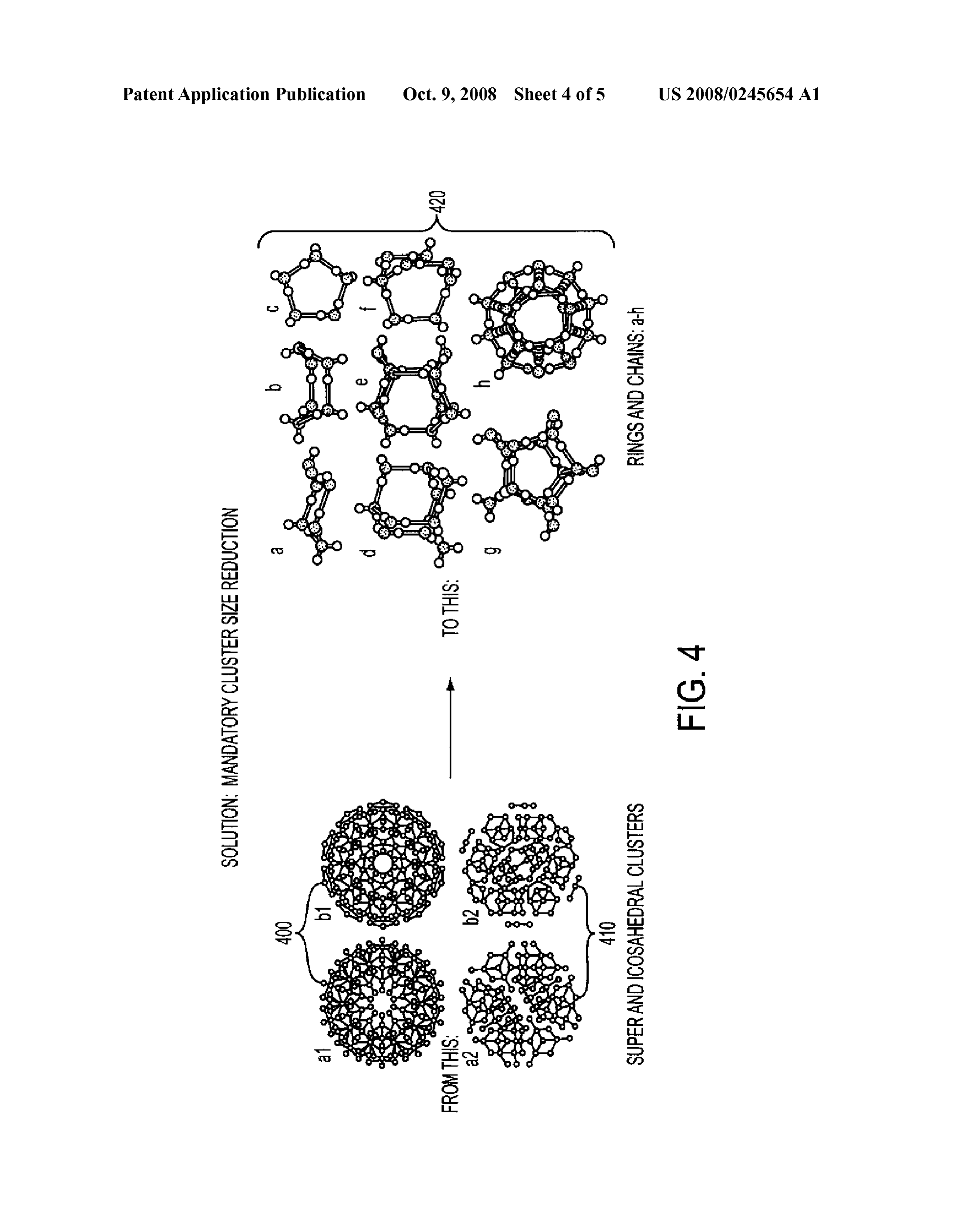
Page 4
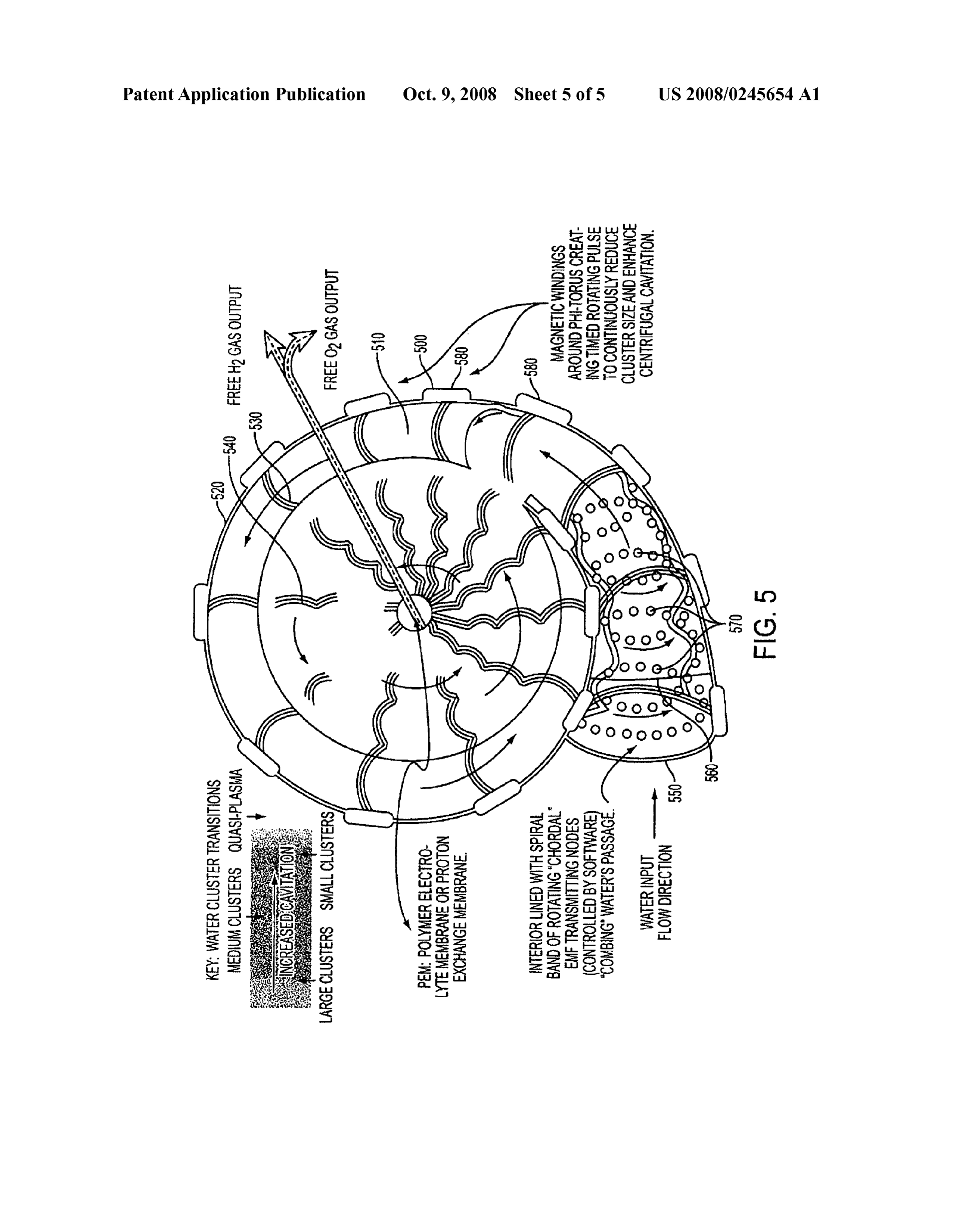
Drawing sheet — no readable text.
Page 5
Drawing sheet — no readable text.
Page 6
Drawing sheet — no readable text.
Page 7
US 2008/0245654 A1 Oct. 9, 2008
SYSTEM FOR AND METHOD OF associated with at least one of the first atom and the second AFFECTING MOLECULES AND ATOMS atom. A second electromagnetic radiation may be directed at WITH ELECTROMAGNETIC RADATION the material, the second electromagnetic radiation having a frequency equal to the second electromagnetic radiation fre
RELATED APPLICATIONS quency, where the first electromagnetic radiation frequency 0001. The present application claims priority to U.S. Pro and the second electromagnetic radiation frequency are Suf visional Application No. 60/820,918 entitled “System For ficient to break the bond between the first atom and the second And Method Of Affecting Molecules And Atoms With Elec atom. The second electromagnetic radiation frequency (v) tromagnetic Radiation' to Young, filed Jul. 31, 2006, the may be defined by the equation v-B-d'•e 10, where B, is disclosure of which is incorporated herein in its entirety. a base frequency associated with either the first or second atom, db is a golden mean, e is a natural log base, j is an
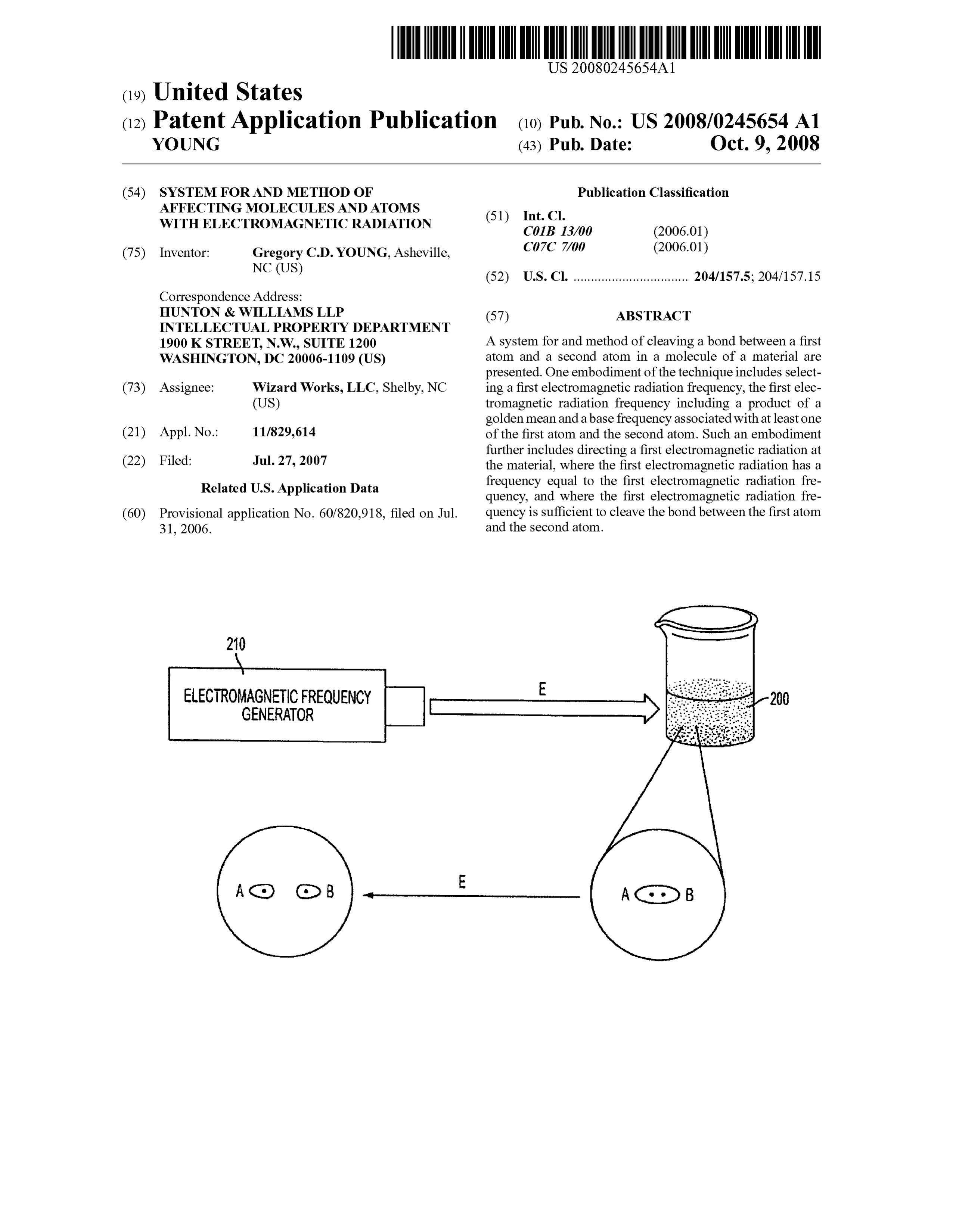
FIELD OF THE INVENTION integer, and k is an integer. The term A may be associated 0002 The invention provides a method for selectively with the first atom and B may be associated with the second affecting targeted atoms and/or molecules by exposing the atom. The terms A and B may be different. The terms A, atoms and/or molecules to a frequency or frequencies of and B, may be the same or different; mand k may be the same electromagnetic radiation selected for the targeted atom or or different; and n and j may be the same or different. The molecule.
material may be irradiated with a second electromagnetic radiation frequency (v") defined by the equation v"=A-d'e
BACKGROUND OF THE INVENTION Lr 10', where A,is a base frequency associated with either the first or second atom, d is a golden mean, e is a natural log 0003 Prior to this invention, a specific technique for deter base, L is the natural log of two, t is equal to n, X is an integer, mining targeted electromagnetic radiation frequencies for and y is an integer. The material may be irradiated with a affecting the atoms or molecules was unknown. second electromagnetic radiation frequency (v") defined by 0004. The molecules that make up compositions of matter the equation v"=(A-d'-L')-10°e, where A is a base may be held together via chemical bonds, such as ionic bonds, frequency associated with either the first or second atom, d is covalent bonds, and hydrogenbonds. Cleavage of these bonds a golden mean, e is a natural log base, L is the natural log of is of interest to scientists and manufacturers, but effective two, a is an integer, and b is an integer. The method may methods of Such cleavage have encountered numerous comprise irradiation of a material with at least one frequency obstacles. according to at least one of each of v, v, v" and v". The 0005 Liu et al., Science 312, 1024 (2006) report resonant material may be irradiated with a first and a second electro photodesorption of hydrogen from a Si (111) Surface using magnetic radiation having material concurrently, where the tunable infrared radiation. According to Liu et al., selective first electromagnetic radiation has a frequency of v, and the bond cleavage by vibration excitation is typically thwarted by second electromagnetic radiation has a frequency of v" and/or energy thermalization. Tully, J. C., Science 312, 1004 (2006) v". One of the first or second atoms may be a hydrogenatom reports that the main impediment to IR mode-selective chem and the other of the first or second atoms may be an oxygen istry is that vibrational energy tends to be redistributed rap atom. The hydrogenatom and the oxygenatom may be part of idly within a molecule. a water molecule and the material may be water. The water may be subjected to cavitation. The water may be subjected to
SUMMARY OF THE INVENTION a magnetic field. The electromagnetic field may be pulsed. 0006. According to an embodiment of the present inven The electromagnetic field may be pulsed at a frequency (v) tion, a method of breaking (also referred to herein as “cleav according to the formula v. Ad".e. 10", where A, is a base ing’ or “dissociating) a bond between a first atom and a frequency associated with an atom in a water molecule, d is second atom in a molecule of a material is presented. A first a golden mean, e is a natural log base, n is an integer, and m electromagnetic radiation frequency, the first electromag is an integer. Electrical current may becaused to flow through netic radiation frequency comprising a product of a golden the water. At least one of mand k may be Zero in the equations mean and a base frequency associated with at least one of the for v and v. The terms in and j may be Zero, positive, or first atom and the second atom is selected. A first electromag negative integers.
netic radiation is directed at the material, the first electromag 0008 According to an embodiment of the present inven netic radiation having a frequency equal to the first electro tion, a method of strengthening a bond between a first atom magnetic radiation frequency. The first electromagnetic and a secondatom in a molecule of a material is provided. The radiation frequency is sufficient to break the bond between method includes selecting a first electromagnetic radiation the first atom and the second atom. frequency, the first electromagnetic radiation frequency 0007 Various optional features of the above embodiment including a product of a golden mean and a base frequency include the following. The material may be a liquid and the associated with at least one of the first atom and the second liquid may be caused to cavitate. The first electromagnetic atom. The method also includes directing a first electromag radiation frequency may further comprise a power of the netic radiation at the material, the first electromagnetic radia golden mean, the power being a positive integer. The first tion having a frequency equal to the first electromagnetic electromagnetic radiation frequency (v) may be defined by radiation frequency, where the first electromagnetic radiation the equation v=A d".e. 10", where A, is a base frequency frequency is sufficient to strengthen the bond between the first associated with either the first or second atom, d is a golden atom and the second atom.
mean, e is a natural log base, n is an integer, and m is an 0009 Various optional features of the embodiment of integer. A second electromagnetic radiation frequency may paragraph O008 include the following. The first electromag be selected, the second electromagnetic radiation frequency netic radiation frequency (v) may be defined by the equation comprising a product of a golden mean and a base frequency v=A-d'-e-10", where A is a base frequency associated
Page 8
US 2008/0245654 A1 Oct. 9, 2008
with either the first or second atom, d is a golden mean, e is second atom, and directing a second electromagnetic radia a natural log base, n is an integer, and m is an integer. The tion at the first and second atoms, the second electromagnetic method may include selecting a second electromagnetic radiation having a frequency equal to the second electromag radiation frequency, the second electromagnetic radiation fre netic radiation frequency, where the first electromagnetic quency comprising a product of a golden mean and a base radiation frequency and the second electromagnetic radiation frequency associated with at least one of the first atom and the frequency are sufficient to facilitate the formation of the bond second atom, and directing a second electromagnetic radia between the first atom and the second atom. The first electro tion at the material, the second electromagnetic radiation magnetic radiation frequency (v) may be defined by the having a frequency equal to the second electromagnetic radia equation v =A d".e. 10", where A is a base frequency tion frequency, where the first electromagnetic radiation fre associated with either the first or second atom, d is a golden quency and the second electromagnetic radiation frequency mean, e is a natural log base, n is an integer, and m is an are sufficient to strengthen the bond between the first atom integer. The second electromagnetic radiation frequency (v) and the second atom. The first electromagnetic radiation fre may be defined by the equation v B' d'e: 10, where B, is quency (v) may be defined by the equation v-A-d'e'10", a base frequency associated with either the first or second where A, is a base frequency associated with either the first or atom, db is a golden mean, e is a natural log base, j is an second atom, d is a golden mean, e is a natural log base, n is integer, and k is an integer. Any of the terms m, n, j, and k may an integer, and m is an integer. The second electromagnetic be positive or negative integers. The terms in and j may be radiation frequency (v) may be defined by the equation negative integers. The material may be irradiated with a sec v. B. d’ e10, where B, is a base frequency associated with ond electromagnetic radiation having a frequency (v") either the first or second atom, d is a golden mean, e is a defined by the equation v"=A-d e'. 10, where A is a natural log base, is an integer, and k is an integer. Any of the base frequency associated with either the first or second atom, terms m, n, j, and k may be positive or negative integers. The d is a golden mean, e is a natural log base, L is the natural log material may be irradiated with a second electromagnetic of two, t is equal to n, X is an integer, and y is an integer. The radiation having a frequency (v") defined by the equation material may be irradiated with a second electromagnetic v"=A-d'e'. 10', where A, is a base frequency associated radiation having a frequency (v") defined by the equation with either the first or second atom, d is a golden mean, e is v"=(A-d'-L-)-10'e', where A, is a base frequency asso a natural log base, L is the natural log of two, t is equal to n, ciated with either the first or second atom, (d) is a golden X is an integer, and y is an integer. The material may be mean, e is a natural log base, L is the natural log of two, a is irradiated with a second electromagnetic radiation having a an integer, and b is an integer. The method may comprise frequency (v") defined by the equation v"=(A-d'-L) irradiation of a material with at least one frequency according -10°e, where A is a base frequency associated with either to at least one of each of v, v, v" and v". The material may the first or second atom, db is a golden mean, e is a natural log be irradiated with a first and a second electromagnetic radia base, L is the natural log of two, a is an integer, and b is an tion concurrently, where the first electromagnetic radiation integer. The method may comprise irradiation of a material has a frequency of v, and the second electromagnetic radia with electromagnetic radiation having at least one frequency tion has a frequency of v" and/or v". according to at least one of each of v, v, v' and v". The 0012. According to an embodiment of the present inven material may be irradiated with a first and a second electro tion, a method of mimicking the presence of a molecule, the magnetic radiation concurrently, where the first electromag molecule having at least a first atom and a second atom, in a netic radiation has a frequency of v, and the second electro material, is presented. The method includes selecting a first magnetic radiation has a frequency of v" and/or v". The terms electromagnetic radiation frequency, the first electromag in and j may Zero, positive, or negative integers. netic radiation frequency comprising a product of a golden 0010. According to an embodiment of the present inven mean and a base frequency associated with at least one of the tion, a method of facilitating the formation of a bond between first atom and the second atom. The method also includes a first atom and a second atom is presented. The method directing a first electromagnetic radiation at the material, the includes selecting a first electromagnetic radiation frequency, first electromagnetic radiation having a frequency equal to the the first electromagnetic radiation frequency comprising a first electromagnetic radiation frequency, where the first elec product of a golden mean and a base frequency associated tromagnetic radiation frequency is sufficient to mimic the with at least one of the first atom and the second atom. The presence of a molecule in a material. In this embodiment, the method also includes directing a first electromagnetic radia first electromagnetic radiation frequency (v.) may be defined tion at the first and second atoms, the first electromagnetic by the equation v =A d".e. 10", where A is a base fre radiation having a frequency equal to the first electromagnetic quency associated with either the first or second atom, d is a radiation frequency, where the first electromagnetic radiation golden mean, e is a natural log base, n is an integer, and m is frequency is sufficient to facilitate the formation of the bond an integer. The material may be irradiated with a second between the first atom and the second atom. electromagnetic radiation frequency (v") defined by the equa 0011 Various optional features of the embodiment of tion v"=A-d'e'. 10', where A, is a base frequency asso paragraph O010 include the following. The first electromag ciated with either the first or second atom, d is a golden mean, netic radiation frequency (v) may be defined by the equation e is a natural log base, L is the natural log of two, t is equal to v=A d".e. 10", where A is a base frequency associated n, X is an integer, and y is an integer. The material may be with either the first or second atom, d is a golden mean, e is irradiated with a second electromagnetic radiation having a a natural log base, n is an integer, and m is an integer. The frequency (v") defined by the equation v"-(A p-L) method may include selecting a second electromagnetic -10°e, where A, is a base frequency associated with either radiation frequency, the second electromagnetic radiation fre the first or second atom, db is a golden mean, e is a natural log quency comprising a product of a golden mean and a base base, L is the natural log of two, a is an integer, and b is an frequency associated with at least one of the first atom and the integer. The method may comprise irradiation of a material
Page 9
US 2008/0245654 A1 Oct. 9, 2008
with at least one frequency according to at least one of each of bonds by exposing the bonds to electromagnetic radiation. v, v, v' and v". The material may be irradiated with a first Other embodiments of the invention provide systems for and and a second electromagnetic radiation having material con methods of selectively cleaving a bond between a first and a currently, where the first electromagnetic radiation has a fre second atom by exposing the bond to electromagnetic radia quency of v, and the second electromagnetic radiation has a tion. In still other embodiments of the invention, the electro frequency of v" and/or v". magnetic radiation may be used to strengthen bonds, includ 0013. According to an embodiment of the present inven ing the facilitation of bond formation. In yet other tion, a method of enhancing the electrolysis of water is pro embodiments of the invention, the electromagnetic radiation vided. A first electromagnetic radiation frequency (v), may be used to mimic atoms and/or molecules. defined by the equation v =A-d'-e-10", is selected, where 0020. The method of affecting an atom or molecule may A. is a base frequency associated with an atom in a water be achieved by irradiating the atom or molecule with a fre molecule, d is a golden mean, e is a natural log base, n is a quency of electromagnetic radiation (v) according to Formula non-negative integer, and m is a non-negative integer. A sec I, depicted below. In some embodiments, the frequencies of ond electromagnetic radiation frequency (v), defined by the electromagnetic radiation (v) according to Formula I fall equation v-B d'e-10, is selected, where B, is a base within, and include, the range of yottahertz (yHz, on the order frequency associated with an atom in a water molecule, d is of 10° Hz) and yottahertz (Yhz, on the order of 10 Hz). a golden mean, e is a natural log base, j is a nonnegative Other embodiments employ frequencies falling within ranges integer, and k is a nonnegative integer. The water is caused to such as, by way of non-limiting examples, 10'Hz through cavitate. A first electromagnetic radiation having the first 10'Hz, 10 Hz through 10 Hz, or 10 Hz through 10 Hz. frequency is directed at the water. A second electromagnetic
Formula I.
radiation having the second frequency is directed at the water.
The step of directing the first electromagnetic radiation may 0021. In Formula I, v is the frequency of radiation used to occur simultaneously with the step of directing the second affect the atom or molecule. The term. A represents the base electromagnetic radiation. Electrical current is caused to flow frequency of the atom (including those within a molecule) to through the water. An optional feature of the above embodi be affected. A base frequency of an atom is a spectroscopic ment includes that at least one of m and k may be equal to parameter associated with that atom. The spectroscopic
parameter may be, by way of non-limiting example, a fre
SUMMARY OF FIGURES
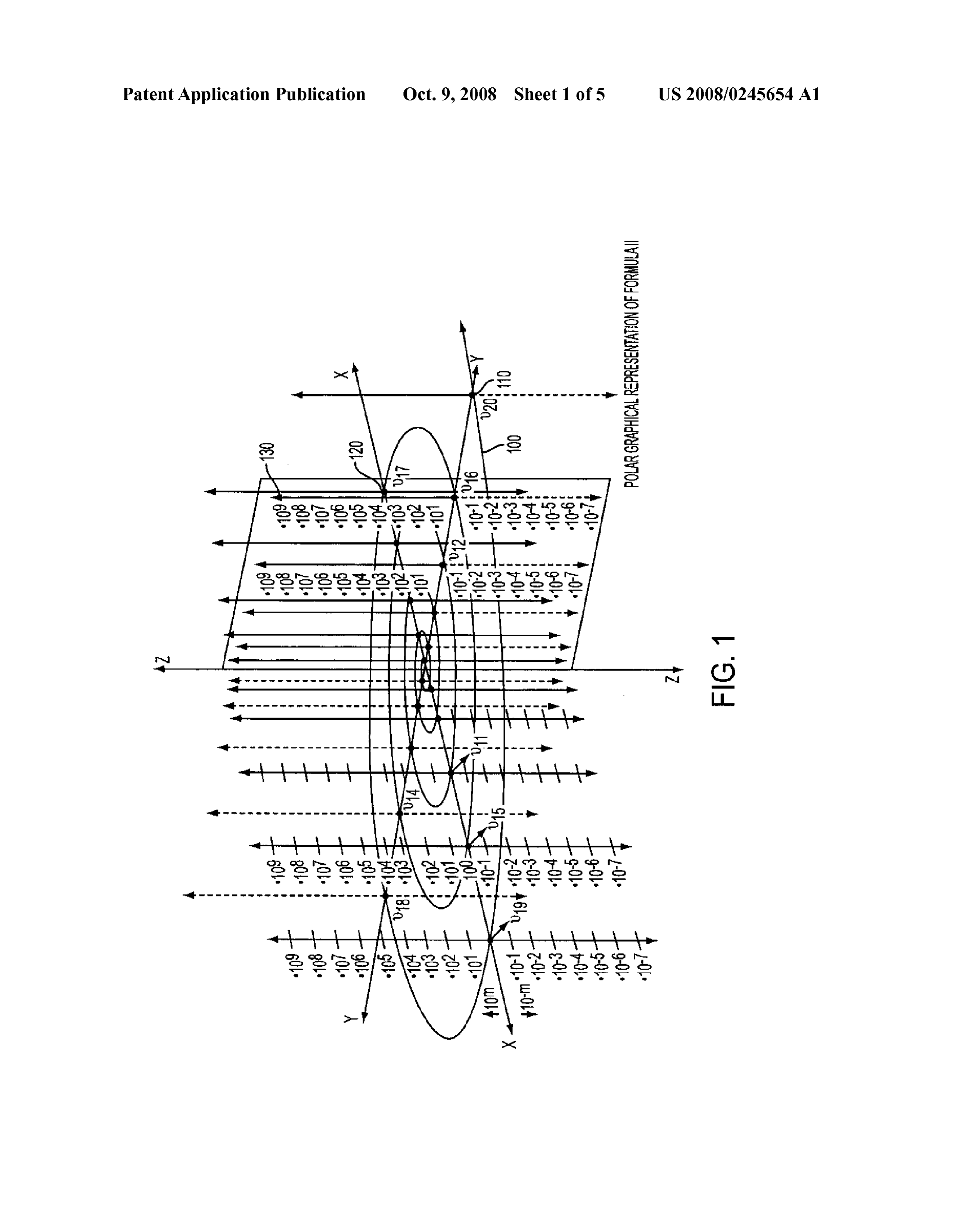
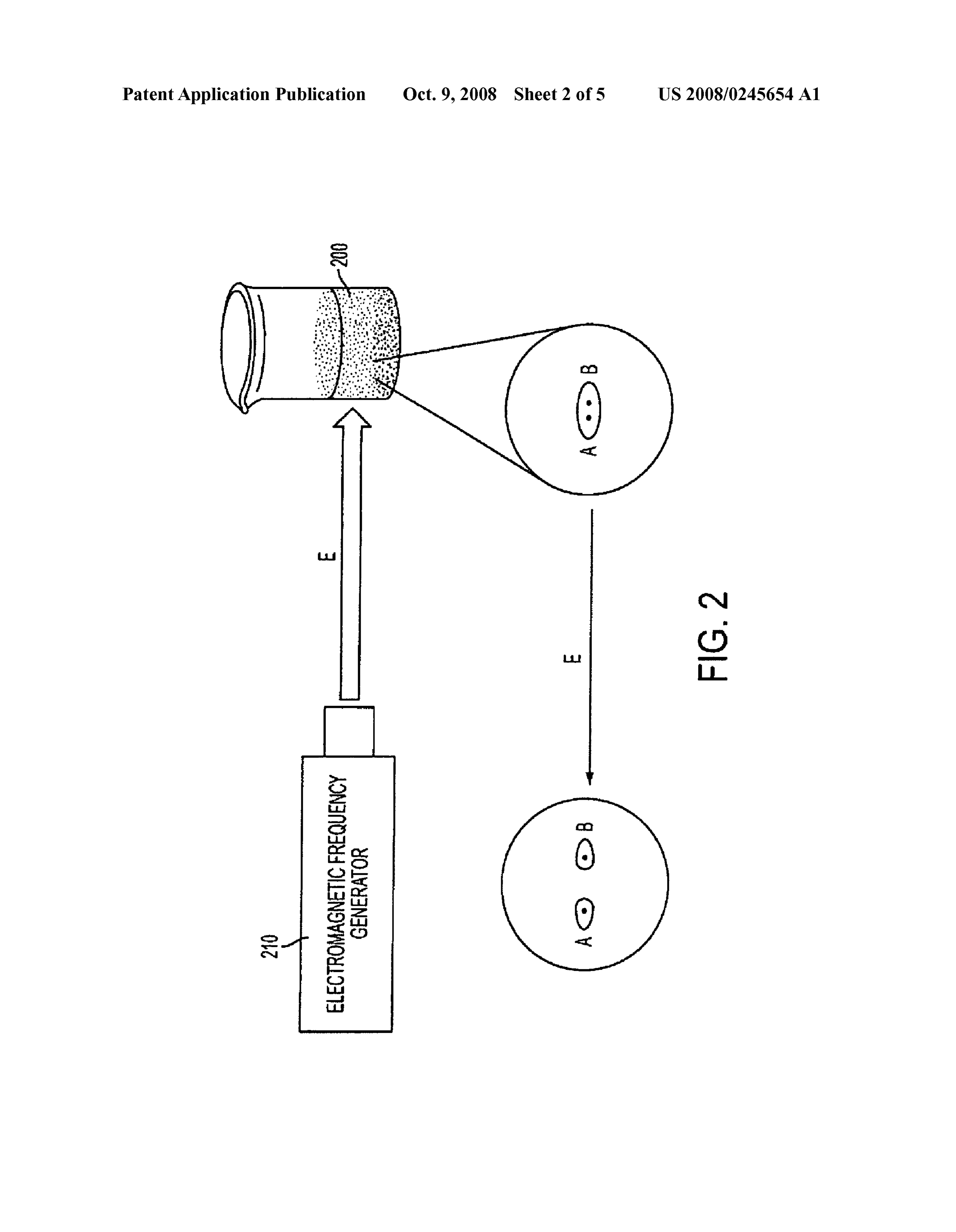
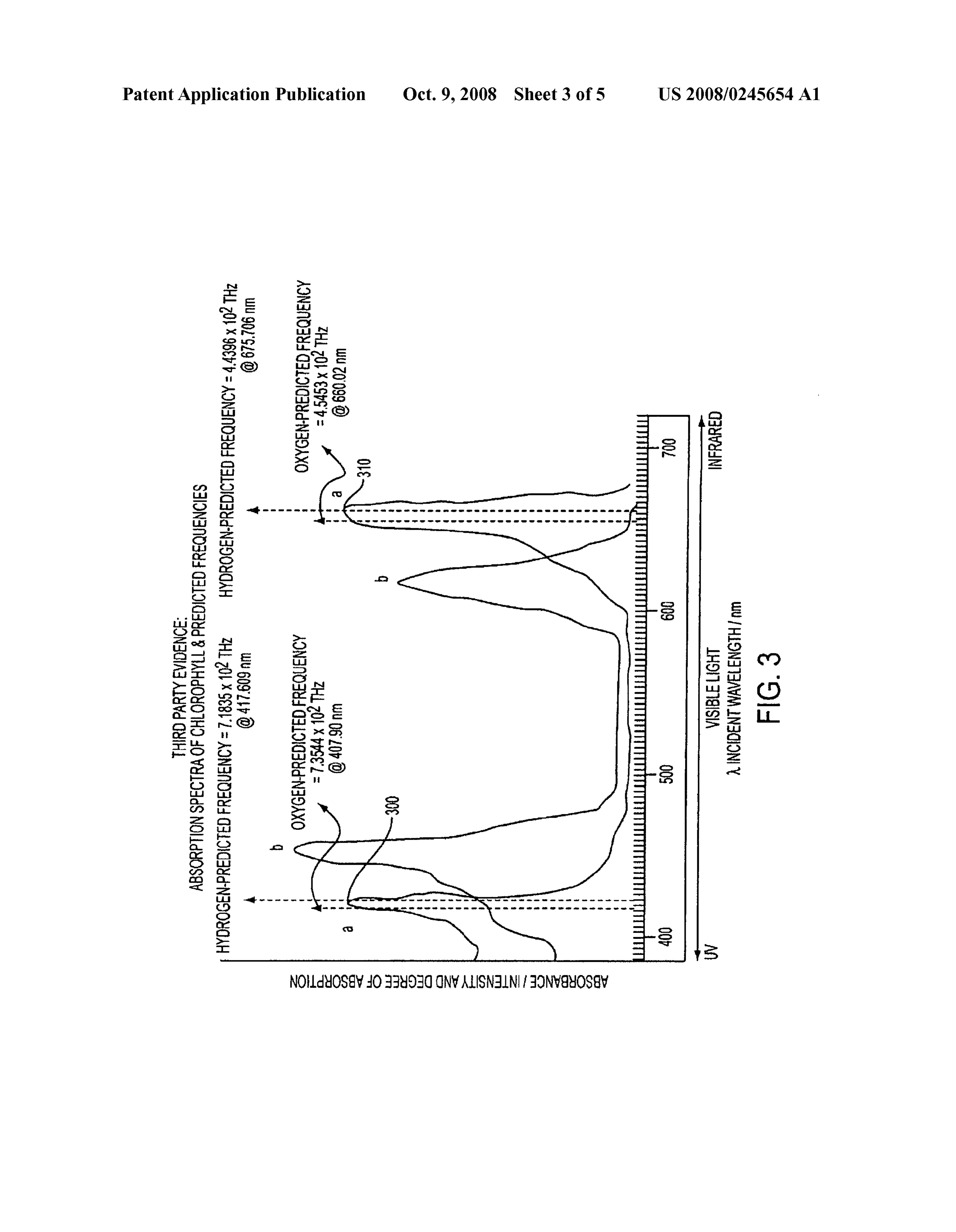
quency corresponding to the maximum wavelength of absorption () for the molecular form of that atom. The 0014 FIG. 1 is a schematic visualization of an electromag symbold represents the golden mean, equal to /2(1+15). The netic radiation frequency selection equation according to an variable n may be any integer, including negative integers, embodiment of the present invention. positive integers and Zero, and may be the same or different. 0015 FIG. 2 illustrates a method of cleaving chemical The constant e is defined as the base for natural logs, equal to bonds by exposing the bonds to electromagnetic radiation about 2.71828. In some embodiments, simultaneous expo according to an embodiment of the invention. Sure of the atom to multiple electromagnetic radiation fre 0016 FIG. 3 illustrates a correlation between the maxi quencies falling within the scope of Formula I can be utilized. mum absorption frequencies of chlorophyll “a” and irradia If the use of multiple electromagnetic radiation frequencies tion frequencies corresponding to hydrogen and oxygen Suitable for affecting an atom is desired, multiple electromag atoms according to an embodiment of the invention. netic radiation frequencies may be determined by solving 0017 FIG. 4 illustrates cluster size reduction of water Formula I for multiple values of n. It is contemplated that two, according to an embodiment of the invention. three or up to eight or more frequencies (v) of electromag 0018 FIG. 5 illustrates an apparatus for reducing the size netic radiation may be used. The method of affecting the atom of macrostructures of a fluid and for irradiating a bond or molecule with multiple frequencies of electromagnetic between a first and second atom with electromagnetic radia radiation according to Formula I may be achieved by irradia tion according to an embodiment of the invention. tion with the multiple frequencies of electromagnetic radia tion simultaneously, sequentially or in a combination thereof.
DETAILED DESCRIPTION OF THE INVENTION In other embodiments, exposure to a single electromagnetic frequency falling within the scope of Formula I may be uti 0019 Certain embodiments of the invention provide a sys lized.
tem for manipulating or affecting an atom or a molecule by 0022. In certain embodiments of the invention, it is con exposing the atom or molecule to electromagnetic radiation. templated that the frequencies of electromagnetic radiation By affecting a molecule, it is to be understood that the effect useful for affecting atoms or molecules may be various orders may be on any one or more of the atoms comprising the of magnitude of the frequency of electromagnetic radiation molecule. Furthermore, by affecting an atom or molecule, it is determinable by Formula I. Formula II may be solved in order to be understood that a method of the invention includes to determine the frequencies of electromagnetic radiation (v) affecting the atomic or molecular electron orbitals, or a com that may be used to affect an atom or molecule according to an bination thereof, of the atom or molecule to be affected. embodiment of the invention. In some embodiments, the fre Embodiments of the invention provide a way to select a quencies (v) of electromagnetic radiation according to For discrete number of frequencies of electromagnetic radiation mula II fall within, and include, the range of yoctaherz (yHz. Suitable for affecting an atom or molecule and a technique for on the order of 10 Hz) and yottahertz (YhZ, on the order of affording an effect by irradiation of the atom or molecule with 10 Hz). Other embodiments employ frequencies falling at least one frequency of electromagnetic radiation selected within ranges such as, by way of non-limiting examples, thereby. Some embodiments of the invention provide a sys 10 Hz through 10 Hz, 10 Hz through 10 Hz, or 10 Hz tem for and method of cleaving or disassociating selected through 10 Hz. Note that in certain embodiments, both v
Page 10
US 2008/0245654 A1 Oct. 9, 2008
and v' fall within these ranges. That is, once values for V are frequencies for each type of atom (i.e. each element). From calculated according to Formula I that fall within a given this finite number of electromagnetic frequencies, a techni range, then additional orders of magnitude of V, calculated as cian with the aid of a tunable electromagnetic radiation fre v' according to Formula II, may be calculated such that they quency generator will be able to simply tune through the still lie within the given range. given predetermined electromagnetic frequencies corre v'-v-10”=A-d'e-10” Formula II. sponding to Formula II for the specific type of atom selected and observe and record which select electromagnetic fre
In Formula II, the term v' is the frequency of radiation used to quency or frequencies are suitable for affecting the atom or affect an atom or molecule and V is as in Formula I. The term molecule in the manner desired.
A represents the base frequency of the atom (including those 0025. One embodiment of the invention includes a process in a molecule) to be affected. A base frequency of the atom is of affecting a molecule in order to cleave or disassociate a a spectroscopic parameter associated with that atom. The bond between a first and a second atom. The first and second spectroscopic parameter may be, by way of non-limiting example, a frequency corresponding to the maximum wave atoms may be of the same or different elements. Cleavage length of absorption (W) for the molecular form of that occurs by exposing the bond to electromagnetic radiation at a atom. The symbol db represents the golden mean, equal to frequency according to Formula II. In some embodiments, /2(1+W5). The variables n and m may be any integer, including covalent bonds (including polar covalent bonds), ionic bonds, negative integers, positive integers and Zero, and may be the hydrogen bonds and Van der Waals interactions may be same or different. The constant e is defined as the base for cleaved or disassociated by the method described herein. natural logs, equal to about 2.71828. In some embodiments, 0026. In Formula II, the term v' is the frequency of radia simultaneous exposure of the atom or molecule to multiple tion used to cleave the bond. The term. A represents the base electromagnetic radiation frequencies falling within the frequency of one of the atoms that is bonded. A base fre scope of Formula II can be utilized. If the use of multiple quency of one of the first or second atoms is a spectroscopic electromagnetic radiation frequencies Suitable for affecting parameter associated with that atom. The spectroscopic an atom or molecule is desired, multiple electromagnetic parameter may be, by way of non-limiting example, a fre radiation frequencies may be determined by Solving Formula quency corresponding to the maximum wavelength of II for multiple values of norm, or a combination thereof. If it absorption (W) for the molecular form of that atom. The is desired to affect multiple atoms present or multiple atoms symbold represents the golden mean, equal to /2(1+15). The of a molecule, multiple frequencies may further be deter Variables n and m may be any integer, including negative mined according to Formula II by inputting the base fre integers, positive integers and Zero, and may be the same or quency parameter A, for each bonded atom. It is contem different. In some embodiments, methods of cleaving or dis plated that two, three or up to eight or more frequencies of associating bonds are achieved by irradiating the bonds with electromagnetic radiation (v') may be used. The atoms or frequencies of electromagnetic radiation selected from For molecules to be affected may be irradiated with the multiple mula II wherein the variable n is a positive integer. The frequencies of electromagnetic radiation simultaneously, constant e is defined as the base for natural logs, equal to sequentially or in a combination thereof. In other embodi about 2.71828. In some embodiments, simultaneous expo ments, exposure to a single electromagnetic radiation fre sure of the bond to multiple electromagnetic radiation fre quency falling within the scope of Formula II may be utilized. quencies falling within the scope of Formula II can be uti 0023 FIG. 1 is a schematic visualization of Formula II lized. If the use of multiple electromagnetic radiation according to an embodiment of the present invention. The frequencies Suitable for cleaving a bond comprising a specific Xy-plane contains a golden spiral 100. In polar coordinates, first atom and a second atom is desired, multiple electromag golden spiral 100 complies with the formula r-d''", where netic radiation frequencies may be determined by solving (r.0) represents respective polar coordinates (radius, angle Formula II for multiple values of n or m, or combinations from the positive X-axis), d represents the golden mean, and thereof. Such multiple frequencies may further be determined It is the well-known mathematical constant equal to about according to Formula II by inputting the base frequency 3.14. Values of v (according to Formula I) are depicted where parameter A, for each bonded atom. It is contemplated that golden spiral 100 intersects the x- and y-axes. Specifically, a two, three or up to eight or more frequencies of electromag value for v when n=0 appears at the origin (0,0), and addi netic radiation (v) may be used. The bonds to be cleaved may tional values for v are plotted on the X- and y-axes by travers be irradiated with the multiple frequencies of electromagnetic ing golden spiral 100 counterclockwise and outward as in radiation simultaneously, sequentially or in a combination increases. For example, the value of v for n=20 appears on the thereof. In other embodiments, exposure to a single electro y-axis at 110 and the value of v for n=17 appears on the x-axis magnetic frequency falling within the scope of Formula II at 120. Orders of magnitude of each v value according to may be utilized.
Formula II are depicted above and below the respective v 0027 FIG. 2 illustrates an embodiment of the invention value outside of the Xy-plane. That is, orders of magnitude of wherein electromagnetic radiation (E) is directed to a mate a particular value of v lie along the line parallel to the Z-axis rial 200. The electromagnetic radiation (E) is generated by an passing through the particular location in the Xy-plane at electromagnetic frequency generator 210. Such as by way of which that value for v is depicted. Orders of magnitude of v non-limiting examples, a laser, maser or oscillator. The fre values for which m is negative appear below the Xy-plane, quency (v) of the electromagnetic radiation is selected while orders of magnitude of v values for which m is positive according to Formula II. The material may be in any form, appear above the Xy-plane. For example and according to Such as a solid, liquid or gas. Depending on the atom utilized Formula II, v' when n=17 and m=9 appears at 130 in FIG. 1. to determine the base frequency (A) input into Formula II, 0024. As seen in FIG. 1. Formula II may be used to calcu the electromagnetic radiation (E) can be used to selectively late a finite number of specific values of electromagnetic cleave a bond between two atoms in the material 200, where
Page 11
US 2008/0245654 A1 Oct. 9, 2008
the base frequency utilized to solve Formula II corresponds to at least one of the atoms in the material. TABLE I-continued 0028. Formula II may be used to calculate a finite number Exemplary Frequencies For Cleaving a Covalent Bond of specific values of electromagnetic frequencies for each that Bonds a Hydrogen to Another Atom type of atom (i.e. each element). From this finite number of electromagnetic frequencies, a technician with the aid of a H. d2. e. 109 1.2432SO341 THz tunable electromagnetic radiation frequency generator will H. d. e. 109 2.01.1621.308 THz be able to simply tune through the given predetermined elec H. di. e. 109 3.254.871649 THz
tromagnetic frequencies corresponding to Formula II for the H. di. e. 109 8.52.13646OS THz specific type of atom selected and observe and record which H. d'7. e. 109 3.78785756 THz select electromagnetic frequency or frequencies are suitable H. di. e. 109 22.309221.6 THz
for cleaving the molecule. Such a technician may simply H. d’. e. 109 58.40630188 THz observe the material for signs that bonds have been broken. H. d’. e. 109 94. SO3381.58 THz 0029. One embodiment of the invention includes a method H. d22. e. 109 S2.909683S THz for cleaving a hydrogen-containing covalent bond, i.e. a cova H. d2. e. 109 247.41306S THz
lent bond where one of the atoms is a hydrogen atom. When H. d’. e. 109 O.6477358136 PHZ one of the first or second atoms is a hydrogen atom, the base H. d2. e. 109 O48058562 PHZ frequency may be solved for hydrogen or for the second atom H. d27. e. 109 695794376 PHZ to which the hydrogen atom is bonded. Determination of the H. d’. e. 109 2.743852938 PHZ
base frequency for hydrogen (H,) is accomplished by first H. di. e. 109 7.1835OO2S PHZ determining the maximum wavelength of absorption (W) H. di. e. 109 162314756 PHZ for diatomic (molecular) hydrogen (H2). The base frequency H. d’. e. 109 8.80664781 PHZ of an element is determined by the formula:
AfC/na. Formula III. 0031. In some embodiments of the invention, bonds can be In Formula III, the term c represents the speed of light. dissociated by exposing the bonds to electromagnetic radia Accordingly, with a maximum wavelength of 21.1 cm, the tion comprising a frequency according Formula II without base frequency for ground state, natural hydrogen (H,) is any additional processes or steps. In other embodiments, the about 1.420405751698 GHZ. process of cleaving bonds by exposure to electromagnetic 0030 The process of cleaving a covalent bond between a radiation having a frequency according to Formula II may be hydrogenatom and another atom may include directing elec combined with another process known to be useful for break tromagnetic radiation of one or more of the frequencies ing bonds, such as by way of a non-limiting example, elec according to Formula II at a material having molecules with at trolysis.
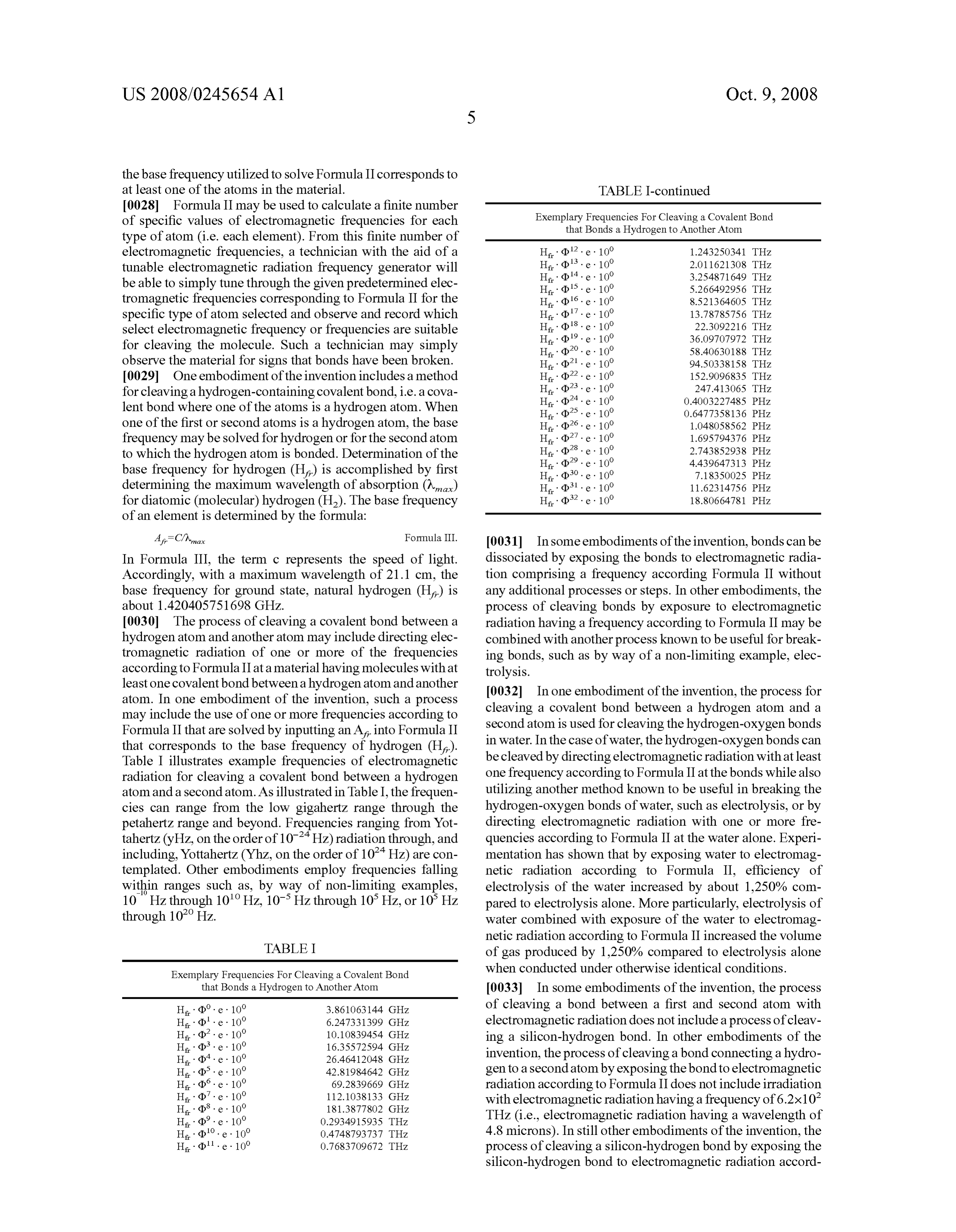
least one covalent bond between a hydrogenatom and another 0032. In one embodiment of the invention, the process for atom. In one embodiment of the invention, such a process cleaving a covalent bond between a hydrogen atom and a may include the use of one or more frequencies according to second atom is used for cleaving the hydrogen-oxygenbonds Formula II that are solved by inputting an A, into Formula II in water. In the case of water, the hydrogen-oxygenbonds can that corresponds to the base frequency of hydrogen (H). be cleaved by directing electromagnetic radiation with at least Table I illustrates example frequencies of electromagnetic radiation for cleaving a covalent bond between a hydrogen one frequency according to Formula II at the bonds while also atom and a second atom. As illustrated in Table I, the frequen utilizing another method known to be useful in breaking the cies can range from the low gigahertz range through the hydrogen-oxygen bonds of water, such as electrolysis, or by petahertz range and beyond. Frequencies ranging from Yot directing electromagnetic radiation with one or more fre tahertz (yHz, on the order of 10 Hz) radiation through, and quencies according to Formula II at the water alone. Experi including, Yottahertz (Yhz, on the order of 10 Hz) are con mentation has shown that by exposing water to electromag templated. Other embodiments employ frequencies falling netic radiation according to Formula II, efficiency of within ranges such as, by way of non-limiting examples, electrolysis of the water increased by about 1,250% com 10 Hz through 10 Hz, 10 Hz through 10 Hz, or 10 Hz pared to electrolysis alone. More particularly, electrolysis of through 10 Hz. water combined with exposure of the water to electromag netic radiation according to Formula II increased the Volume
TABLE I of gas produced by 1,250% compared to electrolysis alone
Exemplary Frequencies For Cleaving a Covalent Bond when conducted under otherwise identical conditions. that Bonds a Hydrogen to Another Atom 0033. In some embodiments of the invention, the process H. D. e. 109 3.86106314.4 GHz of cleaving a bond between a first and second atom with H. d' . e. 109 6.247331399 GHz electromagnetic radiation does not include a process of cleav H. d’. e. 109 10.108394.54 GHz ing a silicon-hydrogen bond. In other embodiments of the H. d. e. 109 16.3SS72594 GHz invention, the process of cleaving a bond connecting a hydro
H. d. e. 109 42.81984.642 GHz gen to a secondatom by exposing the bond to electromagnetic H. d. e. 109 69.28396.69 GHz radiation according to Formula II does not include irradiation
with electromagnetic radiation having a frequency of 6.2x10°
H. d’. e. 109 O.2934.91593S THz THZ (i.e., electromagnetic radiation having a wavelength of H. d. e. 109 O.4748793737 THz 4.8 microns). In still other embodiments of the invention, the H. di. e. 109 O.7683709672 THz process of cleaving a silicon-hydrogen bond by exposing the silicon-hydrogen bond to electromagnetic radiation accord
Page 12
US 2008/0245654 A1 Oct. 9, 2008
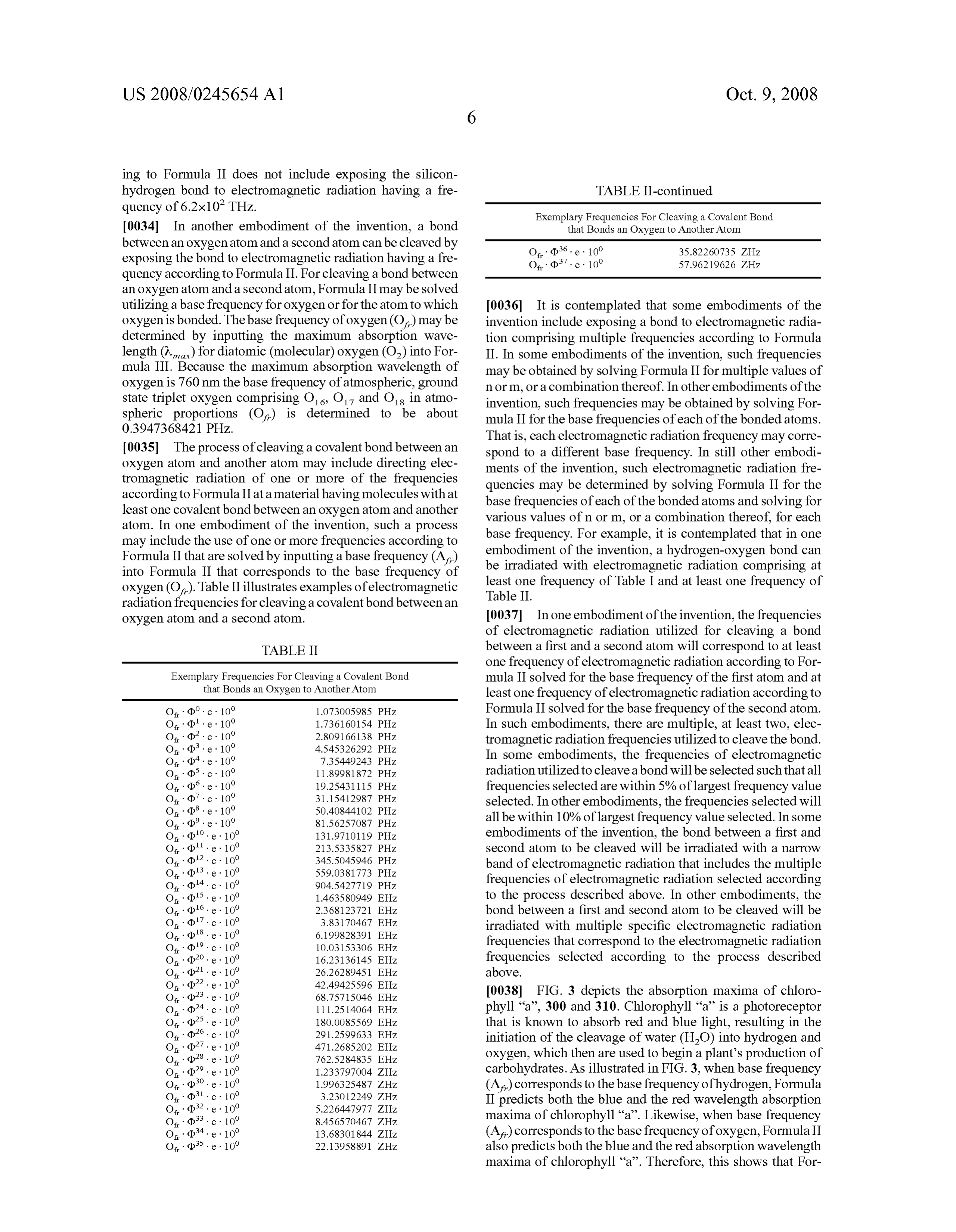
ing to Formula II does not include exposing the silicon hydrogen bond to electromagnetic radiation having a fre TABLE II-continued quency of 6.2x10° THz. Exemplary Frequencies For Cleaving a Covalent Bond 0034. In another embodiment of the invention, a bond that Bonds an Oxygen to Another Atom between an oxygenatom and a second atom can be cleaved by O. die. e. 109 35.8226O735 ZHZ exposing the bond to electromagnetic radiation having a fre O. d7. e. 109 57.96219626 ZHZ quency according to Formula II. For cleaving a bond between an oxygenatom and a second atom, Formula II may be solved utilizing a base frequency for oxygen or for the atom to which 0036. It is contemplated that some embodiments of the oxygen is bonded. The base frequency of oxygen (O) may be invention include exposing a bond to electromagnetic radia determined by inputting the maximum absorption wave tion comprising multiple frequencies according to Formula length (W) for diatomic (molecular) oxygen (O) into For II. In some embodiments of the invention, such frequencies mula III. Because the maximum absorption wavelength of may be obtained by solving Formula II for multiple values of oxygen is 760 nm the base frequency of atmospheric, ground norm, or a combination thereof. In other embodiments of the state triplet oxygen comprising O, O, and Os in atmo invention, such frequencies may be obtained by solving For spheric proportions (O) is determined to be about mula II for the base frequencies of each of the bonded atoms.
That is, each electromagnetic radiation frequency may corre 0035. The process of cleaving a covalent bond between an spond to a different base frequency. In still other embodi oxygen atom and another atom may include directing elec ments of the invention, Such electromagnetic radiation fre tromagnetic radiation of one or more of the frequencies quencies may be determined by solving Formula II for the according to Formula II at a material having molecules with at base frequencies of each of the bonded atoms and Solving for least one covalent bond between an oxygenatom and another various values of n or m, or a combination thereof, for each atom. In one embodiment of the invention, such a process base frequency. For example, it is contemplated that in one may include the use of one or more frequencies according to
Formula II that are solved by inputting a base frequency (A) embodiment of the invention, a hydrogen-oxygen bond can into Formula II that corresponds to the base frequency of be irradiated with electromagnetic radiation comprising at oxygen (O). Table II illustrates examples of electromagnetic least one frequency of Table I and at least one frequency of Table II.
radiation frequencies for cleaving a covalent bond between an oxygen atom and a second atom. 0037. In one embodiment of the invention, the frequencies of electromagnetic radiation utilized for cleaving a bond
TABLE II between a first and a second atom will correspond to at least one frequency of electromagnetic radiation according to For
Exemplary Frequencies For Cleaving a Covalent Bond mula II solved for the base frequency of the first atom and at that Bonds an Oxygen to Another Atom least one frequency of electromagnetic radiation according to O. d9.e. 109 O73OOS985 PHZ Formula II solved for the base frequency of the second atom. O. D. e. 109 73616O154 PHZ In Such embodiments, there are multiple, at least two, elec O. d’. e. 109 2.8091661.38 PHZ tromagnetic radiation frequencies utilized to cleave the bond. O. d. e. 109 4.545326292 PHZ In some embodiments, the frequencies of electromagnetic
O. D. e. 109 18998.1872 PHZ radiation utilized to cleave a bond will be selected such that all O. d. e. 109 9.25431115 PHZ frequencies selected are within 5% of largest frequency value O. d7. e. 109 31.15412987 PHZ selected. In other embodiments, the frequencies selected will
O. D°. e. 109 81.562S7087 PHZ all be within 10% of largest frequency value selected. In some O. d. e. 109 31.971O119 PHZ embodiments of the invention, the bond between a first and O. d''..e. 109 213.5335827 PHZ second atom to be cleaved will be irradiated with a narrow O. d2. e. 109 345. SO45946 PEHz band of electromagnetic radiation that includes the multiple O. D. e. 109 559.0381,773 PHZ frequencies of electromagnetic radiation selected according
O. dpi. e. 109 463580949 EHz to the process described above. In other embodiments, the O. dpi. e. 109 2.3681.23721 EHz bond between a first and second atom to be cleaved will be O. d7. e. 109 3.83170467 EHz irradiated with multiple specific electromagnetic radiation O. d. e. 109 6.1998.28391 EHz frequencies that correspond to the electromagnetic radiation
O. d20. e. 109 6.23136145 EHz frequencies selected according to the process described O. d? . e. 109 26.262894S1 EHz above.
O. d’. e. 109 42.4942S596 EHz 0038 FIG. 3 depicts the absorption maxima of chloro
O. d?'. e. 109 11.2514O64 EHz phyll “a”, 300 and 310. Chlorophyll “a” is a photoreceptor O. d’. e. 109 80.0O85569 EHz that is known to absorb red and blue light, resulting in the O. d?.e. 109 2912599633 EHz initiation of the cleavage of water (H2O) into hydrogen and O. d27. e. 109 471.26852O2 EHz oxygen, which then are used to begin a plant's production of
O. d’. e. 109 233797 004 ZHZ carbohydrates. As illustrated in FIG. 3, when base frequency
(A) corresponds to the base frequency of hydrogen, Formula
II predicts both the blue and the red wavelength absorption
O. dpi. e. 109 8.456570467 ZHZ maxima of chlorophyll “a”. Likewise, when base frequency O. d'.e. 109 3.683O1844 ZHZ (A) corresponds to the base frequency of oxygen, Formula II O. d. e. 109 22.13958891 ZHZ also predicts both the blue and the red absorption wavelength maxima of chlorophyll “a”. Therefore, this shows that For
Page 13
US 2008/0245654 A1 Oct. 9, 2008
mula II accurately predicts the relationship between the base combination thereof. In one embodiment, the magnetic field frequencies of hydrogen and oxygen and known biological can be pulsed at at least one frequency that corresponds to realities. Formula II.
0039. In one embodiment of the invention, it is contem 0044) The second process may be utilized in concert with plated that cleavage of a bond between a first and secondatom the first process in order to increase the efficiency of bond may be accomplished for a specific isotope of either or both of cleavage by exposing the bonds which are to be cleaved to the the first and second atoms. In such a process, a frequency of electromagnetic radiation of the first process. The second electromagnetic radiation according to Formula II may be process, ifutilized in concert with the first process, may occur determined utilizing a base frequency of a specific isotope of concurrently or sequentially with the first process. The sec either the first or second atom. For example, the base fre ond process may also be useful in facilitating other methods quency may be determined for hydrogen (H), deuterium of bond cleavage. Such as electrolysis. (H) or tritium (H). Isotope selectivity may be desired in 004.5 FIG. 4 illustrates super 400 and icosahedral 410 Some embodiments for various reasons. For example, in an water clusters, which may comprise hundreds or even thou embodiment where the first or second atom is a hydrogen sands of water molecules. While not wishing to be bound by isotope, the process could be utilized to selectively cleave any theory of operation, it is believed that the formation of hydrogen, deuterium, or tritium in order to produce molecular these clusters limits the number of covalent hydrogen-oxygen bonds that are exposed to the electromagnetic radiation of the hydrogen (H), molecular deuterium (H) or molecular tri first process. The “surface' of the cluster appears to block tium (H), respectively. much of the electromagnetic radiation from entering the 0040. In one embodiment of the invention, it is contem “interior of the cluster. Therefore, it is believed that while the plated that cleavage of a bond between a first atom and a hydrogen-oxygen bonds that are on the “surface' of the clus second atom will be accomplished by irradiating the bond ter are exposed to the electromagnetic radiation, the hydro with electromagnetic radiation having a frequency according gen-oxygen bonds that are within the cluster are largely un to Formula II, where Formula II is solved for the base fre exposed and, thus, are not Susceptible to electromagnetic quency of the first or second atom with the Smaller atomic radiation-induced bond cleavage. It is also believed that when mass. The atomic mass of an atom is the sum of the mass of used with water, the second process breaks the large water the neutrons, protons and electrons of the atom. clusters 400 and 410 into smaller water clusters 420, as sche 0041 Irradiating a bond utilizing a specific frequency or a matically illustrated in FIG. 4. Because the smaller water narrow band of electromagnetic radiation is generally more clusters possess fewer water molecules, fewer hydrogen-oxy efficient compared to the use of broad-band electromagnetic gen bonds are shielded from the electromagnetic radiation by the “surface' of the cluster. Accordingly, when the macro radiation for several reasons. By irradiating a bond with a structure of the water molecules is in the form of small water specific frequency of electromagnetic radiation specifically clusters 420, the hydrogen-oxygenbonds are more exposed to selected to cleave the bond, instead of a broad-band of elec electromagnetic radiation and more readily cleaved. There tromagnetic radiation, less energy is required to cleave the fore, in one embodiment, the second process can be initially bond because energy will not be wasted on emitting frequen utilized to break the super 400 and icosahedral 410 clusters cies that are ineffective at cleaving the desired bond. It is also into smaller cluster sizes 420, followed by the first process contemplated that certain frequencies of electromagnetic utilized to cleave the bonds in the smaller clusters 420 radiation may adversely impact the desired bond cleavage. Accordingly, the second process can be used in combination Accordingly, for at least these reasons, the use of specific with the first process in a method of cleaving, e.g., the hydro frequencies of electromagnetic radiation facilitates bond gen-oxygen bond of water.
cleavage with less energy requirements than would be 0046 FIG. 5 illustrates an embodiment of the invention required by broad-band irradiation. which combines a first process (the application of electro 0042. Furthermore, utilization of a specific frequency of magnetic radiation having at least one frequency of Formula electromagnetic radiation for cleaving a bond between a first II) with a second process (facilitation of bond cleavage by and second atom may be advantageous when it is desired to exposure of the water to cavitation and a pulsed magnetic cleave a specific bond in a molecule that has more than two field). FIG. 5 illustrates an apparatus 500 comprising a coiled types of atoms. For example irradiation of methanol cylindrical body 510. Although the invention is not limited to (HCOH) with electromagnetic radiation having a frequency such an embodiment, the coiled cylindrical body depicted in according to Formula II where the base frequency is the base FIG.5 proceeds from an outer coilS20 to an innercoilS30. As frequency of hydrogen (H) may be useful for cleaving the the coiled body 510 proceeds from the outer coil 520 to the hydrogen-oxygen and the hydrogen-carbon bonds, while inner coil 530, the diameter of the coil 540 becomes progres leaving the carbon-oxygen bond intact. sively smaller. At the open end of the outer coil, the interior of 0043. In one embodiment of the invention, a second pro the coiled cylindrical body is accessible via the mouth 550 of cess may be utilized in combination with a first process to the cylinder. In some embodiments, as the coiled body pro facilitate bond cleavage (the first process being the applica ceeds from the outer coil 520 to the inner coil 530, the diam tion of electromagnetic radiation having a frequency accord eter of the cylindrical portion of the body 560 becomes pro ing to Formula II). The second process is particularly useful gressively smaller. Furthermore, in some embodiments, the when the material is a liquid. It is contemplated that the interior of the cylindrical body is lined with a coil of electro second process may be useful when, e.g., a liquid tends to magnetic transmitting nodes 570. The electromagnetic trans form macrostructures or quasicrystals via non-covalent inter mitting nodes 570 may emit electromagnetic radiation having actions, such as hydrogen bonding, van der Waals forces, etc. one or more frequencies according to Formula II, including The second process involves Subjecting the liquid to cavita frequencies obtained by plugging the base frequencies of one tion, Such as in a spiral Vortex, a pulsed magnetic field, or a or both of the atoms involved in the bond that is to be cleaved
Page 14
US 2008/0245654 A1 Oct. 9, 2008
into Formula II. In some embodiments of the invention, dif tials of all atomic matter, Such as by affecting electron orbitals ferent electromagnetic frequencies of Formula II are trans of elements, atoms, compounds or a combination thereof. mitted by different portions of the electromagnetic transmit v"-ve L-1-10-4-de-Li-10 Formula IV. ting nodes 570. In other embodiments of the invention, the electromagnetic frequencies transmitted by the electromag 0050. In Formula IV, the term v" is the frequency of elec netic transmitting nodes 570 may not be the same throughout tromagnetic radiation useful for accelerating or retarding the the entire process. In other words, if desired, the electromag rate of the process of affecting the atom or the molecule by netic transmitting nodes 570 at specific points along the inte exposing the atom or molecule to electromagnetic radiation rior of the coiled cylindrical body may change the frequency having a frequency according to Formula II. In some embodi ments, the process to be accelerated or retarded may be a of electromagnetic radiation transmitted. Furthermore, process of cleaving bonds between a first and a second atom. although the invention is not so limited, the apparatus of FIG. The term A represents the base frequency of one of the atoms 5 comprises magnetic windings 580 that are spaced intermit that is bonded. A base frequency of one of the first or second tently along the coiled cylindrical body. In another embodi atoms is a spectroscopic parameter associated with that atom. ment of the invention, the magnetic windings may be con The spectroscopic parameter may be, by way of non-limiting tinuously placed along the coiled cylindrical body. example, a frequency corresponding to the maximum wave 0047. In one embodiment of the invention, the apparatus length of absorption (W) for the molecular form of that of FIG. 5 can be utilized in a method for cleaving the hydro atom and may be determined according to Formula III. The gen-oxygen bonds of water. The method can be utilized, e.g., symbold represents the golden mean, equal to /2(1+15). The for generating hydrogen gas (H) and oxygen gas (O). Water variables n and m may be any integer, including negative can be introduced into the mouth 550 of the apparatus integers, positive integers and Zero, and may be the same or whereby it will become subject to the electromagnetic fre different. The constante is defined as the base for natural logs, quencies according to Formula II being transmitted by the equal to about 2.71828. The constant L is defined as the electromagnetic transmitting nodes 570 found within the natural log of the number two, equal to about 0.693. The interior of the coiled cylindrical body 510. As the water flows variablet is equal to the variable n. In some embodiments, the inward inside the coiled cylindrical body 510, the large water variable n is a negative number when the electromagnetic clusters, such as super 400 and icosahedral 410 clusters, will radiation frequency according to Formula IV is utilized to be broken into smaller clusters 420 because of, e.g., (1) the retard the process of affecting an atom or molecule with spiraling flow or “vortex” of the water; (2) the decreasing electromagnetic radiation having a frequency according to diameter of the cylindrical body; and (3) the magnetic pulsa Formula II. In other embodiments, the variable n is a negative tion of the magnetic coils. The hydrogen-oxygen bonds of number when the electromagnetic radiation frequency water in the smaller clusters 420 will then be more susceptible according to Formula IV is utilized to make anatom, element to bond cleavage induced by the electromagnetic radiation or molecule less reactive. In some embodiments, the variable transmitted by the electromagnetic transmitting nodes 570. In n is a positive number when the electromagnetic radiation various embodiments of the invention, the use of any manner frequency according to Formula IV is utilized to accelerate of breaking large water clusters into Smaller clusters is con the process of affecting anatom or molecule with electromag templated, including those recited herein, and any other netic radiation having a frequency according to Formula II. In known method of breaking large water clusters into Smaller other embodiments, the variable n is a positive number when clusters, or any combinations thereof. the electromagnetic radiation frequency according to For mula IV is utilized to make an atom, element or molecule 0048. Furthermore, it is contemplated that in some more reactive.
embodiments of the invention, a method of cleaving bonds 0051. In some embodiments, the frequencies (v") of elec comprising the first and second processes may further be tromagnetic radiation according to Formula IV fall within, combined with another process known to be useful in cleav and,include, the range of yoctaherz (yHz, on the order of ing bonds. For example, electrolysis is known to convert H2O 10 Hz) and yottahertz (Yhz, on the order of 10 Hz). Other to H2 and O. Accordingly, the first and second processes may embodiments employ frequencies falling within ranges Such be used to increase the efficiency of electrolysis. Using a as, by way of non-limiting examples, 10" Hz through 10" broad-band electromagnetic frequency generator, electroly Hz, 10 Hz through 10 Hz, or 10 Hz through 10 Hz. Note sis of water was observed to increase by about 1,250% when that in certain embodiments, both v (according to Formula I) compared to electrolysis alone. and v" fall within these ranges. That is, once values for v are 0049. In some embodiments of the invention, the process calculated according to Formula I that fall within a given of affecting an atom or a molecule by exposing the atom or range, then additional orders of magnitude of v, calculated as molecule to electromagnetic radiation having a frequency v" according to Formula IV, may be calculated such that they according to Formula II may be accelerated or retarded by still lie within the given range.
additionally irradiating the atom or molecule with electro magnetic radiation with a frequency according to Formula IV.
electromagnetic radiation with a frequency according to For 0052. In Formula V, the term v" is the frequency of elec mula V, or a combination thereof. Formula IV and Formula V tromagnetic radiation useful for accelerating or retarding the are described below. In other embodiments, electromagnetic rate of the process of affecting an atom or a molecule by radiation having a frequency according to either or both of exposing the atom or molecule to electromagnetic radiation Formula IV and Formula V may be utilized, independent of having a frequency according to Formula V. In some embodi electromagnetic radiation having a frequency according to ments, the process to be accelerated or retarded may be a Formula II, in order to cause elements, atoms, compounds, or process of cleaving bonds between a first and a second atom. a combination thereof, to be more or less reactive. Formula IV The term A represents the base frequency of one of the atoms and Formula V may affect energy states and bonding poten that is bonded. A base frequency of one of the first or second
Page 15
US 2008/0245654 A1 Oct. 9, 2008
atoms is a spectroscopic parameter associated with that atom. tion according to Formulas IV and V solved for the base The spectroscopic parameter may be, by way of non-limiting frequency of hydrogen are illustrated in Table IV and Table V. example, a frequency corresponding to the maximum wave respectively.
length of absorption (W) for the molecular form of that atom and may be determined according to Formula III. The TABLE III symbold represents the golden mean, equal to /2(1+15). The Exemplary Frequencies According to Formula IV for Accelerating variables n and m may be any integer, including negative or Retarding the Cleavage of a Bond Between a integers, positive integers and Zero, and may be the same or - Hydrogen Alon and Another Aion different. The constante is defined as the base for natural logs, H. d-8. e-L-8). 100 7.731665658 GHz equal to about 2.71828. The constant L is defined as the H. d7. e-L-7). 100 6.2559.09898 GHz natural log of the number two, equal to about 0.693. In some H. d-6. e-L-6). 100 S.O61834O7 GHz embodiments, the variable n is a negative number when the H. d-s. e-L-5). 100 4.0956,73463 GHz electromagnetic radiation frequency according to Formula V H. d 4. e-L-4). 100 3.31392SS23 GHz
is utilized to retard the process of affecting an atom or mol H. d-2. e-L-2). 100 2.1695895.63 GHz ecule with electromagnetic radiation having a frequency H. d-l.e-L-1). 100 1.7SS47643 GHz
according to Formula II. In other embodiments, the variable n H. di. eCLI). 100 1.1493O1534 GHz is a negative number when the electromagnetic radiation fre H. d2. e-L2). 100 O.92994.1332 GHz quency according to Formula V is utilized to make an atom, H. de-L3). 100 O.752449079 GHz element or molecule less reactive. In some embodiments, the H. d’. eC-4). 100 O.608833694 GHz
variable n is a positive number when the electromagnetic H. d6. e-L'6). 100 O.398604143 GHz radiation frequency according to Formula V is utilized to H. d7. ec-7). 100 O.322S24991 GHz accelerate the process of affecting an atom or molecule with H. ps. e-L8). 100 O.260966605 GHz
electromagnetic radiation having a frequency according to
Formula II. In other embodiments, the variable n is a positive number when the electromagnetic radiation frequency according to Formula V is utilized to make an atom, element TABLE IV or molecule more reactive. Exemplary Frequencies According to Formula V for Accelerating 0053. In some embodiments, the frequencies (v") of elec or Retarding the Cleavage of a Bond Between tromagnetic radiation according to Formula V fall within, and a Hydrogen Atom and Another Atom include, the range of yoctaherz (yHz, on the order of 10 lfr di. eCLI). 100 1.66.064O437 GHz Hz) and yottahertz (Yhz, on the order of 10 Hz). Other lfr d2. eCLI). 100 2.68697267 GEHz
embodiments employ frequencies falling within ranges Such lfr d. eCLI). 100 7.03458577 GHz as, by way of non-limiting examples, 10" Hz through 10" lfr dos. e-L, I). 100 11.38219888 GHz Hz, 10 Hz through 10 Hz, or 10 Hz through 10 Hz. Note lfr d6. e-L, I). 100
that in certain embodiments, both v (according to Formula I) lfr db8. e(II). 100 48.2157682 GHz and v" fall within these ranges. That is, once values for v are lfr d24. eC-L I). 100 O.1064121785 PHZ calculated according to Formula I that fall within a given lfr d2s. e-L, I). 100
range, then additional orders of magnitude of v, calculated as lfr d27. eCLI). 100 O.4SO762218 PHZ v" according to Formula V. may be calculated such that they lfr d28. e(-L I). 100 O.729.3599.219 PHZ still lie within the given range. H. d29.e-L1). 100 1.18O129144 PHZ
0054. In some embodiments, simultaneous exposure of H. d. eL). 109 3.0896.18209 PHZ the bond to multiple electromagnetic radiation frequencies H. d82. e-L1). 100 4.9991 O7274 PHZ falling within the scope of Formula IV or Formula V. or a combination thereof, may be utilized. Multiple electromag netic radiation frequencies may be determined by solving 0056. In some embodiments, at least one narrow band of either or both of Formulas IV and V for multiple values of n electromagnetic frequencies comprising at least one fre and/or m. Such multiple frequencies of electromagnetic quency of electromagnetic radiation selected from Formula II radiation may further be determined according to either or and at least one frequency of electromagnetic radiation fre both of Formulas IV and V by inputting the base frequency quency according to either or both of Formula IV and V is parameter A, for each bonded atom. It is contemplated that utilized to affect an atom or a molecule. In other embodi two, three or up to eight or more frequencies (v" and/or v") ments, multiple specific frequencies corresponding to at least may be used to accelerate or retard a process of affecting an one frequency of electromagnetic radiation corresponding to atom or a molecule by exposing the atom or molecule to Formula II and at least one frequency of electromagnetic electromagnetic radiation having a frequency according to radiation corresponding to either or both of Formulas IV and Formula II. V are used. In some embodiments the frequencies of electro 0055. In one embodiment of the invention, a hydrogen magnetic radiation selected are selected Such that the radia containing covalent bond is irradiated with at least one elec tion corresponding to the at least one frequency of Formula II tromagnetic radiation frequency according to Formula II, and the frequencies of electromagnetic radiation correspond Solved for a base frequency of hydrogen, and at least one ing to either or both of Formulas IV and V are all within 5% electromagnetic radiation frequency according to either or of the largest frequency selected. In other embodiments, the both of Formulas IV and V. solved for a base frequency of frequencies of Formula II and either or both of Formulas IV hydrogen. Exemplary frequencies of electromagnetic radia and V are all within 10% of the largest frequency selected.
Page 16
US 2008/0245654 A1 Oct. 9, 2008
0057 The following formulas (VI-VIII) may be useful in water. Furthermore, the combustion of hydrogen gas is Some embodiments for attenuating EMFs and cancelling pos advantageous because it does not produce the byproducts sible aberrant feedback or cavitation waves during process associated with the combustion of fossil fuels. The combus ing. Note that, as discussed in detail above, tion of hydrogen gas produces only water vapor whereas the v=A-d'e'10". combustion of fossil fuels can create, among others, carbon ?dy=JA101 -e-de Formula VI. dioxide, carbon monoxide, carbon soot and various hydrocar bons.
?dy=Ad"fe'de 0064. In another embodiment of the invention, cleavage and dissociation of water into its elemental constituents of (0058 ?ay–Ad". 10"+c, since ?e'de-e'+c, hydrogen and oxygen can be utilized to desalinate or purify wherein X-1, e=2.718 . . . and c=0. seawater or polluted water, respectively. The hydrogen and oxygen gases produced from water by the processes of the
Formula VII invention can be reacted with one another to produce water free of Salt and contaminants. In such a manner, purified, desalinated water could be provided on a scale hitherto thought impossible.
0065. In another embodiment of the invention, the process
Formula VIII of cleaving selected bonds can be used in various industrial applications, particularly in purification and cleaning pro where cesses. By selecting a frequency according to Formula II that th- dbit corresponds to at least one atom bonded to another in a ? ind)" contaminant and irradiating a contaminated object with elec (A. ed tromagnetic radiation having Such a frequency, processes of ?ay = 1 -- C. the invention can be utilized to clean or purify the contami nated object. It is also contemplated that the processes of the invention can be used in methods of toxic waste and chemical 0059. The processes of the various embodiments of the cleanup.
invention have varied practical applicability. 0066. In one specific embodiment, the process can be uti 0060. In various embodiments of the invention, the pro lized to clean an oil spill. Because oil primarily consists of cess of irradiating a bond with electromagnetic radiation hav hydrocarbons, the cleaning of an oil spill can be achieved, for ing a frequency according to Formula II may be achieved for example, by selecting at least one frequency of electromag any chemical bond, including those in organic and inorganic netic radiation according to Formula II solved for a base compounds, and metal alloys. For example, the process may frequency of carbon and irradiating the oil spill site with the be used to cleave water bonds, including the water bonds of selected frequency or frequencies. As the carbon-carbon and seawater. As a result, in one embodiment of the invention, a carbon-hydrogen bonds are cleaved by the irradiation pro process of desalinating seawater is envisioned. Seawater may cess, volatile hydrocarbons, short chain alcohols, etc. will be be irradiated with at least one frequency of electromagnetic formed and will evaporate and/or dissolve. radiation according to Formula II, thereby creating hydrogen 0067. In certain embodiments of the invention, Formula II and oxygen. The hydrogen and oxygen may then be reacted is solved for electromagnetic radiation frequencies Suitable with one another to prepare desalinated water. for strengthening bonds or forming (creating) bonds between 0061. In other embodiments of the invention, the process a first and a second atom. It is contemplated that the same of irradiating bonds with at least one frequency of electro frequency of electromagnetic radiation utilized to form the magnetic radiation according to Formula II may be used to bond may also serve to strengthen the same bond. The mean cleave the bonds of, by way of non-limiting example, hydro ings of the terms in Formula II are as described above for carbons, alumina (including transparent alumina), hydroge affecting an atom or molecule, generally, as are the tech nated silicon, and steel alloys. niques for determining the value of the terms to be used in 0062. In one embodiment of the invention, simple cleav Formula II. In order to strengthen or create a bond between age and dissociation of water into its elemental constituents of two atoms, Formula II may be solved utilizing a base fre hydrogen and oxygen, and in turn into molecular hydrogen quency of the either or both of the first and the second atoms. and oxygen, can be utilized to prepare hydrogen gas as fuel on In order to achieve bond strengthening or bond formation, demand. In some embodiments, the process of preparing either or both of the first and second atoms are irradiated with hydrogen gas and oxygen gas can be used to power combus at least one frequency of electromagnetic radiation solved tion engines for transportation, such as in an internal com according to Formula II. The irradiation of either or both of bustion engine of an automobile. In other embodiments, the the first and second atoms is intended to encompass irradia hydrogen and oxygen can be combusted to create electricity tion of either or both of the first and second atoms that are not for fuel cell technology or in generators for producing elec bonded to one another as well as either or both of the first and tricity. It is contemplated that such embodiments are useful second atoms wherein the first and second atoms are bonded. for powering, by way of non-limiting examples, automobiles, In certain embodiments, a method of strengthening and/or personal generators, and utility plants. It is also conceived forming a bond will be achieved by irradiating either or both that the hydrogen and oxygen gases produced by way of the of the first and second atoms with a frequency of electromag invention can be used in various heating applications. netic radiation according to Formula II wherein the variable n 0063. The combustion of hydrogen gas prepared accord is a negative integer. The irradiation of either or both of the ing to the processes of the invention is advantageous because first and second atoms may beachieved by utilizing a specific the hydrogen gas is prepared from an abundant resource: frequency of electromagnetic radiation according to Formula
Page 17
US 2008/0245654 A1 Oct. 9, 2008
II or at least one narrow band of frequencies of electromag non-limiting example, via covalent and ionic bonds. In order netic radiation encompassing at least the specific frequency to mimic a molecule, electromagnetic radiation having at of electromagnetic radiation according to Formula II. Fur least one frequency according to Formula II is directed at a thermore, bond strengthening or bond formation of specific medium. The medium may be of any sort, including solids, isotopes may be achieved by irradiating either or both of the liquids and gases. As a result of being exposed to the at least first and second atoms with an electromagnetic radiation fre one frequency of electromagnetic radiation according to For quency corresponding to a base frequency corresponding to a mula II, the medium behaves as though the molecule mim specific isotope of either or both the first and second atoms. icked is present in the medium. The meaning of the terms 0068 Formula II may be used to calculate a finite number found within Formula II are as described above for affecting of specific values of electromagnetic frequencies for each atoms or bonds, generally, as are the techniques for determin type of atom (i.e. each element). From this finite number of ing the value of the terms to be used in Formula II. In order to electromagnetic frequencies, a technician with the aid of a mimic a molecule, Formula II may be solved utilizing a base tunable electromagnetic radiation frequency generator will frequency of either or both of the first and the second atoms of be able to simply tune through the given predetermined elec the molecule to be mimicked.
tromagnetic frequencies corresponding to Formula II for the 0072. In order to mimic a molecule, a medium may be specific type of atom selected and observe and record which irradiated with at least one frequency of electromagnetic select electromagnetic frequency or frequencies are suitable radiation solved according to Formula II. The irradiation of for bond strengthening or bond formation. Such a technician the medium may beachieved by utilizing a specific frequency may simply observe the material for signs of bond strength of electromagnetic radiation according to Formula II or a ening or formation in a number of manners, including by way narrow band of frequencies of electromagnetic radiation of non-limiting example observation of precipitate, change in encompassing the specific frequency of electromagnetic color, change in spectrographic parameters, change in isotro radiation according to Formula II. Furthermore, mimicking pic or allotropic formation, and change in material state of of molecules comprising specific isotopes may be achieved molecule. by irradiating the medium with an electromagnetic radiation 0069 Multiple frequencies of electromagnetic radiation frequency corresponding to a base frequency of a specific according to Formula II may be useful for facilitating bond isotope of either or both of the first and second atoms. strengthening or bond formation. Multiple frequencies of 0073 Multiple frequencies of electromagnetic radiation electromagnetic radiation for bond strengthening or bond according to Formula II may be useful for mimicking a mol formation may be determined by solving Formula II for the ecule. Multiple frequencies of electromagnetic radiation use base frequencies of both the first and second atoms. Multiple ful for mimicking a molecule may be determined by Solving frequencies of electromagnetic radiation according to For Formula II for the base frequencies of both the first and mula II may be determined by solving Formula II for multiple second atoms and/or may be determined by solving Formula values of n or m, or a combination thereof. The process of II for multiple values of norm, or a combination thereof. The bond strengthening and/or bond formation via irradiation of process of mimicking a molecule with at least one frequency the first and/or second atom with at least one frequency of of electromagnetic radiation solved according to Formula II electromagnetic radiation solved according to Formula II may be augmented (i.e. the mimicking effect is increased) or may be accelerated or retarded by also irradiating the first reduced (i.e. the mimicking effect is decreased) by also irra and/or second atom with at least one frequency of electro diating the material with at least one frequency of electro magnetic radiation according to either or both of Formulas IV magnetic radiation according to either or both of Formulas IV and V. and V.
0070. In some embodiments of the invention, when mul 0074. In some embodiments of the invention, when mul tiple frequencies of electromagnetic radiation are utilized for tiple frequencies of electromagnetic radiation are utilized to strengthening or forming bonds, at least one electromagnetic mimic a molecule, the multiple electromagnetic frequencies frequency according to Formula II, as well as any electromag according to Formula II are selected Such that all frequencies netic radiation frequencies of either or both of Formulas IV selected are within 5% of largest frequency value selected. In and V utilized, are selected such that all frequencies selected other embodiments, the frequencies selected will all be within are within 5% of largest frequency value selected. In other 10% of largest frequency value selected. embodiments, the frequencies selected will all be within 10% 0075. In certain embodiments of the invention, the mim of largest frequency value selected. In some embodiments of icking of a molecule will be achieved by irradiating the the invention, the strengthening or formation of a bond will be medium with multiple frequencies of electromagnetic radia achieved by irradiating either or both of the first and second tion according to Formula II. In some embodiments, the atom with a narrow band of electromagnetic radiation that medium will be irradiated with at least one narrow band of includes all, some or one of the multiple frequencies of elec electromagnetic radiation that includes all. Some or one of the tromagnetic radiation used. In other embodiments, the multiple frequencies of electromagnetic radiation used. In strengthening or formation of a bond will be achieved by other embodiments, the mimicking of a molecule will be irradiating either or both of the first and second atom with the achieved by irradiating the medium with the specific electro specific electromagnetic radiation frequencies selected there magnetic radiation frequencies selected therefor. for. 0076. In certain embodiments of the invention, the mol 0071. In certain embodiments of the invention, the method ecules mimicked are catalysts. Accordingly, by mimicking a of affecting an atom and/or a molecule by exposing the atom catalyst, it is envisioned that the irradiation of a reaction or molecule to electromagnetic radiation involves electro mixture will cause a reaction to proceed as if the catalyst were magnetic radiation that may be used to mimic molecules, the present. In other embodiments of the invention, the mimicked molecules having at least a first atom bonded to a second molecule is an electrolyte. When the mimicked molecule is an atom. The first and second atoms may be bonded, by way of electrolyte, the electrolysis of the solution irradiated by a
Page 18
US 2008/0245654 A1 Oct. 9, 2008
frequency of electromagnetic radiation according to Formula We claim:
II is facilitated and progresses as it would if the electrolyte 1. A method of cleaving a bond between a first atom and a mimicked were present. In other embodiments of the inven second atom in a molecule of a material, the method com tion, the mimicked molecule is a solute. When the mimicked prising:
molecule is a solute, the irradiation of the solution with a selecting a first electromagnetic radiation frequency, the frequency of electromagnetic radiation according to Formula first electromagnetic radiation frequency comprising a II comprising the solute may cause the solution to behave as product of a golden mean and a base frequency associ ated with at least one of the first atom and the second though the solution is Saturated and cause the mimicked sol atom; and ute to precipitate. directing a first electromagnetic radiation at the material, 0077. In general, the frequencies of electromagnetic radia the first electromagnetic radiation having a frequency tion within the scope of the invention useful for affecting an equal to the first electromagnetic radiation frequency, atom and/or a molecule by exposing the atom or molecule to wherein the first electromagnetic radiation frequency is electromagnetic radiation, including bond cleavage, fall sufficient to cleave the bond between the first atom and within the range between, and including, Yottahertz (10' the second atom.
Hz) and Yottahertz (10 Hz). Other embodiments employ 2. The method of claim 1 wherein the material is a liquid, frequencies falling within ranges Such as, by way of non the method further comprising causing the liquid to cavitate. limiting examples, 10' Hz through 10' Hz, 10 Hz 3. The method of claim 1 wherein the first electromagnetic through 10 Hz, or 10 Hz through 10 Hz. radiation frequency further comprises a power of the golden 0078. The frequency of the electromagnetic radiation uti mean, the power being an integer. lized to affect an atom or molecule may be calculated to be 4. The method of claim 1 wherein the first electromagnetic accurate to nine significant digits. In other embodiments, the radiation frequency (v) is defined by the equation: frequency of the electromagnetic radiation may be calculated to be accurate to any of three, four, five, six or seven signifi wherein A, is a base frequency associated with either the cant digits. In yet other embodiments of the invention, the first or secondatom, db is a golden mean, e is a natural log electromagnetic radiation having a frequency of Formula II base, n is an integer, and m is an integer. may comprise a narrow band of electromagnetic radiation 5. The method of claim 1 further comprising: that includes the frequency determined by Formula II. In yet selecting a second electromagnetic radiation frequency, other embodiments, a material may be irradiated with elec the second electromagnetic radiation frequency com tromagnetic radiation, where the electromagnetic radiation prising a product of a golden mean and a base frequency consists of electromagnetic radiation having a particular fre associated with at least one of the first atom and the quency, where the electromagnetic radiation consists essen second atom; and tially of electromagnetic radiation having a particular fre directing a second electromagnetic radiation at the mate quency, or where the electromagnetic radiation comprises rial, the second electromagnetic radiation having a fre electromagnetic radiation having a particular frequency. quency equal to the second electromagnetic radiation
EXAMPLE
frequency, wherein the first electromagnetic radiation frequency and the second electromagnetic radiation fre 0079 Water was disassociated into molecular hydrogen quency are sufficient to cleave the bond between the first and molecular oxygen according to the parameters illustrated atom and the second atom. in Table V below. As demonstrated below, the disassociation 6. The method of claim 5 wherein the first electromagnetic of the water was enhanced by the application of electromag radiation frequency (v.) is defined by the equation: netic radiation to the water concurrently with a current.
TABLEV
Comparison of Disassociation of Water with CurrentVersus Disassociation of Water that is Exposed to Both Current and Electromagnetic Radiation of Formula II.
Comparative Example Enhanced Disassociation
Electromagnetic Frequency Ole variable 30-60 KHZ
Current 0.4 amps 0.4 amps
Potential 9.8 volts 9.8 volts
Area of the electrode 251 in 251 in
Number of plates per electrode 23 23
Size of each electrode plate 44.70 cm x 75.51 cm 44.70 cm x 75.51 cm
Current density 0.0143 watts/in? 0.0143 watts/in?
Temperature 79.7F-89.4°F. 79.7F-89.4°F.
Electrode material 400 series Stainless Steel 400 series Stainless Steel
Distance between electrodes 4.60mm 4.60mm
Time 1 hr 1 hr
Electrolyte 1 g Na2CO 1 g Na2CO
Volume of water 7SOL 7SOL
Gas (H, and O.) evolved 0.9g 11.2g
Page 19
US 2008/0245654 A1 Oct. 9, 2008
wherein A is a base frequency associated with either the directing a second electromagnetic radiation at the mate first or secondatom, db is a golden mean, e is a natural log rial, the second electromagnetic radiation having a fre base, n is an integer, and m is an integer, quency equal to the second electromagnetic radiation and wherein the second electromagnetic radiation frequency frequency, (v) is defined by the equation: wherein A, is a base frequency associated with either the first or secondatom, db is a golden mean, e is a natural log base, L is the natural log of two, a is an integer, and b is wherein B, is a base frequency associated with either the an integer.
first or secondatom, db is a golden mean, e is a natural log 23. The method of either claim 21 or 22 wherein the first base, j is an integer, and k is an integer. electromagnetic radiation and the second electromagnetic 7. The method of claim 6 wherein A is associated with the radiation are directed at the material concurrently. first atom and B, is associated with the second atom. 24. A method of strengthening a bond between a first atom 8. The method of claim 7 wherein A, and B, are different. and a second atom in a molecule of a material, the method 9. The method of claim 6 wherein A, and B, are the same: comprising:
m and k are the same; and n and are different. selecting a first electromagnetic radiation frequency, the 10. The method of claim 6 wherein A, and B, are the same: first electromagnetic radiation frequency comprising a in and j are the same; and m and k are different. product of a golden mean and a base frequency associ 11. The method of claim 1 wherein one of the first or ated with at least one of the first atom and the second second atoms is a hydrogen atom and the other of the first or atom; and second atoms is an oxygen atom. directing a first electromagnetic radiation at the material, 12. The method of claim 11 wherein the hydrogenatom and the first electromagnetic radiation having a frequency the oxygenatom are part of a water molecule and the material equal to the first electromagnetic radiation frequency, is water. wherein the first electromagnetic radiation frequency is 13. The method of claim 12 further comprising subjecting sufficient to strengthen the bond between the first atom the water to cavitation. and the second atom.
14. The method of claim 12 further comprising subjecting 25. The method of claim 24 wherein the first electromag the water to a magnetic field. netic radiation frequency (v) is defined by the equation: 15. The method of claim 14 wherein the electromagnetic wherein A, is a base frequency associated with either the field is pulsed. first or secondatom, db is a golden mean, e is a natural log 16. The method of claim 15 wherein the electromagnetic base, n is an integer, and m is an integer. field is pulsed at a frequency (V) according to the formula: 26. The method of claim 24 further comprising: selecting a second electromagnetic radiation frequency, the second electromagnetic radiation frequency com wherein A is a base frequency associated with an atom in prising a product of a golden mean and a base frequency a water molecule, db is a golden mean, e is a natural log associated with at least one of the first atom and the base, n is an integer, and m is an integer. second atom; and 17. The method of claim 12 further comprising causing directing a second electromagnetic radiation at the mate electrical current to flow through the water. rial, the second electromagnetic radiation having a fre 18. The method of claim 6 wherein at least one of mand k quency equal to the second electromagnetic radiation a ZO. frequency, wherein the first electromagnetic radiation 19. The method of claim 6 wherein nandjare nonnegative frequency and the second electromagnetic radiation fre integers. quency are sufficient to strengthen the bond between the 20. The method of claim 4 wherein the bond to be cleaved first atom and the second atom. is not a silicon-hydrogen covalent bond and v is not 6.2x10 27. The method of claim 26 wherein the first electromag THZ. netic radiation frequency (v) is defined by the equation: 21. The method of claim 4 further comprising:
Selecting a second electromagnetic radiation frequency (v"), the second electromagnetic radiation frequency wherein A, is a base frequency associated with either the being defined by the equation: first or secondatom, db is a golden mean, e is a natural log
base, n is an integer, and m is an integer, and wherein the second electromagnetic radiation frequency directing a second electromagnetic radiation at the mate (v) is defined by the equation:
rial, the second electromagnetic radiation having a fre v=B-pe-10, quency equal to the second electromagnetic radiation frequency, wherein B, is a base frequency associated with either the wherein A is a base frequency associated with either the first or secondatom, db is a golden mean, e is a natural log first or secondatom, db is a golden mean, e is a natural log base, j is an integer, and k is an integer. base, L is the natural log of two, t is equal to n, X is an 28. The method of claim 27 wherein in and j are negative integer, and y is an integer. integers.
22. The method of claim 4 further comprising: 29. The method of claim 25 further comprising: Selecting a second electromagnetic radiation frequency selecting a second electromagnetic radiation frequency (v"), the second electromagnetic radiation frequency (v"), the second electromagnetic radiation frequency being defined by the equation: being defined by the equation:
Page 20
US 2008/0245654 A1 Oct. 9, 2008
directing a second electromagnetic radiation at the mate wherein A, is a base frequency associated with either the rial, the second electromagnetic radiation having a fre first or secondatom, db is a golden mean, e is a natural log quency equal to the second electromagnetic radiation base, n is an integer, and m is an integer, frequency, and wherein the second electromagnetic radiation frequency wherein A is a base frequency associated with either the (v) is defined by the equation:
first or secondatom, db is a golden mean, e is a natural log base, L is the natural log of two, t is equal to n, X is an integer, and y is an integer. wherein B, is a base frequency associated with either the 30. The method of claim 25 further comprising: first or secondatom, db is a golden mean, e is a natural log Selecting a second electromagnetic radiation frequency base, j is an integer, and k is an integer. (v"), the second electromagnetic radiation frequency 36. The method of claim 35 wherein in and j are negative being defined by the equation: integers.
37. The method of claim 33 further comprising:
v"=(Ad L-1)-10'e', and selecting a second electromagnetic radiation frequency directing a second electromagnetic radiation at the mate (v"), the second electromagnetic radiation frequency rial, the second electromagnetic radiation having a fre being defined by the equation:
quency equal to the second electromagnetic radiation frequency, wherein A is a base frequency associated with either the directing a second electromagnetic radiation at the mate first or secondatom, db is a golden mean, e is a natural log rial, the second electromagnetic radiation having a fre base, L is the natural log of two, a is an integer, and b is quency equal to the second electromagnetic radiation an integer. frequency, 31. The method of either claim 29 or 30 wherein the first wherein A is a base frequency associated with either the electromagnetic radiation and the second electromagnetic first or secondatom, db is a golden mean, e is a natural log radiation are directed at the material concurrently. base, L is the natural log of two, t is equal to n, X is an 32. A method of facilitating the formation of a bond integer, and y is an integer. between a first atom and a second atom, the method compris 38. The method of claim 33 further comprising: ing: selecting a second electromagnetic radiation frequency selecting a first electromagnetic radiation frequency, the (v"), the second electromagnetic radiation frequency first electromagnetic radiation frequency comprising a being defined by the equation:
product of a golden mean and a base frequency associ ated with at least one of the first atom and the second atom; and directing a second electromagnetic radiation at the mate directing a first electromagnetic radiation at the first and rial, the second electromagnetic radiation having a fre second atoms, the first electromagnetic radiation having quency equal to the second electromagnetic radiation frequency, a frequency equal to the first electromagnetic radiation frequency, wherein the first electromagnetic radiation wherein A is a base frequency associated with either the frequency is sufficient to facilitate the formation of the first or secondatom, db is a golden mean, e is a natural log bond between the first atom and the second atom. base, L is the natural log of two, a is an integer, and b is an integer.
33. The method of claim 32 wherein the first electromag 39. The method of either claim 37 or 38 wherein the first netic radiation frequency (v) is defined by the equation: electromagnetic radiation and the second electromagnetic radiation are directed at the material concurrently.
wherein A is a base frequency associated with either the 40. A method of mimicking the presence of a molecule, the first or secondatom, db is a golden mean, e is a natural log molecule having at least a first atom and a second atom, in a base, n is an integer, and m is an integer. material, the method comprising:
34. The method of claim 32 further comprising: selecting a first electromagnetic radiation frequency, the Selecting a second electromagnetic radiation frequency, first electromagnetic radiation frequency comprising a the second electromagnetic radiation frequency com product of a golden mean and a base frequency associ ated with at least one of the first atom and the second prising a product of a golden mean and a base frequency atom; and associated with at least one of the first atom and the second atom; and directing a first electromagnetic radiation at the material, directing a second electromagnetic radiation at the first and the first electromagnetic radiation having a frequency second atoms, the second electromagnetic radiation equal to the first electromagnetic radiation frequency, having a frequency equal to the second electromagnetic wherein the first electromagnetic radiation frequency is radiation frequency, wherein the first electromagnetic Sufficient to mimic the presence of a molecule in a mate rial.
radiation frequency and the second electromagnetic radiation frequency are sufficient to facilitate the forma 41. The method of claim 40 wherein the first electromag tion of the bond between the first atom and the second netic radiation frequency (v) is defined by the equation: atOm.
35. The method of claim 34 wherein the first electromag netic radiation frequency (v) is defined by the equation: wherein A, is a base frequency associated with either the first or secondatom, db is a golden mean, e is a natural log base, n is an integer, and m is an integer.
Page 21
US 2008/0245654 A1 Oct. 9, 2008
42. The method of claim 41 further comprising: 44. The method of either claim 42 or 43 wherein the first Selecting a second electromagnetic radiation frequency electromagnetic radiation and the second electromagnetic (v"), the second electromagnetic radiation frequency radiation are directed at the material concurrently. being defined by the equation: 45. A method of electrolyzing water, the method compris ing: selecting a first frequency (v) defined by the equation:
v'=A-d'et. 10; and wherein A is a base frequency associated with an atom in directing a second electromagnetic radiation at the mate a water molecule, db is a golden mean, e is a natural log rial, the second electromagnetic radiation having a fre base, n is a non-negative integer, and m is a non-negative quency equal to the second electromagnetic radiation integer, frequency, selecting a second frequency (v) defined by the equation: wherein A is a base frequency associated with either the v=B-pe-10, first or secondatom, db is a golden mean, e is a natural log wherein B, is a base frequency associated with an atom in base, L is the natural log of two, t is equal to n, X is an a water molecule, db is a golden mean, e is a natural log integer, and y is an integer. base, j is a nonnegative integer, and k is a nonnegative 43. The method of claim 41 further comprising: integer,
Selecting a second electromagnetic radiation frequency causing the water to cavitate; (v"), the second electromagnetic radiation frequency directing a first electromagnetic radiation having the first being defined by the equation: frequency at the water, directing a second electromagnetic radiation having the second frequency at the water, wherein the step of direct directing a second electromagnetic radiation at the mate ing the first electromagnetic radiation occurs substan rial, the second electromagnetic radiation having a fre tially simultaneously with the step of directing the sec quency equal to the second electromagnetic radiation ond electromagnetic radiation; and frequency, causing electrical current to flow through the water. wherein A is a base frequency associated with either the 46. The method of claim 33 wherein at least one of mand first or secondatom, db is a golden mean, e is a natural log k is equal to Zero.
base, L is the natural log of two, a is an integer, and b is an integer.
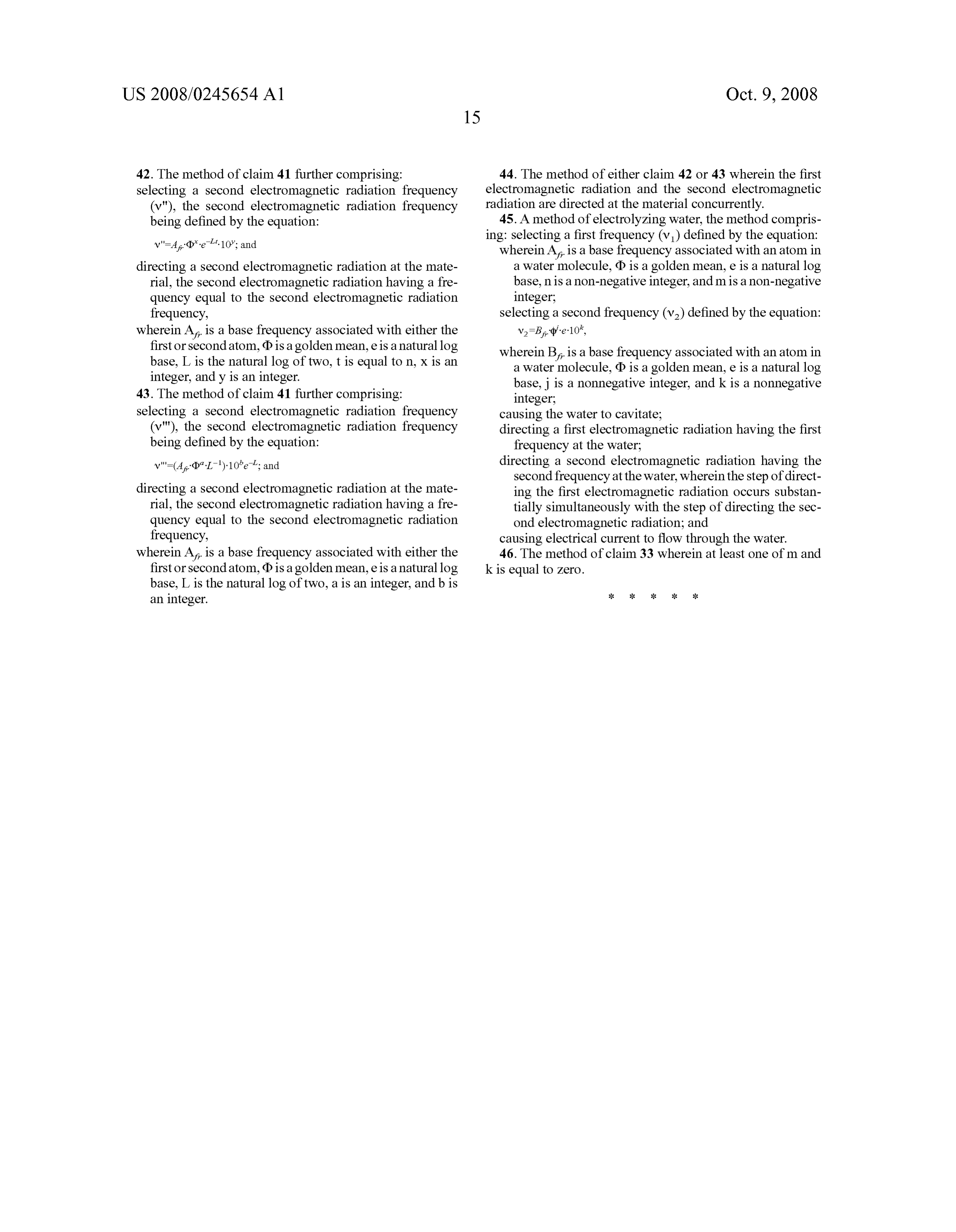
Provenance
- Collection
- Patents citing this work
- Original assignee
- Wizard Works LLC
- Pages
- 21
- Method
- pdftotext (the PDF's own text layer) + pdftoppm 300dpi page scans
- Patent office record
- patents.google.com →
- Source
- Google Patents citing-documents table
- Inventors
- Gregory C.D. YOUNG; Wizard Works LLC
- Published
- 2008-10-09
- Transcribed from
- patentimages.storage.googleapis.com →