patent · US4615984
Dissociation of ligand-binder complex using ultrasound
7 October 1986
Page 1 — bibliographic record
United States Patent (19) 11) Patent Number: 4,615,984 Stoker (45) Date of Patent: Oct. 7, 1986 (54) DISSOCIATION OF LIGAND-BINDER 3,492,212 l/1970 Searcy ............................ 435/173 X COMPLEX USING ULTRASOUND 3,550,586 12/1970 Balamuth. ... 435/173 X a- 3,825,481 7/1974 Supitilov. ... 422/128 X 75) Inventor: Ronald L. Stoker, Bountiful, Utah 4,059,685 l/1977 Johnson .............................. 436/533 A. a 4, 180,383 12/1979 Johnson ................................ 422/69 (73) Assignee: Becton Dickinson & Company, 4,26,828 4/1981 Brunner et al. ......... ... 20/287 Franklin Lakes, N.J. 4,389,253 6/1983 Nishimura et al. ..................... 134/1 21 Appl. No.: 582,949 FOREIGN PATENT DOCUMENTS 22 Filed: Feb. 23, 1984 1015962 l/1966 United Kingdom .................... 34A1 51 Int. Cl. ................. G01N 33/543; G01N 33/545; 1303823 1/1973 United Kingdom........... 204/157.62 B06B 1/00; C12N 13/00 Primary Examiner-Esther M. Kepplinger 52 U.S. C. ........................................ 436/518; 134/1; Assistant Examiner-Patricia Kate White 134/184; 204/157.42; 204/157.62; 422/69; Attorney, Agent, or Firm-Elliot M. Olstein
58 Field of Search ..................... 204/157.1 S, 158 S, A ligand is dissociated from a binder specific for the 204/157.42, 157.62; 436/536, 824, 518, 531; ligand by directing a beam of ultrasound at the complex 134/1, 184; 422/20, 128, 69, 71; 435/173; of ligand and binder. The procedure may be employed 260/112 R in a solid phase assay to separate a labeled form of li 56) References Cited gand, employed as a tracer, from a binder supported on a solid support.
3,003,707 10/1961 Lecher .......................... 204/157.1 S 14 Claims, 2 Drawing Figures
BNDER SOLID SUPPORT B N DER
CHAMBER 5 54 TRANSDUCER
FLTERS
C CONVERTER
Page 2
Drawing sheet — no readable text.
Page 3
power wattage may be turned up so dissociation occurs
DISSOCATION OF LIGAND-BINDER COMPLEX in a faster time period.
USING ULTRASOUND The size of the ultrasonic beam may be determined by using the correct converter and booster horn. In order
This invention relates to the dissociation of a complex 5 to convert electrical power to mechanical power, a of a ligand bound to a binder which is specific for the converter or transducer is used. This is typically a ligand. More particularly, this invention relates to an quartz or lead zirconate titanate. The waves generated assay procedure wherein the ligand is dissociated from by this transducer are modified by a converter and a complex of ligand bound to a binder which is specific booster horn to increase the amplitude. To avoid energy for the ligand. O losses, the converter is mounted at its nodal plane, In many cases, it is desirable to dissociate a ligand where there is a minimum amount of motion. As gener from a complex of a ligand bound to a binder which is ally known in the art, the power derived at the end of specific for the ligand. Thus, for example, in an assay for the horn can then be modified by changing diameter, an analyte wherein the binder used in the assay is to be length, etc. of the horn.
reused in the assay, it is necessary to dissociate the com 15 Although applicant does not intend to be limited by plex of ligand (labeled and/or unlabeled ligand) which any theoretical reasoning, it is believed that the beam of is bound to a binder used in the assay so as to permit ultrasound functions in one or more of the following reuse of the binder. In general, the binder is regenerated ways in accomplishing dissociation of the ligand-binder for reuse in the assay by contacting the binder sup complex:
ported on a solid support with a suitable elution liquid, 20 1. Compression and decompression of the waves such as aqueous methanol to elute the bound ligand vibrate the complex with enough energy to aid in the from the binder by dissociation of the ligand-binder dissociation.
complex. 2. Micro air bubbles which are present in the binder As another example, in some assays, the sample con are compressed at a high velocity which causes oscilla taining analyte is incubated with tracer and binder for 25 tion of such air bubbles, resulting in additional waves both the analyte and tracer to form a bound tracer frac being propagated in any liquid which is used in combi tion (tracer bound to binder), and a free tracer fraction. nation with the sound waves. In this respect, the micro Subsequently, the free tracer fraction is separated from air bubbles function as a secondary transducer. the sample by contacting the sample with a binder for 3. The movement of microbubbles in any liquid used the tracer supported on a solid support. The tracer 30 results in microstreaming, which results in more move bound to the supported binder is then dissociated from ment at the complex as well as providing liquid at the the binder so that it can be passed to a suitable detector complex liquid interface.
for determining the free tracer fraction. The supported 4. A high intensity application of ultrasound results in binder may or may not be reused in the assay. cavitation, which aids in dissociation of the complex. Although it is known in the art that a ligand may be 35 The cavitation can be controlled by adjusting the fre dissociated from its binder in both non-reusable assays, quency, amplitude, and power of the ultrasonic beam. and reusable assays, there is a need for further improve 5. A high intensity application of ultrasound produces ment in such a procedure; e.g., decrease of the time for heat. This heat could increase the kinetics of dissocia dissociation of ligand and binder and/or increase in the tion. If the heat was unnecessary or detrimental to the amount of ligand dissociated. 40 assay, it could be controlled by use of a water-cooled In accordance with one aspect of the present inven jacket.
tion, there is provided an improved process for dissoci The following gives some insight into the principles ating a complex of a ligand bound to a specific binder behind the use of ultrasound; however, the invention is for the ligand wherein a beam of ultrasound is directed not limited thereby.
at the complex to dissociate and separate the ligand 45 In a liquid media, an ultrasonic transducer releases a from the binder. The beam of ultrasound may be di rapid succession of shock waves. The acoustic energy is rected against the complex simultaneously with con transmitted through the liquid media by the back and tacting of the complex with a liquid. The liquid may or forth motion of molecules along the direction of wave may not be an eluting liquid which is known to aid in propagation. This motion produces alternate compres the dissociation of such complexes. 50 sions and rarefactions which in turn create cavitation. The beam of ultrasound which is directed at the com Cavitation is the formation of small oscillating cavities plex has a frequency of at least 20,000 cycles per second. throughout the liquid. The collapsing of the cavities In general, the frequency of the ultrasonic beam does produces shock waves which puts additional energy not exceed about 50,000 cycles per second. The inten against the ligand and binder. The cavitation puts en sity of the ultrasound beam may be varied depending 55 ergy into the system and makes dissociation of bound upon whether or not the binder portion of the complex ligand faster and more efficient.
is to be reused. Thus, if rapid separation of ligand from The present invention is particularly applicable to an the complex is desired, without the ability to reuse the assay wherein the complex of ligand and binder is binder, the intensity of the ultrasound can be increased formed as part of the assay procedure. Thus, for exam so as to achieve more rapid dissociation. In the case 60 ple, in such assay procedures, the binder may be an where the binder is to be reused, then the intensity of antibody, in which case the ligand which is bound to the the ultrasound is controlled so as to provide for dissoci antibody may be either an antigen, a hapten, or an anti ation of the complex without destruction of the binder. body which is specifically bound by the antibody which In addition to the control of frequency, if the binder is the binder. For example, if the ligand is an antibody, is to be reused, it may be necessary to control the power 65 then the binder may be an antibody produced in re output so as to prevent an excess build-up of heat. In sponse to the antibody which is the ligand. Similarly, general, the power output is from 100 to 400 watts. If the binder may be an antigen or hapten, in which case the solid binder does not have to be reused, then the the ligand is an antibody specific for such antigen or
Page 4
hapten. The binder may be a substance other than an In the hereinabove described various assay proce antibody, antigen or hapten, such as, for example, pro dures, the amount of tracer in the bound and/or free tein A which is known to selectively bind Fo fragments fraction is determined as a measure of ligand in the to antibodies, in which case, the ligand may be an anti sample (analyte) by use of a standard curve which is body. Similarly, the binder may be a naturally occur produced by running the assay on samples containing ring substance, in which case, the ligand would be an known amounts of analyte.
antigen or hapten which is specifically bound by such The supports employed for supporting the supported naturally occurring substance; for example, the binder binder employed in the assay may be any one of a wide could be intrinsic factor and the hapten could be Vita variety of supports of the type used in solid phase as min B12. 10 says. As known in the art, such supports include suitable The ligand which is bound to the binder, and which polymers, e.g., polystyrene; polypropylene, crosslinked is subsequently dissociated from the binder, may be a agarose, bacterial cells, ion exchange, resins, cotton as tracer, in which case the ligand is labeled with a detect described in U.S. Pat. No. 4,200,625; and supports of the able marker. In many cases, the ligand which is bound type described in U.S. Pat. No. 4,069,685, etc. Similarly, to the binder is comprised of both labeled ligand (tracer) 15 the binder may be supported on the support by any one and unlabeled ligand. of a wide variety of known procedures including ad In an assay procedure wherein the ligand is dissoci sorption, covalent coupling, etc.
ated from a complex of ligand and binder, the binder is The tracer which is employed in the assay is depen generally supported on a solid support, of a type em dent upon the analyte to be determined in the proce ployed in a solid phase assay. Thus, for example, in 20 dure. The tracer is comprised of a ligand labeled with a accordance with one assay procedure, in an assay for a suitable detectable marker, such as a radioactive iso ligand, which, for example, may be an antigen, a sample tope, a fluorescent compound, an enzyme, a chemilumi suspected of containing the ligand (analyte), and an nescent substance, etc. Tracers of the type generally appropriate tracer (the ligand or appropriate analog used in an assay are included as a ligand which may be thereof labeled with a suitable marker) are contacted 25 dissociated from a complex of ligand and binder. with a binder; in particular, an antibody supported on a In accordance with a preferred procedure, the sup solid suppport, and the ligand and tracer compete for a ported binder used in the assay is in a flowthrough limited number of binding sites on the supported anti chamber, whereby sample, liquid and other components body. The amount of tracer which is bound to the anti may be caused to flow over the binder through the body is inversely proportional to the amount of ligand 30 chamber.
in the sample. After separating the sample from the In accordance with a particularly preferred proce supported binder, the ligand (tracer and analyte) bound dure, the supported binder is reused in the assay and, to the antibody on the solid support is removed (dissoci accordingly, the liquid, as well as the intensity of the I ated) therefrom by contacting the supported antibody ultrasonic beam are selected in a manner such that the with a liquid, while focusing a beam of ultrasound 35 ligand is dissociated from the supported binder, without against the supported binder. Depending on the manner destroying the binding ability of the supported binder. in which the dissociation is accomplished, the binder The liquid which is preferably used in an assay in which may be reused in the assay. the binder is to be reused is preferably a liquid which In accordance with another type of assay procedure, aids in the dissociation of the complex without destroy the ligand to be assayed (analyte) and tracer (the ligand 40 ing the binder, often referred to as an eluting liquid or or appropriate analog thereof labeled with a suitable buffer.
marker) are incubated with a soluble binder for the As representative examples of suitable eluting liquids analyte and tracer and the incubated sample is con for use in dissociating a complex of a ligand bound to a tacted with a binder for the analyte and tracer sup binder, in the case where the binder is to be reused in ported on a solid support to bind any tracer or analyte 45 the assay, there may be mentioned eluting liquids of the which has not been previously bound by the soluble type described in U.S. Pat. No. 3,896,217. A particu binder. After separating the sample from the supported larly preferred eluting liquid is aqueous methanol. binder, the complex of ligand (analyte and tracer) As representative examples of another type of eluting bound to the binder on the solid support may be dissoci liquid, there may be mentioned a liquid which is at an ated by contacting the supported binder with a liquid 50 acidic pH, which is no greater than 3.0 and at which the while focusing a beam of ultrasound against the sup binding ability of binder is not destroyed; i.e., the elut ported binder. Depending on the manner in which the ing liquid is not made too acidic. In general, the eluting dissociation is accomplished, the binder may be reused liquid is at a pH of no less than 1.5, preferably no less in the assay. than a 2.0. In particular, such eluting liquid is water In accordance with further procedure, the sample 55 buffered to a pH as hereinabove described. containing a ligand (analyte), which is an antigen hav The acidic pH may be obtained by the use of any one ing multiple binding sites, is contacted with a tracer in of a wide variety of acidic buffers. As representative the form of a binder for the analyte which has been examples of suitable buffers, there may be mentioned: labeled with an appropriate marker. As a result of such citrates, acetates, glycinates, glutamates, oxalates, tar contact, the sample includes bound tracer (a complex of 60 trates, phosphates, hydrogen chloride, etc. or mixtures the labeled binder bound to the antigen) and free tracer thereof. The selection of a suitable buffer is deemed to (labeled binder which is not bound to the antigen). be within the scope of those skilled in the art from the The mixture is then contacted with a supported teachings herein.
binder, which supported binder is specific for the anti The buffer is employed in a concentration which gen, whereby the bound tracer (complex of the antigen 65 provides the desired eluting, without destroying the bound to the labeled binder) may be dissociated from binding ability of the binder. In some cases, the eluting the supported binder by use of a liquid and a beam of ability is enhanced by increasing the salt concentration ultrasound. (ionic strength) of the solution. Such increases in salt
Page 5
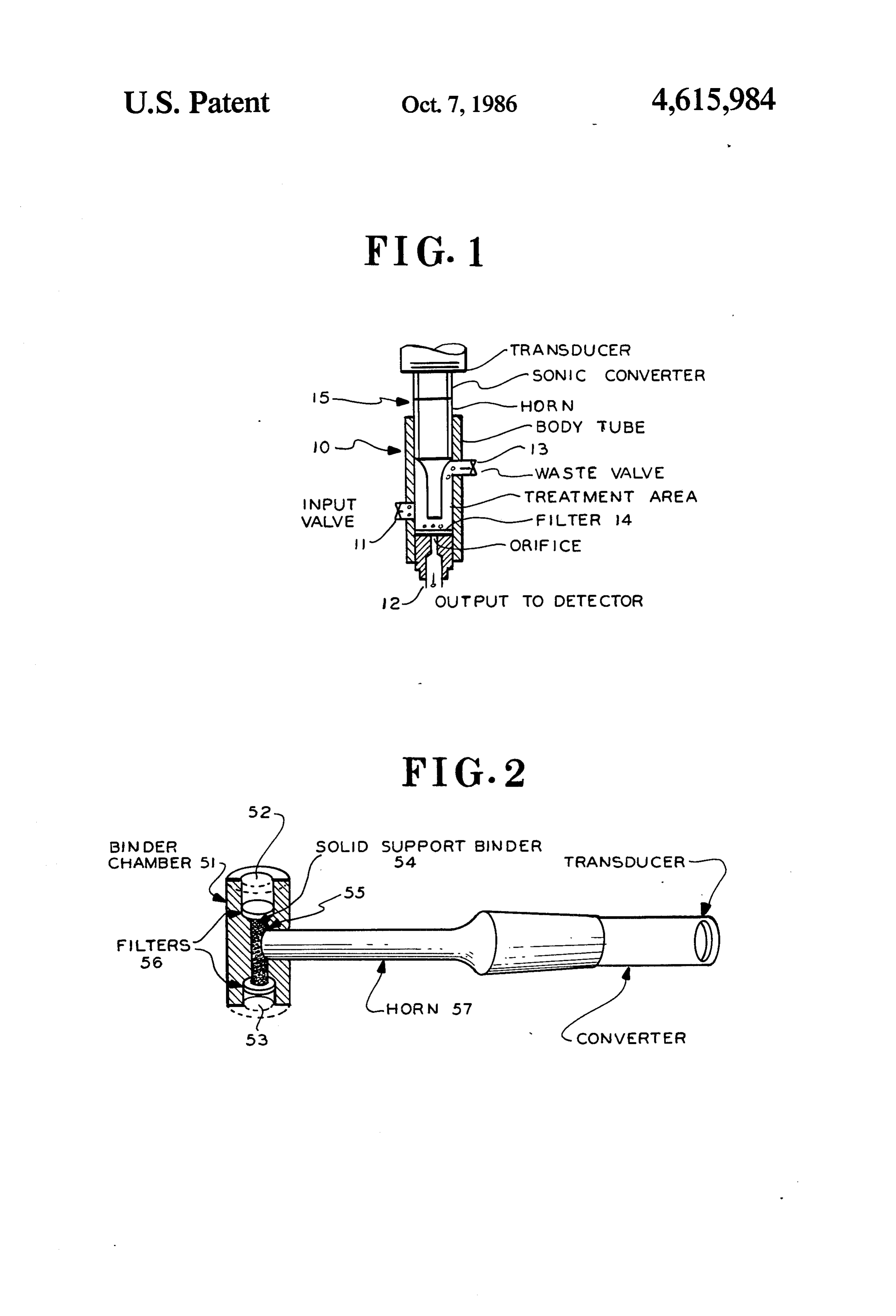
concentration may be effected by increasing the con introduced into the flowthrough cell 10 through line 11, centration of the buffer or by the addition of a water with the supported ligand-binder complex being re soluble salt which does not adversely affect the binder. tained on filter 14.
As representative examples of such salts, there may be In accordance with a preferred embodiment, the horn mentioned: water soluble salts of an alkali metal or 5 15 is turned on, while simultaneously introducing a ammonium, such as halides; sulfates, nitrates, phos suitable liquid; preferably, an eluting liquid, into the phates, carbonates, bicarbonates, etc.; or water soluble flowthrough cell 10 through line 11, vath the eluting transition metal salts, such as a nitrate, halide, etc. or the liquid, in combination with the sonic horn, dissociating like. As hereinabove noted, the total salt concentration, ligand from the binder, with the dissociated ligand in including buffer, is one which provides the desired O the eluting liquid being withdrawn from the cell 10 eluting without destroying the binder, and in general, through output 12 for passage to a suitable detector. In the salt concentration does not exceed 4M, and in most particular, at least a portion of the ligand in the ligand cases does not exceed 2M. In general, the salt concen binder complex is a tracer so that the dissociated ligand tration is at least 0.01M, when such salt is employed. which is passed to the detector may be determined in The procedure of the present invention, in the case 15 the detector.
where the supported binder of the binder/ligand com Subsequent to the dissociation, outlet 12 is closed, plex is not to be reused, may be easily accomplished by outlet 13 is opened, and a liquid is introduced into the continuous flow cell equipped with an ultrasonic horn cell 10 through line 11 for removing the supported (comprised of transducer, sonic converter and horn), as available from Heat System Ultrasonics, Plainview, 20 binder through outlet 13.
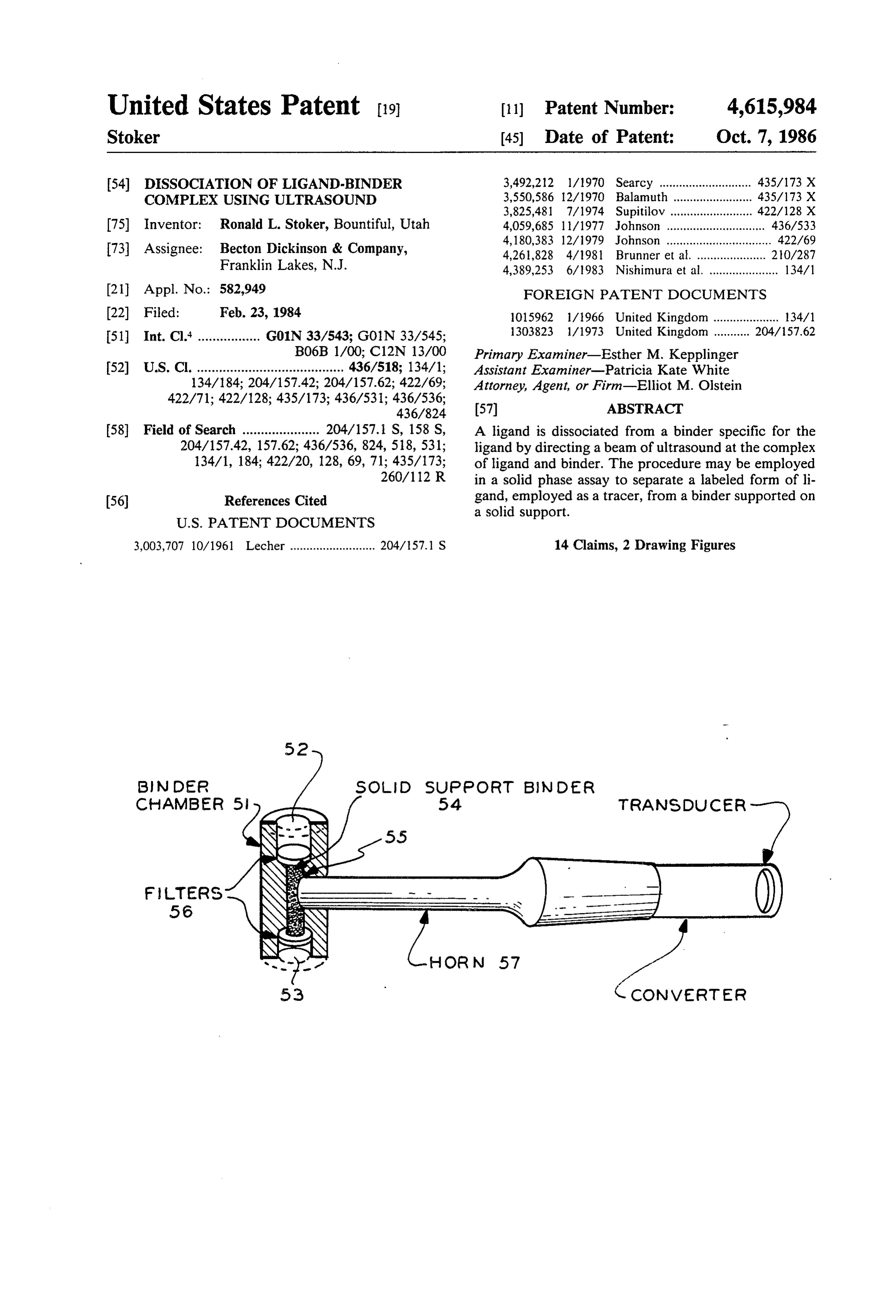
Referring to FIG. 2 of the drawings, there is shown
For example, in such an operation, complex of ligand another embodiment, wherein there is shown a flow bound to a binder on a solid support; for example, solid through chamber 51 having an inlet 52 and an outlet 53. The flowthrough chamber 51 is further provided beads, is introduced into the flow cell equipped with with suitable valving, lines and, for example, a filter or other 25 cally agenerally binder supported on a solid support, schemati designated as 54, which is retained in a means for retaining the complex in the cell. The trans ducer is turned on to dissociate ligand from supported passage 55 connecting the inlet 52 with the outlet 53 by binder (the ligand may be comprised of analyte and suitable retaining means in the form of filters 56. The flowthrough chamber 51 is further provided tracer), and the separated ligand is then passed to a with a sonic horn, generally designated as 57, of a type suitable detection system for the tracer. The supported 30 binder is then removed from the cell and passed two manner insuch known the art, with the horn 57 being situated in a that the sonic waves generated by the horn ways.
The procedure of the present invention may also be areIndirected against the supported binder 54. operation, sample containing tracer is passed easily accomplished in a flowthrough chamber of the through type described in U.S. Pat. No. 4,059,685, which is tracer ischamber
introduced through inlet 52 for passage modified to include an ultrasonic horn (comprised of transducer, sonic converter and horn), which is avail through the supported binder 54 in passage 55, with the able from Heat System Ultrasonics. sample being withdrawn through outlet 53. The tracer The invention will be further described with respect becomes bound to the supported binder 54 to produce a to embodiments thereof illustrated in the accompanying 40 complex of tracer bound to the supported binder. drawings, wherein: Subsequently, the sonic horn 57 is turned on, and a FIG. 1 is a simplified view of one embodiment of suitable eluting liquid is passed over the supported apparatus of the present invention; and binder 54. The combination of eluting liquid and sonic FIG. 2 is a simplified view of another embodiment of waves dissociate the tracer from the binder, with the apparatus of the present invention. 45 tracer being withdrawn from the chamber 51 through It is to be understood, however, that the scope of the outlet 53. As known in the art, such tracer may be invention is not to be limited to the accompanying passed to a suitable detector.
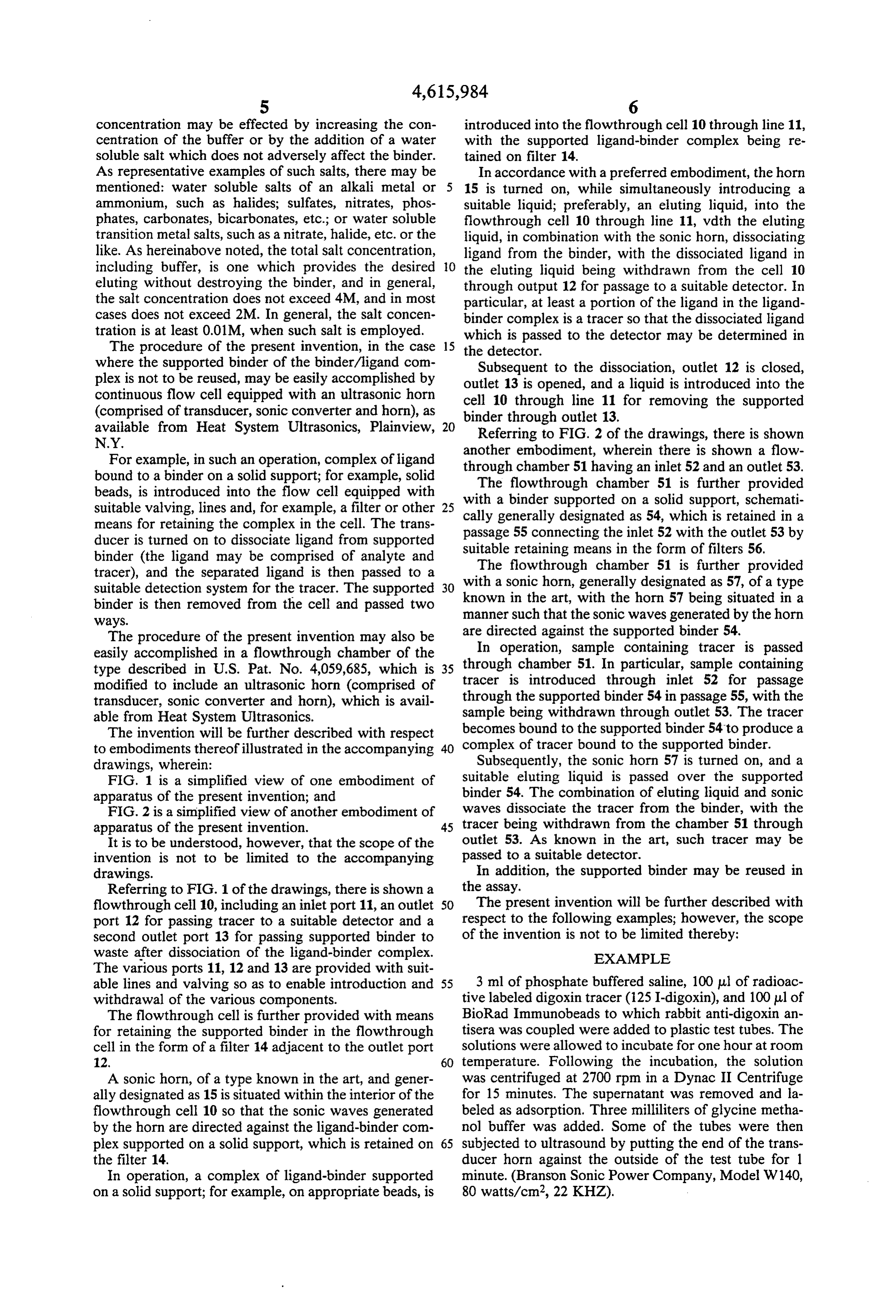
drawings. In addition, the supported binder may be reused in Referring to FIG. 1 of the drawings, there is shown a the assay, flowthrough cell 10, including an inlet port 11, an outlet SO The present invention will be further described with port 12 for passing tracer to a suitable detector and a respect to the following examples; however, the scope second outlet port 13 for passing supported binder to of the invention is not to be limited thereby: waste after dissociation of the ligand-binder complex. EXAMPLE The various ports 11, 12 and 13 are provided with suit able lines and valving so as to enable introduction and 55 3 ml of phosphate buffered saline, 100 pull of radioac withdrawal of the various components. tive labeled digoxin tracer (125I-digoxin), and 100 ul of The flowthrough cell is further provided with means Biorad Immunobeads to which rabbit anti-digoxin an for retaining the supported binder in the flowthrough tisera was coupled were added to plastic test tubes. The cell in the form of a filter 14 adjacent to the outlet port solutions were allowed to incubate for one hour at room 12. 60 temperature. Following the incubation, the solution A sonic horn, of a type known in the art, and gener was centrifuged at 2700 rpm in a Dynac II Centrifuge ally designated as 15 is situated within the interior of the for 15 minutes. The supernatant was removed and la flowthrough cell 10 so that the sonic waves generated beled as adsorption. Three milliliters of glycine metha by the horn are directed against the ligand-binder com nol buffer was added. Some of the tubes were then plex supported on a solid support, which is retained on 65 subjected to ultrasound by putting the end of the trans the filter 14. ducer horn against the outside of the test tube for 1 In operation, a complex of ligand-binder supported minute. (Branson Sonic Power Company, Model W140, on a solid support; for example, on appropriate beads, is 80 watts/cm2, 22 KHZ).
Page 6
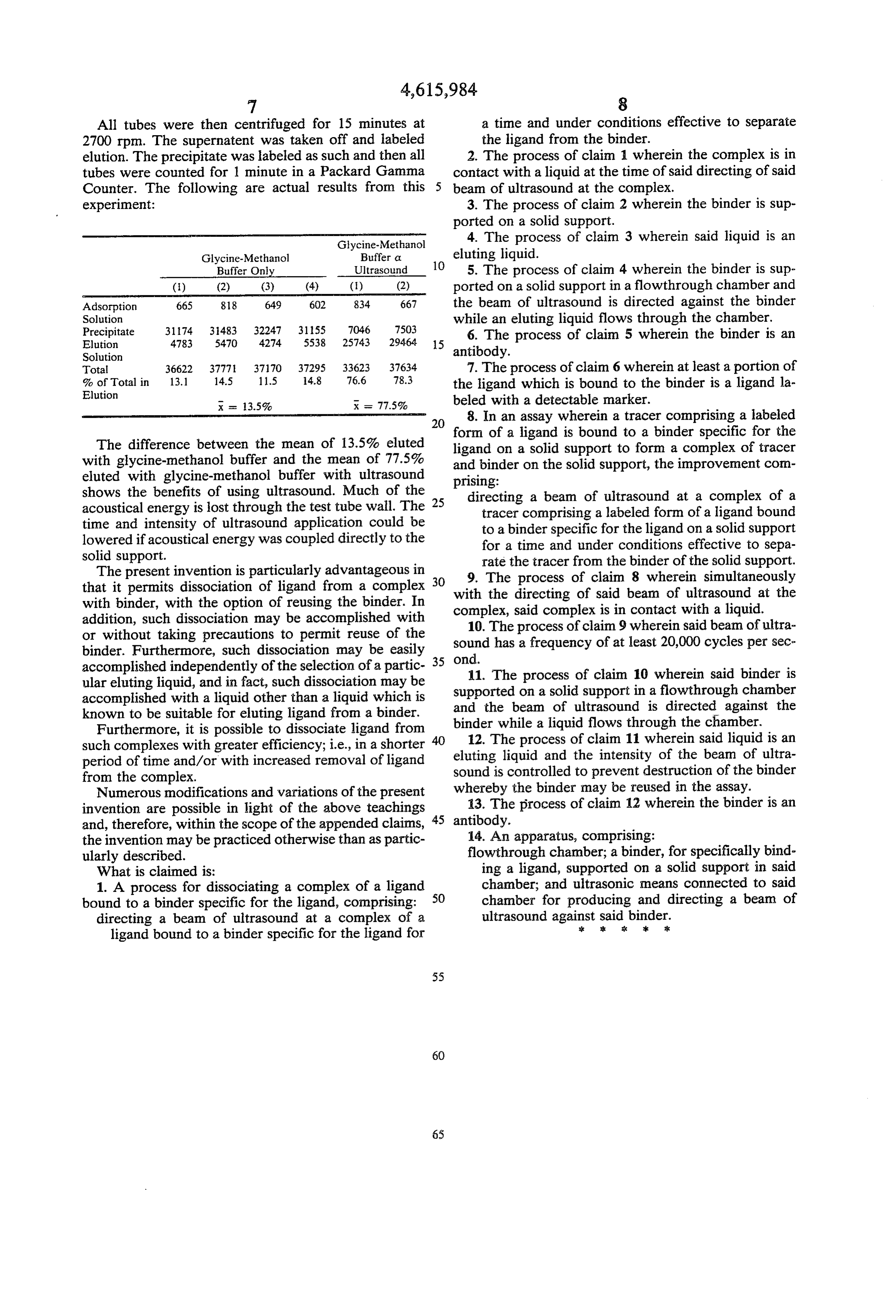
All tubes were then centrifuged for 15 minutes at a time and under conditions effective to separate 2700 rpm. The supernatent was taken off and labeled the ligand from the binder. elution. The precipitate was labeled as such and then all 2. The process of claim 1 wherein the complex is in tubes were counted for 1 minute in a Packard Gamma contact with a liquid at the time of said directing of said Counter. The following are actual results from this 5 beam of ultrasound at the complex.
experiment: 3. The process of claim 2 wherein the binder is sup ported on a solid support.
Glycine-Methanol 4. The process of claim 3 wherein said liquid is an
Glycine-Methanol Buffer a eluting liquid.
Buffer Only Ultrasound 10 5. The process of claim 4 wherein the binder is sup (i) (2) (3) (4) (1) (2) ported on a solid support in a flowthrough chamber and Adsorption 665 818 649 602 834 667 the beam of ultrasound is directed against the binder Solution while an eluting liquid flows through the chamber. Precipitate 3174 3483 32247 31155 7046 7503 6. The process of claim 5 wherein the binder is an
Elution 4783 5470 42.74 5.538 257.43 29464 15
Solution antibody.
Total 36622 3777 3770 37295 33623 37634
7. The process of claim 6 wherein at least a portion of % of Total in 13.1 14.5 115 14.8 76.6 the ligand which is bound to the binder is a ligand la Elution beled with a detectable marker.
8. In an assay wherein a tracer comprising a labeled
The difference between the mean of 13.5% eluted form of a ligand is bound to a binder specific for the ligand on a solid support to form a complex of tracer with glycine-methanol buffer and the mean of 77.5% and binder on the solid support, the improvement con eluted with glycine-methanol buffer with ultrasound prising:
shows the benefits of using ultrasound. Much of the directing a beam of ultrasound at a complex of a acoustical energy is lost through the test tube wall. The 25 tracer comprising a labeled form of a ligand bound time and intensity of ultrasound application could be to a binder specific for the ligand on a solid support lowered if acoustical energy was coupled directly to the for a time and under conditions effective to sepa solid support.
The present invention is particularly advantageous in 30 9. Thethe rate tracer from the binder of the solid support.
that it permits dissociation of ligand from a complex with the directing ofofclaim process 8 wherein simultaneously with binder, with the option of reusing the binder. In complex, said complex is in contactofwith said beam ultrasound at the a liquid.
addition, such dissociation may be accomplished with or without taking precautions to permit reuse of the sound has a frequency of at least 20,000 cycles of 10. The process of claim 9 wherein said beam per ultra sec binder. Furthermore, such dissociation may be easily 35 ond.
accomplished independently of the selection of a partic 11. The process of claim 10 wherein said binder is ular eluting liquid, and in fact, such dissociation may be accomplished with a liquid other than a liquid which is supported on a solid support in a flowthrough chamber and the beam of ultrasound is directed against the known to be suitable for eluting ligand from a binder.
Furthermore, it is possible to dissociate ligand from binder while a liquid flows through the chamber. 12. The process of claim 11 wherein said liquid is an such complexes with greater efficiency; i.e., in a shorter period of time and/or with increased removal of ligand eluting liquid and the intensity of the beam of ultra from the complex. sound is controlled to prevent destruction of the binder Numerous modifications and variations of the present whereby the binder may be reused in the assay. 13. The process of claim 12 wherein the binder is an invention are possible in light of the above teachings 45 antibody.
and, therefore, within the scope of the appended claims, 14. An apparatus, comprising: the invention may be practiced otherwise than as partic ularly described. flowthrough chamber; a binder, for specifically bind What is claimed is: ing a ligand, supported on a solid support in said 1. A process for dissociating a complex of a ligand chamber; and ultrasonic means connected to said bound to a binder specific for the ligand, comprising: 50 chamber for producing and directing a beam of directing a beam of ultrasound at a complex of a ultrasound against
said
binder.
ligand bound to a binder specific for the ligand for
Provenance
- Collection
- Cited prior art
- Original PDF
- patentimages.storage.googleapis.com →
- Filed
- 1984-02-23
- Pages
- 6
- Method
- pdftotext (the PDF's own text layer) + pdftoppm 300dpi page scans
- Source
- Google Patents bibliographic record
- Granted
- 1986-10-07
- Inventors
- Ronald L. Stoker; Becton Dickinson and Co
- Transcribed from
- patentimages.storage.googleapis.com →