patent · US4879011
Process for controlling a reaction by ultrasonic standing wave
7 November 1989
Page 1 — bibliographic record
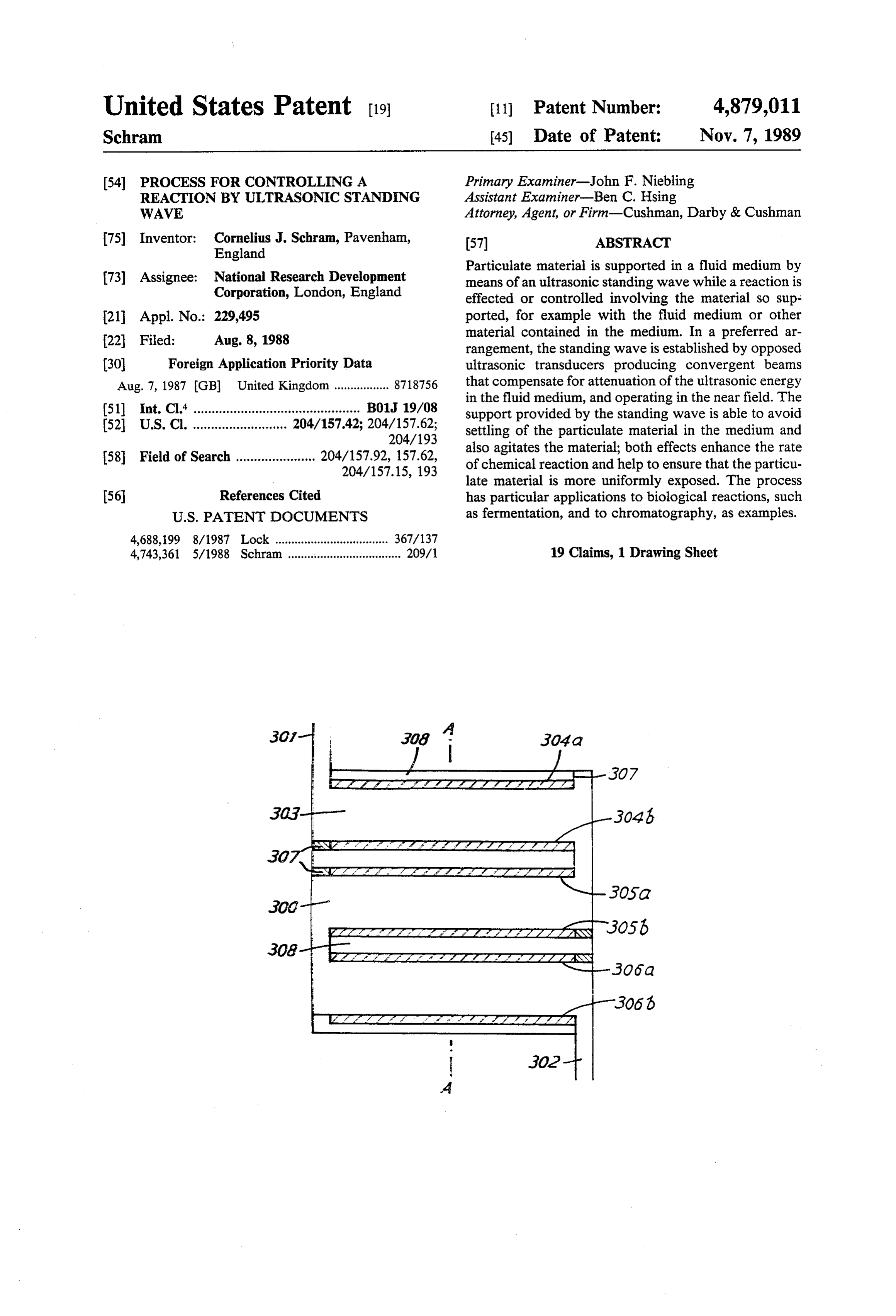
United States Patent (19) 11 Patent Number: 4,879,011 Schram (45) Date of Patent: Nov. 7, 1989 54 PROCESS FOR CONTROLLING A Primary Examiner-John F. Niebling REACTION BY UTRASONC STANDING Assistant Examiner-Ben C. Hsing
WAVE Attorney, Agent, or Firm-Cushman, Darby & Cushman 75) Inventor: Cornelius J. Schram, Pavenham, 57 ABSTRACT England
Particulate material is supported in a fluid medium by 73) Assignee: National Research Development means of an ultrasonic standing wave while a reaction is Corporation, London, England effected or controlled involving the material so sup 21 Appl. No.: 229,495 ported, for example with the fluid medium or other 22 Filed: Aug. 8, 1988 material contained in the medium. In a preferred ar rangement, the standing wave is established by opposed 30 Foreign Application Priority Data ultrasonic transducers producing convergent beams Aug. 7, 1987 GB) United Kingdom ................. 8718756 that compensate for attenuation of the ultrasonic energy in the fluid medium, and operating in the near field. The 51) int. Cl." .............................................. B01J 19/08 support provided by the standing wave is able to avoid 52 U.S. Cl. .......................... 204/157.42; 204/157.62; settling of the particulate material in the medium and 204/193 also agitates the material; both effects enhance the rate 58 Field of Search ...................... 204/157.92, 157.62, of chemical reaction and help to ensure that the particu 204/157.15, 193 late material is more uniformly exposed. The process 56 References Cited has particular applications to biological reactions, such
4,688,199 8/1987 Lock ................................... 367/137 4,743,361 5/1988 Schram ................................... 209/1 19 Claims, 1 Drawing Sheet
Page 2
Drawing sheet — no readable text.
Page 3
rial can considerably facilitate chemical reactions asso
PROCESS FOR CONTROLLING AREACTION BY ciated with the contact therebetween. The fluid motion ULTRASONIC STANDING WAVE may involve recirculation or replenishment. A continu ous supply of "fresh' or unreacted material can be pres
BACKGROUND OF THE INVENTION 5 ented to the particulate material and reaction products The present invention relates to a method of and can be flushed away from the concentration of particu late material with the movement of the fluid.
means for enabling or controlling a reaction between particulate material and a reactant in a fluid medium in In the following discussion of the action of a standing which said material is immersed. The reactions with wave upon suspended particles, those stations along the which the invention may be concerned include chemi 10 axis of propagation of the acoustic energy which the cal and biological processes and more generally may be adjacent net acoustic forces act towards are termed any kind of process which relies on intimate mixing of nodes and those which said acoustic forces act away two or more agents, one or both of which may be in from are termed antinodes, and it is indicated that the particulate form, to effect some action between the 15 particles influenced by a standing wave will tend to agents. accumulate at the nodes of the wave. It must be said, When a material in particulate form is put in contact however, that the detailed theory underlying the ob with another substance to undergo a chemical reaction, served phenomenon of standing waves and their effect the efficiency of the reaction may be limited by the of particles in fact is not fully understood, but any lack difficulty of ensuring that the particles are fully exposed of theoretical understanding has no bearing on the prac to the reactant. Particularly if the product of the reac 20 tical application of the invention. In particular, unless tion is itself a solid, without special measures to prevent stated otherwise, the term "nodes' as used herein may it acting as a barrier it may be possible to expose and thus be considered to include both nodes and antinodes, react only a small proportion of the particulate material. because in practice it does not appear to matter to the Mechanical stirring and agitating procedures are used results that can be achieved.
to promote mixing, of course, and in recent years flui 25 The acoustic forces acting on a particle that is small dised beds have been used to generate more intense compared to the wavelength of a standing wave tend to reaction processes, but these known methods have a urge the particle to the nearest node. If there is an axial number of disadvantages and limitations. For example, opposing force less than the maximum acoustic force, although an object may be to obtain relative displace eg, from the movement of a liquid relative to the stand ment between the particulate material and the fluid, if 30 agitation of the particles is applied through the fluid the ing wave, the equilibrium position of the particle is displaced somewhat, although it still remains attached efficiency of mixing is limited, especially with mechani to the force field of the node. If the opposing force cal mixing methods. To the extent that gravitational exceeds the maximum acoustic force, the particle is forces play any part, these are relatively weak and can swept through the standing wave. Different particles not be controlled; indeed their effects are dependent on 35 may have different responses, the densities of the materials being processed. In the forces and the opposing forces, andboth to the acoustic so can be induced to case of fluidised beds, moreover a minimum bed thick move differentially in the standing wave. For the op ness is needed which can lead to clumping of the partic posing force, any form of non-acoustic force can be ulate matter even though a better mixing can be ob used. For example, the effect of the standing wave can tained than by mechanical methods. be opposed by gravity or an enhanced gravitational SUMMARY OF THE INVENTION field, or other field forces such as electrostatic or elec According to the present invention, there is provided tromagnetic forces may be appropriate. In the case of a process for controlling a reaction involving particu gravity, separation is not dependent on size but on other late material immersed in a fluid medium, characterised 45 acoustic properties of the particles. in that an ultrasonic standing wave is established within If a standing wave pattern is produced by overlap the medium to retain said particulate material sus ping progressive waves from two sources differing pended in the medium and there is relative displacement slightly in frequency, the standing wave will move between said material and the fluid medium, whereby to towards the source emitting the lower frequency. Possi effect or control the reaction. 50 bilities exist therefore both for holding particles fixed in The invention can be applied to achieving many dif space while they are suspended in a liquid, and also for ferent types of reaction. Thus, reactions may be per moving them at a controlled rate, whether or not the formed that rely on the presence of an external energy liquid is itself moving. Reference may be made to U.S. field with the fluid medium, which may itself act simply Pat. No. 4,688,199 for an example of a means of achiev as an inert carrier; one example of this is the polymerisa 55 ing such controlled movement. tion of monomer droplets held stationary by the stand Using an axial opposing force such as the viscous ing wave in a moving fluid stream to be exposed to drag of a liquid, it is possible to operate in a condition in ultra-violet light, the characteristics of the standing which the position of the standing wave is fixed (ie., the wave being so chosen that its influence on the larger array of nodes forming the standing wave is at least polymerised molecules is weakened, allowing them to 60 substantially motionless relative to the sources generat be swept away with the moving fluid for collection. ing the standing wave) and the liquid flows axially to A particularly important group of processes with the standing wave. In this condition the nodes of the which the present invention is concerned involves reac standing wave can be likened to a series of filters or tions between the particulate material and the fluid grids holding the particulate material in a substantially medium itself or other material contained in the me 65 constant position while the liquid passes this material dium. By retaining the particulate matter at the nodes of with any other particles that are less strongly influenced a standing wave established within a zone in the reac by the acoustic forces. Alternatively, with the liquid tion vessel, motion of the fluid past the particulate mate stationary and the standing wave caused to move along
Page 4
its own axis, the nodes of the standing wave can be sions and finely-divided precipitates, as well as dusts, likened to a comb that is passed through the liquid car and even liquid droplets. More generally, the invention rying with it the particulate material. It will be under may be applicable to a wide variety of chemical pro stood that by combination of the movements of both the cesses in which fluid media are in contact with particu liquid and the standing wave, whether in the same sense late matter. For example, the particulate material re or in countercurrent to each other, as well as by con tained in the standing wave can be a catalyst influencing trolling the standing wave intensity and/or frequency, it a chemical reaction involving one or more other reac is readily possible to achieve an extremely wide degree tants. Such processes include enzymatic reactions in of control. which the particulate material comprises one or more Although the particulate matter will be held in con 10 functional enzymes bound to particulate carrier mate centrations at the nodes of a standing wave, the nature rial. Enzymes can also be located at the liquid/gas inter of this restraint need not significantly impede axial flow face of bubbles.
of the fluid medium through this zone. Particles re In the performance of the invention, selection of the tained at the nodes are not held rigidly in a fixed posi frequency and intensity of the standing wave will influ tion, but exhibit a rapid random motion of very small 15 ence the character of particulate matter that is retained amplitude. This enables fluid media to flow through at the nodes and may be used to differentiate between densely concentrated particulate matter in a manner particle types to segregate those types that are not re which permits a more rapid diffusion, eg., of reagents or quired in the specific reaction. Such differentiation may products, to and from that matter. be dependent on properties such as shape, density or The present invention also comprises arrangements in 20 size. For example, if the invention is used to retain prop which there is at least a component of fluid flow normal agating plant cells during the liquid suspension culture to the axis of the standing wave, in an extreme case the of such cells as part of a "cloning' process, as the plant fluid flow being substantially at right-angles to the cells cluster or exhibit cellular differentiation they can standing wave axis. The acoustic energy density in a acquire substantially altered acoustic properties and can nodal plane will generally not be uniform, and a particle 25 conveniently be swept away from the residual plant influenced by the standing wave will move parallel to cells in the fermentation vessel for collection and fur that plane in the direction of increasing energy density. ther handling. Another example lies in chromato The axial acoustic forces on particles in a standing wave graphic techniques involving the binding of material, which move them towards the nodes are normally very dissolved or dispersed in the fluid medium, onto a par much greater than the acoustic forces parallel to the 30 ticulate carrier held by the standing wave. When the nodes of the standing wave, particularly at higher ultra carrier material has become loaded with bound mate sonic frequencies and particularly also when operating rial, its acoustic properties alter and the conditions of in the far field of the radiation. Particles can thus be the standing wave may be set so that it is no longer held displaced parallel to the nodal planes by a much smaller but can be swept away, eg., by the fluid flow, for collec non-acoustic force than is needed to displace them axi 35 tion and elution elsewhere to recover the bound mate ally of the standing wave. Processes according to the rial. If desired, a chromatographic technique of this invention may accordingly rely on relative movement type can be used in a "downstream' operation to re parallel to a standing wave axis or parallel to its nodal cover dissolved/dispersed products of a process which planes, or at angles oblique thereto. involves particulate matter held at the nodes of a stand 40 ing wave.
BRIEF DESCRIPTION OF THE DRAWINGS
Another useful application of the invention is in es
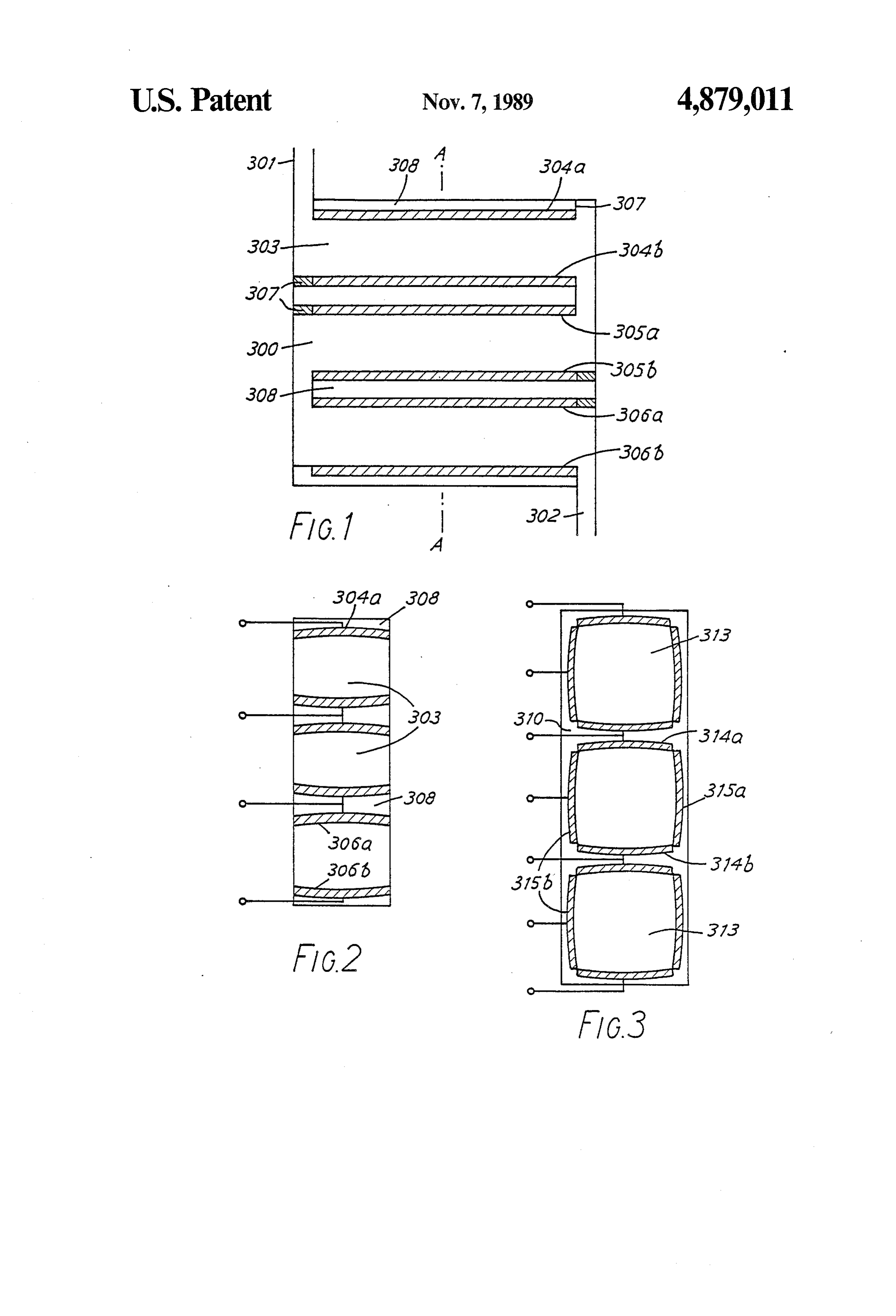
FIG. 1 is a longitudinal sectional view of one form of sentially biological "fermentation' processes. In these apparatus for performing the method according to the processes particulate matter, eg., bacteria, yeasts, plant invention, cells or animal cells, is cultivated in a fermentation FIG. 2 is a transverse sectional view on the plane 45 vessel through which appropriate liquid media are cir A-A in FIG. 1, and culated. Very favourable propagation conditions can be FIG. 3 is a similar transverse sectional view illustrat established if the cellular material is retained at the ing a modification of the apparatus of FIGS. 1 and 2. nodes of the standing wave within the fermentation PREFERRED EMBODIMENTS OF THE vessel. Fresh reactant material can be presented readily 50 to the cellular matter and spent material flushed away
INVENTION from the zone in which the cellular matter is retained. A A process in accordance with the invention may be uniform presentation of reactants can be made to the applied to a very wide size range of particles, the upper bulk of the cellular material, whereas in traditional fer size limit being determined primarily by the internodal mentation vessels this may be more difficult. If the cel distance in the standing wave because the acoustic 55 lular matter is randomly distributed throughout the forces on a particle will essentially cease to be effective fermentation vessel and relies on stirring to effect an when it is so large that is spans the distance between a even distribution of fresh reactant to the cellular matter, node and the adjacent antinode. Among examples of such distribution is bound to be uneven in practice and suitable biological particles there can be considered undesirable local concentrations can occur. In a fermen animal cells, for instance mammalian cells, plant cells, 60 tation process in accordance with the present invention, micro-organisms and the spores of micro-organisms. fresh reactant can be presented to the cellular matter in Cell constituents such as nuclei, mitochondria and mi an appropriate distribution leading to optimum propa crosomes as well as plankton, yeasts, pollen, protozoa, gation conditions.
richetsia and viruses, are further examples of biological The invention particularly facilitates the separation of particles applicable to the processes of the present in 65 desirable and/or undesirable products from the fermen vention. Outside the field of biological particles, the tation system. For example, soluble by-products of the invention can be employed for the processing of many fermentation reaction can be flushed away readily from industrial particulates, including dispersions, suspen the cellular matter. In a traditional fermentation process
Page 5
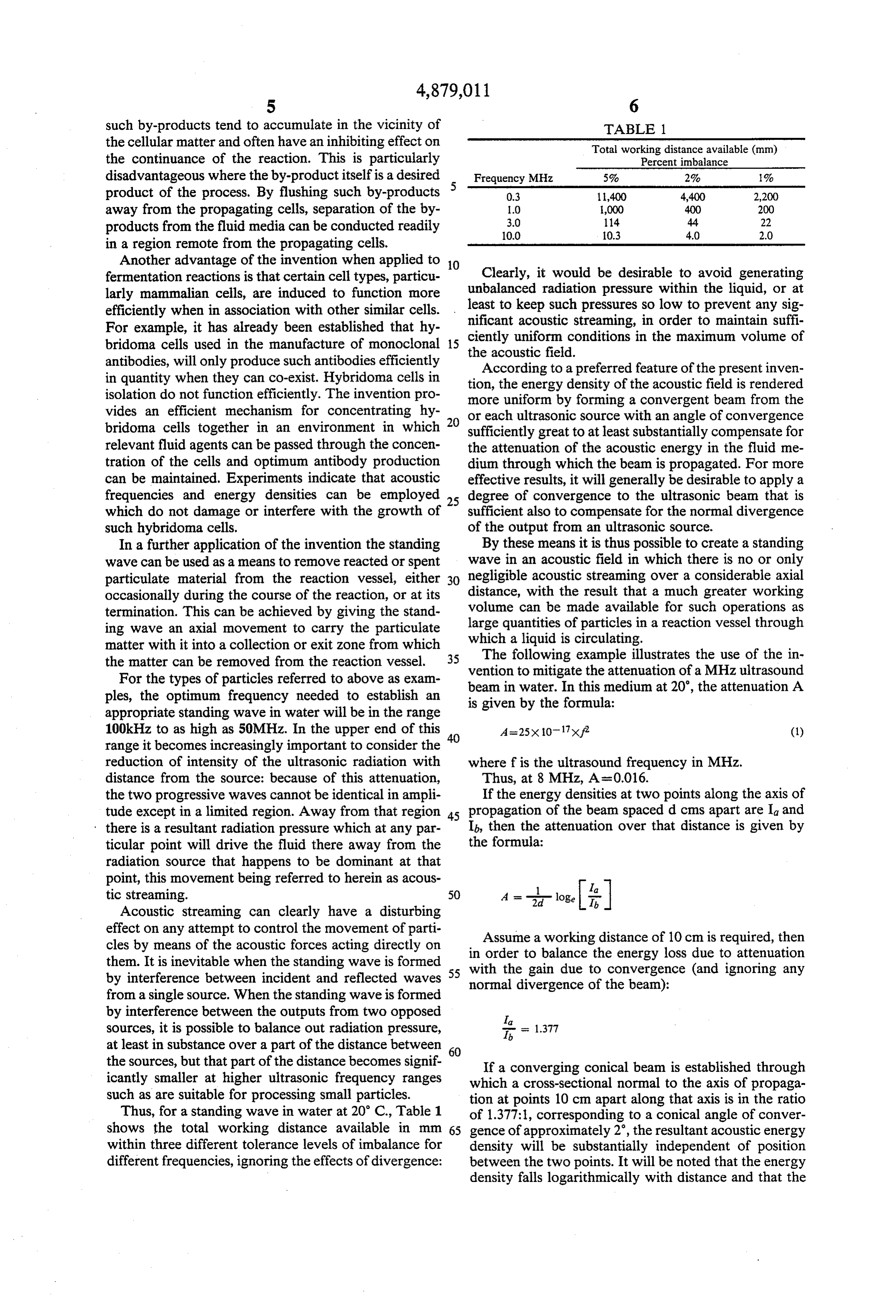
such by-products tend to accumulate in the vicinity of TABLE 1 the cellular matter and often have an inhibiting effect on Total working distance available (mm) the continuance of the reaction. This is particularly Percent imbalance disadvantageous where the by-product itself is a desired Frequency MHz 5% 2% % product of the process. By flushing such by-products 0.3 1,400 4,400 2,200 away from the propagating cells, separation of the by O 1,000 400 200
products from the fluid media can be conducted readily 10.0 0.3 4.0 2.0 in a region remote from the propagating cells.
Another advantage of the invention when applied to 10 fermentation reactions is that certain cell types, particu Clearly, it would be desirable to avoid generating larly mammalian cells, are induced to function more least unbalanced radiation pressure within the liquid, or at to keep such pressures so low to prevent any sig efficiently when in association with other similar cells. nificant
For example, it has already been established that hy ciently uniformacoustic streaming, in order to maintain suffi bridoma cells used in the manufacture of monoclonal 15 the acoustic field.conditions in the maximum volume of antibodies, will only produce such antibodies efficiently According to a preferred feature of the present inven in quantity when they can co-exist. Hybridoma cells in tion, isolation do not function efficiently. The invention pro morethe energy density of the acoustic field is rendered uniform by forming a convergent beam from the vides an efficient mechanism for concentrating hy or each ultrasonic source with an angle of convergence bridoma cells together in an environment in which sufficiently great to at least substantially compensate for relevant fluid agents can be passed through the concen the attenuation of the acoustic energy in the fluid me tration of the cells and optimum antibody production dium through which the beam is propagated. For more can be maintained. Experiments indicate that acoustic effective results, it will generally be desirable to apply a frequencies and energy densities can be employed 25 degree of convergence to the ultrasonic beam that is which do not damage or interfere with the growth of sufficient also to compensate for the normal divergence such hybridoma cells. of the output from an ultrasonic source. In a further application of the invention the standing By these means it is thus possible to create a standing wave can be used as a means to remove reacted or spent wave in an acoustic field in which there is no or only particulate material from the reaction vessel, either 30 negligible acoustic streaming over a considerable axial occasionally during the course of the reaction, or at its distance, with the result that a much greater working termination. This can be achieved by giving the stand volume can be made available for such operations as ing wave an axial movement to carry the particulate which large quantities of particles in a reaction vessel through matter with it into a collection or exit zone from which a liquid is circulating.
the matter can be removed from the reaction vessel. 35 The following example illustrates the use of the in For the types of particles referred to above as exam vention to mitigate the attenuation of a MHz ultrasound ples, the optimum frequency needed to establish an beam in water. In this medium at 20, the attenuation A appropriate standing wave in water will be in the range is given by the formula:
100kHz to as high as 50MHz. In the upper end of this A=25x10-17xf2 (1) range it becomes increasingly important to consider the reduction of intensity of the ultrasonic radiation with where f is the ultrasound frequency in MHz. distance from the source: because of this attenuation, Thus, at 8 MHz, A=0.016.
the two progressive waves cannot be identical in ampli If the energy densities at two points along the axis of tude except in a limited region. Away from that region 45 propagation of the beam spaced d cms apart are Ia and there is a resultant radiation pressure which at any par Ib, then the attenuation over that distance is given by ticular point will drive the fluid there away from the the formula:
radiation source that happens to be dominant at that point, this movement being referred to herein as acous la tic streaming. 50 A = 2d - loge ;
Acoustic streaming can clearly have a disturbing effect on any attempt to control the movement of parti cles by means of the acoustic forces acting directly on in Assumeorder to a working distance of 10 cm is required, then balance the energy loss due to attenuation them. It is inevitable when the standing wave is formed 55 with the gain due to convergence (and ignoring any by interference between incident and reflected waves normal divergence of the beam):
from a single source. When the standing wave is formed by interference between the outputs from two opposed Ia sources, it is possible to balance out radiation pressure, f = 1.37 at least in substance over a part of the distance between 60 the sources, but that part of the distance becomes signif If a converging conical beam is established through icantly smaller at higher ultrasonic frequency ranges which a cross-sectional normal to the axis of propaga such as are suitable for processing small particles. tion at points 10 cm apart along that axis is in the ratio Thus, for a standing wave in water at 20 C., Table 1 of 1.377:1, corresponding to a conical angle of conver shows the total working distance available in mm 65 gence of approximately 2, the resultant acoustic energy within three different tolerance levels of imbalance for density will be substantially independent of position different frequencies, ignoring the effects of divergence: between the two points. It will be noted that the energy density falls logarithmically with distance and that the
Page 6
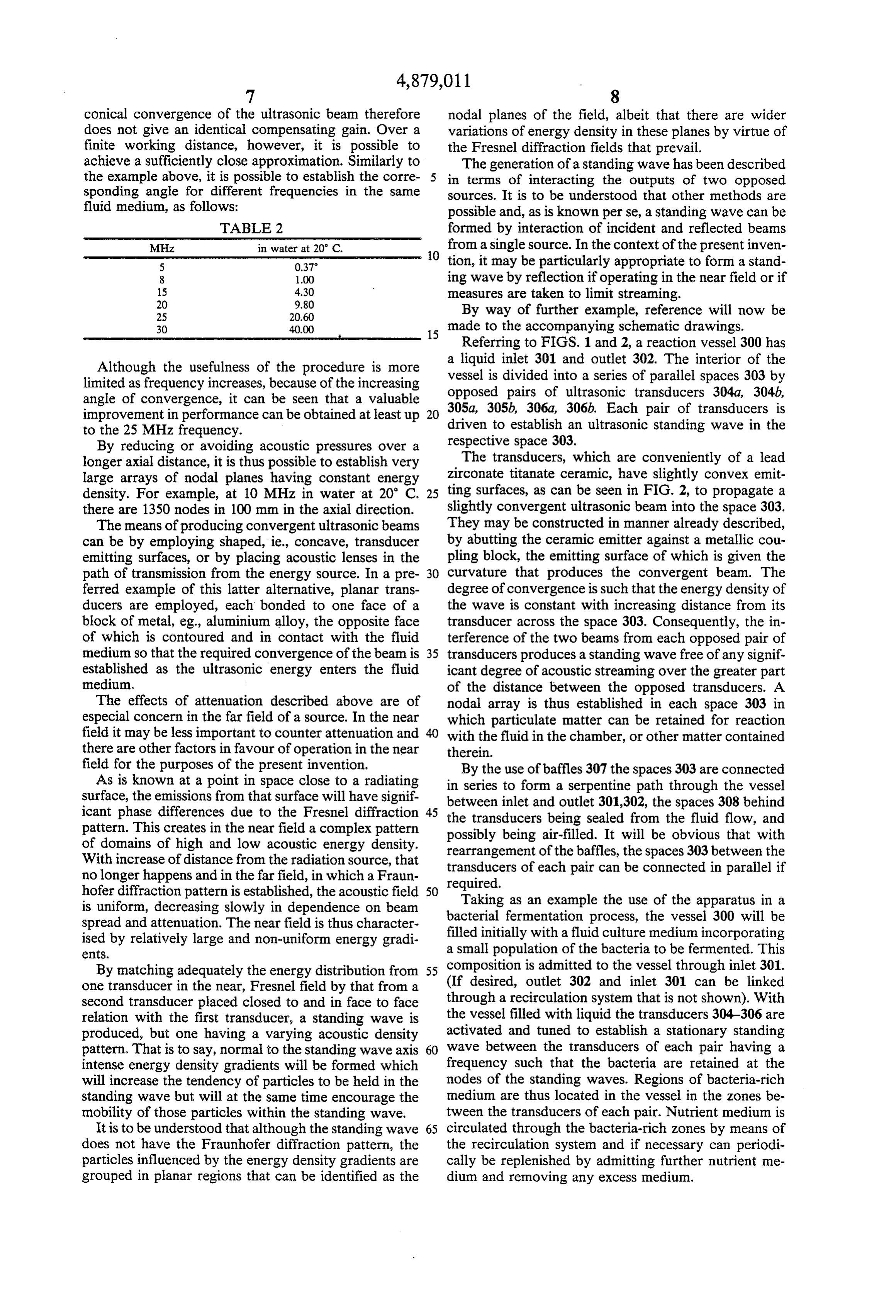
conical convergence of the ultrasonic beam therefore nodal planes of the field, albeit that there are wider does not give an identical compensating gain. Over a variations of energy density in these planes by virtue of finite working distance, however, it is possible to the Fresnel diffraction fields that prevail. achieve a sufficiently close approximation. Similarly to The generation of a standing wave has been described the example above, it is possible to establish the corre 5 in terms of interacting the outputs of two opposed sponding angle for different frequencies in the same sources. It is to be understood that other methods are fluid medium, as follows: possible and, as is known perse, a standing wave can be TABLE 2 formed by interaction of incident and reflected beams MHz. in water at 20 C. from a single source. In the context of the present inven O tion, it may be particularly appropriate to form a stand
8 1.00 ing wave by reflection if operating in the near field or if
measures are taken to limit streaming.
25 20.60 By way of further example, reference will now be
armaramerasraelisarmaanamannenmaa 15 40.00 made to the accompanying schematic drawings.
Referring to FIGS. 1 and 2, a reaction vessel 300 has
Although the usefulness of the procedure is more vessel is inlet a liquid 301 and outlet 302. The interior of the limited as frequency increases, because of the increasing opposed pairs ofinto divided a series of parallel spaces 303 by ultrasonic transducers 304a, 304b, angle of convergence, it can be seen that a valuable improvement in performance can be obtained at least up 20 305a, 305b, 306a, 306b. Each pair of transducers is to the 25 MHz frequency. driven to establish an ultrasonic standing wave in the By reducing or avoiding acoustic pressures over a respective space 303.
longer axial distance, it is thus possible to establish very The transducers, which are conveniently of a lead large arrays of nodal planes having constant energy zirconate titanate ceramic, have slightly convex emit density. For example, at 10 MHz in water at 20 C. 25 ting surfaces, as can be seen in FIG. 2, to propagate a there are 1350 nodes in 100 mm in the axial direction. slightly convergent ultrasonic beam into the space 303. The means of producing convergent ultrasonic beams They may be constructed in manner already described, can be by employing shaped, ie., concave, transducer by abutting the ceramic emitter against a metallic cou emitting surfaces, or by placing acoustic lenses in the pling block, the emitting surface of which is given the path of transmission from the energy source. In a pre curvature that produces the convergent beam. The ferred example of this latter alternative, planar trans degree of convergence is such that the energy density of ducers are employed, each bonded to one face of a the wave is constant with increasing distance from its block of metal, eg., aluminium alloy, the opposite face transducer across the space 303. Consequently, the in of which is contoured and in contact with the fluid terference of the two beams from each opposed pair of medium so that the required convergence of the beam is 35 transducers produces a standing wave free of any signif. established as the ultrasonic energy enters the fluid icant degree of acoustic streaming over the greater part medium. of the distance between the opposed transducers. A The effects of attenuation described above are of nodal array is thus established in each space 303 in especial concern in the far field of a source. In the near which particulate matter can be retained for reaction field it may be less important to counter attenuation and 40 with the fluid in the chamber, or other matter contained there are other factors in favour of operation in the near therein.
field for the purposes of the present invention.
As is known at a point in space close to a radiating in By the use of baffles 307 the spaces 303 are connected series to form a serpentine path through the vessel surface, the emissions from that surface will have signif.
icant phase differences due to the Fresnel diffraction 45 between the inlet and outlet 301,302, the spaces 308 behind transducers being sealed from the fluid flow, and pattern. This creates in the near field a complex pattern possibly being air-filled. It will be obvious that with of domains of high and low acoustic energy density. rearrangement of the baffles,
With increase of distance from the radiation source, that transducers of each pair can the be spaces 303 between the connected in parallel if no longer happens and in the far field, in which a Fraun required.
hofer diffraction pattern is established, the acoustic field 50 Taking as an example the use of the apparatus in a is uniform, decreasing slowly in dependence on beam bacterial fermentation process, the vessel 300 will be spread and attenuation. The near field is thus character ised by relatively large and non-uniform energy gradi filled initially with a fluid culture medium incorporating ents. a small population of the bacteria to be fermented. This By matching adequately the energy distribution from 55 composition is admitted to the vessel through inlet 301. one transducer in the near, Fresnel field by that from a (If desired, outlet 302 and inlet 301 can be linked Second transducer placed closed to and in face to face through a recirculation system that is not shown). With relation with the first transducer, a standing wave is the vessel filled with liquid the transducers 304-306 are produced, but one having a varying acoustic density activated and tuned to establish a stationary standing pattern. That is to say, normal to the standing wave axis 60 wave between the transducers of each pair having a intense energy density gradients will be formed which frequency such that the bacteria are retained at the will increase the tendency of particles to be held in the nodes of the standing waves. Regions of bacteria-rich standing wave but will at the same time encourage the medium are thus located in the vessel in the zones be mobility of those particles within the standing wave. tween the transducers of each pair. Nutrient medium is It is to be understood that although the standing wave 65 circulated through the bacteria-rich zones by means of does not have the Fraunhofer diffraction pattern, the the recirculation system and if necessary can periodi particles influenced by the energy density gradients are cally be replenished by admitting further nutrient me grouped in planar regions that can be identified as the dium and removing any excess medium.
Page 7
In the steady state with, in effect, the whole popula Instead, the standing wave can be utilised to support tion of bacteria as located firmly by means of the stand larger carrier particles to which cells, enzymes or other ing waves, nutrient medium can be drawn from the active elements can be attached by means known in the reaction vessel through the outlet 302 containing at art. The standing wave system and the characteristics of most only a very low population of bacteria. By retain the carrier particle may be chosen to match each other ing the bacterial population at the nodes of the standing largely independently of the characteristics of the ac wave an efficient fermentation regime is established in tive particles, so as to generate a maximum response to which recirculation of the nutrient medium can readily the acoustic forces of the standing wave. As an exam distribute it uniformly to the bacteria. By-products can ple, cells such as hybridoma cells, which are obtained be removed from the fermentation system by flushing 10 from the fusion of a mouse plasma cell and a mouse fresh nutrient medium into the reaction vessel without tumour cell and producing some specific immuno-rea significant loss of bacteria through the outlet. On com gent, can be attached to such carrier particles and thus pletion of the fermentation reaction, the bacterial popu be held substantially immobilised in a gentle current of lation can be released by extinguishing the standing liquid flowing parallel or transversely to the axis of the wave, and flushing the material from the reaction vessel 15 standing wave.
through the outlet 302. Alternately, the contents of the The carrier particles may be formed by any suitably reaction vessel containing the bacteria can simply be inert material and may be given a variety of shapes. Fine drained from the vessel. fibrous elements having a large surface to volume ratio FIG. 3 shows a modified arrangement in that each may be preferred for some purposes. There are also reaction space 313 in a chamber 310 is bounded by two 20 commercially available hollow glass microspheres pairs of opposed transducers 314a, 314b and 315a, 315b ("Eccospheres'-Trade Mark) with a glass wall thick having shaped emitting surfaces and forming an essen ness of about 2 microns which, by virtue of their hollow tial rectangular cross-section fluid passage in which the construction, have a low specific gravity that may be a two pairs of opposed transducers provide two standing desirable quality for their manipulation in a carrier liq wave patterns at right-angles to each other. Particles 25 uid. The glass walls of such particles are well suited to can thus be retained in relatively narrow regions at the holding biologically active elements. intersection of the nodal planes of the two standing In the performance of the present invention it is also waves and the fluid directed through the passages flows possible to provide for some degree of interaction be parallel to these concentrations of particles. As in the tween particles that are orientated and concentrated at preceding example, the curvature of the transducers is 30 the nodes of a standing wave. The interaction may be designed to give an essentially constant means acoustic that of cell proliferation on closely positioned carrier energy density transversely of the passages and the particles at a node, possibly so that the growth forms passages can be connected together in series or in paral bridges between neighbouring carrier particles. For lel. example, if the beds of carrier particles are undisturbed It is a feature of the illustrated examples that the 35 for sufficient time in such conditions for the production radiating surfaces of the transducers lie close to or of an immuno-reagent as referred to above, small mats bound the volume through which the standing wave of hybridioma cell tissue can be encouraged to form at extends. With this arrangement, the standing waves are the nodes, these mats resulting in much improved pro established in the near fields of the transducers and duction of immunoglobulins, and yet by extinguishing relatively large acoustic pressure gradients occur within the standing wave it is possible quickly and simply to the standing wave. These gradients are non-uniform: replace or otherwise manipulate the whole culture. they will exist in the flow direction of the passage as I claim:
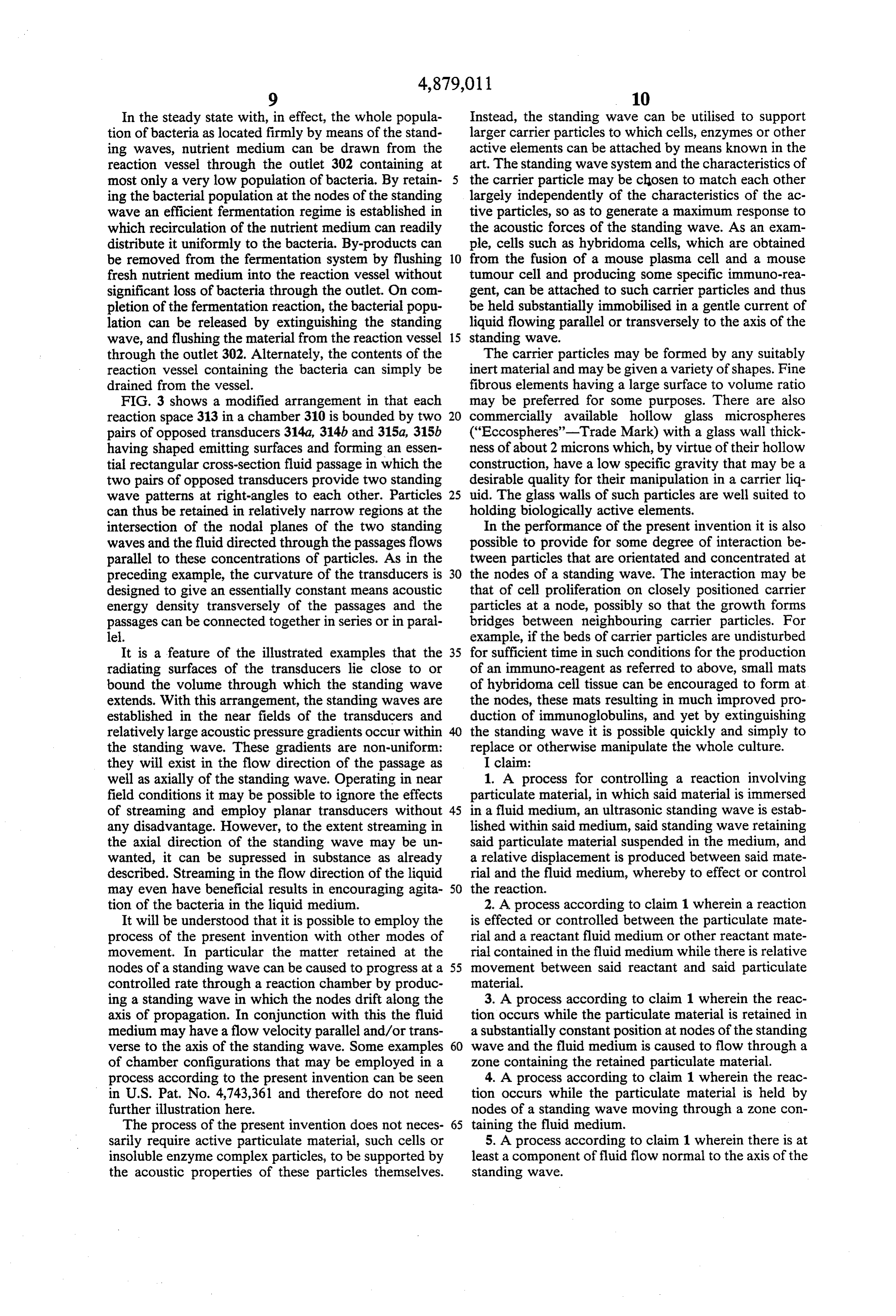
well as axially of the standing wave. Operating in near 1. A process for controlling a reaction involving field conditions it may be possible to ignore the effects particulate material, in which said material is immersed of streaming and employ planar transducers without 45 in a fluid medium, an ultrasonic standing wave is estab any disadvantage. However, to the extent streaming in lished within said medium, said standing wave retaining the axial direction of the standing wave may be un said particulate material suspended in the medium, and wanted, it can be supressed in substance as already a relative displacement is produced between said mate described. Streaming in the flow direction of the liquid rial and the fluid medium, whereby to effect or control may even have beneficial results in encouraging agita 50 the reaction.
tion of the bacteria in the liquid medium. 2. A process according to claim 1 wherein a reaction It will be understood that it is possible to employ the is effected or controlled between the particulate mate process of the present invention with other modes of rial and a reactant fluid medium or other reactant mate movement. In particular the matter retained at the rial contained in the fluid medium while there is relative nodes of a standing wave can be caused to progress at a 55 movement between said reactant and said particulate controlled rate through a reaction chamber by produc material.
ing a standing wave in which the nodes drift along the 3. A process according to claim 1 wherein the reac axis of propagation. In conjunction with this the fluid tion occurs while the particulate material is retained in medium may have a flow velocity parallel and/or trans a substantially constant position at nodes of the standing verse to the axis of the standing wave. Some examples 60 wave and the fluid medium is caused to flow through a of chamber configurations that may be employed in a zone containing the retained particulate material. process according to the present invention can be seen 4. A process according to claim 1 wherein the reac in U.S. Pat. No. 4,743,361 and therefore do not need tion occurs while the particulate material is held by further illustration here. nodes of a standing wave moving through a Zone con The process of the present invention does not neces 65 taining the fluid medium.
sarily require active particulate material, such cells or 5. A process according to claim 1 wherein there is at insoluble enzyme complex particles, to be supported by least a component of fluid flow normal to the axis of the the acoustic properties of these particles themselves. standing wave.
Page 8
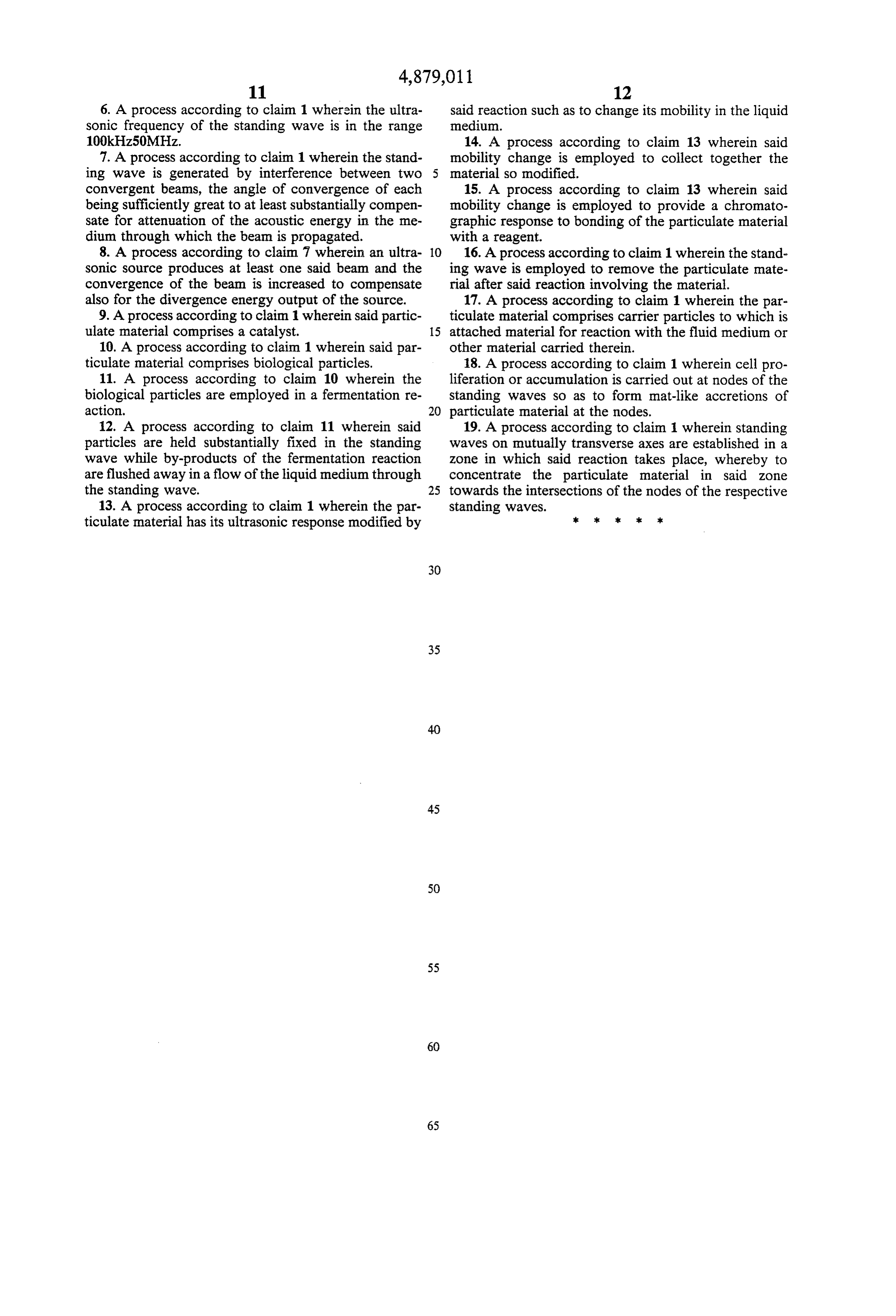
6. A process according to claim 1 wherein the ultra said reaction such as to change its mobility in the liquid sonic frequency of the standing wave is in the range medium.
100kHZ50MHz. 14. A process according to claim 13 wherein said 7. A process according to claim 1 wherein the stand mobility change is employed to collect together the ing wave is generated by interference between two material so modified.
convergent beams, the angle of convergence of each 15. A process according to claim 13 wherein said being sufficiently great to at least substantially compen mobility change is employed to provide a chromato sate for attenuation of the acoustic energy in the me graphic response to bonding of the particulate material dium through which the beam is propagated. with a reagent.
8. A process according to claim 7 wherein an ultra 10 16. A process according to claim 1 wherein the stand sonic source produces at least one said beam and the ing wave is employed to remove the particulate mate convergence of the beam is increased to compensate rial after said reaction involving the material. also for the divergence energy output of the source. 17. A process according to claim 1 wherein the par 9. A process according to claim 1 wherein said partic ticulate material comprises carrier particles to which is ulate material comprises a catalyst. 15 attached material for reaction with the fluid medium or 10. A process according to claim 1 wherein said par other material carried therein.
ticulate material comprises biological particles. 18. A process according to claim 1 wherein cell pro 11. A process according to claim 10 wherein the liferation or accumulation is carried out at nodes of the biological particles are employed in a fermentation re standing waves so as to form mat-like accretions of action. 20 particulate material at the nodes. 12. A process according to claim 11 wherein said 19. A process according to claim 1 wherein standing particles are held substantially fixed in the standing waves on mutually transverse axes are established in a wave while by-products of the fermentation reaction Zone in which said reaction takes place, whereby to are flushed away in a flow of the liquid medium through concentrate the particulate material in said zone the standing wave. 25 towards the intersections of the nodes of the respective 13. A process according to claim 1 wherein the par standing waves.
ticulate material has its ultrasonic response modified by k k : :
Provenance
- Collection
- Cited prior art
- Original PDF
- patentimages.storage.googleapis.com →
- Filed
- 1988-08-08
- Pages
- 8
- Method
- pdftotext (the PDF's own text layer) + pdftoppm 300dpi page scans
- Source
- Google Patents bibliographic record
- Granted
- 1989-11-07
- Inventors
- Cornelius J. Schram; National Research Development Corp UK
- Transcribed from
- patentimages.storage.googleapis.com →