patent · US4808286
Apparatus and method for maximizing production of heat, gas, and electricity through the acceleration of hydrogen dissociation
28 February 1989
Page 1 — bibliographic record
United States Patent (19) 11 Patent Number: 4,808,286 Angelo, II (45) Date of Patent: Feb. 28, 1989 54) APPARATUS AND METHOD FOR (56) References Cited MAXIMIZING PRODUCTION OF HEAT, U.S. PATENT DOCUMENTS
GAS, AND ELECTRICITY THROUGH THE
ACCELERATION OF HYDROGEN 1,334,590 5/1920 Bloom .............................. 204/157.4 DISSOCIATION 3,827,379 8/1974 Tsuruta et al.
76) Inventor: J. F. Angelo, II, P.O. Box. 55275, 3,907,520 9/1975 Huang. 204/157.4 Little Rock, Ark. 72225 4,037,543 7/1977 Angelo .................................. 201/33 4,273,619 6/1981 Angelo, II ... ... 202/211 (21) Appl. No.: 29,267 4,344,821 8/1982 Angelo, II ............................ 201/33 Primary Examiner-John F. Niebling 22) Filed: Mar. 23, 1987 Assistant Examiner-Ben C. Hsing (51) Int. Cl* ...................... C10B 47/20; C10B 49/06; Attorney, Agent, or Firm-Hill, Van Santen, Steadman & Simpson
(52) U.S. C. .......................... 204/157.15; 204/157.41; (57) ABSTRACT 204/157.47; 204/157.52; 204/157.61; 204/164: An apparatus for inducing and accelerating hydrogen 201/19, 201/32; 201/37; 202/131; 202/216; dissociation in a cloud generated from feedstock fed 202/211; 202/218; 110/342; 110/246; 110/247; into a chamber defined by the apparatus is provided. 110/250; 361/230; 361/233; 422/186; The apparatus includes a device for thermally stimulat 422/186.04; 422/186.21; 422/186.3 ing the feedstock to generate the cloud, a device for 58 Field of Search ...................... 204/157.41, 157.47, localizing the cloud within the chamber, a device for 204/157.52, 157.15, 157.6, 157.16, 164, 165; electrically stimulating the localized cloud, and a device -48/200, 202; 201/19, 22, 32, 33, 34, 36, 37, 38; for photonically stimulating the localized cloud. A 202/131, 105,136, 211,216, 218; 361/230, 233; method is also provided.
110/342, 344, 346, 246, 247, 250 18 Claims, 2 Drawing Sheets
Page 2
Drawing sheet — no readable text.
Page 3
Drawing sheet — no readable text.
Page 4
cloud, and means for photonically stimulating the local
APPARATUS AND METHOD FOR MAXIMIZNG ized cloud.
PRODUCTION OF HEAT, GAS, AND Preferably, the means for electrically stimulating the ELECTRICTY THROUGH THE ACCELERATION cloud includes at least one pair of oppositely charged OF HYDROGEN DISSOCATION 5 electrodes. Preferably, the means for photonically stim ulating the localized cloud includes at least one laser.
BACKGROUND OF THE INVENTION Preferably, the means for localizing the cloud includes This invention relates generally to a method and dinal axisa inretort rotating defining the chamber about its longitu a first direction and introducing air tangen means for accelerating the dissociation of hydrogen. 10 tially into a peripheral portion of the chamber not occu More specifically, this invention relates to a device and pied by the feedstock in a second direction that is oppo a method that increases thermal, electrical, and gas site to the first direction.
generation through the acceleration of hydrogen disso The present invention also provides a method for ciation in a furnace.
generating heat and electrical energy. The method com
U.S. Pat. No. 3,901,766 discloses a method and appa 15 prises the steps of:
ratus for producing charcoal. The method comprises (a) introducing a feedstock into a retort; introducing a material to be carbonized into, through, (b) heating the feedstock so that at least a portion of and out of a single chamber, retort, in which the mate the feedstock begins to carbonize or burn and gas is rial is heated to a carbonizing temperature by the com generated;
bustion of gases emitted by the carbonization of previ 20 (c) localizing the generated gas into a localized cloud; ously inserted material. The gases are intermixed for (d) introducing new feedstock and air into the retort combustion with air that is also injected into the cham whereby a continuous combustion of the feedstock is ber. The air and gases are directed and controlled in the achieved; and chamber in such a manner that the carbonizing material (e) electrically and photonically stimulating the local is never exposed to sufficient oxygen to support free 25 ized cloud to elevate the temperature of the cloud and combustion thereof. An apparatus capable of carrying accelerate hydrogen dissociation within the cloud. out the method is also disclosed. Preferably, the localized cloud is alternately electri The carbonization reaction is accompanied by a re cally and photonically stimulated. Preferably, the cloud lease of a large amount of gas. In the furnace disclosed is photonically stimulated by pulsing at least one laser. in U.S. Pat. No. 3,901,766, the furnace causes a localized 30 Preferably, the cloud is electrically stimulated by gener cloud of gas rich in water vapor and including methane ating a spark between at least two oppositely charged to be driven off a tumbling bed of wet feedstock. Due to electrodes.
the construction and operation of the furnace, this gas Accordingly, it is an advantage of the present inven will be localized in only a portion of the rotary kiln or 35 tion to provide a method and apparatus for inducing other combustion device. For example, in a 1,000 cubic and accelerating the dissociation of hydrogen. foot rotary kiln the gas will occupy approximately 100 A further advantage of the present invention is that it cubic feet of the internal chamber. At lower tempera provides a device and method that increases thermal, tures, it has been observed that this localized cloud of electrical, and gas generation in a furnace. gas tends to consume a large amount of energy and thus, 40 Furthermore, an advantage of the present invention is that it provides a method and apparatus for inducing an penalizes the thermal efficiency of the combustion pro electron
CSS. avalanche.
It has been found that during the operation of such provides Another advantage of the present invention is that it furnaces sometimes a furnace will have a temperature a method and apparatus for generating energy runaway on the upside. For example, a furnace operat 45 for jamming or disrupting telecommunications &/or ing at a temperature of 2,000 F. will suddenly take off radio signals.
Moreover, an advantage of the present invention is to a temperature of approximately 2500 to about 2800 that it provides a more efficient furnace. F. Moreover, it was found that the addition of water to the feedstock, and thereby to the localized cloud in the andAdditional will be features and advantages are described in, apparent from, the detailed description of form of vapor, did not cool down the process as ex 50 the presently preferred embodiments and from the pected but, actually induced additional temperature drawings.
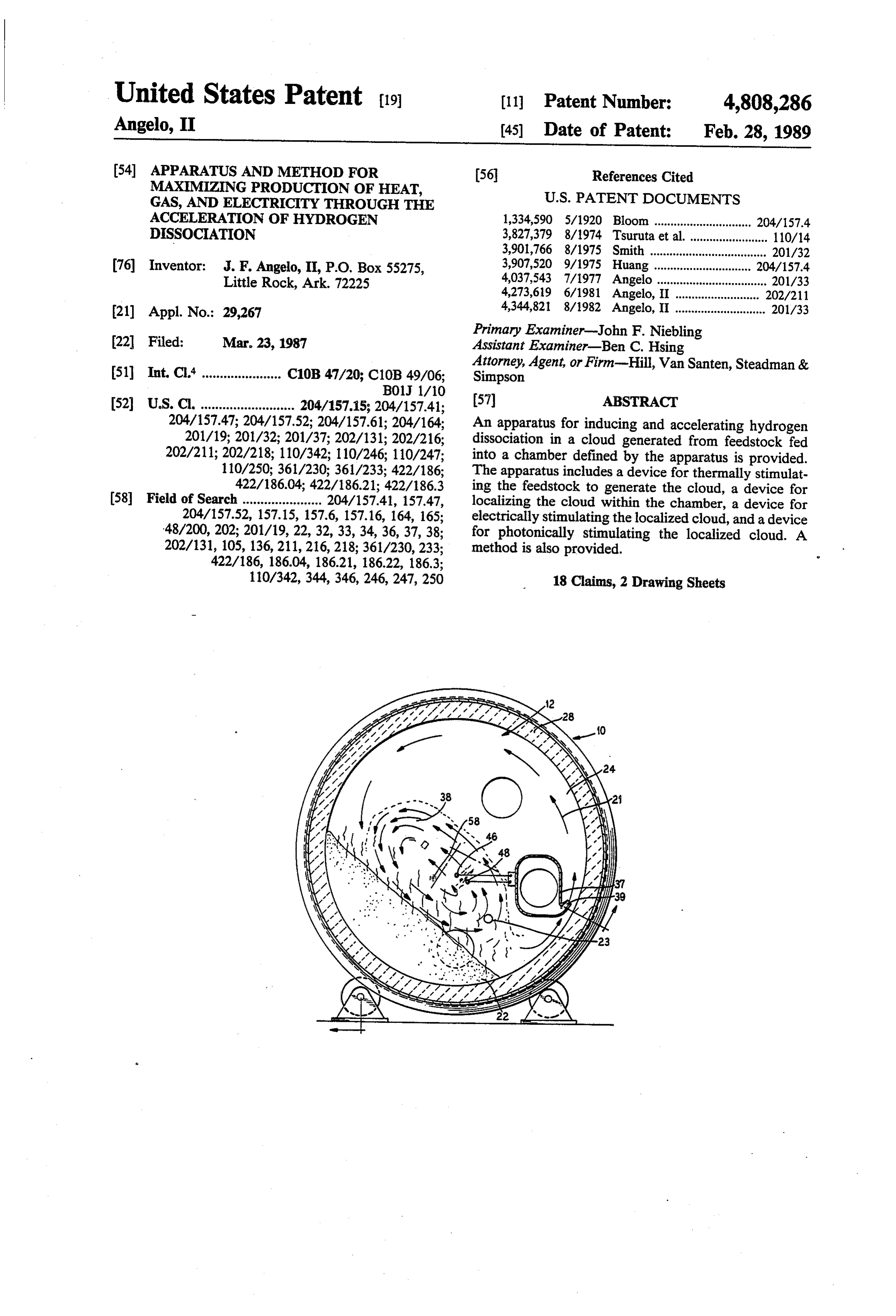
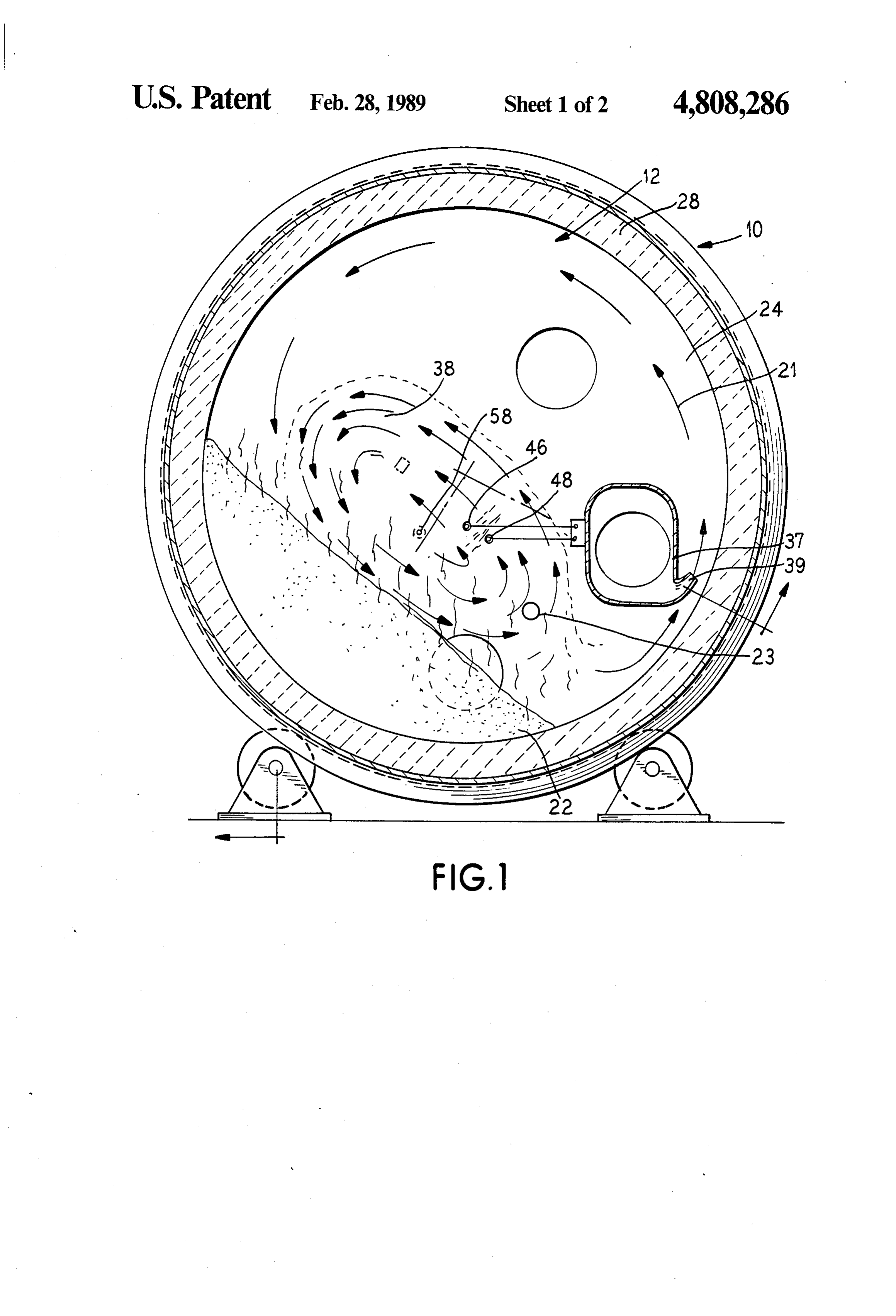
elevation, temporarily. Inventor of the present inven tion hypothesizes that this phenomenon indicates that it BRIEF DESCRIPTION OF THE DRAWINGS is possible to induce and accelerate a hydrogen dissocia FIG. 1 illustrates a front elevational cross-sectional tion reaction taking place in the rotary furnace. 55 schematic view of an embodiment of the apparatus of The present invention provides a method and appara the present invention.
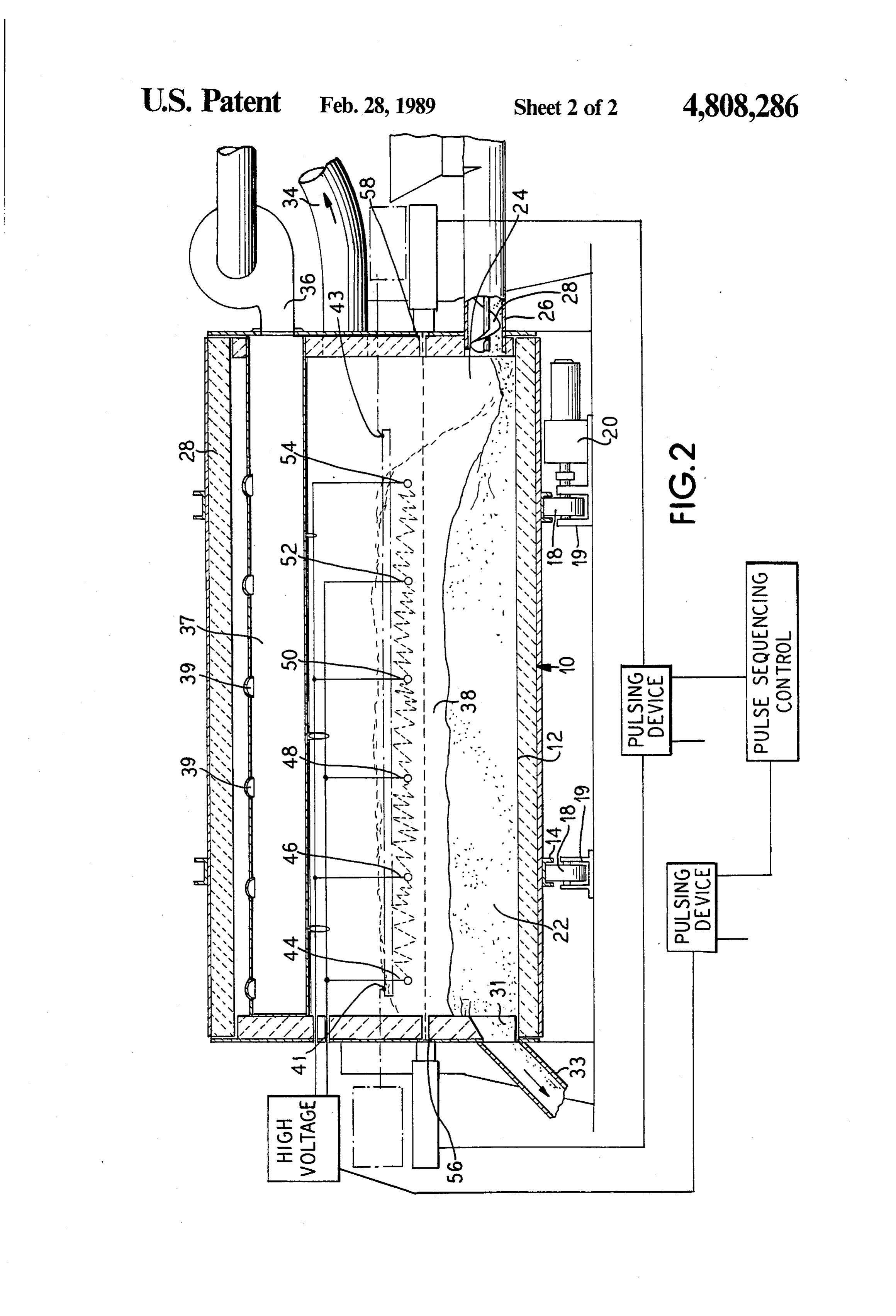
tus for inducing and accelerating a hydrogen dissocia FIG. 2 illustrates a cross-sectional view taken along tion reaction to thereby extract the maximum amount of lines II-II of the apparatus of FIG. 1. energy from the reaction. -
60 DETALED DESCRIPTION OF THE
SUMMARY OF THE INVENTION PRESENTLY PREFERRED EMBODIMENTS
The present invention provides an apparatus for in Rotary furnaces for reducing cellulosic waste such as ducing and accelerating hydrogen dissociation in a wood cloud generated from feedstock fed into a chamber burningchips, waste, and like feedstock to charcoal or said feedstock completely to produce furnace defined by the apparatus. The apparatus includes means 65 heat and ash are known in, for example, U.S. Pat. Nos. for thermally stimulating the feedstock to generate the 3,901,766 and 4,037,543. During, for example, the heat cloud, means for localizing the cloud within the cham ing of the wood, free moisture and volatile hydrocarbon ber, means for electrically stimulating the localized constituent elements of the wood are driven off. This
Page 5
process is called carbonization. Due to the construction along the length of the retort 12. Accordingly, a helical, of the apparatus disclosed in U.S. Pat. No. 3,901,766 and circumferential swirl patter, indicated by arrows 21, is U.S. Pat. No. 4,037,543, the gases driven from the induced within the chamber 24 of the retort 12. wood, or other feedstock, are localized adjacent to the Because air is injected by the blower 36 tangentially, feedstock. These gases are rich in water vapor, as well away from the bed of feedstock, and in an opposite as other gases, including, methane, carbon monoxide, direction to the rotation of the retort, the gases that carbon dioxide oxygen, and hydrogen. induced by the heating of the feedstock, i.e., water The present invention provides an apparatus and vapor, methane, carbon monoxide, hydrogen, and oxy means for "burning the water” in the localized gas. gen, are localized in a cloud 38 adjacent to the feedstock Specifically, the present invention provides a means and 10 as illustrated in FIG. 1. These gases will be localized in apparatus for accelerating the dissociation of hydrogen an area that comprises only approximately 10% of the reaction taking place in the furnace. By accelerating the total internal area of the retort 12. dissociation of hydrogen, this affords the present inven Although it is possible to control the flow of air to tion the means to extract the maximum amount of en prevent the feedstock from completely burning, in the ergy from the furnace. Moreover, as set forth in more 15 present application, enough air is added to cause sub detail below, this also affords generation of energy stantially full combustion of the feedstock, rather than through an electron avalanche. Furthermore, the mere carbonization thereof. Full combustion of the method and means of the present invention can provide feedstock elevates the temperature to approximately a means for disrupting and "jamming' telecommunica 2000' F. By adding sufficient feedstock to the retort 12 tions. 20 and injecting sufficient air, the combustion of the feed Referring now to FIGS. 1 and 2, an embodiment of stock will be spontaneous.
the apparatus for accelerating the dissociation of hydro The inner walls of the retort 12, including the end gen is illustrated. Although the embodiment illustrated walls, are provided with a thick lining 28 of ceramic of the apparatus is a rotary furnace, such as disclosed in insulating material so that the retort 12 can withstand U.S. Pat. No. 3,901,766, it is intended that the method of 25 the temperatures envisioned. At a front end of the retort the present invention can be utilized with any apparatus 12 is located an aperture 31 and pipe 33 through which that can localize a cloud of gas containing water vapor inert ash generated by the combustion of the feedstock and withstand the temperatures set forth herein. The exits the retort 12. A gas outlet 34 retrieves heated gas apparatus 10 comprises a retort 12 which constitutes a from the retort 12 that is then recovered as energy. large cylindrical vessel with its axis inclined slightly 30 Because, as set forth below, temperatures approaching from the horizontal, about a pair of track members 14. 4000 F. will be generated, the heated gas recovered Each track member 14 is supported by a pair of rollers will have a temperature approaching approximately 18 disposed respectively at opposite sides of the midline 4000' F. An afterburner (not shown) can be utilized to of the retort, each roller being carried rotatably by a treat the gas exiting the retort 12 through the gas outlet ground supported block 19. A motor 20 rotates at least 35 34 so that the gas is pollution free. An example of such one pair of rollers causing the retort 12 to slowly rotate. an afterburner is disclosed in U.S. Pat. No. 4,037,543. Preferably, the retort 12 is turned slowly, e.g., about 2 As will be described in detail hereinafter, the appara to 3 r.p.m., about its axis. tus and method of the present invention induces and Feedstock is admitted to the chamber 24 of the retort accelerates the hydrogen dissociation of the water by an auger tube 26 in which is carried a rotatably vapor in the localized cloud. To this end, the method of driven helical auger 28. The auger tube 26 is operable to the present invention utilizes thermal, photochemical, deliver feedstock from any suitable source (not shown) and electrical stimuli to ionize, excite, and stimulate, the into the higher portion of the retort 12. As discussed in molecules and atoms of the gas and elevate the tempera detail below, the feedstock is deposited continuously in ture of the localized gas in order to break down the the higher end of the retort 12 by the auger tube 26 and 45 water vapor cloud to its most elemental form and re gathers at the bottom of the retort 12. Due to the rota lease the maximum amount of energy in the form of heat tion of the retort 12 a bed offeedstock 22 is generated in energy and electrical energy. The thermal energy is the retort. The feedstock utilized can comprise simply provided by the combustion of the feedstock. As set waste, coals, wood chips, or other high moisture feed forth above, this combustion will elevate the tempera stocks including cellulosic wastes. 50 ture of the feedstock and localized cloud to approxi Initially, an external fuel source, such as a gas, is mately 2000' F.
introduced into the retort 12 by, for example, a fuel pipe To provide the electrical stimulus to the cloud, the by a manual control valve, and to a jet 23. The external apparatus of the present invention preferably includes fuel source is burned to elevate the temperature of at within the retort 12 a plurality of electrodes 44, 46, 48, least some of the feedstock to at least the carbonization 55 50, 52, and 54 that are linearly spaced throughout the level, about 550' F. for wood chips. When carboniza length of the chamber 24 of the retort 12 and thereby tion of the feedstock is thus initiated, the reaction is the length of the localized cloud. The electrodes 44, 46, thereafter spontaneous, continuing until the feedstock is 48, 50, 52, and 54 are oppositely charged and are posi fully carbonized to charcoal. Of course, other means for tioned so that a spark can be thrown the entire length of initiating the carbonization of the feedstock can be uti 60 the retort 12. Although, six electrodes 44, 46,48, 50, 52, lized. and 54 are illustrated, any number of pairs of oppositely Air is injected in the retort 12 by a blower 36. The charged electrodes can be utilized. These electrodes 44, blower 36 functions to inject air into the system in an 46, 48, 50, 52, and 54 function to throw an arc between opposite direction to the rotation of the retort 12, i.e., if the electrodes much in the same way as a lightening bolt the retort is rotating clockwise, the blower 36 injects air 65 or a spark plug. However, the spark or arc is localized in a counterclockwise manner. To this end, the blower within the localized cloud 42. The electrodes, 44, 46, 48, 36 injects air into a pipe 37that injects air into the retort 50, 52, and 54 are connected to a high voltage source through holes 39. The holes 39 are preferably spaced that is pulsed by means of a pulsing device that is con
Page 6
trolled by a pulse sequencing control. The pulse se may become a plasma at the temperatures created. The quencing control insures that the cloud is alternately, frequencies of the pulsed lasers, and its spectra, should electrically and photonically stimulated. be chosen in order to maximize the benefits of the spec Before a spark or arc between the electrodes is gener tra. Preferably, lasers are pulsed alternately with a spark ated, the cloud of gas will have a temperature of ap between the electrodes.
proximately 2000' F. due to the combustion of the feed It is believed that in view of the stimuli generated stock as previously stated. Accordingly, not only will above the localized cloud be affected by a thermal stimuli but inducedoninthethelocalized gas that negative ions will be localized cloud and an electron ava also by an electrical stimuli. As set forth hereinafter, the lanche will be generated. To this end, the gas in the cloud will also be stimulated by a photochemical stim 10 cloud will breakdown causing electrons to be released. uli.
To photochemically excite the atoms and molecules, Accordingly, a fourth step in the method would be the primarily the water vapor, in the localized cloud a laser avalanche. Duringand release of energy the the inducement of an electron expected electron avalanche can be utilized. Preferably, two lasers 56 and 58 are utilized and are located at each end of the retort 12 in a 15 phenomenon, streams of charged particles, negative and position so that the laser beams generated by the lasers positive, will flow from the localized gas. These parti cles can be collected by electron gatherers shown at 41 56 and 58 will be exerted through substantially the and 43.
cross-sectional center of the localized cloud 42. Al
The though two lasers are illustrated, one or more lasers can also producesmethod and apparatus of the present invention be utilized to photochemically stimulate the localized 20 ergy in the form an additional feature. In addition to en cloud 42. In order to conserve energy, preferably the of heat and power produced by the lasers 56 and 58, and the electrodes 44, 46, 48, 50, 52, utilization of the three stimuli on the localized gas, en and 54 are pulsed to excite the gases in the localized ergy in the form of electricity is also produced. These pulsed high energy bursts, emanating from the system, cloud 42.
By way of example, a laser that has been found to 25 can be utilized to cause electrical, radio, and other tele function satisfactory is one that generates a 25 nanosec communication interruptions and jamming. Accord ond half-width emmission having peak powers of 3 to 5 ingly, the method and apparatus of the present inven MW. The laser is a Q-spoiled ruby laser with rotating tion may also have applications in areas that desire such prism and 2 cm focal length lens. The laser included an telecommunications interrupting and jamming, for ex H cell designed for 100 atmospheres of pressure. It 30 ample, military uses.
should be noted though, that other lasers can also be The inventor believes that once the temperature utilized. within the chamber of the localized gas achieves ap By utilizing a photochemical stimuli generated by the proximately 4000' F., that the process may become lasers 56 and 58, an electrical stimuli generated by the spontaneous. It is believed that spontaneous combusion electrodes 44, 46, 48, 50, 52, and 54, and a thermal stim 35 of the hydrogen will occur at 3700°F. Accordingly, the uli, temperatures of the localized gas 42 can be driven to need to photonically and electrically simulate the local between approximately 3700 F. and 4000' F. At these ized cloud may not be required or will be required at temperatures, a dissociation of hydrogen is produced substantially less frequent intervals.
whereby the primary reactions within the water vapor It should be understood that various changes and cloud involving water as a reactant is to break down the modifications to the preferred embodiments described water to H2 and O or 2H and O. Other dissociation herein will be apparent to those skilled in the art. Such reactions within the cloud include, among others: changes and modifications can be made without depart H2O-H-I-OH: H2-H-I-H; 2H2-->4H--O2; ing from the spirit and scope of the present invention 2H2O-2H--H2--O2; and 3H2O-2H-2H2--O2--O. and without diminishing it attendant advantages. It is Thus, the water vapor cloud is reduced to its most 45 therefore intended that such changes and modifications fundamental elemental form and large amounts of en be covered by the appended claims.
ergy in the form of heat and electricity via the flow of I claim:
free electrons are released and can be harnessed for 1. A rotary kiln system for inducing and accelerating power usage. hydrogen dissociation in a cloud generated from feed At the temperatures generated (i.e., 3600 F. to 4000 50 stock capable of being carbonized and fed into a cham F.), the localized cloud may become a plasma, i.e., an ber defined by the rotary kiln comprising: electrified gas with atoms dissociated into positive ions means for thermally stimulating the feedstock togen and negative electrons. Thus, ionization avalanches and erate the cloud;
break-downs of the gas leading to optimal ionization means for localizing the cloud within an area of the and maximum dissociation of H2O is expected. Al 55 chamber, the means including means for rotating a though the dissociation of hydrogen and the break retort defining the chamber about its longitudinal down of the water vapor is the primary reaction that direction in a first direction and means for intro will occur in the localized gas 38, other secondary reac ducing air tangentially into a peripheral portion of tions including atoms, molecules, and ions of hydrogen the chamber not occupied by the feedstock in a and oxygen as the reactant will occur. 60 second direction that is opposite to the first direc An example of a method of the present invention tion;
comprises a first step of thermally stimulating the feed means for electrically stimulating the localized cloud; stock. Step two includes ionizing the water vapor lo and cated in a localized cloud generated in the ultra-violet means for photonically stimulating the localized and usable spectrum, i.e., the spectrum of the spark or 65 cloud.
arc between the electrodes. Step 3 is the bombardment 2. The apparatus of claim 1 wherein the means for of the localized cloud photonically with, for example, a electrically stimulating the localized cloud includes at pulse of a laser. As discussed above, the localized cloud least one pair of oppositely charged electrodes.
Page 7
3. The apparatus of claim 1 wherein the means for 10. A method for generating heat and electrical en photonically stimulating the localized cloud includes at ergy comprising the steps of:
least one laser. introducing a feedstock capable of being carbonized 4. The apparatus of claim 1 wheren the means for into a retort;
thermally stimulating the feedstock includes means for 5 heating the feedstock so that at least a portion of the initially heating the feedstock to a temperature where a feedstock begins to at least carbonize and heated portion of the feedstock begins to carbonize and means gas is generated;
for subsequently adding feedstock and sufficient air localizing the generated gas into a localized cloud by whereby a continuous combustion of the feedstock is 10 rotating the retort in a first direction and injecting established. air into the retort tangentially in a second direction 5. The apparatus of claim 1 wherein: opposite to the first direction; the means for electrically stimulating the localized introducing new feedstock capable of being carbon cloud includes a plurality of oppositely charged ized and air into the retort whereby a continuous electrodes; and combustion of the feedstock is achieved; and the means for photonically stimulating the cloud 15 electrically and photonically stimulating the localized includes at least one laser, the laser and electrodes cloud to elevate the temperature of the cloud. being alternately pulsed. 11. The method of claim 10 wherein the localized 6. A rotary kiln system for thermally, photonically cloud lated.
is alternately electrically and photonically stimu and electrically stimulating a localized cloud rich in 20 12, The method of claim 10 including the step of water vapor comprising: electrically stimulating the localized cloud by creating a a vessel for containing the localized cloud rich in spark between at least one pair of oppositely charged water vapor; electrodes.
means for initiating combustion of the feedstock; 13. The method of claim 10 including the step of at least one pair of oppositely charged electrodes for 25 photonically stimulating the localized cloud by generat electrically stimulating the cloud; ing a laser beam into the localized cloud. at least one laser for photonically stimulating the 14. The method of claim 10 including the step of localized cloud; and electrically and photonically stimulating the cloud to means for localizing the localized cloud including elevate the temperature of the cloud to at least 3600' F. means for rotating the vessel in a first direction and 30 15. The method of claim 10 including a step of creat means for injecting air tangentially into the vessel ing an electron avalanche by so simulating the cloud. in a second direction, opposite to the first direction. 16. The method of claim 15 including a step of col 7. The apparatus of claim 6 including two lasers lo lecting the electrons flowing from a cloud. cated at opposite ends of the vessel for photonically 17. The method of claim 10 including a step of col stimulating the cloud. 35 lecting at least some of the heated gas generated in the 8. The apparatus of claim 6 including a plurality of retort.
oppositely charged electrodes extending for a distance 18. The method of claim 10 including a step of gener equal to a length the cloud extends in the vessel. ating electrical impulses capable of disrupting telecom 9. The apparatus of claim 6, wherein the electrodes munications.
and laser are alternately pulsed. 40 k k al
Provenance
- Collection
- Cited prior art
- Original PDF
- patentimages.storage.googleapis.com →
- Filed
- 1987-03-23
- Pages
- 7
- Method
- pdftotext (the PDF's own text layer) + pdftoppm 300dpi page scans
- Source
- Google Patents bibliographic record
- Granted
- 1989-02-28
- Inventors
- II J. F. Angelo
- Transcribed from
- patentimages.storage.googleapis.com →