(Rs2)
Voltage Coefficient of Resistance
Also written oltage Coefficient of Resistance · resistive value
Where it is first named
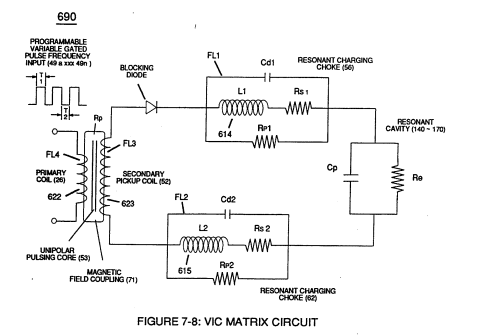
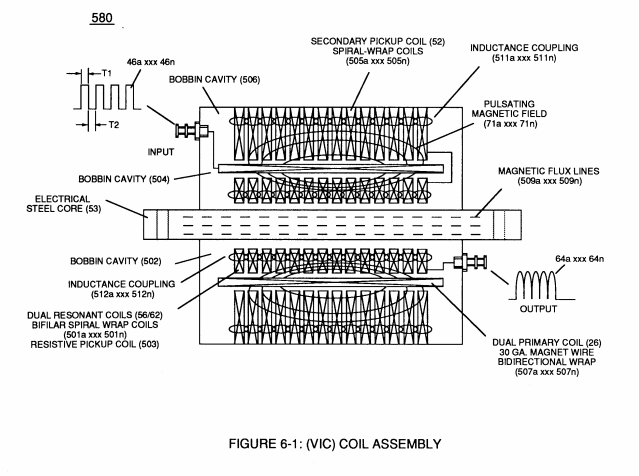
In reference to the use of stainless steel (s/s) coil-wrap (614/615), resistive wire value (Rs1/Rs2) of Figure (7-8) (typically 11.6K ohms per coil) is sufficient enough to inhibit current flow oscillation in direct relationship to circuit impedance (Eq. …
How it is written
- (Rs1/Rs2) 4× with (Rs1) Voltage Coefficient of Resistance
- (Rs2) 1×
- (RS2) 1×
- (Rsl/Rs2) 1× with (Rsl)
Drawings 18
-
The figure it sits on · VIC Matrix Circuit
-
(T2) of Figure (7-8) · Instant Explosion of Water
-
Figure (7-8) · Resistance (Rs)
-
(690) of Figure (7-8) · Resistance (Rs)
-
(690) of Figure (7-8) · Inductance (FL)
-
(690) of Figure (7-8) · Capacitance (Cd)
-
(690) of Figure (7-8) · Inductance Reactance (Rs - Cd - FL)
-
Figure (7-8) · Inductance Reactance (Rs - Cd - FL)
-
(690) of Figure (7-8) · Taper Resonant Capacitor (ERt)
-
690 of Figure 7-8 · Circuit Resistance
-
(52) of Figure (7-8) · Electron Bounce Phenomenon
-
(690) of Figure (7-8) · 8-2 - Traveling Voltage Wave-Guides
-
(52) of Figure (7-8) · 8-3 - Electrical Voltage-Pulse Wave-Transmission
-
(Cp) of Figure (7-8) · 8-4 - State Space (Sp)
-
(690) of Figure (7-8) · 8-6 - VIC Voltage Sync-Pulse Circuit
-
(Cp) of (7-8) · 8-6 - VIC Voltage Sync-Pulse Circuit
-
(690) of Figure (7-8) · Propagating Electrical Stress
-
The figure it sits on · WFC 429 - Illustrations
Where it is named · 7
Resistance (Rs) 2×
-
In reference to the use of stainless steel (s/s) coil-wrap (614/615), resistive wire value (Rs1/Rs2) of Figure (7-8) (typically 11.6K ohms per coil) is sufficient enough to inhibit current flow oscillation in direct relationship to circuit impedance (Eq. …
-
… 9) since "current flow" is, also, restricted in the milliampere (s) range due to (s/s) wire material (Rs1/Rs2) composition ability to oppose electron interaction or electron interchange from one atomic structure to another;
Inductance Reactance (Rs - Cd - FL) 1×
-
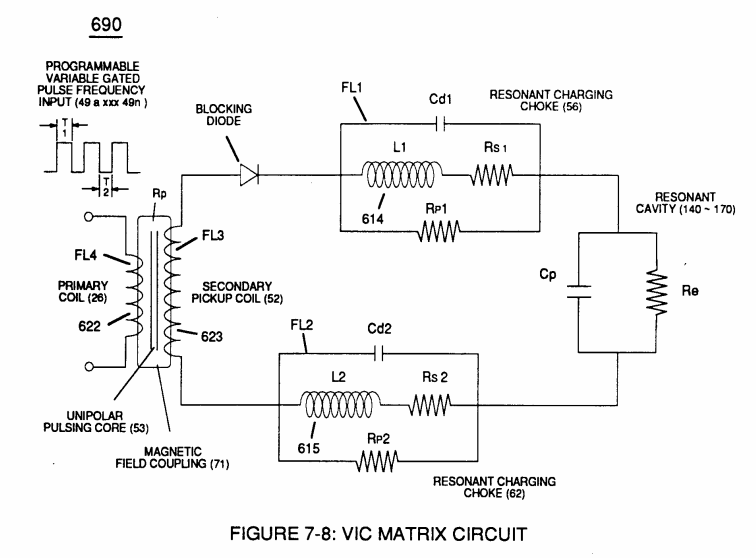
... overcoming any potential loss of pulse signal due to resistive interaction (Rsl/Rs2) of either or both Inductor Cores (L1/L2) wire-material to the formation of Inductance Fields (FL1/FL2) during reoccurring pulse on-time (T1a xxx T1n).
Circuit Resistance 1×
-
resistive value (RS2)
(Z3) is determined by inductance field strength (FL2) and resistive value (RS2) (typically 11.6KQ) of stainless steel (sls) wire-coil (62) (L2) when being exposed to the same external magnetic coupling field strength (Rp)
Electron Bounce Phenomenon 2×
-
oltage Coefficient of Resistance (Rs1/Rs2)
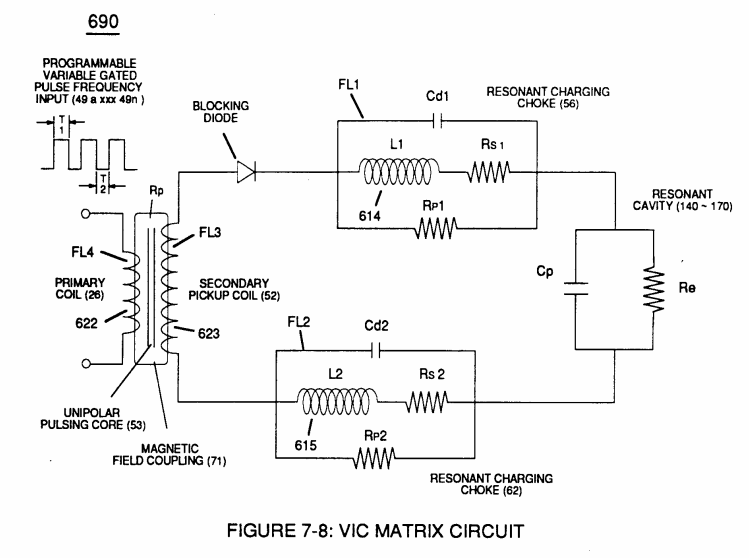
… RR') is in balance phase of equal electrical intensity (66 = 67) of opposite polarity (positive electrical voltage potential _66 equals negative electrical Voltage potential 66 since the Voltage Coefficient of Inductance (FL1/FL2), Voltage Coefficient of Capacitance (Cd1/Cd2), and Voltage Coefficient of Resistance (Rs1/Rs2) across choke coils (L1/L2) are the same values
-
Voltage Coefficient of Resistance (Rs1/Rs2)
… ctrically Interlinked serially together, Electron Bounce Phenomenon (EbP), Voltage Coefficient of Inductance (F11/F12), Voltage Coefficient of Capacitance (Cd1/Cd2), Voltage Coefficient of Resistance (Rs1/Rs2), and Dielectric Coefficient of Water resistance (Re) allows Voltage Potential (Vo - Vn) of opposite electrical polarity to perform work (SS' _ 617 _ RR') without amp influxing, thus, not allowing the …
Voltage to Amp Differential Ratio 1×
-
… etc.) while the resistive value (Rs2) of SS Coil-Wire (SS56/62) performs the work of further resisting the flow of amps not inhibited by both self-Inductance fields (Rpl + Rp2), as so illustrated in (690) of Figure (7-8).