(542) · also written as a run, 542a xxx 542n
Sub-Particle
Also written sub-particles · Gyroscopic Action · particle
Where it is first named
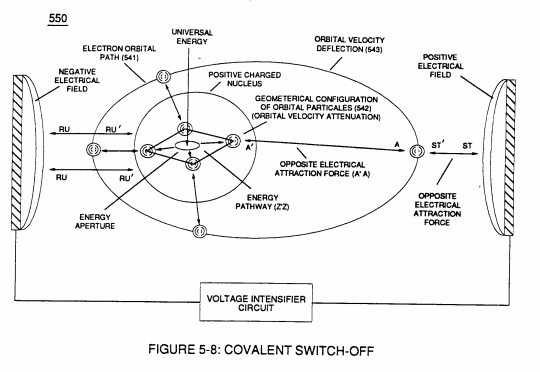
Covalent Switch-Off occurs when deflected and elongated Orbital Electron Pathway (541) reaches a point where applied Opposite Electrical Stress (ST-ST'/RU-RU') (A-A'/Z-Z') is sufficient enough to cause the Gyroscopic Action (542) of Nucleus Particles (543a xxx 543n) to be reduced in orbital spin-velocity ...
How it is written
- (542) 11×
- (Positive Charged atoms 542a xxx 542n having missing electrons) 1×
542a xxx 542n is Meyer's shorthand for a run of the same thing: 542a is the first, 542n the last, and the x's stand for however many lie between. Every stage of the run is this one numeral.
Drawings 33
-
Figure (5-8) · Energy Pumping Action
-
(550) of Figure (5-8) · In Application of Usage
-
(550) of Figure (5-8) · Solar Energy Actuator
-
(760) of Figure (7-15) · Inductance (FL)
-
(760) of Figure (7-15) · Circuit Resistance
-
The programmable pulse-frequency (49a xxx 49n) of Figure (10-1) input is simply adjusted to tune-in to the dielectric property of the Water Molecule. · Propagating Electrical Stress
-
hydrogen energy aperture (7) of (550) of Figure (5-8) · Optical Thermal Lens
-
Carries this number · Degaussing Radioactive Material
-
Carries this number · WFC 430-2 Illustrations
-
Carries this number · WFC 430-2 Illustrations
-
The figure it sits on · Differential Air-Gas Inlet Control
-
(550) of Figure (5-8) · Covalent Switch-Off
-
(7) of Figure (5-8) · Energy Aperture of the Atom
-
The figure it sits on · VIC Matrix Circuit
-
(T2) of Figure (7-8) · Instant Explosion of Water
-
Figure (7-8) · Resistance (Rs)
-
(690) of Figure (7-8) · Resistance (Rs)
-
(690) of Figure (7-8) · Inductance (FL)
-
(690) of Figure (7-8) · Capacitance (Cd)
-
(690) of Figure (7-8) · Inductance Reactance (Rs - Cd - FL)
-
Figure (7-8) · Inductance Reactance (Rs - Cd - FL)
-
(690) of Figure (7-8) · Taper Resonant Capacitor (ERt)
-
690 of Figure 7-8 · Circuit Resistance
-
(52) of Figure (7-8) · Electron Bounce Phenomenon
-
(690) of Figure (7-8) · 8-2 - Traveling Voltage Wave-Guides
-
(52) of Figure (7-8) · 8-3 - Electrical Voltage-Pulse Wave-Transmission
-
(Cp) of Figure (7-8) · 8-4 - State Space (Sp)
-
(550 of Figure 5-8) · 8-4 - State Space (Sp)
-
(690) of Figure (7-8) · 8-6 - VIC Voltage Sync-Pulse Circuit
-
(Cp) of (7-8) · 8-6 - VIC Voltage Sync-Pulse Circuit
-
"Electrovalent Switch-off" phenomenon (550) of Figure (5-8) · WFC Exhaust Air Reclaimer
-
(690) of Figure (7-8) · Propagating Electrical Stress
-
The figure it sits on · WFC 429 - Illustrations
Where it is named · 12
Covalent Switch-Off 1×
-
Gyroscopic Action (542)
Covalent Switch-Off occurs when deflected and elongated Orbital Electron Pathway (541) reaches a point where applied Opposite Electrical Stress (ST-ST'/RU-RU') (A-A'/Z-Z') is sufficient enough to cause the Gyroscopic Action (542) of Nucleus Particles (543a xxx 543n) to be reduced in orbital spin-velocity ...
Electron Bounce Phenomenon 1×
-
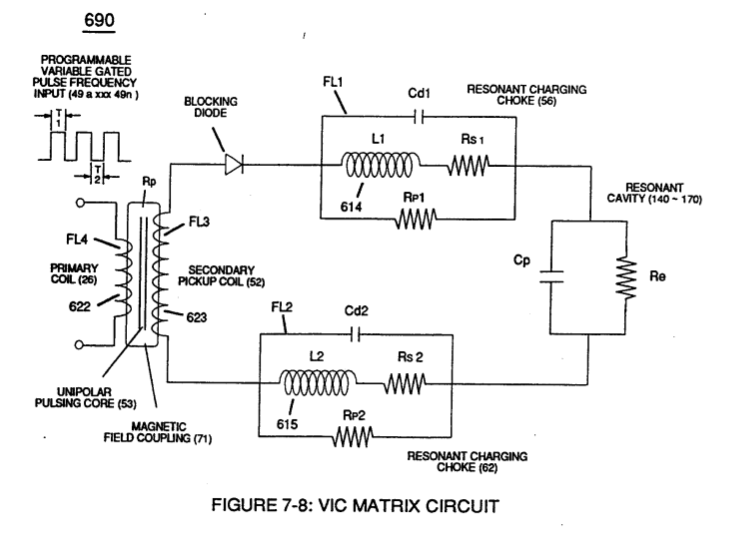
Magnetic Field Coupling (71) of Figure (7-9) entering into and passing through Secondary Coil-winding (52) of Figure (7-8) causes and produces copper ions (643a xxx 643n) (Positive Charged atoms 542a xxx 542n having missing electrons) when moving external electromagnetic field strength (71a xxx 71n) is sufficient enough to dislodge electromagnetically charged electrons (641a xxx 641n) from copper atoms making up copper wire materi …
WFC Atomic Degaussing Process 6×
-
particle (542)
… gure (5-10) existing within the nucleus of the atom functions as a “Energy Regulator” (orbital velocity attenuator) since the overall electrical bonding force (zz') of the orbital sub-particle(s) (542) of Figure (5-8) (geometrically grouped together) is directly linked to the Energy Aperture (7) by way of electrical intensity (qq') (electrical attraction force that exists between Opposite charged m …
-
sub-particle (542)
… portal (functioning as an Energy One-Way Gate Valve) to allow additional energy to pass into (via energy pathway zz' or aa') the Energy Spectrum of the Atom until the nucleus orbital sub-particle (s) (542) returns to the proper energy level needed to sustain and maintain the atom at a stable state of equilibrium, once again. …
-
… At stable state of equilibrium, the orbiting sub-particles (542) of the nucleus of the atom are at a “Balance State of Condition”
-
sub-particle (542)
… meaning that the orbital pathway(s) of the orbiting sub-particle(s) (542) (geometrical configuration) are moving in a circular motion about the axis of the Energy Aperture (7) at a constant spin/velocity and that the sub-particles (542) are being displaced uniformly ... …
-
sub-particles (542)
… y(s) of the orbiting sub-particle(s) (542) (geometrical configuration) are moving in a circular motion about the axis of the Energy Aperture (7) at a constant spin/velocity and that the sub-particles (542) are being displaced uniformly ... …
-
sub-particle (542)
… and that the electrical intensity (qq') between the orbiting sub-particle(s) (542) and the Energy Aperture (7) of the nucleus of the atom remains constant ... a condition by which the atom is not radioactive.
State of Unbalance 4×
-
Once absorbed, the atom reaches a “State of Unbalance” when the orbital sub-particles pathway (s) (542) of Figure (5-8) are deflected (moved) to a higher energy state which, in turns, induces a change in the orbital pathway (s) from an circular to an elliptical configuration since the orbiting sub-particles (542) are regrouped to from a different and distorted arrangement... …
-
… gure (5-8) are deflected (moved) to a higher energy state which, in turns, induces a change in the orbital pathway (s) from an circular to an elliptical configuration since the orbiting sub-particles (542) are regrouped to from a different and distorted arrangement... …
-
sub-particles (542)
This unbalance state of condition(s), now, causes the Energy Aperture (7) to start to oscillate (be elongated repeatedly) in direct relationship to the elliptical pathway of the sub-particles (542).
-
As the orbiting sub-particle (542) approaches the apogee node of the elliptical movement, the Energy Aperture (7) is elongate to a larger opening ... …