patent · US6251687
Fluorescence energy transfer and intramolecular energy transfer in particles using novel compounds
26 June 2001
Page 1 — bibliographic record
(12) United States Patent (10) Patent No.: US 6,251,687 B1 Buechler et al. (45) Date of Patent: *Jun. 26, 2001
(54) FLUORESCENCE ENERGY TRANSFER AND 5,055,414 10/1991 Babb et al. .......................... 436/501 INTRAMOLECULAR ENERGY TRANSFER 5,116,989 5/1992 Hale et al. ........................... 546/265 N PARTICLES USING NOVEL COMPOUNDS 5,123,731 6/1992 Yoshinaga et al. ... 356/73 5,132,206 7/1992 Dreyer ..................................... 435/6 rr. 5,154,887 10/1992 Babb .................... ... 422/56 (75) Inventors: E. she's PE, 5,157,412 10/1992 Kleinschmidt et al. .............. 346/1.1 osepn Barry Noar, Solana Beach; 5,194,393 3/1993 Hugl et al. ........................... 436/525 hy Tadesse, San Diego, all of CA 5,326,692 7/1994 Brinkley et al. ......................... 435/6
FOREIGN PATENT DOCUMENTS
(73) ASSignee: st pagnetis Inc., San Diego, OO75982 4/1983 (EP).
(*) Notice: Subject to any disclaimer, the term of this ES E. SE patent is extended or adjusted under 35 8804777 6/1988 (WO).
U.S.C. 154(b) by 0 days. 9323492 11/1993 (WO).
This patent is Subject to a terminal dis OTHER PUBLICATIONS claimer. Pekcan, O. et al., “Direct Energy Transfer Studies on Doped and Labelled Polymer Latex Particles” Physical Review (21) Appl. No.: 08/409,298 Letters 61:641-644 (Aug. 1, 1988). (22) Filed: Mar. 23, 1995 Stryer, Lubert, “Fluorescent Energy Transfer AS A Spectro
Molecular Probes Ad entitled “Novel Fluorescent Latex
Related U.S. Application Data Microspheres-Tranfluospheres A Breakthrough in Latex (63) Continuation-in-part of application No. 08/311,098, filed on Microsphere Technology (1994)”. Sep. 23, 1994, now Pat. No. 5,763,189, and a continuation Wheeler, B.L. et al., “A Silicon Phthalocyanine and a Silicon in-part of application No. 08/274,534, filed on Jul. 12, 1994, Naphthalocyanine: Synthesis, Electrochemistry, and Elec and a continuation-in-part of application No. 08/138,708, trogenerated Chemiluminescence,” J. Am. Chem. SOc. filed on Oct. 18, 1993, now abandoned, and a continuation in-part of application No. 08/126,367, filed on Sep. 24. 106:7404–7410 (1984).
1993, now abandoned.
Primary Examiner Jyothsna Venkat (51) Int. Cl." ........................ G01N 33/543; G01N 33/53; ASSistant Examiner P. Ponnalun B05B 5/00 (74) Attorney, Agent, or Firm-Foley & Lardner (52) U.S. Cl. .......................... 436/518; 436/528; 436/529; (57) ABSTRACT
435/7.1; 435/7.5; 435/7.92; 427/157; 427/213.34 The invention describes the particles comprising an energy (58) Field of Search .............................. 435/6, 70, 1, 7.5, donor as a first component and a fluorescent dye as a Second 435/7.92; 436/518, 528, 529, 520, 531, component positioned in Said particles at an energy 546,800; 427/213.34, 157; 428/402.24, eXchanging distance from one another, wherein the two 407; 252/301.34, 301.35 components have a Stokes shift of greater than or equal to
50 nm, Said particle having bound on its Surface, a protein, polypeptide, nucleic acid, nucleotide or protein containing
novel fluorescent dyes are described which exhibit intramo 3.996,345 12/1976 Ullman et al. ......................... 424/12 lecular energy transfer for use to label various molecules, 4,166,105 8/1979 Hirschfield ..... ... 424/8 proteins, polypeptides, nucleotides and nucleic acids or to 4,199.559 4/1980 UIlman et al. . ... 424/8 incorporate into particles.
4,542,104 9/1985 Stryer et al. ... ... 436/536 4,666,862 5/1987 Chan .......... ... 436/5O1 4,777,128 10/1988 Lippa ....................................... 435/5 136 Claims, 8 Drawing Sheets
Page 2
Drawing sheet — no readable text.
Page 3
Drawing sheet — no readable text.
Page 4
Drawing sheet — no readable text.
Page 5
Drawing sheet — no readable text.
Page 6
Drawing sheet — no readable text.
Page 7
Drawing sheet — no readable text.
Page 8
Drawing sheet — no readable text.
Page 9
Drawing sheet — no readable text.
Page 10
FLUORESCIENCE ENERGY TRANSFER AND fluorometer to exclude light near the emission wavelength; INTRAMOLECULAR ENERGY TRANSFER however, the use of filters decreases the yield of light IN PARTICLES USING NOVELCOMPOUNDS reaching the detector and generally one circumvents this problem of light loSS by the use of high intensity lamps.
This application is a continuation in part of application Thus, to avoid problems associated with small Stokes shifts Ser. No. 08/274,534 filed Jul. 12, 1994 and of application and dyes which emit near the intrinsic emission of the Ser. No. 08/138,708 filed Oct. 18, 1993, now abandoned and biological fluid, a Sophisticated instrument is generally built. of application Ser. No.08/126,367 filed Sep. 24, 1993, now With the advent of near-patient diagnostics in hospitals, abandoned and of application Ser. No. 08/311,098 filed Sep. there is a need for portable, Simple fluorometers which can 23, 1994 now U.S. Pat. No. 5,763,189 from which priority assess fluorescence in an immunoassay for the detection of is claimed. All of these applications are hereby fully incor analytes in biological Samples.
porated by reference herein. Another problem associated with the assay of analytes in
FIELD OF THE INVENTION
fluids or the Visualization of cellular components with an
intrinsic fluorescence is that of Selection of the dye which is
This invention relates generally to the Synthesis of novel utilized as the label. The dye is generally chosen for its dyes and labels and methods for the detection or visualiza brightness (the product of fluorescence quantum yield and tion of analytes and more Specifically to fluorescent lateX extinction coefficient) since a certain Sensitivity in the assay particles which incorporate the novel fluorescent dyes and or the Visualization technique is required. However, the utilize, in certain aspects, fluorescence energy transfer and selection of the dye used as the label is limited when the intramolecular energy transfer, for the detection of analytes Sample has an intrinsic fluorescence because the instrument in immunoassays or in nucleic acid assayS. may not be capable of distinguishing Sample fluorescence from dye fluorescence.
BACKGROUND The current invention provides a methodology for the Various methodologies are available for the Visualization 25 can be tunedoftoamplified development fluorescent label systems which
Specific excitation and emission wave of cells or molecules in cells and for the measurement of analyte concentrations in fluids. Fluorescence microscopy lengths. The of methodology teaches improved methods for utilizes fluorescent dyes, generally connected to Specific incorporation quenching and dyes into particles to minimize fluorescence to maximize fluorescence intensities of the probes, Such as antibodies, for the localization of proteins dye molecules in the particles. In addition, the design and and complexes in cells. For the measurement of analyte synthesis of novel hybrid phthalocyanine derivatives are concentrations, immunoassays have become popular over described which are incorporated the last 40 years because of the specificity of antibodies thesized as water-Soluble moleculesinto particles or are Syn for use as labels and are toward the analyte or target ligand. Radioimmunoassays were developed because the high Specific activity of the directly coupled to proteins, polypeptides, other labels, radionuclide allowed measurement of Very low concentra 35 utilized for theandquantitation nucleic acids the like. The novel dye systems can be tions of analyte. However, because of the concerns for the particular, in biological fluids. of The analytes in fluids, and in novel dye systems can be environment and human health, the use of radionuclides in immunoassays is becoming less popular. The use of tuned to specific exciting and emitting wavelengths. So that enzymes in immunoassays to amplify a Signal has been a low current Sources, Such as light emitting diodes and laser very important advance in the field of immunoassays 40 be diodes, and detectors, Such as photo diodes, and the like, can because their use does not involve environmental or human used in the manufacture of fluorometers which can be health hazards or risks. Enzyme-linked immunoassays, battery powered and portable, for use, for example, in immunoassays dedicated to near-patient diagnostics.
however, can be problematic because the activity of the enzyme is temperature dependent and the instability of the SUMMARY OF THE INVENTION enzyme or the Substrates can result in inaccurate quantitation 45 of the target ligand. Still other immunoassays monitor This invention relates to novel fluorescent particles and fluorescence as the Signal, with or without enzymes, for the novel water soluble fluorescent dyes. These novel particles measurement of analyte concentrations. and dyes can be tuned to specific excitation and emission The characteristics of the fluorescent dyes are very impor wavelengths to accommodate a wide variety of assay or tant when quantifying analyte concentrations in biological 50 Visualization Systems. In yet another aspect of the invention, fluids. For example, when the biological fluid is blood, the methodology teaches improved methods for incorpora Serum or plasma, the intrinsic fluorescence of the fluid tion of dyes into particles to minimize fluorescence quench precludes the use of many dyes. These biological fluids ing and to maximize fluorescence intensities of the dye generally have fluorescence emissions up to 600 nm when molecules in the particles through the use of different dye exciting at various wavelengths above 200 nm. The fluo 55 molecules which possess the same or very Similar excitation rescence is generated by excitation of the dye at the appro and emission wavelengths.
priate wavelength. The fluorescent Signal is measured by a Many novel phthalocyanine derivatives and hybrid pha fluorometer which is tuned to excite the fluorescent mol locyanine derivatives are disclosed and claimed. In one ecule at a Specific wavelength and to measure the emission embodiment microparticles are disclosed having at least one of fluorescence at another wavelength. The difference in the 60 hybrid phthalocyanine derivative, said derivative(s) having excitation and emission wavelengths is referred to as the (1) at least one donor Subunit with a desired excitation peak; Stokes shift. To achieve the most Sensitive measurement, the and (2) at least one acceptor Subunit with a desired emission emission wavelength of the Sample should not interfere with peak, wherein said derivative(s) is/are capable of intramo the emission of the dye. Also, the Stokes shift should be as lecular energy transfer from Said donor Subunit to Said large as possible So that the excitation light is not seen by the 65 acceptor Subunit.
detector as a background Signal. When the Stokes shift is not In another embodiment, water soluble hybrid phthalocya large, filters or monochromators can be utilized in the nine derivatives are disclosed having (1) at least one donor
Page 11
Subunit with a desired excitation peak; and (2) at least one Brightness is the product of the extinction coefficient and the acceptor Subunit with a desired emission peak, wherein Said quantum yield of the dye. Fifth, the instrument used to detect derivative(s) is/are capable of intramolecular emergy trans the fluorescent Signal is generally designed around the fer from Said donor Subunit to Said acceptor Subunit. Such Specifications of the dye and the Specimen or Sample being derivatives also may contain an electron transfer Subunit. Visualized or assayed.
Axial ligands may be covalently bound to the metals con These points will be discussed in more detail and illustrate tained in the hybrid phthalocyanine derivatives. Numerous Some of the intricacies in developing a fluorescent visual compounds capable of intramolecular energy transfer as ization technique or an assay using fluorescent dyes. One is well as compounds for fluorescence energy transfer are limited either to dyes which have been synthesized or ones claimed. which must be synthesized in order to meet the above criteria. Using prior art methods, a very limited range of
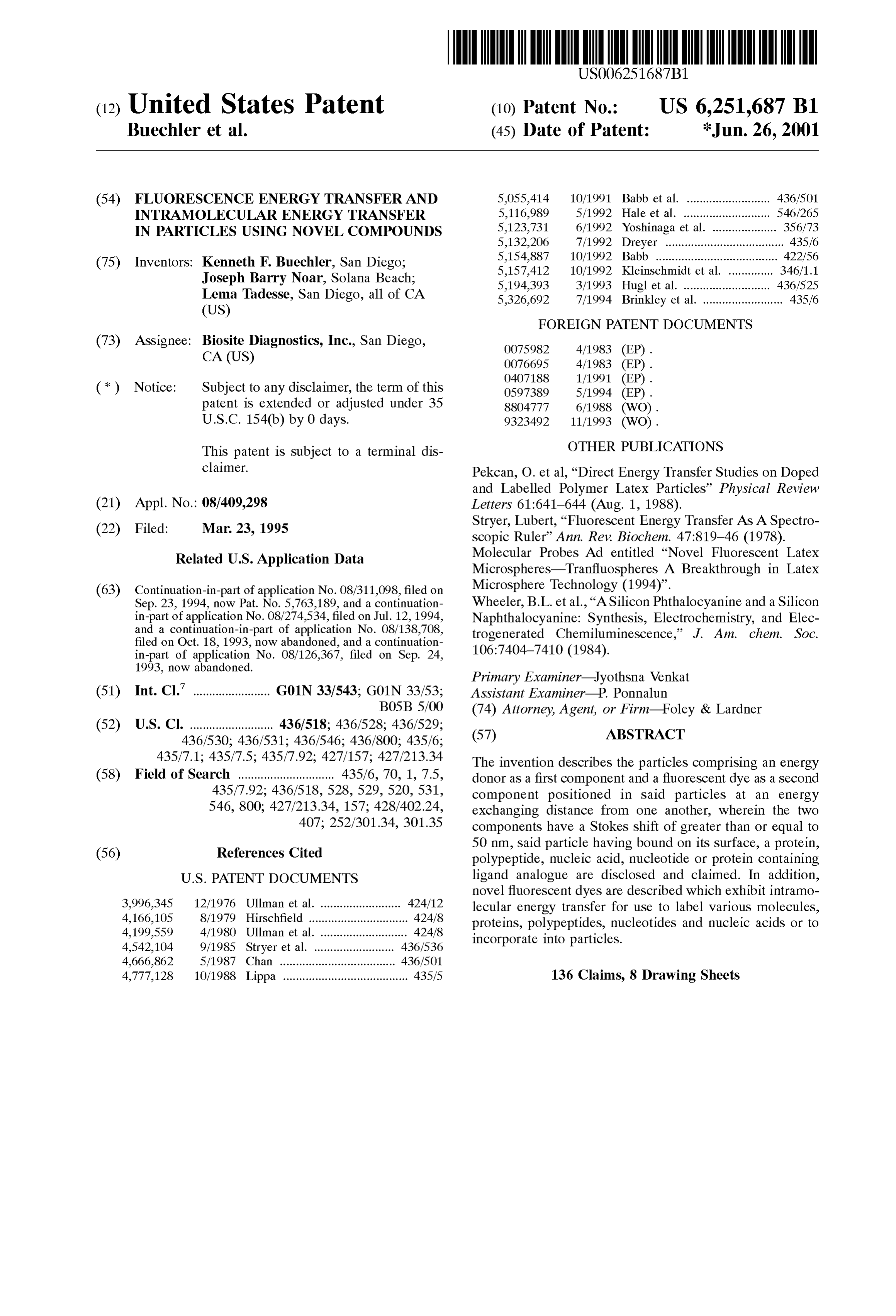
DESCRIPTION OF THE DRAWING excitation and emission wavelengths can be planned for a FIG. 1 depicts the Structures of phthalocyanine, naphtha Specific molecule. The teachings of this invention allow one locyanine and anthranylocyanine. to prepare fluorescent dyes and labels which can be tuned to 15 many excitation and emission wavelengths allowing for
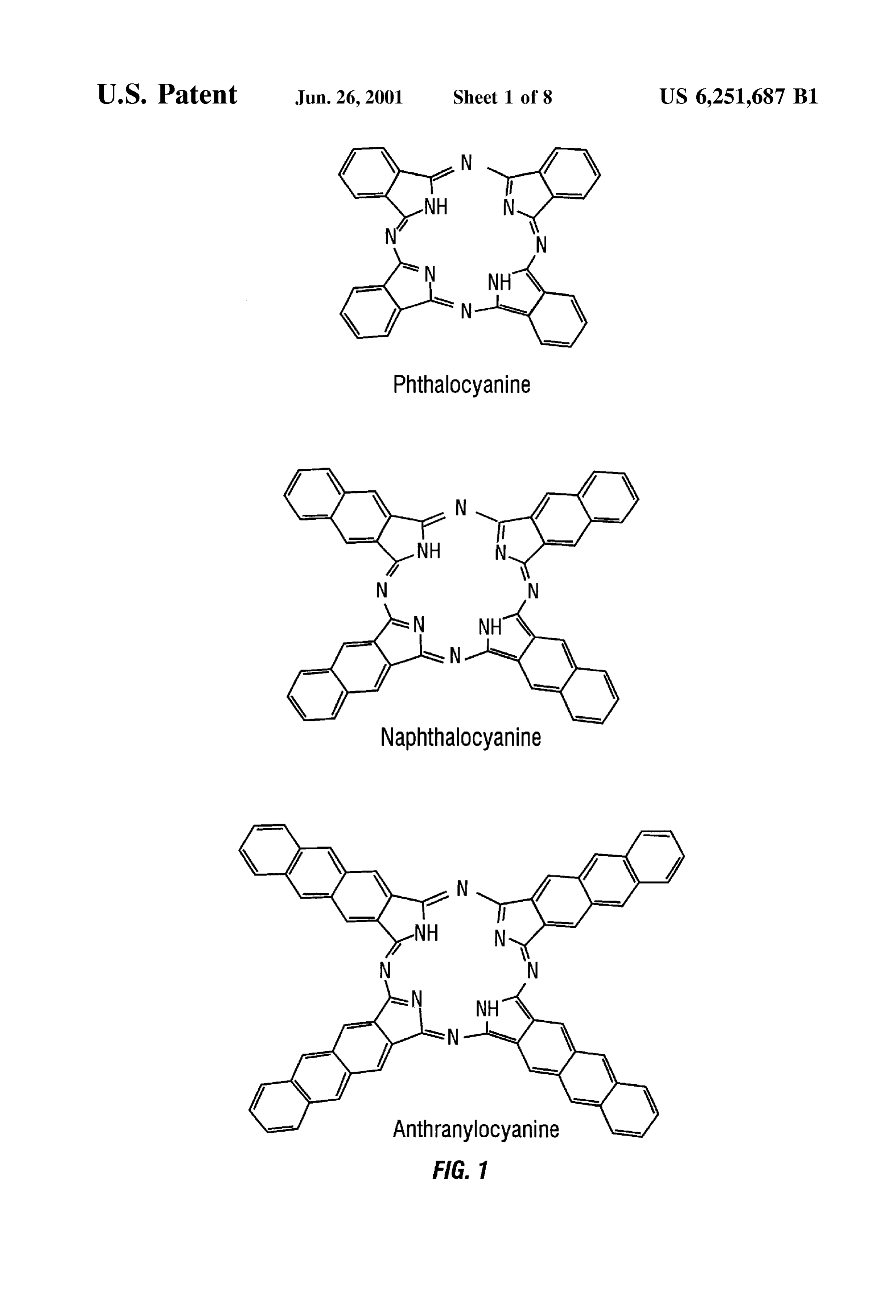
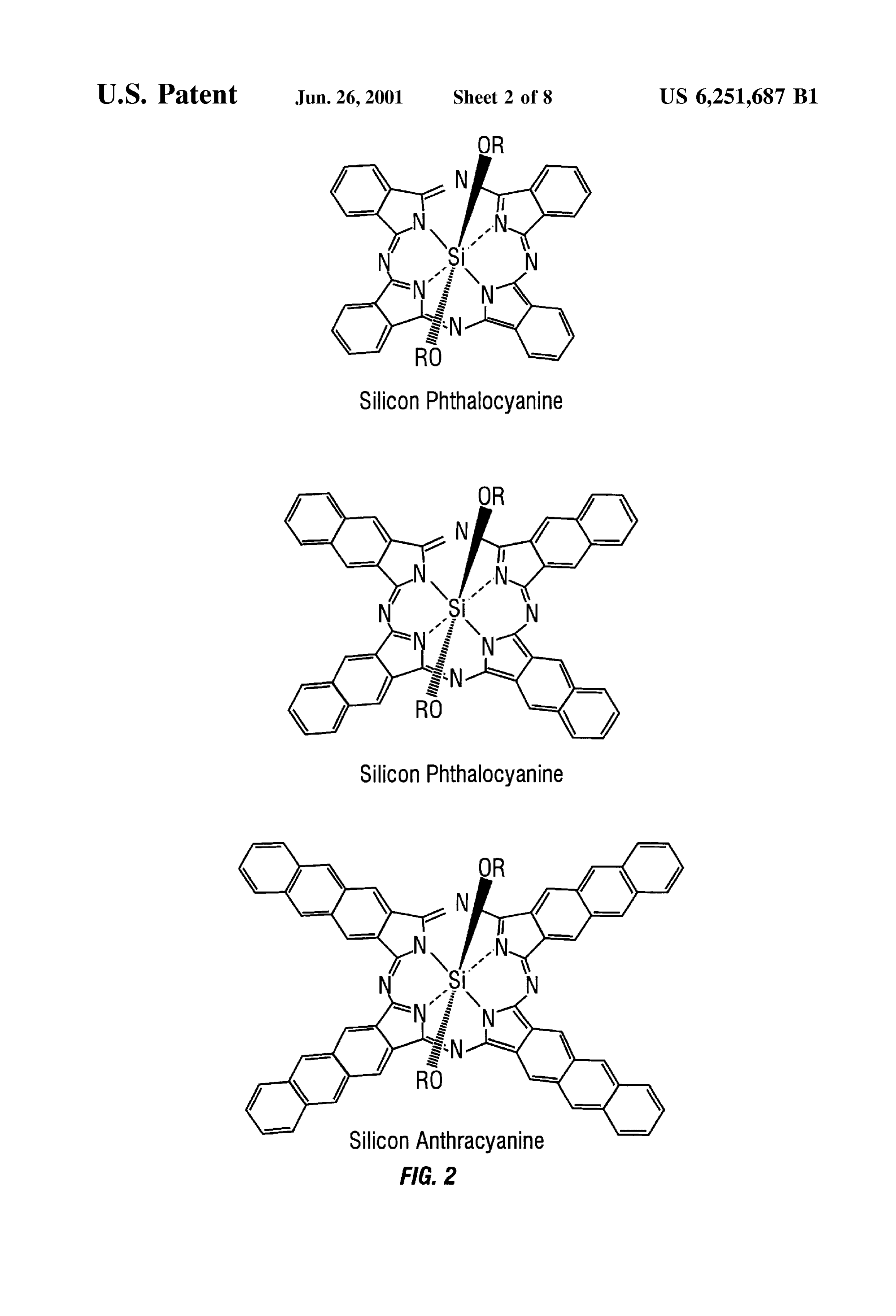
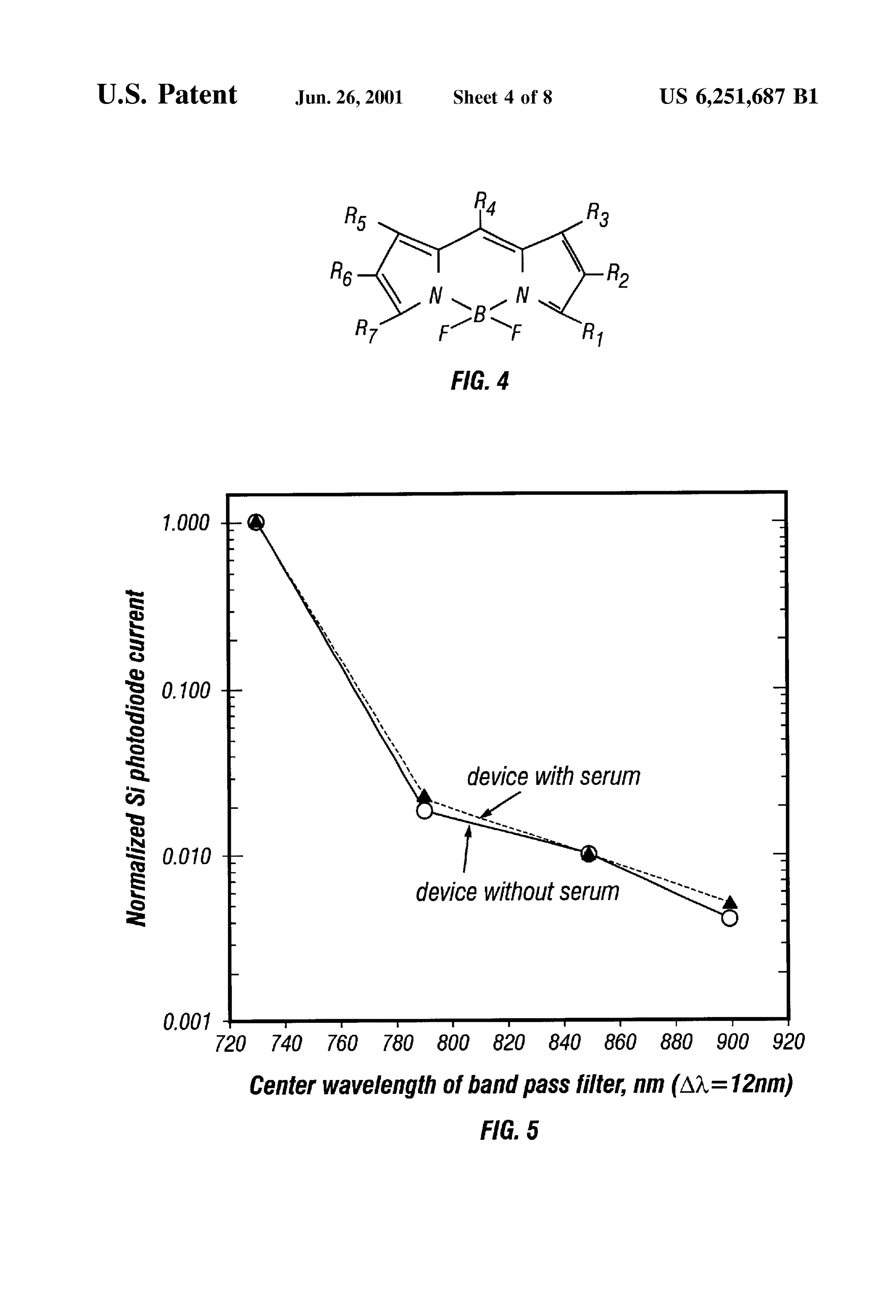
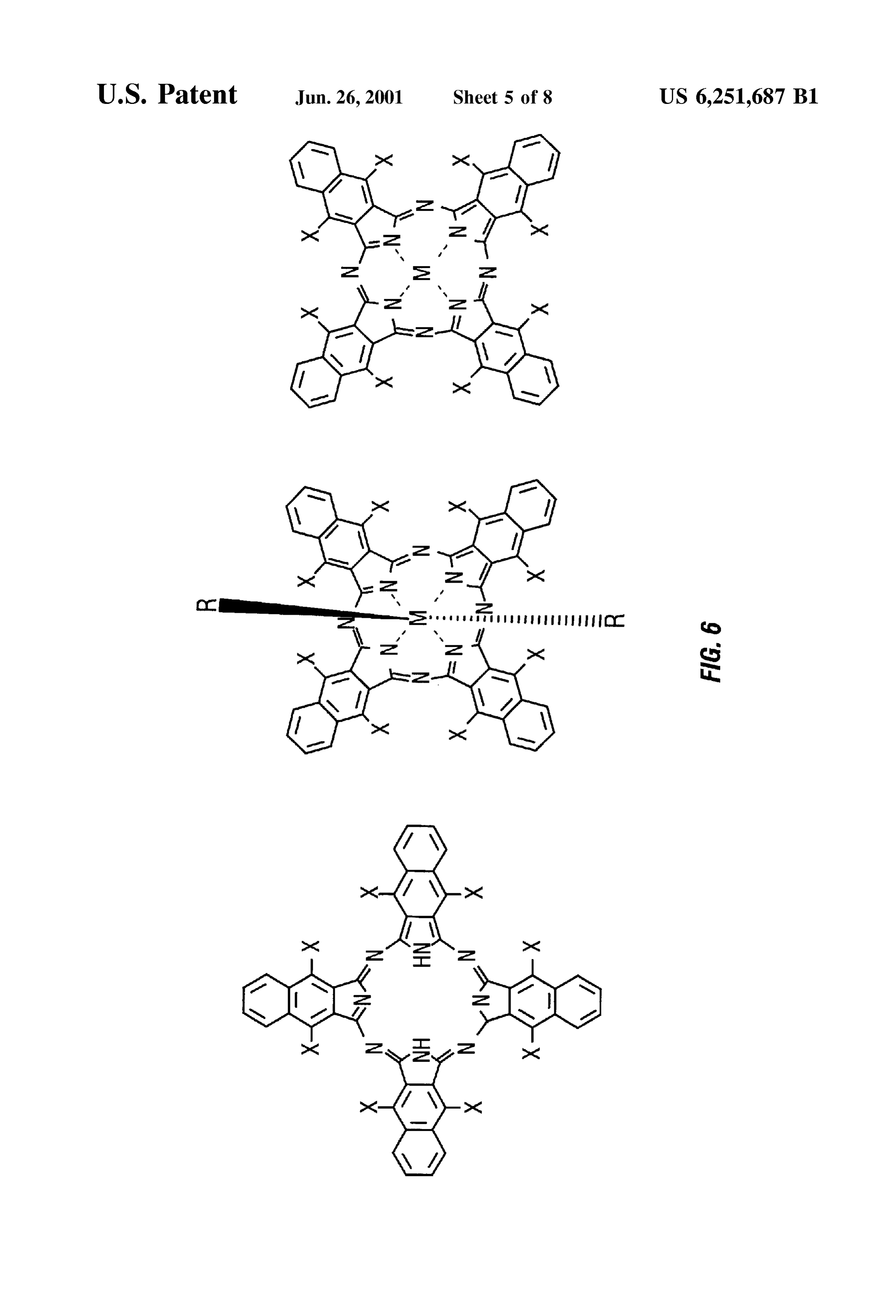
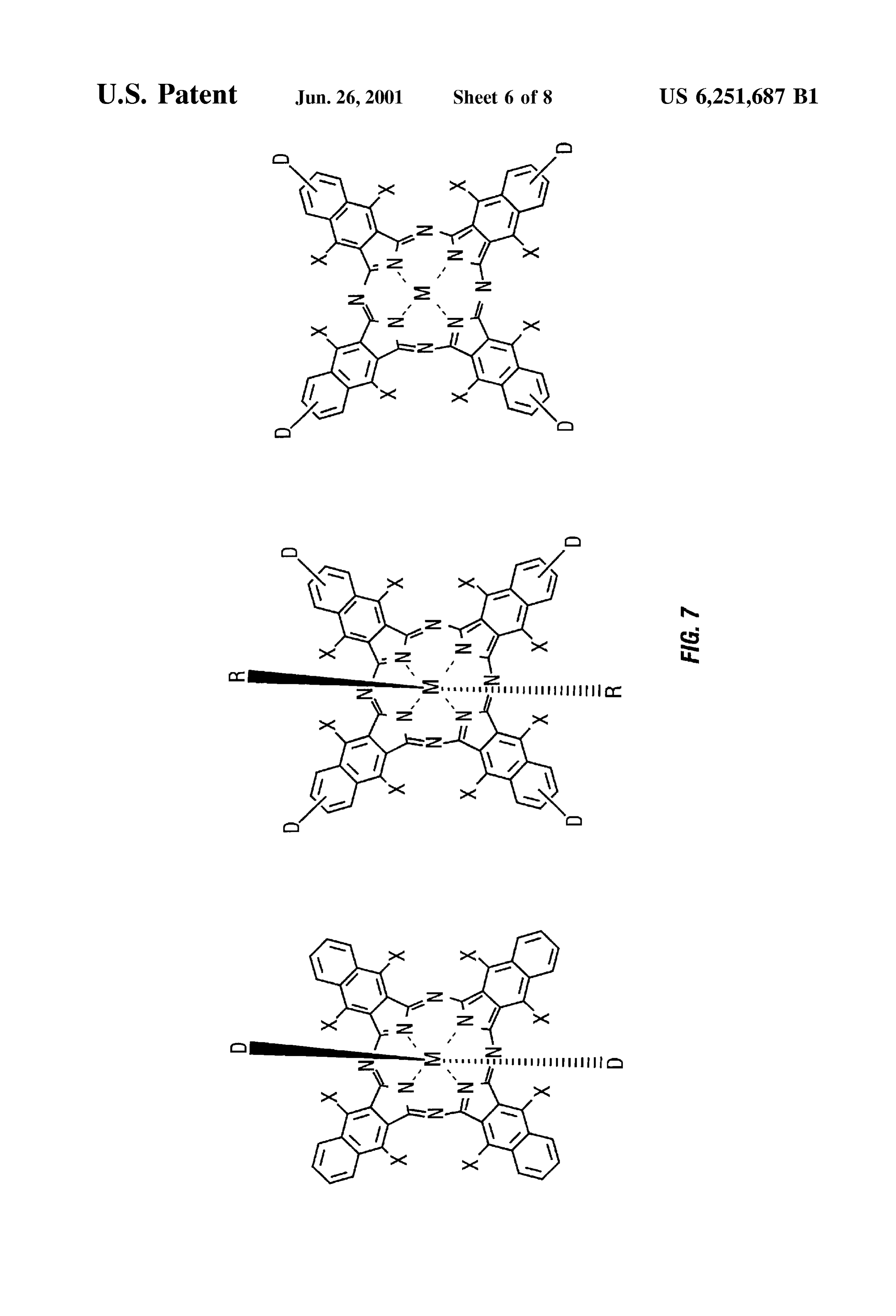
FIG. 2 depicts the Structures of Silicon phthalocyanine, large Stokes shifts. Thus, designing a dye System with the Silicon naphthalocyanine and Silicon anthranylocyanine. Specifications of the sample or Specimen and the instrument FIG. 3 depicts the spectra of silicon phthalocyanine is possible from the teachings of this invention, as opposed dihydroxide and the Spectra of Silicon 2,3-naphthalocyanine to the prior art methods which involve designing the instru dihydroxide. ment around the Specifications of the dye. Tuning the dye FIG. 4 depicts the general structure of ethenyl-substituted System to accommodate the characteristics of the Sample and dipyrrometheneboron difluoro dyes. the instrument results in an inproved visualization process FIG. 5 depicts the attenuation of the background Signal as for the assay.
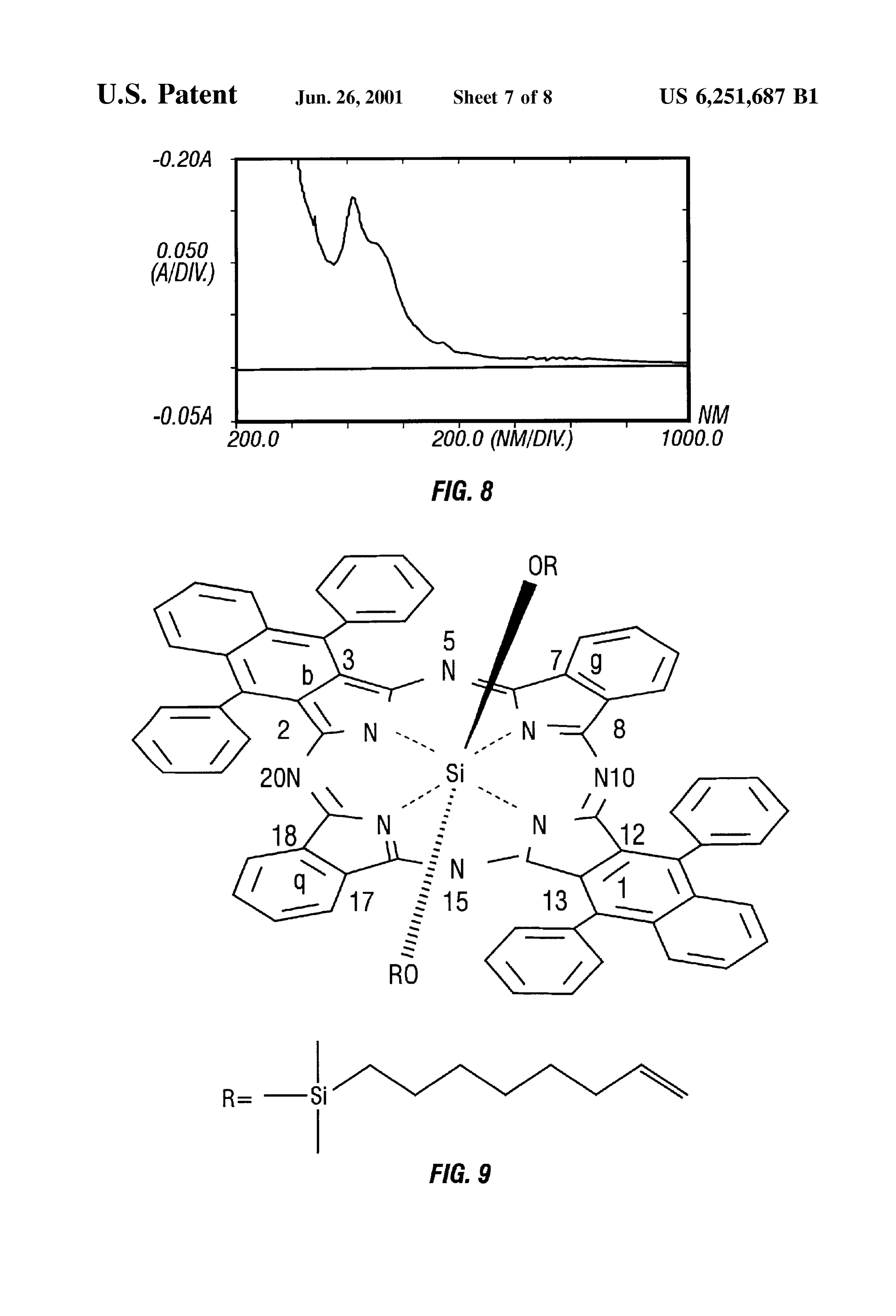
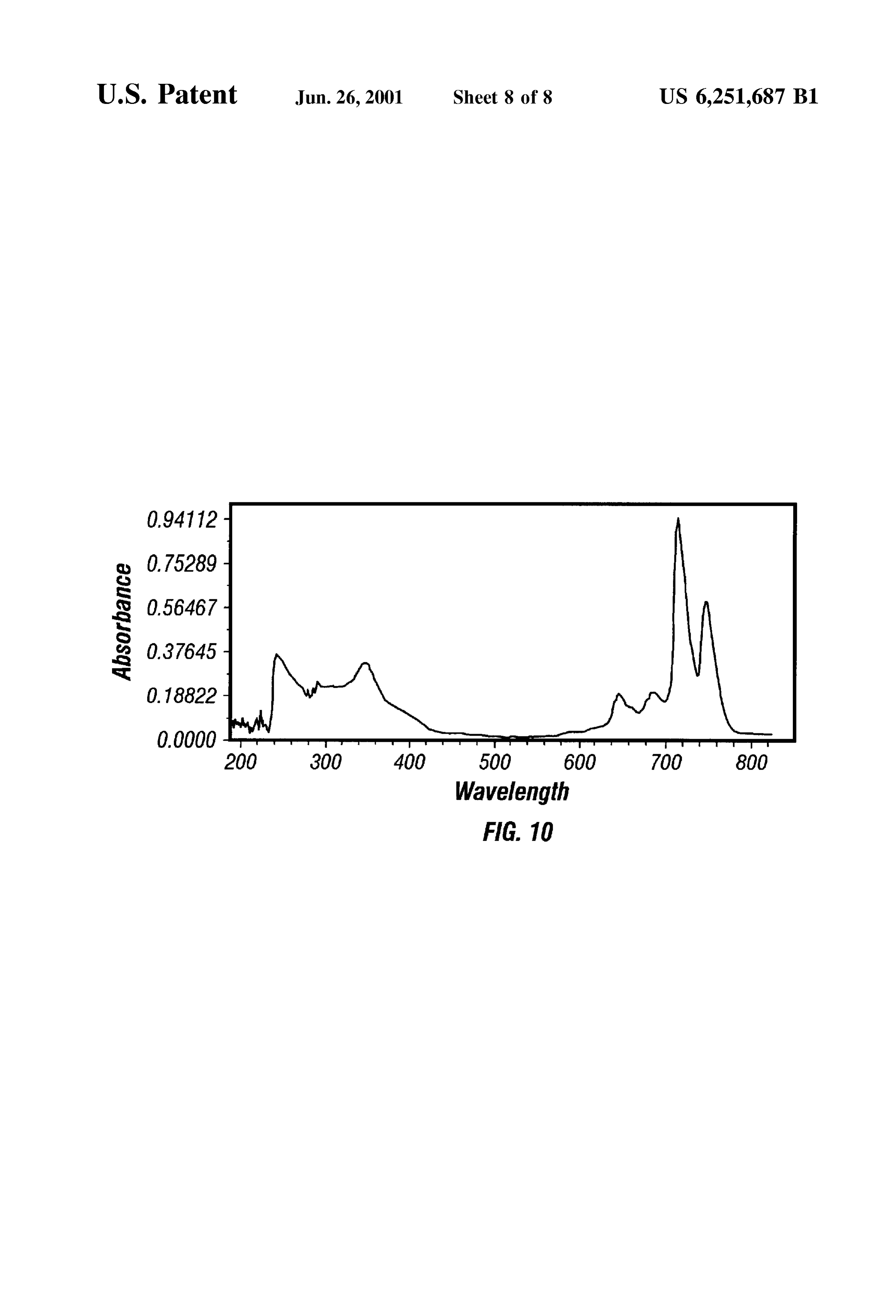
a function of increasing wavelength. The data was measured The excitation and emission wavelengths of the dye using a device as described in Applicant's U.S. Pat. No. 25 should not correspond to those of the Sample being assayed 5,337,343, filed May 21, 1992 entitled “Diagnostic Devices or visualized, otherwise the Sample can interfere with the and Apparatus for the Controlled Movements of Reagents measurement of the fluorescent Signal. When absorption or Without Membranes,” which is hereby fully incorporated emission wavelengths of the Sample do correspond to those herein. of the dye, in practice, one dilutes, for example, a Serum or FIG. 6 depicts naphthalocyanine derivatives which emit blood Sample So that the interference by the Sample is in the near infrared. reduced or the interfering Sample is washed away from the FIG. 7 depicts general Structures of fluorescent energy detection area. Indeed, currently, there is no fluorescent assay System on the market for the measurement of analytes transfer naphthalocyanine compounds. in neat biological fluids, particularly blood, plasma or FIG. 8 depicts the absorbance spectrum of human serum 35 Serum. One reason for the lack of fluorescent assay Systems between 200 nm and 1000 nm. which detect analytes in neat Samples is that no good FIG. 9 depicts the structure of a novel hybrid phthalo fluorescent dye exists which meets all the criteria listed cy a nine derivative, Silic on Idi (1,6- above, particularly for measuring fluorescence in biological diphenylnaphthalocyanine) diphthalocyanine bis Samples. When the Sample absorbs significantly at the (dimethylhexylvinylsilyloxide). 40 excitation wavelength the amount of light which excites the FIG. 10 depicts the spectrum of Silicon di(1,6- Sample is thus affected by the variation in the Sample diphenylnaphthalocyanine) diphthalocyanine bis characteristics. For example, Serum, plasma, or blood from (dimethylhexylvinylsilyloxide). different individuals will be different in their relative
DETAILED DESCRIPTION OF THE
absorptivities, which differences translate into different 45 intensities of excitation light Used to excite the fluorescent
PREFERRED EMBODIMENTS label. The fluorescence emission of the dye is directly This invention describes novel fluorescent particles and proportional to the intensity of the incident light, Such that novel fluorescent molecules and diagnostic methods for their when the Sample absorbs a portion of the incident light, the use. Developing a method for the Visualization of a cellular intensity of the fluorescent Signal will vary accordingly. This component or a cell or for an assay which utilizes a 50 results in measuring an incorrect or effected fluorescence fluorescent dye and which quantifies an analyte in a Sample emission. In addition, the emission wavelength of the dye requires the use of a fluorometer. The fluorescent label, the should not correlate with the emission or absorbance of the Sample and the instrument must be compatible with each Sample because the Sample will increase the measured other to achieve an accurate measurement. Several criteria fluorescence of the dye or the sample will absorb all or a for a fluorescent label as they relate to the Sample and 55 portion of the dye fluorescence and also result in an incorrect instrument are described below. First, the absorption or or effected fluorescence emission. These problems are excitation and emission wavelengths of the dye should not avoided when the sample is invisible to the excitation and correspond So closely to the absorption or fluorescence of emission wavelengths.
the Specimen or Sample Such that the Sample affects the FIG. 8 shows the spectrum between 200 nm and 1000 nm fluorescence measurement of the dye. Second, the Stokes 60 of human serum. Wavelengths above 600 nm absorb con shift of the dye should be as large as possible to minimize siderably less than those between 200 nm and 600 nm. Thus, the measurement of background from the excitation wave both the absorption of the incident light and the effect on the length. Third, the dye must be compatible with the phase of fluorescence of a dye are minimal when exciting above 600 the Visualization or the fluid phase of the assay; that is, the nm. Preferred excitation wavelengths for biological fluids, dye must be water Soluble or water insoluble depending on 65 including urine, blood, Serum or plasma is 600 nm or greater. the visualization or assay format. Fourth, the dye should be Particularly preferred excitation wavelengths above 600 nm as bright as is necessary to achieve the desired Sensitivity. are those which correspond to the maximum light output of
Page 12
S 6 laser diodes and light emitting diodes. Preferred emission come the loSS in light intensity due to the filters, for example, wavelengths are those above 600 nm. The intrinsic sample one requires the use of high powered light Sources. These fluorescence can cause a high background Signal if the light Sources produce heat which must be dissipated in an emission wavelength of the dye and the Sample are over instrument by using heat SinkS or fans. The complexity of the lapping. In addition, the Scattered light of the excitation fluorescence measuring device, both from an optical and a Source can also contribute to the background Signal. The mechanical perspective, is thus greatly affected by the contribution of Scattered light to the background can be seen, inadequacies of the dye system. With the advent of near for example, in FIG. 5. In general, the magnitude of the patient testing in hospitals and emergency departments, Scatter is inversely proportional to the fourth power of the instruments which measure fluorescence in immunoassays measured wavelength. This teaches that desired emission will be required to be portable and uncomplicated to the wavelengths are in the near-infrared or in the infrared region technician. Thus, the future State of the art for the manu of the Spectrum. The inventive teachings described herein facture of, for example, fluorometers which are employed provide for dyes and dye systems which excite above 600 for immunoassays will be required to change to Simple and nm and which emit above 650 nm and more preferred, above portable instruments. The high powered light Sources and 730 nm. 15 expensive optics currently incorporated into fluorometers The Stokes shift of the dye should be as large as possible will not meet the requirements for Small, portable instru to minimize the measurement of background from the mentS.
excitation Source So that the Signal-to-background ratio at The instant invention teaches that fluorescent labels can the limit of Sensitivity is maximized. A large Stokes shift, be prepared with large Stokes Shifts and be tuned to wave however, will only maximize the efficiency of the fluores lengths both of which are compatible with excitation Sources cence measurement and may not always result in an accurate and emission detectors and which are compatible with the fluorescence measurement. For example, table 3 shows data absorption and emission of the Sample, for example, blood, from several dye systems which were excited between 420 Serum, plasma, urine, ground water, and the like. The nm and 670 nm in either buffer, undiluted human serum and blood. The fluorescence intensity of the first dye system (line 25 excitation and emission wavelengths of the novel fluorescent dyes and particles can generally be varied independently of 1, table 1), when excited at 475 nm in serum and blood, is each other.
only 7.6% and 13%, respectively, of the intensity in buffer The dye must be compatible with the fluid phase of the even though the Stokes shift is 205 nm. The second dye assay, system (line 4, table 1), excited at 420 nm, is 28% and 4% water or in other words, the dye must be water Soluble or insoluble depending on the Visualization or assay in Serum and blood of the intensity in buffer, respectively, with a 260 nm Stokes shift. The third and fourth dye systems water format. Many fluorescent dyes are water insoluble or poorly (line 60 and line 59, table 1), excited at 670 nm and 650 nm molecules, Soluble and these dyes are not easily used for labelling and with 110 nm and 130 nm Stokes shifts, respectively, art will recognize proteins, nucleic acids or cells. One skilled in the have fluorescence intensities which are comparable in buffer rated that water insoluble dyes can be incorpo and in serum. The fifth dye system (line 107, table 1), 35 4,326,008, 4,609,689 andas5,154,887, into latex particles described in U.S. Pat. Nos.
which are hereby excited at 670 nm with a 90 nm Stokes shift, has floures cence intensities which are also comparable in buffer, Serum incorporated by reference. Thus, water insoluble dyes can be and blood. The sixth dye system, which is a hybrid phtha made useful by incorporation into lateX particles for Visu locyanine derivative (line 1, table 2), has comparable fluo alization in a variety of assay formats. rescence intensities in buffer, Serum and blood when excited 40 The dye should be as bright as is necessary to achieve the at 646 mm with a Stokes shift of 114 nm. The data show that desired sensitivity. If one knows the extinction coefficient the fluorescence intensity is greatly affected when the exci and the quantum yield of the dye and the concentration of tation wavelength is within the range of the absorbance of the target to be measured, it can be estimated whether the the sample in which the measurement is made. The data also dye is bright enough to achieve the desired Sensitivity. show that the magnitude of the Stokes shift does not have an 45 Incorporation of dyes into lateX particles or the utilization of influence on the accuracy of the measurement. These data an enzyme which catalyzes the production of a fluorescent are representative of other dyes and dye systems which are Substrate are examples of techniques which one skilled in excited at a wavelength where the Sample absorbs. The the art uses as amplification Systems.
effect of the decreased fluorescence emission is not a result The instrument used to detect the fluorescent signal is of the emission wavelength (that is, 680 nm or 780 nm) 50 generally designed around the Specifications of the dye and because the samples absorb minimally at 680 nm and 780 the Specimen or Sample being visualized or assayed because nm. One skilled in the art can appreciate, that with the of the limited numbers of dyes which can be successfully inventive teachings described herein, the wavelengths for used. AS discussed above, the components of the instrument excitation and emission of a dye system should be a function are Selected for a particular dye system since a useful more of the absorption and emission characteristics of the 55 instrument must be highly tuned to eliminate the light from Sample rather than Selecting only a dye system with a large the excitation Source.
Stokes shift. Each of the conditions described above impose limitations The availability of dyes with Stokes shifts greater than on dye systems which can be employed for measuring 100 nm is greatly limited, particularly when the excitation Sub-picomolar concentrations of analytes, particularly in wavelength is greater than 600 nm. To further limit the 60 biological fluids. The limitations also impose restrictions on usefulness of available dyes, the solubility of the dyes in the design of an instrument to measure the fluorescence. The aqueous Samples can be a problem because most dyes with novel teachings of the instant invention allow the design, large Stokes shifts are water insoluble. Synthesis and tuning of dye Systems to match, generally, The problem of a dye possessing a Small Stokes shift is nearly any instrument design.
usually overcome in the engineering of the fluorometer by 65 Several inventive teachings are described for tuning exci the use of monochromators or expensive optics which filter tation and emission wavelengths of dyes So that the excita out the light from the excitation Source. However, to over tion and emission are compatible with the Sample matrix in
Page 13
which the fluorescence is measured and the instrument for should be related to the Specific use of the particles, the quantifying the fluorescence. One teaching is to either Sample to be analyzed and the instrument for measuring the incorporate or adsorb at least two dyes into or onto particles, fluorescence. For example, when developing an assay for an which, as a pair, exhibit fluorescence energy transfer. The analyte in a biological medium, Such as blood, Serum or a particles which can be used are those which adsorb dyes on cell extract, the intrinsic absorbance and fluorescence of the the Surface or absorb or imbibe dyes inside the particle. Sample must be considered. Serum and cellular components Another teaching is to incorporate dyes which are covalently absorb in the ultraviolet spectrum as well as in the visible attached to each other and which also exhibit fluorescence Spectrum up to around 600 nm and the intrinsic fluorescence energy transfer both in Solution and in particles. can broadly approach 600 nm. In addition, Samples which Another teaching is to incorporate hybrids of contain Small particles, Such as dirt particles in ground phthalocyanines, naphthalocyanines, anthranylocyanines water, lipoproteins in Serum or blood, cells and cellular (collectively termed hybrid phthalocyanine derivatives) and particles and components will Scatter the excitation light various derivatives of these classes of compounds which which results in a higher background Signal. The ideal dye have different Subunits depending on the desired excitation couple would include the donor dye which would be excited or emission wavelengths. The hybrid phthalocyanine deriva 15 or absorb at above 600 nm and emit at a wavelength which tives may also be Synthesized as water Soluble compounds the acceptor dye absorbs, and the acceptor dye should emit to be used for direct attachment to proteins, polypeptides at a wavelength above 600 nm. In the case of a single dye other labels or nucleic acids. One advantage of hybrid System, for example, with the use of hybrid phthalocyanine phthalocyanine derivatives is that they allow one to create derivatives, the excitation and emission wavelengths should dyes and dye systems which have greater Stokes shifts with also be above 600 nm. The sample, for example, serum, then higher extinction coefficients at the excitation wavelength. does not affect fluorescence of the acceptor dye because the This is accomplished by properly Selecting the Subunits Sample poorly absorbs at the absorption of the donor dye and which are to be tetramerized to form the hybrid phthalocya the acceptor dye emits at a wavelength where the Sample nine derivative structure and which will absorb the light at does not absorb or fluoresce.
the excitation wavelength. 25 Fluorescent dye molecules incorporated into or onto par The Selection of dye pairs for incorporation into particles ticles will exhibit fluorescence quenching because of the is based on their ability to exhibit energy transfer (singlet close proximity of the dyes to each other and to the matrix Singlet energy transfer) at the appropriate excitation wave of the particle. When loading dyes into or onto particles, one length of the donor dye and the emission of the acceptor. must optimize the concentration of dye as it relates to Fluorescence energy transfer of two molecules is well quenching. The dyes can be loaded Successively or together. known to those skilled in the art and the rate of energy The degree of quenching can be quantified by measuring the transfer is described by Forster in Ann. Physik. (1948) fluorescence emission of a dilute Suspension of particles 2,55-75. Fluorescence energy transfer has been used as a (about 0.001% to 0.1% solids) in a buffer solution, in a Spectroscopic ruler to predict proximity relationships in buffered protein Solution or in water and then also measuring proteins, RNA and peptides (Annual Review of Biochem 35 the fluorescence of the same concentration of particles in istry (1978), 47,819–846) and also to probe geometrical solvent which liberates the dyes from the particles. The ratio details in particles (Physical Review Letters (1988) 61, of the fluorescence intensities (1-fluorescence intensity of 641–644). U.S. Pat. No. 5,326,692 describes fluorescent incorporated dyes divided by the intensity of liberated dyes particles with controllable enhanced Stokes shifts. U.S. Pat. is the degree of quenching of the dyes in the particle. In Nos. 4,542,104 and 4,666,862 describe fluorescence energy 40 practice, one incorporates dyes at various concentrations and transfer in phycobiliproteins. These dye complexes are measures the fluorescence intensities of the incorporated and described for use as labels in immunoassays. The limited liberated dyes to optimize the intensity of fluorescence of the use, however, of phycobiliproteins and the expense of these particle while minimizing the quenching of fluorescence in natural protein complexes make them undesirable for use on the particle. In a Situation where more than one acceptor dye a commercial Scale. Some unsymmetrical or hybrid phtha 45 is used to minimize fluorescence quenching and to maximize locyanines have been described, for example, in J. Am. fluorescence intensity, one may use different acceptor dyes Chem. Soc. 1990, 112, 9640–9641, Chemistry Letters 1992, which have emission peaks which are within about 25 2031–2034 and Inorg. Chem. 1994, 33, 1735–1740, but this nanometers of one another. The emission of both acceptor invention greatly expands the compounds which can be dyes may be useful if the fluorometer is set-up to measure a Synthesized for use in immunodiagnostics to achieve 50 wide band pass of fluorescence, for example, about a 20 to adequate fluorescence intensities and desired excitation and 60 nm bandpass.
emission characteristics. The ratio of the various dimi Another important consideration is the efficiency of the noisoindiline or dicarbonitrile precursors and their Substitu fluorescence energy transfer. In practice, if the energy trans tion by electron donating or electron withdrawing groups in fer efficiency is not close to 100%, then one can observe the the Synthesis of the hybrid phthalocyanines, naphthalocya 55 fluorescence of the donor dye. The resulting fluorescence of nines and anthranylocyanines will affect the absorption the donor dye can make the particles undesirable or even Spectrum and the excitation and emission wavelengths of the useless because the “effective Stokes shift” (that is, the compounds. This is taught and applied to the novel dyes Shortest wavelength distance to a light Source from the herein. defined acceptor molecule emission wavelength in the fluo In one aspect, the novel fluorescent particles of this 60 rescence System) of the particles is now not the difference invention are composed of at least two dyes which are between the excitation and emission wavelengths of the positioned in the interior or on the exterior of particles at an donor and acceptor dyes, respectively, but rather the differ energy exchanging distance. One skilled in the art will ence between the donor emission and the acceptor emission recognize that various particles can be utilized, Such as latex, wavelengths. The emissions of the donor and acceptor Silica, alumina, liposomes, various colloids and the like. 65 wavelengths can overlap partially with each other when Particularly preferred particles are lateX particles. The Selec efficient energy transfer is not obtained and complicate the tion of the dye molecules for incorporation into the particles Selection of filters for use in a fluorometer. The decrease in
Page 14
the energy transfer efficiency can also be directly related to majority of fluorescent molecules have aromatic character, a decrease in the emission of the acceptor dye, resulting in that is, they possess 4n+2 pi electrons. The resultant aro a particle which may not be as bright as a particle with matic character promotes Stacking of the molecules, espe efficient energy transfer. In addition, under conditions of cially of water insoluble molecules in aqueous Solutions or inefficient energy transfer, Slight changes in the Sample or in in particles in aqueous Solution, which in turn promotes Solution conditions, for example, pH, ionic Strength and the fluorescence quenching. The novel particles described like, may affect the magnitude of energy transfer efficiency herein are incorporated with dyes which, through Steric and thereby may affect the intensity of the fluorescent Signal. interference of the dye molecules, have a minimized pro In Selecting dye pairs for fluorescence energy transfer one pensity to Stack in the particles.
begins by Studying the overlap of the donor emission and 1O In another aspect of this invention, fluorescence quench acceptor excitation wavelengths. The dyes are positioned in the particle at an energy exchanging distance from one ing of dye molecules in particles is minimized by employing another which allows Singlet-singlet energy transfer. emission dyesdifferent with approximately the same excitation and wavelengths. That is, the wavelength maximum for
Although a particular pair of dyes has acceptable overlap ping excitation and emission wavelengths (for example, See 15 about 25 nm of each other soofthatthethere excitation and/or emission different dyes is within is substantial overlap
Proc. Natl. Acad. Sci. USA 1969, 63, 23–30), they may not of the peakS. Different dyes will not Stack exhibit fluorescence energy transfer in particles or they may orientation with each other to the same degreein asandyes organized have suboptimal (less than 80%) efficiency of energy trans are the Same. Incorporating different dyes into orwhich fer. The process to determine whether 2 or more dyes will particles using organic Solvents and then removingonto exhibit efficient energy transfer is through experimentation Solvent causes the dye to precipitate or crystallize in the the after the appropriate spectral overlap criteria are met. The particle. The disruption of the crystalline lattice of dye efficiency of fluorescence energy transfer is determined by molecules in particles alters the Stacking of the molecules measuring the fluorescence intensity of the donor dye alone and thereby reduce quenching. Thus, incorporation of dis in particles and also measuring the fluorescence emission of the particles which have incorporated 2 or more dyes (that 25 Similar dye molecules with Similar excitation and emission is, the fluorescent energy transfer particle) at the emission Spectra improves fluorescence intensities of the particles by decreasing the quenching interactions of the molecules.
wavelength of the donor dye, both Sets of particles having the same concentrations of donor dye and particles. The In another aspect of this invention, incorporation into measured fluorescence at the donor dye emission wave particles of dissimilar dyes which exhibit fluorescence length of the fluorescent energy transfer particles divided by energy transfer in the particles may also disrupt the other's the fluorescence of the donor dye particles is the efficiency crystalline lattice formation. Thus, the fluorescence intensi of fluorescence energy transfer. Ideally, in practice, the ties of particles exhibiting fluorescence energy transfer will emission of the donor dye should be undetectable or only be improved as a result of decreasing quenching in the slightly detectable so that the effective Stokes shift is not particle because the Stacking of similar dyes in the particles reduced because of the donor dye emission. Preferred fluo 35 is disrupted by the dissimilar dye.
rescence energy transfer efficiencies are 80% or greater and In yet another aspect of this invention, the Synthesis of particularly preferred fluorescence energy transfer efficien phthalocyanine derivatives and hybrid phthalocyanine cies are 90% or greater. derivatives with axial ligands reduces the Stacking of the Another important criteria for preparing particles exhib aromatic ring System, thus minimizing the interactions iting fluorescence energy transfer is the Selection of the 40 between molecules and maximizing fluorescence intensities. solvent used to Swell and/or imbibe the dyes. The solvent One skilled in the art can appreciate that more than one System should penetrate the interior of the particle, for dye pair which exhibits fluorescence energy transfer can be example, when using lateX particles, and the dyes should incorporated into or onto particles resulting in a class of also be soluble in the solvent system so that the dyes in the particles which fluoresce at different wavelengths. In Solvent can enter the interior of the particle. Optimization by 45 addition, with the inventive teachings described herein, experimentation is recommended, however, to produce par incorporation into or onto particles of 3 or more dyes, which ticles with energy transfer or with optimum energy transfer. together provide a cascade of energy transfer from the For example, table 6 of Example 67 shows the results of absorber(s) to the intermediate donor(s) to the acceptor(s) fluorescence energy transfer in lateX particles prepared with (which fluoresces), can result in the production of particles dimethylformamide and tetrahydrofuran, both of which 50 with very long Stokes Shifts and allows one to produce Swell lateX particles and dissolve the dyes. particles with nearly an unlimited variety of excitation and When using particles which are not porous, for example, emission characteristics.
Silica or alumina, for fluorescence energy transfer, the Sol FIG. 1 shows preferred acceptor dyes which are vent system should dissolve the dyes but allow the dyes to phthalocyanines, naphthalocyanines and anthranylocya adsorb to the particles. In Some instances, it may be neces 55 nines. FIG. 2 shows particularly preferred acceptor dyes Sary to exchange Solvent Systems to adsorb the dyes, that is, which are derivatives of Silicon phthalocyanines, naphtha the first Solvent System dissolves the dyes in the particle locyanines and anthranylocyanines, where R is hydrogen or Slurry and a Second Solvent is introduced which promotes an alkylcarbon chain from 1-20 carbons, either Saturated or the adsorption of the dyes to the particles. When preparing unsaturated, having 0-10 heteroatoms (N.O.S), and having liposomes which contain energy transfer dyes, ultrasonic 60 0 or 1 siloxide groups. The best mode compounds are those techniques, for example, can be utilized to trap the dyes in in which R= the liposome interior as the liposome is formed. Techniques Si(CH2)CFs for forming liposomes can be found in, for example, LipO Si(CH)
Some Technology, Volumes I-III (1984), ed., G. Gregoriadis, Si(CH)-(CH2)CN
CRC PreSS Inc. 65 Si(CH)-(CH2)COOCH
The novel particles described herein exhibit reduced Si(CH),CH=CH, quenching and improved fluorescence intensities. A large Si(CH)-(CH2)COOH
Page 15
Si(CH2)(CH2)Cl; and and phenylbutadienyl dyes are of the formula:
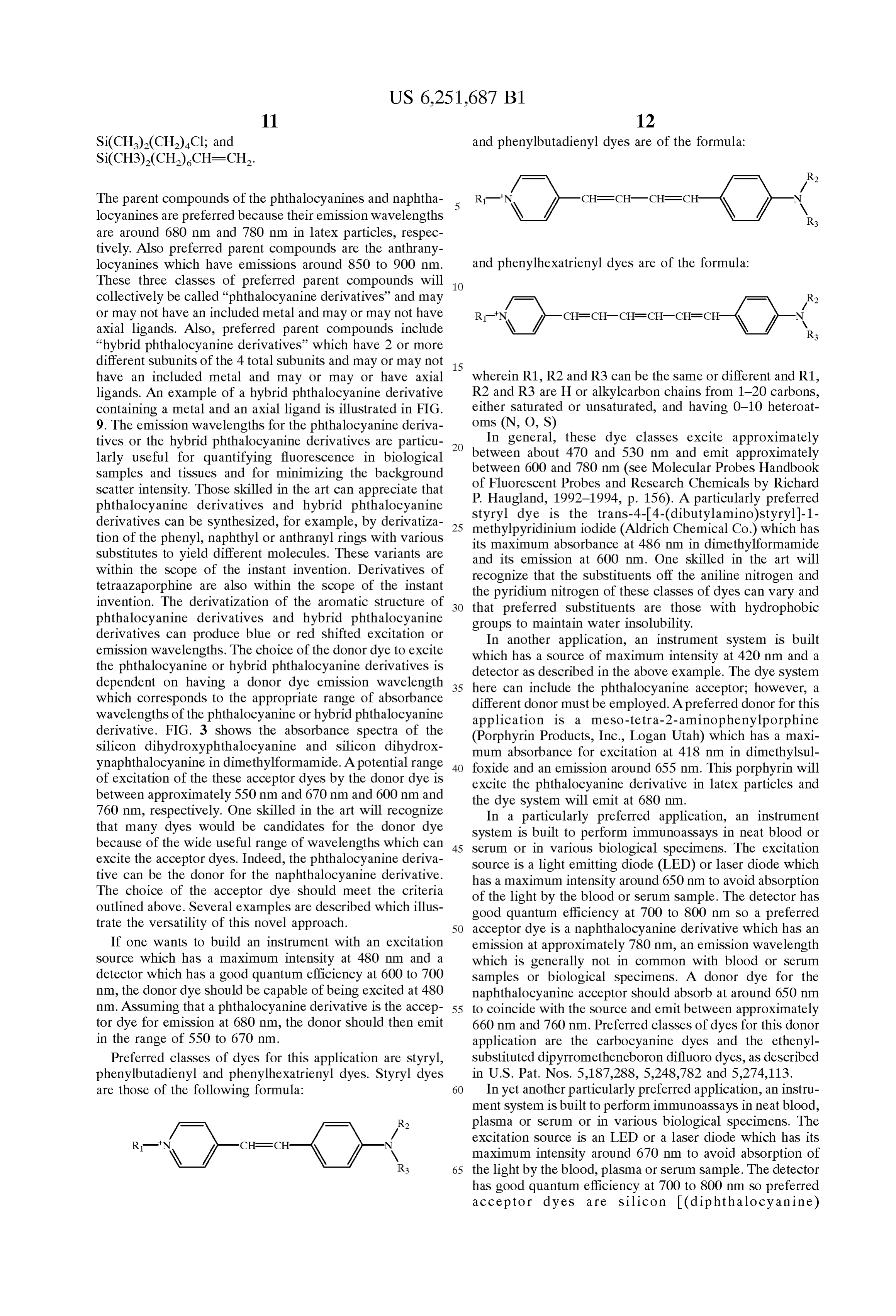
The parent compounds of the phthalocyanines and naphtha 5 R-N CHECH- CH=CH- )-N locyanines are preferred because their emission wavelengths are around 680 nm and 780 nm in latex particles, respec tively. Also preferred parent compounds are the anthrany locyanines which have emissions around 850 to 900 nm. and phenylhexatrienyl dyes are of the formula: These three classes of preferred parent compounds will collectively be called “phthalocyanine derivatives” and may JR2 or may not have an included metal and may or may not have axial ligands. Also, preferred parent compounds include CHECH-CHECH-CHEch–() { R3 “hybrid phthalocyanine derivatives” which have 2 or more different subunits of the 4 total subunits and may or may not 15 have an included metal and may or may or have axial wherein R1,R2 and R3 can be the same or different and R1, ligands. An example of a hybrid phthalocyanine derivative R2 and R3 are H or alkylcarbon chains from 1-20 carbons, containing a metal and an axial ligand is illustrated in FIG. either Saturated or unsaturated, and having 0-10 heteroat 9. The emission wavelengths for the phthalocyanine deriva oms (N, O, S) tives or the hybrid phthalocyanine derivatives are particu In general, these dye classes excite approximately larly useful for quantifying fluorescence in biological between about 470 and 530 nm and emit approximately Samples and tissues and for minimizing the background between 600 and 780 nm (see Molecular Probes Handbook Scatter intensity. Those skilled in the art can appreciate that P.of Haugland,
Fluorescent Probes and Research Chemicals by Richard phthalocyanine derivatives and hybrid phthalocyanine styryl dye is1992-1994, p. 156). A particularly preferred derivatives can be Synthesized, for example, by derivatiza 25 methylpyridiniumtheiodide trans-4-4-(dibutylamino)styryl-1- tion of the phenyl, naphthyl or anthranyl rings with various its maximum absorbance (Aldrich Chemical Co.) which has at 486 nm in dimethylformamide substitutes to yield different molecules. These variants are and its emission at 600 nm. One skilled in the art will within the scope of the instant invention. Derivatives of recognize that the Substituents off the aniline nitrogen and tetraazaporphine are also within the Scope of the instant the pyridium nitrogen of these classes of dyes can vary and invention. The derivatization of the aromatic structure of phthalocyanine derivatives and hybrid phthalocyanine that preferred substituents are those with hydrophobic groups to maintain water insolubility.
derivatives can produce blue or red shifted excitation or In another application, an instrument System is built emission wavelengths. The choice of the donor dye to excite which has a Source of maximum intensity at 420 nm and a the phthalocyanine or hybrid phthalocyanine derivatives is detector as described in the above example. The dye system dependent on having a donor dye emission wavelength 35 which corresponds to the appropriate range of absorbance here can include the phthalocyanine acceptor; however, a different donor must be employed. A preferred donor for this wavelengths of the phthalocyanine or hybrid phthalocyanine application is a meso-tetra-2-aminophenylporphine derivative. FIG. 3 shows the absorbance spectra of the (Porphyrin Products, Inc., Logan Utah) which has a maxi Silicon dihydroxyphthalocyanine and Silicon dihydrox mum absorbance for excitation at 418 nm in dimethylsul ynaphthalocyanine in dimethylformamide. A potential range 40 foxide and an emission around 655 nm. This porphyrin will of excitation of the these acceptor dyes by the donor dye is excite the phthalocyanine derivative in latex particles and between approximately 550 nm and 670 nm and 600 nm and the dye system will emit at 680 nm.
760 nm, respectively. One skilled in the art will recognize In a particularly preferred application, an instrument that many dyes would be candidates for the donor dye System is built to perform immunoassays in neat blood or because of the wide useful range of wavelengths which can 45 Serum or in various biological Specimens. The excitation excite the acceptor dyes. Indeed, the phthalocyanine deriva Source is a light emitting diode (LED) or laser diode which tive can be the donor for the naphthalocyanine derivative. has a maximum intensity around 650 nm to avoid absorption The choice of the acceptor dye should meet the criteria of the light by the blood or serum sample. The detector has outlined above. Several examples are described which illus good quantum efficiency at 700 to 800 nm so a preferred trate the Versatility of this novel approach. 50 acceptor dye is a naphthalocyanine derivative which has an If one wants to build an instrument with an excitation emission at approximately 780 nm, an emission wavelength Source which has a maximum intensity at 480 nm and a which is generally not in common with blood or Serum detector which has a good quantum efficiency at 600 to 700 Samples or biological Specimens. A donor dye for the nm, the donor dye should be capable of being excited at 480 naphthalocyanine acceptor should absorb at around 650 nm nm. ASSuming that a phthalocyanine derivative is the accep 55 to coincide with the Source and emit between approximately tor dye for emission at 680 nm, the donor should then emit 660 nm and 760 nm. Preferred classes of dyes for this donor in the range of 550 to 670 nm. application are the carbocyanine dyes and the ethenyl Preferred classes of dyes for this application are Styryl, substituted dipyrrometheneboron difluoro dyes, as described phenylbutadienyl and phenylhexatrienyl dyes. Styryl dyes in U.S. Pat. Nos. 5,187,288, 5,248,782 and 5,274,113. are those of the following formula: 60 In yet another particularly preferred application, an instru ment System is built to perform immunoassays in neat blood, o ?: plasma or Serum or in various biological Specimens. The excitation Source is an LED or a laser diode which has its
R-N CHF CH- )-N maximum intensity around 670 nm to avoid absorption of 3 65 the light by the blood, plasma or Serum Sample. The detector has good quantum efficiency at 700 to 800 nm so preferred acceptor dyes are Silicon (diphthalocyanine)
Page 16
dinaphthalocyanine with axial ligands or a naphthalocyanine naphthalocyanine derivative will excite with a 650 nm derivative which have an emissions at approximately 760 Source and emit at approximately between 780 nm and 870 nm and 780 nm, respectively, emission wavelengths which nm. One skilled in the art will recognize that the excitation are generally not in common with blood or Serum Samples and emission spectra for any particular dye has a Gaussian or biological Specimens. A donor dye for the preferred form and therefore the excitation Source does not need to acceptors should absorb at around 670 nm to coincide with correspond exactly to the excitation maximum of the donor the source and emit between approximately 660 nm and 760 dye in order to obtain an intense fluorescent Signal. nm. Preferred donor dyes are silicon phthalocyanine with Likewise, the donor emission does not have to coincide with axial ligands. the highest absorption of the acceptor dye in order to achieve In yet another particularly preferred application, for efficient energy transfer. One skilled in the art will also immunoassays in neat blood or Serum, the excitation Source recognize that the Substituents at and on the 1 and 3 positions is around 790 nm and the emission wavelength is around 900 of the carbocyanines and the substituents at the R1 and R7 nm. A preferred dye for a single dye system is a Silicon positions of the dipyrrometheneboron difluoro dyes, and the 1, 6 - octaeth o Xy naphthalo cyanine b is conjugation between the ring Structures can vary and these (dimethylhexylvinylsilyloxide) which is excited at 790 nm 15 variations are also useful in tuning fluorescence Spectra of and emits at about 900 nm.
Preferred dyes for use as donor dyes for naphthalocya theAlso particles.
preferred emission wavelengths of fluorescent par nines and naphthalocyanine derivatives are, carbocyanines ticles range from about 800 nm to 1000 nm. This near and ethenyl-substituted dipyrrometheneboron difluoro dyes, infra-red region is important because the Scattering compo
5,274,113 which have excitation wavelengths up to 790 nm background of thedecreases nent of the light Substantially, thus lowering the and emission wavelengths between about 670 nm and 800 biological Samples do not absorbmeasurement. fluorescent or fluoresce
In addition,
Substantially
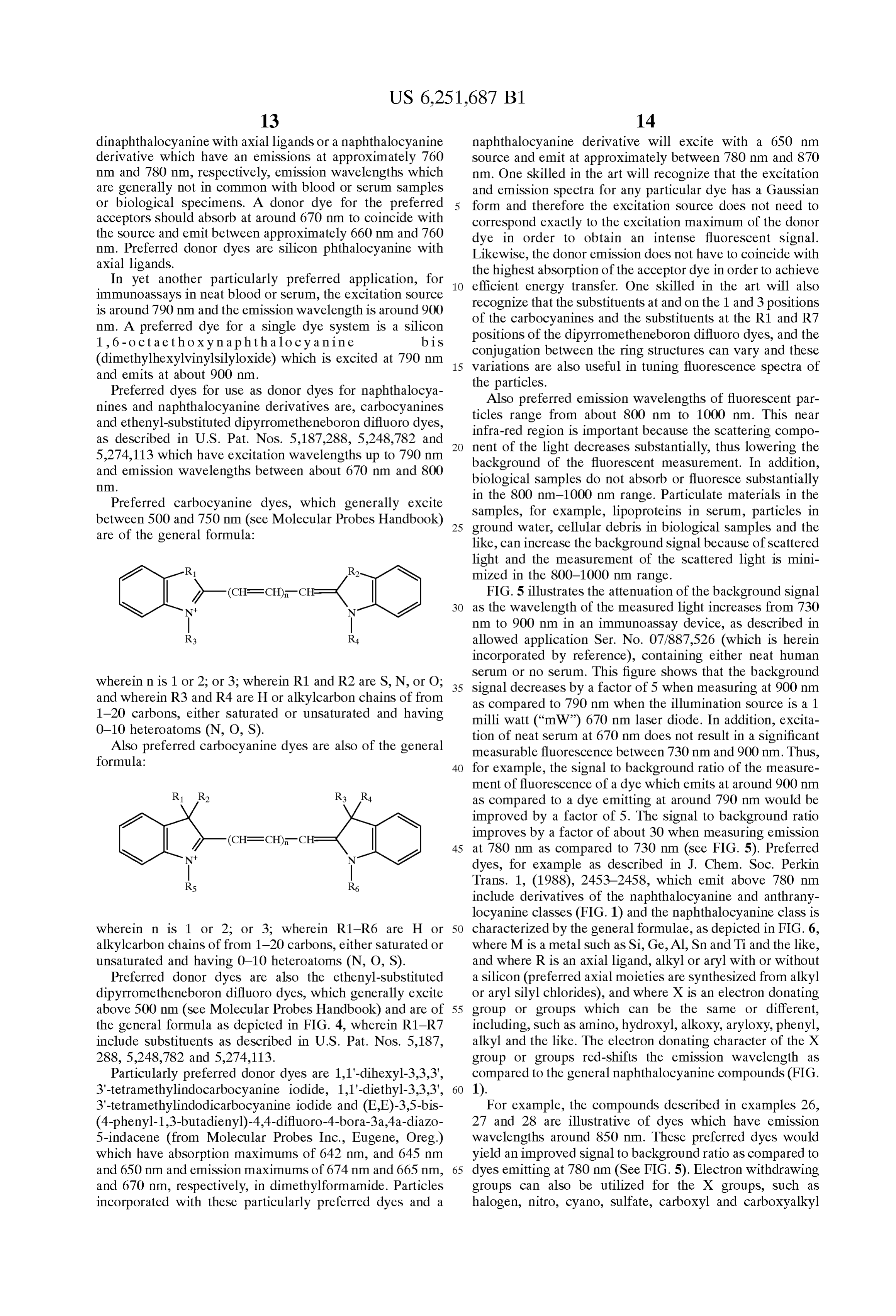
Preferred carbocyanine dyes, which generally excite in the 800 nm-1000 nm range. Particulate materials in the Samples, for example, lipoproteins in Serum, particles in between 500 and 750 nm (see Molecular Probes Handbook) 25 ground water, cellular debris in biological Samples and the are of the general formula: like, can increase the background Signal because of Scattered light and the measurement of the Scattered light is mini mized in the 800-1000 nm range.
FIG. 5 illustrates the attenuation of the background signal as the wavelength of the measured light increases from 730 nm to 900 nm in an immunoassay device, as described in
R l, allowed application Ser. No. 07/887,526 (which is herein incorporated by reference), containing either neat human
Serum or no Serum. This figure shows that the background wherein n is 1 or 2; or 3; wherein R1 and R2 are S, N, or O; 35 Signal decreases by a factor of 5 when measuring at 900 nm and wherein R3 and R4 are H or alkylcarbon chains of from as compared to 790 nm when the illumination source is a 1 1-20 carbons, either Saturated or unsaturated and having milli watt (“mW) 670 nm laser diode. In addition, excita 0-10 heteroatoms (N, O, S). tion of neat Serum at 670 nm does not result in a significant Also preferred carbocyanine dyes are also of the general measurable fluorescence between 730 nm and 900 nm. Thus, formula: 40 for example, the Signal to background ratio of the measure ment of fluorescence of a dye which emits at around 900 nm
R1 R2 R3 R4 as compared to a dye emitting at around 790 nm would be improved by a factor of 5. The Signal to background ratio improves by a factor of about 30 when measuring emission
C-(CH=CH) -- O 45 at 780 nm as compared to 730 nm (see FIG. 5). Preferred dyes, for example as described in J. Chem. Soc. Perkin
include derivatives of the naphthalocyanine and anthrany locyanine classes (FIG. 1) and the naphthalocyanine class is wherein n is 1 or 2; or 3; wherein R1-R6 are H or 50 characterized by the general formulae, as depicted in FIG. 6, alkylcarbon chains of from 1-20 carbons, either saturated or where M is a metal Such as Si, Ge, Al, Sn and Ti and the like, unsaturated and having 0-10 heteroatoms (N, O, S). and where R is an axial ligand, alkyl or aryl with or without Preferred donor dyes are also the ethenyl-substituted a Silicon (preferred axial moieties are Synthesized from alkyl dipyrrometheneboron difluoro dyes, which generally excite or aryl silyl chlorides), and where X is an electron donating above 500 nm (see Molecular Probes Handbook) and are of 55 group or groups which can be the same or different, the general formula as depicted in FIG. 4, wherein R1-R7 including, Such as amino, hydroxyl, alkoxy, aryloxy, phenyl, include Substituents as described in U.S. Pat. Nos. 5,187, alkyl and the like. The electron donating character of the X 288, 5,248,782 and 5,274,113. group or groups red-shifts the emission wavelength as Particularly preferred donor dyes are 1,1'-dihexyl-3,3,3', compared to the general naphthalocyanine compounds (FIG. 3'-tetramethylindocarbocyanine iodide, 1,1'-diethyl-3,3,3', 60 1).
3'-tetramethylindodicarbocyanine iodide and (E.E)-3,5-bis For example, the compounds described in examples 26, (4-phenyl-1,3-butadienyl)-4,4-difluoro-4-bora-3a,4a-diazo 27 and 28 are illustrative of dyes which have emission 5-indacene (from Molecular Probes Inc., Eugene, Oreg.) wavelengths around 850 nm. These preferred dyes would which have absorption maximums of 642 nm, and 645 nm yield an improved Signal to background ratio as compared to and 650 nm and emission maximums of 674 nm and 665 nm, 65 dyes emitting at 780 nm (See FIG. 5). Electron withdrawing and 670 nm, respectively, in dimethylformamide. Particles groups can also be utilized for the X groups, Such as incorporated with these particularly preferred dyes and a halogen, nitro, cyano, Sulfate, carboxyl and carboxyalkyl
Page 17
and the like, which will blue shift the excitation or emission with axial ligands or they can be Synthesized from dicarbo wavelengths. Preferred donor dyes for this class of near nitrile derivatives of benzene, naphthalene or anthracene infra-red emitting dyes are those which have emission compounds, respectively, for Subsequent inclusion of Vari wavelengths which correlate to the absorbance characteris ous metals and elaboration with axial ligands. Hybrid mol tics of the acceptor dye. Preferred dyes for this application ecules comprised of derivatives of tetraazaporphines, as are the ethenyl-substituted dipyrrometheneboron difluoride described in Inorg. Chem. (1994), 33, 1735-1740, are also dyes, as described in U.S. Pat. Nos. 5,187,288, 5,248,782 within the scope of the hybrid phthalocyanine derivatives of and 5,274,113. the instant invention. A Synthetic Strategy for hybrid phtha Preferred molar ratios of donor to acceptor dyes in the locyanine derivatives with 2 different subunits is described, latex particles generally range from about 20:1 to about 1:20 for example, in J. Am. Chem. Soc. (1990), 112, 9640-9641, and particularly from about 1:1 to 6:1. The desired fluores Inorg. Chem. (1994), 33, 1735–1740, Chem. Letters, (1992), cence intensity should be obtained through experimentation 763–766, Chem. Letters, (1992), 1567–1570 and Chem. using the principles taught herein, and by incorporating Letters, (1992), 2031-2034. These references describe the various ratioS of donor to acceptor dyes into the particles at synthesis of hybrid molecules with zinc metal or without various dye concentrations and measuring the fluorescence 15 metal and without axial ligands. The character of the diimi emission of the particles. noisoindoline and its derivatives will dictate the excitation The geometrical orientation of the dipoles of the donor and emission characteristics of the molecule. Moreover, and acceptor dyes will affect the efficiency of energy transfer incorporation of dyes with axial ligands, as taught herein, between them. The donor and acceptor dyes can be Synthe will result in particles which exhibit minimum quenching sized to form a compound of optimal dipole geometry, and maximium fluorescence intensity.
which, in Solution, exhibits efficient fluorescence energy Axial ligands are also beneficial on water Soluble com transfer (“FET). The optimized FET compound then may pounds because the axial ligands will minimize interaction be incorporated into particles. Phthalocyanine derivatives of the hybrid molecule with, for example, proteins, antibod can be utilized for this application for the acceptor moiety, ies and nucleic acids, which may or may not be covalently where the phthalocyanine derivative can be substituted with 25 coupled to the hybrid molecule. The axial ligand may itself, electron donating or withdrawing groups (as described impart water solubility to the hybrid phthalocyanine deriva above) to accomodate the desired excitation and emission tive. An example of a water Soluble hybrid phthalocyanine wavelength. For example, preferred naphthalocyanine com derivative is given in Examples 92, 95-98, 108, 110, 114, pounds for this application are those as depicted in FIG. 7, and 115.
where X is hydrogen or electron donating groups, Such as Novel hybrid phthalocyanine derivatives are described amino, hydroxyl, alkoxy, aryloxy, phenyl, alkyl and the like herein, which contain 3 or 4 different Subunits, and allow for and D is the donor dye covalently attached to the naphtha larger Stokes shifts. In these derivatives, excitation occurs locyanine derivative at a distance which allows for energy with the Subunit which has the highest energy or the lowest transfer between the donor and acceptor. wavelength absorption and the emission occurs in the lowest By applying the teachings of this invention, all phthalo 35 energy Subunit.
cyanine of hybrid phthalocyanine derivatives can function as The desired excitation and emission wavelengths of the donor or acceptor molecules. For example, a Silicon ortho hybrid phthalocyanine derivative will determine the types of octaethoxy(phthalocyanine) derivative will emit at approxi diminoisoindoline derivative and dicarbonitrile derivative mately 750 nm to 780 nm, similar to a silicon naphthalo precursors which are used in the synthesis of the hybrid cyanine derivative. Generally, the distances between donor 40 phthalocyanines. The desired excitation and emission wave and acceptor are about 5 angstroms to 60 angstroms, and lengths are generally dictated by the Sample, the type of preferably from 5 angstroms to 15 angstroms. fluorescent measurement and the instrument. Various com In addition, each naphthalocyanine derivative can have binations of diminoisoindoline derivative and dicarbonitrile 1-4 donor dyes attached, depending on the required appli derivative precursors also may be combined to form a hybrid cation of the FET compound. Suitable donor dyes are those 45 phthalocyanine derivative which may have a red shifted or which emit in the absorbance range of the acceptor dye. blue Shifted excitation and/or emission wavelength pattern. Example 29 describes the synthesis of a fluorescein-silicon In general, electron donating Substituents on the diimi phthalocyanine FET compound. Table 1, item 56, shows the noisoindoline or dicarbonitrile precursors, particularly Situ fluorescence characteristics of this compound in lateX par ated at the ortho positions (that is, ortho to the tetraazapor ticles. One skilled in the art will appreciate that with the 50 phine structure as indicated in FIG. 6 for the X substituents) inventive teachings described herein, many FET compounds of the phthalocyanine Structure, Such as amino, hydroxyl, may be Synthesized for many particular applications requir alkoxy, aryloxy, phenyl, alkyl and the like, will red shift the ing Specific excitation and emission wavelengths. excitation and/or emission wavelengths. Conversely, elec Another approach to developing particles which exhibit tron withdrawing Substituents, also particularly at the ortho desired and predictable fluorescence properties in the high 55 positions, Such as halogen, nitro, cyano, Sulfate, carboxyl Visible to near infrared spectrum is to Synthesize unsym and carboxyalkyl and the like, will blue shift the excitation metrical or hybrid phthalocyanines, naphthalocyanines or or emission wavelengths. In addition, positions on the anthranylocyanines and their derivatives. AS used herein, the Subunits other than the ortho positions can affect the exci term “hybrid phthalocyanine derivatives” refers to all tation and emission characteristics of the hybrid phthalo classes of hybrid phthalocyanines, naphthalocyanines and 60 cyanine derivative. The choice of either diiminoisoindoline anthranylocyanines and their derivatives, with or without or dicarbonitrile precursors for the synthesis of the hybrid metal and axial ligands, including tetraaZaporphines and phthalocyanine derivatives is related to the desired presence their derivatives. The novel hybrid molecules described or absence of metal and the type of metal in the hybrid herein appear to exhibit intramolecular energy transfer. The molecule. For example, when using the diminoisoindoline hybrid phthalocyanine derivatives can be synthesized from 65 precursors in the Synthesis, a Silicon metal can be incorpo diminoisoindoline or derivatives of diiminoisoindolines and rated during the tetramerization reaction to form the phtha incorporate a metal, for example, Silicon, and elaboration locyanine derivative structure. The silicon can be further
Page 18
modified to a Silicon dihydroxy phthalocyanine derivative that the fluorescence intensity of a naphthalocyanine accep molecule So that axial ligands can be elaborated with, for tor in a particle prepared in 70% tetrahydrofuran (dye example, various silyl chloride reagents. The importance of system 4) is increased about 65% when a phthalocyanine axial ligands in reducing quenching and maximizing fluo donor excites a hybrid phthalocyanine compound as com rescence intensity is evident for both phthalocyanine/ pared to the phthalocyanine donor directly exciting the naphthalocyanine molecules and the hybrid phthalocyanine naphthalocyanine acceptor (dye system 2). These results derivatives (see example 65). further illustrate the special properties of the hybrid phtha The axial ligands are also useful for further elaboration of locyanine derivatives in lateX particles exhibiting fluores the molecules, for example, for attaching another fluorescent cence energy transfer.
molecule, for attaching to a ligand, protein, polypeptide or The results of Table 6 of Example 67 also show the ability nucleic acid or for changing the charge of the molecule using of phthalocyanine derivatives with axial ligands to exhibit Sulfate, carboxylic acid or amino Substituents which can Singlet-singlet energy transfer to other phthalocyanine or affect Solubility of the molecule. In the case of using axial hybrid phthalocyanine derivatives with axial ligands. That ligands to attach the water Soluble dye to ligands, proteins, is, it is apparent from Example 65 and Table 4, that axial polypeptides or nucleic acids, a mono- or bis- Substituted 15 ligands reduce the quenching of the dyes and enhance the metal can be utilized. The mono-Substituted metal in the dye, fluorescence of the particles. Other experiments (see however, yields only one axial ligand onto which the chem Example 15, Tables 1 and 2) also support this observation. istry of attachment is made. The other face of the dye, after Thus, axial ligands minimize quenching by preventing the attachment to a ligand, protein, polypeptide or nucleic acid, close contact of the ring structures. One would then expect which has no axial ligand, may interact with neighboring that phthalocyanine or hybrid phthalocyanine derivatives molecules (proteins, polypeptides, nucleic acids and the with axial ligands would not the requist close contact to like) and result in quenching of flourescence. The bis function efficiently as energy transfer donor and acceptor Substituted dye can minimize potential interactions between pairs because the molecules are Spaced apart by the axial neighboring molecules when one axial ligand is used for ligands. However, nearly 100% efficiency of energy transfer attachment and the other is unattached. In this case, the 25 and high fluorescence intensities are observed in particles unattached axial ligand can be Synthesized Such that the when phthalocyanine or hybrid phthalocyanine derivatives terminal atom of the unattached axial ligand imparts water with axial ligands are donors and phthalocyanine or hybrid Solubility to the molecule, for example, a Sulfate, carboxyl, phthalocyanine derivatives are acceptors. or an amino derivative, Such that interactions between The tetramerization reactions of the diminoisoindoline or neighboring molecules is minimized. In the case of utilizing dicarbonitrile precursors to form the hybrid phthalocyanine water soluble hybrid phthalocyanine derivatives, for derivatives can be directed So that opposing Subunits can be example, for compeptitve immunoassays, the ligand ana the same. This is accomplished, for example, with the use of logue of the target ligand which is being measured, can be bulky Substituents on the precursors So that in the tetramer attached to the dye through the axial ligand(s). ization reaction, like Subunits with bulky Substituents cannot When using the dicarbonitrile precursors, the phthalocya 35 be adjacent because of Steric considerations. Bulky phenyl nine derivative is Synthesized without metal, but various Substituents have been used on dicarbonitrile precursors to metals can Subsequently be included, for example, Ge, Al, direct the precursors tetramerization to be opposing Subunits Sn, Ti and the like. These metals can also be elaborated with as described in Inorg. Chem. (1994), 33, 1735–1740, Chem axial ligand(s), depending on the Valence of the metal. istry Letters (1992), 2031-2034 and Chemistry Letters The fluorescence quenching character of the hybrid phtha 40 (1992), 1567–1570.
locyanine derivatives in particles are particularly preferred Preferred hybrid phthalocyanine derivatives have similar over the phthalocyanine derivatives. Example 66 is a typical opposing Subunits So that two different Subunits comprise example of comparison of the quenching characteristics in the structure. Particularly preferred hybrid phthalocyanine lateX particles of Silicon 2,3-naphthalocyanine bis derivatives have similar opposing Subunits on one axis and (dimethylhexylvinylsilyloxide) and silicondi (1,6- 45 different opposing Subunits on the other axis. The nature of diphenylnaphthalocyanine) diphthalocyanine bis the particularly preferred molecules is that red or blue (dimethylhexylvinylsilyloxide). The hybrid phthalocyanine shifted excitation or emission wavelengths and a longer derivative has essentially no quenching as compared to up to Stokes shift can result because of the selection of the 50% quenching of the naphthalocyanine derivative for the precursor molecules for the tetramerization reaction. For various dye loading concentrations listed in the table. The 50 particularly preferred hybrid phthalocyanine derivatives, for fluorescence intensity of latex containing the hybrid phtha example, the “donor” diphenyldiiminoisoindoline or the locyanine derivative are much greater than the phthalocya diminoisoindoline precursors would contribute to 650 nm nine derivative. This illustrates the Special properties of the absorbance of the hybrid molecule, and thereby to the hybrid phthalocyanine derivatives. excitation of the hybrid molecule. The diphenyl phenyldi The hybrid phthalocyanine derivatives are also very good 55 iminoisoindoline or the phenyldiiminoisoindoline precur acceptors when using phthalocyanine derivatives as donors. Sors would act as an “electron transfer Subunit' to the This is shown in table 6 of example 67. When the phthalo “acceptor subunit', which would be a dialkoxy or aryloxy cyanine derivative is the donor and the hybrid phthalocya phenyldiminoisoindoline precursors, So that emission is nine derivative is the acceptor (dye system 3), the fluores dictated at the lowest energy by the acceptor Subunit at about cence intensity of the particles is about 14.5% higher than 60 850 nm. The nature of the “electron transfer Subunits” is when the same phthalocyanine derivative is the donor and a important because it is not desirable for this Subunit to emit naphthalocyanine derivative is the acceptor (dye system 2). because then the desired emission of the acceptor Subunit These results show the special properties of the hybrid will not take place. Thus, the highest occupied molecular phthalocyanine derivative in particles exhibiting fluores orbital (HOMO) and lowest unoccupied molecular orbital cence energy transfer. 65 (LUMO) character of the electron transfer subunit should be The hybrid phthalocyanine derivative also acts as an designed with reference to the donor and acceptor Subunit intermediate donor compound. Table 6 of Example 67 shows molecules. The relationship of the energies of the HOMO
Page 19
and LUMO as they relate to excitation and emission are The resulting fluorescent dye particles which exhibit the taught by Pariser et al., J. Chem. Phys. (1953), 21, 767-776, appropriate excitation and emission characteristics are fur by Pople, Trans. Faraday Soc. (1953), 49, 1375–1385, by ther adsorbed or chemically reacted with various nucleic McHugh et al, Theoret. Chim. Acta (Berlin) (1972), 24, acids, nucleotides, proteins or peptides and the like which 346-370 and by Kobayashi et al., Inorg. Chem. (1994), 33, are required for a Specific purpose. The adsorption of 1735–1740, Chemistry Letters (1992), 2031-2041, Konami macromolecules to particles, particularly lateX particles is et al, Molecular Physics (1993), 80, 153–160. well known to those skilled in the art and generally involves Another application requires the hybrid molecule to have adsorption of the macromolecule at a temperature between two excitation wavelengths, one at approximately 650 nm 5° C. and 50° C. and at a pH which is below the pl of the and another at about 680 nm with emission for both exci molecule.
tations at about 760 nm. Thus, the precursors responsible for Use of Incorporated Dye Particles in Assays the excitation could be a diminoisoindoline for the 650 nm. Fluorescent particles exhibiting fluorescence energy and a tetrafluorodiiminoisoindoline for the 680 nm excita transfer can be adsorbed with either antibodies for use in tions. The emitting Subunit, which can also be used to direct non-competitive immunoassays or ligand analogues for use the tetramerization reaction So that the emitting Subunits are 15 in competitive immunoassays in reaction mixtures of the opposed in the molecule, can be a diphenyl phenyldiimi assays. In the case of non-competitive assays, the reaction noisoindoline. The excitation and emission wavelengths of mixture would include at least one target ligand and at least the resulting hybrid phthalocyanine derivative are thus gen one class of fluorescent particles having bound thereto at erally representitive of the individual diiminoisoindoline least one receptor Specific for target ligand, forming an precursors. antibody (fluorescent) conjugate. In the case of competitive Yet another application requires excitation at about 650 assays, the reaction mixture will include at least one target nm and emission at about 750 nm. The precursors respon ligand, at least one receptor Specific to the target ligand, and Sible for excitation and emission could be diminoisoindo at least one class of fluorescent particles, having bound line and diphenyl phenyldiiminoisoindoline, respectively. thereto at least one ligand analogue, forming a ligand The latter precursor also acts to direct the emitting Subunits analogue (fluorescent) conjugate. The antibody conjugates to be opposed. 25 bound to target ligands in the non-competitive reaction In another application, a large extinction coefficient at the mixture and the ligand analogue conjugates not bound by excitation wavelength is desired for excitation at about 650 receptorS Specific to the target ligands in the competitive nm. The emission wavelength should be at about 850 nm. reaction mixture can be bound to a Solid phase consisting of The precursors responsible for excitation could be a receptorS Specific to another epitope of the target ligand of diphenyldiiminoisoindoline, which would direct these sub the target ligand-antibody conjugate complexes and of units to be opposed and thereby two Subunits would con receptorS Specific to ligand analogues of the ligand analogue tribute to provide the desired extinction coefficient. A phe conjugates, respectively. The fluorescent conjugates nyldiiminoisoindoline derivative precursor could act as an unbound by the Solid phase are removed and the fluores electron transfer Subunit and an alkoxy phenyldiiminoisoin cence of the bound conjugates is measured. The measured doline precursor could be the acceptor with a characteristic 35 fluorescence is related to the target ligand concentration. The emission at about 850 nm. various reagents described above can also be attached In another application, two emission wavelengths are covalently to the lateX particles. For example, antibodies or desired from a compound which is excited at a single ligand analogues can be attached through amine or carboxy wavelength. The desired excitation is around 650 nm and the lic acids to carboxylic acids or amines on the Surface of the emission should be around 760 nm and 810 nm. The 40 particles, respectively, to form stable amide linkages. precursor responsible for excitation could be a tetrafluoro In the case of quantifying nucleic acids in Samples, the diiminoiso indoline or a tetrafluorobenzene-1,2- novel compounds described in the instant invention are dicarbonitrile. The precursor responsible for emission could useful because of their brightness and because of the near be a dibutoxyphenyldiiminoisoindoline or a 3,4-dibutoxy infrared emission characteristics. In general, in designing an naphthalene-1,2-dicarbonitrile, respectively. 45 assay for a nucleic acid, one Selects a probe molecule which Incorporation of Dyes into Particles is complementary to the nucleic acid to be quantified. The The resulting compounds are then incorporated into par probe molecule is then labeled, generally covalently, with a ticles to yield particles which exhibit excitation wavelengths Signal generator. The Signal generator can be a water Soluble above about 600 nm and emission wavelengths above about phthalocyanine derivative or hybrid phthalocyanine deriva 650 nm. One skilled in the art will also appreciate that water 50 tive or a particle with the appropriate dye System, which may soluble hybrid phthalocyanine derivatives are valuable for exhibit fluorescence energy transfer or hybrid phthalocya coupling to proteins, polypeptides, nucleosides, nucleic nine derivatives or combinations of these compounds. The acids and the like, for detecting their presence in biological labelled probe molecule is then introduced into a biological fluids or for performing DNA probe or immunoassays. Sample Suspected of containing the target nucleic acid, and Preferred particle sizes range from about 0.1 nm to 5000 55 the labelled probe Sequence assembles with the target nm and preferably from about 1 nm to 1000 nm. The choice nucleic acid. The labelled probe/target nucleic acid can then of particle size should be related to the specific function for be immobilized onto a Surface which has immobilized the label. The particle Size may vary for a particular appli another nucleic acid which is also complementary to the cation. For example, in an immunoassay, if the label requires target nucleic acid. Conversely, the biological Sample can be a more intense fluorescence for measuring very low con 60 introduced to a Surface which has immobilized a comple centrations of analytes, then one would employ larger par mentary nucleic acid for immobilization of the target nucleic ticles because larger particles can incorporate more dye acid. The labelled probe can then be introduced to the system molecules. The Small particle sizes (0.1-1 nm) may be for binding to the immobilized target molecule. The exceSS employed in fluorescence polarization assays, as described labelled probe is then washed away and the resultant fluo for example, in U.S. Pat. Nos. 4,420,568, 4,476,229 and 65 rescent intensity is correlated with fluorescence intensity 4,510,251, in in vitro visualization of cellular components or from a Standard curve to arrive at a concentration of the in in Vivo imaging techniques. nucleic acid in the Sample.
Page 20
Use of Water Soluble Hybrid Phthalocyanine Derivatives in imaging, in Vitro cancer therapy, nucleic acid assays, cell ASSayS Sorters and the like.
Water soluble hybrid phthalocyanine derivatives can be Experimental Section attached to antibodies for use in non-competitive immunoas Fluorescence measurements referred to in the following Says or ligand analogues for use in competitive immunoas 5 Examples were performed on a Perkin-Elmer model LS50B Says in reaction mixtures of the assays. Ihalon the case of Luminescence Spectrometer for dyes emitting up to around non-competitive assays, the reaction mixture would include 780 nm. In some instances, as indicated in Table 1 by at least one target ligand and at least one water Soluble describing the Intensity in terms of nanoamps (nA), dyes hybrid phthalocyanine derivative having attached thereto at emitting above 800 nm were measured according to least one receptor Specific for target ligand, forming an Example 18. The fluorescence intensities are not corrected. antibody (fluorescent) conjugate. In the case of competitive Absorbance measurements were performed on a Hewlett assays, the reaction mixture will include at least one target Packard 8452A Diode Array Spectrophotometer. ligand, at least one receptor Specific to the target ligand, and at least one water soluble hybrid phtcyanine derivative EXAMPLE 1. having attached thereto at least one ligand analogue, form 15 Synthesis of Silicon Phthalocyanine Dihydroxide SiPc ing a ligand analogue (fluorescent) conjugate. The fluores (OH) cent conjugates of water Soluble hybrid phthalocyanine A Suspension of silicon phthalocyanine dichloride (1.83 g, derivatives, which are Smaller in molecular weight than the 3.0 mmol) in pyridine (50 mL) and water (50 mL) was fluorescent particles described herein, will diffuse faster in refluxed with stirring on an oil bath at 120° C. for 18 hours. Solution and result in binding reactions which have faster After cooling the dark blue Solid product was filtered and the kinetics. Fast kinetics of the binding reactions in assays are residue was washed with water (10 mL), acetone (5 mL) and preferred because the assays will reach equilibrium binding then dried under vacuum to afford 1.71 g of the title in a shorter time, and in turn, assay results can be obtained compound.
in a shorter time. The antibody conjugates bound to target EXAMPLE 2 ligands in the non-competitive reaction mixture and the 25 Synthesis of Silicon Phthalocyanine bis(Trihexylsilyloxide) ligand analogue conjugates not bound by receptorS Specific to the target ligands in the competitive reaction mixture can (Hereinafter Sometimes Referred to as PcSi Trihexyl) be bound to a Solid phase consisting of receptorS Specific to mg, 0.2 mmol) in anhydrous pyridine (11dihydroxide A Suspension of Silicon phthalocyanine (115 another epitope of the target ligand of the target ligand chlorotrihexylsilane (733 ul., 2.0 mmol) wasmL) containing refluxed on an antibody conjugate complexes and of receptorS Specific to oil bath at 130 C. for 5 hours. The resulting purple solution ligand analogues of the ligand analogue conjugates, respec was allowed to cool and was evaporated. The resulting tively. The fluorescent conjugates unbound by the Solid Slurry was treated with ice-cold hexane (2 mL) and the dark phase are removed and the fluorescence of the bound blue Solid product was filtered, washed with ice-cold hexane conjugates is measured. The measured fluorescence is (2 mL) and was dried under vacuum to yield 249 mg of related to the target ligand concentration. 35 crude product. The crude product in chloroform was purified
In the case of quantifying nucleic acids in Samples, the novel compounds described in the instant invention are on an Alumina column (Activity 1) equilibrated in hexane useful because of their brightness and because of the near and the product was eluted with hexane/toluene (2/1, V/v) as a bright blue band. The Solvent containing the product was infrared emission characteristics. In general, in designing an evaporated assay for a nucleic acid, one Selects a probe molecule which 40 171° C. (lit.tompyield
69 mg of the title compound with a mp
is complementary to the nucleic acid to be quantified. The probe molecule is then labeled, generally covalently, with a EXAMPLE 3 Signal generator. The Signal generator can be a water Soluble Synthesis of Silicon Phthalocyanine bis(10 phthalocyanine derivative or hybrid phthalocyanine deriva Carbomethoxy decyl)dimethylsilyloxide (Hereinafter tive. The labelled probe molecule is then introduced into a 45 Sometimes Referred to as PcSi Methyl Ester) biological Sample Suspected of containing the target nucleic To a Suspension of Silicon phthalocyanine dihydroxide acid, and the labelled probe Sequence assembles with the (115 mg, 0.2 mmol) in anhydrous pyridine (11 mL) was target nucleic acid. The labelled probe/target nucleic acid added (10-carbomethoxydecyl)dimethylchlorosilane (586 can then be immobilized onto a Surface which has immo mg, 2 mmol) and the mixture was refluxed with Stirring on bilized another nucleic acid which is also complementary to 50 an oil bath at 130° C. for 5 hours. The dark blue Solution was the target nucleic acid. Conversely, the biological Sample allowed to cool and the Solvent was evaporated. The residue can be introduced to a Surface which has immobilized a was purified on a Silica gel 60 A column equilibrated in complementary nucleic acid for immobilization of the target hexane and the product eluted slowly as a blue band with nucleic acid. The labelled probe can then be introduced to toluene. The toluene fraction containing product was the System for binding to the immobilized target molecule. 55 evaporated, hexane (10 mL) was added to the residue and The excess labelled probe is then washed away and the the blue product was filtered, washed with hexane and dried resultant fluorescent intensity is correlated with fluorescence to afford 105 mg of the title compound. intensity from a Standard curve to arrive at a concentration of the nucleic acid in the Sample. EXAMPLE 4 Those skilled in the art will recognize that many varia 60 Synthesis of Silicon Phthalocyanine b is tions of immunoassays and nucleic acid assays can be (Dimethylvinylsilyloxide) (Hereinafter Sometimes Referred performed and the inventive teachings in the instant inven to as PeSi Vinyl) tion for the use of novel dye systems can be used to develop To a Suspension of Silicon phthalocyanine dihydroxide novel adaptations to existing technologies. (115 mg, 0.2 mmol) in anhydrous pyridine (11 mL) was Those skilled in the art will appreciate that the novel 65 added chlorodimethylvinylsilane (276 u , 2.0 mmol) and fluorescent particles and dyes described herein have many the mixture was refluxed with stirring on an oil bath at 130 uses in immunoassays, fluorescence microScopy, in vivo C. for 5 hours. The dark Solution was allowed to cool and
Page 21
was evaporated. The residue was purified on a Silica gel 60 EXAMPLE 9 A column equilibrated in hexane and the product was eluted Synthesis of Silicon 2,3-Naphthalocyanine bis with toluene as a blue band. The eluate containing product (Dimethylpentafluorophenylsilyloxide (Hereinafter Some was evaporated, the residue treated with hexane and the dark times Referred to as NaPcSi Pentafluoro) blue Solid product was filtered, washed with hexane and was To a Suspension of Silicon 2,3-naphthalocyanine dihy dried under vacuum to afford 7.5 mg of the title compound. droxide (87 mg, 0.11 mmol) in anhydrous pyridine (5 ml) was added chlorodimethylpentafluorophenylsilane (0.188
EXAMPLE 5 ml, 1 mmol). The mixture was refluxed with Stirring on an Synthesis of Silicon Phthalocyanine bis(3-Cyanopropyl) oil bath at 130° C. for 5 hours. After cooling, the solvent was dimethylsilyloxide (Hereinafter Sometimes Referred to as evaporated and the residue was purified on a Silica gel 60 A PcSi Cyano) column which was equilibrated in hexane. The product was To a Suspension of Silicon phthalocyanine dihydroxide eluted with toluene as a green band. The toluene fraction (115 mg, 0.2 mmol) in anhydrous pyridine (11 mL) was containing the product was evaporated and the residue was added chloro(3-cyanopropyl)-dimethylsilane (328 uL, 2.0 treated with hexane. The dark green Solid was filtered, mmol) and the mixture was refluxed with Stirring on an oil 15 washed with hexane and was dried under vacuum to afford bath at 130 C. for 5 hours. The purple solution was allowed 23 mg of the title compound.
to cool and was evaporated. The residue was purified on a EXAMPLE 10
Silica gel 60 A column equilibrated in hexane. The column General Preferred Procedures for the Preparation of Dye was washed with toluene and the product was eluted with loaded Latex Particles of Varying Sizes toluenefisopropyl alcohol (90/10, V/v) as a bright blue band. The various dyes were loaded into lateX particles of The eluate containing product was evaporated under vacuum varying Sizes according to the general procedures outlined to afford 101 mg of the title compound with a mpa260 C. below. The procedures described involve Swelling latex EXAMPLE 6 particles with aqueous Solutions of either tetrahydrofuran or Synthesis of Silicon Phth a locyanine b is 25 dimethylformamide Latex particle sizes prior to addition of the dye solutions.
used range from 67 nm to 783 nm and
(Dimethylpentafluorophenylsilyloxide) (Hereinafter Some one skilled in the art recognizes that Smaller and larger times Referred to as PcSi Pentafluoro)
To a Suspension of Silicon phthalocyanine dihydroxide particles can be used. Tables 1 and 2 of Example 15 below (115 mg, 0.2 mmol) in anhydrous pyridine (11 mL) was show dye the aqueous organic Solvent System and the optimum concentration which were used for the loading into added chlorodimethylpentafluorophenylsilane (376 uL, 2.0 particles for each dye mmol) and the mixture was refluxed with Stirring on an oil derivatives, respectively,pair of a or for hybrid phthalocyanine
Selected number of dyes. One bath at 130 C. for 5 hours. The dark green solution was skilled in the art recognizes that allowed to cool and was evaporated. The residue was to these procedures to preparemany changes can be made particles with different purified on a Silica gel 60 A column equilibrated in hexane. degrees of fluorescence intensities and quenching by loading The product was eluted with toluene as a dark blue band. 35 higher or lower amounts of dye in the particles and The eluate containing the product was evaporated, the changing the ratioS of each dye pair to the other. One also by skilled residue was treated with hexane (10 mL) and the dark blue in the art also recognizes that Similar techniques are useful Solid product was filtered, washed with hexane and was for incorporation of dyes into lateX particles, for example, as dried under vacuum to afford 73 mg of the title compound. described in U.S. Pat. Nos. 4,199,363 and 4,368,258. EXAMPLE 7 40 Surfactant-free polystyrene Sulfate lateX particles in sizes Synthesis of Silicon 2,3-Naphthalocyanine Dihydroxide ranging from 67 nm to 783 nm and carboxyl-modified latex (Hereinafter Sometimes Referred to as NaPcSi Hydroxide) (“CML') particles ranging from 200 nm to 400 nm particles A Suspension of Silicon 2,3-naphthalocyanine dichloride were obtained through Interfacial Dynamics Corp. Inc., (280 mg, 0.34 mmol) in pyridine (10 mL) and water (10 mL) Portland Oreg.
was refluxed with stirring on an oil bath at 130 C. for 24 45 Method 1 Utilizing Tetrahydrofuran hours. After cooling to room temperature, the dark green a. 20% Tetrahydrofuran Tetrahydrofuran (0.09 mL) was Solid product was filtered and, the residue was washed, added, dropwise over a 5 minute period, to a stirring Solution Successively, with water (5 mL) and acetone (2 mL). The of 0.5 mL of 2.0% solids of latex particles at room tem product was dried under vacuum to afford 217 mg of the title 50 perature. The latex Suspension was Stirred at room tempera compound. ture for an additional 30 minutes to Swell the latex. The dye Solution (0.01 mL), which consists of one or more dyes at an
EXAMPLE 8 appropriate concentration in tetrahydrofuran, was added Synthesis of Silicon 2,3-Naphthalocyanine bis dropwise over 5 minutes to the Stirred lateX Solution, to give (Dimethylvinylsilyloxide) (Hereinafter Sometimes Referred the loading dye concentration (in a 0.6 mL volume) as to as NaPcSi Vinyl) 55 indicated in Table 1. The latex-dye solution was stirred at To a Suspension of Silicon 2,3-naphthalocyanine dihy room temperature for 30 minutes in the dark. The latex droxide (87 mg, 0.11 mmol) in anhydrous dimethylforma Solution was then transferred to dialysis tubing (Spectra-por, mide (1 mL) was added chlorodimethylvinylsilane (0.042 12-14,000 molecular weight cutoff, Spectrum, Houston, mL, 0.3 mmol), followed by imidazole (14 mg., 0.2 mmol). Tex.) and the dye-latex Solutions were dialyzed against The mixture was stirred under argon at room temperature for 60 water for 12-15 hours at 4 C. The dye-latex solution was 24 hours. The Solvent was evaporated and the residue was removed from dialysis and the 9% solids of the solution was purified on a Silica gel 60 A column which was equilibrated calculated from the final volume after dialysis and the in hexane. The product was eluted with toluene as a green Starting Solids concentration.
band. The toluene fraction containing the product was b. 50% Tetrahydrofuran evaporated and the residue was treated with hexane. The 65 Tetrahydrofuran (0.20 mL) was added, dropwise over a 5 dark green Solid was filtered, washed with hexane and was minute period, to a stirring solution of 0.24 mL of 4.1% dried under vacuum to afford 26 mg of the title compound. Solids of latex particles at room temperature. The latex
Page 22
Suspension was stirred at room temperature for an additional ecules in the particles. The PeSi vinyl was incorporated into 30 minutes to Swell the latex. The dye solution (0.06 mL), 67 nm latex particles (polystyrene Sulfate from Interfacial which consists of one or more dyes at an appropriate Dynamics Corp. (IDC), Inc., Portland, Oreg.) using method concentration in tetrahydrofuran, was added dropwise over 1 (example 10) at various concentrations as indicated in the 5 minutes to the Stirred latex Solution, to give the loading dye table below. The dye latex particles were diluted to 0.0019% concentration (in a 0.5 mL volume) as indicated in Table 1. Solids in either water or tetrahydrofuran for each dye con The latex-dye Solution was Stirred at room temperature for centration. The Solutions were excited at 350 nm and the 30 minutes in the dark. The latex solution was then dialyzed emission at 680 nm was measured. The percent quenching in and analyzed according to the procedures outlined in the the particles is: (1-fluorescence intensity in water divided 20% tetrahydrofuran method. by the intensity in the organic solvent)x100. The table c. 70% Tetrahydrofuran
Tetrahydrofuran (0.29 mL) was added, dropwise over a 5 below shows the fluorescence intensities as a function of dye minute period, to a stirring solution of 0.15 mL of 6.7% loading concentrations and quenching for each condition. Solids of lateX particles at room temperature. The lateX
Suspension was stirred at room temperature for an additional 15 30 minutes to Swell the latex. The dye solution (0.06 mL), Loading Dye which consists of one or more dyes at an appropriate Concentration concentration in tetrahydrofuran, was added dropwise over (mg/mL) Intensity (680 nm) Quenching (%) 5 minutes to the Stirred latex Solution, to give the loading dye O.O1 42O 41 concentration (in a 0.5 mL volume) as indicated in Table 1. O.O25 489 65 The latex-dye Solution was Stirred at room temperature for O.05
30 minutes in the dark. The latex solution was then dialyzed O1 338 83 and analyzed according to the procedures outlined in the O.15 197 87 20% tetrahydrofuran method. O.3 91 90 Method 2 Utilizing Dimethylformamide 25
a. 50% Dimethylformamide
Dimethylformamide (0.20 mL) was added, dropwise over These results show that an optimum loading dye concen a 5 minute period, to a stirring solution of 0.24 mL of 4.1% tration gives the highest fluorescence intensities and the Solids of lateX particles at room temperature. The lateX lowest quenching. In this case, a dye concentration of Suspension was stirred at room temperature for an additional between 0.025 and 0.05 mg/mL in the loading solution gives 30 minutes to Swell the latex. The dye solution (0.06 mL), the best intensity and the least quenching. LeSS dye than which consists of one or more dyes at an appropriate 0.025 mg/mL gives less intensity and less quenching concentration in dimethylformamide, was added dropwise because the spacing of the dyes begins to significantly over 5 minutes to the Stirred lateX Solution, to give the increase and more dye than 0.05 mg/mL gives less intensity loading dye concentration (in a 0.5 mL volume) as indicated 35 and more quenching because of the increased closeness of in Table 1. The latex-dye solution was stirred at room the dyes in the particles. This type of experiment illustrates temperature for 30 minutes in the dark. The latex solution the procedure for optimization of fluorescence intensity and was then transferred to dialysis tubing (Spectra-por, 12–14, for minimizing quenching.
000 molecular weight cutoff, Spectrum, Houston, Tex.) and the dye-lateX Solution was dialyzed against water for 12-15 40 EXAMPLE 12 hours at 4 C. The dye-latex solution was removed from Verification of Fluorescence Energy Transfer in Latex Par dialysis and the % solids of the solution was calculated from ticles the final Volume after dialysis and the Starting Solids con The latex particles which were incorporated with various centration. dyes for energy transfer were diluted to 0.06% to 0.001% b. 70% Dimethylformamide 45 solids in water and either tetrahydrofuran or dimethylfor
Dimethylformamide (0.29 mL) was added, dropwise over mamide and the Solutions of equal Solids concentrations a 5 minute period, to a stirring solution of 0.15 mL of 6.7% were excited at wavelengths which corresponded to the Solids of lateX particles at room temperature. The lateX approximate excitation maximum of the donor dye. The Suspension was stirred at room temperature for an additional particles were diluted into organic Solvents in order to 30 minutes to Swell the latex. The dye solution (0.06 mL), 50 liberate the dyes from the latex, and therefore, disrupt any which consists of one or more dyes at an appropriate energy transfer process between the dyes in the particles. concentration in dimethylformamide, was added dropwise The fluorescence of the Solutions in water and organic over 5 minutes to the Stirred lateX Solution, to give the Solvent at the emission maximum of the acceptor dye or dyes loading dye concentration (in a 0.5 mL volume) as indicated were recorded and compared. Fluorescence energy transfer in Table 1. The latex-dye solution was stirred at room 55 was defined as Significant when the emission intensity of the temperature for 30 minutes in the dark. The latex solution acceptor was at least 5-fold higher in water than in the was then dialyzed and analyzed according to the procedures organic Solvent.
outlined in the 50% dimethylformamide method. EXAMPLE 13 EXAMPLE 11 Effect of Varying Donor Dye Concentration With Respect to Effect of Varying Dye Loading Concentration on Fluores 60 Acceptor Dye Concentration in Latex Particles on the Fluo cence Intensity and Optimization of Fluorescence Intensity rescence Intensity of the Particles
Latex Particles Meso-tetra-2-dimethylaminophenyl porphyrin was made The incorporation of dye into latex particles must be as follows. To a stirring Solution of meso-tetra-2- optimized in order to achieve the maximum fluorescence aminophenyl porphyrin (100 mg, 0.15 mmol) and 37% intensity and to minimize the degree of fluorescence quench 65 aqueous formaldehyde (500 uL, 6.0 mmol) in tetrahydrofu ing of the dye molecules. Fluorescence quenching can be ran (2.5 mL was added Sodium cyanoborohydride (114 mg, Significant because of the close proximity of the dye mol 1.8 mmol). The mixture was then treated with a glacial
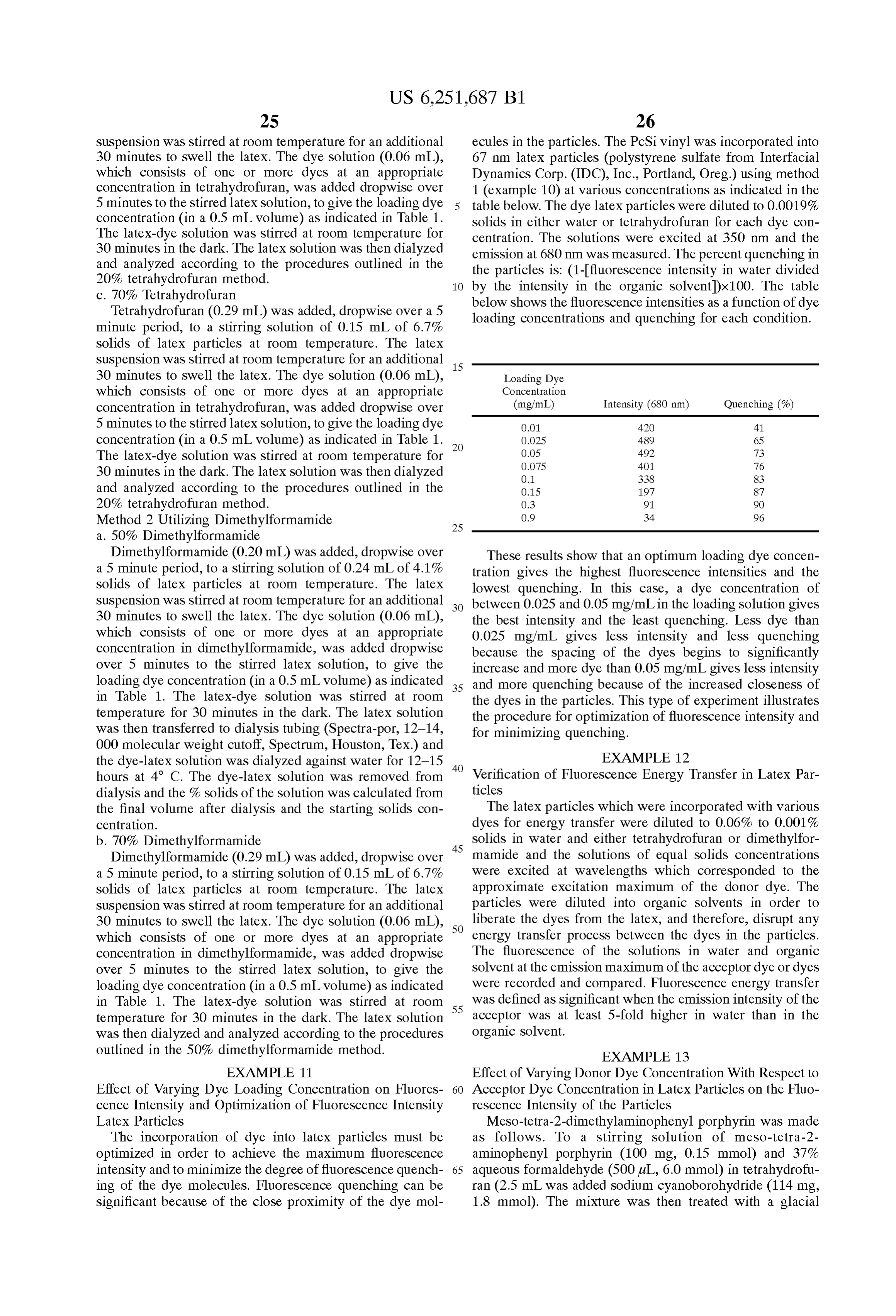
Page 23
acetic acid (60 u) over 10 minutes and stirred at room to 0.057% solids in either water or tetrahydrofuran. The temperature for 3 hours. More glacial acetic acid (60 uD) dye-latex solutions were excited at 350 nm and the fluores was added and the mixture stirred a further 1 hour at room cence intensity at 680 nm was measured. The intensity of temperature. The mixture was evaporated and the residue fluorescence in water divided by the intensity of fluores was purified on a Silica gel 60 A column which was 5 cence in tetrahydrofuran minus 1 is the degree of quenching equilibrated in toluene. The product was eluted with toluene/ of the dyes in the lateX particles. 1% isopropanol as a dark brown band. The fraction con taining the product was evaporated and the ink-blue Solid Preparation of One Phthalocyanine Dye in Latex residue dried under vacuum to afford 85 mg of the title A solution of PcSi pentafluoro dye (0.02 mg) in tetrahy compound. drofuran (0.1 mL) was added dropwise over 5 minutes to a Meso-tetra-2-dimethylaminophenyl porphyrin (Tdap Syn stirred 2% solids solution of latex particles (1.0 mL). The thesized from the meso-tetra-2-aminophenyl porphyrin lateX Suspension was Stirred at room temperature for 6 hours, which was obtained through Porphyrin Products, Inc. then transferred to dialysis tubing (Spectra-por, 12-14,000 Logan, Utah) and PcSi vinyl (example 4) were incorporated molecular weight cutoff, Spectrum, Houston, Tex.) and the into 67 nm latex particles (polystyrene Sulfate latex from 15 dye-latex Solution was dialyzed against water for 12-15 Interfacial Dynamics Inc., Portland, Oreg.) using the tet hours at 4 C. The dye-latex solution was removed from rahydrofuran method 1 of example 10. The molar ratio of the dialysis and the Solids concentration was adjusted to 1.6%. Tdap to the PeSi vinyl varied from 1/1 to 2/1 to 6/1 in the Preparation of Three Phthalocyanine Dyes in Latex latex loading Solutions while maintaining a constant mass A solution which consists of PeSi pentafluoro, PcSi tri (0.1 mg/mL) of PcSi vinyl in each solution. The dialyzed hexyl and PcSi cyano dyes in equimolar amounts to total particles were diluted to 0.0019% solids in water and the 0.02 mg dye in tetrahydrofuran (0.1 mL), was added drop fluorescence intensity at 680 nm of the PcSi vinyl was wise over 5 minutes to a stirred 2% solids Solution of latex measured as a function of excitation wavelength between particles (1.0 mL). The latex Suspension was stirred at room 350 nm and 470 nm. The excitation maximum of the Tdap temperature for 6 hours, then transferred to dialysis tubing is 430 nm and of the PeSi vinyl is 350 nm. The emission 25 (Spectra-por, 12-14,000 molecular weight cutoff, Spectrum, maximum of the Tdap is 650 nm. The table below shows the Houston, Tex.) and the dye-latex Solution was dialyzed results. against water for 12-15 hours at 4 C. The dye-latex solution was removed from dialysis and the Solids concentration was adjusted to 1.6%.
Fluorescence
Preparation of Five Phthalocyanine Dyes in Latex
Intensity at A solution which consists of PCSi pentafluoro, PcSi
Tdap/PcSi vinyl Excitation W (nm) 680 nm. trihexyl, PcSicyano, PcSi vinyl and PcSi methyl ester dyes 1f1 350 490 in equimolar amounts to total 0.02 mg dye in tetrahydrofu 1f1 430 83 ran (0.1 mL), was added dropwise over 5 minutes to a stirred 1f1 450 38 35 2% solids solution of latex particles solution (1.0 mL). The
lateX Suspension was Stirred at room temperature for 6 hours, 2f1 430 830 then transferred to dialysis tubing (Spectra-por, 12-14,000 2f1 450 460 molecular weight cutoff, Spectrum, Houston, Tex.) and the 2f1 470 22O dye-latex Solution was dialyzed against water for 12-15
40 hours at 4 C. The dye-latex solutions were removed from 6/1 450 8OO dialysis and the % Solids concentration was adjusted to 6/1 470 2OO 1.6%.
The table that follows illustrates the results of the fluo
These results show that as the molar ratio of donor to 45 rescence experiments.
acceptor in the lateX particles increases from 1/1 to 6/1, the energy transfer, as measured by the fluorescence intensity of the acceptor dye, becomes Significantly more efficient. There Dyes Entrapped Intensity % Quenching was no observable emission of the Tdap dye in the particles 1. 413 72 at the emission maximum of 650 nm Suggesting that the 50 3 561 56 energy transfer is very efficient. The data indicates that the 5 747 49 fluorescence intensity of the lateX particles, generated through an energy transfer pathway, is affected by the “light gathering capability of the donor dye. Thus, optimization of The data show that as the number of different dyes entrapped the fluorescence intensity of the lateX particles should 55 into the latex goes from 1 to 3 to 5, the fluorescence intensity involve changing the molar ratio of donor to acceptor. increases because the quenching in the particles decreases.
EXAMPLE 1.4
EXAMPLE 1.5
Effect of Incorporation of Different Dyes on Quenching and
Fluorescence Intensity of Latex Particles Preparation and Characterization of Fluorescence Energy Five different Silicon phthalocyanines, Synthesized as 60 Transfer Dye Latex (Table 1) and Fluorescent Latex Incor described in examples 2-6, were incorporated into 67 nm porating Hybrid Phthalocyanine Derivatives (Table 2) Surfactant-free, polystyrene latex particles (Interfacial A variety of fluorescent energy transfer latexes were Dynamics Corp. Inc. Portland, Oreg.) in sets of 1,3 or 5 dyes prepared with various donor and acceptor dye molecules. according to the following methods. Each Silicon phthalo Table 1 shows the loading concentrations of the respective cyanine derivative had maximum excitation and emission 65 donor and acceptor dyes, the mole ratio of the donor and wavelengths at 350 nm and 680 nm, respectively. After acceptor dyes, the dye loading Solvent System as described preparation of each dye-latex, each Suspension was diluted in Example 10 and the excitation and emission wavelengths
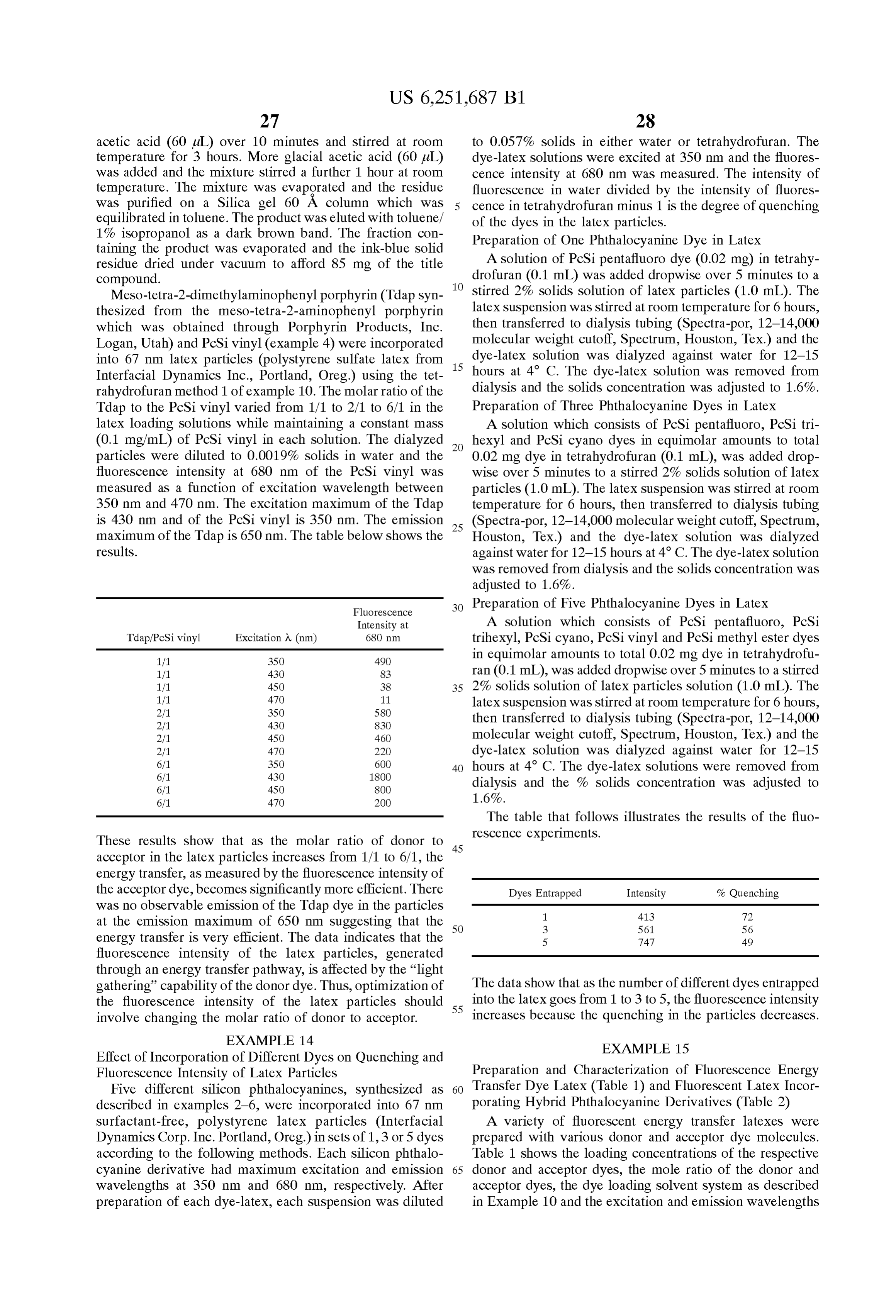
Page 24
and the fluorescence intensity for each particle size at the compound (FET compound) So that the donor and acceptor Specified Solids concentration. For Some of the energy pair reside in the molecule before incorporation into latex. transfer latexes, the same dye pair was incorporated into Table 2 shows the characteristics of lateX particles incor different diameter latexes. The fluorescence energy transfer porated with hybrid phthalocyanine derivatives as described efficiency of the entries is greater than 80%. The dye system in Example 10 and the fluorescence intensity at the Specified represented in line 56 is a fluorescence energy transfer Solids concentration.
TABLE 1.
MOLE DO- SOLVENT
LOADING LOADING NOR: SYSTEM EMISSION
CONC. CONC. MOLE AC- (LATEX INTENSITY MAXIMUM
DONORDYE (mg/mL) ACCEPTOR DYE (mg/mL) CEPTOR SIZE) (% SOLID) (EXCIT) 1. trans-4-4-(Dibutyl amino) O.12 Silicon phthalocyanine O.1 2: THF 340 679 mm. styryl-1-methyl pyridinium iodide mg/mL bis(dimethylvinylsilyl- mg/mL. (20%) (0.0019%) (475 nm)
plm) 2. trans-4-4-(Dibutyl amino) O. Silicon 2,3-naphthalo- O.23 1: DMF 347 789 mm. styryl-1-methyl pyridinium iodide mg/mL cyanine bis(dimethyl- mg/mL. (70%) (0.057%) (475 nm)
plm) 3. trans-4-4-(Dibutyl amino) O. 1,1'-Dihexyl-3,3,3',3'- 0.144 1: DMF 688 688 nm. styryl-1-methyl pyridinium iodide mg/mL tetramethylindodicarbo- mg/mL. (70%) (0.057%) (645 nm)
plm) 4. Meso-tetra-2-aminophenyl O.18 Silicon phthalocyanine O.1 2: THF 1OOO 679 mm. porphine mg/mL. bis(dimethylvinylsilyl- mg/mL. (20%) (0.00095%) (420 nm)
plm) 5. Meso-tetra-2-aminophenyl O. 1,1'-Dihexyl-3,3,3',3'- O.O98 1: DMF 157 676 mm porphine mg/mL. tetramethylindodicarbo- mg/mL. (70%) (0.0019%) (645 nm)
plm) 6. Meso-tetra-2- O.21 Silicon phthalocyanine O.1 2: THF 209 679 mm. dimethylaminophenyl porphine mg/mL. bis(dimethylvinylsilyl- mg/mL. (20%) (0.00095%) (430 nm)
plm) 7. 3-Ethyl-3-ethyl carboxyethyl- 0.056 Silicon 2,3-naphthalo- O.25 4: DMF 289 785 nm. hiadicarbocyanine iodide mg/mL. cyanine bis(dimethyl- mg/mL. (70%) (0.057%) (650 nm)
plm) 8. 1,1'-Dioctadecyl-3,3,3,3',3'- O.036 Silicon 2,3-naphthalo- O.O13 4: DMF 324 787 in etramethylindodicarbocyanine mg/mL. cyanine bis(dimethyl- mg/mL. (70%) (0.057%) (650 nm) perchlorate vinylsilyloxide) (0.067 plm) 9. 1,1'-Diethyl-3,3,3'3'- O.O78 Silicon 2,3-naphthalo- O.O25 6: DMF 723 787 in etramethylindocarbocyanine mg/mL. cyanine bis(dimethyl- mg/mL. (70%) (0.057%) (635 nm) iodide vinylsilyloxide) (0.067 plm)
O. 1,1'-Dihexyl-3,3,3',3'- O.O94 Silicon 2,3-naphthalo- O.O25 6: DMF 907 783 mm. etramethylindodicarbocyanine mg/mL. cyanine bis(dimethyl- mg/mL. (70%) (0.057%) (635 nm) iodide vinylsiloxide) (0.067 plm) 1. 3,3'-Diethyl O.O13 Silicon 2,3-naphthalo- O.O25 DMF 12 788 mm hiatricarbocyanine iodide mg/mL. cyanine bis(dimethyl- mg/mL. (70%) (0.057%) (650 nm)
plm) 2. 3,3'-Dipropyl O.O13 Silicon 2,3-naphthalo- O.O25 DMF 65 788 mm hiadicarbocyanine iodide mg/mL. cyanine bis(dimethyl- mg/mL. (70%) (0.057%) (660 nm)
plm) 3. 1.9-Dimethyl-methylene O.O08 Silicon 2,3-naphthalo- O.O25 DMF 57 788 mm blue, chloride mg/mL. cyanine bis(dimethyl- mg/mL. (70%) (0.057%) (650 nm)
plm) 4. N,N'-Di(3-trimethyl- O.O13 Silicon 2,3-naphthalo- O.O25 DMF 63 788 mm ammoniumpropyl) thia- mg/mL. cyanine bis(dimethyl- mg/mL. (70%) (0.057%) (650 nm) dicarbocyanine tribromide vinylsilyloxide) (0.067 plm) 5. 1,1,3,3,3',3'-Hexamethyl- O.O12 Silicon 2,3-naphthalo- O.O25 DMF 33 788 mm indoctricarbocyanine perchlorate mg/mL cyanine bis(dimethyl- mg/mL. (70%) (0.057%) (650 nm)
plm) 6. N-(3–Triethyl- O.O14 Silicon 2,3-naphthalo- O.O25 DMF 55 788 mm ammoniumpropyl)-4-(4-(p- mg/m. cyanine bis(dimethyl- mg/mL. (70%) (0.057%) (500 nm) dibutylaminophenyl) butadienyl) vinylsilyloxide) (0.067 pyridium, dibromide plm) 7. 1,1,3,3,3',3'-Hexamethyl- O.O15 Silicon 2,3-naphthalo- O.O25 DMF 8 788 mm
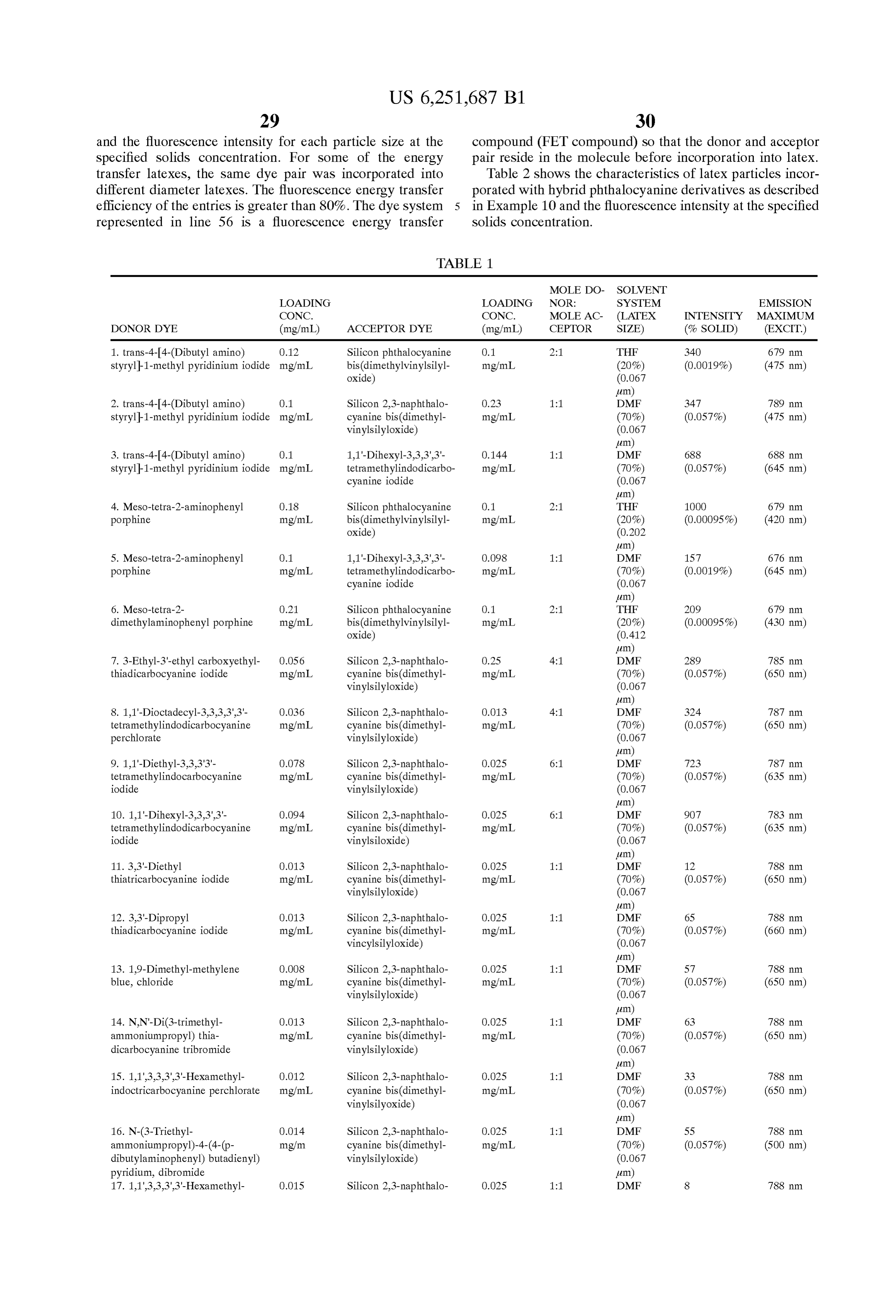
Page 25
TABLE 1-continued
MOLE DO SOLVENT
LOADING LOADING NOR: SYSTEM EMISSION
CONC. CONC. MOLE AC (LATEX INTENSITY MAXIMUM
DONORDYE (mg/mL) ACCEPTOR DYE (mg/mL) CEPTOR SIZE) (% SOLID) (EXCIT) 4,4'-5,5-dibenzo-2,2'-indo mg/mL. cyanine bis(dimethyl mg/mL. (70%) (0.057%) (650 nm) tricarbocyanine perchlorate vinylsilyloxide) (0.067 plm) 18. Fluoroscein O.264 Silicon phthalocyanine O1 6:1 THF 517 683 mm. mg/mL. bis(dimethylvinylsilyl mg/mL. (20%) (0.057%) (485 nm)
plm) 19. Chlorophyll B O.O87 Silicon 2,3-naphthalo O.O25 4:1 THF 72 783 nm. mg/mL. cyanine bis(dimethyl mg/mL. (20%) (0.057%) (440 nm)
plm) 20. Chlorophyll B O.244 Silicon phthalocyanine O1 2:1 THF 140 679 mm. mg/mL. bis(dimethylvinylsilyl mg/mL. (20%) (0.001.9%) (440 nm)
plm) 21. trans-4-4-(Dibutyl O.181 Silicon p alocyanine 4:1:1 THF 681 mm amino)styryl-1-methyl pyridinium mg/mL. bis(dime penta (20%) (0.001.9%) (475 nm) iodide fluorophen silyloxide)+ (0.067
bis(dime vinylsilyl mg/mL.
Oxide) 22. trans-4-4-(Dibutyl amino) 0.072 Silicon phth al ocyanine O.04 4:1:1:1 THF 2O6 681 mm styryl-1-methyl pyridinium iodide mg/mL. bis(triexylsi yloxide) + mg/mL. (20%) (0.001.9%) (475 nm)
phenylsilyloxide) +
Silicon phthalocyanine
Oxide) 23. 3-Ethyl-3'-carboxyethylthia O.O13 Silicon 2,3-naphthalo O.O25 DMF 76 788 nm. dicarbocyanine iodide mg/mL. cyanine bis(dimethyl mg/mL. (70%) (0.057%) (625 nm)
pum) 24, 3-Ethyl-3'-ethyl-carboxy O.O13 Silicon 2,3-naphthalo O.O25 DMF 135 788 nm. ethyloxathiadicarbocyanine iodide mg/mL. cyanine bis(dimethyl mg/mL. (70%) (0.057%) (630 nm)
plm) 25. 3,3'-Diethylthia O.O13 Silicon 2,3-naphthalo O.O25 DMF 59 787 in dicarbocyanine iodide mg/mL. cyanine bis(dimethyl mg/mL. (70%) (0.057%) (660 nm)
plm) 26. 3,3'-Diethyloxa O.O12 Silicon 2,3-naphthalo O.O25 DMF 57 787 in dicarbocyanine iodide mg/mL. cyanine bis(dimethyl mg/mL. (70%) (0.057%) (590 nm)
plm) 27. 1,1'-Dihexyl-3,3,3,3'- O.O94 Silicon 2,3-naphthalo O.O25 DMF 127 788 nm. tetramethylindodicarbocyanine mg/mL. cyanine bis(dimethyl mg/mL. (50%) (0.057%) (650 nm) iodide vinylsilyloxide) + (0.431
Silicon naphthalocyanine O.05 pum CML)
maleimidosilyloxide) 28. 1,1'-Dihexyl-3,3,3',3'- O.O94 Silicon 2,3-naphthalo O.O25 6:1:2 DMF 193 788 nm. tetramethylindodicarbocyanine mg/mL. cyanine bis(dimethyl mg/mL. (50%) (0.057%) (635 nm) iodide vinylsilyloxide) + (0.431
Silicon phthalocyanine O.05 pum CML)
maleimidosilyloxide) 29. 1,1'-Dihexyl-3,3,3,3'- O.O3 Silicon 2,3-naphthalo O.05 DMF 275 788 nm. tetramethylindodicarbocyanine mg/mL. cyanine bis(dimethyl mg/mL. (50%) (0.057%) (650 nm) iodide hexylvinylsilyloxide) (0.431 pum CML) 30. 1,1'-Dihexyl-3,3,3,3' O.1 Silicon 2.3 naphthalo O.2 DMF 163 798 nm. tetramethylindodicarbocyanine mg/mL. cyanine bis(dimethyl mg/mL. (50%) (0.057%) (650 nm) iodide triphenylsilyloxide) (0.431 pum CML) 31. 1,1'-Dihexyl-3,3,3',3'- Silicon naphthalocyanine O.05 DMF 153 790 nm. tetramethylindodicarbocyanine bis(dimethylretinol) mg/mL. (50%) (0.057%) (650 nm) iodide (0.431 pum CML) 32. 1,1,3,3,3',3'-Hexamethyl O.216 Silicon 2,3-naphthalo O1 DMF 0.4 788 nm. indotricarbocyanine perchlorate mg/mL. cyanine bis(dimethyl mg/mL. (50%) (0.00057%) (635 nm)
pum CML) 33. 1,1'-Dihexyl-3,3,3,3'- O.512 DMF 776 mm
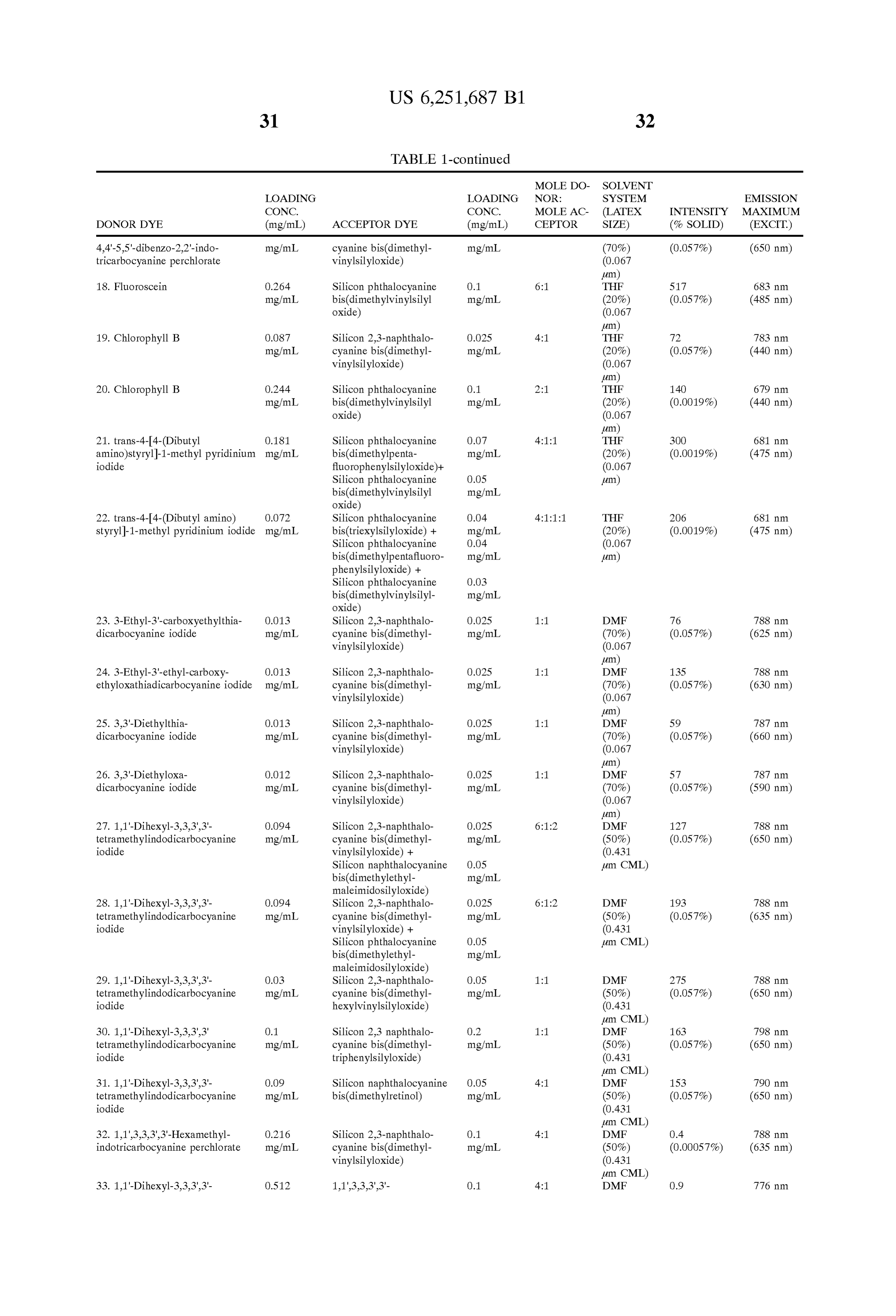
Page 26
Drawing sheet — no readable text.
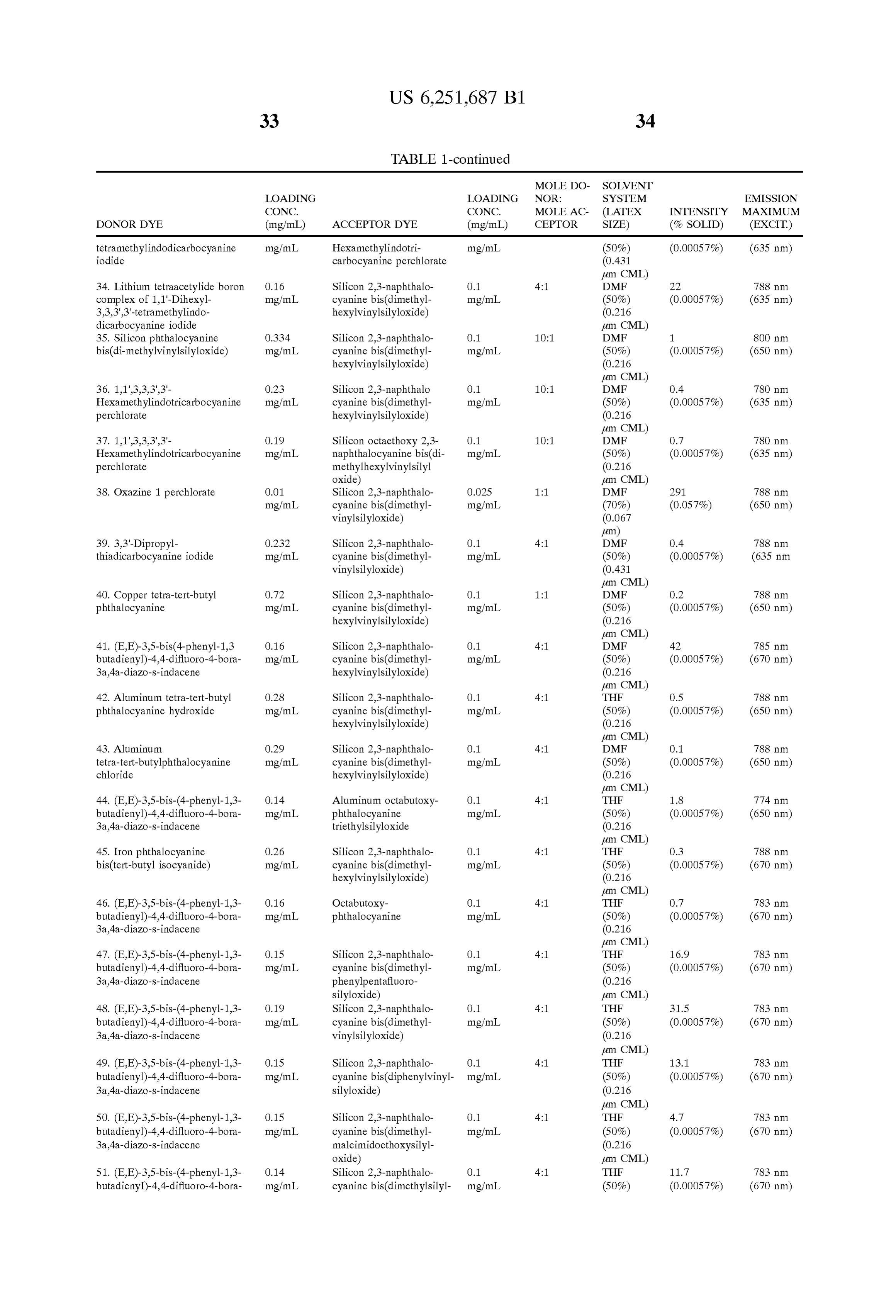
Page 27
Drawing sheet — no readable text.
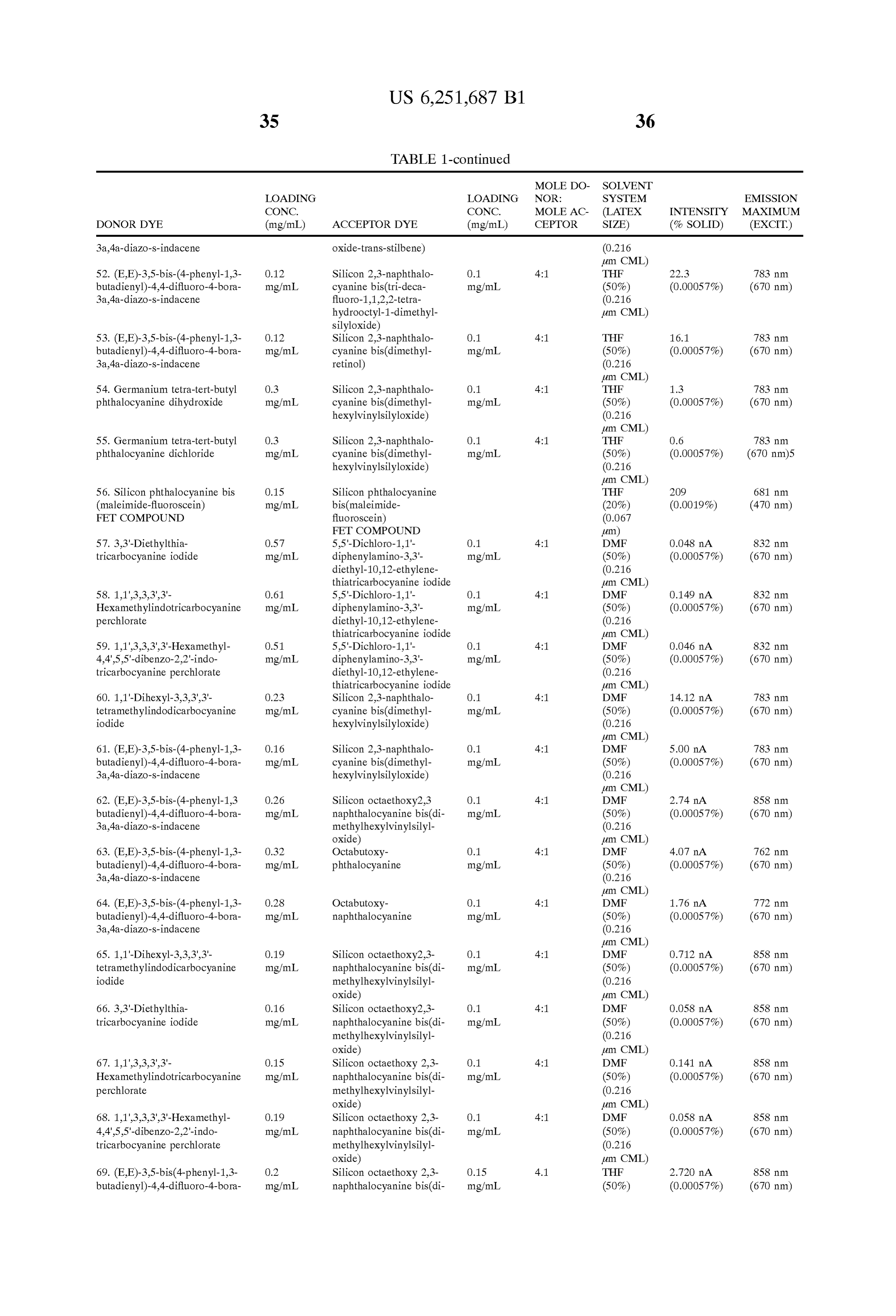
Page 28
Drawing sheet — no readable text.
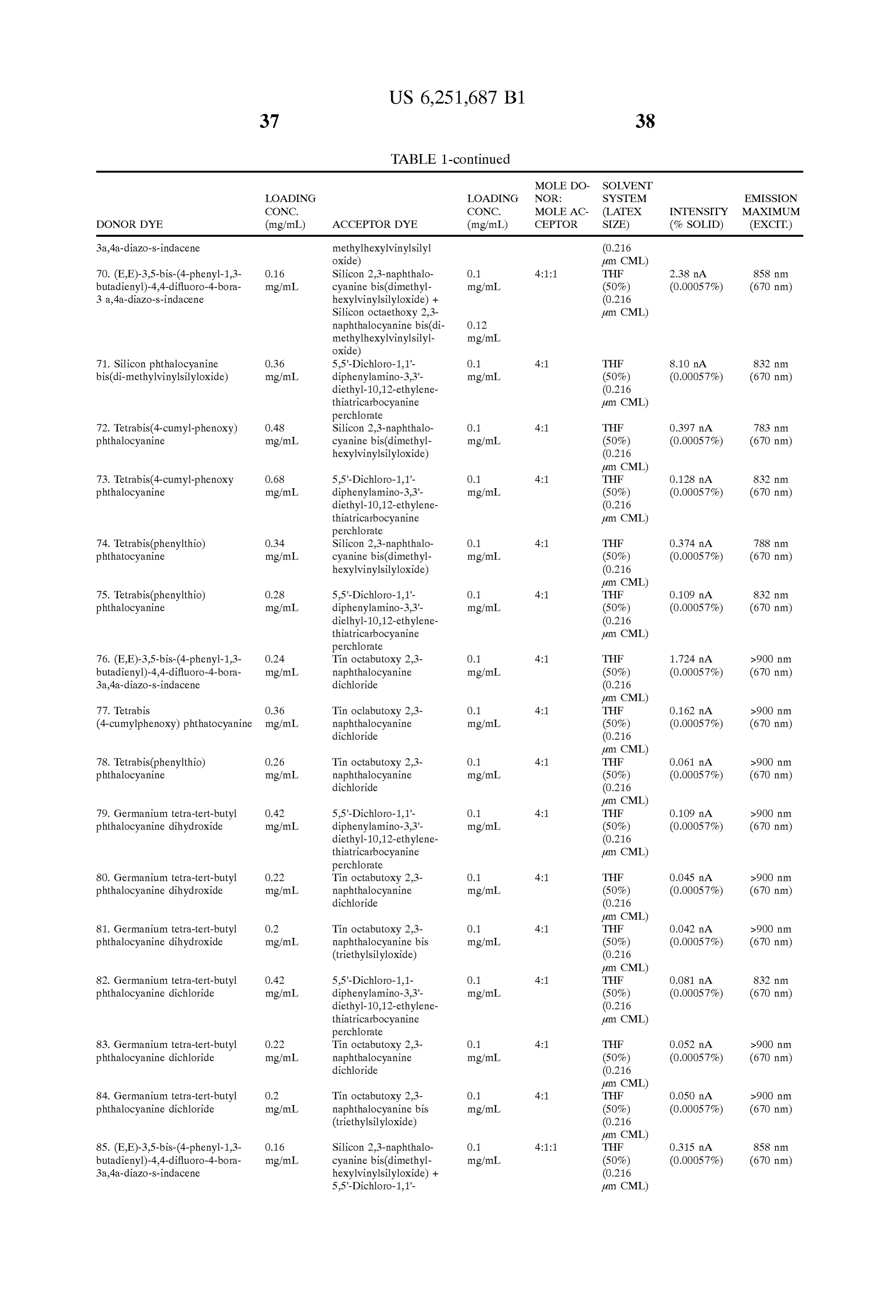
Page 29
TABLE 1-continued
MOLE DO SOLVENT
LOADING LOADING NOR: SYSTEM EMISSION
CONC. CONC. MOLE AC (LATEX INTENSITY MAXIMUM
DONORDYE (mg/mL) ACCEPTOR DYE (mg/mL) CEPTOR SIZE) (% SOLID) (EXCIT)
hiatricarbocyanine perchlorate 86. (E.E)-3,5-bis-(4-phenyl-1,3- O.24 5,5'-Dichloro-1,1- O1 4:1 THF 2.230 mA 832 nm. butadienyl)-4,4-difluoro-4-bora mg/mL. diphenylamino-3,3'- mg/mL. (50%) (0.00057%) (670 nm) 3a,4a-diazo-s-indacene diethyl-10,12-ethylene (0.216
perchlorate 87. 1,1'-Dihexyl-3,3,3,3'- O.34 5,5'-Dichloro-1,1- O1 4:1 THF 0.545 mA 82.3 nm. tetramethyl-indodicarbocyanine mg/mL. diphenylamino-3,3'- mg/mL. (50%) (0.00057%) (670 nm) iodide diethyl-10,12-ethylene (0.216
perchlorate 88. (E.E)-3,5-bis-(4-phenyl-1,3- O16 Silicon 2,3-naphthalo 4:1:1 THF 49 783 nm. butadienyl)-4,4-difluoro-4-bora mg/mL. cyanine bis(dimethyl (50%) (0.00057%) (670 nm) 3a,4a-diazo-s-indacene hexylvinylsilyloxide) + (0.216
cyanine bis(dimethyl
Oxide) 89. Silicon phthalocyanine 1.O Silicon octaethoxy 2,3- 1.O 1.5:1 THF 0.4 858 nm. bis(dimethylhexylvinylsilyloxide) mg/mL. a) la ocyanine bis(di mg/mL. (50%) (0.00057%) (670 nm)
90. Silicon phthalocyanine 1.O Silicoin 2,3- 1.O 1.5:1.2:1 THF 0.4 854 nm. bis(dimethylhexylvinylsilyloxide) mg/mL. a) la ocyanine mg/mL. (50%) (0.00057%) (670 nm)
Silicoin octaethoxy 2,3- 1.O a) la ocyanine bis(di mg/mL.
let hylhexylvinylsilyl oxide) 91. Silicon phthalocyanine Silicoin 2,3- 9.7:1 THF 155.8 785 nm. bis(trihexylsilyloxide) mg/mL. la ocyanine (50%) (0.00057%) (670 nm)
pum CML) 92. Silicon phthalocyanine in 2,3- 3.5: THF 23.2 785 nm. bis(3-cyanopropyl) mg/mL. ocyanine (50%) (0.00057%) (670 nm) dimethylsilyloxide bis(dimethylhexylvinylsily (0.216 pum CML) 93. Silicon phthalocyanine in 2,3- O.1: THF 14.5 785 nm. bis(dimethylpentafluorophenylsilyl mg/mL. ocyanine (50%) (0.00057%) (670 nm) Oxide) bis(dimethylhexylvinylsily (0.216 pum CML) 94. Silicon phthalocyanine in 2,3- O:3: THF 70.5 785 nm. dimethylpentafluorophenylsilyloxi mg/mL. ocyanine (50%) (0.00057%) (670 nm) de trihexylsilyloxide bis(dimethylhexylvinylsily (0.216 pum CML) 95. Silicon phthalocyanine in 2,3- THF 2008 785 nm. bis(10-carbomethoxydecyl) mg/mL. ocyanine (50%) (0.00057%) (670 nm) dimethylsilyloxide bis(dimethylhexylvinylsily (0.216 pum CML) 96. Silicon phthalocyanine in 2,3- 4.7: THF 126.8 780 nm. bis(dimethylhexylvinylsilyloxide) mg/mL. la ocyanine (50%) (0.00057%) (670 nm)
pum CML) 97. Silicon phthalocyanine (10 in 2,3- 2.1: THF 2O7.7 785 nm. carbomethoxydecyl) mg/mL. la ocyanine (50%) (0.00057%) (670 nm) dimethylsilyloxide (dimethylhexylvinylsily (0.216 (dimethylvinylsilyloxide) ide) pum CML) 98. Silicon phthalocyanine in 2,3- 5.3: THF 262.8 780 nm. bis(dimethylhexylvinylsilyloxide) mg/mL. la ocyanine (50%) (0.00057%) (670 nm)
99. Silicon phthalocyanine (10 in 2,3- 4.6: THF 117.2 780 nm. carbomethoxydecyl) mg/mL. la ocyanine (50%) (0.00057%) (670 nm) dimethylsilyloxide rihexylsilyloxide) (0.216 (dimethylvinylsilyloxide) pum CML) 100. Silicon phthalocyanine Silicon di(1,6-diphenyl 1.O 5:1 THF 177.6 77O in bis(dimethylhexylvinylsilyloxide) mg/mL. 2,3-naphthalocyanine) mg/mL. (50%) (0.00057%) (670 nm)
loxide)
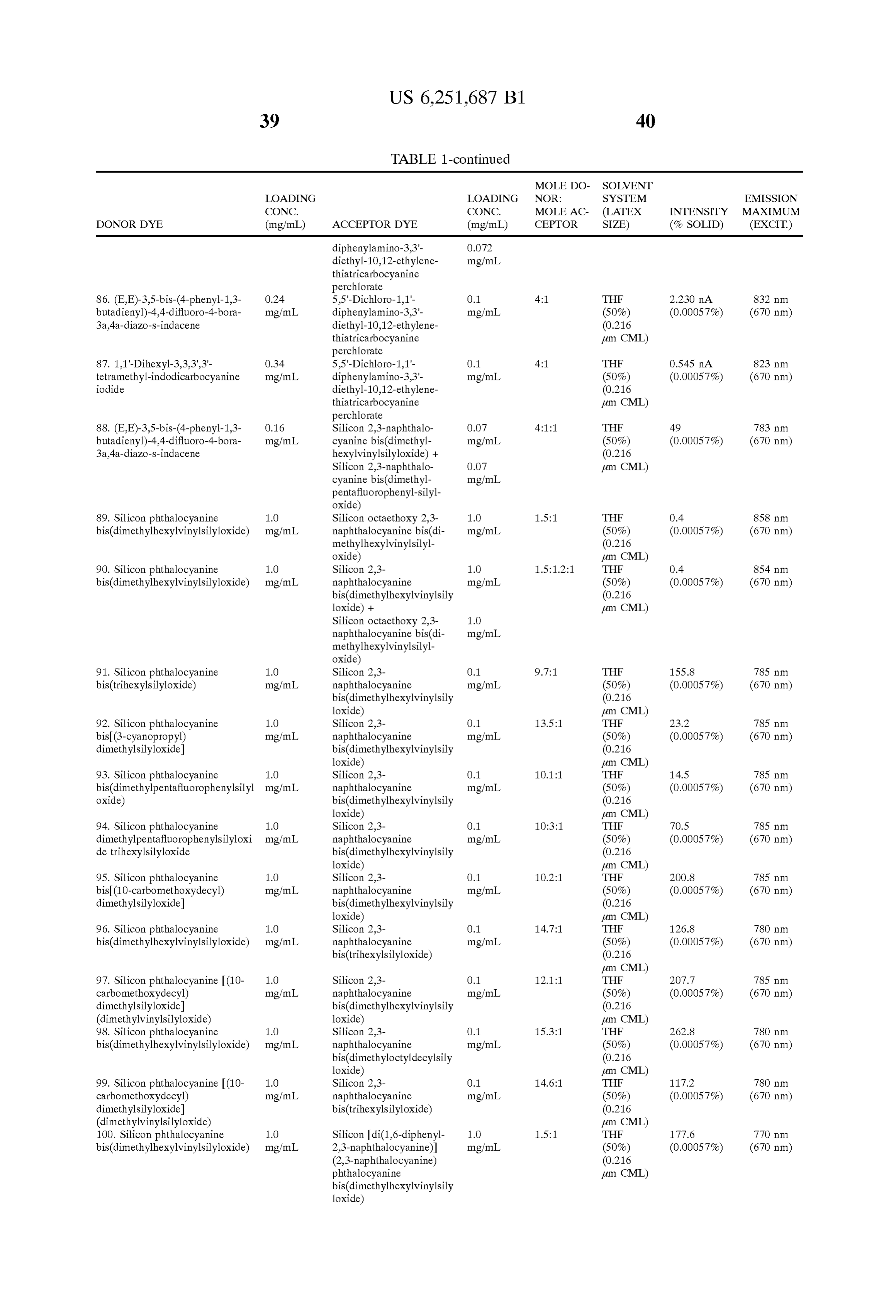
Page 30
TABLE 1-continued
MOLE DO SOLVENT
LOADING LOADING NOR: SYSTEM EMISSION
CONC. CONC. MOLE AC (LATEX INTENSITY MAXIMUM
DONORDYE (mg/mL) ACCEPTOR DYE (mg/mL) CEPTOR SIZE) (% SOLID) (EXCIT) 101. Silicon phthalocyanine 1.O Silicon di(1,6-diphenyl 1.O 1.6:1 THF 1413 760 nm. bis(dimethylhexylvinylsilyloxide) mg/mL. 2,3-napht halocyanine) mg/mL. (50%) (0.00057%) (670 nm) di(2,3-ter (0.216 butylphthalocyanine pum CML) bis(dimet hylhexylvinylsily loxide) 102. Silicon phthalocyanine 1.O Silicon di(2,3- 1.O 1.4:1 THF 66.5 780 nm. dis(dimethylhexylvinylsilyloxide) mg/mL. naphthalocyanine) mg/mL. (50%) (0.00057%) (670 nm) di (1,4- (0.216 diphenylphthalocyanine) pum CML) bis(dime hylhexylvinylsily loxide) 103. Silicon phthalocyanine 1.O Silicond i( ,6-diphenyl 1.O 1.5:1 THF 259.3 760 nm. bis(dimethylhexylvinylsilyloxide mg/mL. 2,3-naph halocyanine) mg/mL. (50%) (0.00057%) (670 nm) diphthalocyanine (0.216 bis(trilhexylsilyloxide) pum CML) 104. Silicon phthalocyanine 1.O Silicond i( ,6-diphenyl 1.O 1.5:1 THF 7.7 843 nm. bis(dimethylhexylvinylsilyloxide) mg/mL. 2,3-naph halocyanine) mg/mL. (50%) (0.00057%) (670 nm) di(2,3- (0.216 dicyanophthalocyanine) pum CML) bis(dime hylhexylvinylsily
Oxide) 105. Silicon phthalocyanine 1.O Silicon 2,3- O1 15:1 THF 55.5 785 nm. bis(dimethylvinylsilyloxide) mg/mL. naphthalocyanine mg/mL. (50%) (0.00057%) (670 nm) bis(dime hylhexylvinylsily (0.216
Oxide) pum CML) 106. Silicon phthalocyanine 10.4 Silicond i(1,6- 1.O 15:1 :0.11 THF 503 785 nm. bis(dimethylhexylvinylsilyloxide) mg/mL. diphenylnaphthalocyanin mg/mL. (70%) (0.00057%) (670 nm) e) diphthalocyanine (0.216 bis(dimet hylhexylvinylsily pum CML)
Oxide) +
naphthalocyanine mg/mL bis(dimet hylhexylvinylsily
Oxide) 107. Silicon phthalocyanine 10.4 Silicond i(1,6- 1.O 15:1 750 760 nm. bis(dimethylhexylvinylsilyloxide) mg/mL. diphenylnaphthalocyanin mg/mL. (70%) (0.00057%) (670 nm) e) diphthalocyanine (0.216 bis(dimet hylhexylvinylsily pum CML)
Oxide) 108. Silicon phthalocyanine 1.2 Silicon 2,3- O1 15:1 THF 335 785 nm. bis(dimethylhexylvinylsilyloxide) mg/mL. naphthalocyanine mg/mL. (50%) (0.00057%) (670 nm) bis(dimet hylhexylvinylsily (0.216
Oxide) pum CML) 109. Silicon phthalocyanine 5.2 Silicond i(1,6- 0.5 15:1 O.19 THF 410 798 nm. bis(dimethylhexylvinylsilyloxide) mg/mL. diphenylnaphthalocyanin mg/mL. (70%) (0.00057%) (670 nm) e) diphthalocyanine (0.216 hylhexylvinylsily pum CML)
diphenylnaphthalocyanin mg/mL.
e) dinaphthalocyanine bis(dimet hylhexylvinylsily 110. Silicon phthalocyanine 4.8 Silicond i(1,6- 0.5 15:1 4.09 798 nm. bis(dimethylhexylvinylsilyloxide) mg/mL. diphenylnaphthalocyanin mg/mL. (70%) (0.00057%) (670 nm) e) dinaphthalocyanine (0.216 bis(dimet hylhexylvinylsily pum CML)
Oxide)
TABLE 2
LOADING
CONC. SOLVENT LATEX EMISSION
HYBRD COMPOUND (mg/mL) SYSTEM SIZE % SOLID INTENSITY MAXIMUM EXCITATION
1. Silicon di(1,6-diphenylnaphthalocyanine) 2.O THF O.216 O.OOO57% 50 760 nm. 650 nm. diphthalocyanine bis(dimethylhexyl mg/mL. pum CML vinylsilyloxide 2. Silicon di(1,6-diphenylnaphthalocyanine) 2.O THF O.216 O.OOO57% 0.7/0.5 765 nmf 650 nm. tetrafluorophthalocyanine mg/mL. pum CML 825 nm.
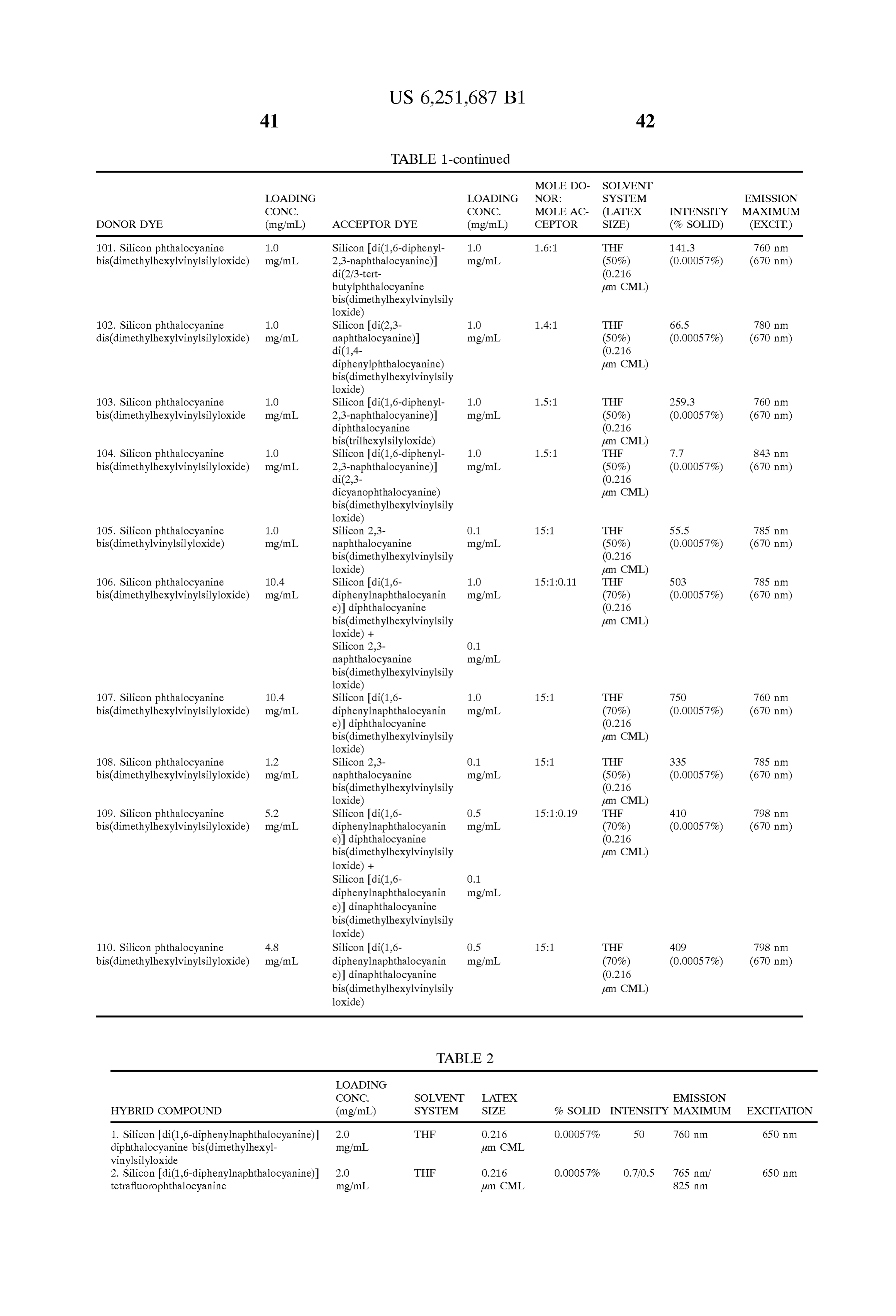
Page 31
TABLE 2-continued
LOADING
CONC. SOLVENT LATEX EMISSION
HYBRID COMPOUND (mg/mL) SYSTEM SIZE % SOLID INTENSITY MAXIMUM EXCITATION phthalocyanine
3. Silicon di(1,6-diphenylnaphthalocyanine) 1.5 THF O.216 O.OOO57% O.5/0.3 770 nmf 650 mm etrafluorophthalocyanine mg/mL. pum CML 839 mm. phthalocyanine
4. Silicon di(1,6-diphenylnaphthalocyanine) 0.1 THF O.216 O.OOO57% O.2 775 nm. 650 mm diphthalocyanine bis(dimethylpentafluoro- mg/mL. pum CML phenylsilyloxide) 5. Silicon di(1,6-diphenylnaphthalocyanine) 1.5 THF O.216 O.OOO57% 7 758 in 650 mm di(tert-butylphthalocyanine) bis(dimethyl- mg/mL. pum CML hexylvinylsilyloxide) 6. Silicon di(2,3-naphthalocyanine) di(1,4- 1.O THF O.216 O.OOO57% 7 779 in 650 mm diphenylphthalocyanine) mg/mL. pum CML
7. Silicon di(2,3-naphthalocyanine di(1,4- 2.O THF O.216 O.OOO57% 6 792 mm 650 mm diphenylphthalocyanine) mg/mL. pum CML
8. Silicon di(1,6-diphenyl-2,3- 2.O THF O.216 O.OOO57% 43 757 in 650 mm naphthalocyanine) di(2,3-tert- mg/mL. pum CML butylphthalocyanine)
9. Silicon di(1,6-diphenyl-2,3- 0.4 THF O.216 O.OOO57% 2 77O in 660 mm naphthalocyanine) di(2,3-tert- mg/mL. pum CML butylphthalocyanine)
O. Silicon di(1,6-diphenyl-2,3- 1.5 THF O.216 O.OOO57% 58 757 in 650 mm naphthalocyanine) diphthalocyanine mg/mL. pum CML
1. Silicon di(1,6-diphenyl-2,3- O.2 THF O.216 O.OOO57% 15 798 nm. 350 mm naphthalocyanine) dinaphthalocyanine mg/mL. pum CML
2. Silicon (1,6-diphenyl-2,3- O.8 THF O.216 O.OOO57% 74 720 mm 630 nm. naphthalocyanine) triphthalocyanine mg/mL pum CML
3. Silicon di(1,6-diphenyl-2,3- 2.O THF O.216 O.OOO57% 34 77O in 675 nm. naphthalocyanine) (2,3-naphthalocyanine) mg/mL. pum CML phthalocyanine
4. Silicon di(2,3-naphthalocyanine) O1 THF O.216 O.OOO57% 1. 800 nm. 650 mm di (2,3-dicyanophthalocyanine) mg/mL. pum CML
5. Silicon di(1,6- 0.5 THF O.216 O.OOO57% 8 790 nm. 650 mm diphenylnaphthalocyanine) mg/mL. pum CML di (dichlorophthalocyanine 6. Silicon di(1,6-diphenyl-2,3- 0.5 THF O.216 O.OOO57% 1. 764 nm. 660 mm naphthalocyanine) diphthalocyanine mg/mL. pum CML bispoly(ethylene glycol) methyl ester 7. Silicon di(1,6-diphenyl-2,3- 0.4 THF O.216 O.OOO57% 2 768 mm 670 nm. naphthalocyanine) diphthalocyanine mg/mL. pum CML dihydroxide 8. Silicon di(1,6-diphenyl-2,3- 1.O THF O.216 O.OOO57% 17 766 mm 650 mm naphthalocyanine) diphthalocyanine mg/mL. pum CML
9. Silicon di(1,6-diphenyl-2,3- 0.5 THF O.216 O.OOO57% 1.O 777 in 660 mm naphthalocyanine) diphthalocyanine mg/mL. pum CML
20. Silicon trinaphthalocyanine 0.5 THF O.216 O.OOO57% 11 782 mm 660 mm dichlorophthalocyanine mg/mL. pum CML
EXAMPLE 16 mL, 2% solids, 412 nmi; entry 10, Table 1) was added
Adsorption of Anti-Human Chorionic Gonadotropin (hCG) quickly while Vortexing to a Solution of anti-B hCG mono Antibody to Latex Particles clonal antibody (0.2 mL, 6.6 mg/mL, Applied Biotech Inc., A typical example of the adsorptions of an antibody to 60 San Diego, Calif.) in 20 mM sodium borate/150 mM sodium dyed lateX particles, prepared as described in Example 10, chloride, pH 8.2. A solution of 0.1 M potassium citrate, pH and of a complementary antibody to undyed lateX particles, 3, (0.04 mL) was added quickly while vortexing to the both of which can be used in a sandwich assay for hCG, is antibody latex Solution at room temperature and the pH of outlined below. Those skilled in the art will recognize that the resulting solution was 3.5. The solution incubated at various techniques are available to adsorb or to covalently room temperature for 5 minutes, then a solution of 2 M couple proteins, peptides, ligand analogues nucleotides and potassium borate, pH 9.7 (0.025 mL) was added quickly nucleic acids to latex particles. A Solution of dye latex (0.1 while vortexing to bring the pH to about 8.5. This latex
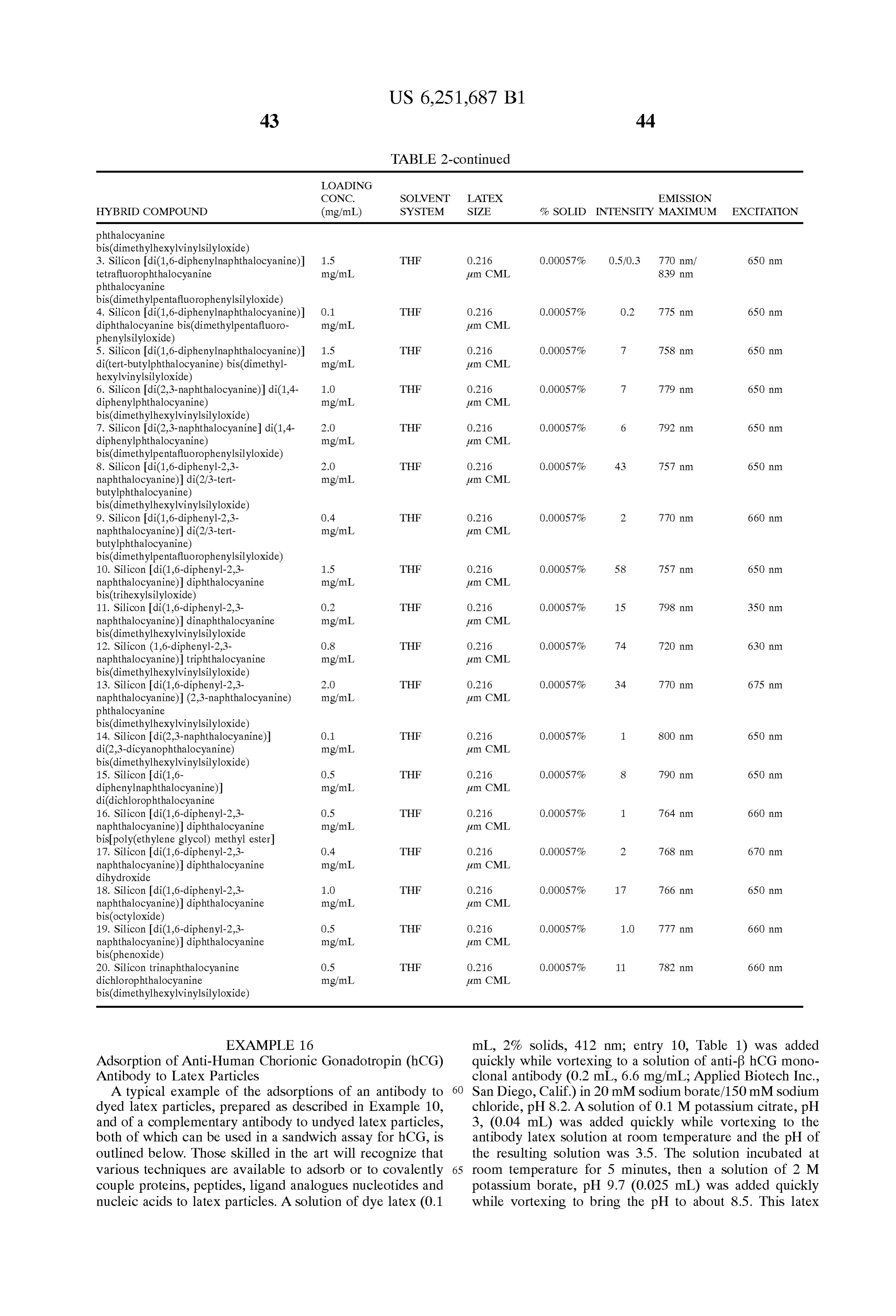
Page 32
antibody conjugate was dialyzed (Spectra-por dialysis SL-6; 1=670+10 nm, 0.95 mW) which was filtered by a tubing, molecular weight cutoff of 300,000, Spectrum, low-pass cutoff filter (Corion LS700, passes wavelengths Houston, Tex.) against 4 changes of 2 L each of 20 mM less than 700 nm). Fluorescence emission was detected at Sodium borate/150 mM sodium chloride, pH 8.2 at 4 C. for 90° to the incident diode laser beam. The emitted light was 4 days. The dialyzed latex conjugate was then removed from collected and focused on a silicon photodiode (Melles Griot, the dialysis tubing and the Solids concentration was calcu Cat. # 13DS1009) by a condenser consisting of two aspheric lated to be 0.4%. This conjugate can be used for immunoas lenses (Melles Griot, Cat. # 01 LAG 119). A high-pass cutoff Says for hCG in Serum. The lateX has excitation and emission filter (Schott Glass RG715) in front of the Silicon photo wavelengths of 650 nm and 780 nm, respectively. diode blocked scattered laser light at 670 nm but passed A solution of polystyrene sulfate latex (0.036 mL, 8.4% emitted light at wavelengths larger than 715 nm. The pho solids, 1000 nmi; Interfacial Dynamics Corp., Inc., Portland tocurrent from the Silicon photodiode was amplified and Oreg.) was added quickly, at room temperature, while Vor displayed by a current amplifier in nanoamps (“na”), texing to a Solution consisting of anti-C. hCG monoclonal (Melles Griot, Cat. # 13 AMP 003). In some instances, 12 antibody (0.12 mL, 10.3 mg/mL, Applied Biotech Inc. San nm band filters were placed in front of the silicon photodiode Diego, Calif.) in 20 mM sodium borate/150 mM sodium 15 with center wavelengths at 730 nm, 790 nm, 850 nm, and chloride, pH 8.2 and 0.1 M potassium citrate, pH 3, (0.6 900 nm.
mL). The solution incubated at room temperature for 5 EXAMPLE 1.9 minutes and was Subjected to centrifugation in an Eppendorf centrifuge (2000xg for 5 min). The Supernatant was Synthesis of Silicon 2,3-Naphthalocyanine bis removed, the pellet was resuspended in 0.1 M potassium (Diphenylvinylsilyl-oxide) phosphate, pH 7, (1.5 mL) and the Suspension was Subjected A Suspension of Silicon 2,3-naphthalocyanine dihydrox to centrifugation as described above. This proceSS was ide (39 mg, 0.05 mmol) in dimethylformamide (0.5 uL) repeated 2 times more and in the final centrifugation, the containing diphenylvinylchlorosilane (28 uL, 0.125 mmol) pellet was resuspended with 0.1 M potassium phosphate, pH and imidazole (7 mg, 0.1 mmol) was stirred under argon at 7 (0.3 mL) to make 1% solids. This antibody latex is used 25 room temperature for 18 hours. The reaction mixture was on a Solid phase, Such as a membrane, to capture the evaporated and the residue purified on a Silica column hCG-dye antibody lateX conjugate complex in a reaction equilibrating with hexane and eluting the product with mixture in an immunoassay for hCG. toluene as a long green band. The toluene fraction contain ing the product was evaporated to afford 5 mg green Solid.
EXAMPLE 1.7
Immunoassay for hCG EXAMPLE 2.0 The solid phase anti-C. hCG latex solution (0.005 mL, 1% Synthesis of Silicon 2,3-Naphthalocyanine bis solids; example 16) can be applied to a 2 cm’ piece of 0.45 (Triphenylsilyloxide) micron nylon membrane (Millipore Corp., Boston, Mass.) A Suspension of silicon 2,3-naphthalocyanine dihydrox which has been treated with a 2% solution of condensed 35 ide (39 mg, 0.05 mmol) in dimethylformamide (1 mL) milk to lower non-specific binding interactions. This mem containing triphenylchlorosilane (37 mg, 0.125 mmol) and brane can be used as the Solid phase onto which is captured imidazole (7 mg, 0.1 mmol) was stirred under argon at room the hCG dye latex conjugate complex. Thus, an hCG assay temperature for 18 hours. The reaction mixture was evapo can be performed by addition of dye latex conjugate (0.025 rated and the residue purified on a Silica column equilibrat mL, example 16) to 0.1 mL Samples of Serum Suspected of 40 ing with hexane and eluting the product with toluene as a containing hCG and also to 0.1 mL Serum Samples contain green band. The toluene fraction containing the product was ing known amounts of hCG (10, 100, 300, 500 and 1000 evaporated to afford 2.5 mg green Solid.
mIU/mL). The serum samples should be incubated about 10 EXAMPLE 21 minutes and then the Samples are applied to the Solid phase membrane containing the Solid phase lateX. The membrane 45 Synthesis of Silicon 2,3-Naphthalocyanine bis should be placed over an absorbent So that the Serum Sample (Dimethylmaleimidoethoxysilyloxide) containing the dye latex conjugates flows through the Solid A Suspension of Silicon 2,3-naphthalocyanine dihydrox phase lateX spot. After the Serum Solution has passed through ide (39 mg, 0.05 mmol) in dimethylformamide (1 mL) the membrane, Serum (0.5 mL) not containing the dye latex containing dichlorodimethylsilane (13.5 uL, 0.11 mmol) and conjugate is applied to the membrane to remove unbound 50 imidazole (14 mg., 0.2 mmol) was stirred under argon at dye latex conjugate. The latex Spots on the membranes are room temperature for 18 hours. The reaction mixture was then placed in a front Surface fluorescence accessory in a then treated with N-(2-hydroxyethyl)maleimide (35 mg, fluorometer and the spot is excited at 650 nm and the 0.25 mmol) and stirred for an additional 10 hours. The fluorescence intensity of the Spot on each membrane is reaction mixture was evaporated and the residue purified on measured at 780 nm. The fluorescence intensity as a function 55 a Silica column equilibrating with hexane, then toluene and of the hCG concentrations of the known Samples is plotted. eluting the product with toluene/10% isopropanol as a green The fluorescence intensities of the unknown hCG serum band. The eluate containing the product was evaporated to Samples can be compared to the known hCG concentrations afford 3.5 mg of green solid.
from the graph. The assay protocol of this Example may be EXAMPLE 22 performed using conjugates comprised of water Soluable 60 Synthesis of Silicon 2,3-Naphthalocyanine bis hybrid phthalocyanine derivatives and, for example, (Dimethylsilyloxide-trans-stilbene) proteins, polypeptides, antibodies, nucleic acids and the like, A Suspension of Silicon 2,3-naphthalocyanine dihydrox instead of the dye latex conjugates. ide (39 mg, 0.05 mmol) in dimethylformamide (1 mL) EXAMPLE 1.8 containing dichlorodimethylsilane (13.5 uL, 0.11 mmol) and Fluorometer for Measuring Near Infrared Emitting Dyes 65 imidazole (14 mg., 0.2 mmol) was stirred under argon at The dye sample (2 mL sample volume in a 10 mmx10 mm room temperature for 2 hours. The reaction mixture was then quartz cuvette) was excited by a diode laser (Sun Laser treated with trans-4-hydroxyStilbene (49 mg, 0.25 mmol)
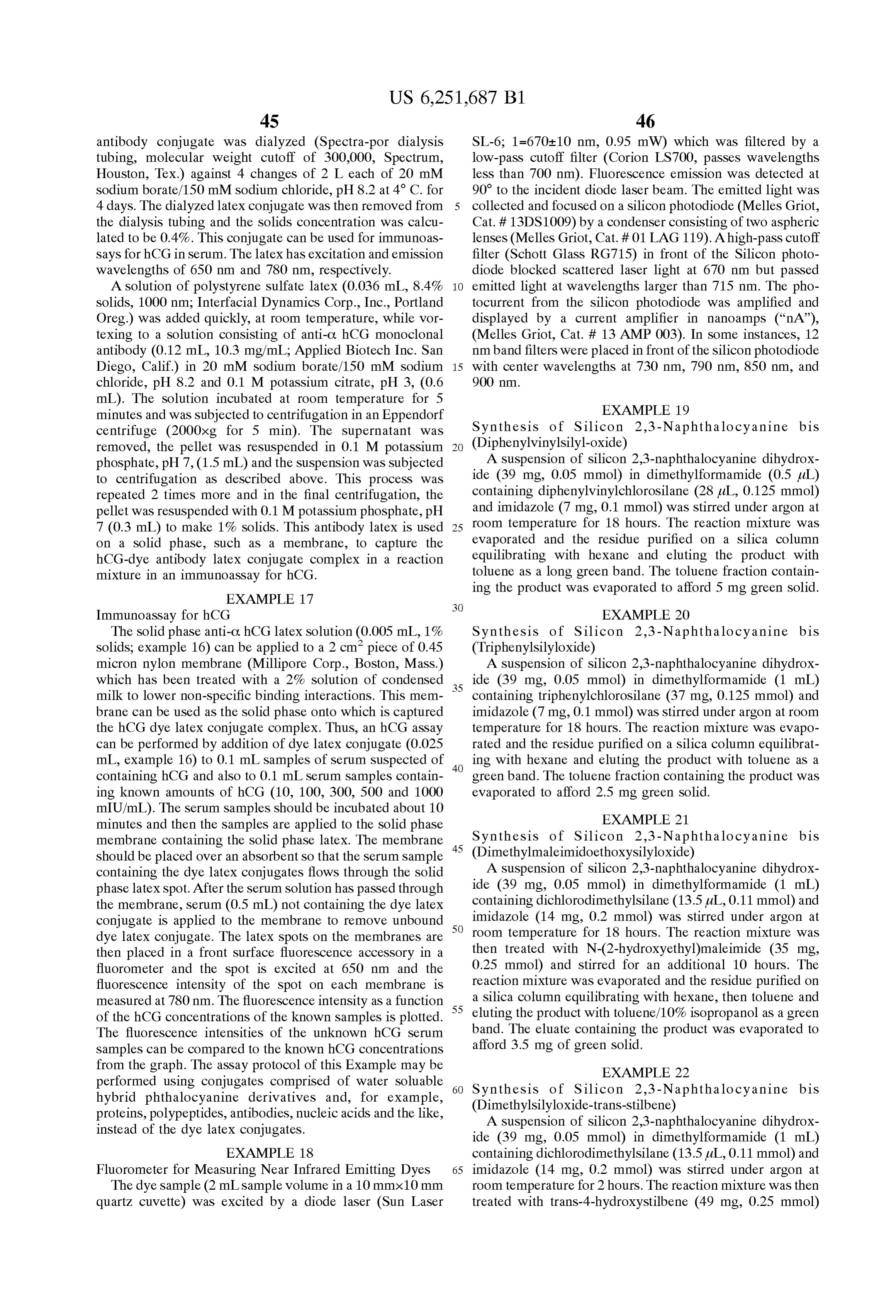
Page 33
and stirred for an additional 5 hours. The reaction mixture After stirring for 10 minutes, silicon tetrachloride (4.0 mL) was evaporated and the residue purified on a Silica column was added and the reaction mixture was heated at 190° C. for equilibrating with hexane and eluting the product with 1 hour. The reaction mixture was cooled to room toluene as a long green band. The toluene fraction contain temperature, and water (120 mL) was added slowly to ing the product was evaporated to afford 4 mg green Solid. hydrolyze the unreacted silicon tetrachloride. The blue black precipitate was filtered off and washed Sequentially
EXAMPLE 23 with methanol (5 mL) and acetone (5 mL).
Synthesis of Silicon 2,3-Naphthalocyanine bis UV-vis (methylene chloride) (nm)): 768,869. (Dimethylhexylvinylsilyloxide)
A Suspension of Silicon 2,3-naphthalocyanine dihydrox EXAMPLE 27 ide (39 mg, 0.05 mmol) in dimethylformamide (1 mL) Synthesis of Silicon(IV)5,9,14,18,23.27.32,36-octaethoxy containing 7-oct-1-enyldimethylchlorosilane (32 u , 0.125 2,3-naphthalocyanine Dihydroxide (Abbreviated as: Silicon mmol) and imidazole (7 mg, 0.1 mmol) was stirred under Octaethoxy-2,3-naphthalocyanine Dihydroxide) argon at room temperature for 18 hours. The reaction A Suspension of Silicon octaethoxy-2,3-naphthalene mixture was evaporated and the residue purified on Silica 15 dichloride (1.96 g) in pyridine (15 mL) containing water (15 column equilibrating with hexane and eluting the product mL) was refluxed for 18 hours. The Suspension was cooled, with toluene as a green band. The toluene fraction contain the black precipitate filtered and washed with water (10 mL). ing the product was evaporated and the residue treated with The precipitate was dried under vacuum and weighed (1.37 hexane to afford a dark green Solid and light green Super g, purple powder).
natant. The mixture was centrifuged, the Supernatant UV-vis (methylene chloride) () (nm)): 766, 867. removed and the Solid treated with more hexane and cen
EXAMPLE 28
trifuged. The Supernatant was again removed and the Solid Synthesis of Silicon(IV)5,9,14,18,27.32,36-octaethoxy-2,3- dried under vacuum to yield 7.3 mg of product. naphthalocyanine bis(7-Oct-1-Enyl Dimethyl Sillyloxide) EXAMPLE 24 (Abbreviated as: Silicon Octaethoxy-2,3-naphthalocyanine Synthesis of Silicon 2,3-Naphthalocyanine bis 25 bis(Dimethylhexylvinylsilyloxide))
(Tride cafluoro-1,1,2,2-tetrahydro octyl-1- A Suspension of Silicon IV octaethoxy-2,3- dimethylsilyloxide) naphthalocyanine dihydroxide (1.0 g) in dimethylforma A Suspension of Silicon 2,3-naphthalocyanine dihydrox mide (20 mL) containing 7-Oct-1-enyldimethylchlorosilane ide (39 mg, 0.05 mmol) in dimethylformamide (1 mL) (0.6 mL) and imidazole (140 mg) was stirred under argon at containing (tridecafluoro-1,1,2,2-tetrahydrooctyl)-1- room temperature for 24 hours. The reaction mixture was dimethylchlorosilane (37 uL, 0.1 mmol) and imidazole (7 evaporated with a rotary evaporator, chromatographed on a mg, 0.1 mmol) was stirred under argon at room temperature silica gel (70–230 mesh, 60 A, 2x50 cm) column equili for 2 hours. The reaction mixture was evaporated and the brated in hexane. The product was eluted sequentially with residue purified on a Silica column equilibrating with hexane 35 hexane and hexane-toluene (1:1)), Vacuum dried, and and eluting with hexane/20% toluene followed by hexane/ weighed (46 mg).
40% toluene to afford the product as a green band. The UV-vis (tetrahydrofuran) () (nm), e(M' cm)): 855, product eluate was evaporated and the residue treated with 37OOOO.
hexane to afford a green Solid. The mixture was centrifuged, Infrared Spectrum(KBr): 3074, 2958, 2924, 2854, 1589, the Supernatant removed and the Solid treated with more 40 1417, 1373, 1348, 1262, 1238, 1194, 1161, 1111, 1044, hexane and recentrifuged. The Supernatant was again 1025,933, 909, 844, 799, 760 cm. removed and the green solid dried under vacuum to yield 7.5 H-NMR (500 MHz, CDC1): 8 9.0 (m, 2.5-Nc), 7.9 (m, mg of product. 3,4-Nc), 5.3 (m, -CH), 4.6 (m, vinyl-CH), 3.5 (m, vinyl
EXAMPLE 25 0.1 (m, Y-CH), -0.8 (m, B -CH), -1.7 (m, C. -CH), Synthesis of Silicon 2,3-Naphthalocyanine bis 45
(Dimethylretinol)
A Suspension of Silicon 2,3-naphthalocyanine dihydrox EXAMPLE 29 Synthesis of Silicon Phthalocyanine b is ide (39 mg, 0.05 mmol) in dimethylformamide (1 mL) (Dimethylmaleimidofluorescein) containing dichlorodimethylsilane (13.5 uL, 0.11 mmol) and 50 imidazole (14 mg., 0.2 mmol) was stirred under argon at Fluorescein ATP (0.5 mg, 1.05umol) was treated with a room temperature. After 20 minutes, the reaction mixture solution of 0.12 M potassium carbonate in 80% methanol was treated with all-trans-retinol (72 mg, 0.25 mmol) and (52 uL). After 5 minutes, the hydrolysis solution was quenched by the addition of 0.5 M potassium phosphate/0.1 stirred for an additional 1 hour. The reaction mixture was evaporated and the residue purified on a Silica column M potassium borate, pH 7.0 in 1 N HCl (10 uL). The equilibrating with hexane and eluting the product with 55 quenched hydrolysis Solution was evaporated to dryness, toluene as a long green band. The toluene fraction contain redissolved in dimethylformamide (100 uL) and the result ing the product was evaporated and the residue treated with ing Solution added to Silicon phthalocyanine bis hexane to yield a dark green Solid and light green Superna (dimethylmaleimidosilyloxide) in a 1.0 mL serum vial. The tant. The mixture was centrifuged, the hexane removed and 60 reaction mixture was then Stirred at room temperature for 1 the Solid dried under vacuum to yield 10 mg of final product. hour. The crude product was then chromatographed on two 3"x3" silica plates using toluene/20% dimethylformamide.
EXAMPLE 26 After elution, the plates were dried under Vacuum and
Synthesis of Silicon(IV)5,9,14,18,23.27.32,36-octaethoxy rechromatographed for a better Separation. The product band 2,3-naphthalocyanine Dichloride (Abbreviated as: Silicon was scraped off, and treated with dimethylformamide (5 Octaethoxy-2,3-naphthalocyanine Dichloride)) 65 mL), vortexed 30 seconds and filtered from the silica. The 4.9-Diethoxy-1,3-diiminobenzfisoindoline (0.6 g) was filtrates were evaporated to give 0.55 mg of greenish fluo added under argon to freshly distilled quinoline (12 mL). rescent Solid.
Page 34
49 SO
EXAMPLE 30 (Abbreviated as: Tin(IV)octabutoxy-2,3-naphthalocyanine
Synthesis of Tin(IV)5,9,14,18,23,27,32.36-octabutoxy-2,3- bis(Dimethylhexylvinylsilyloxide)) naphthalocyanine bis(Triethylsilyloxide)) A mixture of 7-Oct-1-enyldimethylsilanol (186 mg), A mixture of triethylsilanol (77 uL), sodium (3.5 mg), and Sodium (7 mg), and Xylenes (10 mL) was refluxed under Xylenes (5 mL) was refluxed under argon for 1 hour. A 5 argon for 5 hours. Tin(IV)octabutoxy-2,3-naphthalocyanine solution of Tin(IV)octabutoxy-2,3-naphthalocyanine dichlo dichloride (37 mg) was added to the solution formed, and the ride (74 mg) in Xylenes (5 mL) was added to the solution mixture was refluxed for 2 days. The resultant was washed formed and the mixture was refluxed for 20 minutes. The with water (10 mL), dried (MgSO), and evaporated to a resultant was washed twice with water (25 mL each time), dark red solid with a rotary evaporator. This solid was dried (MgSO), and evaporated to a dark red solid with a chromatographed on a silica gel (70–230 mesh, 60 A, 2x50 rotary evaporator. This Solid was chromatographed on a cm) column equilibrated in hexane and eluted Sequentially silica gel (70–230 mesh, 60 A, 2x50 cm) column equili with toluene and toluene-10% isopropanol. The product brated in hexane and eluted Sequentially with toluene and was vacuum dried, and weighed (17 mg). toluene-10% isopropanol. The product was vacuum dried, and weighed (17 mg). UV-vis (tetrahydrofuran) () (nm), e(M' cm)): 785; UV-vis(tetrahydrofuran) () (nm), e(M' cm)): 900, 15 893, 227000.
174OOO. Fluorescence (tetrahydrofuran) (er (nm)): 789. fix
EXAMPLE 31 EXAMPLE 35
Synthesis of Tin(IV)2,3-Naphthalocyanine bis Synthesis of 7-Oct-1-enyldimethylsilanol (Triethylsilyloxide) A solution of 7-Oct-1-enyldimethylchlorosilane (2.56 mL) A mixture of triethylsilanol (77 uL), sodium (3.5 mg), and in ether (2 mL) was added dropwise over 1 hour to a stirring Xylenes (8 mL) was refluxed under argon for 1 hour. mixture of triethylamine (1.5 mL), water (0.18 mL) and Tin(IV)2,3-naphthalocyanine dichloride (45 mg) was added ether (15 mL) in an ice/water bath. The resultant was stirred to the Solution formed, and the mixture was refluxed for 5 a further 1 hour in the ice/water bath and filtered washing the days. The Suspension was filtered, and the Solid was washed 25 filtered solid with ether (10 mL). The filtrate was evaporated Sequentially with Xylenes and water, Vacuum dried, and with a rotary evaporator and the residue partitioned between weighed (41 mg). The solid was chromatographed on a Silica hexane (30 mL) and water (30 mL). The organic layer was gel (70–230 mesh, 60 A, 2x50 cm) column equilibrated with Separated, dried (MgSO) and filtered through Silica gel methylene chloride and eluted Sequentially with methylene (70–230 mesh, 60 A), washing with hexane (100 mL). The chloride-20% tetrahydrofuran, methylene chloride-50% filtrate was evaporated with a rotary evaporator to afford a tetrahydrofuran and finally tetrahydrofuran. The product colorless oil which was vacuum dried and weighed (1.06 g). was triturated with hexane (2 mL), vacuum dried, and EXAMPLE 36 weighed (26 mg).
UV-vis(tetrahydrofuran)() (nm), e(M cm)): 700; Synthesis of 2.3.20.21-Tetrabromo)-9,14.27.32-tetrabutoxy 746; 786, 253000. 2,3-naphthalocyanine
Fluorescence (tetrahydrofuran) () (nm)): 820. 1,4-dibutoxynaphthalene-2,3-dicarbonitrile (161 mg) and 2,3-dibromo-6,7-dicyanonaphthalene (168 mg) were added
EXAMPLE 32 to a refluxing solution of lithium metal (35 mg) in 1-butanol Synthesis of Tin(IV)2,3-naphthalocyanine bis(7-Oct-1- (2 mL) under an argon atmosphere. The reaction Solution Enyldimethylsilyloxide) (Abbreviated as: Tin(IV)2,3- was maintained at reflux for 2 hours, cooled, and Stirred into naphthalocyanine bis(Dimethylhexylvinylsilyloxide)) 40 glacial acetic acid (10 mL). After 30 minutes, the solvent
A mixture of 7-oct-1-enyldimethylsilanol (186 mg), was evaporated with a rotary evaporator and the residue Sodium (7 mg), and Xylenes (10 mL) was refluxed under dissolved in methylene chloride (10 mL). The solution was argon for 4 hours. Tin(IV)2,3-naphthalocyanine dichloride washed twice with 1 N hydrochloric acid (10 mL each (90 mg) was added to the solution formed and the mixture time).followed by water (10 mL), dried (MgSO) and evapo was refluxed for 4 days. The suspension was filtered and the 45 rated with a rotary evaporator. The residue was chromato Solid was washed sequentially with Xylenes (5 mL) and graphed on a silica gel (70–230 mesh, 60 A, 2x50 cm), water (5 mL). The organic layer of the filtrate was separated, column equilibrated in hexane and eluted Sequentially with dried (MgSO), and evaporated with a rotary evaporator. hexane-10% toluene, hexane-20% toluene, hexane The residue was triturated twice with hexane (2 mL each 30% toluene, hexane- 40% toluene and finally hexane time) to afford a bright green Solid which was vacuum dried 50 50% toluene. The solid product was triturated with hexane and weighed (8.5 mg). (2 mL), vacuum dried, and weighed (8 mg). UV-vis (tetrahydrofuran) () (nm), e(M' cm)): 670, UV-vis(tetrahydrofuran) () (nm)): 743,839. 7200; 732, 69900; 786, 84900. Fluorescence(tetrahydrofuran) () (nm)): 789. EXAMPLE 33 EXAMPLE 37
Synthesis of Tin(IV)5,9,14,18,23,27,32.36-octabutoxy-2,3- 55 Synthesis of 2,2,7,7/12', 12-Tetrabutoxydinaphthobg/ naphthalocyanine Dichloride 1-7, 12/17-octafluorodiben Zog, 1/q-5,10,15,20 Tin tetrachloride (234 uL) was added to a mixture of octabutoxy-2,3-naphthalocyanine (310 mg) in dry dimeth tetraazoporphyrin (Abbreviated as: Di(1,6-dibutoxy-2,3-
ylformamide (15 mL) under an argon atmosphere and the 60 1,4-Dibutoxynaphthalene-2,3-dicarbonitrile (161 mg) and mixture refluxed with stirring for 6 hours. The resultant was tetrafluorophthalonitrile (100 mg) were added to a refluxing allowed to cool, the Suspension was filtered, and the dark red solid was washed sequentially with dimethylformamide (5 solution of lithium metal (35 mg) in 1-butanol (2 mL) under mL) and water (5 mL), vacuum dried and weighed (288 mg). at reflux atmosphere.
an argon The reaction Solution was maintained for 1 hour, cooled, and Stirred into glacial acetic
EXAMPLE 34 65 acid (10 mL). After 30 minutes the solvent was evaporated Synthesis of Tin(IV)5,9,14,18,23,27,32.36-octabutoxy-2,3- with a rotary evaporator and the residue dissolved in meth naphthalocyanine bis(7-oct-1-Enyldimethylsilyloxide ylene chloride (10 mL). The solution was washed twice with
Page 35
S1 52 1N hydrochloric acid (10 mL each time), followed by water product was collected by filtration, washed Sequentially with (10 mL), dried (MgSO) and evaporated with a rotary water (5 mL) and methylene chloride (5 mL), vacuum dried evaporator. The residue was chromatographed twice on a and weighed (766 mg).
silica gel (70–230 mesh, 60 A, 2x50 cm), column equili EXAMPLE 41 brated in hexane and eluted sequentially with hexane-10% Synthesis of 2.2°12', 12-Tetraphenyldinaphthob.l-7,17 toluene, hexane-20% toluene, hexane-30% toluene, and dibenzog.g-5,10,15,20-tetraazoporphyrinatosilicon Dihy finally hexane-40% toluene. The product was vacuum dried and weighed (10 mg). droxide (Abbreviated as: Silicondi(1,6-diphenyl-2,3- UV-vis (tetrahydrofuran) () (nm), e(M' cm)): 679, naphthalocyanine) diphthalocyanine Dihydroxide) 25800; 752, 88200; 789, 76500. Silicon tetrachloride (231 uL) was added to a mixture of Fluorescence (tetrahydrofuran) () (nm)): 815. diphenyl-1,3-diiminobenzfisoindoline (470 mg) and 1,3- diminoisoindoline (97 mg) in freshly distilled quinoline (5
EXAMPLE 38 mL) under an argon atmosphere and the mixture heated with
Synthesis of 2.2°12' 12-Tetraphenylydinaphthob.I-7,17 stirring at 200° C. for 40 minutes. The resultant was allowed octafluorodibenzog, q-5,10,15,20-tetraazoporphyrin 15 to cool to 160° C., treated with water (5 mL) and refluxed for (Abbreviated as: Di(1,6-diphenyl-2,3-naphthalocyanine)di 5 minutes. The mixture was cooled, treated with ether (30 (tetrafluorophthalocyanine)) mL) and filtered washing the Solid Sequentially with ether 1,4-diphenylnaphthalene-2,3-dicarbonitrile (165 mg) and (10 mL) and water (10 mL). The organic layer of the filtrate tetrafluorophthalonitrile (100 mg) were added to a refluxing (which was dark green) was separated from the aqueous solution of lithium metal (35 mg) in 1-butanol (2 mL) under layer, washed with water (15 mL), dried (MgSO) and an argon atmosphere. The reaction Solution was maintained evaporated with a rotary evaporator. The residue was chro at reflux for 1.5 hours, cooled, and Stirred into glacial acetic matographed three times on a silica gel (70–230 mesh, 60 A, acid (10 mL). After 30 minutes, the solvent was evaporated 2x50 cm), column equilibrated in hexane and eluted Sequen with a rotary evaporator and the residue dissolved in meth tially with hexane, hexane-10% methylene chloride, ylene chloride (10 mL). The solution was washed twice with 25 hexane-20% methylene chloride, and finally hexane 1N hydrochloric acid (10 mL each time), followed by water 50% methylene chloride. The product was vacuum dried and (10 mL), dried (MgSO), and evaporated with a rotary weighed (55.5 mg).
evaporator. The residue was chromatographed on a Silica gel UV-vis (tetrahydrofuran) () (nm), e(M' cm)): 640; (70–230 mesh, 60 A, 2x50 cm), column equilibrated in 680; 714, 67900; 742.
hexane and eluted Sequentially with hexane-10% toluene, Fluorescence (tetrahydrofuran) () (nm)): 750. hexane-20% toluene, hexane-30% toluene, hexane EXAMPLE 42 40% toluene and finally hexane-50% toluene. The bright Synthesis of 2,2,7,7/12', 12-Tetraethoxydinaphthobg/ green product was vacuum dried and weighed (7 mg). 1-7, 12 / 17- diben Zog, 1/q-5,10,15,20 UV-vis (tetrahydrofuran) () fix (nm), e(M' cm)): 747, tetraazoporphyrinatolsilicon Dihydroxide (Abbreviated as:
Fluorescence(tetrahydrofuran) () (nm)): 760. Silicondi(1,6-die thoxy-2,3-naphthalocyanine) diphthalocyanine Dihydroxide)
EXAMPLE 39 Silicon tetrachloride (137 uL) was added to a mixture of
Synthesis of Dibutoxy-1,3-diiminobenzfisoindoline 4.9-diethoxy-1,3-diiminobenzfisoindoline (227 mg) and Anhydrous ammonia was slowly bubbled through a 1,3-diiminoisoindoline (58 mg) in freshly distilled quinoline stirred mixture of 1,4-dibutoxynaphthalene-2,3- 40 (3 mL) under an argon atmosphere and the mixture heated dicarbonitrile (1.61 g), 25% sodium methoxide in methanol with stirring at 200 C. for two hours. The resultant was (1.14 mL), and dry 1-butanol (10 mL) for 30 minutes. With allowed to cool 160° C., treated with water (3 mL) and continued ammonia introduction, the mixture was refluxed refluxed for 5 minutes. The mixture was cooled, treated with for 30 minutes. After the resultant had cooled, the solvent 45 ether (10 mL), and the dark blue solid product filtered off, was removed under Vacuum with a rotary evaporator. The washing the Solid sequentially with ether (10 mL) and water residue was chromatographed on a silica gel (70–230 mesh, (10 mL), vacuum dried and weighed (175 mg). 60 A, 2x50 cm), column equilibrated in hexane and eluted UV-vis (tetrahydrofuran) () (nm)): 600, 632, 666, 700, Sequentially with toluene, toluene-1% isopropanol, 724, 788.
toluene-2% isopropanol, toluene-5% isopropanol, 50 EXAMPLE 43 toluene-10% isopropanol and finally toluene-20% iso Synthesis of 2,2,7,7/12', 12-Tetraethoxydinaphthobg/ propanol. The yellow product was treated with ether (10 1-7,12/17-dibenzogl/q-5,10,15,20-tetraazoporphyrinato mL), collected by filtration, washed with ether (10 mL), silicon bis(7-Oct-1-Enyldimethylsilyloxide (Abbreviated as:
vacuum dried and weighed (517 mg).
H-NMR (500 MHz, CDC1) 88.22 (m,5,8–H), 7.65 (m, Silicondi(1,6-die thoxy-2,3-naphthalocyanine) 6,7-H), 4.23 (m, Y-CH-), 1.97 (m, B -CH), 1.61 (m, 55 diphthalocyanine bis(Dimethylhexylvinylsilyloxide)) A mixture of silicon di(1,6-die thoxy-2,3-
C. -CH-), 1.04 (t, -CH). naphthalocyanine) diphthalocyanine dihydroxide (85 mg), EXAMPLE 40 7-Oct-1-enyldimethylchlorosilane (256 uL), imidazole (68
Synthesis of 4.9-Diethoxy-1,3-diiminobenzfisoindoline mg), and dimethylformamide (2 mL) was stirred at room Anhydrous ammonia was slowly bubbled through a 60 temperature for 24 hours. The resultant was concentrated Stirred mixture of 1,4-diethoxynaphthalene-2,3- under vacuum with a rotary evaporator. The residue was dicarbonitrile (1.33 g), 25% sodium methoxide in methanol chromatographed on a silica gel (70–230 mesh, 60 A, 2x50 (1.14 mL), and dry ethanol (10 mL) for 20 minutes. With cm) column equilibrated in hexane and eluted Sequentially continued ammonia introduction, the mixture was refluxed with toluene and toluene -1% isopropanol. The product was for 2 hours. After the resultant had cooled, the solvent was 65 vacuum dried and weighed (32 mg). removed under vacuum with a rotary evaporator. The resi UV-vis (tetrahydrofuran) () (nm)): 601, 633, 667, 702, due was treated with methylene chloride (10 mL) and the 731, 822, 904.
Page 36
S3 S4
EXAMPLE 44 evaporator. The residue was chromatographed on a Silica gel Synthesis of 2,2,12,12-Tetraphenyldinaphthob.l7,17 (70-230 mesh, 60 A, 2x50 cm) column equilibrated in dibenzog.g-5,10,15,20-tetraazoporphyrinatosilicon bis(7- methylene chloride and eluted with methylene chloride. The oct-1-Enyldimethylsilyloxide) (Abbreviated as: Silicondi product was vacuum dried and weighed (18 mg). (1,6-diphenyl-2,3-naphthalocyanine))diphthalocyanine bis UV-vis (tetrahydrofuran) () (nm)): 727, 759,809,835. (Dimethylhexylvinylsilyloxide) (FIG.9) Fluorescence (tetrahydrofuran) () (nm)): 685, 760, A mixture of silicon di(1,6-diphenyl-2,3- 840.
naphthalocyanine) diphthalocyanine dihydroxide (30 mg), 7-Oct-1-enyldimethylchlorosilane (115 uL), imidazole (30 EXAMPLE 48 mg) and dimethylformamide (650 uL) was stirred at room Synthesis of 2',2,12', 12-Tetraphenyldinaphthob.l-7', temperature for 30 minutes. The resultant was concentrated 7- diethoxynaphthog)-17-benzoq)-5,10,15,20 under vacuum on the rotary evaporator. The residue was tetraazoporphyrinatosilicon Dihydroxide (Abbreviated as: chromatographed on a silica gel (70–230 mesh, 60 A, 2x50 Silicondi(1,6-diphenyl-2,3-naphthalocyanine)1,6- cm) column equilibrated in hexane and eluted Sequentially diethoxyphthalocyanine)phthalocyanine Dihydroxide) Silicon tetrachloride (172 uL) was added to a mixture of with hexane and toluene. The product was vacuum dried and 15 diphenyl-1,3-diiminobenzfisoindoline weighed (38 mg). (347 mg), diethoxy H-NMR (500 MHz, CDC1) 88.31, 8.25 (m, 2.5-Nc, 1, 3-diiminobenzfiso indoline (71 mg) and 1,3- 10,13-Nc), 7.94 (m, Ar-Nc), 7.95, 7.74 (3,4-Nc, 11,12-Pc), diminoisoindoline (36 mg) in freshly distilled quinoline (2 0.68 (m, e -CH), 0.21 (m, 8 -CH), -0.11 (m, Y-CH), mL) under an argon atmosphere and the mixture heated with -1.22 (m, B-CH-), -2.14 (m, C.-CH-), -2.76 (s, -CH-). stirring at 200 C. for 1 hour. The resultant was allowed to UV-vis(tetrahydrofuran) () (nm), e(M cm)): 644; cool to 160° C., treated with water (2 mL) and refluxed for 684; 718, 81100; 748. 5 minutes. The mixture was cooled, treated with ether (10
fix mL) and filtered washing the solid sequentially with water (5 mL) and ether (5 mL). The organic layer of the filtrate was
EXAMPLE 45 25 separated, washed with water (10 mL), dried (MgSO) and Synthesis of Tetrafluoro-1,3-diiminobenzfisoindoline evaporated with a rotary evaporator. The residue was chro Anhydrous ammonia was slowly bubbled through a matographed on a silica gel (70–230 mesh, 60 A, 2x50 cm) stirred mixture of tetrafluorophthalonitrile (2.0 g), 25% column equilibrated in methylene chloride and eluted with sodium methoxide in methanol (2.3 mL), and dry 1-butanol methylene chloride. The product was vacuum dried and (10 mL) for 20 minutes. With continued ammonia weighed (6 mg).
introduction, the mixture was refluxed for 1 hour. After the UV-Vis (methylene chloride) (0.(nm)): 649, 693, 724, resultant had cooled, the Solvent was removed under 758,827.
Vacuum with a rotary evaporator. The residue was treated Fluorescence (tetrahydrofuran) () (nm)): 750. with ether (50 mL) and the product was collected by EXAMPLE 49 filtration, washed sequentially with water (10 mL), and ether 35 Synthesis of 2,2,12,12°-Tetraphenyldinaphthob.l-7- (10 mL), vacuum dried and weighed (0.45 g). tetrafluoro naphthog-17-benzoq-5,10,15,20 EXAMPLE 46 tetraazoporphyrinatosilicon Dihydroxide (Abbreviated as: Synthesis of 4,7-Diphenyl-1,3-diiminobenzfisoindoline Silicondi(1,6-diphenyl-2,3-naphthalocyanine) Anhydrous ammonia was slowly bubbled through a 40 (tetrafluorophthalocyanine)phthalocyanine Dihydroxide) Stirred mixture of 1,4-diphenylnaphthalene-2,3- Silicon tetrachloride (172 uL) was added to a mixture of dicarbonitrile (4.3 g), 25% sodium methoxide in methanol diphenyl-1,3-diiminobenz fisoindoline (347 mg), (3.0 mL), and dry 1-butanol (25 mL) for 30 minutes. With tetrafluoro-1,3-diiminobenzfisoindoline (54 mg) and 1,3- continued ammonia introduction, the mixture was refluxed diminoisoindoline (36 mg) in freshly distilled quinoline (2 for 1.5 hours. After the resultant had cooled, the solvent was 45 mL) under an argon atmosphere and the mixture heated with removed under vacuum with a rotary evaporator. The resi stirring at 200 C. for 1 hour. The resultant was allowed to due was treated with methylene chloride (50 mL) and the cool to 160° C., treated with water (2 mL) and refluxed for product was collected by filtration, washed Sequentially with 5 minutes. The mixture was cooled, treated with ether (10 water (10 mL) and methylene chloride (10 mL), vacuum mL) and filtered washing the solid sequentially with water (5 dried and weighed (3.68 g). 50 mL) and ether (5 mL). The organic layer of the filtrate was
EXAMPLE 47
separated, washed with water (10 mL), dried (MgSO) and
Synthesis of 2,2,12,12-Tetraphenyldinaphthob.l7,17 evaporated with a rotary evaporator. The residue was chro octafluorodibenzog,q-5,10,15,20-tetraazoporphyrinato matographed on a silica gel (70–230 mesh, 60 A, 2x50 cm) column equilibrated in methylene chloride and eluted with silicon Dihydroxide (Abbreviated as: Silicondi(1,6- methylene chloride. The product was vacuum dried and dip he nyl-2,3-naphthal oc y a nine) di 55 weighed (21 mg).
(tetrafluorophthalocyanine)dihydroxide) UV-vis (tetrahydrofuran) () (nm)): 646, 689, 720, 753, Silicon tetrachloride (86 uL) was added to a mixture of 790.
diphenyl-1,3-diiminobenzfisoindoline (174 mg) and Fluorescence (tetrahydrofuran) (). (nm)): 760. fix tetrafluoro-1,3-diiminoisoindoline (54 mg) in freshly dis tilled quinoline (1 mL) under an argon atmosphere and the 60 EXAMPLE 50 mixture heated with stirring at 200 C. for 1 hour. The Synthesis of 2' 2,12,12-Tetraphenyldinaphthob.l-7- resultant was allowed to cool to 160 C., treated with water tetrafluoro naphthog-17-benzoq-5,10,15,20 (1 mL) and refluxed for 5 minutes. The mixture was cooled, tetra a Zop orphyrin a to Silic on bis (7-Oct - 1 - treated with ether (10 mL) and filtered washing the solid Enyldimethylsilyloxide (Abbreviated as: Silicondi(1,6- sequentially with water (2 mL) and ether (5 mL). The 65 dip he nyl-2,3-naphthalo cyanine) organic layer of the filtrate was separated, washed with (tetrafluorophthalocyanine)phthalo cyanine b is water (5 mL), dried (MgSO) and evaporated with a rotary (Dimethylhexylvinylsilyloxide))
Page 37
SS S6
A mixture of silicon di(1,6-diphenyl-2,3- cooled. Cold glacial acetic acid (20 mL) was added to the naphthalocyanine) (tetrafluorophthalo cyanine) Suspension formed and vacuum dried. The green residue was phthalocyanine dihydroxide (10.5 mg), 7-oct-1-enyl dimeth resuspended in dichloromethane and the Solution centri ylchlorosilane (38 uL), imidazole (10 mg) and fuged at 3000 rpm for 15 minutes. The Supernatant was dimethylformamide (200 uL) was stirred at room tempera washed with 1 NHCL (2x20 mL) followed by water (1x10 ture for 30 minutes. The resultant was concentrated under mL). The organic layer was dried under vacuum. The crude Vacuum on the rotary evaporator. The residue was chro product was chromatographed on a silica gel (70–230 mesh, matographed on a silica gel (70–230 mesh, 60 A, 2x50 cm) 60 A, 2x50 cm)column equilibrated in hexane. The product column equilibrated in hexane and eluted with toluene, The was eluted Sequentially with hexane and toluene, Vacuum product was vacuum dried and weighed (4 mg). dried and weighed (4.2 mg).
UV-vis(tetrahydrofuran) () (nm)): 732, 757, 794,816. UV-vis (tetrahydrofuran) () (nm), e(M' cm)): 668, Fluorescence (tetrahydrofuran) () (nm)): 763,830. 43297; 688, 86914; 726, 92715; 758, 64329.
EXAMPLE 51
Fluorescence (tetrahydrofuran) () fix (nm)): 732.
Synthesis of 2,2,12,12-Tetraphenyldinaphthob.l-7- 15 EXAMPLE 54 tetrafluoro naphthog-17-benzoq-5,10,15,20 Synthesis of 5-tert-Butyl-1,3-diiminoisolindoline tetraazoporphyrinatosilicon bis(Dimethylpentafluoro Anhydrous ammonia was slowly bubbled through a Phenylsilyloxide) (Abbreviated as: Silicondi(1,6-diphenyl stirred mixture of 4-tert-butylphthalonitrile (1.8 g), 25% 2,3-naphthalocyanine)(tetrafluorophthalocyanine) Sodium methoxide in methanol (2.3 mL), and dry 1-pentanol phthalocyanine bis(Dimethylpentafluorophenylsilyloxide)) (20 mL) for 30 minutes. With continued ammonia A mixture of silicon di(1,6-diphenyl-2,3- introduction, the mixture was refluxed for 1.5 hours. After naphthalocyanine)(tetrafluorophthalocyanine) phthalocya the resultant had cooled, the solvent was removed with a nine dihydroxide (10.5 mg), chlorodimethylpentafluorophe rotary evaporator. The residue was treated with methylene nylsilane (28 u L), imidazole (10 mg) and chloride (20 mL) and the product was collected by filtration, dimethylformamide (200 uL) was stirred at room tempera 25 washed sequentially with methylene chloride (20 mL), ether ture for 30 minutes. The resultant was concentrated under (10 mL), vacuum dried and weighed (0.4 g). Vacuum on the rotary evaporator. The residue was chro matographed on a silica gel (70–230 mesh, 60 A, 2x50 EXAMPLE 55 cm)column equilibrated in hexane and eluted with hexane Synthesis of 6,7-Dibromo-1,3-diiminobenzfisoindoline 50% toluene to afford two product fractions A and B which Anhydrous ammonia was slowly bubbled through a were vacuum dried and weighed (2.8 mg and 5.5 mg, stirred mixture of 6,7-dibromonaphthalene-2,3- respectively). dicarbonitrile (0.5 g), 25% sodium methoxide in methanol A. (0.3 mL), and dry 1-pentanol (10 mL) for 50 minutes. With UV-Vis(tetrahydrofuran) (0.(nm)): 650, 726, 762, 796, continued ammonia introduction, the mixture was refluxed 824. 35 for 2.5 hours. After the resultant had cooled, the orange Fluorescence(tetrahydrofuran) () (nm)): 770. yellow solid was collected by filtration and washed with B. ether (20 mL), vacuum dried and weighed (0.6 g). UV-vis(tetrahydrofuran) () (nm)): 651, 726, 763, 796, EXAMPLE 56
Fluorescence(tetrahydrofuran) () (nm)): 770. Synthesis of Silicondi(1,6-diphenyl-2,3-naphthalocyanine) 40 di-tert-butylphthalocyanine dihydroxide
EXAMPLE 52 Silicon tetrachloride (57 ul) was added to a mixture of Synthesis of 2,2,12,12°-Tetraphenyldinaphthob.I-7,17 diphenyl-1,3-diiminobenzfisoindoline (172 mg) and dibenzog,q-5,10,15,20-tetraazoporphyrinatosilicon bis 5-tert-butyl-1,3-diiminoisoindoline (50 mg) in freshly dis (Dimethylpentafluorophenylsilyloxide) (Abbreviated as: 45 tilled quinoline (1 mL) under an argon atmosphere and the Silicondi (1,6-diphenyl-2,3-naphthalocyanine mixture heated with stirring at 210° C. for 1 hour. The diphthal oc y a nine b is resultant was allowed to cool, treated with water (2 mL) and (Dimethylpentafluororphenylsilyloxide)) refluxed for 5 minutes. The mixture was cooled, treated with A mixture of silicon di(1,6-diphenyl-2,3- ether (10 mL) and filtered washing the solid with ether (30 naphthalocyanine) diphthalocyanine dihydroxide (20 mg), 50 mL). The organic layer of the filtrate was separated, washed chlorodimethylpentafluorophenylsilane (58 uD), imidazole twice with water (20 mL each time), dried (NaSO) and the (20 mg) and dimethylformamide (450 uL) was stirred at ether evaporated with a rotary evaporator. The residue was room temperature for 1 hour. The resultant was concentrated chromatographed on a silica gel (70–230 mesh, 60 A, 2x50 under vacuum on the rotary evaporator. The residue was cm), column equilibrated with hexane. The product was treated with hexane (5 mL) and the green Solid product 55 eluted with methylene chloride, Vacuum dried and weighed collected by filtration, washed with hexane (2 mL), vacuum (11 mg, green Solid).
dried and weighed (26 mg). UV-vis (methylene chloride) () (nm)): 656, 670, 694, UV-vis(tetrahydrofuran) () (nm)): 648, 691, 724, 759. 730, 758.
Fluorescence (tetrahydrofuran) () (nm)) 768.
fix Fluorescence (methylene chloride) () (nm)): 767.
EXAMPLE 53 60 EXAMPLE 57
Synthesis of 2,2,12,12°-Tetraphenyldinaphthob.l-7,17 Synthesis of Silicondi(1,6-diphenyl-2,3- dibenzog,q)-5,10,15,20-tetraazac21H),(23H), porphyrin naphthalocyanine)di-tert-butylphthalocyanine bis (Abbreviated as: di(1,6-Diphenyl-2,3-napthalocyanine)di(2/ (Dimethylhexylvinylsilyloxide) 3-tert-butylphthalocyanine) A mixture of silicon di(1,6-diphenyl-2,3- A mixture of 1,4-diphenylnaphthalene dicarbonitrile (495 65 naphthalocyanine)di(2/3-tert-butylphthalocyanine) dihy mg), 4-tert-butylphthalonitrile (92 mg), and lithium butox droxide (320 mg), 7-oct-1-enyldimethylchlorosilane (200 ide (4.0 mL) was refluxed in an oil bath for 1.5 hours and uL), imidazole (136 mg) and dimethylformamide (6 mL)
Page 38
was stirred at room temperature for 12 hours. The resultant nia introduction, the mixture was refluxed for 3 hours. After was concentrated under Vacuum on the rotary evaporator. the resultant had cooled, the solvent was removed with a The residue was chromatographed on a silica gel (70–230 rotary evaporator. The residue was dried under vacuum and mesh, 60 A, 2x50 cm) column equilibrated and eluted with weighed (1.4g, green Solid).
hexane. The blue product was vacuum dried and weighed (150 mg). EXAMPLE 62 UV-vis (methylene chloride) () (nm)): 632, 676, 702, Synthesis of 5,9,14,18,23,27,32.36,-Octamethoxy 2,3-
Fluorescence (methylene chloride) () (nm)): 716. naphthalocyanine (Abbreviated as: Octamethoxy-2,3- naphthalocyanine)
EXAMPLE 58 1,4-dimethoxynaphthalene-2,3-dicarbonitrile (820 mg) Synthesis of Silicon(IV)2,3,11,12,20,2129.30-octabromo suspended in 25% sodium methoxide in methanol (7 mL) 2,3-naphthalocyanine Dihydroxide (Abbreviated as: Silicon was refluxed for 1.5 hours, cooled, and Stirred into glacial Octabromo-2,3-naphthalocyanine Dihydroxide) acetic acid (50 mL). After 30 minutes, the solvent was Silicon tetrachloride (114 uL) was added to a mixture of 15 evaporated with a rotary evaporator and the residue dis 6,7-dibromo-1,3-diiminobenzfisoindoline (433 mg) and solved in methylene chloride (100 mL). The solution was 5-tert-butyl-1,3-diiminoisoindoline (100 mg) in freshly dis washed sequentially with 10% hydrochloric acid (100 mL), tilled quinoline (2 mL) under an argon atmosphere and the brine (100 mL) and evaporated with a rotary evaporator. The mixture heated with stirring at 210° C. for 2 hours. The resultant was allowed to cool, treated with water (2 mL) and residue
was chromatographed on a silica gel (70–230 mesh, 2x50 cm) column equilibrated in toluene. The product refluxed for 15 minutes. The mixture was cooled, treated with ether (4 mL) and filtered washing the solid three times was eluted with toluene, vacuum dried and weighed (52 mg, with ether (2 mL each time). The solid was vacuum dried red-brown solid).
and weighed (0.57 g, dark green Solid). UV-vis (tetrahydrofuran) () (nm)): 837.
EXAMPLE 59 EXAMPLE 63
Synthesis of Silicon(IV)2,3,11,12,20,2129.30-octabromo 2,3-naphthalocyanine bis(7-Oct-1-Enyldimethyl Silyloxide) Synthesis of Germanium (IV)2/3.9/10,16/17,23/24-Tetra (Abbreviated as: Silicon Octabromo-2,3-naphthalocyanine tert-butylphthalocyanine Dichloride (Abbreviated as: Ger bis(Dimethylhexylvinylsilyloxide)) manium Tetra-tert-butylphthalocyanine Dichloride) A mixture of Silicon octabromo-2,3-naphthalocyanine Germanium tetrachloride (1.5 mL) was added to a mix dihydroxide (500 mg), 7-oct-1-enyl dimethylchlorosilane ture of 5-tert-butyl-1,3-diiminoisoindoline (500 mg) and (256 uL), imidazole (68 mg) and dimethylformamide (5 mL) tributylamine(3.4 mL) in 1,2,3,4-tetrahydronaphthalene (7 was stirred at room temperature for 12 hours. The resultant mL) under an argon atmosphere and the mixture refluxed for was concentrated under Vacuum with a rotary evaporator. 35 3.5 hours. The resultant was allowed to cool, treated Sequen The residue was chromatographed on a silica gel (70–230 tially with water (20 mL) and methylene chloride (20 mL). mesh, 60 A, 2x50 cm) column equilibrated in hexane. The The organic layer was separated, washed with water (10 product was eluted with toluene, Vacuum dried and weighed mL), dried (MgSO) and evaporated with a rotary evapora (300 mg). tor. The residue was chromatographed on a silica gel(70–230 UV-vis (tetrahydrofuran) () (nm)): 694, 702 sh. 40 mesh, 60 A, 2x50 cm) column equilibrated in toluene. The Fluorescence (tetrahydrofuran) () (nm)): 706. product was eluted Sequentially with toluene and tolu EXAMPLE 60 ene:isopropanol (9:1), vacuum dried and weighed (310 mg). Synthesis of Silicon(IV)1,4,8,11,15,18,22,25 UV-vis(tetrahydrofuran) () (nm)): 680. fix
octaethoxyphthalocyanine Dichloride (Abbreviated as: Sili 45 Fluorescence(tetrahydrofuran) () (nm)); 718, 750. con Octaethoxyphthalocyanine Dichloride)
Silicon tetrachloride (600 uL) was added to a mixture of EXAMPLE 64 4,7-diethoxy-1,3-diiminoisoindoline (1.0 g) in freshly dis Effect of Human Serum and Blood on the Fluorescence tilled quinoline (10 mL) under an argon atmosphere and the Intensities of Various Dye Systems in Latex With Different mixture heated with stirring at 200° C. for 1.5 hours. The Stokes Shifts and Excitation and Emission Wavelengths resultant was allowed to cool and treated with water (10 mL) 50 Donor and acceptor dye pairs or a hybrid phthalocyanine followed by methylene chloride (10 mL). The organic layer was separated and evaporated with a rotary evaporator. The derivative were incorporated into 0.2 micron latex (CML black residue was treated with ether (5 mL) and filtered. The vent systemPortland, from IDC, Oreg.) using the tetrahydrofuran sol filtrate was dried (NaSO) and the solvent evaporated with 55 10. The latex particles indicated method as in Table 3 and in Example a rotary evaporator, vacuum dried and weighed(300 mg, centrations as indicated in the Tableto into were diluted various solids con either a buffer dark green Solid). containing 5 mM potassium phosphate, 1 mM potassium UV-vis (tetrahydrofuran) () (nm)): 742. borate, and 5 mg/mL bovine Serum albumin, pH 7, neat UV-vis (methylene chloride) () (nm)): 764. human Serum or neat human blood. The excitation and IR (KBr): 3435, 3060, 2983, 2932, 2228, 1727, 1603, 60 emission wavelengths and the corresponding Stokes shift are 1504, 1317, 1256, 1218, 1068, 810 cm. as indicated in Table 6.
EXAMPLE 61 The results show that the fluorescence intensities mea Synthesis of 4,7-Diethoxy-1,3-diiminoisoindoline Sured in neat human Serum and blood are greatly affected Anhydrous ammonia was slowly bubbled through a when the excitation wavelength is in a region where human stirred mixture of 1,4-diethoxy-2,3-phthalonitrile (1.0 g), 65 Serum and blood absorb. Conversely, the fluorescence inten 25% sodium methoxide in methanol (1.2 mL), and dry Sities of latex measured in human Serum and blood are not 1-pentanol (20 mL) for 45 minutes. With continued ammo affected when the excitation wavelength is above 646 nm.
Page 39
The results show that the dihydroxy hybrid derivative,
TABLE 3 which has no axial ligand, has a large degree of quenching, even at 0.1 mg/mL dye loading while the bis dimethylhexy
Dye System tation sion Stokes CeCe. Solids lvinylsilyloxide hybrid derivative (with the axial ligand) has
(Donor/Acceptor) (nm) (nm) Shift Intensity % very little quenching. The results indicate that axial ligands are important for phthalocyanine derivatives to attain maxi trans-4-4-(Dibutylamino) 475 68O 205 mum fluorescence intensities in particles.
styryl-1-methyl pyridinium
Iodide/Silicon phthalo cyanine bis(dimethylvinyl TABLE 4 silyloxide)
Buffer 369 Fluorescence Percent Fluorescence Serum 28 Percent intensity of Quench of intensity of Whole Blood 48 Quench of Latex Silicon Latex con Meso-tetra-2-aminophenyl 68O 260 Silicon containing di(1,6- taining Silicon porphine/Silicon phthalo di(1,6- Silicon diphenyl- di(1,6- cyanine bis(dimethylvinyl 15 diphenyl- di(1,6- naphthalo- diphenyl silyloxide) naphthalo- diphenyl- cyanine) naphthalo Buffer 257 O.OO10 Concen- cyanine) naphthalo- diphthalo- cyanine) Serum 72 O.OO10 tration of diphthalo- cyanine) cyanine bis diphthalo Whole Blood 11 O.OO10 dye per cyanine diphthalo- dimethyl- cyanine bis (EE)-3,5-bis-(4-phenyl 670 78O 110 mL of 2% dihy- cyanine hexylvinylsilyl- dimethylhexyl 1,3-butadienyl)-4,4-di solid (mg) droxide dihydroxide Oxide vinylsilyloxide
aZO-s-indacene/Silicon 2,3- O.1 89 1. O 4 naphthalocyanine bis O.2 75 2 6 7 (dimethylhexylvinylsilyl O.3 8O 2 O 1O
Oxide) O.6 82 2 3 16 Buffer 21 O.OOOS
Serum 2O O.OOOS 25 O.8 84 1. 5 19 Whole Blood 22 O.OOOS
tetramethylindodicarbo cyanine Iodide/Silicon 2,3- EXAMPLE 66 naphthalocyanine bis Comparison of Quenching in Latex for a Hybrid Phthalo (dimethylhexylvinylsilyl
Oxide) cyanine Derivative and a Naphthalocyanine Derivative, Buffer 29 O.OOOS Both with Axial Ligands
Serum
Whole Blood
Silicondi (1,6-diphenylnaphtha o licy a nine)
31 diphthalocyanine bisdimethylhexylvinylsilyloxide (hybrid (dimethylhexylvinylsilyl 35 phthalocyanine derivative) and Silicon 2,3-naphthalocyanine oxide)/Silicon di(1,6- bis dimethylhexylvinylsilyloxide (naphthalocyanine diphenylnaphthalocyanine) derivative) were incorporated into 0.2 micron CML latex diphthalocyanine bis (IDC Corporation, Portland Oreg.) at various dye concen (dimethylhexylvinylsilyl
Oxide) trations as indicated in the Table below using the tetrahy 40 drofuran Solvent System. The fluorescent latexes were
Buffer 503 O.OOOS
Serum
Whole Blood
diluted to 0.00057% solids in either 5 mM potassium
Hybrid Compound phosphate, 1 mM potassium borate buffer, pH 7 or in tetrahydrofuran. The fluorescence intensities were measured
Silicon di(1,6-diphenyl- 646 760 114 at excitation and emission wavelengths as indicated in the naphthalocyanine) Table below.
diphthalocyanine bis 45 (dimethylhexylvinylsilyl The results show that the hybrid phthalocyanine deriva Oxide) tive is much more resistant to quenching than the naphtha Buffer 50 locyanine derivative. The results show the Special properties Serum 45 of the hybrid phthalocyanine derivatives for attaining
50 improved fluorescence intensities in lateX.
Fluorescence intensities are not corrected.
TABLE 5
EXAMPLE 65 Silicon 2,3- Percent Percent Effect of Axial Ligand on the Quenching of Silicondi(1,6- naphthalocyanine Fluorescence Quench Fluorescence Quench diphenylnaphthalocyanine) diphthalocyanines 55 bis(dimethylhexyl- Intensity of (Ex. 350 Intensity of (Ex. 650 vinylsilyloxide) Latex Latex
Silicondi (1,6-diphenylnaphthalo cyanine) concentration (Ex. 350 nm Em. 780 (Ex. 650 nm Em 780 diphthalocyanine dihydroxide and Silicondi(1,6- (mg/mL) Em. 780 nm) nm) Em. 780 nm) nm) diphenylnaphthalocyanine) diphthalocyanine bis dimethylhexylvinylsilyloxide were incorporated into 0.2 O.1
micron CML latex (IDC Corporation, Portland Oreg.) at 60 0.5 41 19 4 34 various dye concentrations as indicated in the Table below O.7 63 26 6 41 using the THF solvent system. The fluorescent latexes were O.9 31 32 3 46 1.O 31 28 3 42 diluted to 0.00057% solids in either 5 mM potassium 2.0 33 36 3 47 phosphate, 1 mM potassium borate buffer, pH 7 or in tetrahydrofuran. The fluorescence intensities were measured 65 Silicon di(1,6- by excitation at 646 mm. Emission was set at 760 nm. The diphenylnaphtha results are presented below in Table 4.
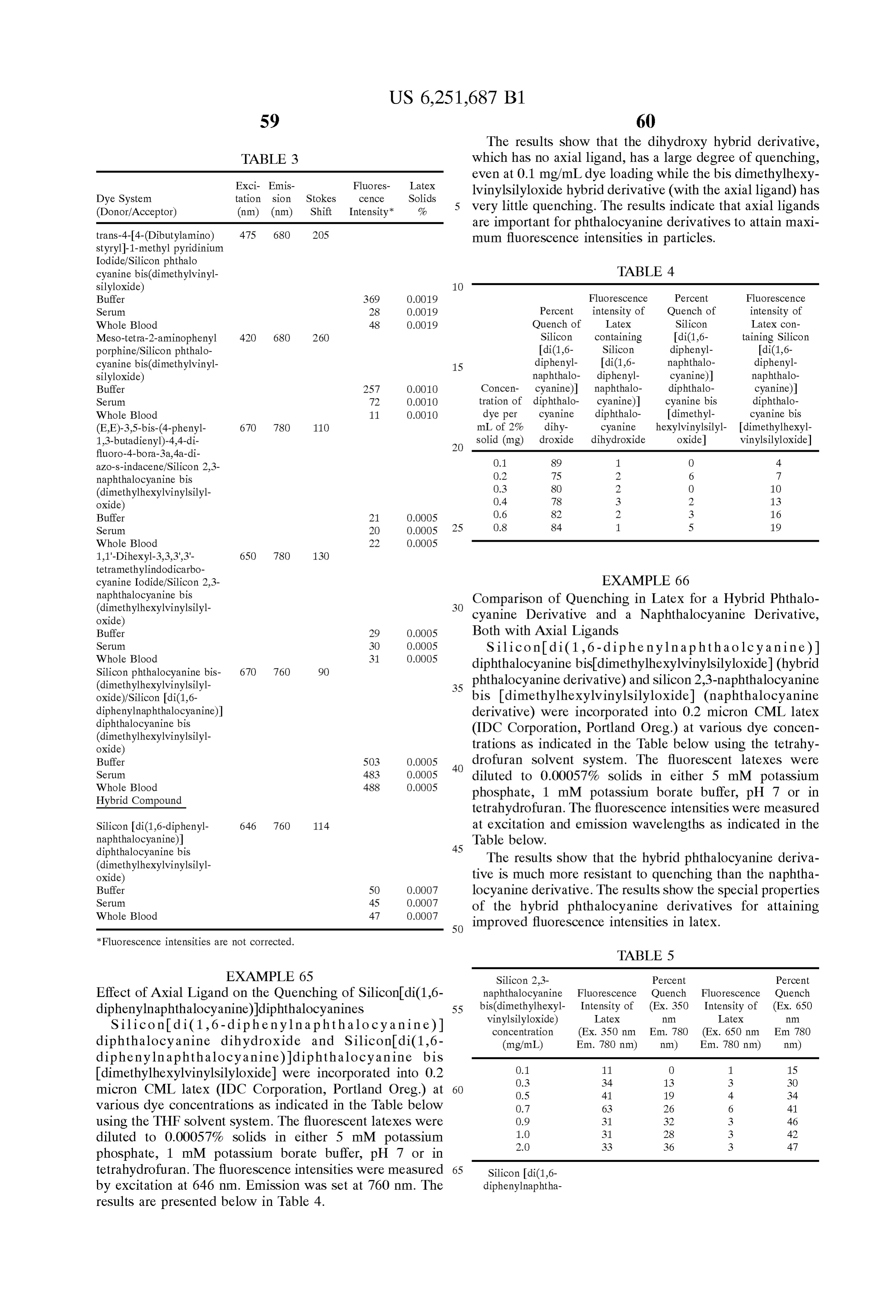
Page 40
of lateX particles at room temperature. The latex Suspension
TABLE 5-continued was stirred at room temperature for an additional 30 minutes iocyanine) Percent Percent to Swell the latex. The dye solution (0.74 mL), which diphthalocyanine Fluorescence Quench Fluorescence Quench
consists of two or three dyes, each at an appropriate con bisdimethyl- Intensity of (Ex. 350 Intensity of (Ex. 650 centration in tetrahydrofuran, was added dropwise over 5
Oxide) concentra- (Ex. 350 nm Em. 760 (Ex. 650 nm Em 760 minutes to the Stirred latex Solution, to give the loading dye tion (mg/mL) Em. 760 nm) nm) Em. 760 nm) nm) concentration (in a 1.33 mL volume) as indicated in Table 6. O.1 11 O 6 O
The latex-dye Solution was Stirred at room temperature for
O.3 31 O 16 O 30 minutes in the dark. The latex solution was dialyzed and
analyzed according to the procedures outlined in the pre
O.9 78 O 39 O ceeding 50% tetrahydrofuran solvent system method.
c. 50% Dimethylformamide Solvent System 15 Dimethylformamide, DMF, (0.19 mL) was added, drop wise over a 5 minute period, to a stirring solution of 0.67 mL
EXAMPLE 67 of 1.5% solids of latex particles at room temperature. The Incorporation and Characterization of Hybrid Phthalocya lateX Suspension was stirred at room temperature for an nine and Phthalocyanine Derivatives into Particles using additional 30 minutes to Swell the latex. The dye solution Tetrahydrofuran and Dimethylformamide Solvent Systems (0.47 mL), which consists of two or three dyes, each at an Hybrid phthalocyanine and phthalocyanine derivatives were incorporated into carboxyl-modified latex (CML, appropriate concentration in dimethylformamide, was added Interfacial Dynamics Corp. Inc., Portland, Oreg.) using the dropwise over 5 minutes to the Stirred lateX Solution, to give procedures indicated below for the dyes and using dye the loading dye concentration (in a 1.33 mL volume) as concentrations as indicated in Table 6. The fluorescence indicated in Table 6. The latex-dye solution was stirred at intensities of the lateX Solutions were measured at the 25 room temperature for 30 minutes in the dark. The latex excitation and emission wavelengths and at the latex con Solution was then transferred to dialysis tubing (Spectrapor, centrations (% solids) as indicated in Table 6 for each of the 12-14,000 molecular weight cutoff, Spectrum, Houston, Solvent Systems used. Tex.) and the dye-latex Solution was dialyzed against water a. 50% Tetrahydrofuran Solvent System
Tetrahydrofuran, THF, (0.19 mL) was added, dropwise for 12-15 hours at 4 C. The dye-latex solution was removed over a 5 minute period, to a stirring solution of 0.67 mL of from dialysis and the % solids of the solution was calculated 1.5% solids of latex particles at room temperature. The latex from the final Volume after dialysis and the Starting Solids Suspension was stirred at room temperature for an additional concentration.
30 minutes to Swell the latex. The dye solution (0.47 mL), d. 70% Dimethylformamide Solvent System which consists of two or three dyes, each at an appropriate 35 Dimethylformamide (0.19 mL) was added, dropwise over concentration in tetrahydrofuran, was added dropwise over a 5 minute period, to a stirring solution of 0.4 mL of 2.5% 5 minutes to the Stirred latex Solution, to give the loading dye Solids of latex particles at room temperature. The latex concentration (in a 1.33 mL volume) as indicated in Table 6. Suspension was stirred at room temperature for an additional The latex-dye Solution was Stirred at room temperature for 30 minutes in the dark. The latex Solution was then trans 40 30 minutes to Swell the latex. The dye solution (0.74 mL), ferred to dialysis tubing (Spectra-por, 12-14,000 molecular which consists of two or three dyes, each at an appropriate concentration in dimethylformamide, was added dropwise weight cutoff, Spectrum, Houston, Tex.) and the dye-latex solution was dialyzed against water for 12-15 hours at 4 C. over 5 minutes to the Stirred latex Solution, to give the The dye-latex solution was removed from dialysis and the % loading dye concentration (in a 1.33 mL volume) as indi Solids of the Solution was calculated from the final volume 45 cated in Table 6. The latex-dye solution was stirred at room after dialysis and the Starting Solids concentration. temperature for 30 minutes in the dark. The latex solution b. 70% Tetrahydrofuran Solvent System was then dialyzed and analyzed according to the procee Tetrahydrofuran (0.19 mL) was added, dropwise over a 5 dures put through the procedures outlined in the preceeding minute period, to a stirring solution of 0.4 mL of 2.5% solids 50% dimethylformamide solvent system method.
TABLE 6
Loading Fluorescence Intensity of particles made in various
COC. Molar Emission %. Solid dye loading solvent system
Dye Systems mg/mL Ratio (excit.) (latex size) 50% THF 70% THF 50% DMF 70% DMF 1. Silicon phthalocyanine 0.066, 1:1 785 nm. O.OOO57% 21.6 Not 0.4 Not bis(dimethylvinylsilyloxide) + O.1 (670 nm) (0.216 um) performed performed Silicon 2,3-naphthalocyanine
2. Silicon phthalocyanine O.08/ 1:1 785 nm. O.OOO57% 37.8 39.1 13.5 12.7 bis(dimethylhexylvinylsilyloxide) + 0.1 (670 nm) (0.216 um)
Silicon 2,3-naphthalocyanine
3. Silicon phthalocyanine O.35/ 1:1 760 nm. O.OOO57% 99.5 118.0 22.7 6.6 bis(dimethylhexylvinylsilyloxide) + 0.5 (670 nm) (0.216 um)
Silicon di(1,6-diphenyl-2,3- naphthalocyanine)
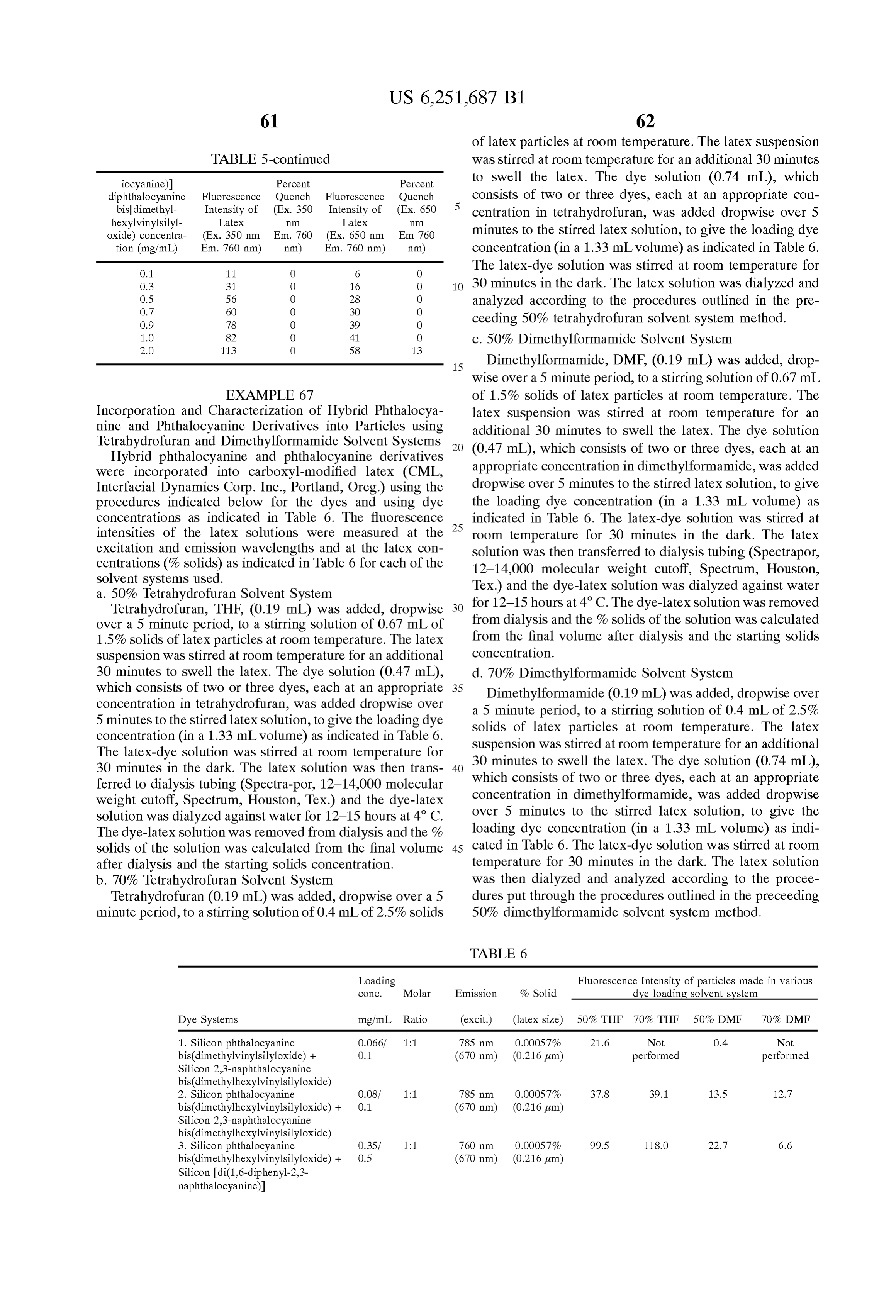
Page 41
TABLE 6-continued
Loading Fluorescence Intensity of particles made in various
COC. Molar Emission %. Solid dye loading solvent system
Dye Systems mg/mL Ratio (excit.) (latex size) 50% THF 70% THF 50% DMF 70% DMF diphthalocyanine
4. Silicon phthalocyanine O.35/ 1:1: 785 nm. O.OOO57% 86.9 105.9 18.5 7.7 bis(dimethylhexylvinylsilyloxide) + 0.5/ O.O23 (670 nm) (0.216 um)
naphthalocyanine) diphthalocyanine
Silicon 2,3-naphthalocyanine
EXAMPLE 68 Vacuum on the rotary evaporator. The residue was chro Synthesis of 4,7-Diphenyl-1,3-diiminoisoindoline matographed on a silica gel (70–230 mesh, 60 A, 2x50 cm) Anhydrous ammonia was slowly bubbled through a column equilibrated in hexane. The product was eluted with stirred mixture of 3,6-diphenylphthalonitrile (5.9 g), toluene, vacuum dried and weighed (3 mg). Synthesized according to Journal of American Chemical UV-vis (tetrahydrofuran) () (nm)): 667, 745 Society 75, 4338 (1953) and Journal of Organic Chemistry, Fluorescence (tetrahydrofuran) () (nm)): 774 USSR (English Translation) 8, 341 (1972), 25% sodium EXAMPLE 71 methoxide in methanol (1.35 mL), and dry 1-butanol (20 25 Synthesis of 2,12-di-(2,3)-Naphthob.1-7.7", 17,17'- mL) for 1 hour. With continued ammonia introduction, the tetraphenyl dibenzoga-5,10,15,20-tetraazopophyrinato mixture was refluxed for 1.5 hours. After the resultant had silicon bis(Dimethylpentafluorophenylsilyloxide), cooled the product was collected by filtration, washed (Abbreviated as: Silicondi(2,3-naphthalocyanine di(1,4- sequentially with 1-butanol (10 mL) and ether (10 mL), dip he nyl phthal oc y a nine) b is vacuum dried and weighed (0.62 g). (dimethylpentafluorophenylsilyloxide)) EXAMPLE 69 A mixture of silicondi(2,3-naphthalocyanine)di(1,4-
Synthesis of 2,12-di-(2,3)-Naphthob.1-7.7", 17,17'- diphenylphthalocyanine)dihydroxide (10 mg), chlorodim tetraphenyldibenzog, q-5,10,15,20-tetraazoporphyrinato ethylpentafluorophenylsilane (28 uL), imidazole (10 mg) Silicon Dihydroxide (Abbreviated as: Silicondi(2,3- 35 and dimethylformamide (200 uL) was stirred at room tem naphthalocyanine)di(1,4-diphenylphthalocyanine) perature for 10 minutes. The resultant was concentrated dihydroxide)) under vacuum on the rotary evaporator. The residue was Silicon tetrachloride (69 uL) was added to a mixture of chromatographed on a silica gel (70–230 mesh, 60 A, 2x50 4,7-diphenyl-1,3-diiminoisoindoline (119 mg) and 1,3- cm) column equilibrated in hexane. The product was eluted diminobenzfisoindoline (39 mg) in freshly distilled quino 40 with toluene, vacuum dried and weighed (3 mg). line (1 mL) under an argon atmosphere and the mixture UV-vis (tetrahydrofuran) () (nm)) 701, 754 heated with stirring at 200 C. for 1 hour. The resultant was Fluorescence (tetrahydrofuran) () (nm)): 789 allowed to cool to 160° C., treated with water (1 mL) and EXAMPLE 72 refluxed for 5 minutes. The mixture was cooled, treated with Synthesis of 2,2,12,12.-Tetraphenyldinaphthob.l-7', ether (10 mL) and filtered, washing the Solid Sequentially 45 17°/- di(tert-butyl) diben Zog, q-5,10,15,20 with water (5 mL) and ether (5 mL). The organic layer of the tetraazoporphyrinatosilicon Dihydroxide (Abbreviated as: filtrate was separated from the aqueous layer washed sequentially with 1 N hydrochloric acid (10 mL) and water Silicondi(1,6-diphenyl-2,3-naphthalocyanine)di
(10 mL), dried (MgSO) and evaporated with a rotary Silicon tetrachloride (344 uL) was added to a mixture of evaporator. The residue was chromatographed on a Silica gel (70-230 mesh, 60 A, 2x50 cm) column equilibrated in 50 diphenyl-1,3-diiminobenzfisoindolmine
mg) in freshly methylene chloride. The product was eluted with methylene distilled quinoline (2 mL) under an argon atmosphere and chloride-1% isopropanol, Vacuum dried and weighed (43 the mixture heated with stirring at 200 C. for 1 hour. The mg). resultant was allowed to cool to 150 C., treated with water UV-vis (tetrahydrofuran) () (nm)): 690, 736, 758 55 (3 mL) and refluxed for 10 minutes. The mixture was cooled, Fluorescence (tetrahydrofuran) () (nm)): 774 treated with ether (30 mL) and filtered, washing the solid EXAMPLE 70 sequentially with ether (20 mL) and water (20 mL). The
Synthesis of 2,12-di-(2,3)-Naphthob.1-7.7", 17,17'- organic layer of the filtrate was separated from the aqueous tetraphenyldibenzog,q-5,10,15,20-tetraazoporphyrinato layer, washed sequentially with 1N hydrochloric acid (2x10 silicon bis(7-Oct-1-Enyldimethylsilyloxide), (Abbreviated 60 mL) and water (10 mL), dried (MgSO) and evaporated with as: Silicondi (2,3-naphthalocyanine) di(1,4- a rotary evaporator. The residue was chromatographed three diphenylphthalocyanine)bis(dimethylhexylvinylsilyloxide)) times on a silica gel (70–230 mesh, 60A, 2x50 cm) column A mixture of Silicondi(2,3-napthalocyanine)di(1,4- equilibrated in hexane. The product was eluted Sequentially diphenylphthalocyanine)dihydroxide (10.6 mg). 7-Oct-1- with methylene chloride and methylene chloride-1% enyldimethylchlorosilane (41 ul), imidazole (11 mg) and 65 isopropanol, Vacuum dried and weighed (55 mg). dimethylformamide (200 uL) was stirred at room tempera UV-vis (tetrahydrofuran) () (nm)): 646, 684, 720,743 ture for 30 minutes. The resultant was concentrated under Fluorescence (tetrahydrofuran) () (nm)): 750
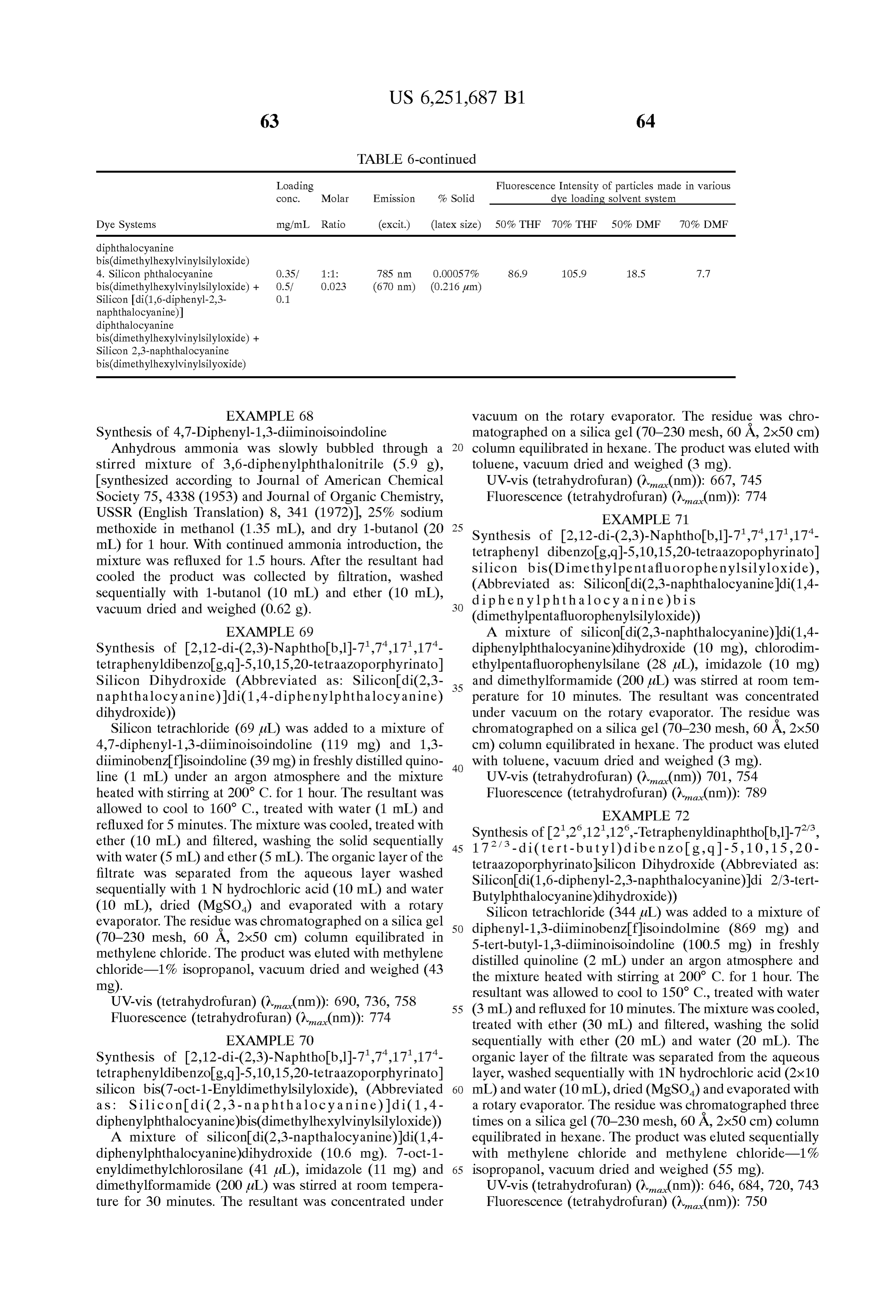
Page 42
EXAMPLE 73 cm) plates eluting sequentially (air drying the plates between Synthesis of 2,2,12,12-Tetraphenyldinaphthob.l-7', each elution) with toluene-5% methylene chloride, 17°-di(tert-butyl) dibenzog, q)-5,10,15,20 toluene-10% methylene chloride, toluene-20% methyl tetra a Zop orphyrin a to Silic on bis (7 - Oct-1- ene chloride and finally toluene-50% methylene chloride. Enyldimethylsilyloxide) (Abbreviated as: Silicondi(1,6- The plates were eluted in the latter solvent ten times to effect diphenyl-2,3-naphthalocyanine) di(2/3-tert Separation of the desired product from by-products. The butylphthalocyanine bis(Dimethylhexylvinylsilyloxide)) green product was vacuum dried and weighed (9 mg). A mixture of Silicondi (1,6-diphenyl-2,3- UV-vis (tetrahydrofuran) () (nm)): 670, 714, 750 naphthalocyanine)di(2/3-tert-butylphthalocyanine) Fluorescence (tetrahydrofuran) () (nm)): 762 dihydroxide (2.8 mg) and dimethylformamide (500 ul) was EXAMPLE 76 stirred at room temperature for 10 minutes. The resultant Synthesis of 2,2,12,12-Tetraphenyldinaphthob.l-7-(2, was concentrated under Vacuum on the rotary evaporator. 3) - naphthog- 17-benzoq-5, 10, 15, 20,- The residue was chromatographed on a silica gel (70–230 tetra a Zop orphyrin a to Silic on bis ( 7 - Oct-1- mesh, 60 A, 2x50 cm) column equilibrated in hexane. The Enyldimethylsilyloxide) (Abbreviated as: Silicondi(1,6-
product was eluted Sequentially with hexane and toluene, 15 phthalocyanine vacuum dried and weighed (16.5 mg). bis(Dimethylhexylvinylsilyloxide)) A mixture of di(1,6-diphenyl-2,3-naphthalocyanine)(2,
UV-vis (tetrahydrofuran) () (nm)): 648, 688, 726, 750 3-naphthalocyanine)phthalocyanine dihydroxide (9 mg), Fluorescence (tetrahydrofuran) () (nm)): 756 7-Oct-1-enyldimethylchlorosilane (33.5 uL), imidazole (9
EXAMPLE 74
mg) and dimethylformamide (200 uL) was stirred at room
Synthesis of 2,2,12,12-Tetraphenyldinaphthob.l-7', temperature for 10 minutes. The resultant was concentrated 17°-di(tert-butyl) dibenzog, q)-5,10,15,20 under vacuum on the rotary evaporator. The residue was chromatographed on a silica-gel (GF,1000u, 20x20 cm) tetra a Zop orphyrin a to Silic on b is plate eluting with hexane-50% methylene chloride. The (Dimethylpentafluorophenylsilyloxide) (Abbreviated as: product was triturated twice with hexane (1 mL), vacuum Silicondi(1,6-diphenyl-2,3-naphthalocyanine)di(2/3-tert 25 dried and weighed (9 mg).
butyl phthalocyanine) b is UV-vis (tetrahydrofuran) () (nm)): 674, 718, 756 (dimethylpentafluorophenylsilyloxide)) Fluorescence (tetrahydrofuran) () (nm)): 763 A mixture of Silicondi (1,6-diphenyl-2,3- EXAMPLE 77 naphthalocyanine)di(2/3-tert-butylphthalocyanine) Synthesis of2',2-Diphenylnaphthob-7,12,17-tribenzoq, dihydroxide (21.8 mg), chlorodimethylpentafluorophe l,q)-5,10,15,20-tetraazoporphyrinatosilicon Dihydroxide nylsilane (56.5 uL), imidazole (20.4 mg) and (Abbreviated as: Silicon (1,6-diphenyl-2,3- dimethylformamide (500 uL) was stirred at room tempera naphthalocyanine)triphthalocyanine Dihydroxide) ture for 10 minutes. The resultant was concentrated under Silicon tetrachloride (687 uL) was added to a mixture of Vacuum on the rotary evaporator. The residue was chro diphenyl-1,3-diiminobenzfisoindoline (347 mg) and 1,3- matographed on a silica gel (70–230 mesh, 60 A, 2x50 cm) 35 diminoisoindoline (726 mg) in freshly distilled quinoline (5 column equilibrated in hexane. The product was eluted mL) under an argon atmosphere and the mixture heated with Sequentially with hexane and toluene, Vacuum dried and stirring at 200 C. for 1 hour. The resultant was allowed to weighed (25 mg). cool to 170° C., treated with water (5 mL) and refluxed for UV-vis (tetrahydrofuran) () (nm)): 652, 694,730, 760 5 minutes. The mixture was cooled, treated with ether (20 Fluorescence (tetrahydrofuran) () (nm)): 769 40 mL) and filtered, washing the Solid Sequentially with water (10 mL) and ether (10 mL). The organic layer was separated
EXAMPLE 75 from the aqueous layer, washed Sequentially with 1N hydro Synthesis of 2,2,12', 12°-Tetraphenyldinaphthob.l-7-(2, chloric acid (50 mL), (re-filtering to effect separation) and 3) - naphthog- 17-benzoq-5, 10, 15, 20 water (50 mL), dried (MgSO) and evaporated with a rotary tetraazoporphyrinatosilicon Dihydroxide (Abbreviated as: 45 evaporator. The filtered solids were treated with acetone (20 Silicondi(1,6-diphenyl-2,3-naphthalocyanine)(2,3- filtrate mL) and re-filtered washing with acetone (10 mL). The naphthalocyanine)phthalocyanine Dihydroxide) was dried (MgSO) and evaporated with a rotary Silicon tetrachloride (172 uL) was added to a mixture of evaporator. The residues from the ether and acetone evapo diphenyl-1,3-diiminobenzfisoindoline (347 mg), 1,3- rations were combined and chromatographed on a silica gel diiminobenz fiso indoline (49 mg) and 1,3- 50 (70-230 mesh, 60 A, 2x50 cm) column equilibrated in diminoisoindoline (36 mg) in freshly distilled quinoline (2 hexane. The product was eluted Sequentially with methylene chloride, toluene and toluene-1% isopropanol. The product mL) under an argon atmosphere and the mixture heated with was stirring at 200 C. for 1 hour. The resultant was allowed to 20x20then re-chromatographed on Silica gel (GF, 1000u, cm)plates eluting with methylene chloride, air drying cool to 170° C., treated with water (2 mL) and refluxed for the plates and re-eluting with toluene-1% isopropanol. The 5 minutes. The mixture was cooled, treated with ether (20 blue-green product was vacuum
dried and weighed (60 mg).
mL) and filtered, washing the Solid with sequentially with UV-vis (tetrahydrofuran) () (nm)): 622, 658, 688, 698 water (5 mL) and ether (10 mL). The organic layer was
Separated from the aqueous layer, washed with 1 N hydro EXAMPLE 78 chloric acid (2x10 mL), (filtering again to effect separation) Synthesis of 2,2,12,12-Tetraphenyldinaphthob.l-7,17 and water (10 mL), dried (MgSO) and evaporated with a 60 dibenzog,q-5,10,15,20-tetraazoporphyrinatosilicon bis rotary evaporator. The residue was chromatographed on a (Trihexylsilyloxide) (Abbreviated as: Silicondi(1,6- silica gel (70–230 mesh, 60 A, 2x50 cm) column equili diphenyl-2,3-naphthalocyanine) diphthalocyanine bis brated in hexane. The product was eluted Sequentially with (Trihexylsilyloxide)) toluene, toluene-5% methylene chloride, toluene-10% A mixture of Silicondi (1,6-diphenyl-2,3- methylene chloride, toluene-20% methylene chloride and 65 naphthalocyanine) diphthalocyanine dihydroxide (8 mg), finally toluene-50% methylene chloride. The product was chlorotrihexylsilane (55 ul), imidazole (10 mg) and dim then re-chromatographed on silica gel (GF,1000u, 20x20 ethylformamide (200 ul) was stirred at room temperature
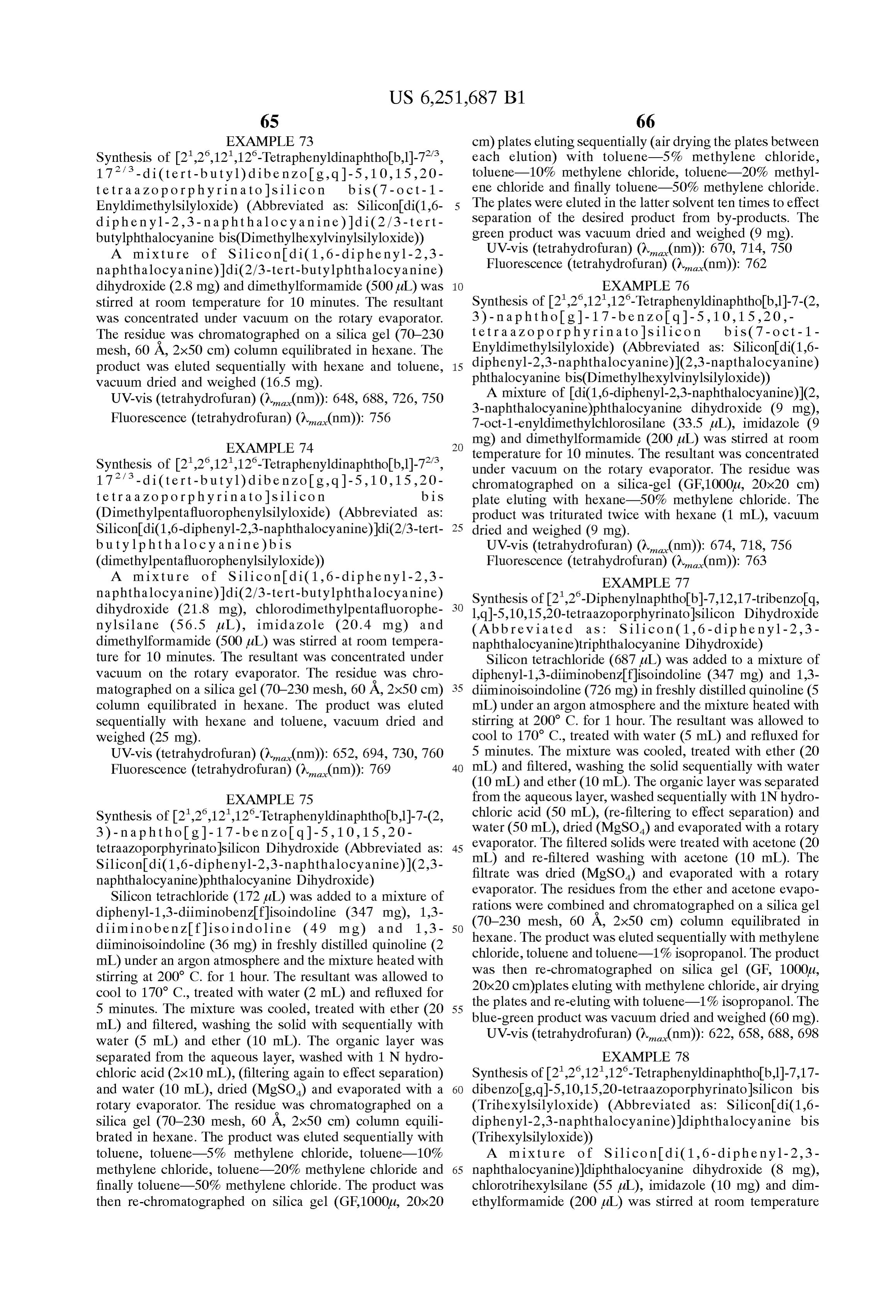
Page 43
for 10 minutes. The resultant concentrated under vacuum on Silicon tetrachloride (115uL) was added to a mixture of the rotary evaporator. The residue was chromatographed on diphenyl-1,3-diiminobenzfisoindoline (174 mg) and 5,6- a silica gel (70–230 mesh, 60 A, 2x50 cm) column equili dicyano-1,3-diiminoisoindoline (98 mg) in freshly distilled brated in hexane. The product was eluted Sequentially with quinoline (2 mL) under an argon atmosphere and the mixture hexane and toluene, vacuum dried and weighed (4.5 mg). heated with stirring 200 C. for 1 hour. The resultant was UV-vis (tetrahydrofuran) () (nm)): 644, 684, 718, 748 allowed to cool to 170° C. treated with water (2 mL) and Fluorescence (tetrahydrofuran) () (nm)): 752 refluxed for 5 minutes. The mixture was cooled, treated with EXAMPLE 79 ether (20 mL) and filtered, washing the Solid Sequentially Synthesis of 2,2-Diphenylnaphthob-7,12,17-tribenzog, with water (10 mL) and ether (10 mL). The filtered dark l,q)-5,10,15,20-tetraazoporphyrinatosilicon bis(7-oct-1- green insoluble Solid was treated with acetone (20 mL), Enyldimethylsilyloxide) (Abbreviated as: Silicon(1,6- filtered, treated with methylene chloride (20 mL) and diphenyl-2,3-naphthalocyanine) triphthalocyanine bis re-filtered washing with methylene chloride (20 mL. The (Dimethylhexylvinylsilyloxide)) acetone/methylene chloride filtrate was dried (MgSO) and A mixture of Silicon(1,6-diphenyl-2,3-naphthalocyanine) evaporated with a rotary evaporator. The residue was chro triphthalocyanine)dihydroxide (23.3 mg), 7-oct-1- 15 matographed on a silica gel (70–230 mesh, 60 A, 2x50 cm) enyldimethylchlorosilane (115.2 uL), imidazole (30.6 mg) column equilibrated in hexane. The product was eluted and dimethylformamide (500 uL) was stirred at room tem Sequentially with methylene chloride and methylene perature for 10 minutes. The resultant was concentrated chloride-1% isopropanol, Vacuum dried and weighed (63 under vacuum on the rotary evaporator. The residue was mg).
treated with hexane (2 mL), filtered from yellow insoluble IR (KBr) 2233 cm (CN)
Solid and the filtrate evaporated. The residue was chromato UV-vis (tetrahydrofuran) () (nm)): 627, 686, 746, 826 graphed on a Silica gel (GF, 1000u, 20x20 cm) plate eluting Fluorescence (tetrahydrofuran) () (nm)): 831 with hexane, air drying the plate and re-eluting with hexane-50% methylene chloride. The product was vacuum EXAMPLE 83 dried and weighed (0.8 mg). 25 Synthesis of 2,2,12,12-Tetraphenyldinaphthob.l-7, NMR(500 MHz, CDC1) 89.54(m.2H), 9.47(d.2H), 8.41 7, 17°, 17-tetraacy anodibenzog, q)-5,10,15,20 (d.2H), 8.37(m.2H), 8.25(m.2H), 8.19(dd.2H), 8.09(dd.2H), tetra a Zop orphyrin a to Silic on bis ( 7 - Oct-1- 8.02(m.10H), 5.65(m.2H), 4.90(m.4H), 1.67(m.4H), 0.76 Enyldimethylsilyloxide) (Abbreviated as: Silicondi(1,6- (m, 4H), -0.11(m.4H), -1.25 (m.4H), -2.17 (m.4H), -2.79 dip he nyl-2,3-naphthalo cyanine) di(2,3- (s.12H). dicyanophthalocyanine)bis(dimethylhexylvinylsilyloxide))
Fluorescence (tetrahydrofuran) () (nm)): 710 A mixture of Silicondi (1,6-diphenyl-2,3-
EXAMPLE 8O
naphthalocyanine) di(2,3-dicyanophthalocyanine)
Synthesis of 2,2,12,12°-Tetraphenyldinaphthob.l-7,17 (77 dihydroxide (21.6 mg), 7-oct-1-enyldimethylchlorosilane benzog,q,-5,10,15,20-tetraazoporphyrinatosilicon bis(7- AiL) uL), imidazole (20.4 mg) and dimethylformamide (500 oct-1-Enyldimethylsilyloxide) (Abbreviated as: Silicondi resultant stirred 35 was at room temperature for 10 minutes. The (1, 6 - diphenyl-2,3-naphthalo cyanine) di(2,3- evaporator.was concentrated under Vacuum on the rotary The residue was chromatographed on a Silica gel
A mixture of Silicondi (1,6-diphenyl-2,3- (GF, 1000u, 20x20 cm) plate eluting with hexane, air drying naphthalocyanine)di(2,3-naphthalocyanine)dihydroxide (6 the plate and re-eluting with methylene chloride. The prod mg), 7-Oct-1-enyldimethylchlorosilane (21 uD), imidazole 40 uct was vacuum dried and weighed (4 mg). (5.7 mg) and dimethylformamide (200 uL) was stirred at NMR (500 MHz, CDC1) 88.65 (s.4H), 8.38(m.4H), 8.16 room temperature for 10 minutes. The resultant was con (m.4H), 8.02(m.4H), 7.94(m.8H), 7.87(m.4H), 5.51(m.2H), centrated under Vacuum on the rotary evaporator. The resi 4.81(m.4H), 1.55(m.4H), 0.71(m.4H), 0.24(m.4H), -0.06 due was chromatagraphed on a silica gel (GF, 1000u, 20x20 (m.4H), -1.19(m.4H), -2.07(m.4H), -2.71 (s.2H) cm) plate eluting sequentially (air drying the plate between 45 UV-vis (tetrahydrofuran) () (nm)): 631, 693, 752,835 each elution) with hexane-20% toluene, hexane-50% Fluorescence (tetrahydrofuran) () (nm)): 839 toluene and toluene. The green product was triturated three times with hexane (1 mL), vacuum dried and weighed (5.4 EXAMPLE 84 mg). Synthesis of 2,7/12-di-(2,3)-Naphthobg/l)-7,7,12,12/ RMR (500 MHz, CDC1) 88.75 (b.4H), 8.38(m.8H), 50 17°, 17te tra cyano dibenzog, 1/q-5,10,15,20 8.15(m.4H), 8.03(m.16H), 7.80(m.8H), 5.40(m.2H), 4.70 tetraazoporphyrinatosilicon Dihydroxide (Abbreviated as: (m.4H), 1.38(m.4H), 0.59(m.4H), 0.16(m.4H), -0.05(m, Silicond i(2,3-naphthalocyanine) di(2,3- 4H), -1.08(m.4H), -1.97(m.4H), -2.58(s.12H). dicyanophthalocyanine)dihydroxide) UV-vis (tetrahydrofuran) () (nm)): 668,696,746,784 Silicon tetrachloride (330 ul) was added to a mixture of Fluorescence (tetrahydrofuran) () (nm)): 792 1,3-diiminobenzfisoindoline (195 mg) and 5,6-dicyano-1,
EXAMPLE 81 3-diiminoisoindoline (195 mg) in freshly distilled quinoline 5,6-Dicyano-1,3-diiminoisoindoline (4 mL) under an argon atmosphere and the mixture heated Anhydrous ammonia was slowly bubbled through a with stirring at 200 C. for 1 hour. The resultant was allowed Stirred mixture of benzene-1,2,4,5-tetracarbonitrile (1.78 g), to cool to 160° C., treated with water (4 mL) and refluxed for and dry methanol (40 mL) for 1 hour. The product was 60 10 minutes. The mixture was cooled, treated with ether (20 collected by filtration, washed Sequentially with methanol mL) and filtered, washing the Solid Sequentially with water (10 mL) and ether (10 mL), vacuum dried and weighed (2.07 (10 mL), ether (10 mL), and acetone (10 mL). The solid was g). vacuum dried and weighed (560 mg). EXAMPLE 82 EXAMPLE 85
Synthesis of 2',2,12', 12-Tetraphenyldinaphthob.l-7, 65 Synthesis of 2,7/12-di-(2,3)-Naphthob.g/I-7°,7,12,12/ 7, 17°, 17-tetra cyano dibenzog, q)-5,10,15,20 17°, 17 tetra cyano diben Zog, 1/q-5,10,15,20 tetraazoporphyrinatosilicon Dihydroxide tetra a Zop orphyrin a to Silic on bis ( 7 - Oct-1-
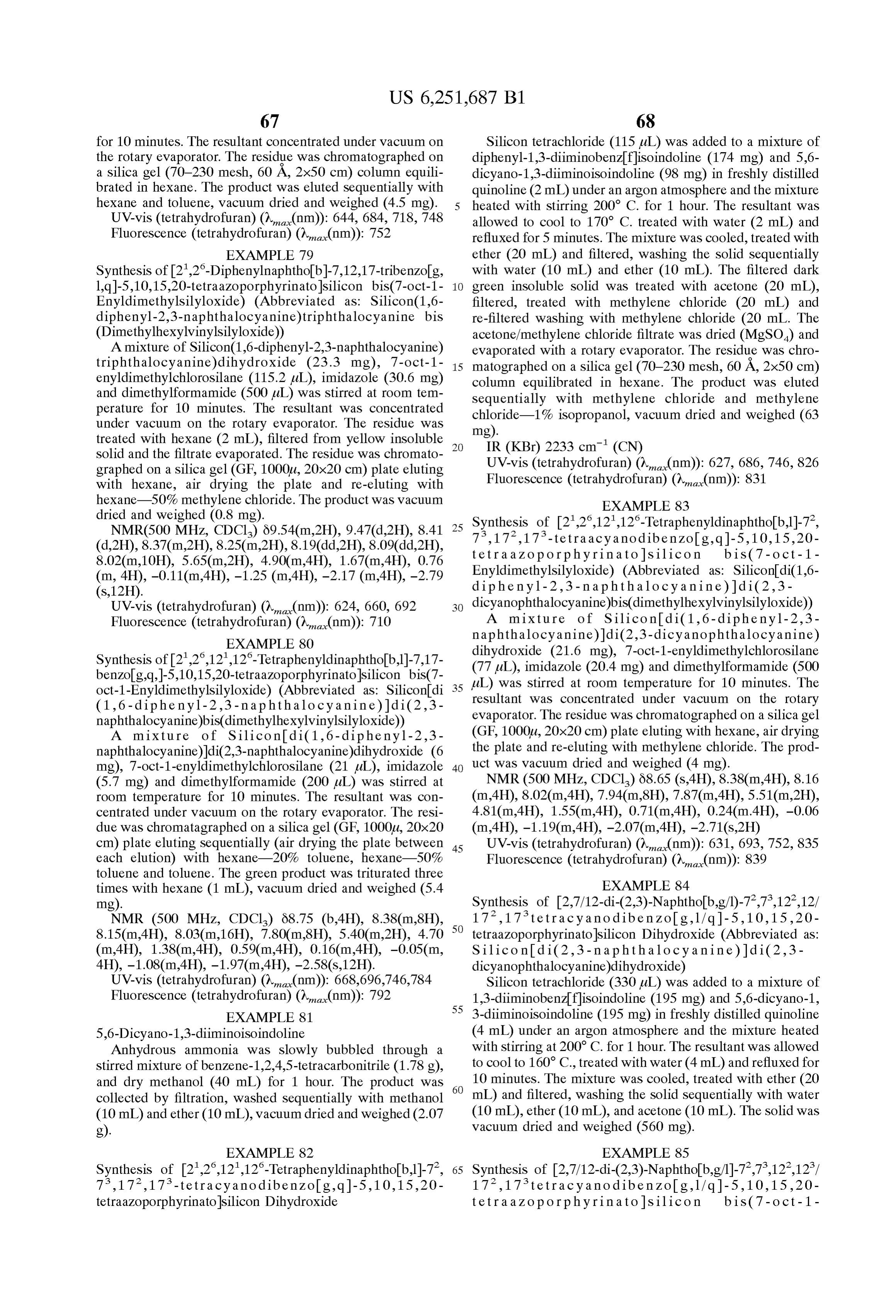
Page 44
Enyldimethylsilyloxide) (Abbreviated as: Silicondi(2,3- mL) and water (100 mL) and evaporated with a rotary naphthalocyanine) di(2,3-dicyanophthalocyanine)bis evaporator. The residue was chromatographed on a Silica gel (dimethylhexylvinylsilyloxide) (70-230 mesh, 60 A, 2x50 cm) column equilibrated in A mixture of Silicondi(2,3-naphthalocyanine)di(2,3- hexane. The product was eluted with toluene-10% dicyanophthalocyanine)dihydroxide (155 mg), 7-Oct-1- isopropanol, Vacuum dried and weighed (340 mg). enyldimethylchlorosilane (770 mL), imidazole (204 mg) and UV-vis (tetrahydrofuran) () (nm)): 716, 766, 694. dimethylformamide (2 mL) was stirred at room temperature EXAMPLE 89 for 30 minutes. The resultant was concentrated under
Vacuum on the rotary evaporator. The residue was chro Synthesis of 2',2,12', 12-Tetraphenyldinaphthob.l-7, matographed on two silica gel (GF, 2000u, 20x20 cm)plates 7, 17°, 17-tetrachlorodibenzog, q-5,10,15,20 tetra a Zop orphyrin a to Silic on bis ( 7 - Oct-1- eluting with hexane, air drying the plate and re-eluting with methylene chloride. The product was vacuum dried and Enyldimethylsilyloxide), (Abbreviated as: Silicondi(1,6- weighed (3.1 mg). dip he nyl-2,3-naphthalo cyanine) di(2,3-
NMR (500 MHz, CDC1) 810.3(s4H), 9.94(s.4H), 8.65 A mixture of silicondi(1,6-diphenyl-2,3- (m.4H), 7.98(m.4H), 5.80(m.1H), 5.59(m.1H), 4.92 (m.4H), 15 naphthalocyanine)di(2,3-dichlorophthalocyanine) 1.56(m.4H), 0.71(m.4H), 0.26(m.4H), -0.05(m.4H), -0.96 dihydroxide (340 mg), 7-oct-1-enyldimethylchlorosilane (m.4H), -1.83(m.4H), -2.44.(s, 12H) (1.1 mL), imidazole (325 mg) and dimethylformamide (7 UV-vis (tetrahydrofuran) () (nm)): 649, 704,731,788 mL) was stirred at room temperature for 48 hours. The Fluorescence (tetrahydroforan) () (nm)): 795 resultant was concentrated under Vacuum on the rotary EXAMPLE 86 evaporator. The residue was chromatographed on a Silica gel Synthesis of 2,7/12-di-(2,3)-Naphthobg/I-7,7,12,12/ (70-230 mesh, 60 A, 2x50 cm) column equilibrated in 17°, 17te tra cyanodibenzog, 1/q-5,10,15,20 hexane. The product was eluted with toluene, Vacuum dried tetra a Zop orphyrin a to Silic on b is and weighed (75 mg).
(Dimethylpentafluorophenylsilyloxide) (Abbreviated as: 25 UV-vis (tetrahydrofuran) () (nm)): 720,770,698. Silicondi (2,3-naphthalocyanine) di(2,3- Fluorescence (tetrahydrofuran) () (nm)): 781 dicy an ophthalo cyanine) b is EXAMPLE 90 (dimethylpentafluorophenylsilyloxide)) Synthesis of 2,2,12,12-Tetraphenyldinaphthob.l-7,17 A mixture of Silicondi(2,3-naphthalocyanine)di(2,3- dibenzo(g,q-5,10,15,20-tetraazoporphyrinatosilicon bis dicyanophthalocyanine)dihydroxide (155 mg), chlorodim (Octyloxide) (Abbreviated as: Silicondi(1,6-diphenyl-2,3- ethylpentafluorophenylsilane (565 uL), imidazole (204 mg) naphthalocyanine) diphthalocyanine bis(Octyloxide)) and dimethylformamide (2 mL) was stirred at room tem A mixture of Silicondi (1,6-diphenyl-2,3- perature for 1 hour. The resultant was concentrated under naphthalocyanine) diphthalocyanine dihydroxide (49 mg) Vacuum on the rotary evaporator. The residue was chro and 1-octanol (1 mL) was refluxed with Stirring on an oil matographed on two silica gel (GF, 1000u, 20x20 cm)plates 35 bath at 235 C. for 3 hours. The resultant was concentrated eluting with hexane, air drying the plate and re-eluting with under vacuum on the rotary evaporator (using a water bath methylene chloride, vacuum dried and weighed (3 mg). at 60° C). The residue was chromatographed on two silica UV-vis (tetrahydrofuran) () (nm)): 656,712, 740, 800 gel (GF, 1000u, 20x20 cm) plates eluting with methylene Fluorescence (tetrahydrofuran) () (nm)): 807 chloride three times (air drying the plates between each EXAMPLE 87 40 elution). The product was vacuum dried and weighed (19
Synthesis of 5,6-Dichloro-1,3-diiminoisoindoline mg).
Anhydrous ammonia was slowly bubbled through a UV-vis (tetrahydrofuran) () (nm)): 642, 682, 716, 746 stirred mixture of 4,5-dichlorphthalonitrile (1.0 g), 8% Fluorescence (tetrahydroforan) () (nm)): 751 fix
sodium butoxide in 1-butanol (500 uL), 1,4-dioxane (1 mL), 45 EXAMPLE 91 and dry 1-butanol (10 mL) for 60 minutes. With continued Synthesis of 2,2,12', 12-Tetraphenyldinaphthob.I-7,17 ammonia introduction, the mixture was refluxed for 2 hours. dibenzo(g,q-5,10,15,20-tetraazoporphyrinatosilicon bis After the resultant had cooled, the product was collected by (Octyloxide) (Abbreviated as: Silicondi(1,6-diphenyl-2,3- filtration, washed with methylene chloride (20 mL), vacuum naphthalocyanine) diphthalocyanine bis(Phenoxide)) dried and weighed (0.63 g). 50
A mixture of Silicondi (1,6-diphenyl-2,3-
EXAMPLE 88
naphthalocyanine) diphthalocyanine dihydroxide (49 mg),
Synthesis of 2,2,12,12-Tetraphenyldinaphthob.l-7, and phenol (1 g) was refluxed with stirring on an oil bath at 220 C. for 2 hours. The resultant was allowed to cool and 7, 17°, 17-tetrachlorodibenzog, q)-5,10,15,20 chromatographed on a silica gel (70–230 mesh, 6 A, 2x50 tetraazoporphyrinatosilicon Dihydroxide (Abbreviated as: cm)
Silicondi(1,6-diphenyl-2,3-naphthalocyanine)di(2,3- 55 with column equilibrated in hexane. The product was eluted hexane-50% methylene chloride, vacuum dried and dichlorophthalocyanine)dihydroxide) weighed (13 mg).
Silicon tetrachloride (500 uL) was added to a mixture of UV-vis (tetrahydrofuran) () (nm)): 654, 704, 732,768 5,6-dichloro-1,3-diiminoisoindoline (308 mg) and 4,7- Fluorescence (tetrahydrofuran) () (nm)): 776 diphenyl-1,3-diiminobenzfisoindoline (900 mg) in freshly distilled quinoline (14 mL) under an argon atmosphere and 60 EXAMPLE 92 the mixture heated with stirring at 210 C. for 1 hour. The Synthesis of 2,2,12,12-Tetraphenyldinaphthob.l-7,17 resultant was allowed to cool to 160 C., treated with water dibenzo(g,q-5,10,15,20-tetraazoporphyrinatosilicon bis (3 mL) and refluxed for 10 minutes. The mixture was cooled, poly(Ethylene Glycol)methyl Ether (Abbreviated as: treated with ether (50 mL) and filtered, washing the solid Silicondi (1,6-diphenyl-2,3 naphthalocyanine) sequentially with water (50 mL) and ether (100 mL). The 65 diphthalocyanine bispoly(Ethylene Glycol)methyl Ether) organic layer of the filtrate was separated from the aqueous A mixture of Silicondi (1,6-diphenyl-2,3- layer, washed sequentially with 1 N hydrochloric acid (50 naphthalocyanine) diphthalocyanine dihydroxide (49 mg),
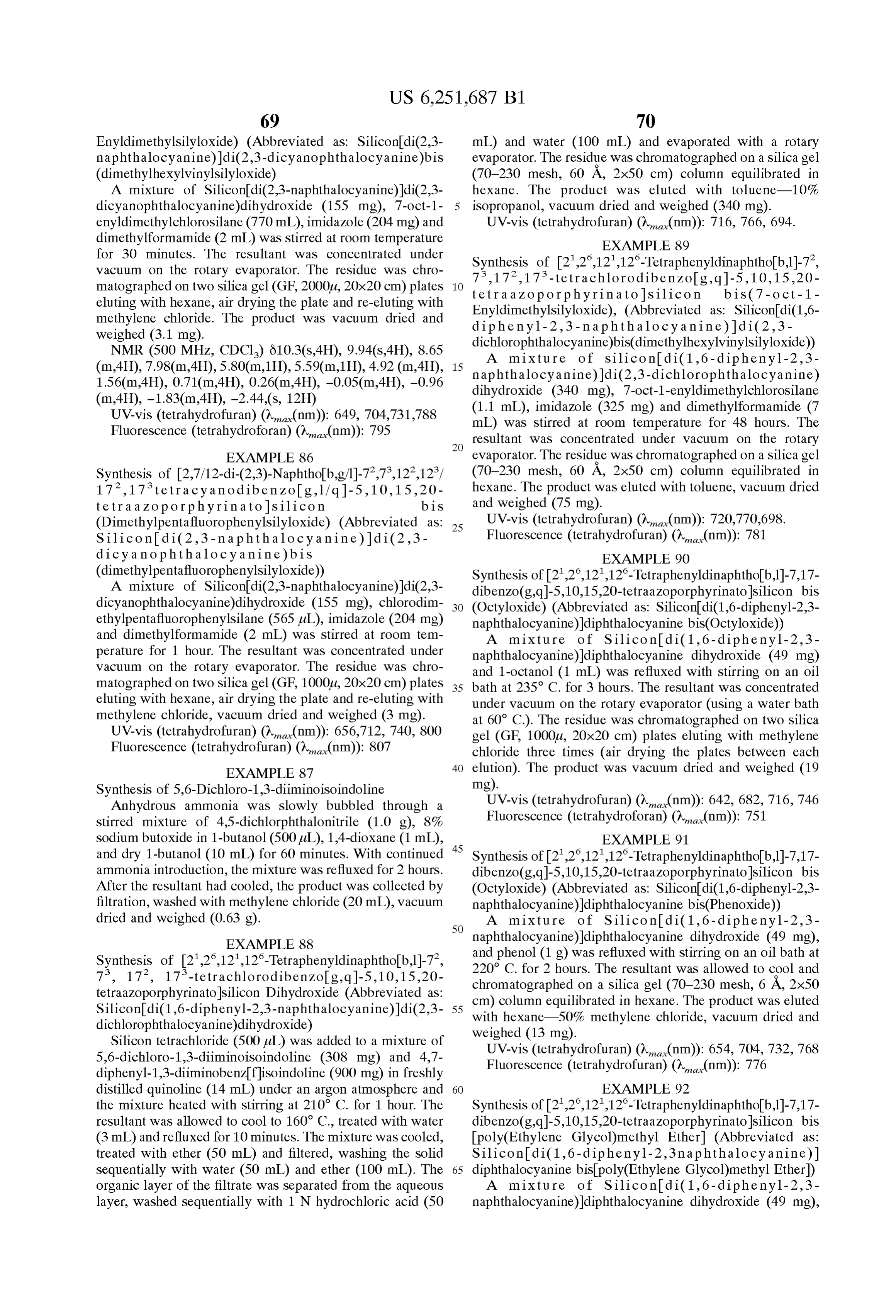
Page 45
poly(ethyleneglycol)methyl ether (400 mg), and 1,2,4- plates eluting Sequentially (air drying the plates between trimethylbenzene (5 mL) was refluxed with stirring on an oil each elution) with methylene chloride, methylene bath at 220 C. for 3 days using a Dean-Stark trap. The chloride-10% methanol and finally tetrahydrofuran. The resultant was concentrated under Vacuum on the rotary product was vacuum dried and weighed (152 mg). NMR evaporator. The residue was chromatographed on a Silica gel 5 (500 MHz, CDC1) 88.30(m.4H), 8.25 (m.4H), 8.00 (70-230 mesh, 60 A, 2x50 cm) column equilibrated in (m.24H,) 7.77(m.4H)3.63 (m,CH's) methylene chloride and eluted Sequentially with methylene UV-vis (tetrahydrofuran) () (nm)): 648, 692, 720,754 chloride-1% isopropanol, methylene chloride-5% Fluorescence (tetrahydrofuran) () (nm)): 760 isopropanol, methylene chloride-20% isopropanol, meth ylene chloride-50% isopropanol and finally methylene EXAMPLE 96 chloride-50% methanol. The product was vacuum dried Synthesis of 2,2,12', 12-Tetraphenyldinaphthob.I-7,17 and weighed (145 mg). dibenzog,q)-5,10,15,20-tetraazoporphyrinatosiliconpoly UV-vis (tetrahydrofuran) () (nm)): 648, 692, 726,758 (ethylene Glycol)acetylthiopropionyl poly(Ethylene Fluorescence (tetrahydrofuran) () (nm)): 765 Glycol) (Abbreviated as: Silicondi(1,6-diphenyl-2,3- 15 naphthalocyanine) diphthalocyaninepoly(ethylene
EXAMPLE 93 Glycol)poly(ethylene Glycol)acetylthiopropionate)
Synthesis of 2,2,12,12°-Tetraphenyldinaphthob.I-7,17 A mixture of acetylthiopropionic acid, (15 mg), 1,1'- dibenzo(g,q-5,10,15,20-tetraazoporphyrinatosilicon bis carbonyldiimidazole (16 mg) and dimethylformamide (1 (4-Octyl)-phenoxide (Abbreviated as: Silicondi(1,6- mL) was stirred at room temperature for 40 minutes. A diphenyl-2,3 Naphthalocyanine) diphthalocyanine bis(4- portion of this solution (100 uL) was added to Silicondi(1, Octyl)-phenoxide) 6-diphenyl-2,3-naphthalocyanine) diphthalocyanine bis A mixture of Silicondi (1,6-diphenyl-2,3- poly(ethylne glycol) (49.5 mg) and the mixture stirred at naphthalocyanine) diphthalocyanine dihydroxide (42 mg), room temperature for 3 days. The resultant was concentrated 4-octylphenol (41 mg) and 1,2,4-trimethylbenzene (5 mL) under vacuum on the rotary evaporator. The residue was was refluxed with stirring on an oil bath at 200 C. for 16 25 chromatographed on a silica gel (GF, 1000u, 20x20 cm) hours. The resultant was concentrated under vacuum on the plate eluting with tetrahydrofuran, Vacuum dried and rotary evaporator. The residue was chromatographed on a weighed (3 mg).
silica gel (70–230 mesh, 60 A, 2x50 cm) column equili UV-vis (tetrahydrofuran) () (nm)): 644, 690, 718, 750 brated in hexane and eluted with hexane-50% methylene Fluorescence (tetrahydrofuran) () (nm)): 754 chloride. The product was vacuum dried and weighed (49 EXAMPLE 97 mg). Synthesis of 2',2,12', 12-Tetraphenyldinaphthob.l-7, UV-vis (tetrahydrofuran) () (nm)): 644, 684, 716, 746 7, 17°, 17-tetra carboxy dibenzog, q)-5,10,15,20 Fluorescence (tetrahydrofuran) () (nm)): 751 tetraazoporphyrinatosilicon Dihydroxide (Abbreviated as: EXAMPLE 94 Silicondi (1,6-diphenyl 2,3-naphthalocyanine)di(2,3- Silic on 2,3 - Naphthalo cyanine b is 35 dicarboxyphthalocyanine)dihydroxide) (Dimethyloctadecylsilyloxide) A mixture of Silicondi (1,6-diphenyl-2,3- A mixture of Silicon 2,3-naphthalocyanine dihydroxide naphthalocyanine) di(2,3-dicyanophthalocyanine) (155 mg), chlorodimethyloctadecylsilane (1.04 g), imida dihydroxide (36 mg) and concentrated sulfuric acid (200 uL) zole (204 mg) and dimethylformamide (5ul ) was stirred at 40 was heated with stirring at 50° C. for 48 hours. The cooled room temperature for 1 hour. The resultant was concentrated mixture was then carefully treated with water (150 uL) and under vacuum on the rotary evaporator. The residue was heated with stirring at 100° C. for 20 hours. The cooled chromatographed on a silica gel (70–230 mesh, 60 A, 2x50 mixture was then treated with water (1 mL) and the dark cm) column equilibrated in hexane. The product was eluted precipitate collected by filtration washing with water (1 Sequentially with hexane and methylene chloride, Vacuum 45 mL). The solid was then treated with 1 N potassium car dried and weighed (180 mg). bonate solution (1 mL) and refluxed with stirring for 1 hour. UV-vis (tetrahydrofuran) () (nm)):686, 732, 770 The cooled mixture was acidified to pH 2 by dropwise Fluorescence (tetrahydroforan) () (nm)): 776 addition of 6 N hydrochloric acid and the fine dark green
EXAMPLE 95
solid product filtered, washing with water (1 mL). The solid
Synthesis of 2,2,12,12°-Tetraphenyldinaphthob.I-7,17 50 wasUV-vis vacuum dried and weighed (20 mg).
dibenzo(g,q-5,10,15,20-tetraazoporphyrinatosilicon bis Fluorescence (tetrahydrofuran) () (nm)): 791. poly(Ethylene Glycol) (Abbreviated as: Silicondi(1,6- diphenyl-2,3-naphthalocyanine) diphthalocyanine bispoly EXAMPLE 98 (Ethylene glycol)) Synthesis of 2,2,12,12-Tetraphenyldinaphthob.l-7, A mixture of Silicondi (1,6-diphenyl-2, 55 7, 17°, 17-tetracarboxydibenzog, q)-5,10,15,20 3naphthalocyanine) diphthalocyanine dihydroxide (49 mg), tetraazoporphyrinatosilicon bispoly(ethylene Glycol) poly(ethylene glycol) (1 g), and 1,2,4-trimethylbenzene (5 methyl Ether (Abbreviated as: Silicondi(1,6-diphenyl 2,3- mL) was refluxed with stirring on an oil bath at 210°C. for naphthalocyanine)di(2,3-dicarboxyphthalocyanine)bis 3 days using a Dean-Stark trap. The resultant was concen poly(ethylene Glycol)methyl Ether) trated under vacuum on the rotary evaporator. The residue 60 A mixture of Silicondi (1,6-diphenyl-2,3- was chromatographed on a silica gel(70–230 mesh, 60 A, naphthalocyanine)di(2,3-dicarboxyphthalocyanine) 2x50 cm) column equilibrated in methylene chloride and dihydroxide (10 mg), poly(ethylene glycol)methyl ether (80 eluted sequentially with methylene chloride-1% mg) and 1,2,4-trimethylbenzene (1 mL) was refluxed with isopropanol, methylene chloride-5% isopropanol, methyl stirring on an oil bath at 220 C. for 3 days using a ene chloride-20% isopropanol and finally methylene 65 Dean-Stark trap. The resultant was concentrated under chloride-50% isopropanol. The product was then Vacuum on the rotary evaporator. The residue was chro re-chromatographed on silica gel GF, 1000u, 20x20 cm) matographed on a silica gel (GF, 1000u, 20x20 cm) plate
Page 46
eluting with methylene chloride-10% methanol, air drying under vacuum on the rotary evaporator. The residue was the plate and re-eluting with methylene chloride-10% chromatographed on a silica gel (70–230 mesh, 60 A, 2x50 methanol. The green product was vacuum dried and weighed cm) column equilibrated in hexane. The product was eluted (8 mg). with toluene, vacuum dried and weighed (35 mg). IR (KBr)1712 cm (COOH) UV-vis (tetrahydrofuran) () (nm)e(Mcm)): 770, UV-vis (tetrahydrofuran) () (nm)): 648,702.726,792. 728, 688, 654, 182000.
UV-vis (water) () (nm)): 712, 816. Fluorescence (tetrahydrofuran) () (nm)): 774, 727. Fluorescence (tetrahydrofuran) () (nm)): 800. EXAMPLE 103 EXAMPLE 99 Synthesis of 2,2'-Dichlorobenzob-7,12,17-tri(2,3-
Synthesis of Silicon(IV)2,3-naphthalocyanine bis(tert naphtho)g,l,q-5,10,15,20,-tetraazoporphyrinatosilicon bis Butyldimethylsilyloxide) Dimethylpentafluorophenylsilyloxide) (Abbreviated as: A mixture of Silicon naphthalocyanine dihydroxide, tert Silicontri (2,3-naphthalo cyanine) 2,3- butyldimethylchlorosilane (390 mg), imidazole (180 mg) dichlorophthalo cyanine b is and dimethylformamide (5 mL) was stirred at 150° C. for 30 15 (Dimethylpentafluorophenylsilyloxide)) minutes. The resultant was chromatographed on a Silica gel A mixture of Silicontri(2,3-naphthalocyanine)-2,3- (70–230 mesh, 60 A, 2x50 cm) column equilibrated in dichlorphthalocyanine dihydroxide (400 mg), chlorodimeth hexane. The product was eluted Sequentially with hexane ylpentafluorophenylsilane (1.0 mL), imidazole 270 mg) and and toluene, vacuum dried and weighed (6 mg). dimethylformamide (5 mL) was stirred at room temperature UV-vis (tetrahydrofuran)() (nm)): 772,730, 686. for 16 hours. The reaction mixture was filtered, washing the Fluorescence (tetrahydrofuran) () (nm)): 775. solid with dimethylformamide(4x2 mL). The filtrate was H-NMR (500 MHz, CDcl) & 10.14 (s,8H), 8.67(m.8H), evaporated under Vacuum on the rotary evaporator. The 7.90(m.8H), -1.20(s.18H), -2.60(s.12H) residue was dissolved in toluene and filtered. The filtrate was concentrated under Vacuum on the rotary evaporator. The
EXAMPLE 100 residue was chromatographed on a silica gel (70–230 mesh,
Synthesis of Silicon(IV)phthalocyanine bis(tert 60 A, 2x50 cm) column equilibrated in hexane. The product Butyldimethylsilyloxide) was eluted Sequentially with hexane and toluene, Vacuum A mixture of Silicon(IV)phthalocyanine dihydroxide (200 dried and weighed (34 mg).
mg), tert-butyldimethylchlorosilane (525 mg), imidazole UV-vis (tetrahydrofuran) () (nm)e(Mcm)): 780, (272 mg) and dimethylformamide (5 mL) was stirred at 150 736, 696, 662; 142000.
C. for 30 minutes. The resultant was chromatographed on a Fluorescence (tetrahydrofuran) (0. (nm)): 735, 784 nm. fix silica gel (70–230 mesh, 60 A, 2x50 cm) column equili EXAMPLE 104 brated in hexane. The product was eluted Sequentially with hexane and toluene, Vacuum dried and weighed (12 mg). Synthesis of 2,2,12,12'-Tetraphenyldinaphthob.l -7, UV-vis (tetrahydrofuran) () (nm)): 666,636,600. 35
Fluorescence (tetrahydrofuran) () (nm)): 671. silicon bis(7-Oct-1-Enyldimethylsilyloxide) (Abbreviated
H-NMR (500 MHz, CDcl) & 9.65(m.8H), 8.33(m.8H), dinaphthalocyanine -1.45(s.18H),-2.98(s.12H) bis(Dimethylhexylvinylsilyloxide)) A mixture of Silicondi(1,6-diphenylnaphthalocyanine)
EXAMPLE 101 di-2,3-naphthalocyanine dihydroxide (25 mg) and 7-Oct-1- Synthesis of 2,2'-Dichlorobenzob-7,12,17-tri(2,3- 40 enyldimethychlorosilane(60 uD), imadazole (16 mg) and naphtho)g,l,q)-5,10,15,20,-tetraazoporphyrinatosilicon dimethylformamide (4 mL) was stirred at room temperature Dihydroxide (Abbreviated as: Silicontri(2,3- for 3 days. The resultant was concentrated under Vacuum on naphthalocyanine) 2,3-dichlorophthalocyanine the rotary evaporator. The residue was chromatographed on Dihydroxide) a silica gel (70–230 mesh, 60 A, 2x50 cm) column equili Silicon tetrachloride (600 uL) was added to a mixture of 45 brated in hexane. The product was eluted Sequentially with 5,6-dichloro 1,3-diiminoisoindoline (100 mg) and 1,3- hexane and toluene, vacuum dried and weighed (15 mg). diiminobenzfisoindoline(466 mg) in freshly distilled This compound has also been isolated as a by-product quinoline (4 mL) under an argon atmosphere and the mixture during the chromatographic purification in Example 75. heated with stirring at 210°C. for 2 hours. The resultant was 50 UV-vis (tetrahydrofuran)() (nm)e(M'cm): 786, allowed to cool, treated with water (20 mL) and refluxed for 440000.
20 minutes. The mixture was cooled, treated with ether (10 Fluorescence (tetrahydrofuran)() (nm)): 792. mL) and filtered, the Solid was washed sequentially with "H-NMR(500 MHz, CDC1): 8–2.9(12-CH-);-2.0(m, water (2x20 mL), ether (3x20 mL), methylene chloride (10 4H), 1.07(m.4H), -0.06(m.4H).0.17(m.4H), 0.6(m.4H), 1.4 mL) and acetone (20 mL) The solid was vacuum dried and (m.4H), 4.7(m.4H), 5.3(m.2H), 7.8(m,8H), 8.03(m,16H), weighed (0.83 g). The crude product was used without 55 8.15(m.4H), 8.38(m,8H), 8.8(m.4H).
purification for the next step.
EXAMPLE 105
EXAMPLE 102 Synthesis of 2',2,12,12°-Tetraphenyldinaphthob.l -7, Synthesis of 2,2'-Dichlorobenzob-7,12,17-tri(2,3- 17-di(2,3-naphtho)g,q-5,10,15,20-tetraazoporphyrinato naphtho)g,l,q]-5,10,15,20,-tetraazoporphyrinatosilicon bis 60 silicon Dihydroxide (Abbreviated as: Silicondi(1,6- (7-Oct-1-Enyldimethylsilyloxide) (Abbreviated as: Silicon diphenylnapththalocyanine)dinaphthalo Cyanine tri(2,3-naphthalocyanine)2,3-dichlorophthalocyanine bis Dihydroxide))
(Dimethylhexylvinylsilyloxide)) Silicon tetrachloride (600 uL)was added to a mixture of A mixture of Silicontri(2,3-naphthalocyanine)2,3- 4.9-diphenyl 1,3-diiminobenzfisoindoline (1.0 g) and 1.3 dichlorophthalocyanine dihydroxide (400 mg) and 7-oct-1- 65 diminobenzfisoindoline (50mg) in freshly distilled quino enyldimethylchlorosilane (1.5 mL) was stirred at room line (1 mL) under an argon atmosphere and the mixture temperature for 15 hours. The resultant was concentrated heated with stirring at 210°C. for 2 hours. The resultant was
Page 47
allowed to cool, treated with water (10 mL) and refluxed for silicon Dihydroxide (Abbreviated as: Sulfo Silicon di(1,6- 15 minutes. The mixture was cooled, treated with ether (20 Diphenyl-2,3-naphthalocyanine diphthalocyanine mL) and filtered. The organic layer of the filtrate was washed Dihydroxide) with 1 N hydrochloric acid (2x20 mL). The solid was A mixture of Silicondi (1,6-diphenyl-2,3- washed with methylene chloride (5x20 mL). The organic naphthalocyanine diphthalocyanine)dihydroxide (0.2 g) and phases were combined and evaporated with a rotary evapo chloroform (2 mL) was stirred at room temperature for 10 rator. The residue was chromatographed on a silica gel minutes under an argon atmosphere. The mixture was then (70-230 mesh, 60 A, 2x50 cm) column equilibrated in cooled in an ice-bath and chlorosulfonic acid (2 mL) was methylene chloride. The product was eluted with toluene added. The mixture was stirred in the ice-bath for 15 minutes 10% isopropanol, vacuum dried and weighed (25 mg). and then at room temperature for 20 minutes. The mixture UV-vis (methylene chloride) () (nm): 794. was then refluxed for 2 hours, cooled and poured onto EXAMPLE 106 crushed ice (100 g). The resulting green mixture was
Synthesis of Silicon(IV)phthalocyanine bis(7-Oct-1-Enyl extracted with chloroform (2x30 mL). The combined Dimethylsilyloxide (Abbreviated as: Silicon Phthalocyanine organic layers were washed with water (20 mL), dried (MgSO) and evaporated with a rotary evaporator. The bis(Dimethylhexylvinyloxide)) 15
A mixture of silicon phthalocyanine dihydroxide 500 mg), brown residue was treated with 6 N potassium hydroxide (3 mL) with Swirling and after 5 minutes the mixture was 7-Oct-1-enyldimethylchlorosilane (2.5 mL), imidazole (680 partitioned between water (40 mL) and ether (20 mL). The mg)and dimethylformamide(10 mL) was stirred at room temperature for 48 hours. The resultant was evaporated aqueous layer was acidified with 1 N hydrochloric acid (15 mL), washed with ether (40 mL) and evaporated with a under vacuum on the rotary evaporator. The residue was rotary dissolved in toluene (20 mL) and filtered. The solid washed weighedevaporator.
The residue was vacuum dried and with toluene(40 mL). The filtrate was concentrated under vacuum on the rotary evaporator and was chromatographed (sh).UV-vis(methanol)(()(nm)): 650, 658, 692, 726, 748 on a silica gel (70–230 mesh, 60 A, 2x50 cm) column UV-vis(water)(()(nm)): 654, 662, 732, 758 (sh). equilibrated in hexane. The product was eluted Sequentially with hexane and toluene, vacuum dried and weighed (324 25 IR(KBr)Fluorescence (water) (() (nm)): 773. mg). (cm): 3153, 1720, 1405, 1225, 1182, 1037, UV-vis (tetrahydrofuran) () (nm)e(M'cm) 668,636, 1014, 10622.
660 nm, 283000 EXAMPLE 109 Fluorescence (tetrahydrofuran) () (nm)): 673 Synthesis of Acetylthiopropionic Acid H-NMR(500 MHz, CDC1): 8 -2.8(s.12H), -2.27 To a stirred Solution of 3-mercaptopropionic acid (1 mL), (m.4H), -1.33 (m.4H), -0.20(m.4H), 0.31 (m,4H), 0.84(m, and imidazole (5.4 g) in tetrahydrouran (700 mL) was 4H), 1.54(m.4H), 1.80 (m.4H), 4.94(m.4H), 5.75(m.2H), added, dropwise, over 15 minutes, under argon, a Solution of 8.3(m.8H),9.65(m,8H). 1-acetylimidazole (9.6 g) in tetrahydrofuran (100 mL). The EXAMPLE 107 Solution was allowed to stir a further 3 hours at room Synthesis of Silicon(IV)phthalocyanine(10-carbomethoxy 35 temperature after which time the tetrahydrofuran was Decyldimethylsilyloxide)(dimethylvinylsilyloxide) removed under vacuum. The residue was treated with ice A mixture of silicon(IV)phthalocyanine dihydroxide (500 cold water (18 mL)and the resulting solution acidified with mg), imidazole (300 mg), dimethylformamide (6 mL) and a ice-cold concentrated hydrochloric acid (14.5 ml) to pH mixture of (10-carbomethoxydecyldimethylchlorosilane 1.5-2.0 The mixture was extracted with diethyl ether (2x50 (590 mg) and chlorodimethylvinylsilane (250mg)was added 40 mL), the ether was washed with water (2x50 mL) and dried and the reaction mixture Stirred at room temperature for 24 over MGSO and evaporated. The residual crude yellow oily hours. The resultant was concentrated under vacuum on the rotary evaporator. The residue was chromatographed on a solid hexane product (10.5 g) was recrystallized from chloroform to afford 4.8 g. (41% yield) acetylthiopropionic acid silica gel (70–230 mesh, 60 A, 2x50 cm) column equili as a white solid with a melting point of 440-45. brated in hexane. The products (a) Silicon (IV) 45 phthalocyanine bis(10-carbomethoxy decyldimethyl EXAMPLE 110 silyloxide) (100 mg) and (b) silicon(IV)phthalocyanine (10 Synthesis of 2,2,12', 12-Tetraphenyldinaphthob.I-7,17 carbo methoxy decyl dimethylsilyl oxide) dibenzog,q)-5,10,15,20-tetraazoporphyrinatosiliconpoly (dimethylvinylsilyloxide) (68 mg) were eluted with toluene. (ethylene Glycol)thiopropionyl poly(Ethylene Glycol) (a) 50 (Abbreviated as: Silicondi(1,6-diphenyl-2,3- UV-vis (tetrahydrofuran) () (nm): 666,638,602. naphthalocyanine) diphthalocyaninepoly(ethylene Fluorescence (tetrahydrofuran) () (nm)): 671. Glycol)poly(ethylene Glycol)thiopropionate) H-NMR(500 MHz, CDC1): 8 -2.9(s.12H).2.27(m.4H), A solution of silicondi(1,6-diphenyl-2,3- -1.35(m.4H), -0.22(m.4H), 0.25(m.4H), 1.18 (m, 4H), 1.0 naphthalocyanine) diphthalocyaninepoly(ethyleneglycol (m.4H), 0.70 m.4H)1.65(m.4H), 2.35(m.4H), 3.7(s,6H), 55 thiopropionate in 0.12M potassium carbonate in 80% 8.33(m.8H), 9.64(m.8H). methanol (1 mL) was allowed to Stand at room temperature (b) for 5 minutes. The pH of the solution was then adjusted to UV-vis (tetrahydrofuran)() (nm)): 668, 636,602 7 by dropwise addition of a solution of 0.5 M potassium Fluorescence (tetrahydrofuran)() (nm)): 673 phosphate pH 7 which was made 1N in hydrochloric acid. H-NMR(500 MHz, CDC1): 8 -2.9(s.6H), -2.75(s.6H), 60 The thiol content of the solution was estimated by Ellman's -2.27(m.4H), -1.36(m.4H), -0.015(m.4H), 0.027 (m.4H), method using dithionitrobenzoic acid. The title compound in 0.07 m.4H).0.10(m.4H), 1.21(m.4H), 1,65(m,3H), 2.33(m, Solution is capable of being conjugated to ligand analogues, 3H);3.0(m.1H), 3.4(m.1H), 3.6(s), 3.7(s), 4.26(m.1H);8.33 proteins, polypeptides and nucleic acids containing for (m.8H), 9.6(m.8H). example, maleimide or alkyliodide functional groups. EXAMPLE 108 65 EXAMPLE 111
Synthesis of Sulfo2,2,12,12-tetraphenyldinaphthob.l Synthesis of 2(2-Amino-4-thiolbutanoic Acid Thiolactone) -7,17-dibenzog,q)-5,10,15,20-tetraazoporphyrinato bromoacetamide (Abbreviated as: Bromoacetyl-HCTL)
Page 48
Bromoacetic acid (1.0 g), homocysteine thiolactone the residue treated with ethanol (2 mL) and filtered washing hydrochloride (1.1 g) and pyridine (1.2 mL) were dissolved with ethanol (2 mL). The filtrate was evaporated, and the in anhydrous dimethylformamide (36 mL) and 1-(3- product vacuum dried and weighed 200 mg). This product dimethylaminopropyl)-3-ethylcarbodiimide hydrochloride was used without further purification in the next step. (1.52 g) was added. The reaction was stirred at room EXAMPLE 1.15 temperature for 18 hours. The solvents were removed under Synthesis of Sulfo2',2,12', 12-tetraphenyldinaphthob.lvacuum, ethanol (10 mL) was added to dissolve the residue 7,17-dibenzog,q-5,10,15,20-tetraazoporphyrinatosilicon and then the ethanol was removed under Vacuum. Ethanol N-(cysteine)amidomethoxidehydroxide (Abbreviated as: (10 mL) was again added to dissolve the residue and was Sulfo Silicond 91,6-diphenyl-2,3-naphthalocyanine again removed under vacuum. Water (20 mL) was added to diphthalocyanine N-(cysteine)amidomethoxidehydroxide) the oil and the aqueous Solution was extracted 3 times with A solution of sulfo silicon di(1,6-diphenyl-2,3- methylene chloride (45 mL). The combined organic extracts naphthal oc y a nine diphth a lo cyanine N-(2- were dried over anhydrous magnesium Sulfate. The Solution butyrothiolactone)amidomethoxidehydroxide(10 mg) in was filtered and the Solvent was removed under vacuum to water (182 mL) was treated with 1 N potassium hydroxide give a clear oil. Diethyl ether (5 mL) was added and the 15 Solution (46 mL) and allowed to stand at room temperature resulting precipitate was collected and washed on a fritted for 10 minutes. The pH of the solution was then adjusted to funnel. The precipitate was dried under vacuum and 1.0 g of 7phosphate by dropwise addition of a solution of 0.5 M potassium pH7 which was made 1 N in hydrochloric acid.
the title compound was recovered. The thiol content of the solution was estimated by Ellman's EXAMPLE 112 method using dithionitrobenzoic acid. The title compound in Synthesis of 2Naphthob-7,12,17-tribenzog,l,q}-5,10,15, Solution is capable of being conjugated to ligand analogues, 20-tetraazoporphyrinatosilicon Dihydroxide (Abbreviated proteins, polypeptides and nucleic acids containing, for as: Silicon(IV) tri(phthalo)naphthalocyaninehydroxide example, maleimide or alkyliodide functional groups. What is claimed is:
Silicon tetrachloride (912 uL) was added to a mixture of 1,3-diiminoisoindoline (1.0 g) and 1,3-diiminobenzf 25 first1. component
A loadable particle comprising an energy donor as a isoindoline (0.25 g) in freshly distilled quinoline (3 mL) positioned in Saidandparticle energy acceptor as a Second component at an energy exchanging distance under an argon atmosphere and the mixture heated with from one another, wherein stirring at 210 C. for 2 hours. The resultant was allowed to Stokes shift of greater than orthe two components have a equal to 50 nm, wherein Said cool, treated with water (25 mL) and refluxed for 15 first component has an excitation wavelength greater than minutes. The mixture was cooled, the Solid filtered, Washing approximately 500 nm, said Second component has an the solid sequentially with water (3x10 mL) and ether (5x10 emission wavelength greater than approximately 680 nm, mL). The Solid was vacuum dried and weighed (1.5 g). and at least one of Said first component and Said Second EXAMPLE 113 component is a phthalocyanine derivative having an axial Synthesis of 2Naphthob-7,12,17-tribenzog,l,q}-5,10,15, ligand or a naphthalocyanine derivative having an axial 20-tetraazoporphyrinatosilicon bis(7-Oct-1-Enyldimethyl 35 ligand; Said particle having bound on its Surface, a protein, Sillyloxide) (Abbreviated as: Silicontri(phthalo) polypeptide, nucleic acid, nucleotide or protein comprising a ligand analogue.
A mixture of Silicon(IV)(tri(phthalo)naphthalocyanine 2. A loadable particle comprising an energy donor as a dihydroxide (1.0 g). 7-Oct-1-enyldimethylchlorosilane (3.0 40 first component and an energy acceptor fluorescent dye as a mL), imidazole (0.68 g) and dimethylformamide (10 mL) Second component positioned in Said particle at an energy was stirred at room temperature for 24 hours. The resultant eXchanging distance from one another, wherein Said first was concentrated under Vacuum on the rotary evaporator. component is a phthalocyanine derivative having an axial The residue was chromatographed on a silica gel (70–230 ligand and the two components have a Stokes shift of greater mesh 60 A, 2x50 cm) column equilibrated in hexane. The 45 than3. or equal to 50 nm.
A loadable particle comprising an energy donor as a product was eluted Sequentially with hexane and hexane 3% toluene, vacuum dried and weighed (11 mg). first component and an energy acceptor fluorescent dye as a UV-vis(methylene chloride)() (nm)): 716, 704, 684, Second component positioned in Said particle at an energy 648, 6.18 eXchanging distance from one another, wherein Said Second Fluorescence (methylene chloride)(O(nm)): 710 component is a phthalocyanine derivative having an axial 50 ligand and the two components have a Stokes shift of greater
"H-NMR(500 MHz,CDC1): 8 -2.8(s.12H), -2.2(m, than or equal to 50 nm.
4H), 1.7(m.4H), 4.9(m.4H), 5.7(m.2H), 7.94(m.2H), first4. component
A loadable particle comprising an energy donor as a and an energy acceptor fluorescent dye as a 8.3(m,6H), 8.7(m.2H), 9.6(m,6H), 10.1(S.2H). Second component positioned in Said particle at an energy EXAMPLE 114 55 eXchanging distance from one another, wherein Said first Synthesis of Sulfo2,2,12,12-tetraphenyldinaphthob.l- component is a naphthalocyanine derivative having an axial 7,17-dibenzog,q-5,10,15,20-tetraazoporphyrinatosilicon ligand and the two components have a Stokes shift of greater N-(2-butyrothiolactone)amidomethoxidehydroxide than or equal to 50 nm.
(Abbreviated as Sulfo Silicon di(1,6-Diphenyl-2,3- 5. A loadable particle comprising an energy donor as a naphthalocanine diphthalocyanine-2-butyrothiolactone) 60 first component and an energy acceptor fluorescent dye as a amidomethoxidehydroxide Second component positioned in Said particle at an energy A mixture of sulfo silicon di(1,6-diphenyl-2,3- eXchanging distance from one another, wherein Said Second naphthalocyanine diphthalocyanine dihydroxide (200 mg), component is a naphthalocyanine derivative having an axial bromoacetyl homocysteine thiolactone (7 mg) and pow ligand and the two components have a Stokes shift of greater dered potassium carbonate (180 mg), in dimethylformamide 65 than or equal to 50 nm.
(2 mL) was stirred under argon at room temperature for 24 6. A loadable particle comprising an energy donor as a hours. The Solvent was evaporated with a rotary evaporator, first component and an energy acceptor fluorescent dye as a
Page 49
Second component positioned at an energy exchanging dis porphine derivative and Said Second component is a naph tance from one another, wherein Said first component is a thalocyanine derivative having an axial ligand and the two phthalocyanine derivative and Said Second component is a components have a Stokes shift of greater than or equal to naphthalocyanine derivative and the two components have a 50 nm.
Stokes shift of greater than or equal to 50 nm and at least one 15. A loadable particle comprising an energy donor as a of Said phthalocyanine derivative and Said naphthalocyanine first component and an energy acceptor fluorescent dye as a derivative has an axial ligand. Second component positioned at an energy exchanging dis 7. A loadable particle comprising an energy donor as a tance from one another, wherein Said first component is a first component and an energy acceptor fluorescent dye as a carbocyanine dye and Said Second component is a phthalo Second component positioned at an energy exchanging dis cyanine derivative having an axial ligand and the two tance from one another, wherein Said first component is a components have a Stokes shift of greater than or equal to
Styryl derivative and Said Second component is a phthalo 16. A loadable particle comprising an energy donor as a cyanine derivative having an axial ligand and the two first component and an energy acceptor fluorescent dye as a components have a Stokes shift of greater than or equal to Second component positioned at an energy exchanging dis 50 nm. 15 tance from one another, wherein Said first component is a 8. A loadable particle comprising an energy donor as a carbocyanine dye and Said Second component is a naphtha first component and an energy acceptor fluorescent dye as a locyanine derivative having an axial ligand and the two Second component positioned at an energy exchanging dis components have a Stokes shift of greater than or equal to tance from one another, wherein Said first component is a 50 nm.
Styryl derivative and Said Second component is a naphtha 17. A loadable particle comprising an energy donor as a locyanine derivative having an axial ligand and the two first component and an energy acceptor fluorescent dye as a components have a Stokes shift of greater than or equal to Second component positioned at an energy exchanging dis 50 nm. tance from one another, wherein Said first component is a 9. A loadable particle comprising an energy donor as a salt of trans-4-4-(Dibutylamino)styryl-1-methyl pyridine first component and an energy acceptor fluorescent dye as a 25 and Said Second component is Silicon phthalocyanine bis Second component positioned at an energy exchanging dis (dimethylvinylsilyloxide) and the two components have a tance from one another, wherein Said first component is a Stokes shift of greater than or equal to 50 nm. phenylbutadienyl derivative and Said Second component is a 18. A loadable particle comprising an energy donor as a phthalocyanine derivative having an axial ligand and the two first component and an energy acceptor fluorescent dye as a components have a Stokes shift of greater than or equal to Second component positioned at an energy exchanging dis 50 nm. tance from one another, wherein Said first component is a 10. A loadable particle comprising an energy donor as a salt of trans-4-4-(Dibutylamino)styryl-1-methyl pyridine first component and an energy acceptor fluorescent dye as a and Said Second component is a Salt of 1,1-Dihexyl 3,3,3, Second component positioned at an energy exchanging dis 3,-tetramethylindodicarbocyanine and the two components tance from one another, wherein Said first component is a 35 have a Stokes shift of greater than or equal to 50 nm. phenylbutadienyl derivative and Said Second component is a 19. A loadable particle comprising an energy donor as a naphthalocyanine derivative having an axial ligand and the first component and an energy acceptor fluorescent dye as a two components have a Stokes shift of greater than or equal Second component positioned at an energy exchanging dis to 50 nm. tance from one another, wherein Said first component is a 11. A loadable particle comprising an energy donor as a 40 salt of 3-Ethyl-3-carboxyethylthiadicarbocyanine and said first component and an energy acceptor fluorescent dye as a Second component is Silicon 2,3-naphthalocyanine bis Second component positioned at an energy exchanging dis (dimethylvinylsilyloxide) and the two components have a tance from one another, wherein Said first component is a Stokes shift of greater than or equal to 50 nm. phenylhexatrienyl derivative and Said Second component is 20. A loadable particle comprising an energy donor as a a phthalocyanine derivative having an axial ligand and the 45 first component and an energy acceptor fluorescent dye as a two components have a Stokes shift of greater than or equal Second component positioned at an energy exchanging dis to 50 nm. tance from one another, wherein Said first component is a 12. A loadable particle comprising an energy donor as a salt of 3-Ethyl-3'-ethylcarboxyethyloxathiadicarbocyanine first component and an energy acceptor fluorescent dye as a and Said Second component is Silicon 2,3-naphthalocyanine Second component positioned at an energy exchanging dis 50 bis(dimethylvinylsilyloxide) and the two components have a tance from one another, wherein Said first component is a Stokes shift of greater than or equal to 50 nm. phenylhexatrienyl and Said Second component is a naphtha 21. A loadable particle comprising an energy donor as a locyanine derivative having an axial ligand and the two first component and an energy acceptor fluorescent dye as a components have a Stokes shift of greater than or equal to Second component positioned at an energy exchanging dis 50 nm. 55 tance from one another, wherein Said first component is a 13. A loadable particle comprising an energy donor as a Salt of 3,3'-diethylthiadicarbocyanine and Said Second com first component and an energy acceptor fluorescent dye as a ponent is Silic on 2,3-naphthalocyanine b is Second component positioned at an energy exchanging dis (dimethylvinylsilyloxide) and the two components have a tance from one another, wherein Said first component is a Stokes shift of greater than or equal to 50 nm. porphine derivative and Said Second component is a phtha 60 22. A loadable particle comprising an energy donor as a locyanine derivative having an axial ligand and the two first component and an energy acceptor fluorescent dye as a components have a Stokes shift of greater than or equal to Second component positioned at an energy exchanging dis 50 nm. tance from one another, wherein Said first component is a 14. A loadable particle comprising an energy donor as a Salt of 3,3'-Diethyloxadicarbocyanine and Said Second com first component and an energy acceptor fluorescent dye as a 65 ponent is Silic on 2,3-naphthalocyanine b is Second component positioned at an energy exchanging dis (dimethylvinylsilyloxide) and the two components have a tance from one another, wherein Said first component is a Stokes shift of greater than or equal to 50 nm.
Page 50
23. A loadable particle comprising an energy donor as a 3'-tetramethylindodicarbocyanine iodide and Said Second first component and two energy acceptor fluorescent dyes as component is Silicon 2,3-Naphthalocyanine bis a Second component positioned at an energy exchanging (dimethylhexylvinylsilyl oxide) and the two components distance from one another, wherein Said first component is have a Stokes shift of greater than or equal to 50 nm. Salt of 1,1-Dihexyl-3,3,3',3'- 31. A loadable particle comprising an energy donor as a tetramethylindodicarbocyanine and Said two dyes are Sili first component and an energy acceptor fluorescent dye as a con 2,3-naphthalocyanine bis(dimethylvinylsilyloxide) and Second component positioned at an energy exchanging dis Silic on naphthalo cyanine b is tance from one another, wherein Said first component is (dimethylethylmaleimidesilyloxide), and the cumulative Silicon phthalocyanine bis(dimethylvinylsilyloxide) and Stokes shift of Said energy donor and Said two dyes is greater Said Second component is Silicon 2,3-naphthalocyanine bis than or equal to 50 nm. (dimethylhexylvinylsilyloxide) and the two components 24. A loadable particle comprising an energy donor as a have a Stokes shift of greater than or equal to 50 nm. first component and two energy acceptor fluorescent dyes as 32. A loadable particle comprising an energy donor as a a Second component positioned at an energy exchanging first component and an energy acceptor fluorescent dye as a distance from one another, wherein Said first component is 15 Second component positioned at an energy exchanging dis Salt of 1,1-Dihexyl-3,3,3',3'- tance from one another, wherein Said first component is a tetramethylindodicarbocyanine and Said two dyes are Sili salt of 1,1,3,3,3',3'-Hexamethylindotricarbocyanine and con 2,3-naphthalocyanine bis(dimethylvinylsilyloxide) and Said Second component is Silicon 2,3-naphthalocyanine bis Silic on phthalo cyanine b is (dimethylhexylvinylsilyloxide) and the two components (dimethylethylmaleimidesilyloxide), and the cumulative have a Stokes shift of greater than or equal to 50 nm. Stokes shift of Said energy donor and Said two dyes have a 33. A loadable particle comprising an energy donor as a Stokes shift of greater than or equal to 50 nm. first component and an energy acceptor fluorescent dye as a 25. A loadable particle comprising an energy donor as a Second component positioned at an energy exchanging dis first component and an energy acceptor fluorescent dye as a tance from one another, wherein Said first component is a Second component positioned at an energy exchanging dis 25 salt of 1,1,3,3,3',3'-Hexamethylindotricarbocyanine and tance from one another, wherein Said first component is a Said Second component is Silicon octaethoxy 2,3- salt of 1,1'-Dihexyl-3,3,3',3'-tetramethylindodicarbocyanine naphthalocyanine bis(dimethylhexylvinylsilyloxide) and the and Said Second component is Silicon 2,3-naphthalocyanine two components have a Stokes shift of greater than or equal bis(dimethylhexylvinylsilyloxide) and the two components to 50 nm.
have a Stokes shift of greater than or equal to 50 nm. 34. A loadable particle comprising an energy donor as a 26. A loadable particle comprising an energy donor as a first component and an energy acceptor fluorescent dye as a first component and an energy acceptor fluorescent dye as a Second component positioned at an energy exchanging dis Second component positioned at an energy eXchanging dis tance from one another, wherein said first component is a tance from one another, wherein Said first component is a Salt of Oxazine 1 and Said Second component is Silicon salt of 1,1'-Dihexyl-3,3,3',3'-tetramethylindodicarbocyanine 35 2,3-naphthalocyanine bis(dimethylvinylsilyloxide) and the and Said Second component is Silicon 2,3-naphthalocyanine two components have a Stokes shift of greater than or equal bis(dimethyltriphenylsilyloxide) and the two components to 50 nm.
have a Stokes shift of greater than or equal to 50 nm. 35. A loadable particle comprising an energy donor as a 27. A loadable particle comprising an energy donor as a first component and an energy acceptor fluorescent dye as a first component and an energy acceptor fluorescent dye as a 40 Second component positioned at an energy exchanging dis Second component positioned at an energy exchanging dis tance from one another, wherein Said first component is a tance from one another, wherein Said first component is a Salt of 3,3'-Dipropylthiadicarbocyanine and Said Second salt of 1,1'-Dihexyl-3,3,3',3'-tetramethylindodicarbocyanine component is Silicon 2,3-naphthalocyanine bis and Said Second component is Silicon naphthalocyanine (dimethylvinylsilyloxide) and the two components have a bis(dimethylretinol) and the two components have a Stokes 45 Stokes shift of greater than or equal to 50 nm. shift of greater than or equal to 50 nm. 36. A loadable particle comprising an energy donor as a 28. A loadable particle comprising an energy donor as a first component and an energy acceptor fluorescent dye as a first component and an energy acceptor fluorescent dye as a Second component positioned at an energy exchanging dis Second component positioned at an energy exchanging dis tance from one another, wherein Said first component is tance from one another, wherein Said first component is a 50 Copper tetra-tert-butyl phthalocyanine and Said Second com salt of 1,1,3,3,3',3'-Hexamethylindotricarbocyanine and ponent is Silic on 2,3-naphthalocyanine b is Said Second component is Silicon 2,3-naphthalocyanine bis (dimethylhexylvinylsilyloxide) and the two components (dimethylvinylsilyloxide) and the two components have a have a Stokes shift of greater than or equal to 50 nm. Stokes shift of greater than or equal to 50 nm. 37. A loadable particle comprising an energy donor as a 29. A loadable particle comprising an energy donor as a 55 first component and an energy acceptor fluorescent dye as a first component and an energy acceptor fluorescent dye as a Second component positioned at an energy exchanging dis Second component positioned at an energy exchanging dis tance from one another, wherein Said first component is tance from one another, wherein Said first component is a (E.E)-3,5-bis-(4-phenyl-1,3-butadienyl)-4,4-difluoro-4- salt of 1,1'-Dihexyl-3,3,3',3'-tetramethylindodicarbocyanine bora-3a,4a-diaZo-S-indacene and Said Second component is and Said Second component is a Salt of 1,1,3,3,3,3'- 60 Silic on 2, 3-naphthalo cyanine b is Hexamethylindotricarbocyanine and the two components (dimethylhexylvinylsilyloxide) and the two components have a Stokes shift of greater than or equal to 50 nm. have a Stokes shift of greater than or equal to 50 nm. 30. A loadable particle comprising an energy donor as a 38. A loadable particle comprising an energy donor as a first component and an energy acceptor fluorescent dye as a first component and an energy acceptor fluorescent dye as a Second component positioned at an energy exchanging dis 65 Second component positioned at an energy exchanging dis tance from one another, wherein Said first component is the tance from one another, wherein Said first component is lithium tetraacetylide boron complex of 1,1'-Dihexyl-3,3,3', Aluminum tetra-tert-butyl phthalocyanine hydroxide and
Page 51
Said Second component is Silicon 2,3-naphthalocyanine bis (E.E)-3,5-bis-(4-phenyl-1,3-butadienyl)-4,4-difluoro-4- (dimethylhexylvinylsilyloxide) and the two components bora-3a,4a-diaZo-S-indacene and Said Second component is have a Stokes shift of greater than or equal to 50 nm. Silic on 2, 3-naphthalo cyanine b is 39. A loadable particle comprising an energy donor as a (dimethylmaleimidoethoxysilyloxide) and the two compo first component and an energy acceptor fluorescent dye as a nents have a Stokes shift of greater than or equal to 50 nm. Second component positioned at an energy exchanging dis 47. A loadable particle comprising an energy donor as a tance from one another, wherein Said first component is first component and an energy acceptor fluorescent dye as a Aluminum tetra-tert-butyl phthalocyanine chloride and Said Second component positioned at an energy exchanging dis Second component is Silicon 2,3-naphthalocyanine bis tance from one another, wherein Said first component is (dimethylhexylvinylsilyloxide) and the two components (E.E)-3,5-bis-(4-phenyl-1,3-butadienyl)-4,4-difluoro-4- have a Stokes shift of greater than or equal to 50 nm. bora-3a,4a-diaZo-S-indacene and Said Second component is 40. A loadable particle comprising an energy donor as a Silicon 2,3-naphthalocyanine bis(dimethylsilyloxide-trans first component and an energy acceptor fluorescent dye as a stilbene) and the two components have a Stokes shift of Second component positioned at an energy exchanging dis greater than or equal to 50 nm.
tance from one another, wherein Said first component is 15 48. A loadable particle comprising an energy donor as a (E.E)-3,5-bis-(4-phenyl-1,3-butadienyl)-4,4-difluoro-4- first component and an energy acceptor fluorescent dye as a bora-3a,4a-diazo-S-indacene and Said Second component is Second component positioned at an energy exchanging dis Aluminum octabutoxyphthalocyanine triethylsilyloxide and tance from one another, wherein Said first component is the two components have a Stokes shift of greater than or (E.E)-3,5-bis-(4-phenyl-1,3-butadienyl)-4,4-difluoro-4- equal to 50 nm. bora-3a,4a-diaZo-S-indacene and Said Second component is 41. A loadable particle comprising an energy donor as a Silicon 2,3-naphthalocyanine bis(tridecafluoro-1,1,2,2,- first component and an energy acceptor fluorescent dye as a tetrahydrooctyl-1-dimethylsilyloxide and the two compo Second component positioned at an energy exchanging dis nents have a Stokes shift of greater than or equal to 50 nm. tance from one another, wherein Said first component is Iron 49. A loadable particle comprising an energy donor as a phthalocyanine bis(tert-butyl isocyanide) and said Second 25 first component and an energy acceptor fluorescent dye as a component is Silicon 2,3-naphthalocyanine bis Second component positioned at an energy exchanging dis (dimethylhexylvinylsilyloxide) and the two components tance from one another, wherein Said first component is have a Stokes shift of greater than or equal to 50 nm. (E.E)-3,5-bis-(4-phenyl-1,3-butadienyl)-4,4-difluoro-4- 42. A loadable particle comprising an energy donor as a bora-3a,4a-diaZo-S-indacene and Said Second component is first component and an energy acceptor fluorescent dye as a Silicon 2,3-naphthalocyanine bis(dimethylretinol) and the Second component positioned at an energy exchanging dis two components have a Stokes shift of greater than or equal tance from one another, wherein Said first component is to 50 nm.
(E,E)-3,5-bis-(4-phenyl-1,3-butadienyl)-4,4-difluoro-4- 50. A loadable particle comprising an energy donor as a bora-3a,4a-diazo-S-indacene and Said Second component is first component and an energy acceptor fluorescent dye as a Octabutoxyphthalocyanine and the two components have a 35 Second component positioned at an energy exchanging dis Stokes shift of greater than or equal to 50 nm. tance from one another, wherein Said first component is 43. A loadable particle comprising an energy donor as a Germanium tetra-tert-butyl phthalocyanine dihydroxide and first component and an energy acceptor fluorescent dye as a Second component is Silicon 2,3-naphthalocyanine bis Second component positioned at an energy exchanging dis (dimethylhexylvinylsilyloxide) and the two components tance from one another, wherein Said first component is 40 have a Stokes shift of greater than or equal to 50 nm. (E.E)-3,5-bis-(4-phenyl-1,3-butadienyl)-4,4-difluoro-4- 51. A loadable particle comprising an energy donor as a bora-3a,4a-diazo-S-indacene and Said Second component is first component and an energy acceptor fluorescent dye as a Silic on 2,3 - naphthalo cyanine b is Second component positioned at an energy exchanging dis (dimethylphenylpentafluorosilyloxide) and the two compo tance from one another, wherein Said first component is nents have a Stokes shift of greater than or equal to 50 nm. 45 Germanium tetra-tert-butyl phthalocyanine dichloride and 44. A loadable particle comprising an energy donor as a Said Second component is Silicon 2,3-naphthalocyanine bis first component and an energy acceptor fluorescent dye as a (dimethylhexylvinylsilyloxide) and the two components Second component positioned at an energy exchanging dis have a Stokes shift of greater than or equal to 50 nm. tance from one another, wherein Said first component is 52. A loadable particle comprising an energy donor as a (E.E)-3,5-bis-(4-phenyl-1,3-butadienyl)-4,4-difluoro-4- 50 first component and an energy acceptor fluorescent dye as a bora-3a,4a-diazo-S-indacene and Said Second component is Second component positioned at an energy exchanging dis Silicon 2,3-naphthalocyanine bis(dimethylvinylsilyloxide) tance from one another, wherein Said first component is and the two components have a Stokes shift of greater than Silicon phthalocyanine bis (maleimide-fluoroscein) (FET or equal to 50 nm. compound) and said Second component is Silicon phthalo 45. A loadable particle comprising an energy donor as a 55 cyanine bis (maleimide-fluoroscein) (FET compound) and first component and an energy acceptor fluorescent dye as a the two components have a Stokes shift of greater than or Second component positioned at an energy exchanging dis equal to 50 nm.
tance from one another, wherein Said first component is 53. A loadable particle comprising an energy donor as a (E.E)-3,5-bis-(4-phenyl-1,3-butadienyl)-4,4-difluoro-4- first component and an energy acceptor fluorescent dye as a bora-3a,4a-diazo-S-indacene and Said Second component-is 60 Second component positioned at an energy exchanging dis Silicon 2,3-naphthalocyanine bis(diphenylvinylsilyloxide) tance from one another, wherein Said first component is a and the two components have a Stokes shift of greater than salt of 1,1'-Dihexyl-3,3,3',3'-tetramethylindodicarbocyanine or equal to 50 nm. and Said Second component is Silicon 2,3-Naphthalocyanine 46. A loadable particle comprising an energy donor as a bis(dimethylhexylvinylsilyloxide) and the two components first component and an energy acceptor fluorescent dye as a 65 have a Stokes shift of greater than or equal to 50 nm. Second component positioned at an energy exchanging dis 54. A loadable particle comprising an energy donor as a tance from one another, wherein Said first component is first component and an energy acceptor fluorescent dye as a
Page 52
Second component positioned at an energy exchanging dis 62. A loadable particle comprising an energy donor as a tance from one another, wherein Said first component is first component and an energy acceptor fluorescent dye as a (E.E)-3,5-bis-(4-phenyl-1,3-butadienyl)-4,4-difluoro-4- Second component positioned at an energy exchanging dis bora-3a,4a-diazo-S-indacene and Said Second component is tance from one another, wherein Said first component is Silic on 2,3 - naphthalo cyanine b is (E.E)-3,5-bis-(4-phenyl-1,3-butadienyl)-4,4-difluoro-4- (dimethylhexylvinylsilyloxide) and the two components bora-3a,4a-diaZo-S-indacene and Said Second component is have a Stokes shift of greater than or equal to 50 nm. Silicon octaethoxy 2,3-naphthalocyanine bis 55. A loadable particle comprising an energy donor as a (dimethylhexylvinylsilyloxide) and the two components first component and an energy acceptor fluorescent dye as a have a Stokes shift of greater than or equal to 50 nm. Second component positioned at an energy exchanging dis 63. A loadable particle comprising an energy donor as a tance from one another, wherein Said first component is first component and two energy acceptor fluorescent dyes (E.E)-3,5-bis-(4-phenyl-1,3-butadienyl)-4,4-difluoro-4- positioned at an energy exchanging distance from one bora-3a,4a-diazo-S-indacene and Said Second component is another, wherein said first component is (E.E)-3,5-bis-(4- Silicon octaethoxy 2,3-naphthalocyanine bis phenyl1,3-butadienyl)-4,4-difluoro-4-bora-3a,4a-diazo-S- (dimethylhexylvinylsilyloxide) and the two components 15 indacene and Said two dyes are Silicon 2,3- have a Stokes shift of greater than or equal to 50 nm. naphthalocyanine bis(dimethylhexylvinylsilyloxide) and 56. A loadable particle comprising an energy donor as a Silicon octaethoxy 2,3-naphthalocyanine bis first component and an energy acceptor fluorescent dye as a (dimethylhexylvinylsilyloxide) and the cumulative Stokes Second component positioned at an energy exchanging dis shift of Said energy donor and Said two dyes is greater than tance from one another, wherein Said first component is or equal to 50 nm.
(E.E)-3,5-bis-(4-phenyl-1,3-butadienyl)-4,4-difluoro-4- 64. A loadable particle comprising an energy donor as a bora-3a,4a-diazo-S-indacene and Said Second component is first component and an energy acceptor fluorescent dye as a Octabutoxyphthalocyanine and the two components have a Second component positioned at an energy exchanging dis Stokes shift of greater than or equal to 50 nm. tance from one another, wherein Said first component is 57. A loadable particle comprising an energy donor as a 25 Silicon phthalocyanine bis(dimethylvinylsilyloxide) and first component and an energy acceptor fluorescent dye as a Said Second component is a Salt of 5,5'-Dichloro-1,1'- Second component positioned at an energy exchanging dis diphenyla mino-3,3'- diethyl-10, 12 tance from one another, wherein Said first component is ethylenethiatricarbocyanine and the two components have a (E.E)-3,5-bis-(4-phenyl-1,3-butadienyl)-4,4-difluoro-4- Stokes shift of greater than or equal to 50 nm. bora-3a,4a-diazo-S-indacene and Said Second component is 65. A loadable particle comprising an energy donor as a Octabutoxynaphthalocyanine and the two components have first component and an energy acceptor fluorescent dye as a a Stokes shift of greater than or equal to 50 nm. Second component positioned at an energy exchanging dis 58. A loadable particle comprising an energy donor as a tance from one another, wherein said first component is first component and an energy acceptor fluorescent dye as a Tetrabis(4-cumylphenoxy)phthalocyanine and said Second Second component positioned at an energy exchanging dis 35 component is Silicon 2,3-naphthalocyanine bis tance from one another, wherein Said first component is a (dimethylhexylvinylsilyloxide) and the two components salt of 1,1'-Dihexyl-3,3,3',3'-tetramethylindocarbocyanine have a Stokes shift of greater than or equal to 50 nm. and Said Second component is Silicon octaethoxy 2,3- 66. A loadable particle comprising an energy donor as a naphthalocyanine bis(dimethylhexylvinylsilyloxide) and the first component and an energy acceptor fluorescent dye as a two components have a Stokes shift of greater than or equal 40 Second component positioned at an energy exchanging dis to 50 nm. tance from one another, wherein Said first component is 59. A loadable particle comprising an energy donor as a Tetrabis(4-cumylphenoxy)phthalocyanine and said Second first component and an energy acceptor fluorescent dye as a component is a salt of 5,5'-Dichloro-1,1'-diphenylamino-3, Second component positioned at an energy exchanging dis 3'-diethyl-10,12-ethylenethiatricarbocyanine and the two tance from one another, wherein Said first component is a 45 components have a Stokes shift of greater than or equal to salt of 3,3'-Diethylthiatricarbocyanine and said second com 50 nm.
ponent is Silicon octaethoxy 2,3-naphthalocyanine bis 67. A loadable particle comprising an energy donor as a (dimethylhexylvinylsilyloxide) and the two components first component and an energy acceptor fluorescent dye as a have a Stokes shift of greater than or equal to 50 nm. Second component positioned at an energy exchanging dis 60. A loadable particle comprising an energy donor as a 50 tance from one another, wherein Said first component is first component and an energy acceptor fluorescent dye as a Tetrabis(phenylthio)phthalocyanine and Said Second compo Second component positioned at an energy exchanging dis nent is Silic on 2, 3-naphthalocyanine b is tance from one another, wherein Said first component is a (dimethylhexylvinylsilyloxide) and the two components salt of 1,1,3,3,3',3'-Hexamethylindotricarbocyanine and have a Stokes shift of greater than or equal to 50 nm. Said Second component is Silicon octaethoxy 2,3- 55 68. A loadable particle comprising an energy donor as a naphthalocyanine bis(dimethylhexylvinylsilyloxide) and the first component and an energy acceptor fluorescent dye as a two components have a Stokes shift of greater than or equal Second component positioned at an energy exchanging dis to 50 nm. tance from one another, wherein Said first component is 61. A loadable particle comprising an energy donor as a Tetrabis(phenylthio)phthalocyanine and Said Second compo first component and an energy acceptor fluorescent dye as a 60 nent is a salt of 5,5'-Dichloro-1,1'-diphenylamino-3,3'- Second component positioned at an energy exchanging dis diethyl-10,12-ethylenethiatricarbocyanine and the two com tance from one another, wherein Said first component is a ponents have a Stokes shift of greater than or equal to 50 nm. salt of 1,1,3,3,3',3'-Hexamethyl-4,4,5,5'-dibenzo-2,2'- 69. A loadable particle comprising an energy donor as a indotricarbocyanine and Said Second component is Silicon first component and an energy acceptor fluorescent dye as a octa ethoxy 2,3 - naphthalo cyanine b is 65 Second component positioned at an energy exchanging dis (dimethylhexylvinylsilyloxide) and the two components tance from one another, wherein Said first component is have a Stokes shift of greater than or equal to 50 nm. (E.E)-3,5-bis-(4-phenyl-1,3-butadienyl)-4,4-difluoro-4-
Page 53
bora-3a,4a-diazo-S-indacene and Said Second component is Said Second component is Tin octabutoxy 2,3- Tin octabutoxy 2,3-naphthalocyanine dichloride and the two naphthalocyanine bis(triethylsilyloxide) and the two com components have a Stokes shift of greater than or equal to ponents have a Stokes shift of greater than or equal to 50 nm. 50 nm. 78. A loadable particle comprising an energy donor as a 70. A loadable particle comprising an energy donor as a first component and two energy acceptor fluorescent dyes as first component and an energy acceptor fluorescent dye as a a Second component positioned at an energy exchanging Second component positioned at an energy exchanging dis distance from one another, wherein Said first component is tance from one another, wherein Said first component is (E.E)-3,5-bis-(4-phenyl-1,3-butadienyl)-4,4-difluoro-4- Tetrabis(4-cumylphenoxy)phthalocyanine and said Second bora-3a,4a-diaZo-S-indacene and Said two dyes are Silicon component is Tin octabutoxy 2,3-naphthalocyanine dichlo 2,3-Naphthalocyanine bis(dimethylhexylvinylsilyloxide) ride and the two components have a Stokes shift of greater and a salt of 5,5'-Dichloro-1,1'-diphenylamino-3,3'-diethyl than or equal to 50 nm. 10, 12-ethylenethiatricarbocyanine and the cumulative 71. A loadable particle comprising an energy donor as a Stokes shift of Said energy donor and Said two dyes is greater first component and an energy acceptor fluorescent dye as a than or equal to 50 nm.
Second component positioned at an energy exchanging dis 15 79. A loadable particle comprising an energy donor as a tance from one another, wherein Said first component is first component and an energy acceptor fluorescent dye as a Tetrabis(phenylthio)phthalocyanine and Said Second compo Second component positioned at an energy exchanging dis nent is Tin octabutoxy 2,3-naphthalocyanine dichloride and tance from one another, wherein Said first component is the two components have a Stokes shift of greater than or (E.E)-3,5-bis-(4-phenyl-1,3-butadienyl)-4,4-difluoro-4- equal to 50 nm. bora-3a,4a-diaZo-S-indacene and Said Second component is a 72. A loadable particle comprising an energy donor as a salt of 5,5'-Dichloro-1,1'-diphenylamino-3,3'-diethyl-10,12 first component and an energy acceptor fluorescent dye as a ethylenethiatricarbocyanine and the two components have a Second component positioned at an energy exchanging dis Stokes shift of greater than or equal to 50 nm. tance from one another, wherein Said first component is 80. A loadable particle comprising an energy donor as a Germanium tetra-tert-butyl phthalocyanine dihydroxide and 25 first component and an energy acceptor fluorescent dye as a Said Second component is a Salt of 5,5'-Dichloro-1,1'- Second component positioned at an energy exchanging dis diphenyla mino-3,3'- diethyl-10, 12 tance from one another, wherein Said first component is a ethylenethiatricarbocyanine and the two components have a salt of 1,1'-Dihexyl-3,3,3',3'-tetramethylindodicarbocyanine Stokes shift of greater than or equal to 50 nm. and Said Second component is a Salt of 5,5'-Dichloro-1,1'- 73. A loadable particle comprising an energy donor as a diphenyla mino-3,3'- diethyl-10, 12 first component and an energy acceptor fluorescent dye as a ethylenethiatricarbocyanine and the two components have a Second component positioned at an energy exchanging dis Stokes shift of greater than or equal to 50 nm. tance from one another, wherein said first component is 81. A loadable particle comprising an energy donor as a Germanium tetra-tert-butyl phthalocyanine dihydroxide and first component and two energy acceptor fluorescent dyes as Said Second component is Tin octabutoxy 2,3- 35 a Second component positioned at an energy exchanging naphthalocyanine dichloride and the two components have a distance from one another, wherein Said first component is Stokes shift of greater than or equal to 50 nm. (E.E)-3,5-bis-(4-phenyl-1,3-butadienyl)-4,4-difluoro-4- 74. A loadable particle comprising an energy donor as a bora-3a,4a-diaZo-S-indacene and Said two dyes are Silicon first component and an energy acceptor fluorescent dye as a 2,3-naphthalocyanine bis(dimethylhexylvinylsilyloxide) Second component positioned at an energy exchanging dis 40 and Silic on 2,3 - naphthalo cyanine b is tance from one another, wherein Said first component is (dimethylpentafluorophenylsilyloxide) and the cumulative Germanium tetra-tert-butyl phthalocyanine dihydroxide and Stokes shift of Said energy donor and Said two dyes is greater Said Second component is Tin octabutoxy 2,3- than or equal to 50 nm.
naphthalocyanine bis(triethylsilyloxide) and the two com 82. A loadable particle comprising an energy donor as a ponents have a Stokes shift of greater than or equal to 50 nm. 45 first component and an energy acceptor fluorescent dye as a 75. A loadable particle comprising an energy donor as a Second component positioned at an energy exchanging dis first component and an energy acceptor fluorescent dye as a tance from one another, wherein Said first component is Second component positioned at an energy exchanging dis Silicon phthalocyanine bis(dimethylhexylvinylsilyloxide) tance from one another, wherein Said first component is and Said Second component is Silicon octaethoxy 2,3- Germanium tetra-tert-butyl phthalocyanine dichloride and 50 naphthalocyanine bis(di-methylhexylvinylsilyl-oxide) and Said Second component is a Salt of 5,5'-Dichloro-1,1'- the two components have a Stokes shift of greater than or diphenyla mino-3,31 - diethyl-10, 12 equal to 50 nm.
ethylenethiatricarbocyanine and the two components have a 83. A loadable particle comprising an energy donor as a Stokes shift of greater than or equal to 50 nm. first component and two energy acceptor fluorescent dyes as 76. A loadable particle comprising an energy donor as a 55 a Second component positioned at an energy exchanging first component and an energy acceptor fluorescent dye as a distance from one another, wherein Said first component is Second component positioned at an energy exchanging dis Silicon phthalocyanine bis(dimethylhexylvinylsilyloxide) tance from one another, wherein Said first component is and Said two dyes are eluted from the group consisting of Germanium tetra-tert-butyl phthalocyanine dichloride and Silic on 2, 3-naphthalo cyanine b is Said Second component is Tin octabutoxy 2,3- 60 (dimethylhexylvinylsilyloxide) and Silicon octaethoxy 2,3- naphthalocyanine dichloride and the two components have a naphthalocyanine bis(di-methylhexylvinylsilyloxide) and Stokes shift of greater than or equal to 50 nm. the Stokes Shift of Said energy donor and Said two dyes is 77. A loadable particle comprising an energy donor as a greater than or equal to 50 nm.
first component and an energy acceptor fluorescent dye as a 84. A loadable particle comprising an energy donor as a Second component positioned at an energy exchanging dis 65 first component and an energy acceptor fluorescent dye as a tance from one another, wherein Said first component is Second component positioned at an energy exchanging dis Germanium tetra-tert-butyl phthalocyanine dichloride and tance from one another, wherein Said first component is
Page 54
Silicon phthalocyanine bis(trihexylsilyloxide) and said Sec Second component positioned at an energy exchanging dis ond component is Silicon 2,3-naphthalocyanine bis tance from one another, wherein Said first component is (dimethylhexylvinylsilyloxide) and the two components Silicon phthalocyanine (10-carbomethoxy decyl) have a Stokes shift of greater than or equal to 50 nm. dimethylsilyloxide(dimethylvinylsilyloxide) and said sec 85. A loadable particle comprising an energy donor as a ond component is Silicon 2,3-naphthalocyanine bis first component and an energy acceptor fluorescent dye as a (trihexylsilyloxide) and the two components have a Stokes Second component positioned at an energy exchanging dis shift of greater than or equal to 50 nm. tance from one another, wherein Said first component is 93. A loadable particle comprising an energy donor as a Silicon phthalo cyanine bis(3-cyano propyl) first component and an energy acceptor fluorescent dye as a dimethylsilyloxide and said Second component is Silicon Second component positioned at an energy exchanging dis 2,3-naphthalocyanine bis(dimethylhexylvinylsilyloxide) tance from one another, wherein Said first component is and the two components have a Stokes shift of greater than Silicon phthalocyanine bis(dimethylhexylvinylsilyloxide) or equal to 50 nm. and said Second component is Silicondi(1,6-diphenyl-2,3- 86. A loadable particle comprising an energy donor as a naphthalocyanine)(2,3-naphthalocyanine)phthalocyanine first component and an energy acceptor fluorescent dye as a 15 bis(dimethylhexylvinylsilyloxide) and the two components Second component positioned at an energy exchanging dis have a Stokes shift of greater than or equal to 50 nm. tance from one another, wherein Said first component is 94. A loadable particle comprising an energy donor as a Silic on phthalo cyanine b is first component and an energy acceptor fluorescent dye as a (dimethylpentafluorophenylsilyloxide) and said second Second component positioned at an energy exchanging dis component is Silicon 2,3-naphthalocyanine bis tance from one another, wherein Said first component is (dimethylhexylvinylsilyloxide) and the two components Silicon phthalocyanine bis(dimethylhexylvinylsilyloxide) have a Stokes shift of greater than or equal to 50 nm. and said Second component is Silicondi(1,6-diphenyl-2,3- 87. A loadable particle comprising an energy donor as a naphthalocyanine)di(2/3-tert-butylphthalocyanine bis first component and an energy acceptor fluorescent dye as a (dimethylhexylvinylsilyloxide) and the two components Second component positioned at an energy exchanging dis 25 have a Stokes shift of greater than or equal to 50 nm. tance from one another, wherein Said first component is 95. A loadable particle comprising an energy donor as a Silicon phthalocyanine dimethylpentafluorophenylsi first component and an energy acceptor fluorescent dye as a lyloxide trihexylsilyloxide and Said Second component is Second component positioned at an energy exchanging dis Silic on 2,3 - naphthalo cyanine b is tance from one another, wherein Said first component is (dimethylhexylvinylsilyloxide) and the two components Silicon phthalocyanine bis(dimethylhexylvinylsilyloxide) have a Stokes shift of greater than or equal to 50 nm. and Said Second component is Silicondi(2,3- 88. A loadable particle comprising an energy donor as a naphthalocyanine)di(1,4-diphenylphthalocyanine)bis first component and an energy acceptor fluorescent dye as a (dimethylhexylvinylsilyloxide) and the two components Second component positioned at an energy exchanging dis have a Stokes shift of greater than or equal to 50 nm. tance from one another, wherein Said first component is 35 96. A loadable particle comprising an energy donor as a Silicon phthalocyanine bis(10-carbomethoxy decyl) first component and an energy acceptor fluorescent dye as a dimethylsilyloxide and said Second component is Silicon Second component positioned at an energy exchanging dis 2,3-naphthalocyanine bis(dimethylhexylvinylsilyloxide) tance from one another, wherein Said first component is and the two components have a Stokes shift of greater than Silicon phthalocyanine bis(dimethylhexylvinylsilyloxide) or equal to 50 nm. 40 and said Second component is Silicon di(1,6-diphenyl-2,3- 89. A loadable particle comprising an energy donor as a naphthalocyanine) diphthalocyanine bis(trihexlsilyloxide) first component and an energy acceptor fluorescent dye as a and the two components have a Stokes shift of greater than Second component positioned at an energy exchanging dis or equal to 50 nm.
tance from one another, wherein Said first component is 97. A loadable particle comprising an energy donor as a Silicon phthalocyanine bis(dimethylhexylvinylsilyloxide) 45 first component and an energy acceptor fluorescent dye as a and Said Second component is Silicon 2,3-naphthalocyanine Second component positioned at an energy exchanging dis bis(trihexylsilyloxide) and the two components have a tance from one another, wherein Said first component is Stokes shift of greater than or equal to 50 nm. Silicon phthalocyanine bis(dimethylhexylvinylsilyloxide) 90. A loadable particle comprising an energy donor as a and said Second component is Silicondi(1,6-diphenyl-2,3- first component and an energy acceptor fluorescent dye as a 50 naphthalocyanine) di(2,3-dicyanophthalocyanine)bis Second component positioned at an energy exchanging dis (dimethylhexylvinylsilyloxide) and the two components tance from one another, wherein Said first component is have a Stokes shift of greater than or equal to 50 nm. Silicon phthalocyanine (10-carbomethoxy decyl) 98. A loadable particle comprising an energy donor as a dimethylsilyloxide(dimethylvinylsilyloxide) and said sec first component and an energy acceptor fluorescent dye as a ond component is Silicon 2,3-naphthalocyanine bis 55 Second component positioned at an energy exchanging dis (dimethylhexylvinylsilyloxide) and the two components tance from one another, wherein Said first component is have a Stokes shift of greater than or equal to 50 nm. Silicon phthalocyanine bis(dimethylvinylsilyloxide) and 91. A loadable particle comprising an energy donor as a Said Second component is Silicon 2,3-naphthalocyanine bis first component and an energy acceptor fluorescent dye as a (dimethylhexylvinylsilyloxide) and the two components Second component positioned at an energy exchanging dis 60 have a Stokes shift of greater than or equal to 50 nm. tance from one another, wherein Said first component is 99. A loadable particle comprising an energy donor as a Silicon phthalocyanine bis(dimethylhexylvinylsilyloxide) first component and two energy acceptor fluorescent dyes as and Said Second component is Silicon 2,3-naphthalocyanine a Second component positioned at an energy exchanging bis(dimethyloctyldecylsilyloxide) and the two components distance from one another, wherein Said first component is have a Stokes shift of greater than or equal to 50 nm. 65 Silicon phthalocyanine bis(dimethylhexylvinylsilyloxide) 92. A loadable particle comprising an energy donor as a and Said two dyes are Silicondi (1, 6 first component and an energy acceptor fluorescent dye as a diphenylnaphthalocyanine) diphthalocyanine bis
Page 55
(dimethylhexylvinylsilyloxide) and Silicon 2,3- cence intensity is increased by the combination of Said naphthalocyanine bis(dimethylhexylvinylsilyloxide) and the Second and said additional component(s). cumulative Stokes shift of Said energy donor and Said two 108. A loadable particle in accordance with claims 23, 24, dyes is greater than or equal to 50 nm. 63, 78, or 81 wherein the particle is latex, and wherein the 100. A loadable particle comprising an energy donor as a particle comprises at least one additional fluorescent dye as first component and an energy acceptor fluorescent dye as a a fourth component, Said fourth component exhibiting in the Second component positioned at an energy exchanging dis particle approximately the same excitation and emission tance from one another, wherein Said first component is wavelengths as Said two acceptor dyes, whereby quenching Silicon phthalocyanine bis(dimethylhexylvinylsilyloxide) is decreased and fluorescence intensity is increased by the and Said Second component is Silicondi(1,6- combination of Said two acceptor dyes and Said additional diphenylnaphthalocyanine) diphthalocyanine bis component(s).
(dimethylhexylvinylsilyloxide) and the two components 109. A loadable fluorescent microparticle made by the process comprising: a) selecting a series of dyes comprising have a Stokes shift of greater than or equal to 50 nm. at least one initial energy donor dye with a desired excitation 101. A loadable particle comprising an energy donor as a peak and at least one final energy acceptor dye with a desired first component and an energy acceptor fluorescent dye as a 15 emission peak, wherein at least one of Said dyes is a Second component positioned at an energy exchanging dis phthalocyanine derivative having an axial ligand or a naph tance from one another, wherein Said first component is thalocyanine derivative having an axial ligand and wherein Silicon phthalocyanine bis(dimethylhexylvinylsilyloxide) each dye in the Series has a spectral overlap Sufficient to and Said Second component is Silicon 2,3-naphthalocyanine allow for energy transfer of excitation energy to the final bis(dimethylhexylvinylsilyloxide) and the two components acceptor dye, wherein the excitation wavelength of Said have a Stokes shift of greater than or equal to 50 nm. microparticle is 600 nanometers or greater, and wherein the 102. A loadable particle comprising an energy donor as a Stokes shift is greater than or equal to 50 nanometers, and first component and two energy acceptor fluorescent dyes as b) randomly incorporating said Series of dyes in a micro a Second component positioned at an energy exchanging particle.
distance from one another, wherein Said first component is 25 110. A loadable fluorescent microparticle as claimed in Silicon phthalocyanine bis(dimethylhexylvinylsilyloxide) claim 109, with an excitation peak between 620 and 750 and Said two dyes are eluted from the group consisting of nanometers, and an emission peak between 650 and 850 Silicondi(1,6-diphenylnaphthalocyanine) diphthalocyanine nanometerS.
bis(dimethylhexylvinylsilyloxide) and Silicondi (1,6- 111. A loadable fluorescent microparticle as claimed in diphenylnaphthalocyanine)dinaphthalocyanine bis claim 109, with an excitation peak between 650 and 900 (dimethylhexylvinylsilyloxide) and the cumulative Stokes nanometers, and an emission peak between 800 and 1000 shift of Said energy donor and Said two dyes is greater than nanometerS.
or equal to 50 nm. 112. A loadable fluorescent microparticle as claimed in 103. A loadable particle comprising an energy donor as a claim 109 wherein Said particle comprises latex, Silica, first component and an energy acceptor fluorescent dye as a 35 alumina, liposomes or colloids.
Second component positioned at an energy exchanging dis 113. A loadable fluorescent microparticle as claimed in tance from one another, wherein Said first component is claim 111 wherein Said particle comprises latex, Silica, Silicon phthalocyanine bis(dimethylhexylvinylsilyloxide) alumina, liposomes or colloids.
and Said Second component is Silicondi(1,6- 114. A loadable microparticle made by the process com diphenylnaphthalocyanine)dinaphthalocyanine bis 40 prising: A) Selecting at least one hybrid phthalocyanine (dimethylhexylvinylsilyloxide) and the two components fluorescent derivative, said fluorescent derivative(s) having have a Stokes shift of greater than or equal to 50 nm. (1) at least one donor Subunit with a desired excitation peak; 104. A loadable particle of claims 1-17, 18, 19–52, or and (2) at least one acceptor Subunit with a desired emission 53-103 wherein said loadable particle is latex. peak, wherein said fluorescent derivative(s) is/are capable of 105. A loadable particle of claims 1-17, 19–22, 25–52, 45 intramolecular energy transfer from Said donor Subunit to 53-62, 64-77, or 79-80 comprising at least one additional said acceptor Subunit; and B) randomly incorporating said fluorescent dye as a third component, Said third component hybrid phthalocyanine fluorescent derivative(s) into a exhibiting in the particle approximately the same excitation microparticle.
and emission wavelengths as Said Second component, 115. A loadable microparticle as claimed in claim 114 whereby quenching is decreased and fluorescence intensity 50 wherein Said particle comprises latex, Silica, alumina, lipo is increased by the combination of Said Second component Somes or colloids.
and optionally Said third component. 116. A loadable microparticle made by the process com 106. A loadable particle of claims 23, 24, 63, 78, or 81 prising: A) Selecting at least one hybrid phthalocyanine comprising at least one additional fluorescent dye as a fourth fluorescent derivative, said fluorescent derivative(s) having component, Said fourth component exhibiting in the particle 55 (1) at least one donor Subunit with a desired excitation peak; approximately the same excitation and emission wave (2) at least one acceptor Subunit with a desired emission lengths as Said two acceptor dyes, whereby quenching is peak; and (3) at least one electron transfer Subunit; wherein decreased and fluorescence intensity is increased by the said fluorescent derivative(s) is/are capable of intramolecu combination of Said two dyes and optionally said additional lar energy transfer from Said donor Subunit to Said acceptor component. 60 Subunit; and B) randomly incorporating Said hybrid phtha 107. A loadable particle in accordance with claims 1-17, locyanine fluorescent derivative(s) into a loadable micro 19–22, 25–52, 53–62, 64-77, or 79–80 wherein the particle particle.
is latex, and wherein the particle comprises at least one 117. A loadable microparticle as claimed in claim 116 additional fluorescent dye as a third component, Said third wherein Said particle comprises latex, Silica, alumina, lipo component exhibiting in the particle approximately the same 65 Somes or colloids.
excitation and emission wavelengths as Said Second 118. A loadable microparticle made by the process com component, whereby quenching is decreased and fluores prising: A) Selecting at least one hybrid phthalocyanine
Page 56
fluorescent derivative containing a metal, Said fluorescent having an axial ligand, with a desired emission peak, derivative(s) having (1) at least one donor Subunit with a wherein each dye in the Series has a spectral overlap desired excitation peak; (2) at least one acceptor Subunit Sufficient to allow for energy transfer of excitation energy to with a desired emission peak; and (3) at least one axial the final energy acceptor dye, and wherein the Stokes shift ligand covalently bound to Said metal in Said hybrid phtha is greater than or equal to 50 nanometers; and b) randomly locyanine fluorescent derivative; wherein Said fluorescent incorporating Said Series of dyes in a loadable microparticle. derivative(s) is/are capable of intramolecular energy transfer 129. A loadable fluorescent microparticle for the detection from Said donor Subunit to said acceptor Subunit; and B) of at least one analyte in a Sample Suspected of containing randomly incorporating Said hybrid phthalocyanine fluores said analyte(s), Said microparticle made by the process cent derivative(s) into a loadable microparticle. comprising: A) Selecting a series of dyes comprising at least 119. A loadable microparticle as claimed in claim 118 one initial energy donor dye with a desired excitation peak wherein Said particle comprises latex, Silica, alumina, lipo and at least one final energy acceptor dye with a desired Somes or colloids. emission peak, wherein each dye in the Series has a spectral 120. A loadable microparticle made by the process com overlap Sufficient to allow for Significant energy transfer of prising: A) selecting at least one phthalocyanine fluorescent 15 excitation energy to the final energy acceptor dye and derivative containing a metal, said fluorescent derivative(s) wherein at least one of Said dyes is a phthalocyanine having at least one axial ligand covalently bound to Said derivative having an axial ligand or a naphthalocyanine metal in Said phthalocyanine fluorescent derivative; and B) derivative having an axial ligand, wherein the excitation randomly incorporating Said phthalocyanine fluorescent wavelength of Said microparticle is Selected So as to be in the derivative into a microparticle. range where the Sample absorbs approximately 10% or leSS 121. A loadable microparticle as claimed in claim 120 of the incident light and emits at a wavelength where the Selected from the group consisting of latex, Silica, alumina, Sample fluorescence contributes to approximately 10% or liposomes or colloids. less of the background signal; and B) randomly incorporat 122. A loadable microparticle made by the process com ing Said Series of dyes in a loadable microparticle. prising: A) Selecting at least one hybrid phthalocyanine 25 130. A loadable fluorescent microparticle for the detection fluorescent derivative containing a metal, Said fluorescent of at least one analyte in a Sample Suspected of containing derivative(s) having (1) at least one donor Subunit with a said analyte(s), Said microparticle made by the process desired excitation peak; (2) at least one acceptor Subunit comprising: A) Selecting a hybrid phthalocyanine fluores with a desired emission peak; (3) at least one electron cent derivative with a desired excitation peak and a desired capable of being transferred from the donor subunit to the emission peak, wherein the excitation wavelength of Said acceptor Subunit; and (4) at least one axial ligand covalently microparticle is Selected to be in the range where the Sample bound to Said metal in Said phthalocyanine fluorescent absorbs approximately 10% or less of the incident light and derivative; wherein said fluorescent derivative(s) is/are emits at a wavelength where the Sample fluorescence con capable of intramolecular energy transfer from Said donor tributes to approximately 10% or less of the background Subunit to said acceptor Subunit; and B) randomly incorpo 35 Signal; and B) randomly incorporating said Series of dyes in rating said phthalocyanine fluorescent derivative(s) into a a loadable microparticle.
loadable microparticle. 131. A loadable microparticle comprising a compound 123. A loadable microparticle as claimed in claim 122 Selected from the group consisting of Silicon(di(1,6- wherein the particle comprises lateX, Silica, alumina, lipo diphenylnaphthalocyanine)) diphthalocyanine bis Somes or colloids. 40 (dimethylhexylvinylsilyloxide), silicon (di(1,6- 124. A loadable fluorescent assay microparticle made by diphenylnaphthalocyanine)) tetrafluorophthalocyanine the process comprising: A) Selecting a Series of dyes com phthalocyanine bis(dimethylhexylvinylsilyloxide), silicon prising at least one initial donor dye with a desired excitation (di (1, 6 - diphenyl naphthal oc y a nine)) peak and two or more final acceptor dyes with desired tetrafluorophthalocyanine phthalocyanine bis emission peaks equal to or very similar to each other, 45 (dimethylpentafluorophenylsilyloxide), Silicon(di(1,6- wherein each dye in the Series has a spectral overlap diphenylnaphthalocyanine)) diphthalocyanine bis Sufficient to allow for Significant energy transfer of excita (dimethylpentafluorophenylsilyloxide), Silicon(di(1,6- tion energy to the final acceptor dyes, and B) randomly diphenylnaphthalocyanine)di(tert-butyl-phthalocyanine)bis incorporating Said Series of dyes in a loadable microparticle, (dimethylhexylvinylsilyloxide), silicon (di(2,3- whereby the improved particle exhibits minimal fluorescent 50 naphthalocyanine))di(1,4-diphenylphthalocyanine)bis quenching and maximum fluorescence intensity. (dimethylhexylvinylsilyloxide), silicon (di(2,3- 125. A loadable fluorescent assay microparticle of claim naphthalocyanine)di(1,4-diphenylphthalocyanine)bis 124 wherein said emission peaks are within 25 nm of each (dimethylpentafluorophenylsilyloxide), Silicon(di(1,6- other. diphenyl-2,3-naphthalocyanine)) di(2/3-tert 126. A loadable fluorescent assay microparticle of claim 55 butylphthalocyanine)bis(dimethylhexylvinylsilyloxide), 124 wherein said series of dyes contains up to five different Silicon(di(1,6-diphenyl-2,3-naphthalocyanine))di(2/3-tert dyes. butyl phthalocyanine) b is 127. A loadable fluorescent assay microparticle of claim (dimethylpentafluorophenylsilyloxide), Silicon(di(1,6- 124 wherein Said Series of dyes contains up to ten different diphenyl-2,3-naphthalocyanine))diphthalocyanine bis dyes. 60 (trihexylsilyloxide), silicon (di(1,6-diphenyl-2,3- 128. A loadable fluorescent microparticle made by the naphth a locyanine)) din a phthalo cyanine b is process comprising: a) selecting a series of dyes comprising (dimethylhexylsilyloxide), silicon di(1,6-diphenyl-2,3- at least one initial energy donor dye Selected from the group naphth a locyanine)) triphthalo cyanine b is consisting of carbocyanine dyes and ethenyl-Substituted (dimethylhexylvinylsilyloxide), silicon(di(1,6-diphenyl-2,3- dipyrrometheneboron difluoro dyes, with a desired excita 65 naphthalocyanine))(2,3-naphthalocyanine)phthalocyanine tion peak and at least one final energy acceptor dye, Selected bis(dimethylhexylvinylsilyloxide), silicon(di(2,3- from the group consisting of phthalocyanine derivatives naphthalocyanine))di(2,3-dicyanophthalocyanine)bis
Page 57
(dimethylhexylvinylsilyloxide), silicon (di(1,6- ponents are located on the exterior or on both the interior and diphenylnaphthalocyanine))di(dichlorophthalocyanine), exterior of the particle.
Silicon (di(1,6-diphenyl-2,3-naphthalocyanine)) 133. The particle of claim 132 wherein said first compo diphthalocyanine bis(poly(ethylene glycol)methyl ester), nent and Said Second component are incorporated at the Silicon (di(1,6-diphenyl-2,3-naphthalocyanine)) Surface of the particle.
diphthalocyanine dihydroxide, Silicon(di(1,6-diphenyl-2,3- 134. The particle of claim 1 wherein the energy donor and naphthalocyanine))diphthalocyanine bis(octyloxide), Silicon the energy acceptor are located on the exterior or on both the (di(1,6-diphenyl-2,3-naphthalocyanine))diphthalocyanine interior and exterior of the particle. bis(phenoxide), Silicon trinaphthalocyanine dichlorophtha 135. The particle of claim 134 wherein the energy donor locyanine bis(dimethylhexylvinylsilyloxide), silicon(tri(2,3- and the energy acceptor are incorporated at the Surface of the naphthalocyanine))2,3-dichlorophthalocyanine bis particle.
(dimethylhexylvinylsilyloxide), and silicon (tri(2,3- 136. A loadable particle comprising an energy donor as a naphthalocyanine))2,3-dichlorophthalocyanine bis first component and an energy acceptor as a Second com (dimethylpentafluorophenylsilyloxide). ponent positioned in Said particle at an energy exchanging 132. A loadable particle comprising an energy donor as a 15 distance from one another, wherein the two components first component and energy acceptor as a Second component wherein at leastshift have a Stokes of greater than or equal to 50 nm and one of Said first component and Said Second positioned in Said particle at an energy exchanging distance component is a phythalocyanine derivative having an axial from one another, wherein the two components have a ligand or a naphthalocyanine derivative having an axial Stokes shift of greater than or equal to 50 nm and wherein ligand, Said particle having bound on its Surface, a protein, at least one of Said first component and Said Second com ponent is a phathalocyanine derivative having an axial polypeptide, nucleic acid, nucleotide or protein comprising a ligand analogue, wherein Said first and Said Second com ligand or a naphthalocyanine derivative having an axial ponents ligand, Said particle having bound on its Surface, a protein, particle. are located in both the interior and exterior of the polypeptide, nucleic acid, nucleotide or protein comprising a ligand analogue, wherein Said first and Said Second com
Provenance
- Collection
- Cited prior art
- Original PDF
- patentimages.storage.googleapis.com →
- Filed
- 1995-03-23
- Pages
- 57
- Method
- pdftotext (the PDF's own text layer) + pdftoppm 300dpi page scans
- Source
- Google Patents bibliographic record
- Granted
- 2001-06-26
- Inventors
- Kenneth F. Buechler; Joseph Barry Noar; Lema Tadesse; Biosite Diagnostics Inc
- Transcribed from
- patentimages.storage.googleapis.com →