patent · US5687706
Phase change material storage heater
18 November 1997
Page 1 — bibliographic record
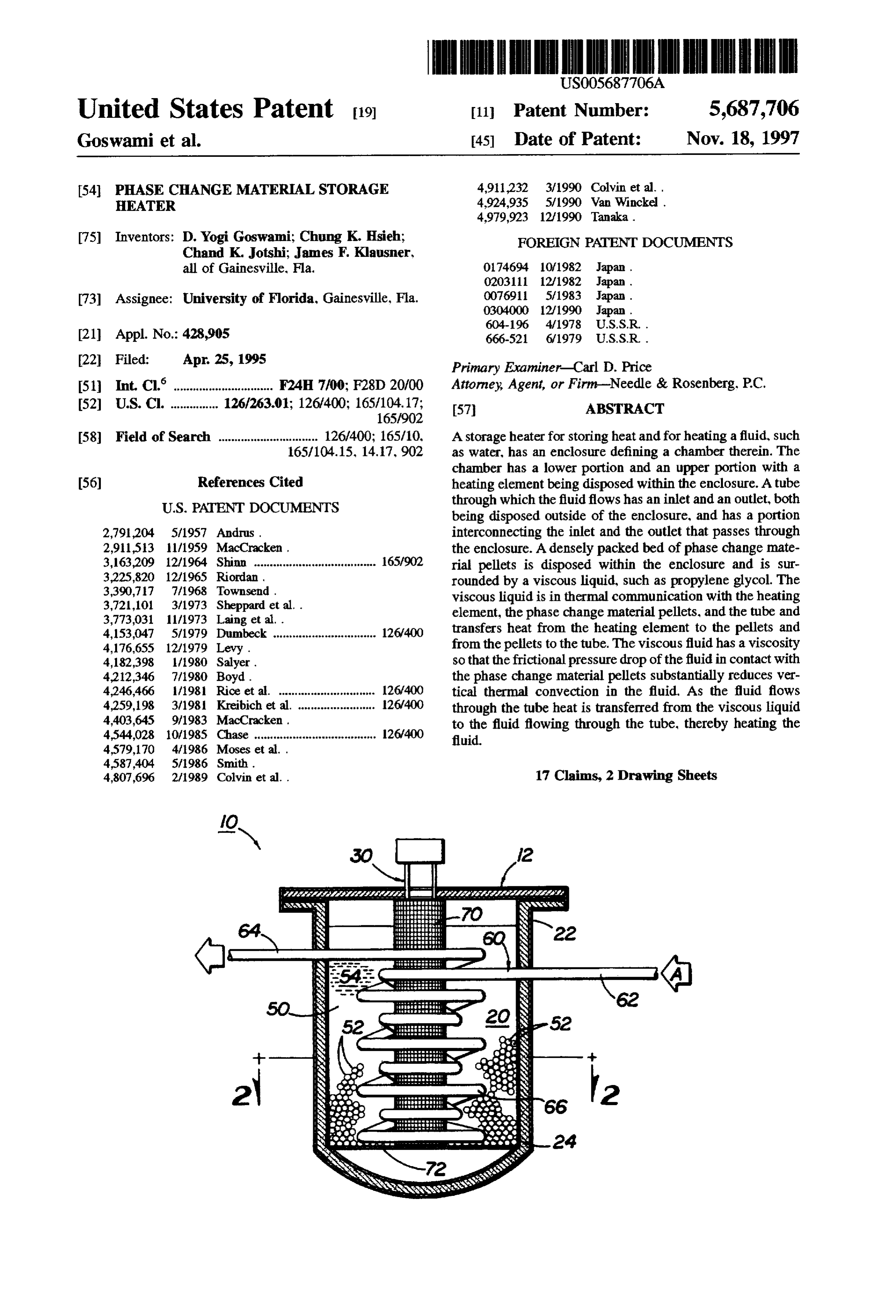
United States Patent 19 11 Patent Number: 5,687,706 Goswami et al. 45) Date of Patent: Nov. 18, 1997 (54) PHASE CHANGE MATERAL STORAGE 4,911,232 3/1990 Colvin et al., HEATER 4924,935 5/1990 Van Winckel.
75 Inventors: D. Yogi Goswami; Chung K. Hsieh; FOREIGN PATENT DOCUMENTS Chand K. Jotshi; James F. Klausner, all of Gainesville, Fla. 0174694 10/1982 Japan.
(73) Assignee: University of Florida, Gainesville, Fla. 0076911 5/1983 Japan.
21) Appl. No.: 428,905 666-521 6/1979 U.S.S.R. 22 Fed: Apr. 25, 1995 Primary Examiner-Carl D. Price 51 Int. Cl. ... F24H 7/00; F28D 20/00 Attorney; Agent, or Firm-Needle & Rosenberg, P.C. 52) U.S. Cl. ............... 126/263-01; 126/400; 165/104.17; 57 ABSTRACT
58) Field of Search ............................... 126/400; 165/10, A storage heater for storing heat and for heating a fluid, such 65/104.15, 14.7, 902 as water, has an enclosure defining a chamber therein. The chamber has a lower portion and an upper portion with a 56) References Cited heating element being disposed within the enclosure. A tube
being disposed outside of the enclosure, and has a portion 2,791,204 5/1957 Andrus. interconnecting the inlet and the outlet that passes through 2,911,513 11/1959 MacCracken, the enclosure. A densely packed bed of phase change mate 3,163,209 12/1964 Shinn ...................................... 165/902 rial pellets is disposed within the enclosure and is sur 3,225,820 12/1965 Riordan, rounded by a viscous liquid, such as propylene glycol. The 3,390,717 7/1968 Townsend. viscous liquid is in thermal communication with the heating 3,721.101 3/1973 Sheppard et al. . element, the phase change material pellets, and the tube and 3,773,031 11/1973 Laing et al. . transfers heat from the heating element to the pellets and 4,153,047 5/1979 Dumbeck ................................ 126/400 4,176,655 12/1979 Levy. from the pellets to the tube. The viscous fluid has a viscosity 4,182,398 1/1980 Salyer. so that the frictional pressure drop of the fluid in contact with 4.212,346 7/1980 Boyd. the phase change material pellets substantially reduces ver 4,246,466 1/1981 Rice et al. .............................. 26/400 tical thermal convection in the fluid. As the fluid flows 4,259,198 3/1981 Kreibich et al. ........................ 126/400 through the tube heat is transferred from the viscous liquid 4,403,645 9/1983 MacCracken. to the fluid flowing through the tube, thereby heating the 4,544,028 10/1985 Chase ...................................... 26/400 fluid.
4,807,696 2/1989 Colvin et al. . 17 Claims, 2 Drawing Sheets
Page 2
Drawing sheet — no readable text.
Page 3
Drawing sheet — no readable text.
Page 4
PHASE CHANGE MATERAL STORAGE together by a flange and insulated to form a thermal insu BEATER lation barrier. A hollow tube extends from an upper corner of the tank towards a diagonally opposite corner to a
BACKGROUND OF THE INVENTION compartment having perforated dividing walls. An electrical resistance heat source is included in this compartment.
1. Field of the Invention Water enters the compartment through a service water inlet The present invention relates generally to heat storage fitting. The hollow tube has a second tube therein with an devices, and in particular to electrically heated water heaters opening at its end through which heated service water may utilizing encapsulated phase change materials to store heat. be withdrawn through an outlet fitting. Heat storage material 2. Description of the Prior Art O such as barium hydroxide octahydrate is used in the tank. The heat storage material is packed in ball-shaped
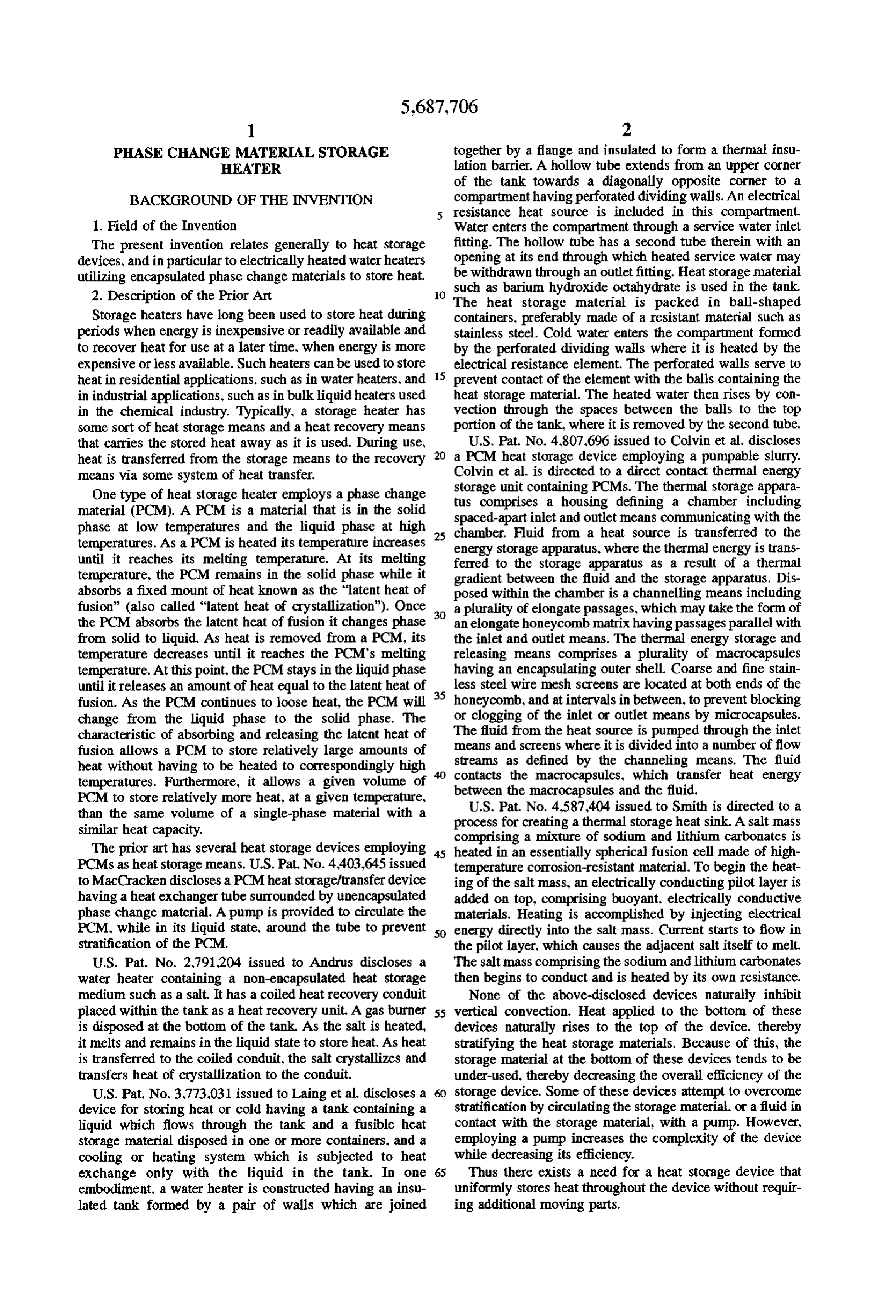
Storage heaters have long been used to store heat during containers, preferably made of a resistant material such as periods when energy is inexpensive or readily available and stainless steel. Cold water enters the compartment formed to recover heat for use at a later time, when energy is more by the perforated dividing walls where it is heated by the expensive or less available. Such heaters can be used to store electrical resistance element. The perforated walls serve to heat in residential applications, such as in water heaters, and 15 prevent contact of the element with the balls containing the in industrial applications, such as in bulk liquid heaters used heat storage material. The heated water then rises by con in the chemical industry. Typically, a storage heater has vection through the spaces between the balls to the top some sort of heat storage means and a heat recovery means portion of the tank, where it is removed by the second tube. that carries the stored heat away as it is used. During use, 20 U.S. Pat. No. 4,807,696 issued to Colvin et al. discloses heat is transferred from the storage means to the recovery a PCM heat storage device employing a pumpable slurry. means via some system of heat transfer. Colvin et al. is directed to a direct contact thermal energy One type of heat storage heater employs a phase change tus storage unit containing PCMs. The thermal storage appara material (PCM). A PCM is a material that is in the solid spaced-apart comprises a housing defining a chamber including phase at low temperatures and the liquid phase at high 25 chamber. Fluid inlet and outlet means communicating with the from a heat source is transferred to the temperatures. As a PCM is heated its temperature increases energy storage apparatus, where the thermal energy is trans until it reaches its melting temperature. At its melting ferred to the storage apparatus as a result of a thermal temperature, the PCM remains in the solid phase while it gradient between the fluid and the storage apparatus. Dis absorbs a fixed mount of heat known as the "latent heat of posed within the chamber is a channelling means including fusion" (also called "latent heat of crystallization"). Once 30 a plurality of elongate passages, which may take the form of the PCM absorbs the latent heat of fusion it changes phase an elongate honeycomb matrix having passages parallel with from solid to liquid. As heat is removed from a PCM. its the inlet and outlet means. The thermal energy storage and temperature decreases until it reaches the PCM's melting releasing means comprises a plurality of macrocapsules temperature. At this point, the PCM stays in the liquid phase having an encapsulating outer shell. Coarse and fine stain until it releases an amount of heat equal to the latent heat of less steel wire mesh screens are located at both ends of the fusion. As the PCM continues to loose heat, the PCM will 35 honeycomb, and at intervals in between, to prevent blocking change from the liquid phase to the solid phase. The or clogging of the inlet or outlet means by microcapsules. characteristic of absorbing and releasing the latent heat of The fluid from the heat source is pumped through the inlet means and screens where it is divided into a number of flow fusion allows a PCM to store relatively large amounts of streams as defined by the channeling means. The fluid heat without having to be heated to correspondingly high temperatures. Furthermore, it allows a given volume of contacts the macrocapsules, which transfer heat energy PCM to store relatively more heat, at a given temperature, between the macrocapsules and the fluid. U.S. Pat. No. 4587,404 issued to Smith is directed to a than the same volume of a single-phase material with a process for creating a thermal storage heat sink. A salt mass similar heat capacity. comprising a mixture of sodium and lithium carbonates is The prior art has several heat storage devices employing 45 heated in an essentially spherical fusion cell made of high PCMs as heat storage means. U.S. Pat. No. 4403.645 issued temperature corrosion-resistant material. To begin the heat to MacCracken discloses a PCM heat storage/transfer device ing of the salt mass, an electrically conducting pilot layer is having a heat exchanger tube surrounded by unencapsulated added on top. comprising buoyant, electrically conductive phase change material. A pump is provided to circulate the materials. Heating is accomplished by injecting electrical PCM, while in its liquid state, around the tube to prevent 50 energy directly into the salt mass. Current starts to flow in stratification of the PCM. the pilot layer, which causes the adjacent salt itself to melt. U.S. Pat. No. 2,791.204 issued to Andrus discloses a The salt mass comprising the sodium and lithium carbonates water heater containing a non-encapsulated heat storage then begins to conduct and is heated by its own resistance. medium such as a salt. It has a coiled heat recovery conduit None of the above-disclosed devices naturally inhibit placed within the tank as a heat recovery unit. A gas burner 55 vertical convection. Heat applied to the bottom of these is disposed at the bottom of the tank. As the salt is heated, devices naturally rises to the top of the device, thereby it melts and remains in the liquid state to store heat. As heat stratifying the heat storage materials. Because of this, the is transferred to the coiled conduit, the salt crystallizes and storage material at the bottom of these devices tends to be transfers heat of crystallization to the conduit. under-used, thereby decreasing the overall efficiency of the U.S. Pat. No. 3,773,031 issued to Laing et al. discloses a storage device. Some of these devices attempt to overcome device for storing heat or cold having a tank containing a stratification by circulating the storage material, or a fluid in liquid which flows through the tank and a fusible heat contact with the storage material, with a pump. However, storage material disposed in one or more containers, and a employing a pump increases the complexity of the device cooling or heating system which is subjected to heat while decreasing its efficiency.
exchange only with the liquid in the tank. In one 65 Thus there exists a need for a heat storage device that embodiment, a water heater is constructed having an insu uniformly stores heat throughout the device without requir lated tank formed by a pair of walls which are joined ing additional moving parts.
Page 5
SUMMARY OF THE INVENTION In the preferred embodiment, the invention is a storage The present invention is a storage heater for storing heat water heater that comprises an enclosure filled with pellets for later use in heating a fluid. It comprises an enclosure, made of cross-linked high density polyethylene (HDPE). having a lower portion and an upper portion. A heating (The cross-linking process involves exposing the pellets to element, disposed within the enclosure, adds heat to the a source of neutrons, thereby making the form of the HDPE enclosure. A densely packed bed of PCM pellets disposed pellets stable so that on melting, the pellets retain their within the enclosure stores the heat, and a tube, which passes shape.) The average diameter of the pellets is at least 5x10 through the densely packed bed of PCM pellets, recovers meters and the concentration of the pellets in the bed is at heat from the densely packed bed of PCM pellets and least 40% (67% preferably) by volume of the bed. The transfers heat to the fluid being heated. A viscous liquid O pellets are surrounded by a viscous fluid, such as propylene surrounding the PCM pellets, in thermal communication glycol. Other viscous fluids, having a high viscosity and a with the heating element, the PCM pellets, and the tube, high heat characteristic may be employed. An electrical transfers heat from the heating element to the pellets, while heating unit extending down through the central axis of the in the heat storing mode, and from the pellets to the tube, water heater is used to add heat to the system. A mesh, or while in the heat recovery mode. 15 other screen, surrounding the heating unit prevents contact The heating element is a variable heat flux heating ele by the PCM elements with the heating unit. A coiled water ment capable of transferring heat to the lower portion of the tube extends helically down and back up through the PCMs enclosure at a greater rate than the rate at which it transfers in the enclosure for removing heat from the system thereby heat to the upper portion of the enclosure and may comprise heating the water.
an electrical heating dement. The heating element has a It is an object of the present invention to employ PCM vertically disposed first member having a distal end and a pellets in a storage heater that uniformly heats all of the second member extending about a portion of the first mem ber adjacent the distal end. The lower potion produces more pellets.
heat per unit length than the vertical portion so that more It is a further object of the present invention to reduce heat is produced in the lower portion of the enclosure than 25 vertical convection in a PCM storage heater. in the upper portion of the enclosure. It is a further object of the present invention to reduce The tube through which the fluid to be heated flows has stratification in a PCM storage heater without employing a an inlet and an outlet disposed outside of the enclosure. An pump.
intermediate potion of the tube, interconnecting the inlet and These and other objects will become apparent from the the outlet, passes through the enclosure so that as the fluid 30 following description of the preferred embodiment taken in flows through the tube, heat is transferred from the viscous conjunction with the following drawings, although varia liquid to the fluid flowing through the tube. The tube also tions and modifications may be effected without departing comprises a coil disposed within the enclosure and around from the spirit and scope of the novel concepts of the the heating element. disclosure.
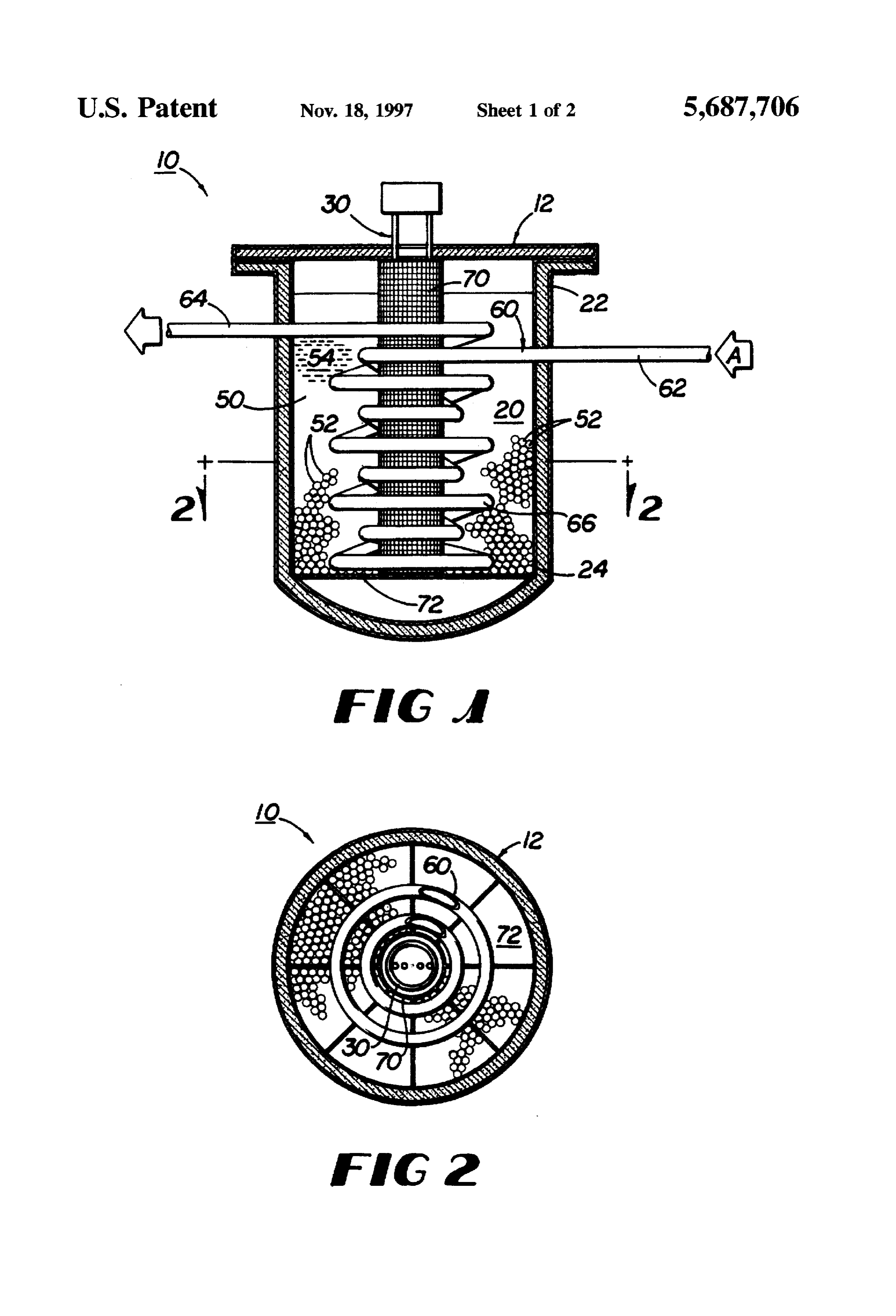
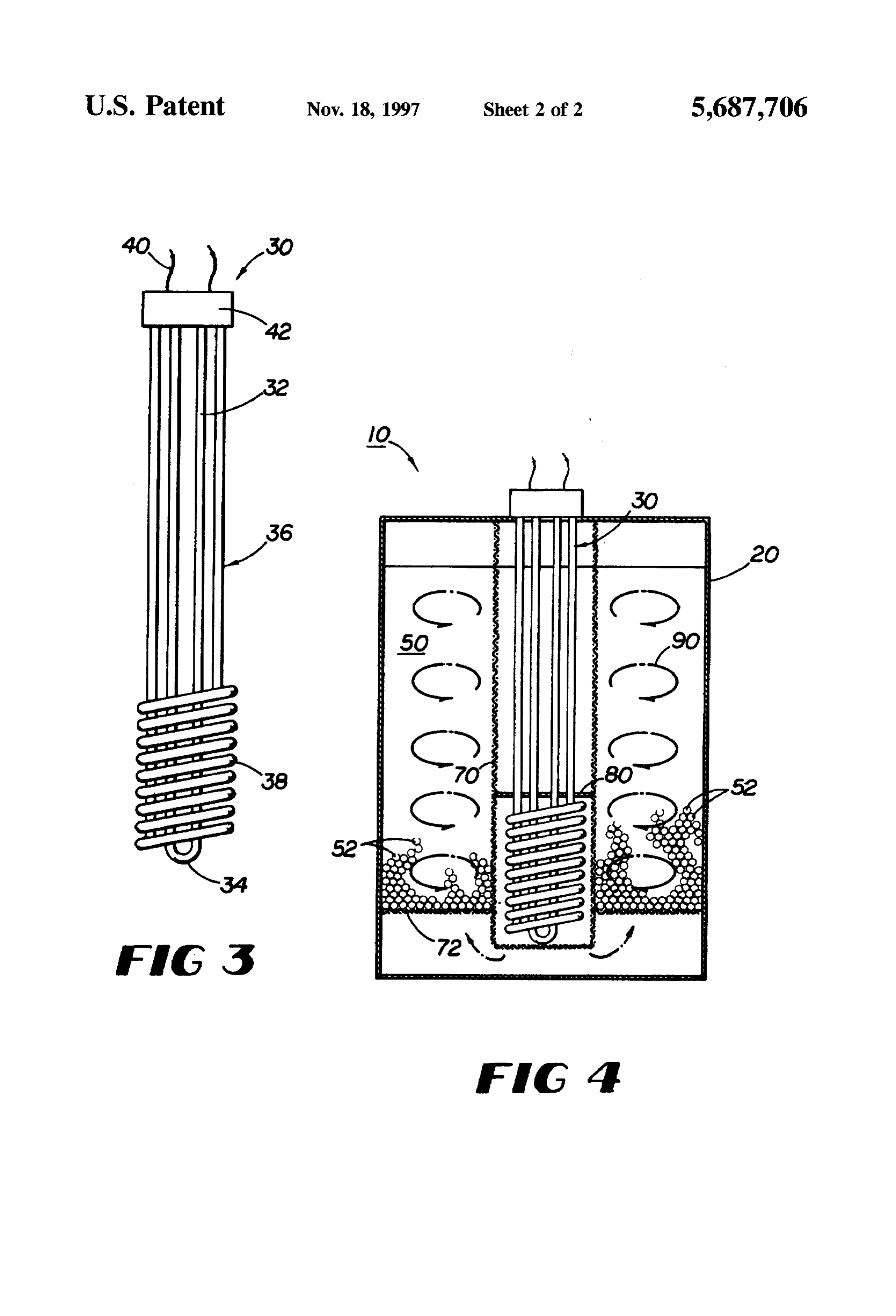
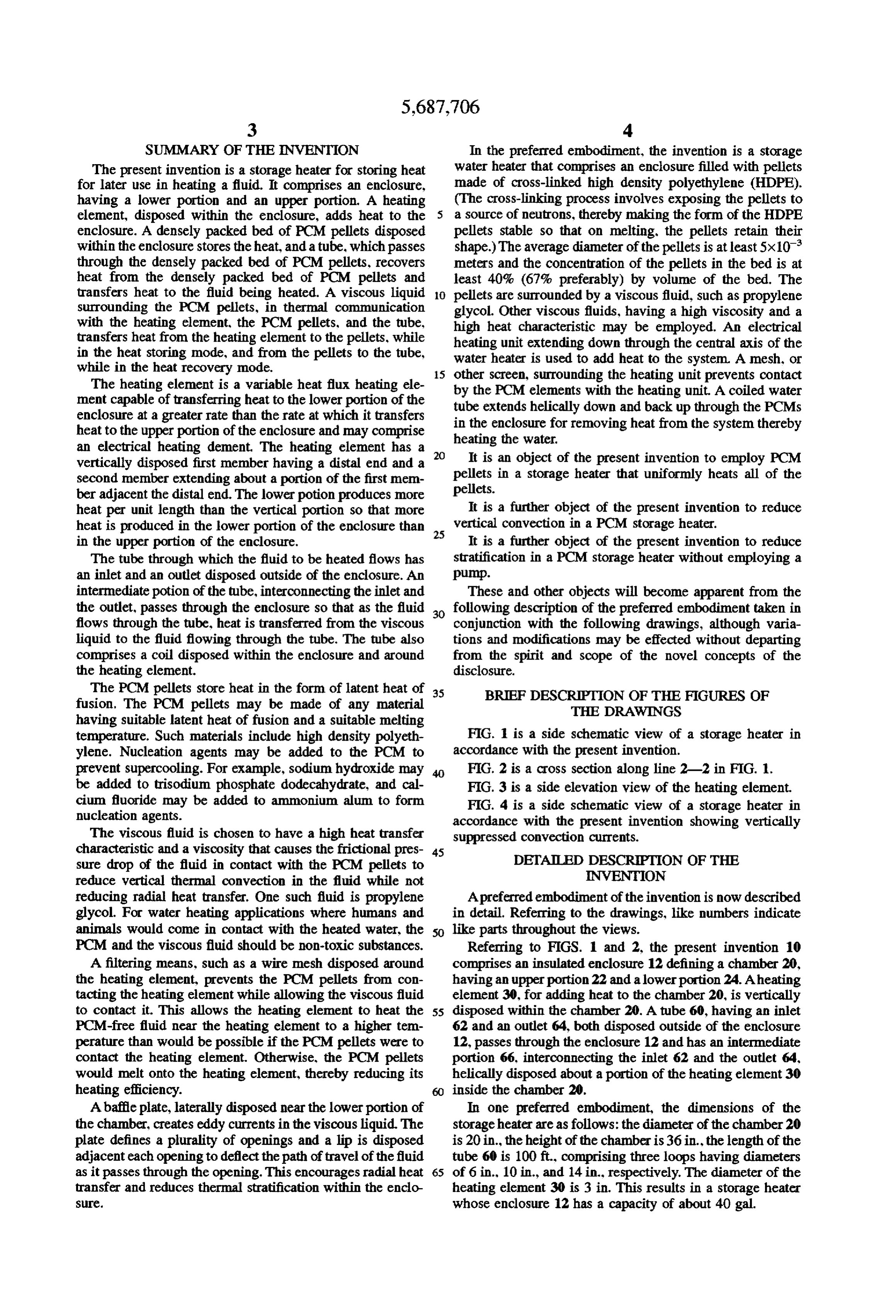
The PCM pellets store heat in the form of latent heat of 35 BRIEF DESCRIPTION OF THE FIGURES OF fusion, The PCM pellets may be made of any material THE DRAWINGS having suitable latent heat of fusion and a suitable melting temperature. Such materials include high density polyeth FIG. 1 is a side schematic view of a storage heater in ylene. Nucleation agents may be added to the PCM to accordance with the present invention. prevent supercooling. For example, sodium hydroxide may FIG. 2 is a cross section along line 2-2 in FIG. 1. be added to trisodium phosphate dodecahydrate, and cal FIG. 3 is a side elevation view of the heating element. cium fluoride may be added to ammonium alum to form FIG. 4 is a side schematic view of a storage heater in nucleation agents. accordance with the present invention showing vertically The viscous fluid is chosen to have a high heat transfer suppressed convection currents.
characteristic and a viscosity that causes the frictional pres 45 DETALED DESCRIPTION OF THE sure drop of the fluid in contact with the PCM pellets to INVENTION reduce vertical thermal convection in the fluid while not reducing radial heat transfer. One such fluid is propylene A preferred embodiment of the invention is now described glycol. For water heating applications where humans and in detail. Referring to the drawings, like numbers indicate animals would come in contact with the heated water, the 50 like parts throughout the views.
PCM and the viscous fluid should be non-toxic substances. Referring to FIGS. 1 and 2, the present invention 10 A filtering means, such as a wire mesh disposed around comprises an insulated enclosure 12 defining a chamber 20, the heating element, prevents the PCM pellets from con having an upper portion 22 and a lower portion 24. Aheating tacting the heating element while allowing the viscous fluid element 30, for adding heat to the chamber 20, is vertically to contact it. This allows the heating element to heat the 55 disposed within the chamber 20. A tube 60, having an inlet PCM-free fluid near the heating element to a higher tem 62 and an outlet 64, both disposed outside of the enclosure perature than would be possible if the PCM pellets were to 12, passes through the enclosure 12 and has an intermediate contact the heating element. Otherwise, the PCM pellets portion 66, interconnecting the inlet 62 and the outlet 64. would melt onto the heating element, thereby reducing its helically disposed about a portion of the heating element 30 heating efficiency. inside the chamber 20.
Abaffle plate, laterally disposed near the lower portion of In one preferred embodiment, the dimensions of the the chamber, creates eddy currents in the viscous liquid. The storage heater are as follows: the diameter of the chamber 20 plate defines a plurality of openings and a lip is disposed is 20 in., the height of the chamber is 36 in... the length of the adjacent each opening to deflect the path of travel of the fluid tube 60 is 100 ft., comprising three loops having diameters as it passes through the opening. This encourages radial heat 65 of 6 in., 10 in., and 14 in... respectively. The diameter of the transfer and reduces thermal stratification within the enclo heating element 30 is 3 in. This results in a storage heater Se whose enclosure 12 has a capacity of about 40 gal.
Page 6
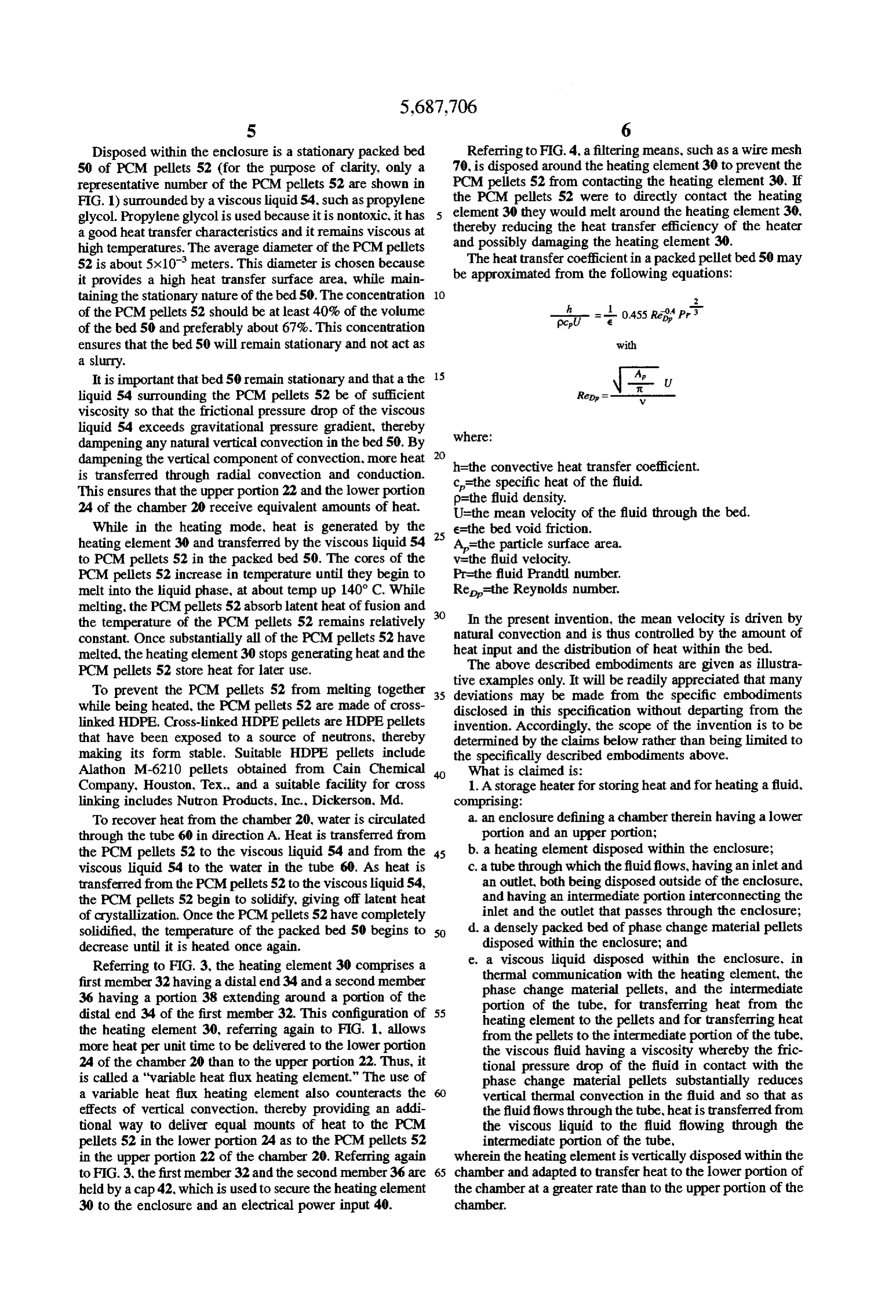
Disposed within the enclosure is a stationary packed bed Referring to FIG. 4, a filtering means, such as a wire mesh 50 of PCM pellets 52 (for the purpose of clarity, only a 70, is disposed around the heating element 30 to prevent the representative number of the PCM pellets 52 are shown in PCM pellets 52 from contacting the heating element 30. If FIG. 1) surrounded by a viscous liquid 54, such as propylene the PCM pellets 52 were to directly contact the heating glycol. Propylene glycol is used because it is nontoxic, it has element 30 they would melt around the heating element 30, a good heat transfer characteristics and it remains viscous at thereby reducing the heat transfer efficiency of the heater high temperatures. The average diameter of the PCM pellets and possibly damaging the heating element 30. 52 is about 5x10 meters. This diameter is chosen because The heat transfer coefficientin a packed pellet bed 50 may it provides a high heat transfer surface area, while main be approximated from the following equations: taining the stationary nature of the bed S0. The concentration 10 2 of the PCM pellets 52 should be at least 40% of the volume A- = 0.4 p. 3 of the bed 50 and preferably about 67%. This concentration rig = 0455 Re5 Pr ensures that the bed 50 will remain stationary and not act as with a slurry.
It is important that bed 50 remain stationary and that a the 15 Ap U liquid 54 surrounding the PCM pellets 52 be of sufficient Rep. = w viscosity so that the frictional pressure drop of the viscous liquid 54 exceeds gravitational pressure gradient, thereby where:
dampening any natural vertical convection in the bed 50. By dampening the vertical component of convection, more heat is transferred through radial convection and conduction. h=the c=the convective heat transfer coefficient.
specific heat of the fluid.
This ensures that the upper portion 22 and the lower portion p=the fluid density.
24 of the chamber 20 receive equivalent amounts of heat. U=the mean velocity of the fluid through the bed. While in the heating mode, heat is generated by the e=the bed void friction.
heating element 30 and transferred by the viscous liquid 54 25 A=the particle surface area.
to PCM pellets 52 in the packed bed 50. The cores of the v=the fluid velocity.
PCM pellets 52 increase in temperature until they begin to Pr=the fluid Prandtl number.
melt into the liquid phase, at about temp up 140° C. While Re=the Reynolds number.
melting, the PCM pellets 52 absorb latent heat of fusion and the temperature of the PCM pellets 52 remains relatively 30 In the present invention, the mean velocity is driven by constant. Once substantially all of the PCM pellets 52 have natural convection and is thus controlled by the amount of melted, the heating element 30 stops generating heat and the heat input and the distribution of heat within the bed. PCM pellets 52 store heat for later use. The above described embodiments are given as illustra tive
To prevent the PCM pellets 52 from melting together 35 deviations examples only. It will be readily appreciated that many while being heated, the PCM pellets 52 are made of cross disclosed inmay be made from the specific embodiments this specification without departing from the linked HDPE, Cross-linked HDPE pellets are HDPE pellets invention. Accordingly, the scope of the invention is to be that have been exposed to a source of neutrons, thereby determined by the claims below rather than being limited to making its form stable. Suitable HDPE pellets include the specifically described embodiments above.
Alathon M-6210 pellets obtained from Cain Chemical What is claimed is:
Company, Houston, Tex... and a suitable facility for cross 1. A storage heater for storing heat and for heating a fluid, linking includes Nutron Products, Inc., Dickerson. Md. comprising:
To recover heat from the chamber 20, water is circulated a. an enclosure defining a chamber therein having a lower through the tube 60 in direction A. Heat is transferred from portion and an upper portion; the PCM pellets 52 to the viscous liquid 54 and from the 45 b. a heating element disposed within the enclosure; viscous liquid 54 to the water in the tube 60. As heat is c. a tube through which the fluid flows, having an inlet and transferred from the PCMpellets 52 to the viscous liquid 54, an outlet, both being disposed outside of the enclosure, the PCM pellets 52 begin to solidify, giving off latent heat and having an intermediate portion interconnecting the of crystallization. Once the PCM pellets 52 have completely inlet and the outlet that passes through the enclosure; solidified, the temperature of the packed bed 50 begins to 50 d. a densely packed bed of phase change material pellets decrease until it is heated once again. disposed within the enclosure; and Referring to FIG. 3, the heating element 30 comprises a e. a viscous liquid disposed within the enclosure, in first member 32 having a distal end 34 and a second member thermal communication with the heating element, the 36 having a portion 38 extending around a portion of the phase change material pellets, and the intermediate distal end 34 of the first member 32. This configuration of 55 portion of the tube, for transferring heat from the the heating element 30, referring again to FIG. 1, allows heating element to the pellets and for transferring heat more heat per unit time to be delivered to the lower portion from the pellets to the intermediate portion of the tube.
the viscous fluid having a viscosity whereby the fric 24 of the chamber 20 than to the upper portion 22. Thus, it tional pressure drop of the fluid in contact with the is called a "variable heat flux heating element." The use of phase change material pellets substantially reduces a variable heat flux heating element also counteracts the vertical thermal convection in the fluid and so that as effects of vertical convection, thereby providing an addi the fluid flows through the tube, heat is transferred from tional way to deliver equal mounts of heat to the PCM the viscous liquid to the fluid flowing through the pellets 52 in the lower portion 24 as to the PCM pellets 52 intermediate portion of the tube, in the upper portion 22 of the chamber 20. Referring again wherein the heating element is vertically disposed within the to FIG. 3, the first member 32 and the second member 36 are 65 chamber and adapted to transfer heat to the lower portion of held by a cap 42, which is used to secure the heating element the chamber at a greater rate than to the upper portion of the 30 to the enclosure and an electrical power input 40. chamber.
Page 7
2. The storage heater of claim 1 further comprising means b. a heating element disposed vertically within the disposed in the chamber for creating eddy currents in the chamber, comprising an elongated member having a viscous liquid, thereby reducing thermal stratification within top end and an opposite bottom end and adapted to the enclosure. produce a greater heat flux from the bottom end than 3. The storage heater of claim 2 wherein the means for 5 from the top end;
creating eddy currents comprises a plate laterally disposed in the lower portion of the chamber, the plate defining a c. aheat recovery tube, through which waterflows, having plurality of openings passing therethrough and means dis and inlet and an outlet, both being disposed outside of posed adjacent each opening to deflect the path of travel of the enclosure, and an intermediate portion intercon the fluid as it passes through the opening. necting the inlet and the outlet, the intermediate portion 4. The storage heater of claim 1, wherein the heating passing through the chamber;
element comprises: d. a packed bed of phase change material pellets disposed a. a vertically disposed first member having a distal end; within the chamber;
and b. a second member extending about a portion of the first 15 e. a viscous liquid disposed within the chamber, in ther member adjacent the distal end. mal communication with the heating element, the phase 5. The storage heater of claim 1 further comprising change material pellets, and the intermediate portion of filtering means disposed about at least a portion of the the tube, for transferring heat from the heating element heating element for preventing the phase change material to the pellets and for transferring heat from the pellets pellets from contacting the heating element while allowing 20 to the tube, so that as water flows through the tube heat the viscous fluid to pass therethrough to contact the heating is transferred from the viscous liquid to the water; the element, viscous fluid having a viscosity so that the frictional 6. The storage heater of claim 5, wherein the filtering pressure drop of the fluid in contact with the phase means comprises a wire mesh. change material pellets substantially reduces vertical 7. The storage heater of claim 1, wherein the intermediate 25 thermal convection in the fluid portion of the tube comprises a coil disposed around at least f. a plate laterally disposed near the lower portion of the a portion of the heating element. chamber for creating eddy currents in the viscous 8. The storage heater of claim 7, wherein the tube is liquid, thereby enhancing radial heat transfer and helically disposed around the heating element. reducing thermal stratification within the chamber; and 9. The storage heater of claim 1, wherein the phase change g. a wire mesh, disposed around the heating element, material pellets comprise cross-linked high density polyeth ylene. which allows the viscous liquid to pass through the 10. The storage heater of claim 1, wherein the densely mesh and contact the heating element and which pre packed bed comprises more than 40% phase change material 35 vents the phase change material pellets from contacting by volume of the bed. the heating element.
11. The storage heater of claim 10, wherein the densely 15. The storage heater of claim 14, wherein the heat packed bed comprises about 67% phase change material by recovery tube comprises a coil passing through the chamber, volume of the bed. helically disposed around the heating element. 12. The storage heater of claim 1, wherein the viscous 40 16. The storage heater of claim 15, wherein the phase fluid is propylene glycol. change material pellets comprise cross-linked high density 13. The storage heater of claim 1, wherein the average polyethylene.
diameter of the pellets is at least 5x10 meters. 17. The storage heater of claim 15, wherein the viscous 14. A storage heater for heating water, comprising: liquid comprises propylene glycol.
a. an insulated enclosure defining a chamber therein having an upper portion and a lower portion; k . . . .
Provenance
- Collection
- Cited prior art
- Original PDF
- patentimages.storage.googleapis.com →
- Filed
- 1995-04-25
- Pages
- 7
- Method
- pdftotext (the PDF's own text layer) + pdftoppm 300dpi page scans
- Source
- Google Patents bibliographic record
- Granted
- 1997-11-18
- Inventors
- D. Yogi Goswami; Chung K. Hsieh; Chand K. Jotshi; James F. Klausner; University of Florida
- Transcribed from
- patentimages.storage.googleapis.com →