patent · US4153047
Heat storage systems
8 May 1979
Page 1 — bibliographic record
United States Patent (19) 11) 4,153,047 Dumbeck (45) May 8, 1979 (54) HEAT STORAGE SYSTEMS Assistant Examiner-Larry I. Schwartz Attorney, Agent, or Firm-Laurence R. Brown 76) Inventor: Robert F. Dumbeck, 104 Anderson 57 ABSTRACT
(21) Appl. No.: 815,550 The present invention provides systems for transfer of heat such as useful in solar energy systems. A heat stor (22 Filed: Jul. 13, 1977 age medium is used, preferably salt conditioned by anti 51) Int. C.’............................................... F24H 7/04 caking anti-corrosive treatment whereby hydrated salts 52) U.S.C. .................................... 126/400; 126/270; have increased utility by remaining granular during 126/271 severe temperature and humidity changes, permitting 58 Field of Search ......................... 252/70, 383,384; the salt to be used more effectively as a heat storage and 427/215; 126/270, 271, 400; 165/104 S exchange medium. The heat storage medium is coated
with a heat transfer liquid preferably silicone oil which functions to preserve salt, prevent rust and corrosion
2,955,956 10/1960 Baugh et al. ......................... 427/215 medium between the heat storage medium and transfer 3,600,326 8/1971 Wilcox et al. ........................ 252/383 means such as heat coils. A solar heat system comprises 3,963,627 6/1976 Cottrell ................................ 428/405 a solar energy concentrator, a heat input system to a 3,997,001 12/1976 Chubb .................................. 126/400 granular particle storage medium, and a heat output 4,033,130 7/1977 Hermans. ... 165/104 S system extracting heat from the storage medium. 4,037,579 7/1977 Chubb .................................. 126/400
Primary Examiner-John J. Camby 25 Claims, 2 Drawing Figures
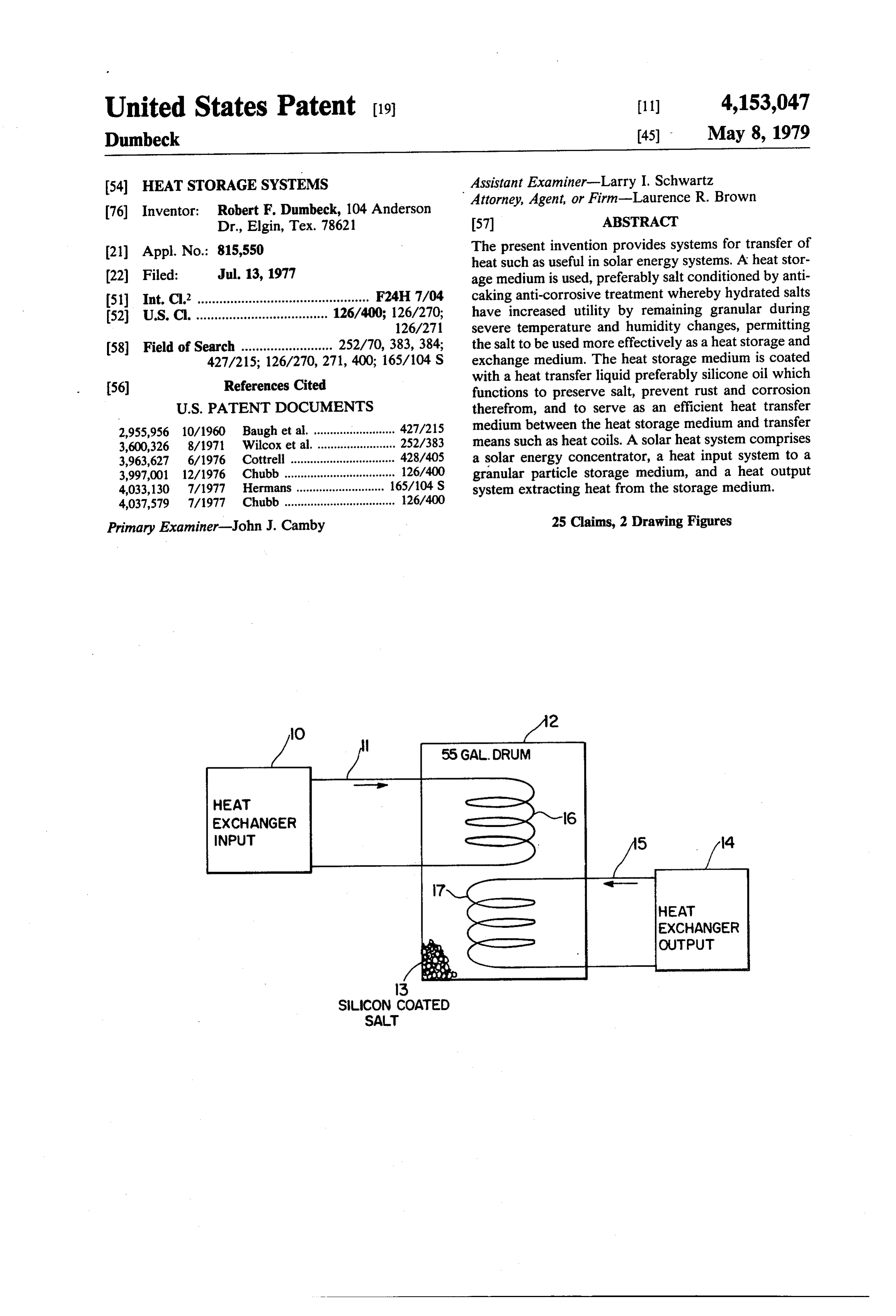
HEAT
EXCHANGER
INPUT
HEAT
EXCHANGER
OUTPUT
SLICON COATED
SALT
Page 2
Drawing sheet — no readable text.
Page 3
container the amount of surface presented to the trans
HEAT STORAGESYSTEMS fermedium is critical as well as the nature of the parti cle-to-particle contact if that be the transfer medium.
FIELD OF THE INVENTION By very nature the retention of heat in a storage The present invention relates to heat storage systems 5 medium detracts from its physical properties in effi and methods of heat storage and transfer. ciently receiving and giving up the stored heat. Thus, in heat system construction it has been difficult to provide
BACKGROUND OF THE INVENTION both high capacity heat storage capabilities and high In heat storage systems it is a requirement to take heat efficiency operation in transfer of heat into and out of from one source, transfer it to a storage medium and 10 the storage medium. This problem is particularly accen then derive the heat when required from storage. Poor tuated when low cost heat storage materials are dictated efficiency in energy storage and transfer has caused in a system, such as sand or salt.
many systems to be marginal in performance or inopera It has now been found that by practice of the present tive. Some of the most pronounced deficiencies are in invention, many difficulties and disadvantages of prior the nature of the storage medium and the transfer mech 15 art attempts to produce efficient heat storage and trans anism for getting heat in or out of the storage medium. fer systems have been overcome in a simple highly Wherever a media interface occurs or a system interface efficient manner.
there is a boundary matching problem to overcome. SUMMARY OF THE INVENTION Thus, for example, transfer of heat from a liquid such as The present invention, generally stated, provides hot water to a gas such as air produces an interface 20 where the amount of heat transfer is critical to the heat improved methods and systems for heat storage and ing efficiency of the two systems or in the ultimate transfer by means of specialty processing of selected media. materials and providing efficient heat transfer interfac Similarly efficiency and transfer problems exist in the ing. Thus, granular materials such as sand or salt are storage of heat. Hot water may be used as storage me 25 stored for example in 55 gallon drums as a heat storage dium, but it is temperature limited since it becomes medium providing a large surface area and excellent steam at boiling temperature. Solids with good heat heat storage characteristics. The materails are wetted retention characteristics can be used as storage media. by a liquid, preferably silicone oil, to provide efficient Salts such as common sodium chloride table salt thus heat transfer interfacing into, out of and between the might be used. 30 heat storage materials.
One serious problem that is often met in handling In a typical embodiment of the invention, solar heat is hydrated salt products is the tendency of the salt parti transferred at high temperatures in the order of at least 150 C. (above water boiling temperature) by an appro cles to cake or bind together. This is often troublesome priate lens into a circulating piped system of preferably in bulk storage or in barrelled products but is most 35 serious in those cases where salt crystals are disposed in silicone oil heat transfer media which enters the storage packages or in systems where a humid gaseous stream thereinto. drum for heating the storage materials by heat transfer flows through the particles. The difficulty is particu Retained heat is then transferred to a heat larly serious in changing both the physical surface area user such as a home heating system by a similar circulat afforded by granules and the physical relationship of the ing piped system which derives heat stored in the mate salt with water. 40 rials. By wetting the storage materials more stroage Remedies to prevent caking have met with little suc capacity and out of heat transfer efficiency is attained both into storage. If granular salt is used as a preferred cess in the prior art, perhaps because of restrictions of the nature of impurities that may be involved. For ex heat storage medium then the wetting serves to inhibit ample, table salt has been dusted with magnesia or tri corrosion and prevent caking from humidity or mois calcium phosphate to prevent caking. Also, flake grade 45 ture. If sand, another preferred heat storage medium, is calcium chloride has been dusted with anahydrous cal used, it is prevented from packing and is retained in cium chloride in an attempt to prevent caking, all with good physical contact with heat exchangers by the wetting agent.
limited success.
Also, caking has been partly prevented by dusting the OBJECTS OF THE INVENTION crystals with powdery material by prior art methods, 50 A general object of the invention is to provide im again with limited results.
Another serious problem with such salt products is proved heat storage systems resolving one or more deficiencies of the prior art such as those aforesaid.
their corrosiveness. They will tend to rust or pit metals Another object is to use effectively granular materials and cannot be stored in or used around steel or iron in particular. 55 in heat storage systems.
Whenever salts take on moisture and go into solution Yet another object is to produce more efficient trans the corrosiveness spreads, creeps and contaminates fer of heat between system interfaces. surrounding areas. It is one object of the present invention to provide These properties have limited use and storage of the new anti-caking salt compositions. salt products in favor of substitute materials when avail 60 ple,It isefficient also an object of this invention to provide a sim and practical method for preparation of able. salt particles which resist caking by being encased in a Other solid heat storage materials such as stones or protective fluid film.
sand present interface problems and tend to settle or It is also an object of this invention to provide anti pack. The ability to effectively use available heat by 65 caking salt particles for utilities where prior usage has appropriate transfer into the heat media is limited not been restricted because of particle caking. only by the material heat storage properties but the One specific object of this invention is to use salt nature of the heat transfer interface. Thus with stones or other granular particles packed together in a storage paticles as a heat storage and transfer medium.
Page 4
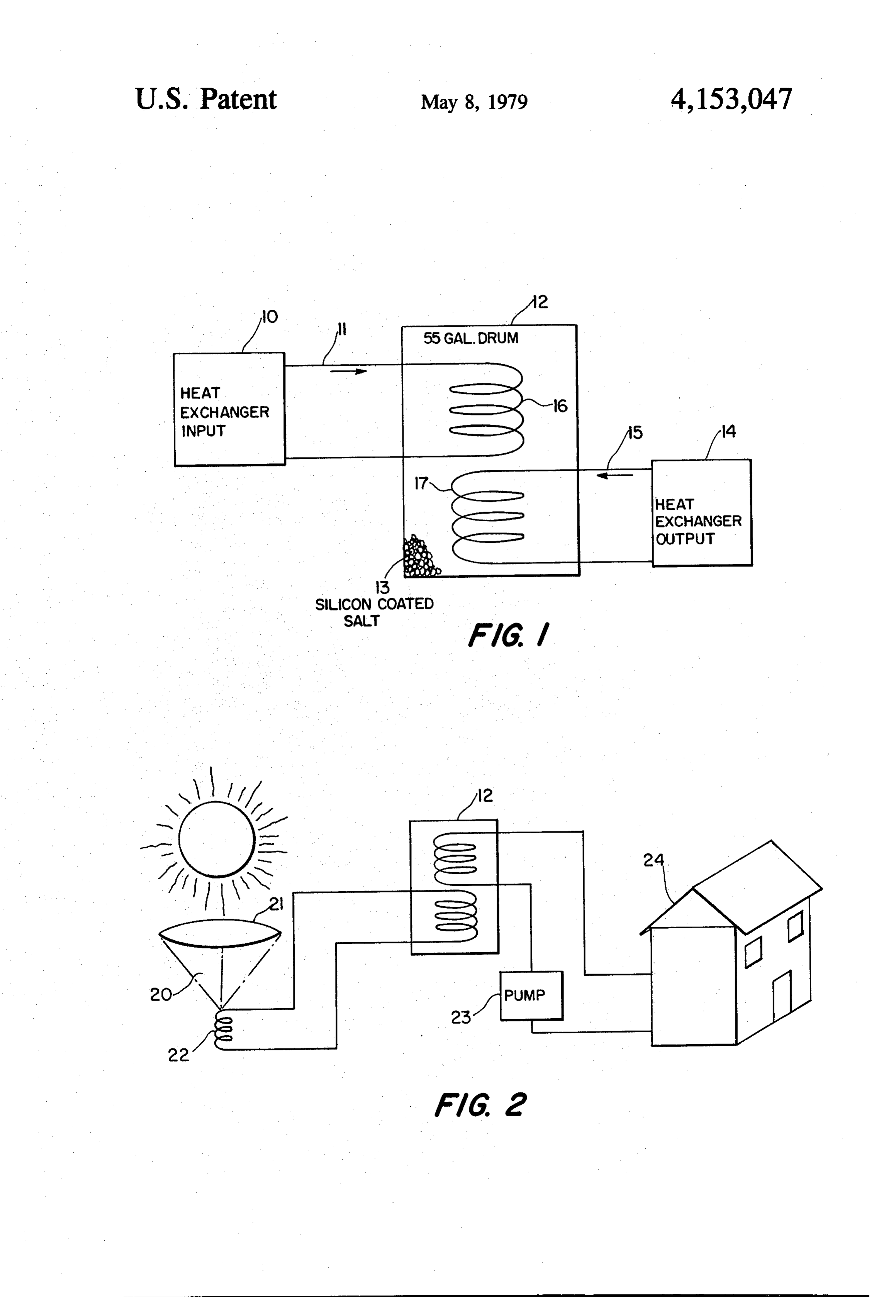
Another specific object of this invention is to process various possible storage materials have differing charac salt particles so that they may be stored for example in teristics. If used in a well known standard container steel drums without inducing corrosion thereof. such as a 55 gallon steel drum, the granular materials are THE DRAWING easy to handle and give good packing volume and stor These and other objects and advantages will become all age potential provided the heat can be transferred into more apparent from the following more detailed de tionparticles and removed. This is an inefficient opera scription of preferred embodiments of the present in eitherwith an air contact medium for thermal exchange, used directly or indirectly. Air is a poor heat vention, and the accompanying drawing, wherein... exchanger. Also if circulated through a granule pile, the FIG. 1 is a schematic diagram of a heat transfer sys 10 variations and effect of humidity is pronounced. It, tem embodying the invention, and however, does reach through gaps and covers a large FIG. 2 is a schematic diagram of a solar heat system surface area.
embodying the invention. It has been found in accordance with this invention DETAILED DESCRIPTION OF THE 15 that liquid in wetted contact with granules is a preferred INVENTION thermal exchange medium that efficiently and effec
The environment for the material combinations pro tively face reaches most granules over very large total sur area for transfer in and out of heat.
posed by this invention and the heat storage system It has also been found in accordance with this inven aspects of the invention are referenced to the drawing, where FIG. 1 is a general heat transfer system environ 20 tion that silicone oil is a preferred liquid, because of a ment. Thus, an input heat exchange unit 10, which combination of features. It is non-corrosive. It is an might be a furnace, solar system, heat pump, etc., pro excellent heat transfer medium. It creeps and covers vides in the piping 11 carrying a circulating heat ex uniformly all exposed surfaces. Thus, one or two quarts change medium at a temperature entering 55 gallon (208 (0.95 or 1.9 liters) of silicone oil can be put into a 55 liter) steel drum 12 higher than that attained by the 25 gallon drum either before or after filling with a granular granular storage materials 13 within the drum. Note material, preferably sand or salt, and then it will creep that heat transfer is reversible and as a cooling system, to surface cover all granules and the inside metal sur the heat input system 10 could be a well or refrigerator faces and even creep out cracks in the lid, etc. if not unit. hermetically sealed. This provides a thin protective Output heat from the storage system is directed to 30 covering for steel preventing corrosion, and for salt as external heat exchanger unit 14 by a similar piping sys described herein in other places.
tem 15. Inside the drum 12 are heat exchanger surfaces By this means all the foregoing desired criteria are represented by coils, 16, 17 respectively. realized by inexpensive, common materials to effec In the use of this system critical factors are (a) the tively and efficiently improve heat storage systems at physical characteristics of the storage medium and (b) 35 the most critical prior art areas of deficiency. It is clear the efficiency of transfer of heat into and out of the that the silicone wetted coils 16, 17 effectively exchange storage medium. heat into and out of storage drum 12 which has very In the fomer respect, the preferred storage material high storage capacity for long periods at very high embodiment is one that has the following set of proper temperatures above the boiling temperature (100' C.) of ties: Water.
1. Holds high quantities of latent heat in a form that A practical solar system using these characteristics is can be entered and withdrawn easily. shown in FIG. 2. Thus, the sun's rays 20 are focussed by 2. Inexpensive. lens 21 onto a heat exchange unit shown as coils 22 3. Non-corrosive. through which is circulated silicon oil as a heat transfer 4. Non-deteriorable. 45 medium. Thus, the temperature of circulating fluid may, 5. Easy to handle. for example, conveniently be in the order of more than 6. Adaptable to size and shape. 150 C., whereas water would turn to steam. 7. Keep size and shape over life. The heat storage medium container 12 is physically 8. Small in volume relative to heat storage capacili above the coils 22 to provide a thermal syphon effect. ties. 50 Thus as long as the coil 22 temperature is higher than 9. Provide large effective surface contact areas for that stored in drum 12, the liquid will rise and circulate interfacing. with the liquid cooled off by heat transfer into the stor In order to comply with these material properties, age medium then falling and returning to the solar heat granular substances are preferred. Sand, for example, source. The heat is stored until demand, effected by can be efficient in volume and meets most of the above 55 starting pump 23, which withdraws stored heat for criteria. It, however, does not easily respond to the heating house 24, for example.
efficient transfer to heat in and out because it is difficult Therefore, the combination of the use of the various to reach and transfer heat to all the salt particles features provides a heat storage and transfer system quickly. Also, it tends to deteriorate by packing and with considerable advantage in materials, cost, effi reducing effective surface areas. ciency, low maintenance and low operating costs. Fur Ordinary NaCl rock or table salt is a preferable thermore, an improved and synergistic effect results in material for heat storage capability. However, it is diffi the combination of the various features of use of granu cult to handle, will tend to corrode metals and particu lar materials, with high heat storage capabilities, wetted larly iron, and will deteriorate in the presence of humid by a liquid and in an efficient heat exchange relationship ity and moisture. Glauber's salt has some of these same 65 with thermal sources by means of the wetting medium. advantages and disadvantages. Added low life maintenance is achieved, low heat Relevant to the second above criterion, namely the pumping costs into the storage medium, simple and efficiency of heat transfer in and out of the medium, the inexpensive materials and systems components, etc.
Page 5
The silicon coating uniformly covers all exposed areas which would require greater care in spraying or granular surfaces, stays uniformly wet and does not tumbling.
drain off granular materials and need only comprise Silicone solutions of various types may be used to about 1% of the volume of the container with granular coat the salt particles by practice of the present inven materials, i.e., one to two quarts of silicone oil per 55 5 tion and such are commercially available in the art. One gallon drum of sand or salt. - suitable silicone composition is a blend of about 70 to 98 Other examples and embodiments are found in the percent by weight petroleum oil carrier having a viscos following description. ity of about 20 to 300 SSU at 50 C., and from about 2 to 30 percent by weight of silicone. The amount of the
Practice of the present invention provides an effec 10 organosiloxane tive means by which to limit caking of salt particles and copolymer in the mixture need only be sufficient to corrosive properties thereof, thereby to extend the cles. Hence, although effect the desired coating of the salt parti usage of such particles to areas where prior attempted a range up to 30 percent by usage was impractical. weight is suitable, a range of from about 2 to about 10 percent by weight is typically effective and is accord
Generally, salt particles are rendered anti-caking by 15 ingly being exposed to liquid coating, preferably silicon solu preferred.
tions which form a thin moisture protection film adher prepared byastheused
Silicones herein may include organosiloxane ing uniformly about the particles. Although not intend No. 2,676,182, which is set method forth in detail in U.S. Pat.
incorporated herein by refer ing to be bound by explanation of the theory of how ence. The organosiloxane copolymer is typically anti-caking is achieved by the present method, it ap 20 formed of (CH3)3SiO05 units coupled pears that the silicone renders the salt particles imper a corresponding ratio of about 0.65/1with to SiO2 units in 1.2/1 respec meable to water either by containing the water of hy tively, and in which the silicone-bonded hydroxyl con dration or by restricting moisture from the surround tent is at least 0.8weight percent based on the weight of ings from gaining access to the encased particles. The the organosiloxane copolymer.
film also appears to contain the corrosive salt solutions 25 The amount of silicone-oil mixture used to coat the in place without spreading so that for example sodium salt particles may vary and need be sufficient only to chloride can be stored in steel drums without corrosion. provide a silicone coating to enrobe the particles. When The salt particles which may be coated by a liquid oil excess amounts of silicone-oil mixture are used, the or silicone solution using the practice of the present excess will normally accumulate as residue or will serve invention may be of different chemical constituencies 30 to coat any new particles which may be added or those and typically may be salts such as sodium chloride gen which remain uncoated, and may even be useful in erally which have a tendency to cake and corrode. creeping over exposed surfaces of steel drum containers More specifically, the salts which are hydrated and tend or the like to provide thereon a protective film as well, to increase or decrease in hydrated value in the pres which even further limits the corrosion effected by ence of ambient atmosphere over temperature and hu 35 proximity to salt.
midity changes are effectively rendered anti-caking by The following examples illustrate practice of the practice of the present invention. Some examples of salt present invention in greater detail. In the examples, as particles which may be encased in a coating of silicone well as in the specification generally, all parts are given include, without limitation, and in general the alkali by weight unless indicated otherwise. metal chlorides, sulfides, sulfates and nitrates. Glauber's EXAMPLE 1 salt (Na2Sol0H2O), sodium cloride, calcium chloride and the like are preferred examples. 100 parts by weight of Glauber's salt encapsulated by Coating of the salt particles may be effected by any of spraying thereon a mixture of silicone-oil onto the parti a number of available methods such as spraying, pan cles. One preferred mixture of silicone-oil has about 9 coating, suspension-in-air coating, gravity coating, or 45 parts by weight mineral oil and 1 part by weight of a the like. copolymer, providing a ratio of 0.65/1 to 1.2/1 of Spraying may be effected simply by directing an (CH3)3SiO05 units to SiO2 units.
atomized mist directly onto the salt particles. EXAMPLE 2 Pan coating may be effected by coating the salt parti cles by immersing into the silicone while tumbling in a 50 In a comparison test, 100 parts by weight of Glauber's pan. . salt are taken and exposed to the same variations of Suspension-in-air coating may be effected by floating temperature-moisture conditions. The untreated salt the salt particles in a stream of air and coating the parti particles cake into a solid mass whereas the particles cles by spraying the silicone onto the particles. prepared by the practice of Example 1 remained free Gravity coating may be effected by simply permitting 55 flowing.
the silicone to be poured over the salt particles with EXAMPLE 3 coating being accomplished by gravity as the silicone flows from downwardly between the particles. Sodium chloride commonly known as rock salt One useful device for effecting coating of the salt dipped in a solution of fluoro-silicon fluid, commer particles, by way of example, is that disclosed in U.S. cially available as Dow-Corning No. 551265, and there Pat. No. 2,955,956. after stored in steel drums exposed to warm humid It has been found that oil and silicone solutions tend ambient air for several weeks wherein the salt remains to spread over the surface of salt particles or granules, in particle form without caking and without rusting the whether of regular or irregular shape, and form a thin drums.
film. Thus, in the coating processes above mentioned 65 EXAMPLE 4 the tumbling and spraying is for providing access to the silicone solution to all particles rather than the lengthy Silicone coated sodium chloride salt particles of vari process of providing the solution to all exposed surface ous sizes in a storage vat coated with silicone solution
Page 6
were exposed to temperatures higher than 25 C. by conveyor. Preferably the conveyor is a pneumatic tube. passing heated air therethrough until the salt tempera Using moist air, the particles are transmitted without ture significantly exceeded that of ambient air, and then any significant degree of caking. humid ambient air at about 20 C., without drying, was EXAMPLE 10 passed through the storage vat at a volume flow ad justed to increase the air temperature to about 25 C. In a conveyance chute connecting a heating station After operation under such conditions the sodium chlo with a cooling station, salt particles prepared by the ride particles remain discrete, not caked, and provide procedure of Examples 1 to 3 are transported in either large surface area to the air resulting in efficient contact direction to heat or cool respectively. Not only is it areas with corresponding transfer of stored heat to the 10 found that the coated salt particles effectively store and air. The process may be reversed for cooling air. transmit latent heat but also the transmission is effec EXAMPLE 5 tively made without any significant degree of caking or salt corrosion to the system. -
The temperature of the heated air passing through the salt particles exceeds 100 C. to produce substantially 15 EXAMPLE 11 the same conditions as Example 4, thereby to provide a Salt particles processed by the procedure of Exam process not feasible with unpressurized water. The heat ples 1 to 3 contained in an open top plastic container in transfer may be made by means of coils passing through the presence of humid ambient air compared to those in the salt where the silicone serves as a wetting agent and a similar heat transfer medium to more effectively store and 20 The lattercontainer salt using the same salt in untreated form.
particles freely cake whereas the former withdraw heat. remain granular.
EXAMPLE 6 Thereafter hot and cold ambient air was passed The salt particles prepared by the procedure of Ex through ture. When the salt in the containers to change air tempera exposed to identical heating and cooling amples 1 to 3 are contained in a fifty (50) gallon steel conditions, the
drum. Uncoated salt particles are similarly contained more effectivelycontainer transfers having the coated particles stored latent heat than the and stored over a period of several weeks. The drum containing the coated salt particles of Examples l to 3 container having the uncoated salt particles. will show little corrosion compared with the drum EXAMPLE 12 containing the uncoated particles. In some cases the 30 Sodium chloride particles are dipped in a high deter protective silicone solution has also coated the drum surface and has even crept over the rims and to an gency oil solution to form an oil film over their entire surface area and while said film is in place, ambient outside surface forming a thin protective film on the humid air is passed through a plurality of said particles drum surface.
35 in contact with each other without causing caking.
EXAMPLE 7 Thus, a protective liquid coating that resists passage In U.S. Pat. No. 3,254,703, cans of Glauber's salt are of water into the salt is used by this invention to im disposed in a heat storage bin, the cans being used be prove granularity and decrease corrosiveness of salt. cause of the great tendency of Glauber's salt to cake EXAMPLE 13 over temperature-moisture changes. Instead of storing 40 the salt in cans and passing air over the can surfaces, the Two quarts of Dow-Corning 200 fluid dimethylpoly particles of Glauber's salt coated by the method of siloxane silicon is placed in a 55 gallon steel drum into Example 1 are disposed directly into a heat storage bin which is placed heat conduction coils for circulation of such as that disclosed in U.S. Pat. No. 3,254,703 and a heat transfer medium. The drum is filled with salt ambient humid air is passed through the salt particles. 45 which packs around the coils. The silicon creeps about Not only do the coated salt particles resist caking but the salt particles and covers them and forms a wetting also they provide a more efficient heat storage and surface between salt particles and between the coils and transfer system since air passing through the heat stor the salt for efficient transfer and storage of heat. The age bin is channeled through an indefinite number of salt may be of various grain sizes, but smaller grains paths between the salt particles covering a large salt 50 present greater surface areas in contact with the heat surface area which improves the efficiency of the heat transfer medium and thus are preferable. transfer mechanism. The heat transfer medium circulated in the coils is
EXAMPLE 8
preferably similar silicone oil, which can be heated by solar methods for example about 100° C. for efficient
In another example of improving the utility of coated 55 transfer and storage in the salt granules. This has signifi salt particles by practice of the present invention, a cant advantage over any water systems which form black solar heat collector is covered with a layer of steam and need be pressurized.
silicone coated salt particles, and exposed to the sun. From the foregoing, it will be readily apparent to Heat from the solar collector is transmitted to the salt those skilled in the art that various modifications and which serves as a heat storage source, Ambient air is 60 changes may be effected without departing from prac thereafter heated by being blown through the salt parti tice of the presently disclosed invention. cles. It is clear that this invention provides a synergistic EXAMPLE 9 combination whether with respect to the system, the particular materials or the heat transfer interfacing.
In yet another example of improving the utility of 65 Thus, the silicon coated granules not only prevent cak coated salt particles by practice of the present inven ing and erosion but also effect an efficient heat transfer tion, salt particles coated by the procedure of Examples interfacing. The use of the materials permits high stor 1 to 3 are transmitted from one location to another by a age temperatures and efficient solar energy systems.
Page 7
Those novel features believed descriptive of the spirit film that does not drain off and thermally exchang and nature of the invention are defined with particular ing heat stored in said particles by passing a heat ity in the appended claims. transfer medium through the particles to exchange What is claimed is: temperature therewith by thermal contact with all 1. A heat storage system comprising in combination, the particle surfaces through said liquid coating, a body of granular heat storage particles in adjacent 11. The method of claim 10, wherein the container is contact with each other adapted to receive and closed.
store heat, 12. The method of claim 10, wherein the coating a wetting agent covering the particles with an adher comprises silicone oil.
ing liquid coating uniformly covering all exposed 10 13. The method defined in claim 12, wherein the surfaces with a film that does not drain off, particles are coated by placing in a container and plac and heat transfer means in thermal contact with said ing into the container a quantity of silicone oil in the wetting agent thereby transferring heat from said order of 1% of the volume of the container. storage particles through thermal exchange by 14. The method of claim 10 including the step of contact through said wetting agent to substantially 15 storing the coated particles in contact with each other the entire interfacing surface areas of the particles. in the presence of humid ambient air. 2. A system as defined in claim 1, wherein the parti 15. The method of claim 10, wherein the particles are cles are salt. salt.
3. A system as defined in claim 1, wherein the wetting 16. The method of claim 15, wherein the salt particles agent comprises silicone oil. 20 are hydrated.
4. The system defined in claim 1, wherein the parti 17. The method of claim 15, wherein the salt particles cles are stored in a closed container. are sodium chloride.
5. The system defined in claim 4, wherein the parti 18. The method of claim 15, wherein the salt particles cles are salt, the container is a steel tank and said wet are Glauber's salt, ting agent is silicone oil whereby corrosion of the steel 25 19. The method of claim 15, wherein the salt particles tank by salt reaction is eliminated by a surface film of are in steel containers.
the wetting agent on the inside surface of the steel tank. 20. The method of claim 15, wherein the salt is trans 6. The system defined in claim 1, where the means ported transferring heat comprises piping circulating a liquid ture to from a one location at a predetermined tempera second location of a different temperature.
heat transfer agent into the body. 30 7. The system defined in claim 6, wherein the liquid 21. The method of claim 20, wherein the container is heat transfer agent comprises unpressurized silicone the22.transportation means.
The method defined in claim 10, wherein the heat whereby temperatures of greater than 100 C. are at transfer medium comprises silicone oil. tainable without change of liquid or piping pressure. 23. The method defined in claim 10, wherein the 8. The system defined in claim 6 including means 35 heating the heat transfer agent and means disposing the medium is passed through coils immersed in the parti cles, and wherein said film wets the particles to effi piping below the body to enhance thermal circulation ciently transfer heat between the particles and the heat of the liquid in the piping through said body. transfer medium.
9. The system defined in claim 6 including means heating the liquid transfer agent substantially above of24. The method defined in claim 22 including the step heating the transfer medium to a temperature exceed
10. The method of retaining a body of granular parti ing 100 C.
cles over long periods of time in a consistent uniform of25. The method defined in claim 10 including the step circulating the heat transfer medium through piping physical relationship without packing, corrosion or deterioration in a heat exchange relationship compris 45 into thermal contact with said particles, heating the heat ing the steps of, transfer medium above the temperature of the particles storing the particles in contact with each other in a and locating the particles above the heating location to enhance thermal circulation of said heat transfer me container, covering the particles with an adhering liquid coating dium in said piping. k sk it at that uniformly covers all exposed surfaces with a 50
Provenance
- Collection
- Cited prior art
- Original PDF
- patentimages.storage.googleapis.com →
- Filed
- 1977-07-13
- Pages
- 7
- Method
- pdftotext (the PDF's own text layer) + pdftoppm 300dpi page scans
- Source
- Google Patents bibliographic record
- Granted
- 1979-05-08
- Inventors
- Robert F. Dumbeck
- Transcribed from
- patentimages.storage.googleapis.com →