patent · US5139002
Special purpose blends of hydrogen and natural gas
18 August 1992
Page 1 — bibliographic record
United States Patent (19) 11 Patent Number: 5,139,002 Lynch et al. (45) Date of Patent: Aug. 18, 1992 54 SPECIAL PURPOSE BLENDS OF 48,' U.S. Bureau of Mines Automotive Exhaust Emis HYDROGEN AND NATURAL GAS sions Program, Feb. 1972.
75) Inventors: Frank E. Lynch, Conifer: Roger W. National Fire Protection Association Regulation #50A, Marmaro, Morrison, both of Colo. "Gaseous Hydrogen Systems at Consumer Sites'. no date provided.
73 Assignee: Hydrogen Consultants, Inc., National Institute for Standards and Technology, Tech Littleton, Colo. nical Note 617. no date provided.
21 Appl. No.: 607,133 National Fire Protection Association Regulation #52, 22 Filed: Oct. 30, 1990 "Compressed Natural Gas (CNG) Vehicular Fuel Sys tems". no date provided.
51) Int. Cl. .............................................. FO2B 13/00 California Energy Commisson Staff Report, AB 234 52 U.S. Cl. .............................. 123/575; 123/27 GE; Report (Draft), "Cost and Availability of Low Emis 23/DIG. 12 sion Motor Vehicles and Fuels," Apr. 1989.
58) Field of Search .................. 23/575, 1 R, 1 D, 2, F. E. Lynch and G. J. Egan, "Near Term Introduction 123/3, DIG. 2, 525,526, 27 GE of Clean Hydrogen Vehicles Via H2-CNG Blends', (56) References Cited presented at the Fourth Canadian Hydrogen Work
, 2.88 9/1914. Atwood ...................... 23/DG 2 Primary Examiner-Raymond A. Nelli 1.379,077 5/1921 Blumenberg, Jr. ......... 23/DIG. 2 Attorney, Agent, or Firm-James R. Young
2,866.693 2A958 Allen . 57 ABSTRACT
3,906,913 9/1975 Rupe ........................... 123/DIG 2 A fuel comprising natural gas modified by the addition 4.017.268 4/1977 Gilley . of hydrogen in appropriate proportions to produce a 4,372,753 2/1983 Narasimhan, Jr. et al. . mixture with a burn rate that matches the burn rate of 4,520,763 6/1985 Lynch et al. . the gasoline is provided for burning in a gasoline engine 4,531497 7/1985 Srnith .................................. 123/525 without the need for modifications in engine timing, 4,535,728 8/1985 Batchelor ..................... 23A27 GE 4,567.857 2/986 Houseman et al. ......... 123ADIG. 2 combustion chamber geometry, or other engine design 4,573,435 3/1986 Shelton . parameters. A mixture of natural gas and nitrogen is 4,831.993 5/1989 Kelgard .............................. 23/575 also used to increase the knock limit on the power curve 4,865,00 9/1989 Jensen ................................. 23/525 of fumigated diesel (compression ignition) engines and 4,876,988 10/1989 Paul et al. . to increase the lean burn limit in spark ignition engines.
OTHER PUBLICATIONS
Eccleston and Fleming, "Technical Progress Report 3 Claims, 1 Drawing Sheet
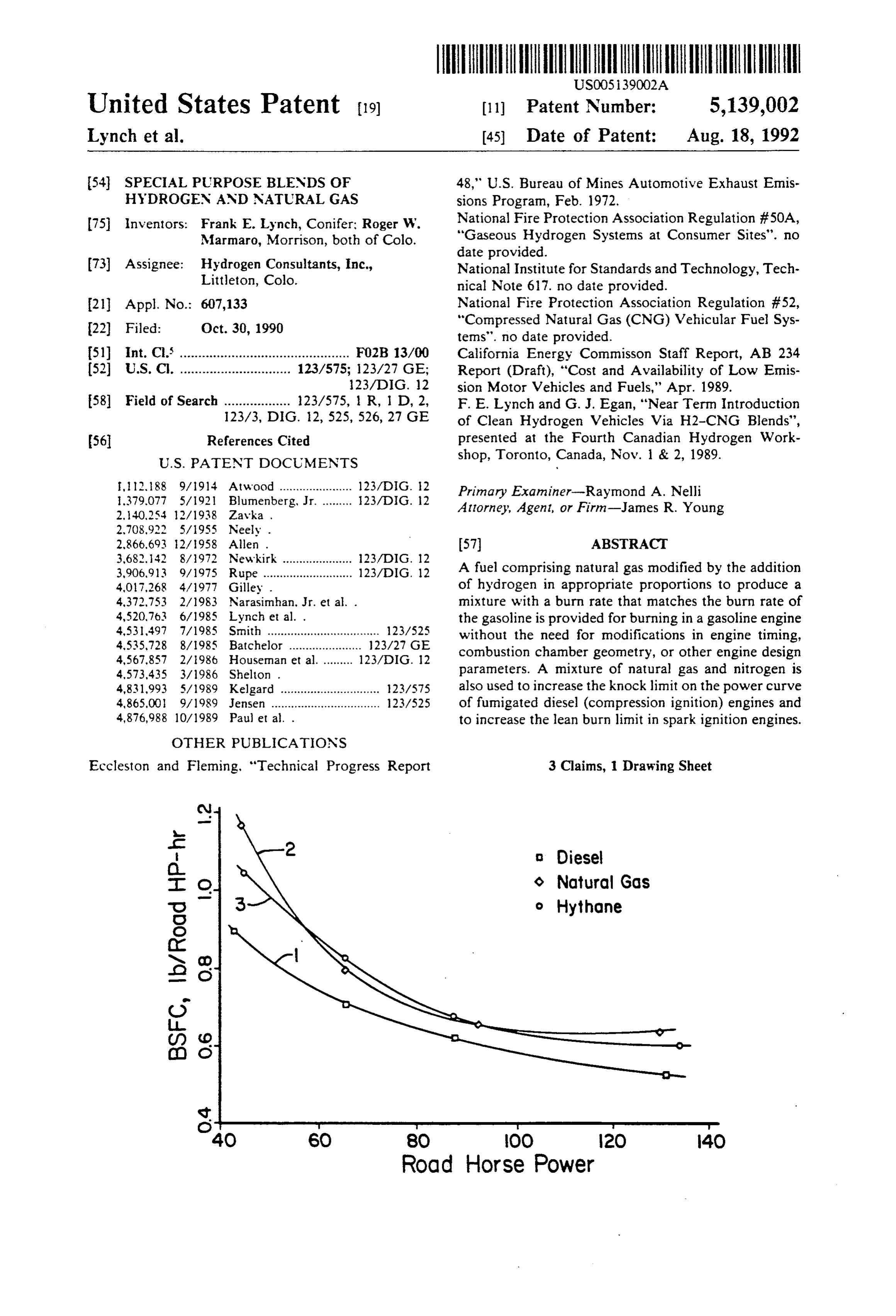
D. Diesel go Natural Gos
O Hythone
o SO 8O OO 2O 4O
Road Horse Power
Page 2
Drawing sheet — no readable text.
Page 3
do so in the immediate future. Such drawbacks include
SPECIAL PURPOSE BLENDS OF HYDROGEN the greater cost of hydrogen relative to conventional AND NATURAL GAS fuels, the difficulty and expense of storing hydrogen, which results in limited driving range, reduced power
BACKGROUND OF THE INVENTION 5 and operational problems when burned in engines de 1. Field of the Invention signed for gasoline or diesel fuel, and the lack of a fuel The present invention relates to alternative fuels for distribution infrastructure. There is also an undeserved internal combustion engines, and more specifically to perception, sometimes dubbed the Hindenburg Syn blends of hydrogen in natural gas that are specially O drome, that hydrogen is significantly more dangerous formulated to achieve specific advantages over pure than conventional fuels.
natural gas or more tradition gasoline or diesel fuels. To overcome these difficulties and yet take advan 2. Description of the Prior Art tage of the burning characteristics of hydrogen, there The current predominant forms of fuel for internal have been many studies and developments directed to combustion engines are derivatives of petroleum, 5 the use of hydrogen in conjunction with conventional namely gasoline and diesel fuel. However, the advanc liquid petroleum fuels in internal combustion engines. ing depletion and unreliability of crude oil resources Examples of these developments are disclosed or sug and significant environmental concerns resulting from gested by U.S. Pat. No. 1,112,188, issued to Atwood on the use of these fuels underscore the need for pe Sept. 29, 1914; U.S. Pat. No. 1,379,077, issued to Blu troleum-independent alternative fuels. Primary U.S. menberg on May 24, 1921; U.S. Pat. No. 3,906,913 is alternative energy resources are reserves of natural gas 20 sued to Rupe on Sept. 23, 1975; U.S. Pat. No. 4,017,268, and coal. Natural gas can be used directly as an alterna issued to Gilley on Apr. 12, 1977 and U.S. Pat. No. tive fuel for internal combustion engines, or it can be 4,573,435, issued to Shelton on Mar. 4, 1986. In the converted into other fuels, including hydrogen gas and earlier of these patents, hydrogen was selected because liquid fuels, such as methanol (methyl alcohol). Coal is of its effect as a combustion stimulant. In the more difficult to use directly as a fuel in internal combustion 25 recent patents, hydrogen was selected because it is a ergines, although it can be converted to "coal gas' comprising primarily hydrogen and carbon monoxide cleaner ing burning fuel itself and because it reduces pollut emissions exhausted from gasoline engines.
or into liquid fuels, including methanol and synthetic Eccleston and Fleming reported on hydrogen/natu petroleum. ral gas engine tests conducted under the U.S. Bureau of Hydrogen, theoretically if not yet practically, is an 30 attractive alternative for meeting future transportation Mines Automotive Exhaust Emissions Program, Tech nical Progress Report 48, February, 1972. They were energy requirements with renewable energy sources. really proposing the use of hydrogen-rich synthetic coal Like electricity. hydrogen is an energy carrier, not a source of energy. Traditionally, hydrogen has been for study gas as an automotive fuel, but they had no such fuel, so, manufactured from natural gas or coal, although it is 35 preparing purposes mixtures only, they simulated the coal gas by of hydrogen in natural gas. They also produced by an electrical water-splitting process known as electrolysis that can be powered by any form found that hydrogen reduced hydrocarbon, carbon of energy. Producing hydrogen as a transportation fuel monoxide, and nitrogen oxide emissions over a wide from nonrenewable energy forms would improve urban range of fuel/air mixtures, relative to pure natural gas. air quality, but it would not solve resource problems. However, the use of hydrogen in conjunction with However, if hydrogen is derived from renewable en conventional fuels have also been fraught with difficul ergy sources, such as solar energy, wind energy, geo ties. For example, hydrogen is virtually insoluble in thernal energy or ocean thermal energy, it can provide liquid hydrocarbons, such as gasoline or diesel fuel. It the basis for a perfectly balanced energy cycle: also cannot be dissolved in liquefied butane or liquefied (l) Electrolysis separates water, H2O, into hydrogen propane to any significant extent, although it readily and oxygen gases, H2 and O2 respectively according to mixes with natural gas in compressed gas tanks. To the reaction 2H2O-2H2--O2. The oxygen may be avoid the necessity of having two fuel storage systems vented or sold as a byproduct. (one for hydrogen, one for the liquid fuel) numerous (2) Hydrogen is stored, transported, delivered to efforts have sought to break down liquid fuels in on motor vehicles and burned to produce energy for pow SO board reformers to make hydrogen-rich gaseous prod ering the vehicles and water vapor as a by-product ucts. However, even though such processes are rou according to the net reaction 2H2+O2-2H2O. tinely carried out in the chemical process industry, they (3) The water vapor is released to the atmosphere are extremely difficult to implement compactly aboard where it eventually falls as precipitation, once again an automobile in a way that meets the rapid changes in becoming available for electrolysis. 55 an automobile's fuel demand. Therefore, contemporary Hydrogen combustion produces no objectionable emis alternative fuels programs before this invention have sions other than trace amounts of nitrogen oxides that been proceeding without the benefit of clean burning form when residual nitrogen and oxygen in air are renewable hydrogen.
heated in the combustion process. Even though proto Because of the fledgling nature of distribution sys type hydrogen vehicles have already passed the most tems for alternative fuels, such as methanol or natural strict standards for nitrogen oxide emissions, future gas, for burning in automobiles, it is advantageous for hydrogen powered fuel cells may eventually propel alternative fuel vehicles to operate on conventional motor vehicles with absolutely no nitrogen oxides at all. fuels as well. However, the alternative fuels known and Unfortunately, as wonderful as the hydrogen energy used prior to this invention have substantially different cycle may seem in theory, there are several practical 65 burn or combustion rates than the conventional fuels. drawbacks to the use of hydrogen that have impeded For example, natural gas, which is considered to be one the implementation of hydrogen as a transportation fuel of the major alternative fuels for at least the near future, on any significant scale in the past and will continue to and conventional gasoline burn at significantly different
Page 4
rates in internal combustion engines thus requiring sub Therefore, when operating on natural gas, a small stantial engine modifications and adjustments to burn amount of diesel fuel still is injected into the combustion one fuel or the other. At a fixed rotating speed (RPM), chamber to ignite the natural gas/air mixture, i.e., act manifold vacuum and "equivalence ratio" (the fuel/air ing in lieu of spark plugs. Burning other fuels, such as ratio as a fraction of the chemically correct or stoichio methanol or natural gas in conjunction with diesel fuel, metric ratio), natural gas burns more slowly than gaso has been shown to decrease particulate emissions line in a given engine. A number of factors influence the (smoke) and nitrogen oxides, but it also increases harm rate of combustion in the cylinder of an engine, but ful carbon monoxide and organic gases.
optimum ignition timing should be set where it ignites Hydrogen has also been tried as a supplement to the fuel soon enough so that the peak combustion pres 10 diesel fuel. For example, in the 1920's and 193013 s en sure occurs about 10 to 15 of crank rotation after the gines of hydrogen filled dirigible air ships burned some piston passes top-dead-center on the combustion stroke. hydrogen with diesel fuel. In flight, the loss in weight Because natural gas burns more slowly than conven tional gasoline, vehicles with dual fuel engine systems due to diesel fuel consumption had to be countered by releasing hydrogen to maintain neutral buoyancy.
for burning either natural gas or gasoline must have at 5 Rather than simply venting the hydrogen to the atmo least some means for advancing the ignition timing to sphere, it was fumigated into the engines, which had the meet the requirements of natural gas and for retarding effect the timing for optimum gasoline combustion. This re studiesofofextending hydrogen the range of the airships. Laboratory in diesels have continued to the quirement presents several technical difficulties, includ present, but prior to this ing the need for sophisticated engine control systems 20 real positive or promising invention hydrogen there have been no fumigant or natural that adjust the fuel/air mixture and ignition timing ac gas fumigant techniques for diesel engines that would be cording to the requirements of both the alternative and both economical as well as provide significantly in conventional fuels. Some existing state of the art com proved exhaust emission.
puterized gasoline engine control systems, when operat ing in the "closed loop" mode, automatically advance 25 SUMMARY OF THE INVENTION the ignition timing in search of the most efficient operat ing conditions. If the automatic controls have enough tion is to providea an
Accordingly, general object of the present inven inexpensive clean burning alterna range, they might meet the spark advance requirements of natural gas operation, at least some of the time. At tive fuel that can be substituted for, and burned inter other times, in the "open loop" mode, the ignition tim 30 changeably with, conventional gasoline or other fuels in ing may be set by the microprocessor to predetermined spark ignition internal combustion engines. values that are approximately correct for gasoline under Another general object of this invention is to provide a given set of operating conditions. At such times the an inexpensive, clean burning alternative fuel that can spark delivery will be too late for efficient, low emis substantially decrease the amount of conventional fuel, sions operation on natural gas. 35 such as diesel fuel, consumed by a compression ignition There is an aftermarket device called Dual Curve engine.
Ignitions offered by Autotronic Controls Corporation, Another general object of this invention is to provide El Paso, Tex., that changes the ignition timing of the an inexpensive alternative fuel that can be burned in engine when it is switched from gasoline to natural gas conjunction with diesel fuel in compression ignition and back again. However, since there are so many dif engines.
ferent types of ignition systems in the myriad of differ Another general object of this invention is to provide ent automobiles that may be converted to natural gas in gaseous fuel mixtures that reduce the environmentally the future, it is impossible for a single device to serve all harmful exhaust emissions of internal combustion en of them with optimum ignition timing for both gasoline gines.
and natural gas. Ford Motor Company is also develop 45 Another general object of this invention is to provide ing an advanced control system for its "Flexible Fuel gaseous fuel mixtures that increase the thermal effi Vehicle" that measures the ratio of methanol/gasoline ciency of internal combustion engines.
flowing to the engine, computes the correct fuel/air A more specific object of this invention is to provide mixture and ignition timing (vastly different for the two a gaseous fuel mixture that essentially matches the burn fuels), and instructs the engine's electronic controls to SO ing rates of conventional fuels, such as gasoline, in make the necessary adjustments. Such sophistication is spark-ignition internal combustion engines. cost-effective only on a mass-produced basis. Even Another specific object of this invention is to provide then, there are so many other engine design features a gaseous fuel mixture which significantly reduces the built into the permanent structures of engines by manu emissions of hydrocarbons, relative to pure natural gas, facturers based on optimum performance criteria at a 55 when burned at near-stoichiometric conditions in spark conventional fuel burn rate and which cannot be ignition engines.
changed, that simple adjustment of fuel-air ratios and Another specific object of this invention is to provide spark timing still do not result in efficient running en a gaseous fuel mixture that increases the knock-limited gines when the alternate fuel is burned. power levels attainable in compression ignition (diesel) Alternative fuels for diesel or compression ignition engines fumigated by gaseous fuels while minimizing engines are also of interest for reducing urban air pollu the rate of diesel fuel injection at engine loads below the tion and dependence on petroleum. In addition to modi knock-limited power level.
fied petroleum oils, vegetable oils and other liquids are Another specific object of this invention is to provide being evaluated for their potential to reduce diesel ex a gaseous fuel mixture that increases the thermal effi haust emissions. Natural gas is also used in diesel en 65 ciency of compression ignition (diesel) engines fumi gines by a process known as fumigation wherein gase gated by gaseous fuels.
ous fuel is metered into the intake air stream. However, Another specific object of the present invention is to natural gas does not ignite efficiently by compression. provide a gaseous fuel mixture that decreases the ex
Page 5
haust emissions of compression ignition (diesel) engines DETALED DESCRIPTION OF THE fumigated by gaseous fuels. PREFERRED EMBODIMENTS Additional objects, advantages, and novel features of this invention shall be set forth in part in the description Alternative fuels for internal combustion engines are that follows, and in part will become apparent to those 5 provided, according to the preferred embodiments of skilled in the art upon examination of the following or this invention, by mixing hydrogen with natural gas. may be learned by the practice of the invention. The The tion alternative fuels prepared according to this inven are called "Hythane" for convenience. The prefix objects and the advantages of the invention may be Hy is taken from hydrogen, and the suffix thane is taken realized and attained by means of the instrumentalities and in combinations particularly pointed out in the O from methane, which is the principal constituent of natural gas. Also, while the natural gas constituent of appended claims.
To achieve the foregoing and other objects, and in this invention is referred to most often as natural gas, methane is understood to be essentially a functional accordance with the purposes of the present invention, equivalent of natural gas and could be substituted for as embodied and broadly described herein, the process 15 natural gas in this invention.
of this invention may comprise the steps of mixing natu The two gaseous fuels, natural gas and hydrogen are ral gas and hydrogen as an alternate fuel in respective mixed in proportions according to this invention that proportions that result in the alternate fuel having a meet two specific objectives, depending on whether the combustion rate that matches or nearly approximates fuel mixture is to be used in a spark-ignited engine or in the combustion rate of a conventional liquid hydrocar a compression-ignited engine.
bon fuel, such as gasoline. Such an alternate fuel with a First, for spark-ignited engines, a blend of hydrogen molar percent of hydrogen in the range of about 10 to and natural gas is provided that closely approximates 20 percent, and preferably about 15 percent, provides a the combustion rate of gasoline or other conventional combustion rate similar to gasoline for burning in con fuel when burned in typical spark-ignition internal com ventional, spark-ignited gasoline burning engines. 25 bustion engines at a near-stoichiometric fuel/air ratio. The method and composition of this invention also This blend, generally referred to as "Hythane G" in this includes an alternate fuel mixture comprising natural to description, permits the mixture to be burned according gas and hydrogen for use in fumigating compression this invention efficiently and cleanly as an alternate fuel in engines designed for conventional fuels, such as ignited engines, such as diesel engines. This alternate gasoline, fuel for fumigating diesel engines according to this in without the need for expensive and complex vention comprises a molar percent of hydrogen in the ignition system and other engine modifications. Second, for compression-ignited engines, a blend of range of about 5 to 15 percent, and preferably about 10 hydrogen in natural gas, called Hythane D herein, con percent. The method also includes feeding this alternate tains the least fuel mixture into the engine as the primary energy 35 three beneficialamount of hydrogen necessary to achieve effects: (a) substantial extension of the source to meet engine load and power demands, while knock-limited torque levels achievable by fumigation maintaining minimal diesel fuel injection only in suffi with pure natural gas; (b) increased thermal efficiency cient quantities for efficient compression induced igni that offsets the cost of the hydrogen additive; and (c) tion. Howiever, use of this alternate fuel as the primary substantial reduction in the emission of hydrocarbons energy source according to this invention is limited to from the engine's exhaust.
the knock-limited value, and additional energy for Since hydrogen and natural gas are completely misci power beyond the knock-limited value is provided by ble in one another and chemically nonreactive toward injecting additional quantities of liquid diesel fuel. one another, mixtures of the two, once made, can be handled, stored, and fed into internal combustion en
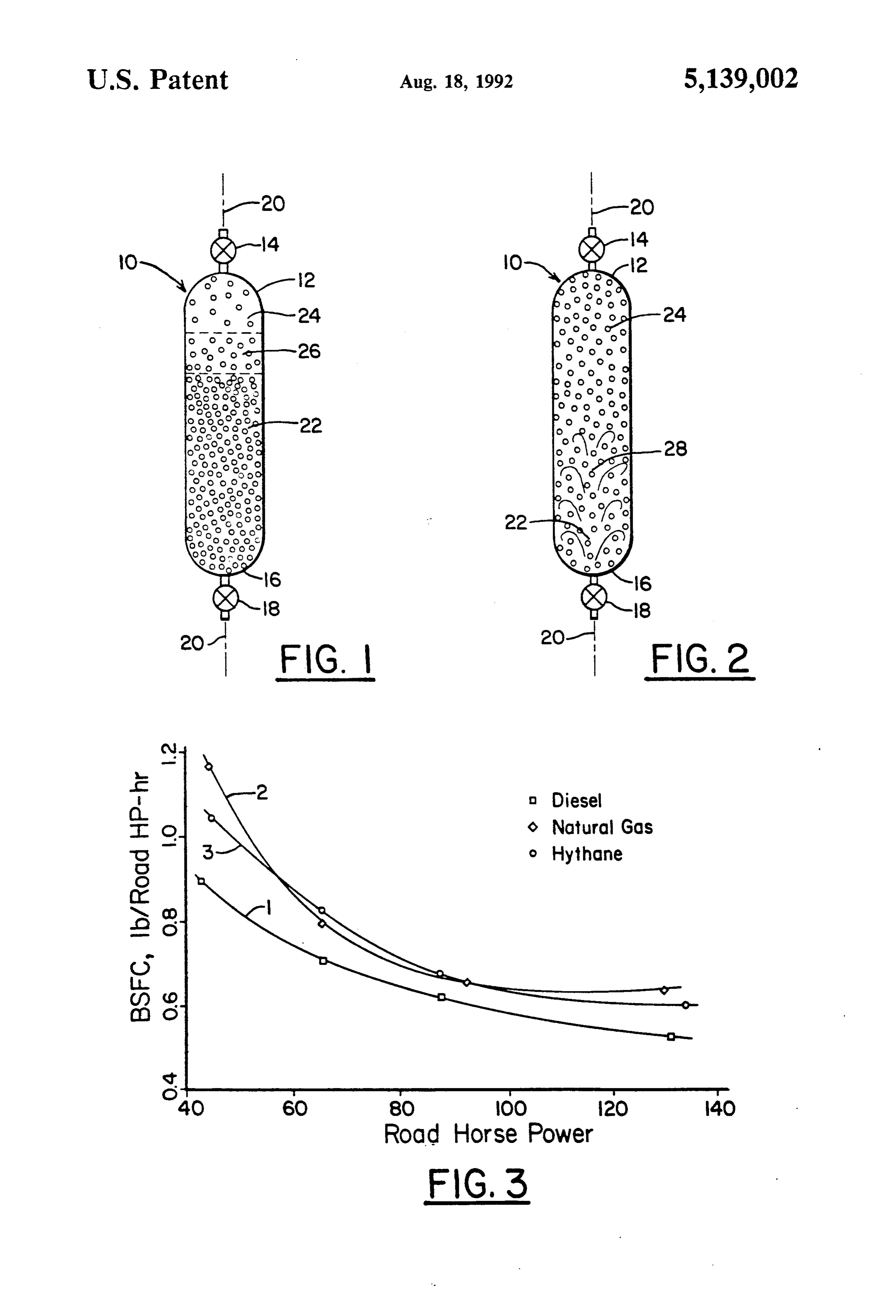
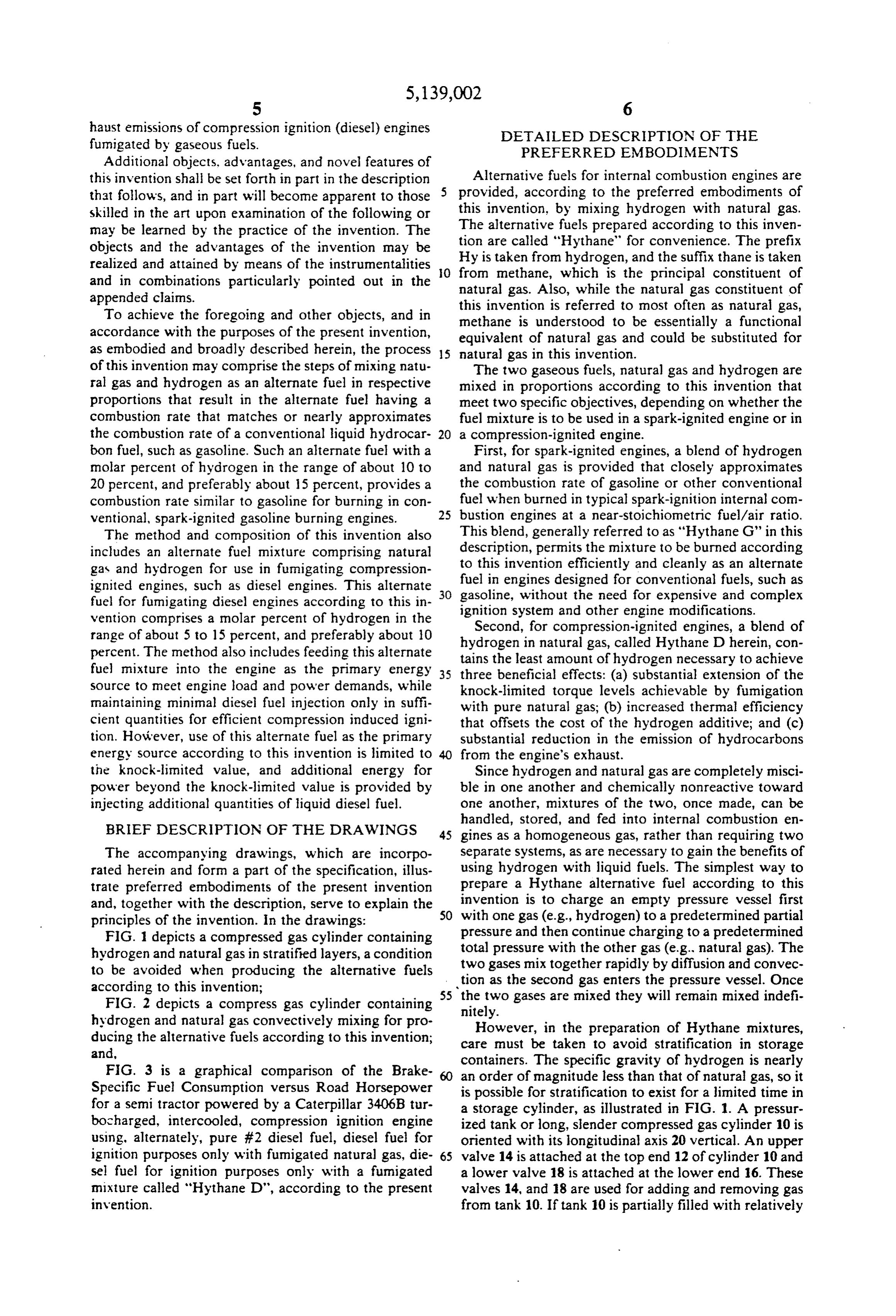
BRIEF DESCRIPTION OF THE DRAWINGS 45 gines as a homogeneous gas, rather than requiring two The accompanying drawings, which are incorpo separate systems, as are necessary to gain the benefits of rated herein and form a part of the specification, illus using hydrogen with liquid fuels. The simplest way to trate preferred embodiments of the present invention prepare a Hythane alternative fuel according to this and, together with the description, serve to explain the 50 invention is to charge an empty pressure vessel first principles of the invention. In the drawings: with one gas (e.g., hydrogen) to a predetermined partial FIG. 1 depicts a compressed gas cylinder containing pressure and then continue charging to a predetermined hydrogen and natural gas in stratified layers, a condition total pressure with the other gas (e.g. natural gas). The to be avoided when producing the alternative fuels two gases mix together rapidly by diffusion and convec according to this invention; tion as the second gas enters the pressure vessel. Once FIG. 2 depicts a compress gas cylinder containing 55 the two gases are mixed they will remain mixed indefi nitely.
hydrogen and natural gas convectively mixing for pro However, in the preparation of Hythane mixtures, ducing the alternative fuels according to this invention; care must be taken to avoid stratification in storage and, containers. The specific gravity of hydrogen is nearly FIG. 3 is a graphical comparison of the Brake
Specific Fuel Consumption versus Road Horsepower an order of magnitude less than that of natural gas, so it is possible for stratification to exist for a limited time in for a semi tractor powered by a Caterpillar 3406B tur a storage cylinder, as illustrated in FIG. 1. A pressur bocharged, intercooled, compression ignition engine ized tank or long, slender compressed gas cylinder 10 is using, alternately, pure #2 diesel fuel, diesel fuel for oriented with its longitudinal axis 20 vertical. An upper ignition purposes only with fumigated natural gas, die 65 valve 14 is attached at the top end 12 of cylinder 10 and sel fuel for ignition purposes only with a furnigated a lower valve 18 is attached at the lower end 16. These mixture called "Hythane D", according to the present valves 14, and 18 are used for adding and removing gas invention. from tank 10. If tank 10 is partially filled with relatively
Page 6
dense natural gas 22, and if less dense hydrogen 24 is of a gas compressor, hydrogen and natural gas can be added slowly (i.e., no convective mixing) through the fed in a precise ratio and thoroughly mixed during the upper valve 14, the contents of the tank will not mix compression process prior to entering compressed gas immediately. In the absence of any convective phenom storage cylinders.
ena, the stratified layers of gas will mix together by 5 Most of the components required to convert motor diffusion, shown generally as region 26, over a period of vehicles for use of Hythane blends are the same as natu time that is dependent on tank geometry and gas tem ral gas vehicle components. Compressed gas storage perature. cylinders, pressure regulators, carburetors and miscella Such stratification can, however, be virtually elimi neous equipment for using gaseous fuels in spark igni nated, as seen in FIG. 2, by adding hydrogen rapidly (to 10 tion engines are commercially available. Impco, Cerri promote convective stirring) through the lower valve tos, Calif. and Automotive Natural Gas Inc., Milton, 18 so that any concentrated clouds of low density hy Wis., offer conversion kits. Compressed gas cylinders drogen 22 must rise through the denser natural gas 24 suitable for Hythane are available from any manufac and thereby become convectively mixed as shown gen turer of mild steel high pressure tanks, such as those erally by region 28. If, on the other hand, hydrogen is 5 used in the merchant gas industry. High performance, charged into tank 10 first, it is preferable to charge the lightweight tanks employing composite materials tech natural gas through the upper valve 14. nology are available form Structural Composites, Po Under typical vehicle refueling circumstances, when mona, Calif. and CNG Cylinder corp., Long Beach, hydrogen and natural gas are rapidly charged into a Calif. Aluminum alloys, austenitic stainless steels (e.g., small horizontal storage cylinder (not shown), mixing is 20 316) or mild steels (e.g., 1019) are acceptable for con complete, for all practical purposes, within 10 minutes taining Hythane at moderate temperatures. Due to the or less. Another way to prepare well-mixed Hythane is possibility of hydrogen embrittlement, cylinders and to simultaneously flow hydrogen and natural gas into a other components that carry Hythane should not be storage cylinder through a common gas fitting (not made of high strength steels (e.g., 4130) or titanium. shown). Cylinders for the storage of compressed Hy 25 Most suppliers of tubing, valves, fittings, regulators and thane should conform to the recommendations of Na compressed gas cylinders, etc., can supply hydrogen tional Fire Protection Association Regulation #50A compatibility data for their products. The recommenda "Gaseous Hydrogen Systems at Consumer Sites'. tions of National Fire Protection Association Regula The composition ratio, in terms of molar percent of tion #52 "Compressed Natural Gas (CNG) Vehicular the constituents, can be determined conveniently in two 30 Fuel Systems" should be followed in modifying vehi ways. If hydrogen and natural gas are stored in pressure cles to use Hythane.
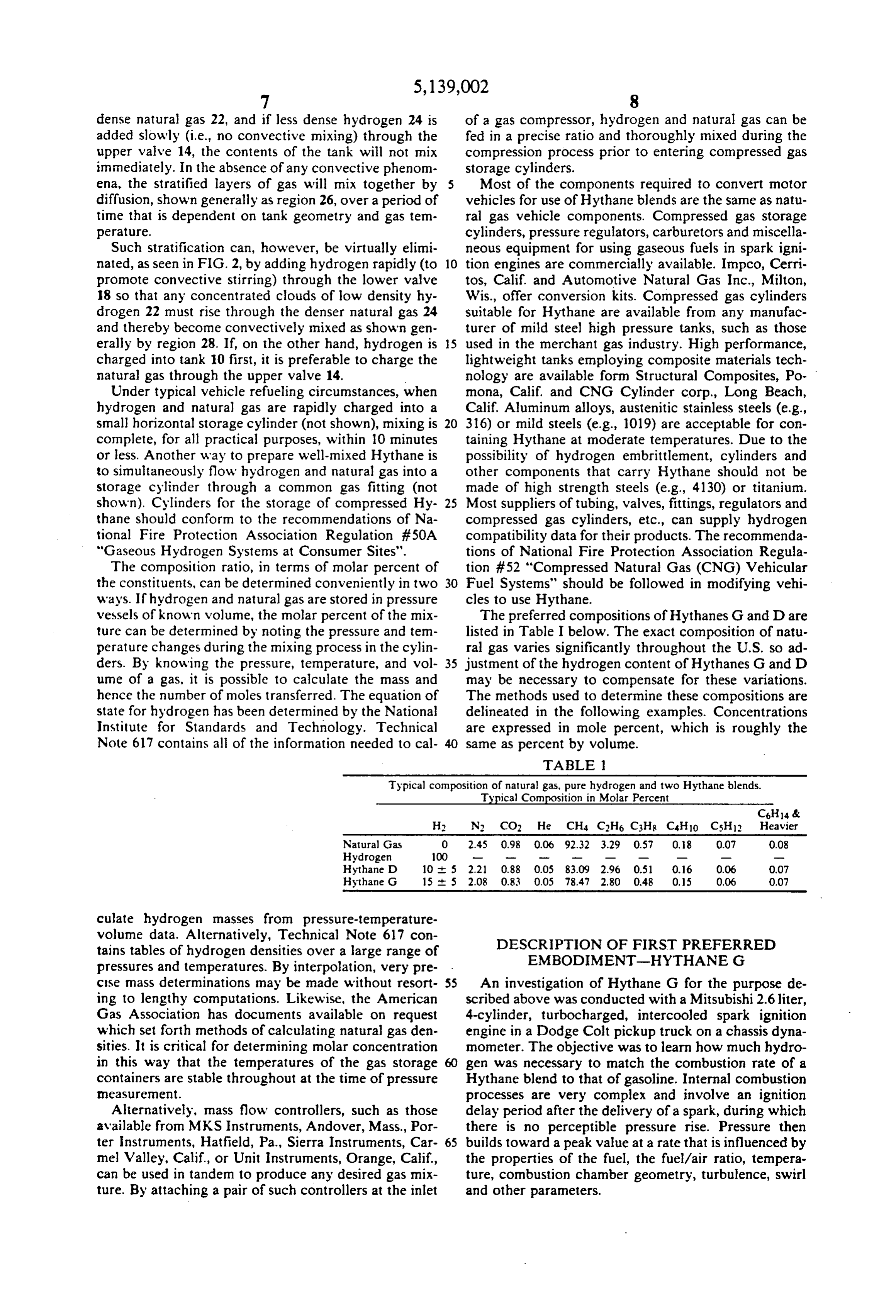
vessels of known volume, the molar percent of the mix The preferred compositions of Hythanes G and D are ture can be determined by noting the pressure and tem listed in Table I below. The exact composition of natu perature changes during the mixing process in the cylin ral gas varies significantly throughout the U.S. so ad ders. By knowing the pressure, temperature, and vol 35 justment of the hydrogen content of Hythanes G and D ume of a gas, it is possible to calculate the mass and may be necessary to compensate for these variations. hence the number of moles transferred. The equation of The methods used to determine these compositions are state for hydrogen has been determined by the National delineated in the following examples. Concentrations Institute for Standards and Technology. Technical are expressed in mole percent, which is roughly the Note 617 contains all of the information needed to cal- 40 same as percent by volume.
TABLE
Typical composition of natural gas, pure hydrogen and two Hythane blends.
Typical Composition in Molar Percent
H N. CO. He CH4 C2H6, C3H8 CH10 Csh Heavier
Natural Gas O 2.45 0.98 0.06 92.32 3.29 O.S 0.8 0.07 0.08
Hythane D 10 it 5 2.2 0.88 0.0S 83.09 2.96 0.51 0.6 0.06 0.07 Hythane G 15 at S 2.08 0.83 0.05 78.47 2.80 0.48 0.15 0.06 0.07
culate hydrogen masses from pressure-temperature volume data. Alternatively, Technical Note 617 con DESCRIPTION OF FIRST PREFERRED tains tables of hydrogen densities over a large range of EMBODIMENT-HYTHANE G pressures and temperatures. By interpolation, very pre cise mass determinations may be made without resort 55 An investigation of Hythane G for the purpose de ing to lengthy computations. Likewise, the American scribed above was conducted with a Mitsubishi 2.6 liter, Gas Association has documents available on request 4-cylinder, turbocharged, intercooled spark ignition which set forth methods of calculating natural gas den engine in a Dodge Colt pickup truck on a chassis dyna sities. It is critical for determining molar concentration mometer. The objective was to learn how much hydro in this way that the temperatures of the gas storage gen was necessary to match the combustion rate of a containers are stable throughout at the time of pressure Hythane blend to that of gasoline. Internal combustion eaStreet. processes are very complex and involve an ignition Alternatively, mass flow controllers, such as those delay period after the delivery of a spark, during which available from MKS Instruments, Andover, Mass., Por there is no perceptible pressure rise. Pressure then ter instruments, Hatfield, Pa., Sierra Instruments, Car 65 builds toward a peak value at a rate that is influenced by mel Valley, Calif., or Unit instruments, Orange, Calif., the properties of the fuel, the fuel/air ratio, tempera can be used in tanden to produce any desired gas mix ture, combustion chamber geometry, turbulence, swirl ture. By attaching a pair of such controllers at the inlet and other parameters.
Page 7
A practical measure of overall combustion rate, for imized CO2 concentration) NO is at the lowest concen the purposes of the present invention, is provided by tration possible without compromising THC and CO noting the spark advance setting that produces the max emissions.
imum torque under a fixed set of operating conditions. When operating on pure natural gas under these con There is typically a range of spark advance settings over 5 ditions, the CO concentrations were negligible (a few which an engine produces maximum torque. A gradual hundredths loss of torque occurs as the spark advance settings are the range ofof100 a percent) but the THC emissions were in to 300 ppm. It is generally recognized varied outside this range. The least spark advance that that 80% to 90% of the THC emitted by natural gas will produce maximum engine torque is known to those skilled in engine testing as "minimum best torque' or 10 vehicles is photochemically non-reactive methane. Since methane does not contribute to the formation of
MBT ignition timing. In test engines equipped with ozone in the atmosphere, THC values are reduced by transducers for cylinder pressure and crank angle, maxi the amount of methane to determine the reactive hydro mum torque typically coincides with combustion pres carbon (RHC) concentration. For Example, the Colo sure peaks located about 10 to 15 after top-center on rado Department the power stroke. For typical 4-stroke gasoline engines, 15 0.15 to determineofRHC Health multiplies THC values by during vehicle certification the requisite spark advance is generally in the range of tests, thus estimating that 0.85 of the THC is non reac 10' to 40 before top-center on the compression stroke, tive methane.
depending on a number of aspects of engine design, When operating over the same range of speeds and fuel/air ratio, exhaust gas recycle (if any) and operating loads on Hythane G, THC concentrations were typi conditions. Natural gas, when burned in engines de- 20 signed for gasoline under comparable conditions, re cally in the range of 10 to 20 ppm. When multiplied by quires significantly greater spark advance to compen the 0.15 RHC factor, the hydrocarbon emissions with sate for its slower burning rate. All other conditions sions wereGnegligible
Hythane are truly negligible. Of course, CO emis with Hythane G, typically 0.01%.
being equal, MBT spark timing for efficient combustion NOx emissions, although not measured, may be reduced of natural gas must be about 15 to 25 more advanced 25 relative to pure natural gas. It is known that NOx falls than the standard gasoline ignition timing. Hydrogen, on the other hand, burns much faster than gasoline. In rapidly in spark ignition engines as the excess air in the mixture, indicated by exhaust O2, approaches zero.
engines specially modified for burning hydrogen at or With pure natural gas in engines designed for gasoline, near the stoichiometric fuel/air ratio, MBT spark tim the minimum oxygen concentration that can be ing is found at or after top-center on the power stroke. 30 achieved is about
Since natural gas burns slower than gasoline and hydro urban driving. Below2-3% under conditions typical of gen burns faster than gasoline, the present invention climb rapidly. With Hythane G, COthat level, and THC begin to exhaust O2 levels may comprises a mixture of the two fuel gases that burns at be reduced to 0.1-0.3% before CO and HC begin to essentially the same rate as gasoline.
35 climb. It is therefore probable that NO is reduced with
EXAMPLE Hythane G relative to pure natural gas.
Tanks containing 10%, 15%, 20%, 25%, and 30% The emissions data obtained in this example and de hydrogen by volume were prepared for the tests. The scribed above is considered to be general in nature and spark timing was adjusted manually to find the "mean not possible to compare precisely with Federal stan best torque' setting at steady speeds with a fixed throt- 40 dards for exhaust emissions. The Federal test proce tle position. The air/fuel ratio was adjusted manually to dure, which is expensive and time consuming, could be maximize CO2 emissions. This assures that the air/fuel performed. However, since quantifying the precise ratio was very near the chemically correct or "stoichio emissions reduction is not crucial to the invention, such metric" value. Conditions ranging from idle to wide tests are not necessary and were not performed for this open throttle were applied over a range of engine 45 example. It is sufficient to note that: (1) Natural gas speeds. The resulting settings were compared to the vehicles can meet Federal standards for exhaust emis factory distributor curve of the engine. Relatively few sions; (2) Hythane G, according to this invention, pro tests were necessary to rule out the 25% and 30% mix vided significant reductions of hydrocarbons, showed tures, which burned much faster than gasoline. A Hy negligible CO, and may have reduced NO, relative to thane blend with 15% hydrogen in natural gas was 50 operation on pure natural gas in simulated urban driv found to require substantially the same timing as that ing; therefore, (3) in qualitative terms, it is reasonable provided by the standard gasoline engine distributor. test to expect low emissions with Hythane G in the Federal 10% hydrogen on the average required slightly more procedure.
advance (5-7) than the standard gasoline setting and Although fuel consumption was not measured during 20% required slightly less advance (approximately 55 this Example 1 testing of Hythane G, reduced fuel con 2'-4"). The differences in the 10% to 20% range were sumption is projected, because Hythane G solves a small enough to be negligible for the purposes of this fundamental problem with burning natural gas in en invention. Therefore, Hythane G, according to this gines designed for gasoline. Since it is necessary to preferred embodiment of the invention, comprises ignite natural gas earlier on the compression stroke than about 15.5% hydrogen in natural gas. 60 gasoline at any particular operating condition, there is a Emissions measurements were made at various steady greater expenditure of work performed against the ex speed and load conditions typical of urban driving. The panding combustion products during the compression Bear engine analyzer used for the tests showed total stroke. This wasted work is generally recognized by hydrocarbons (THC), carbon monoxide (CO), carbon those skilled in the art of converting engines for dual dioxide (CO2) and oxygen (O2) concentrations in the 65 fuel operation, as one of the penalties of burning natural exhaust. Nitrogen oxide emissions (NO) were not mea gas in engines designed for gasoline. Designers of dedi sured; however, it is generally known that by operating cated natural gas engines seek to solve this problem or as nearly as possible to the stoichiometric mixture (max at least minimize it with increased compression ratio
Page 8
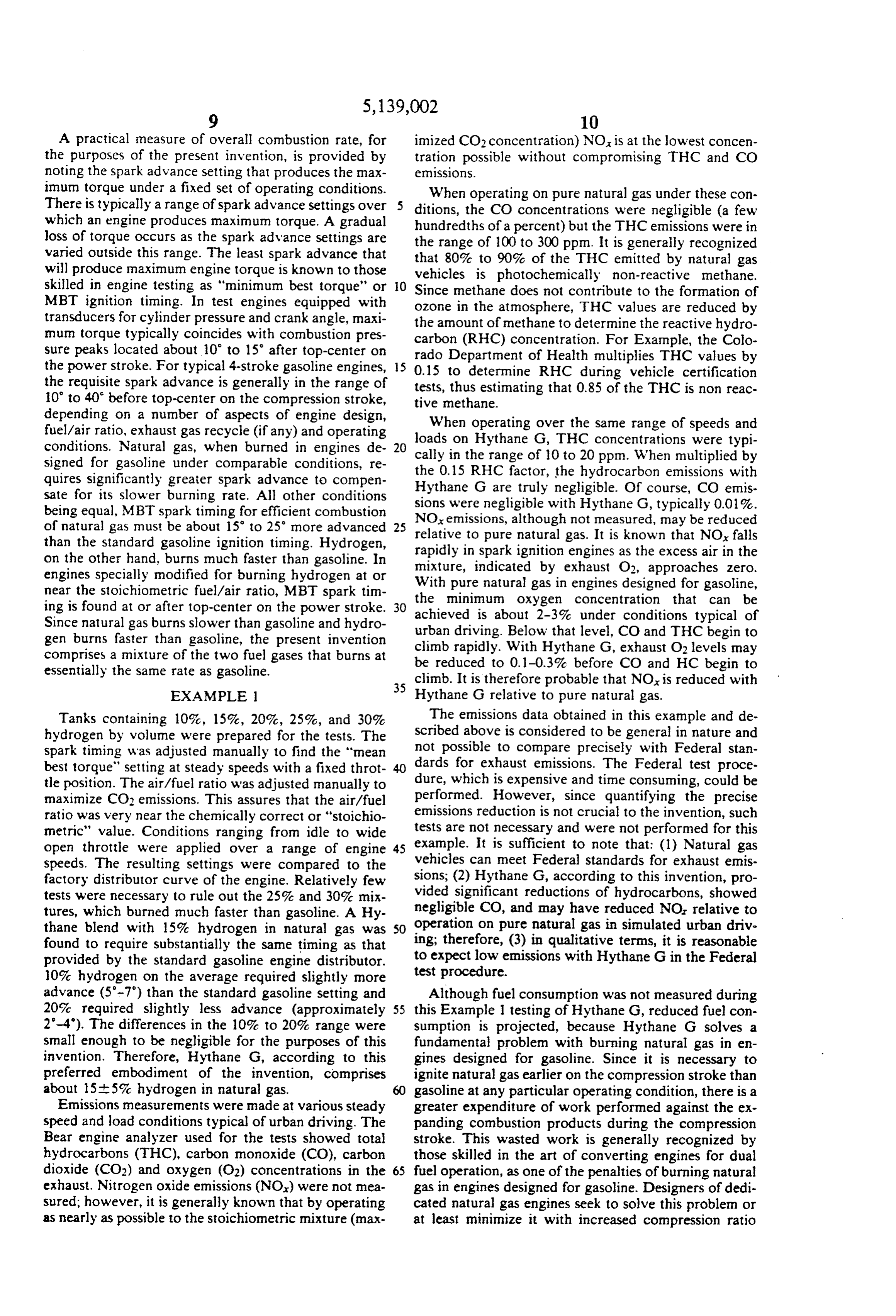
and altered combustion chamber design. In contrast, power. Subsequently, mixtures with 10% and 15% hy with the Hythane G of this invention burned in an es drogen were prepared. Table II compares the power sentially conventional gasoline engine, by definition the levels and emissions that were recorded for pure natural pressure rises at a rate very similar to gasoline. There gas and a Hythane D blend containing 10% hydrogen fore, thermal efficiency is expected to be comparable by volume.
regardless of whether Hythane G or gasoline is used in TABLE 2 a given engine.
Emissions at knock-limited maximum power with
DESCRIPTION OF THE SECOND PREFERRED a fumigated diesel engine at 1300 RPM.
The second embodiment alternative fuel of this in Fuel PS Power % CO ppm HC 7. O. vention also comprises a blend of natural gas and hydro Natural Gas 7.0 78 0.25 269
gen, but it is specially formulated for fumigating or MAPPS as manifold air pressure, pounds per square inch gage burning in compression ignited or diesel engines rather than for matching the combustion rate of gasoline. The 15 Accounting for the slightly higher manifold air pres combination of natural gas and hydrogen, according to this invention, has been found to provide significant sure (hence greater volume of exhaust), greater knock advantages in fumigating diesel engines that have not limited power level and lower ppmHC, the brake been obtained from the use of either natural gas or hy specific HC emissions (i.e., grams per kW-hr) with Hy drogen alone with diesel fuel. However, as described 20 thane D according to this invention are estimated to be below, a different proportionate range of the natural gas 61% less than with pure natural gas. and hydrogen constituents is preferred for use in com As can be seen from Table 2, hydrogen increased the pression ignited diesel engines than for use in spark power level that could be attained without encounter ignited gasoline engines. ing engine knock by 17% over pure natural gas. The 25 detonations that are responsible for knocking require an
EXAMPLE 2 incubation period, during which precursor reactions Tests were conducted with a Caterpillar 3406B tur take place in the heated and compressed mixture. There bocharged, intercooled diesel engine in a Freightliner are two ways that hydrogen mixed with natural gas semitractor at the test facilities of Tren Fuels, Inc., of may solve the knocking problem. Additives that pre Denver, Col. The conventional diesel injection system 30 vent knocking in gasoline engines do so by inhibiting of the engine was set to provide the least quantity of #2 detonation precursor reactions. The hydrogen may diesel fuel, obtained from Total Petroleum, Inc., that have that effect on natural gas. Another possible expla was needed to cause reliable ignition of gaseous fuels, nation is that, since hydrogen accelerates combustion, i.e., the diesel injectors acted in lieu of spark plugs. The the entire charge in the combustion chamber is con air intake system of the engine was equipped with a 35 sumed before the incubation period is over. In either gaseous fuel line, regulators, and manual control valves case, the effectiveness speaks for itself in the substantial to facilitate the introduction of gaseous fuels to the flow increase in knock-limited power coupled with a sub of air entering the diesel engine-a practice known as stantial decrease in emissions, specifically in hydrocar fumigation. The gaseous fuel comprising the mixture of bons (HC).
natural gas and hydrogen according to this invention 40 Additional tests indicate that 10-5% hydrogen in entered the air stream before the inlet of the turbo natural gas is enough to make significant improvements charger, thereby assuring turbulent mixing as the gase in engine efficiency. The curves in FIG. 3 show the ous fuel flowed through the turbocompressor and inter brake specific fuel consumption of a diesel engine with cooler. All tests were conducted on a chassis dynamom three fuel combinations: (1) pure diesel; (2) natural gas eter at 1300 RPM with the transmission in 8th gear. 45 with a small amount of diesel for ignition; and (3) Hy Essentially, the engine was run primarily on the alter thane D of this invention with an equally small amount nate gaseous fuel fed through the air intake, and the of diesel fuel for ignition purposes. Diesel fuel alone is diesel fuel fed through the conventional injectors was clearly the most efficient fuel and natural gas the least only used to ignite from the compression and in turn to efficient with Hythane D somewhere between the two. ignite the gaseous fuel. SO The brake-specific fuel consumption is reported in FIG. The tests were conducted by gradually increasing the 3 in equivalent pounds of diesel fuel per road horsepow flow of gaseous fuel into the diesel's air stream, which er-hour. Hydrogen and natural gas consumption were increased the engine's power output to the dynamome converted to equivalent pounds of diesel fuel by ratios ter. The power output was increased in this manner to of lower heat value of the fuels, then added to the the maximum level that could be sustained without 55 amount of diesel fuel used for ignition purposes. Road knocking-a condition that has severely damaged fumi horsepower read from a chassis dynamometer includes gated diesel engines in the past. Knocking results when losses through the drive train and tires. a portion of the fuel/air mixture, usually near the hot The tests that produced FIG. 3 were conducted with exhaust valve, becomes heated and compressed ahead 15 mole-percent hydrogen in natural gas. Increasing of the advancing flame front. Before the mixture can be hydrogen concentration to 20% reduced hydrocarbon consumed smoothly by the normal combustion process emissions further, but it also brought diminishing re (deflagration) it abruptly detonates and sends shock turns with respect to engine efficiency. Increased fuel waves through the engine structure that are heard as cost and reduced fuel capacity of the compressed gas audible knocking sounds. Knocking can and often does storage tanks is a deterrent to greater hydrogen concen result in overheated engine parts (especially pistons) 65 trations, unless future emissions regulations mandate and physical damage from the shock waves. lower emissions.
linitial tests with 2% and 4% hydrogen by volume in The preferred method of fumigation with Hythane natural gas showed 6-7% increases in knock-limited makes use of the blended fuel's ability to extend torque
Page 9
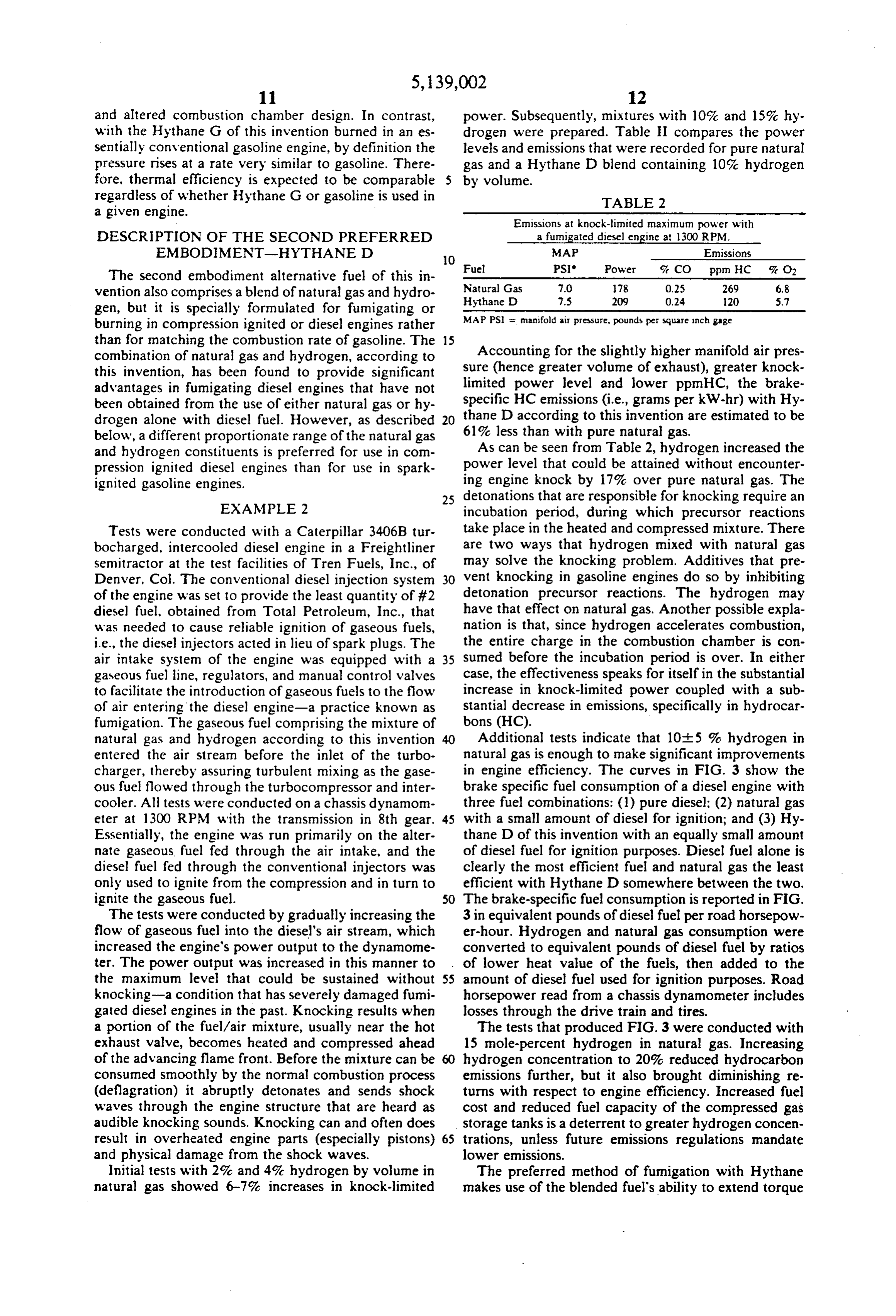
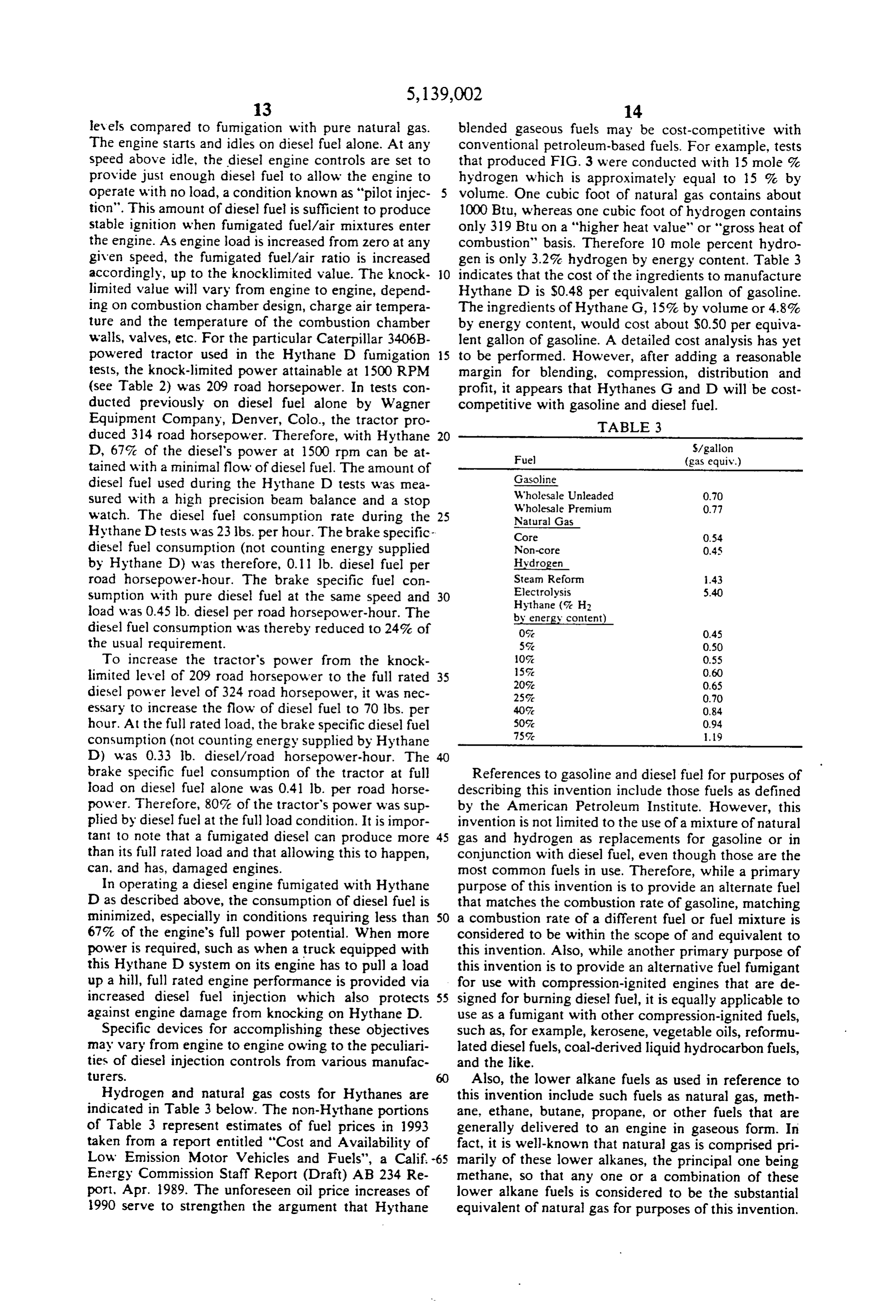
levels compared to fumigation with pure natural gas. blended gaseous fuels may be cost-competitive with The engine starts and idies on diesel fuel alone. At any conventional petroleum-based fuels. For example, tests speed above idle, the diesel engine controls are set to that produced FIG. 3 were conducted with 15 mole % provide just enough diesel fuel to allow the engine to hydrogen which is approximately equal to 15% by operate with no load, a condition known as "pilot injec volume. One cubic foot of natural gas contains about tion". This amount of diesel fuel is sufficient to produce 1000 Btu, whereas one cubic foot of hydrogen contains stable ignition when fumigated fuel/air mixtures enter only 319 Btu on a "higher heat value" or "gross heat of the engine. As engine load is increased from zero at any combustion' basis. Therefore 10 mole percent hydro given speed, the fumigated fuel/air ratio is increased gen is only 3.2% hydrogen by energy content. Table 3 accordingly, up to the knocklimited value. The knock O indicates that the cost of the ingredients to manufacture limited value will vary from engine to engine, depend Hythane D is $0.48 per equivalent gallon of gasoline. ing on combustion chamber design, charge air tempera The ingredients of Hythane G, 15% by volume or 4.8% ture and the temperature of the combustion chamber by energy content, would cost about $0.50 per equiva walls, valves, etc. For the particular Caterpillar 3406B lent gallon of gasoline. A detailed cost analysis has yet powered tractor used in the Hythane D fumigation 5 to be performed. However, after adding a reasonable tests, the knock-limited power attainable at 1500 RPM margin for blending, compression, distribution and (see Table 2) was 209 road horsepower. In tests con profit, it appears that Hythanes G and D will be cost ducted previously on diesel fuel alone by Wagner competitive with gasoline and diesel fuel. Equipment Company, Denver, Colo., the tractor pro TABLE 3 duced 314 road horsepower. Therefore, with Hythane 20 S/gallon D, 67% of the diesel's power at 1500 rpm can be at Fuel (gas equiv.) tained with a minimal flow of diesel fuel. The amount of diesel fuel used during the Hythane D tests was mea Gasoline sured with a high precision beam balance and a stop Wholesale Unleaded 0.70
watch. The diesel fuel consumption rate during the 25 Natural Gas
Hythane D tests was 23 lbs. per hour. The brakespecific Core 0.54 diesel fuel consumption (not counting energy supplied Non-core 0.45 by Hythane D) was therefore, 0.11 lb. diesel fuel per Hydrogen road horsepower-hour. The brake specific fuel con Steam Reform
Electrolysis
sumption with pure diesel fuel at the same speed and 30 Hythane (% H2 load was 0.45 lb. diesel per road horsepower-hour. The by energy content) diesel fuel consumption was thereby reduced to 24% of 0% 0.45 the usual requirement. 5% 0.50 To increase the tractor's power from the knock 10%
limited level of 209 road horsepower to the full rated 35 20% 0.65 diesel power level of 324 road horsepower, it was nec 25% 0.70 essary to increase the flow of diesel fuel to 70 lbs. per 40% 0.84 hour. At the full rated load, the brake specific diesel fuel 50% 0.94 consumption (not counting energy supplied by Hythane 75% .9 D) was 0.33 lb. diesel/road horsepower-hour. The 40 brake specific fuel consumption of the tractor at full References to gasoline and diesel fuel for purposes of load on diesel fuel alone was 0.41 lb. per road horse describing this invention include those fuels as defined power. Therefore, 80% of the tractor's power was sup by the American Petroleum Institute. However, this plied by diesel fuel at the full load condition. It is impor invention is not limited to the use of a mixture of natural tant to note that a fumigated diesel can produce more 45 gas and hydrogen as replacements for gasoline or in than its full rated load and that allowing this to happen, conjunction with diesel fuel, even though those are the can, and has, damaged engines. most common fuels in use. Therefore, while a primary In operating a diesel engine fumigated with Hythane purpose of this invention is to provide an alternate fuel D as described above, the consumption of diesel fuel is that matches the combustion rate of gasoline, matching minimized, especially in conditions requiring less than SO a combustion rate of a different fuel or fuel mixture is 67% of the engine's full power potential. When more considered to be within the scope of and equivalent to power is required, such as when a truck equipped with this invention. Also, while another primary purpose of this Hythane D system on its engine has to pull a load this invention is to provide an alternative fuel fumigant up a hill, full rated engine performance is provided via for use with compression-ignited engines that are de increased diesel fuel injection which also protects 55 signed for burning diesel fuel, it is equally applicable to against engine damage from knocking on Hythane D. use as a fumigant with other compression-ignited fuels, Specific devices for accomplishing these objectives such as, for example, kerosene, vegetable oils, reformu may vary from engine to engine owing to the peculiari lated diesel fuels, coal-derived liquid hydrocarbon fuels, ties of diesel injection controls from various manufac and the like.
tlers. Also, the lower alkane fuels as used in reference to Hydrogen and natural gas costs for Hythanes are this invention include such fuels as natural gas, meth indicated in Table 3 below. The non-Hythane portions ane, ethane, butane, propane, or other fuels that are of Table 3 represent estimates of fuel prices in 1993 generally delivered to an engine in gaseous form. In taken from a report entitled "Cost and Availability of fact, it is well-known that natural gas is comprised pri Low Emission Motor Vehicles and Fuels', a Calif.-65 marily of these lower alkanes, the principal one being Energy Commission Staff Report (Draft) AB 234 Re methane, so that any one or a combination of these port, Apr. 1989. The unforeseen oil price increases of lower alkane fuels is considered to be the substantial 1990 serve to strengthen the argument that Hythane equivalent of natural gas for purposes of this invention.
Page 10
The higher alkanes include hexane (C6H14), heptane than hydrogen, and wherein said engine has design (C7H16), octane (C8H18), gasoline, diesel fuels, and the criteria, including compression parameters for the com like that are normally handled and delivered to an en bustion chamber and timing of the igniter, that are opti gine in liquid form. mum for the specific burn rate of said first fuel, the The foregoing is considered as illustrative only of the improvement in the method of operating said engine, principles of the invention. Further, since numerous comprising the steps of modifications and changes will readily occur to those feeding into said combustion chamber an alternate skilled in the art, it is not desired to limit the invention fuel comprising natural gas and hydrogen mixed to the exact construction and operation shown and together in respective proportions that cause said described, and accordingly, all suitable modifications O alternate fuel to have an effective burn rate that and equivalents may be resorted to falling within the substantially matches said specific burn rate of said scope of the invention as defined by the claims which first fuel while maintaining said design criteria follow. substantially the same.
The embodiment of the invention in which an exclu 2. The improvement of claim 1, wherein said respec sive property or privilege is claimed are defined as 5 tive proportions of said alternate fuel have a molar follows: percent hydrogen in the range of about 10 to 20 percent 1. For an internal combustion engine that has at least and the remainder of the alternate fuel being natural one compressible combustion chamber, fuel feed appa gaS.
ratus for feeding a combustible first fuel into the con 3. The improvement of claim 1, wherein said alter pression chamber, and an igniter for igniting fuel in the nate fuel has about fifteen percent (15%) hydrogen and combustion chamber, wherein said first fuel has a spe the remainder of the alternate xxfuels being natural gas. cific burn rate that is higher than methane and lower
Provenance
- Collection
- Cited prior art
- Original PDF
- patentimages.storage.googleapis.com →
- Filed
- 1990-10-30
- Pages
- 10
- Method
- pdftotext (the PDF's own text layer) + pdftoppm 300dpi page scans
- Source
- Google Patents bibliographic record
- Granted
- 1992-08-18
- Inventors
- Frank E. Lynch; Roger W. Marmaro; Hydrogen Consultants Inc
- Transcribed from
- patentimages.storage.googleapis.com →