patent · US4716859
Process for treatment of liquids consisting primarily of methanol
5 January 1988
Page 1 — bibliographic record
United States Patent (19) (11 Patent Number: 4,716,859 König et al. (45. Date of Patent: Jan. 5, 1988 (54 PROCESS FOR TREATMENT OF LIQUIDS 4,499,863 2/1985 Gandhi et al. .......................... 123/3 CONSSTNG PRIMARILY OF METHANOL 4,519,342 5/1985 Yoon ................. ... 123/3 4,520,764 6/1985 Ozawa et al. ..... ... 123/3 75 Inventors: Axel König Kurt Korbel, both of 4,567,857 2/1986 Houseman et al. ..................... 123/3 Wolfsburg; Karl-Werner Ellinger, FOREIGN PATENT DOCUMENTS
Rötgesbittel; Michael Schneider,
Ottobrunn-Riemerling; Karel 372383 5/1932 United Kingdom .................... 23/3 Kochloefl, Moosburg; Ortwin Bock, OTHER PUBLICATIONS
Landshut-Kunhausen, all of Fed.
Rep. of Germany SAE Technical Paper Series 85.0573, "Engine Opera 73) Assignees: Volkswagen AG, Wolfsburg; tion on Partially Dissociated Methanol," Axel König, Sid-Chenie AG, Munich, both of Karl-Werner Ellinger and Kurt Korbel, Feb. 25-Mar. Fed. Rep. of Germany 1, 1985.
(21) Appl. No.: 858,062 Primary Examiner-E. Rollins Cross Attorney, Agent, or Firm-William R. Price (22 Filed: Apr. 30, 1986 (57) ABSTRACT (30) Foreign Application Priority Data
Process for the treatment of liquids consisting mainly of
May 8, 1985 DE Fed. Rep. of Germany ....... 3S16562 methanol as fuels for mobile or stationary combustion 51) Int. Cl." ............................................. FO2B 43/08 engines or as hydrogen sources for fuel cells, which 52 U.S. C. ............................... 123/3; 123/DIG. 12; comprises passing the methanol mixture through a reac 429/17; 429/44 tion chamber containing a noble metal supported cata 58) Field of Search .................. 123/3, 1A, DIG. 12; lyst for the catalytic decomposition or steam reforming 429/44, 17 of methanol, which is composed of: (A) a noble metal (56. References Cited component of one or more elements of Group VIII of the Periodic Table on a carrier material which con
3,400,019 9/1968 Mathis 8DossosadeOPophabase vsaeseoseon 429/44 other refractory metallic oxides and/or binders, or (B2) 3,450,507 6/1969 Korwin ..... ... 429/7 TiO2 or CeO2, applied to the surface of a preformed 4,244,188 lol981 Joy .......................................... 123/3 refractory carrier.
4,282,335 3/1981 Peterson et al. ........................ 123/3 4,366,782 l/1983 Jackson et al. ... ... 123/3 4,441,461 4/1984 Yoon et al. ............................. 123/3 39 Claims, 1 Drawing Figure
Page 2
Drawing sheet — no readable text.
Page 3
THE PRIOR ART
PROCESS FOR TREATMENT OF LIQUIDS
CONSISTING PRIMARILY OF METHANOL Until now, base metal catalysts comprising copper and chromium, and promoted with zinc, were used for
FIELD OF THE INVENTION The invention these reactions because of the low reaction tempera concerns a process for the treatment of tures and the high degree of conversion that could be obtained. But a definite disadvantage of these catalysts
The invention concerns a process for the treatment of liquids consisting mainly of methanol as fuels for mobile istheytheir thermal instability and especially the fact that cannot be used under partly oxidizing conditions, or stationary combustion engines or as source of hydro 10 i.e. with the addition of oxygen. On the other hand, the gen for fuel cells, with a reaction chamber containing a decomposition reaction in particular is expected to pro noble metal of Group VIII of the Periodic Table sup ceed not only under reducing but also under partly ported catalyst for the catalytic decomposition or steam oxidizing conditions in order that the heat balance of reforming of at least part of the methanol at elevated the reaction can be controlled especially with regard to temperatures. 15 an autothermic reaction course. BACKGROUND OF THE INVENTION The use of noble metal catalysts for the decomposi tion
The following explanations refer mainly to a system purposes, of methanol was attempted (for qeneral industrial but not for fuel processing), mainly because of for processing fuel, since the preferred application of their capability to function under partly oxidizing con the process according to the invention is in this area. 20 ditions. These catalysts have been so developed that a Fuel processing processes are known in which at least honeycomb-like carrier body made of ceramic material, part of the liquid fuel to be fed into a combustion engine e.g. cordierite, with numerous flow channels traversing for work, is first catalytically decomposed under reduc it longitudinally is covered with an intermediate sup ing or partly oxidizing conditions. The decomposition port layer consisting primarily of aluminum oxide (Al of the liquid fuel, preferably into gaseous carbon mon 25 2O3), which acts as the support for the catalytically oxide and hydrogen, is expected to result in a better active layer consisting of noble metals. combustion that produces less harmful substances in the Another possibility of preparing the catalyst consists combustion engine, particularly during idling and at of applying the noble metal layer to ceramic shaped low speeds as well as during cold starting and during bodies that are themselves either made of aluminum the warm-up phase. 30 oxide (Al2O3) or some other ceramic material contain The utilization of methanol as fuel proved particu ing an intermediate layer of Al2O3.
larly favorable in this case. For one, this fuel can be prepared relatively easily and at relatively low cost andThese noble metal catalysts, when properly selected combined, can carry out the methanol decomposi from almost all primary energy sources containing car tion even under partly oxidizing conditions at relatively bon. Furthermore, the methanol decomposition reac 35 low temperatures and with favorable degrees of conver tion is an endothermic process in which the otherwise sion. However, the formation of dimethyl ether and lost heat of the exhaust gases from the combustion en coke in a considerable amount is a disadvantage. While gine can be used to increase the efficiency. Finally, the the coke deactivates the active centers of the catalyst reaction gases produced during the methanol decompo carrier and even clogs the flow channels of the catalyst sition contain a relatively large amount of hydrogen, 40 body when present in relatively large quantities, the which burns cleanly and ignites even at very lean fuel to dimethyl ether is undesirable because of its low anti air ratios, which contributes to a desirable reduction of knock value in fuels for combustion engines. the consumption of the combustion engine, especially at low speeds. SUMMARY OF THE INVENTION The methanol is decomposed according to the equa 45 An object of this invention is the provision of a pro tion cess for the processing of liquids consisting mainly of CH3OHeCO+2H2 (1) methanol of the type defined above, in which the cata lytic decomposition or steam reforming of the methanol proceeds at a low optimal conversion temperature,
The reaction (1) is strongly endothermic and can be 50 especially carried out at temperatures above 200' C. with the aid which further under partly oxidizing conditions and in the formation of dimethyl ether and coke of heterogeneous catalysts. The gas mixture obtained is largely prevented. Another object of this invention is (known as synthesis gas) contains approximately 33 vol the provision of a process % CO and 66 vol% H2. which guarantees the highest possible degree of conversion
Another industrially interesting process is methanol 55 controllable composition of thewith a uniform or easily steam reforming, which proceeds according to the throughout the entire range of thedecomposition gases operating tempera equation ture with a high proportion of hydrogen. CH3OH-HO-seco2+3H2 (2) This objective is reached according to the invention through the use of a catalyst that comprises:
This endothermic reaction can also be regarded as a 60 (A) a noble metal component consisting of one or combination of the methanol decomposition reaction aseveral elements of group VIII of the Periodic Table on carrier comprising (l) and water gas shift reaction according to the equa tion (B) TiO2 or CeO2, singly or in admixture with then selves or with other inert refractory metallic oxides
CO-H2OeCO2-H2 (3) 65 and/or a hydraulic binder, or
(B2) of TiO2 and/or CeO2, deposited as an intermedi
Methanol steam reforming is usually catalyzed by the ate layer to the surface of a preformed inert refractory same catalysts as the methanol decomposition. carrier.
Page 4
and/or CeO2 in the form of their soluble salts to the
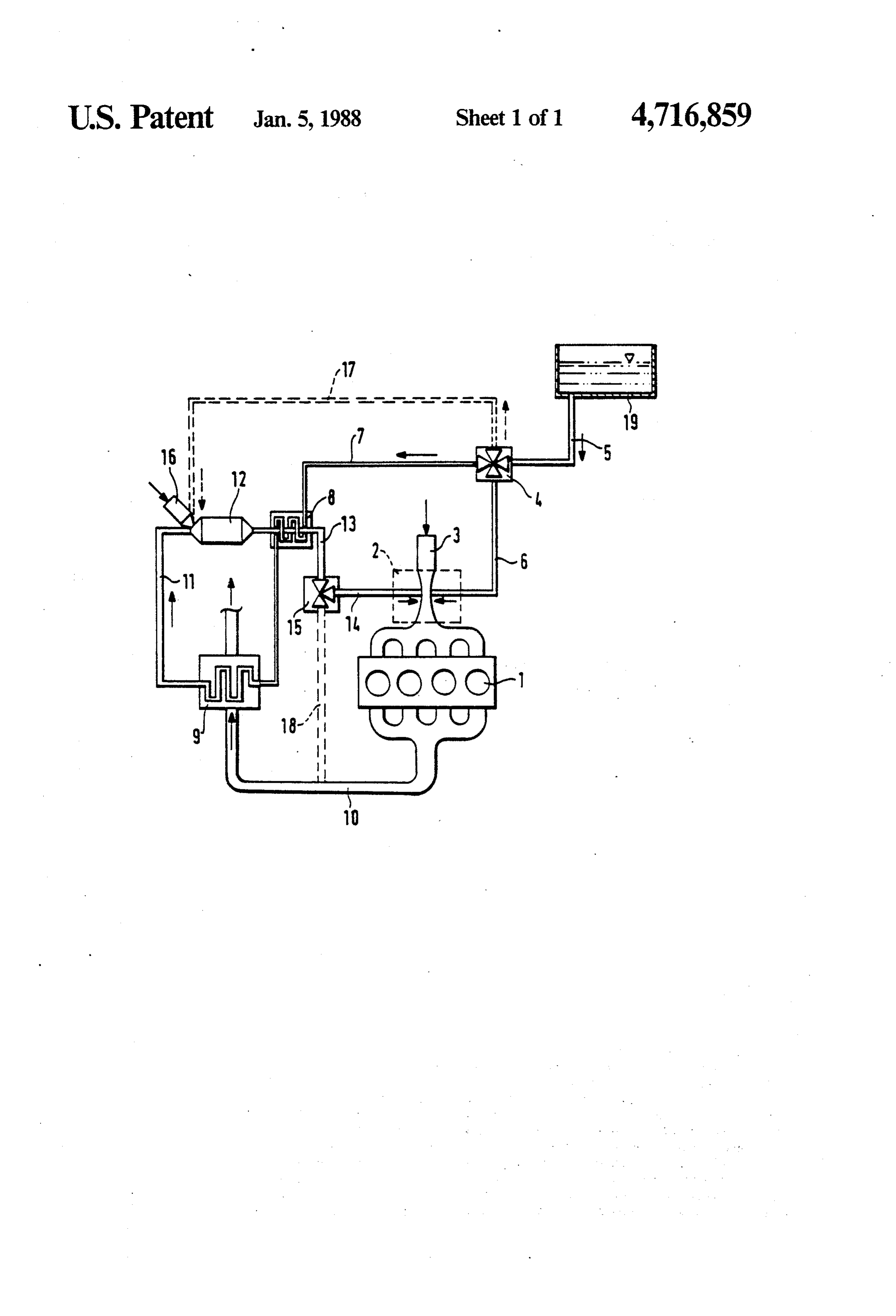
DESCRIPTION OF THE DRAWING surface of the preformed refractory substrate, calcining The attached drawing is a diagrammatic representa of the substrate treated in this manner and impregnating tion of the fuel processing system for a stationary or an the calcined substrate with the noble metal component automotive internal combustion engine. 5 (A). In this case, the water- or methanol-soluble salts of the components of (B2), e.g. the nitrates, formates, ace
DESCRIPTION OF THE PREFERRED tates or oxalates are preferably used. The preformed EMBODIMENT refractory substrate is dipped in the salt solution or Tests have shown that the use of these catalysts re impregnated with it in this case.
sults in a very favorable, largely coke-free methanol 10 According to a further variant, the catalyst can be decomposition at decomposing temperatures in the obtained by impregnation or dipping of the preformed range of 300-600' C. in which the reaction gas contains refractory substrate with or in an alcoholic, especially mainly carbon monoxide and hydrogen, but hardly any methanolic solution of an alkoxytitanate, calcining of amounts of dimethyl ether. Thus, this type of catalyst is the substrate treated in this manner and dipping the particularly suitable for use in a fuel processing system 15 calcined substrate into the noble metal component (A). for combustion engines in which methanol is used as The adhesion of the titanium dioxide to the preformed fuel and in which this is decomposed under reducing or molded shapes can be improved by the use of alkox partly oxidizing conditions in a reaction chamber. Fur ytitanates such 3S tetraisopropyl titanate, ther, the proportion of hydrogen in the gaseous reaction ((CH3)2CHO)4Ti, or tetra-n-butyl titanate, (nmixture can be increased simply by the addition of 20 lyzed C4H8O)4Ti. The alkoxytitanates are preferably hydro water according to equation (2). This is advantageous with steam before calcining. especially for cold-starting.conditions or when a cheap In all variants or preparation of the catalyst, the im hydrogen source is desired for fuel cells. In the latter pregnation of the carrier with the noble metal compo case, the formed CO2 can be separated from the hydro nent is carried out by well-known methods, using gen by known methods (e.g. by absorption in an alkaline 25 water-soluble salts of noble metals, especially of medium or by fractional condensation). H2PtCl6 or (NH4)2PtCl6or the corresponding salts of The noble metal component (A) of the catalyst used Rh or Ir. The catalyst precursors prepared by this according to the invention is preferably platinum. How method are then dried and calcined. Calcining usually is ever, rhodium and/or iridium and alloys of these metals performed at 450" to 650 C., preferably at 550' to 640 may also be used. 30 C.
The concentration of the noble metal component (A) To obtain the respective noble metals from the salts is preferably 0.01 to 3 wt %, preferably 0.05 to 0.3 wit of the noble metals, the calcined catalyst precursor is %, with regard to the total catalyst. To increase the activated by reduction with hydrogen. The activation thermal resistance or stability of the catalysts, the oxidic can be done immediately after calcining or later in the carrier (B1) or the intermediate layer (B2), which is 35 reaction chamber of the processing system. TiO2 or CeO2, or a mixture of TiO2 or CeO2, can con The invention also contemplates the catalytic decon tain as other refractory metallic oxides ZrO2 or La2O3 position or steam reforming of liquids consisting mainly in concentrations from 1 to 20 wt %, preferably 1 to 10 of methanol at autothernic conditions with the addition wt %, particularly 5 to 10 wt %. The hydraulic binder, of oxygen or of a gas containing oxygen. Preferably, preferably Portland or calcium aluminate cement, also 40 water is added to the methanol, and the conversion of contributes to increase the mechanical strength. The the aqueous methanol mixture is then carried out prefer concentration of the hydraulic binder generally ably at a temperature in the range of from 300 to 600 amounts to 5 to 50 wt %, preferably 15 to 25 wt %, with C., a pressure in the range of 0.1 to 10 bar, and a liquid regard to the total catalyst. Cordierite, mullite, silicon space velocity of from 0.5 to 20 liters hydrous methanol carbide or a-Al2O3 are used preferably as preformed 45 per hour and per liter of catalyst. refractory carriers. A practical example of a fuel processing and feeding The oxidic carrier according to variant (B) or the system for a combustion engine is shown in the draw preformed refractory substrate according to variant ing, in which methanol is used as fuel and decomposed (B2) can be in the form of rings, spheres or honeycomb in a reaction chamber.
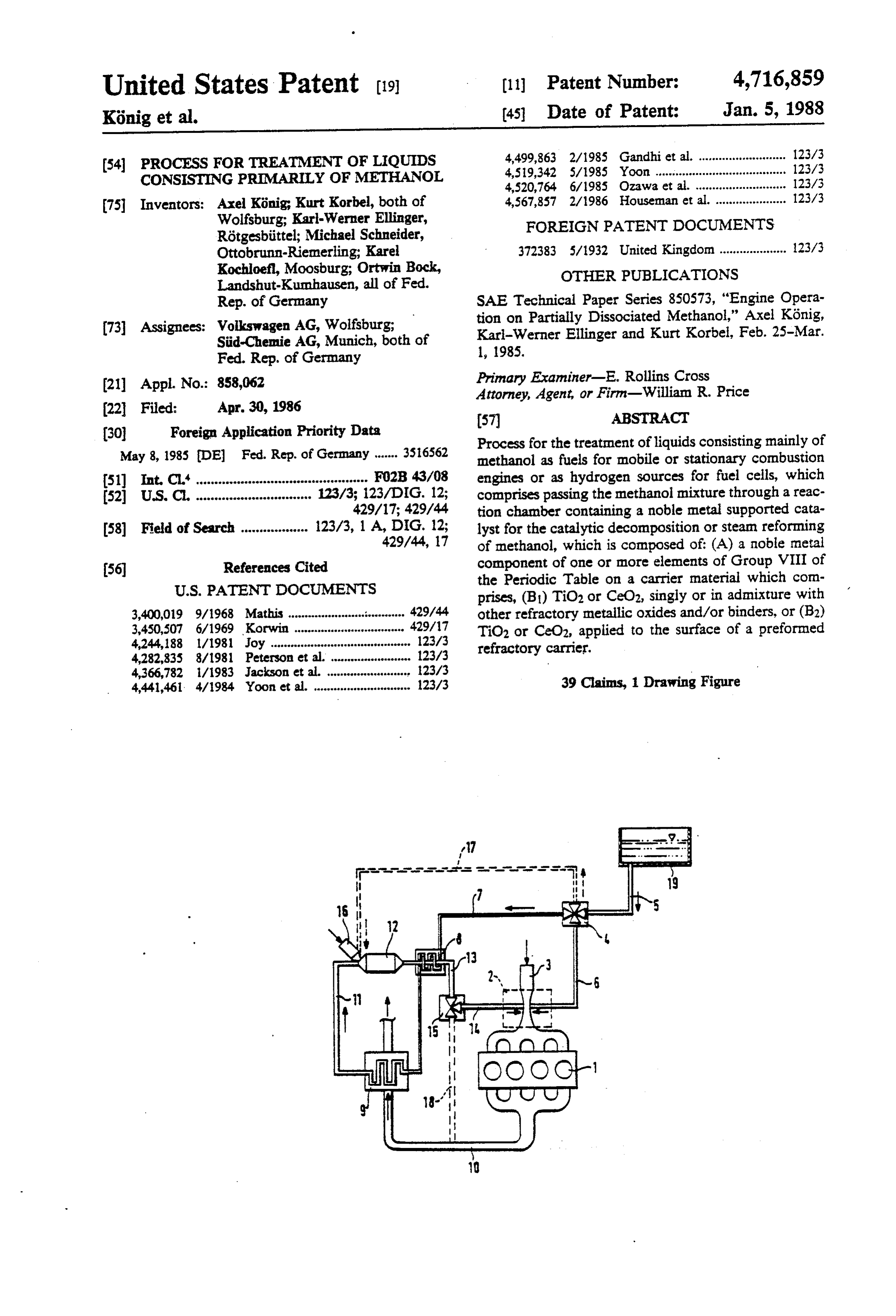
like shapes, tablets or extrusion molded shapes. 50 In the drawing, 1 indicates a regular conventional The catalysts used in the systems according to the combustion engine with several cylinders, which sucks invention can be prepared by various methods. in air through an intake line 3. A fuel metering device is According to one variant, the catalyst is prepared by indicated by 2, through which fuel is fed in liquid and pressing the starting component for (B1) without hy /or gaseous phase, depending on the operating condi draulic binder with a lubricating substance, such as 55 tion of the combustion engine. For this purpose, a gas aluminum stearate and/or graphite, to form molded line 14 feeding gaseous fuel as well as a fuel line 6 feed shapes, calcining of the molded shapes and impregnat ing liquid fuel are connected to the fuel metering device ing the calcined molded shapes with the noble metal 2, and fuel line 6 can be connected through a first con component (A). According to another variant, the cata trol valve 4 to a fuel line 5 extending from a fuel storage lyst is prepared by the addition of water and lubricants tank 19. Fuel storage tank 19 contains liquid methanol such as aluminum stearate and/or graphite to the start as fuel.
ing components for (B) containing a hydraulic binder, A second fuel line 7, which can be operated by con the producing of molded shapes, drying and calcining trol valve 4 alternatively or additionally, is connected of the molded shapes and subsequent impregnation of through a first heat exchanger 8 as well as a second heat the calcined molded shapes with the noble metal com exchanger 9 to a fuel line 11 leading into a reaction ponent (A). chamber 12, in which the methanol used as fuel is trans According to another variant, the catalyst can be ported mainly in the vapor state. In reaction chamber 12 prepared by applying the components of (B2), i.e. TiO2 there is a catalyst that causes a decomposition of the
Page 5
methanol under the effect of elevated temperatures in carbon prevents monoxide and hydrogen and at the same time the formation of dimethyl ether.
the range of approximately 300-600' C. under reduc This catalyst can also be used in a decomposition ing or partly oxidizing conditions, so that a reactor gas system constructed similarly in principle for the prepa is present at the outlet of reaction chamber 12, which ration of hydrogen according contains mainly CO and H2 and also CO2 and H2O case the hydrogen is fed-aftertothe equation (2), in which removal of the CO when obtained under partly oxidizing conditions. This 2-into a fuel cell for direct conversion into electrical gas is removed through line 13 and fed by a second energy.
control valve 15 into gas line 14 leading into fuel meter Several examples for the preparation of the catalysts ing device 2. O used according to the invention are given in the follow A burner provided at the intake of reaction chamber 12 is indicated by 16, which sucks air from the environ ing text.
ment and feeds it into reaction chamber 12 for the pro EXAMPLE I duction of the partly oxidizing atmosphere. In addition, burner 16 obtains fuel during the starting operation 15 to ABET commercial TiO2 (specific surface area according through a starting line 17 from the first control valve 4, after the=addition 45 m2/g) was pressed into 4.5 x 4.5 mm tablets of 8 wt % A-stearate. These were which is ignited and burned during this starting opera heated to 640' C. in air during 8 hours, kept at 640 C. tion for the purpose of heating the reaction chamber. for one hour and then cooled again to room tempera The combustion gases produced in the reaction cham ture. After impregnation with an aqueous solution of ber during this starting operation are led by proper 20 H2PtCl6 (at 25' C.), the Pt-containing tablets were dried switching of the second control valve 15 through a line (120' C., 4 hours) and calcined (2 hours) at 400' C. The 18 directly into an exhaust gas line indicated by 10, catalyst obtained by this method (K-1) contained 0.3 wt which removes the combustion gases of combustion % Pt. Its physical-mechanical data are compiled in engine 1. Table I.
The heat of reaction needed in reaction chamber 12 25 for the performance of the endothernically proceeding EXAMPLE 2 methanol decomposition process is provided by the A commercial TiO2 (spec. surface area (SA) accord heating, vaporizing and super-heating of the fuel sup ing to BET = 45 m2/g) was first mixed dry with 25% plied for this decomposition process in two heat ex calcium aluminate cement. Then, after the addition of changers 3 and 9 in the practical example shown in the 30 60% H2O (calculated with regard to the material used), drawing and in addition by an exothermic partial oxida wet mixed, and 3% electrographite were added shortly tion of the fuel with the use of the air fed in through before the end of the mixing process. The moist mass burner 16 taking place in reaction chamber 12. The was spread out in a thin layer and air-dried at 120' C. liquid methanol is heated and partially vaporized in the until a loss on drying (LOD) of 8 to 12% was obtained. first heat exchanger 8 through which the liquid fuel 35 The mass was then pressed into cylindrical tablets with flows. Simultaneously, the decomposition gas dis a diameter of 4.5 mm and a height of 4.5 mm. The tab charged from reaction chamber 12 through line 13 is lets were stored for four days in a closed container and cooled so that charging losses in combustion engine 1 then steam treated in a steam autoclave at 5.5 bar and due to elevated temperatures of the mixture are pre 155 C. for 12 hours. The tablets were then allowed to vented. The remaining liquid methanol is vaporized and sit in the air for one day and subsequently heated in air the vapor is super-heated in the second heat exchanger to 640 C. within three hours and maintained at 640 C. 9 heated by the exhaust gases of combustion engine 1, so for one hour. After cooling, they were impregnated that the fuel can be fed into reaction chamber 12 in the with an aqueous solution of H2PtCl6. The tablets con vapor state at elevated temperatures. taining Pt were dried at 120' C. (4 hours) and calcined Further utilization of the sensible heat of the exhaust again at 400' C. (2 hours). The catalyst (K-2) obtained gases removed through exhaust gas line 10 from con by this method contained 0.3 wt % Pt. Its physical bustion engine 1, could involve diverting these gases mechanical data are compiled in Table I. through an outer jacket (not shown) surrounding reac EXAMPLE 3 tion chamber 12 for indirect heat exchange within the reaction chamber 12. SO A commercial CeO2 (BET-SA = 43 m2/g) was Depending on the operating condition of the combus pressed into 4.5x4.5 mm tablets after the addition of 8 tion engine, liquid fuel and/or the decomposition gas wt % All-stearate. These were heated in air at 640 C. removed from reaction chamber 12 can now be mixed for 3 hours, then maintained at 640 C. for one hour and with the combustion air sucked in through suction line subsequently cooled again to room temperature. After 3. In this case, the addition of decomposition gas, which 55 impregnation with an aqueous solution of H2PtCl6 (at is limited in volume, will predominate especially under 25 C.), the tablets containing Pt were dried (120' C., 4 operating conditions where large proportions of harm hours) and calcined again at 400' C. (2 hours). The ful substances are usually produced. Such operating catalyst obtained by this method (K-3) contained 0.3 wit conditions include cold start and the warm running of % Pt. Its physical-mechanical data are compiled in the combustion engine as well as low speed operating 60 Table I.
conditions in which lean fuel-air ratios are used. During EXAMPLE 4 operating conditions approaching high speed, more liquid fuel is used to reach the desired high perfor Square openings measuring 1.5 ceramic A commercial honeycomb refractory with mm along each side was
The catalyst of this invention is used in reaction 65 dipped in tetraisopropyl titanate (TIPT) at roon ten chamber 12 at the lowest possible temperatures in the perature for 30 minutes.
The carrier was then steam treated in a steam auto range of approximately 300' C. This converts the meth anol during this process as completely as possible into clave at 5.5 bar and 155 C. for 12 hours to hydrolyze
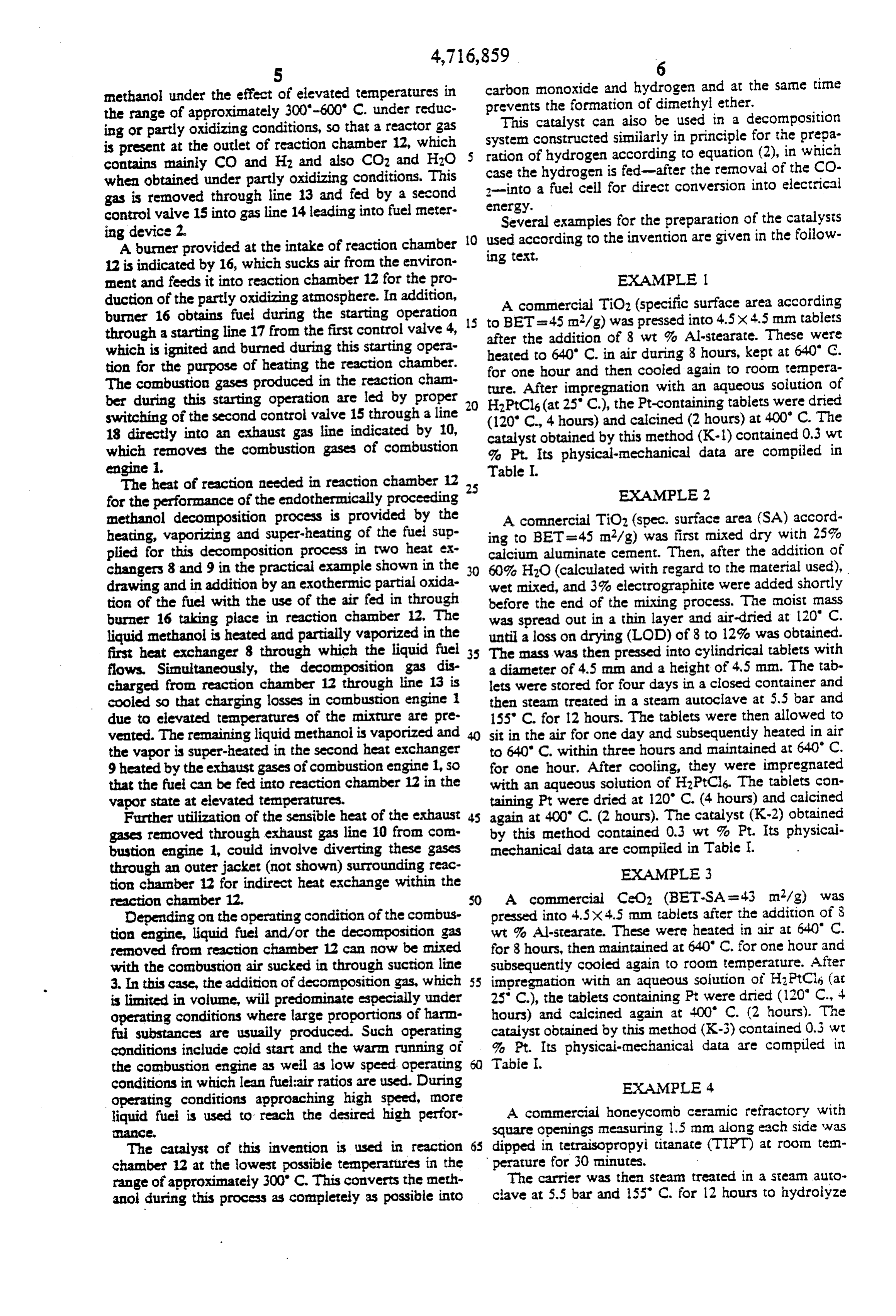
Page 6
the TIPT. Then it was calcined in a muffle furnace at The catalyst (K-7) obtained by this method contained 600' C. (2 hours). The honeycomb ceramic carrier con 0.3 wt % Pt; its physical-mechanical data are compiled tained 6 wt % TiO2 after this treatment. in Table I.
The TiO2 containing carrier was impregnated with an EXAMPLE 8 aqueous solution of H2PtCl6. Thereafter, it was care The process of Example 7 was repeated with the fully dried and calcined again at 400' C. (2 hours).
The catalyst (K-4) obtained by this method contained variation that the La2O3 was replaced by the Sane 0.3% Pt; its physical-mechanical data are compiled in amount of ZrO2. The physical-mechanical data of the Table I. catalyst (K-3) obtained by this method are compiled in O Table I.
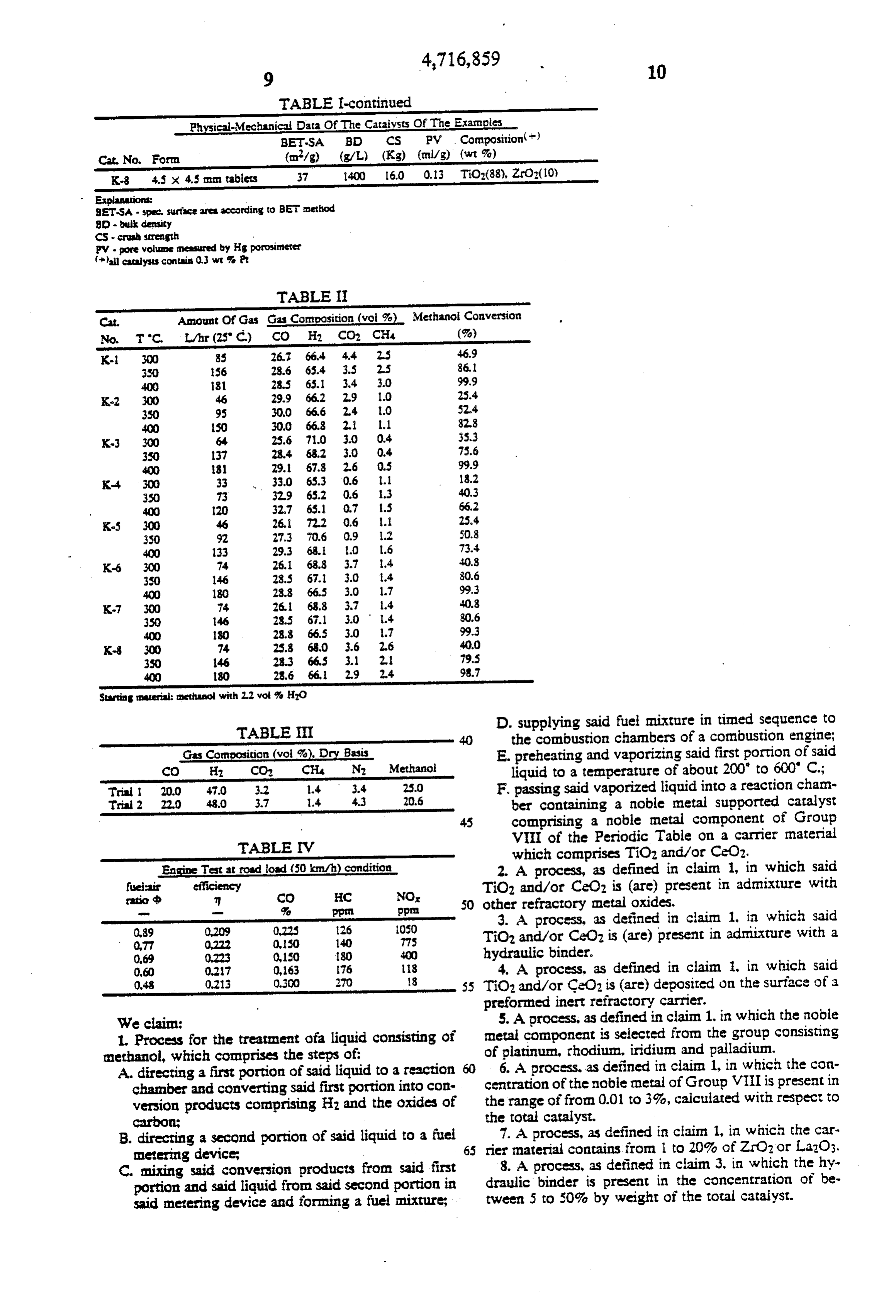
EXAMPLES The catalysts obtained according to Examples l and 2 A commercial a-Al2O3 substrate (spheres with 2-6 were heated to 400' C. in a stream of hydrogen over a mm diameter, BET-SA=200 m2/g) was dipped in tetra period of 3 hours to reduce the noble metal component. isopropyl titanate (TIPT) at room temperature for 15 After cooling to 300' C., the methanol decomposition minutes. Subsequently, the TIPT was hydrolyzed by 15 was started in a conventional metal tube reactor. The steam treating in a steam autoclave at 5.5 bar and 155 nethanol contained 2.2 vol %, H2O. The methanol de C. for 12 hours. Then it was calcined at 600 C. (2 composition was carried out with a rate of flow of 2 hours). The substrate contained 2.6 wt % TiO2. liters/hour/liter of catalyst at 300', 350' and 400' C. After impregnation with an aqueous solution of The catalysts obtained according to Examples 1 to 8 HPtCl6, the spheres containing Pt were dried at 120' were heated in a stream of hydrogen to 400' C. over a C. (4 hours) and calcined again at 400' C. (2 hours). period of 3 hours to reduce the noble metal component. The catalyst (K-5) obtained by this method contained After cooling to 300' C., a methanol decomposition was 0.3 wt % Pt; its physical-mechanical data are compiled carried out with these catalysts in a test reactor, under in Table I. conditions in the test reactor corresponding to a largely isothermic decomposition. This methanol decomposi
EXAMPLE 6 tion was performed at a space velocity of 2 liters per A commercial TiO2 (BET-SA=45 m2/g) was mixed hour and liter of catalyst at 300', 350' and 400' C. The with a commercial La2O3 (BET-SA=25 m/g) (ratio gas developed by the catalytic decomposition was nea by weight 9:1) for approximately 30 minutes in a pan sured with a gas meter and analyzed by gas chromatog grinder. After the addition of 8 wt % Al-stearate, the 30 raphy. The results are compiled in Table II. mass was pressed into 4.5X4.5 mm tablets and the pro In additional trials, methanol decomposition was duced tablets were heated in air to 640 C. for 8 hours, performed under largely autothermic conditions, which then kept at 640' C. for one hour and subsequently correspond principally to the conditions in reaction cooled again to room temperature. The tablets were chamber 12 in the fuel processing system shown in the impregnated with an aqueous solution of H2PtCl6. 35 drawing. Here, the concentration recorded in vol% in The catalyst (K-6) obtained by this method contained Table III were determined as typical gas compositions 0.3 wt % Pt; its physical-mechanical data are compiled in 2 trials with catalyst Kil and K5, respectively. The in Table I. rates of flow were between 3 liters per hour and liter of EXAMPLE 7 catalyst and 6 liters per hour and liter of catalyst in these trials. The temperatures in the reactor were between
A commercial TiO2 (BET-SA=45 m2/g) was mixed 220' C. and 400' C. A four-cylinder in-line spark-igni with a commercial La2O3 (BET-SA=2.5 m2/g)(ratio by tion engine of a passenger car with a piston displace weight 9:1) for approximately 30 minutes in a pan ment of 1800 cm was fed with a decomposition gas grinder. After the addition of 8 wt % Al-stearate, the obtained by Trial 2 of Table III. The efficiency T of the mass was pressed into 4.5x4.5 mm tablets. These tablets 45 engine as well as the concentration of harmful sub were heated to 640". C. in air for 3 hours, then kept at stances contained in the exhaust gases of the engine 640 C. for one hour and subsequently cooled again to were measured at an operating condition corresponding room temperature. to a road load of 50 kilometers per hour. The results are The tablets were then impregnated with an aqueous compiled in Table IV with the fuel:air ratio d as a vari solution of H2PtCl6 at 25 C. The tablets containing Pt 50 able. These results show that using the decomposition were dried (120' C., 4 hours) and caicined again at 400" gas an engine running is obtainable with very lean air:f- C. (2 hours). uel ratio (d=0.48) with good efficiency and with low concentration of harmful exhaust substances.
TABLE I
Physical-Mechanical Data Of The Catavsts Of The Exarntpies
Cat No. Forn (m/g) (g/L) (Kg) (mi/g) (wt %)
K-1 4.5 x 4.5 mm tablets 40 1326 7.3 0.13 TiO2
K-2 4.5 x 4.5 mm tablets 5 l13 39.0 0.22 TiO75) Ca-Al-cement
K-3 4.5 x 4.5 mm tablets 1850 12.5 0.12 CoO
K- Honeycomb ceramics 8 358 0.14 TiO2(6.1), Cordierite K-5 2-3 mm spheres 25 (523 10.0 0.50 TiO2(2.6), Al2O3
K-6 4.5 x 4.5 mm tablets 35 1350 16.0 0.12 TiO2(38), La2O3(10)
K-7 4.5 x 4.5 mm tablets 35 1350 160 0.12 TiO2(83), LaO3(10)
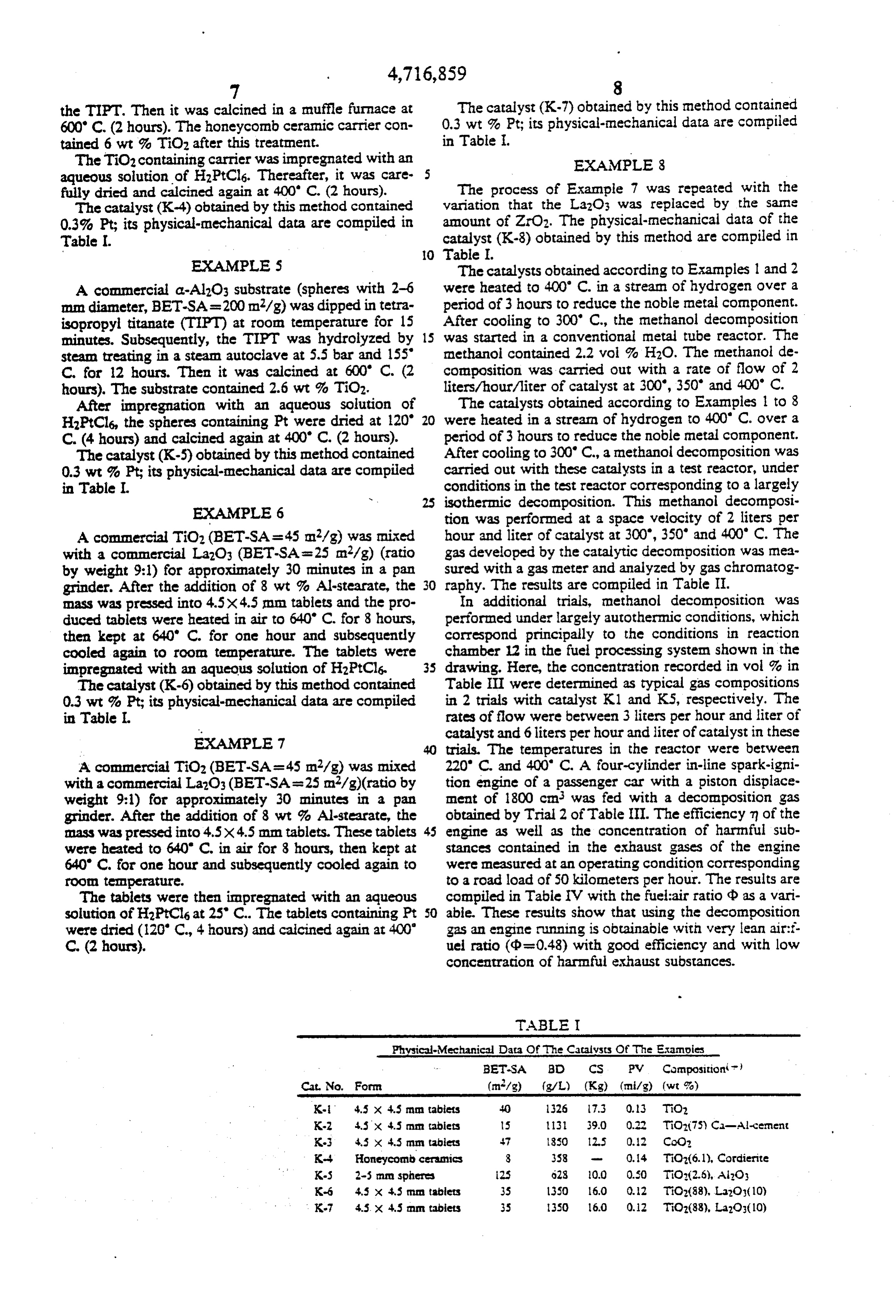
Page 7
TABLE I-continued
Physical-Mechanical Data Of The Catalysts Of The Examples
Cat No. Fora (m/g) (g/L) (Ks) (ml/g) (wt %)
K-3 4.5 x 4.5 mm tablets 37 400 16.0 0.13 TiO2(83), ZrO2(10) Explanations:
BET-SA - spec. surface area according to BET method
Bad - bulk density
CS crush strength
FV - pore volume measured by Hg porosimeter *all catalysts contain 0.3 wt % Pt
TABLE II
Cat. Amount Of Gas Gas Composition (vol. 2) Methanoi Conversion
K- 300 8S 26.7 66.4 44, 2.5 46.9
400 81 28S 65. 34 3.0 99.9
K-2 300 46 29.9 662 29 1.0 25.4
400 30 30.O 66.3 2. l. 323
K-3 300 64 25.6 71.0 3.0 0.4 35.3
K-4 300 33 33.0 65.3 0.6 .1 13.2 3SO 73 329 65.2 0.6 .3 40.3 400 20 327 6S. 0.7 1.5 66.2
K-S 300 46 26, 722 0.6 . 25.4
K-6 300 74 26. 63.8 3.7 .4 40.3 330 146 23.5 67. 3.0 t.A. 80.6
K-7 3CO 74 26, 68.8 3.7 .4 40.3
400 180 28.8 66S 3.0. 7 99.3
K-8 300 74 25.3 680 3.6 2.6 400
Starting material: methanol with 22 vol% HO
TABLE III
D. supplying said fuel mixture in timed sequence to - 40 the combustion charnbers of a combustion engine; Gas Composition (vol. 23). Dry Basis E. preheating and vaporizing said first portion of said CO H. CO CH. N. Methanol liquid to a temperature of about 200' to 600' C.; Trial 200 to 32 1.4 3.4 25.0 F. passing said vaporized liquid into a reaction cham Trial. 2 220 48.0 3.7 .4 4.3 20.6 ber containing a noble metal supported catalyst 45 comprising a noble metal component of Group
TABLE rv VIII of the Periodic Table on a carrier material which comprises TiO2 and/or CeO2.
Enginest at road load (30 km/h) condition 2. A process, as defined in claim 1, in which said fit cities CO HC NO TiO2 and/or CeO2 is (are) present in admixture with % ppm 50 other refractory metal g h . A process, as defined in claim 1, in which said 2 3. : g: TiO2 and/or CeO2 is (are) present in admixture with a 0.69 0.223 0,150 30 400 hydraulic binder. 060 O27 0,163 8 4. A process, as defined in claim 1, in which said 0.48 0.23 0.300 270 13 55 TiO2 and/or CeO2 is (are) deposited on the surface of a - preformed inert refractory carrier.
We cairn: 5. A process, as defined in claim. 1. in which the noble 1. Process for the treatment ofa liquid consisting of metal component is selected from the group consisting methanol, which comprises the steps of: of platinum, rhodium, iridium and palladium.
A directing a first portion of said liquid to a reaction 60 6. A process, as defined in claim 1, in which the con chamber and converting said first portion into con- centration of the noble metal of Group VIII is present in version products comprising H2 and the oxides of the range of from 0.01 to 3%, calculated with respect to carbon; the total catalyst.
B. directing a second portion of said liquid to a fuel 7. A process, as defined in claim 1, in which the car metering device; 65 rier material contains from 1 to 20% of ZrO2 or La2O3. C. mixing said conversion products from said first 8. A process, as defined in claim 3, in which the hy portion and said liquid from said second portion in draulic binder is present in the concentration of be said metering device and forming a fuel mixture; tween 5 to 50% by weight of the total catalyst.
Page 8
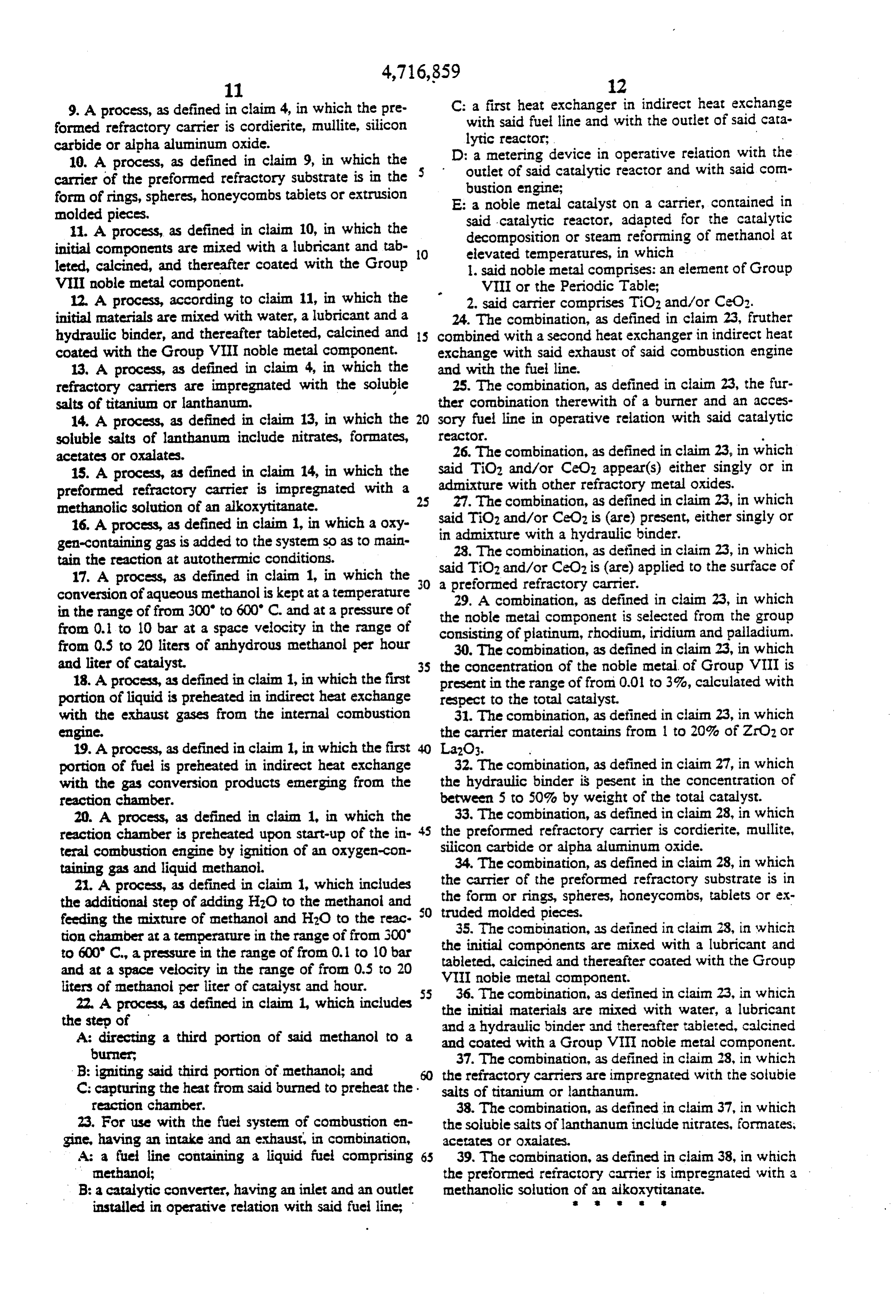
9. A process, as defined in claim 4, in which the pre C: a first heat exchanger in indirect heat exchange formed refractory carrier is cordierite, nullite, silicon with said fuel line and with the outlet of said cata carbide or alpha aluminum oxide. lytic reactor;
10. A process, as defined in claim 9, in which the D: a metering device in operative relation with th carrier of the preformed refractory substrate is in the 5 outlet of said catalytic reactor and with said corn form of rings, spheres, honeycombs tablets or extrusion bustion engine;
molded pieces, E: a noble metal catalyst on a carrier, contained in said catalytic reactor, adapted for the catalytic 11. A process, as defined in claim 10, in which the decomposition or steam reforming of methanol at initial components are mixed with a lubricant and tab 10 elevated temperatures, in which leted, calcined, and thereafter coated with the Group 1. said noble metal comprises: an element of Group VIII noble metal component. VIII or the Periodic Table; 12. A process, according to claim 11, in which the 2. said carrier comprises TiO2 and/or CeO2. initial materials are mixed with water, a lubricant and a 24. The combination, as defined in claim 23, fruther hydraulic binder, and thereafter tableted, calcined and 15 combined with a second heat exchanger in indirect heat coated with the Group VIII noble metal component. exchange with said exhaust of said combustion engine 13. A process, as defined in claim 4, in which the and with the fuel line.
refractory carriers are impregnated with the soluble 25. The combination, as defined in claim 23, the fur salts of titanium or lanthanun. ther corubination therewith of a burner and an acces 14. A process, as defined in claim 13, in which the 20 sory fuel line in operative relation with said catalytic soluble salts of lanthanum include nitrates, formates, reacO.
acetates or oxalates. 26. The combination, as defined in claim 23, in which 15. A process, as defined in claim 14, in which the said TiO2 and/or CeO2 appear(s) either singly or in admixture with other refractory metal oxides.
preformed refractory carrier is impregnated with a 25 27. The combination, as defined in claim 23, in which methanolic solution of an alkoxytitanate.
16. A process, as defined in claim 1, in which a oxy said TiO2 and/or CeO2 is (are) present, either singly or gen-containing gas is added to the system so as to main in admixture with a hydraulic binder. tain the reaction at autothermic conditions. 23. The combination, as defined in clain 23, in which said TiO2 and/or CeO2 is (are) applied to the surface of 17. A process, as defined in claim 1, in which the 30 a preformed conversion of aqueous methanol is kept at a temperature refractory carrier. 29. A combination, as defined in claim 23, in which in the range of from 300' to 600' C. and at a pressure of the noble metal component is selected from the group from 0.1 to 10 bar at a space velocity in the range of consisting of platinum, rhodium, iridium and palladium. from 0.5 to 20 liters of anhydrous methanol per hour 30. The combination, as defined in claim 23, in which and liter of catalyst. the concentration of the noble metal of Group VIII is 18. A process, as defined in claim 1, in which the first present in the range of from 0.01 to 3%, calculated with portion of liquid is preheated in indirect heat exchange respect to the total catalyst.
with the exhaust gases from the internal combustion 31. The combination, as defined in clain. 23, in which engine. the carrier material contains from 1 to 20% of ZrO2 or 19. A process, as defined in claim 1, in which the first La2O3.
portion of fuel is preheated in indirect heat exchange 32. The combination, as defined in claim 27, in which with the gas conversion products energing from the the hydraulic binder is pesent in the concentration of reaction chamber. between 5 to 50% by weight of the total catalyst. 20. A process, as defined in claim 1, in which the 33. The combination, as defined in claim 28, in which reaction chamber is preheated upon start-up of the in 45 the preformed refractory carrier is cordierite, mullite, teral combustion engine by ignition of an oxygen-con silicon carbide or alpha aluminum oxide. taining gas and liquid methanoi. 34. The combination, as defined in claim 28, in which 2. A process, as defined in claim 1, which includes the the carrier of the preformed refractory substrate is in form or rings, spheres, honeycombs, tablets or ex the additional step of adding H2O to the methanol and SO truded molded pieces.
feeding the mixture of methanol and H2O to the reac tion chamber at a temperature in the range of from 300' the35.initial
The combination, as defined in claim 23, in which components are mixed with a lubricant and to 600 C., a pressure in the range of from 0.1 to 10 bar tableted, calcined and thereafter coated with the Group and at a space velocity in the range of from 0.5 to 20 VIII noble metal component. liters of methanol per liter of catalyst and hour. 55 36. The combination, as defined in claim 23, in which 22. A process, as defined in claim 1, which includes the initial materials are mixed with water, a lubricant the step of and a hydraulic binder and thereafter tableted, calcined A: directing a third portion of said methanol to a and coated with a Group VIII noble metal component. burner 37. The combination, as defined in claim 28, in which B: igniting said third portion of methanol; and the refractory carriers are impregnated with the soluble C; capturing the heat from said burned to preheat the . salts of titanium or lanthanum.
reaction chamber. 38. The combination, as defined in claim 37, in which 23. For use with the fuel system of combustion en the soluble salts of lanthanum include nitrates, formates, gine, having an intake and an exhaust, in combination, acetates or oxalates.
A: a fuel line containing a liquid fuel comprising 65 39. The combination, as defined in claim 38, in which methanol; the preformed refractory carrier is impregnated with a B: a catalytic converter, having an inlet and an outlet methanolic solution of an alkoxytitanate. installed in operative relation with said fuel line;
Page 9
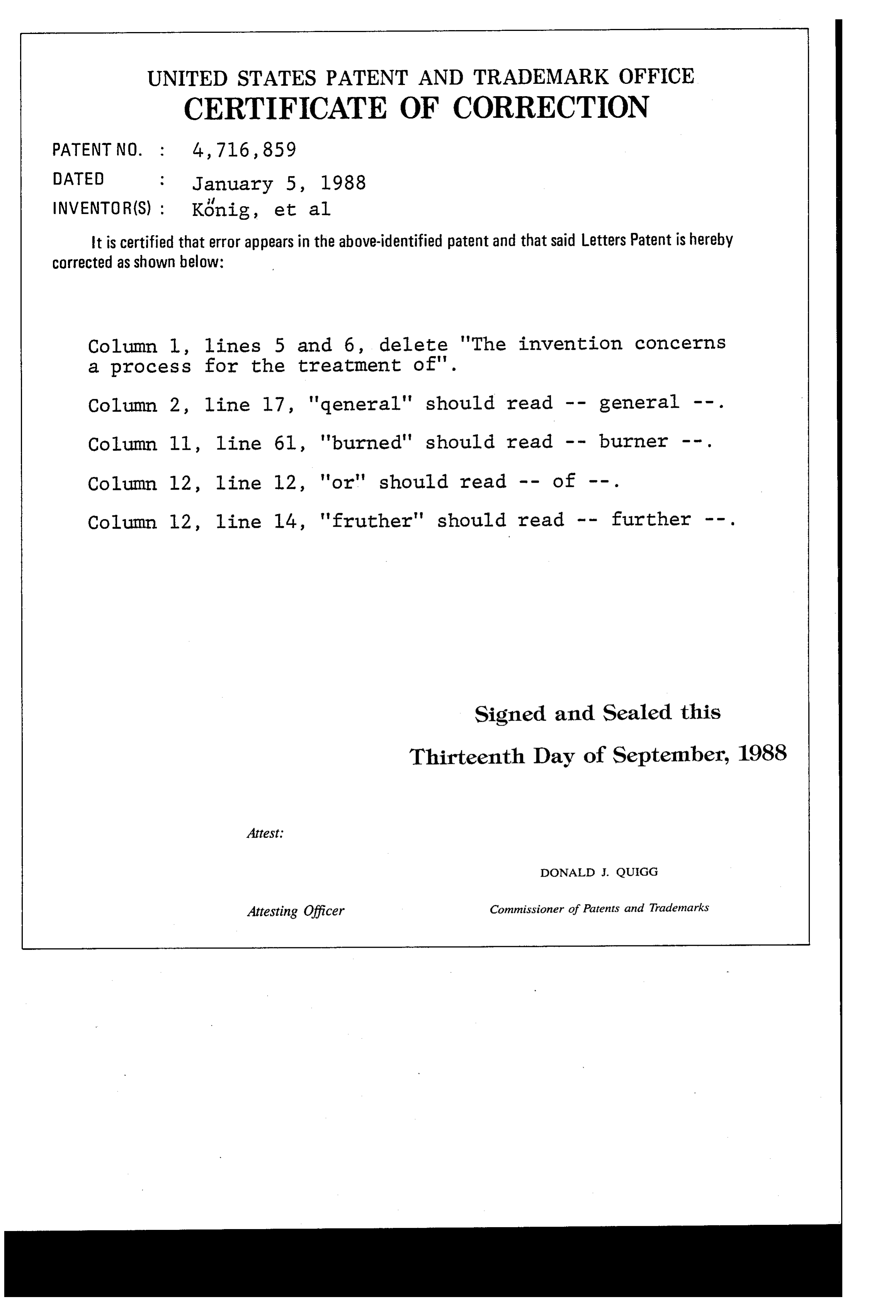
UNITED STATES PATENT AND TRADEMARK OFFICE
CERTIFICATE OF CORRECTION
INVENTOR(S) : König, et al.
It is certified that error appears in the above-identified patent and that said Letters Patent is hereby Corrected as shown below:
Column 1, lines 5 and 6, delete 'The invention concerns a process for the treatment of'.
Column 2, line 17, 'qeneral' should read -- general -- . Column 11, line 61, 'burned' should read -- burner -- . Column 12, line 12, 'or' should read -- of --. Column 12, line 14, 'fruther' should read -- further --.
Signed and Sealed this
Thirteenth Day of September, 1988
Attest:
DONALD J. QUIGG
Attesting Officer Commissioner of Patents and Trademarks
Provenance
- Collection
- Cited prior art
- Original PDF
- patentimages.storage.googleapis.com →
- Filed
- 1986-04-30
- Pages
- 9
- Method
- pdftotext (the PDF's own text layer) + pdftoppm 300dpi page scans
- Source
- Google Patents bibliographic record
- Granted
- 1988-01-05
- Inventors
- Axel Konig; Kurt Korbel; Karl-Werner Ellinger; Michael Schneider; Karel Kochloefl; Ortwin Bock; Sued Chemie AG; Volkswagen AG
- Transcribed from
- patentimages.storage.googleapis.com →