patent · US4192146
Process for the recovery of energy and in particular for the recovery of heat on the heat pump principle
11 March 1980
Page 1 — bibliographic record
United States Patent (19) 11) 4,192,146 Crede 45) Mar. 11, 1980 54 PROCESS FOR THE RECOVERY OF FOREIGN PATENT DOCUMENTS
ENERGY AND IN PARTICULAR FOR THE
RECOVERY OF HEAT ON THE HEATPUMP 2160785 6/1973 Fed. Rep. of Germany ... ... 62/238 PRINCIPLE 2260462 6/1974 Fed. Rep. of Germany ... ... 237/26
76 Inventor: Helfried Crede, Fuchsbichl 9b, 2411308 9/1975 Fed. Rep. of Germany .......... 237/1 A D-8021 Icking, Fed. Rep. of 2441775 3/1976 Fed. Rep. of Germany ........... 126/400 Germany 2552459 6/1976 Fed. Rep. of Germany .
825313 3/1938 France ....................................... 62/19 2290639 11/1974 France ....................................... 62/238 (21) Appl. No.: 820,435 2307235 11/1976 France ....................................... 62/238
22 (Filed: Aug. 1, 1977 237313 8/1945 Switzerland . (30) Foreign Application Priority Data OTHER PUBLICATIONS Jul. 30, 1976 (DE) Fed. Rep. of Germany ....... 2634,233 Solar Energy: Part II, The Continent p. 87, Heating Apr. 4, 1977 (DE) Fed. Rep. of Germany ....... 2715075 /Piping/Air Conditioning.
"Ice-Maker Heat Pump: A New Tool for Energy Con 51) Int. C.’........................ F25B 27/00; F25D3/00; servation', Jan. 1977, vol. 45, #1, Refrigeration Service
52 U.S.C. ............................................. 62/2; 62/59; "Heat Pump Progress in Europe', The Heating & Ven 62/238; 126/400 tilating Engineer, Jul/Aug. 1978, A. A. Field.
58) Field of Search ..................... 237/1 A, 2 B; 62/2, Primary Examiner-Leslie Braun 62/238, 59,238 W, 324 D, 126/400 Attorney, Agent, or Firm-Karl H. Gross (56) References Cited 57 ABSTRACT
1,969,187 8/1934 Schutt .................................. 62/59 X one or more ambient heat sources whose temperature is 1,985,632 12/1934 Fleischer .................................. 62/59 usually above but may drop near 0° C. Heat is with 3,563,304 2/1971 McGrath ............................. 237/2 B drawn from the body according to the heat-pump prin 3,952,519 4/1976 Watson ........... 126/400X ciple. If the temperature of the heat sources drops near 3,984,050 10/1976 Gustafsson ........................... 237/2 B zero the withdrawal of heat from the body results in the
formation of ice in the body and the latentheat of fusion liberated during the ice formation is also withdrawn, so 4,019,338 4/1977 Poteet ......... ... 62/238 E that the time periods during which the temperature of 4,019,679 4/1977 Vogt et al............................ 237/2 B the ambient sources is near 0° C. can be bridged. When 4,030,312 6/1977 Wallin ........................................ 62/2 the temperature of the ambient sources rises again their 4,037,650 7/1977 Randall .................................. 62/238 4,044,949 8/1977 Morawetz et al. .................. 237/1 A heat is used to re-melt the ice in the body of water. 4,049,045 9/1977 Moog................................... 237/2 B 4,123,002 10/1978 Saunders ............................. 237/1 A 11 Claims, 1 Drawing Figure
Page 2
Drawing sheet — no readable text.
Page 3
In accordance with the invention this problem is
PROCESS FOR THE RECOVERY OF ENERGY solved by the process as disclosed herein. AND IN PARTICULAR FOR THE RECOVERY OF Ambient heat sources, that are generally available, HEAT ON THE HEAT PUMP PRINCIPLE are e.g. the ambient air, soil, rain water, melted snow water, domestic waste water, solar radiation. The start
For obtaining heat from ambient sources of heat, such ing point of the process according to the invention is the as air and soil, water and also direct solar radiation, fact that even in our latitudes in winter the ambient there is available a circulation process known as "heat temperature, apart from a few periods of frost, is gener pump'. In this, a cold medium, which is brought to a ally above 0 C. and frequently well above this. low temperature by adiabatic evaporation, is brought O For the recovery of heat from ambient heat sources into heat exchange relationship with the ambient heat the process according to the invention provides be source. The heated cold medium is heated to a high tween the ambient sources and the circulation path for temperature by compression, whereupon it gives up the cooling medium of the "heat pump' a water reser heat to a heating circuit in a heat exchanger. voir which on the one hand is in heat exchange relation Air and soil are poor conductors of heat, for which 15 ship with the cooling medium of the heat pump, in reason and owing to the danger of icing up of the heat order to draw heat from the water into the cooling transfer surfaces they have hitherto received little atten medium, taking into account the formation of ice, and to tion for the purpose of obtaining heat. Water, which which on the other hand heat is fed from the ambient basically would be well suited for obtaining heat for 20 heat sources to melt ice that has formed. heating purposes, is available in sufficient quantities For melting the ice that forms in the process accord only in exceptional cases as soil water or surface water. ing to the invention one or more of the said ambient In winter, which is the season of greatest heating solar heat sources are always available. Periods of frost can radiation is so slight owing to the low position of the be bridged by providing a large water reservoir of e.g. sun and frequent occurrence of cloud, that it cannot be 25 20-50 m3 as a heat store or buffer. Then during periods resorted to to cater for more than a basic need for heat of frostice is produced which is remelted later when the 1ng. frost periods are over by means of the said ambient heat In order, in the use of water as a source of heat, to sources. If the period of frost lasts for a long time the reduce the necessary quantity of water in such manner relatively cheap off-peak current can be utilized for that e.g. drawing from the public water supply is possi 30 melting the ice.
ble, in accordance with a proposal in Swiss Pat. No. 231 The heat store or buffer, owing to its low tempera 449 the latent heat of the water is rendered useful for ture, viz. O'C., does not undergo any loss of energy by heating purposes by cooling the drawn water to the heat radiation, conduction or convection, in contrast freezing point and freezing it. The ice that becomes when embedded in "warm' soil affords a recovery of deposited on the vaporiser of the "heat pump' is period 35 energy.
ically broken off by changing the shape of the parts on In addition to its function as a heat store or buffer the which the ice is deposited or, in accordance with a water reservoir fulfils a further important function. proposal in Swiss Pat. No. 237 313 is loosened by melt Whilst with direct heat exchange of the ambient air ing the adhering layer from within. The broken off or with the cooling medium of the heat pump rapid icing loosened ice is then to be swept off into a duct system or of the vaporiser and hence a complete cessation of the into a sea or river which is available. Owing to the large flow of heat from the air into the cooling medium is to quantity of ice forming-about 3 tons a day for an aver be expected, in the case of the present process the ambi age one-family house-and the associated technical and ent air is brought into heat exchange relationship with ecological problems the path of the ice deposit into the the water reservoir, which is at a temperature of 0°C, duct system or sea or river is not accessible. 45 so that the moisture in the air is not deposited as ice. On In the first-mentioned Swiss Pat. No. 231 449 the use the contrary, ice is formed on the vaporiser surfaces of a cooling system for an artificial ice path for heating immersed in water, where it can be satisfactorily be purposes is also mentioned. The cooling system has to remelted by the water that passes over it and which has dissipate the heat flowing from the ambient air into the been heated by the ambient heat sources. artificial ice path; the heat can be fed into a heating 50 According to the external temperature and the heat circuit. Apart from the fact that in relation to the size of ing requirements a more or less thick coating of ice will the cooling system the recovery of heat is only slight form around the surfaces of the vaporiser, which will owing to the poor flow of heat, which it is not desired impair the flow of heat from the water reservoir to the to improve, from the ambient air over the ice into the cooling medium. In order to take account of this, the cooling medium, the heat incidence is the reverse of 55 surfaces of the vaporiser should be made sufficiently what is required. With a high external temperature the large. Advantageously the deposited ice is also continu cooling system operates fully with a corresponding ously or periodically loosened from the vaporiser sur incidence of heat, in order to keep the ice frozen. The faces, for which purpose mechanical or thermal loosen lower the external temperature falls, the less does the ing processes in accordance with Swiss Pat. Nos. 231 cooling system need to operate, at external tempera 449, 237 313 and German Offenlegungsschrift 2552 459 tures below 0° C. may even come to a standstill. Just are available.
when heating is most required the cooling system fails Advantageously the water reservoir may have a sub in the recovery of heat. stance, e.g. cooking salt, added to it so that a porous ice The invention is based on the problem of providing a layer of improved heat conductivity forms which can process in which generally available ambient heat 65 more easily be loosened, e.g. mechanically. The poros sources can be used for the economic recovery of en ity of the ice layer is attributable to a multiplicity of ergy and in particular for the recovery of heat for heat capillaries in which the salt separates during the forma ing purposes and periods of frost can be bridged. tion of ice in the form of highly concentrated sols.
Page 4
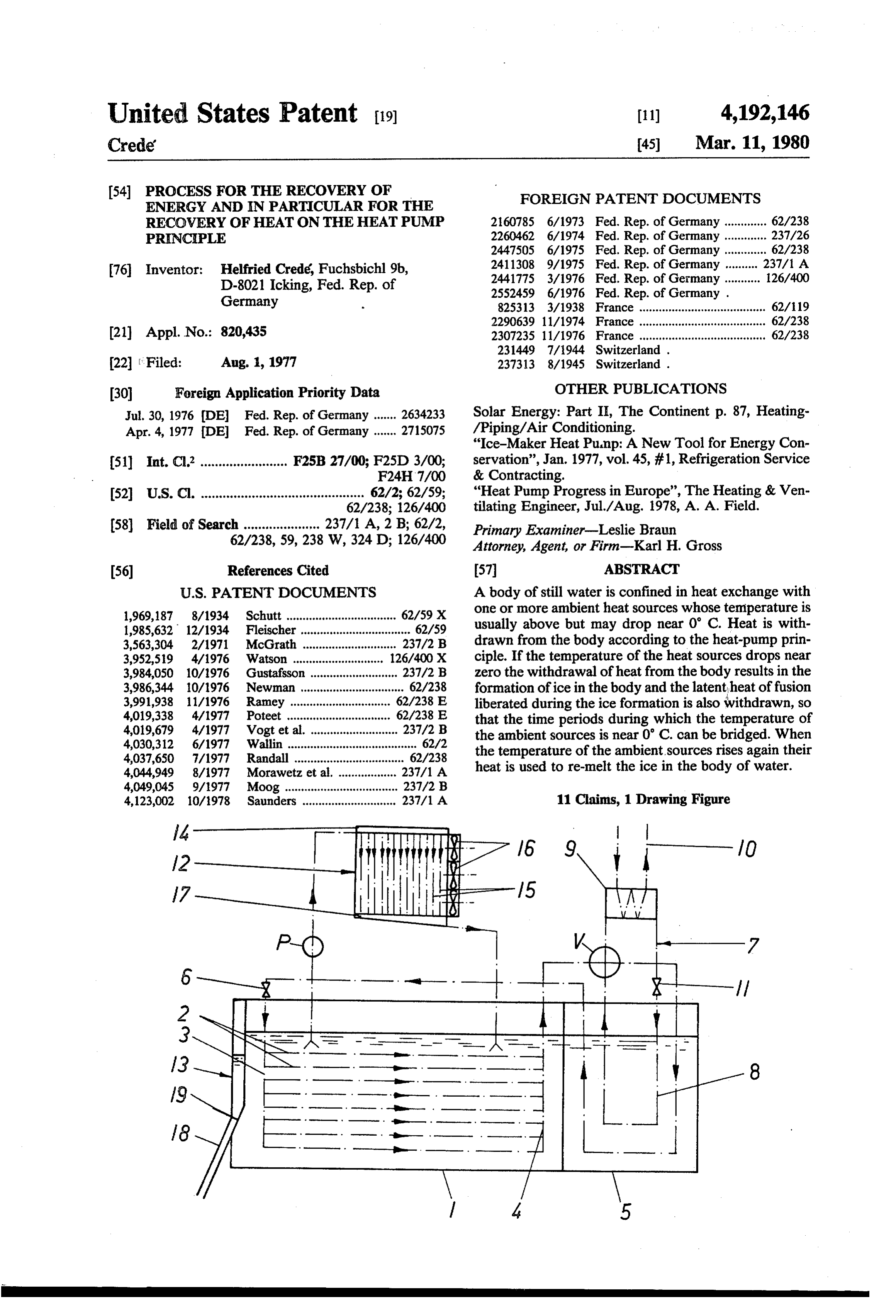
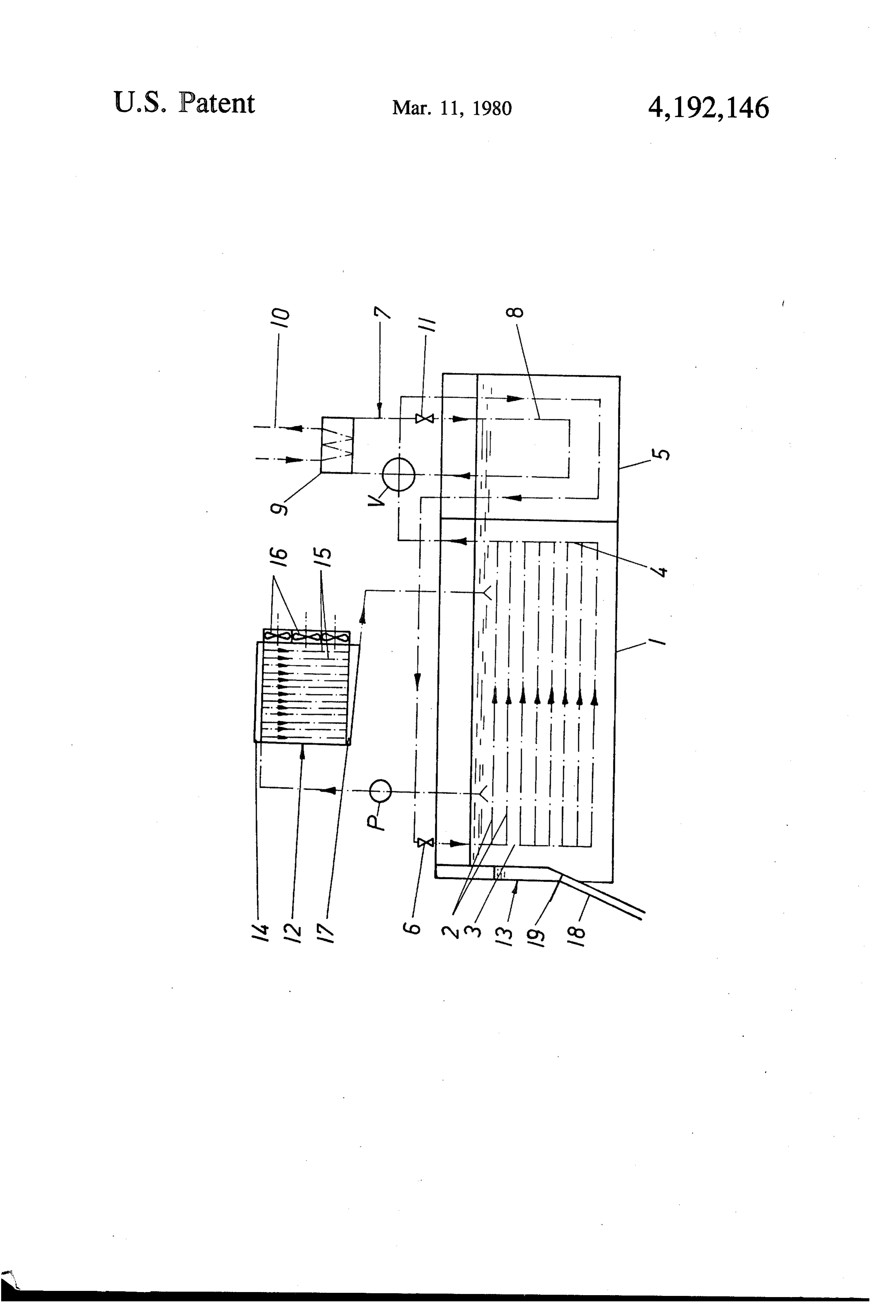
As the ambient heat source for the supply of heat to tainer 1 is heated by a compressor V in a first stage and the water reservoir the external air comes into consider is brought into heat exchange relationship through a ation in the first place. Water from the water reservoir secondary container 5 of about 8 m water capacity in is advantageously fed in a closed circuit through a heat order to heat this water to about 40 C. during the night exchanger, where it is brought into intensive heat ex time when the compressor V operates with cheap off. change relationship with the ambient. air. A part of the peak current. The cooling medium that condenses is moisture in the air will condense, so that heat of con returned to the tubes 2 via a throttle 6. densation given off can additionally be used. For the A second cooling medium circuit 7 having a vapo utilization of solar radiation, water can be fed from the riser 8 immersed in the secondary container 5 extends reservoir tank through solar collectors of known con O via the same compressor V into a condenser 9 from struction. Soil heat can be used, the tank for the water which heat at a higher temperature is led away into a reservoir being embedded in the soil. Rain water and heating circuit 10. From the condenser 9 the cooling melted snow water can be introduced directly into the water reservoir, in which case an overflow should be medium member 11.
is returned to the vaporiser 8 via a throttle provided, e.g. into the public system. Domestic waste 15 The supply of heat to the primary container 1 takes water, which has an average temperature of about 30
C., must be brought into contact with the water reser place, in the case illustrated (a) via the soil and the container walls, voir via a heat exchanger in view of the dirt that it (b) via a heat exchanger 12 exposed to the external air contains.
As above described, the heated cooling medium is, in 20 (c)and via a domestic waste water collector 13 immersed the process known as "heat pump', heated to a high in the primary container. temperature by compression, whereupon it gives up its heat in a heat exchanger to a heating circuit. Since the Cold water from the primary container 1 is pumped work to be expended in the compressor rises more than by a pump Pinto a reservoir 14 of the heat exchanger proportionally to the temperature difference to be over 25 12. From here the water flows under gravity into a come, it is desirable to perform the compression in two battery of parallel substantially vertical copper tubes 15, stages, the first stage during night time in order to use which if need be may be passed over by the external air the cheaper off-peak current and the second stage dur with the aid of a blower 16. The heated water is col ing the day time when heat is required for heating. For lected in a lower collecting tube 17 and fed back to the performing the two-stage process the water reservoir is 30 primary container.
divided into a large primary water reservoir and a The domestic waste water collector 13 of about 1 m3 smaller secondary water reservoir. During the night the capacity is connected to the duct system by a down pipe secondary water reservoir is heated to an intermediate 18. A slide valve 19 holds the down pipe normally temperature e.g. 40 C. by withdrawal of heat from the closed and opens e.g. by a time-limit switch, when the primary water reservoir, and during the daytime the 35 domestic waste waters have emitted substantially their heat required for heating the house is fed into a heating heat content into the primary water reservoir. circuit, making use of the same compressor. The two I claim:
stage compression is not only economical in current; it 1. A process for the recovery of thermal energy from also permits higher hot water temperatures to be generally available ambient sources of thermal energy, achieved. Since in the summer months, when no heating 40 particularly from ambient air, whose temperature is is required but only hot water, owing to the higher above but may drop near 0 Centigrade, comprising the external temperatures the water reservoir also attains a steps of exposing a confined body pfstill water to heat relatively high temperature and there is a thermal gradi exchange with at least one such source of thermal en ent to the now relatively colder soil, hence heat would ergy to transfer heat energy into the body of water and flow away unused, advantageously in these summer 45 raise the temperature of the same; circulating a refriger months only the secondary water reservoir, which is ating medium through the body of water to withdraw thermally insulated from the soil, is used. heat energy from the same according to the heat-pump The process according to the invention will be ex principle with the formation of ice therein when the plained in more detail with reference to the accompany temperature of said one source drops near O C.; con ing drawing, which is a diagrammatic illustration of the 50 tinuing to effect circuit of the cooling medium and the tubing of the body of water towithdrawal withdraw of heat energy from said the latent heat of fusion water reservoir.
A concrete primary container 1 of e.g. 5X5 m floor liberated during the formation of ice, so as to bridge those periods of time wherein said one source drops area X2.5 m height and of about 50 m water capacity, near or below 0° C. and until the temperature of said constructed in the soil, is traversed by substantially 55 one source rises again; and thereupon re-melting the parallel vaporiser tubes 2 which are filled and emptied via collecting ducts 3, 4. The mutual spacing of the thus formed ice by heat exchange with said one ambient vaporiser tubes is such that the maximum possible ice source of thermal energy.
coating around a vaporiser tube prior to merging with 2. A process as defined in claim 1, wherein the step of the ice coating of the adjacent vaporiser tube still per exposing comprises effecting heat exchange between mits an acceptable flow of heat from the water reservoir the body of water and at least one ambient source of to the cooling medium. The outermost vaporiser tubes thermal energy by causing the water to pass through a have to be arranged at a sufficiently long distance from heat exchanger.
the walls of the container such that the ice coating does 3. A process as defined in claim 1, wherein the step of not extend to them. The means for anchoring the vapo 65 exposing comprises effecting heat exchange between riser tubes must withstand the forces exterted by the ice. the body of water and the at least one ambient source of The cooling medium flowing through the vaporiser thermal energy by causing the water to pass through a tubes 2 and heated by the water in the primary con solar collector.
Page 5
4. A process as defined in claim 1, wherein the step of to reduce its mechanical strength and improve its ther exposing comprises admitting domestic waste water mal transmissivity.
into heat-exchange relationship with the body of water. 9. A process as defined in claim 1; further comprising 5. A process as defined in claim 4, wherein the step of the steps of circulating a refrigerating medium through admitting domestic waste water into heat-exchanging the body of water to withdraw heat energy into an relationship with the body of water comprises confining additional confined body of water during a first period the waste water in separated but heat-exchanging rela of timeanother according to the heat pump principle; and circu tionship with said body of water until it has yielded up lating refrigerating medium through said addi at least a substantial part of its thermal energy to the O as to withdraw heata from tional body during different second period of time so said additional body accord same, and thereafter discharging the collected waste ing to the heat pump principle.
Water. 10. A process as defined in claim 9; wherein the step 6. A process as defined in claim 1, and further com of circulating said first refrigerating medium comprises prising the auxiliary step of only at times effecting heat the step of compressing said refrigerating medium in a exchange between the body of water and a source of 15 compressor during a first time period, and the step of artificially generated heat. circulating said other refrigerating medium comprises 7. A process as defined in claim 1, wherein the refrig the step of compressing said other refrigerating medium erating medium is circulated through the body of water in the same compressor during a different second time in at least one conduit having a wall on which the ice 20 period.
forms; and further comprising the step of dislodging the of11. A process as defined in claim 1, wherein said body water is confined in a reservoir sufficiently large for ice from said wall.
the body to act as a heat store in the event no thermal 8. A process as defined in claim 1; and further com energy is available during a prolonged period of time prising the step of adding to the body of water a sub from an ambient source.
stance which causes the forming ice to be porous so as 25 k k k
Provenance
- Collection
- Cited prior art
- Original PDF
- patentimages.storage.googleapis.com →
- Filed
- 1977-08-01
- Pages
- 5
- Method
- pdftotext (the PDF's own text layer) + pdftoppm 300dpi page scans
- Source
- Google Patents bibliographic record
- Granted
- 1980-03-11
- Inventors
- Helfried Crede
- Transcribed from
- patentimages.storage.googleapis.com →