patent · US4699700
Method for hydrogen production and metal winning, and a catalyst/cocatalyst composition useful therefor
13 October 1987
Page 1 — bibliographic record
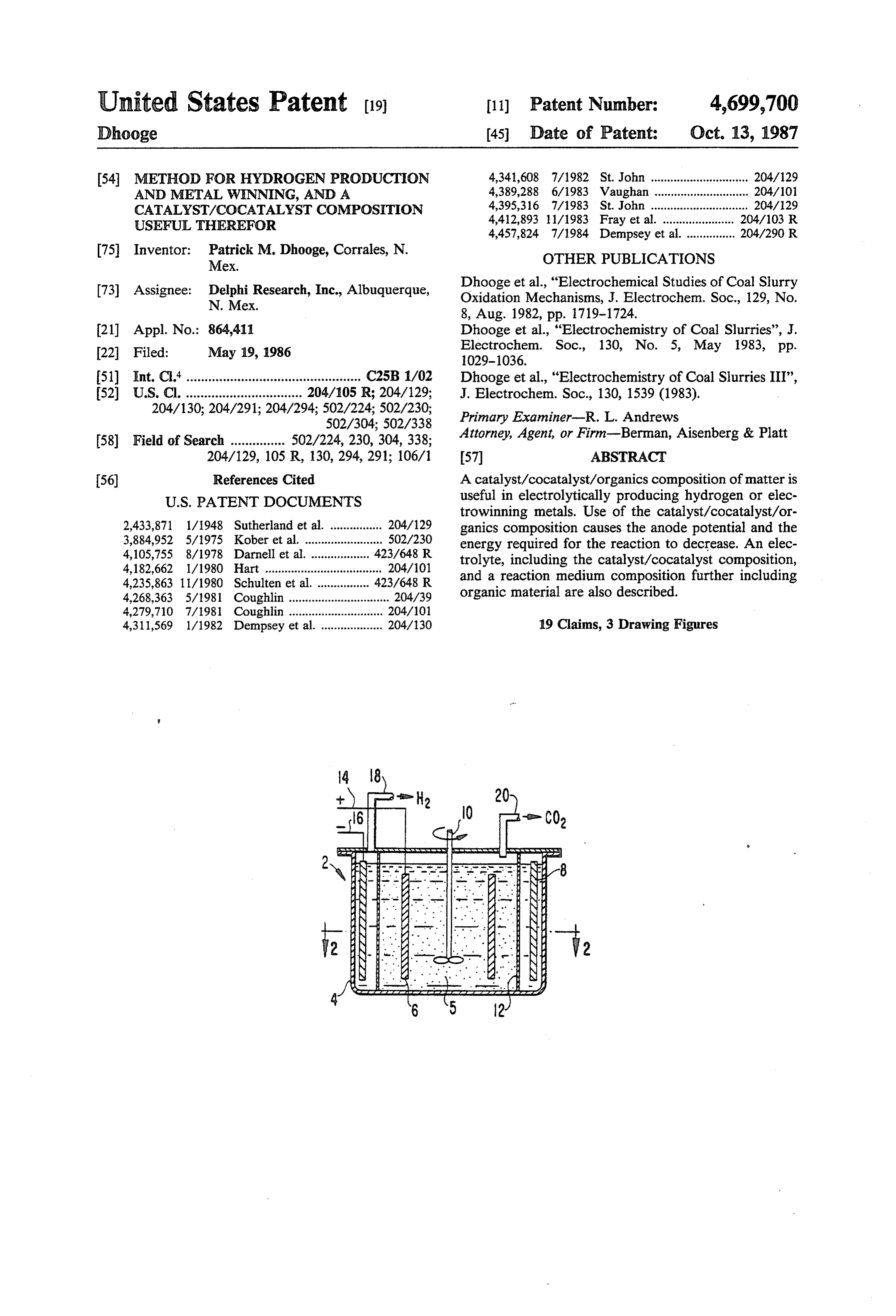
United States Patent (19) 11 Patent Number: 4,699,700 Dhooge 45 Date of Patent: Oct. 13, 1987 54 METHOD FOR HYDROGEN PRODUCTION 4,34,608 7/1982 St. John .............................. 204/129 AND METAL WENNING, AND A 4,389,288 6/1983 Vaughan ... ... 204/101 CATALYST/COCATALYST COMPOSITION 4,395,316 7/1983 St. John .... ...p 204/29 USEFUL THEREFOR 4,412,893 11/1983 Fray et al. ... ... 204/103 R
75 Inventor: Patrick M. Dhooge, Corrales, N. OTHER PUBLICATIONS Mex.
(73) Assignee: Delphi Research, Inc., Albuquerque, Dhooge et al., "Electrochemical Studies of Coal Slurry N. Mex. Oxidation Mechanisms, J. Electrochem. Soc., 129, No.
21 Appl. No.: 864,411 Dhooge et al., "Electrochemistry of Coal Slurries', J. 22 Filed: May 19, 1986 Electrochem. Soc., 130, No. 5, May 1983, pp.
(51) Int. Cl* ................................................ C25B 1/02 Dhooge et al., “Electrochemistry of Coal Slurries III', 52) U.S. C. ................................ 204/105 R; 204/129; J. Electrochem. Soc., 130, 1539 (1983). 204/130; 204/291; 204/294; 502/224: 502/230; Primary Examiner-R. L. Andrews 502/304; 502/.338 Attorney, Agent, or Firm-Berman, Aisenberg & Platt
204/129, 105 R, 130, 294, 291; 106/1 57 ABSTRACT 56 References (Cited A catalyst/cocatalyst/organics composition of matter is
trowinning metals. Use of the catalyst/cocatalyst/or 2,433,871 1/1948 Sutherland et al. ................ 204/129 ganics composition causes the anode potential and the 3,884,952 5/1975 Kober et al. ........................ 502/230 energy required for the reaction to decrease. An elec 4,105,755 8/1978 Darnell et al. ... 423/648 R trolyte, including the catalyst/cocatalyst composition, 4,182,662 l/1980 Hart .................................... 204/101 and a reaction medium composition further including 4,235,863 11/1980 Schulten et al. ... 423/648 R 4,268,363 5/1981 Coughlin ............................... 204/39 organic material are also described. 4,279,710 7/1981 Coughlin ............. ... 204/101 4,311,569 1/1982 Dempsey et al. ................... 204/30 19 Claims, 3 Drawing Figures
Page 2
Drawing sheet — no readable text.
Page 3
anode of an aqueous electrolytic cell. Particular catalyst
METHOD FOR HYDROGEN PRODUCTION AND systems are not disclosed.
METAL WINNING, AND A U.S. Pat. No. 4,279,710 presents an electrochemical CATALYST/COCATALYST COMPOSITION method and associated apparatus for gasification of USEFUL THEREFOR carbonaceous materials to carbon dioxide with the at tendant formation of fuels or high-energy intermediates,
STATEMENT such as hydrogen or light hydrocarbons, and produc This invention was made with the support of the tion of electric power. No particular catalyst systems State of New Mexico under Project No. 2-73-4633 10 are disclosed.
awarded by the New Mexico Energy Research and U.S. Pat. No. 4,235,863 considers a method of pro Development Institute. New Mexico has reserved ducing hydrogen in an electrolytic system using a hy rights in this invention. dride-forming liquid metal, such as liquid lithium or FIELD OF THE INVENTION liquid sodium, the resulting hydride being thermally decomposed to produce hydrogen.
This invention relates to a catalyst composition of an 15 U.S. Pat. No. 4,182,662 relates to a method of form electrocatalyst and a homogeneous cocatalyst, and use ing hydrogen by electrolysis in a cell containing an of the catalyst composition in combination with organic aqueous acid solution. Catalysts used are graphitized material for the electrochemical production of hydro carbon, ruthenized titanium or platinized titanium. gen or reduction of metal ions to metal in an aqueous 20 U.S. Pat. No. 4,395,316 is an improvement on the electrolyte. process of U.S. Pat. No. 4,341,608, which uses an anode CROSS REFERENCE TO RELATED of lead-rich ruthenium polychlore compounds. APPLICATION In U.S. Pat. No. 4,311,569, an improved catalytic A related application, Ser. No. 864,410 entitled “A 25 is usedofalone anode a ternary platinum group reduced metal oxide method for treating organic waste material and a cata metals and/or or in combination with platinum group platinum group metal oxides or mixtures lyst/cocatalyst composition useful therefor” has been filed concurrently herewith, and the specification having at least one valve-metal component, such as titanium, hafnium, zirconium, niobium, tantalum, and thereof is incorporated herein by reference. tungsten, in a process for electrolytically generating BACKGROUND OF THE INVENTION 30 oxygen. The invention of U.S. Pat. No. 4,457,824 is an Carbonaceous materials are oxidized when suspended improvement on the same method. In these two patents, in an aqueous electrolyte containing a reversible or the catalysts are in the electrodes, and thus are not quasireversible electrocatalyst and a homogeneous available in solution for homogeneous oxidation of any cocatalyst. The electrocatalyst is regenerated in an elec dissolved organics. Oxidation of organic materials using trochemical cell through which a direct current is 35 catalytic electrodes is not shown or suggested. passed, the water being reduced to form hydrogen, or U.S. Pat. No. 2,433,871 provides an electrolytic cell the metal ions being reduced to metal, at the cathode. for production of hydrogen and oxygen using alkaline The reduced electrocatalyst is reoxidized at the anode. aqueous electrolyte and a vanadium addition agent to U.S. Pat. No. 4,412,893 concerns electrolyzing cati reduce the operating voltage.
ons at a cathode of an electrolytic cell, wherein anolyte 40 U.S. Pat. No. 4,105,755 concerns the production of contains ferrous ion as a reducing agent. The electroly hydrogen by reacting an ash-containing carbonaceous sis is conducted while the anolyte is agitated or while material, optionally on organic waste material, with a the anode moves with respect to the anolyte, providing halogen to form a halogen acid, and then decomposing relative motion between the anode and the anolyte, the halogen acid to halogen (recycled) and hydrogen. promoting contact of the anode with the ferrous ion 45 The halogen acid is preferably decomposed electrolyti despite their mutual electrostatic repulsion. A static cally if this step of the reaction takes place as a separate relationship between the cathode and the catholyte is step from the initial reaction of the ash-containing car required. The concentration of the ferrous ion is in the bonaceous material and halogen. range from 0.5 to 10 grams per liter.
U.S. Pat. No. 4,389,288 relates to electrochemical 50 SUMMARY OF THE INVENTION gasification of carbonaceous material by anodic oxida An object of the present invention is to provide an tion in an aqueous acidic electrolyte to produce oxides electrocatalytic reactor system in which the anode is of carbon at the anode and hydrogen at the cathode of depolarized by organic material oxidation using a cata an electrolytic cell using an iron catalyst. lyst/cocatalyst combination in an aqueous electrolyte in U.S. Pat. No. 4,268,363 provides for electrochemical 55 an electrochemical cell, hydrogen being generated, or gasification of carbonaceous materials by anodic oxida metal ions reduced to metal, at the cathode. The over tion, producing oxides of carbon at the anode and hy all reactions in the anode half-cell and in the cathode drogen or metallic elements at the cathode of an elec half-cell are:
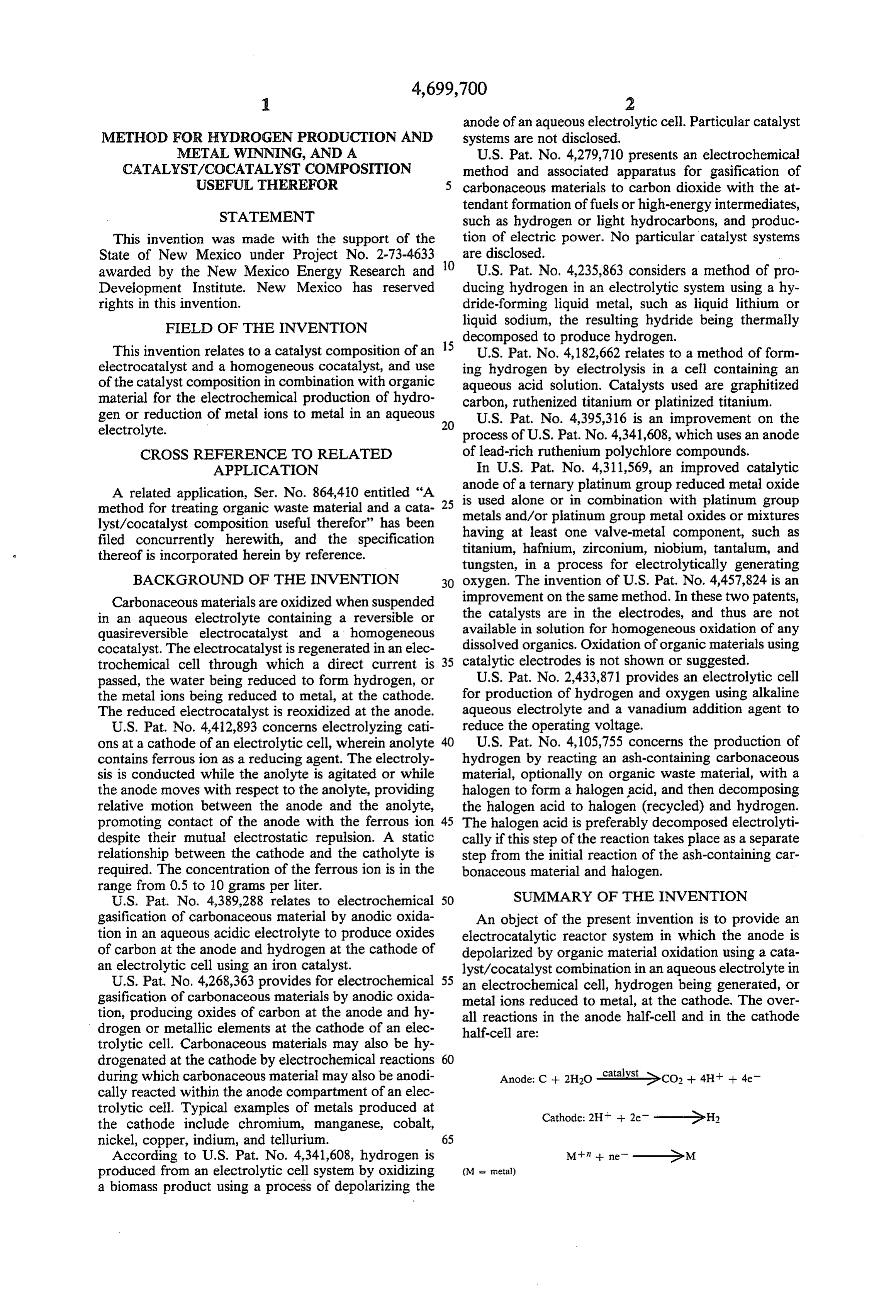
trolytic cell. Carbonaceous materials may also be hy drogenated at the cathode by electrochemical reactions 60 catalyst during which carbonaceous material may also be anodi Anode: C -- 2H2O CO2 + 4H -- 4e cally reacted within the anode compartment of an elec trolytic cell. Typical examples of metals produced at the cathode include chromium, manganese, cobalt, Cathode: 2H +2e. --G-H2 nickel, copper, indium, and tellurium. 65
According to U.S. Pat. No. 4,341,608, hydrogen is Mtn -- ne. --GeM produced from an electrolytic cell system by oxidizing (M = metal) a biomass product using a process of depolarizing the
Page 4
The process employs one of several electrocatalysts trocatalyst. This results in improvement in reaction rate together with one of several homogeneous cocatalysts and/or lowering of activation energies. to improve the organic oxidation rate and to lower the The electron transfer complex must exist at least. activation energy for the oxidation of the organic mate momentarily to account for increased oxidation rates rial. and lowered activation energies of the reactions taking Another object of the invention is to provide a novel place. It is postulated that the oxidation mechanism catalyst/cocatalyst composition of matter. A further involves a short-lived coordination complex between object of the invention is to provide a method of using the organic compound and the homogeneous cocata the catalyst/cocatalyst composition of the invention for lyst, such as that of platinum ions or palladium ions and the production of hydrogen or for the reduction of 10 the double bonds of organic compounds, e.g., Ziese's metal ions to metal. Yet another object of the invention salt anion, the trichloro (ethylene) platinate (II) ion, is to provide an anolyte composition comprising or which is stable in aqueous solution. Similar platinum ganic material, a conductive electrolyte, catalyst and organic double-bond complexes are apparently formed cocatalyst. in catalyst mixtures of this invention. The standard There are several distinct aspects of this invention: 15 potential of the iron (II)/iron (III) redox couple in 1.0 (a) a catalyst/cocatalyst composition, M sulfuric acid is -0.69V. The standard potential of (b) use of (a) in a method of producing hydrogen platinum (IV)/platinum (II) redox couple in 1.0 M sul electrolytically, furic acid is also approximately +0.69V. Thus, the (c) use of (a) in a method of electrowinning metals platinum (II) species is in equilibrium with the platinum
(IV) species, iron (III) and iron (II), and can be consid (d) use of (a) to reduce potential and thus energy ered to be complexed for at least short periods of time to required to produce hydrogen or reduce metal ions to organic double bonds or other appropriate functionality metal, on the organic compounds. The increase in reaction rate (e) an aqueous electrolyte composition comprising produced by platinum, palladium, rhodium and ruthe
nium is due to the fact that the homogeneous cocatalyst (f) a reaction medium composition comprising or /organic complexes are more long-lived than the elec ganic material in (e).
Component (a) is an indispensable subcombination of trocatalyst/organic complexes and thus are more effi each of the other aspects of the invention. The disper gies are accounted for by the Lowered cient at transferring electrons.
lower activation ener activation energy sion of (a) throughout the anolyte composition imparts necessary for formulation of the organic compound
homogeneity to the distribution of the catalyst and of homogeneous cocatalyst complex. The required supply the catalyst.
The benefits derived from use of the catalyst of oxidizing electrons can be derived from direct reduc tion of the cocatalyst, followed by reoxidation by the /cocatalyst are several. The production of hydrogen (b) electrocatalyst or by formation of a short-lived elec or electrowinning of metals (c) at reduced potentials is 35 trocatalyst/cocatalyst/organic an energy-saving, economical process. Likewise, an cocatalyst compound acts as acomplex bridge in which the to transfer an increase in reaction rates using the catalyst/cocatalyst electron from the organic compound to the electrocata combination (a) provides energy-saving economy. lyst. Thus, the electron transfer complex (ETC) in BRIEF DESCRIPTION OF THE DRAWINGS 40 volved in the oxidation forms spontaneously when the FIG. 1 is a vertical sectional view of an electrochemi homogeneous cocatalyst is added to an electrolyte con cal cell useful for practicing the invention. taining dissolved or suspended organic compounds FIG. 2 is a cross-sectional view taken on the plane actingwhich have functional groups or bonds capable of inter 2-2 of the cell of FG, 1. with the cocatalyst. The relative weight ratios vary with
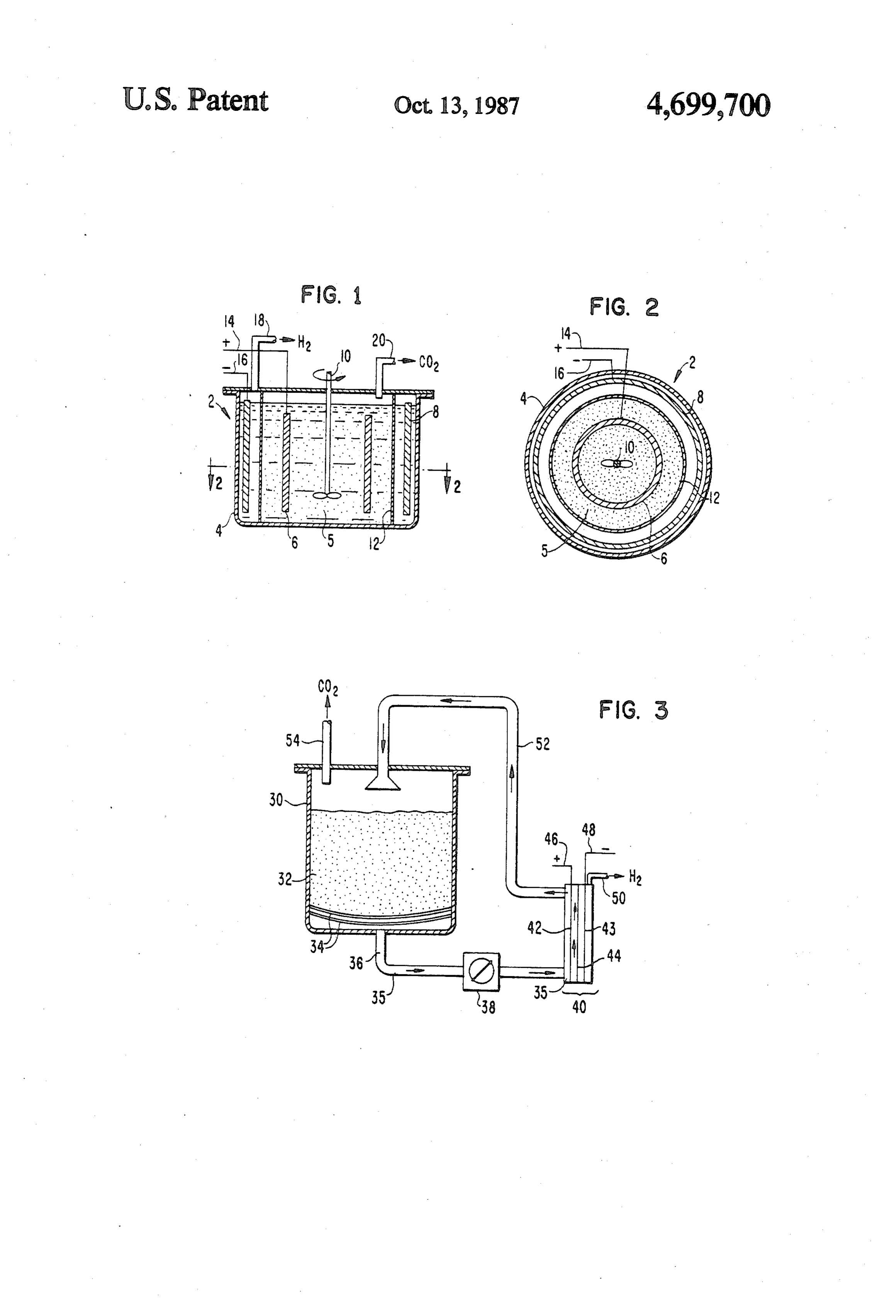
FIG. 3 is a vertical sectional view of apparatus in cócatalyst and 45 the type of organic compound, the type of which the organic reaction area and electrochemical proportions the electrocatalyst. Preferred ranges of cell are separated. for each component are relatively large amounts of organic material (an activity for the organic
DETAILED DESCRIPTION OF THE of 1 or more), a great concentration of the electrocata INVENTION 50 lyst (activity of 0.1 to 1.0 or more) and a smaller concen In the process of the invention hydrogen gas is gener tration of the cocatalyst compound (activity of 0.01 to ated or metal ions reduced to metal in an electrolytic 0.001 or less). The ETC is formed in an electrolyte cell. At the cathode of the electrolytic cell, hydronium which solvates the catalysts and at a temperature of 0 ion is reduced to hydrogen. The reaction at the anode is C. or higher with an organic material with functionali a mediated, or electrocatalytic, reaction in which the 55 ties which can interact with the cocatalyst, and in the oxidized form of a reversible redox couple, produced at absence of any interfering conditions, such as species the anode, subsequently oxidizes the carbon in organic which tie up or precipitate the catalysts. The species material present in the electrolytic cell. The products of which precipitate the catalysts are those which form the carbon oxidation are carbon oxides and the reduced insoluble salts with the catalysts, such as (for the met form of the redox couple, which is reoxidized at the 60 als), hydroxide, silicate, sulfide, high concentrations of anode. The process described herein employs one of sulfate or high concentrations of phosphate, and (for several electrocatalysts along with one of several homo bromine) silver cation, gold cation or mercury cation. geneous cocatalysts to improve the organic oxidation Species or substances which tie up the catalysts include rate and to lower the activation energy required for the highly absorptive inert materials such as clay or acti oxidation of the organic material. Obtained data shown 65 vated carbon, or compounds with which the catalysts that the mechanism of the organic oxidation is changed react irreversibly, such as the reaction of bromine with by the homogeneous cocatalyst, which apparently some organic compound to form bromoform or tetra forms an electron transfer complex involving the elec bromomethane.
Page 5
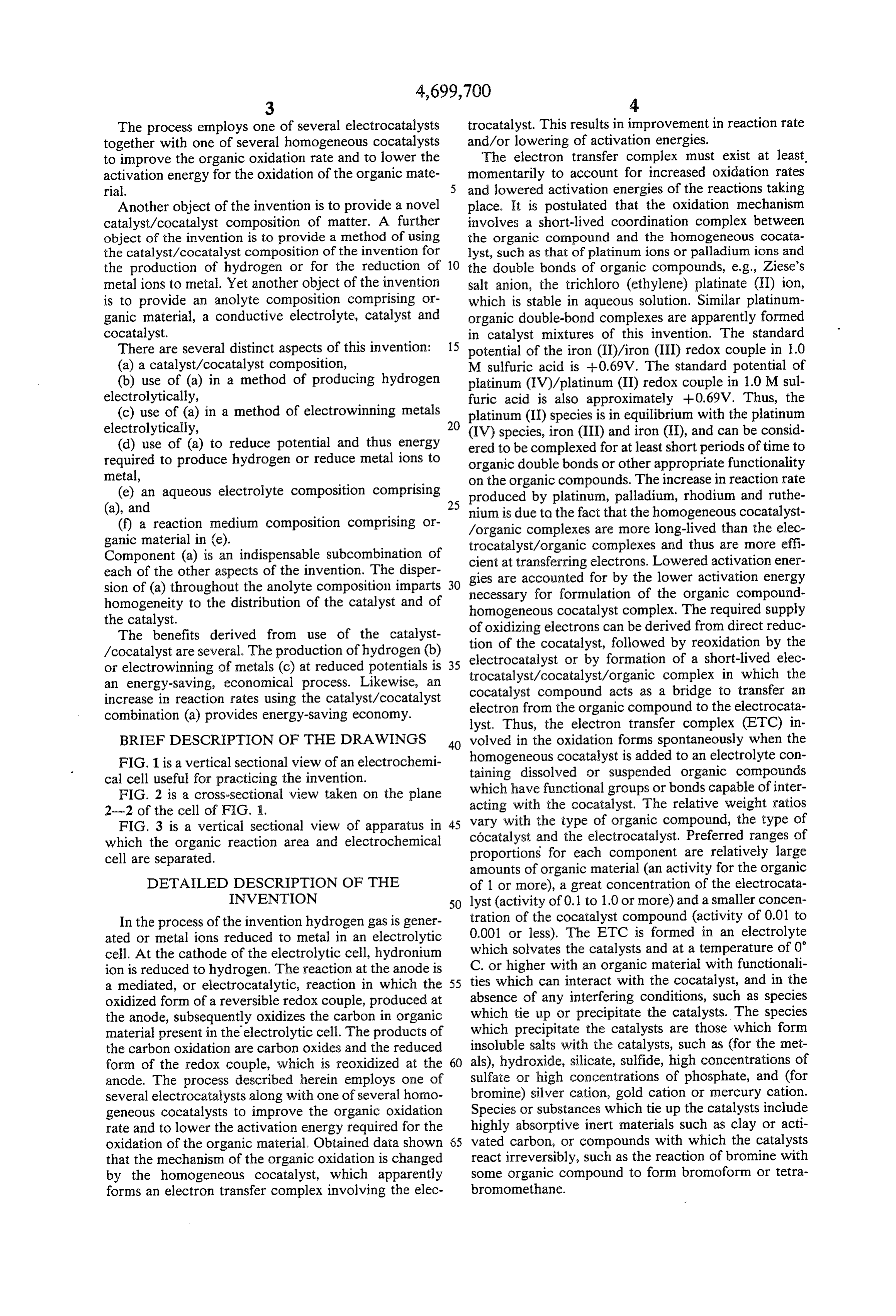
The electrocatalyst is obtained as pure catalyst, from used in the electrowinning of metals at potentials lower various salts or compounds of the electrocatalyst, or than those now used, again due to the depolarizing from impurities in the organic material. action of the organic/electrocatalyst/homogeneous The acid solutions usually used in the catalytic system cocatalyst combination.
dissolve many metal oxides, sulfides, many metal salts, Examples of organic material or biomass suitable for etc. If any of these compounds exist as impurities in the practicing the invention are coal, peat, oil shale, woody organic waste used in the reactor, they will be leached wastes, cattle manure, garbage, sewage sludge, various out by an acid solution. Iron is one of the most common industrial chemical wastes, food and fiber processing metals found in sewage sludge, manure and many other by-products or waste and grown biomass products, biological wastes, and so can supply part or all of the O such as bulk grass plants, water plants, etc., or any electrocatalyst once leached from the organic material. organic material which can be oxidized by the catalyst Bromine or iodine found in sufficient quantity in some solution at a reasonable rate.
waste materials, particularly brominated or iodinated Examples of catalyst compositions useful for practic organics, can supply the particularly brominated or ing the invention are various combinations of metal ion iodinated organics, to provide the necessary electrocat 15 complexes and/or oxidizing halogens. The complexes alyst concentration. The electrocatalyst is usually vary and depend upon the composition of the solution added to the electrolyte, as there is not enough nor and the nature of the organic material. Non-limiting mally found in waste materials to develop the desired examples of electrocatalysts are cerium (4--) ion com reaction rate, but some waste materials supply their plex, iron (3+) ion complex, bromine and iodine. Non own electrocatalyst, e.g. when leachable iron, bromine 20 limiting examples of homogeneous cocatalysts are plati or iodine is present in sufficient quantity in the waste num (4--) ion complex, ruthenium (3+) ion complex, material. It is doubtful that any waste material will rhodium (3+) ion complex, nickel (2+) ion complex, contain sufficient quantities of copper, nickel, platinum, cobalt (2+) ion complex, palladium (2+) ion complex, vanadium, etc., to supply their own cocatalyst as well, copper (2--) ion complex and vanadium (5--) oxide but such is not precluded. Whether the electrocatalyst 25 complex. The catalyst solutions are made by dissolving and cocatalyst are added as metals, metal salts, etc., or the halogen, metal, and/or soluble metal salt in an elec leached from the organic waste material does not affect trolyte solution. Useful combinations of electrocatalyst the nature of the process described herein. The catalyst and homogeneous cocatalyst include: materials are identified by chemical analysis of the bromine with palladium2+: (fat) waste material to determine catalyst content (if any), 30 iron with platinum': (urea, wood cellulose, manure and by chemical analysis of the acid electrolyte solution and/or fat) (after it has been thoroughly mixed with the waste and iron with vanadiums: (sewage sludge) allowed to stand for, e.g., from 24 to 72 hours). bromine with ruthenium3+: (urea, wood cellulose and The homogeneous cocatalyst is optionally obtained /or fat) from pure cocatalyst metal, from various salts or com 35 bromine with vanadium.5+: (wood cellulose and/or pounds of the cocatalyst, or from impurities in the or manure) ganic material. The homogeneous cocatalyst is dis iron3+ with cobalt2+: (wood cellulose and/or manure) solved in or homogeneously distributed throughout the iodine with ruthenium3+: (urea) catalyst solution. This is advantageous in that it elimi iron3+ with palladium2+: (fat) nates one heterogeneous step in the process of transfer 40 iron3+ with nickel 2: (manure) of electrons from the electrocatalyst and in that the The range of electrocatalyst concentration providing cocatalyst is available to the entire surface of any solid a suitable reaction rate is from 0.01 Mup to 100 percent. organic particles immersed in the catalyst solution. The The preferred range is 0.1 M to 1.0 M. The range of cocatalyst is homogeneous with the electrocatalyst so cocatalyst providing an appropriate reaction rate is lution, it is a single ion complex (not an admixture), and 45 from 0.0001 M to 0.1 M. The preferred range is from the homogeneity of the cocatalyst is very critical to the 0.001 M to 0.01 M. The preferred ranges provide econ increased reaction rates observed. omy of operation.
The employed electrolyte is any aqueous solution in In practicing the invention, an aqueous electrolyte, an which the electrocatalyst and cocatalyst are soluble at electrocatalyst and a homogeneous oxidation cocatalyst least in reduced form, but is typically a solution of a 50 are combined for producing hydrogen or electrowin strong mineral acid, such as hydrochloric acid, phos ning metals (at the cathode of an electrochemical cell). phoric acid or sulfuric acid. The acid solution reduces Anode materials used in the invention are, for exam the reduction potential necessary for hydrogen produc ple, platinum, platinum-clad titanium, graphite, reticu tion, while providing a solubilizing medium for the lated vitreous carbon or platinum plated reticulated catalyst composition. The system is satisfactorily oper 55 vitreous carbon. Suitable anode materials are those ated at various temperatures, depending on the catalyst materials which do not corrode in the electrolyte and at combination and the organic source; temperatures from which the electrode-catalyst redox pair is reversible or 70° C. to 200° C. are typical. However, temperatures quasi-reversible.
from 0° C. to 500 C. or more may be used. Suitable cathode materials are, for example, nickel The principle advantages of the process are two-fold. 60 mesh or platinum or platinum plated reticulated vitre Firstly, the process produces electrolytic hydrogen at a ous carbon. Other suitable cathode materials are materi potential considerably below that necessary to crack als which do not corrode in the electrolyte and at which water. The organic/electrocatalyst/homogeneous the hydronium-hydrogen redox couple is reversible or cocatalyst combination acts as a depolarizing agent to quasi-reversible.
reduce the potential applied at the anode. Using this 65 The electrolyte is, for example, phosphoric or sulfu process, electrolytic hydrogen is produced from inex ric acid in concentrations varying from 1M to 6M, or pensive organic waste material at much lower cost than potassium sulfate at 0.2M. Other useful electrolytes are was formerly possible. Secondly, the process can be those which possess the necessary conductivity, dis
Page 6
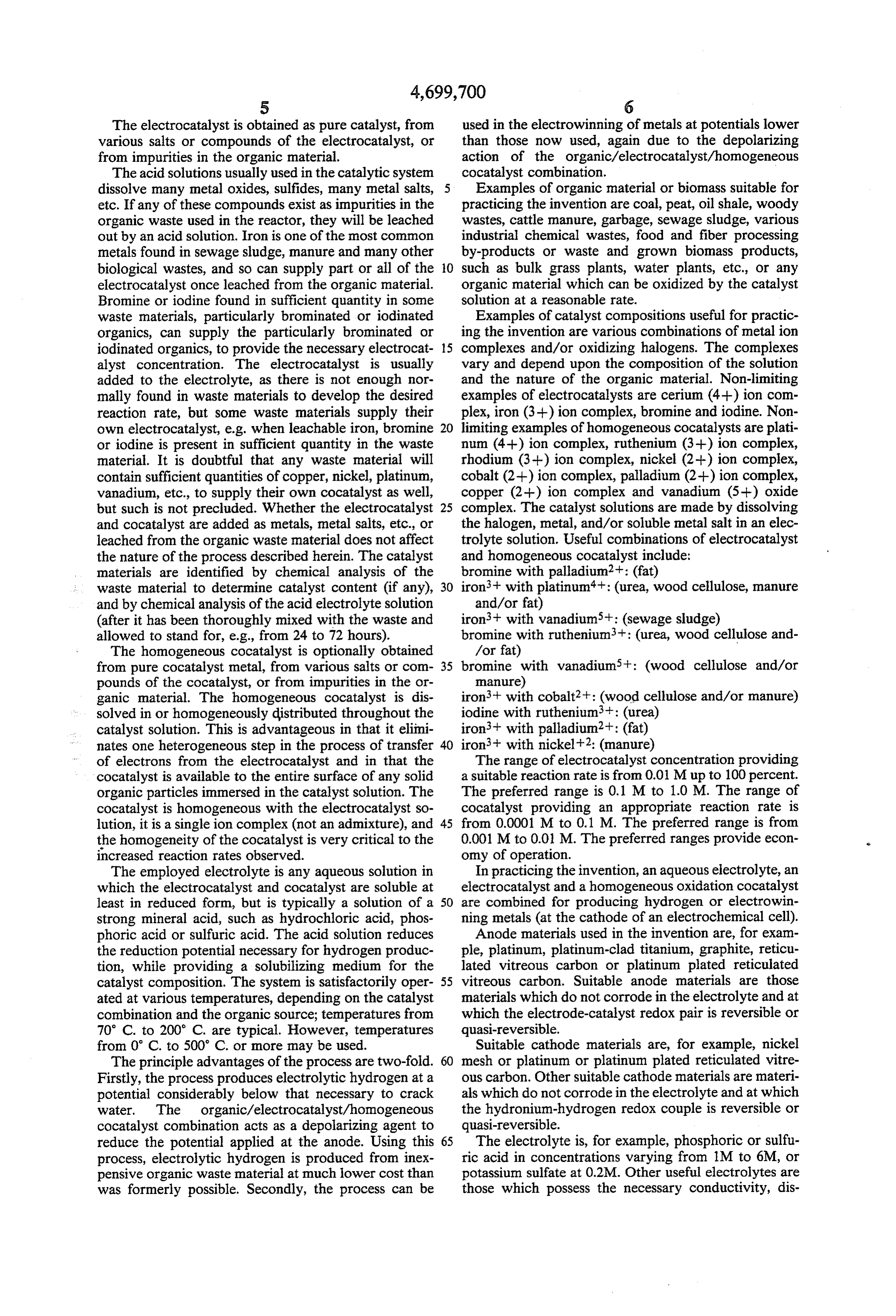
solve at least the reduced form of the catalyst, and do stirrer 10 are immersed. Electrolyte 5 is an electrolyte not interfere with or poison the catalyst. The electrolyte containing electrocatalyst and homogeneous cocatalyst is made by diluting concentrated sulfuric acid, phos together with the organic material. Anode 6 and cath phoric acid or potassium sulfate crystals with water of ode 8 are separated by an ion specific or semi-permeable reasonable purity, e.g. distilled water, deionized water 5 membrane 12. Anode 6 is connected to lead 14 and or tap water. cathode 8 is connected to lead 16. Leads 4 and 16 are The electrolyte solution optionally has many differ connected to a source of electric current (not shown). ent compositions. Various other acids which are suit Hydrogen generated in the cathode compartment are able electrolytes are perchloric acid, hydrobromic acid, removed through conduit 18, and gases generated in the hydroiodic acid, nitric acid, boric acid, hydrofluoric 10 anode compartment are removed through conduit 20. acid, or any other strong acid which is not irreversibly FIG. 2 is a top view of the electrochemical cell 2, show degraded in the system. There are a variety of salts ing circular anode 6, circular cathode 8 and anode elec which are suitable electrolytes, including sodium or trolyte solution 5 containing the electrolyte, electrocat potassium choride, bromide or iodide, iron chloride, alyst and homogeneous cocatalyst, together with the bromide or iodide, sodium or potassium phosphate, 15 organic material. Ion specific or semi-permeable mem sodium sulfate, any of the alkali-metal fluorides, any of brane 12 is shown as a circular separator between the the alkali or alkaline-earth nitrates or perchlorates, iron anode and cathode compartments. FIG. 3 shows tank nitrate, iron perchlorate, any of the soluble borate salts, 30 which contains a mixture 32 of electrolyte, electro any of the soluble aluminum or ammonium salts and any catalyst, homogeneous cocatalyst and organic material other electrolyte salt or salt mixture which is not irre 20 resting on optional filter screen 34. Organic material is versibly degraded in the system. The important attri reacted with electrolyte and catalyst combination in butes of the electrolyte are that it is able to solvate at tank 30, and electrolyte solution 35 flows through exit least the reduced form of the electrocatalyst, that it 36 via pump 38 to electrochemical cell 40, which con provides a low-resistivity medium between the elec tains electrolyte solution 35 in which anode 42 is im trodes and that it does not degrade in the oxidation 25 mersed. Anode 42 and cathode 43 are separated by ion system. specific or semi-permeable membrane separator 44. The operating potential of the system is dependent on Anode 42 is connected to lead 46, and cathode 43 is the electrocatalyst and the electrolyte. The electrolyte, connected to lead 48. Leads 46 and 48 are connected to because of its relatively high concentration, generally a source of electric current (not shown). Hydrogen determines the form of the electrocatalyst complex (if 30 generated at the cathode is led off at exit 50. Solution any), and can shift the redox potential of the electrocat from the anode compartment is returned by conduit 52 alyst by several tenths of volts. For iron (3-) in 1.0 M to tank 30 for reuse. Gases generated in tank 30 are phosphoric acid, the standard redox potential is -0.49 withdrawn therefrom through conduit 54. Organic ma volt, and the cell anode is operated at any potential from terial in tank 30 is mixed with catalyst solution by per --0.5 to +1.5 volts or more, versus the normal hydro 35 colation, spraying, stirring, density gradient or other gen electrode (NHE). method. Catalyst which is reduced in tank 30 is reoxi The normal hydrogen electrode (NHE) is an imagi dized in electrochemical cell 40 before being returned nary electrode at which the H/H2 redox reaction is to tank 30.
perfectly reversible, and which is suspended in solution The electrocatalyst is regenerated from the reduced where the activity of the hydrogen cation is 1.0 and form by oxidation at the anode. There may be some where hydrogen gas at 1.0 atmosphere (activity = 1.0) is reoxidation of reduced cocatalyst at the anode, but this bubbled over the electrode surface. The potential of this is minimal compared with the reoxidation of the elec electrode is defined to be 0.000 V, and is the standard of trocatalyst since the cocatalyst is largely not consumed. reference for redox potentials of other species. In prac The electrochemical cells shown in FIGS. to 3 are tice, the electrode is approximated by a piece of plati 45 non-limiting examples of the invention. The electro nized platinum (platinum covered with platinum black) chemical cell may be configured as a cylinder, a sphere in an acid solution of H+ activity 1.0, while hydrogen or other appropriate shape. The anode compartment is gas at 1.0 atmosphere is bubbled over the surface (H2 alternatively the inner compartment, the outer compart activity -- 1.0). ment, or either compartment in a cell in which the elec The preferred operating range for iron (3-) in phos 50 trodes are planar. The separator is, optionally, an ion phoric acid is +0.5 to +0.8 volt. For iron (3+) in 1. M specific membrane or any semipermeable barrier. sulfuric acid, the standard redox potential is +0.69 volt, Suitable ion-specific membranes include cation and the cell anode is suitably operated at any potential specific membranes, for example, Ionics 61 CZL-386 from -- 0.70 to -- 1.5 volts or more, versus the NHE. (manufactured by Ionics, Inc.) and Nafion 423 (manu The preferred potential range at the anode for iron (3+) 55 factured by DuPont). The semi-permeable membrane is, in sulfuric acid solution is -0.7 to -- 1.0 volt. For bro e.g., a microporous plastic, sintered (fritted) glass, a gel, nine, the standard redox potential is -1.087 volts, and such as agar, or any other material which restricts fluid the cell anode is effectively operated at any potential flow and does not allow intimate mixing of the anolyte from -- 1.0 to -- 1.5 volts or more, versus the NHE. and catholyte. The Ionics 61 CZL-386 membrane is a Preferred potential range for bromine is from + 1.0 to 60 modacrylic fiber-backed cation-transfer membrane. -- 1.2 volts versus the NHE. For iodine, the standard Either an ion-specific of a semi-permeable membrane redox potential is approximately --0.47 volt, and the may be used, but the use of ion-specific membranes cell anode is operated at any potential from +0.5 to leads to higher electrochemical cell efficiency since + 1.5 volts or more, versus the NHE. The preferred they strongly limit the diffusion of the electrocatalyst potential range for iodine is from +0.50 to +0.70 volt. 65 between the catholyte and the anolyte. Semipermeable Referring now to the Figures, FIG. 1 shows an elec membranes are generally less expensive but do not pro trochemical cell 2 suitable for practicing the invention. vide as much of a barrier to electrocatalyst diffusion, Tank 4 contains electrolyte 5 in which anode 6 and thus lowering the efficiency of the electrochemical cell
Page 7
in comparison with a cell using an ion-specific mem cathode are platinum, platinum-doped carbon, plati brane. num-clad titanium, platinum-clad niobium, nickel or Other operating limitations are principally imposed nickel-doped carbon. Platinum, platinum-clad titanium by the materials used in construction of the reactor or niobium, platinum-doped carbon or carbon are pre system. The system may be built of very inert, strong, 5 ferred materials for the anode. The preferred electro expensive materials, such as quartz-lined steel, and op lyte solution depends on the electrocatalyst used and erated at relatively high temperatures (100' to 500 C. the type of organic material. Several satisfactory combi or more) or it may be made from inexpensive materials, nations (useful for hydrogen production) are exempli such as polypropylene or polyethylene and ordinary fied below:
glass, and operated at temperatures of 20° C. to 120° C. 10 0.1 M iron (3--)/0.1 M cobalt (2+)/wood cel Electrode materials must not corrode at the operating lulose/6M sulfuric acid;
temperature of the electrochemical cell. Another limita 0.1 M iron (3+)/0.01 M vanadium (V)/sewage slud tion is the necessity to operate below the critical tem ge/6M sulfuric acid;
perature of the electrolyte solution being used. 0.01 M bromine/0.01 M vanadium (5+)/wood cellu Elevated temperatures are used when depolarization 15 lose or manure/6M sulfuric acid;
is effected with a refractory organic compound, such as 0.01 M bromine/0.001 M ruthenium (3+)/urea, cel lignin, chitin or a saturated aliphatic hydrocarbon; or lulose or fat/6M sulfuric acid; and when excess heat energy is available at low cost and a 0.1 Miron (3+)/0.001 M platinum (4--)/urea, cellu lower redox potential electrocatalyst (for example, iron lose or fat/6M sulfuric acid.
in phosphoric acid, or iodine) can be used to reduce The operating potential of the anode is maintained at electrical costs. When a lower-potential electrocatalyst +0.5 to +1.5 volt versus the NHE, and temperatures of has an unacceptable reaction rate at, e.g., 70 C., it is not operation are typically from 20° C. to 200° C. With precluded from oxidizing the organic compound at an more inert, stronger materials of construction for the adequate rate at, e.g. 250° C. The pressure in the system apparatus the operating temperature may be 500 C. or may vary and is dependent on the nature of the electro 25 more. Lower temperatures require less energy ex lyte and the electrocatalyst. A concentrated sulfuric pended in heating the system.
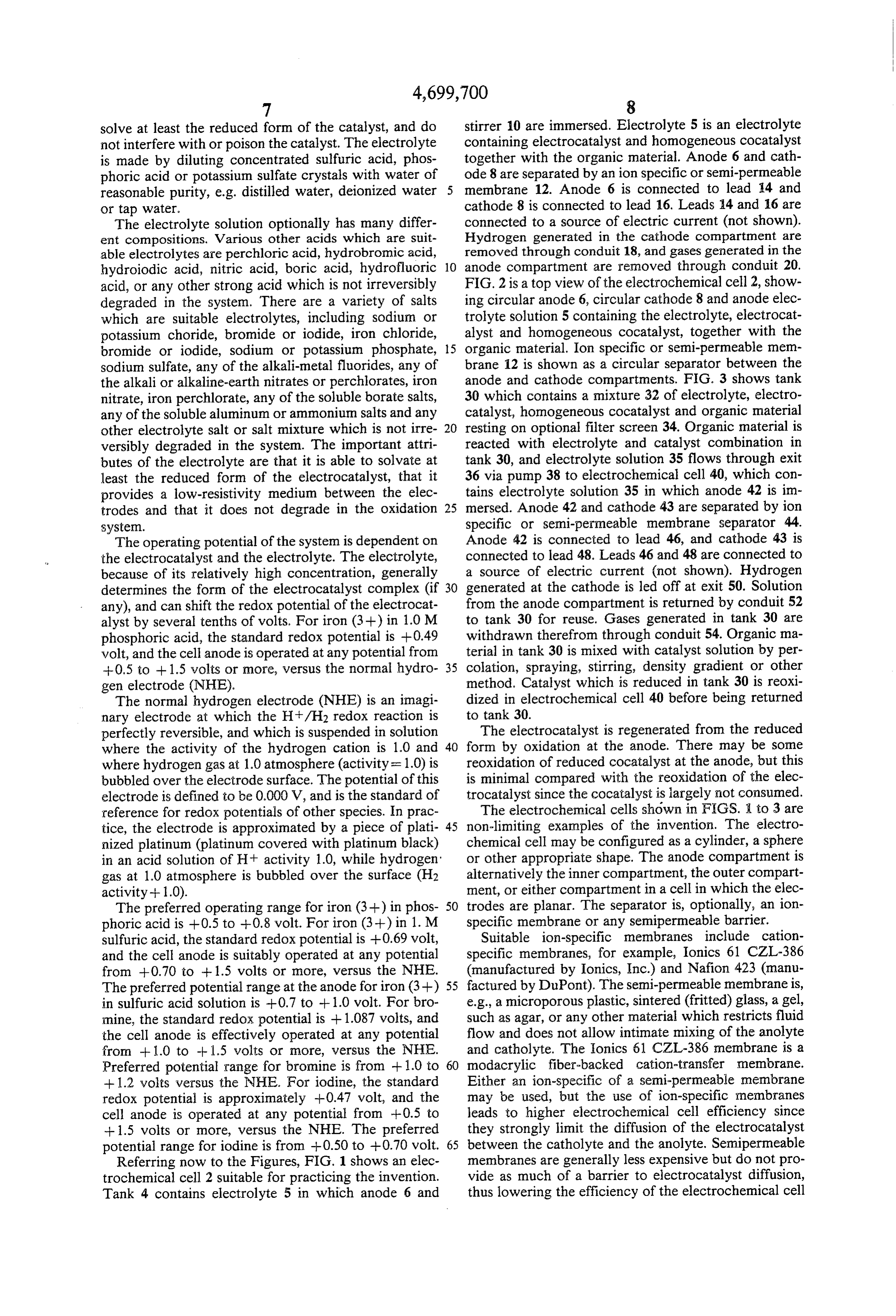
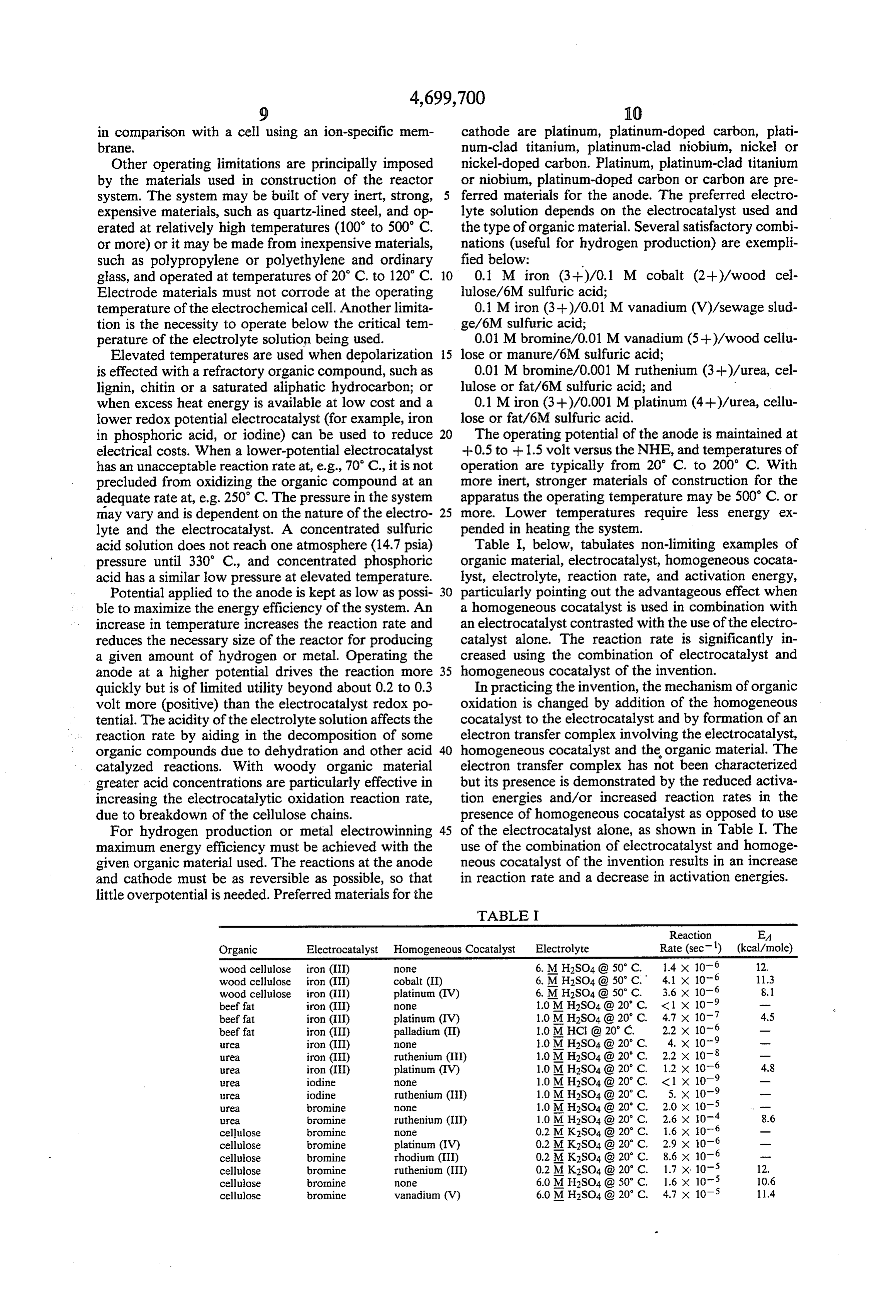
acid solution does not reach one atmosphere (14.7 psia) Table I, below, tabulates non-limiting examples of pressure until 330 C., and concentrated phosphoric organic material, electrocatalyst, homogeneous cocata acid has a similar low pressure at elevated temperature. lyst, electrolyte, reaction rate, and activation energy, Potential applied to the anode is kept as low as possi 30 particularly pointing out the advantageous effect when ble to maximize the energy efficiency of the system. An a homogeneous cocatalyst is used in combination with increase in temperature increases the reaction rate and an electrocatalyst contrasted with the use of the electro reduces the necessary size of the reactor for producing catalyst alone. The reaction rate is significantly in a given amount of hydrogen or metal. Operating the creased using the combination of electrocatalyst and anode at a higher potential drives the reaction more 35 homogeneous cocatalyst of the invention. quickly but is of limited utility beyond about 0.2 to 0.3 In practicing the invention, the mechanism of organic volt more (positive) than the electrocatalyst redox po oxidation is changed by addition of the homogeneous tential. The acidity of the electrolyte solution affects the cocatalyst to the electrocatalyst and by formation of an reaction rate by aiding in the decomposition of some electron transfer complex involving the electrocatalyst, organic compounds due to dehydration and other acid 40 homogeneous cocatalyst and the organic material. The catalyzed reactions. With woody organic material electron transfer complex has not been characterized greater acid concentrations are particularly effective in but its presence is demonstrated by the reduced activa increasing the electrocatalytic oxidation reaction rate, tion energies and/or increased reaction rates in the due to breakdown of the cellulose chains. presence of homogeneous cocatalyst as opposed to use For hydrogen production or metal electrowinning 45 of the electrocatalyst alone, as shown in Table I. The maximum energy efficiency must be achieved with the use of the combination of electrocatalyst and homoge given organic material used. The reactions at the anode neous cocatalyst of the invention results in an increase and cathode must be as reversible as possible, so that in reaction rate and a decrease in activation energies. little overpotential is needed. Preferred materials for the
TABLE I
Reaction EA
Organic Electrocatalyst Homogeneous Cocatalyst Electrolyte Rate (sec) (kcal/mole) wood cellulose iron (III) One 6. MH2SO4 G 50° C. 1.4 x 10⁻⁶ 12. wood cellulose iron (III) cobalt (II) 6. M. H2SO4 G 50° C. 4.1 x 10⁶ 11.3 wood cellulose iron (III) platinum (IV) 6. MH2SO4 G 50° C. 3.6 x 10⁻⁶ 8.1 beef fat iron (III) O 1.0 MH2SO4 (a 20° C. < 1 x 10⁻⁹ -- beeffat iron (III) platinum (IV) 1.0 MH2SO4 G20 C. 4.7 x 10 4.5 beef fat iron (III) palladium (II) 1.0 M HCl G20 C. 2.2 x 10⁻⁶ - ea iron (III) Ole 1.0 MH2SO4 @ 20° C. 4. x 10-9 - lea iron (III) ruthenium (III) 1.0 MH2SO4 (a 20° C. 2.2 x 10⁸ - lea iron (III) platinum (IV) 1.0 MH2SO4 G. 20' C, 1.2 x 10⁻⁶ 4.8 lea iodine none 1.0 MH2SO4 G. 20' C. < 1 x 10⁻⁹ - lea iodine ruthenium (III) 1.0 MH2SO4 (a 20° C. 5. x 10 - lea bromine Ce 1.0 MH2SO4 G20 C. 2.0 x 10 . . -- ea bromine ruthenium (III) 1.0 MH2SO4 (a) 20° C. 2.6 x 10⁻⁴ 8.6 cellulose bromine One 0.2 MK2SO4 (a 20° C. 1.6 x 10⁶ - cellulose bromine platinum (IV) 0.2 MK2SO4 G 20° C. 2.9 x 10⁻⁶ --- cellulose bromine rhodium (III) 0.2 MK2SO4 G. 20' C. 8.6 x 10⁻⁶ - cellulose bromine ruthenium (III) 0.2 MK2SO4 G. 20' C. 1.7 x 10⁻⁵ 12. cellulose bromine TOne 6.0 MH2SO4 @ 50° C. 1.6 x 10- 10.6 cellulose bromine vanadium (V) 6.0 MH2SO4 G 20° C. 4.7 x 10⁻⁵ 11.4
Page 8
TABLE I-continued
Organic Electrocatalyst Homogeneous Cocatalyst Electrolyte Rate (sect) (kcal/mole) cellulose One wanadium (V) 6.0 M H2SO4 G 20° C. <1. X 10-6 - fat bromine Ole 0.2 MK2SO4 @ 20° C. 1.9 x 10-0 - fat bromine palladium (II) 0.2 M K2SO4 (a 20° C. 2.9 x 10⁻⁶ - fat bromine ruthenium (III) 0.2 MK2SO4 G. 20 C, 9.3 x 10⁻⁶ 11.1 cattle manure iron (III) Ole 6.0 M H2SO4 G 50° C. 4.0 x 10⁻⁷ 12.3 cattle manure iron (III) platinum (IV) 6.0 M H2SO4 G 50° C. 1.1 x 10⁻⁶ --- cattle manure iron (III) cobalt(II) 6.0 MH2SO4 G 50° C. 1.2 x 10⁻⁶ 8.0 cattle manure iron (III) nickel(II) 6.0 M H2SO4 G 50° C. 8.0 x 10⁻⁷ -- cattle manure bromine IOle 6.0 MH2SO4 (a 50° C. 7.6 x 10⁶ 10.0 cattle manure bromine wanadium (V) 6.0 M H2SO4 (a 50° C. 1.1 x 10⁻⁵ 5. sewage sludge iron (III) none 6.0 MH2SO4 (a 50° C. 1.2 x 10⁻⁶ 18.7 sewage sludge iron (III) vanadium (V) 6.0 M H2SO4 G 50° C. 3.8 x 10⁻⁶ 13.3
The invention is further illustrated by the following The solution is agitated to dissolve the salts and then examples in which all parts and percentages are by transferred into the reactor tank. The electrodes in the weight unless otherwise indicated. These non-limiting electrochemical-cell are a 20 pores/inch reticulated examples are illustrative of certain embodiments de vitreous carbon (RVC) anode and a platinum-plated 20 signed to teach those skilled in the art how to practice 20 pores/inch RVC cathode, separated by a Nafion (R) 423 the invention and represent the best mode contemplated cation-specific membrane. A potential of 1.0 volt is for carrying out the invention. applied across the electrodes. The reactor tank is sealed,
EXAMPLES
and the catalyst solution is pumped from the tank through the electrochemical cell and back into the tank.
Example 1 25 The reactor tank is heated to about 80° C. giving a
A catalyst solution of 1.0 M sulfuric acid containing current level of 0.5 to 2.0 amperes. The reaction tank volume is about twice the volume of the solution in 0.1 M iron (III) and 0.001 M platinum (IV) is prepared liters, the reaction rate is about 1 x 10-sec-1 and the by diluting 0.055 liter of concentrated sulfuric acid, 20 activation energy is 11.3 kcal/mole. The electrochemi grams of iron (III) sulfate, and 0.410 grams of chloropla 30 cal cell is operated at more than 95 percent efficiency, tinic acid to one liter with water. 70 Grams of urea are then added to the solution. The solution is stirred to and about 13 cubic feet of hydrogen is produced, as dissolve the salts and 600 ml of solution is transferred to determined by gas chromatographic analysis during 100 the anode half-cell of FIG. 1; a solution of 1.0 M sulfuric hours of operation.
acid is added to the cathode half-cell. These two solu Example 3 tions are the anolyte and the catholyte, respectively. 35 A catalyst solution of 1.0 M sulfuric acid containing The anode is a platinum-clad titanium wire mesh 0.01 M cobalt and 0.1 M iodine is prepared by diluting formed into a cylindrical shape, and the cathode is a cylindrical shape formed of fine nickel wire mesh. Both 0.055 liter of concentrated sulfuric acid, 1.57 g. cobalt electrodes are totally immersed in solution. A Te water. The and(II) sulfate 12.7 g. iodine crystals to one liter with reactor cell of FIG. 1 is loaded with 15 g. of flon (E)-coated stirring bar is used to agitate the solution 40 potato in the anode half-cell, and an Ionics 61 CZL-386 cation solutionstarch in the inner (anode) chamber. The catalyst is added to the outer (cathode) chamber. Each specific membrane is used to separate the two half-cells. electrode is platinum-clad titanium mesh formed into a The cell is sealed and maintained at 30° C., and a D.C.
potential of approximately 1.0V is applied across the 45 cylinder, and the half-cells are separated by a supported Nafion (R) 423 cation-specific membrane. The reactor electrodes, resulting in a current of 7 mA. After a 100 cell is sealed and heated to 120° C., and a potential of hour test period, the hydrogen generated is purged and -- 0.70 volts is applied to the anode versus the cathode. analyzed by gas chromatography, giving a hydrogen The resulting reaction rate is approximately 1.7 x 10⁻⁵ generation efficiency value of 99%, approximately 20% sect, with the of the urea being consumed. For the anode half-cell 50 ergy equal to 13.2iodine/starch reaction activation en solution reaction, the reaction rate constant is hydrogen/second are produced at the1.7cathode, kcal/mole. About x 10-5 moles
1.2X 10⁻⁶ sec-1 and the activation energy is 4.8 kcal/- efficiency of nearly one hundred percent. The starch is mole.
consumed in a little over eight hours.
Example 2 Further examples of systems operated at higher tem
The reactor tank of FIG. 3 is loaded with a supported 55 peratures
Variations are shown in Table II.
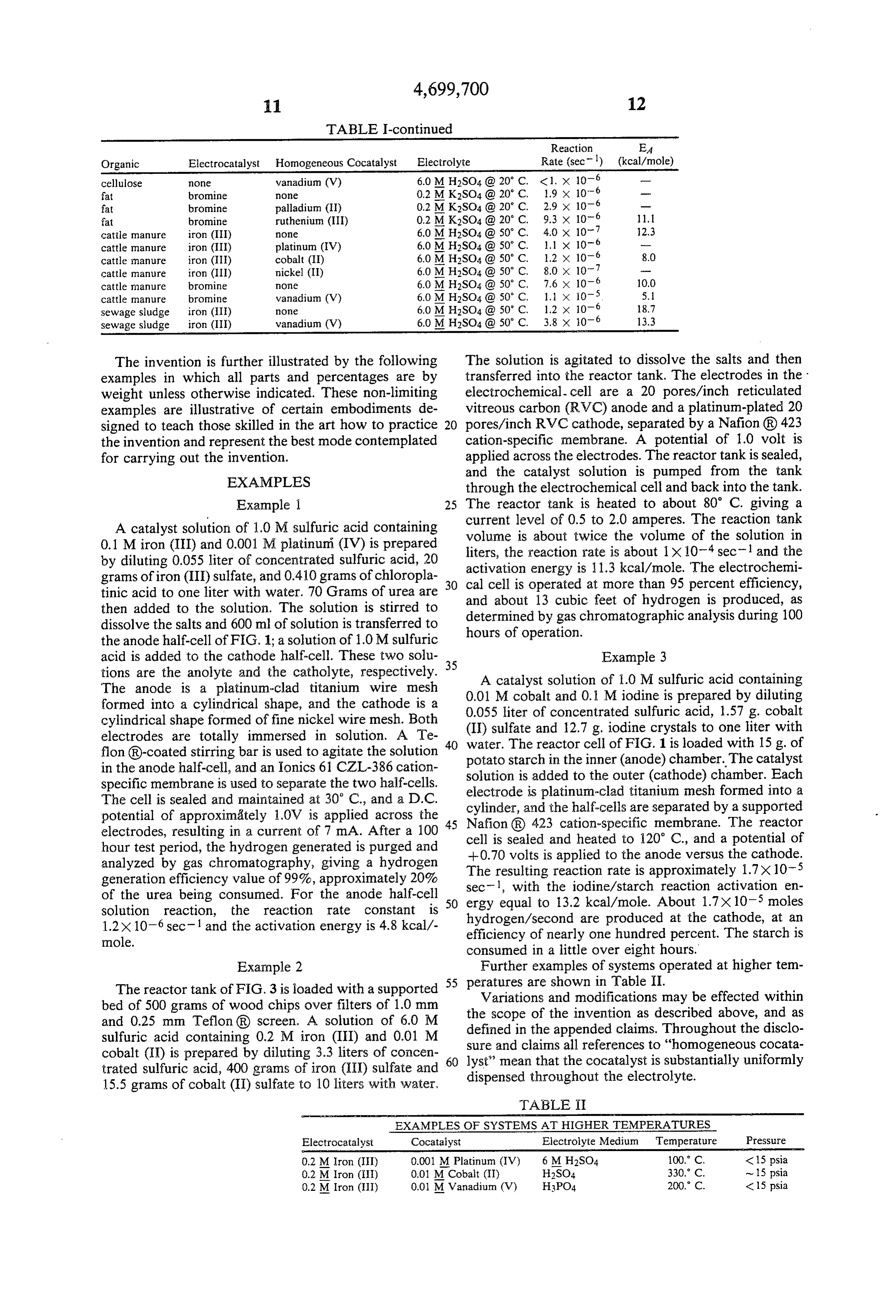
and modifications may be effected within bed of 500 grams of wood chips over filters of 1.0 mm and 0.25 mm Teflon (R) screen. A solution of 6.0 M the scope of the invention as described above, and as sulfuric acid containing 0.2 M iron (III) and 0.01 M defined in the appended claims. Throughout the disclo cobalt (II) is prepared by diluting 3.3 liters of concen 60 lyst” meanclaims sure and all references to "homogeneous cocata that the cocatalyst is substantially uniformly trated sulfuric acid, 400 grams of iron (III) sulfate and dispensed throughout the electrolyte. 15.5 grams of cobalt(II) sulfate to 10 liters with water,
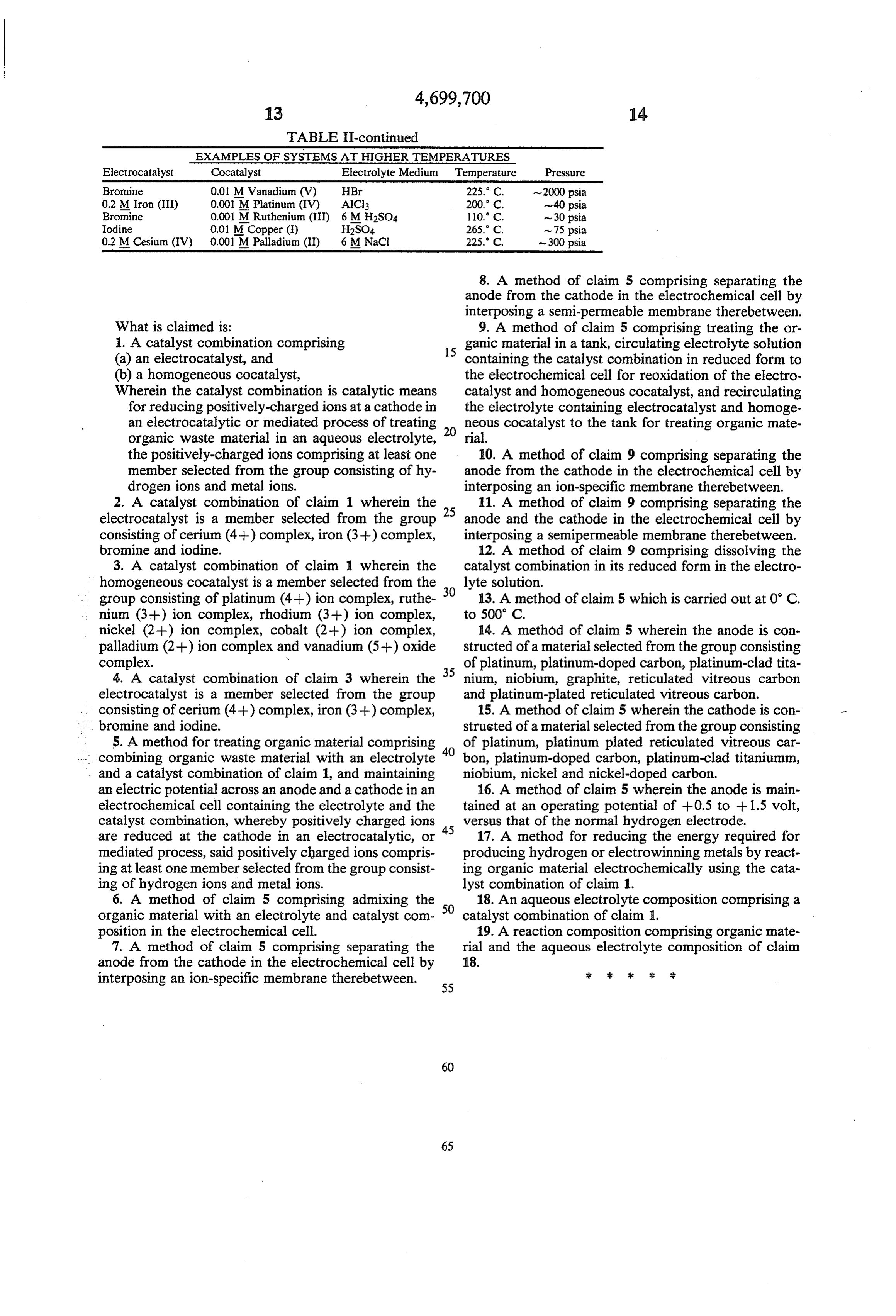
TABLE II
EXAMPLES OF SYSTEMS AT HIGHER TEMPERATURES
Electrocatalyst Cocatalyst Electrolyte Medium Temperature Pressure 0.2 MIron (III) 0.001 M Platinum (IV) 6 M H2SO4 100. C. < 15 psia 0.2 MIron (III) 0.01 M Cobalt(II) H2SO4 330. C. ~15 psia 0.2 MIron (III) 0.01 MVanadium (V) H3PO4 200. C. < 15 psia
Page 9
TABLE II-continued
EXAMPLES OF SYSTEMS AT HIGHER TEMPERATURES
Electrocatalyst Cocatalyst Electrolyte Medium Temperature Pressure Bromine 0.01 MVanadium (V) HBr 225. C. -2000 psia 0.2 MIron (III) 0.001 M Platinum (IV) AlCl3 200. C. - 40 psia Bronine 0.001 M Ruthenium (III) 6 MH2SO4 110. C. ~30 psia Iodine 0.01 M. Copper (I) H2SO4. 265. C. -75 psia 0.2 M Cesium (IV) 0.001 M Palladium (II) 6 MNaCl 225. C. ~300 psia
8. A method of claim 5 comprising separating the anode from the cathode in the electrochemical cell by interposing a semi-permeable membrane therebetween.
What is claimed is: 9. A method of claim 5 comprising treating the or 1. A catalyst combination comprising 15 ganic material in a tank, circulating electrolyte solution (a) an electrocatalyst, and containing the catalyst combination in reduced form to (b) a homogeneous cocatalyst, the electrochemical cell for reoxidation of the electro Wherein the catalyst combination is catalytic means catalyst and homogeneous cocatalyst, and recirculating for reducing positively-charged ions at a cathode in the electrolyte containing electrocatalyst and homoge an electrocatalytic or mediated process of treating neous cocatalyst to the tank for treating organic mate organic waste material in an aqueous electrolyte, rial.
the positively-charged ions comprising at least one 10. A method of claim 9 comprising separating the member selected from the group consisting of hy anode from the cathode in the electrochemical cell by drogen ions and metal ions. interposing an ion-specific membrane therebetween. 2. A catalyst combination of claim 1 wherein the 11. A method of claim 9 comprising separating the electrocatalyst is a member selected from the group 25 anode and the cathode in the electrochemical cell by consisting of cerium (4--) complex, iron (3--) complex, interposing a semipermeable membrane therebetween. bromine and iodine. 12. A method of claim 9 comprising dissolving the 3. A catalyst combination of claim 1 wherein the catalyst combination in its reduced form in the electro homogeneous cocatalyst is a member selected from the 30 lyte solution.
group consisting of platinum (4--) ion complex, ruthe 13. A method of claim 5 which is carried out at 0° C. nium (3-) ion complex, rhodium (3--) ion complex, to 500 C.
nickel (2--) ion complex, cobalt (2--) ion complex, 14. A method of claim 5 wherein the anode is con palladium (2+) ion complex and vanadium (5--) oxide structed of a material selected from the group consisting
of platinum, platinum-doped carbon, platinum-clad tita 4. A catalyst combination of claim 3 wherein the nium, niobium, graphite, reticulated vitreous carbon electrocatalyst is a member selected from the group and platinum-plated reticulated vitreous carbon. consisting of cerium (4+) complex, iron (3+) complex, 15. A method of claim 5 wherein the cathode is con bromine and iodine. structed of a material selected from the group consisting 5. A method for treating organic material comprising 40 of platinum, piatinum plated reticulated vitreous car combining organic waste material with an electrolyte bon, platinum-doped carbon, platinum-clad titaniumm, and a catalyst combination of claim 1, and maintaining niobium, nickel and nickel-doped carbon. an electric potential across an anode and a cathode in an 16. A method of claim 5 wherein the anode is main electrochemical cell containing the electrolyte and the tained at an operating potential of -0.5 to -- 1.5 volt, catalyst combination, whereby positively charged ions versus that of the normal hydrogen electrode. are reduced at the cathode in an electrocatalytic, or 45 17. A method for reducing the energy required for mediated process, said positively charged ions compris producing hydrogen or electrowinning metals by react ing at least one member selected from the group consist ing organic material electrochemically using the cata ing of hydrogen ions and metal ions. lyst combination of claim 1.
6. A method of claim 5 comprising admixing the 50 18. An aqueous electrolyte composition comprising a organic material with an electrolyte and catalyst com catalyst combination of claim 1.
position in the electrochemical cell. 19. A reaction composition comprising organic mate 7. A method of claim 5 comprising separating the rial and the aqueous electrolyte composition of claim anode from the cathode in the electrochemical cell by 8.
interposing an ion-specific membrane therebetween. k is
Page 10
UNITED STATES PATENT AND TRADEMARK OFFICE
CERTIFICATE OF CORRECTION
INVENTOR(S) : Patrick M. DHOOGE - It is certified that error appears in the above-identified patent and that said Letters Patent are hereby corrected as shown below:
Column 3, line 31, "of the catalyst and " should read -- of the cocatalyst and--.
Signed and Sealed this
Seventeenth Day of May, 1988 1 Attest:
DONALD J. QUIGG
Attesting Officer -- Commissioner of Patents and Trademarks
Provenance
- Collection
- Cited prior art
- Original PDF
- patentimages.storage.googleapis.com →
- Filed
- 1986-05-19
- Pages
- 10
- Method
- pdftotext (the PDF's own text layer) + pdftoppm 300dpi page scans
- Source
- Google Patents bibliographic record
- Granted
- 1987-10-13
- Inventors
- Patrick M. Dhooge; Delphi Research Inc
- Transcribed from
- patentimages.storage.googleapis.com →