patent · US4005185
Method for hydrogen generation
25 January 1977
Page 1 — bibliographic record
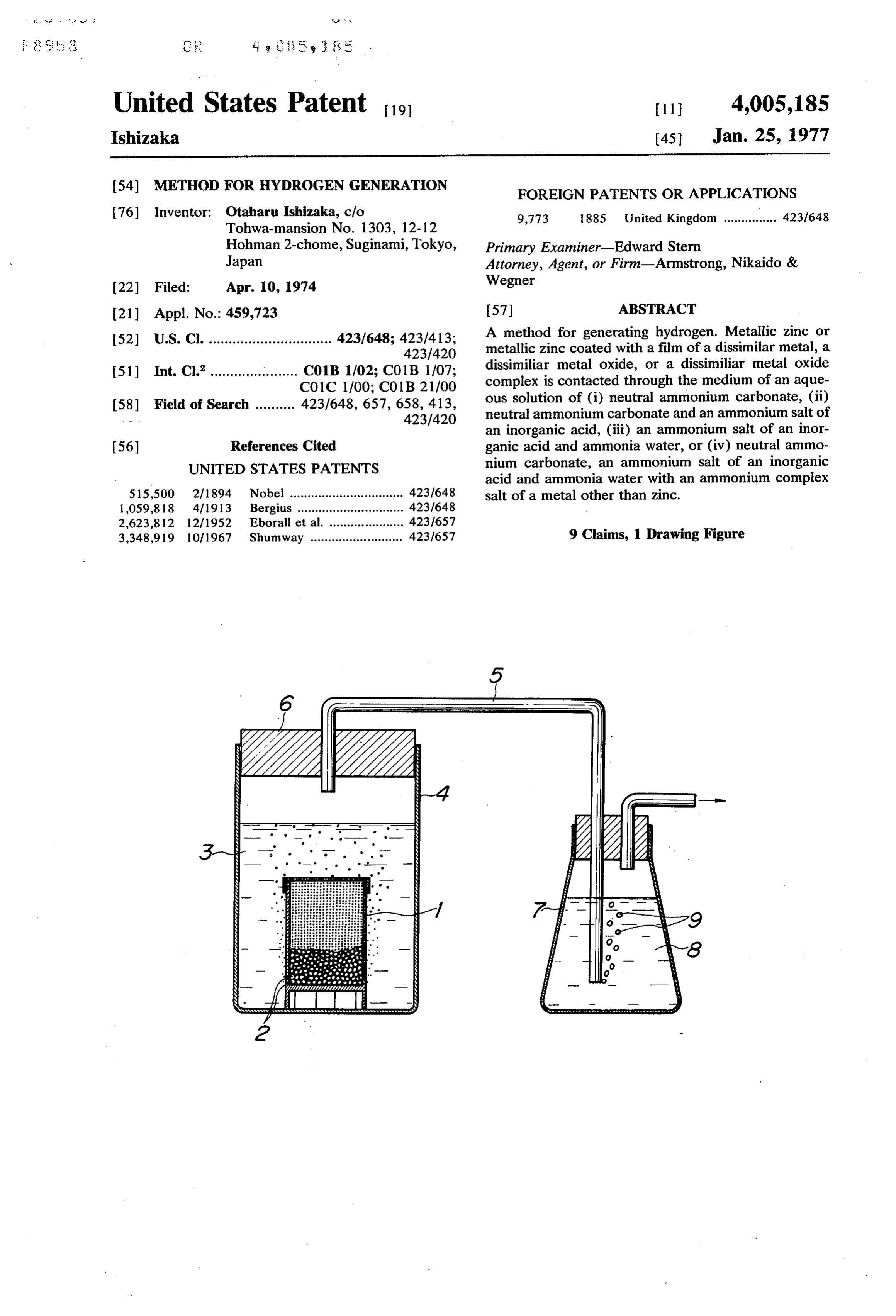
United States Patent 19 11 4,005,185 Ishizaka 45 Jan. 25, 1977 (54) METHOD FOR HYDROGEN GENERATION FOREIGN PATENTS OR APPLICATIONS 76) Inventor: Otaharu Ishizaka, c/o 9,773 1885 United Kingdom ..........r 423.1648
Hohman 2-chome, Suginami, Tokyo, Primary Examiner-Edward Stern
Japan Attorney, Agent, or Firm-Armstrong, Nikaido & 22 Filed: Apr. 10, 1974 Wegner 21 Appl. No.: 459,723 57 ABSTRACT 52) U.S. Cl. ............................... 423/648; 423/413; A method for generating hydrogen. Metallic zinc or 423/420 metallic zinc coated with a film of a dissimilar metal, a 51 Int. Cl.’...................... C01B 1/02; CO1B 1/07; dissimiliar metal oxide, or a dissimiliar metal oxide CO1C 1/00; C01B 21/00 complex is contacted through the medium of an aque 58) Field of Search .......... 423/648, 657, 658, 413, ous solution of (i) neutral ammonium carbonate, (ii) 423/420 neutral ammonium carbonate and an ammonium salt of an inorganic acid, (iii) an ammonium salt of an inor (56) References Cited ganic acid and ammonia water, or (iv) neutral ammo UNITED STATES PATENTS nium carbonate, an ammonium salt of an inorganic acid and ammunia water with an ammonium complex 515,500 2/1894 Nobel ................................ 423/648 salt of a metal other than zinc. 1,059,818 4/1913 Bergius ............ a 423/648 2,623,812 12/1952 Eborall et al. ... 423/657 3,348,919 10/1967 Shumway .......................... 423.1657 9 Claims, 1 Drawing Figure
Page 2
Drawing sheet — no readable text.
Page 3
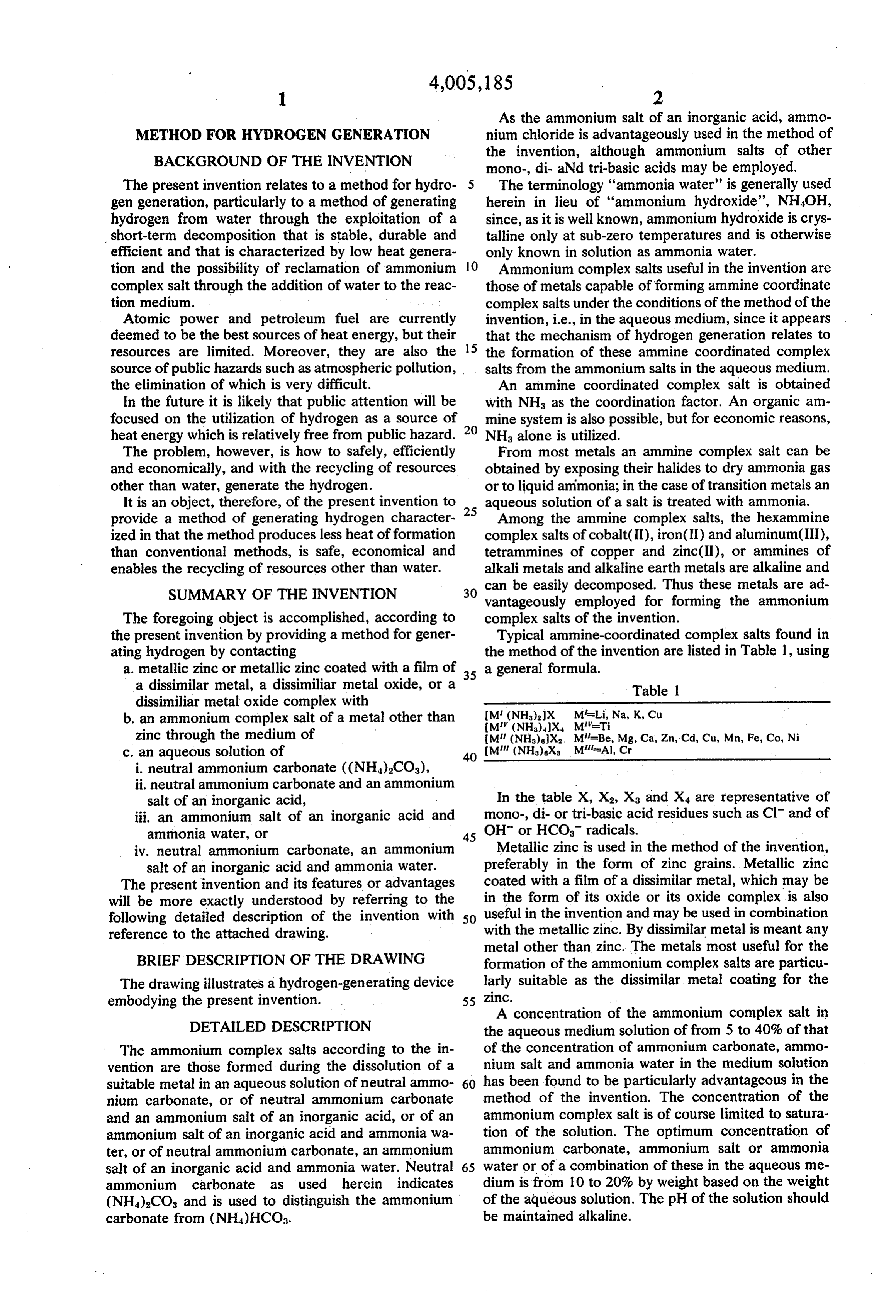
As the ammonium salt of an inorganic acid, ammo
METHOD FOR HYDROGEN GENERATION nium chloride is advantageously used in the method of BACKGROUND OF THE INVENTION the invention, although ammonium salts of other mono-, di- and tri-basic acids may be employed.
The present invention relates to a method for hydro 5 The terminology "ammonia water' is generally used gen generation, particularly to a method of generating herein in lieu of "ammonium hydroxide', NH4OH, hydrogen from water through the exploitation of a since, as it is well known, ammonium hydroxide is crys short-term decomposition that is stable, durable and talline only at sub-zero temperatures and is otherwise efficient and that is characterized by low heat genera only known in solution as ammonia water. tion and the possibility of reclamation of ammonium O Ammonium complex salts useful in the invention are complex salt through the addition of water to the reac those of metals capable of forming ammine coordinate tion medium. complex salts under the conditions of the method of the Atomic power and petroleum fuel are currently invention, i.e., in the aqueous medium, since it appears deemed to be the best sources of heat energy, but their that the mechanism of hydrogen generation relates to
resources are limited. Moreover, they are also the the formation of these ammine coordinated complex source of public hazards such as atmospheric pollution, salts from the ammonium salts in the aqueous medium. the elimination of which is very difficult. An ammine coordinated complex salt is obtained In the future it is likely that public attention will be with NH as the coordination factor. An organic am focused on the utilization of hydrogen as a source of 20 mine system is also possible, but for economic reasons, heatenergy which is relatively free from public hazard. NH alone is utilized.
The problem, however, is how to safely, efficiently From most metals an ammine complex salt can be and economically, and with the recycling of resources obtained by exposing their halides to dry ammonia gas other than water, generate the hydrogen. or to liquid ammonia; in the case of transition metals an It is an object, therefore, of the present invention to 25 aqueous solution of a salt is treated with ammonia. provide a method of generating hydrogen character Among the ammine complex salts, the hexammine ized in that the method produces less heat of formation complex salts of cobalt(II), iron(II) and aluminum(III), than conventional methods, is safe, economical and tetrammines of copper and zincCII), or ammines of enables the recycling of resources other than water. alkali metals and alkaline earth metals are alkaline and SUMMARY OF THE INVENTION 30 can be easily decomposed. Thus these metals are ad vantageously employed for forming the ammonium
The foregoing object is accomplished, according to complex salts of the invention.
the present invention by providing a method for gener Typical ammine-coordinated complex salts found in ating hydrogen by contacting the method of the invention are listed in Table 1, using a.metallic zinc or metallic zinc coated with a film of 35 a general formula.
a dissimilar metal, a dissimiliar metal oxide, or a Table 1 dissimiliar metal oxide complex with b. an ammonium complex salt of a metal other than M (NH)X M=Li, Na, K, Cu
zinc through the medium of M (NH)X, M=Be, Mg, Ca, Zn, Cd, Cu, Mn, Fe, Co, Ni c. an aqueous solution of 40 M (NH)x Miss Al, Cr i. neutral ammonium carbonate ((NH4)2COs), ii. neutral ammonium carbonate and an ammonium salt of an inorganic acid, In the table X, X2, Xa and X4 are representative of iii. an ammonium salt of an inorganic acid and mono-, di- or tri-basic acid residues such as Cl and of ammonia water, or 45 OH or HCOs radicals.
iv. neutral ammonium carbonate, an ammonium Metallic zinc is used in the method of the invention, salt of an inorganic acid and ammonia water. preferably in the form of zinc grains. Metallic zinc The present invention and its features or advantages coated with a film of a dissimilar metal, which may be will be more exactly understood by referring to the in the form of its oxide or its oxide complex is also following detailed description of the invention with 50 useful in the invention and may be used in combination reference to the attached drawing. with the metallic zinc. By dissimilar metal is meant any metal other than zinc. The metals most useful for the
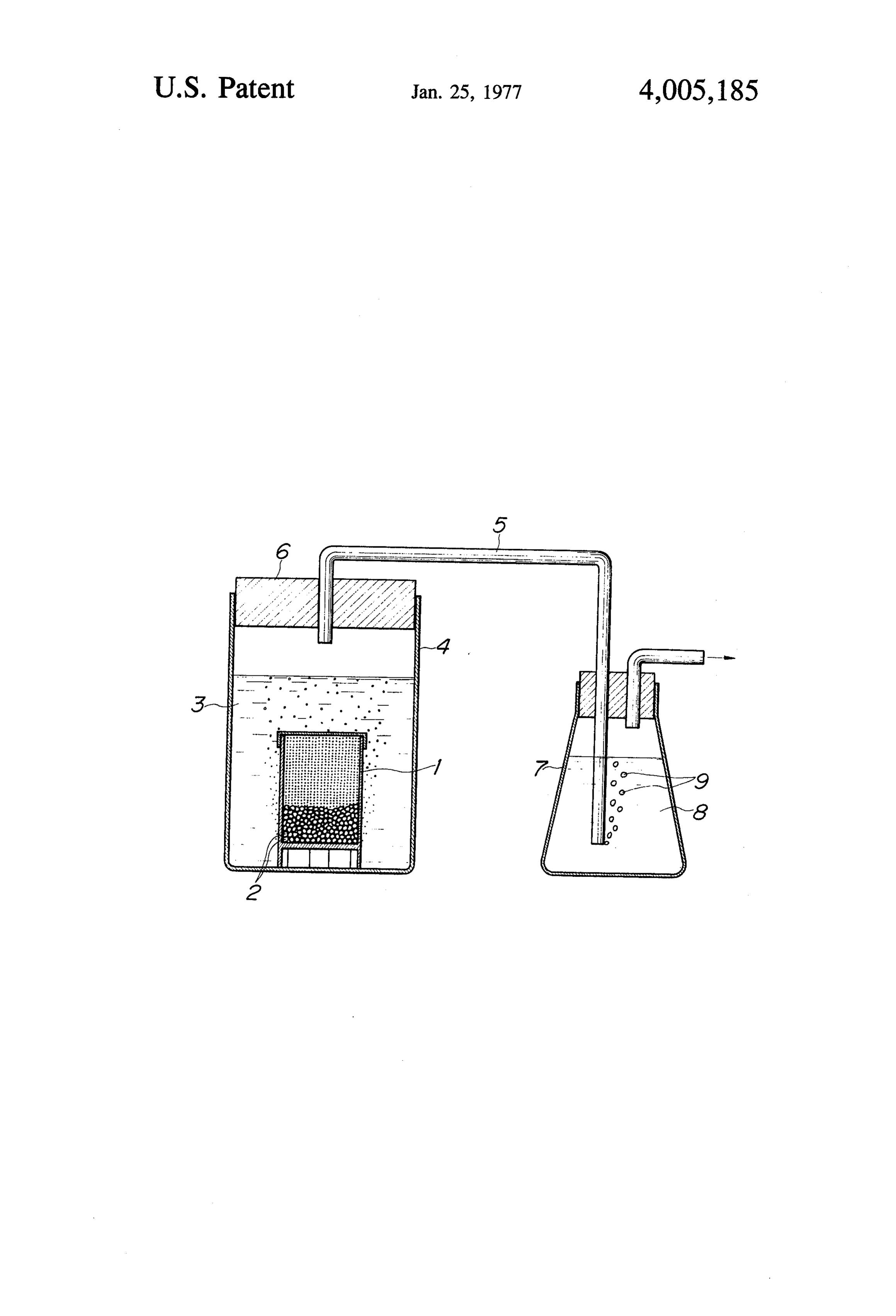
BRIEF DESCRIPTION OF THE DRAWING formation of the ammonium complex salts are particu The drawing illustrates a hydrogen-generating device larly suitable as the dissimilar metal coating for the embodying the present invention. 55 zinc.
A concentration of the ammonium complex salt in
DETAILED DESCRIPTION the aqueous medium solution of from 5 to 40% of that The ammonium complex salts according to the in of the concentration of ammonium carbonate, ammo vention are those formed during the dissolution of a nium salt and ammonia water in the medium solution suitable metal in an aqueous solution of neutral ammo- 60 has been found to be particularly advantageous in the nium carbonate, or of neutral ammonium carbonate method of the invention. The concentration of the and an ammonium salt of an inorganic acid, or of an ammonium complex salt is of course limited to satura ammonium salt of an inorganic acid and ammonia wa tion of the solution. The optimum concentration of ter, or of neutral ammonium carbonate, an ammonium ammonium carbonate, ammonium salt or ammonia salt of an inorganic acid and ammonia water. Neutral 65 water or of a combination of these in the aqueous me ammonium carbonate as used herein indicates dium is from 10 to 20% by weight based on the weight (NH)CO and is used to distinguish the ammonium of the aqueous solution. The pH of the solution should carbonate from (NH4)HCO3. be maintained alkaline.
Page 4
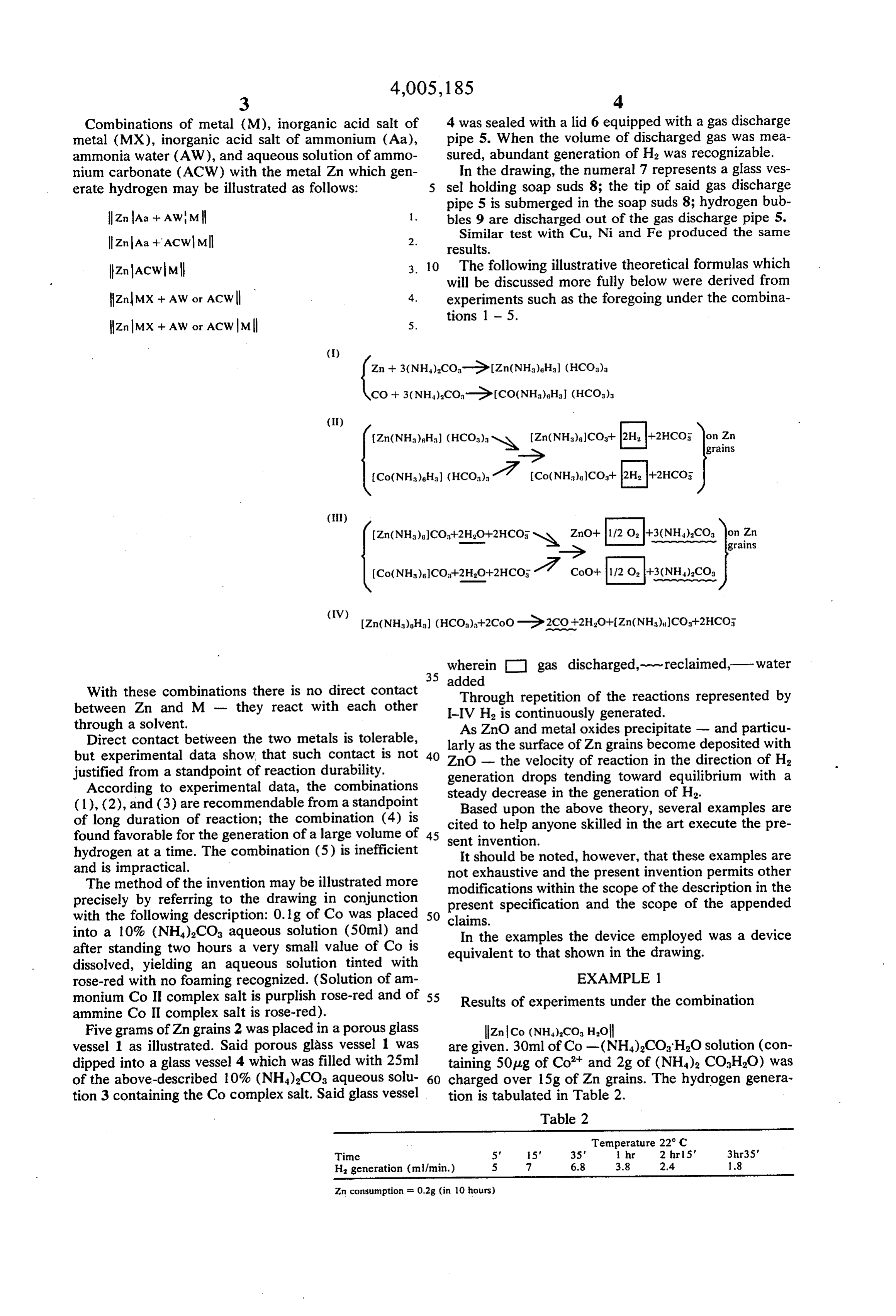
Combinations of metal (M), inorganic acid salt of 4 was sealed with a lid 6 equipped with a gas discharge metal (MX), inorganic acid salt of ammonium (Aa), pipe 5. When the volume of discharged gas was mea ammonia water (AW), and aqueous solution of ammo sured, abundant generation of H2 was recognizable. nium carbonate (ACW) with the metal Zn which gen In the drawing, the numeral 7 represents a glass ves erate hydrogen may be illustrated as follows: 5 sel holding soap suds 8; the tip of said gas discharge pipe 5 is submerged in the soap suds 8; hydrogen bub
ZnAa + AwM 1. bles 9 are discharged out of the gas discharge pipe 5. Similar test with Cu, Ni and Fe produced the same
IZnAa + ACw MI 2. results.
|ZnACw M 3. 10 The following illustrative theoretical formulas which will be discussed more fully below were derived from |Znd MX + AW or ACW 4. experiments such as the foregoing under the combina
CO + 3(NH),Coa-S (Co(NH4)Hal (HCOs).
Zn(NHa)Ha) (HCOs). N Zn(NH))CO- H.2Hco, grains
(III)
(Zn(NH4). Cost2Ho:2HCO, N. ZnO grains
Co(NH)CO+2HO+2HCO. 1 CoO-- 1/2 O-3 (NH),CO.
wherein O gas discharged, -reclaimed, -water 35 added
With these combinations there is no direct contact Through repetition of the reactions represented by between Zn and M - they react with each other I-IV. He is continuously generated. through a solvent. As ZnO and metal oxides precipitate - and particu Direct contact between the two metals is tolerable, larly as the surface of Zn grains become deposited with but experimental data show that such contact is not 40 ZnO - the velocity of reaction in the direction of H, justified from a standpoint of reaction durability. generation drops tending toward equilibrium with a According to experimental data, the combinations steady decrease in the generation of H2. (1), (2), and (3) are recommendable from a standpoint Based upon the above theory, several examples are of long duration of reaction; the combination (4) is cited to help anyone skilled in the art execute the pre found favorable for the generation of a large volume of 45 sent invention.
hydrogen at a time. The combination (5) is inefficient It should be noted, however, that these examples are and is impractical. not exhaustive and the present invention permits other The method of the invention may be illustrated more precisely by referring to the drawing in conjunction modifications within the scope of the description in the present specification and the scope of the appended with the following description: 0.1 g of Co was placed SO claims.
into a 10% (NH),COs aqueous solution (50ml) and In the examples the device employed was a device after standing two hours a very small value of Co is equivalent to that shown in the drawing. dissolved, yielding an aqueous solution tinted with rose-red with no foaming recognized. (Solution of am EXAMPLE 1. monium Co II complex salt is purplish rose-red and of 55 Results of experiments under the combination ammine Co II complex salt is rose-red).
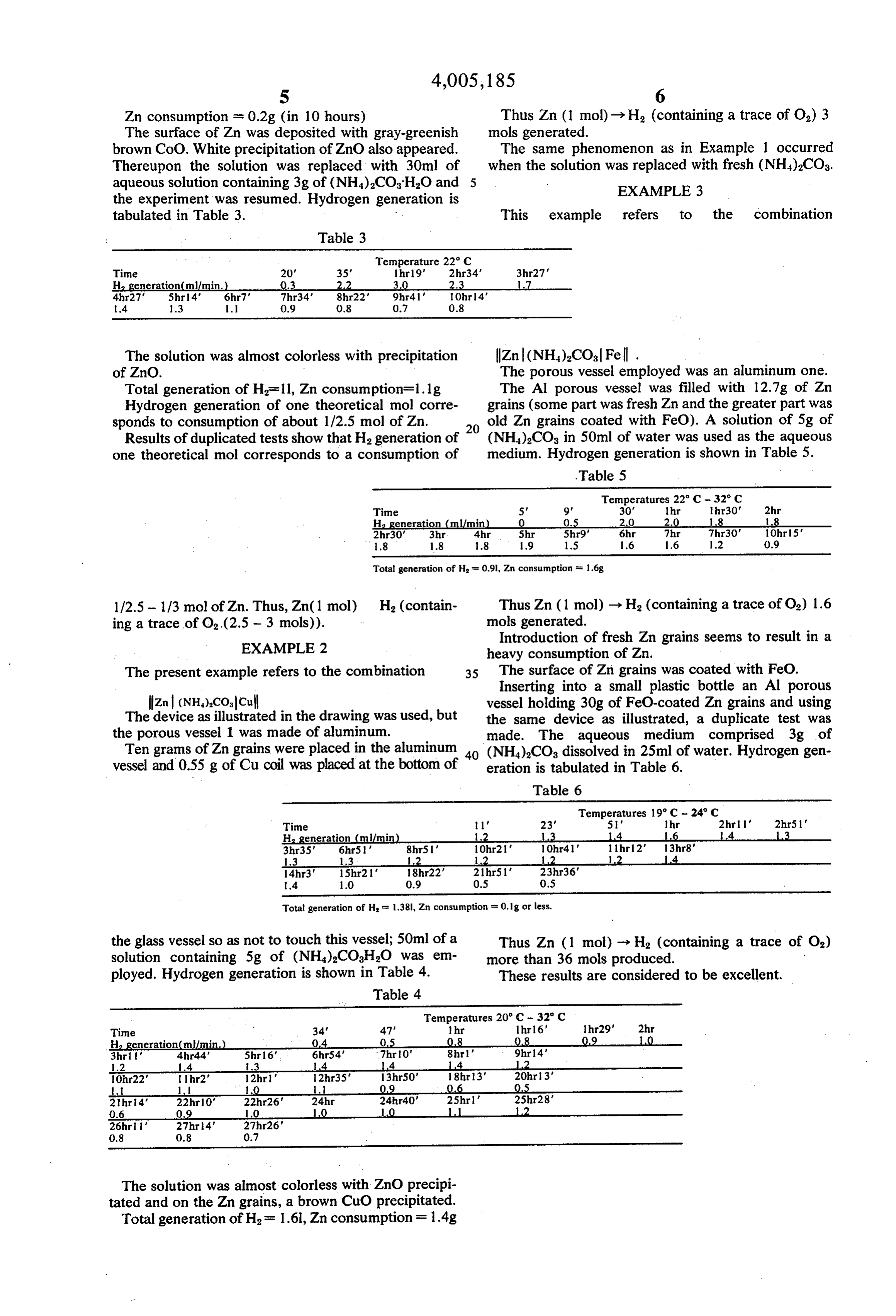
Five grams of Zn grains 2 was placed in a porous glass ZnCo (NH),CO, Hol vessel 1 as illustrated. Said porous glass vessel 1 was are given. 30ml of Co-(NH4)2CO3H2O solution (con dipped into a glass vessel 4 which was filled with 25ml taining 50pug of Co” and 2g of (NH), COHO) was of the above-described 10% (NH4)2COs acqueous solu 60 charged over 15g of Zn grains. The hydrogen genera tion 3 containing the Co complex salt. Said glass vessel tion is tabulated in Table 2. Table 2
Temperature 22 C
Time 5' 5" 35' 1 hr 2 hr 15 3hr35'
H. generation (ml/min.) 5 7 6.8 3.8 2.4 f.8
Zn consumption a 0.2g (in 10 hours)
Page 5
Zn consumption = 0.2g (in 10 hours) Thus Zn (1 mol) -> H. (containing a trace of O.) 3 The surface of Zn was deposited with gray-greenish mols generated.
brown CoO. White precipitation of ZnO also appeared. The same phenomenon as in Example 1 occurred Thereupon the solution was replaced with 30ml of when the solution was replaced with fresh (NH),CO. aqueous solution containing 3g of (NH)COHO and 5 the experiment was resumed. Hydrogen generation is EXAMPLE 3 tabulated in Table 3. This example refers to the combination Table 3 s - Temperature 22 C
Time 20' 35' 1hr19' 2hr34' 3hr27' He generation(ml/min. 2. 3.
4hr27' Shri 4' 6hr7' 7hr34' 8hr22' 9hr41' Ohr4'
The solution was almost colorless with precipitation |Zn(NH),COa Fe. of ZnO. The porous vessel employed was an aluminum one. Total generation of HF ll, Zn consumption=1.1g The Al porous vessel was filled with 12.7g of Zn Hydrogen generation of one theoretical mol corre- grains (some part was fresh Zn and the greater part was sponds to consumption of about 1/2.5 mol of Zn. 20 old Zn grains coated with Fe0). A solution of 5g of Results of duplicated tests show that Hageneration of (NH4)2COa in 50ml of water was used as the aqueous one theoretical mol corresponds to a consumption of medium. Hydrogen generation is shown in Table 5. Table 5
Temperatures 22°C - 32° C
Time 5' 9' 30 hir hr30' 2hr He generation ml/min O 0. 2.0 2 2hr30' 3r 4.hr Sh 5hrs' 6hr 7hr Thr30" OhrS'
Total generation of H = 0.91, Zn consumption = 1.6g
1/2.5 - 1/3 mol of Zn. Thus, Zn(1 mol) H. (contain- Thus Zn (1 mol) -> H. (containing a trace of O,) 1.6 ing a trace of O(2.5 - 3 mols)). mols generated. Introduction of fresh Zn grains seems to result in a
EXAMPLE 2 heavy consumption of Zn.
The present example refers to the combination 35 The surface of Zn grains was coated with Fe0. Inserting into a small plastic bottle an Al porous vessel holding 30g of Fe0-coated Zn grains and using
The device as illustrated in the drawing was used, but the same device as illustrated, a duplicate test was the porous vessel 1 was made of aluminum. made. The aqueous medium comprised 3g of Tengrams of Zn grains were placed in the aluminum 40 (NH4)2COs dissolved in 25ml of water. Hydrogen gen vessel and 0.55g of Cu coil was placed at the bottom of eration is tabulated in Table 6. Table 6
Temperatures 19C - 24°C
Time 1" 23' 5' thr 2hr 1' 2hr51' H. generation Ini l 4 3hr35' 6hr5' 8hr51' Ohr21' 10hr4' 11hr12 13hrs'
14hr3 Shr21 18hr22' 21hrs 1 23hr36
Total generation of H = 1.38, Zn consumption to 0.1g or less.
the glass vessel so as not to touch this vessel; 50ml of a Thus Zn (1 mol) - H. (containing a trace of Oz) solution containing 5g of (NH4)2COHO was em more than 36 mols produced. ployed. Hydrogen generation is shown in Table 4. These results are considered to be excellent. Table 4
Temperatures 20 C-32 C
Time 34' 47' 1hr 1hr16' hir29" 2hr ..H., generation(m/min. O O
21hr14' 22hr0' 22hr26 24hr 24hra.0' 25hr' 2Shr28' 0.6 0.9 1.0 1.0 1.0 1. L2
The solution was almost colorless with ZnO precipi tated and on the Zn grains, a brown CuO precipitated.
Total generation of Ha = 1.6l, Zn consumption F 1.4g
Page 6
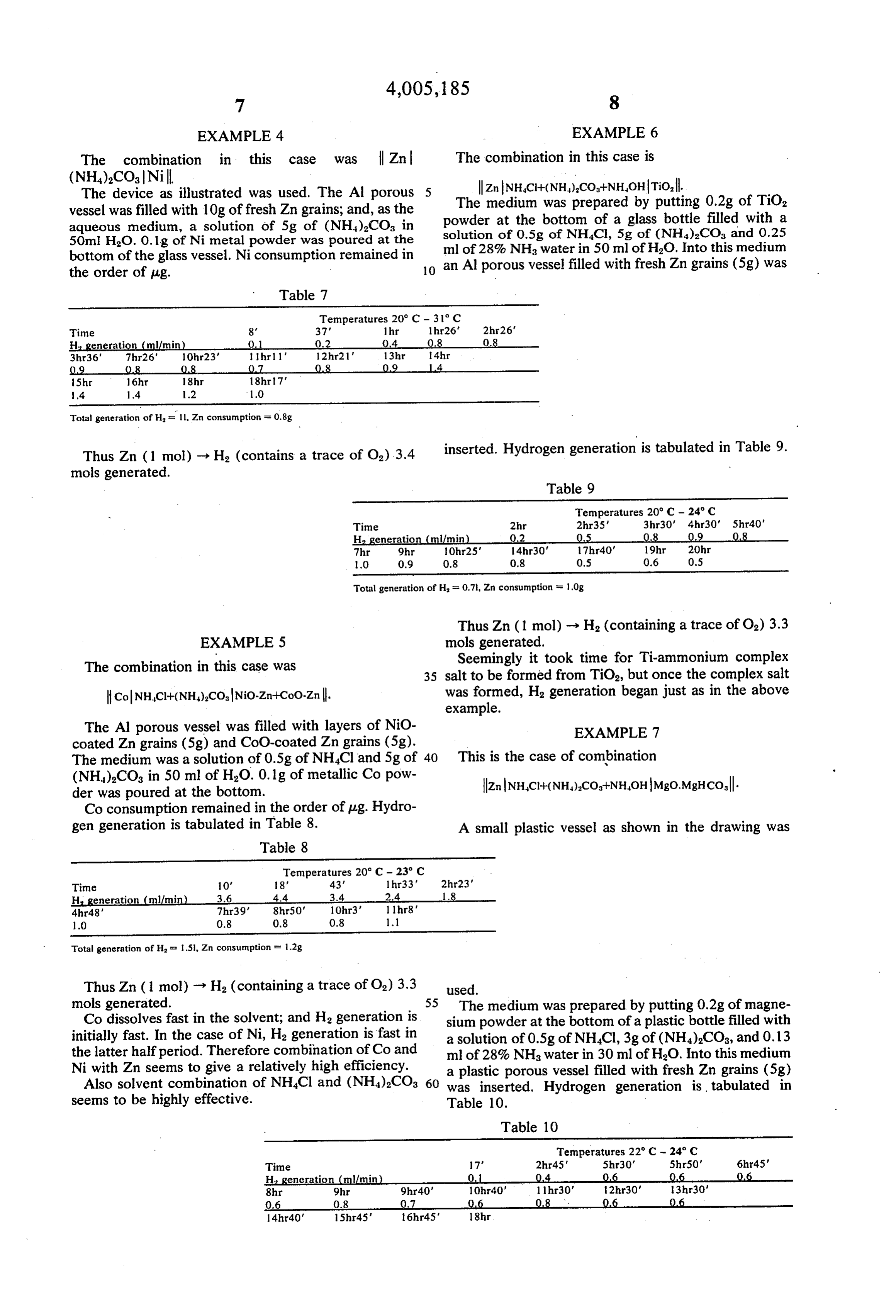
EXAMPLE 4 EXAMPLE 6
The combination in this case was HZn The combination in this case is
The device as illustrated was used. The Al porous 5 The|zn|NHCH-(NH),Coat-NH.OHTiO,.
medium was prepared by putting 0.2g of TiO, vessel was filled with 10g of fresh Zn grains; and, as the powder at the bottom of a glass bottle filled with a aqueous medium, a solution of 5g of (NH4)2COs in solution of 0.5g of NHCl, 5g of (NH4)2COs and 0.25 50ml H2O. O. 1g of Nimetal powder was poured at the bottom of the glass vessel. Niconsumption remained in ml of 28% NH water in 50 ml of H2O. Into this medium the order of pug. o an Al porous vessel filled with fresh Zn grains (5g) was Table 7
Temperatures 20° C - 3 1C
Time 8' 37 1hr 1hr26 2hr26 H. generation (ml/mi 0. 0. 0 O 3hr36' 7hr26 Ohr23' 1 hr 11 12hr21 3r f4.hr
Total generation of H, = 11, Zn consumption = 0.8g
Thus Zn (1 mol) --> H. (contains a trace of O)3.4 inserted. Hydrogen generation is tabulated in Table 9. mols generated.
Table 9
Temperatures 20° C - 24 C
Time 2hr 2hr35' 3hr30' 4hr30' Shr40'
H. generation (ml/min 0.2 0.
7 9. Ohr25" 14hr30 7hr40' 19hr 20hr
O 0.9 0.8 0.8 0.5 0.6 0.5
Total generation of H = 0.7, Zn consumption = 1.0g
Thus Zn (1 mol) --> H. (containing a trace of O.) 3.3
EXAMPLE 5 mols generated.
The combination in this case was Seemingly it took time for Ti-ammonium complex 35 salt to be formed from TiO, but once the complex salt
CoNHCH-(NH),CoalNiO-Zn+Coo-Zn. was formed, H2 generation began just as in the above example.
The Al porous vessel was filled with layers of NiO coated Zn grains (5g) and CoO-coated Zn grains (5g). EXAMPLE 7 The medium was a solution of 0.5g of NHCl and 5g of 40 This is the case of combination
(NH),COs in 50 ml of H.O. 0.1g of metallic Co pow der was poured at the bottom. |zn|NHCH-(NH),Cost-NH.OH MgO.MgH coal. Co consumption remained in the order of pug. Hydro gen generation is tabulated in Table 8. A small plastic vessel as shown in the drawing was Table 8
Temperatures 20 C-23 C
Time 10' 8" 43 1hr33' 2hr23'
H. generation (m/mi 3.6 4.4 34 2 1.
4hr48" 7hr39' 8hr50' 10hr3' 11hr3'
total generation of H is 1.5., Zn consumption = 1.2g
Thus Zn (1 mol) - H. (containing a trace of O.) 3.3 used.
mols generated. w 55 The medium was prepared by putting 0.2g of magne Co dissolves fast in the solvent; and H2 generation is si powder at the bottom of a plastic bottle filled with initially fast. In the case of Ni, H2 generation is fast in luti f0.5g of NHCl, 3g of (NH),COs, and 0.13 the latter half period. Therefore combination of Co and is E.er in o E. Io GNdium Ni with Zn seems to give a relatively high efficiency. a plastic porous vessel filled with fresh Zn grains (5g) Also solvent combination of NHCl and (NH4)2CO3 60 E. N.E. Hydrogen generation ill . seems to be highly effective. Table 10.
Table 10
Temperatures 22°C-24°C
Time 7 2hr45" Shr30' 5hrs.O.' 6hr45'
8hr 9hr 9hr40' 10hr40' 11hr30' 2hr30' 3hr30'
Page 7
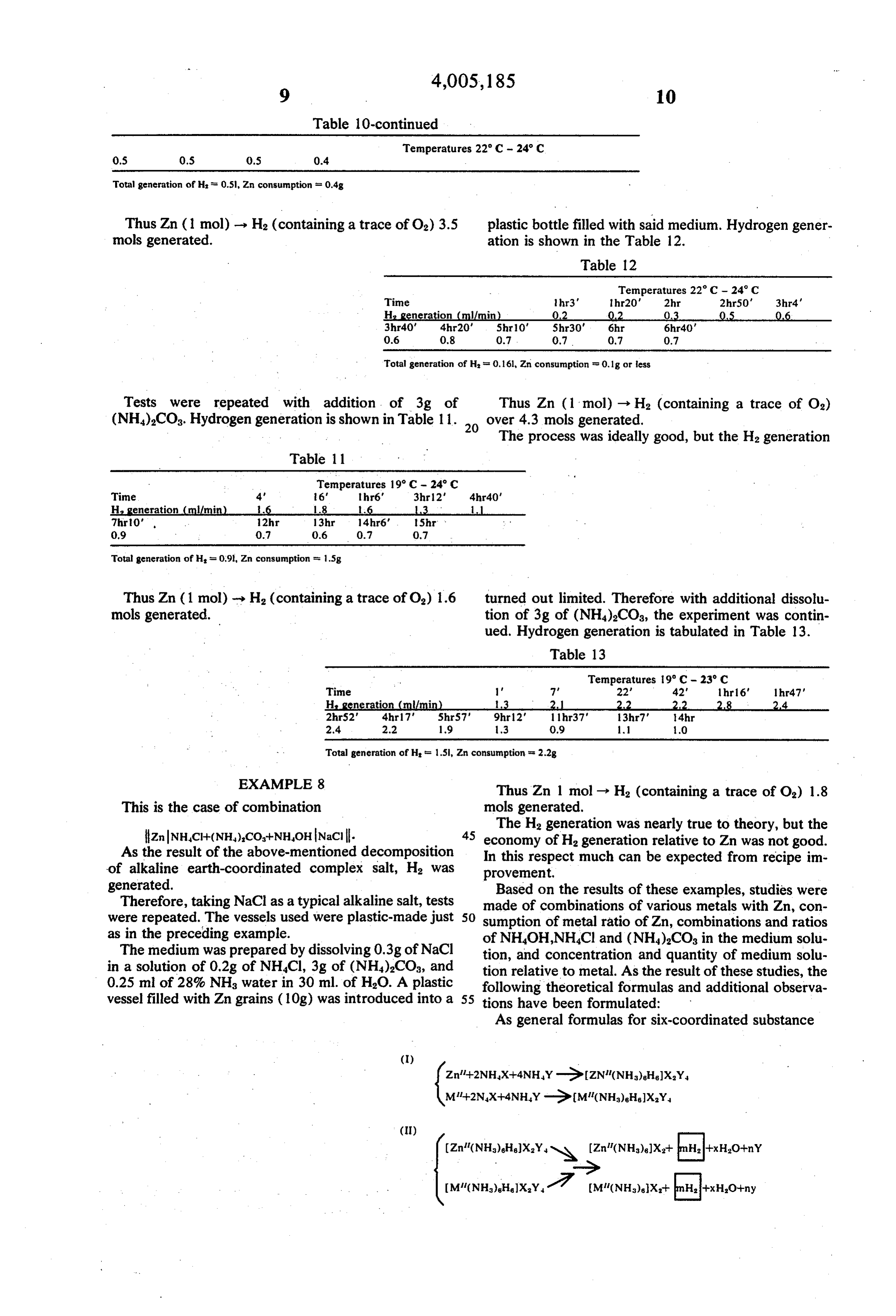
Table 10-continued
Temperatures 22°C - 24 C
Total generation of 0.51, Zn consumption = 0.4g
Thus Zn (1 mol) - He (containing a trace of Oz) 3.5 plastic bottle filled with said medium. Hydrogen gener mols generated. ation is shown in the Table 12. Table 12
Temperatures 22 C - 24 C
Time hr3 hr20' 2hr 2hrs) 3hr4.'
3ra.0' 4hr20' 5hr10' Shr30' 6r 6hr40
Total generation of H = 0, 16l, Zn consumption = 0.1g or less
Tests were repeated with addition of 3g of Thus Zn (1 mol) - Ha (containing a trace of Oz) (NH),CO. Hydrogen generation is shown in Table 1 1. 2 o'er 4.3 mols generated.
The process was ideally good, but the H2 generation
Table 1 1
Temperatures 19°C-24°C
Time 4' 6' thrs' 3hr2 4hr40'
7hr 10' . 12hr 13hr 4hr6' Sr.' .
0.9 0.7 O6 0.7 0.7
Total generation of H = 0.9, Zn consumption = 1.5g
Thus Zn (1 mol) - H. (containing a trace of O.) 1.6 turned out limited. Therefore with additional dissolu mols generated. tion of 3g of (NH4)2CO3, the experiment was contin ued. Hydrogen generation is tabulated in Table 13.
Table 13
Temperatures 19 C-23 C
Time 7 22' 42 1hr16 hr47'
2hrs2' 4hr 17' 5hrs 9hr2 11hr37 3hr 4 2.4 2.2 1.9 3 0.9 1.1 O
Total generation of H = 1.5., Zn consumption as 2.2g
EXAMPLE 8
Thus Zn 1 mol - H. (containing a trace of O.) 1.8
This is the case of combination mols generated. The H generation was nearly true to theory, but the
Hzn|NHCH-(NH,),Cost-NH.OH NaCl. economy of H, generation relative to Zn was not good. As the result of the above-mentioned decomposition in this respect much can be expected from recipe im of alkaline earth-coordinated complex salt, He was provement.
generated. s Based on the results of these examples, studies were Therefore, taking NaCl as a typical alkaline Salt tests made of combinations of various metals with Zn, con Were repeated. The vessels used were plastic-made just 50 sumption of metal ratio of Zn, combinations and ratios as in the preceding example, of NHOH,NHCl and (NH),CO in the medium solu The medium was prepared by dissolving.93g.9f NaCl tion, and concentration and quantity of medium solu in a solution.9f 0.2g of NH4C3g of NH4)2CO3, and tion relative to metal. As the result of these studies, the 0.25 ml of 28% NH3 water in 30 ml of Ha9. A plastic following theoretical formulas and additional observa vessel filled with Zn grains (10g) was introduced into a 55 tions have been formulated:
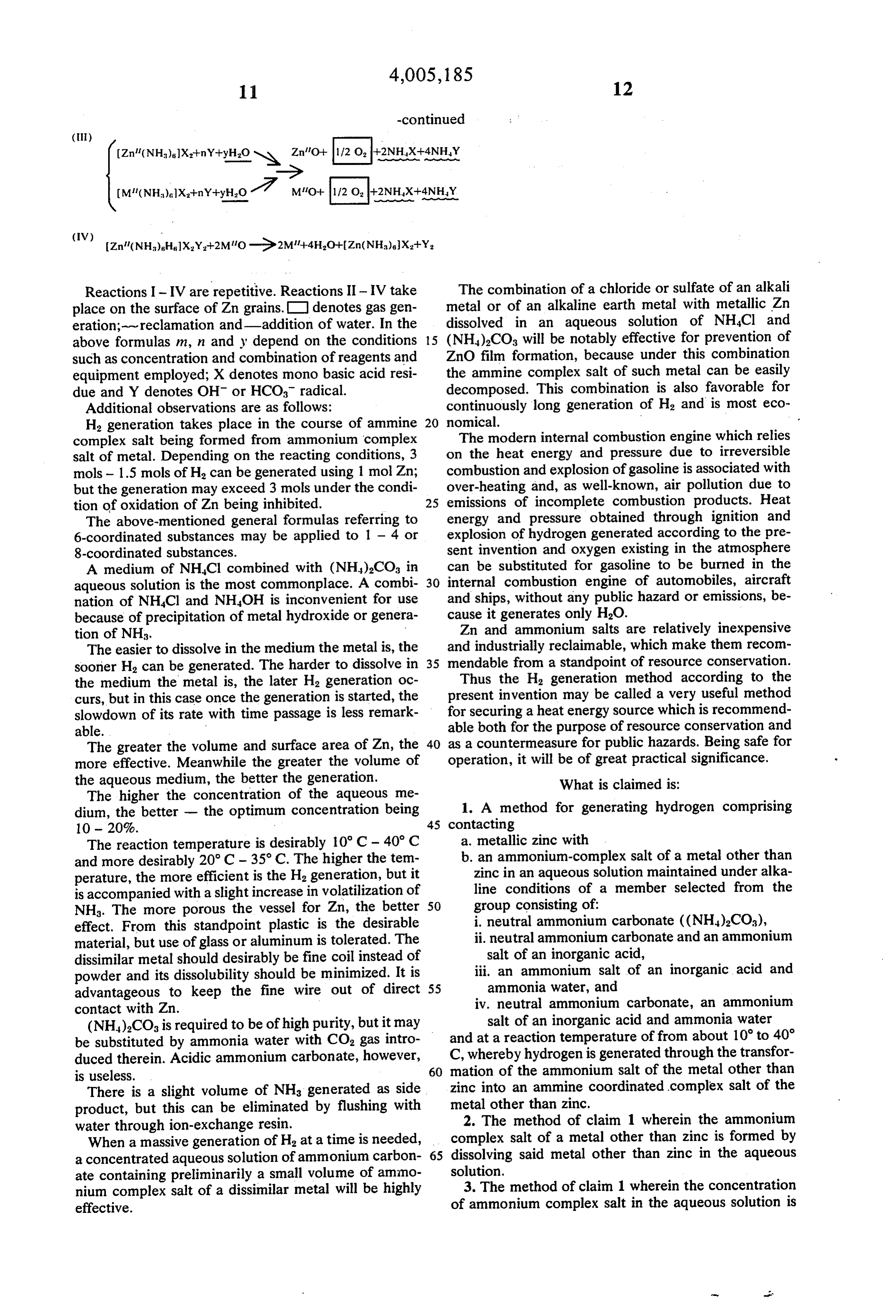
As general formulas for six-coordinated substance
(Zn"(NH).H.IX,Y, N. (Zn(NH))X- shorny
M(NH4)H)X,Y, 1 2 (M(NH)X- mixhorny
Page 8
(III)
Reactions I-IV are repetitive. Reactions II-IV take The combination of a chloride or sulfate of an alkali place on the surface of Zn grains.D denotes gas gen metal or of an alkaline earth metal with metallic Zn eration;-reclamation and-addition of water. In the dissolved in an aqueous solution of NHCl and above formulas m, n and y depend on the conditions 15 (NH4)2CO will be notably effective for prevention of such as concentration and combination of reagents and ZnO film formation, because under this combination equipment employed; X denotes mono basic acid resi the ammine complex salt of such metal can be easily due and Y denotes OH or HCO radical. decomposed. This combination is also favorable for Additional observations are as follows: continuously long generation of H, and is most eco He generation takes place in the course of ammine 20 nomical.
complex salt being formed from ammonium complex The modern internal combustion engine which relies salt of metal. Depending on the reacting conditions, 3 on the heat energy and pressure due to irreversible mols - 1.5 mols of H. can be generated using 1 mol Zn; combustion and explosion of gasoline is associated with but the generation may exceed 3 mols under the condi over-heating and, as well-known, air pollution due to tion of oxidation of Zn being inhibited. 25 emissions of incomplete combustion products. Heat The above-mentioned general formulas referring to energy and pressure obtained through ignition and 6-coordinated substances may be applied to 1 - 4 or explosion of hydrogen generated according to the pre 8-coordinated substances. sent invention and oxygen existing in the atmosphere A medium of NHCl combined with (NH4)2CO in can be substituted for gasoline to be burned in the aqueous solution is the most commonplace. A combi 30 internal combustion engine of automobiles, aircraft nation of NHCl and NHOH is inconvenient for use and ships, without any public hazard or emissions, be because of precipitation of metal hydroxide or genera cause it generates only H.O.
tion of NH3. Zn and ammonium salts are relatively inexpensive The easier to dissolve in the medium the metal is, the and industrially reclaimable, which make them recom sooner H2 can be generated. The harder to dissolve in 35 mendable from a standpoint of resource conservation. the medium the metal is, the later H2 generation oc Thus the H2 generation method according to the curs, but in this case once the generation is started, the present invention may be called a very useful method slowdown of its rate with time passage is less remark for securing a heat energy source which is recommend able. able both for the purpose of resource conservation and The greater the volume and surface area of Zn, the 40 as a countermeasure for public hazards. Being safe for more effective. Meanwhile the greater the volume of operation, it will be of great practical significance. the aqueous medium, the better the generation. What is claimed is: The higher the concentration of the aqueous me 1. A method for generating hydrogen comprising dium, the better - the optimum concentration being 10 - 20%. 45 contacting
The reaction temperature is desirably 10 C-40 C a. metallic zinc with and more desirably 20 C-35°C. The higher the tem b. an ammonium-complex salt of a metal other than perature, the more efficient is the H2 generation, but it zinc in an aqueous solution maintained under alka is accompanied with a slight increase in volatilization of line conditions of a member selected from the NHa. The more porous the vessel for Zn, the better 50 group consisting of:
effect. From this standpoint plastic is the desirable i. neutral ammonium carbonate ((NH4)2CO), material, but use of glass or aluminum is tolerated. The ii. neutral ammonium carbonate and an ammonium dissimilar metal should desirably be fine coil instead of salt of an inorganic acid, powder and its dissolubility should be minimized. It is iii. an ammonium salt of an inorganic acid and advantageous to keep the fine wire out of direct 55 ammonia water, and contact with Zn. iv. neutral ammonium carbonate, an ammonium (NH4)2COa is required to be of high purity, but it may salt of an inorganic acid and ammonia water be substituted by ammonia water with CO2 gas intro C, and at a reaction temperature of from about 10 to 40 duced therein. Acidic ammonium carbonate, however, whereby hydrogen is generated through the transfor is useless. 60 mation of the ammonium salt of the metal other than There is a slight volume of NH3 generated as side zinc into an ammine coordinated complex salt of the product, but this can be eliminated by flushing with metal other than zinc.
2. The method of claim 1 wherein the ammonium water through ion-exchange resin.
When a massive generation of H at a time is needed, complex salt of a metal other than zinc is formed by a concentrated aqueous solution of ammonium carbon 65 dissolving solution.
said metal other than zinc in the aqueous ate containing preliminarily a small volume of ammo nium complex salt of a dissimilar metal will be highly 3. The method of claim 1 wherein the concentration effective. of ammonium complex salt in the aqueous solution is
Page 9
about 5 to 40% of the concentration of the ammonium 7. The method of claim 1 wherein the ammonium complex salt of a metal other than zinc is formed by carbonate in the solution. adding a sulfate of said metal to the aqueous solution. 4. The method of claim 1 wherein the aqueous solu 8. The method of claim 1 wherein the rate of hydro gen generation is controlled by varying the concentra tion is an aqueous solution of ammonium chloride and tion of (i), (ii), (iii), or (iv) in said aqueous solution. neutral ammonium carbonate. 9. A method for generating hydrogen comprising S. The method of claim 1 wherein the metal other contacting metallic zinc with an ammonium complex salt of a metal other than zinc in an aqueous solution than zinc is lithium, sodium, potassium, copper, tita O maintained under alkaline conditions of an ammonium nium, beryllium, magnesium, cadmium, manganese, salt of an inorganic acid and ammonia water and at a reaction temperature of from about 10 to 40 C iron, cobalt, nickel, aluminum or chromium. whereby hydrogen is generated through the transfor 6. The method of claim 1 wherein the ammonium mation of the ammonium complex salt of the metal 5 other than zinc into an ammine coordinated complex complex salt of a metal other than zinc is formed by salt of the metal other than zinc.
adding a chloride of said metal to the aqueous solution.
Provenance
- Collection
- Cited prior art
- Original PDF
- patentimages.storage.googleapis.com →
- Filed
- 1974-04-10
- Pages
- 9
- Method
- pdftotext (the PDF's own text layer) + pdftoppm 300dpi page scans
- Source
- Google Patents bibliographic record
- Granted
- 1977-01-25
- Inventors
- Otaharu Ishizaka
- Transcribed from
- patentimages.storage.googleapis.com →