patent · US4235863
Method of and cell for generating hydrogen
25 November 1980
Page 1 — bibliographic record
United States Patent (19) 11) 4,235,863 Schulten et al. 45 Nov. 25, 1980 54 METHOD OF AND CELL FOR GENERATING 58 Field of Search .............................. 204/59 R, 61; HYDROGEN 423/648 R, 648 A, 646 75) Inventors: Rudolf Schulten, Aachen-Richterich; (56. References Cited Friedrich Behr, U.S. PATENT DOCUMENTS
Herzogenrath-Kohlscheid; Helmut 2,635,993 4/1953 Snavely................... 204/59 RX Wenzl, Jilich, all of Fed. Rep. of 2,864,761 12/1958 D'Ouville et al. ............... 423/646 X Germany 3,192,138 6/1965 Enk et al. ............................... 204/61 73 Assignee: Kernforschungsanlage Jilich 3,676,071 7/1972 Speed ................................... 423/648 . Gesellschaft mit beschrankter 3,957,597 5/1976 Maroni et al. ......................... 204/60 Haftung, Jilich, Fed. Rep. of FOREIGN PATENT DOCUMENTS
Germany
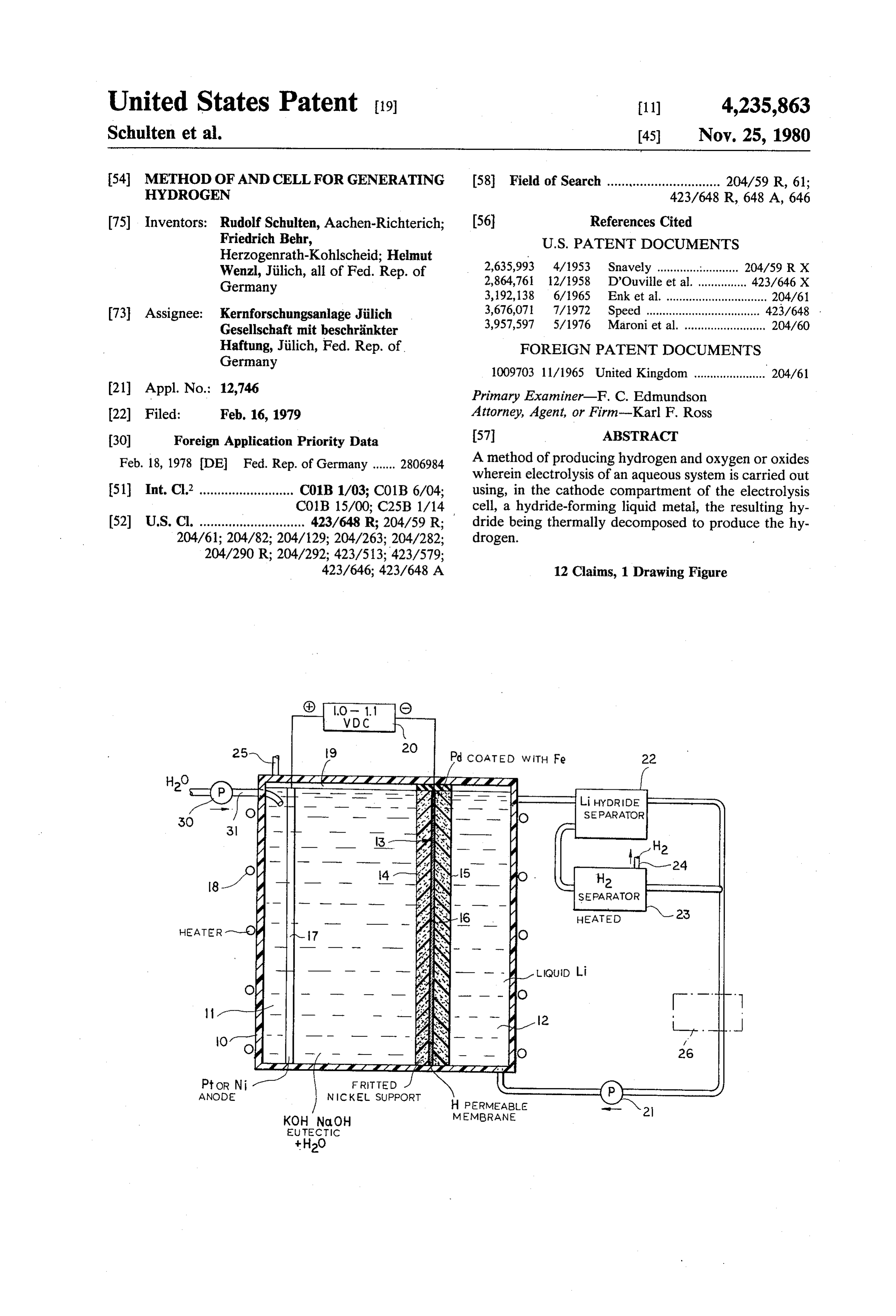
(21) Appl. No.: 12,746 Primary Examiner-F. C. Edmundson (22) Filed: Feb. 16, 1979 Attorney, Agent, or Firm-Karl F. Ross 30 Foreign Application Priority Data 57 ABSTRACT Feb. 18, 1978 DE Fed. Rep. of Germany ....... 2806984 A method of producing hydrogen and oxygen or oxides wherein electrolysis of an aqueous system is carried out 51) Int. C.’.......................... C01B 1/03; C01B 6/04; using, in the cathode compartment of the electrolysis C01B 15/00; C25B 1/14 cell, a hydride-forming liquid metal, the resulting hy 52 U.S. Cl. ............................. 423/648 R; 204/59 R; dride being thermally decomposed to produce the hy 204/61; 204/82; 204/129; 204/263; 204/282; drogen.
423/646; 423/648 A 12 Claims, 1 Drawing Figure
Li HYDRIDE
SePARATOR
FRITTED
EUTECTIC
Page 2
Drawing sheet — no readable text.
Page 3
the cathode are those like palladium or iron alloys
METHOD OF AND CELL FOR GENERATING which have a high reversible hydrogen diffusion rate. HYDROGEN This process cannot be utilized to obtain efficiently molecular hydrogen as is required when the latter is to
FIELD OF THE INVENTION 5 be used as an energy carrier.
The present invention relates to a method of produc OBJECTS OF THE INVENTION ing hydrogen and oxygen and to an electrolysis cell for carrying out this process. It is the principal object of the present invention to provide a relatively simple and economical method of
BACKGROUND OF THE INVENTION O producing molecular hydrogen and oxygen in the form It is known to generate hydrogen and oxygen by the of gaseous Oxygen or oxidized substances. use of electrical energy in an electrolysis process in temAnother object of this invention is to provide a sys with high energy economy for producing molecu which water or another substance containing both hy lar hydrogen.
drogen and oxygen is subjected to the electrolysis in an
Yet another object of the invention is to provide an electrolysis cell, with or without the aid of further 15 improved chemical reactions, to produce the hydrogen or oxygen electrolysiselectrolysis cell or apparatus including an cell for carrying out an improved method of or hydrogen and oxides which are generated instead of producing hydrogen.
gaseous oxygen.
An electrolysis cell for this purpose is generally sub SUMMARY OF THE INVENTION divided into an anode compartment and a cathode com 20 partment by a membrane which is permeable to hydro The above and other objects are attained, in accor gen. dance with the present invention, in a method of elec The production of hydrogen and oxygen by electro trolyzing a system capable of electrolytic decomposi lytic decomposition of water, for example, is a well 25 tion to produce hydrogen and oxygen or an oxide, usu ally an aqueous system or a system having an aqueous known practice utilizing the above-mentioned ap component, which makes use of an electrolysis cell proach.
It is known, in addition, to increase the efficiency of having a cathode compartment and an anode compart the electrolytic decomposition by a simultaneous chem ment separated by a membrane permeable to hydrogen. ical reaction which has the function of reducing the 30 According to the invention, a liquid alkaline metal is voltage required for the decomposition at the anode and introduced into the cathode compartment to form at hence the current requirements for the decomposition. least in part the cathode (generally with the membrane) When a chemical reaction is to be effected simulta while the applied voltage is less than 1.6 volts and the neously with the electrolysis for the purpose described, current density is about 2000A/m2 or more, the hydro it is desirable, as much as possible, to provide a revers 35 gen diffusing from the anode compartment forming the ible chemical reaction so that a portion of the supplied corresponding partment.
alkali-metal hydride in the cathode com energy is coupled with an endothermic chemical reac tion. According to an essential feature of the invention, the For example, in the so-called sulfuric acid hybrid alkaline metal is continuously introduced into the cath process, the sulfur dioxide is initially reacted anodically ode compartment while alkali-metal hydride is continu to sulfuric acid in accordance with the following equa- 40 ously removed therefrom.
tion: According to the invention, the alkali-metal hydride is then heated to a temperature above its melting point and to a temperature which will result in thermal de composition of the alkali-metal hydride at least in large
The sulfuric acid is them thermochemically trans- 45 measure to produce molecular hydrogen. formed in accordance with the following reaction: According to the invention, the thermal decomposi tion of the alkali-metal hydride may be carried out con
H2SO4-H2O -- SO2 + 3O2. tinuously as well.
In the process of the present invention, water in the
This process has been found to be advantageous be- 50 electrolyte is disassociated and the hydrogen ions or cause of its relatively low energy requirements although hydronium ions migrate to the membrane where the considerable energy must be expended nevertheless for hydrogen ions are converted at the cathode by dis the vaporization of the water used in the process. In charge to hydrogen and diffused through the membrane addition it has been found that considerable effort is to react with the alkali metal and form the correspond required to recover the oxygen with high purity from 55 ing metal hydride.
the resulting SO2/O2 mixture. According to the invention, the alkali-metal hydride It is also known to produce hydrogen and oxygen by can be separaed from the molten (liquid) alkali metal the electrolytic dissociation technique in which hydro and subjected free from significant quantities of the gen is withdrawn form the electrolytic solution under liquid alkaline metal, to a thermal treatment whereby the applied voltage by absorbtion in the cathode. At the 60 the alkali metal resulting from this thermal treatment is anode oxygen is released. Such systems are described, returned to the electrolysis cell while hydrogen is re for example, in U.S. Pat. No. 3,874,928 and the German covered.
Pat. Document (open application-Offenlegungss In the anode compartment, gaseous oxygen is re chrift) No. 2,003,749. leased directly although, if desired, an oxidation process A reversal of this process is also used for generating 65 can be effected in the electrolyte from which oxygen electricity and it is also known to provide a cathode can be recovered subsequently by a thermochemical with a high surface concentration of hydrogen for the process in which case the oxidized compound, after production of gaseous hydrogen. The materials used for release of the oxygen, can be returned to the anode
Page 4
compartment as well. In this case, gaseous oxygen is not over all with the heat generated in the process being generated directly in the anode compartment. utilized for steam generation under pressure. The steam The chemical in the anode compartment has the ad which is thus produced can be converted again to elec vantage that it further reduces the cell voltage. tricity with considerable energy recovery. Thus ultimately in accordance with the invention, The process of the present invention can also be car molecular hydrogen and molecular oxygen can be re ried out advantageously at elevated temperatures as covered as products while all other materials processed indicated because under these conditions, the electrical in the reaction can be returned to the respective cell overloading takes place to a lesser extent, because of the compartments. All other substances are thus recycled. increased absorption, diffusion and desorption rates of According to a feature of the invention, the mem O the hydrogen, than when the electrolysis is carried out brane can fulfill at least in part the function of the cath at temperature up to 100° C.
ode provided that it is a material of high electrical con If the process is to be effected at a temperature of ductivity. When the membrane is, as is usually the case about 300° C. with oxygen formation at the anode and in accordance with this invention, a thin foil or film of with the aid of a hydrated melt of potassium hydroxide a metal, it has been found that the electrode is customar 15 and sodium hydroxide (eutectic) or with concentrated ily formed by this film in addition to the liquid alkali sulfuric acid as the electrolyte, it has been found to be metal in contact therewith or in proximity thereto.
As cathodic hydrogen acceptors, we prefer to use advantageous to maintain the cell voltage at about 0.85 to 1.15 volts with the current density measured over the hydride formers which have as high as possible an affin membrane cross section at about 2000 A/m2 or more. ity to hydrogen. This enables the overall cell voltage to 20 The process of the present invention gives rise to be held as low as possible.
Best results are obtained with hydride-forming alkali any separation of gasesForsoexample, numerous advantages.
that the it does not require expense hitherto metals, namely, molten lithium and molten sodium. In associated with such gas separation and the preferred mode or best mode of carrying out the required for it are completely eliminated.the equipment invention in practice, molten lithium is employed. 25
We have found that this hydride former is preferable ergy About 50% of the minium necessary reversible en to others because the lithium hydride which is formed required for water splitting is directly coupled to during reaction is only soluble to a slight degree in the endothermicof reaction.
the circulation the lithium because of its transport via liquid lithium and thus can be separated from the liquid lithium by simple procedures. 30 Where thermal energy is required to maintain the A further advantage is that the heat which is picked reaction, it can be obtained at least in part from the up by the molten hydride is utilized or recovered in the cooling circulation of a high temperature nuclear reac thermochemical hydrogen-splitting reaction by reduc tor by, for example, utilizing helium heated therein in ing the heat which must be employed therefor. the decomposition of the lithium hydride, e.g. as a blan Because of its extremely high affinity for hydrogen, 35 keting gas, or by passing the circulated lithium through the use of lithium allows the hydrogen concentration in a portion of the cooling circuit of the high temperature the membrane to be relatively low. For this reason as nuclear reactor or by passing the lithium hydride melt well, by comparison to conventional processes, the through a portion of this circulation. This poses no voltage required to operate the electrolysis cell is held problem since lithium, lithium hydride and helium have to a minimum. 40 all been utilized in the cooling circuits of high tempera In this connection it should be noted that the reduced ture nuclear reactors or can be used therein in the same hydrogen concentration in the membrane material al way that other alkali metals are employed. lows membrane materials which undergo nonreversible In this connection it may be noted that the materials reactions with hydrogen or which must have hydrogen for the coolant systems of high temperature nuclear concentrations of more than 1 to 7% by weight to be 45 reactors are especially designed for use with alkali met avoided. als in a liquid state and hence the utilization of the high It has been found to be advantageous to use as the temperature nuclear reactor cooling system to heat the electrolyte in the system of the present invention, an electrolysis system of the present invention poses no aqueous solution of alkali-metal hydroxides or, even problems with respect to the materials from which the more preferably, a eutectic mixture of sodium hydrox SO cooling system is constructed.
ide and potassium hydroxide with a small amount of Especially low cell voltages can be obtained when water. An alternative to the latter preferred electrolyte oxygen is not intended to be generated directly at the System is an electrolyte system which consists of sulfu anode but a chemical oxidation is carried out in the ric acid containing some water. anode compartment in the electrolyte therein. For this Especially advantageous results are obtained when 55 purpose, chemical compounds can be incorporated in the electrolyte is constituted of highly concentrated the electrolyte and these can be oxidized with produc sulfuric acid or a fused eutectic mixture of potassium tion of oxygen subsequently by a further endothermic and sodium hydroxides with a reduced water content. step externally of the electrolysis cell. In these cases, the process can be carried out at a tem For example, with electrolysis temperatures of up to perature between 200 and 400° C., preferably about 200 C., sulfur dioxide can be incorporated in an elec 300° C. An increase in the efficiency of the process is obtainable by maintaining the electrolyte under a pres trolyte tain 45 consisting of dilute sulfuric acid which can con to 70% by weight H2SO4, the following reac sure of up to 60 bar and advantageously in excess of 1 tions being effected:
bar.
It is possible to carry out the process of the present 65 invention so that the interfaces are electrically over anodic:
cathodic with the loaded, ie. discharges or resistance heating occurs. This aid of a membrane: 2H3O+ -- 2e - 2H (absorbed) + 2H2O permits the electrolysis to be effected exothermically 2Na(1q) + 2H - 2NaH
Page 5
-continued compartment 11 and a cathode compartment 12 by a s850 C. membrane 16 which is permeable to hydrogen and also thermic: H2SO4 - GH2O + SO2 + 3O2 serves at least in part as the cathode, being connected to
thermic: 2NaH- G-2Na+ H2. the negative terminal of a direct-current source 20 capa ble of delivering a voltage less than 1.6 volts and prefer
An alternative process uses a hydrogen chloride/- ably between 1.0 and 1.1 volts dc in the case of sodium, chlorine/hydrogen system in which hydrogen chloride forming the cathodic liquid alkaline metal. The anode compartment can be provided with an in aqueous solution is oxidized to chlorine. This can be electrode (anode) 17 which is inert to the electrolyte effected with the following cyclical process: 10 here shown to be a fused hydroxide eutectic of potas anodic:
sium hydroxide and sodium hydroxide containing some cathodic with the Water.
aid of a membrane: 2H3O + 2e - 2H (absorbed) + 2H2O Water can be fed into this system by a pump 30 and a
line 31. Naturally, the amount of water introduced into 15 this system should be equal to the amount of hydrogen
thermic: 2LiH(lq)- Ge2L + H2 The electrolysis cell is shown to be formed with a heater 18 to maintain it at its operating temperature of
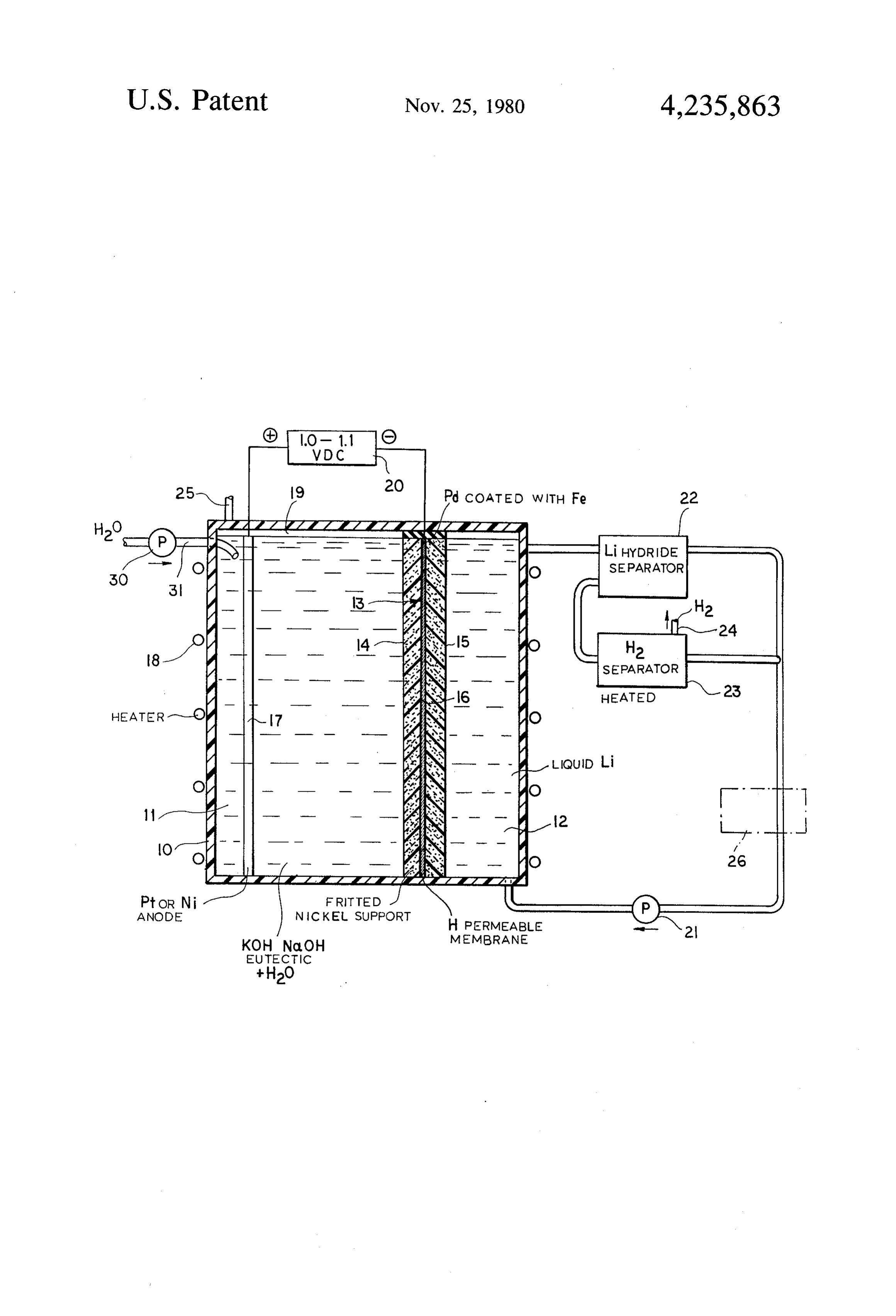
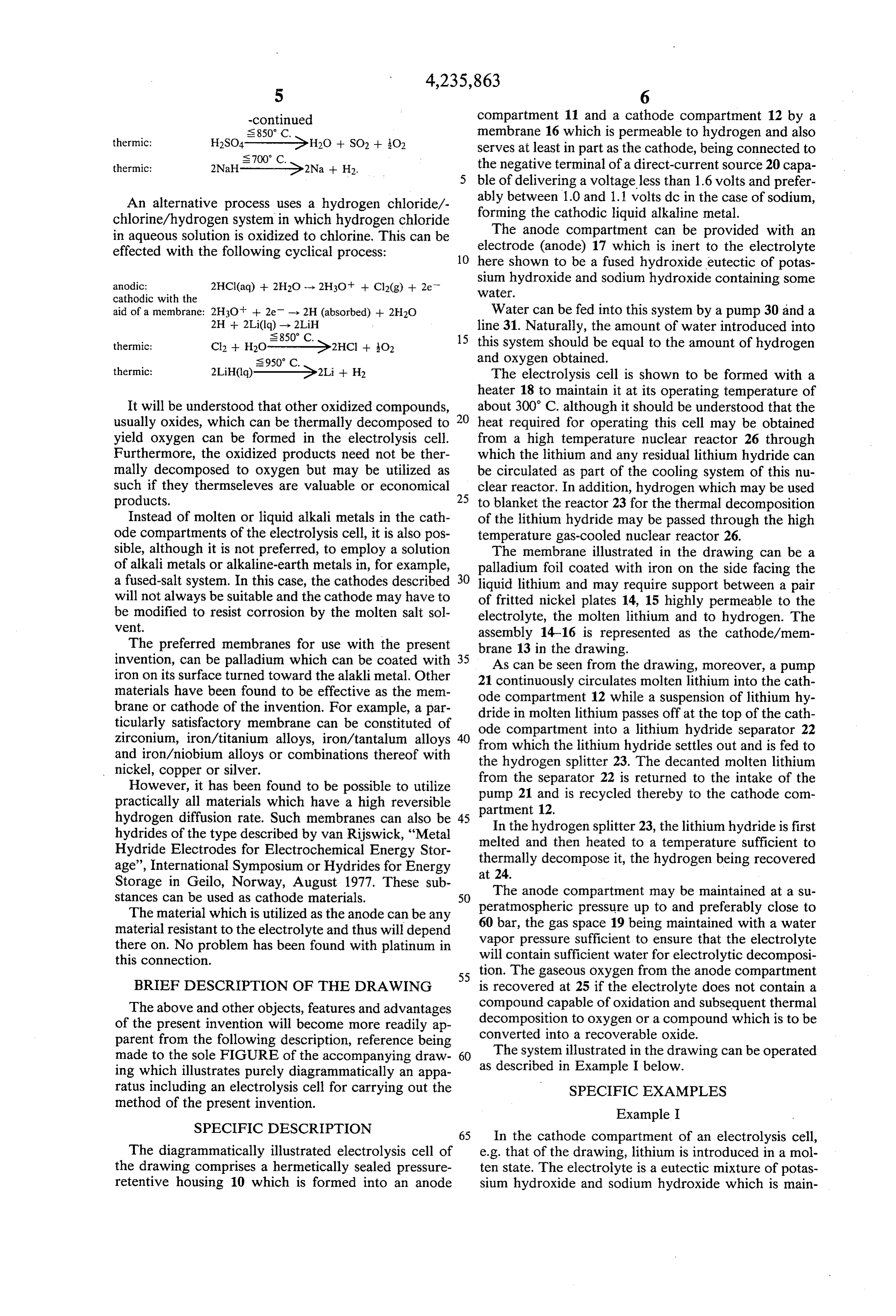
It will be understood that other oxidized compounds, about 300° C. although it should be understood that the usually oxides, which can be thermally decomposed to 20 heat required for operating this cell may be obtained yield oxygen can be formed in the electrolysis cell. from a high temperature nuclear reactor 26 through Furthermore, the oxidized products need not be ther which the lithium and any residual lithium hydride can mally decomposed to oxygen but may be utilized as be circulated as part of the cooling system of this nu such if they thermseleves are valuable or economical clear reactor. In addition, hydrogen which may be used products. 25 to blanket the reactor 23 for the thermal decomposition Instead of molten or liquid alkali metals in the cath of the lithium hydride may be passed through the high ode compartments of the electrolysis cell, it is also pos temperature gas-cooled nuclear reactor 26. sible, although it is not preferred, to employ a solution The membrane illustrated in the drawing can be a of alkali metals or alkaline-earth metals in, for example, palladium foil coated with iron on the side facing the a fused-salt system. In this case, the cathodes described 30 liquid lithium and may require support between a pair will not always be suitable and the cathode may have to of fritted nickel plates 14, 15 highly permeable to the be modified to resist corrosion by the molten salt sol electrolyte, the molten lithium and to hydrogen. The Vent. assembly 14-16 is represented as the cathode/mem The preferred membranes for use with the present brane 13 in the drawing.
invention, can be palladium which can be coated with 35 As can be seen from the drawing, moreover, a pump iron on its surface turned toward the alakli metal. Other 21 continuously circulates molten lithium into the cath materials have been found to be effective as the mem ode compartment 12 while a suspension of lithium hy brane or cathode of the invention. For example, a par dride in molten lithium passes off at the top of the cath ticularly satisfactory membrane can be constituted of ode compartment into a lithium hydride separator 22 Zirconium, iron/titanium alloys, iron/tantalum alloys 40 and iron/niobium alloys or combinations thereof with from the which the lithium hydride settles out and is fed to hydrogen splitter 23. The decanted molten lithium nickel, copper or silver. from the separator 22 is returned to the intake of the However, it has been found to be possible to utilize pump 21 and is recycled thereby to the cathode com practically all materials which have a high reversible partment 12.
hydrogen diffusion rate. Such membranes can also be 45
In the hydrogen splitter 23, the lithium hydride is first hydrides of the type described by van Rijswick, "Metal melted and then heated to a temperature sufficient to Hydride Electrodes for Electrochemical Energy Stor thermally decompose it, the hydrogen being recovered age', International Symposium or Hydrides for Energy at 24.
Storage in Geilo, Norway, August 1977. These sub The anode compartment may be maintained at a su stances can be used as cathode materials. 50 peratmospheric
The material which is utilized as the anode can be any 60 bar, the gas spacepressure up to and preferably close to material resistant to the electrolyte and thus will depend vapor pressure sufficient 19 being maintained with a water there on. No problem has been found with platinum in will contain sufficient water to ensure that the electrolyte this connection. for electrolytic decomposi 55 tion. The gaseous oxygen from the anode compartment
BRIEF DESCRIPTION OF THE DRAWING is recovered at 25 if the electrolyte does not contain a The above and other objects, features and advantages compound decomposition capable of oxidation and subsequent thermal to oxygen or a compound which is to be of the present invention will become more readily ap parent from the following description, reference being converted into a recoverable oxide. made to the sole FIGURE of the accompanying draw 60 The system illustrated in the drawing can be operated ing which illustrates purely diagrammatically an appa as described in Example I below.
ratus including an electrolysis cell for carrying out the SPECIFIC EXAMPLES method of the present invention. Example I
SPECIFIC DESCRIPTION 65 In the cathode compartment of an electrolysis cell, The diagrammatically illustrated electrolysis cell of e.g. that of the drawing, lithium is introduced in a mol the drawing comprises a hermetically sealed pressure ten state. The electrolyte is a eutectic mixture of potas retentive housing 10 which is formed into an anode sium hydroxide and sodium hydroxide which is main
Page 6
tained under a vapor pressure of 1 bar water vapor in compartment and a cathode of a cathode compart the form of steam. The electrolysis is carried out at a ment;
temperature of about 380° C. with an applied voltage continuously introducing in a liquid state a metal between about 0.9 and 1.1 volts. The current density is capable of forming a hydride into said cathode slightly above 2000A/m2 measured over the surface of 5 compartment while separating said cathode com the membrane. partment from said anode compartment by a mem The membrane is a 10-2 mm thick palladium foil on brane permeable to hydrogen, thereby forming the whose surface facing the lithium melt a coating of 10-3 hydride of said metal in said cathode compartment; mm thick iron is applied by vapor deposition to resist 10 removing said hydride of said metal from said cath corrosion from the molten lithium. ode compartment while replenishing the same with The membrane can be activated, if desired, with pal said metal in the liquid state; and ladium mohr.
heating said hydride of said metal externally of said cathode compartment to a temperature above the
To increase its mechanical stability, the membrane is melting point of the metal hydride to decompose sandwiched between two highly porous fritted nickel 5 the metal hydride and produce hydrogen. support plates. The membrane serves simultaneously as 2. The method defined in claim 1 wherein the elec the cathode. The anode is a platinum sheet although trolysis is carried out at the potential below about 1.6 nickel can also be used without modifying the parame volts and with a current density at said membrane of ters. above about 2000 A/m2.
During the operation of the electrolysis cell, lithium 20 3. The method defined in claim 2 wherein said metal hydride is formed in solid state in the molten lithium. is an alkali metal selected from the group which consists The lithium hydride is recovered, melted at about 690 of lithium and sodium.
C. and is then decomposed in a helium atmosphere is lithium. 4. The method defined in claim 3 wherein said metal (current) at about 850 C. under a pressure of about 1 bar. The hydrogen is recovered and the lithium is recy 25 trolyte 5. The method defined in claim 3 wherein said elec is an aqueous system containing an alkali metal cled. About 5 to 10% by weight of the lithium hydride hydroxide or sulfuric acid in high concentration. is not thermally decomposed and is recycled with the 6. The method defined in claim 5 wherein said elec molten lithium to the cell.
trolyte consists of a water-containing eutectic composi
It was found that similar current densities can be 30 tion of sodium hydroxide and potassium hydroxide. maintained with a foil of iron/titanium nickel alloy at 7. The method defined in claim 5 wherein said elec a thickness of 10-2 mm. trolyte is concentrated sulfuric acid. Example II 8. The method defined in claim 5 wherein the elec trolysis is carried out at a temperature between about
Somewhat better results were obtained with the use 35 200° C. and about 400° C.
of an iron/niobium alloy containing about 30% by 9. The method defined in claim 8 wherein the elec weight niobium and some copper as the membrane. trolysis is carried out at a temperature of about 300° C. Here again the membrane was used simultaneously as 10. The method defined in claim 8 wherein at least the the cathode and a layer of palladium (10-3 mm in thick cathode compartment of said electrolysis cell is main ness) was vapor deposited thereon. 40 tained at a superatmospheric pressure up to 60 bar. When sodium was substituted as the hydride former 11. The method defined in claim 10 wherein said in the system of Example I for the lithium, the tempera membrane is selected from the group which consists of: ture could be about 250° C. using a voltage of 1.0 to 1.6 a layer of palladium coated with iron on its side volt. The resulting sodium hydride was decomposed at 45 turned toward the liquid metal; a temperature above 430' C. into liquid sodium and a layer of zirconium;
hydrogen. a layer of iron/titanium alloy; We claim: a layer of iron/tantalum alloy; and 1. A method of generating hydrogen and oxygen or a layer of iron/niobium alloy. an oxidized compound which comprises the steps of: 50 leased 12. The method in claim 11 wherein oxygen is re electrolyzing an electrolyte decomposable to pro the stepinofsaid anode compartment, further comprising collecting the oxygen released in said anode duce hydrogen and disposed in an anode compart compartment.
ment of an electrolyte cell between an anode in said sk ck sk k
Provenance
- Collection
- Cited prior art
- Original PDF
- patentimages.storage.googleapis.com →
- Filed
- 1979-02-16
- Pages
- 6
- Method
- pdftotext (the PDF's own text layer) + pdftoppm 300dpi page scans
- Source
- Google Patents bibliographic record
- Granted
- 1980-11-25
- Inventors
- Rudolf Schulten; Friedrich Behr; Helmut Wenzl; Kernforschungsanlage Juelich GmbH
- Transcribed from
- patentimages.storage.googleapis.com →