patent · US1863636
Gaseous fuel mixture
21 June 1932
Page 1 — bibliographic record
Patented June 21, 1932 1863,636
UNITED STATES PATENT OFFICE
GEORGE C. QUELCH, OF OAKMONT, PENNSYLVANIA, AssIGNOR, BY MESNE ASSIGN
MENTS, TO UNION CARBIDE AND CARBON RESEARCH LABORATORIES, INC, OF NEW
YORK, N.Y., A CORPORATION OF NEW YORK
GASEOUs FUELMIXTURE
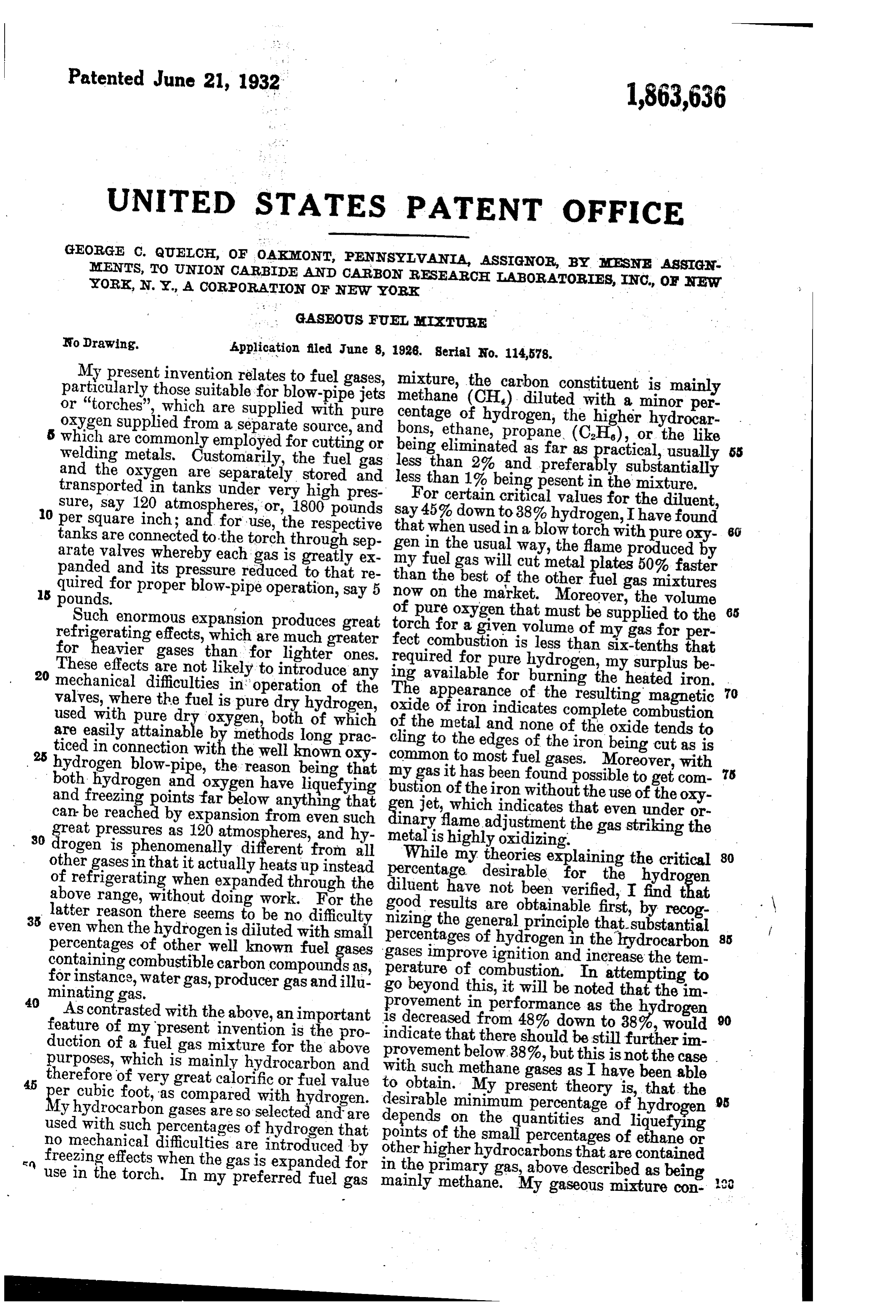
So Drawing. Application filed June 8, 1928. Serial No. 114,578. My presentthose particularly invention suitablerelates to fuel gases, for blow-pipe mixture, the carbon constituent is mainly jets methane or “torches', which are supplied with pure centage of(CH), diluted with a minor per oxygen supplied from a separate source, and bons, ethane, propane the(CH), hydrogen, higher hydrocar or the like 5 which are commonly employed for cutting or being eliminated as far as Reil usually 55 welding metals. Customarily, the fuel gas less than 2% and preferably substantially and the oxygen are separately stored and less than 1% being pesent in the mixture. transported in tanks under very high pres sure, say 120 atmospheres, or, 1800 pounds sayFor certain critical values for the diluent, 10 per square inch; and for use, the respective that whendownto
tanks are connected to the torch through sep gen in theused in a blowtorch with pure oxy 8 arate valves whereby each gas is greatly ex my fuel gasusual way, the flame produced by panded and its pressure reduced to that re than the bestwill cut metal plates 50% faster quired for proper blow-pipe
operation, say 5 now on the market. other of the fuel gas mixtures
Moreover, the volume
Such enormous expansion produces great torch of pure oxygen that must be supplied to the 65 refrigerating effects, which are much greater fect for a given volume of my gas for per for E. gases than for lighter ones. required for pureishydrogen, combustion less than six-tenths that
These effects are not likely to introduce any ing available for burning themyheated surplus be iron.
20 mechanical difficulties in operation of the The appearance of the resulting magnetic valves, where the fuel is pure dry hydrogen, oxide of iron indicates complete combustion 70 used with pure dry oxygen, both of which of the metal and none of the oxide tends to are easily attainable by methods long prac cling to the edges of the iron being cut as is ticed in connection with the well known oxy common to most fuel gases. Moreover, with hydrogen blow-pipe, the reason being that my gas it has been found possible to get com s both hydrogen and oxygen have liquefying and freezing points far below anything that bustion of the iron without the use of the oxy can be reached by expansion from even such SEnary jet, which indicates that even under or flame adjustment the gas striking the great pressures as 120 atmospheres, and hy 90 drogen is phenomenally different from all metalis highly oxidizing. While my theories explaining the critical 80 other gases in that it actually heats up instead percentage of refrigerating when expanded through the diluent have desirable for the hydrogen above range, without doing work. For the good results are obtainable first,I by not been verified, find that recog 33 latter reason there seems to be no difficulty nizing the general principle that substantial even when the hydrogenis diluted with small percentages of hydrogen in the hydrocarbon 85 percentages of other well known fuel g containing combustible carbon compounds as, gases improve ignition and increase the tem for instance, minating gas.water gas, producer gas and illu go beyondofthis, perature combustion. In attempting to it will be noted that theim
As contrasted with the above, animportant is decreased from 48% downastothe38%, provement in performance hydrogen 90 would feature of my present invention is the pro indicate that there should be still furtherim duction of a fuel gas mixture for the above provement below.38%, but this is not the case purposes, which is mainly hydrocarbon and with such methane gases as I have been able therefore of very great calorific or fuel value to obtain. My present theory is, that the RE cubic foot, as compared with hydrogen. desirable minimum percentage
My hydrocarbon gases are so selected and are depends on the quantities andofliquefying hydrogen 95 used with such percentages of hydrogen that points of the small percentages of ethane or no mechanical difficulties are introduced by other freezing effects when the gas is expanded for in thehigher hydrocarbons that are contained use in the torch. In my preferred fuel gas mainly methane.gas,My primary above described as being
gaseous mixture con o
Page 2
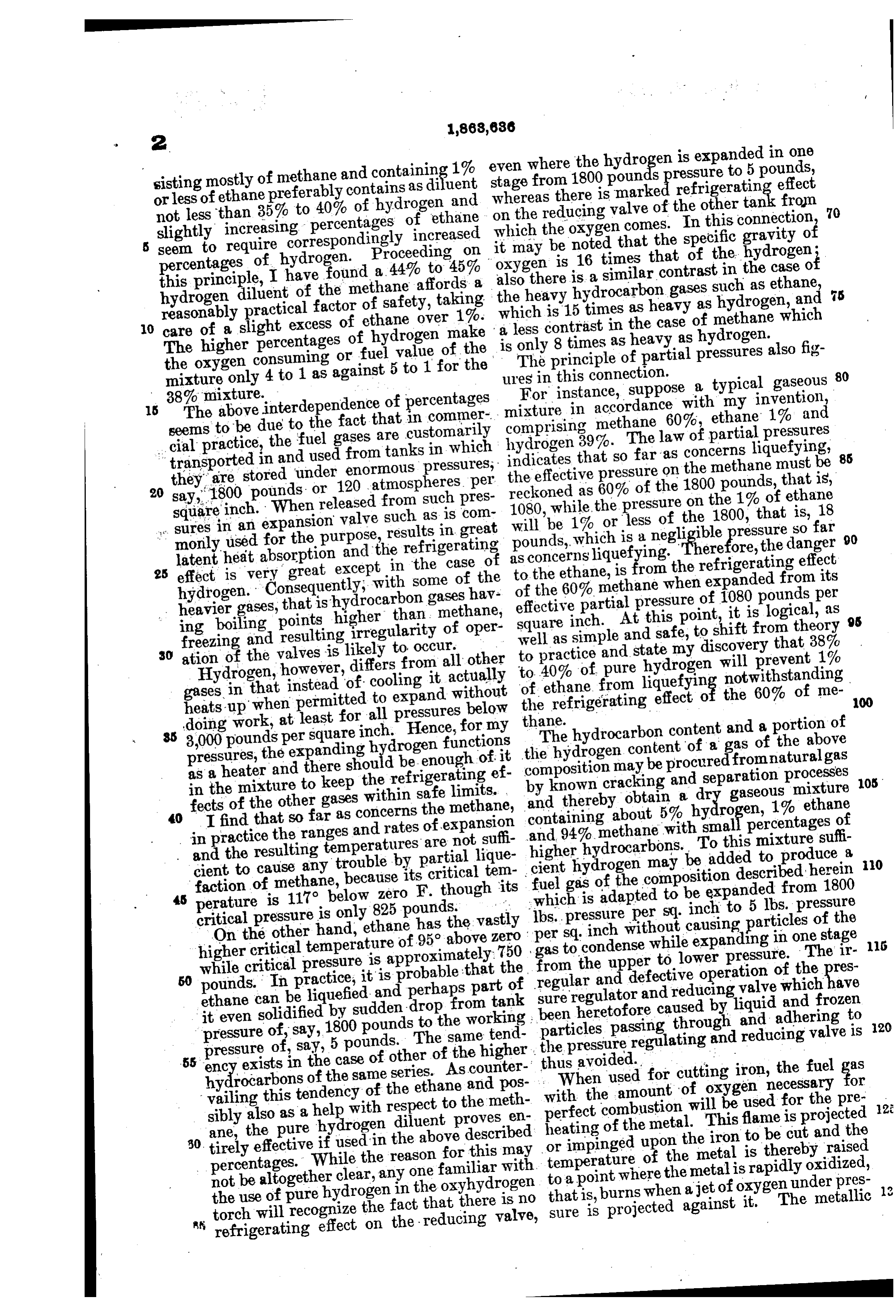
even where the hydrogen is expanded in one sisting mostly of methane and containing 1% stage from 1800 pounds pressure to 5 pounds, or less of ethane preferably contains as diluent whereas there is marked refrigerating effect not less than 35% to 40% of hydrogen and on the reducing valve of the other tank from 70 slightly increasing percentages of ethane which the oxygen comes. In this connection, seem to require correspondingly increased it may be noted that the specific gravity of percentages of hydrogen. Proceeding on oxygen is 16 times that of the hydrogen; this principle, I have found a .44% to 45% also there is a similar contrast in the case o hydrogen the heavy hydrocarbon gases such as ethane, reasonablydiluent practicaloffactor the methane affords of safety, takinga which is 15 times as heavy as hydrogen, and 0. care of a slight excess of ethane over 1%. a less contrast in the case of methane which The higher percentages of hydrogen make is only 8 times as heavy as hydrogen. the oxygen consuming or fuel value of the The principle of partial pressures also fig mixture only 4 to 1 as against 5 to 1 for the ures in this connection.
38% mixture. For instance, suppose a typical gaseous 80 s The above interdependence- of percentages mixture in accordance with my invention, seems to be due to the fact that in commer comprising methane 60%, ethane 1% and cial practice, the fuel gases are customarily hydrogen 39%. The law of partial pressures transported in and used from tanks in which indicates that so far as concerns liquefying, 85 they are stored under enormous pressures, the effective pressure on the methane must be 20 say, 1800 pounds or 120 atmospheres per reckoned as 60% of the 1800 pounds, that is, square inch. When released from such pres 1080, while, the pressure on the 1% of ethane sures in an expansion valve such as is com will be 1% or less of the 1800, that is, 18 monly used for the purpose, results in great pounds, which is a negligible pressure so far 90 latent heat absorption and the refrigerating as concernsliquefying. Therefore, the danger 25 effect is very great except in the case of to the ethane, is from the refrigerating effect hydrogen. Consequently, with some of the of the 60% methane when expanded from its effective partial pressure of 1080 pounds per heavier ing gases, boiling that is hydrocarbon gases hav square inch. At this point, it is logical, as freezing and points resultinghigher than methane, irregularity of oper well as simple and safe, to shift from theory 95 30 ation of the valves is likely to occur. to practice and state my discovery that 38% Hydrogen, however, differs from all other to 40% of pure hydrogen will prevent 1% gases in that instead of cooling it actually of ethane from liquefying notwithstanding heats up when permitted to expand without the refrigerating effect of the 60% of me. 100 doing work, at least for all pressures below thane.
3,000 pounds per square inch. Hence, for my The hydrocarbon content and a portion of pressures, the expanding hydrogen functions the hydrogen content of a gas of the above as a heater and there should be enough of it composition may be procuredfrom naturalgas in the mixture to keep the refrigerating ef by known cracking and separation processes 05 fects of the other gases within safe limits. and thereby obtain a dry gaseous mixture containing about 5% hydrogen, 1% ethane 40 I find that so far as concerns the methane, in practice the ranges and rates of expansion and 94% methane with small percentages of and the resulting temperatures are not suffi higher hydrocarbons. To this mixture sufi cient to cause any trouble by partial lique fuel cient hydrogen may be added to produce, a O faction of methane, because its critical tem whichgasisofadapted the composition described herein to be expanded from 1800 45 perature is 117 below zero F. though its critical pressure is only 825 pounds. . lbs. pressure per sq. inch to 5 lbs. pressure On the other hand, ethane has the vastly - per sq. inch without causing particles of the higher critical temperature of 95° above zero gas to condense while expanding in one stage 5 while critical pressure is approximately 750 from the upper to lower pressure. The ir pounds. In practice, it is probable that the regular and defective operation of the pres ethane can be liquefied and perhaps part of sure regulator and reducingyalye which have it even solidified by sudden drop from tank been heretofore caused by liquid and frozen pressure of, say, 1800 pounds to the working particles passing through and adhering to 20 pressure of, say, 5 pounds. The same tend the pressure regulating and reducing valve is 55 E. exists in the case of other of the higher. thus avoided. . . iron, the fuel gas hydrocarbons of the same series. As counter with When used for cutting vailing this tendency of the ethane and pos the amount of oxygen necessary for sibly also as a help with respect to the meth perfect combustion will be used for the pre 12: ane, the pure hydrogen diluent proves en heating of the metal. This flame is projected 30. tirely effective if used in the above described or impinged upon the iron to be cut and the percentages. While the reason for this may temperature of the metal is thereby raised not be altogether clear, any one familiar with to a point where the metalis rapidly oxidized, the use of pure hydrogen in the oxyhydrogen thatis, burns when a jet of oxygen under pres torch will recognize the fact that there is no sure is projected against it. The metallic Af refrigerating effect on the reducing valve,
Page 3
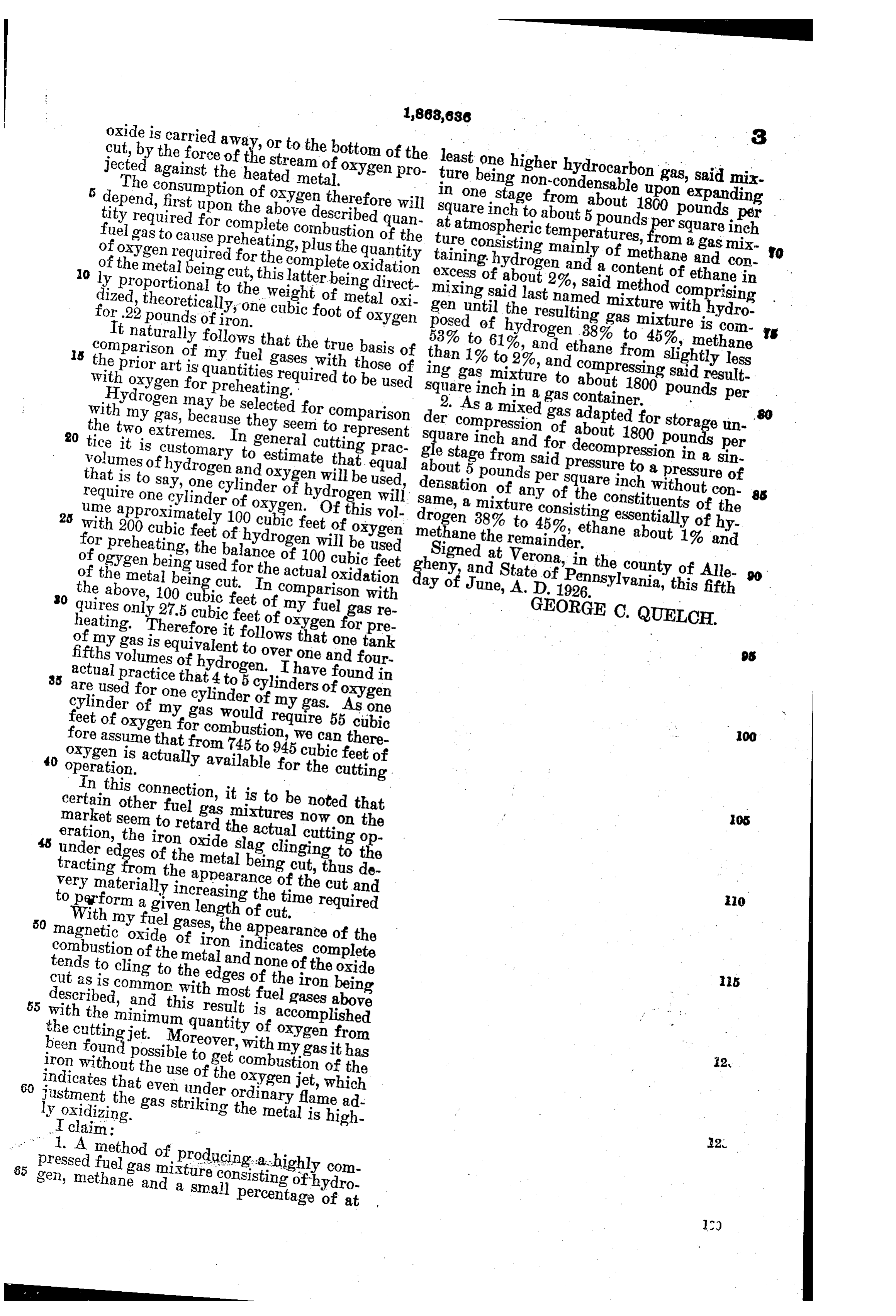
oxide is carried E. or to the bottom of the 3 cut, byagainst jected the forcetheof the stream heated of oxygen pro least one higher hydrocarbon gas, said mix metal.
The consumption of oxygen therefore will in ture being non-condensable upon expanding depend, first upon the above described quan square oneinch stageto about from 5about
per pounds, square per inch tity required for complete combustion of the at atmospheric temperatures, from a gas mix fuel gas to cause preheating, plus the quantity ture consisting mainly of methane and con O of oxygen required for the complete oxidation
O of the metal being cut,this latterbeing direct taining hydrogen and a content of ethane in ly proportional to the weight of metal oxi mixing excess ofsaid about last
named saidmixture methodwith comprising hydro dized, for .22theoretically, pounds of iron.one cubic foot of oxygen gen until the resulting gas mixture is com It naturally follows that the true basis of posed of hydrogen 38% to 45%, methane s comparison of my fuel gases with those of 53% to 61%, and ethane from slightly less the prior artfor is quantities than 1% to 2%, and compressing said result required to be used ing gas mixture with oxygen preheating. square inch in a to container. gas about 1800 pounds per
Hydrogen may be selected for comparison 2. As a mixed gas adapted for storage un with my gas, because they seem to represent 20 the two extremes. In general cutting prac der compression of about 1800 pounds per tice it is customary to estimate that equal gle E. inch stage fromandsaid forpressure decompression to a in a sin pressure of volumes ofhydrogen and oxygen will be used, about 5 pounds per square inch without con that is to say, one cylinder of hydrogen will densation of any of the constituents of the require one cylinder of oxygen. Of this vol same, a mixture consisting essentially of hy 25 ume approximately 100 cubic feet of oxygen with 200 cubic feet of hydrogen will be used drogen 38% to 45%, ethane about 1% and for preheating, the balance of 100 cubic feet methane the remainder. Signed at Verona, in the county of Alle of ogygen being used for the actual oxidation heny, and State of1926. Pennsylvania, this fifth of the metal being cut. In comparison 0. the above, 100 cubic feet of my fuel gas re
quires only 27.5 cubic feet of oxygen for pre GEORGE C. QUELCH. heating. Therefore it follows that one tank of my gas is equivalent to over one and four fifths volumes of hydrogen. I have found in 35 actual practice that 4 to 5 cylinders of oxygen are used for cylinder one gas of my cylinder wouldofrequire
one feet of oxygen for combustion, we can there fore assume that from 745 to 945 cubic feet of 100 O oxygen is actually available for the cutting operation.
In this connection, it is to be noted that certain other fuel gas mixtures now on the 105 market seem to retard the actual cutting op 45 eration, the iron oxide slag clinging to the under edges of the metal being cut, thus de tracting from the appearance of the cut and veryperform to materially increasing a given length ofthecut.time required O 50 With my fuel gases, the appearance of the magnetic oxide of iron indicates complete combustion of the metal and none of the oxide tends to cling to the edges of the iron being 115 cut as is common with most fuel gases above 55 described, and this result is accomplished with the minimum quantity of oxygen from the cuttingjet. Moreover,with mygasithas been found possible to get combustion of the 32. iron without the use of the oxygen jet, which 6 indicates that even under ordinary flame ad lyjustment, the gas striking the metal is high oxidizing.
1. A nethod of producing a highly com 65 pressed fuel gas mixture consisting of hydro gen, methane and a small percentage of at
Provenance
- Collection
- Cited prior art
- Original PDF
- patentimages.storage.googleapis.com →
- Filed
- 1926-06-08
- Pages
- 3
- Method
- pdftotext (the PDF's own text layer) + pdftoppm 300dpi page scans
- Source
- Google Patents bibliographic record
- Granted
- 1932-06-21
- Inventors
- George C Quelch; Union Carbide and Carbon Research Laboratories Inc
- Transcribed from
- patentimages.storage.googleapis.com →