patent · US3628912
Process for inhibiting hydrogen permeation of steel in ammonia service
21 December 1971
Page 1 — bibliographic record
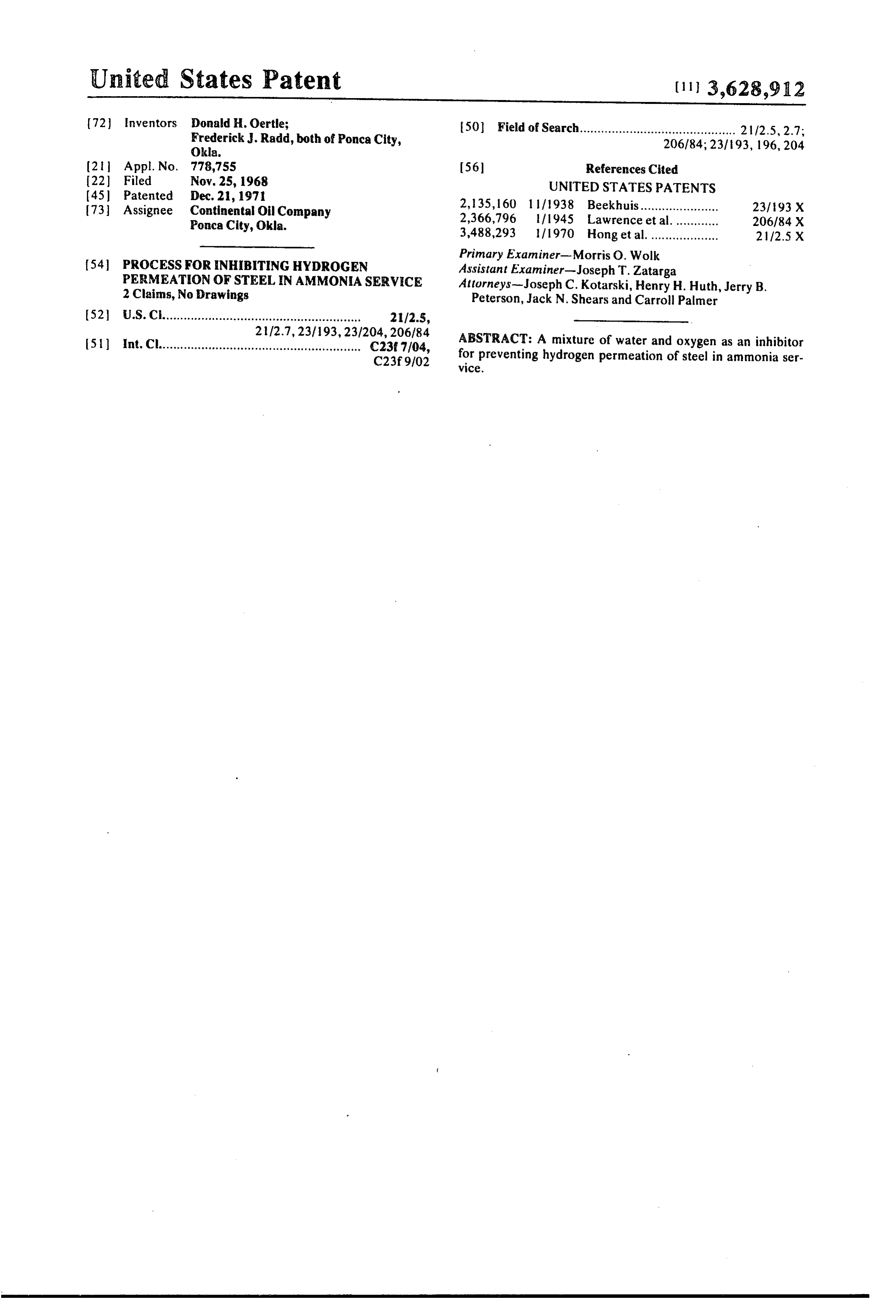
United States Paten (11) 3,628,912 (72) Inventors Donald H. Oertle; 50 Field of Search............................................ 2 112.5, 2.7; Frederick J. Radd, both of Ponca City, 206/84; 23.193, 196, 204 Okla.
(21 Appl. No. 778,755 (56) References Cited 22) Filed Nov. 25, 1968 UNITED STATES PATENTS
73) Assignee Continental Oil Company 2,135,160 l l 1938 Beekhuis...................... 23193 X Ponca City, Okla. 2,366,796 l/1945 Lawrence et al. 206/84 X 3,488,293 l (1970 Hong et al.................... 2 1/2.5 X
Primary Examiner-Morris O. Wolk 54 PROCESS FOR INHIBITING HYDROGEN Assistant Examiner-Joseph T. Zatarga PERMEATION OF STEEL ENAMMONIASERVICE Attorneys-Joseph C. Kotarski, Henry H. Huth, Jerry B. 2 Claims, No Drawings Peterson, Jack N. Shears and Carroll Palmer 52 U.S.C........................................................ 21/2.5,
51 ) Int. Cl........................................................ C23f 7104, ABSTRACT: A mixture of water and oxygen as an inhibitor C23f 9/02 for preventing hydrogen permeation of steel in ammonia ser vice.
Page 2
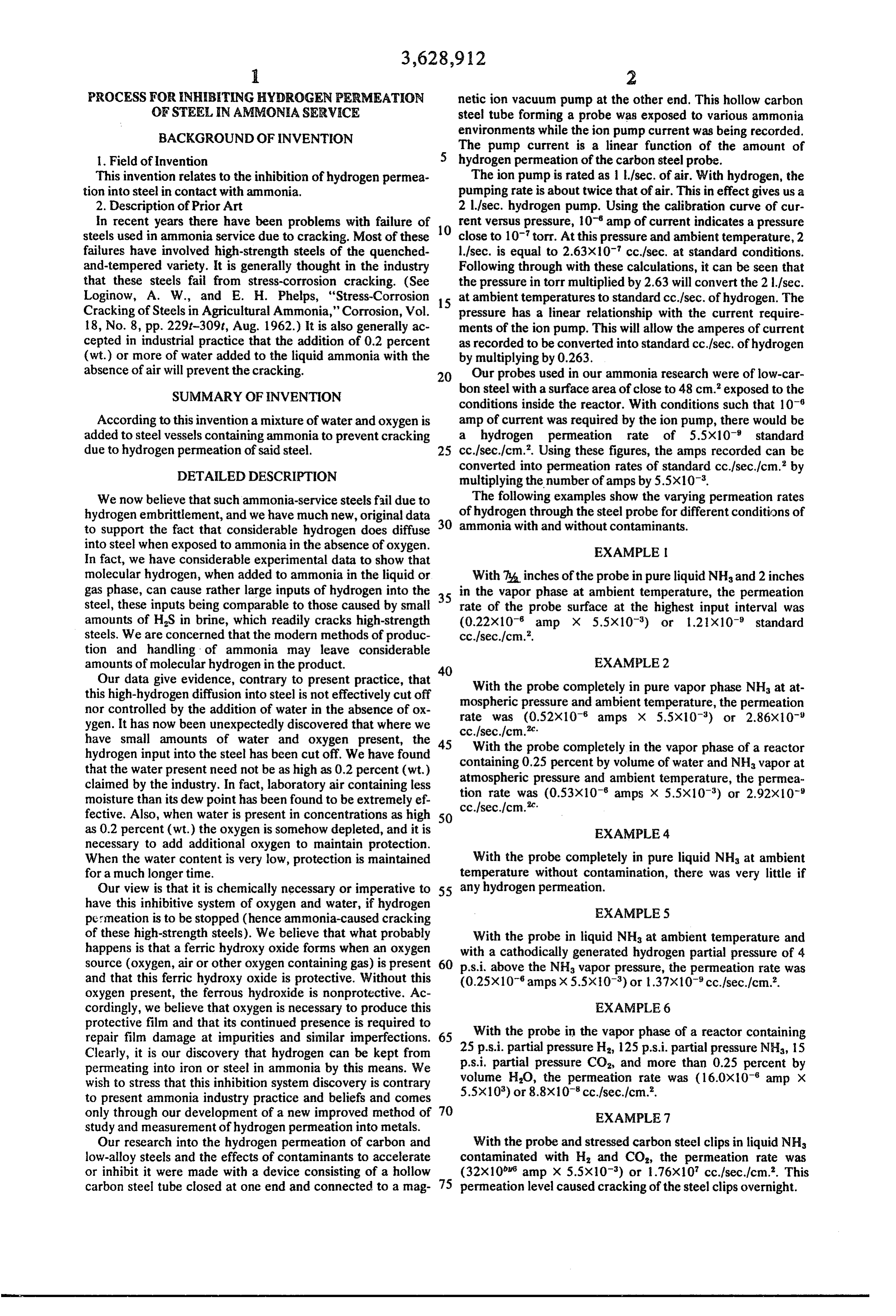
PROCESS FOR NHIBITING HYDROGEN PERMEATOR netic ion vacuum pump at the other end. This hollow carbon OFSTEEN AMRAONEASERVICE steel tube forming a probe was exposed to various ammonia BACKGROUND OF INVENTON environments while the ion pump current was being recorded. The pump current is a linear function of the amount of 1. Field of Invention hydrogen permeation of the carbon steel probe. This invention relates to the inhibition of hydrogen permea The ion pump is rated as 1 l/sec. of air. With hydrogen, the tion into steel in contact with ammonia. pumping rate is about twice that of air. This in effect gives us a 2. Description of Prior Art 2 l/sec. hydrogen pump. Using the calibration curve of cur in recent years there have been problems with failure of 10 rent versus pressure, 10amp of current indicates a pressure steels used in ammonia service due to cracking. Most of these close to 10 torr. At this pressure and ambient temperature, 2 failures have involved high-strength steels of the quenched 1./sec. is equal to 2.63X10 cc./sec. at standard conditions. and-tempered variety. It is generally thought in the industry Following through with these calculations, it can be seen that that these steels fail from stress-corrosion cracking. (See the pressure in torr multiplied by 2.63 will convert the 2 l/sec. Loginow, A. W., and E. H. Phelps, "Stress-Corrosion 15 at ambient temperatures to standard cc./sec. of hydrogen. The Cracking of Steels in Agricultural Ammonia,' Corrosion, Vol. pressure has a linear relationship with the current require 18, No. 8, pp. 229t-309t, Aug. 1962.) It is also generally ac ments of the ion pump. This will allow the amperes of current cepted in industrial practice that the addition of 0.2 percent as recorded to be converted into standard cc./sec. of hydrogen (wt.) or more of water added to the liquid ammonia with the by multiplying by 0.263.
absence of air will prevent the cracking. 20 Our probes used in our ammonia research were of low-car SUMMARY OF INVENTION bon steel with a surface area of close to 48 cm. exposed to the conditions inside the reactor. With conditions such that 10
According to this invention a mixture of water and oxygen is amp of current was required by the ion pump, there would be added to steel vessels containing ammonia to prevent cracking a hydrogen permeation rate of 5.5X10 standard due to hydrogen permeation of said steel. 25 cc./sec./cm.. Using these figures, the amps recorded can be
DETALED DESCRIPTION
converted into permeation rates of standard cc-/sec./cm.” by multiplying the number of amps by 5.5X10.
We now believe that such ammonia-service steels fail due to The following examples show the varying permeation rates hydrogen embrittlement, and we have much new, original data of hydrogen through the steel probe for different conditions of to support the fact that considerable hydrogen does diffuse 30 ammonia with and without contaminants. into steel when exposed to ammonia in the absence of oxygen. EXAMPLE I In fact, we have considerable experimental data to show that molecular hydrogen, when added to ammonia in the liquid or With 7A inches of the probe in pure liquid NHs and 2 inches gas phase, can cause rather large inputs of hydrogen into the 35 in the vapor phase at ambient temperature, the permeation steel, these inputs being comparable to those caused by small rate of the probe surface at the highest input interval was amounts of HS in brine, which readily cracks high-strength (0.22x10 amp X 5.5x108) or 1.21x10 standard steels. We are concerned that the modern methods of produc cc./sec./cm..
tion and handling of ammonia may leave considerable amounts of molecular hydrogen in the product. EXAMPLE 2 Our data give evidence, contrary to present practice, that 40 With the probe completely in pure vapor phase NHa at at this high-hydrogen diffusion into steel is not effectively cut off mospheric pressure and ambient temperature, the permeation nor controlled by the addition of water in the absence of ox rate was (0.52x10 amps x 5.5x10) or 2.86x10 ygen. It has now been unexpectedly discovered that where we cc./sec./cm.'
have small amounts of water and oxygen present, the 45 With the probe completely in the vapor phase of a reactor hydrogen input into the steel has been cut off. We have found containing 0.25 percent by volume of water and NHa vapor at that the water present need not be as high as 0.2 percent (wt.)
claimed by the industry. In fact, laboratory air containing less atmospheric pressure and ambient temperature, the permea moisture than its dew point has been found to be extremely ef cc./sec./cm.' (0.53X10 amps x 5.5x10') or 2.92x10 tion rate was fective. Also, when water is present in concentrations as high 50 as 0.2 percent (wt.) the oxygen is somehow depleted, and it is EXAMPLE 4 necessary to add additional oxygen to maintain protection.
When the water content is very low, protection is maintained With the probe completely in pure liquid NH at ambient for a much longer time. temperature without contamination, there was very little if Our view is that it is chemically necessary or imperative to 55 any hydrogen permeation.
have this inhibitive system of oxygen and water, if hydrogen EXAMPLES permeation is to be stopped (hence ammonia-caused cracking of these high-strength steels). We believe that what probably With the probe in liquid NH3 at ambient temperature and happens is that a ferric hydroxy oxide forms when an oxygen with a cathodically generated hydrogen partial pressure of 4 source (oxygen, air or other oxygen containing gas) is present 60 p.s. i. above the NHa vapor pressure, the permeation rate was and that this ferric hydroxy oxide is protective. Without this oxygen present, the ferrous hydroxide is nonprotective. Ac (0.25x10amps x 5.5x10⁸) or 1.37x10⁹ cc./sec./cm.”. cordingly, we believe that oxygen is necessary to produce this EXAMPLE 6 protective film and that its continued presence is required to repair film damage at impurities and similar imperfections. 65 With the probe in the vapor phase of a reactor containing Clearly, it is our discovery that hydrogen can be kept from 25 p.s. i. partial pressure H, 125 p.s. i. partial pressure NHa, 15 p.s. i. partial pressure CO, and more than 0.25 percent by permeating into iron or steel in ammonia by this means. We volume HO, the permeation rate was (16.0x10 amp X wish to stress that this inhibition system discovery is contrary to present ammonia industry practice and beliefs and comes 5.5x10) or 8.8x10 cc./sec.lcm..
only through our development of a new improved method of 70 EXAMPLE 7 study and measurement of hydrogen permeation into metals.
Our research into the hydrogen permeation of carbon and With the probe and stressed carbon steel clips in liquid NH low-alloy steels and the effects of contaminants to accelerate contaminated with H and CO, the permeation rate was or inhibit it were made with a device consisting of a hollow (32x10 amp x 5.5x10") or 1.76x10 cc./sec./cm.. This carbon steel tube closed at one end and connected to a mag 75 permeation level caused cracking of the steel clips overnight.
Page 3
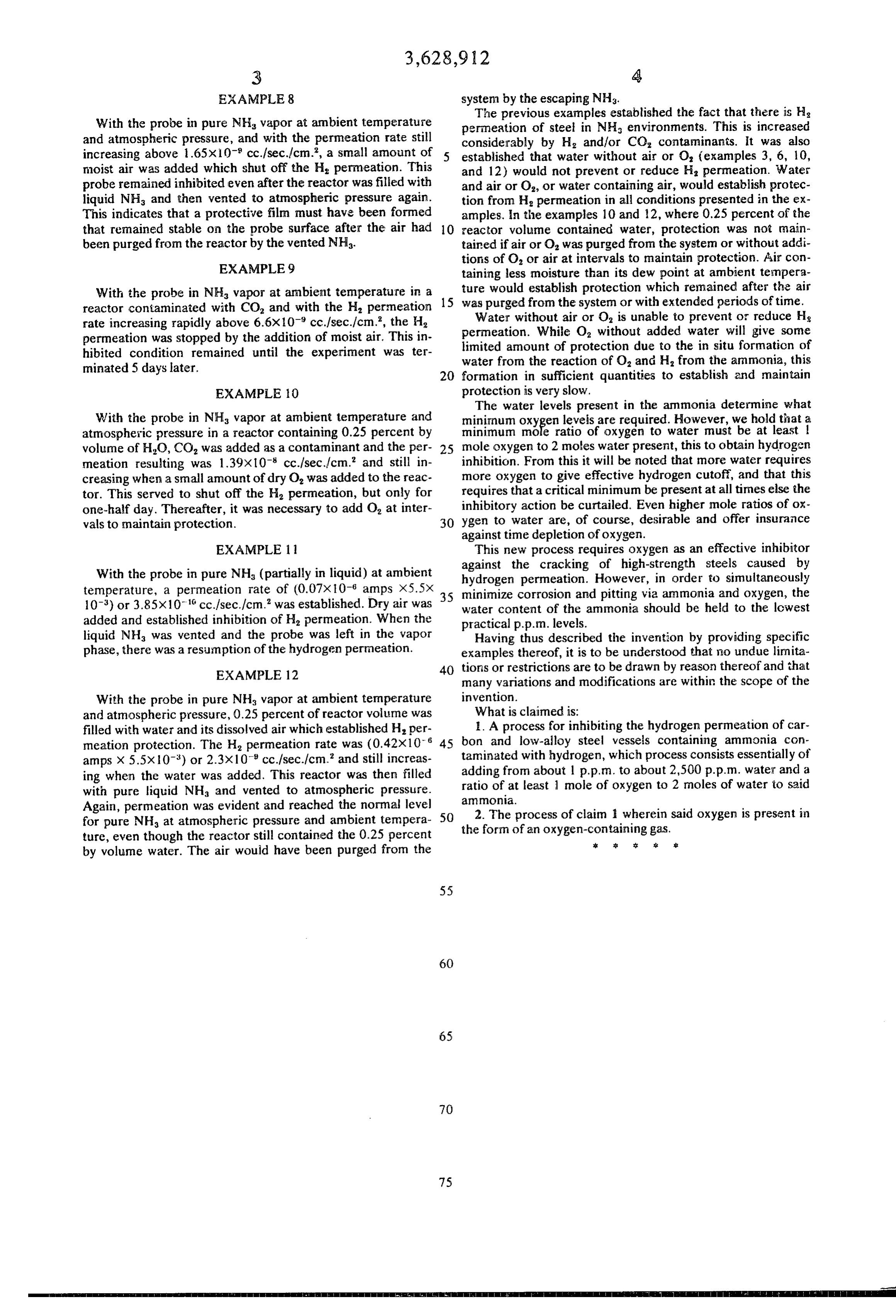
EXAMPLE 8 system by the escaping NH3.
The previous examples established the fact that there is H.
With the probe in pure NH vapor at ambient temperature perineation of steel in NH environments. This is increased and atmospheric pressure, and with the permeation rate still considerably by H. and/or CO, contaminants. It was also increasing above 1.65x10 cc./sec.lcm.”, a small amount of 5 established that water without air or O (examples 3, 6, 10, moist air was added which shut off the H. permeation. This and 12) would not prevent or reduce His permeation. Water probe remained inhibited even after the reactor was filled with and air or O, or water containing air, would establish protec liquid NH and then vented to atmospheric pressure again. tion from H. permeation in all conditions presented in the ex This indicates that a protective film must have been formed amples. In the examples 10 and 12, where 0.25 percent of the that remained stable on the probe surface after the air had 10 reactor volume contained water, protection was not main been purged from the reactor by the vented NH3. tained if air or O, was purged from the system or without addi
EXAMPLE 9
tions of O, or air at intervals to maintain protection. Air con taining less moisture than its dew point at ambient tempera
With the probe in NH vapor at ambient temperature in a ture would establish protection which remained after the air reactor contaminated with CO, and with the H. permeation 15 was purged from the system or with extended periods of time. rate increasing rapidly above 6.6X 10 cc./sec./cm., the H, Water without air or O, is unable to prevent or reduce H. permeation was stopped by the addition of moist air. This in permeation. While O, without added water will give some hibited condition remained until the experiment was ter limited amount of protection due to the in situ formaticn of inated late 5 days ays later.
water from the reaction of O, and H from the ammonia, this formation in sufficient quantities to establish and maintain
EXAMPLE 10 protection is very slow.
The water levels present in the ammonia determine what
With the probe in NH vapor at ambient temperature and minimum oxygen levels are required. However, we hold that a atmospheric pressure in a reactor containing 0.25 percent by minimum mole ratio of oxygen to water must be at least ! volume of HO, CO, was added as a contaminant and the per- 25 mole oxygen to 2 moles water present, this to obtain hydrogen meation resulting was 1.39x10 cc./sec./cm. and still in inhibition. From this it will be noted that more water requires creasing when a small amount of dry O, was added to the reac more oxygen to give effective hydrogen cutoff, and that this tor. This served to shut off the H. permeation, but only for requires that a critical minimum be present at all times else the one-half day. Thereafter, it was necessary to add O, at inter inhibitory action be curtailed. Even higher mole ratios of ox vals to maintain protection. 3O ygen to water are, of course, desirable and offer insurance against time depletion of oxygen.
EXAMPLE 11 This new process requires oxygen as an effective inhibitor against the cracking of high-strength steels caused by
With the probe in pure NH (partially in liquid) at ambient hydrogen permeation. However, in order to simultaneously temperature, a permeation rate of (0.07X 10⁻⁶ amps X5.5X minimize corrosion and pitting via anmonia and oxygen, the 10) or 3.85X10 cc./sec./cm. was established. Dry air was water content of the ammonia should be held to the lowest added and established inhibition of H. permeation. When the practical p.p.m. levels.
liquid NH was vented and the probe was left in the vapor Having thus described the invention by providing specific phase, there was a resumption of the hydrogen permeation. examples thereof, it is to be understood that no undue limita EXAMPLE 12 40 tions or restrictions are to be drawn by reason thereof and that many variations and modifications are within the scope of the
With the probe in pure NH vapor at ambient temperature invention.
and atmospheric pressure, 0.25 percent of reactor volume was What is claimed is:
filled with water and its dissolved air which established H. per 1. A process for inhibiting the hydrogen permeation of car meation protection. The H. permeation rate was (0.42X10' 45 bon and low-alloy steel vessels containing ammonia con amps x 5.5x10) or 2.3x10 cc./sec./cm. and still increas taminated with hydrogen, which process consists essentially of ing when the water was added. This reactor was then filled adding from about 1 p.p.m. to about 2,500 p.p.m. water and a ratio of at least 1 mole of oxygen to 2 moles of water to said with pure liquid NH and vented to atmospheric pressure. ammonia.
Again, permeation was evident and reached the normal level for pure NH at atmospheric pressure and ambient tempera- 50 the2.form The process of claim 1 wherein said oxygen is present in of an oxygen-containing gas.
ture, even though the reactor still contained the 0.25 percent by volume water. The air would have been purged from the
Provenance
- Collection
- Cited prior art
- Original PDF
- patentimages.storage.googleapis.com →
- Filed
- 1968-11-25
- Pages
- 3
- Method
- pdftotext (the PDF's own text layer) + pdftoppm 300dpi page scans
- Source
- Google Patents bibliographic record
- Granted
- 1971-12-21
- Inventors
- Donald H Oertle; Frederick J Radd; Continental Oil Co
- Transcribed from
- patentimages.storage.googleapis.com →