patent · US4302320
Water gas electrolyzer apparatus
24 November 1981
Page 1 — bibliographic record
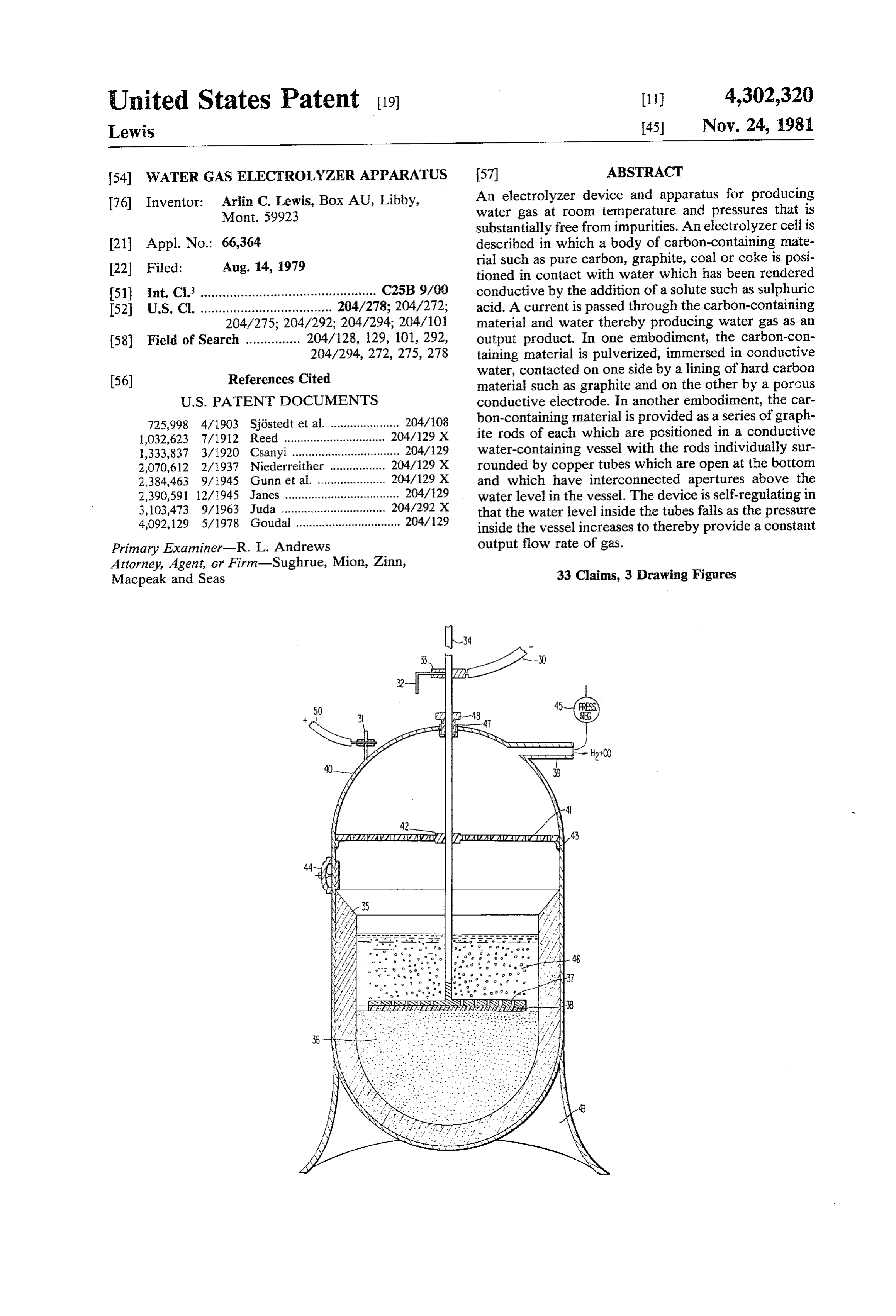
United States Patent (19) 11 4,302,320 Lewis 45 Nov. 24, 1981 54 WATER GAS ELECTROLYZER APPARATUS 57 ABSTRACT 76 Inventor: Arlin C. Lewis, Box AU, Libby, An electrolyzer device and apparatus for producing Mont. 59923 water gas at room temperature and pressures that is substantially free from impurities. An electrolyzer cell is 21 Appl. No.: 66,364 described in which a body of carbon-containing mate 22 Filed: Aug. 14, 1979 rial such as pure carbon, graphite, coal or coke is posi tioned in contact with water which has been rendered 51) Int. Cl. ............................................... C25B 9/00 conductive by the addition of a solute such as sulphuric 52 U.S. C. .................................... 204/278; 204/272; acid. A current is passed through the carbon-containing 204/275; 204/292; 204/294; 204/101 material and water thereby producing water gas as an 58 Field of Search ............... 204/128, 129, 101, 292, output product. In one embodiment, the carbon-con 204/294, 272,275,278 taining material is pulverized, immersed in conductive f water, contacted on one side by a lining of hard carbon 56) References Cited material such as graphite and on the other by a porous
bon-containing material is provided as a series of graph rods of each which are positioned in a conductive 1,333,837 3/1920 Csanyi ................................. 204/129 water-containing vessel with the rods individually sur 2,070,612 2/1937 Niederreither . . 204/129 X rounded by copper tubes which are open at the bottom 2,384,463 9/1945 Gunn et al. .... 20/129 x and which have interconnected apertures above the 332; 3. al - - - - - - - - - - - - - - - a -a - - - - - - - - - - - - - - of: water level in the vessel. The device is self-regulating in
y a W-w la ... w - that thethewater inside vessellevel insidetothethereby
increases tubes falls as thea constant provide pressure
Primary Examiner-R. L. Andrews output flow rate of gas. Attorney, Agent, or Firn-Sughrue, Mion, Zinn,
Macpeak and Seas 33 Claims, 3 Drawing Figures
ZIZAZA ZZIZAZAZIA:
SSSSSSSS SaSSS
Faza
Page 2
Drawing sheet — no readable text.
Page 3
Drawing sheet — no readable text.
Page 4
at least a portion of the surface of the body of carbon
WATER GAS ELECTROLYZER APPARATUS containing material, and means for passing an electrical current through the body of carbon-containing material
BACKGROUND OF THE INVENTION and the volume of water. Preferably, the volume of 1. Field of the Invention water contains a solute for increasing its conductivity. The invention pertains to apparatus for producing Means is also to be provided for collecting the gas pro water gas by electrolysis at standard room temperature duced by the apparatus. The carbon-containing material and pressure. The invention further relates to such ap may be pure carbon, coal, coke, charcoal or graphite or paratus and a method for electrolyzing water and car any mixture of these materials. Means may also be pro bon to produce clean water gas which is substantially O vided for converting the water gas produced by the free from carbon dioxide and oxygen impurities. apparatus to methanol and may include means for pres 2. Description of the Prior Art w surizing the water gas to a pressure in excess of about "Water gas' is a combustible mixture of gases includ 4000 lbs. per square inch and the provision of a suitable ing primarily hydrogen and carbon monoxide which 5 catalyst agent which may be ZnO and Cr2O3. It may may be used in a large variety of applications ranging also be desired to attach means for drying the gas pro from home heating and powering of automobiles and duced by the apparatus to the gas outlet. The drying other vehicles to a wide range of industrial applications. means may include a drying tube having alternate layers In the prior art, water gas was produced by first igniting of granulated iron and calcium chloride. Still furthcr coal or coke then blowing air through it until the coal or 20 there may be provided means for removing carbon coke reached a "white hot' temperature, well above dioxide from the gas produced by the apparatus which 1000" C. The air was then shut off and blasts of steam may include means for bubbling the produced gas were blown through the hot coal or coke producing a through a solution of sodium hydroxide.
chemical reaction yielding primarily a mixture of hy In one preferred embodiment of the invention, an drogen and carbon monoxide. Once the coal or coke 25 apparatus for producing water gas by electrolysis from cools down to around 1000 C., the steam was shut off carbon and water includes a conductive containment and air again blown through the coal or coke to bring it vessel, a carbon lining disposed upon a lower or bottom back to the desired temperature and the process was portion of an inner surface of the containment vessel, a then repeated. supply of pulverized carbon-containing material posi There were quite a number of problems involved tioned inside the containment vessel and surrounded on with this process. The container, called a stove or gen 30 erator, was very costly because of the lining materials all but an upper side by the carbon lining, a supply of water having a conductivity-increasing solute therein, a which had to withstand the high temperatures involved perforated in the process. However, most importantly, the water water and inconductive plate electrode covered by the contact with the upper side of the supply gas so produced contained a number of impurities in of carbon-containing cluding carbon dioxide, nitrogen and oxygen which are 35 pled to the conductivematerial, a conductive rod cou undesirable from the standpoint of safe and efficient through an aperture in plate electrode which extends combustion. Oxygen in particular was a particularly insulated therefrom and the containment vessel and is undesirable as it rendered the gas per se combustible cal potential between themeans for applying an electri containment vessel and con without the introduction of oxygen from the atmo sphere or an external source thereby making the gas 40 ductive rod. An insulating support may be provided for generated dangerous to handle and store. Moreover, the preventing lateral movement of the conductive rod. process was generally inefficient as the large amounts of Also, there may be added a removable access door in a heat energy generated by the coal or coke was wasted. wall of the containment vessel above the level of the carbon lining and the level of the water for recharging
SUMMARY OF THE INVENTION 45 the vessel. An outlet pipe may be coupled to the con Accordingly, it is an object of the present invention tainment vessel at an upper portion thereof above the to provide an apparatus and a method for producing water level. In order to convert the water gas to metha water gas without the problems attendant with the prior nol, a catalyst adapted for converting water gas compo art processes. nents to methanol may be provided in the output line Specifically, it is an object of the present invention to 50 while simultaneously the pressure regulating means in provide such an apparatus and method for producing the output line maintains the pressure within the con water gas which produces such gas without the pres tainment vessel at a pressure sufficiently high to effect ence in large amounts of undesirable impurities such as the conversion of the components to methanol. Prefera carbon dioxide, nitrogen and particularly oxygen. bly, the pressure is maintained above about 4000 pounds Moreover, it is still further an object of the present 55 per square inch while a catalyst material including a invention to provide such an apparatus and method mixture of ZnO and Cr2O3 is used.
which operates at room temperatures and pressures so In still another embodiment of the invention, a self that special and costly materials which are capable of regulating apparatus for producing water gas by elec withstanding both high temperatures and pressures are trolysis from carbon and water includes a containment not required. 60 vessel, a water supply within the vessel containing a It is a still further object of the present invention to conductivity-increasing solute and an open space for provide such an apparatus which is mechanically easy collecting gas left above the level of the water at a top to construct using standard easily available compo portion of the containment vessel. One or more rods of nents. carbon-containing material are positioned longitudi These, as well as other objects of the invention, may 65 nally within the vessel with electrical connection being be met by the provision of apparatus for producing provided to each through the wall of the vessel. A water gas by electrolysis including a body of carbon conductive tube surrounds a major portion of each of containing material, a volume of water in contact with the rods and extends above the water level within the
Page 5
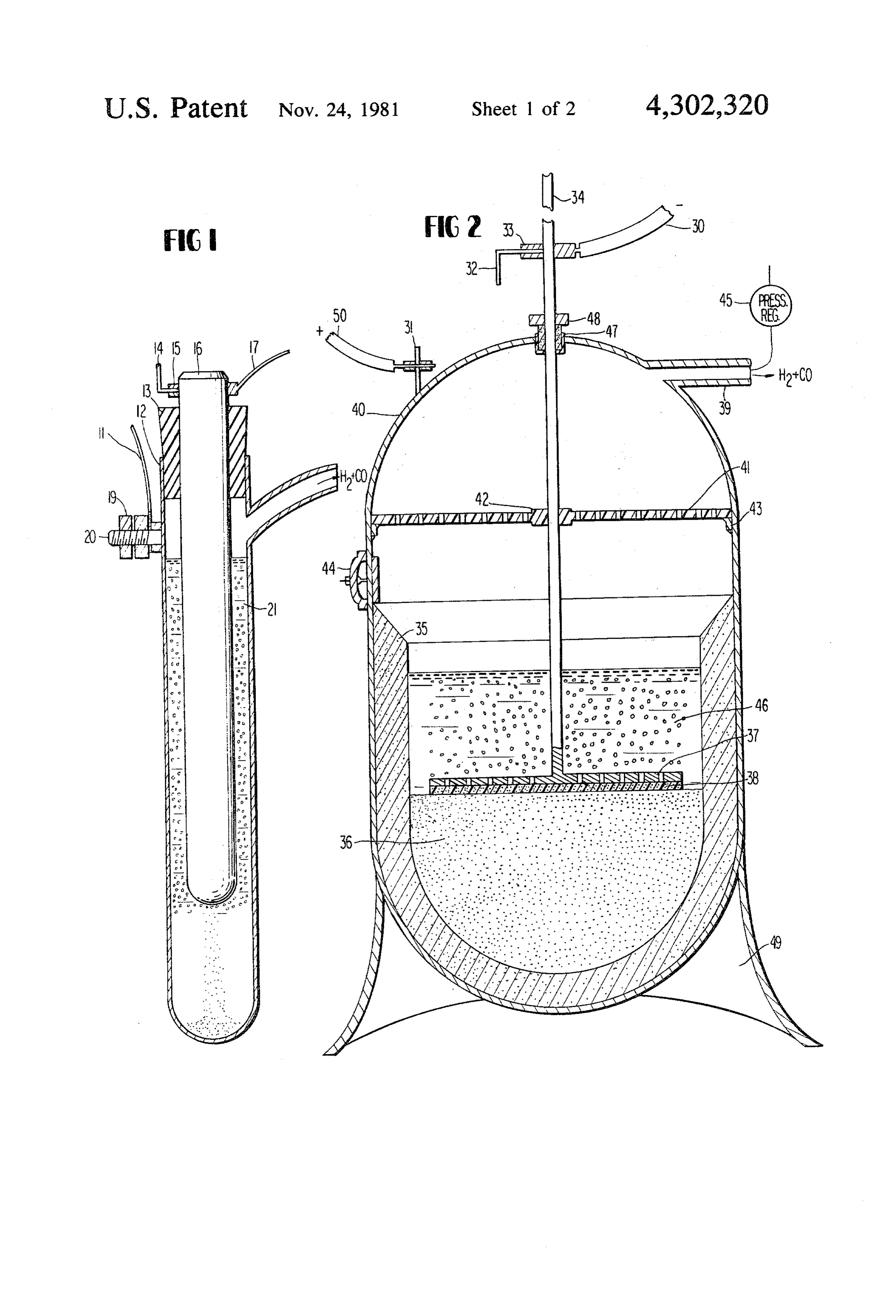
containment vessel with a water-containing space is an electrical contact with conductive tube 12 and is around each rod reaching to a lower end of each tube connected thereto via cathode terminal post 20 to well below the water level but above a bottom surface which it is secured by knob. 19. of the containment vessel with interconnected openings Tube 12 is filled with water approximately to the being provided above the water level. An outlet pipe is level shown. Preferably, to the water has been added a coupled to an upper portion of at least one of the tubes. small amount of a conductivity-increasing solute such The containment vessel may be conductive with the as sulphuric acid, to enhance the rate at which gas is tubes each mechanically and electrically coupled generated. An open space is left above the level of thereto. To make electrical connection to the rods, a water 11. A gas outlet tube 18 is joined to tube 12 at that portion of each of the rods may extend through a corre 10 point.
sponding aperture in a bottom portion of the vessel with Operationally, an electrical potential is applied be an insulating seal positioned around each rod in the tween anode lead 17 and cathode lead 11 and hence corresponding aperture with means for making electri between carbon or graphite rod 16 and conductive tube cal connection to the projecting ends of the rod outside 12. The anode or positive lead is attached to rod 16 the vessel. An electrical potential is applied between the 5 while the negative or cathode lead is attached to con conductive containment vessel and the rods to activate ductive tube 12. The applied voltage is DC. the electrolysis process. The water gas generated in the As a result of the application of electrical potential, apparatus of this embodiment may be converted to electrolysis takes place at the surface of rod 16. Hydro mathanol by the same means as the embodiment de gen and oxygen are formed from the water with the scribed immediately above. 20 hydrogen released into the open space above the water Still further, objects of the invention can be met by a level while the oxygen reacts at the surface of carbon or method for producing water gas including the steps of graphite rod 16 to form carbon monoxide. The mixture covering at least a surface of a carbon-containing mate of these two gases collects at the open space above the rial in a containment vessel with water containing a level of water 11 and is extracted through gas outlet conductivity-increasing solute, passing an electrical 25 tube 18, the mixture of the two gases forming water gas. current through the water and the supply of carbon A second embodiment of the invention is shown in containing material, and collecting the gas thereby gen the cross-sectional view of FIG. 2. A conductive con erated. A catalyst material adapted for converting the tainment vessel 40 has cylindrical center portion with generated water gas components to methanol may be hemispherical ends. The upper of containment vessel 40 provided and the pressure within the containment ves 30 is preferably made removable. A graphite or carbon sel may be maintained sufficiently high to effect the lining 35 is positioned as shown along the inner wall of conversion. A pressure of about 4000 pounds per square containment vessel 40 on approximately two-thirds of inch and a catalyst material including a misture of ZnO the inner surface at its lower portion. and Cr2O3 are preferred. The collected gas may be A supply 36 of pulverized carbon-containing material dried by passing it through alternate layers of granu 35 is positioned within lining 35. For this material pure lated iron and calcium chloride while the gas may be carbon, graphite, charcoal, coal or coke may be utilized. further purified by bubbling it through a solution of However, it is preferred that as pure a carbon material sodium hydroxide. as possible be utilized to eliminate the presence of un BRIEF DESCRIPTION OF THE DRAWINGS 40 wanted impurities in the output gaseous product. The supply 36 of pulverized carbon-containing material is
FIG. 1 shows a cross-sectional view of a first embodi covered by a supply of water 46 to which has been ment of an apparatus for generating water gas in accor added a conductivity-increasing solute such as sul dance with the present invention. phuric acid.
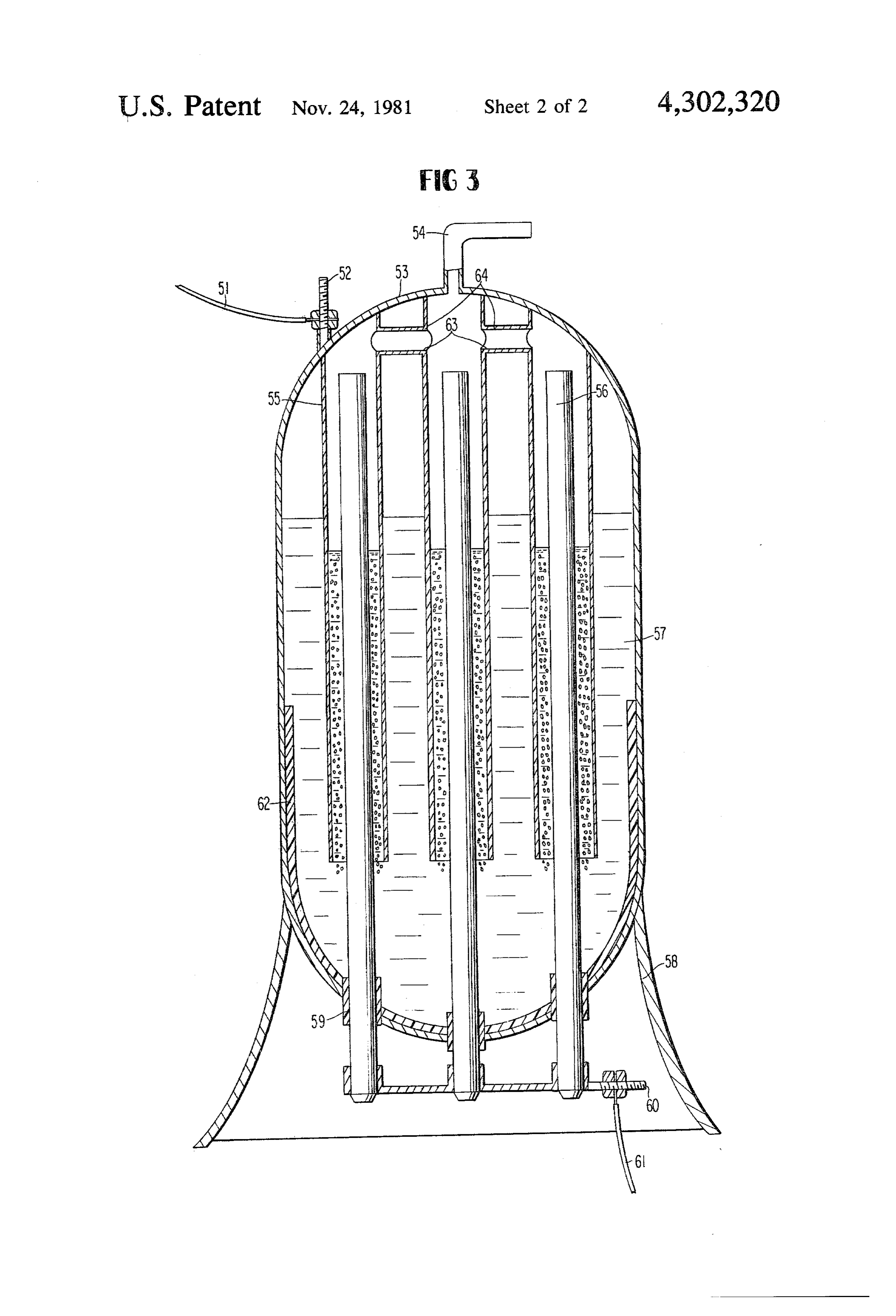
FIG. 2 shows a cross-sectional view of a second em Anode lead 50 is attached to conductive containment bodiment of an apparatus for generating water gas in 45 40 through a welded connection member 31. Electrical accordance with the present invention. contact is made to supply 36 of carbon-containing mate FIG. 3 shows a cross-sectional view of a third em rial through the walls of vessel 40 and through lining 35. bodiment of apparatus for generating water gas in ac The cathode connection from the cathode or negative cordance with the present invention. lead 30 is made via a copper rod 34 attached at its lower 50 end to a perforated copper plate 37. A layer of porous
DESCRIPTION OF THE PREFERRED
EMBODIMENT insulating material 38 is positioned between the lower surface of perforated copper plate 37 and the upper
Referring first to the cross-sectional view of FIG. 1, surface of the supply 36 of carbon-containing material. there is shown a first embodiment of apparatus for gen Cathode lead 30 is electrically coupled to copper rod 34 erating high quality water gas at room temperatures and 55 by means of tightening clamp 33 and a handle 32 which pressures constructed in accordance with the teaching adjusts the lead tension.
of the present invention. The embodiment shown in Copper rod 34 is insulated from conductive contain FIG. 1 includes a closed bottom conductive tube 12 ment vessel 40 by an insulating packing nut 48 and which may, for example, be made of copper. A carbon insulating seal 47. Lateral movement of the center por or graphite rod 16 is positioned within tube 12 substan 60 tion of copper rod 34 is inhibited by insulating perfo tially along the center line thereof. Rod 16 is insulated rated support 41 and a bushing 42 which permits copper from conductive tube 12 and mechanically supported rod 34 to move up and down as desired depending upon by a rubber stopper 13 which mates with the opening at the volume of supply 36. The perforations in support 41 the top of tube 12 and has a center aperture adapted to and copper plate 37 are necessary for the gas produced the shape of rod 16. 65 by the electrolysis process to escape from supply 36 and Electrical connection is made to rod 16 at its upper to pass through supply 46 of conductive water to the end through a metal clamp 15. Anode lead 17 is secured upper proportion of containment vessel 40 to gas outlet to clamp 15 by a tightening handle 14. Cathode lead 11 pipe 39. A pressure regulator 45 may be coupled in
Page 6
series through gas outlet pipe 39. Removable door 44 output water gas corresponding decreases. This serves can be used for charging containment vessel 40. as a self-regulating feature in that when the gas rate of Operationally, a negative potential is applied to cop production becomes higher than desired the production per rod 34 while a relative positive potential is applied rate will automatically decrease. to anode lead 50 and conductive containment vessel 40. 5 For the embodiment shown in FIG. 3, additional Upon application of this potential, the electrolysis pro means may be provided for converting the generating cess commences and water gas is generated in the same water gas components to methanol by the addition of a manner as with the embodiment described above. pressure regulator and the provision of an appropriate If desired, the water gas generated in the apparatus of catalyst.
FIG. 2 can be converted to methanol. To do this a O In each of the three embodiments described and in supply of a suitable catalyst is provided in the outlet modifications thereto, the gas generated can be further pipe circuit and pressure regulator 45 is set to a pressure purified by bubbling it through a solution of sodium sufficiently high that the desired reaction for conver hydroxide so as to remove any remaining amounts of sion of the water gas components to methanol will oc carbon dioxide that may be present. Also, the gas may cur. For the catalyst, ZnO mixed with Cr2O3 may be 15 be dried by passing it through a drying tube filled with used. For this catalyst, a pressure of greater than about alternate layers of granulated iron and calcium chloride. 4000 pounds per square inch may be used. Of course, This latter will also remove any trace amounts of oxy containment vessel 40 must be sufficiently strong to gen that may be present.
withstand this pressure. This completes the description of the preferred em A third embodiment is shown in the cross-section 20 bodiments of the invention. Although preferred em view of FIG. 3. In this version, a conductive contain ment vessel 53 is provided much as in the embodiment bodiments have been described, it is believed that nu merous modifications and alterations thereto would be of FIG. 2. However, different from the embodiment of apparent to one having ordinary skill in the art without FIG. 2, the carbon source is provided as, for example, three elongated carbon or graphite rods 56 positioned 25 departing from the spirit and scope of the invention. vertically within containment vessel 53. The lower ends constructed in the
For example, such apparatus of the invention may be a way that it can be used and fitted of each of rods 56 extends through a corresponding aperture in the bottom of containment vessel 53. Insulat into automotive vehicles with a power supply built in as ing seals 59 are provided to prevent leakage and to a combined unit. Otherwise, the power supply can be electrically insulate rods 56 from conductive contain 30 furnished from regular house current. The apparatus of ment vessel 53. The protruding lower ends of rods 56 the invention also may be utilized to supply fuel for are electrically coupled by anode connection 60 and homes and industry.
hence to anode lead 61. What is claimed is:
Each of rods 56 is surrounded for most of its extent by 1. Apparatus for producing water gas by electrolysis one of copper tubes 55. A water-containing space is 35 comprising:
formed around each rod 56 between the rod and the a body of carbon containing material; corresponding one of copper tubes 55. The lower end of means for containing a volume of water in contact this space is open to conductive water 57 while the with at least a portion of the surface of said carbon upper ends are welded to the upper surface of conduc containing material; and tive containment vessel 53. Gas outlet apertures are 40 means for passing an electrical current through said provided at the upper portions of each of copper tubes body of carbon-containing material and said vol 55 with connecting tubes 64 connecting the two side ume of water, and wherein said means for contain tubes with the center one of copper tubes 55. Otherwise, ing said volume of water is copper or contains the interior of the upper portions of copper tubes 55 are copper.
sealed from the remainder of the open space above the 45 2. The apparatus of claim 2 wherein said volume of level of conductive water 57 within conductive contain water contains a solute for increasing the conductivity ment vessel 53. A gas outlet pipe 54 is connected to one of said water.
of the upper portions of one of copper tubes 55 whereby 3. The apparatus of claim 2 further comprising means gas generated within all three copper tubes 55 can be for collecting gas produced with said apparatus.
4. The apparatus of claim 3 wherein said carbon-con
In this embodiment an insulating plastic layer 62 may taining material is selected from the group consisting of be positioned along the interior portion of the botton carbon, coal, coke, charcoal and graphite. part of containment vessel 53 simply to collect any debris generated during the electrolysis process to keep for5.converting
The apparatus of claim 3 further comprising means water gas produced by said apparatus to
from shorting out rods 56 to the surface of conductive methanol.
containment vessel 53. 6. The apparatus of claim 5 wherein said converting Operationally, a voltage potential is applied between means comprises:
rods 56 and copper tubes 55 via annode lead 61 and means for pressurizing said water gas to a pressure in cathode lead 51, respectively. Once this potential is excess of about 4000 pounds per square inch; and a applied generation of water gas proceeds in the same 60 catalyst agent.
manner as described for the two embodiments described above. 7. The apparatus of claim 6 wherein said catalyst The embodiment of FIG. 3 has an additional advan agent comprises ZnO and Cr2O3.
tage. That is, when the pressure within the upper por 8. The apparatus of claim 3 further comprising means tions of copper tube 55 exceeds that within the remain 65 for9.drying
The said water gas produced by said apparatus.
apparatus of claim 8 wherein said drying der of the space above conductive water 57 within containment vessel 53, the water level in each of copper means comprises a drying tube comprising alternate tubes 55 will drop so that the rate of production of layers of granulated iron and calcium chloride.
Page 7
10. The apparatus of claim 3 further comprising a supply of water within said vessel containing a means for removing carbon dioxide from said gas pro conductivity-increasing Solute and leaving an open duced by said apparatus. . volume at a top portion of said containment vessel; 11. The apparatus of claim 10 wherein said carbon at least one rod of carbon-containing material posi dioxide removing means comprises means for bubbling tioned within said containment vessel; said gas through a solution of sodium hydroxide. means for making electrical connection to each said 12. Apparatus for producing water gas by electrolysis rod;
from carbon and water comprising: an electrically conductive tube surrounding a major an electrically conductive containment vessel; portion of each said rod extending above the water 10 level in said containment vessel with a water-con a carbon lining disposed upon lower portions of an taining space around each rod extending to a lower inner surface of said containment vessel; end of each tube above a bottom surface of said a supply of pulverized carbon-containing material containment vessel and having an opening above positioned inside said containment vessel and being said water level, wherein said electrically conduc surrounded on all but an upper side by said carbon 15 tive tube is copper or contains copper; and lining; an outlet pipe coupled to said containment vessel at a supply of water containing a conductivity-increas an upper portion thereof. ing solute covering said supply of carbon-contain 21. The apparatus of claim 20 wherein said contain ing material; ment vessel is electrically conductive and wherein said a perforated electrically conductive plate electrode 20 tubes are each mechanically and electrically coupled to covered by said water and contacting an electri said containment vessel.
cally insulating material separating said conductive 22. The apparatus of claim 21 wherein said means for making electrical connection to each said rod com plate electrode from said upper side of said supply prises:
of carbon-containing material, wherein said con 25 a portion of each said rod extending through a corre ductive plate electrode is copper or contains cop sponding aperture in a bottom portion of said ves per;
sel;
an electrically conductive rod coupled to said con an electrically insulating seal positioned around each ductive plate electrode and extending through an said rod in said corresponding aperture; and aperture in said containment vessel; 30 means for making electrical connection to an end of means for sealably insulating said conductive rod each said rod extending through said aperture. from said containment vessel; and 23. The apparatus of claim 22 further comprising means for applying an electrical potential between means for applying an electrical potential between said said containment vessel and said conductive rod. containment vessel and said means for making electrical 13. The apparatus of claim 12 further comprising an 35 connection to an end of each said rod. insulating support for preventing lateral movement of 24. The apparatus of claim 20 further comprising an said conductive rod. electrically insulating lining covering at least a portion 14. The apparatus of claim 13 further comprising a ment of a lower portion of an inner surface of said contain removable access door in a wall of said containment vessel.
vessel above the level of said carbon lining and said pressure 25. The apparatus of claim 20 further comprising Water. regulating means coupled to said outlet pipe. 15. The apparatus of claim 13 further comprising an 26. The apparatus of claim 25 further comprising a outlet pipe coupled to said containment vessel at an catalyst material adapted for converting water gas com ponents to methanol dissolved in said water and upper portion thereof. 45 wherein said pressure regulating means maintains the 16. The apparatus of claim 15 further comprising pressure within said containment vessel at a pressure pressure regulating means coupled to said outlet pipe. sufficiently high to effect conversion of said compo 17. The apparaus of claim 15 further comprising: nents to methanol.
a catalyst material adapted for converting water gas 27. The apparatus of claim 26 where said pressure components to methanol; and 50 regulation means maintains said pressure above about wherein said pressure regulating means maintains the 4000 pounds per square inch and wherein said catalyst pressure within said containment vessel at a pres material comprises a mixture of ZnO and Cr2O3. sure sufficiently high to effect conversion of said 28. The apparatus of claim 12 wherein said contain components to methanol. ment vessel comprises copper.
18. The apparatus of claim 17 wherein said pressure 55 29. The apparatus of claim 20 wherein said contain regulating means maintains said pressure above about ment vessel comprises copper. 4000 pounds per square inch and wherein said catalyst 30. The apparatus of claim 12, wherein said perfo material comprises ZnO and Cr2O3. rated conductive plate electrode is a copper containing electrode.
19. The apparatus of claim 12 wherein said carbon 60 31. The apparatus of claim 30, wherein said copper containing material comprises material selected from containing electrode is a copper electrode. the group consisting of carbon, coal, coke, charcoal and 32. The apparatus of claim 20, wherein said conduc graphite. tive tube is a copper containing conductive tube. 20. Self-regulating apparatus for producing water gas 33. The apparatus of claim 32, wherein said copper by electrolysis from carbon and water comprising: 65 containing conductive tube is a copper conductive tube. a containment vessel; sk sk : sk sk
Provenance
- Collection
- Cited prior art
- Original PDF
- patentimages.storage.googleapis.com →
- Filed
- 1979-08-14
- Pages
- 7
- Method
- pdftotext (the PDF's own text layer) + pdftoppm 300dpi page scans
- Source
- Google Patents bibliographic record
- Granted
- 1981-11-24
- Inventors
- Arlin C. Lewis
- Transcribed from
- patentimages.storage.googleapis.com →