patent · US3468641
Conversion of liquid hydrocarbons into fuel gas or water gas by a thermal or catalytic splitting
23 September 1969
Page 1
Drawing sheet — no readable text.
Page 2
United States Patent Office 3,468,641 Patented Sept. 23, 1969
ply system it is highly important that the gas which is 3,468,641 being conveyed should have a high calorific value per CONVERSION OF LIQUID HYDROCARBONS INTO unit of volume.
FUEL GAS OR WATER GAS BY ATHERMAL, OR A known process of producing gases having a high
CATALYTIC SPLTTING
Hans Werner Gross, Buchschlag, Erwin Ehrhardt, calorific value is carried out in a plurality of stages and Sprendingen, and Gerhard Baron, Frankfurt, Ger uses pure oxygen as a splitting agent in one or two stages. many, assignors to Metallgesellschaft Aktiengesell Another known process is a cyclic process carried out schaft, Frankfurt am Main, Germany under atmospheric pressure. In the latter process, the re Filed May 2, 1966, Ser. No. 546,666 quired heat is supplied by a regenerative system. This Int, C. C10g 11/28 O process results in undesired by-products, which are part U.S. C. 48-214 13 Claims ly liquid, particularly when the operation of the regen erative system is being reversed. In another known proc ess, which is suitable for continuous operation, light, low
ABSTRACT OF THE DISCLOSURE boiling hydrocarbons are cracked under atmospheric or 5 Superatmospheric pressure in a hot gas having a high
A process of producing a gas having a high methane content by a hydrogenating splitting of hydrocarbons content of free hydrogen. This process results also in undesired liquid by-products, particularly aromatic com under at least atmospheric pressure, comprising Supply Rends, Such as benzene, toluene, naphthalene and the ing hydrocarbons containing 3-30 carbon atoms per ike.
molecule and steam in a mixture at a temperature up to 20 The Printed German Application No. 1,180,481 de 450° C. to a first bed of a catalyst having a hydrogenating splitting promoting activity, withdrawing split gases con Scribes a high a continuous process of producing gases having methane content by a catalytic splitting of hydro taining higher hydrocarbons from said first bed and pass carbons containing 4-10 carbon atoms per molecule. In ing them through a second bed of a catalyst having a hy this process, the hydrocarbons are mixed under normal drogenating splitting promoting activity and present in an 25 or elevated pressure with hydrogen and are heated to a amount which is 10-25% of the amount of said catalyst in said first bed, withdrawing split gases from said Second temperature which is in the range of 350-500 C, and bed, and controlling the temperature of said second bed Selected so that the heat of reaction results in a tempera ture of 400-550° C. in the bed of the nickel-containing at a value which is sufficiently higher than the tempera ture of said split gases withdrawn from Said first bed to 30 catalyst. It is preferable to use pressures between 10 and keep the concentration of higher hydrocarbons in the 25 kg./sq. cm. (absolute pressure) and a ratio of 2-5 parts steam to one part hydrocarbon on a weight basis. In split gases withdrawn from said second bed below 8 this process, a sequential reaction takes place, in which grams higher hydrocarbons per standard cubic meter of a major part of the mixed liquid hydrocarbons is first split gas. reacted with steam to form hydrogen and carbon mon 35 oxide, whereas the remainder is split to form methane
It is known to convert liquid hydrocarbons into fuel and carbon dioxide. The carbon monoxide and residual steam may then form carbon dioxide and hydrogen in a gas or water gas by a thermal or catalytic Splitting in Water gas reaction. Carbon monoxide and hydrogen may the presence of gases which contain water vapor and/or also react to form methane.
oxygen. Such gases are, e.g., air or technically pure 40 Thermodynamic and reaction-kinetic considerations Oxygen. show that this process can be performed only in a narrow The thermal or thermal-catalytic splitting of hydrocar range of operating conditions owing to its heat balance. bons known as cracking, which is carried out without This theoretical analysis has been confirmed in practice admixture or with an admixture of Small amounts of (R. G. Cockerham and G. Percival, 147th National Meet steam, results also in a gas fraction which consists of ing of the American Chemical Society, 1964). hydrogen and C to Ca hydrocarbons and has a high calo The mixed hydrocarbons to be gasified must consist rific value. This process cannot be considered a complete mainly of low-boiling hydrocarbons. When a mixture conversion because it results preferably in low-boiling consisting mainly of C to Co. hydrocarbons is reacted liquid hydrocarbons and in coke. with steam on the catalyst, the required temperature can Liquid hydrocarbons may be converted into Water 50 be maintained in the catalyst bed only if the reaction gas consisting mainly of CO and H2 by an oxygenating mixture is preheated to such a high temperature that splitting with oxygen or by splitting with oxygen and steam. The need to use pure oxygen in the production cracking reactions are obtained independently of the added steam. These cracking reactions reduce the re of nitrogen-free product gases may be an economical activity of the feedstock and the activity of the catalyst disadvantage. 55 and may finally lead to a deposition of carbon black. The splitting in the presence of oxygen has the ad. A preheating to a higher temperature will promote also vantage that an indirect supply of heat is not required andthe endothermic reactions taking place in the catalyst that the process can be carried out in a stack or shaft furnace. For a catalytic splitting of liquefied gases or ofbed and yielding carbon monoxide and hydrogen. These reactions cause a decrease of the temperature in the liquid hydrocarbons only with steam, with an exclusion 60 catalyst bed. Upon a decrease of the catalyst temperature, of free oxygen or free hydrogen, an indirect supply of the relative surplus of carbon monoxide causes a for heat is required. For this reason, this process is carried mation of carbon and carbon dioxide (Boudouard equi out in tubular heaters. This process has been preferred librium) because the known catalysts having a high nickel when a nitrogen-free product gas is to be obtained with content promote the Boudouard reaction more than the out using free oxygen. Such gas may be, e.g., water gas, homogenous water-gas reaction. which may be converted into hydrogen by a conversion Reactions of mixed hydrocarbons containing a larger of its carbon monoxide content with steam to form car number of carbon atoms per molecule are accompanied bon dioxide, which is then removed by Scrubbing.
An object which has recently become highly interest by secondary reactions, which can be controlled only ing is the conversion of liquid hydrocarbons to rich 70 with difficulty and which result in a formation of poly mers and carbon black. These secondary reactions reduce gases having a high methane content. For a distribution the life of the catalyst and create a need for frequent of fuel gas over large areas by a long-distance gas Sup
Page 3
shut-downs. Such disturbances may be avoided when the sure) and low temperatures, e.g., 0° to -5° C. and hydrocarbon mixture to be gasified is preheated to a lower, hydrocarbons may condense in the long-distance temperature not exceeding 450° C., independently of its line and this condensate may cause the known disturb boiling range and its end point, before it is introduced ances in the Supply of gas over long distances. into the splitting catalyst. The preheating temperature It has been found that the life of such splitting plant depends on the boiling characteristics of the feed hydro can be considerably prolonged if the unsplit or incom carbons and the rate at which steam is admixed. The pletely split, higher hydrocarbons contained in the split preheating temperature is lower, the higher the average gas after the initial decline in activity of the catalyst are number of carbon atoms per molecule of the mixed completely split in a succeeding reactor, which contains hydrocarbon feed, and the preheating temperature is 0. a hydrogenating splitting catalyst in an amount which is lower, the lower the rate at which steam is admixed. only 10-25% of the amount of catalyst in the main reac When a steam-gasoline weight ratio of 2.5:1 is used tor. When the activity of this succeeding catalyst declines, in splitting a gasoline having a boiling range of 35-180° C. the temperature only of the latter is increased in depend and the steam-gasoline mixture is preheated to 450° C., ence on the content of higher hydrocarbons in the split the exit temperature of the split gas from the catalyst 5 gas discharged from said Succeeding catalyst until the con bed will be about 480 C. Under these operating con centration of carbon monoxide and hydrogen increases to ditions, a fresh catalyst having a high nickel content of, Such an extent that the succeeding catalyst must be re e.g., 30-40% on a support of magnesium silicate or placed.
alumina exhibits in most cases a satisfactory perform The invention relates to a process of producing gases ance for some weeks. The condensate which is obtained 20 having a high methane content by a hydrogenating split when the split gas is cooled is entirely free of hydro ting of hydrocarbons containing 3-30 carbon atoms per carbons, and the split gas itself contains higher hydro molecule under atmospheric or superatmospheric pres carbons only in amounts of about 0.1-0.6 gram per Sure on catalysts which contain nickel or cobalt, in the standard cubic meter. This shows that the hydrocarbon presence of steam and, if desired, in the presence of hy feed is virtually completely split. In this specification and 25 drogen or of gases which contain free hydrogen, in which the claims, the term “higher hydrocarbons' is used to process a mixture of hydrocarbons and steam is pre describe hydrocarbons having 3 or more carbon atoms heated to and is introduced into the catalyst bed at a tem per molecule. After a relatively long period of operation, perature not exceeding 450° C. which may amount to about 2-3 months, which depends This process comprises two stages. The second of these mainly on the catalyst support and the conditions under 30 stages is carried out at a higher temperature than the which the catalyst was manufactured, the activity of the first.
catalyst declines. This is initially indicated by an increase This process is characterized in that the split gas which of the contents of higher hydrocarbons in the split contains higher hydrocarbons after an initial decline in gas. As the operation proceeds further, the activity of activity of the catalyst is passed through an after-reactor, the catalyst declines to such an extent that hydrocarbons which contains a hydrogenating splitting catalyst in an are condensed when the gas is cooled to ambient tem amount of 10-25% of the amount of catalyst in the pre perature. Experiments have shown that this decline in ceding reactor, and the temperature of the catalyst in the activity is mainly due to a recrystallization of the nickel after-reactor is increased, suitably in steps, above the on the catalyst. Whereas this loss in activity may be exit temperature of the split gas from the first splitting compensated to some extent by raising the temperature 40 stage, So that the concenration of higher hydrocarbons in of the catalyst bed by 5-10 C., this effect is obtained the end gas is kept below a predetermined value. only for a comparatively short time. The temperature The temperature of the catalyst may be increased by of the catalyst bed may be raised by an increase of the indirect external heating. For this purpose, the catalyst is entrance temperature of the steam-gasoline mixture or arranged in a tubular heater. Alternatively, the tempera by an indirect heating of the catalyst, e.g., with super ture increase may be effected by an addition of a small heated process steam. In the latter case, the catalyst is amount of air to the rich gas produced in the first stage accommodated in tubes of a tubular heater. If the exit so that the heat of the exothermic reaction of oxygen with temperature of the split gas from the catalyst is higher the rich gas and/or with the residual hydrocarbons in the than 550 C., thermodynamical effects give rise to the aftersplitting reactor results in the desired temperature formation of a gas which consists mainly of carbon 50 CeaSe.
monoxide and hydrogen and corresponds in its properties The aftersplitting may be promoted by the same cobalt to the known gases for town or long-distance supply or nickel-containing catalyst which is also used in the systems but can no longer be described as a rich gas. main reactor. This catalyst may contain, e.g., 20-40% Whereas the activity of the catalysts may be tempo cobalt or nickel on a support of magnesium silicate or rarily improved by the above-mentioned raising of the alumina. It has been found desirable to add chromium, temperature, this results in an even higher crystallization 55 platinum, palladium or tungsten as stabilizers to these rate of the nickel so that the life of the catalysts is not catalysts.
substantially increased. The process according to the invention will be ex Surprisingly it has now been found that when the exit plained more fully hereinafter in an example and with temperature of the split gas from the catalyst is main 60 tained constant, e.g., at 480 C., the activity of the reference to the single figure of the accompanying draw. Ing.
catalyst does not decline in proportion with time but an appreciable decline in activity during the first 1000 EXAMPLE to 2000 operating hours is followed by an operating period of many months, in which the activity of the 65 Gasoline is to be converted into a high-methane gaS catalyst is no more changed. Depending on the com in a plant having a flow scheme as shown on the drawing. position of the catalyst, the amount of higher hydro The gasoline has the following properties: carbons which flow through the catalyst bed without Boiling range ------------------------ C-- 35-180 being split in this period amount to 3-30 grams per Carbon ----------------------percent by wt. 84.75 standard cubic meter of split gas. This corresponds to Hydrogen --------------------------- do---- 15.25 about 0.5-5% of the hydrocarbon feed. This proportion 70 Farafns, about ---------------------percent - 93.5 of higher hydrocarbons in the produced rich gas is excessively high for many uses. Under the operating Aromatic compounds, about -----------do---- 5.1
conditions of long-distance gas lines, involving a super atmospheric pressure of 5-12 kg/sq. cm. (absolute preS Naphthalene, about -------------------...-- 20
Page 4
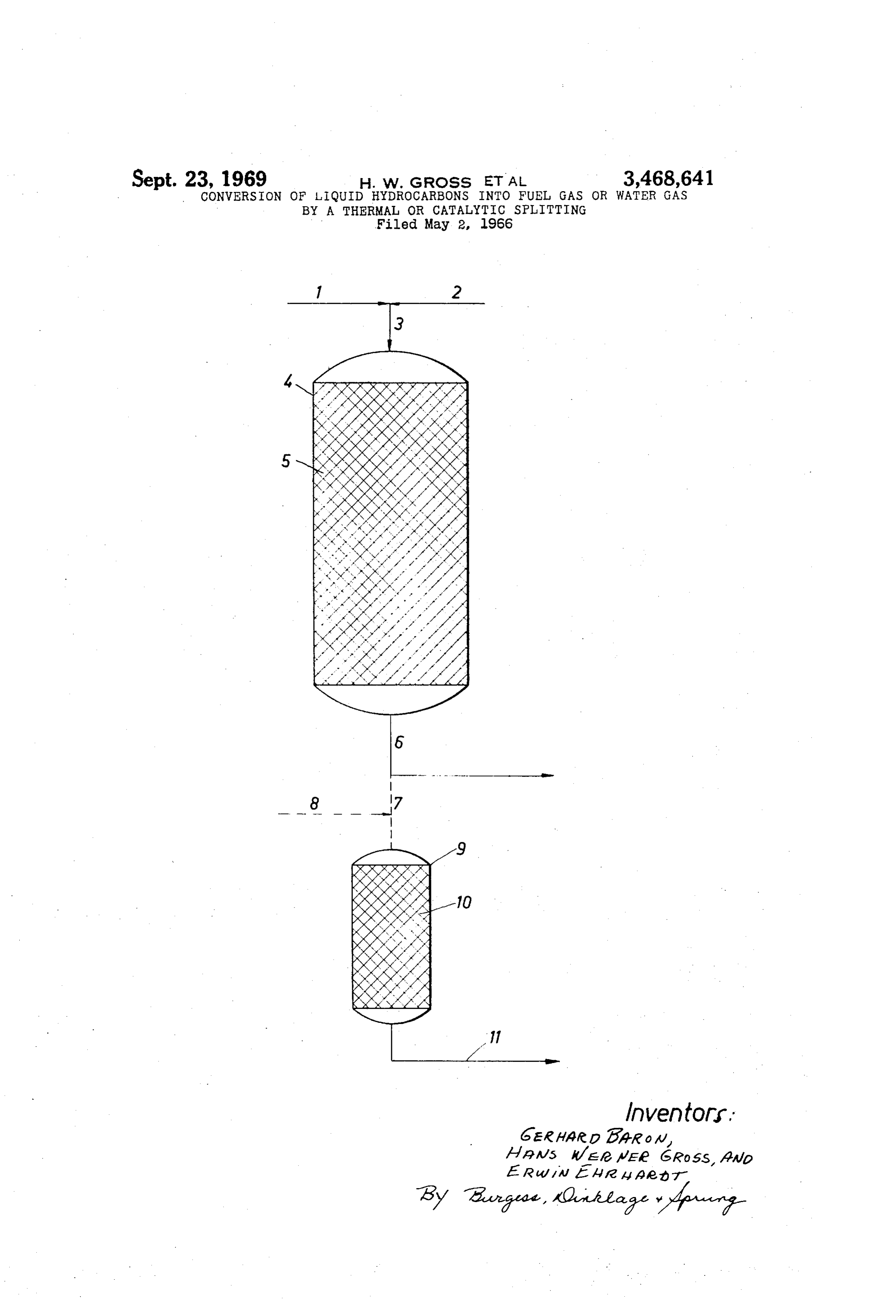
2.5 kg. steam are introduced through conduit 2 per The experiment was repeated. After five months of op kilogram of this gasoline supplied through conduit 1. eration under the same conditions, the reaction tempera Gasoline and steam are preheated so that the temperature tures were not increased but an aftersplitting reactor 9 of the mixture of these two substances in conduit 3 is having a catalyst charge 10 was put into operation and 450 C. At this temperature, the mixture enters the cata fed through conduit 7. The catalyst was the same as that lyst bed 5 contained in the reactor 4. The gasoline should in the layer 5 of reactor 4. The amount of catalyst in not be heated to a temperature above 450 C. at any time reactor 9 was only 20% of the amount of catalyst in re before contacting the catalyst. actor 4. The gas analysis remained the same when the The split gas exits from the catalyst bed through con aftersplitting reactor had been put into operation but the duit 6 at a temperature of 480 C. This split gas has the 10 proportion of higher hydrocarbons in the rich gas dropped following composition on a dry basis: to 0.2-0.4 gram per standard cubic meter. Percent by vol. Conly after seven further months of operation, the re
CO2 -------------------------------------- 22.4 sulting rich gas contained 5-7 grams higher hydrocarbons CO -------------------------------------- 0.6 per standard cubic meter whereas the gas analysis was Ha --------------------------------------- 16.9 15 almost unchanged.
CH4 -------------------------------------- 60. When the reaction end temperature in the aftersplitting reactor 9 was increased in small steps, the concentration 100.0 of higher hydrocarbons in the rich gas was maintained
During the first three to four weeks of operation, the 20 below 3 grams per standard cubic meter for further four unsplit hydrocarbons in the rich gas amounted to 0.2- changed. The catalyst in the after-reactor was then ex months.
0.4 gram per standard cubic meter of gas and had the With a single exchange of the catalyst in the after following composition: - splitting reactor 9, the life of the catalyst in reactor 4 Hydrocarbons: Percent by wt. wasInprolonged to 26 months.
the plant illustrated by the flow scheme, the tem
Cs ------------------------------------- 6.0 25 perature increase in the aftersplitting reactor was effected Co ------------------------------------ 51.0 by an addition of a small amount of air through the
Cs ------------------------------------- 13.0 conduit 8 into the transfer conduit 7 between the two Benzene ------------------------------------ 5.0 30 reactors. Alternatively, the after-reactor 10 may consist of a Other hydrocarbons could not be detected by gas tubular heater, the tubes of which contain the catalyst. chromatography. These tubes are heated by superheated process steam, After the usual removal of the carbon dioxide by scrub which flows around the tubes and is then supplied to the bing to a residual concentration of about 2%, a rich gas reactor 5 through conduit 2.
for distribution in long-distance supply systems or town 35 What is claimed is:
gas systems is available with the following composition 1. A process of producing a gas having a high methane of its gaseous components: content by a hydrogenating splitting of hydrocarbons Percent by vol. under prising at least atmospheric pressure, said process com supplying hydrocarbons containing 3-30 carbon
CO2 --------------------------------------- 1.8 40 atoms per molecule and steam in a mixture at a tempera
H2 ----------------------------------------- 21.4 ture up to 450° C. to a first bed of a catalyst having a hydrogenating splitting promoting activity, withdrawing
CH4 --------------------------------------- 76.0 split gases containing higher hydrocarbons from said first The small content of higher hydrocarbons in this gas bed and passing them through a second bed of a catalyst is not disturbing. having a hydrogenating splitting promoting activity and After five months of operation, the proportion of high 45 present in an amount which is 10-25% of the amount of er hydrocarbons in the rich gas had increased to 6.2 said catalyst in said first bed, withdrawing split gases grams per standard cubic meter. In other respects, the from said second bed, and controlling the temperature of analysis of the gas had not changed. These higher hydro carbons had the following composition: said second bed at a value which is sufficiently higher than the temperature of said split gases withdrawn from
Hydrocarbons: Percent by wt. 50 Said first bed to keep the concentration of higher hydro Cs ------------------------------------- 3.0 carbons in the split gases withdrawn from said second bed Cs ------------------------------------- 15.0 below 8 grams higher hydrocarbons per standard cubic C ------------------------------------- 15.0 meter of split gas.
Cs ------------------------------------- 12.0 55 2. A process as claimed in claim 1, which comprises Cs ------------------------------------- 25.0 initially supplying hydrocarbons containing 3-30 carbon C10 ------------------------------------ 22.0 atoms per molecule and steam in a mixture at a tempera Benzene ------------------------------------ 4.0 ture up to 450 C. to said first bed when the same has a Toluene ------------------------------------ 4.0 hydrogenating splitting promoting activity which is suffi Higher hydrocarbons having this composition are toler 60 ciently high to cause said hydrocarbons to be split to such able in a gas for long-distance supply up to an upper an extent that split gases withdrawn from said first bed limit of about 8 grams per standard cubic meter. contain higher hydrocarbons in a concentration below 8 When the exit temperature of the rich gas from the split grams higher hydrocarbons per standard cubic meter of catalytic reactor 4 was increased by external heating by 65 gas, and beginning to pass split gases withdrawn about 10° C., the proportion of higher hydrocarbons in from said first bed through said second bed when said the rich gas was temporarily reduced to the original value split gases withdrawn from said first bed contain higher of 0.2-0.4 gram per standard cubic meter. After a total hydrocarbons in a concentration which exceeds 8 grams operating time of 8 months and at a gas exit tempera higher hydrocarbons per standard cubic meter of split ture of 520 C, liquid hydrocarbons penetrated the cat 70 gas, due to a decline of said activity of said catalyst in alyst bed in such an amount that the cooling of the rich said3. first bed.
A process as set forth in claim , in which said mix gas resulted in a condensate which contained hydrocar bons. Shortly before the plant was shut down, the rich ture contains hydrogen.
gas contained 18 grams higher hydrocarbons per standard 4. A process as set forth in claim 1, in which said mix cubic meter. 75 ture contains hydrogen-containing gases.
Page 5
5. A process as set forth in claim 1, in which said 11. A process as set forth in claim 10, in which said catalyst in at least one of said beds comprises a sub- oxygen is added in the form of air. stance selected from the class consisting of cobalt and 12. A process as set forth in claim 1, in which said nickel. second bed is maintained in a plurality of tubes and the 6. A process as set forth in claim 1, in which at least one of said beds is maintained under a superatmospheric temperature of said second bed is controlled by a supply of external heat to said tubes.
pressure. 13. A process as set forth in claim 12, in which the out 7. A process as set forth in claim 1, in which said tem- side of said tubes is contacted with flowing superheated perature of said second bed is increased in steps in in- steam, which is subsequently used to form said mixture. tervals of time. 10 References Cited 8. A process as set forth in claim 1, in which said hy drocarbons in said mixture comprise gasoline. UNITED STATES PATENTS 9. A process as set forth in claim 1, in which the Sup- 3,089,843 5/1963 Eastman et al. 208-107 XR ply of said mixture is interrupted when the temperature 3,128,163 4/1964 Weittenhiller et al. - 48-213 XR of said second bed required to keep the concentration of higher hydrocarbons g the split withdrawn from 15 FOREIGN PATENTS said second bed below 8 grams higher hydrocarbons per 1,131,350 6/1962 Germany. standard cubic meter of split gas, is above 550 C., 1,145,586 3/1963 Germany. whereafter said catalyst in said second bed is replaced by o a fresh catalyst having a hydrogenating splitting promot. 20 MORRIS O. WOLK, Primary Examiner ing activity and the supply of said mixture is then resumed. J. OLSEN, Assistant Examiner 10. A process as set forth in claim 1, in which the temperature of said second bed is controlled by adding U.S. C. X.R. Oxygen to said split gases withdrawn from said first bed w before said split gases are passed through said second bed. 25 23-288; 48-212, 213, 215; 208-108
Provenance
- Collection
- Cited prior art
- Original PDF
- patentimages.storage.googleapis.com →
- Filed
- 1966-05-02
- Pages
- 5
- Method
- pdftotext (the PDF's own text layer) + pdftoppm 300dpi page scans
- Source
- Google Patents bibliographic record
- Granted
- 1969-09-23
- Inventors
- Hans Werner Gross; Erwin Ehrhardt; Gerhard Baron; Metallgesellschaft AG
- Transcribed from
- patentimages.storage.googleapis.com →