patent · US5993761
Conversion of hydrocarbons assisted by gliding electric arcs in the presence of water vapor and/or carbon dioxide
30 November 1999
Page 1 — bibliographic record
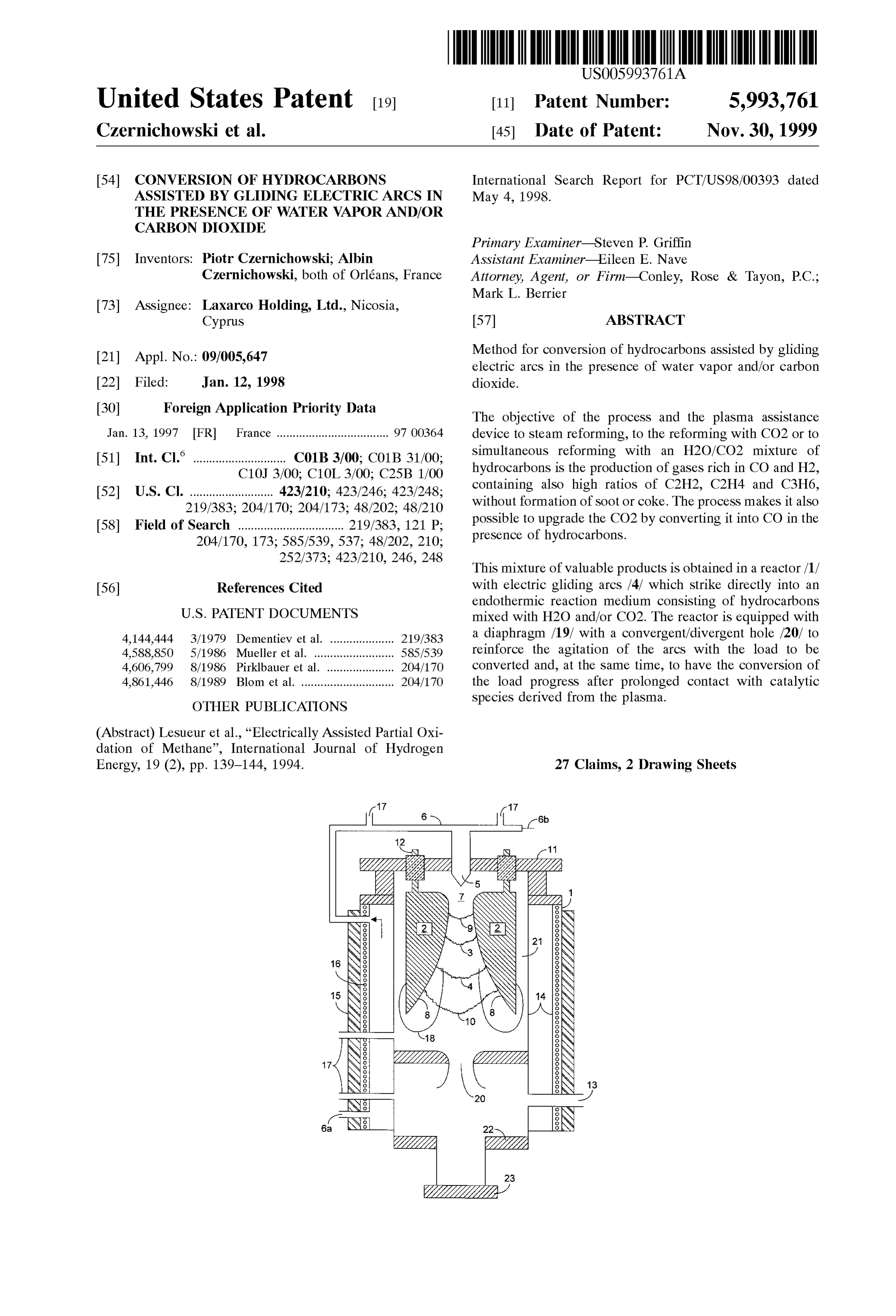
United States Patent (19) 11 Patent Number: 5,993,761 Czernichowski et al. (45) Date of Patent: Nov.30, 1999 54 CONVERSION OF HYDROCARBONS International Search Report for PCT/US98/00393 dated ASSISTED BY GLIDING ELECTRIC ARCS IN May 4, 1998.
THE PRESENCE OF WATER WAPOR AND/OR
CARBON DIOXIDE
Primary Examiner Steven P. Griffin 75 Inventors: Piotr Czernichowski; Albin ASSistant Examiner Eileen E. Nave Czernichowski, both of Orléans, France Attorney, Agent, or Firm-Conley, Rose & Tayon, P.C.; Mark L. Berrier 73 Assignee: Laxarco Holding, Ltd., Nicosia,
Cyprus 57 ABSTRACT
21 Appl. No.: 09/005,647 Method for conversion of hydrocarbons assisted by gliding electric arcs in the presence of water vapor and/or carbon 22 Filed: Jan. 12, 1998 dioxide.
30 Foreign Application Priority Data The objective of the proceSS and the plasma assistance Jan. 13, 1997 FR France ................................... 97 OO364 device to steam reforming, to the reforming with CO2 or to 51 Int. Cl. ............................. C01B3/00; CO1B 31/00; simultaneous reforming with an H2O/CO2 mixture of C10J 3/00; C1OL3/00; C25B 1/00 hydrocarbons is the production of gases rich in CO and H2, 52 U.S. Cl. .......................... 423/210; 423/246; 423/248; containing also high ratios of C2H2, C2H4 and C3H6, 219/383; 204/170; 204/173; 48/202; 48/210 without formation of Soot or coke. The proceSS makes it also 58 Field of Search ................................. 219/383, 121 P; possible to upgrade the CO2 by converting it into CO in the 204/170, 173; 585/539, 537; 48/202, 210; presence of hydrocarbons.
This mixture of valuable products is obtained in a reactor /1/ 56) References Cited with electric gliding arcs /47 which Strike directly into an endothermic reaction medium consisting of hydrocarbons
4,144,444 3/1979 Dementiev et al. .................... 219/383 a diaphragm /19/ with a convergent/divergent hole /20/ to 4,588,850 5/1986 Mueller et al. .......... ... 585/539 reinforce the agitation of the arcs with the load to be 4,606.799 8/1986 Pirklbauer et al. .. ... 204/170 converted and, at the same time, to have the conversion of 4,861,446 8/1989 Blom et al. ...... ... 204/170 the load progreSS after prolonged contact with catalytic
OTHER PUBLICATIONS
Species derived from the plasma.
(Abstract) Lesueur et al., “Electrically Assisted Partial Oxi dation of Methane”, International Journal of Hydrogen
Energy, 19 (2), pp. 139-144, 1994. 27 Claims, 2 Drawing Sheets
Page 2
Drawing sheet — no readable text.
Page 3
Drawing sheet — no readable text.
Page 4
CONVERSION OF HYDROCARBONS the gliding electric arcs. The activation of the medium is ASSISTED BY GLIDING ELECTRIC ARCS IN evident by the presence of rather unusual species (with THE PRESENCE OF WATER WAPOR AND/OR respect to the traditional hydrocarbon conversion CARBON DIOXIDE conditions) originating from the matter in which these arcs are developed. Thus, electrons can be detected, as well as
RELATED APPLICATIONS atoms, ions and/or molecular radicals. Such as: H, OH, O, This application is based on a French patent application, O2, H+, O+, O2+, OH-, HO2, CH3, CH2, CH, C2 and many National Registration No. 9700364, filed Jan. 13, 1997. others. Most of these species can exist in their excited electronic or vibrational States with a very long lifetime.
BACKGROUND OF THE INVENTION They are also known as being extremely active chemically. The production of Synthesis gas starting from light Satu
This invention concerns a hydrocarbon conversion pro rated hydrocarbons is a very well-known and very important ceSS assisted by Special gliding arc plasma in the presence of Stage, especially for the upgrading of natural gases. The carbon dioxide (CO2) and/or water vapor. This process is most used process at the present time, the catalytic Steam illustrated by the conversion of two model mixtures in an arc 15 reforming (or "steam reforming) encounters major prob reactor equipped with a maturation post-plasma compart lems. In principle, a high temperature (thermodynamic ratio) ment: and a high pressure (for kinetic ratios) are Sufficient for this a natural gas containing mainly methane and Some ethane, process. However, in practice, despite the know-how for the propane and butanes, production of “Synthesis gas' according to the processes, the a “propane” containing Some ethane and butanes. joint management of the compositions, preSSures and tem Therefore, the invention can be applied to any pure peratures is delicate, even impossible without resorting to hydrocarbon, such as CH4, C2H6, C3H8 or C4H10 and catalysts.
to their mixtures. Then, in order to perform natural gas (mainly rich in In the presence of water vapor and/or of CO2, it is then methane) reforming with water vapor, usually a catalytic possible to convert, totally or partially, all these hydrocar 25 way is Sought: presence of an active Solid Substance for bons basically into Synthesis gas (consisting of a majority of temperatures which can be attained without too much dif hydrogen H2 and of carbon monoxide CO), but also into ficulty. Therefore, the traditional Steam reforming technol other valuable products, Such as ethylene (C2H4), acetylene ogy uses furnaces in which Several hundred fragile metal (C2H2) and propane (C3H6), and all without using tradi tubes (filled with a catalyst and having a length which can tional catalysts. The proceSS is based mainly on Steam reach several dozen meters) are located, heated with natural reforming reactions, Such as: gas. This technology is tied to the very Strong drops in preSSure and, especially, in heating energy. The temperature
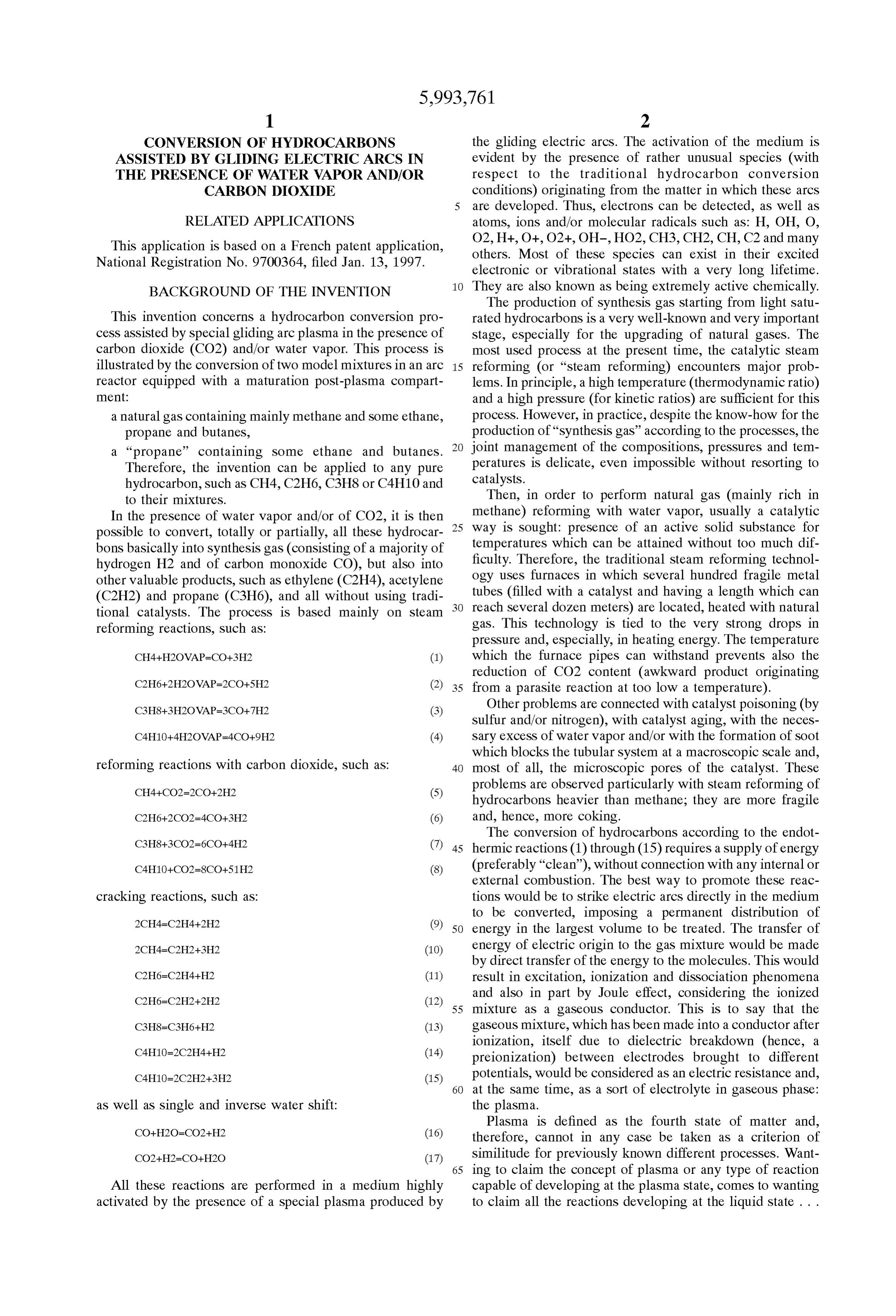
CH4H2OWAP=CO-3H2 (1) which the furnace pipes can withstand prevents also the
reduction of CO2 content (awkward product originating (2) 35 from a parasite reaction at too low a temperature).
C3H8-3H2OVAP-3CO-7H2 (3) Other problems are connected with catalyst poisoning (by Sulfur and/or nitrogen), with catalyst aging, with the neces
C4H10-4H2OVAP-4CO-9H2 (4) Sary excess of water vapor and/or with the formation of Soot which blocks the tubular System at a macroscopic Scale and, reforming reactions with carbon dioxide, Such as: 40 most of all, the microscopic pores of the catalyst. These
CH4-CO2=2CO-2H2 (5) problems are observed particularly with Steam reforming of hydrocarbons heavier than methane; they are more fragile
C2H6-2CO2=4CO-3H2 (6) and, hence, more coking.
The conversion of hydrocarbons according to the endot 45 hermic reactions (1) through (15) requires a Supply of energy
C4H10+CO2=8CO+51H2 (8) (preferably “clean'), without connection with any internal or external combustion. The best way to promote these reac cracking reactions, Such as: tions would be to Strike electric arcs directly in the medium
to be converted, imposing a permanent distribution of energy in the largest Volume to be treated. The transfer of 2CH4-C2H2-3H2 (10) energy of electric origin to the gas mixture would be made by direct transfer of the energy to the molecules. This would
C2H6=C2H4-H2 (11) result in excitation, ionization and dissociation phenomena C2H6-C2H2-2H2 (12) and also in part by Joule effect, considering the ionized 55 mixture as a gaseous conductor. This is to Say that the
C3H8-C3H6--H2 (13) gaseous mixture, which has been made into a conductor after
ionization, itself due to dielectric breakdown (hence, a preionization) between electrodes brought to different
C4H10-2C2H2-3H2 (15) potentials, would be considered as an electric resistance and, 60 at the same time, as a Sort of electrolyte in gaseous phase:
as well as Single and inverse water shift: the plasma.
Plasma is defined as the fourth state of matter and, therefore, cannot in any case be taken as a criterion of
CO2-H2=CO-H2O (17) similitude for previously known different processes. Want 65 ing to claim the concept of plasma or any type of reaction
All these reactions are performed in a medium highly capable of developing at the plasma State, comes to wanting activated by the presence of a special plasma produced by to claim all the reactions developing at the liquid State . . .
Page 5
There are one thousand one types of plasma, and one chemist can also (to a certain extent) distribute directly the thousand one ways to obtain these plasmas. By definition energy either in thermal form or in chemical form. He can (simplified), plasma is a gaseous medium in which the also intervene on the flux Still loaded with active Species particles are in part ionized. Likewise, a part of the electrons leaving the gliding arc Zone, to have these species reach with is not associated with an atom, a molecule, an ion or a the load to be converted in a maturation post-plasma Zone. radical. Thus, even though globally, at a Scale of a few Our bibliographic research concerning the last three microns, the medium is electrically neutral, two large fami decades yields few published and/or patented results con lies can be defined, in a simplistic way: the heavy particles cerning the partially oxidizing conversion of Saturated (radicals, atoms, molecules and ions) and the electron cloud. hydrocarbons assisted by plasma. This may be due to the In most plasmas, the main macroscopic physical problems connected with the presence of oxygen originating parameter-temperature-is the same for all the compo from dissociation of the H2O and/or CO2 molecules and nents: this is thermodynamic equilibrium. These conditions attacking the traditional tungsten or graphite electrodes of can be very easily obtained: it is Sufficient to Supply much classic plasma devices. Nevertheless, we report these energy, as in the case of plasma torches (plasmatrons, for attempts to use different Sources of plasma. Systematically, Some), where the plasma is produced by a very high electric 15 both the approach and the reaction proceSS are different from arc current. There are also other devices capable of gener ours. They have only point in common: the use of the word ating this State, Such as, for example, induction or radiofre "plasma’ or the possibility of treating the same hydrocarbon quency torches whereby the gaseous medium becomes reso molecules.
nant with an electric circuit. Such plasmas are called thermal K. KARL et al. . . . , CH 378,296 (1957) proposed plasmas by the experts. It is obvious that a thermal plasma hydrocarbon steam reforming under 66.7 kPa-0.3 MPa will modify the chemistry of a gas medium, Simply by pressure, in a “silent” discharge characterized by a 0.3-0.5 destroying all the molecules, particularly the fragile ones, MV/m very intense electric field. This source of plasma has Such as the hydrocarbons. The fragments found at the end of been known for a century and is totally different from that the process originate from partial recombination of the invention.
phenomena, often yielding too simple molecules. Such 25 R. J. HEASON presented, in 1964, his doctorate thesis chemistry offers very poor prospects, requires much energy concerning methane pyrolysis and the reaction of CH4 with and presents problems connected with the high temperature water vapor in an arc plasma (700 A, 20V) in argon. These (Such as the resistance of the materials). results are published only in manuscript form Professional chemists indisputably prefer the idea of a “Investigation of methane and methane-Steam reactions in plasma which does not respect the conditions of complete an argon plasma, Dissertation, Ohio State Univ., thermodynamic equilibrium. For example, it is Sufficient to Columbus. A “thermal’ plasma and a device consuming a act on the free electrons by taking advantage of the fact that great quantity of argon (2 moles Ar for 1 mole CH4) are they are much lighter. It is also possible to act on the rotation involved.
or vibration properties of Some molecules. In terms of C. H. LEIGH and E. A. DANCY“Study of the reforming energy, this comes to breaking the energy exchange equi 35 of natural gas by a plasma arc', Proc. of the Int. Round Table librium between the plasma and the Surrounding medium on Study and Appl. of Transport Phenomena in Thermal (heat, electrical energy, radiation, etc.). This State is qualified Plasmas, contribution 1.5, Odeillo, 1975, 11 pages heated a as non-equilibrium. Such plasmas are often called “low mixture of CH4/CO2-1 in a jet of argon plasma, a traditional temperature' plasmas, although the concept of temperature plasma arc torch. The jet temperature was approximately 10 cannot be used: there are Several methods whereby Such 40 kK. The argon flux was of the same order of magnitude as plasmas may be generated: microwaves, electron beams, that of the mixture to be treated. These researchers observed flame front, etc. However, the generators of these plasmas a 11-74% conversion of carbon to H2, CO., C2H4 and C2H6 are rare on an industrial Scale and are appropriate only for a (without having ever detected C2H2 or H2O in the very precise application. This is the reason why, despite the products). No application was possible because of the high great number of patents, Such plasmas are rarely used in 45 consumption of electrical energy (70% of it passed in the chemistry. plasma torch cooling water) and of noble gas. Also, when a plasma is established or when its existence Also P. CAPEZZUTO et al. “The oxidation of methane is ended, the equilibrium is broken. These transitory States with carbon dioxide, water vapor and oxygen in radio are actually non-equilibrium plasmas and last only a few frequency discharges at moderate pressures', 3rd Int. Symp. milliseconds. One type of plasma takes advantage of this 50 of Plasma Chemistry, Limoges, 1976, contribution G.5.11, 7 phenomenon, the gliding electric arc plasma, known under pages studied partial oxidation of methane placed sepa the name of “GlidArc', a relatively recent invention (1968) rately in mixture with CO2, either with O2 or with H2O, by H. LESUEUR et al. “Low Temperature Plasma Genera with the ratios CH4/oxidizer=1. The 35 MHZ radiofre tion Device through the Formation of Gliding Electric quency (RF) plasma reactor needed an additional argon flux Discharges”, BF 2,639,172). Outside of the numerous geo 55 and could only work at low pressures of approximately 2.7 metric possibilities of a GlidArc plasma generator, and in a kPa. For a 3 to 36 l(n)/min total flow of entering gas, the very global way, the parameters on which a chemist can act energy density varied from 1 to 12 kWh/m3. No industrial are: preSSure, temperature, gas Speed, current, electrical use was possible because of the high consumption of elec frequency and Voltage. Such a number of parameters trical energy and of noble gas (in addition to the complexity exceeds the conventional reasoning capabilities of the man 60 of the electrical Supply and the requirement to work under of the trade. For each application, a real know-how and an vacuum). The mechanical Setup constraints, the low energy inventive activity are necessary in order to obtain a result the yield and the insufficient unit powers of the sources of RF objectives of which are both the economic profitability and plasma make the use of this method economically poorly the respect of the ecological principles. The approach Suited for the transformation of major Volumes of gas. allowed by the GlidArc enables the chemist to envision the 65 However, it is interesting to note that, in all the cases, the distribution of a Supply of energy directly in the gaseous authors observe an almost total conversion of the methane mixture without, for example, resorting to catalysts. The and an appearance of the following products:
Page 6
S 6
For the CH4/CO2 systems, mostly H2, CO, C2H2, with device has been mentioned above under the name of Gli presence of C2H4 (<5%) and of C2H6 (<1%). dArc. Our first tests on the production of Synthesis gas For the CH4/H2O system, the same as above but with a starting from a CH4+CO2 mixture injected into this new few traces of CO2. type of plasma (without any cooling or plasmagenic argon) A patent by S. SANTEN et al. “Thermal reforming of were reported by H. LESUEUR et al., “Production of gaseous hydrocarbon GB-A-2 172,011 of 1986, claims the synthesis gas (CO+H2) starting from the oxidation of CH4 use of a plasma generator to heat reagents (a gaseous by CO2 in a gliding discharge electro-reactor”, Physics Colloquium, Supplement to the Journal of Physics, vol. 51 hydrocarbon, Some water vapor and, possibly, Some coal), (18), p. C5-49–C5-58 (1990). We later made a more sys completely or partially, up to a temperature exceeding 1200
C. At Such temperatures, these inventors expect favorable tematic ide in a comparison of methane reforming with carbon diox transferred arc and in the GlidArc to show the great conditions to carry out their purely thermal process without Superiority of the gliding arc reactor, see K. MEGUERNES the use of catalysts. The temperatures reached in the reactor et al., “Oxidation and the thermal mode of the reforming (claimed and even a cold discharge', of CH4 by CO2 in an electric arc and in 11th In. Symp. on Plasma Chem., Lough emphasized in the title of the patent), therefore indicate a borough treatment of hydrocarbons under thermodynamic equilib 15 complete (England), article on
the conversion of CH4 by CO2 was rium. The process is based on a direct arc (two annular published by H. LESUEUR electrodes) or transferred arc plasma generator, which are partial oxidation of methane', et Int. al., “Electrically assisted
J, Hydrogen Energy, Vol.
very traditional devices known for almost a century. 19(20, p. 139–144 (1994). L. KERKER writes in a general manner on the tests on This (pure) methane reforming by (pure) CO2 has shown production of Synthesis gas at Huls ... in German . . . . The a very interesting way to upgrade certain gases with high illustrations indicate that a tubular reactor with traditional arc, with very high power (1 to 9 MW), is involved; it has contents our reactor of carbon dioxide. However, the products leaving had an H2/CO molar ratio between 0.5 and 0.8, been used at this plant since 1939 to produce acetylene. This almost in agreement with reaction (5). Therefore, this gas time, the case involved is a natural gas Steam reforming composition was totally unsuitable for the Fischer-TropSch project for the production of 99.9% pure hydrogen, at a very 25 competitive price with respect to electrolysis (although still technology (Synthesis of hydrocarbon Synthetic fuels, more expensive than the hydrogen generated by the tradi “syncrude') or similar technology for the production of methanol. The two processes require Synthesis gas with an tional Steam reforming or partial oxidation methods).
Our team in Orleans has also been working since 1986 on H2/CO ratio near 2:1.
the conversion of hydrocarbons in thermal plasma reactors. We discovered also that, after a few improvements, the Same
These traditional torches with simple or transferred arc water vapor GlidArc device is well Suited for a Supply of pure plasma make it possible to obtain plasmas with relatively as the only plasmagenic medium. The overheat Small volume, but at very high temperatures (T210 kK). ing tests of the water vapor by means of this device were Although these devices may be potential Sources of active performed at laboratory Scale and at atmospheric pressure. Species, they are, nevertheless, poorly Suited for chemical 35 The improved GlidArc was supplied with very wet water applications requiring lower temperatures (in order not to vapor at 105 C. No deterioration of the plasma generator completely demolish the hydrocarbon molecules to Soot) Supplied with water vapor was observed after Several long and, above all, greater plasmagenic Volumes to be able to act experiments.
Spheric preSSure
The water vapor thus overheated at atmo and chemically activated by the presence of intimately on all the fluid to be treated. The plasma torch technology, for example, well established in the Solid project 40 H, O, OH and other metastable species may be of interest for domain, has thus been found at the same time very costly drying or for chemical transformations, see P. CZERNI and very difficult to implement for chemical processes. CHOWSKI and A. CZERNICHOWSKI, “Gliding electric However, we have obtained some improvements in the arcs to overheat water vapor”, 9th University-Industry Col thermal plasma domain in the case of a transformation of loquium “Electrical techniques and quality of drying, methane with carbon dioxide or elementary oxygen in a 45 Bordeaux-Talence, 1994, p. B1-1-B1-7.
specifically controlled electric arc, see P. JORGENSEN et It is at this stage that we thought that traditional Steam al., “Process for the Production of Reactive Gases Rich in reforming of pure methane can be improved in the presence Hydrogen and in Carbon Oxide in an Electric Post-Arc, BF of sliding electric arcs which contribute to the reaction 2.593,493, (1986). The structure of the device placed in 50 medium an easily controllable enthalpy and Some highly operation at the time unfortunately did not allow using water reactive Species. These particular arcs may then play the role Vapor as reagent or to work without consuming the argon of a catalyst in homogeneous phase, See A. CZERNI necessary as plasmagenic gas of a first pilot arc. Later we CHOWSKI et al., “Assistance device and process by means used almost the same arc with higher current (20-150 A) to bon of plasma in the non-catalytic Steam cracking of hydrocar study the oxidation of ethylene, see K. MEGUERNES et al., and halogenated organic compounds”, BF 2,724.808 “Oxidation of ethane C2H6 by CO2 or O2 in an electric arc". 55 (1994).
J. High Temp. Chem. Process, vol. 1(3), p. 71-76 (1992), The previously mentioned methane Steam reforming without much improvement in the consumption of electric endothermic reaction (1) requires, in order to be fully energy or of plasmagenic argon. executed under Standard conditions (298 K, 1 atm), an
SUMMARY OF THE INVENTION
energy equivalent to 206 kJ per transformed CH4 mole, or 60 else at 0.64 kWh per 1 m3(n) of the CO+H2 mixture
It is in order to correct these problems that we studied produced. When the reaction is barely started understandard reforming of pure methane by carbon dioxide in an electro conditions (the CH4 transformation ratios being only reactor which had just been invented by our team. It con 0.005%), it is necessary, according to Thermodynamics, to Sisted of three electrodes between which gliding discharges heat the reagents to higher temperatures, which requires not develop; the plasma medium thus obtained was very much 65 only to Supply the reaction enthalpy, but also leads to out of thermodynamic equilibrium and contained numerous reheating all the mixture. Our calculations indicated that a excited Species which made it highly reactive. This plasma minimum cost, 0.933 kWh per 1 m3(n), for the CO/H2
Page 7
equimolar mixture is situated at the temperature of 950 K, obtain Simultaneously during one Single operation in the where a 75% transformation of initial CH4 is attained. At GlidArc reactor, a conversion of certain hydrocarbons by this stage, the CH4/CO2 molar ratio is too high (4.98) for Steam reforming (reactions 1 through 4), reforming with Some applications of this Synthesis gas. In order to increase carbon dioxide (reactions 5 through 8) and an inverse shift the transformation ratio of methane to approximately 97%, of part of the hydrogen (reaction 17). The purpose of this is it would be necessary to heat all the reaction mixture to to obtain a synthesis gas with a desirable H2/CO molar ratio approximately 1200 K at the theoretical cost of 0.986 kWh per further use of this Synthesis gas, for example through a per 1 m3(n) of the CO/H2 mixture, but the excess hydrogen Fischer-Tropsch process. This objective has been achieved still exists at an H2/CO level equal to 3.04. and, furthermore, we have been Surprised by the appearance The pure CH4 decomposition in the presence of over of other conversion products of the load: C2H4, C2H2 and heated water vapor in a simple GlidArc reactor, without C3H8 at quite high contents. These unsaturated products can maturation, has actually yielded large quantities (in terms of then contribute an additional value to this hydrocarbon percentages by volume) of H2 (up to 68%) and CO (up to conversion process assisted by gliding electric arcs. 14.8%), while the percentage of C2H2 by volume (max. 15 Another new idea, which is another feature of this invention, is to divide the old GlidArc reactor into two 1.1%) and C2H4 (max. -0.34%) were low. In all cases, we compartments.
had H2/CO molar ratios exceeding the value of 4 and even By adding a partition, in the form of a reaching 5.8 diaphragm, we create in this manner a gliding arc compart It is possible to transform CO into H2 or, inversely, H2 ment with reinforcement of the recirculation of the reagents, into CO via almost athermic reactions (16) and (17), called and another maturation compartment where the reactions “shift”. This makes it possible to prepare mixtures with the generated in the arc Zone can be completed. The two parts desired composition of Synthesis gas for a particular appli of the reactor communicate through a very large hole cation. Nevertheless, in practice in the industry, these reac allowing the reagents and the active Species to penetrate the tions require a separate reactor, and the presence of catalysts maturation post-plasma Zone.
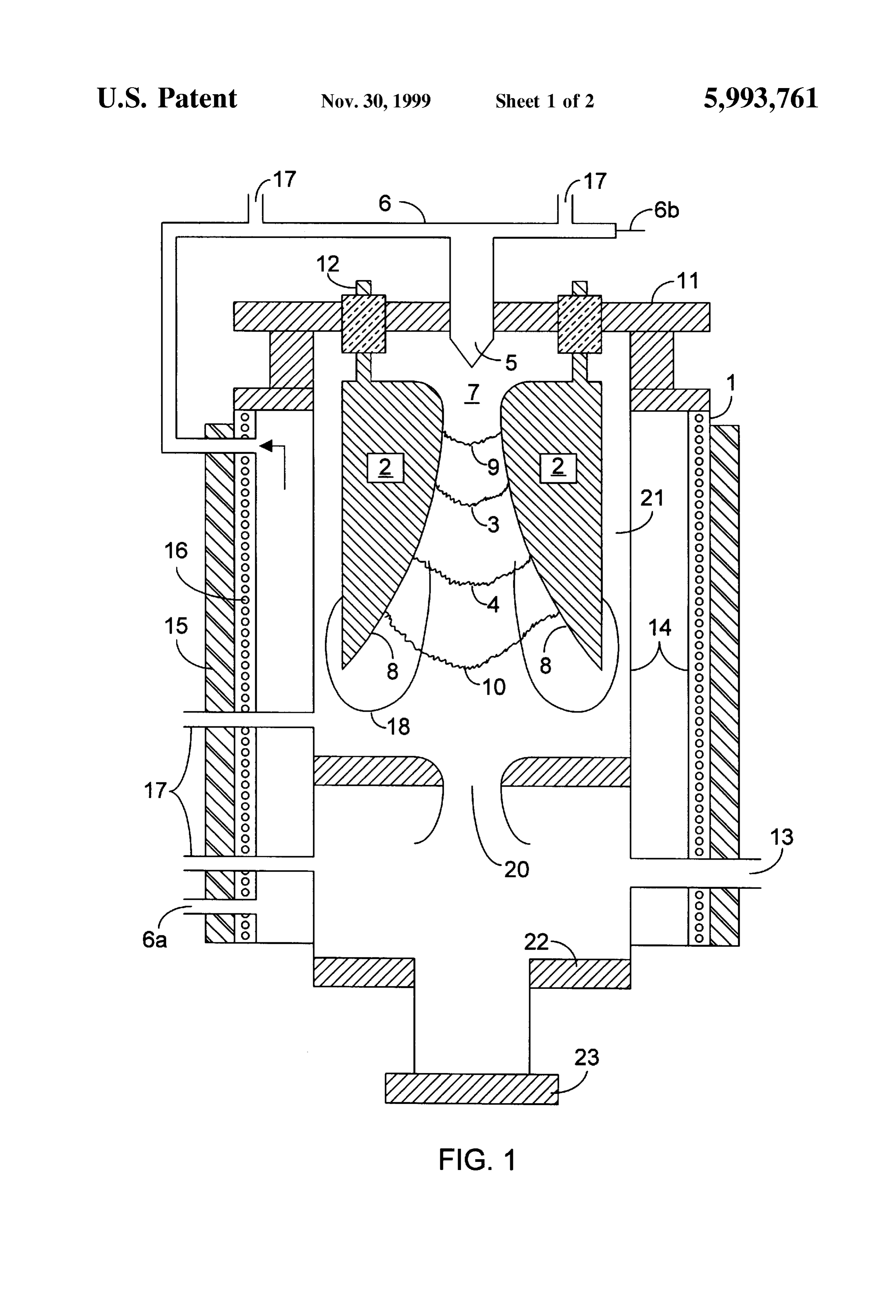
and they are accompanied by all the problems due to the Several types of GlidArc reactors may be used. That complexity, poisoning and aging of the catalytic load, etc. 25 sketched in FIG. 1 is a small size device (laboratory scale) In order to explain the phenomenon observed of too high used to illustrate the invention. Of course, it is only a non-restrictive example of execution of a future industrial an H2/CO ratio in our pure methane Steam cracking tests Size reactor. The assisted by the GlidArc plasma, we performed a Series of stainless steel 0.8 Small gliding arc reactor /1/ uses Six mm thick profiled sheet electrodes /2/ tests, see A. CZERNICHOWSKI and K. MEGUERNES. (only two of the six electrodes Symmetrically arranged “Electrically assisted water shift reaction', 12th Int. Symp. around the axis of the flow of the fluid to be treated are on Plasma Chem., Minneapolis, Minn., 1995, vol. 2, p. shown in FIG. 1). Each one of the electrodes is 14 cm long 729-33. By injecting a mixture of carbon monoxide with and 25 mm wide. The electrodes delimit a nipple-shaped water vapor in a GlidArc reactor, we did observe reaction (16), without the least presence of traditional catalyst. 35 Space /3/ in which the gliding electric arcS /47 can develop. This reactor contains a 1.8 mm diameter nozzle /5/blowing
Therefore, it is the plasma itself which catalyzed this shift, the fluid /6/ to be converted into space /7/ between the converting CO into H2. electrodes arranged So that the fluid circulates along the The objective of the proceSS and the plasma assistance central part of these electrodes exposed to the arcs. Thus, the device to steam reforming, to the reforming with CO2 or to roots /8/ of the arcs, cracking and pre-ionizing the gas at Site simultaneous reforming with an H2O/CO2 mixture of 40 /9/ where the distance between the electrodes is the least, hydrocarbons is the production of gases rich in CO and H2, glide on these electrodes, then disappear at Site /10/ near the containing also high ratios of C2H2, C2H4 and C3H6, end of the electrodes, to reappear at the initial Site. The without formation of Soot or coke. The proceSS makes it also process is Sequential and the life of an arc f4/ is observed to possible to upgrade the CO2 by converting it into CO in the be between 1 and 20 ms, depending on the linear Speed of presence of hydrocarbons. 45 the fluid in Zones /7/, /9/, /3/ and /10/between electrodes/2/. This mixture of valuable products is obtained in a reactor The gliding arcS /4/ have variable characteristics Starting /1/ with electric gliding arcs /4/ which Strike directly into an from site /9/ where they are started, up to their extinction endothermic reaction medium consisting of hydrocarbons /10/, Specifically with dissipations of energy which grown in mixed with H2O and/or CO2. The reactor is equipped with time. The reactor is closed by means of a lid /11/ holding the a diaphragm /19/ with a convergent/divergent hole /20/ to 50 electrically insulated electrodes with high Voltage connec reinforce the agitation of the arcs with the load to be tions /12/. The entire structure is sealed; it withstands a converted and, at the same time, to have the conversion of partial vacuum (in the order of 7 kPa) as well as a 12 bars the load progreSS after prolonged contact with catalytic overpreSSure at the time of combustion of methane-rich Species derived from the plasma. mixtures. Lastly, an orifice /13/ is provided as the outlet of 55 the products of the treatment. The reactor with 80 mm inside
BRIEF DESCRIPTION OF THE DRAWINGS diameter and 1.5 liters capacity) is equipped with a closed FIG. 1 is a schematic of the reactor used in the inventive stainless steel double wall/14/, as an envelope. These double method. walls /14/, insulated by means of mineral wadding /15/are used to recycle the energy released in the reactor, injecting
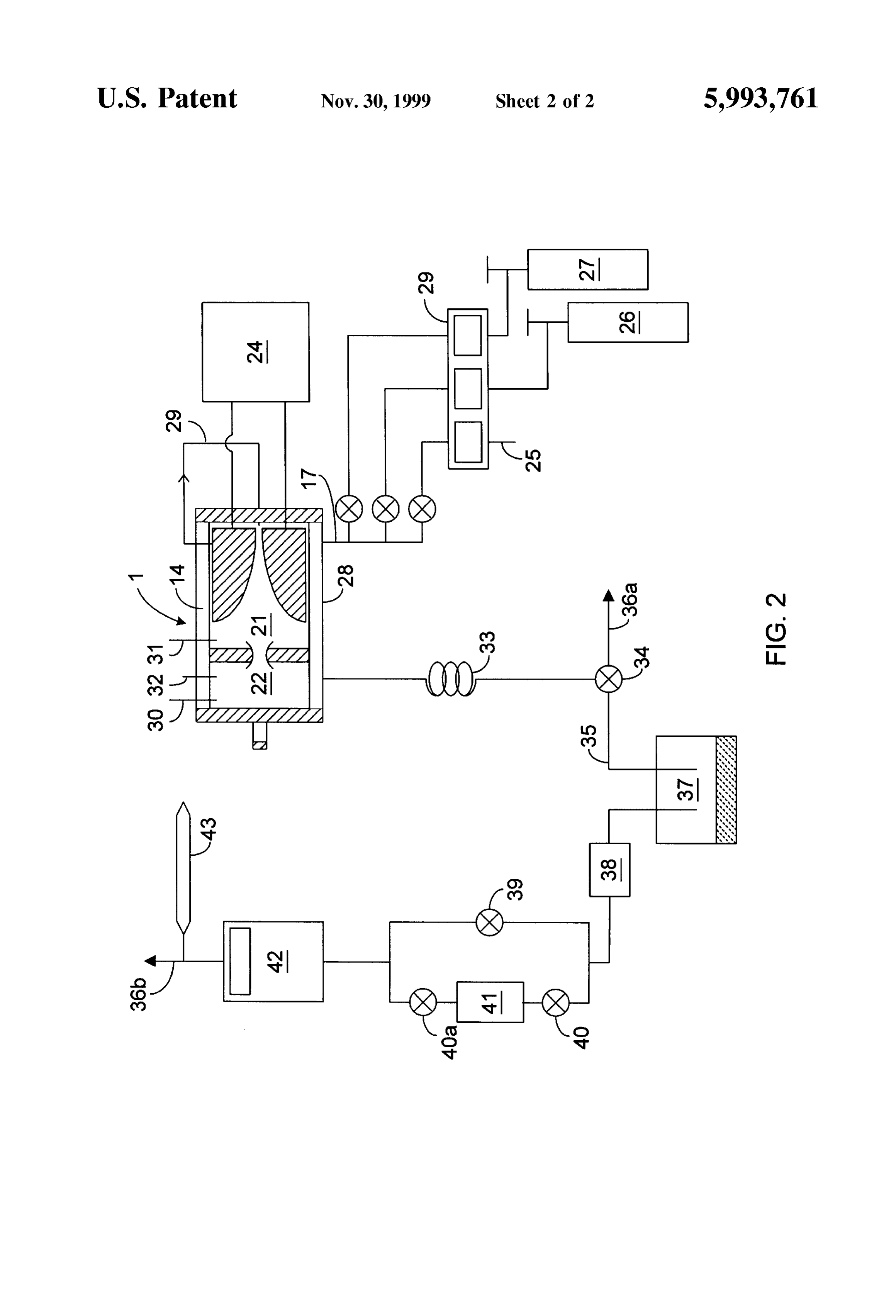
FIG. 2 is a Schematic diagram of the entire reactor System 60 it into the incoming fluid. The heat losses of the reactor can used in the inventive method.
be further limited by means of a resistor /16/ wound around
DETAILED DESCRIPTION OF THE the reactor and carrying an electric current. Other fluids can INVENTION be added separately through intake (6b), to form a mixture which is then injected by nozzle/5/. Some holes or take-offs
Therefore, we had a new idea, which is the subject of this 65 /17/are used, for example, to branch a pressure gauge, run invention, to apply simultaneously H2O and CO2 to a a thermocouple wire or a Sampler of the fluid entering the mixture (with variable composition, as needed) in order to reactor. Through a fast (>10 ms), almost punctiform injec
Page 8
tion of the fluid between electrodes (2/, a recirculation preionization of the medium and then transfer of the elec phenomenon /18/ of the reagents in the gliding arcS Zone is trical energy to the plasma. The electric power of the reactor already produced. To reinforce this recirculation, we add a used varies between 0.57 and 1.09 kW under 0.1 or 0.2. A for ceramic diaphragm /19/provided with a wide axial hole /20/, a flow rate of fluids to be treated from 0.57 to 1.23 m3(n)/hr, thus dividing the reactor in two parts: a compartment of arcs the energy supply with respect to the load is 0.47 to 1.23 /21/, approximately 2/3 of the total Volume of the reactor, and kWh/m3(n). Nothing nevertheless prevents using more a “maturation' compartment /22/, equal to approximately /3 power, higher flow rates and/or greater energy for industrial of the total volume of the reactor. Hole (20?, with operations.
convergent/divergent shape (18 mm in diameter in the Reforming of a natural gas (NG) or of a “propane” will be narrow part) allows the reagents (partially used up) to pass, better understood with the help of FIG. 2. The reactor used as well as the long-living active Species originating from the is that shown in FIG. 1. FIG. 2 is a schematic representation excitation of the gases by the gliding arcs. Therefore, in the of the apparatus as a whole. In this figure, the GlidArc maturation Zone, the conversion is likely to be ended in an reactor /1/ is Supplied by a special high Voltage power environment in which the temperature is much lower. The generator /24/. It is operated directly with, as plasmagenic fluid, once in this post-plasma Zone, cannot any longer 15 gas, a NG taken from the city supply network (25/ (or with return to the arc Zone. The bright Zone of the gliding electric the “propane” /26/ from a pressurized cylinder), mixed with arcs can be observed through a 12 mm diameter porthole /23/, in order to make certain of the proper operation of the carbon dioxide /27/, water vapor (or liquid water) /28/ or reactor. Very important information can be drawn from the with the CO2/H2O mixture. The gas flow rates are con emission spectrum of this Zone! The conversion of the trolled by mass flowmeters /29/. The gas mixture entering hydrocarbons can be sufficiently advanced at the time of (dry) can be sampled for chromatographic analysis through passage through a single GlidArc reactor. Otherwise, the a take-off/17/. The flow rate of the water vapor is also known products partially converted in a reactor can be treated in after calibration of the dosing pump of the device /28/. The Several reactors thus described and placed in Series (not thermocouple (29/ makes it possible to measure the tem shown). perature of the fluid at the entry of the injection nozzle while Special care must then be emphasized at the time of 25 the probes /30/ and /31/ indicate the temperatures in the two installation of diaphragm /19/ in the shape of a convergent/ compartments of the reactor. A pressure gauge /32/ gives at divergent hole. These new means create a new maturation any time the pressure inside the reactor: this pressure is kept reaction Zone in which very active and metastable Species Slightly higher than atmospheric pressure. The products (thus having catalytic properties) make it possible to reform leaving the reactor are cooled in a heat eXchanger in the air hydrocarbons resulting from Violent reactions in the plasma /33/. After leaving the eXchanger, the gases are directed to a Zone, can be deactivated on other molecules and thus cause direction invertor tap /34/ which sends them either to the conversion of the reagents to progreSS even faster. analysis/35/ or to evacuation stack /36a/. At the time of our Physics provide uS with information on Such atomic and tests, we collect and weigh the water leaving the reactor, by molecular species as H, OH, O2, CO2, CO, H2, H3 (and condensation /37/ and absorption /38/, as well as the dry many others) which have a sufficiently long life to travel 35 gaseous product for chromatographic analyses. To this long distances in the gas flux, even at atmospheric pressure. effect, the wet gas is conveyed to outlet /36a/, then when we This phenomenon is very important for the conversion of estimate that the reactor is operating in Stable condition hydrocarbons known for their fragility. In fact, the action of (pressure, temperatures, gas flow rates, water vapor flow a non-thermal (or out of equilibrium) plasma, Such as the rate, electrical power), tap /34/ is reversed and it is sent to GlidArc plasma coupled with the maturation post-plasma 40 analysis /35/. The water is stored in the greatly cooled flask Zone enables us to completely prevent coking of the hydro /37/ and in an absorbing material. Tap /39/being first closed carbon load. Long hours of operation of the reactor thus built and taps /40 and /40a/ open, the dry gas runs through a bulb and perfect transparency of the porthole (all this in the or a spherical flask fa1/ then through gas meter f42/ and presence of hydrocarbons as fragile as propane and butanes) leaves the experimental device through /36b? for the evacu are the best proof of “soft' transformations which can be 45 ation Stack, The temperature of the gas at the outlet of the executed in a GlidArc reactor with Said post-plasma com meter/42/ is measured by a thermometer/43/. At the time of partment. each test, also the atmospheric pressure is measured with a The reactor is supplied by controlled flows (by mass barometer, in order to bring our balances of Volumes to flowmeters) of gas taken from bottles (or other Sources) normal conditions (n).
and/or of the water vapor produced by a generator. The 50 Numerous feasibility tests of the reforming process of Supply of the reactor with an initially liquid Substance at natural gas or “propane” were performed in the new reactor ambient temperature (for example, a heavier hydrocarbon or with the maturation compartment (we are presenting only water) can also be carried out by using a dosing pump. The the most significant tests). The composition (% by volume) constant flow of this liquid, controlled by a valve and a of the NG originating from the city distribution network was flowmeter, is thus evaporated in an oven, to be then injected 55 not changing much: CH4 from 89.7 to 91.9; C2H6 from 6.6 between the double walls and, lastly, into the reactor, to 6.8; C3H8 from 1.1 to 1.2, C4H10 from 0.25 to 0.29 whether or not previously mixed with another fluid of the (mixture of n- and iso-butane); O2 from 0.17 to 0.34; and N2 proceSS. from 1.2 to 1.8. Besides, we were analyzing carefully this Chemical analyses are performed, using traditional gas NG at the time of each test in order to establish an exact chromatographic methods. We use three chromatographs, 60 balance of matter. The composition (% by volume) of the each assigned to the Specific dry gases: CO, CO2 and CH4 “propane” contained in a bottle was: CH4 0.1; C2H6 1.0; for the first, hydrogen alone for the Second, and all the C3H896.7; C3H6 0.3; and C4H101.9 (also a mixture of and hydrocarbons for the third. The flow of the water vapor in iso-butane).
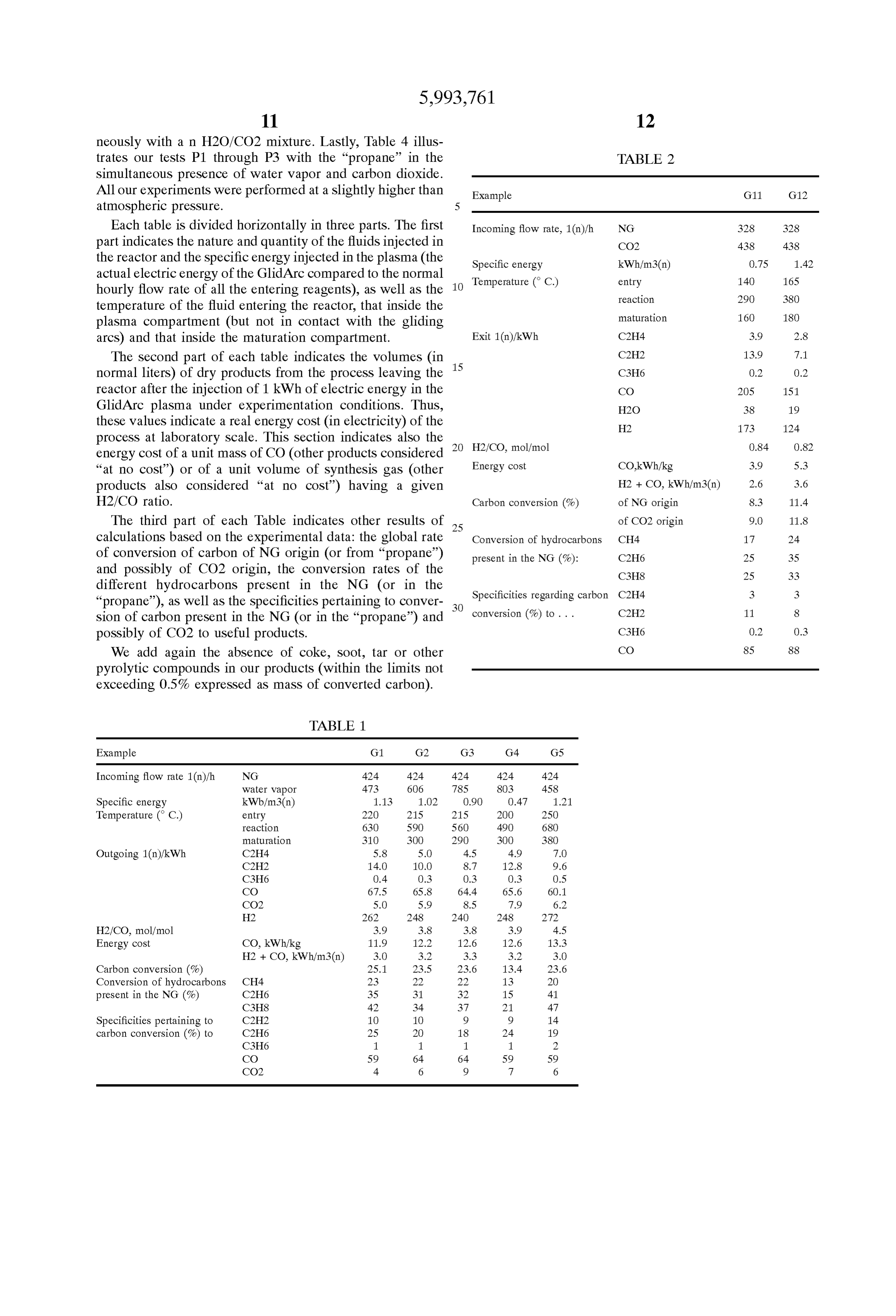
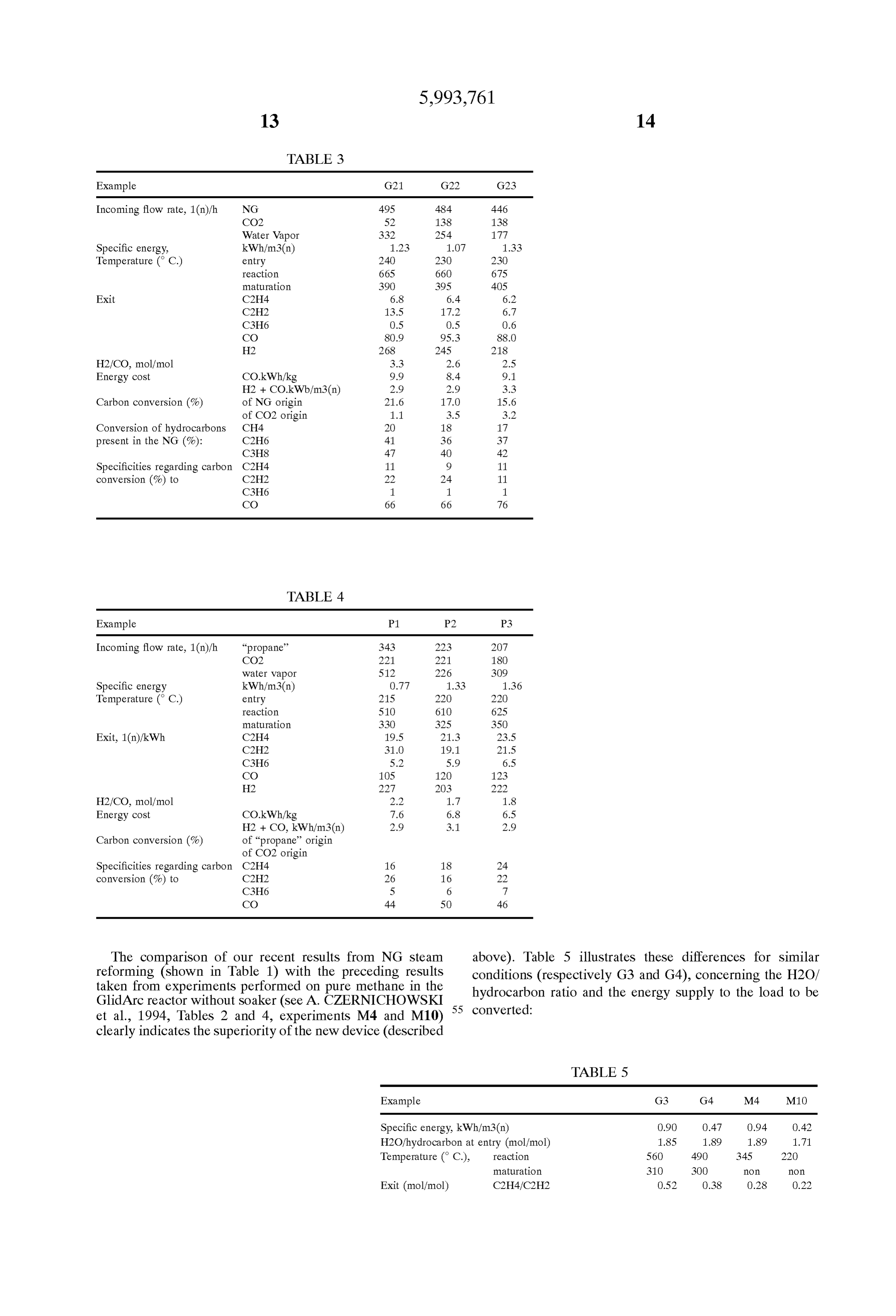
the products is quantified by trapping a known volume of Table 1 summarizes examples G1 through G5 of natural exiting gases. 65 gas Steam reforming. Table 2 Summarizes exampleS G11 and The gliding arcs inside the reactor are Supplied by a G12 of NG reforming with CO2 alone. Table 3 summarizes Special high Voltage System ensuring at the same time examples G21 through G23 of NG reforming simulta
Page 9
neously with a n H2O/CO2 mixture. Lastly, Table 4 illus trates our tests P1 through P3 with the “propane” in the TABLE 2 Simultaneous presence of water vapor and carbon dioxide.
All our experiments were performed at a slightly higher than Example G11 G12 atmospheric preSSure.
Each table is divided horizontally in three parts. The first Incoming flow rate, 1(n)/h NG 328 328 part indicates the nature and quantity of the fluids injected in CO2 4.38 438 the reactor and the specific energy injected in the plasma (the Specific energy kWh/m3(n) 0.75 1.42 actual electric energy of the GlidArc compared to the normal hourly flow rate of all the entering reagents), as well as the Temperature (C.) entry 140 165
temperature of the fluid entering the reactor, that inside the maturation 160 18O plasma compartment (but not in contact with the gliding arcs) and that inside the maturation compartment. Exit 1(n)/kWh C2H4 3.9 2.8
The Second part of each table indicates the Volumes (in 15 normal liters) of dry products from the process leaving the C3H6 O.2 O.2 reactor after the injection of 1 kWh of electric energy in the CO 205 151 GlidArc plasma under experimentation conditions. Thus, H2O 38 19 these values indicate a real energy cost (in electricity) of the 173 124 process at laboratory Scale. This Section indicates also the energy cost of a unit mass of CO (other products considered H2/CO, mol/mol COkWh/kg
“at no cost”) or of a unit volume of Synthesis gas (other Energy cost 3.9 5.3 products also considered "at no cost”) having a given H2 + CO, kWh/m3(n) 2.6 3.6 H2/CO ratio. Carbon conversion (%) of NG origin 8.3 11.4 The third part of each Table indicates other results of 25 of CO2 origin 9.O 11.8 calculations based on the experimental data: the global rate Conversion of hydrocarbons CH4 17 24 of conversion of carbon of NG origin (or from “propane”) present in the NG (%): 25 35 and possibly of CO2 origin, the conversion rates of the 25 33 different hydrocarbons present in the NG (or in the Specificities regarding carbon “propane”), as well as the specificities pertaining to conver sion of carbon present in the NG (or in the “propane”) and conversion (%) to . . . 11 possibly of CO2 to useful products. O.2
We add again the absence of coke, Soot, tar or other CO 85 pyrolytic compounds in our products (within the limits not exceeding 0.5% expressed as mass of converted carbon).
TABLE 1.
Example G1 G2 G3 G4 G5
Incoming flow rate 1(n)/h NG 424 424 424 424 424 water vapor 473 606 785 803 458
Specific energy kWb/m3(n) 1.13 1.02 O.90 O.47 1.21
Temperature (C.) entry 22O 215 215 2OO 250 reaction 630 590 560 490 68O maturation 310 3OO 290 3OO 38O
Outgoing 1(n)/kWh C2H4 5.8 5.0 4.5 4.9 7.0
C2H2 14.O 1O.O 8.7 12.8 9.6
C3H6 0.4 O.3 O.3 O.3 0.5
CO 67.5 65.8 64.4 65.6 60.1
CO2 5.0 5.9 8.5 7.9 6.2
H2 262 248 240 248 272
H2/CO, mol/mol 3.9 3.8 3.8 3.9 4.5
Energy cost CO, kWh/kg 11.9 12.2 12.6 12.6 13.3
H2 + CO, kWh/m3(n) 3.0 3.2 3.3 3.2 3.0
Carbon conversion (%) 25.1 23.5 23.6 13.4 23.6
Conversion of hydrocarbons CH4 23 22 22 13 2O present in the NG (%) C2H6 35 31 32 15 41
C3H8 42 34 37 21 47
Specificities pertaining to C2H2 1O 1O 9 9 14 carbon conversion (%) to C2H6 25 2O 18 24 19
C3H6 1. 1. 1. 1. 2
CO 59 64 64 59 59
CO2 4 6 9 7 6
Page 10
TABLE 3
Example G21 G22 G23
Incoming flow rate, 1(n)/h NG 495 484 446
Specific energy, kWh/m3(n) 1.23 1.07 1.33 Temperature (C.) entry 240 230 230
Exit C2H4 6.8 6.4 6.2
H2/CO, mol/mol 3.3 2.6 2.5 Energy cost CO.kWh/kg 9.9 8.4 9.1
Carbon conversion (%) of NG origin 21.6 17.0 15.6
Conversion of hydrocarbons CH4 2O 18 17 present in the NG (%): C2H6 41 36 37
Specificities regarding carbon C2H4 11 9 11 conversion (%) to C2H2 22 24 11
TABLE 4
Example P1 P2 P3
Incoming flow rate, 1(n)/h “propane' 343 223 2O7
Specific energy kWh/m3(n) O.77 1.33 1.36 Temperature (C.) entry 215 22O 22O
Exit, 1(n)/kWh C2H4 19.5 21.3 23.5
H2/CO, mol/mol 2.2 1.7 18 Energy cost CO.kWh/kg 7.6 6.8 6.5
Carbon conversion (%) of "propane' origin of CO2 origin
Specificities regarding carbon C2H4 16 18 24 conversion (%) to C2H2 26 16 22
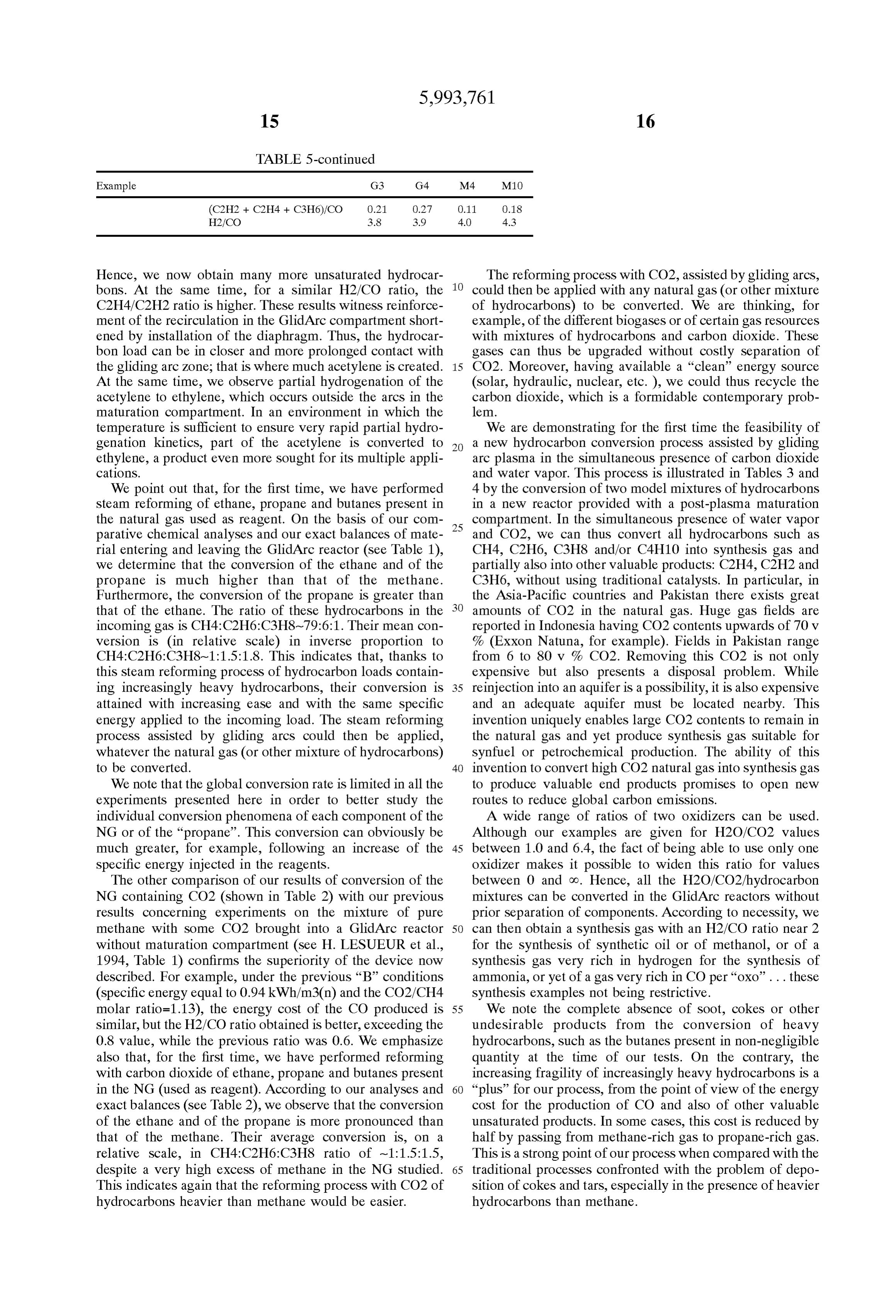
The comparison of our recent results from NG steam above). Table 5 illustrates these differences for similar reforming (shown in Table 1) with the preceding results conditions (respectively G3 and G4), concerning the H2O/ taken from experiments performed on pure methane in the hydrocarbon ratio and the energy Supply to the load to be GlidArc reactor without soaker (see A. CZERNICHOWSKI et al., 1994, Tables 2 and 4, experiments M4 and M10) 55 converted: clearly indicates the Superiority of the new device (described
TABLE 5
Example G3 G4 M4 M10
Specific energy, kWh/m3(n) O.90 O.47 O.94 O.42 H2O/hydrocarbon at entry (mol/mol) 1.85 1.89 1.89 1.71 Temperature (C.), reaction 560 490 345 22O
Exit (mol/mol) C2H4/C2H2 0.52 O.38 O.28 O.22
Page 11
TABLE 5-continued
Example G3 G4 M4 M10
Hence, we now obtain many more unsaturated hydrocar The reforming process with CO2, assisted by gliding arcs, bons. At the same time, for a similar H2/CO ratio, the could then be applied with any natural gas (or other mixture C2H4/C2H2 ratio is higher. These results witness reinforce of hydrocarbons) to be converted. We are thinking, for ment of the recirculation in the GlidArc compartment short example, of the different biogases or of certain gas resources ened by installation of the diaphragm. Thus, the hydrocar with mixtures of hydrocarbons and carbon dioxide. These bon load can be in closer and more prolonged contact with gases can thus be upgraded without costly Separation of the gliding arc Zone; that is where much acetylene is created. 15 CO2. Moreover, having available a “clean' energy source At the same time, we observe partial hydrogenation of the (Solar, hydraulic, nuclear, etc.), we could thus recycle the acetylene to ethylene, which occurs outside the arcs in the carbon dioxide, which is a formidable contemporary prob maturation compartment. In an environment in which the lem.
temperature is Sufficient to ensure very rapid partial hydro We are demonstrating for the first time the feasibility of genation kinetics, part of the acetylene is converted to a new hydrocarbon conversion process assisted by gliding ethylene, a product even more Sought for its multiple appli arc plasma in the Simultaneous presence of carbon dioxide cations. and water vapor. This process is illustrated in Tables 3 and We point out that, for the first time, we have performed 4 by the conversion of two model mixtures of hydrocarbons Steam reforming of ethane, propane and butanes present in in a new reactor provided with a post-plasma maturation the natural gas used as reagent. On the basis of our com 25 compartment. In the Simultaneous presence of water vapor parative chemical analyses and our exact balances of mate and CO2, we can thus convert all hydrocarbons Such as rial entering and leaving the GlidArc reactor (see Table 1), CH4, C2H6, C3H8 and/or C4H10 into synthesis gas and we determine that the conversion of the ethane and of the partially also into other valuable products: C2H4, C2H2 and propane is much higher than that of the methane. C3H6, without using traditional catalysts. In particular, in Furthermore, the conversion of the propane is greater than the Asia-Pacific countries and Pakistan there exists great that of the ethane. The ratio of these hydrocarbons in the amounts of CO2 in the natural gas. Huge gas fields are incoming gas is CH4:C2H6:C3H8-79:6:1. Their mean con reported in Indonesia having CO2 contents upwards of 70 V version is (in relative Scale) in inverse proportion to % (Exxon Natuna, for example). Fields in Pakistan range CH4:C2H6:C3H8-1:1.5:1.8. This indicates that, thanks to from 6 to 80 V % CO2. Removing this CO2 is not only this Steam reforming process of hydrocarbon loads contain expensive but also presents a disposal problem. While ing increasingly heavy hydrocarbons, their conversion is 35 reinjection into an aquifer is a possibility, it is also expensive attained with increasing ease and with the same specific and an adequate aquifer must be located nearby. This energy applied to the incoming load. The Steam reforming invention uniquely enables large CO2 contents to remain in proceSS assisted by gliding arcs could then be applied, the natural gas and yet produce Synthesis gas Suitable for whatever the natural gas (or other mixture of hydrocarbons) synfuel or petrochemical production. The ability of this to be converted. 40 invention to convert high CO2 natural gas into Synthesis gas We note that the global conversion rate is limited in all the to produce valuable end products promises to open new experiments presented here in order to better Study the routes to reduce global carbon emissions. individual conversion phenomena of each component of the A wide range of ratioS of two oxidizers can be used. NG or of the “propane”. This conversion can obviously be Although our examples are given for H2O/CO2 values much greater, for example, following an increase of the 45 between 1.0 and 6.4, the fact of being able to use only one Specific energy injected in the reagents. oxidizer makes it possible to widen this ratio for values The other comparison of our results of conversion of the between 0 and OO. Hence, all the H2O/CO2/hydrocarbon NG containing CO2 (shown in Table 2) with our previous mixtures can be converted in the GlidArc reactors without results concerning experiments on the mixture of pure prior Separation of components. According to necessity, we methane with some CO2 brought into a GlidArc reactor 50 can then obtain a Synthesis gas with an H2/CO ratio near 2 without maturation compartment (see H. LESUEUR et al., for the synthesis of synthetic oil or of methanol, or of a 1994, Table 1) confirms the Superiority of the device now Synthesis gas very rich in hydrogen for the Synthesis of described. For example, under the previous “B” conditions ammonia, or yet of a gas very rich in CO per “OXo' ... these (specific energy equal to 0.94 kWh/m3(n) and the CO2/CH4 Synthesis examples not being restrictive. molar ratio=1.13), the energy cost of the CO produced is 55 We note the complete absence of Soot, cokes or other similar, but the H2/CO ratio obtained is better, exceeding the undesirable products from the conversion of heavy 0.8 value, while the previous ratio was 0.6. We emphasize hydrocarbons, Such as the butanes present in non-negligible also that, for the first time, we have performed reforming quantity at the time of our tests. On the contrary, the with carbon dioxide of ethane, propane and butanes present increasing fragility of increasingly heavy hydrocarbons is a in the NG (used as reagent). According to our analyses and 60 “plus” for our process, from the point of View of the energy exact balances (see Table 2), we observe that the conversion cost for the production of CO and also of other valuable of the ethane and of the propane is more pronounced than unsaturated products. In Some cases, this cost is reduced by that of the methane. Their average conversion is, on a half by passing from methane-rich gas to propane-rich gas. relative scale, in CH4:C2H6:C3H8 ratio of -1:1.5:1.5, This is a Strong point of our process when compared with the despite a very high excess of methane in the NG Studied. 65 traditional processes confronted with the problem of depo This indicates again that the reforming process with CO2 of Sition of cokes and tars, especially in the presence of heavier hydrocarbons heavier than methane would be easier. hydrocarbons than methane.
Page 12
Lastly, we point out the presence of non-negligible quan by using a fine nozzle and also by means of a diaphragm tities (but at adjustable content) of unsaturated hydrocarbons with a convergent/divergent hole placed axially and rein C2H4, C2H2 and C3H6 in our products from conversion forcing recirculation of the reagents in this direct reaction assisted by GlidArc plasma. They contribute an additional ZOC.
value as final commercial product (acetylene) or as raw Other positive points can also be claimed for a future material for other organic Syntheses. Mixed with Synthesis practical application:
gas, they also facilitate the construction of hydrocarbon transformation of hydrocarbons and possibly of CO2 into chains at the time of the Fischer-Tropsch synthesis products with much greater value (H2, CO, unsaturated (information from recent scientific work by Professor A. hydrocarbons),
LAPIDUS of the Organic Chemistry Institute of Moscow). the only reagent necessary is water and/or CO2, Thus, formed simultaneously with the CO and H2 during the the absence of any catalyst, conversion of hydrocarbons in the Glid-Arc, these unsatur ated molecules can contribute to the direct application of an the very compact equipment which can be installed at improved Synthesis of liquid hydrocarbons. Sites with restricted Surface area (for example on off On a more technical level, it must be pointed out how 15 shore oil platforms for the conversion of associated Surprisingly easy is the operation of the reactor and of its gases).
assembly, without deterioration of electrodes, electrode the method does not depend on the chemical composition holders, diaphragm or wall of the reactor or of the matura of the mixture of hydrocarbons, tion compartment, all Submitted to the action of the incom the Glid-Arc reactor has no chemical inertia and can ing reagents and of the outgoing products. This is explained respond very quickly to control Signals, by the moderate temperature of the assembly (<680 C.) and the incoming and outgoing products, after condensation by a very short contact time between the roots of the arcs of the water vapor, do not carry any foreign ballast with the electrodes, even if made of steel and even if not increasing their Volume, which makes the conversion cooled. We did not encounter any problems in the imple operations easier.
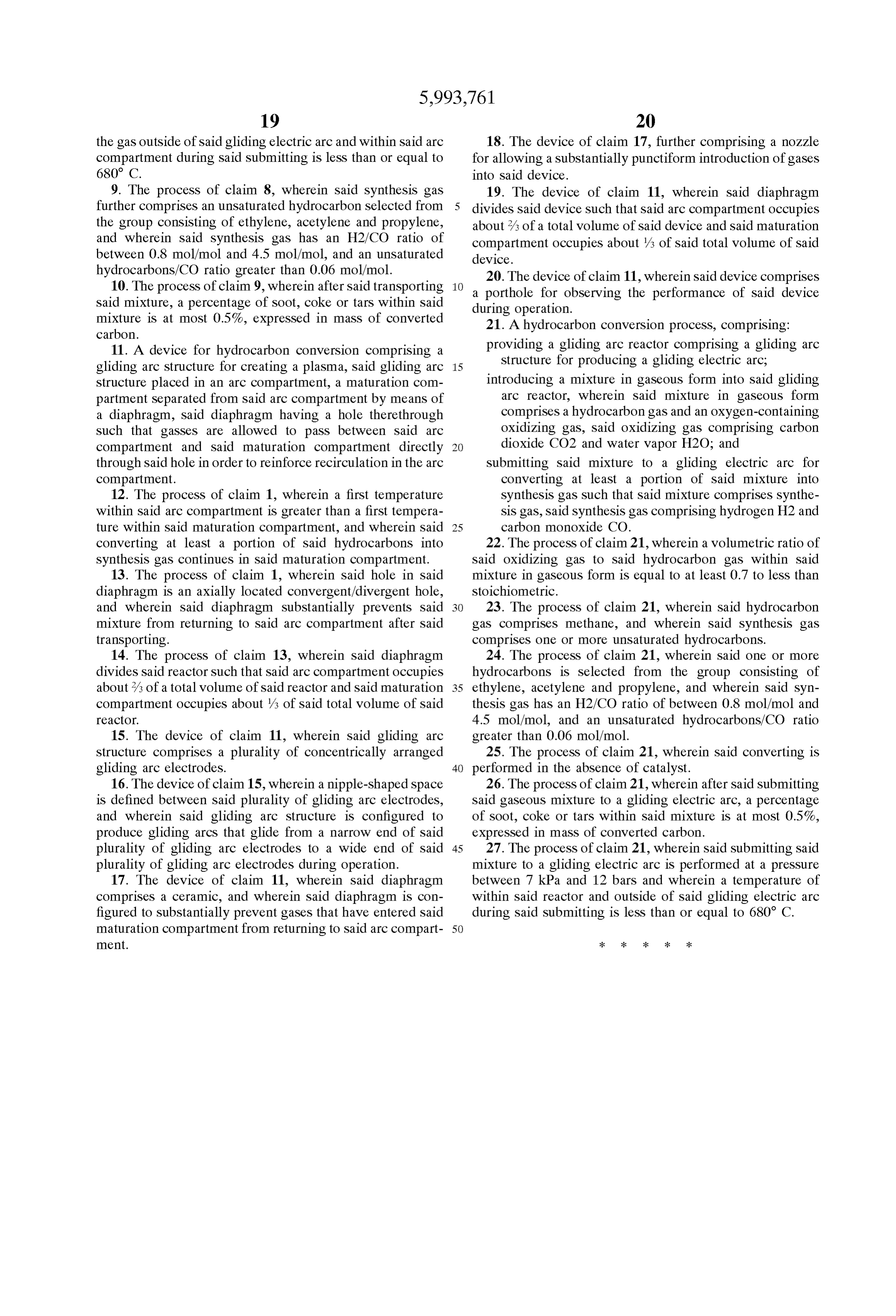
mentation of the plasmagenic gases chosen: the mixtures of 25 What is claimed is:
hydrocarbons with water vapor and/or CO2. 1. A hydrocarbon conversion process, comprising: Our experiments have demonstrated the feasibility of the providing a gliding arc reactor comprising an arc com new process of production of gases rich in hydrogen and partment and a maturation compartment partially carbon monoxide, containing also very large quantities of divided by a diaphragm, wherein a hole is defined in C2H4, C2H2 and C3H6. Said diaphragm for transporting gas therethrough; The process consists of manufacturing these gases by means of gliding electric arcs which Strike directly in the introducing a mixture in gaseous form into Said gliding hydrocarbon mixed with water vapor and/or with carbon arc reactor, wherein Said mixture in gaseous form dioxide in any proportions. This causes the oxidation and/or comprises a hydrocarbon and an oxygen-containing partial cracking of these hydrocarbons, avoiding the disad 35 Oxidizer;
Vantages of the existing processes. The reagents, partially Submitting Said mixture to a gliding electric arc within converted in a gliding arc compartment, then penetrate Said arc compartment for converting at least a portion another maturation compartment which is separated from of Said hydrocarbon into Synthesis gas Such that Said the direct reaction Zone by a diaphragm with a large hole. mixture further comprises Synthesis gas, Said Synthesis There, in the presence of the Still active Species produced in 40 gas comprising hydrogen H2 and carbon monoxide the arcs and transported by the gas leaving the arc Zone, the CO; and gas undergoes an additional conversion at a much lower transporting Said mixture from Said arc compartment into temperature than that present in the direct reaction Zone. Said maturation compartment through Said hole in Said The subject of this invention then is a process which diaphragm.
allows the partial cracking and oxidation of the hydrocar 45 2. The process of claim 1, wherein Said oxidizer com bons in the active presence of water vapor and/or carbon prises water vapor H2O.
dioxide, without any need for other reagents or catalysts and 3. The process of claim 1, wherein Said oxidizer com without the formation of Soot, coke or tar with the proper prises carbon dioxide CO2.
operation of the reactor. The tests clearly demonstrate the 4. The process of claim 1, wherein Said oxidizer com ease of reforming with Steam, or carbon dioxide or Simul 50 prises carbon dioxide CO2 and water vapor H2O. taneous reforming with an H2O/CO2 mixture accompanied 5. The process of claim 1, wherein Said Synthesis gas by non-catalytic hydrocarbon cracking. comprises one or more unsaturated hydrocarbons, and The invention makes it also possible to transfer directly wherein Said one or more unsaturated hydrocarbons com electrical energy under high Voltage and relatively low prises an unsaturated hydrocarbon Selected from the group current to an endothermic reaction medium. These electrical 55 consisting of acetylene C2H2, ethylene C2H4 and propylene conditions, combined with high Speed of the plasmagenic C3H6.
medium in the arc Zone, cause a Strong electric and also 6. The process of claim 1, wherein Said mixture in gaseous thermodynamic non-equilibria. The material injected into form comprises Said oxidizer in a Volumetric oxidizer/ this non-equilibrium plasma Zone created in the GlidArc hydrocarbon ratio equal to at 0.7 to less than Stoichiometric. device then reacts in non-thermal manner. 60 7. The process of claim 6, wherein Said mixture in gaseous No difficulty was noted at the time of the experiments and form comprises CO2, and wherein Said Submitting Said the extrapolation for large Volumes is easy. Despite a non mixture to a gliding electric arc comprises reacting Said CO2 optimized reactor and only one pass of the reagents through with said hydrocarbon for converting the CO2 into carbon the GlidArc compartment, a large part of the initial mol monoxide CO.
ecules is converted into Synthesis gas and into unsaturated 65 8. The process of claim 7, wherein said submitting said hydrocarbons. This conversion is greatly improved by the mixture to a gliding electric arc is performed at a preSSure almost punctiform injection of the reagents into the arc Zone between 7 kPa and 12 bars and wherein the temperature of
Page 13
the gas outside of Said gliding electric arc and within Said arc 18. The device of claim 17, further comprising a nozzle compartment during Said Submitting is less than or equal to for allowing a Substantially punctiform introduction of gases 680° C. into Said device.
9. The process of claim 8, wherein said synthesis gas 19. The device of claim 11, wherein said diaphragm further comprises an unsaturated hydrocarbon Selected from divides Said device Such that Said arc compartment occupies the group consisting of ethylene, acetylene and propylene, about 2/3 of a total Volume of Said device and Said maturation and wherein said synthesis gas has an H2/CO ratio of compartment occupies about/3 of Said total Volume of Said between 0.8 mol/mol and 4.5 mol/mol, and an unsaturated device.
hydrocarbons/CO ratio greater than 0.06 mol/mol. 20. The device of claim 11, wherein said device comprises 10. The process of claim 9, wherein after said transporting 1O a porthole for observing the performance of Said device Said mixture, a percentage of Soot, coke or tars within Said during operation.
mixture is at most 0.5%, expressed in mass of converted 21. A hydrocarbon conversion process, comprising: carbon.
11. A device for hydrocarbon conversion comprising a providing a gliding arc reactor comprising a gliding arc gliding arc Structure for creating a plasma, Said gliding arc 15 Structure for producing a gliding electric arc, Structure placed in an arc compartment, a maturation com introducing a mixture in gaseous form into Said gliding partment Separated from Said arc compartment by means of arc reactor, wherein Said mixture in gaseous form a diaphragm, Said diaphragm having a hole therethrough comprises a hydrocarbon gas and an oxygen-containing Such that gasses are allowed to pass between Said arc Oxidizing gas, Said oxidizing gas comprising carbon compartment and Said maturation compartment directly dioxide CO2 and water vapor H2O, and through said hole in order to reinforce recirculation in the arc Submitting Said mixture to a gliding electric arc for compartment. converting at least a portion of Said mixture into 12. The process of claim 1, wherein a first temperature Synthesis gas Such that Said mixture comprises Synthe within Said arc compartment is greater than a first tempera sis gas, Said Synthesis gas comprising hydrogen H2 and ture within Said maturation compartment, and wherein Said 25 carbon monoxide CO.
converting at least a portion of Said hydrocarbons into 22. The process of claim 21, wherein a volumetric ratio of Synthesis gas continues in Said maturation compartment. Said oxidizing gas to Said hydrocarbon gas within Said 13. The process of claim 1, wherein said hole in said mixture in gaseous form is equal to at least 0.7 to less than diaphragm is an axially located convergent/divergent hole, Stoichiometric.
and wherein Said diaphragm Substantially prevents said 23. The process of claim 21, wherein said hydrocarbon mixture from returning to Said arc compartment after said gas comprises methane, and wherein Said Synthesis gas transporting. comprises one or more unsaturated hydrocarbons. 14. The process of claim 13, wherein said diaphragm 24. The process of claim 21, wherein said one or more divides Said reactor Such that Said arc compartment occupies hydrocarbons is Selected from the group consisting of about 2/3 of a total volume of Said reactor and Said maturation 35 ethylene, acetylene and propylene, and wherein Said Syn compartment occupies about/3 of Said total Volume of Said thesis gas has an H2/CO ratio of between 0.8 mol/mol and reactOr. 4.5 mol/mol, and an unsaturated hydrocarbons/CO ratio 15. The device of claim 11, wherein said gliding arc greater than 0.06 mol/mol.
Structure comprises a plurality of concentrically arranged 25. The process of claim 21, wherein Said converting is gliding arc electrodes. 40 performed in the absence of catalyst. 16. The device of claim 15, wherein a nipple-shaped space 26. The process of claim 21, wherein after said submitting is defined between said plurality of gliding arc electrodes, Said gaseous mixture to a gliding electric arc, a percentage and wherein Said gliding arc Structure is configured to of Soot, coke or tars within said mixture is at most 0.5%, produce gliding arcs that glide from a narrow end of Said expressed in mass of converted carbon.
plurality of gliding arc electrodes to a wide end of Said 45 27. The process of claim 21, wherein said Submitting said plurality of gliding arc electrodes during operation. mixture to a gliding electric arc is performed at a preSSure 17. The device of claim 11, wherein said diaphragm between 7 kPa and 12 bars and wherein a temperature of comprises a ceramic, and wherein Said diaphragm is con within Said reactor and outside of Said gliding electric arc figured to Substantially prevent gases that have entered said during said submitting is less than or equal to 680 C. maturation compartment from returning to Said arc compart 50 ment.
Page 14
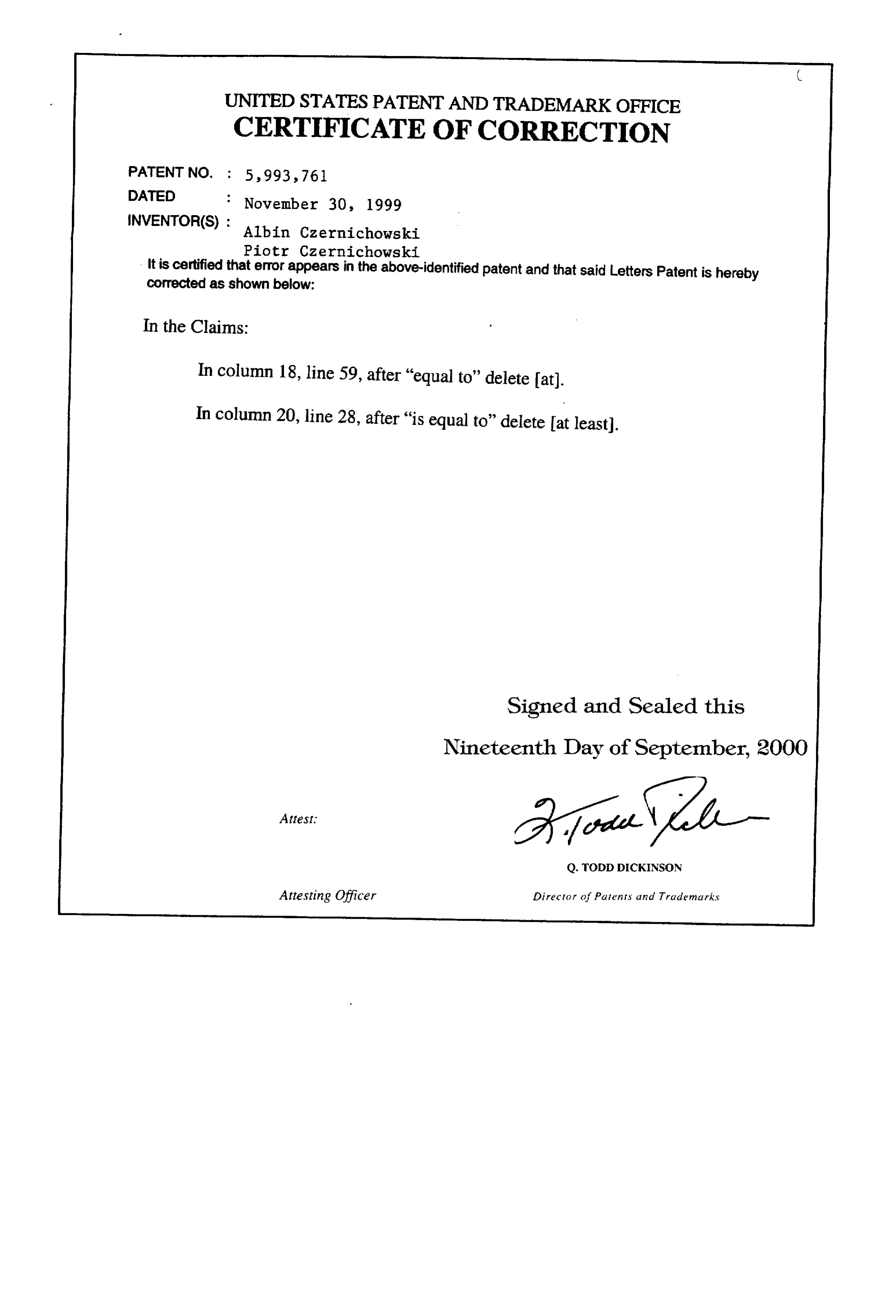
UNITED STATES PATENT ANDTRADEMARK OFFICE
CERT FICATE OF CORRECTION
INVENTOR(S) : Albin Czernichowski
Piotr Czernichowski it is certified that error appears in the above-identified patent and that said Letters Patent is hereby corrected as shown below:
In the Claims:
In column 18, line 59, after "equal to” delete at). In column 20, line 28, after "is equal to" delete at least.
Signed and Sealed this
Nineteenth Day of September, 2000
2.76% Q. ToDD DICKINSON
Attesting Officer Director of Patents and Trademarks
Provenance
- Collection
- Cited prior art
- Original PDF
- patentimages.storage.googleapis.com →
- Filed
- 1998-01-12
- Pages
- 14
- Method
- pdftotext (the PDF's own text layer) + pdftoppm 300dpi page scans
- Source
- Google Patents bibliographic record
- Granted
- 1999-11-30
- Inventors
- Piotr Czernichowski; Albin Czernichowski; Laxarco Holding Ltd
- Transcribed from
- patentimages.storage.googleapis.com →