(RR)
Voltage Deflection
Also written electrical force
Where it is first named
(see Figure 1-6 again as to Figure 1-9) as to Newton's and Coulomb's Laws of electrical force (RR).
How it is written
- (RR) 1×
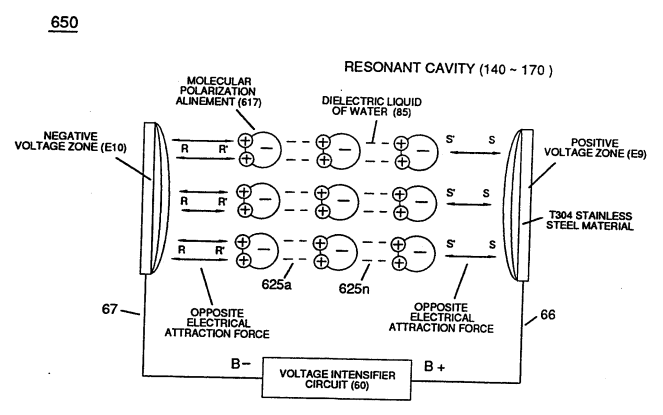
- (SS' - 617a xxx 617n - RR') 1× with (617) Molecular Polarization Alignment
Drawings 13
-
The stationary "positive" electrical voltage-field (E1) not only attracts the negative charged oxygen atom but also pulls away negative charged electrons from the water molecule. · Voltage Dissociation of The Water Molecule
-
(650) of Figure (7-4) · Amp Inhibiting Circuit Vs Voltage Enhancement
-
(650) of Figure (7-4) · Resistance (Rs)
-
The figure it sits on · Inductance (FL)
-
(650) of Figure (7-4) · Inductance (FL)
-
(650) of Figure (7-4) · Capacitance (Cd)
-
"Voltage Deflection" of Figure (7-4) · Capacitance Reactance
-
Opposite Electrical Attraction Force (SS' ~ 617 ~ RR' - T3 - SS' ~ 617 - RR') of Figure (7-4) · Electron Bounce Phenomenon
-
The figure it sits on · WFC 426 - Illustrations
-
The figure it sits on · 8-2 - Traveling Voltage Wave-Guides
-
(650) of Figure (7-4) · 8-4 - State Space (Sp)
-
(650) of Figure (7-4) · 8-6 - VIC Voltage Sync-Pulse Circuit
-
The figure it sits on · Propagating Electrical Stress
Where it is named · 2
Atomic Interaction to Voltage Stimulation 1×
-
electrical force (RR)
(see Figure 1-6 again as to Figure 1-9) as to Newton's and Coulomb's Laws of electrical force (RR).
Capacitance Reactance 1×
-
Voltage Deflection (SS' - 617a xxx 617n - RR')
In terms of Component Reactance, Inductors (L1/L2) should always be larger than Capacitor (ER) of Figure (7-2) in order to maximize amp restriction to enhance "Voltage Deflection" (SS' - 617a xxx 617n - RR') of Figure (7-4) and, is expressed by :