(E16)
Electrical Voltage Fields
Also written positive voltage field · Voltage Zones
Where it is first named
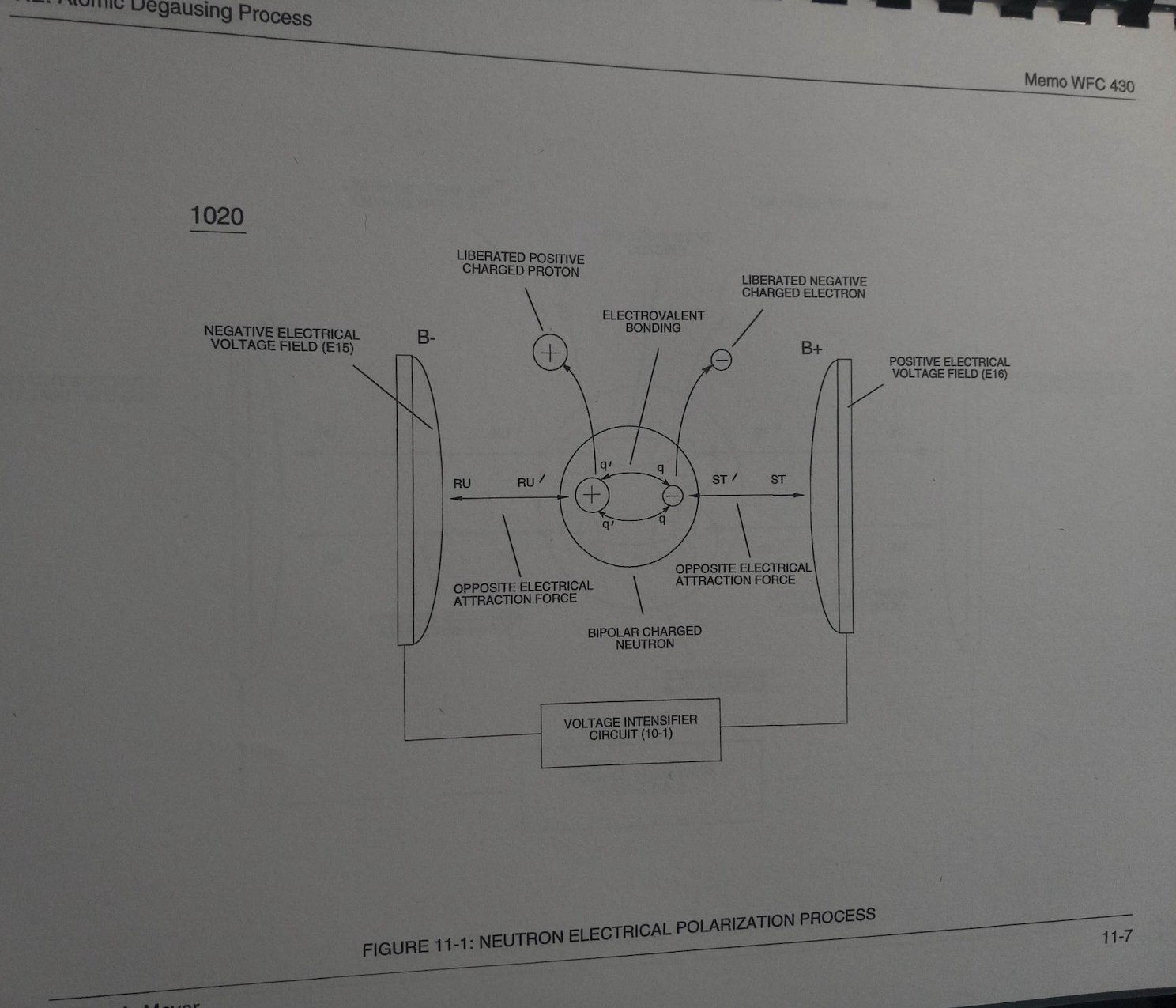
… able atom occurs when opposite electrical attraction forces (RU-RU' / ST'-ST) are set up between the electrical charged sub-particles of the atom and the recurring pulsating electrical voltage fields (E15/E16) of opposite electrical polarity of potential (B+/B-), as so illustrated in (1020) of Figure (11-1) titled “Neutron Electrical Polarization Process” as to Figure (10-1) titled “Voltage Intensifi …
How it is written
- (E15/E16) 2× with (E15) Electrical Voltage Fields
- (954/E15 – 956/E16) 1× with (954) Physical Stress, (E15) Electrical Voltage Fields, (956) Voltage Fields
- (E16) 1×
- (E16/956) 1× with (956) Voltage Fields
- (E17/E16) 1× with (E17) Voltage Zones
Drawings 6
-
Carries this number · Wobbling Effect
-
Carries this number · Wobbling Effect
-
Carries this number · WFC 430-2 Illustrations
-
dual unipolar voltage pulse circuit (1010) of Figure (11-1) · Voltage Flexing Process
-
Carries this number · WFC 430 - Illustrations
-
"Voltage Energized Thermal Transference Effect" (1050) of Figure (11-5) · Voltage Flexing Process
Where it is named · 6
Wobbling Effect 3×
-
electrical voltage fields (E15/E16)
… able atom occurs when opposite electrical attraction forces (RU-RU' / ST'-ST) are set up between the electrical charged sub-particles of the atom and the recurring pulsating electrical voltage fields (E15/E16) of opposite electrical polarity of potential (B+/B-), as so illustrated in (1020) of Figure (11-1) titled “Neutron Electrical Polarization Process” as to Figure (10-1) titled “Voltage Intensifi …
-
When applied, the opposite voltage fields (E15/E16) overcomes the electrovalent bonding force (qq') that exists between the two unlike electrical charged subatomic particles forming the neutron
-
positive voltage field (E16)
... whereby, the positive charged proton (B+) is deflected toward stationary negative voltage field (B-) (B15) and, simultaneously, the negative charged electron (B-) is deflected in opposite direction toward the stationary positive voltage field (E16) since unlike charges attract (RU-RU' / ST'-ST) under the law of physics … thereby, overcoming electrovalent bonding force (qq').
Voltage Flexing Process 1×
-
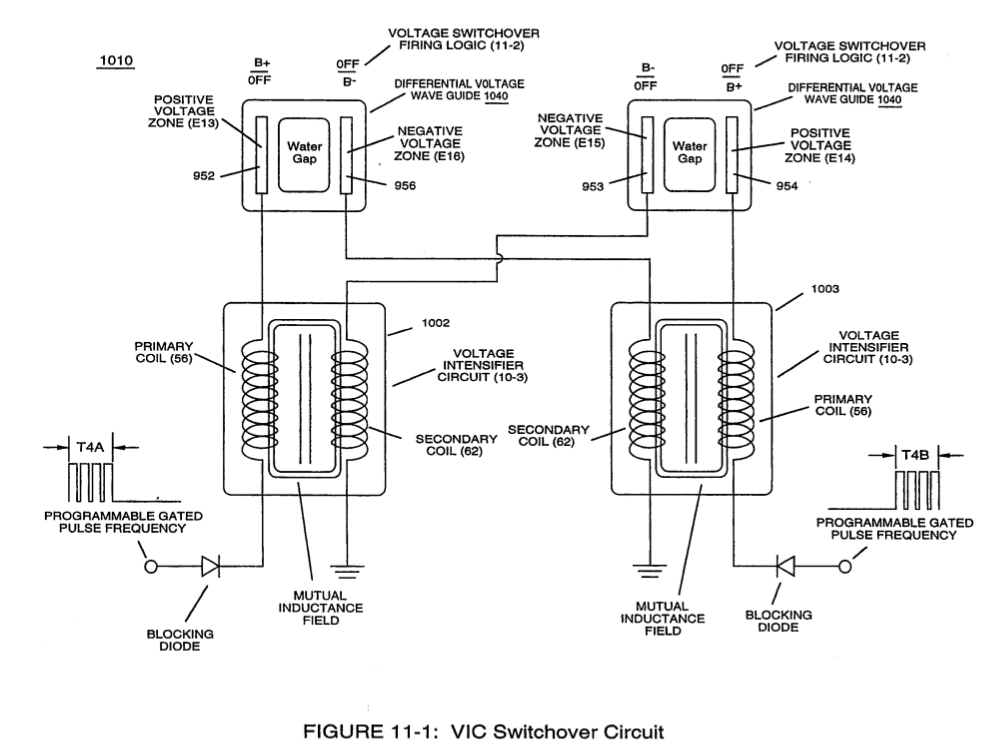
... whichever the case may be, the applied stationary voltage fields (952/E13 – 953/E14) or (954/E15 – 956/E16) alternately switch over periodically superimposes electrical stress forces (S-S' and R - R') onto the energy spectrum of the water molecule atom (s )(210) while physical flexing (951) of Figure (11-5) of the water molecule atom (s) occurs
VIC Switchover Circuit 1×
-
Pairing together positive voltage zone (E13/952) with negative voltage zone (E16/956) and doing the same with voltage-surfaces (E14/953) to (E15/954) as so graphically shown in (1O1O) of Figure (11-1) and each having an longitudinal axis of identical length, now, individually forms what is called hereinafter a "Differential Voltage Wave-guide" (1040)
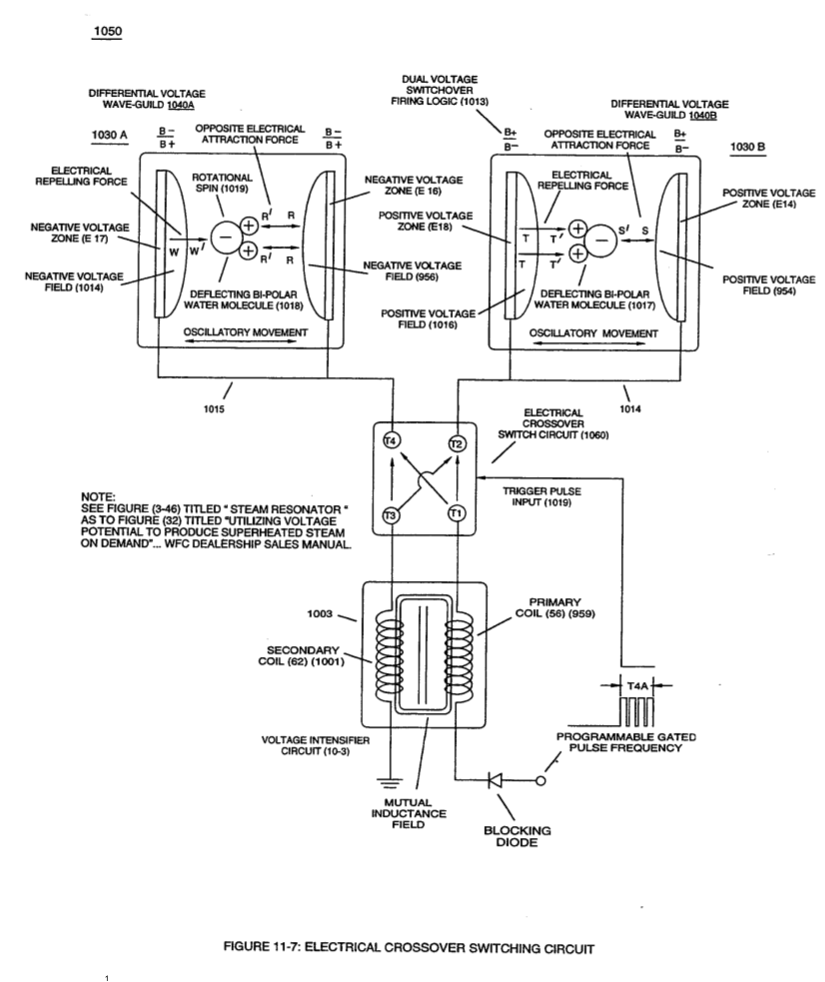
Electrical Crossover Switching Circuit 1×
-
Voltage Zones (E17/E16)
The Electrical Crossover Switching Circuit (1060) singularly places either a Positive Voltage Potential (1014) across both Voltage Zones (E18/E14) and/or a Negative Voltage Potential across Voltage Zones (E17/E16) or vise versa.