(92) · also written as a run, 92a xxx 92n
Electrons
Also written negative charged electrons · negative charge electrons · charged particles
Where it is first named
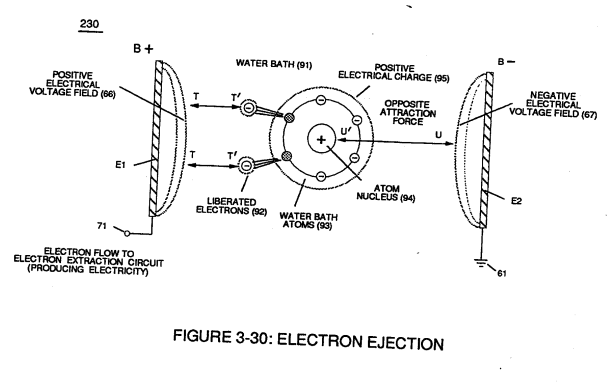
Subjecting and exposing water molecule (85) to even higher voltage levels (xxx Vn) (up to and beyond several thousand volts) causes water bath (91) of Figure (3-30) as to Figure (3-25) to go into a state of ionization by allowing opposite polarity forces (TT') and (UU') to eject one or more electrons (92a xxx 92n) from water bath atoms (93).
How it is written
- (92) 3×
- (92a xxx 92n) 2×
- (92/95) 1× with (95) Positive Electrical Charge
92a xxx 92n is Meyer's shorthand for a run of the same thing: 92a is the first, 92n the last, and the x's stand for however many lie between. Every stage of the run is this one numeral.
Drawings 9
-
Figure (3-25) · Voltage Intensifier Circuit (60)
-
Figure (3-30) · Resonant Action
-
Carries this number · WFC 422DA - Illustrations
-
Electron Ejection Process (230) of Figure (29) · Water Fuel Injector (Taper Resonant Cavity Chamber)
-
Carries this number · Funneling Effect
-
Figure (3-30) · Water Fuel Injection System - Page 2
-
Carries this number · Energy Pumping Action
-
(57 of Figure 3- 25 ~35 of Figure 6-2) · Instant Explosion of Water
-
(170) of Figure (3-25) · 8-4 - State Space (Sp)
Where it is named · 6
Resonant Action 6×
-
electrons (92a xxx 92n)
Subjecting and exposing water molecule (85) to even higher voltage levels (xxx Vn) (up to and beyond several thousand volts) causes water bath (91) of Figure (3-30) as to Figure (3-25) to go into a state of ionization by allowing opposite polarity forces (TT') and (UU') to eject one or more electrons (92a xxx 92n) from water bath atoms (93).
-
negative charged electrons (92)
Intensified electrical attraction force (TT') causes dislodged negative charged electrons (92) to migrate to positive voltage-plate (E1) while electrical attraction force (UU') causes positive charged atom nucleus (94) to travel toward negative voltage-plate (E2).
-
electrons (92a xxx 92n)
Replication of higher voltage forces (TT') and (UU') during pulsing operations causes a continued release of other electrons (92a xxx 92n) from other water bath atoms (93a xxx 93n) which, in practice, increases electrical charges of water bath (91) since water bath (91) is a dielectric liquid.
-
electrons (92)
Water bath atoms (93a xxx 93n) having missing electrons (92) take-on a positive electrical charge (95) which is subject to and moved by negative electrical force (UU'); whereby, the liberated and free floating negative charge electrons (92) are subject to and moved by positive electrical force (TT').
-
negative charge electrons (92)
Water bath atoms (93a xxx 93n) having missing electrons (92) take-on a positive electrical charge (95) which is subject to and moved by negative electrical force (UU'); whereby, the liberated and free floating negative charge electrons (92) are subject to and moved by positive electrical force (TT').
-
charged particles (92/95)
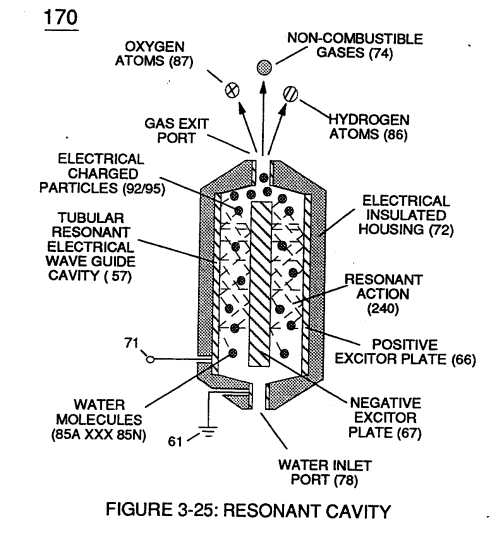
At resonance, electrical polarization process (160) interacts uniformly with liberated charged particles (92/95) of Figure (3-25) to obtain a even higher gas-yield (88) at maximum voltage deflection (xxx Vn).