(129)
Sub-critical Oxygen atom
Also written oxygen atom
Where it is first named
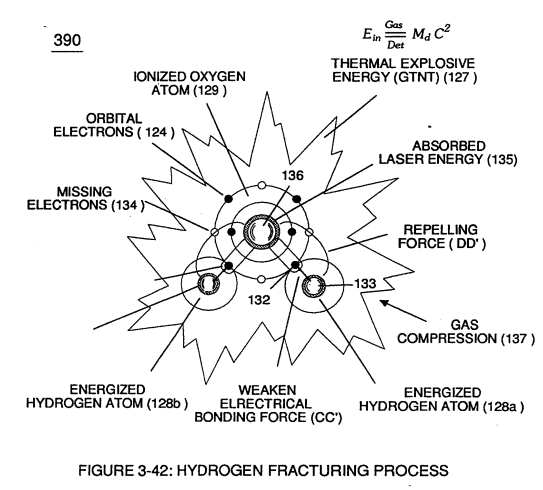
Sub-critical Oxygen atom (129) having less than the normal amount of covalent electrons (orbital electrons) is unable to reach "stable-state" (six to eight covalent electrons required) when the two hydrogen atoms (128 a/b) seek to form the water molecule during thermal gas ignition.
How it is written
- (129) 2×
Drawings 8
-
This atomic thermal-interaction between sub-critical combustible gas atoms (127 and 128a/b) is, now, herein after called "The Hydrogen fracturing Process. " · Hydrogen Fracturing Process
-
Carries this number · WFC 422DA - Illustrations
-
(390) of Figure (41) · Water Fuel Injector (Taper Resonant Cavity Chamber)
-
Carries this number · Funneling Effect
-
Hydrogen Fracturing Process (390) of Figure (3-42) · Water Fuel Injection System - Page 1
-
(390) of Figure (3-42) · In Application of Usage
-
(390) of Figure (3-42) · Resistance (Rs)
-
(390) of Figure (3-42) · Capacitance Reactance
Where it is named · 2
Hydrogen Fracturing Process 2×
-
Sub-critical Oxygen atom (129)
Sub-critical Oxygen atom (129) having less than the normal amount of covalent electrons (orbital electrons) is unable to reach "stable-state" (six to eight covalent electrons required) when the two hydrogen atoms (128 a/b) seek to form the water molecule during thermal gas ignition.
-
oxygen atom (129)
while, at the same time, absorbed laser energy (135) prevents oxygen atom (129) from reaching "stable state" when electrical attraction force (BB') (opposite electrical attraction force being equivalent to the number of missing electrons) locks onto and pulls away hydrogen atom electron (132) while repelling force (DD') keeps the two positive charged nucleus's (133/136) apart.