(108)
Gas Atom Nucleus
Also written gas nucleus
Where it is first named
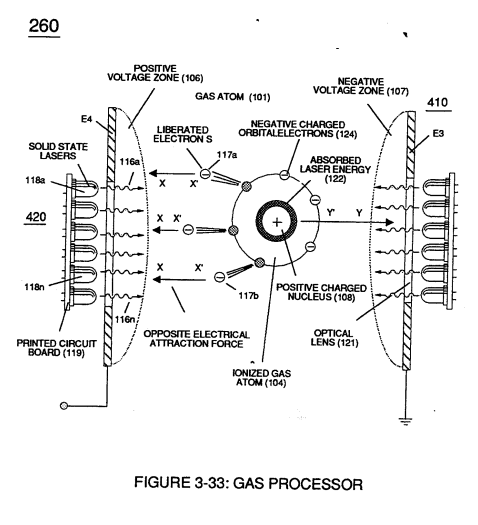
Positive electrical voltage field (106) causes negative charged orbital electrons (124a xxx) to be ejected from gas atom (101) due to opposite electrical attraction force (xx'); while, at the same time, negative electrical voltage field (107) exerts a second electrical attraction force (yy') on gas atom positive charged nucleus (108)
How it is written
- (108) 5×
Drawings 9
-
Figure (3-33) · Gas Processor
-
In terms of assembly, gas resonant cavity (410), electron extraction circuit (270), optical lens (121) forms gas processor (260) of Figure (3-31). · Gas Processor
-
Carries this number · WFC 422DA - Illustrations
-
Carries this number · WFC 422DA - Illustrations
-
(80) of Figure (4) · Water Fuel Injector (Taper Resonant Cavity Chamber)
-
(280) of Figure (34) · Funneling Effect
-
Ambient Air Ionizer (Gas Processor) (80) of Figure (4-6) · Water Fuel Injection System - Page 3
-
(Light Emitting Diodes) (1100 xxx 116n) of Figure (3-33) · WFC Exhaust Air Reclaimer
-
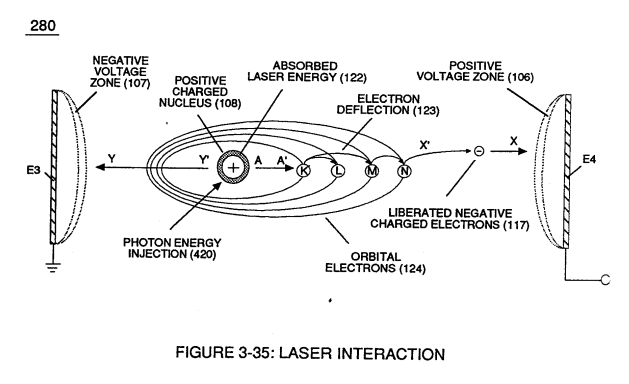
(280) of Figure (3-35) · Voltage to Amp Differential Ratio
Where it is named · 5
Gas Processor 5×
-
Positive electrical voltage field (106) causes negative charged orbital electrons (124a xxx) to be ejected from gas atom (101) due to opposite electrical attraction force (xx'); while, at the same time, negative electrical voltage field (107) exerts a second electrical attraction force (yy') on gas atom positive charged nucleus (108)
-
To further destabilize gas atom (104), emitted laser energy (electromagnetic energy having zero mass) (116) is, now, injected into Gas Resonant Cavity (410) via optical lens (121) and superimposed onto gas ionized process (260) and subsequently absorbed by gas atom nucleus (108), as illustrated in (260) of Figure (3-33) as to (270) of Figure (3-34).
-
gas atom nucleus (108)
The absorbed laser energy (122) of Figure (3-35) not only causes ionized gas atom orbital electrons (124) to be deflected away from gas atom nucleus (108) but, also, weakens electrostatic force (AA') between gas atom nucleus (108) and deflecting electrons (123a xxx)
-
gas atom nucleus (108)
The absorbed laser energy (122) of Figure (3-35) not only causes ionized gas atom orbital electrons (124) to be deflected away from gas atom nucleus (108) but, also, weakens electrostatic force (AA') between gas atom nucleus (108) and deflecting electrons (123a xxx)
-
gas nucleus (108)
In retrospect to operational parameters, led's (118) light spectrum (extending from the visible into the Ultraviolet light region) can be selected for a given or predetermined electromagnetically gas priming application (280) since gas nucleus (108) is more responsive to coherent rather than diffused light source.