Stan Meyer - The Nitrogen Key
Started by Aaron Murakami · · 21 posts · last reply 22 June 2015
-
#1 ·
Hi everyone,
I'm starting this thread first to lay out in Stan Meyer's own words what his process is and how nitrogen is the key to making his water fuel.
If you believe contrary - DO NOT POST HERE - go start another thread and discuss resonant circuits, etc... this thread is to explain the very key that makes a real fuel that can be used in an engine.
So many people are fixated on the water cells, but only a very small handful of people are paying attention to his earlier work that reveals his secret.
First of all, this all comes down to burning the water gas. But as most of us know, a "HHO" gas from a common ducted water cell will just give you a quick pop and you cannot sustain a flame. I'm not talking about a pressurized Brown's Gas torch flame, I'm talking about a slower and cooler burning flame that allows you to get the thermal energy from the water fuel. Stan Meyer was very, very clear about this throughout his work over the entire course of time that he was involved in this research and development.
He said that to control the burn rate of the water fuel, you have to mix non-combustible gases with it. That includes non-combustible gases from 1) the water has 17%+ dissolved gases according to him, 2) from the ambient air going into the intake, and 3) from the exhaust gases recycling back to mix with the water gas - of course that exhaust gas will contain non-combustible gases from sources 1 & 2.
I had a special interest in nitrogen from some other technologies so that was in the back of my mind as being a possibility and that dealt mostly with allotropic or active nitrogen. That is essentially ionized nitrogen atoms that are heavily positively charged. It was brought to my attention a few years ago that NITROGEN was the non-combustible gas that Meyer was talking about specifically. The nitrogen alarm went off, I re-looked at Stan Meyer's work, and there it was plain as day - NITROGEN indeed IS the non-combustible gas that Meyer was referring to. It certainly wasn't the 1% trace gases that some "experts" are claiming.
When plain HHO is ignited, it detonates instead of actually giving any real thermal combustion. The atoms and molecules just combine instantly to form a water molecule and there was a shrinkage in the volume that the gasses occupied. HHO is a mixture of about a dozen hydrogen based molecules and atoms and oxygen based molecules and atoms. It is not just a re-arranged water molecule. It works wonders as a torch flame and as a fuel supplement, but for fuel supplementation, the real benefit is coming form the reactive oxygen molecules stripping electrons from the hydrocarbon molecules breaking them into smaller pieces. That give you more BTU's our of the same amount of fuel that was put into the combustion chamber. This is the model that makes sense to me anyway and in any case, it is not the exact subject of this thread.
The water is always touted as being such a wonderful byproduct - BUT, what if... that is actually what robs you of the energy that is lying right there in the hydrogen and you only get a little teaser from it.
With electrolysis, nitrogen gases in the water also split to create atomic nitrogen. Nitrogen is normally very difficult to split and it has a triple electron bond - the strongest normal bond in nature. But when you do strip those electrons away, you can have a nitrogen atom that is +3 charge - it is a very strong vacuum cleaner for anything negatively charged such as some of the HHO molecules and atoms that happen to be negatively charged. Things seem to happen easier when done in water or with water. Sir Humphrey Davy said in 1807 that electrolytic hydrogen will bind with nitrogen in the presence of water when normal hydrogen will not!
Now when we dilute the HHO gases with nitrogen, much of this nitrogen is ionized through the combustion and electrolysis processes. When there is atomic nitrogen, the hydrogen can attach to it creating traces of ammonia (NH3), some oxygen can bond creating traces of nitrous oxide (N2O) and other molecules. Each molecule of this is one less water molecule that forms and you were able to get more thermal energy out of the same amount of water gas that if you didn't have the nitrogen dilution. This allows the water fuel (with nitrogen) to burn slower and cooler - you get the thermal energy out of it - real combustion and not a quick Brown's Gas pop.
The slow burning flames from water are the foundation of Stan Meyer's work - this is his logo. It all started with this. That is not Brown's Gas torch flames rising from the water, those are slow burning "candle flames", which is what you want for a sole fuel for an engine and not just a supplement. It's been in front of everybody's eyes since the beginning. As the only fuel, and to get enough combustion so that the engine can give enough power to turn a generator to create enough electricity to make enough fuel, this process is what is required according to Stan Meyer. This idea is embodied in every single part of his work with water fuel.
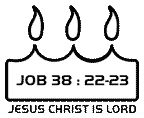
(Stan Meyer's Logo)
Stanley Meyer says word for word: "the velocity of hydrogen is so great that the hydrogen ensuing from a nozzle will not under ordinary circumstances sustain a flame. Therefore, to sustain a flame at a nozzle attached to a hydrogen generator the burning velocity of the hydrogen gas must be reduced. "
This is where it starts when it comes to understanding what Stan Meyer was up to - "...the burning velocity of the hydrogen gas must be reduced."
- and other non-volatile gasses such as oxygen and nitrogen. The hydrogen gas with the attendant non-volatile gasses in a controlled ratio are fed via a line to a controlled air intake system. The combined hydrogen, non-volatile gasses, and the air after intermixing are fed to a combustion chamber wherein the mixture is ignited. The exhaust gasses of the combustion chamber are returned in a closed loop arrangement to the mixing chamber for the mixture of volatile as the non-combustible gasses.
- [0006] More specifically, the generated hydrogen gas is fed to a gas mixing chamber, wherein the hydrogen gas is inter- mixed with non-combustible gasses. The mixture is fed to a carburator (air intake mixture) system.
- [0007] The gas mixture is'fed through nozzle to chamber in a jet spray. Valve or gate controls the amount of air intake to the jet spray. The gasses combine with the air to form a gas mixture of hydrogen, non-volatile gas, and oxygen. The mixture now combustible, but not volatile, is entered into a combustion chamber"
Meyer defines non-volatile NITROGEN as a non-volatile gas.
He also defines the non-volatile gases as being synonymous with using the term non-combustible gases.
The gases combine with AIR to form a gas mixture of hydrogen, non-volatile gas (NITROGEN) and oxygen. The mixture now combustible, but NOT VOLATILE, is not entered into the combustion chamber.
Plain water gas from the cell is EXTREMELY VOLATILE. That is just the way the so-called HHO gas is. It becomes NON-VOLATILE by blending it with NITROGEN! And THAT is the key to how he ran an engine on water, air and electricity. He wasn't making big amounts of gas. He started off with common flat plated electrolysis cells with pulsed DC. No VIC and all the resonance business. That all came after and is NOT foundational to the real foundation of Stan Meyer's technology. the real foundation is a simple pulsed dc electrolysis cell gas production is diluted with NITROGEN. Without the nitrogen, the water gas is very volatile and is not in the preferred combustible state that is needed for an engine. And you can take a look at adding a magnetic coil around the pipes as well as applying a vacuum to the cell, but this is the basic concept.
Look at this nozzle...
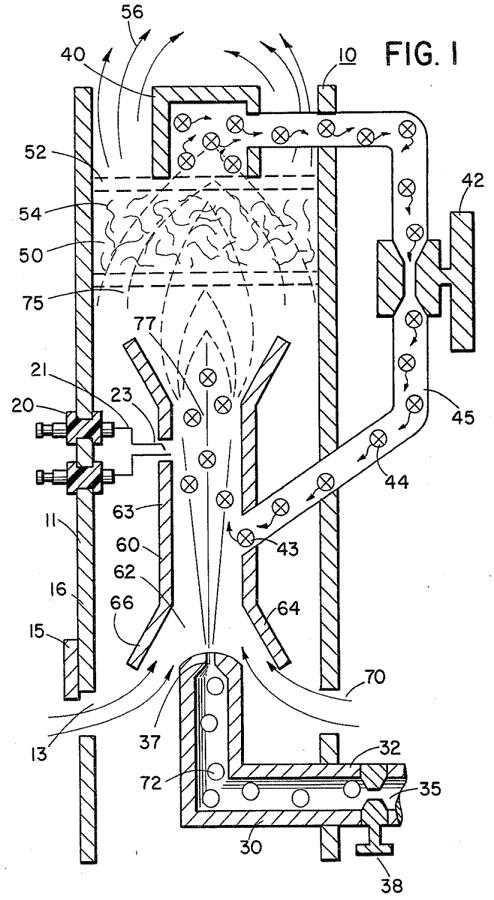
You can see the HHO from the bottom blends with ambient air and then it gets burned. The exhaust from the flame goes to the environment and some is recaptured to go dilute the hho and ambient air mix to be reburned. -
#2 ·
With an engine, it is the EXACT same concept...

You can also see the flat plate electrolysis cell - well before any of the resonant WFC tube setups.
And here is more specific to NITROGEN in Stan Meyer's own words in BLUE is his words:
The sub-atomic action of the direct current voltage on the non-electrolytic water causes the hydrogen and oxygen atoms to be separated--and similarly other gasses entrapped in the water such as nitrogen. (Meaning the NITROGEN IS ALSO SEPARATED or IONIZED during electrolysis. There is 17% Nitrogen in water. For extra nitrogen, ambient air and exhaust is constantly condensed in a loop).
the velocity of hydrogen is so great that the hydrogen ensuing from a nozzle will not under ordinary circumstances sustain a flame. Therefore, to sustain a flame at a nozzle attached to a hydrogen generator the burning velocity of the hydrogen gas must be reduced.
It has been found that all water in its natural state whether it be tap water, well water, sea water, or fresh water is a saturate of ambient air. Further, in that ambient air contains a substantial amount of nitrogen, all natural water will have entrapped therein nitrogen. Again, the percentage of nitrogen entrapped in natural water has been determined to be a fixed percentage and very uniform at seventeen (17%) percent -- irrespective of the source of the water or its impurities. Hence, a natural water gas analysis will show a seventeen percent of nitrogen relative to the hydrogen and the oxygen. (He says the flame needs to be slowed down. And he talks over and over about there being a LOT of NITROGEN in the water.)
There are a lot more references from Meyer specifically spelling out that NITROGEN is the non-combustible gases that he is always referencing. Just in these references already, we can see that this is the key to making a suitable fuel and Meyer started with flat plate electrolyzers and simple pulsed DC. If you search any of those references, you can pull up the patents.
This thread has already debunked every Stan Meyer "expert" who claims that there are no references by Meyer that ever names Nitrogen. Well, here are a few and there are a lot more.
I put my favorite reference in this report that I'm offering. You can just take the time and search and you will find them if you don't want the report. They're all online and have been for years.
REPORT AVAILABLE HERE: WATER FUEL SECRETS -
#3 ·
I thought it was pretty obvious that when he said 'non-combustible gases' he meant Nitrogen (Air). It wouldn't be reasonable or cost effective to use any other gas because you would have to buy tanks of it.
A lot of the simple points that Stan made clearly seem to be misunderstood or ignored by most of the people studying his work so I guess this is no exception. -
#4 ·
These patents are initial approach of Meyer to understand a new way for obtain more thermal energy.bluestix wrote:
I thought it was pretty obvious that when he said 'non-combustible gases' he meant Nitrogen (Air). It wouldn't be reasonable or cost effective to use any other gas because you would have to buy tanks of it.
A lot of the simple points that Stan made clearly seem to be misunderstood or ignored by most of the people studying his work so I guess this is no exception.
The explaination of combustion is wrong because the engine is in fact an mechanical atomic reactor..
When reaction is started you obtain as result an change of state of molecules that you sent inside thanks to the compression.
You start the combustion mixing the fuel (CxxHxx molecule) with air (oxygen/nitrogen) obtaining COx and NOx as exaust gas.
The main problem is that the energy produced from compression does not have enough power for dissociated the nitrogen molecules, as result you have inert gas into the exaust gas.
You need to understand that combustions reactions have different levels:
1) humans for live need just air in molecular state
2) engine suck air and split just oxygen molecules into atoms
3) air as fuel tech split all air into atoms
We are born in petrol era and we know that your car for run need gasoline or diesel.
At today an endothermic engine use the oxygen, present in air, just as the oxydant of fuel, this explaination is correct in part because the process of combustion isn't understand completely..
Returning to Stan Meyer.. probably during some tests has found that air have enough power and the initial researchs using exaust gas (nitrogen and water vapour) with watergas are changed ionizing the air and mixing with watergas.
But Stan Meyer don't has clear the reaction because sometimes works and sometimes not.
From that reason Stan have the idea to wfc injector, an all in one device. Good intuition but with more electrical and mechanical problems.
After we know all that Stan is died and this technology is was lost..
In this year 2013 an italian team has found the right way for transform air into fuel because this is the year of energy revolution for the benefit for all peoples. -
#5 ·
Yes, but Stan Meyer apparently did not understand all the reactions. This thread is for documentation of Stan Meyer's concept of slowing the burn rate of fuel. Engines have more nitrogen and less oxygen leaving the exhaust than went into the air intake as if oxygen is split into a nitrogen atom and hydrogen atom. We can discuss those atomic concepts in another thread.tutanka wrote:
These patents are initial approach of Meyer to understand a new way for obtain more thermal energy.
The explaination of combustion is wrong because the engine is in fact an mechanical atomic reactor..
When reaction is started you obtain as result an change of state of molecules that you sent inside thanks to the compression.
You start the combustion mixing the fuel (CxxHxx molecule) with air (oxygen/nitrogen) obtaining COx and NOx as exaust gas.
The main problem is that the energy produced from compression does not have enough power for dissociated the nitrogen molecules, as result you have inert gas into the exaust gas.
You need to understand that combustions reactions have different levels:
1) humans for live need just air in molecular state
2) engine suck air and split just oxygen molecules into atoms
3) air as fuel tech split all air into atoms
We are born in petrol era and we know that your car for run need gasoline or diesel.
At today an endothermic engine use the oxygen, present in air, just as the oxydant of fuel, this explaination is correct in part because the process of combustion isn't understand completely..
Returning to Stan Meyer.. probably during some tests has found that air have enough power and the initial researchs using exaust gas (nitrogen and water vapour) with watergas are changed ionizing the air and mixing with watergas.
But Stan Meyer don't has clear the reaction because sometimes works and sometimes not.
From that reason Stan have the idea to wfc injector, an all in one device. Good intuition but with more electrical and mechanical problems.
After we know all that Stan is died and this technology is was lost..
In this year 2013 an italian team has found the right way for transform air into fuel because this is the year of energy revolution for the benefit for all peoples. -
#6 ·
Hi Aaron,
Do have any hint on how the Quenching Circuit Technology worked..? this is also the key in Co-equalling the burn rate to match with the Fossil fuel burn rate.
Stan' s patent indicate Hydrogen Flame used for heating applications using the Quenching tube..
Rgds,
Faraday88. -
#7 ·
Hi Faraday,Faraday88 wrote:
Hi Aaron,
Do have any hint on how the Quenching Circuit Technology worked..? this is also the key in Co-equalling the burn rate to match with the Fossil fuel burn rate.
Stan' s patent indicate Hydrogen Flame used for heating applications using the Quenching tube..
Rgds,
Faraday88.
Actually, I don't believe the quenching tubes are necessary because all the patents discussing nitrogen were before Meyer ever did anything with the quenching tubes. -
#8 ·
I think the quenching disk/tubes is mostly for preventing flashback. The quenching tube does put the hydrogen and the nitrogen released from the water in intimate contact though. -
#9 ·
yes that is true.. quenching is just used for security.. if you want to make reactions you need high temperature, pressure or catalyst and pure nitrogen. With nitrogen you cam make ammonia and run an engine.. nitrogen can be the ONLY substitute of carbon. -
#10 ·
Aaron,
You have done a lot of research into hydrogen, I would like to encourage you to do a presentation on it at the next conference it would be fascinating,
Tom C -
#11 ·
Thanks Tom, I like the idea. I can maybe review the nitrogen connection at the end of the plasma talk since it is somewhat connected. Got a VM from you - will reply when I get back on the road.Tom C wrote:
Aaron,
You have done a lot of research into hydrogen, I would like to encourage you to do a presentation on it at the next conference it would be fascinating,
Tom C -
#12 ·
This was the exact point that Stan Meyer's made by mixing ionized nitrogen to the HHO. Everyone knows that the HHO simply detonates very quickly and can damage an engine with that super fast strong ping. It turns to water and shrinks right away but damage is already done. Stan Meyer's specifically discussed that the mixing of the nitrogen will slow down the velocity and temp of the water fuel burn equaling that of gasoline and that is how you get the thermal energy out of the fuel. Nitrogen has a triple electron bond - the strongest natural molecular bond or so they say. Ionize nitrogen and it is VERY positively charged. When the water fuel is ignited, the hydrogen and oxygen will preferably attach themselves to the ionized nitrogen since it is the stronger attractor instead of to themselves. That prevents the formation of the water molecule (which is always touted as a benefit - "the exhaust is water" - along with wasting almost all the thermal energy that could be had), etc... That is how to get HHO to burn as slow as a candle - all about getting the mixtures right of ionized ambient air and the HHO coming from the cell. This is exactly what all the self-proclaimed Stan Meyer experts are in violent denial about but I prove it in Stan Meyer's own words. Even when they see this spelled out in Stan Meyer's own documents, they continue to deny it. At least some people are paying attention.BroMikey wrote:
Nitro is powerful and has a closer burn rate for internal combustion engines that requires less deviation from factory ECM standards making tuning far far easier. -
#13 ·
Some n2o is created when ionized nitrogen is mixed in a combustion chamber with hho and ignited. A bit of nh3 and other molecules, which can condense bit by bit as it is recycled.BroMikey wrote:
Hi Aaron
Sounds very good to me. I talked to Boyce for hrs and hrs on the phone and in person. His boat exhaust manifolds were very close to the water. He raced boats winning because his 50hp marine engine produced 100hp using the good stuff.
Whatever it was. The water mist/vapors, from the hot running manifolds were said to burn right along with the HHO.
I think tank Nitrogen was never used but he had a special engine built in his machine shop plus timing was way over to meet the requirement.
I don't know how long his engines lasted.
Maybe Nitro could be derived through water cracking of various forms not yet revealed.
Say that maybe nitro bonds when vaporization takes place because this is all done without a vacuum or in the presence of ambient air that is comprised of 76 Percent Nitrogen.
Brother Mike
Michael John Nunnerley did this with his jet engine. -
#14 ·
Hi Mike,BroMikey wrote:
Hi Aaron
What I should be asking is do you have a fueling phase for your rocket motor that uses HHO and Nitro and is it tank Nitro or can the nitro be gotten other ways without using heavy steal tanks?
That is what I wanted to ask.
When I was 12-15 I saw the propane jets on wing tips. I like your turbo charger better. Here it is.
[ATTACH=CONFIG]3043[/ATTACH]
Mike
Mine just runs on propane and that's it.
What I don't show in that is that I have an exhaust recycler. I pull a lever and the thrust diverts to a big water bong that boils water - steam output goes back to turbine impeller. For x pounds of propane in the tank, I can get it to idle on less than 1psi instead of 8 psi (when recycling exhaust through water).
I have all the radio circuits needed to heterodyne an area between some antennas - I couldn't get the antennas built good enough. Exhaust that gets recycled through water - that is what needs to go through an ABS tube with the antennas. The heterodyning will create the fuel - some n2o, nh3, etc. the only source of nitrogen to do this is from the ambient air. -
#15 ·
Aaron Murakami wrote:
Some n2o is created when ionized nitrogen is mixed in a combustion chamber with hho and ignited. A bit of nh3 and other molecules, which can condense bit by bit as it is recycled.
Michael John Nunnerley did this with his jet engine.
For make ammonia you need NOT just nitrogen and if you use air you must eliminate the oxygen. The ionization condition can't be present for more time and if you want make an chemical reaction all must be maked in the same time. Don't forget that for make hho you use enough electric energy. About heterodyne I have to see an working system actually is just an dream. -
#16 ·
I believe you can do this Aaron! Is heterodyn in the same family as hydrazine - N2H4 and N2H5, etc.? (I could have googled itm but I do not believe "rabbi wiki" that much, since they also got Stan's tech 100% wrong.Aaron Murakami wrote:
Hi Mike,
Mine just runs on propane and that's it.
What I don't show in that is that I have an exhaust recycler. I pull a lever and the thrust diverts to a big water bong that boils water - steam output goes back to turbine impeller. For x pounds of propane in the tank, I can get it to idle on less than 1psi instead of 8 psi (when recycling exhaust through water).
I have all the radio circuits needed to heterodyne an area between some antennas - I couldn't get the antennas built good enough. Exhaust that gets recycled through water - that is what needs to go through an ABS tube with the antennas. The heterodyning will create the fuel - some n2o, nh3, etc. the only source of nitrogen to do this is from the ambient air. -
#17 ·
Sorry guys, my previous post makes no sense!
To me it looks like Aaron is developing new heterodyning techniques to manipulate the atomic-level chemistry to artificially form desired components.
Atomic chemistry is about electric balances, timing, and control, isn't it?
The common man has no screwdrivers and pliers we can stick in there and "tune" things to our song - why can't heterodyne tech be one of tools available to actually accomplish it?
Tesla aether-power towers were bought, stripped and sold for scrap before the masses could benefit, but thousands of people have seen things lit, whirring, heating, etc, with there own eyes... not powered by the grid or other fuels.
Searl had tech in real demo filmed flying under remote control and picked up on radar... seen by many of the public... no hydrocarbon other other fuels, or even indirect grid dependencies...
Many witnessed Stan's machines and buggy running not on any liquid fuels, other than created by itself on the go...
If oxygen from air as a mono-propellant is ones fancy - hey great!
IF carbon can be abandoned in favor of a complete nitrogen replacement - hey great!
RIGHT NOW - as I write this - 99% or what ever unacceptable amount of internal combustion engines are still running on hydrocarbon fuels.
Other technologies historically to the contrary all of a sudden are VERY QUIETLY and VERY FAST infiltrating the market, riding the gravy train put there by the VACUUM of tech discussed on this forum.
Just look at one "simple" little detail for instance:
NH3 as fuel by itself only produce about HALF the energy output than gasoline - N2O is added to gasoline and it outperforms the normal gasoline by far... where does it leave "hho" and "nh3"??
The answer lies, like Aaron explains in this threat, is in Stan's tech regarding CONTROL of this fuel constituents. To get THERE takes time to TUNE all the parameters until a successful synchronicity is reach providing the desired synergy.
To the doubtful out there, I advise to go look up the main nitrogen chemistry and ALL its compound branches.
Stan was NOT wrong - neither is Aaron, and nor anybody else that would dare to venture along these lines.
My pastor has got some Stan-tech in a private state of tune going for him allowing his and two other cars to run on full power - not substituting any existing fuel, with normal fuel-tank lines OFF the engines - it is ONLY the artificial water-fuel created on demand with air, water and electricity (and no, the electrical systems are NOT over-burdened), thank you to Stan and people like Aaron who seek the truth.
I say no more on this subject... LOOK into the truth Aaron shares here - read the Water Fuel Secrets report !
 Thank you Aaron!!!
-
#18 ·
Hi Aaron,Aaron Murakami wrote:
Hi everyone,
I'm starting this thread first to lay out in Stan Meyer's own words what his process is and how nitrogen is the key to making his water fuel.
If you believe contrary - DO NOT POST HERE - go start another thread and discuss resonant circuits, etc... this thread is to explain the very key that makes a real fuel that can be used in an engine.
So many people are fixated on the water cells, but only a very small handful of people are paying attention to his earlier work that reveals his secret.
First of all, this all comes down to burning the water gas. But as most of us know, a "HHO" gas from a common ducted water cell will just give you a quick pop and you cannot sustain a flame. I'm not talking about a pressurized Brown's Gas torch flame, I'm talking about a slower and cooler burning flame that allows you to get the thermal energy from the water fuel. Stan Meyer was very, very clear about this throughout his work over the entire course of time that he was involved in this research and development.
He said that to control the burn rate of the water fuel, you have to mix non-combustible gases with it. That includes non-combustible gases from 1) the water has 17%+ dissolved gases according to him, 2) from the ambient air going into the intake, and 3) from the exhaust gases recycling back to mix with the water gas - of course that exhaust gas will contain non-combustible gases from sources 1 & 2.
I had a special interest in nitrogen from some other technologies so that was in the back of my mind as being a possibility and that dealt mostly with allotropic or active nitrogen. That is essentially ionized nitrogen atoms that are heavily positively charged. It was brought to my attention a few years ago that NITROGEN was the non-combustible gas that Meyer was talking about specifically. The nitrogen alarm went off, I re-looked at Stan Meyer's work, and there it was plain as day - NITROGEN indeed IS the non-combustible gas that Meyer was referring to. It certainly wasn't the 1% trace gases that some "experts" are claiming.
When plain HHO is ignited, it detonates instead of actually giving any real thermal combustion. The atoms and molecules just combine instantly to form a water molecule and there was a shrinkage in the volume that the gasses occupied. HHO is a mixture of about a dozen hydrogen based molecules and atoms and oxygen based molecules and atoms. It is not just a re-arranged water molecule. It works wonders as a torch flame and as a fuel supplement, but for fuel supplementation, the real benefit is coming form the reactive oxygen molecules stripping electrons from the hydrocarbon molecules breaking them into smaller pieces. That give you more BTU's our of the same amount of fuel that was put into the combustion chamber. This is the model that makes sense to me anyway and in any case, it is not the exact subject of this thread.
The water is always touted as being such a wonderful byproduct - BUT, what if... that is actually what robs you of the energy that is lying right there in the hydrogen and you only get a little teaser from it.
With electrolysis, nitrogen gases in the water also split to create atomic nitrogen. Nitrogen is normally very difficult to split and it has a triple electron bond - the strongest normal bond in nature. But when you do strip those electrons away, you can have a nitrogen atom that is +3 charge - it is a very strong vacuum cleaner for anything negatively charged such as some of the HHO molecules and atoms that happen to be negatively charged. Things seem to happen easier when done in water or with water. Sir Humphrey Davy said in 1807 that electrolytic hydrogen will bind with nitrogen in the presence of water when normal hydrogen will not!
Now when we dilute the HHO gases with nitrogen, much of this nitrogen is ionized through the combustion and electrolysis processes. When there is atomic nitrogen, the hydrogen can attach to it creating traces of ammonia (NH3), some oxygen can bond creating traces of nitrous oxide (N2O) and other molecules. Each molecule of this is one less water molecule that forms and you were able to get more thermal energy out of the same amount of water gas that if you didn't have the nitrogen dilution. This allows the water fuel (with nitrogen) to burn slower and cooler - you get the thermal energy out of it - real combustion and not a quick Brown's Gas pop.
The slow burning flames from water are the foundation of Stan Meyer's work - this is his logo. It all started with this. That is not Brown's Gas torch flames rising from the water, those are slow burning "candle flames", which is what you want for a sole fuel for an engine and not just a supplement. It's been in front of everybody's eyes since the beginning. As the only fuel, and to get enough combustion so that the engine can give enough power to turn a generator to create enough electricity to make enough fuel, this process is what is required according to Stan Meyer. This idea is embodied in every single part of his work with water fuel.
(Stan Meyer's Logo)
Stanley Meyer says word for word: "the velocity of hydrogen is so great that the hydrogen ensuing from a nozzle will not under ordinary circumstances sustain a flame. Therefore, to sustain a flame at a nozzle attached to a hydrogen generator the burning velocity of the hydrogen gas must be reduced. "
This is where it starts when it comes to understanding what Stan Meyer was up to - "...the burning velocity of the hydrogen gas must be reduced."
- and other non-volatile gasses such as oxygen and nitrogen. The hydrogen gas with the attendant non-volatile gasses in a controlled ratio are fed via a line to a controlled air intake system. The combined hydrogen, non-volatile gasses, and the air after intermixing are fed to a combustion chamber wherein the mixture is ignited. The exhaust gasses of the combustion chamber are returned in a closed loop arrangement to the mixing chamber for the mixture of volatile as the non-combustible gasses.
- [0006] More specifically, the generated hydrogen gas is fed to a gas mixing chamber, wherein the hydrogen gas is inter- mixed with non-combustible gasses. The mixture is fed to a carburator (air intake mixture) system.
- [0007] The gas mixture is'fed through nozzle to chamber in a jet spray. Valve or gate controls the amount of air intake to the jet spray. The gasses combine with the air to form a gas mixture of hydrogen, non-volatile gas, and oxygen. The mixture now combustible, but not volatile, is entered into a combustion chamber"
Meyer defines non-volatile NITROGEN as a non-volatile gas.
He also defines the non-volatile gases as being synonymous with using the term non-combustible gases.
The gases combine with AIR to form a gas mixture of hydrogen, non-volatile gas (NITROGEN) and oxygen. The mixture now combustible, but NOT VOLATILE, is not entered into the combustion chamber.
Plain water gas from the cell is EXTREMELY VOLATILE. That is just the way the so-called HHO gas is. It becomes NON-VOLATILE by blending it with NITROGEN! And THAT is the key to how he ran an engine on water, air and electricity. He wasn't making big amounts of gas. He started off with common flat plated electrolysis cells with pulsed DC. No VIC and all the resonance business. That all came after and is NOT foundational to the real foundation of Stan Meyer's technology. the real foundation is a simple pulsed dc electrolysis cell gas production is diluted with NITROGEN. Without the nitrogen, the water gas is very volatile and is not in the preferred combustible state that is needed for an engine. And you can take a look at adding a magnetic coil around the pipes as well as applying a vacuum to the cell, but this is the basic concept.
Look at this nozzle...
You can see the HHO from the bottom blends with ambient air and then it gets burned. The exhaust from the flame goes to the environment and some is recaptured to go dilute the hho and ambient air mix to be reburned.
Without departing from the gist of this Thread,a quick thought about his demonstration unit spurs in My mind as i read your discription on the need of Nitrogen Gas and its proportion to slow down the burn rate of Hydro-Oxy Gas.
Yes,i'm refering to the Flame melting a Stainless Steel wire, straight from the nozzle of his Demonstration (9 cell Tubular array), This Flame is a sustained Cool Flame until it touches the Stainless Steel wire, instantly melting it, do you think the dissolved Nitrogen gas in the Tap water used is readily attributing to the slowed down Burn rate? just curious on this..
Rgds,
Faraday88. -
#19 ·
This is the exact thing i was wondering about. I am messing around with this stuff right now, so if i find anything, i will post it here.Faraday88 wrote:
Hi Aaron,
Without departing from the gist of this Thread,a quick thought about his demonstration unit spurs in My mind as i read your discription on the need of Nitrogen Gas and its proportion to slow down the burn rate of Hydro-Oxy Gas.
Yes,i'm refering to the Flame melting a Stainless Steel wire, straight from the nozzle of his Demonstration (9 cell Tubular array), This Flame is a sustained Cool Flame until it touches the Stainless Steel wire, instantly melting it, do you think the dissolved Nitrogen gas in the Tap water used is readily attributing to the slowed down Burn rate? just curious on this..
Rgds,
Faraday88.
I havent messed with tap water for a while, because while giving a simple demo to a friend, the water quickly turned green, then brown, and we both started caughing, and tearing up. I will probably just use rain water, and post the results here. If anyone knows a good dimension for a flash tube, let me know. (i might just use a long vinyl tube)
This is my first post here, so if I am doing anything wrong, please let me know. C:
-David v -
#20 ·
First time I saw this post.Faraday88 wrote:
Hi Aaron,
Without departing from the gist of this Thread,a quick thought about his demonstration unit spurs in My mind as i read your discription on the need of Nitrogen Gas and its proportion to slow down the burn rate of Hydro-Oxy Gas.
Yes,i'm refering to the Flame melting a Stainless Steel wire, straight from the nozzle of his Demonstration (9 cell Tubular array), This Flame is a sustained Cool Flame until it touches the Stainless Steel wire, instantly melting it, do you think the dissolved Nitrogen gas in the Tap water used is readily attributing to the slowed down Burn rate? just curious on this..
Rgds,
Faraday88.
Stan quotes a lot of nitrogen gas in tap water, but he is way overstating what is really there.
There is very little nitrogen in tap water - most is coming from the intake air. -
#21 ·
There are some back flash arrestor check valves that work ok and you can plug them into vinyl tube if that is what you mean.David VonOhlerking wrote:
This is the exact thing i was wondering about. I am messing around with this stuff right now, so if i find anything, i will post it here.
I havent messed with tap water for a while, because while giving a simple demo to a friend, the water quickly turned green, then brown, and we both started caughing, and tearing up. I will probably just use rain water, and post the results here. If anyone knows a good dimension for a flash tube, let me know. (i might just use a long vinyl tube)
This is my first post here, so if I am doing anything wrong, please let me know. C:
-David v
Did you have some kind of fumes coming from the water?
I had water go brown then eventually, it actually went clear.
My negative tube got a white powder coating and the gas production was amazing.

Sign in to reply, or ask for an account.