patent · US5862800
Molten nitrate salt solar central receiver of low cycle fatigue 625 alloy
26 January 1999
Page 1 — bibliographic record
United States Patent (19) 11 Patent Number: 5,862,800 Marko (45) Date of Patent: Jan. 26, 1999 54 MOLTEN NITRATE SALT SOLAR CENTRAL Inco Alloys International technical information on RECEIVER OF LOW CYCLE FATIGUE 625 INCONEL alloy 625LCF, Publication No. IAI-83–L.
ALLOY
High Temperature Optical Properties of Alloys for Central 75 Inventor: Myroslaw Marko, Westlake Village, Solar Receiver Solar Power Systems, Optical Sciences Cen Calif. ter University of Arizona, Final Report to Doe Under 73 Assignee: Boeing North American, Inc., Seal Contract E(29–2)–3673 Apr. 1978, P. 9, H. S. Gurev, K. D. Beach, Calif. Masterson.
21 Appl. No.: 723,233 Primary Examiner-Larry Jones 22 Filed: Sep. 27, 1996 Attorney, Agent, or Firm-Harry B. Field; Steven E. Kahm (51) Int. Cl." ......................................................... F24, 2/02 57 ABSTRACT 52 U.S. Cl. .......................... 126/680; 126/651; 126/655;
126/663; 126/677 This invention provides a molten Salt, Solar central Smooth 58 Field of Search ..................................... 126/680, 677, tube receiver that is able to effectively absorb a peak solar 126/663, 655, 651 flux of 1.42 MW/M° by constructing the receiver from low 56) References Cited cycle fatigue 625 alloy. Although higher flux levels are attainable for a smooth tube receiver by reducing the tube
4,512,336 4/1985 Wiener .................................... 126/442 receiver's size is optimized at this flux level to minimize 4,525,620 6/1985 Deverell et al. . 219/137 WM capital and performance costs. Analogously, material pro 4,714,498 12/1987 Khare ................................. 148/11.5 N vides Substantial performance and capital cost improve 4,765,956 8/1988 Smith et al.. ments for receivers constructed with internally enhanced 5,417,052 5/1995 Bharathan et al. .................... 60/39.02 film coefficient tubes. The receiver's cost is minimized by
OTHER PUBLICATIONS utilizing autogenously welded and drawn tubing with the SAE AMS 5879A, Issued Jan. 1991, Revised Jan. 1996; Weld located at the tube's neutral axis to provide minimal Nickel Alloy, Corrosion and Heat Resistant, Sheet, Strip, strain at the weld.
and Foil 62Ni–21.5Cr-9.0Mo–3.7Cb, Cold Rolled and
Annealed from Inco Alloys Tech. 13 Claims, 2 Drawing Sheets
Page 2
Drawing sheet — no readable text.
Page 3
Drawing sheet — no readable text.
Page 4
MOLTEN NITRATE SALT SOLAR CENTRAL chloride StreSS corrosion cracking due to either impurities in RECEIVER OF LOW CYCLE FATIGUE 625 the molten salt or externally derived chlorides from the ALLOY atmosphere or thermal insulation, a low coefficient of ther mal expansion, good thermal conductivity, excellent creep
BACKGROUND OF THE INVENTION and yield Strengths and outstanding mechanical and thermal 1. Field of the Invention fatigue resistance.
This invention relates to materials of construction for a The Solar central receiver is constructed by assembling a Solar central receiver and more particularly to the use of low plurality of tubes arranged for parallel flow and made of low cycle fatigue 625 alloy to form a panel. Multiple panels are cycle fatigue 625 alloy as the material used to fabricate a arranged for Serpentine-Series flow to form either a cavity, Solar central receiver containing high temperature Sodium billboard or cylindrical surround field receiver on which potassium nitrate Salt as the heat transport fluid. reflected Sunlight is focused by a plurality of heliostats. 2. Description of the Related Art
Presently, materials used to contain 565 C. Sodium OBJECTS OF THE INVENTION potassium nitrate Salt in Solar central receiver applications 15 It is an object of the invention to increase the Solar heat include 304 and 316 austenitic stainless steels and Incoloy flux absorptive capacity of a Solar central receiver by using 800 nickel-iron-chromium alloy. This class of materials a material with high fatigue Strength and low thermal possesses: high coefficients of thermal expansion, low yield and creep Strengths, low thermal conductivities, low thermal expansion coefficient So as to reduce the receiver's Size and fatigue properties and are Susceptible to chloride StreSS thereby reduce it’s cost.
corrosion cracking. However, they do have; excellent Salt It is an object of this invention to provide a material for corrosion resistant properties up to 600 C., excellent weld containing molten Sodium-potassium nitrate Salt at 605 C. ability and fabricability, and are acceptable to the ASME It is a further object to provide a material with a low Boiler and Pressure Vessel Code. coefficient of thermal expansion. When used in a molten nitrate Salt, Solar central receiver 25 It is yet another object to provide a material that is highly the construction material for the Solar absorption panel tubes resistant to chloride StreSS corrosion cracking. should be: resistant to the molten Salt's Strong oxidation It is yet another object to provide a material with high properties, resistant to chloride StreSS corrosion cracking, thermal and mechanical fatigue resistance. economically fabricated, weldable, acceptable to the ASME It is yet another object to provide a material with high Boiler and Pressure Vessel Code and table to withstand the yield and creep Strengths.
Severe thermal Strains caused by the through wall and acroSS It is still another object to provide a material with excel diameter temperature gradients. These Strains, which are directly proportional to the materials thermal expansion lent weldability.
coefficient, Set the receiver's size by restricting the absorbed 35 It is an object of this invention to provide the lowest cost, Solar flux to a value determined by the materials allowable Smallest, lowest pressure loSS and most efficient Smooth tube fatigue Strain level for the imposed number of daily Sun and Solar central receiver having an optimum heliostat field size cloud cover cycles over the receivers lifetime. that utilizes Sodium-potassium nitrate Salt for its heat trans Because a receiver's radiation and convection thermal port fluid.
losses are directly proportional to its area and temperature 40 It is yet another object to provide a material that can be distribution, a Smaller receiver with equivalent temperatures used to construct a cost effective internally enhanced film has lower thermal losses. However, because the light coefficient tube Solar central receiver.
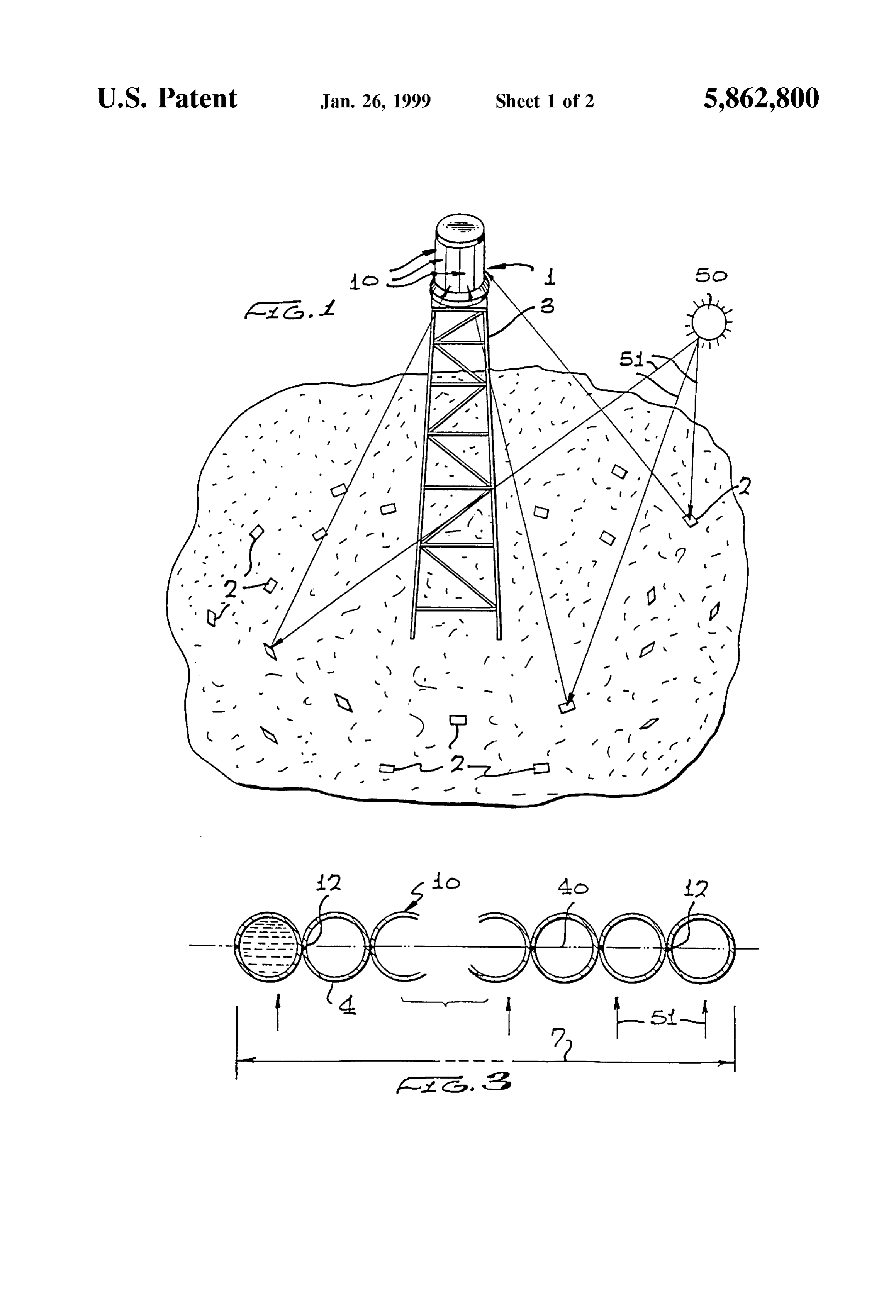
reflected by the solar plant's sun collection field (heliostats) It is still another object to provide an autogenous welded onto the receiver more easily misses a Smaller receiver its and drawn tube to minimize cost and locate the Weld out of light Spillage losses are greater. Still, the reduction in 45 the Sun's flux to minimize Strain at the Weld location. thermal losses off-sets the light Spillage losses except for Other objects, advantages and novel features of the very Small receivers. Also, Smaller receivers designed to present invention will become apparent from the following achieve their reduced size by improved material properties, detailed description of the invention when considered in Such as; a lower coefficient of thermal expansion combined conjunction with the accompanying drawings. with a greater thermal fatigue Strength have lower fluid flow 50 preSSure losses and reduced capital costs because they have BRIEF DESCRIPTION OF THE DRAWINGS fewer shorter tubes of a diameter like the lesser materials larger size receiver. FIG. 1 is a configuration Sketch of a cylindrical, molten Salt Solar central receiver with a Surround heliostat field.
SUMMARY OF INVENTION FIG. 2 is an isometric view of a typical molten Salt, Solar
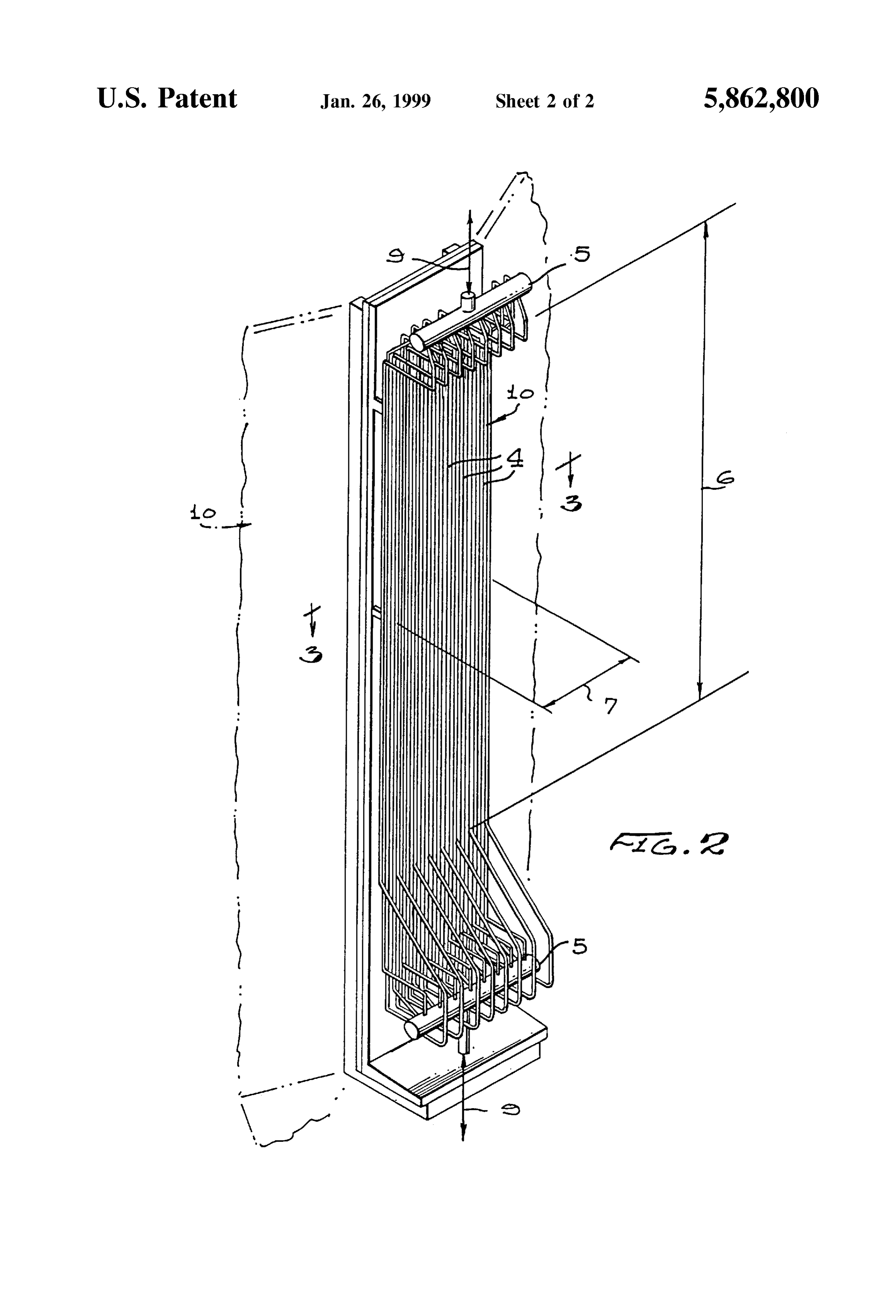
This invention uses low cycle fatigue 625 alloy construc absorption panel.
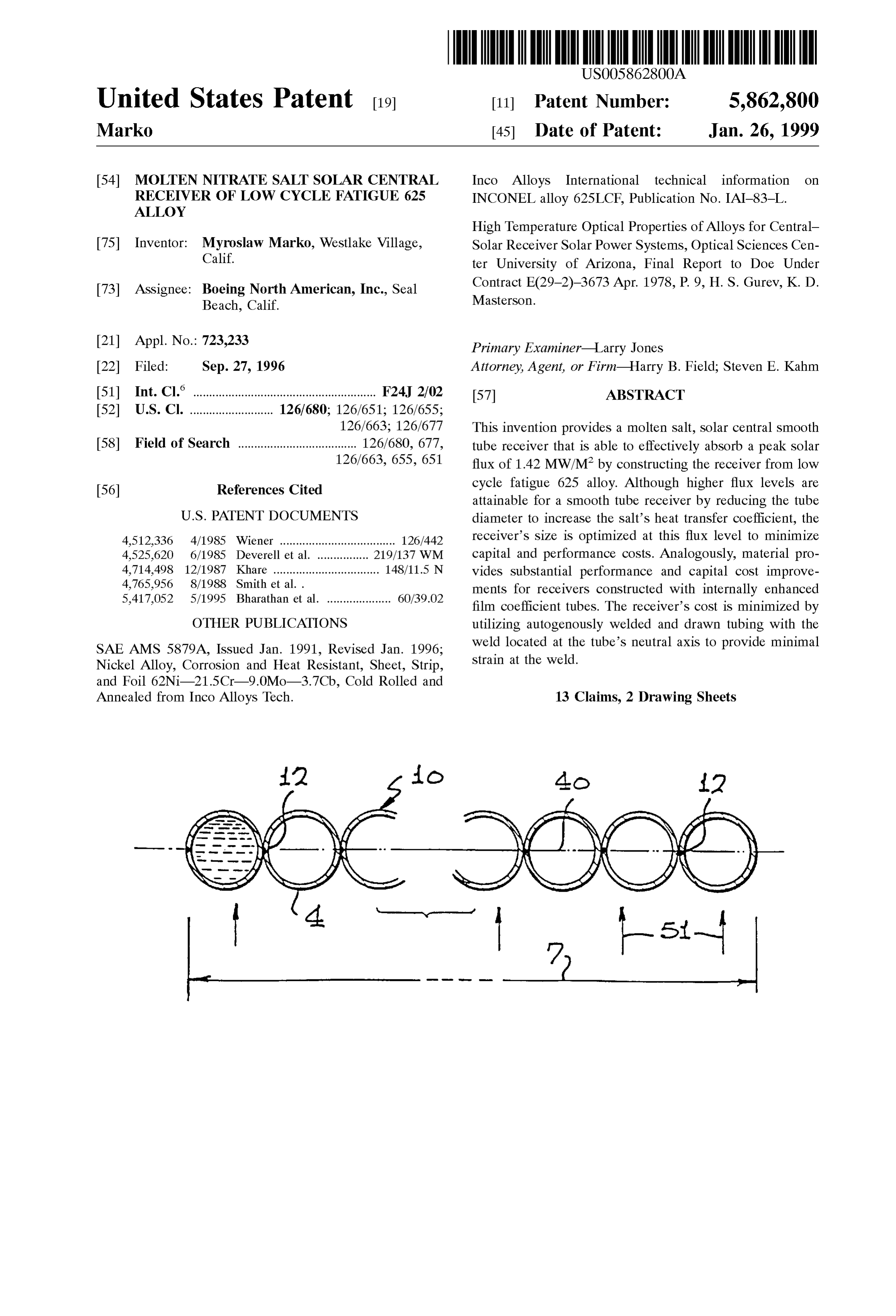
tion material to provide the Smallest, most reliable, efficient FIG. 3 is a detailed cross section view of the panel's Solar and economical molten nitrate Salt, Solar central receiver. absorption tubes showing the autogenous tube weld loca The low cycle fatigue 625 alloy receiver is substantially tion.
smaller than one constructed from 304,316 or Incoloy 800 60 DETAILED DESCRIPTION OF THE because its Smaller coefficient of thermal expansion, com PREFERRED EMBODIMENT bined with its higher allowable thermal fatigue strain levels at higher metal temperatures, permits a significant increase This invention relates to materials used to contain the high in Solar flux onto the receiver. temperature Sodium-potassium nitrate Salt heat transport Low cycle fatigue 625 alloy possesses: excellent base 65 fluid in Solar central receivers. These receivers may be of the metal and weldment resistance to corrosion from 605 C. cavity, billboard or cylindrical, Surround field type and are molten Sodium-potassium nitrate Salt, high resistance to used to absorb Solar radiation for the generation of thermal
Page 5
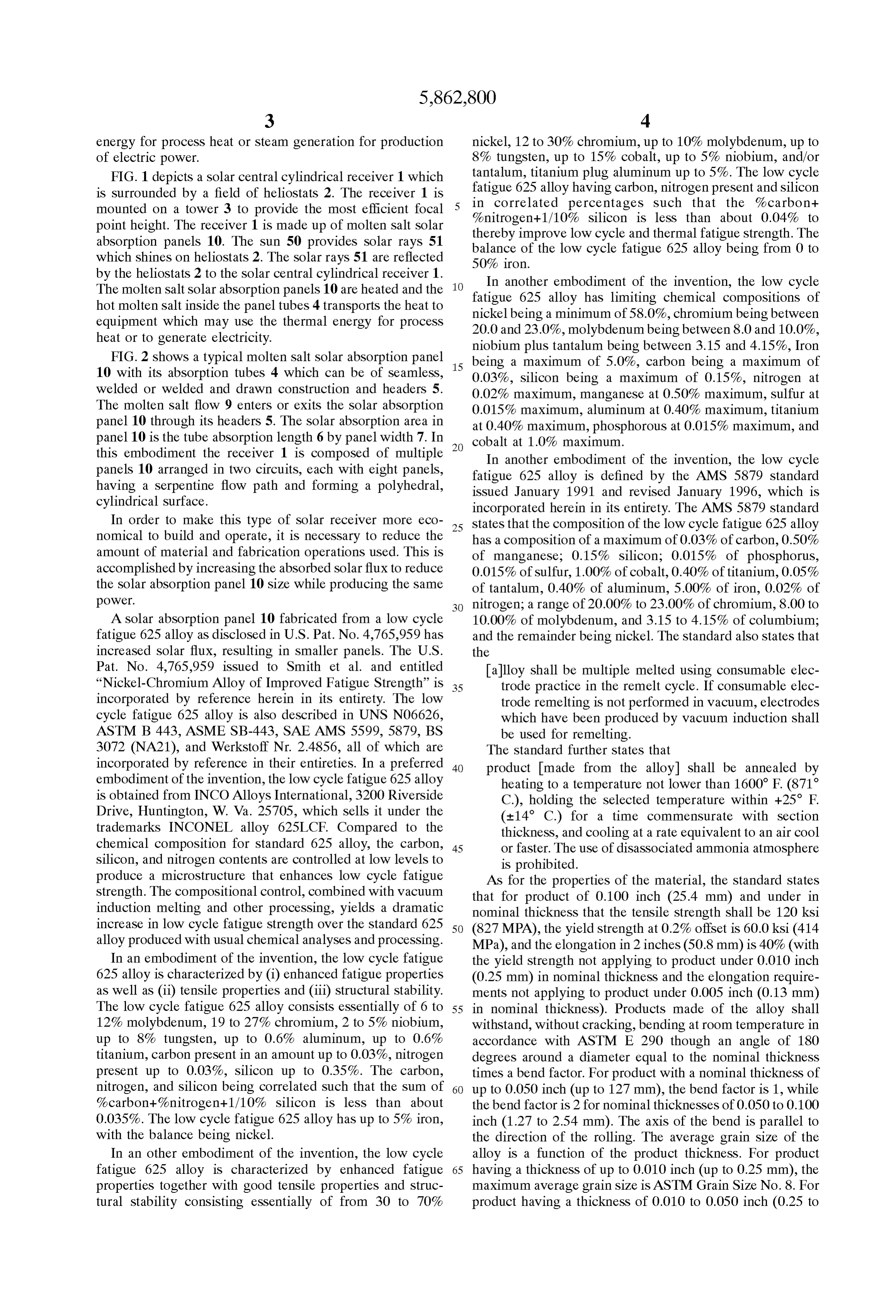
energy for proceSS heat or Steam generation for production nickel, 12 to 30% chromium, up to 10% molybdenum, up to of electric power. 8% tungsten, up to 15% cobalt, up to 5% niobium, and/or FIG. 1 depicts a solar central cylindrical receiver 1 which tantalum, fatigue 625 titanium plug aluminum up to 5%. The low cycle alloy having carbon, nitrogen present and Silicon is surrounded by a field of heliostats 2. The receiver 1 is in correlated percentages Such that the % carbon-- mounted on a tower 3 to provide the most efficient focal %nitrogen--1/10% point height. The receiver 1 is made up of molten Salt Solar thereby improve lowsilicon is less than about 0.04% to absorption panels 10. The Sun 50 provides solar rays 51 balance of the low cycle fatiguethermal cycle and fatigue Strength. The 625 alloy being from 0 to which shines on heliostats 2. The Solar rays 51 are reflected 50% iron.
by the heliostats 2 to the solar central cylindrical receiver 1. In another embodiment of the invention, the low cycle The molten salt solar absorption panels 10 are heated and the fatigue 625 alloy has limiting chemical compositions of hot molten Salt inside the panel tubes 4 transports the heat to nickel being a minimum of 58.0%, chromium being between equipment which may use the thermal energy for proceSS 20.0 and 23.0%, molybdenum being between 8.0 and 10.0%, heat or to generate electricity. niobium plus tantalum being between 3.15 and 4.15%, Iron FIG. 2 shows a typical molten Salt Solar absorption panel being a maximum of 5.0%, carbon being a maximum of 10 with its absorption tubes 4 which can be of seamless, 15 0.03%, silicon being a maximum of 0.15%, nitrogen at welded or welded and drawn construction and headers 5. 0.02% maximum, manganese at 0.50% maximum, Sulfur at The molten salt flow 9 enters or exits the solar absorption 0.015% maximum, aluminum at 0.40% maximum, titanium panel 10 through its headers 5. The Solar absorption area in at 0.40% maximum, phosphorous at 0.015% maximum, and panel 10 is the tube absorption length 6 by panel width 7. In cobalt at 1.0% maximum.
this embodiment the receiver 1 is composed of multiple In another embodiment of the invention, the low cycle panels 10 arranged in two circuits, each with eight panels, fatigue 625 alloy is defined by the AMS 5879 standard having a Serpentine flow path and forming a polyhedral, issued January 1991 and revised January 1996, which is cylindrical Surface. incorporated herein in its entirety. The AMS 5879 standard In order to make this type of Solar receiver more eco 25 States that the composition of the low cycle fatigue 625 alloy nomical to build and operate, it is necessary to reduce the has a composition of a maximum of 0.03% of carbon, 0.50% amount of material and fabrication operations used. This is of manganese, 0.15% silicon; 0.015% of phosphorus, accomplished by increasing the absorbed Solar flux to reduce 0.015% of Sulfur, 1.00% of cobalt, 0.40% of titanium, 0.05% the Solar absorption panel 10 Size while producing the same of tantalum, 0.40% of aluminum, 5.00% of iron, 0.02% of power. nitrogen; a range of 20.00% to 23.00% of chromium, 8.00 to A solar absorption panel 10 fabricated from a low cycle 10.00% of molybdenum, and 3.15 to 4.15% of columbium; fatigue 625 alloy as disclosed in U.S. Pat. No. 4,765,959 has and the remainder being nickel. The Standard also States that increased Solar flux, resulting in Smaller panels. The U.S. the
Pat. No. 4,765,959 issued to Smith et al. and entitled alloy shall be multiple melted using consumable elec “Nickel-Chromium Alloy of Improved Fatigue Strength” is 35 trode practice in the remelt cycle. If consumable elec incorporated by reference herein in its entirety. The low trode remelting is not performed in vacuum, electrodes cycle fatigue 625 alloy is also described in UNS N06626, which have been produced by vacuum induction shall ASTM B 443, ASME SB-443, SAE AMS 5599, 5879, BS be used for remelting.
3072 (NA21), and Werkstoff Nr. 2.4856, all of which are The standard further states that incorporated by reference in their entireties. In a preferred 40 product made from the alloy shall be annealed by embodiment of the invention, the low cycle fatigue 625 alloy heating to a temperature not lower than 1600°F. (871 is obtained from INCO Alloys International, 3200 Riverside C.), holding the selected temperature within +25 F. Drive, Huntington, W. Va. 25705, which sells it under the (+14 C.) for a time commensurate with section trademarks INCONEL alloy 625LCF. Compared to the thickness, and cooling at a rate equivalent to an air cool chemical composition for Standard 625 alloy, the carbon, 45 or faster. The use of disasSociated ammonia atmosphere Silicon, and nitrogen contents are controlled at low levels to is prohibited.
produce a microstructure that enhances low cycle fatigue AS for the properties of the material, the Standard States Strength. The compositional control, combined with vacuum that for product of 0.100 inch (25.4 mm) and under in induction melting and other processing, yields a dramatic nominal thickness that the tensile strength shall be 120 ksi increase in low cycle fatigue Strength over the Standard 625 50 (827 MPA), the yield strength at 0.2% offset is 60.0 ksi (414 alloy produced with usual chemical analyses and processing. MPa), and the elongation in 2 inches (50.8 mm) is 40% (with In an embodiment of the invention, the low cycle fatigue the yield Strength not applying to product under 0.010 inch 625 alloy is characterized by (i) enhanced fatigue properties (0.25 mm) in nominal thickness and the elongation require as well as (ii) tensile properties and (iii) Structural Stability.
ments not applying to product under 0.005 inch (0.13 mm)
The low cycle fatigue 625 alloy consists essentially of 6 to 55 in nominal thickness). Products made of the alloy shall 12% molybdenum, 19 to 27% chromium, 2 to 5% niobium, withstand, without cracking, bending at room temperature in up to 8% tungsten, up to 0.6% aluminum, up to 0.6% accordance with ASTM E 290 though an angle of 180 titanium, carbon present in an amount up to 0.03%, nitrogen degrees around a diameter equal to the nominal thickness present up to 0.03%, silicon up to 0.35%. The carbon, times a bend factor. For product with a nominal thickness of nitrogen, and Silicon being correlated Such that the Sum of 60 up to 0.050 inch (up to 127mm), the bend factor is 1, while %carbon--% nitrogen-1/10% silicon is less than about the bend factor is 2 for nominal thicknesses of 0.050 to 0.100 0.035%. The low cycle fatigue 625 alloy has up to 5% iron, inch (1.27 to 2.54 mm). The axis of the bend is parallel to with the balance being nickel. the direction of the rolling. The average grain size of the In an other embodiment of the invention, the low cycle alloy is a function of the product thickness. For product fatigue 625 alloy is characterized by enhanced fatigue 65 having a thickness of up to 0.010 inch (up to 0.25 mm), the properties together with good tensile properties and Struc maximum average grain size is ASTM Grain Size No. 8. For tural stability consisting essentially of from 30 to 70% product having a thickness of 0.010 to 0.050 inch (0.25 to
Page 6
S 6 1.27 mm), the maximum average grain size is ASTM Grain Because minimum System cost is the key criterion for the Size No. 6. For product having a thickness of 0.050 to 0.100 Successful development of a commercially viable Solar inch (1.27 to 2.54 mm), the maximum average grain size is power plant, the values shown in Table 1 are based on a ASTM Grain Size No. 5. In the preferred embodiment of the receiver flux distribution which is optimized to provide the invention, the tubes 4 of the panel are thin wall tubes having lowest cost receiver/heliostat field combination. a wall thickness of 0.049 inches and an average grain size FIG. 3 shows the location of the autogenous weld 12 on range of ASTM Grain Size No. 7 to 9.
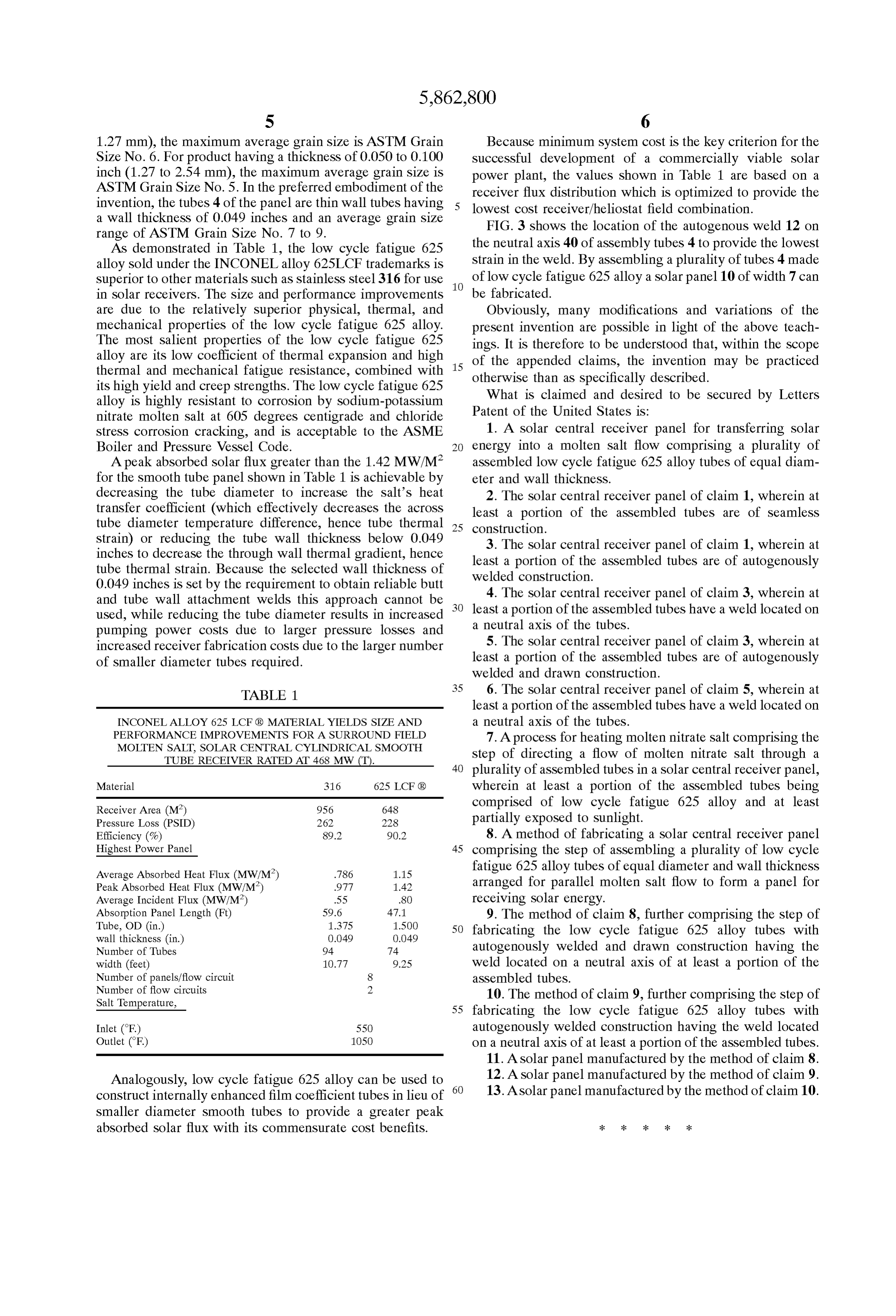
As demonstrated in Table 1, the low cycle fatigue 625 the neutral axis 40 of assembly tubes 4 to provide the lowest alloy sold under the INCONEL alloy 625LCF trademarks is strain in the weld. By assembling a plurality of tubes 4 made Superior to other materials. Such as Stainless Steel 316 for use of low cycle fatigue 625 alloy a solar panel 10 of width 7 can in Solar receivers. The size and performance improvements be fabricated.
are due to the relatively Superior physical, thermal, and Obviously, many modifications and variations of the mechanical properties of the low cycle fatigue 625 alloy. present invention are possible in light of the above teach The most salient properties of the low cycle fatigue 625 ings. It is therefore to be understood that, within the Scope alloy are its low coefficient of thermal expansion and high of the appended claims, the invention may be practiced thermal and mechanical fatigue resistance, combined with 15 otherwise than as Specifically described.
its high yield and creep Strengths. The low cycle fatigue 625 alloy is highly resistant to corrosion by Sodium-potassium What is claimed and desired to be secured by Letters nitrate molten Salt at 605 degrees centigrade and chloride Patent of the United States is:
StreSS corrosion cracking, and is acceptable to the ASME 1. A Solar central receiver panel for transferring Solar Boiler and Pressure Vessel Code. energy into a molten Salt flow comprising a plurality of A peak absorbed solar flux greater than the 1.42 MW/M’ assembled low cycle fatigue 625 alloy tubes of equal diam for the smooth tube panel shown in Table 1 is achievable by eter and wall thickness.
decreasing the tube diameter to increase the Salt's heat 2. The Solar central receiver panel of claim 1, wherein at transfer coefficient (which effectively decreases the across least a portion of the assembled tubes are of SeamleSS tube diameter temperature difference, hence tube thermal 25 construction.
strain) or reducing the tube wall thickness below 0.049 3. The Solar central receiver panel of claim 1, wherein at inches to decrease the through wall thermal gradient, hence least a portion of the assembled tubes are of autogenously tube thermal strain. Because the selected wall thickness of 0.049 inches is set by the requirement to obtain reliable butt welded 4. The construction.
Solar central receiver panel of claim 3, wherein at and tube wall attachment welds this approach cannot be used, while reducing the tube diameter results in increased least a portion of the assembled tubes have a weld located on pumping power costs due to larger preSSure losses and a neutral axis of the tubes.
increased receiver fabrication costs due to the larger number 5. The Solar central receiver panel of claim 3, wherein at of Smaller diameter tubes required. least a portion of the assembled tubes are of autogenously welded and drawn construction.
TABLE 1.
35 6. The Solar central receiver panel of claim 5, wherein at least a portion of the assembled tubes have a weld located on
INCONEL ALLOY 625 LCF (R) MATERIAL YELDS SIZE AND a neutral axis of the tubes.
PERFORMANCE IMPROVEMENTS FOR A SURROUND FIELD 7. A process for heating molten nitrate Salt comprising the MOLTEN SALT, SOLAR CENTRAL CYLINDRICAL SMOOTH Step of directing a flow of molten nitrate Salt through a TUBE RECEIVER RATED AT 468 MW (T). 40 plurality of assembled tubes in a Solar central receiver panel, Material 316 625 LCF (R) wherein at least a portion of the assembled tubes being Receiver Area (M) 956 648 comprised of low cycle fatigue 625 alloy and at least
Pressure Loss (PSID) 262 228 partially exposed to Sunlight. Efficiency (%) 89.2 90.2 8. A method of fabricating a Solar central receiver panel Highest Power Panel 45 comprising the Step of assembling a plurality of low cycle
Average Absorbed Heat Flux (MW/M) 786 1.15 fatigue 625 alloy tubes of equal diameter and wall thickness Peak Absorbed Heat Flux (MW/M) 977 1.42 arranged for parallel molten Salt flow to form a panel for Average Incident Flux (MW/M) 55 8O receiving Solar energy.
Absorption Panel Length (Ft) 59.6 47.1 9. The method of claim 8, further comprising the step of Tube, OD (in.) 1.375 1.5OO 50 fabricating the low cycle fatigue 625 alloy tubes with wall thickness (in.) O.O49 O.O49
Number of Tubes 94 74 autogenously welded and drawn construction having the width (feet) 10.77 9.25 Weld located on a neutral axis of at least a portion of the Number of panels/flow circuit 8 assembled tubes.
Salt Temperature, 10. The method of claim 9, further comprising the step of fabricating the low cycle fatigue 625 alloy tubes with
Inlet (F) 550 autogenously welded construction having the Weld located Outlet (F) 1OSO on a neutral axis of at least a portion of the assembled tubes. 11. A solar panel manufactured by the method of claim 8.
Analogously, low cycle fatigue 625 alloy can be used to 60 12. A Solar panel manufactured by the method of claim 9. construct internally enhanced film coefficient tubes in lieu of 13. A solar panel manufactured by the method of claim 10. Smaller diameter Smooth tubes to provide a greater peak absorbed Solar flux with its commensurate cost benefits.
Provenance
- Collection
- Cited prior art
- Original PDF
- patentimages.storage.googleapis.com →
- Filed
- 1996-09-27
- Pages
- 6
- Method
- pdftotext (the PDF's own text layer) + pdftoppm 300dpi page scans
- Source
- Google Patents bibliographic record
- Granted
- 1999-01-26
- Inventors
- Myroslaw Marko; Boeing North American Inc
- Transcribed from
- patentimages.storage.googleapis.com →