patent · US5356731
Molten cabonate fuel cell with sintered LiCoO2 electrode
18 October 1994
Page 1 — bibliographic record
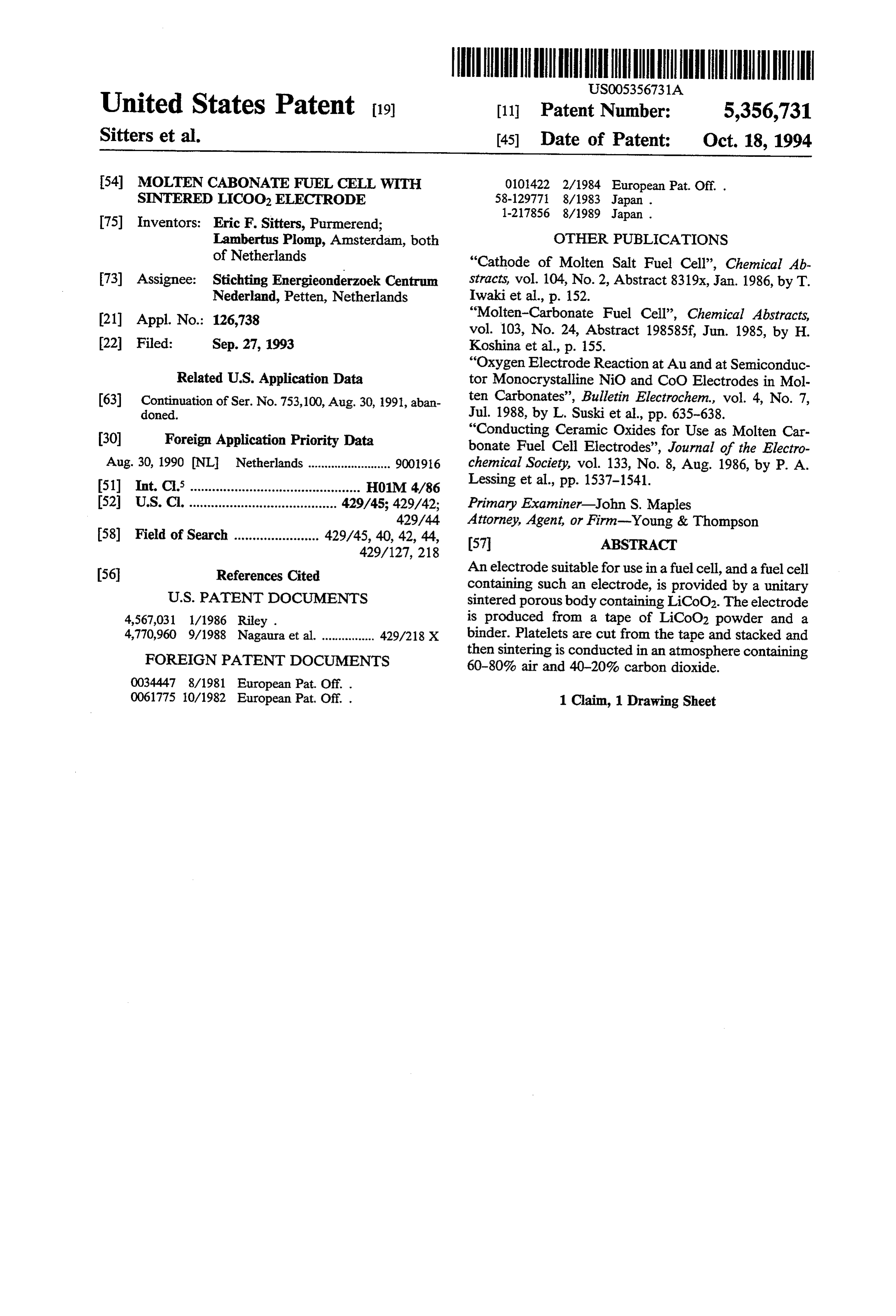
United States Patent (19) 11 Patent Number: 5,356,731 Sitters et al. (45) Date of Patent: Oct. 18, 1994 54 MOLTEN CABONATEFUEL CELL WITH 01.01422 2/1984 European Pat. Off. . SINTERED LICOO2 ELECTRODE 58-129771 8/1983 Japan .
75) Inventors: Eric F. Sitters, Purmerend;
Lambertus Plomp, Amsterdam, both OTHER PUBLICATIONS of Netherlands
"Cathode of Molten Salt Fuel Cell', Chemical Ab 73) Assignee: Stichting Energieonderzoek Centrum stracts, vol. 104, No. 2, Abstract 8319x, Jan. 1986, by T. Nederland, Petten, Netherlands Iwaki et al., p. 152.
(21) Appl. No.: 126,738 "Molten-Carbonate Fuel Cell', Chemical Abstracts,
(22 Filed: Sep. 27, 1993 Koshina et al., p. 155.
"Oxygen Electrode Reaction at Au and at Semiconduc
Related U.S. Application Data tor Monocrystalline NiO and CoO Electrodes in Mol 63 Continuation of Ser. No. 753,100, Aug. 30, 1991, aban ten Carbonates', Bulletin Electrochen., vol. 4, No. 7, doned. Jul. 1988, by L. Suski et al., pp. 635-638. 30) Foreign Application Priority Data "Conducting Ceramic Oxides for Use as Molten Car bonate Fuel Cell Electrodes', Journal of the Electro
Aug. 30, 1990 NL Netherlands ......................... 9001916 chemical Society, vol. 133, No. 8, Aug. 1986, by P. A. 511 Int. Cl............................................... H01M 4/86 Lessing et al., pp. 1537-1541. 52 U.S. C. ........................................ 429/45; 429/42; Primary Examiner-John S. Maples 429/44 Attorney, Agent, or Firm-Young & Thompson 58) Field of Search ....................... 429/45, 40, 42, 44, 57 ABSTRACT
56 References Cited An electrode suitable for use in a fuel cell, and a fuel cell containing such an electrode, is provided by a unitary
4,567,031 1/1986 Riley . is produced from a tape of LiCoO2 powder and a 4,770,960 9/1988 Nagaura et al. ................ 429/218 X binder. Platelets are cut from the tape and stacked and
FOREIGN PATENT DOCUMENTS
then sintering is conducted in an atmosphere containing 60-80% air and 40-20% carbon dioxide.
0061775 10/1982 European Pat. Off. . 1 Claim, 1 Drawing Sheet
Page 2
Drawing sheet — no readable text.
Page 3
disc is removed and the beaker is covered with a gauze.
MOLTEN CABONATEFUEL CELL WITH The solution is evaporated further until it starts to swell SINTERED LICOOELECTRODE and spontaneous ignition takes place. After ignition, the heating is switched off and the powder formed is col
This application is a continuation of application Ser. 5 lected. The powder obtained, optionally in combination No. 07/753,100, filed Aug. 30, 1991, now abandoned. with the powder originating from other similar prepara Tape suitable for use in fuel cells, electrode suitable tions, is kept at 500 C. for 8 hours in order to remove for use in a fuel cell, method for sintering an electrode of this type and a fuel cell provided with an electrode of theDeterminations carbon formed during the pyrolysis.
by X-ray diffraction showed that the
The invention relates to an electrode suitable for use powder, which still contained carbon, contains Li2CO2 in a fuel cell and to a fuel cell which contains an elec and Co. Determinations by X-ray diffraction after re trode of this type. moval of carbon by burning to completion showed that Fuel cells are generally known and are becoming LicoO2 In has been formed.
order to prepare a suspension, the required amount increasingly important in connection with economical 15 energy conversion. of LiCoO2 (50 g) is mixed in a polythene bottle (500 ml) A promising type of fuel cell is the molten carbonate with the amount of carbon used (20g). 450 ZrO2 balls fuel cell, which places high demands on electrodes. The and an amount of binder (Cerbind) which is sufficient to aim is, inter alia, to obtain cathodes which have a low allow the balls to move freely (100 g) are then added. overpotential and which also have long-term stability This binder also contains plasticizer dispersant, anti against the effects of the electrodes used in such a cell. foaming agent and the like (that is to say the usual addi The use of a cathode of lithium-containing nickel tives for the production of tape). The mount of binder oxide (NiO) is known. used depends on the amount of carbon (see Table A). A tape has now been found which is characterized in Dichloromethane (CH2Cl2) is added for dilution. The that said tape contains LiCoO2. A tape of this type can 25 mixture is then rolled for 2 hours on a roller bench (90 be produced in a manner known perse using LiCoO2 revolutions per minute).
and a binder. Expediently, a plasticizer and/or disper The suspension is poured off from the balls, freed sant and/or anti-foam anti-foaming agent is used to from air under reduced pressure and then processed on gether with the binder, as is known perese for the prep a teflon-coated glass plate to give a tape. The tape cast aration of tapes. ing speed is 1.25 m/min. The leading blade is set at 2.25 Platelets can be produced from such a tape, which mm and the second blade at 2.00 mm. After the tape has platelets can then be sintered, optionally after stacking. formed, the tape is dried in air for some time under a Sintering is expediently carried out in an atmosphere drying cap.
consisting of 60 to 80% air and 40 to 20% carbon diox TABLE A ide, in particular 68 to 72% air and 28 to 32% carbon 35 dioxide. A suitable temperature program is chosen for Data on starting materials for suspension preparation sintering. Good results are obtained by heating to 250 Powder Carbon Binder CH2Cl2
C. at a heating rate of 100° C. per hour, then heating to 450 C. at a heating rate of 50° C. per hour, then heating 50.00
at a heating rate of 100° C. per hour to the desired 40 62.34 1.37 201.30 49.20 sintering temperature of 800 to 1000 C. and finally, 42.54 10.61 100.00 25,05 after sintering, cooling to room temperature at a rate of 60.00 15.01 166.68 80.02 100 C. per hour. Of course, the invention also relates to 42.57
fuel cells which are provided with a material according 47.31 0.00 80.00 47.56 to the invention. 45 50.59 33.79 176.13 54.84 Carbon is incorporated in the tape in order to give the material the desired porosity. The carbon is in the form of grains having an average size of 30 to 34 micrometers Prior to sintering, a number of circular platelets of the and is incorporated in an amount of 10 to 40% by desired diameter (depending on shrinkage) are punched weight. SO from the tape to be used. These platelets are placed on The carbon burns during sintering and then leaves top of one another and, under a gas mixture of 70% air openings behind. and 30 CO2 (dry cathode gas) in a tubular furnace, are
EXAMPLE I
C. at 50° C. per hour and finally to the desired sintering
The starting material used was 1 mol of metal solu 55 temperature (between 800° C. and 1000 C) at 100° C. tion consisting of 0.5mol of Li originating from LiNO3 per hour. After sintering, the stack is cooled to room and 0.5 mol of Co originating from Co(NO3)2.6H2O to temperature at 100° C. per hour. The sintering platelets which 1.5 mol of citric acid and 2.25 mol of ammonium are characterized with the aid of X-diffraction, elec nitrate have been added. tromicroscopy, atomic absorption spectroscopy and Hg The starting materials are dissolved in demineralized porosimetry.
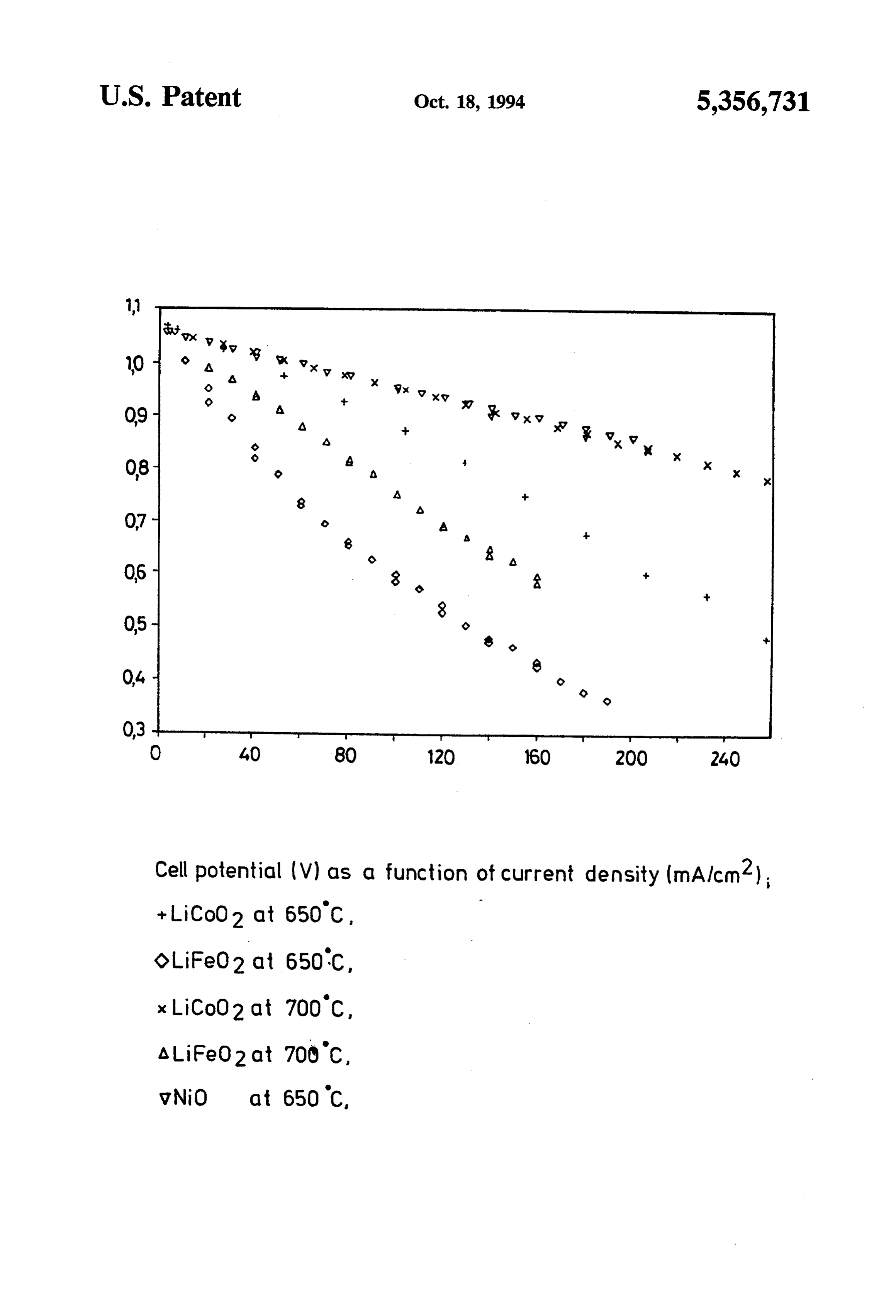
water, with stirring and gentle warming. A 1.5 liter In the same way as LiCoO2, LiFeO2 was also pro stock solution is made in order to prepare 100g of pyro duced and processed to form electrodes. lyzed powder. Perignition 75 ml are introduced into the EXAMPLE II 3 l elongated (quartz) beaker. In order to prevent con densation on the walls, the beaker is wrapped in heating 65 Cathodes were produced by means of tape casting tape. from an LiCoO2 powder and an LiFe02 powder. The The solution in water is evaporated with (magnetic) cathodes obtained were tested in laboratory cells hav stirring until a viscous solution has formed. The stirrer ing a surface area of 3 Cm2. The results obtained using
Page 4
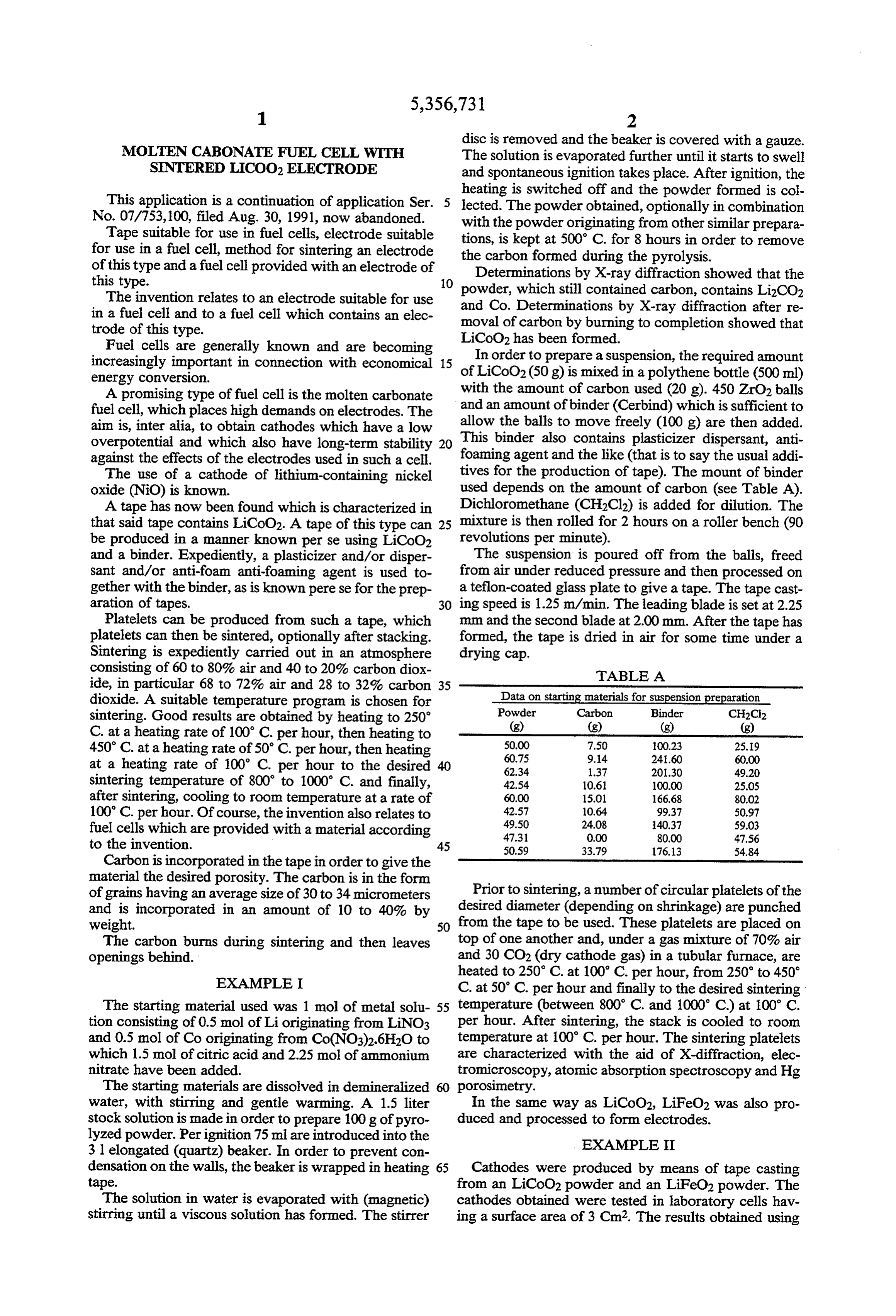
these materials and the results obtained using the known characteristic of reactants and products in the carbonate NiO cathode are shown in Table B and the figure. (film) of the moistened electrode. Consequently it is For comparison, the figures for known, lithium-con expected that i, is dependent on the porous microstruc taining NiO cathodes are included in the Table. ture and only to a lesser extent on intrinsic material It can be seen from the data that LiFeO2 cathodes characteristics. The temperature will also have a small show a poor cell performance, which is essentially inde effect unless chemical reaction occur in the carbonate pendent of the porous microstructure. The ohmic losses film, which reactions have a highly temperature are high (about 4 times those of a conventional NiO dependent rate of reaction. It is pointed out that the i, cathode). The poor performance is mainly the conse values which are obtained are all of the same order of quence of a high polarization (6 times that of NiO). At 10 650 C. the cell performance is poor. Raising the cell magnitude. The porous microstructure of LiCoO2 and temperature to 700° C. does give an improvement in the LiFeO2 are also very similar to one another. cell performances as a consequence of the reduction in the polarization, as a result of which a more linear IV T - 650 C. 700° C. characteristic is obtained. The LiFeO2 cathodes used 15 here are doped with 3 mol % magnesium. Repeating the Cathode material
Vel
nkath
(iR)kath Vicel
mkath
test with cathodes to which Co has been added in place LiFeO2 435 357 148 530 250 140 of Mg leads to hardly any change in the characteristics. LiCoO2 745 80 180 880 50 80 An appreciably better performance is obtained in the NiO 900 53 35 900 53 35 case of the LiCoO2 cathode. The polarization is appre 20 ciably lower.
Table C shows several current densities which are TABLE C obtained for the total surface area as determined using T is 650 C. T - 700 C. Hg porosimetry. It can be seen from the results that the Cathode Aer io i io i1 characteristics of NiO cathodes are predominantly con 25 material (m) io/i (mA/cm) io/i (mA/cm) trolled by the mass transfer (i.e/i, approximately 5). It NiO 0.22 5.0 3.4 0.7 Ow was indeed already known that the kinetic characteris LiCoO2 0.15 2.0 10 0.5 41 36 0.9 tic of NiO cathodes is fast. In the case of LiCoO2 cath LiFeO2 0.15 0.03 0.05 .3 1.2 0.5 0.4 odes mass transfers and kinetic characteristic are ap proximately equally significant (io/i, approximately 2). 30
LiFeO2 cathodes are mainly controlled by kinetic char We claim:
acteristic (i/i, approximately 0.03). At a temperature of 1. A molten carbonate fuel cell containing an elec 700 C. the characteristic of the LiCoO2 cathode is trode which is a unitary sintered porous body of Li more controlled by the mass transfer. The limiting cur CoO2.
rent density i, is mainly determined by the transport 35 k . . . .
Provenance
- Collection
- Cited prior art
- Original PDF
- patentimages.storage.googleapis.com →
- Filed
- 1993-09-27
- Pages
- 4
- Method
- pdftotext (the PDF's own text layer) + pdftoppm 300dpi page scans
- Source
- Google Patents bibliographic record
- Granted
- 1994-10-18
- Inventors
- Eric F. Sitters; Lambertus Plomp; Energy Research Centre of the Netherlands
- Transcribed from
- patentimages.storage.googleapis.com →