patent · US5695650
Method for dewatering previously-dewatered municipal waste-water sludges using high electrical voltage
9 December 1997
Page 1 — bibliographic record
United States Patent (19) 11 Patent Number: 5,695,650 Held 45) Date of Patent: Dec. 9, 1997
54 METHOD FOR DEWATERNG PREVIOUSLY. FOREIGN PATENT DOCUMENTS DEWATERED MUNCPALWASTE-WATER 2327965 6/1977 France ................................... 210/609 SLUDGES USNG GE ELECTRICAL 53-91468 11/1978 Japan ..................................... 210/748 WOLTAGE 60-25597 8/1985 Japan.
76 Inventor: Jeffery S. Held, 431 W. Oakdale #4A, OTHER PUBLICATIONS Chicago, Ill. 60657 "The Microbiology of Waste Disposal", chapter 36, Gaudy et al., The Microbiology of Waste Waters, W.B. Saunders & 21 Appl. No.: 552,226 Comp., 1971.
22 Filed: Nov. 2, 1995 "Bacteria Cell Wall," Curtiss, Microbiology, 1976, W.W. Norton & Co.
(51) Int. Cl. ..................................... CO2F1/461 Sterilization Methods used in microbiology, Morrisey et al. 52U.S. C. .......................... 210/748; 205/742; 20.5/751; Sterilization Technology, 1993. 210/609; 210/764; 210/768; 422/22 "Pulsed High Electric Field Sterilization", by R.P. Gupta. 58 Field of Search .................................. 205/742, 751; "Controlling Fluid Flow with Porous Metals", Machine 210/609, 748, 764, 768, 769, 808, 315, Design, Jan. 8, 1987.
323.1, 323.2, 497.01, 497.3; 422/22 "Porous Metal Products" products brochure, Newmet Ther met Krebsoge Company.
56) References Cited "Heliflow Heat Exchanger” product brochure, Graham Mfg.
"Marlen OPTT Series PumpStuffer" product brochure.
3,280,982 10/1966 Barto...................................... 210315 3,397,140 8/1968 Dea ................. ... 210/609 Primary Examiner-Peter A. Hruskoci 3,913,500 10/1975 Paccione et al. ... 108 P Attorney, Agent, or Firm-Milton S. Gerstein; Marvin N. 3,962,069 6/1976 Inoue et al... ... 204/300R Benn 4,043,047 8/1977 Galliker ... ............. 34/1 4,101,400 7/1978 Pepping . 204/180 R 57 ABSTRACT 4,193,206 3/1980 Maffet .................................... 210,769 4,306,978 12/1981 Wurtz .................................... 210/750 The present invention is directed to a pulsed electric-field 4,367,132 1/1983 Bell et al. ........... ... 204/180 R system, apparatus and method for the effective disinfecting 4,561,953 12/1985 Muralidhara et al. ... 204/132.3 and dewatering previously-dewatered, biologically active 4,608,179 8/1986 Deal ..................... ....... 210/748 waste-water sludges (e.g., municipal waste-water sewage 4,655,932 4/1987 Roslonski ........ ... 20709 sludge) in an efficient manner, so as to dramatically reduce 4,671,874 6/1987 Fremont et al. . ... 210/243 the resulting volume of the inert waste material which has to 4,747,920 5/1988 Muraidhara et al. 204/82.3 be disposed of by the municipality. The method employed 4,755,305 7/1988 Fremont et al. ... ....... 210/748 sequentially consists of hydraulically pressurizing the pre 4,861,496 8/1989 Diaz. ................ ....... 210748 4,971,705 11/1990 Roslonski ....... 210/742 viously dewatered sludge, pre-heating the previously dewa 5,026,484 6/1991 Juvan ......... ....... 205/742 tered sludge to a predetermined temperature range, exposing 5,034,111 7/1991 Kondo et al. ... 204/300 R the previously dewatered sludge to a high energy pulsing 5,037,560 8/1991 Gayman ......... ... 210/751 electrical discharges, pressure separation of the resulting 5,043404 9/1991 Bushnell et al. ..... ......... 99/451 solids and liquid fraction, and final pressure extrusion of the 5,049,248 9/199 Muralidhara et al. ... 204180.1 separated solids through nozzles.
5,230,809 7/1993 Rosionski Doo 5,326,530 7/1994 Bridges ... 13 Claims, 4 Drawing Sheets
Page 2
Drawing sheet — no readable text.
Page 3
Drawing sheet — no readable text.
Page 4
Drawing sheet — no readable text.
Page 5
Drawing sheet — no readable text.
Page 6
METHOD FOR DEWATERNG PREVIOUSLY. the water remains associated with the biologically-active DEWATERED MUNCPAL WASTE-WATER cells which comprise the residual bio-solids waste material; SLUDGES USNG HGH ELECTRICAL a significant amount of the total water remains inside the WOLTAGE cells of this residual bio-solids waste material. That is, water molecules exist on the outside of the cells of the bio-solids
BACKGROUND OF THE INVENTION waste material, and water molecules also exist on the inside The present invention is directed to the discovery that the of the cells of the bio-solids waste material. Also, water majority of the water contained in municipal waste-water molecules are bonded between the cells of the bio-solids sludge treated by the municipal treatment plants is contained waste material. Therefore, since the individual cells of the within and between molecular cells. The water molecules 10 sludge containing the water are not dewatered using con contained within the cell, for purposes of this application, ventional dewatering techniques, as the individuals cells shall be referred to as "intra-cellular” water molecules, while have not been irreparably ruptured as a result of the con the water molecules between the cells and bound thereat via ventional dewatering techniques currently used, so that most both mechanical and electrical bonding shall be referred to of the water in the aggregate within the matrix structure of as "intercellular" water molecules. It has been the discovery 15 each cell mayflow out, it would be highly advantageous if that this intra-cellular and intercellular water makes up the this previously-dewatered, residual bio-solids waste majority of the water in municipal waste-water sludge material sludge could be further dewatered in a continuous treated at a municipal treatment plant, which intra-cellular and extended manner by substantially removing the water and intercellular water is not typically released by located within the cellular matrix, in a commercially avail conventional, municipal dewatering methods which process able process. This new approach to the further dewatering at the municipal sludge. the cellular level of the residual bio-solids waste material The present invention, also, relates to a system, apparatus would result in achieving a substantially-reduced volume and method directed to the safe and effective treatment of and mass of the residual waste material requiring disposition previously-dewatered, biologically-active, municipal waste by the municipality at the end of its waste-water treatment water sludges, and more, particularly, to a pulsed, electric cycle. Especially when compared to conventional dewater field apparatus and relate method for the disinfecting and ing techniques presently utilized by municipalities, the dewatering of previously-dewatered, municipal waste-water reduction in the overall volume and weight associated with sludges in an efficient and effective manner at the level of the this residual bio-solids waste material, will result in a individual, molecular cells of the waste material, so as to significant cost-savings to each municipality as a result of substantially reduce the resulting volume and weight of the 30 the expected future costs per ton of disposing substantially waste material which has to be disposed of by the munici less residual bio-solids waste material in an environmentally pality. safe manner, as proscribed by applicable rules and regula Presently, for all municipal waste-water sewage material, tions.
or sludge, treatment of the waste-water sludge by the After many years of study and public hearings, the EPA municipality is done in accordance with applicable rules and 35 has recently promulgated EPA 503 regulations that have regulations. However, there remains a residual bio-solids changed the applicable rules with respect to the disposition waste material which contains a significant amount of water of bio-solids waste material by municipalities. The EPA503 that has to be eventually disposed of by the municipality in regulations address and promote the safe and effective an environmentally-safe manner. Prior to disposing of this disposal of bio-solids waste material by municipalities in bio-solids waste material, the municipality will attempt to accordance with the underlying rational and supporting facts dewater this bio-solids waste material to the maximum of defining two different classes of residual bio-solids waste extent possible, in order to reduce its disposal cost and any material, Class "A" and Class "B", and of the need to have environmental impact. Conventional dewatering techniques an underlying, regulatory process which adopts a different, that are utilized by the municipal waste-water treatment regulatory approach for each of the two classes of residual plants are commonly referred to as (i) a "belt filter" type 45 bio-solids waste material, and, thereafter, closely regulating press, which is a system of multiple rollers and mesh belts the acceptable avenues of disposal for each of the two through which the bio-solids waste material is caused to classes of bio-solids waste material. The difference between travel between, and which cooperate to squeeze some of the Class "A"bio-solids waste material and Class"B"bio-solids water from the bio-solids waste material; or (ii) a dedicated, waste materials is directed to the active burden facing the in-line, centrifuge apparatus of some sort, which uses cen disposal thereof. Class "A" bio-solids waste material is a trifugal force to squeeze some of the water from the bio biologically-inert, non-active waste material, and there are solids waste material; or (iii) a plate and frame filter press no limitations on the disposition of Class "A" bio-solids with hydraulic or mechanical drive, which uses mechanical waste material by the municipality. However, Class "B" pressure to dewater discrete batches of the bio-solids waste bio-solids waste material is a biologically-active waste material. On a typical day in a typical treatment-plant, the 55 material, which may be pathogenic, and, as a result, the bio-solids waste sludge that is treated by the municipality disposition of Class "B" bio-solids waste material by the will result in amaterial mixture containing greater than 90% municipality is accomplished in a regulatory manner that is water-content, and less than 10% solids-content prior to the consistent with a highly controlled and regulated commodity dewatering process by the municipality. Following the at appropriate dump sites.
dewatering operation, there is nevertheless a relatively high Prior to the recent promulgation of EPA503 regulations, water content remaining in the resulting, residual, bio-solids municipally-treated waste-material, both raw and previously waste material, which residual will be concentrated to a dewatered, biologically active, non-sterile, residual bio mixture containing about 65% to 80% water-content and solids waste, could be disposed of by the local municipality about 20% to 35% solids-content at the output-end of the by lake, ocean or river dumping; this often resulted in the municipality's waste-water treatment apparatus. unfortunate result that the various waters used for disposal An underlying technical problem not addressed nor appre would become wild with algae bloom, and the like, indicat ciated by conventional dewatering techniques is that most of ing severe nutrient enrichment of the water, to the detriment
Page 7
of adjacent land owners and downstream water users. Now, Another object of the present invention is to provide a low EPA503 regulations effectively prohibit the disposal of any cost conversion of Class 'B' bio-solids to Class "A" bio residual bio-solids waste material by municipalities in this solids.
manner. After the promulgation of EPA 503 regulations, A still further object of the present invention is to provide there are currently only three approved options that can be a densified and pelletized end-product suitable for conve used for the disposal of bio-solids waste material, namely: nient storage and land application without need of special (1) incineration; the burning of bio-solids waste material in ized equipment.
accordance with existing rules and regulations; (2) landfill It is still another object of the present invention to provide ing; there are now specialized landfills (e.g., Class D landfills) that to which the municipality can transport the a method for intercepting previously-dewatered bio-solids, bio-solids waste material for disposal; and (3) land applica municipal waste-water sludge prior to the disposal thereof, tion; where the bio-solids material is used as a fertilizer without interrupting the process flow of the municipal and/or soil enhancer. Option (3), land application, is gov waste-water treatment plant.
erned by the classification of the residual bio-solids material, It is still another object of the present invention to provide Class "A" or Class "B". From the viewpoint of the 15 a method for pressurizing the bio-solids municipal waste municipality, this dual classification of bio-solids waste water sludge to an operating pressure of 1000 to 2000 psi. material presents the opportunity to utilize new technology It is still another object of the present invention to provide to solve the bio-solids waste disposal problem as a result of a method
EPA503 regulations. Of the above options, (1) and (2) above operatingfor thermally conditioning the bio-solidsflow to an temperature of 40° to 60° C.
are the most expensive, with all of the inherent character istics associated with a very highly regulatory environment. It is still another object of the present invention to provide Obviously, it would be a great advantage if a municipality a method for cellular rupture via high voltage D.C. pulse at could end up with a process to treat previously dewatered an amplitude of 15,000 to 30,000 volts/CM, or of a variable waste material in a manner which will safely and effectively and sufficient duration.
convert, at the cellular level. Class "B" bio-solid waste It is still another object of the present invention to provide material, which is high regulated with respect to the disposal 25 a method for separation of solids and liquids within the thereof by the municipality, into a safe Class "A" bio-solids bio-solids flow.
waste material, which the municipality can then dispose of It is still another object of the present invention to provide in any permissible environmentally safe manner, which allows the municipality to dispose of the solids waste a method for extrusion of pressurized, thermally material in a less costly and less regulated manner. Such a 30 conditioned, electrically disrupted and separated bio-solids novel disinfecting and dewatering process would operate at flow into pellets of various size geometrics. the cellular level of the bio-solids waste material to rupture It is still another object of the present invention to provide the cell wall in a manner non-repairable by the cell structure, a method for collection, metering, and return to process of thereby facilitating the internal water and related materials the separated liquid fraction of the bio-solids flow. within the cell to be squeezed out of the cell structure, so that 35 In accordance with an illustrative embodiment of the such is no longer actively contained within the cell structure present invention there is provided a pulsed electric-field by the cell. The resulting material is a safe, biologically system for the disinfecting and dewatering of biologically inert, solid material.
Furthermore if such a novel disinfecting and dewatering comprisingactive, previously-dewatered, waste-water sludge material, process could be easily added to existing municipal waste waste in combination: means for pressurizing the water sewage treatment plants in a manner which would not means for heating material to a predetermined range of pressurization; require any redesign of the waste-water treatment process or temperature the waste material to a predetermined facility, local regulatory approval, and in a manner to range, the heating means operatively coupled to the pressurization means; means for converting the facilitate a non-disruptive convenient retrofitable add-on biologically-active module without any disruption to the municipality's conversion means operatively waste material into inert material, the on-going operations with respect to its existing and regu 45 coupled to the heating means; lated waste-water sewage treatment facility at the very end mined means for filtering the inert waste material in a predeter of existing waste-water treatment facilities, such would be a converting manner, the filtering means operatively coupled to the great advantage to the industry. means; and means for discharging the inert waste material in a predetermined manner, the discharge means
It is known to kill indigenous microorganism, inoculated operatively listeria, yeasts and molds in a pumpable material, such as biologically-active coupled to the filtering means, whereby the milk, juice, raw eggs, and the like, by exposing the material waste material andwaste the material is transformed into inert resulting volume of inert waste to multiple, short pulses of electrical energy in the range of material requiring disposition is substantially reduced. 10-30KV. range. The electrical field pierces through, and, finally, causes the irreparable rupture of the affected cells of Briefly, according to one embodiment of the present the microorganisms. By breaking down these cells, and 55 invention, a method is further provided for the disinfecting preventing their self-repair mechanisms from repairing the and dewatering of biologically-active previously dewatered cell-membrane damage, the food-product is safer, and the waste-water sludge material, comprising the steps of: pres shelf-life of the product is extended. An example of this surizing the waste material to a predetermined range of process in disclosed in U.S. Pat. No. 5,048,404. pressurization; heating the waste material to a predetermined temperature range, the heating step operatively coupled to
SUMMARY OF THE INVENTION the pressurization step; converting the biologically-active Accordingly, a general object of the present invention is waste material into inert material, the conversion step opera to provide for the further dewatering of previously tively coupled to the heating step; filtering the inert waste dewatered, bio-solids, municipal waste-water sludge. material in a predetermined manner, the filtering step opera It is a further object of the present invention to provide for 65 tively coupled to the converting step; and discharging the the disinfecting of previously-dewatered, bio-solids munici inert waste material in a predetermined manner, the dis pal waste-water sludge. charge step operatively coupled to the filtering step, whereby
Page 8
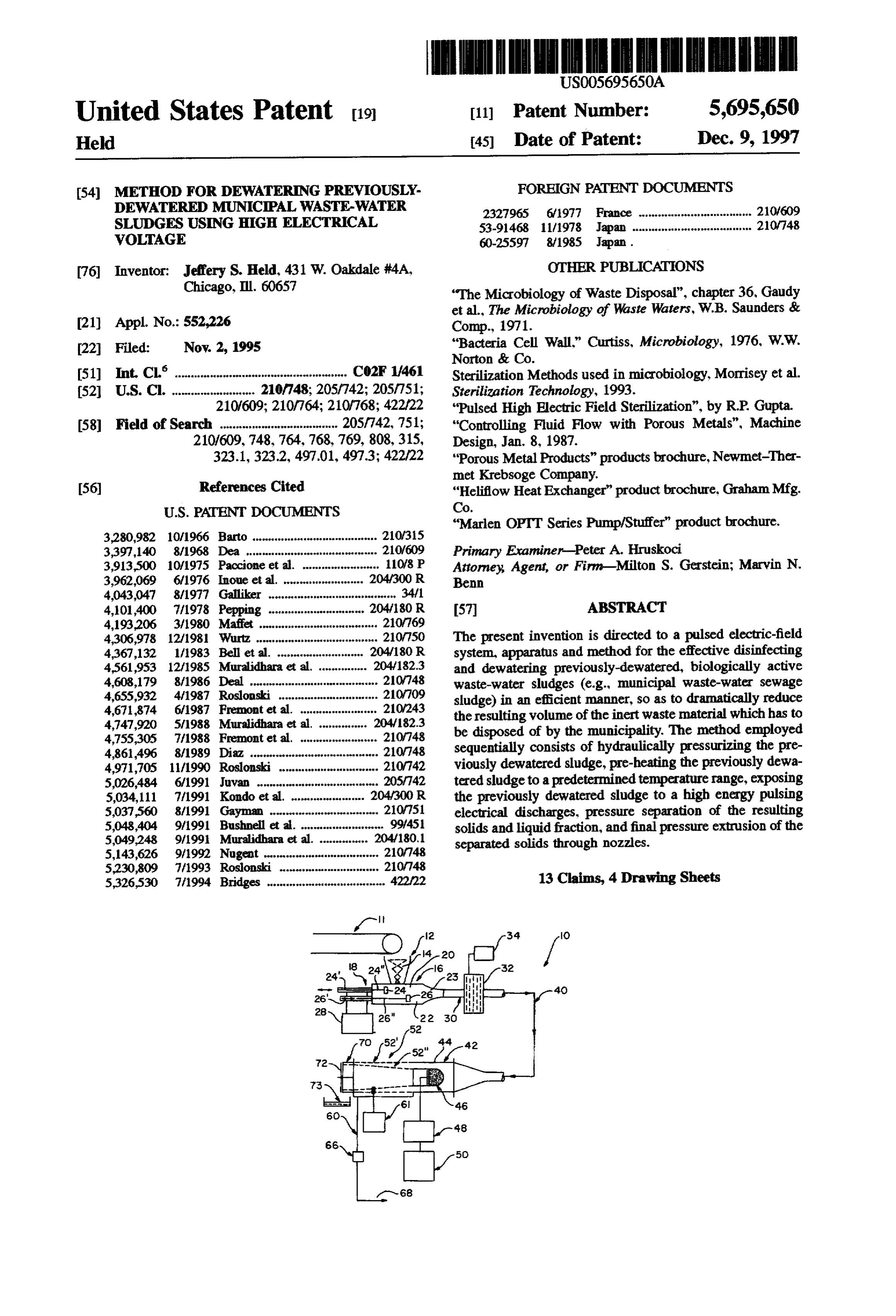
the biologically-active waste material is transformed into The input of the apparatus of the invention is a conically inert waste material and the resulting volume of inert waste shaped hopper 12 with spiral feed 14. This conically-shaped material requiring disposition is substantially reduced. This hopper with spiral feed will uniformly charge, or load, the method is called electroporation. previously-dewatered, bio-solids waste-water sludge exiting Other objects, features, and advantages of this invention the conventional dewatering apparatus via conveyer 11 into will become apparent from the following detailed descrip a double-screw auger feed-section 16 having a hydraulically tion of the preferred embodiment of this invention, as driven, self-priming positive displacement pump 18, such as illustrated in the accompanying drawings. Abel Pumps Corporation's Model "SH" with cone valves, whereby the thick-consistency sludge is pressurized. This
BRIEF DESCRIPTION OF THE DRAWTNGS 10 pressurized environment is important in order to create the The foregoing summary, and other objects, features, and driving force to the filter at the end of the process (discussed advantages of the present invention, its organization, con hereinbelow), and, also, so that the sludge may be heated struction and operation, together with further objects and without causing the generation of steam, which, if produced, advantages thereof, will be best understood from an exami would be detrimental to proper disposal. The double-screw nation of the following description of the preferred embodi s auger feed-section 16 can also be utilized to introduce ment of the invention will be better understood when read in various alkaline or acidic chemicals to enhance the elec connection with the accompanying drawings. For the pur troporation effect of the disruptor cell, discussed pose of illustrating the invention, there is shown in the hereinbelow, or to modify the pH of the bio-solids to drawings an embodiment which is presently preferred, it conform to the intended land use application, or to enhance being understood, that the invention is not limited to the the dewatering effect of the filtration module. The specific methods and apparatus disclosed. previously-dewatered, bio-solids, waste-water sludge is alternately drawn through one of two suction valves, and
FIG. 1 is a flow schematic of the process of the invention; then
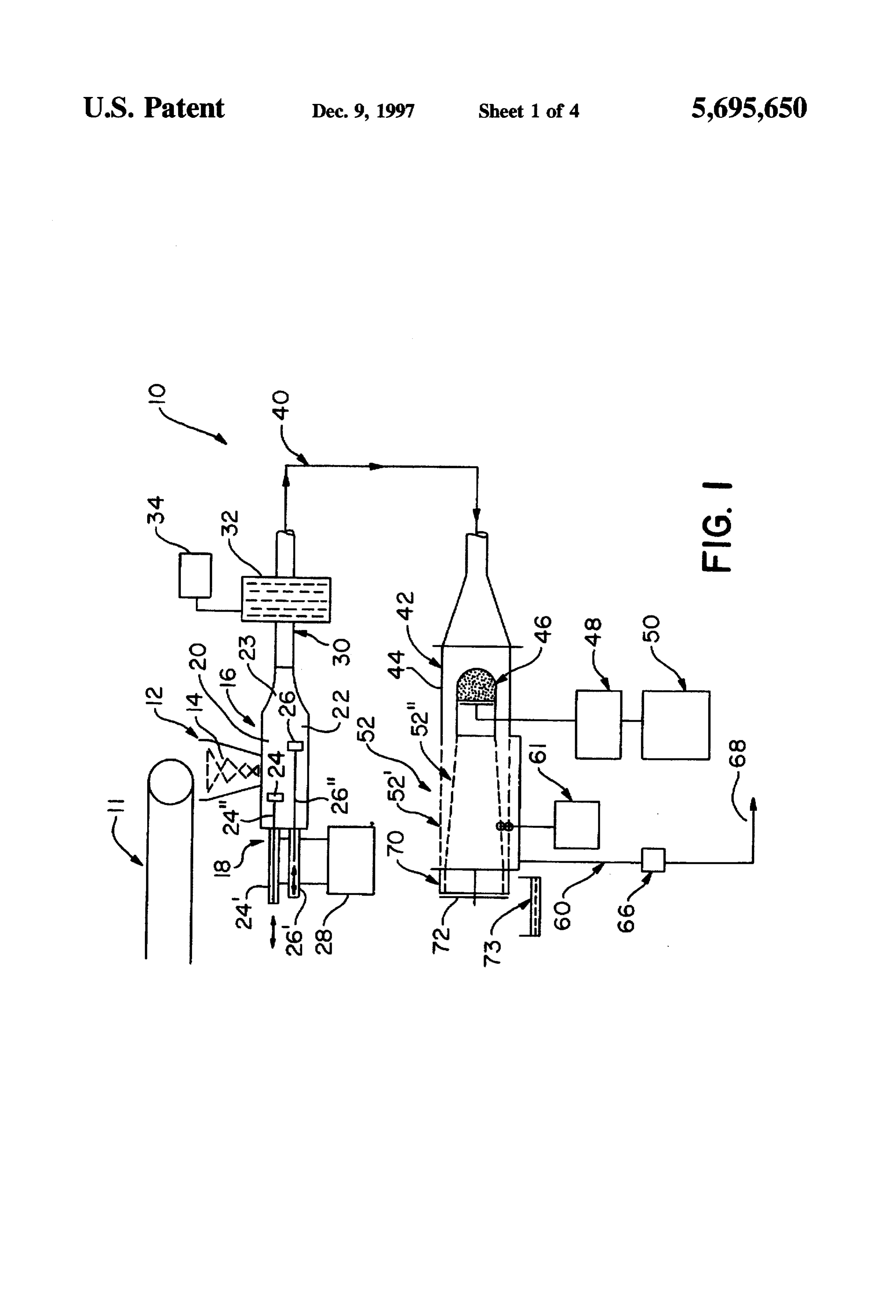
FIG. 2A is a proximate-to-scale, general arrangement of through into one of two pump cavities 20, 22, and pumped the system of the invention; one or two discharge valves into a common dis 25 charge port 23. The pump pistons 24, 26 are driven by
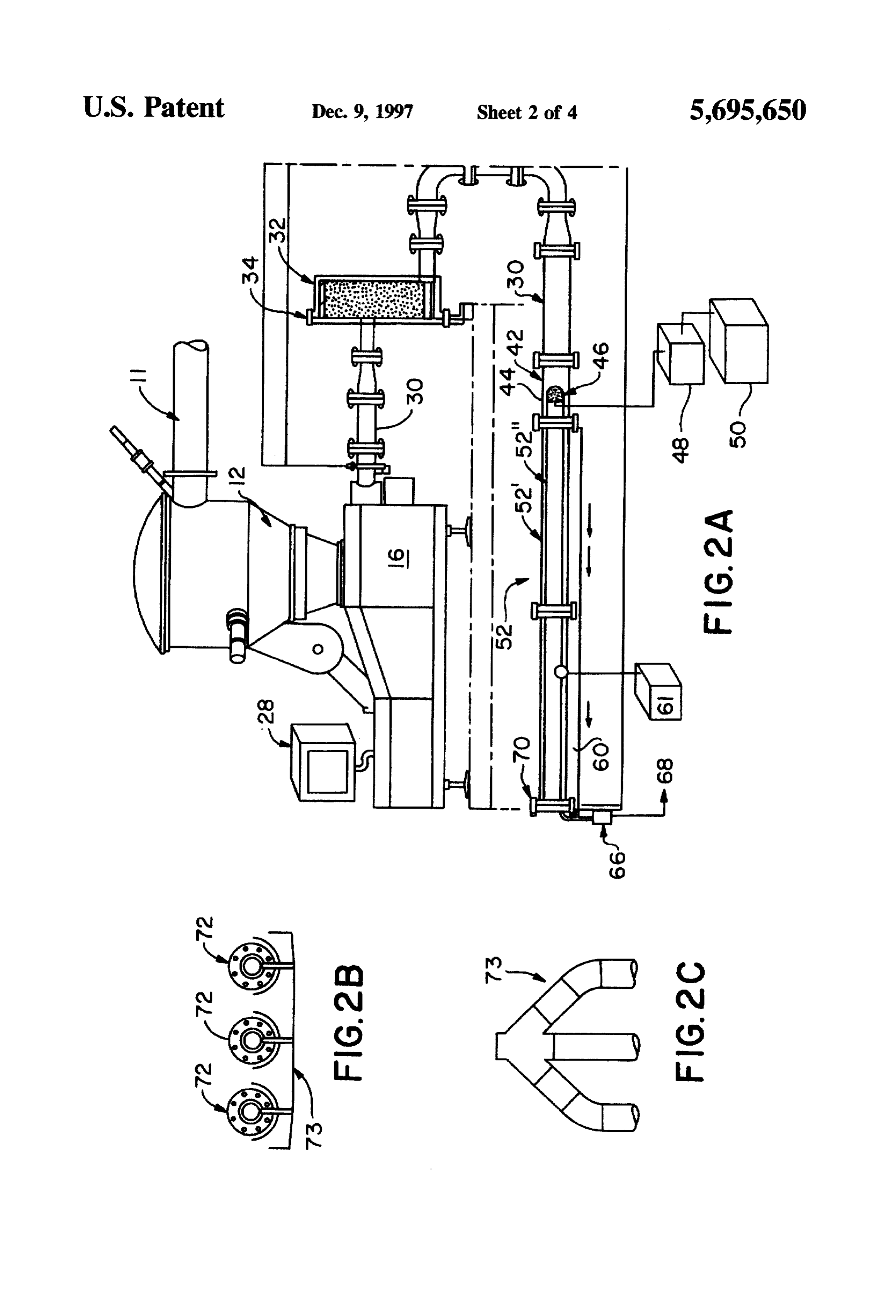
FIG. 2B is an elevational view of the pelletizing-heads hydraulic cylinders 24', 26 via piston rods 24", 26". The section of the apparatus of FIG. 2A; hydraulic cylinders are powered by a conventional hydraulic FIG. 2C is a front, elevational view of the discharging power-package 28. The common discharge port 23 is con conduits from the pelletizing-heads section of FIG. 2B to a nected via piping 30 to the inlet of a helical heat exchanger collector; 30 32, such as that manufactured by Graham Manufacturing FIG. 3 is an elevational cross-sectional view showing the Company, Model “Helixflow". The heating source 34 to the general arrangement of the disruptor cell; and exchanger is preferable low pressure steam. The exiting FIG. 4 is an elevational cross-sectional view showing the bio-solids sludge temperature is controlled via a standard general arrangement of the filtration module. thermostatic steam valve-control to a range of between 40 35 degrees C. and 60 degrees C. Temperatures below 40
DETALED DESCRIPTION OF THE degrees C. tend to depress the electroporation effect of the PREFERRED EMBODMENT disruptor cell, while temperatures above 60 degrees C. tend Referring to the drawings in greater detail, wherein like to "scale" certain types of bio-solids to the interior of the referenced numerals indicate like elements throughout, there walls of the heat exchanger. The electroporation effect is not is shown in FIGS. 1 and 2Athe apparatus 10 of the invention noticeably enhanced at temperatures above 40 degrees C. for dewatering previously-dewatered municipal waste-water The heat exchanger, also, incorporates a vent to collect sludge. The apparatus 10 of the invention is added on to the various off-gasses resulting from the heating process, in a outlet of a conventional municipal waste-water treatment conventional manner. The off-gasses are preferably col plant for dewatering bio-solids sludge. Thus, the apparatus lected via avacuum pump for subsequent, ambient discharge 10 is a secondary, or tertiary, system for the further dewa 45 or treatment as dictated by the content of the off-gasses. The tering of previously-dewatered sludge that has been dewa main purpose of venting is that the electroporation perfor tered by a primary system. Itis, of course, possible to use the mance can be enhanced by eliminating as much air as apparatus 10 alone, so that it serves as the only dewatering possible from the sludge material, and so that, as the material system; however, owing to financial restraints, it is envi is heated in the heat exchanger, there will not be included sioned that the apparatus 10 will serve to further dewater 50 vapors.
previously-dewatered sludge. From the heat exchanger 32, the thermally conditioned A conventional municipal waste-water treatment plant bio-solids continue under pressure through interconnecting typically comprises belt filter presses, centrifuges, plate and piping 40 to the disruptor cell 42, best seen in FIG. 2A and frame, or other, conventional dewatering technologies that 3. The disruptor cell 42 consists of an electrically-grounded, discharge the sludge-material via conveyor to a storage bin, 55 cylindrically-shaped, outer metallic shell or annular pipe 44, hopper, container or truck body for intermediate retention with an internal, electrically-insulated, high voltage elec prior to transit for off-site disposal. Such a conveyer is trode 46. The electrode design is such as to provide laminar indicated by reference numeral 11 in FIG. 1, and it consti flow characteristics over its leading surface into an approxi tutes the outlet, or end-point, at which the conventional mate %" (1 cm) annulus between it and the annular pipe 44, dewatering technique terminates, and the apparatus 10 of the to thereby create a uniform disruption zone. The high present invention begins to function. According to the voltage electrode 46 is generated, or pulsed, in a uni-polar or invention, instead of the output of the conveyer 11 being fed bi-polar mode, and at an amplitude of 25,000 to 30,000 volts to a truck, or the like, for off-site disposal, it is instead per centimeter, at a frequency of 3 to 5 hertz, and for a directed to the inlet of the apparatus 10 of the invention by duration dependent upon the characteristics of the bio-solids means of a variety of standard, material-handling equipment 65 material being treated. Thus, the laminar-flowing sludge is and methods that discharge the output from the conveyer 11 subject to what may be called an "electro-baric" field, which into the input of the apparatus 10 of the present invention. is an electric field exposed to constant-pressure flowing
Page 9
media. A conventional, solid-state pulse generator 48 having the bacteria or virus is broken, as occurs in the present a capacitive discharge circuit receives power from a power invention, the resulting biological material is inert thereafter. supply 50. Power switching is accomplished via a sparkgap, The pelletizing head consists of a plurality of circular plates "Thiotron", or solid state switch. The pulse control unit, the each having a circular array of holes coincident with the power supply and switching sub-system are standard com 5 annular, exit-flow channel of the filtration module. The mercially available items regularly used in the electric rotating cutter assembly shears the extruded bio-solids into power, laser, and bio-technology industries. pellets which drop onto the solids-collection conveyor The controlling principle at work within the disruptor cell which transfer the disinfected, twice-dewatered, volume? is electroporation. During the electroporation process, suf mass reduced bio-solids to the existing storage bin, hopper, ficient voltage potential develops along the molecular cell O container, or truck body for intermediate retention prior to wall to result in an imbalance of forces, which causes the transit for off-site disposal.
rupture of the molecular cell wall. Upon rupture, the cell Almost all cells in the sludge are greater than 2 micron undergoes "lysis", which is the loss of intra cellular fluids in size, and the majority of are greater than 1 micron in size, and materials. As lysis continues, the cell dies, and its liquid and some are as great as 3 to 5 micron range. Preferably, content is released, which liquid content is mostly water 15 each of the metal filter membranes 56, 56" will typically be molecules. In addition, high voltage discharges releases or a 10-micron mesh.
breaks intercellular water mechanical electrical bonds. After The metal membranes 56, 56" will have to be cleaned this disruption occurs, the bio-solids material becomes suf periodically. To do this, scrapers would be provided. ficiently biologically inert to meet Class "A" EPA 503 may be used. back-pulsing the metal membranes with steam Alternatively, standards, and, is suitable for extended dewatering.
It is also noted that the discovery of the present
The disruptor cell 42 is directly connected to, and longi invention-which tudinally axially in-line with, a filtration module 52 consist tained is, that the majority of the water con in municipal ing of two electrically charged metal filtration membranes carried out using other waste sludge is intracellular-may be 52', 52", and which is best seen in FGS. 2A and 4. The outer, techniques for irreparably rupturing the filtering membrane 52' is a concentric cylinder, or porous employed. cell membranes. For example, ultrasonic waves may be metal pipe, while the inner, filtering membrane 52" is an expanding, frustoconical-shaped metal member, such that The aspects of the present invention which are believed to the annular region between the inner and outer filtering be novel are set forth with particularity in the appended elements gradually and continually narrows or tapers along claims. While a specific embodiment of a novel pulsed the length of flow in the filtration module. This geometry 30 electro-baric system, associated apparatus, and related method, for the disinfecting and dewatering of previously between the two filtering elements creates a continual decreasing cross-sectional area along the length of the dewatered municipal residual waste-water sludge material filtration module. The concentric filtration surfaces conserve has been described for the purpose of illustrating the manner overall space while optimizing a characteristic of bio-solids in which the invention may be used and made, it should be under pressure, which characteristic is the migration and 35 by understood that although the invention has been described adherence of liquids to a contact surface, whereby the liquid reference to particular embodiments thereof, many water is separated from the solid content of the waste. The changes and modifications of the invention may become metal filter membranes that may be used are those manu apparent to those skilled in the art without departing from factured by the Porous Metal Components division of New the spirit and scope of the invention. All such modifications and changes as may reasonably and properly be included met Krebsoge, Deerfield, Ill.
The use of low voltages for aiding in filtration is a within the scope of our invention are intended to be included well-known method of separating out particles from water herein. Therefore, this invention should not be limited in scope to the particular embodiments shown and described and is also utilized on the filtration surfaces of the filters 52, 52", and produced via low-voltage supply 61. The filtration herein, but only by the true spirit and scope of the basic underlying principles disclosed in the claims that follow.
cell is operated at a pressure of between 1000 to 1500 psi, I claim:
depending upon the desired level of additional dewatering, 1. A method of dewatering municipal waste sludge con and the clarity of the liquid filtrate. The liquid filtrate is taining collected from the tapering inner metal membrane filter 52" lar cellular intra-cellular water molecules contained in molecu and the parallel outer metal membrane filter 52 via a comprising: units of the municipal waste sludge water, liquid-collection assembly 60, which consists of an external (a) pumping municipal waste sludge into a dewatering drain pan and an internal drain combining to a common apparatus;
drain to a liquid metering unit 66. The liquid metering unit is conventional instrumentation, and is used to monitor (b) destroying in the dewatering apparatus at least most of system performance. The liquid meter discharges to the the individual cellular units of the municipal waste return piping 68 of the apparatus. The tapering or narrowing 55 sludge in order to release the intra-cellular water mol annular region between the two membranes causes a con ecules contained therein; and stant pressure on the sludge as it flows. The operating (c) separating the resulting released water content from pressures within the annular region between the two metal the resulting solid content for subsequent collection; membranes will be between 1000-1500 psi, which causes said step (b) comprising irreparably rupturing the mem any remaining water in the sludge to be "squeezed out". brane of each of at least the majority of molecular The disinfected and twice-dewatered bio-solids material cellular units of the municipal waste sludge in order to exits the filtration module through a pelletizing head 70 with release the intra-cellular water molecules contained a rotating cutter assembly 72, as best seen in FIGS. 2A-2C therein by electroporating each membrane; and 4, and then conveyed in a collector-conveyer 73 for said step of electroporating comprising passing the subsequent disposal. The bio-solid material is biologically 65 municipal waste sludge at a temperature of at least 40 inert, since, whereas a normal healthy bacteria or virus has degrees C. through an electric field having a voltage of DNA which is reproducible, once the DNA mechanism for at least 25,000 volts per centimeter,
Page 10
2. The method of dewatering municipal waste sludge said step of converting comprising electroporating the containing intra-cellular water molecules according to claim previously-dewatered, biologically-active sludge mate 1, further comprising: rial with a pulsed, alternating-polarity, high-voltage (d) before said step (a), initially dewatering the municipal electric field having a voltage of at least 25,000 volts waste sludge; said step (b) being performed on per centimeter.
previously-dewatered municipal waste sludge. 9. A method dewatering municipal waste sludge that 3. The method of dewatering municipal waste sludge contains intra-cellular water molecules contained in molecu containing intra-cellular water molecules according to claim lar cellular units of the municipal waste sludge, comprising: 1, wherein said step (b) is performed on previously 10 (a) directing the flow of the municipal waste sludge dewatered municipal waste sludge. longitudinally, axially against a closed end of an inner 4. The method of dewatering municipal waste sludge pipe;
containing intra-cellular water molecules according to claim (b) thereafter, causing the municipal waste sludge to flow 1, wherein said step (c) comprises pressurizing the mixture through an annular flow volume between the inner pipe of released water and solid content in order to force the 15 and an outer pipe that is concentrically-mounted about migration and adherence of the released water to a contact the inner pipe; and surface, whereby the liquid water is separated from the solid (c) irreparably rupturing the membranes of the cellular content of the waste. units of the municipal waste sludge by passing said 5. The method of dewatering municipal waste sludge sludge at a temperature of at least 40 degrees C. containing intra-cellular water molecules according to claim through an electric field having a voltage of at least 1, wherein said step of passing the municipal waste sludge 25,000 volts per centimeter. containing water and intra-cellular water molecules through 10. The method according to claim 9, wherein said step an electric field comprises generating a pulsed, high-voltage (a) comprises causing the municipal waste sludge to have electro-baric field of between 25,000 to 30,000 volts per 25 laminar flow in at least part of the annular flow volume. centimeter, at a frequency of between 3 to 5 hertz. 11. The method according to claim 9, wherein said step (c) 6. The method of dewatering municipal waste sludge comprises generating a pulsed, high-voltage electric field of containing intra-cellular water molecules according to claim between 25,000 to 30,000 volts per centimeter, at a fre 1, wherein said step (b) further comprises: quency of between 3 to 5 hertz; said step (c) comprising pumping the municipal waste sludge against a spherical producing the pulsed, high-voltage electric field at the closed end of an inner pipe, and causing the municipal closed end of the inner pipe.
waste sludge to assume laminar flow into an annular 12. A method of dewatering municipal waste sludge region between the inner pipe and an outer, concentric containing intra-cellular water molecules contained in pipe. molecular cellular units of the municipal waste sludge water, 7. The method of dewatering municipal waste sludge 35 comprising:
containing intra-cellular water molecules according to claim (a) pumping municipal waste sludge into a dewatering 6, wherein said step of exposing the laminar-flowing munici apparatus;
pal waste sludge to an electroporating means comprises (b) destroying in the dewatering apparatus at least most of generating a pulsed, high-voltage electric field of between the individual cellular units of the municipal waste 25,000 to 30,000 volts per centimeter, at a frequency of sludge in order to release the intra-cellular water mol between 3 to 5 hertz, at the spherical closed end of the inner ecules contained therein; and pipe, whereby the spherical closed end of the inner pipe also (c) separating the resulting released water content from serves as an electrode.
8. A method of disinfecting and dewatering of previously 45 the resulting solid content for subsequent collection; dewatered, biologically-active waste-water sludge material, said step (b) comprising irreparably rupturing the mem said sludge material having individual cells of waste mate brane of each of at least the majority of molecular rial associated therewith, comprising the steps of: cellular units of the municipal waste sludge in order to release the intra-cellular water molecules contained pressurizing said previously-dewatered sludge material; therein by electroporating each membrane at a tem heating said previously-dewatered sludge material to a perature of at least 40 degrees C. with an electric field temperature of at least 40 degrees C.; having a voltage of at least 25,000 volts per centimeter; converting said previously-dewatered, biologically-active said step (b) comprising pumping the municipal waste sludge material into inert material, said converting step 55 sludge against a spherical closed end of an inner pipe irreparably rupturing at least said surface of said cells at which said step of electroporating each membrane is of waste material; carried out; and filtering said inert waste material in a predetermined directing the electroporated municipal waste sludge manner, said filtering step following said converting through an annular volume between the inner pipe and step; and a concentrically-mounted outer pipe for subsequent discharging said inert waste material in a predetermined separation of the water content of the municipal waste manner; sludge from its solid content.
whereby, the biologically-active sludge material is trans 13. A method of dewatering municipal waste sludge formed into inert waste material and the resulting containing intra-cellular water molecules contained in volume of inert waste material requiring disposition is molecular cellular units of the municipal waste sludge water, substantially reduced; comprising:
Page 11
(a) pumping municipal waste sludge into a dewatering cellular units of the municipal waste sludge in order to apparatus; release the intra-cellular water molecules contained (b) destroying in the dewatering apparatus at least most of therein by electroporating each membrane; the individual cellular units of the municipal waste s said step of electroporating comprising generating a sludge in order to release the intra-cellular water mol pulsed, high-voltage electric field of at least 25,000 to ecules contained therein; and 30,000 volts per centimeter; and (c) separating the resulting released water content from before said step (b), heating the municipal waste sludge to the resulting solid content for subsequent collection; a temperature of at least 40 degrees C. said step (b) comprising irreparably rupturing the mem 10 brane of each of at least the majority of molecular sk sk
Page 12
UNITED STATES PATENT AND TRADEMARK OFFICE
Certificate
Patent No. 5,695,650 Patented: December 9, 1997 On petition requesting issuance of a certificate for correction of inventorship pursuant to 35 U.S.C. 256, it has been found that the above identified patent, through error and without any deceptive intent, improperly sets forth the inventorship.
Accordingly, it is hereby certified that the correct inventorship of this patent is: Jeffery S. Held, Chicago, Illinois; and Anthony J. Tomasell, Libertyville, Illinois.
Signed and Sealed this Ninth Day of November 2004.
DUANE S. SMITH
Supervisory Patent Examiner
Art Unit 1724
Provenance
- Collection
- Cited prior art
- Original PDF
- patentimages.storage.googleapis.com →
- Filed
- 1995-11-02
- Pages
- 12
- Method
- pdftotext (the PDF's own text layer) + pdftoppm 300dpi page scans
- Source
- Google Patents bibliographic record
- Granted
- 1997-12-09
- Inventors
- Jeffery S. Held
- Transcribed from
- patentimages.storage.googleapis.com →