patent · US5690902
Hydrogen-powered automobile with in situ hydrogen generation
25 November 1997
Page 1 — bibliographic record
United States Patent (19) 11 Patent Number: 5,690,902 Werth 45) Date of Patent: *Nov. 25, 1997 54 HYDROGEN-POWERED AUTOMOBILE 119591 10/1918 United Kingdom................... 423/658 WITH IN STU HYDROGEN GENERATION 424622 5/1933 United Kingdom. 423/658
75 Inventor: John Werth, Princeton, N.J.
Primary Examiner-Wayne Langel 73 Assignee: H Power Corporation, Belleville, N.J. Attorney; Agent, or Firm-Salzman & Levy * Notice: The term of this patent shall not extend 57 ABSTRACT beyond the expiration date of Pat. No.
5,510,201. The new iron material and catalyst admixture of this inven tion feature a method for operating an automotive vehicle 21 Appl. No.: 477,520 that is designed to internally combust hydrogen generated in situ aboard the vehicle. The method of the invention utilizes 22) Filed: Jun. 7, 1995 hydrogen from an onboard reactor to power an automotive vehicle. Hydrogen from the onboard reactor is generated by
Related U.S. Application Data a bed of iron that is made to react with HO in the presence of an alkalihydroxide catalyst attemperatures not exceeding 63 Continuation-in-part of Ser. No. 52,561, Apr. 23, 1993, approximately 250° C. The preferred alkali hydroxide is the abandoned. hydroxide of potassium in a range of concentrations between 51 Int. Clar. CO1B 3/08 50 to 60 percent by weight, with the preferred concentration 52 U.S. Cl. ....................... 423/658; 123/3; 123/DIG. 12 being about 53%. The iron materials of this invention may 58 Field of Search ................................ 123/3, DIG. 12; comprise in situ freshly-ground particulates as an added 423/658 enhancement for the reactivity between the iron and H.O.
The particles range in diameter size from approximately 25 56) References Cited to 1,200 um, with an average-sized distribution having at least twenty percent (20%) of the particles less than 300 um
5,085,176 2/1992 Brinkley, II ............................... 1233 300 um in diameter. The average particle density ranges 5,438,961 8/1995 Peschka et al. ... from approximately 1 to 7.8 g/cc, with a non-compressed 5,462.02 10/1995 Minami et al. ... packed particle density ranging from about 1.5 to 3.5 g/cc. 5,513,600 5/1996 Teves ......................................... 1233 The particles have a surface area greater than approximately
FOREIGN PATENT DOCUMENTS
4793.07 12/1951 Canada .................................. 423/658 18 Claims, 2 Drawing Sheets
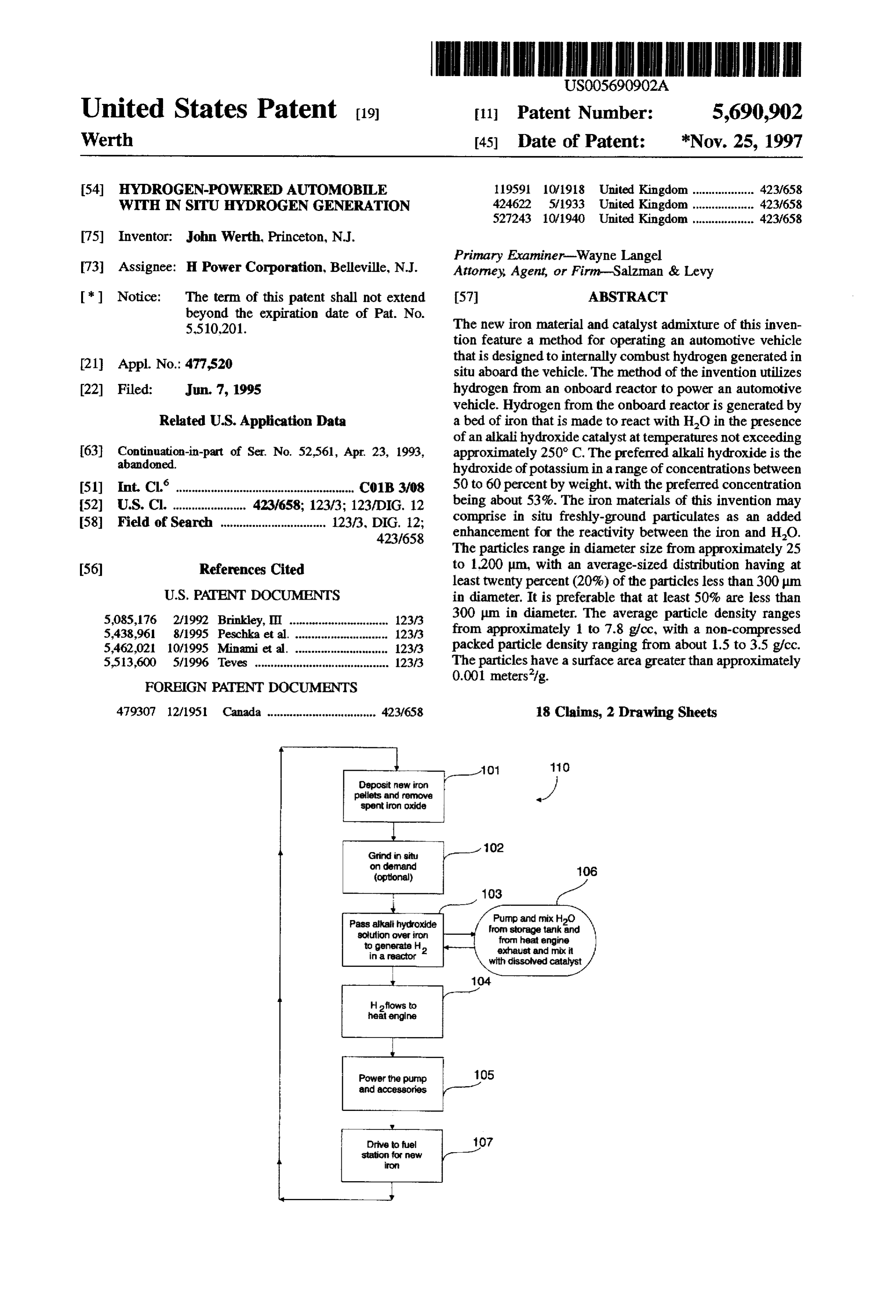
deposit new iron pellets and remove spent iron oxide
Grind in sit
on demand
Pass alkali hydroxide Pump and mix H2O solution over iron from storage tank and to generate H2 from heat engine in a reactor exhaust andmb it with dissolved catalyst
Haflows to heat engine
Power the pump and accessories
Drive to fuel station for new iror
Page 2
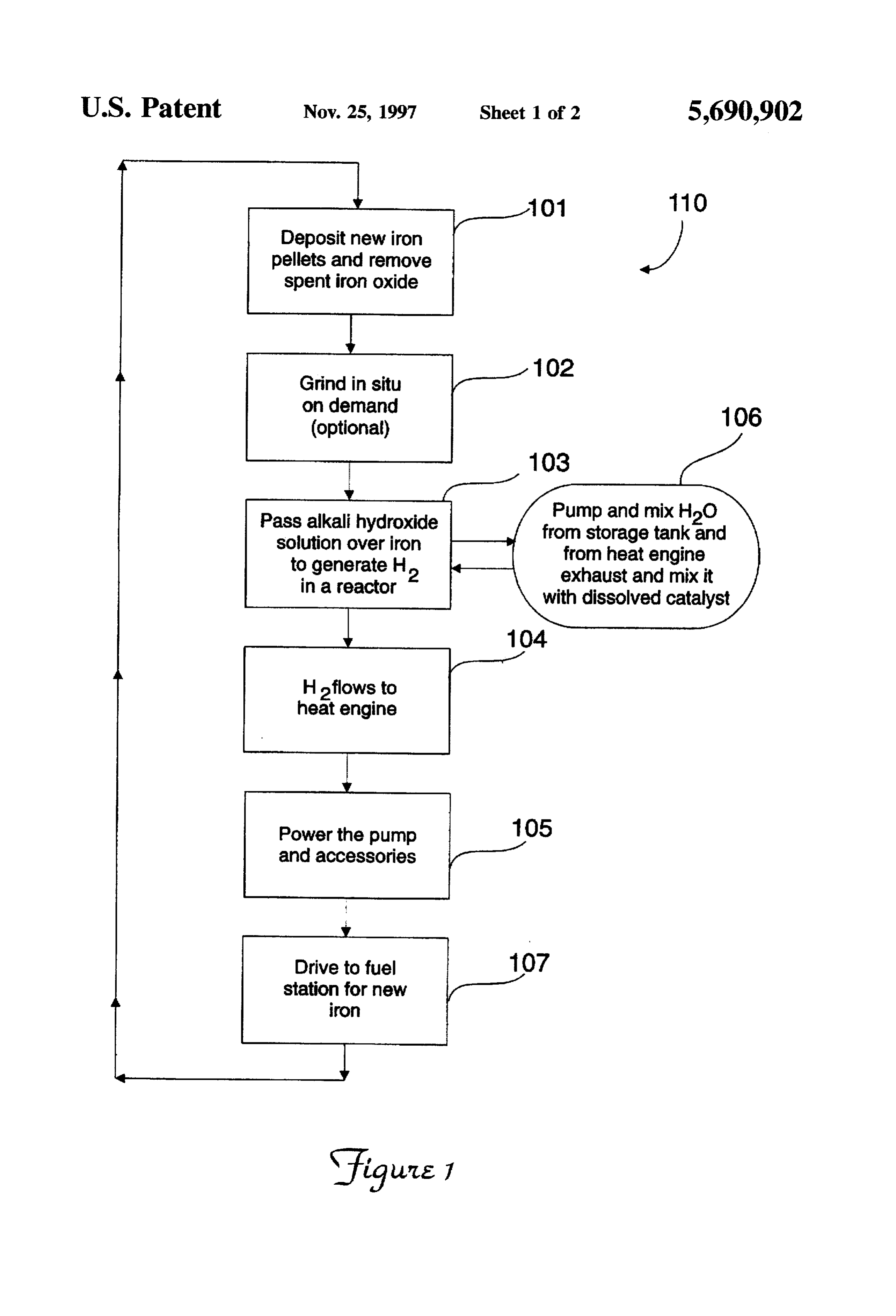
Deposit new iron pellets and remove spent iron oxide
Grind in situ
On demand
Pass alkali hydroxide Pump and mix H2O Solution Over iron from storage tank and to generate H 2 from heat engine in a reactor exhaust and mix it with dissolved catalyst
heat engine
and acceSSOries
station for new iron fig LL& 1
Page 3
Drawing sheet — no readable text.
Page 4
HYDROGEN-POWERED AUTOMOBILE prises an alkaline hydroxide and, more particularly, the WITH INSITU HYDROGEN GENERATION preferred hydroxide of potassium.
In addition to the distinctive catalyst of this invention, it
RELATED PATENT APPLICATION is additionally contemplated that an alternative process of This patent application is a continuation-in-part of PCT 5 form hydrogen generation may be obtained by using a more active application, PCT/US 9,303,825 (which was filed Apr. 23. increase of iron, to wit, freshly-ground particles of iron which 1993); and the U.S. patent application, Ser. No. 08/052,561 react at high the efficiency thereof. Such active iron is able to rates with water at lower-than-normal tempera (which was also filed Apr. 23, 1993), abandoned. Each was tures without catalysis. This alternative active-iron process assigned to a common assignee. 10 embodiment may also be combined with the catalysis
FIELD OF THE INVENTION
process, thus providing yet a third process.
The iron particles of the active-iron process are ground
The present invention pertains to a hydrogen-generating when the vehicle is initially powered and throughout vehicu process used to power automotive vehicles wherein water is lar operation. The instantaneous grinding of the iron par passed over a bed of iron material and, more particularly, to 5 ticles in situ is beneficial because iron in moist air becomes a new, catalyzed method of generating hydrogen in situ rapidly oxidized after grinding. (As early as fifteen minutes within an automobile, one that utilizes lower-than-normal after grinding, iron will lose its enhanced reactivity when temperatures when the water reacts with the iron material. exposed to moist air.) Therefore, after the initial grinding, more iron should be ground periodically onboard the vehicle
BACKGROUND OF THE INVENTION or, alternatively, freshly-ground iron fuel charges can be The generation of hydrogen by passing steam at or about injected The from sealed packets.
freshly-ground reactive iron is easily deposited in a 700° C. over a bed of iron is well known in the art. It is generally a simple way of obtaining hydrogen, which is packet(s) compartment in the vehicle. It is easily handled as sealed drawn off and dried. One of the primary uses of hydrogen can be freshly of freshly-ground particulates, but, additionally, it can be for powering land vehicles and, in particular, auto 25 particles ground in situ aboard the vehicle. The range mobiles having heat engines designed to run on hydrogen. 1,200 pum; an average-sized in diameter size from approximately 25 to This type of vehicle provides several advantages, one of least distribution is one in which at which is the absence of hydrocarbon and carbon monoxide twenty percent (20%) of the particles are less than 300 exhaust pollutants. um in diameter. It is preferable that at least 50% are less than 300 um in diameter. The average particle density ranges
The electrical automobile is currently underintense devel 30 approximately from about 1 to 7.8 g/cc, with a non opment due to the twin needs to reduce air pollution and compressed packed particle density ranging from about 1.5 conserve fuel resources. One of the major difficulties in the development of the electrical automobile is supplying the to 3.5 gfcc. The particles have a surface area greater than approximately 0.001 meters/g.
power for the electrical drive motors. Such power is cur 35 The potassium hydroxide catalyst of this invention is truly rently furnished by batteries. Present battery technology, however, is not capable of providing the energy needed to unique. old, one
As the hydrogen generation of iron and steam is very would expect that such a temperature-reducing run the automobile over extended distances at an affordable coSt. catalyst would have been discovered a long time ago. It is also unusual since many compounds and materials have
This invention shows that hydrogen can be generated in been tried, without much success.
situ (i.e., onboard a vehicle) at a low cost. This hydrogen The potassium hydroxide catalyst of this invention makes thus generated is then used to power an automotive engine. possible low-temperature reactors operating at or about 200 One well-known method, no longer in use, of hydrogen C. to 250° C.; hydrogen can be produced at high rates generation is to generate hydrogen by passing high thereby without requiring large amounts of iron in the temperature steam over a bed of iron. This method can be 45 reactor. A low-temperature reaction of this type would too expensive and impractical for automotive purposes. The normally require impractical amounts of iron in order to containers needed to generate, supply and contain the high generate enough hydrogen at the usual low activity. temperature steam can make the cost of running the vehicle However, this catalyst greatly enhances the rate of reaction too expensive. Further, the use of high-temperature steam between HO and iron, thus reducing the amount of iron can be dangerous. 50 needed for reaction with the water. For example, when using The present invention is the development of a new high-temperature steam for the hydrogen generation, a hydrogen-generating process utilizing either low medium-sized hydrogen-powered car which has its power temperature steam or liquid water. Being able to use a generated by a standard heat engine (such as an Otto cycle low-temperature process in vehicles is valuable, since it is engine) might consume about 50 pounds of iron during a quite practical. In the first instance, the need to expend 55 one-hour trip. In order to obtain the same amount of hydro energy in bringing water or steam to a high temperature is gen from a steam reaction at 250° C., more than 400 pounds eliminated. Secondly, a process that does not use high of heated iron would be required under present state-of-the temperature steam is inherently safer; it also does not require art methods; only about 50 pounds would actually react to special pressure fittings and piping. Thirdly, the utilization form hydrogen. The added weight of the iron reduces of high temperatures almost always results in reactors that mileage. The additional 350 pounds of iron would then need are large and heavy, since insulation is usually required to the requisite heat to bring it to operating temperature. In prevent heat loss; obviously, the added weight and space of other words, the additional 350 pounds of iron would be large reactors are extremely detrimental in producing a nothing short of excess baggage. The need to carry and heat low-cost, efficient automobile. more iron than is stoichiometrically required, is completely The low-temperature process of this invention is made 65 impractical.
possible by a unique catalyst, which greatly enhances the To the best of Applicant's knowledge, no catalyst has HO and iron reaction. The catalyst of this invention com been shown to be effective, practical and economical in
Page 5
accelerating the iron-water reaction attemperatures less than approximately 1 to 7.8 g/cc, with a non-compressed packed 400° C. Catalysts that have been tried without success particle density ranging from about 1.5 to 3.5 gfcc. The include sodium chloride, sodium sulfate, zinc sulfate, zinc particles have a surface area greater than approximately chloride, potassium sulfate, potassium chloride, lithium 0.001 meters/g.
bromide, calcium chloride, potassium stannate, ferrous and It is also contemplated that a third embodiment may ferric sulfate, ferrous chloride and ferric chloride. combine the freshly-ground iron process with the catalyst The preferred concentration of the potassium hydroxide process.
catalyst of this invention is approximately 53 grams of potassium hydroxide per 100 grams of solution. BRIEF DESCRIPTION OF THE DRAWINGS
At this concentration, operating at 230° C., a given A complete understanding of the present invention may be quantity of iron reacts with water to form iron oxide at a obtained by reference to the accompanying drawings, when per-minute conversion rate of 3.6%. This rapid conversion considered in conjunction with the subsequent detailed rate makes practical the use of iron to fuel automobiles and description, in which:
other land vehicles.
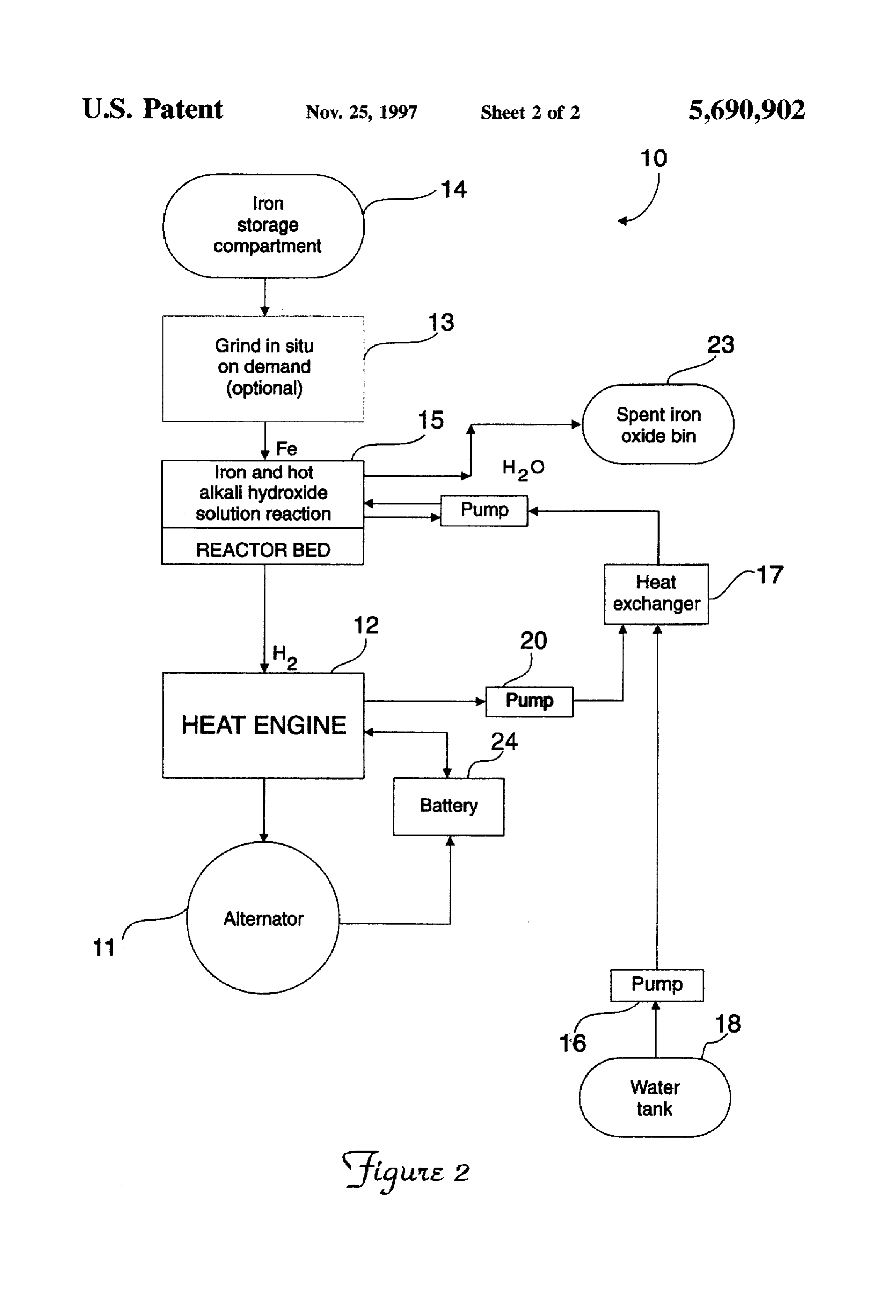
15 FIG. 1 illustrates a flowchart diagram of a method using
It should be understood that while the other alkalihydrox the inventive catalyst of this invention; and ides are effective catalysts, the use of the hydroxide of FIG. 2 depicts a schematic diagram of the system of a potassium is preferred. The hydroxides of cesium, rubidium hydrogen-powered vehicle that utilizes the new catalyst of and lithium are too expensive. The hydroxides of sodium the invention.
and lithium form excessively stable ferrates with the iron, which is undesirable, because stable ferrates are difficult to DESCRIPTION OF THE PREFERRED decompose. They also reduce the amount of catalyst in EMBODMENT solution. The formation of the excessively stable ferrates.
therefore, poses problems in the replenishment of the Generally speaking, the invention features three embodi catalyst, with attendant inconvenience and the additional 25 ments of a method of powering a vehicle by using hydrogen costs of labor and materials. as fuel. The hydrogen is generated in situ, onboard the vehicle, and is used to power a standard heat engine that has
SUMMARY OF THE INVENTION been modified to run on hydrogen gas. Such hydrogen is In accordance with the new iron material and catalyst generated by passing low-temperature heated alkali hydrox processes of this invention, there is also provided a method 30 ide solution or low-temperature steam over an iron bed for hydrogen generation in situ aboard an automobile. The contained in a reactor. The iron is bulk-loaded into the processes power a vehicle having a modified heat engine vehicle. In one embodiment, it is freshly-ground in situ into (such as an Otto cycle engine) that is designed to run on particles of iron. In another embodiment, the iron is caused hydrogen. This invention contemplates three embodiments to react with the water in the presence of an alkali hydroxide hereof. 35 catalyst, which allows the reaction to proceed at tempera In a first embodiment, hydrogen to power the engine is tures the below about 250° C. A third embodiment contemplates combination of the first and second embodiments herein.
supplied onboard by a bed of iron that is made to react with water in the presence of an alkali hydroxide catalyst at Now referring to FIG. 1, a flowchart diagram 110 of the temperatures not exceeding approximately 250° C. The inventive method is shown. Consider an automobile, not preferred alkali hydroxide is the hydroxide of potassium in shown, having a modified heat engine that is powered by a range of concentrations between 50 to 60 percent by hydrogen obtained in situ from an iron fuel-and-water weight, with the preferred concentration being about 53%. reaction. The heat engine can be designed for hydrogen The hydrogen for powering the heat engine is generated power, utilizing a standard Otto cycle. The fuel for gener onboard the automobile in situ, by using a reactor compart ating the hydrogen is made of iron. A fresh charge of iron is ment containing the iron materials. The hydrogen is gener 45 obtained from a fuel station, step 101. The spent iron (iron ated by passing a solution of alkali hydroxide over the iron, oxide) that is in the iron oxide bin is removed and a fresh which then becomes iron oxide. The vehicle's operator charge of iron particles or pellets is supplied. The iron may obtains afresh charge of the iron materials from an iron fuel be further enhanced in its reactivity with water by the station for placement in a storage compartment of the periodic grinding of the iron particles in situ, step 102. This vehicle which feeds the reactor compartment. The exchange enhanced reactivity of the iron, which increases the reactiv of the iron oxide with a fresh iron charge at the fuel station ity of the iron-HO reaction, is one embodiment of the can function in a manner that is similar to that of the current process of this invention. In another embodiment, the cata process for returning empty soda cans to a supermarket, lytic reaction of this invention proceeds at desirable con except that the process at hand is automated, as at gasoline version rates, and at desirable temperatures, without the pumping stations. For the spent iron (iron oxide), the fuel 55 need to grind the iron. In a third embodiment, the two station would give the vehicle operator a cash allowance processes may be combined. The reactor containing the iron toward the purchase of a new iron charge. The old, spent iron can also be tumbled, so as to mix or stir the iron. would then be recycled into fresh iron by a reduction process The vehicle is equipped with a heat engine that internally at the fuel station or at a central distribution facility. combusts hydrogen to produce mechanical power. The The iron materials of the second process of this invention hydrogen is generated in situ by passing heated water may comprise in situ freshly-ground particulates which (containing an alkali hydroxide catalyst) at typically enhance the HO-iron reaction. The freshly ground particles between approximately 230° C. to 250° C. over the iron range in diameter size from approximately 25 to 1200 m; deposited in the reactor, step 103. The grinding of the iron an average-sized distribution is one in which at least twenty within the compartment (step 102) can be optionally used, percent (20%) of the particles are less than 300 m in 65 either alone or in combination with the catalyst process. The diameter. It is preferable that at least 50% are less than 300 grinding of the iron makes the iron more reactive, so that the um in diameter. The average particle density ranges from conversion of the iron to iron oxide, which is measured in
Page 6
percent per minute (%/min.), can take place at lower-than majority of the fuel (iron) has been spent (i.e., converted to normal water temperatures and at better-than-normal con iron oxide). The automotive power process is then essen version rates, as illustrated below in Table 1, without the tially repeated.
catalyst being present. Referring to FIG. 2, a schematic diagram 10 of the system
TABLE
for a hydrogen-powered vehicle utilizing this invention is shown. The vehicular system comprises a heat engine 12
No Catalyst) that receives electrical energy from a battery 24 and hydro gen fuel from a reactor 15. The iron from an iron storage
HO Temp. (C.) Conv. Rate (Ground) Conv. Rate(Unground) compartment 14 is fed to an iron bed disposed in the reactor 10 15. Agrinding apparatus 13 can refresh the iron fed from the
300 40 18 iron storage compartment 14 to the reactor 15. Water is 200 24 0.8 pumped from a water tank 18 via pump 16 to the iron bed 15 via a diluter (not shown). The water is heated to the
The alkalihydroxide catalyst used to enhance the reaction 5 proper the temperature from recovered waste heat obtained from heat engine 12 via heat exchanger 17. The water is is preferably the hydroxide of potassium in a concentration in the approximate range of between 50 and 60% by weight. pumped (via circulating pump 19) and recirculated to the It should be understood that, while the other alkali hydrox diluter (not shown) and from there to the iron bed of reactor ides are effective catalysts, the use of the hydroxide of 15. The hydrogen that is produced in reactor 15 flows to the potassium is preferred. The hydroxides of cesium, rubidium heat engine 12, in order to produce power via internal and lithium are too expensive. The hydroxides of sodium combustion. Additional water must be periodically added to and lithium form excessively stable ferrates with the iron, tank 18 so as to maintain a proper supply level. The which is undesirable, because stable ferrates are difficult to electricity produced by the alternator 11 driven by the heat decompose. They also reduce the amount of catalyst in engine 12 is used to charge the battery 24. The electricity of solution. The formation of these excessively stable ferrates, battery 24 is used to power the respective pumps 16, 19, and therefore, poses problems in the replenishment of the 25 20, as well as the grinding apparatus 13. (For purposes of catalyst, with attendant inconvenience and the additional clarity, suitable electrical connections among battery 24 and costs of labor and materials. Other alkali hydroxides, electrically-driven components are not shown in FIG. 2.) however, can be used in some cases with the potassium A spent-iron bin 23 receives the iron oxide from the hydroxide. The reaction is preferably conducted attempera reactor 15. The spent iron is emptied periodically, usually at tures ranging between approximately 200° C. and 250° C. the time of refueling.
as shown by the conversion rate in Table 2 hereinbelow. The reactor 15 generally comprises one or more tubes, not The preferred concentration of the potassium hydroxide shown, that are filled with a porous or powdered metal. The catalyst of this invention is approximately 53 grams of tubes are preferably made from materials that conduct heat, potassium hydroxide per 100 grams of solution. 35 although in certain embodiments of the present invention At this concentration, operating at 235° C., a given (whereby start-up heat is generated internally, such as by air quantity of commercial sponge iron powder reacts with H2O injection), heat-conductive materials are not necessary. to form iron oxide at a per-minute conversion rate of 3.62%. Preferably, the tubes are made from materials such as This rapid conversion rate (measured in percent per minute) inconel, stainless steel or Teflon(8.The size of the tubes will, makes practical the use of iron to fuel automobiles and other of course, depend upon the size of the generating system. land vehicles. However, they generally have an inside diameter of at least about 4 inch (0.635 cm) and a length of at least about 6
TABLE 2 inches (15 cm). The number of tubes will also vary, depend ing upon the size of the system. The general range is from
Temp. C. Catalyst Type Concentration Coversion Rate 45 about 1 to 100 tubes; the more preferable range is from about 230 KOH 56.2 2.02%lmin. 1 to 5. The tubes may also be of varying sizes and shapes 230 KOH 53.3 2.76 (including curves, spirals, etc.). The tubes may also be
KOH
KOH
disposed at various angles.
230 NaOH 530 0.98 The iron materials of this invention can comprise in situ 235 NaOH 49.O 1.00 50 freshly-ground particulates. The particles range in diameter
NaOH
NaOH
size from approximately 25 to 1.200 pm; an average-sized distribution is one in which at least twenty percent (20%) of the particles are less than 300 pm in diameter. It is preferable
The generated hydrogen flows to the heat engine, step that at least 50% are less than 300 um in diameter. The 104, where it is internally combusted to generate power, 55 average particle density ranges approximately from about 1 along with a water by-product. This by-product water is to 7.8 g/cc, with a non-compressed packed particle density pumped via pump 20 to the heat exchanger 17 in order to ranging from about 1.5 to 3.5 g/cc. The particles have a replenish the water in the alkali hydroxide solution circu surface area greater than approximately 0.001 meters/g. lating in and out of reactor 15. Additional water is periodi To initiate the reaction, the water in the container 18 is cally added to tank 18 so as to maintain a proper supply level heated. The water flows into and reacts with the metal and is also mixed with the catalytic alkali hydroxide reactant to produce a metal oxide, such as Fe0, and solution, step 106. An alternator that is powered by the heat hydrogen gas.
engine can generate electricity for the battery used to pro One way to start the hydrogen-producing reaction is to vide the spark to combust the hydrogen. The pumps and the inject catalyzed solution and air into the reactor Zone, so that accessories of the system can be powered by the battery, step 65 the rapid oxidation of the metal and the catalytic burning of 105. The operator of the vehicle eventually drives to the fuel the hydrogen (produced by the reacting water) will help heat station to obtain a new charge of iron, step 107, when the the metal reactor up to the necessary temperature for reac
Page 7
tion. Another way to supply the necessary start-up heat is to about 800° C. to 1,10020 C. One method of doing this is to burn a small amount of conventional fuel (such as com inject air or oxygen into the reactor bed. This causes some pressed natural gas, propane or gasoline) in a separate of the reducing agent to burn, thereby heating up the burner, employing a suitable means to transport the gener regeneration reaction zone, i.e., autothermal reforming. ated heat. A simple source of start-up heat may be a small 5 Another method is to burn the vent gas from a hydrogen storage battery that furnishes power to a heating bulb or producing reaction and transfer its combustion heat to the heating coil that is disposed within or adjacent to the regeneration reaction zone through the walls of the reactor. energy-producing device. Still another method is to burn part of the reducing agent upstream of the reforming device and transfer the combus
A more complex scheme for supplying start-up heat to the tion heat across the reactor bed walls of the metal/metal reactor Zone is to employ a plurality of reactor beds in the 10 oxide containing reactor. Still another scheme for supplying reaction zone (such as elongated tubes of metal reactant), the necessary heat to maintain the regenerating reaction is to with at least either one small reactor bed or a number of beds burn vent gas from another nearby regenerating bed. This of graduated sizes. The smallest bed is brought up to vent gas normally contains steam, carbon dioxide and unre operating temperature first with a battery or a small burner; acted reformate. The best method, however, is to use a heat the hydrogen it produces is burned with air to form water, so 15 exchanger that takes advantage of the engine's waste heat as to heat up the larger reactor beds. and delivers the waste heat to the reactor. In the case of beds of graduated sizes, the hydrogen In general, the vent gas from the reaction between iron produced by the next larger bed may be used to heat up the oxide and reformate does not only produce a mixture of next larger bed, etc. water and carbon dioxide. The equilibrium composition of 20 the vent gas also includes unreacted hydrogen and unreacted
One of the advantages of the present invention over other hydrogen production systems (including metal-hydride carbon can be monoxide. Some of the unreacted reducing mixture burned, so as to satisfy the endothermic need of either based systems) is its ability to regenerate or reform the spent the iron oxide reaction or the reformer reaction, but if all of metal oxide after completion of the reaction and the pro it were burned or vented, the overall efficiency would go duction of hydrogen. This advantage is even more signifi 25 down. To avoid this, some water may be condensed from the cant because of the relatively low cost involved in the vent gas; the resulting, drier mixture may then be fed to a regeneration of spent metal oxide. The system of the present second-stage iron oxide regenerator to produce more invention may employ a variety of methods to regenerate the elemental iron. The vent gas of the second stage would then spent metal oxide, some of which are already commercially be burned to provide the needed endotherms, and the overall 30 efficiency would be better than that of a single-stage regen in use.
One method of regeneration comprises reacting the spent erator.
metal oxide with a reducing gas, a mixture of gases or a The reformation process may be carried out at a location liquid. Because of its relatively low cost, the presently away from the fuel station, such as at a central plant. The preferred reducing agent is reformed natural gas. This gas metal and spent metal oxides may be transferred to and from generally comprises a mixture of hydrogen, carbon 35 refueling stations near the site of the central station. The monoxide, carbon dioxide and residual steam. While hydro metal powder or material is preferably conveyed into and gen and carbon monoxide are the only active reducing out of the metal-water reaction chamber 14 during refueling agents, the metal/metal oxide bed that is being regenerated by a suitable means, such as gravity flow. The metal and is not irreversibly harmed by the presence of the other two metal oxides are transferred from the refueling stations to components. If hydrogen gas is available at a lower cost than the central reforming plant by a variety of means (including reformed natural gas, it, too, could be used. In most cases, trucking, railroad car and the like). The recycling of the heat is added to the reaction, because the regeneration metal reactant can theoretically occur an infinite number of process is somewhat endothermic. Where available, rela times.
tively pure carbon monoxide can also be used as a reducing As an alternative to using a relatively large, removed agent. 45 central processing facility for reforming the spent metal The gaseous reducing agents may be supplied as a oxide, smaller reformer units at the site of the refueling reformed liquid fuel such as reformed methanol, reformed station may be used. As with the centralized reforming unit, ethanol, reformed petroleum derivatives and reformed or the on-site reforming units may be used to convert the spent decomposed ammonia. metal oxide to metal reactant (as previously described) by The reformed fuels may be derived by various techniques 50 using, for example, reformed natural gas. The reduced metal including: (1) steam-reforming (in which the fuel in gaseous may then immediately be used to generate hydrogen in a form reacts with steam); (2) partial oxidation (in which the hydrogen-powered device; stored for subsequent use to fuel reacts with oxygen or air in proportions less than that generate hydrogen in such a device; or used as an interme needed for complete oxidation); or (3) autothermal reform diate storage device, in conjunction with metal hydride ing (in which the fuel partially reacts with steam and 55 storage beds. A convenient way to utilize the reduced metal partially with oxygen or air). In terms of yield of hydrogen as an intermediate storage device in combination with a per unit of fuel, steam-reforming is more efficient than metal hydride bed is to react the reduced metal with steam partial oxidation. Steam-reforming is endothermic, while to produce slightly wet hydrogen. The hydrogen is then partial oxidation is exothermic. With regard to both hydro dried by suitable means known in the art, such as by gen yield and heat addition/removal, autothermal reforming desiccants.
falls between steam-reforming and partial oxidation. The A small amount of hydrogen generated from the iron selection of a particular reforming process will thus be made water reaction can be compressed and stored for start-up for a particular operation based upon factors which include heat-up purposes. The hydrogen is diverted by means of a the hydrogen yield required equipment costs and solenoid valve that is controlled by a pressure sensor or complexity, and the overall process heat requirements. 65 pressure switch. The hydrogen storage device acts like a Heat must be supplied to the reduction reaction, since the storage battery, supplying energy during start-up and absorb reduction reaction is generally endothermic, taking place at ing it during normal driving for later use.
Page 8
During the regeneration of spent metal oxide, the 5. The method in accordance with claim 4, wherein said reformed natural gas may contain sulfur impurities, which potassium hydroxide is in a concentration of approximately may accumulate in the bed over many regeneration cycles. 53% by weight.
The Sulfur will react with the metal reactant, creating metal 6. The method in accordance with claim 1, wherein said Sulfides. The metal sulfides might not decompose either by particles are freshly ground in situ aboard the vehicle. steam upon discharge or by fuel or reformate upon recharge. 7. The method in accordance with claim 1, wherein said This will eventually irreversibly tie up a large fraction of the iron particles have a non-compressed packed particle density metal reactant bed as metal sulfides instead, thereby pre ranging from about 1.5 to 3.5 gfcc.
venting it from switching from metal oxide to elemental 8. The method in accordance with claim 1, wherein at metal. In order to overcome this contamination problem, O least 50% of the particles are less than 300 m in diameter. unwanted metal sulfide (e.g., FeS) can be converted to sulfur 9. The method in accordance with claim 1, wherein said dioxide (SO2) and some metal oxide (e.g., one of the iron iron particles comprise a bulk-loading of particles or pellets Oxides) by briefly (i.e., in 1 to 15 minutes) passing a stream for use as a refresher charge in said vehicle, of air over the heated bed of spent metal oxide before that 10. An improved H2O-iron reaction method, comprising bed is reduced to elemental metal. Since the bed must be reacting H2O and iron material to form hydrogen in the heated anyway, in order to regenerate it, little or no addi presence of a catalyst, for fueling an automotive vehicle tional heating is needed to remove the metal sulfide by hot having a heat engine, said catalyst comprising a dissolved air oxidation. The risk of explosion during transition through alkali hydroxide, said iron material comprising bulk-loaded the bed from air to reformate or fuel can be significantly particles or pellets of iron which are then freshly ground for reduced by briefly purging the bed with low-temperature 20 enhancing reactivity of the iron material in producing steam, carbon dioxide, nitrogen or any other suitable inert hydrogen, said alkali hydroxide enhancing said HO-iron gas. In particular, the mixture of low-temperature steam and reaction by allowing said reaction to proceed attemperatures CO2 from another bed undergoing regeneration is a readily below approximately 250° C.
available, essentially cost-free, purging agent. 11. The method in accordance with claim 10, wherein said Since other modifications and changes varied to fit par iron material comprises particles ranging in diameter size ticular operating requirements and environments (such as from approximately 25 to 1,200 m, with an average-sized the use of hydrogen generated by the aforementioned meth distribution having at least twenty percent (20%) of the ods for supplying a fuel cell) will be apparent to those skilled particles less than 300 pm in diameter, and having an in the art, the invention is not considered limited to the average particle density ranging from approximately 1 to 7.8 gfcc., and a surface area greater than approximately 0.001 examples chosen for purposes of disclosure, and covers all 30 meters/g.
changes and modifications which do not constitute depar tures from the true spirit and scope of this invention. 12. The method in accordance with claim 10, wherein said Having thus described the invention, what is desired to be alkali hydroxide catalyst is potassium hydroxide. protected by Letters Patent is presented in the subsequently 35 potassium method 13. The in accordance with claim 12, wherein said hydroxide is in a concentration of approximately appended claims.
What is claimed is: 50-60% by weight.
1. An improved H2O-iron reaction method, comprising 14. The method in accordance with claim 13, wherein said reacting H2O and iron material to form hydrogen in situ, potassium hydroxide is in a concentration of approximately aboard an automotive vehicle having a heat engine that is 53% by weight.
designed to internally combust hydrogen, the HO-iron 15. The method in accordance with claim 10, wherein said reaction taking place in the presence of a catalyst comprising iron particles have a non-compressed packed particle density a dissolved alkali hydroxide, said iron material comprising ranging from about 1.5 to 3.5 gfcc. particles or pellets of iron, said particles being bulk-loaded 16. The method in accordance with claim 10, wherein at into a reactor chamber, said alkali hydroxide enhancing said 45 least 50% of the particles are less than 300 um in diameter. HO-iron reaction. 17. The method in accordance with claim 10, wherein said 2. The method in accordance with claim 1, wherein said iron particles comprise a bulk-loading of particles or pellets iron material comprises particles ranging in diameter size for18.useAnas improved a refresher charge in an automotive vehicle.
HO-iron reaction method, comprising from approximately 25 to 1200 um, with an average-sized reacting HO and iron material to form hydrogen in situ, distribution having at least twenty percent (20%) of the aboard an automotive vehicle particles less than 300 m in diameter, and having an designed to internally combust having a heat engine that is average particle density ranging from approximately 1 to 7.8 comprising particles or pellets hydrogen, of iron, said iron material said particles being gfcc., and a surface area greater than approximately 0.001 bulk-loaded into a reactor chamber, said HO-iron reaction
3. The method in accordance with claim 1, wherein said 55 being enhanced by grinding said iron material in situ aboard alkali hydroxide catalyst is potassium hydroxide. said automotive vehicle, said reaction between said HO and 4. The method in accordance with claim 3, wherein said 250said iron proceeding at temperatures below approximately potassium hydroxide is in a concentration of approximately C.
Provenance
- Collection
- Cited prior art
- Original PDF
- patentimages.storage.googleapis.com →
- Filed
- 1995-06-07
- Pages
- 8
- Method
- pdftotext (the PDF's own text layer) + pdftoppm 300dpi page scans
- Source
- Google Patents bibliographic record
- Granted
- 1997-11-25
- Inventors
- John Werth; H Power Corp
- Transcribed from
- patentimages.storage.googleapis.com →