patent · US5484512
Methods and apparatuses for producing high purity oxygen and hydrogen
16 January 1996
Page 1 — bibliographic record
United States Patent 19 11 Patent Number: 5,484,512 Sasaki et al. (45) Date of Patent: Jan. 16, 1996 54 METHODS AND APPARATUSES FOR 59-162284 9/1984 Japan. PRODUCING HIGH PURITY OXYGEN AND 62-13563 1/1987 Japan.
HYDROGEN 62-1784 f1987 Japan.
(75) Inventors: Takashi Sasaki, Hyogo; Hiroyuki 2-179474 7/1990 Japan. Harada, Tokyo; Akihiko Hogetsu, 3-107488 5/1991 Japan.
Hyogo, all of Japan 4-94.85 1/1992 Japan.
(73) Assignees: Shinko Pantec Co., Ltd., Kobe, 6-151386 5/1994 Japan. Mitsubishi Corporation, Tokyo, both of Japan Primary Examiner-Kathryn Gorgos
Attorney, Agent, or Firm-Marshall, O'Toole, Gerstein, (21 Appl. No.: 247,670 Murray & Borun (22 Filed: May 23, 1994 57 ABSTRACT
(51) Int. Cl. .................. C2SB 1/10 An electrolytic solution prepared by dissolving an electro 52 U.S. Cl. .......................... 204/129; 204/263; 204/232; lyte such as KOH in pure water is fed into a membrane 204/241; 210/900 electrolytic cell of a membrane electrolyzer membrane elec 58 Field of Search ..................................... 204/232, 129, trolysis, made while the membrane electrolytic cell is pro vided intermittently or continuously with pure water. Oxy 204/266, 263, 241; 210/660, 669, 681, gen generated at the anode and hydrogen generated at the 188,900 cathode are purified individually by purifiers to produce 56) References Cited oxygen and hydrogen of high purity. Also disclosed are methods of producing oxygen and hydrogen of high purity
degassing module is employed in conjunction with a solid 4,369,102 1/1983 Galluzzo et al. ....................... 204/262 polymer electrolyte electrolytic cell for effecting membrane 4.950,371 8/1990 McElroy ............ ... 204/253 electrolysis of the pure water, and in conjunction with a 5,037,518 8/1991 Young et al. .. ... 204/263 5,124,033 6/1992 Ohmi et al. .......................... 210/257. molecular sieve for individually dehumidifying oxygen gen erated at the anode and hydrogen at the cathode of the
FOREIGN PATENT DOCUMENTS electrolytic cell.
57-134586 8/1982 Japan. 5 Claims, 5 Drawing Sheets
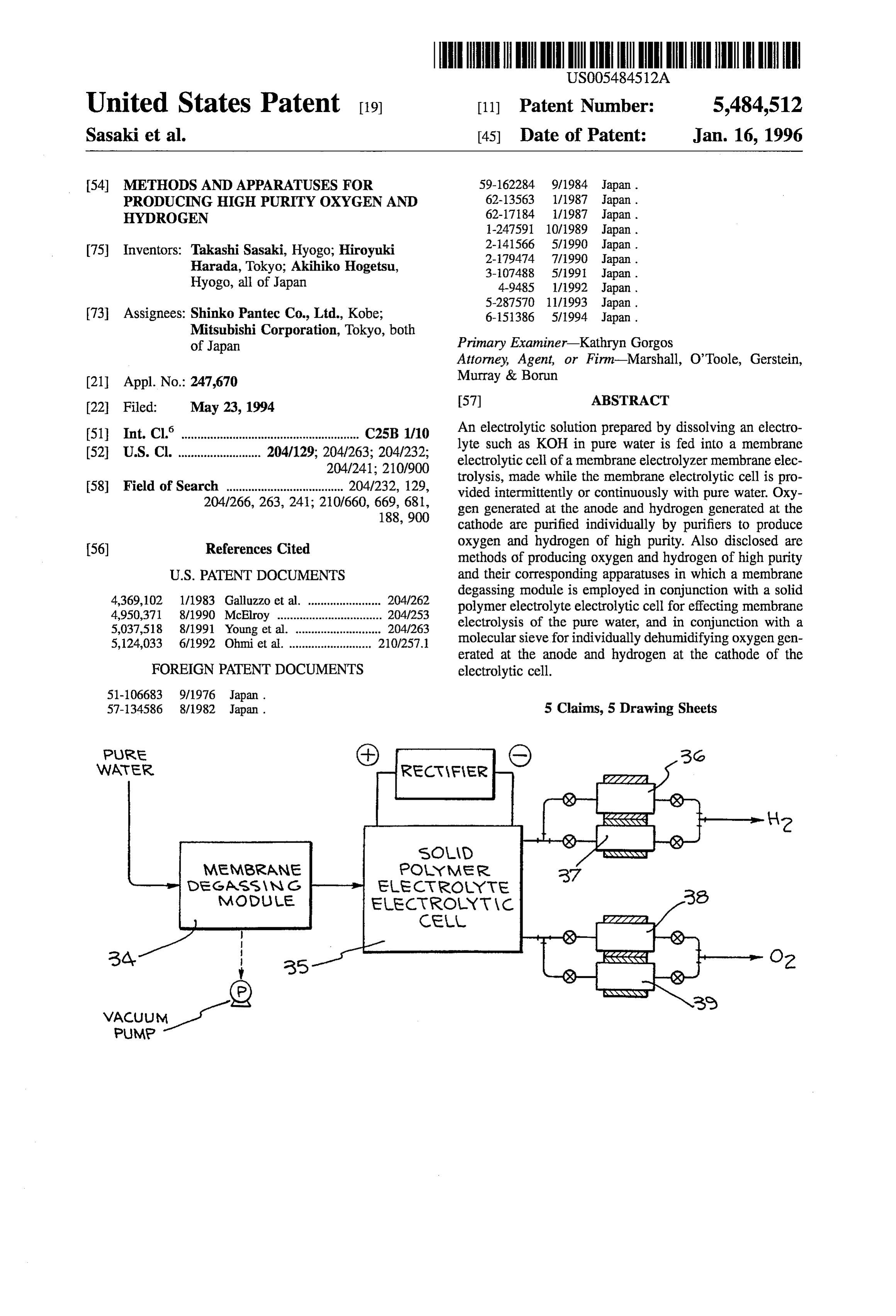
PyRE GD O 36 WAER. KECW WAER
SNNNNNY
SOA)
NAO L S. ESCVROYV AC 32,
CELA
34 Sway
SYNaSas
PUMP
Page 2
Drawing sheet — no readable text.
Page 3
Drawing sheet — no readable text.
Page 4
Drawing sheet — no readable text.
Page 5
Drawing sheet — no readable text.
Page 6
Drawing sheet — no readable text.
Page 7
METHODS AND APPARATUSES FOR pose many safety problems in case of emergency, such as PRODUCING HGH PURITY OXYGEN AND earthquakes.
HYDROGEN With regard to hydrogen, it is generally assumed that all
BACKGROUND OF THE INVENTION
impurities can be removed by a palladium membrane per meation method. This method, however, poses the problem 1. Field of the Invention that carbon contained in the palladium membrane reacts The present invention relates generally to apparatuses for with selves hydrogen to produce hydrocarbons, which are them sources of impurities. Carbon impurities have adverse producing high purity oxygen and hydrogen. The present invention also relates generally to methods of producing 10 effects on the production of semiconductors, in particular, on high purity oxygen and hydrogen. More particularly, the devices.properties electric of oxide films in the production of MOS present invention relates to methods and apparatuses for impurityThere is, therefore, a great need to eliminate carbon from hydrogen.
producing high purity oxygen and hydrogen by way of electrolysis of an electrolytic solution. In view of the above, there is a continuing need to develop 2. Description of Related Art 15 methods and apparatuses for producing high purity oxygen and hydrogen.
In the electronics industry, oxygen and hydrogen of high purity are used, for example, as atmospheric gases for SUMMARY OF THE INVENTION thermal treatment. For instance, in the production process of semiconductors, oxygen of high purity is used as an atmo One feature of the present invention involves a method of spheric gas for the oxide film formation process, and hydro 20 producing oxygen and hydrogen of high purity comprising gen of high purity is used as the atmospheric gas for thermal the steps of (a) providing an electrolytic solution comprising treatment and for epitaxial growth. The purity of such an electrolyte dissolved in pure water; (b) feeding the oxygen and hydrogen impacts the quality of the product. electrolytic solution into a membrane electrolytic cell of a Thus, high purity oxygen and hydrogen are needed in the membrane electrolyzer; (c) electrolyzing the electrolytic electronics industry, particularly in the production of inte 25 solution while providing the membrane electrolytic cell grated circuits. Such gases are produced and provided as intermittently or continuously with pure water; and (d) described below. purifying individually by purifying means oxygen produced For hydrogen gas, excessive reproduction gas from elec at the anode and hydrogen produced at the cathode. trolysis of common salt or from petroleum refinement is first 30 Another feature of the present invention is an apparatus purified by a purifier such as a fractionater, using a PSA for producing oxygen and hydrogen of high purity, the (Pressure Swing Adsorption) purification method or a cata apparatus comprising a membrane electrolyzer for effecting lytic combustion purification method (primary purification), membrane electrolysis of an electrolytic solution prepared to obtain somewhat high purity hydrogen. This hydrogen is by dissolving an electrolyte in pure water; a pure water introduced into a bomb (cylinder), etc. at high pressure and feeding means for continuously or intermittently feeding delivered to users. 35 pure water to a membrane electrolytic cell of the membrane
For oxygen gas, air is liquefied by the Joule-Thomson electrolyzer; and purifiers for purifying oxygen generated at process, and components of the air are separated from each the anode and hydrogen generated at the cathode of said other by a cryogenic distillation process (low temperature membrane electrolyzer.
processing), using the differences in their boiling points, to 40 Another feature of the present invention involves a obtain somewhat high purity oxygen. The oxygen thus method of producing oxygen and hydrogen of high purity obtained is delivered in the form of liquefied oxygen to cold comprising the steps of (a) degassing pure water by a evaporators (oxygen gas generators or sources; hereinafter degassing means; (b) feeding the degassed water continu referred to just as "CE") of plants. Liquefied oxygen is ously or intermittently into a solid polymer electrolyte vaporized when needed in the gas form. 45 electrolytic cell; (c) effecting membrane electrolysis; and (d) The gases of oxygen and hydrogen provided by the dehumidifying individually by dehumidifying means the above-mentioned production methods, however, have impu oxygen generated at the anode and hydrogen generated at rities such as nitrogen, carbon dioxide, carbon monoxide, the cathode.
hydrocarbons and water (hereinafter referred to as "impu Yet another feature of the present invention involves an rities such as nitrogen”). Such impurities cannot be com 50 apparatus for producing oxygen and hydrogen of high purity, pletely removed by the above-mentioned purifications. the apparatus comprising a degassing means for degassing Hence, the above-mentioned oxygen and hydrogen must be pure water; a solid polymer electrolyte electrolytic cell for further individually purified by purifiers at semiconductor effecting membrane electrolysis of degassed pure water plants to remove the impurities (the "secondary purifica degassed by the degassing means, a pure water feeding tion'). 55 means for continuously or intermittently feeding pure water This further purification treatment (the secondary purifi into the solid polymer electrolyte electrolytic cell; and a cation) needs to be done by an adsorption treatment with an dehumidifying means for individually dehumidifying oxy adsorbent or by a sophisticated purification method such as gen generated at the anode and hydrogen generated at the a palladium membrane permeation process. It is difficult, cathode of the solid polymer electrolyte electrolytic cell. however, to remove impurities such as nitrogen by the these 60 Yet another feature of the present invention involves an purification treatment processes. Moreover, semiconductor apparatus for producing oxygen and hydrogen of high purity elements of finer structure and higher strength require an comprising a pure water producing means for making pure ever-increasing purity of gases for their production, result water from raw water, a degassing means for degassing pure ing in a requirement of purifiers and purification systems water produced by the pure water producing means; a solid which are very complicated and expensive. 65 polymer electrolyte electrolytic cell for effecting membrane Moreover, oxygen stored in liquid form in CE and hydro electrolysis of the degassed pure water produced by the gen introduced into and delivered in bombs at high pressure, degassing means; a pure water feeding means for continu
Page 8
ously or intermittently feeding pure water into the solid ated at the anode (oxygen), the impurities which may be polymer electrolyte electrolytic cell; and a dehumidifying introduced into the purifier are only traces of hydrogen, the means for individually dehumidifying oxygen produced at electrolyte composition and water. On the other hand, for the the anode and hydrogen produced at the cathode of the solid gas generated at the cathode (hydrogen), the impurities polymer electrolyte electrolytic cell. which may be introduced into the purifier are only traces of The above discussed and many other features and atten oxygen, the electrolyte composition and water. The kinds of dant advantages of the present invention will become appar impurities generated by electrolysis are thus very few, and ent as the invention becomes better understood by reference impurities such as carbon dioxide, carbon monoxide, hydro to the following detailed description. carbons and nitrogen are in principle not generated at all. 10 The trace hydrogen in the oxygen gas and the trace oxygen
BRIEF DESCRIPTION OF THE DRAWINGS in the hydrogen gas can be easily converted into water by means of an oxidation catalyst, then the water can be easily
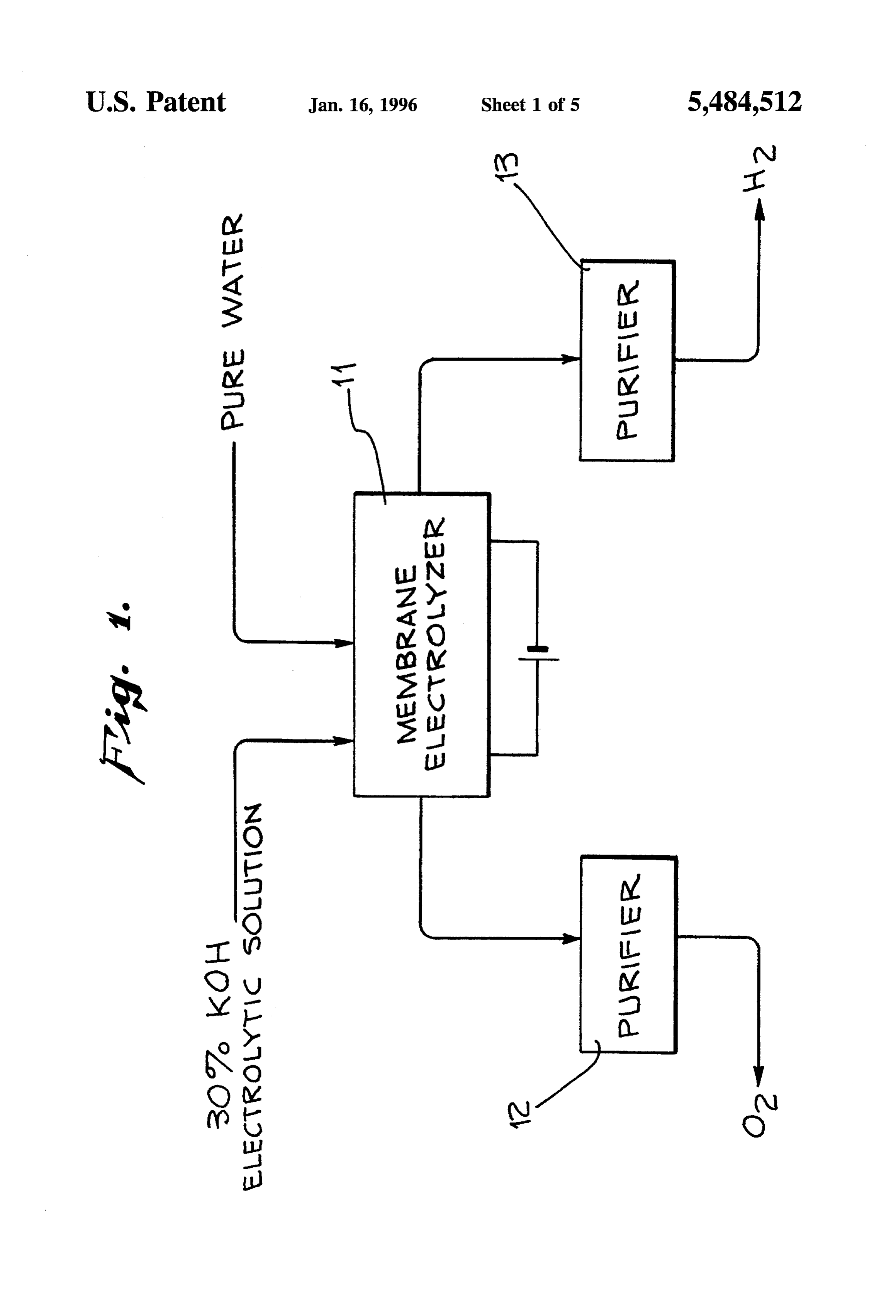
FIG. 1 is a diagram schematically showing the first removed by a moisture adsorbent such as a molecular sieve. embodiment of the methods and apparatuses for producing Further, electrolyte components can be easily removed with high purity oxygen and hydrogen of according to the present 15 Water.
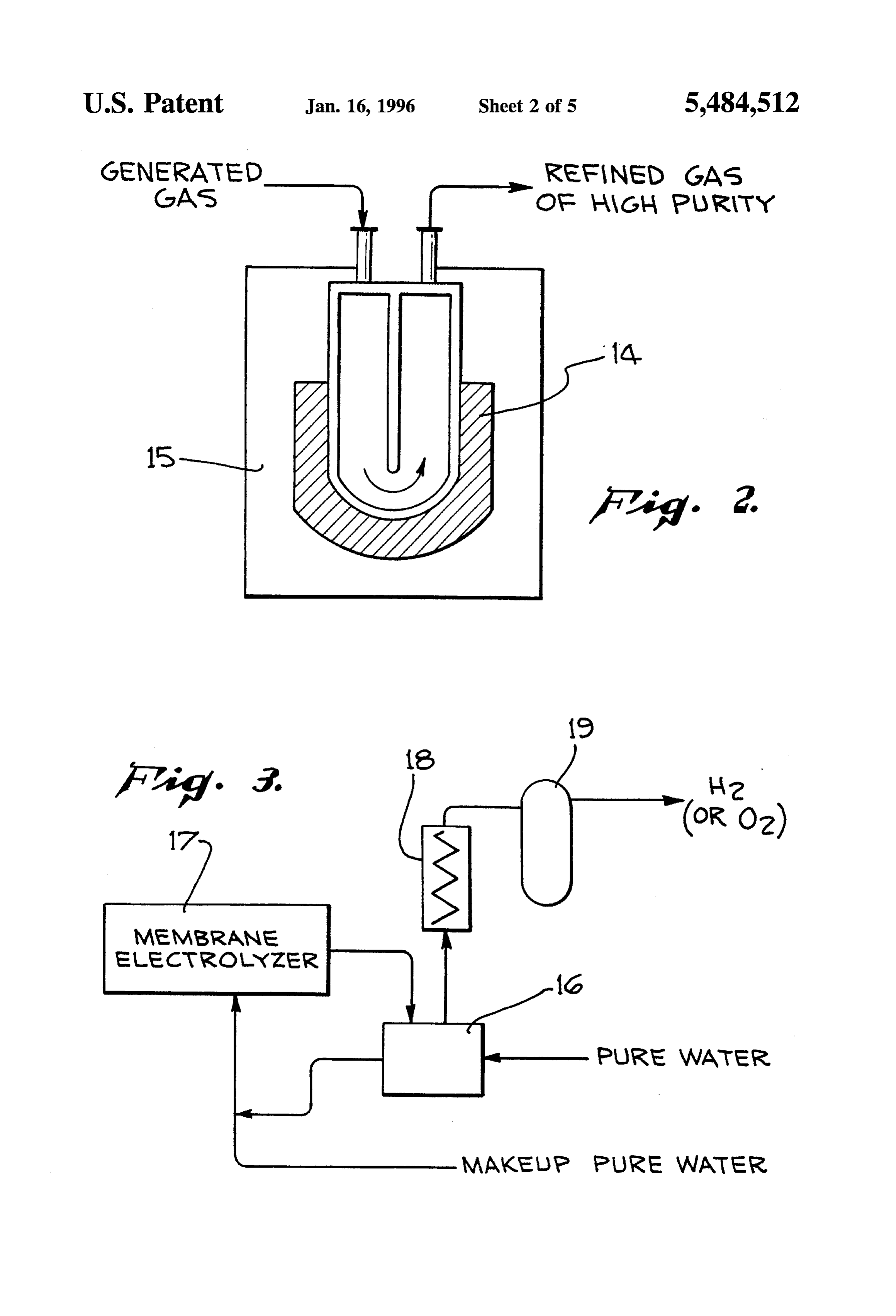
invention. The separate gases (oxygen and hydrogen) introduced FIG. 2 is a diagram showing an example of a purifier to into the respective purifiers are purified and refined. Since be used by the methods and apparatuses for producing high each of the separate gases to be introduced has a very limited purity oxygen and hydrogen according to the present inven kind of impurity as described above, a simple and inexpen tion, 20 sive purifier or purifying system can purify the gas. As FIG. 3 is a diagram schematically showing the second discussed above, the kinds of impurities contained in the embodiment of the methods and apparatuses for producing gases to be introduced into a purifier are very few relative to high purity oxygen and hydrogen according to the present those of the conventional method (nitrogen, carbon dioxide, invention. carbon monoxide, hydrocarbons, moisture, etc.), sophisti FIG. 4 is a diagram schematically showing the third 25 cated purifying methods such as a palladium membrane embodiment of the methods and apparatuses for producing permeation method are, therefore, not required. The impu high purity oxygen and hydrogen according to the present rities can be removed easily by treatment with an oxidation invention. catalyst or an adsorbent, or by cooling with liquefied nitro FIG. 5 is a diagram schematically showing the fourth 30 the gen, etc. to purify the gas. Then, the gases can be purified to embodiment of the methods and apparatuses for producing desired level suitable for the electronics industry, includ high purity oxygen and hydrogen according to the present ing semiconductor production, by simple and inexpensive invention.
purifiers or purifying systems. Thus, high purity oxygen and hydrogen can be produced.
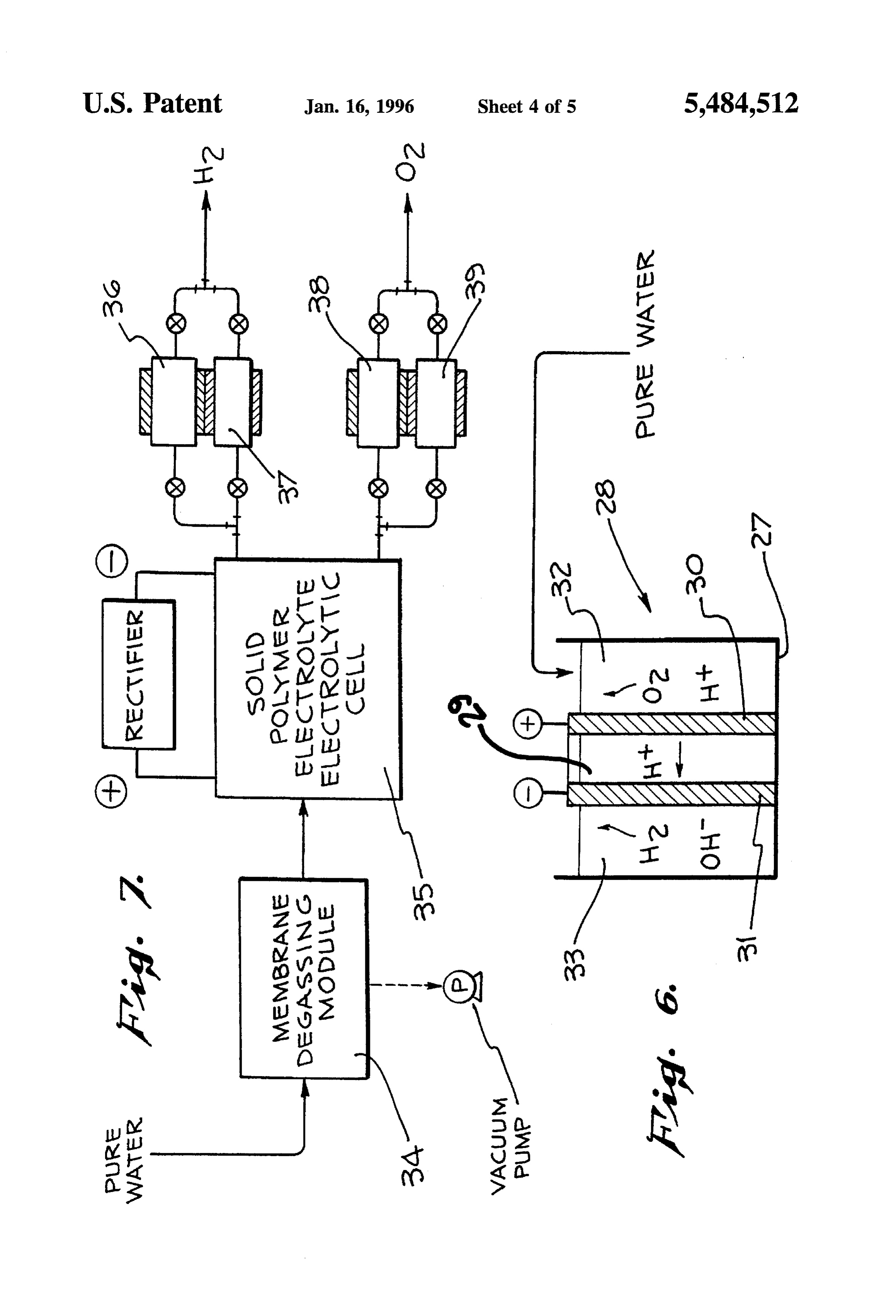
FIG. 6 is a diagram showing an example of a solid Moreover, since pure water is subjected to membrane polymer electrolyte electrolytic cell to be used in the meth 35 electrolysis and the generated oxygen and hydrogen are ods and apparatuses for producing high purity oxygen and separately purified by purifiers to produce oxygen and hydrogen according to the present invention. hydrogen, high purity oxygen and hydrogen can be pro FIG. 7 is a diagram schematically showing the fifth duced whenever needed. There is no need for storage in embodiment of the methods and apparatuses for producing bombs, CE, etc. Furthermore, oxygen and hydrogen genera high purity oxygen and hydrogen according to the present 40 tion can be terminated instantly by simply turning off the invention. power supply, contributing to enhanced safety. This is FIG. 8 is a diagram schematically showing the sixth another benefit to producing high purity oxygen and hydro embodiment of the methods and apparatuses for producing gen simultaneously.
high purity oxygen and hydrogen according to the present Hence, according to methods and apparatuses for produc invention. 45 ing high purity oxygen and hydrogen of the present inven
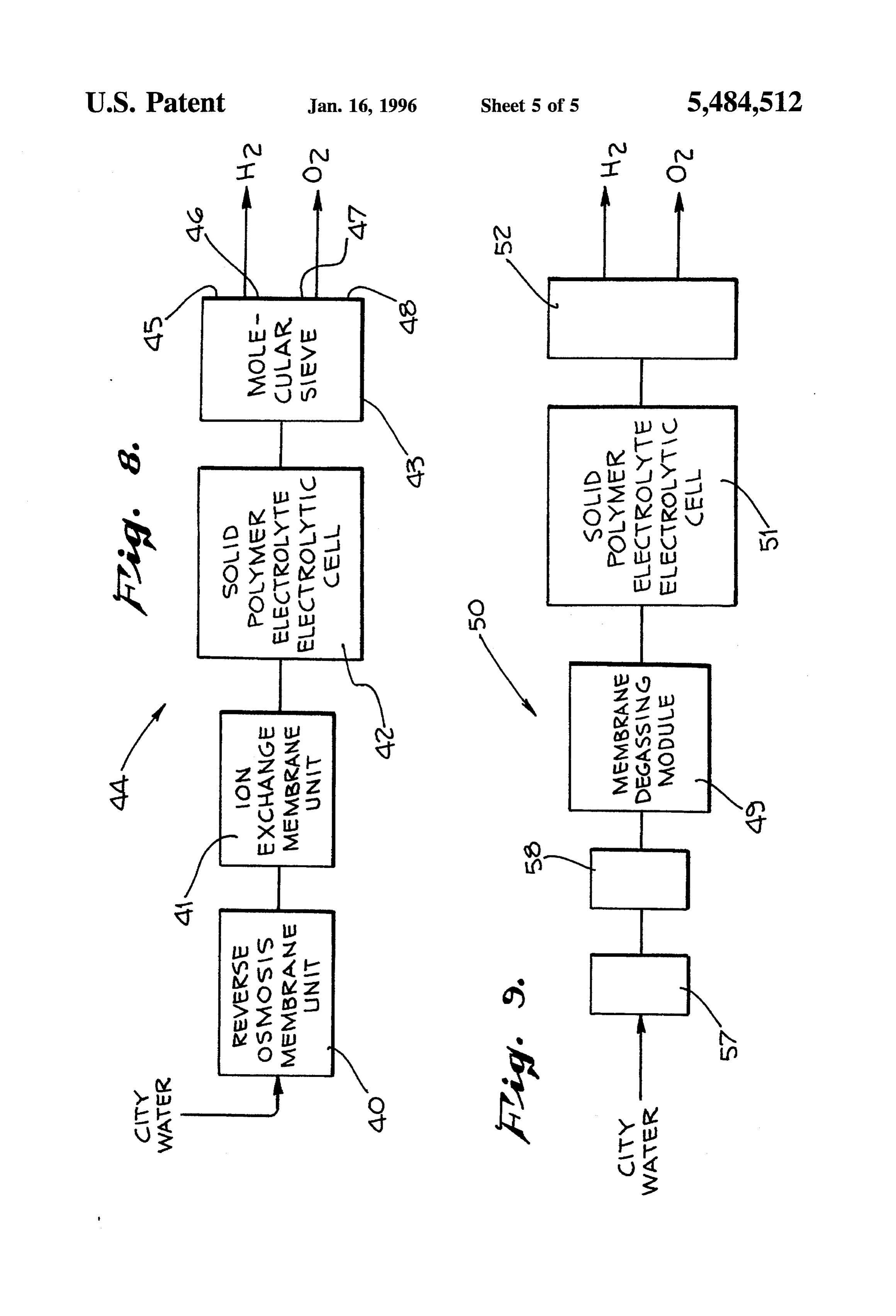
FIG. 9 is a diagram schematically showing the seventh tion, there is no need to eliminate impurities such as nitro embodiment of the methods and apparatuses for producing gen, which was difficult in the past. Oxygen and hydrogen high purity oxygen and hydrogen according to the present can be purified by simple purification treatments to the invention. desired levels suitable to the production of semiconductors.
Further, the methods and apparatuses of producing high
DETAILED DESCRIPTION OF THE purity oxygen and hydrogen according to the present inven PREFERRED EMBODIMENTS tion are conducive to enhanced safety. Oxygen and hydrogen In methods and apparatuses for producing high purity of high purity can be produced whenever they are required, and oxygen and hydrogen according to the present invention, an 55 Moreover, there is no need of storing them in bombs, CE, etc. electrolytic solution prepared by dissolving an electrolyte in the generation of oxygen and hydrogen can be pure water (i.e., deionized water) is fed into a membrane terminated instantaneously by turning off the power supply. electrolytic cell of a membrane electrolyzer. Membrane For the above-mentioned electrolysis, nickel is preferably electrolysis is made while said membrane electrolytic cell is used for the electrodes (both the anode and the cathode). provided intermittently or continuously with pure water, and 60 For the above-mentioned electrolyte, it is preferable to oxygen generated at the anode and hydrogen generated at use electrolytes, such as KOH, NaOH and NaSO, which the cathode thereof are purified individually by purifiers to do not produce gases other than H and O. This, in turn, produce oxygen and hydrogen. improves the current efficiency during the membrane elec As pure water is subjected to membrane electrolysis, the trolysis, and makes it hard for the electrodes to elute and for gas generated at the anode is oxygen and the gas generated 65 any substances to precipitate on the electrodes. at the cathode is hydrogen. These gases can be introduced For the above-mentioned pure water, it is preferable to use separately into their respective purifiers. For the gas gener pure water of which the specific resistance is 18.25 MC2 cm
Page 9
(25° C) or over. This further reduces the kinds and quan membrane (fluorocarbon resin sulfonic acid cation exchange tities of impurities, such as nitrogen, contained in the gases membrane), and the effective membrane area was 250 cm. generated by the membrane electrolysis, to be introduced The current density of the membrane electrolysis was 50A/ into the purifiers. This, in turn, allows purification with dim', and the cell voltage was 2.1 V. The purifiers (12) and simple and inexpensive purifiers and purifying systems. (13) were of a system using liquefied nitrogen cooling. The Such pure water is preferably obtained by ion exchange and cooling temperature was -180° C. The production rate of membrane separation treatments. Such pure water facilities oxygen of high purity was 25 N1/hr, 3 bar, and that of are expensive facilities, but they are always provided in the hydrogen of high purity was 50 Nl/hr, 3 bar. present advanced semiconductor plants. Although it depends The purity of the generated high purity oxygen was on the uses to which the hydrogen and oxygen are to be put, 10 99.999% or over and the purity of the generated high purity existing pure water facilities can generally be used under hydrogen was 99.999% or over. Their purities were com normal conditions. parable to or superior to those of oxygen and hydrogen For a membrane of the above-mentioned membrane elec obtainable by the secondary purification process employed trolyzer, a conventional asbestos membrane, or other mem in conventional semiconductor plants. branes such as an ion-exchange membrane, an inorganic 15 For the above-mentioned purifiers (12) and (13), a purifier porous membrane and an organic porous membrane are which is a cooling system (shown in FIG. 2) may be used. preferable. It is most preferred to use an ion-exchange The bottom of the vessel of this purifier is cooled with membrane. The reason being that the applicable current liquefied nitrogen (-180°C.) or the like (14), and the purifier density for a conventional asbestos membrane is up to 25 can aggregate and remove impurities, KOH and moisture. A/dm whereas that for an ion-exchange membrane may be For the material of the purifier, it is desirable to use stainless set higher at from 40 to 50 Adm. This, in turn, will reduce 20 the quantity of impurities contained in the gasses generated steel which has been electropolished, then heated in an by the membrane electrolysis. Moreover, the membrane oxidizing atmosphere to form a colored oxide film over the electrolyzer may be made more compact and the electrolyz surface, or stainless steel which has been electropolished, ing block may be made into a module. heated to form the film, then pickled and washed to dissolve For the above-mentioned purifiers, simple and inexpen 25 and remove the colored oxide film. Both stainless steels have sive purifiers will do as explained above. For instance, good corrosion resistance against KOH, hardly adsorb mois purifiers having a purifying mechanism based on a cooling ture, and produce less particles. method may be used. FIG. 3 is a schematic diagram showing the second For the materials for the piping going from the membrane embodiment of the methods and apparatuses for producing electrolyzer to the purifiers and the vessels of the purifiers, 30 high purity oxygen and hydrogen to the present invention. it is preferable to use stainless steel which has been elec As shown in FIG. 3, a gas scrubber (16) (impinger type tropolished, then heated in an oxidizing atmosphere to form scrubber (gas-liquid contact system)) is provided between a a colored oxide film, or stainless steel which has been membrane electrolyzer (17) and a purifier (18) comprising a electropolished, then heated, and then treated by pickling cooler, etc. The gases generated by membrane electrolysis and washing to meld and remove the colored oxide film 35 are scrubbed in the gas scrubber (16), then fed into the (Japanese Patent Provisional Publication No. SHO purifier (18). The KOH entrained by the gas during the 6213563, Japanese Patent Publication No. HEI-2-1916, and membrane electrolysis is scrubbed in the gas scrubber (16), Japanese Patent Provisional Publication No. HEI-2- then fed into the purifier (18). The KOH entrained by the gas 141566). This will result in a higher resistance to KOH, less during the membrane electrolysis is removed by the gas adsorption of water, less particle formation, and elimination 40 scrubber (16). Hence the purifier (18) may be a simpler one, of contamination. Hence high purity oxygen and hydrogen or the purity of the gas may be improved. If KOH removed can be produced more easily and more reliably. by the gas scrubber (16) is arranged to be introduced FIG. 1 is a schematic diagram showing the first embodi together with the scrubbing water (pure water) into the ment of the methods and apparatuses for producing high 45 membrane electrolyzer (17), KOH can be recycled. purity oxygen and hydrogen according to the present inven FIG. 4 is a schematic diagram showing the third embodi tion. ment of the methods and apparatuses for producing high The electrolyte was KOH of which impurities were of the purity oxygen and hydrogen according to the present inven ppb order (A1:17 ppb., Zn; 10 ppb, As: 3 ppb., Cu: 1.8 ppb; tion.
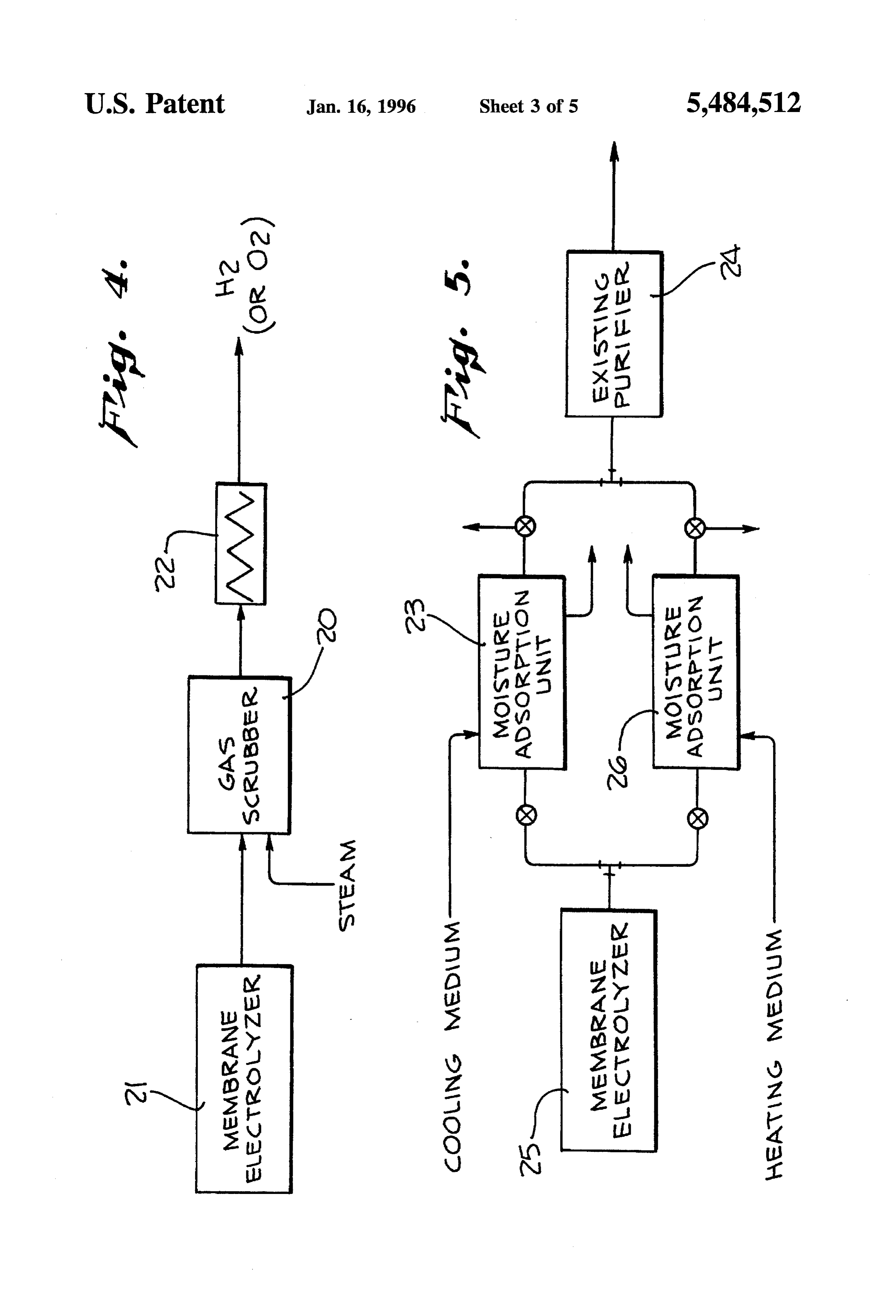
Pb: 0.9 ppb; Cd: 0.1 ppb; etc.) The pure water had TOC 50 As shown in FIG.4, a gas scrubber (20), which scrubs gas (total organic carbon) <1.0 ppb, specific resistance of with steam, is provided between a membrane electrolyzer 18.25Mg2-cm; particle quantity <1.0 n/ml, silica <1.0 ppb, (21) and a purifier (22). In the steam scrubbing, the steam and residue on evaporation <1.0 ppb. KOH was dissolved in contacts the generated gas of low temperature to coagulate the pure water to prepare a 30% KOH aqueous solution and and turn it into a mist. Water particles of the mist provide the solution was used as the electrolytic solution. 55 nuclei for capturing the KOH spray and many nuclei in The above-mentioned 30% KOH aqueous solution (elec which KOH is coagulated are produced. As a result, the trolytic solution) was fed into a membrane cell of a mem purification by the purifier (22) can be made much more brane electrolyzer (11), and membrane electrolysis was easily.
performed while the pure water was fed continuously into FIG. 5 is a schematic diagram showing the fourth embodi the membrane electrolytic cell. Oxygen generated at the 60 ment of the methods and apparatuses for producing high anode was introduced into a purifier (12) to purify the purity oxygen and hydrogen according to the present inven oxygen. On the other hand, hydrogen generated at the tion.
cathode was introduced into a purifier (13) to purify the FIG. 5 shows an embodiment for when a semiconductor hydrogen. Thus, high purity oxygen and hydrogen were plant already has a purifier. As shown in FIG. 5, moisture generated. 65 adsorption units (23) and (26), which have a simple struc In the operation, the membrane of the membrane electro ture, such as a molecular sieve (molecular sieves having lyzer (11) was an ion-exchange membrane cation-exchange pore diameter of 4 A (Na2CA102)12(SiO2)12.27H2O) are
Page 10
provided between an existing purifier (24) and a membrane The solid polymer electrolyte electrolytic cell is shown in electrolyzer (25). The moisture adsorption units (23, 26) FIG. 6. In a cell proper (27) of a solid polymer electrolyte take away excessive moisture from the generated gas. Other electrolytic cell (28), there is located a porous solid polymer impurities are removed by the existing purifier (24). By electrolyte (29), for instance, a cation exchange membrane installing just the membrane electrolyzer (25) and moisture (fluorocarbon resin sulfonic acid cation exchange mem adsorption units (two units), oxygen and hydrogen of puri brane, e.g., “NAFIONQ 117" of DuPont, which are fabri ties comparable to those of conventional oxygen and hydro cated from copolymers of tetrafluoroethylene and perfluori gen can be obtained. The two moisture adsorption units of nated monomers containing sulfonic or carboxylic acid FIG. 5 are used alternatively. One unit is cooled to adsorb groups) is preferred. A porous anode (30) and a porous moisture, while the other unit is heated to evaporate and 10 cathode (31) both preferably being made of platinum group release the moisture adsorbed. When the evaporation and metal are joined to both sides of the solid electrolyte (29). release are completed, the unit is made to stand by for the The cell proper (27) is divided by the solid polymer elec next operation of moisture adsorption. trolyte (29) into two electrolytic cells (32) and (33); the The above-mentioned method of producing oxygen and hydrogen of high purity and its apparatus can produce, by 15 anode
electrolytic cell (32) and the cathode electrolytic cell
While a voltage is applied across the anode (30) and the membrane electrolysis, oxygen and hydrogen free of certain cathode (31), pure water is introduced into the anode side to impurities such as nitrogen. It is, therefore, not necessary to make electrolysis. Oxygen is generated at the anode (30) and remove certain impurities such as nitrogen, which was hydrogen is generated at the cathode without being mixed difficult in the past. A relatively simple method of purifica with each other. As the electrolyte is a solid polymer tion is sufficient to attain the required purity, i.e., that 20 electrolyte comprising a cation exchange membrane (29), obtained with a secondary purification process. Since high purity oxygen and hydrogen can be produced just when the ionic conduction in the electrolyte is made by the transfer needed, there is no need of storage in tanks, bombs, etc., of H being generated by an electrochemical reaction at the thus, improving safety. anode, and any electrolytes such as KOH are not used. Traces of hydrogen, electrolyte components and moisture, 25 anode containsthea oxygen
Accordingly, trace of being the gas generated at the water, but it does not contain however, are contained in the oxygen gas generated at the anode as impurities after the membrane electrolysis, and hydrogen being the gas generated atnorthedissolved hydrogen, electrolyte components, cathode gases. The contains a traces of oxygen, electrolyte components and moisture are trace of water, but it does not contain oxygen, electrolyte contained in the hydrogen gas generated at the cathode.
These impurities must be removed. The moisture and elec 30 components,
To be more nor dissolved gases.
specific, pure water is introduced from a pure trolyte component can be removed by a moisture adsorbent such as a molecular sieve. The trace hydrogen in the oxygen water supply system (not illustrated) into the anode electro and the trace oxygen in the hydrogen, however, must be lytic cell (32) of the solid polymer electrolyte electrolytic turned into moisture first by means of an oxidation catalyst, cell (28). The pure water is decomposed by the reactions: etc. before removal by a moisture adsorbent. In addition to 35 cross-contamination of the generated oxygen and hydrogen and contamination with electrolyte components, impurities such as nitrogen may also contaminate the generated oxygen and hydrogen. The source of impurities such as nitrogen are at the anode (30) to produce oxygen gas. The H" ions gasses dissolved in the pure water. The presence of impu 40 generated at the same time permeate through the solid rities such as nitrogen in the generated hydrogen and oxygen electrolyte (29) to produce hydrogen gas, of which volume require further and more complicated purification proce is twice that of the oxygen gas, at the cathode (28) by the dures. reaction
It is, therefore, desirable to further reduce the kinds and quantities of impurities in the generated oxygen and hydro 45 gen. As explained above, the oxygen being the gas generated Further provided in accordance with the present invention at the anode and the hydrogen generated at the cathode after are methods and apparatuses for producing high purity the membrane electrolysis do not contain impurities except oxygen and hydrogen which employ a degassing means for a trace of water. Hence, simple dehumidification of such degassing gases from pure water, a solid polymer electrolyte 50 generated gases with the above-mentioned dehumidifying electrolytic cell for effecting membrane electrolysis of pure means is sufficient to obtain high purity oxygen and hydro water degassed by the degassing means, and dehumidifying gen required in technical fields including the electronics means for separately dehumidifying oxygen generated at the industry. This method of producing oxygen and hydrogen of anode and hydrogen generated at the cathode of the water high purity generates less kinds of impurities to be purified electrolytic cell. 55 relative to the above-mentioned methods and apparatuses of Pure water, introduced into the apparatus, is first degassed the present invention, and allows further simplification of by a degassing means to remove N and O gasses dissolved the purification processes.
in the pure water. Next, the pure water is introduced into the For the above-mentioned pure water, it is preferable to use solid polymer electrolyte electrolytic cell and subjected to pure water of which purity is, in terms of specific resistance, membrane electrolysis. Oxygen is generated at the anode, 60 18.25MS2-cm (25° C) or over. This assures that the impurity and hydrogen is generated at the cathode. Oxygen and in the gases generated after membrane electrolysis is just hydrogen so generated contain no impurities except traces of traces of water. Thus, high purity oxygen and hydrogen can water. Oxygen and hydrogen purities are thus very high. be obtained. Such a pure water can be obtained by ion Further, since the pure water to be introduced into the exchange and membrane separation. A pure water facility of above-mentioned cell is degassed in advance, dissolved 65 this kind is expensive, but the advanced semiconductor gasses such as N2 are not allowed to enter the generated plants of the present day are always provided with such a gases. facility. The existing pure water facility is normally adequate
Page 11
for the supply of pure water, although it depends on the high purity. The pure water had TOC (total organic carbon) usages to which the hydrogen and oxygen are to be put. <1.0 ppb, specific resistance of 18.25MC.2-cm, particle quan For the above-mentioned degassing means, it is preferable tity<1.0 m/ml, silicag1.0 ppb, and residue on evapora to use a membrane degassing module (membrane type air tion<1.0 ppb. Said pure water was degassed by the mem drier using water vapor permeable membrane (fluorocarbon brane degassing module (34), then subjected to membrane resin (PTFE) hollow fiber membrane), SUNSEP-W Module electrolysis by the solid polymer electrolyte water electro (Asahi Glass Co. Ltd.)). The reason is that it is simple, of a lytic cell (35). Oxygen was generated at the anode and continuous type, and compact. hydrogen was generated at the cathode. The oxygen and the An apparatus for producing high purity oxygen and hydrogen were separately introduced into (36) or (37), and hydrogen according to the present invention is provided with 10 (38) or (39) to be dehumidified. As a result, oxygen of high a pure water producing means for making water into pure purity at 99.999% or over and hydrogen of high purity at water, a solid polymer electrolyte electrolytic cell for mem 99.999% or over were obtained. Their purities are compa brane electrolysis of the pure water produced by the pure rable to or higher than those of highly-pure oxygen and water producing means, and dehumidifying means for sepa hydrogen obtained by the purification processes (secondary rately dehumidifying the oxygen generated at the anode and 15 purification) in the conventional semiconductor plants. The the hydrogen generated at the cathode of said electrolytic details of the production conditions were as follows: cell. Water such as city water, etc. is introduced into the pure Degassing condition: Inlet pure water pressure at 3.0 water manufacturing means of this apparatus to produce kg/cm;
pure water. Then, the pure water is introduced into the solid inflow pure water rate at 1 1/min. polymer electrolyte electrolytic cell membrane electrolysis 20 Voltage: 5 V.
is performed. Next, the oxygen and the hydrogen generated Current: 300 A.
by this electrolysis are dehumidified by the dehumidifying Dehumidifying conditions:
means to obtain oxygen and hydrogen of high purity. As Inlet gas temperature at 30° C.; degassing is not done prior to the membrane electrolysis, the Outlet gas dew point at -70° C.; and oxygen and hydrogen obtained have lower purities relative 25 Regeneration temperature at 300° C. to those of the oxygen and hydrogen obtained by the FIG. 8 is a schematic diagram showing the sixth embodi above-mentioned method and apparatus, but are applicable ment of the methods and apparatuses for producing high to certain applications, fairly meeting the required purities. purity oxygen and hydrogen according to the present inven For instance, the hydrogen is fairly good for hydrogen energy applications. When higher purities are needed, it is 30 tion.For the major components, the apparatus uses, as a pure sufficient to add a means for degassing the pure water water producing means, a pure water producing means (44) obtained from the pure water producing means; the mem brane electrolysis is made after degassing by the degassing comprising a reverse osmosis membrane unit (40) (the same S. as that of FIG. 7) and an ion exchange resin unit (41) (the For the above-mentioned pure water producing means, 35 solid same as that of FIG.7) both being connected with piping. A there is no specially limiting requirement. An apparatus polymer electrolyte electrolytic cell (42) (the same as comprising a reverse osmosis unit and anion-exchange resin that of FIG. 7) was connected to the pure water producing unit, both connected with piping, are preferably used. For means (44) with piping. Molecular sieves (43) (the same as example, a simple pure water unit for a laboratory, wherein those of FIG.7; comprising (45), (46), (47) and (48) just like the fifth embodiment above) were connected to said elec a reverse osmosis membrane and an ion-exchange resin or 40 trolytic an ion-exchange membrane are used as a set, are preferably cell (42) with piping. used. When a large sized apparatus is needed, an apparatus City water was continuously introduced into the above comprising a primary pure water unit having a reverse mentioned apparatus to produce oxygen and hydrogen of osmosis membrane and a secondary pure water unit having high purity. The city water was turned into pure water by the an ion-exchange resin and an ultra filtration (UF) membrane 45 pure water producing means (44). The pure water was subjected to membrane electrolysis by said electrolytic cell as a set is preferred. In this case, for the reverse osmosis (42). Oxygen was generated at the anode and hydrogen was membrane, cellulose acetate membrane is preferred, and for generated at the cathode. The oxygen and the hydrogen were the ion-exchange resin, a mix bed ion-exchange column using an ion-exchange resin and a cation exchange resin in separately introduced into the molecular sieves (43) to be mixture is preferred. With this arrangement, organic matters 50 dehumidified. As a result, oxygen of high purity at 99.999% and salts are efficiently removed. or over and hydrogen of high purity at 99.999% or over were FIG. 7 is a schematic diagram showing the fifth embodi obtained. The details of the production conditions were as follows:
ment of the methods and apparatuses producing high purity oxygen and hydrogen according to the present invention. City water inflow rate: 12 ml/min (added water). For the major components, the apparatus uses, as a 55 Voltage: Pure water production rate: 3 1/min. degassing means, a membrane degassing module (34) 4 V.
(membrane type air drier using water vapor permeable Current: 1200 A.
membrane (fluorocarbon resin of polytetrafluoroethylene Dehumidifying conditions:
(PTFE) hollow fiber membrane), SUNSEP-W Module Inlet gas temperature at 35° C.; (Asahi Glass Co. Ltd.)) to which a solid polymer electrolyte 60 Outlet gas dew point at -70° C.; and electrolytic cell (35) (the same apparatus as that of FIG. 6) Regeneration temperature at 300° C. is connected with piping. Molecular sieves (36), (37), (38) FIG. 9 is a schematic diagram showing the seventh and (39) (the same as the molecular sieves of FIG. 5 are embodiment of the methods and apparatuses for producing connected to the cell (35) with piping as the dehumidifying high purity oxygen and hydrogen according to the present C2S. 65 invention.
Pure water was continuously introduced into the above The apparatuses are identical to those of the sixth embodi mentioned apparatus to produce oxygen and hydrogen of ment except a membrane degassing module (49) of the fifth
Page 12
embodiment is connected, with piping, between a pure water What is claimed is:
producing means (50) and a solid polymer electrolyte elec 1. A method of producing high purity oxygen and hydro trolytic cell (51) of the apparatus of the sixth embodiment. gen comprising the steps of:
City water was continuously introduced into the above (a) degassing a gas in pure water by using a membrane mentioned apparatus to produce oxygen and hydrogen of 5 degassing module including an air drier using a fluo high purity. The city water was turned into pure water by the rocarbon resin hollow fiber membrane; pure water producing means (50). The pure water was (b) providing an electrolytic solution comprising an elec degassed by the membrane degassing module (49) and trolyte dissolved in only the degassed pure water subjected to membrane electrolysis by said electrolytic cell wherein said electrolyte is selected from the group (51). Oxygen was generated at the anode and hydrogen was 10 consisting of KOH, NaOH and HaSO4; then generated at the cathode. The oxygen and the hydrogen were (c) feeding the electrolytic solution into a membrane separately fed into the molecular sieves (52) to be dehu electrolytic cell of a membrane electrolyzer including a midified. As a result, oxygen of high purity at 99.999% or membrane, an anode and a cathode; over and hydrogen of high purity at 99.999% or over were obtained. Their purities are comparable to those of highly 15 (d) electrolyzing the electrolytic solution while providing pure oxygen and hydrogen obtained by the secondary puri the membrane electrolytic cell intermittently or con fication in the conventional semiconductor plants. The tinuously with degassed pure water to produce oxygen details of the production conditions were as follows: at the anode and hydrogen at the cathode, wherein said City water inflow rate: 12 ml/min. (added water) oxygen and said hydrogen have entrained electrolyte Pure water production rate: 3 l/min. components;
Degassing conditions: 20 (e) removing said electrolyte components by scrubbing Inlet pure water pressure at 3.0 kg/cm; said oxygen and hydrogen in a gas scrubber with pure Inflow pure water rate at 3 l/min. water or steam; and
Voltage: 4 V.
Current: 1200 A. (f) purifying individually by purifying means oxygen Dehumidifying conditions: 25 produced at the anode and hydrogen produced at the Inlet gas temperature at 35° C.; cathode by a cooling type purifier. Outlet gas dew point at -70° C.; and 2. An apparatus for producing oxygen and hydrogen of high purity, said apparatus comprising;
Regeneration temperature at 300° C. a membrane degassing module including an air drier As explained above, the methods and apparatuses pro ducing oxygen and hydrogen according to the present inven 30 using a fluorocarbon resin hollow fiber membrane for tion subject pure water to membrane electrolysis and sepa degassing a gas in pure water to provide degassed pure rately purify, by means of purifiers, the oxygen and the water, hydrogen generated to produce oxygen and hydrogen of a membrane electrolyzer directly and operatively con high purity. Hence the methods and the apparatuses allow nected downstream to the membrane degassing mod the use, for purification, of a simple and inexpensive purifier 35 ule, and including a membrane, an anode and a cathode or purification system such as one based on a purification for effecting membrane electrolysis of an electrolytic system of cooling with liquefied nitrogen rather than sophis solution prepared by dissolving an electrolyte in the ticated purification methods such as the palladium mem degassed pure water, wherein said electrolyte is brane permeation method. Furthermore, the methods and the selected from the group consisting of KOH, NaOH and apparatuses have an effect that they can produce oxygen and 40 Na2SO;
hydrogen of high purity whenever needed for use, eliminat a pure water feeding means fed directly into the degassing ing the need of storage in bombs, tanks, etc., thus enhancing module for continuously or intermittently feeding safety. degassed pure water to a membrane electrolytic cell of The apparatuses for producing oxygen and hydrogen of the membrane electrolyzer, and high purity according to the present invention degas, when 45 purifiers for individually purifying oxygen generated at necessary, pure water by means of the degassing means to the anode and hydrogen generated at the cathode of remove N, O gases, etc. dissolved in the pure water before said membrane electrolyzer being connected to a cool membrane electrolysis in a solid polymer electrolyte elec ing purifier through a gas scrubber wherein the elec trolytic cell. Hence the apparatuses produce highly-pure trolyte entrained by the oxygen and hydrogen during oxygen and hydrogen both containing no impurities except 50 the membrane electrolysis and contained in the oxygen traces of water. High purity oxygen and hydrogen needed for and hydrogen generated by the membrane electrolysis technical fields such as the electronics industry can be is scrubbed by pure water or steam. obtained by merely dehumidifying, by means of dehumidi 3. A method of producing oxygen and hydrogen of high fying means, the produced oxygen and hydrogen. There are purity comprising the steps of:
no impurities such as nitrogen, which were difficult in the 55 (a) degassing a gas in pure water using a membrane past. The purification treatment can be made extremely degassing module including an air drier using a fluo simply relative to the conventional methods, and as the kinds rocarbon resin hollow fiber membrane to provide of impurities to be purified are very few, the purification degassed water, treatment is much simpler.
Having thus described exemplary embodiments of the 60 (b) feeding only the degassed water continuously or present invention, it should be noted by those of skill in the intermittently into a solid polymer electrolyte electro art that the within disclosures are exemplary only and that lytic cell having an unporous solid polymer electrolyte various other alternatives, adaptations and modifications electrolytic membrane made of a cation exchange may be made within the scope of the present invention. membrane wherein a platinum group metal is joined to Accordingly, the present invention is not limited to the 65 opposite sides of the solid polymer electrolyte mem specific embodiments as illustrated herein, but is only lim brane to form an anode and a cathode; ited to the following claims and their equivalents. (c) effecting membrane electrolysis; and
Page 13
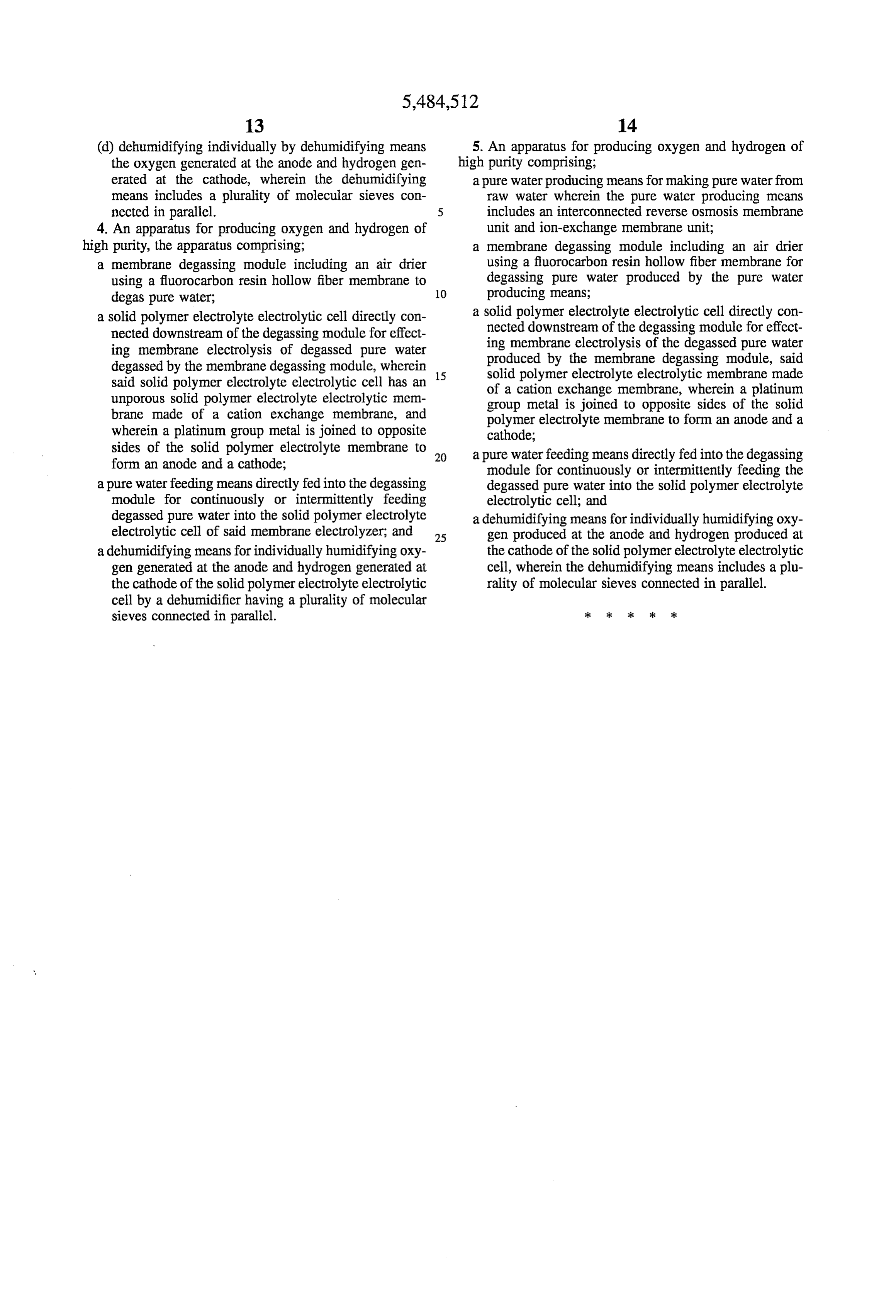
(d) dehumidifying individually by dehumidifying means 5. An apparatus for producing oxygen and hydrogen of the oxygen generated at the anode and hydrogen gen high purity comprising:
erated at the cathode, wherein the dehumidifying a pure water producing means for making pure water from means includes a plurality of molecular sieves con raw water wherein the pure water producing means nected in parallel. 5 includes an interconnected reverse osmosis membrane 4. An apparatus for producing oxygen and hydrogen of unit and ion-exchange membrane unit; high purity, the apparatus comprising; a membrane degassing module including an air drier a membrane degassing module including an air drier using a fluorocarbon resin hollow fiber membrane for using a fluorocarbon resin hollow fiber membrane to degassing pure water produced by the pure water degas pure water; 10 producing means;
a solid polymer electrolyte electrolytic cell directly con a solid polymer electrolyte electrolytic cell directly con nected downstream of the degassing module for effect nected downstream of the degassing module for effect ing membrane electrolysis of degassed pure water ing membrane electrolysis of the degassed pure water degassed by the membrane degassing module, wherein 15 produced by the membrane degassing module, said said solid polymer electrolyte electrolytic cell has an solid polymer electrolyte electrolytic membrane made unporous solid polymer electrolyte electrolytic mem of a cation exchange membrane, wherein a platinum group metal is joined to opposite sides of the solid brane made of a cation exchange membrane, and polymer electrolyte membrane to form an anode and a wherein a platinum group metal is joined to opposite cathode, sides of the solid polymer electrolyte membrane to 20 a pure water feeding means directly fed into the degassing form an anode and a cathode; module for continuously or intermittently feeding the a pure water feeding means directly fed into the degassing degassed pure water into the solid polymer electrolyte module for continuously or intermittently feeding electrolytic cell; and degassed pure water into the solid polymer electrolyte a dehumidifying means for individually humidifying oxy electrolytic cell of said membrane electrolyzer; and 25 gen produced at the anode and hydrogen produced at a dehumidifying means for individually humidifying oxy the cathode of the solid polymer electrolyte electrolytic gen generated at the anode and hydrogen generated at cell, wherein the dehumidifying means includes a plu the cathode of the solid polymer electrolyte electrolytic rality of molecular sieves connected in parallel. cell by a dehumidifier having a plurality of molecular sieves connected in parallel. ck k k
Page 14
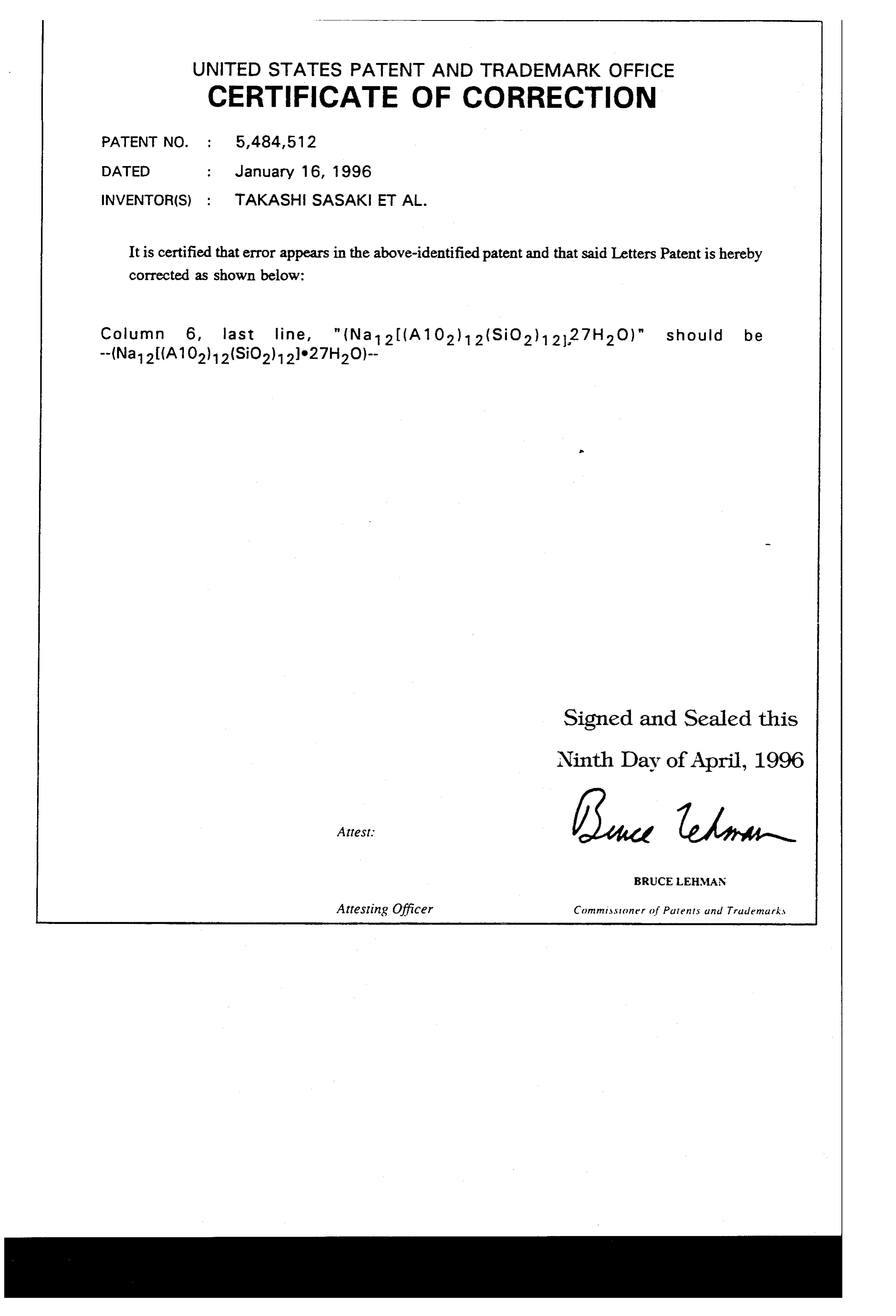
UNITED STATES PATENT AND TRADEMARK OFFICE
CERTIFICATE OF CORRECTION
INVENTOR(S) : TAKASH SASAK ET AL.
It is certified that error appears in the above-identified patent and that said Letters Patent is hereby corrected as shown below:
Column 6, last line, "(Na 12 (A 102)12 (SiO2)1227H2O)" should be
Signed and Sealed this
Ninth Day of April, 1996 (a teen
BRUCE EHMAN
Attesting Officer Commisstoner of Patients and Trade marks
Provenance
- Collection
- Cited prior art
- Original PDF
- patentimages.storage.googleapis.com →
- Filed
- 1994-05-23
- Pages
- 14
- Method
- pdftotext (the PDF's own text layer) + pdftoppm 300dpi page scans
- Source
- Google Patents bibliographic record
- Granted
- 1996-01-16
- Inventors
- Takashi Sasaki; Hiroyuki Harada; Akihiko Hogetsu; Mitsubishi Corp; Shinko Pantec Co Ltd
- Transcribed from
- patentimages.storage.googleapis.com →