patent · US5360461
Polymeric storage bed for hydrogen
1 November 1994
Page 1 — bibliographic record
United States Patent (19) 11 Patent Number: 5,360,461 Meinzer 45 Date of Patent: Nov. 1, 1994 54 POLYMERIC STORAGE BED FOR 5,40,397 8/1992 Haga et al. ............................ 357/30 HYDROGEN 5,204,310 4/1993 Tolles et al. ........................ 502A16 75 Inventor: Richard A. Meinzer, Glastonbury, OTHER PUBLICATIONS Conn. "Hydrogen Use-Transportation Fuel”, by H. Buchner, 73) Assignee: United Technologies Corporation, published in Int. J. Hydrogen Energy, vol. 9, No. 6, 1984, Hartford, Conn. pp. 501-5.14.
“Hydrogen: An Alternative Fuel', by Daimler Benz.
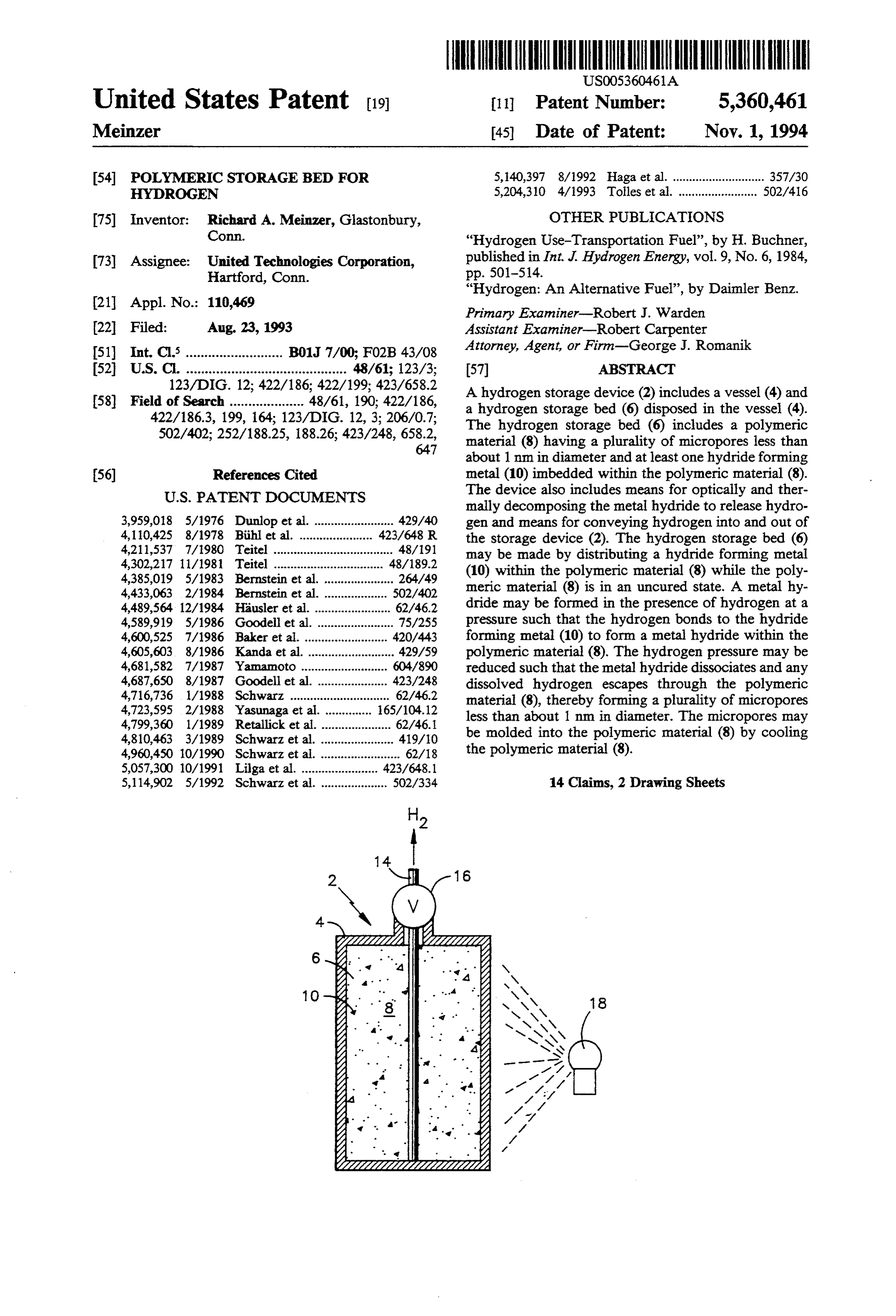
21 Appl. No.: 110,469 Primary Examiner-Robert J. Warden 22 Filed: Aug. 23, 1993 Assistant Examiner-Robert Carpenter 51) Int. Cl........................... B01J 7/00; FO2B 43/08 Attorney, Agent, or Firm--George J. Romanik 52 U.S. C. ........................................... 48/61; 123/3; 57 ABSTRACT 123/DIG. 12; 422/186; 422/199; 423/658.2 A hydrogen storage device (2) includes a vessel (4) and 58 Field of Search .................... 48/61, 190; 422/186, a hydrogen storage bed (6) disposed in the vessel (4). 422/186.3, 199, 164; 123/DIG. 12, 3; 206/0.7; The hydrogen storage bed (6) includes a polymeric 502/.402; 252/188.25, 188.26; 423/248, 658.2, material (8) having a plurality of micropores less than
about 1 nm in diameter and at least one hydride forming (56) References Cited metal (10) imbedded within the polymeric material (8).
mally decomposing the metal hydride to release hydro 3,959,018 5/1976 Dunlop et al. ........................ 429/40 gen and means for conveying hydrogen into and out of 4, 10,425 8/1978 Bihl et al. ..... 423/648 R the storage device (2). The hydrogen storage bed (6) 4,211,537 7/1980 Teitel .................................... 48/191 may be made by distributing a hydride forming metal 4,302,217 1/1981 Teitel ................................. 48/89.2 (10) within the polymeric material (8) while the poly 4,385,019 5/1983 Bernstein et al. ..................... 264/49 4,433,063 2/1984 Bernstein et al. ................... SO2A402 meric material (8) is in an uncured state. A metal hy 4,489,564. 12/1984 Hausler et al. ....................... 62/46.2 dride may be formed in the presence of hydrogen at a 4,589,919 5/1986 Goode et al. ....................... 75/255 pressure such that the hydrogen bonds to the hydride 4,600,525 7/1986 Baker et al. ......................... 420/443 forming metal (10) to form a metal hydride within the 4,605,603 8/1986 Kanda et al........................... 429/59 polymeric material (8). The hydrogen pressure may be 4,681,582 7/1987 Yamamoto .......................... 604/890 reduced such that the metal hydride dissociates and any 4,687,650 8/1987 Goodell et al. ..................... 423A248 dissolved hydrogen escapes through the polymeric 4,716,736 l/1988 Schwarz .............................. 62/46.2 material (8), thereby forming a plurality of micropores 4,723,595 2/1988 Yasunaga et al. ..... 65/104.12 less than about 1 nm in diameter. The micropores may 4,799,360 1/1989 Retallicket al. ..................... 62/46.
4,810,463 3/1989 Schwarz et al. ...................... 41.9/10 be molded into the polymeric material (8) by cooling 4,960,450 10/1990 Schwarz et al. ........................ 62/18 the polymeric material (8).
5,057,300 10/1991 Lilga et al........................ 423/648.1 5,114,902 5/1992 Schwarz et al. .................... 502/.334 14 Claims, 2 Drawing Sheets
Page 2
Drawing sheet — no readable text.
Page 3
Drawing sheet — no readable text.
Page 4
within its containment vessel after several charge/dis
POLYMERC STORAGE BED FOR HYDROGEN charge cycles. Designing systems to compensate for compaction results in a loss of hydrogen storage per
TECHNICAL FIELD unit weight. Thus, the existing metal hydride systems The present invention relates generally to a hydrogen are heavy and typical system energy storage densities storage device. are about 1/16th or less of that for gasoline. The maxi mum value for metal hydride storage, assuming 7.6
BACKGROUND ART weight percent (wt.%) of hydrogen, is about 700 watt The use of hydrogen as a source of energy is becom hours/kg for an automotive engine efficiency of about ing desirable as emissions from industry, traffic and O 30%.
homes continue to pollute the environment. Using hy Physical storage of hydrogen using materials such as drogen as an alternative fuel for many different systems charcoal, zeolite or glass powder is another option. The is advantageous because hydrogen does not pollute the resulting net energy densities in such systems, however, environment and because it has the highest energy den may also be insufficient for mobile applications. For sity per unit weight of any chemical fuel. When used as 15 example, the net energy density of hydrogen stored in fuel in combustion engines or fuel cells, hydrogen is charcoal at room temperature is only about 10 watt oxidized to water. Unlike other fuels, burning hydrogen hours/kg, which is substantially less than gasoline. does not produce carbon dioxide, which has been tied to Thus, the prior art currently has no practical way to global warming. Hydrogen has potential as a fuel in enable hydrogen to be an effective fuel substitute for both mobile environments, such as vehicles, and station gasoline because the achievable net energy densities are ary environments, such as utilities. Due to the advan not high enough.
tages of using hydrogen as fuel, there exists a need to Accordingly, there is a need for a hydrogen storage achieve higher net energy storage densities than are device capable of achieving higher net energy densities presently possible. For example, in mobile applications than are presently possible.
a net energy density comparable to that of gasoline, 25 2960 watt-hour/kg assuming an energy efficiency of DISCLOSURE OF THE INVENTION 23%, may be necessary for hydrogen to be an effective The present invention relates to a hydrogen storage fuel substitute for gasoline. No alternative method or device that may combine physical and chemical hydro device for storing hydrogen currently exists to achieve gen storage mechanisms to achieve higher net energy
Several methods of storing hydrogen exist. In one present densities than are presently possible. Additionally, the method, hydrogen is compressed and stored as a gas densitiesinvention which are may be able to achieve net energy comparable to gasoline.
under pressures of about 20 MPa or more. Limitations One aspect of the invention includes a hydrogen of this method include undesirable system weight-to storage device having a vessel and a hydrogen storage volume storage ratios due to the heavy walled contain 35 bed disposed in the vessel. The hydrogen storage bed ers needed to store the gas at high pressure. includes a polymeric material having a plurality of mi Similarly, liquefaction of hydrogen and storage at cryogenic temperatures possess limitations. For exam cropores less than about 1 nm in diameter and at least ple, significant energy penalties exist because of the one hydride forming metal imbedded within the poly high energy required to liquify the hydrogen and to meric material. The device also includes means for maintain it in the liquified state. Although another decomposing the metal hydride to release hydrogen and method, cryogenic storage of hydrogen in high surface means for conveying hydrogen into and out of the stor area activated carbons, avoids the energy costs of lique age device.
fying the hydrogen, other limitations exist such as a low Another aspect of the invention includes a hydrogen storage capacity per kilogram of storage medium. 45 storage device as discussed above, except the polymeric Metal hydride storage is another option for hydrogen material includes a metal organic compound capable of storage. In this system, a metal such as magnesium, forming a metal hydride.
vanadium, titanium or niobium reversibly forms a metal Another aspect of the invention includes a method of hydride by absorbing hydrogen in an exothermic reac making a hydrogen storage bed. A hydride forming tion. Upon application of heat, the hydride disassociates 50 metal is distributed in a polymeric material which is in into the metal and hydrogen, thus allowing the hydro an uncured state. A metal hydride may be formed in the gen to be used as fuel. Magnesium hydride is the pre presence of hydrogen at a pressure such that the hydro ferred hydride because of its high weight percentage of gen bonds to the hydride forming metal to form a metal hydrogen, 7.6%. Pure magnesium hydride, however, hydride within the polymeric material. Alternatively, a has poor hydriding and dehydriding kinetics. For exam 55 metal hydride may be distributed directly into the poly ple, it must be heated to about 300 C. to release hydro meric material. Excess hydrogen at high pressure will gen. This temperature cannot be readily achieved using dissolve into the polymeric material. The hydrogen waste heat from a combustion engine. Consequently, pressure may be reduced such that the metal hydride researchers have examined alternative magnesium com dissociates and releases hydrogen that escapes through pounds such as Mg2NiH, La2Mg17H and Mg2CuHe as the polymeric material, forming a plurality of micro well as non-magnesium compounds such as FeTiH, pores less than about 1 nm in diameter. The micropores LaNish and CaNish. Although these alternatives may be molded into the polymeric material by cooling have better hydriding and dehydriding kinetics, none of the polymeric material.
them contains a weight percentage of hydrogen that Another aspect of the invention includes a method exceeds magnesium hydride. 65 having similar steps as above except that a metal or The present metal hydrides also possess charge/dis ganic compound capable of forming a metal hydride is charge cycle limitations, which are a consequence of used instead of distributing a hydride forming metal in the hydride material decrepitating and compacting the polymeric material. In addition, the polymeric ma
Page 5
terial is initially heated to decompose the metal organic ous combinations of these materials may also be used for compound. the metal 10. Magnesium is the preferred metal due to The foregoing and other features and advantages of its ability to store hydrogen as magnesium hydride and the present invention will become more apparent from to dissociate molecular hydrogen into atomic hydrogen. the following description and accompanying drawings. In addition, magnesium is much lighter than other met
BRIEF DESCRIPTION OF THE DRAWING
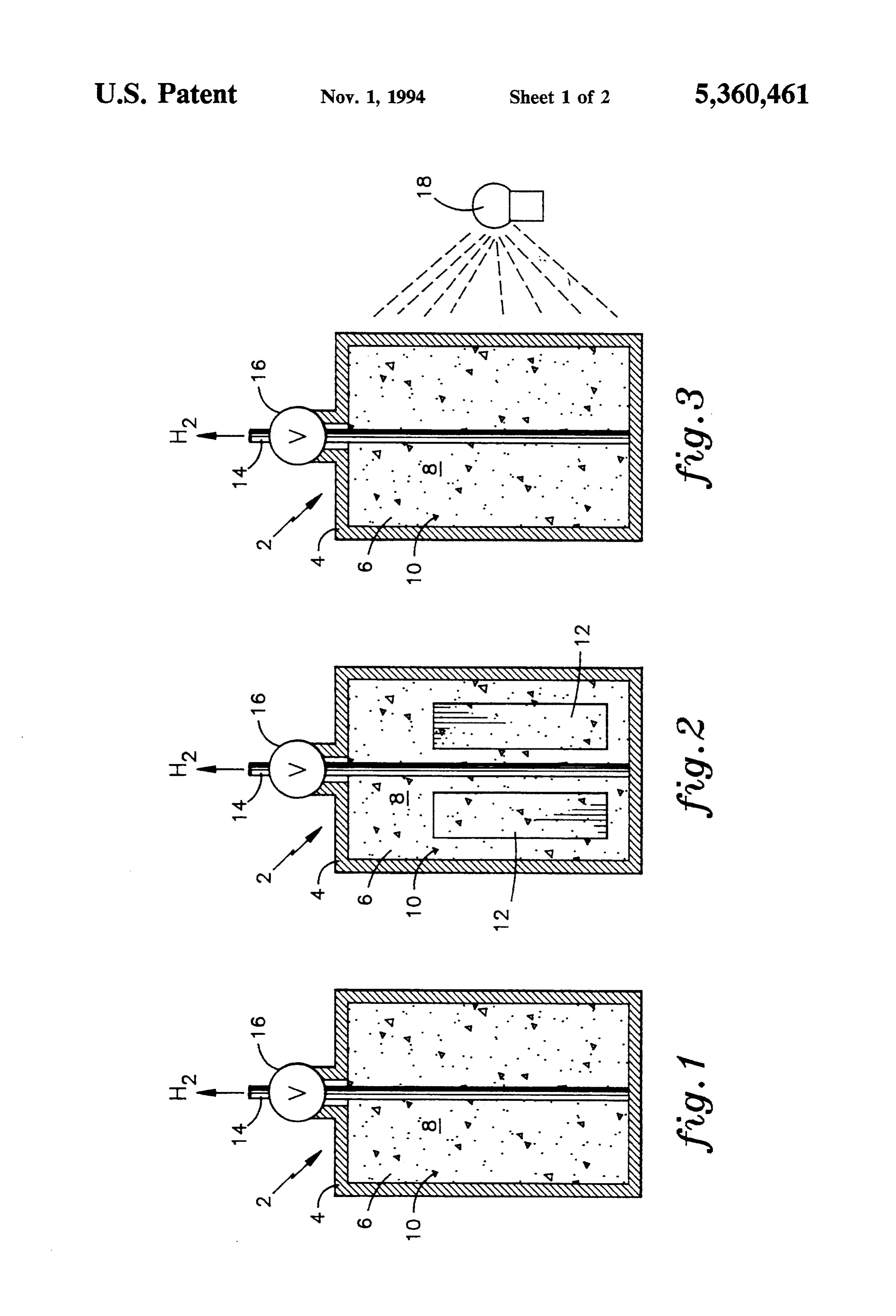
als, such as titanium, which are capable of dissociating hydrogen.
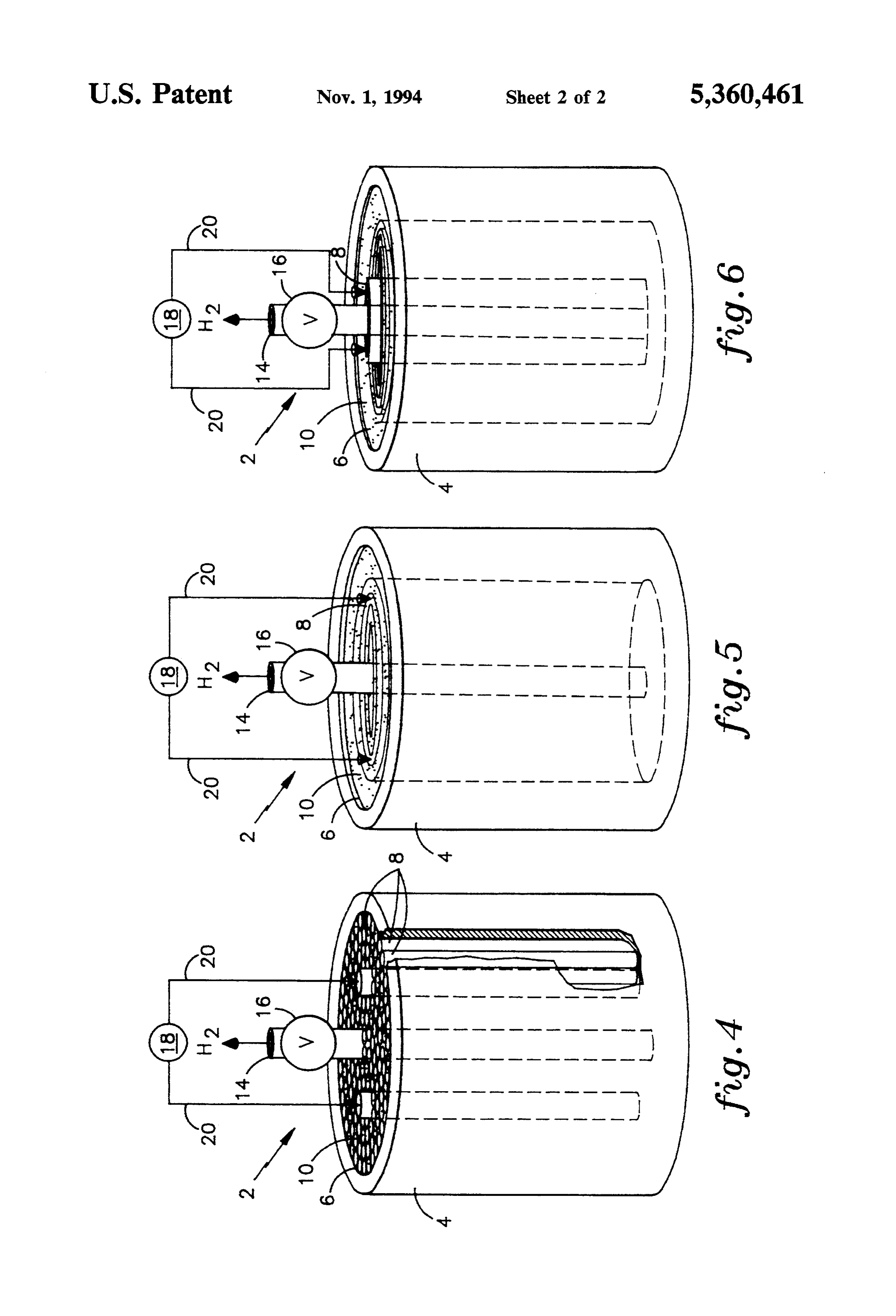
FIG. 1 is a schematic view of a hydrogen storage The polymeric material 8 may be any polymer capa device of the present invention. ble of forming the micropores and withstanding hydro FIG. 2 is a schematic view of another hydrogen stor 10 gen storage temperatures and pressures. It may either be age device of the present invention further including athermoplastic orthermosetting material and may be in electrodes dispersed in a polymeric material. the form of a thin sheet, a block, a plurality of concen FIG. 3 is a schematic view of another hydrogen stor tric sheets, or a plurality of rods. The polymeric mate age device of the present invention further including rial 8 may be either a conducting or nonconducting means for optically releasing hydrogen by direct fiber 15 material. Selection of the polymeric material 8 may illumination. determine the dominant hydrogen absorption mecha FIG. 4 is a schematic view of another hydrogen stor nism. For example, if the polymeric material 8 is non age device of the present invention showing the poly conductive, then chemical absorption may occur at meric material as a plurality of rods, wherein the poly metal atom sites within the polymeric material 8 and meric material is used as a light pipe to release hydro 20 physical absorption may occur at the micropores. Both gen. atomic and molecular absorption of hydrogen can oc FIG. 5 is a schematic view of another hydrogen stor cur. Metal atoms such as magnesium and titanium can age device of the present invention further illustrating a cause hydrogen to dissociate so that atomic hydrogen plurality of concentric sheets of polymeric material, can be absorbed by neighboring micropores within the wherein the polymeric material is used as a light pipe to 25 polymeric material 8. If the polymeric material 8 is release hydrogen. nonconductive, polymers such as polyesters, fluorocar FIG. 6 is a schematic view of another hydrogen stor bons and polyorganosiloxanes may be used. Fillers may age device of the present invention showing the poly then be mixed with the nonconducting polymeric mate meric material as a single sheet rolled in a spiral, rial 8 to make it conducting. The fillers may be any wherein the polymeric material is used as a light pipe to 30 metal capable of forming a metal hydride such as mag release hydrogen. nesium, vanadium, or titanium. Alternatively, the fillers
BEST MODE FOR CARRYING OUT THE
may comprise a metal organic compound capable of
NVENTION
decomposing at moderate temperatures of about 180 C.
under hydrogen pressures of about 500 kPa. Metal or
The hydrogen storage device 2 of FIG. 1 includes a 35 ganic compounds such as grignard reagents are accept vessel 4 and a polymeric hydrogen storage bed 6. In the able, but conjugated heterocyclic compounds are pre various embodiments of the invention, the hydrogen ferred because they are planar. Alternatively, the poly storage bed 6 may rely on a combination of physical and meric material 8 may comprise a metal hydride. chemical storage mechanisms to achieve high net en If the polymeric material 8 is electrically conductive, ergy densities. Either mechanism by itself may also 40 then chemical absorption may occur in a manner similar achieve high net energy densities. to the bonding process in palladium. In this process, The vessel 4 of the present invention may be made of hydrogen dissociates into atoms with subsequent bond any material suitable to withstand the temperatures and ing of the atoms to conduction electrons. Physical ab pressures necessary for effective hydrogen storage. sorption between the polymeric material 8 and hydro Preferably, the vessel 4 will be as light as possible, espe 45 gen will provide the force for retaining hydrogen. Poly cially in mobile applications of the hydrogen storage mers such as polyaromatics, linear polyenes and charge device 2. Therefore, a vessel 4 made from a low density transfer salts may be used. Examples of polyaromatic material may be desirable. Materials such as iron and conducting polymers include polyaniline, polypyrroles, steels are acceptable, but aluminum and composites are polythiophenes, and polyphenylenes. The specific con the preferred materials. The hydrogen storage bed 6 SO ductivity of these polymers is about 10-1 (ohm-cm), disposed in the vessel 4 includes a polymeric material 8 but doping can increase their conductivity. Examples of having a plurality of micropores less than about 1 nm in linear polyene polymers include polyacetylenes and diameter. Preferably, the micropores are intercon polythiazyls. The specific conductivity of relatively nected and are less than about 0.5 nm in diameter be pure polyacetylene is about 10 (ohm-cm), while cause it is advantageous to have a large number of small 55 that of metal doped polyacetylene is about 10 (ohm pores to store a significant amount of hydrogen in a cm)- 1. Polythiazyls have specific conductivities com small space. The polymeric material 8 may have a po parable to doped polyacetylenes. Examples of charge rosity of at least about 10%. Preferably, the porosity transfer salts include various derivatives of tetrathiaful will be greater than about 50%. The micropores pro valene-tetracyano-p-quinodimethane (TTF-TCNQ). vide the physical hydrogen storage aspect of the inven TTF is an electron donor and TCNQ is an electron tion and may store both molecular and atomic hydro acceptor. Other donors such as Bis (ethylenedithio)tet gen. rathiafulvalene (BEDT-TTF (ET)) and acceptors such At least one hydride forming metal 10 may be imbed as tetracyanonaptho-2,6-quinodimethane (TNAP) may ded within the polymeric material 8 to chemically en also be used. The specific conductivity of the charge hance hydrogen retention in the storage device 2 by 65 transfer salts may be about 102 (ohm-cm) at room reacting with the hydrogen. The metal 10 may comprise temperature. The polyaromatics and charge transfer iron, titanium, magnesium, vanadium, niobium, nickel, salts are preferred because they are capable of forming copper, zinc, or another hydride forming metal. Vari layered structures with void regions between each
Page 6
layer. Hydrogen molecules or atoms may be stored in meric material 8 passes between the hot rollers, the these regions. magnesium will be pressed into the polymeric material Preferably, the polymeric material 8 will be electri 8. Better distribution of the metal 10 within the poly cally conductive to enhance hydrogen release and pro meric material 8 can be achieved by heating the metal mote hydrogen storage through the interaction of con 10 so that metal vapor enters the polymeric material 8. duction electrons with the hydrogen. Alternatively, a metal hydride may be imbedded in the The hydrogen storage device 2 also includes means polymeric material 8.
for decomposing the metal hydride to release hydrogen. A hydride vapor or powder of a hydride forming This could be accomplished by heating the storage bed metal, a metal organic vapor, or metal organic powder 6 with hot exhaust from an engine or by circulating a 10 of a hydride forming metal, such as magnesium, magne heat transfer fluid through tubes in the polymeric mate sium vapor or metal organic vapor or metal organic rial 8. Any other means known in the art may also be powder could be added to a monomer before polymeri used. If the polymeric material 8 is electrically conduc zation as another alternative. The monomer would then tive, an electric current may be applied to a plurality of be heated to polymerize it and incorporate the hydride electrodes 12 to heat the polymeric material 8 by resis 15 forming metal 10 or metal organic compound into the tance heating, as shown in FIG. 2. This resistance heat polymeric material 8.
ing could be used to initially provide hydrogen to start If magnesium is present, the polymeric material 8 a combustion engine or to provide more uniform heat may be heated initially to provide the activation energy ing of the hydrogen bed 6 that may be simultaneously and initiate the hydride reaction. The polymeric mate heated by another method. 20 rial 8 may be heated from about 120° C. to about 250 C. Alternatively, the hydrogen may be released opti in the presence of hydrogen at a pressure such that the cally by transmitting photons which are capable of hydrogen bonds to the hydride forming metal 10 to dissociating metal hydride bonds through the polymeric form a metal hydride within the polymeric material 8. A material 8. Light may be transmitted into the polymeric pressure greater than about 3450 kPa may be suitable. material 8 by any known means, such as direct illumina 25 At room temperature other metal hydrides can form tion by a light source 18, as shown in FIG. 3. Light without the addition of heat due to the exothermic sources such as laser diodes or incandescent lamps may nature of the reaction.
be used. Additionally, a window may be placed in the The hydrogen pressure is reduced such that the metal vessel 4 at a position such that illumination of the poly hydride dissociates and releases hydrogen that escapes meric material 8 is enhanced by direct external light. 30 into the polymeric material 8. Hydrogen diffuses Alternatively, a light source 18 may be placed inside the through the polymeric material 8 and forms a plurality vessel 4. As shown in FIGS. 4-6, optical fibers 20 may of micropores less than about 1 nm in diameter in the also be used to transmit light into the polymeric mate polymeric material 8. The micropores may be molded rial 8. In these embodiments, the polymeric material 8 into the polymeric material 8 by cooling the polymeric acts as a light pipe and transmits light to reaction sites 35 material 8 to about room temperature and sub-atmos where hydrogen can be released. FIG. 4 shows the pheric pressure or some other suitable temperature and polymeric material 8 in the form of rods. Similarly, pressure.
FIGS. 5 and 6 show the polymeric material 8 as a plu Alternatively, if a polymeric material 8 comprising a rality of concentric sheets and as a single spiral sheet, metal organic compound capable of forming a metal respectively. The wavelength of the light used to illumi hydride is used, the polymeric material 8 must be ini nate the polymeric material 8 should be selected such tially heated such that the metal organic compound that it breaks bonds between the hydrogen and hydride decomposes to form a hydride forming metal 10. forming metal. For example, a wavelength of approxi If the polymeric material 8 is conductive, the hydro mately 500 nm may be required to release hydrogen gen storage bed 6 may be made with a similar method as from magnesium hydride. The optical release of hydro 45 described above. Less metal 10, however, may be need gen may be combined with the previously described to be added to the polymeric material 8 because con conventional method of heating the storage bed 6 to ducting polymeric materials have a greater capacity to release hydrogen. Additionally, the device of the pres store hydrogen in void regions between the layers than ent invention includes means for conveying hydrogen do nonconducting polymers. Metal atoms may be mixed into and out of the storage device 2. This may be ac with the polymeric material 8 to provide sites for chem complished by imbedding a perforated pipe 14 or simi ical reaction and sites at which the hydrogen molecules lar device through the hydrogen storage bed 6. The may dissociate into atoms. The atoms may diffuse from pipe 14 may be equipped with a valve 16 or some other the metal sites into void regions within the polymeric device for controlling the flow of hydrogen. Other material 8.
conventional means of conveying hydrogen into and 55 Hydrogen may be stored in the device 2 of the pres out of the device 2 are also acceptable. ent invention by flowing hydrogen into the hydrogen Hydrogen storage material may be made as rods, storage bed 6 such that the hydrogen flows through blocks, sheets or pellets which are subsequently loaded micropores in the polymeric material 8. The hydrogen into the storage device 2 to form the hydrogen storage may react at a metal site to form atoms, which migrate bed 6. If the polymeric material 8 is nonconductive, the away from the metal 10 and attach to the polymeric hydrogen storage bed may be made by distributing a material 8 by a physioabsorption process. Hydrogen hydride forming metal 10 within the polymeric material may be stored chemically in the form of a metal hydride 8 which is in an uncured state. The metal 10 may be and physically on the walls of the micropores. distributed in the polymeric material 8 by any appropri Hydrogen is released by heating the hydrogen stor ate method. For example, the metal 10, such as magne age bed 6 to a temperature sufficient to decompose the sium powder less than about 1 nm in diameter, may be metal hydride into hydrogen and the hydride forming placed on the polymeric material 8 which is then passed metal 10. Alternatively, the hydrogen may be optically through hot rollers. As the magnesium covered poly released by illuminating the metal hydride with photons
Page 7
of a wavelength selected to break bonds between the 2. The device of claim 1, wherein the means for de hydrogen and hydride forming metal 10. composing the metal hydride comprise means for heat The present invention overcomes some of the prob ing the polymeric material.
lems of the prior art. For example, the hydride forming 3. The device of claim 1, wherein the means for de 5 composing metal 10 imbedded in the polymeric material 8 avoids cally releasing the metal hydride comprise means for opti the prior art problem of powdering metal hydrides. The through the polymeric hydrogen by transmitting photons hydrogen bonds to the hydride forming metal 10 to material. 4. The device form a metal hydride within the polymeric material 8. metal comprises a material of claim 1 wherein the hydride forming Additionally, if the polymeric material 8 incorporates a O consisting of iron, titanium, magnesium,selected from the group metal organic compound capable of forming a metal bium, nickel, copper, zinc and mixtures vanadium, thereof. nio hydride, the powdering problem of the prior art is es 5. The device of claim 1 wherein the polymeric mate sentially eliminated. rial is electrically conductive. One advantage of optically releasing hydrogen is the 6. The device of claim 5 wherein the polymeric mate immediate release of hydrogen. Since the entire hydro 15 rial is selected from the group consisting of polyaromat gen storage bed 6 does not need to be heated, less en ics, linear polyenes and charge-transfer salts. ergy is required to obtain sufficient hydrogen to start a 7. The device of claim 5 further comprising elec vehicle. The reduced energy requirement allows the use trodes disposed in the polymeric material. of a smaller battery in the vehicle. Once the vehicle 8. A hydrogen storage device comprising: starts, hot exhaust gases can supply the energy needed 20 (a) a vessel, to release additional hydrogen. This fast response oper (b) a hydrogen storage bed disposed in the vessel, ating characteristic may be especially desirable for start wherein the hydrogen storage bed comprises a ing a vehicle in cold weather. polymeric material having a plurality of micro Advantages of physically storing hydrogen in micro pores less than about 1 nm in diameter and the pores approximately 1 nm in diameter include an in 25 polymeric material comprises a metal organic com crease in the amount of hydrogen storage per unit sur pound capable of forming a metal hydride, face area. (c) means for decomposing the metal hydride to re It should be understood that the invention is not lim lease hydrogen, ited to the particular embodiments shown and described 30 (d) means for conveying hydrogen into and out of the herein, but that various changes and modifications may vessel.
be made without departing from the spirit or scope of composing 9. The device of claim 8, wherein the means for de the claimed invention. the metal hydride comprise means for heat I claim: ing the polymeric material.
1. A hydrogen storage device comprising: 10. The device of claim 8, wherein the means for 35 decomposing the metal hydride comprise means for (a) a vessel, optically releasing hydrogen by transmitting photons (b) a hydrogen storage bed disposed in the vessel, through the polymeric material.
wherein the hydrogen storage bed comprises a 11. The device of claim 8 wherein the polymeric polymeric material having a plurality of micro material comprises magnesium.
pores less than about 1 nm in diameter, 12. The device of claim 8 wherein the polymeric (c) at least one hydride forming metal imbedded material is electrically conductive.
within the polymeric material, 13. The device of claim 12 further comprising elec (d) means for decomposing a metal hydride formed trodes disposed in the polymeric material. from the hydride forming metal to release hydro 14. The device of claim 12 wherein the polymeric gen, 45 material is selected from the group consisting of poly (e) means for conveying hydrogen into and out of the aromatics, linear polyenes k it and
salts.
vessel.
Provenance
- Collection
- Cited prior art
- Original PDF
- patentimages.storage.googleapis.com →
- Filed
- 1993-08-23
- Pages
- 7
- Method
- pdftotext (the PDF's own text layer) + pdftoppm 300dpi page scans
- Source
- Google Patents bibliographic record
- Granted
- 1994-11-01
- Inventors
- Richard A. Meinzer; United Technologies Corp
- Transcribed from
- patentimages.storage.googleapis.com →