patent · US3970610
Polymerization process
20 July 1976
Page 1 — bibliographic record
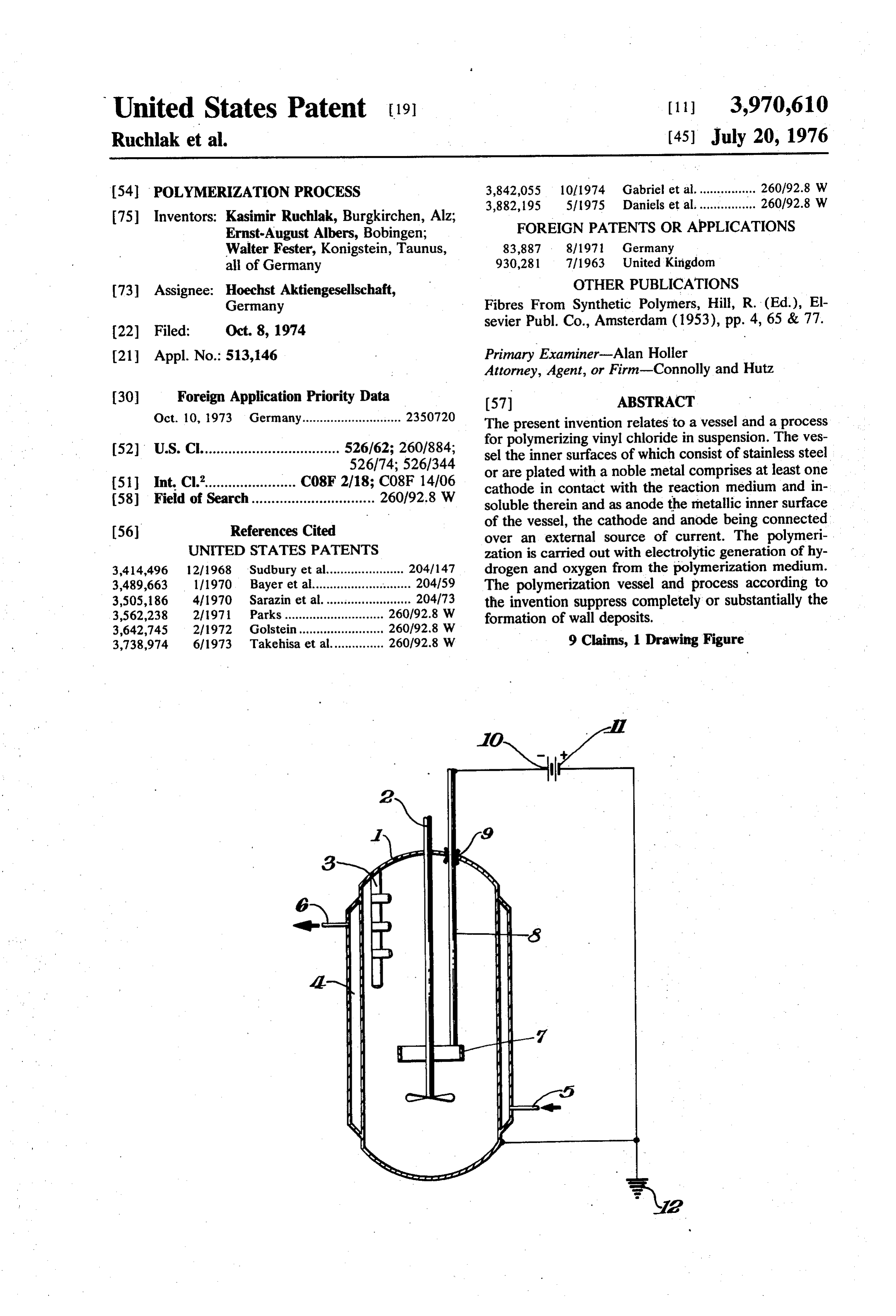
United States Patent (19) [11] 3,970,610 Ruchlak et al. (45) July 20, 1976 54). POLYMERIZATION PROCESS 3,842,055 10/1974 Gabriel et al................. 260/92.8 W 3,882,195 5/1975 Daniels et al................. 260/92.8 W 75) Inventors: Kasimir Ruchlak, Burgkirchen, Alz; FOREIGN PATENTS OR APPLICATIONS Ernst-August Albers, Bobingen;
Walter Fester, Konigstein, Taunus, 83,887 8/1971 Germany all of Germany 930,281 7/1963 United Kingdom 73) Assignee: Hoechst Aktiengesellschaft, OTHER PUBLICATIONS Germany Fibres From Synthetic Polymers, Hill, R. (Ed.), El (22) Filed: Oct. 8, 1974 sevier Publ. Co., Amsterdam (1953), pp. 4, 65 & 77. 21 Appl. No.: 513,146 Primary Examiner-Alan Holler Attorney, Agent, or Firm-Connolly and Hutz 30 Foreign Application Priority Data (57) ABSTRACT Oct. 10, 1973 Germany............................ 2350.720 The present invention relates to a vessel and a process for polymerizing vinyl chloride in suspension. The ves 52) U.S. Cl................................... 526/62; 260/884; sel the inner surfaces of which consist of stainless steel 526/74; 526/344 or are plated with a noble metal comprises at least one (51) Int. Cl........................ C08F 2/18; C08F 14/06 cathode in contact with the reaction medium and in 58) Field of Search............................... 260/92.8 W soluble therein and as anode the metallic inner surface (56) References Cited of the vessel, the cathode and anode being connected over an external source of current. The polymeri
UNITED STATES PATENTS zation is carried out with electrolytic generation of hy 3,414,496 12/1968 Sudbury et al...................... 204/147 drogen and oxygen from the polymerization medium. 3,489,663 111970 Bayer et al............................ 204159 The polymerization vessel and process according to 3,505, 186 4/1970 Sarazin et al......................... 204,173 the invention suppress completely or substantially the 3,562,238 2/1971 Parks............................ 260/92.8 W formation of wall deposits. 3,642,745 2/1972 Golstein........................ 260/92.8 W 3,738,974 6/1973 Takehisa et al............... 260/92.8 W 9 Claims, 1 Drawing Figure
Page 2
Drawing sheet — no readable text.
Page 3
by a steam heating which involves difficulties in the
POLYMERIZATION PROCESS polymerization control and keeping constant of the reactor Content.
The present invention relates to an improvement in According to a further known process the wall tem the process for polymerizing vinyl chloride in suspen perature is maintained at least at the level of the inside sion in reactors lined with stainless steel or a noble temperature of the reactor, i.e. any effective cooling metal to reduce the formation of wall deposits; it also through the wall is dispensed with (German Offen relates to a reactor suitable for carrying out the said legungsschrift 1,520,609). It is, however, very disad process. - vantageous when the entire reaction heat has to be Vinyl chloride polymers are produced on a large 10 removed exclusively over a reflux condenser. scale by suspension polymerization in aqueous me According to the latter-two processes the formation dium. In this process the monomer or mixture of mono of wall deposits cannot be fully avoided either. It is not mers is dispersed in the aqueous phase and polymerized possible to maintain all inner surfaces in the reactor at in the presence of monomer soluble activators and 15 the required temperature, for example stirrer, thermo so-called suspension stabilizers. An important problem couple, mandrel, so that on these parts deposits are still in this process is the formation of polymer deposits on formed.
the reactor wall, which may give rise to troubles in the In literature a process is described according to performance of the reaction and deteriorate the quality which the polymerization of acrylonitrile in aqueous of the products obtained. In the first place, after a short 20 medium is carried out in a vessel of ferrous metal in the polymerization period the dissipation of heat through presence of a base metal electrode, wherein the elec the reactor wall is considerably reduced or even be trode, is immersed in the polymerization medium and comes impossible and, moreover, the detaching or electrically connected with the material of the poly peeling off of a formed wall deposit during the poly merization vessel by a conduit outside of said medium. merization may contaminate the polymer. When prod The electrode consists of a metal the potential of which ucts of this type are further processed into sheets or 25 in the polymerization medium should be positive with extruded articles the known fish eyes are formed. To respect to the metal of the polymerization vessel. It, avoid these disadvantages it is therefore necessary to therefore, acts as soluble anode. The metal of this solu remove the deposit from the reactor wall. The polymer ble anode migrates to the wall of the polymerization deposits may occur in the form of a paper-like contigu 30 vessel connected as cathode; it should, however, be ous layer, a thin powdery layer or as thick lumps. In sufficiently electropositive or have a sufficient reducing general, the reactor is cleaned by means of high pres action in order that it can dissolve again in the reaction sure sprayers with water or another liquid. With heavy medium with formation of hydrogen (U.S. Pat. No. deposit formation entering of the reactor for manual 3,505, 186). This process has the drawback that reactor cleaning cannot be avoided. Such cleaning operations 35 and electrode material are constantly consumed and a of large reactors often require a period of several hours contamination of the polymer formed with the corre whereby the reactor capacity is reduced, especially in sponding metalions cannot be avoided. It is unsuitable continuously operating plants, and the production costs for the polymerization of vinyl chloride' as the use of are increased. base metals is not allowed for safety reasons. Attempts have, therefore, been made to reduce or 40 simple It is the object of the present invention to provide a even avoid the formation of such deposits in the sus vinyl chloride process for the suspension polymerization of pension polymerization of vinyl chloride. German Aus essentially without formation of wall legeschrift 1,072,812, for example, describes a process deposits, not only in a batch process but also in a con wherein the suspension polymerization is carried out in tinuous process over a prolonged period of time. the presence of a combination of protective colloids, It has already been proposed to avoid the formation oxygen-containing organic emulsifiers forming com 45 of wall deposits by electrolysis in an aqueous polymeri plex compounds with the protective colloids used and zation medium by applying an external voltage and alkaline earth metal chlorides or alkali metal phos connecting the reactor wall as cathode and an elec phates. However, in this process the formation of wall trode placed in the reaction medium or being in contact therewith as anode. It has been found, how deposits is reduced but slightly.
It has also been proposed to use in the suspension 50 ever, that high current densities are required to avoid polymerization of vinyl chloride a special activator the formation of deposits especially in the suspension polymerization of vinyl chloride or of vinyl chloride combination of azonitriles orazonitriles with monomer soluble organic peroxides, advantageously in an alka with determined amounts of suitable comonomers. line medium (U.S. Pat. No. 3,753,966). By this pro With low current densities a certain amount of deposit cess, too, only a partial reduction of the formation of 55 is formed, although to a lesser extent and with a weaker wall deposits in the polymerization is obtained. adhesiveness as in the polymerization without electrol In another known process to avoid polymer forma ysis, which deposit can be readily removed from the tion on the inner wall of the autoclave in the suspension reactor wall.
Surprisingly, it has been found that the formation of polymerization of vinyl chloride the temperature of the 60 wall cooling agent in the cooling jacket of the autoclave is chloride deposit in the suspension polymerization of vinyl maintained at a temperature of at most -15°C during or of vinyl chloride with determined amounts the first three quarters of the polymerization period of suitable comonomers can be suppressed completely and during the last quarter it does not exceed 0°C (Ger or substantially by exchanging the poles in the electrol man Offenlegungsschrift 2,033,780). This process can 65 ysis. The present invention provides a process for the only be used for large scale autoclaves having a capac suspension polymerization of vinyl chloride, suspension ity of over 100 cubic meters. Owing to the low temper copolymerization ature of the cooling medium the deficient amount of vinyl chloride withorupsuspension to 20% graft polymerization of by weight of monomers heat necessary for the polymerization must be supplied
Page 4
capable of being copolymerized or graft-polymerized activators can be used either individually or as mix with vinyl chloride, in the presence of monomer soluble tures. Also mixtures of monomer-soluble with water activators, suspension stabilizers and ionic and/or non soluble catalysts, like hydrogen peroxide and potassium ionic auxiliary suspension stabilizers, in vessels the persulfate can be employed, the ratio being preferably inner walls of which consist of stainless steel or are 5 greater than 1.
plated with a noble metal, wherein the metallic walls The catalysts are employed in the usual amounts for and inner parts of the polymerization vessel are con the suspension process, i.e. generally between 0.001 to nected as anode and in conductive connection via an 3% by weight, preferably 0.01 to 0.3% by weight, based external source of current with at least one insoluble on the weight of the vinyl chloride or the mixed mono cathode in the liquid medium of the polymerization O CS.
system, with application of an external voltage the The polymerization is preferably carried out at a polymerization takes place with electrolytic generation temperature in the range of from about 30 to about of hydrogen and oxygen and the electrolysis conditions 80°C, but this limit is not critical, other usual tempera in the polymerization medium are such that no impor 15 tures are also possible.
tant anodic dissolution of the reactor wall occurs. The voltage necessary for the electrolytic production The suspension polymerization of vinyl chloride and of hydrogen and oxygen depends on the shape and the the copolymerization or graft polymerization of vinyl dimensions of the polymerization vessel and on the chloride with other monomers is carried out under the arrangement of the electrodes in the vessel. It further depends on the current density and - in connection usual conditions in the presence of known suspension 20 therewith stabilizers and auxiliary suspension stabilizers as de - the intensity of the generation of oxygen scribed for example in U.S. Pat. Nos. 3,691,080 and tion and hydrogen required in each case to avoid the forma 3,663,520, for example, water soluble cellulose deriva of a deposit. The current density applied may be tives, like ethers (hydroxymethyl or hydroxypropyl extremely low or even very high, depending on the cellulose, methyl cellulose, methyl hydroxypropyl cel 25 polymerization conditions and the type of autoclave lulose, methoxyethyl or methoxypropyl cellulose), gel used. Current densities in the range of from about 5 to 3,000 and preferably 20 to 800 milliamperes/mproved atin, glue, dextran, polyvinyl alcohol, partially acety to be advantageous. The current density obtained de lized polyvinyl alcohol or partially saponified polyvinyl esters. Mixtures of the various stabilizers may also be reactionofmedium pends, course, on the construction of the vessel, the and on the type and amount of sup used.
porting electrolytes or buffer substances. It proved
Auxiliary suspension stabilizers may additionally be 30 particularly added, such as cationic, anionic, amphoteric or non the polymerization, advantageous to choose at the beginning of ionic emulsifiers, like anionic tensides, above all alkyl-, during which the tendency to de aryl- and aryl-alkyl-sulfonates, alkyl-sulfates, alkali posit formation is especially pronounced, a higher cur rent density and to reduce the current density in the metal salts especially sodium and potassium salts of 5 latter phase of the polymerization. sulfo-succinic acid esters and salts of higher fatty acids. The type of material and the surface structure of the Suitable nonionic auxiliary stabilizers are, for example, polymerization vessel and the inner elements and the polymers and copolymers of alkylene oxides, especially of ethylene and propylene oxide, the alkyl and aryl type of material and surface structure of the reactants ethers and esters thereof, sorbitan fatty acid esters and 40 introduced into the vessel also determine the voltage to be applied. Ranges of general applicability cannot be the condensation products thereof with alkylene ox given. The optimum external voltage to be applied in ides.
The suspension stabilizers are suitably used in nary tests. can each case
be readily determined by simple prelimi any case the external voltage should be so amounts of from 0.01 to 1% by weight, particularly high that the excess voltage in the electrolytic oxygen from 0.05 to 0.3% by weight and the auxiliary suspen 45 and hydrogen separation is overcome. It is limited by sion agents in amounts of from 0.01 to 0.1% by weight, the fact that an anodic dissolution of the reactor wall both based on the weight of vinyl chloride or mixed should be substantially avoided. Thus, the critical value
OOCS.
The polymerization is carried out in the presence of naturally depends on the reactor material used. Besides the electrolysis conditions, the reaction me monomer soluble activators conventionally used in the 50 suspension process as for example described in U.S. dium, i.e. the composition of the polymerization mix Pat. Nos. 3,691,080 and 3,663,520, preferably perox tant anodic be ture, should chosen in such a manner that no impor dissolution of the reactor wall is taking ides, peroxy compounds and certain azo compounds, place. The term "no important anodic dissolution' is for example, tert. butyl hydroperoxide, acetylcyclohex intended to cover such cases in which the dissolution is ane-sulfonyl peroxide, perbenzoate, perpivalate, cu 55 practically not higher than in a polymerization carried mylperalkyl- or -peraryl-oxy acetate, especially tert. out without current, as well as those in which it is five butyl- or cumyl-perphenoxy acetate, percarbonates or even ten fold higher. In the latter case it should be such as diisopropyl percarbonate or alkylaryl percar kept in mind that in the known polymerization without bonates with longer alkyl chains, azonitriles of the for electrolysis, besides an unavoidable dissolution of the mula 60 reactor wall, losses of reactor material always occur in the frequent removal of the wall deposits, which losses
(H. R. R. H. may be much higher than the above limiting value. If in some cases, the advantages in accordance with the
present invention justify a higher wear of the reactor 65 wall the limiting value may still be higher than indi cated above.
in which R, R and Rs each are hydrogen or an alkyl The polymerization can be carried out in a neutral, radical having from 1 to 6 carbon atoms. The aforesaid alkaline or acid medium under the known suspension
Page 5
polymerization conditions of vinyl chloride. The pH of mostly be dispensed with. In a continuous process the the starting polymerization mixture is generally in the operation periods can be considerably prolonged. range of from 1 to 12, preferably 2 to 10 and more The present invention further provides a polymeriza preferably 2.5 to 7.5. To adjust the pH in the acid or 5 tion vessel to carry out the process of the invention basic range acids and bases may be added, for example comprising at least one cathode in contact with the phosphoric acid, hydrochloric acid, sulfuric acid, car polymerization medium and insoluble therein and as boxylic acids such as acetic acid, citric acid; alkali anode the metallic inner surface of the polymerization metal hydroxides, or ammonia. If corrosive media are vessel, the cathode and the anode being conductively used, such as HCl or HSO, a noble metal or noble connected by an external source of current. metal plated reactor should be used. The use of a reac 10 When a polymerization vessel having small dimen tor of this type may also be of advantage with regard to sions is used one cathode in contact with the reaction other electrolysis conditions. Preferably buffer sub medium is sufficient. With larger vessels it is expedient, stances are added, for example, acetates, citrates, dihy for obtaining a sufficient current density for the elec drogen phosphates, hydrogen phosphates, or bicarbon 15 trolytic separation of hydrogen and oxygen, to use ates, especially of the alkali metals. Alternatively, any either a cathode of suitable geometrical shape, prefer other known buffer substance to adjust a definite pH ably an annular cathode, or to install several cathodes. value may be used. A particularly preferred system To avoid reliably the formation of a deposit on the consists of Na2HPO/NaH2PO/HPO. The amounts of cathode it should be provided with suitable cleaning these buffer substances depend on the pH value to be 20 means, for example, automatically operating brushes or desired and are mostly in the range of from 0.03 to 5% by weight, preferably 0.1 to 2% by weight, based on the a spraying device. It proved especially advantageous to monomer or the monomer mixture.
arrange the cathode(s) not in the reaction medium proper but in a dosing pipe for the necessary polymeri
When the conductibility of the polymerization mix-. zation auxiliaries, such as activator, buffer, suspension ture is not high enough to obtain a sufficient current 25 stablizer, or auxiliary suspension stabilizer, so that it density supporting electrolytes of the known type may does (they do) not come into contact with the polymer be added; preferably the buffer substances used. Unde formed. With such a cathode arrangement the respec sired secondary reactions under electrolysis conditions tive solution in the dosing pipe to the reaction medium can be avoided by applying a lower current density or modifying the polymerization conditions, especially the 30 should can be have a sufficiently high conductibility, which ensured by adding small amounts of the afore concentration of the polymerization mixture. said supporting electrolytes. - .- The process of the invention is used for the homo The polymerization vessels consist, as is usual in polymerization of vinyl chloride in suspension or for suspension polymerizations of vinyl chloride, of stain the copolymerization of vinyl chloride in suspension less steel or metals plated with stainless steel or with with other monomers copolymerizable with vinyl chlor noble metal so that under the chosen electrolysis condi ide, which monomers are used in an amount of up to 35 tions practically no dissolution of the surface metal of 20, preferably up to 15% by weight and especially 0.1 the reactor wall occurs. Under suitable reaction condi to 15% by weight, based on the monomer mixture. The tions the inner copolymerization of vinyl chloride includes the graft another resistantsurface of the reactor may consist of polymerization with the said monomers or polymers mium, titanium, tantalum,forsilver, metal, example, nickel or chro gold or platinum. It is made therefrom, these graft-copolymers containing at expedient to connect as anode not only the inner sur least 70% by weight, preferably at least 80% by weight face of the reactor but also other inside of vinyl chloride units, based on the graft-copolymer. a layer could form, for example, stirrer,parts on which Suitable monomers are especially olefinically unsatu finger shaped coolers, thermocouples. Of course,plates, baffle care rated compounds as described for example in U.S. Pat. 45 should be taken that the supply lines of the cathodes Nos. 3,663,520 and 3,691,080, above all, vinyl esters of inside of the reactor are insulated. As cathodes noble linear or branched carboxylic acids having from 2 to 20 metal and preferably from 2 to 4 carbon atoms, for example, used. electrodes
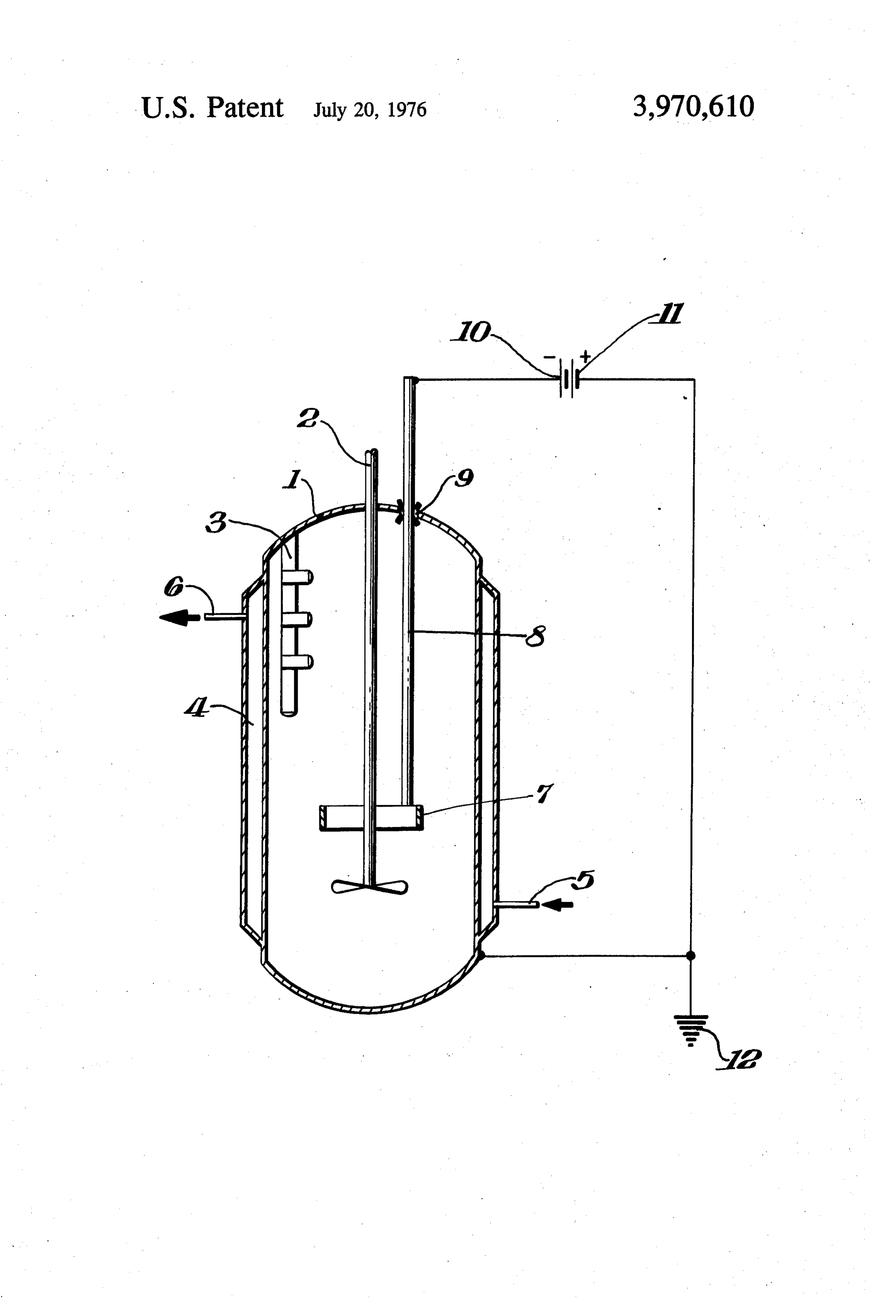
Other (silver, gold, platinum) are preferably materials such as stainless steel, nickel, vinyl acetate, vinyl propionate, vinyl butyrate, vinyl-2- ethylhexanoate, vinyl fumarate, vinyl stearate; vinyl 50 chromium, tin, lead or graphite are also suitable. ethers such as vinylmethyl ether; unsaturated monocar beAdescribed device in accordance with the invention will now boxylic acids, such as crotonic acid, acrylic acid, meth accompanyingbydrawing.way of example with reference to the acrylic acid, and the esters thereof with alcohols having A polymerization vessel of stainless steel 1 is pro from 1 to 10 carbon atoms, for example, the methyl, vided butyl or octyl esters; unsaturated dicarboxylic acids, 55 throughwithwhich stirrer 2, baffle plate 3 and jacket heating 4, a liquid heating medium flows through such as maleic acid, fumaric acid, itaconic acid, the inlet 5 and outlet 6. Stirrer 2 and baffle plate 3 are anhydrides, imides and esters thereof with alcohols likewise made of stainless steel and electrically con having from 1 to 10 carbon atoms. Further suitable comonomers are acrylonitrile, aromatic vinyl mono nected with vessel 1. Approximately in the center of mers such as styrene; a-olefins such as ethylene, pro the polymerization vessel an electrode 7 of stainless pylene or butylene; or vinylidene halides, for example, 60 steel is mounted which surrounds the shaft of the stirrer vinylidene chloride. The monomers are used individu concentrically electrode is at approximately the same distance. The fastened by holding means 8, which is ally or in the form of mixtures with one another.
When the process of the invention is carried out passed through the wall of the polymerization vessel discontinuously the walls of the reactor can be substan and electrically insulated with respect thereto. By a tially kept free from deposit over long periods of time, 65 dispositif 9 the vertical position of the electrode in the i.e. during a great number of polymerizations, so that vessel can be varied. By holding means 8 the electrode the time consuming cleaning of the wall with consider 7 is connected with the negative pole 10 of a source of able and uncontrolled removal of reactor material can current, while the positive pole of said source of cur
Page 6
rent is connected to earth 12 and electrically con stainless steel electrode was used as cathode instead of nected with the polymerization vessel. the platinum electrode. In this case, too, the inner sur The following examples illustrate the invention. face of the autoclave and the cathode were free from
deposit after 10 polymerizations.
A 40 liter autoclave lined with stainless steel and EXAMPLE 5 provided with stirrer was successively charged with A 40 liter autoclave lined with stainless steel and 28 liters of desalted water provided with stirrer was successively charged with 12 grams of polyvinyl alcohol 23 liters of desalted water 45 grams of HPO, 10 12 grams of polyvinyl alcohol 45 grams of NaH2PO w 56 grams of HPO, 13.5 grams of diisopropyl percarbonate (40% by 56 grams of NaH2PO weight solution in phthalate) 16.5 grams of diisopropyl percarbonate (40% by The pH of the mixture was 2.7. weight solution in phthalate) The autoclave contained a platinum-plated electrode 15 The pH of the starting mixture was 2.7. A platinum as cathode and the wall of the autoclave was connected cathode was used, the reactor wall was the anode. The as anode. During polymerization a voltage of 20 volts voltage applied of 20 volts resulted in a current inten was applied resulting in a current intensity of 250 milli sity of 250 milliamperes. At the wall of the autoclave amperes. At the wall of the autoclave the current den the current density was 500 milliamperes/m. After sity was 500 milliamperes/m. The air contained in the 20 removal of the air in the autoclave by repeated evacua autoclave was removed by repeatedly evacuating and tion and passing through gaseous vinyl chloride, 9.5 kg passing through a vinyl chloride gas current. Next, 9 kg of vinyl chloride and 1.65 kg of vinyl acetate were of vinyl chloride were forced in, the polymerization forced in. The polymerization was carried out as speci mixture was heated to 53°C while stirring and polymer fied in Example 1. After termination of the polymeriza ization was continued to a fall in pressure Ap of 4 atmo- 25 tion the inner surface of the autoclave was completely spheres gauge. After a polymerization period of 6 free from deposit.
hours, the reaction mixture was cooled, the pressure of EXAMPLE 6 the autoclave released and the polymerization mixture was discharged. In this manner 10 batches were poly The polymerization was carried out as described in merized one after the other and thereafter the auto- 30 Example 5 with 10 kg of vinyl chloride and 1.1 kg of clave was opened. The wall of the autoclave and the butyl acrylate. After termination of the polymerization cathode were fully clean. the wall of the autoclave was completely free from deposit,
EXAMPLE 2 (comparative example)
The polymerization was carried out as described in 35 EXAMPLE 7 Example 1, with the exception, however, that the auto The polymerization was carried out as described in clave did not contain a cathode and that no voltage was Example 5 with 10 kg of vinyl chloride and 1.1 kg of applied. After removal of the first polymerization batch acrylonitrile. After termination of the polymerization a slight deposit had formed on the wall of the auto no deposit had formed on the wall.
clave. Without cleaning a further batch was polymer- 40 EXAMPLE 8 ized. After discharge, a 1 mm thick deposit had formed which strongly adhered to the wall and had to be re A suspension polymerization was carried out under moved manually. the conditions of Example 1 using as initiator 36 grams EXAMPLE 3 45 of dilauroyl peroxide instead of diisopropyl percarbon ate. Voltage 15 volts, current intensity 150 milliam
A 40 liter autoclave lined with stainless steel and peres, current density at the wall of the vessel 300 provided with stirrer was successively charged with milliamperes/m. After a polymerization period of 8 32 liters of desalted water hours the reaction mixture was cooled, the pressure in 30 grams of hydroxypropyl cellulose the autoclave was released and the autoclave was emp 30 grams of sodium dodecylbenzene sulfonate 50 tied. The wall of the vessel was absolutely clean and no 56 grams of HPO, deposit formed after 9 further polymerizations under 56 grams of NaH2PO the same conditions.
16.5 grams of diisopropyl percarbonate (40% by EXAMPLE 9 weight solution in phthalate)
The starting mixture had a pH of 2.7. The autoclave 55 A suspension polymerization was carried out under contained a platinum electrode as cathode, the wall of the conditions of Example 1 at a temperature of 68°C the autoclave was connected as anode, the voltage was using as initiator 20 grams of dilauroyl peroxide. Volt 20 volts and the current intensity during polymeriza age 20 volts, current intensity 200 milliamperes, cur tion amounted to 250 milliamperes. At the wall of the rent density at reactor wall 400 milliamperes/m. After autoclave the current density was found to be 500 60 a polymerization period of 9 hours the mixture was milliamperes/m. The polymerization was carried out cooled, the pressure released and the autoclave was as described in Example 1. After 10 consecutive poly emptied. The polymerization was repeated 10 times merizations the inner surface of the autoclave was still under the specified conditions. Thereafter the wall of free from deposit. the autoclave was still completely clean.
EXAMPLE 4 EXAMPLE O
A suspension polymerization was carried out under A suspension polymerization was carried out under the conditions of Example 3 with the exception that a the conditions of Example 1 using 110 grams of NaH
Page 7
PO4 instead of 45 grams of NaH2PO and 45 grams of tions carried out under the aforesaid conditions no HPO, so that the starting mixture had a pH of 9. Volt deposit was observed on the reactor wall and the elec age 20 volts, current intensity 200 milliamperes, cur trode.
rent density at the reactor wall 400 milliamperes/m. EXAMPLE 4 After a polymerization period of 6 hours the pressure was released and the polymerization batch removed The polymerization was carried out as described in from the reactor. After 10 polymerizations under the Example 13 with the exception that 84 grams of citric aforesaid conditions the wall was still entirely free from acid and 32 grams of NaOH were used instead of Na2H deposit. - PO/HPO. The voltage was 35 volts, the current in O tensity 200 milliamperes, the current density at the
EXAMPLE 11 reactor wall 400 milliamperes/m. The pH of the initial A 400 liter autoclave lined with stainless steel and mixture was 4.3. After 5 polymerizations some areas of the reactor wall were covered with a thin layer which provided with stirrer was charged with 220 liters of desalted water
could be easily removed mechanically.
80 grams of polyvinyl alcohol EXAMPLE 15 9 grams of hydroxypropyl cellulose 250 grams of NaH,PO, A 400 liter autoclave lined with stainless steel and 250 grams of HPO, " .. provided with stirrer was successively charged with 100 grams of diisopropyl percarbonate (40% by 20 200 liters of desalted water '. weight solution in phthalate) 120 grams of polyvinyl alcohol The mixture had a pH of 2.7. A platinum plated elec 450 grams of HPO, trode was used as cathode and the reactor wall con 450 grams of NaH2PO, . . . : ,, nected as anode. Voltage 50 volts, current intensity 120 grams, of diisopropyl percarbonate (40% by 150 milliamperes, current density at reactor wall 60 25 weight solution in phthalate) milliamperes/m. The polymerization was carried out The mixture had a pH of 2.7. The autoclave contained under the conditions of Example 1 with 90 kg of vinyl a platinum plated electrode as cathode, the wall was chloride at a temperature of 53°C while stirring. After connected as anode. During the whole polymerization a polymerization period of 6 hours the pressure was period the voltage was maintained at 20 volts, the cur released and the batch removed from the autoclave. No rent intensity being 150 milliamperes. The current wall deposit could be observed after 10 polymeriza 30 density, at the reactor wall was 60 milliamperes/m. tions under the aforesaid conditions. After removal of the air in the autoclave by repeatedly evacuating and passing through gaseous vinyl chloride
EXAMPLE 2 90 kg of vinyl chloride were forced in, the reaction A suspension polymerization was carried out under 35 mixture was heated to 58°C while stirring and the conditions of Example 11, using, however, 100 90 liters of desalted water grams of NaHPO, and 100 grams of HPO. The initial 40 grams of polyvinyl alcohol mixture had a pH of 2.7, the voltage was 50 volts, the 150 grams of HPO, current intensity 130 milliamperes and the current 150 grams of NaH2PO, density at the reactor wall 50 milliamperes/m. After a 40 grams of diisopropyl percarbonate as 40% by polymerization period of 6 hours the reaction mixture - 40 weight aqueous solution diluted with little acetone was cooled, the pressure released and the batch re and moved from the autoclave. After 10 polymerizations 30 kilograms of vinyl chloride under the specified conditions the reactor wall was still were added per hour. The discharge of polymer was absolutely clean. adjusted in such a manner that the polymerization pres 45 sure remained constant. The polymerization was inter
EXAMPLE 13 rupted after 30 hours, the remaining mixture was dis A 40 liter autoclave lined with stainless steel and charged and the reactor opened. The wall was abso provided with stirrer was charged with lutely clean and free from deposit. 23 liters of desalted water In a comparative continuous polymerization under 11 grams of polyvinyl alcohol 50 the same conditions but without application of current, 1.27 grams of hydroxymethyl cellulose i.e. without electrolysis, the polymerization had to be 0.28 gram of a block copolymer of ethylene and interrupted after 30 hours since the dissipation of heat propylene oxide through the reactor wall had broken down. On the 50 grams of NaHPO, average, the reactor wall was covered with a 7 cm thick 55 contiguous layer which was still thicker in some places.
5.1 grams of HPO, 16.5 grams of diisopropyl percarbonate (40% by It was very difficult to remove mechanically. weight solution in phthalate) EXAMPLE 16 (comparative example) A platinum-plated electrode was used as cathode, the reactor wall connected as anode. The voltage was 35 The polymerization was carried out in the same appa volts resulting in a current intensity of 200 milliam 60 ratus and under the same conditions as in Example i, peres. The current density at the reactor wall was 400 with the exception, however, that the platinized elec milliamperes/m. The initial pH was 7.1. After the usual trode was connected as anode and the wall of the reac scavenging of the reactor, 11 kilograms of vinyl chlor tor as cathode. During polymerization the current in ide were forced in and polymerized at 55°C while stir 65 tensity was maintained constant at 500 milliamperes ring until the drop in pressure Ap was 4 atmospheres corresponding to a current density of 1,000 milliam gauge. After a polymerization period of 6 hours the peres/m. The necessary voltage rose to 50 volts. Poly mixture was cooled, the pressure released and the merization temperature, drop in pressure and polymer batch removed from the reactor. After 5 polymeriza ization period were the same as in Example 1. After
Page 8
each polymerization the vessel was opened and exam said surfaces, the external voltage being of such magni ined. After the third polymerization a deposit had tude that substantial dissolution of the stainless steel or formed in places which had further grown after the noble metal surfaces does not occur. fourth polymerization, partially to a thickness of 0.5 2. The process as claimed in claim 1, wherein buffer mm. During the fourth polymerization the flow of cur substances are added to the polymerization mixture. rent through the polymerization vessel was distinctly 3. The process as claimed in claim 1, wherein the impeded so that the experiment had to be interrupted. polymerization is started at a pH in the range of from 1 What is claimed is: to 12.
1. In the process of suspension polymerization of 4. The process as claimed in claim 1, wherein the vinyl chloride in a liquid polymerization mixture within 10 current density is in the range of from 5 to 3,000 mil a reactor with from 0 to 20 percent by weight of at least liamperes/m”.
one monomer polymerizable therewith in the presence 5. The process as claimed in claim 1, wherein the of activators, stabilizers and auxiliary stabilizers nor current density is the highest in the starting phase of the mally used in the suspension polymerization of vinyl polymerization.
chloride, the improvement comprising minimizing de 15 6. The process of claim 1, wherein a sufficient posits formed on the walls of the reactor during poly amount of a supporting electrolyte is added to the poly merization by conducting the polymerization in a reac merization mixture to improve the conductivity of the tor having inner stainless steel or noble metal surfaces mixture.
in contact with the polymerization mixture, said stain 20 7. The process according to claim 1, wherein the less steel or noble metal surfaces being connected as an polymer produced during the polymerization is a graft anode, said liquid polymerization medium being in polymer.
contact with at least one cathode insoluble therein and 8. The process according to claim 1 wherein the current density is in the range of from 20 to 800 mil spaced from said anode, said cathode and anode being liamperes/m.
connected by an external source of current, applying 25 external voltage to said anode and cathode during poly 9. The process as claimed in claim 1 wherein the merization thereby electrolytically generating hydro polymerization is carried 2k xk out
as>k askcontinuous process.
gen and oxygen in the liquid polymerization mixture at
Provenance
- Collection
- Cited prior art
- Original PDF
- patentimages.storage.googleapis.com →
- Filed
- 1974-10-08
- Pages
- 8
- Method
- pdftotext (the PDF's own text layer) + pdftoppm 300dpi page scans
- Source
- Google Patents bibliographic record
- Granted
- 1976-07-20
- Inventors
- Kasimir Ruchlak; Ernst-August Albers; Walter Fester; Hoechst AG
- Transcribed from
- patentimages.storage.googleapis.com →