patent · US5308187
Parking lot pavement for making hot precombustion air for a fossil fuel burner
3 May 1994
Page 1 — bibliographic record
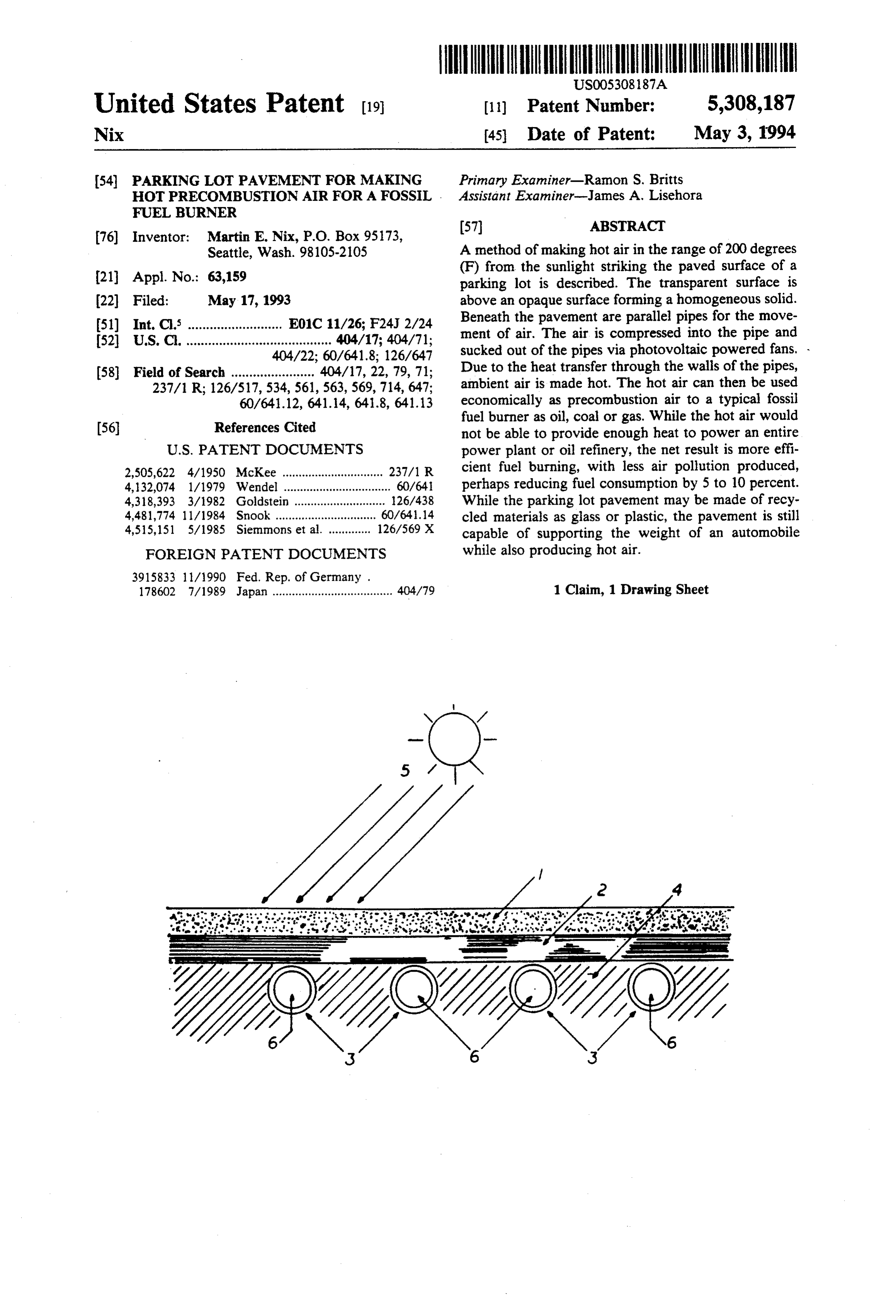
United States Patent 19 11) Patent Number: 5,308,187 Nix 45 Date of Patent: May 3, 1994 (54) PARKING LOT PAVEMENT FOR MAKING Primary Examiner-Ranon S. Britts HOT PRECOMBUSTION AIR FOR A FOSSIL Assistant Examiner-James A. Lisehora
FUEL BURNER
76) Inventor: Martin E. Nix, P.O. Box 95173, (57) ABSTRACT Seattle, Wash. 98105-2105 A method of making hot air in the range of 200 degrees (F) from the sunlight striking the paved surface of a (21) Appl. No.: 63,159 parking lot is described. The transparent surface is 22 Filed: May 17, 1993 above an opaque surface forming a homogeneous solid. 51) Int. Cl. .......................... Eoic 11/26 F24, 2/24. Beneath the pavement are parallel pipes for the move. 52 U.S. C. ........................................ 0/40/71 ment of air. The air is compressed into the pipe and 404/22, 60/6418, 126/647 sucked out of the pipes via photovoltaic powered fans.
58) Field of Search ....................... 404/17, 22,79, 71. Due to the heat transfer through the walls of the pipes, 237/1 R; 126/517, 534, 561,563, 569,714,647; ambient air is made hot. The hot air can then be used 60/64.12, 641. 4, 64.8, 641.13 economically as precombustion air to a typical fossil fuel burner as oil, coal or gas. While the hot air would (56) References Cited not be able to provide enough heat to power an entire
2,505,622 4/1950 McKee ............................... 237/1 R cient fuel burning, with less air pollution produced, 4,132,074 1/1979 Wendel. ... 60/64 perhaps reducing fuel consumption by 5 to 10 percent. 4,318,393 3/1982 Goldstein .. 126/438 While the parking lot pavement may be made of recy 4,481,774 11/1984 Snook .................... 60/64. 14 cled materials as glass or plastic, the pavement is still 4,515,151 5/1985 Siemmons et al. ............. 126/569 X capable of supporting the weight of an automobile FOREIGN PATENT DOCUMENTS while also producing hot air.
178602 7/1989 Japan ..................................... 404/79 1 Claim, 1 Drawing Sheet
Page 2
Drawing sheet — no readable text.
Page 3
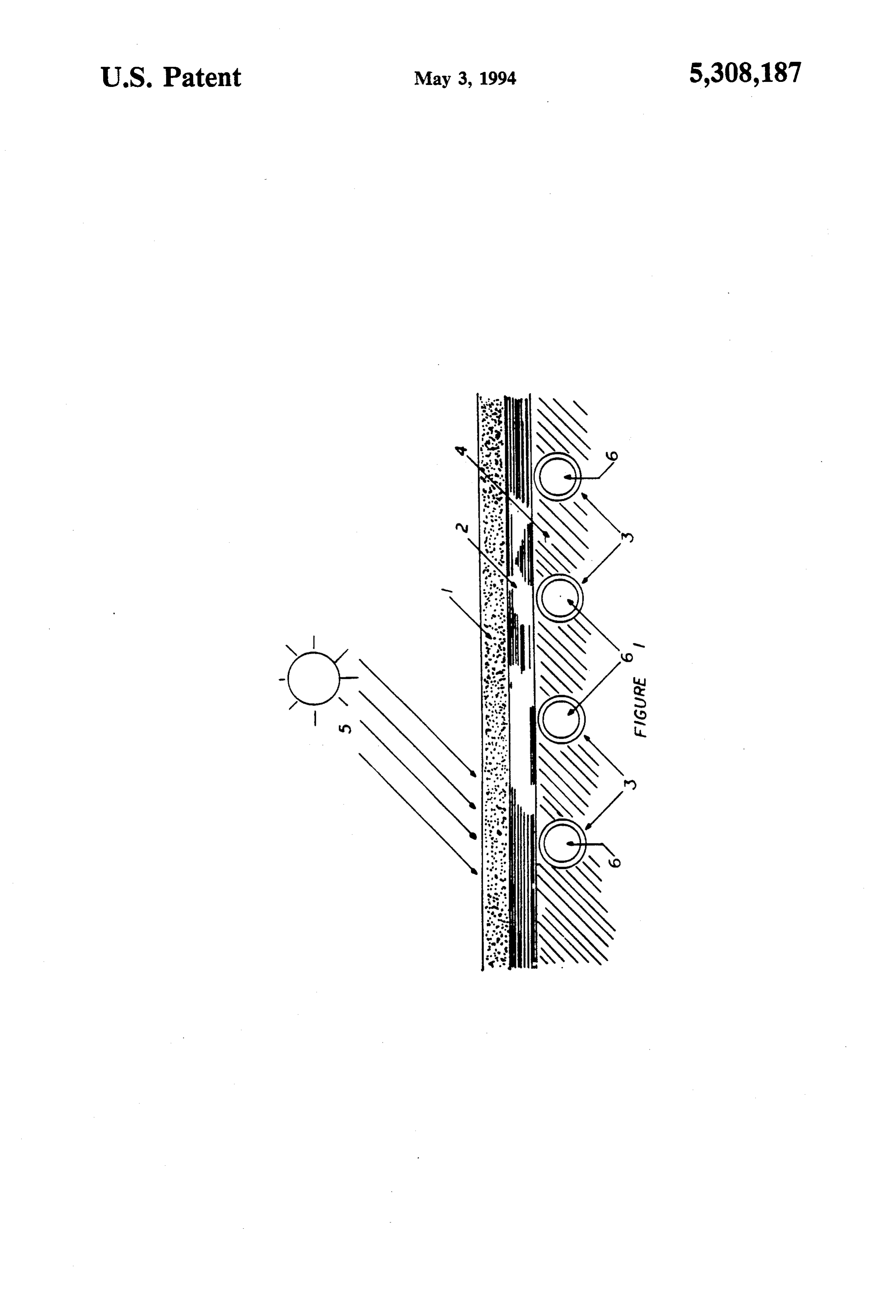
upon the surrounding ground (4) and the pipes' walls
PARKING LOT PAVEMENT FOR MAKING HOT (3), the net result is manufacturing hot air (6).
PRECOMBUSTION AIR FOR A FOSSIL FUEL The air (6) is moved through the pipes (3) via solar BURNER powered photovoltaic fans. The air (6) is sucked and/or compressed so as to overcome the friction of the mov
DESCRIPTION OF PRIOR ART ing air (6) on the walls of the pipe (3). The pipes (3) are Solar energy has been utilized beneficially by man laid parallel and buried in the ground (4). Then the pavement (1)(2) is paved over the top of the pipes (3) kind for centuries. One of the earliest solar collectors is and ground (4), forming a functioning heat transfer unit. a greenhouse producing temperatures in the 100 degrees O This homogeneous solid becomes suitable as parking (F) range. Even hotter temperatures in the 200 degrees lot pavement while also serving the economic function (F) can be achieved with flatplate solar collectors. of collecting sunlight like a solar collector. While still hotter temperatures above 500 degrees (F) It can be shown that the amount of sunlight striking can be achieved by focusing sunlight via lenses or para upon the United States' parking lots could in theory bolic concave reflectors unto a small focal area. The 15 provide a significant amount of energy, if a cost effec disclosed device is of the flatplate type. tive means of collecting the energy could be achieved. SUMMARY OF INVENTION This parking lot pavement would thus be able to provide air (6) in the 200 degree (F) range which air (6)
The system for heating air with solar energy and could be used for a hot water heater.
supplying the air to a fossil fuel burner comprises an However, hot air (6) can also be more economically opaque pavement layer overlying a ground surface, an utilized as precombustion air for a fossil fuel burner as upper transparent layer formed on the pavement, and a oil, gas or coal. Presently, most fossil fuel burners use plurality of parallel pipes within the ground surface outside ambient air, however by mixing hot air with a beneath the pavement layer, the pipes carrying air and fuel as oil, coal or gas, less fuel is burned to achieve the transferring heat between the ground surface and the 25 same results. Furthermore, the hot air results in more 31. efficient combustion of the fuel, thus alleviating some BRIEF DESCRIPTION OF THE DRAWINGS air pollution. It should be noted that hot air is less dense than cold air, however the compression from solar pow
FIG. 1 is a cross-sectional horizontal view of the ered photovoltaic fans does compress the hot air at the functioning components of the invention. 30 fossil fuel burner. The net result is solar energy is used DESCRIPTION OF THE PREFERRED to move the air (6) while solar energy is used to com EMBODIMENT press the hot air (6) while also solar energy is used to make ambient air hot. Thus, no parasitic load is placed
A method of production of hot air (6) from solar upon a power plant. The hot air (6) produced from the radiation (5) is shown illustrated in FIG. 1. Sunlight (5) 35 parking lot pavement will be about 200 degrees (F). The travels through an upper transparent surface (1) and hot air (6) will not be sufficient to power the entire heat travels transversely until the sunlight strikes an opaque load of a power plant or oil refinery, but should be able subsurface (2). The net effect of the upper transparent to supply 5 to 10 percent of the heat load as precombus surface (1) and the opaque subsurface (2) is to form a tion air. The net result is an increase in overal effi homogeneous solid which functions to generate heat in ciency.
the 200 degrees (F) range. The upper transparent sur What is claimed is:
face (1) insulates the heat generated from the opaquer 1. A system for heating air with solar energy and for subsurface (2) while also providing insolation. supplying the air to a fossil fuel burner, said system So as to reduce the cost of construction the upper comprising;
transparent surface (1) may be made of recycled materi 45 (a) an opaque pavement layer overlying a ground als as finely ground clear plastic and glass. The opaque surface, said pavement layer having a pavement subsurface (2) may also be made of recycled materials as top surface;
dark glass, flyash and plastic. Via method of compres (b) an upper transparent layer formed on said pave sion as a heavy roller, the mixture of recycled materials ment top surface, said upper transparent layer is made into a homogeneous solid pavement capable of 50 being transparent to sunlight and formed of a mate supporting the heavy weight of an automobile. rial which traps heat generated by said opaque Beneath the pavement (1)(2) is a network of evenly pavement layer; and spaced and parallel pipes (3). These pipes (3) serve as a (c) a plurality of parallel pipes within the ground suitable means to move air (6). As the air (6) moves surface beneath said pavement layer, said pipes through the pipes (3) the air (6) becomes hotter due to 55 carrying air and transferring heat between said the transfer of heat through the walls of the pipe (3), and ground surface and
said air.k k due to the heating effect of the opaque subsurface (3)
Provenance
- Collection
- Cited prior art
- Original PDF
- patentimages.storage.googleapis.com →
- Filed
- 1993-05-17
- Pages
- 3
- Method
- pdftotext (the PDF's own text layer) + pdftoppm 300dpi page scans
- Source
- Google Patents bibliographic record
- Granted
- 1994-05-03
- Inventors
- Martin E. Nix
- Transcribed from
- patentimages.storage.googleapis.com →