patent · US2727933
Partial oxidation and pyrolysis of saturated hydrocarbons
20 December 1955
Page 1
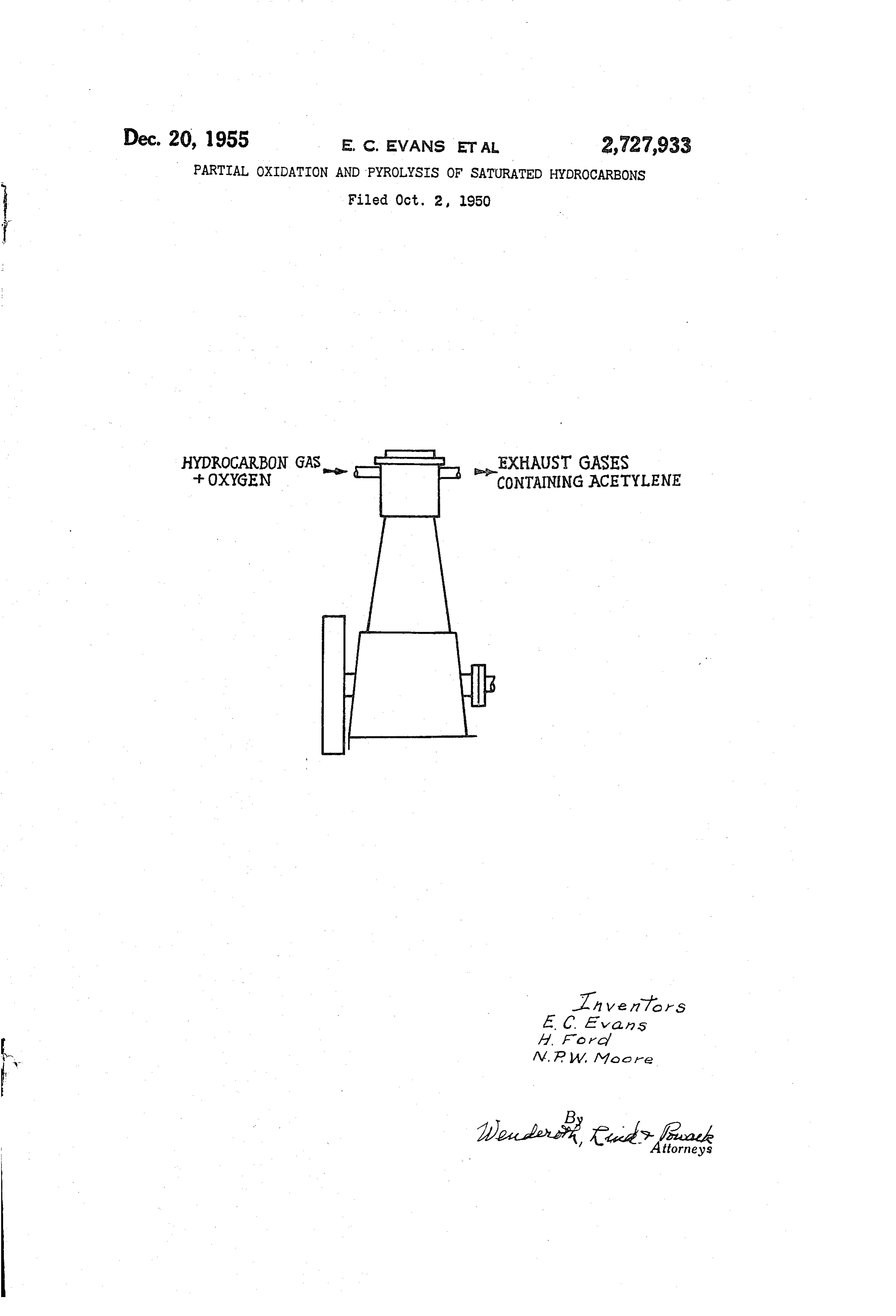
Drawing sheet — no readable text.
Page 2
United States Patent Office ' 2,727,933 Patented Dec. 20, 1955
2,727,933 The regulation of conditions within the combustion chamber can be effected in a variety of different ways
PARTIAL OXIDATION AND PYROLYSIS OF
SATURATED HYDROCARBONS
taken either separately or in any combination. Thus, the regulation of conditions may be effected, at least in part,
Edgar Charles Evans, Stanmore, and Hugh Ford and 5 by controlling the composition and/or condition of the Nolan Peter William Moore, London, England, as charge introduced into said combustion chamber prior to signors to National Research Development Corpora ignition thereof or it may be effected, at least in part, tion, London, England, a British company by controlling the composition and/or conditions of the Application October 2, 1950, Serial No. 187,912 charge in said combustion chamber at or subsequently O to the ignition thereof. Moreover, the regulation of con ditions may be effected by controlling the point in the
Claims priority, application Great Britain October 4, 1949 engine cycle at which ignition takes place, or alterna 3 Claims. (C.260-679) tively, by controlling the point in the engine cycle at This invention is for improvements in or relating to which the combusted, partially combusted or combust ing charge or a desired proportion of such charge is re the partial oxidation and pyrolysis of saturated hydro moved from the combustion chamber. carbons and has for an object to provide an improved In this connection it may be desirable to introduce, at process, inter alia, for the production of acetylene by the certain stages in the cycle, modifying substances i. e. dehydrogenation of hydrocarbons. chemical substances of such a nature that they will them Known processes of producing acetylene from hydro selves influence the rate and extent and, in certain cases, carbons such as methane, ethane and ethylene are based the nature of the chemical reactions or influence the range on the dehydrogenation of hydrocarbons by: of composition of the reacting mixtures which can sup: (1) Arc process, port active combustion. For example, it is known that (2) Cracking processes, and minute traces of ethylene dibromide have the power of (3) Partial combustion processes. arresting active combustion of a methane-air mixture. In all three processes the fundamental consideration is The various conditions obtaining within the combus the heating of the hydrocarbon to a sufficiently high tem tion chamber may be regulated by controlling the inlet perature (methane, for example, requires 1500° C., eth conditions of the charge induced or introduced to the ane 1300 C.) coupled with the fact that the time at combustion chamber, for example, by controlling the which this high temperature should be maintained must temperature, pressure and composition of the charge, be as short as possible to avoid the decomposition or whilst furthermore the compression ratio and the degree further reaction of the acetylene thus produced to carbon of expansion of the combusted charge may be controlled. black and hydrogen or other intermediate product. The Furthermore, if required, the entire operation of the partial pressure of the acetylene should also be kept as engine cycle may be effected at pressures lower than are low as possible in relation to the initial pressure whilst the normal in internal combustion engines, for example, by gas, after its formation, should be cooled as rapidly as the use of an exhauster associated with the exhaust of possible. the internal combustion piston engine, the exhauster be All these processes suffer from the disadvantage that ing either directly coupled to the engine or driven by power and/or energy consumption is extremely high. external means. By coupling the exhauster directly to The arc process, for example, requires on an average 40 the engine, the power required is derived from the com about 4% kilowatt hours per lb. of acetylene produced, bustion taking place within the combustion chamber. a consumption of the same order as that required for A further means of regulating or controlling the pres acetylene production from carbide. sure-volume-time relationship in the cycle is by operat Cracking processes require considerable heat energy ing the piston of the internal combustion engine by a which is generally obtained by the combustion of the 45 mechanism other than the simple crank and connecting by-product gases, whilst the high temperatures required rod mechanism, an example of which would be one or for acetylene production introduce serious refractory other form of known quick-return motion mechanism so problems, particularly when methane is used. as to give a relatively slow compression stroke and a The third process of partial combustion requires the rapid expansion stroke.
use of oxygen in order to obtain the necessary high flame 50 It will be appreciated that the high temperatures re temperature and needs very accurate control. Approxi quired for the dehydrogenation or other conversion of mately 5 tons of oxygen are usually required by this the organic substances are achieved partially by the effect. process for the production of 1 ton. of acetylene which, of compression during the compression stroke and par of course, adds considerably to the cost of operation. tially by the temperature of the partial combustion tak The by-product gases from the combustion process, how ing place during the early stages of the working stroke ever, consist largely of carbon monoxide and hydrogen of the internal combustion piston engine, whilst the which can be produced in such proportions as to allow necessary rapid lowering of the temperature results from of their use for the manufacture of methyl alcohol. the adiabatic expansion of the gases occurring during According to the present invention there is provided the later stages of the working expansion stroke and the a process for the partial oxidation and/or pyrolysis or exhaust stroke. If desired or necessary, the combustion cracking of organic substances which comprises feeding 60 products may be subjected to a further cooling after hav said organic substance, together with molecular oxygen, ing been exhausted from the engine by means of a e.g. air, oxygen or air enriched with oxygen, into the quenching spray which may, for example, either be combustion chamber of an internal combustion engine water or it may be a solvent, such as acetone, which is and regulating the conditions within said combustion capable of selectively dissolving acetylene from the ex chamber during the engine cycle to effect the desired 65 haust products.
conversion of the organic substance and to preserve the After removal of the desired partial oxidation, pyrol products of said conversion against undesired degradation ysis or cracking products, the remaining gaseous mix or further conversion. ture can either be recycled to the engine in admixture One of the advantages of this process for the conver 70 with further quantities of the organic substance and sion of organic substances is that positive work may be molecular oxygen, or it can be burnt, after dilution with obtained from the engine. secondary air, in an internal combustion engine or gas.
Page 3
turbine, or further, the remaining gaseous products may space such as nitrogen or carbon dioxide, into the combustion be used for chemical synthesis, or as a fuel. at any desired stage.
A feature of the invention consists in that a preliminary Since the partial oxidation, pyrolysis and cracking charge of an easily ignitable fuel is ignited in the com processes are liable to be affected by various metals and bustion chamber and the organic substance to be con combustionarechamber generally sensitive to catalysis, the surfaces of the and other surfaces in the engine verted is introduced into the combustion chamber, at least in part, during or after the ignition of said preliminary where the hot gases come into contact with the metals, are preferably made of special steel or other metal sur charge; if desired, additional organic substances, for ex faces which will minimise the formation of carbon and ample methane or ethane or a liquid fuel, could be in which will not catalytically interfere with the desired troduced into the combustion chamber, either homoge 0. conversions and, indeed, metal may be used which can neously or in a localised region so as to form a very rich catalytically assist in the dehydrogenation of hydrocar mixture in that region, after ignition of an original bons to acetylene.
charge of the same or another substance had taken place;
for example, the additional hydrocarbon could be in 5 theInapplication prior British Patent No. 619,634 there is described jected into the combusting gases in the combustion cham intensely heated of what is termed "sweat cooling' to surfaces. The prior invention concerns ber under pressure. The ignition of the original charge the formation of porous layers on the heated surfaces can be effected by means of a spark or other suitable through which a cooling fluid can be caused to flow source or sources of heat or by the heat of compression under the necessary pressure to ensure that the cooled of the charge itself as in a compression-ignition engine. fluid percolates through the pores and reaches the Surface A suitable means of introducing or removing part of and comes into contact with the hot gases flowing over or the whole charge is with a sleeve valve mechanism, the the surfaces. - ports of which are so shaped or dimensioned as to meter The present invention can conveniently embody the the charge into or out of the combustion space by means "sweat cooling' invention of the prior patent and, accord of the pressure difference across the ports and the time in which the port is in communication with the combus ingly, it is a feature of the invention that the Surfaces of the combustion chamber are formed, e. g. by means tion space. of powder metallurgy methods, with a porous structure In order to secure the maximum yield in the partial oxidation (i. e. dehydrogenation) of hydrocarbons, it and a liquid or gas is forced through the porous structure to effect "sweat cooling' of the combustion chamber Sur may be necessary to use rich mixtures for introduction faces and/or to limit undesirable surface reactions and into the combustion chamber or engine and, in order to deposition stabilise the combustion of such rich mixtures, it may be a layer ofofgassolidthroughon said surfaces, by the provision of which the reacting molecules desirable to achieve stratification of the ingoing charge. would have to diffuse to reach the surface. The invention has been carried into effect in the pro duction of acetylene by partial combustion of methane 3 5 tionIt of will be appreciated that, by variation in the regula the conditions under which the internal combus in a single cylinder variable compression spark ignition engine. The engine used was a Ricardo E.6 Experi tion piston engine operates, a wide degree of control of the partial oxidation, pyrolysis or cracking processes can be mental Engine having a bore of three inches and a stroke secured whereby an accurate control of combustion may of four and three-eighths inches and having an adjustable cylinder head providing a range of compression ratios 40 be achieved which leads not only to high yields of the from 5.5 to 1 to 18 to 1, the engine being capable of desiredrecovery product, e. g. acetylene, but also enables the of a considerable proportion of the energy pro running at speeds up to 3,000 revolutions per minute. duced in the combustion in the form of mechanical work; The engine has been operated under a wide variety of running conditions using both air and oxygen in the process, moreover, permits the recovery of carbon admixture with excess methane. For instance, the proc black The from the exhausted gases.
accompanying diagrammatic drawing illustrates ess has been carried out using a wide range of engine schematically how the process may be carried into effect speeds and it has been established that the higher yields of acetylene are obtainable at the higher engine speeds. in We an internal combustion engine. claim:
That is to say that the yield of acetylene increased with an increase of engine speed up to the maximum speed of within anainternal 1. In process for the pyrolysis of hydrocarbons combustion engine in which the hydro the engine namely 3,000 revolutions per minute. carbon is fed as the fuel into the combustion chamber in The engine has been operated with varying compres which heat is supplied by combustion of part of said sion ratios and it has been further established that the fuel, supplying said hydrocarbon into said combustion yield of acetylene increases as the compression ratio is chamber by induction together with substantially pure reduced down to the minimum ratio obtainable on the oxygen in an amount sufficient to react with only a small engine, namely 5.5 to 1. proportion of said hydrocarbon and produce a pyrolyzed It has also been established that, over a wide range of methane-air or methane-oxygen mixtures, the engine will product, said hydrocarbon-oxygen mixture being substan tially free from inert diluents, and adiabatically expanding operate stably, i. e. will continue with a steady rate of said product of the pyrolysis within said combustion production of acetylene; for example, the engine will op 60 chamber to preserve said product from undesired degrada erate stably with methane-oxygen mixtures containing as tion and to cool said product to a temperature at which much as 200% by volume excess of methane over the said degradation is substantially prevented. amount stoichiometrically equivalent to the oxygen in the 2. in a process for the pyrolysis of Saturated gaseous mixture. The yields of acetylene are improved, however, hydrocarbons to substantially unsaturated hydrocarbons if an inert diluent gas is present in the mixture, for ex in the combustion chamber of an internal combustion ample nitrogen, as was established by the higher yields reciprocating piston-type engine, comprising feeding the obtainable with methane-air mixtures containing up to saturated hydrocarbon together with molecular oxygen a 50% by volume excess of methane; the reason for this into the combustion chamber wherein the amount of result is apparently to be found in the reduced partial hydrocarbon employed is far in excess of that required pressures of the hydrocarbon gases in the mixture, a for complete combustion of the saturated hydrocarbon conclusion which is supported by the higher yields ob relative to the amount of oxygen fed into the combustion tainable at the lower compression ratio in the engine. chamber and heating the mixture of hydrocarbon and The partial pressure of the hydrocarbon or of its de oxygen in the combustion chamber to a sufficiently high temperature to initiate the conversion of the saturated composition products can be reduced during the dehy drogenation process by the introduction of a dilutant, 75 hydrocarbon into gaseous unsaturated hydrocarbon, that
Page 4
improvement comprising providing the energy for the References Cited in the file of this patent endothermic heat of cracking by the combustion of part UNITED STATES PATENTS of the charge with a great deficiency of oxygen within said engine, said combustion of the fuel-rich charge 1,880,310 Wulff------------------- Oct. 4, 1932 initiated by the ignition resulting from the injection of 5 1939,018 Odell ------------------ Dec. 12, 1933 an easily ignitible fuel, and conducting substantially the 1966,779 Wulff------------------ July 17, 1934 entire rapid cooling of the gaseous reacting mixture by 2,145,250 Dillstrom --------------- Jan. 31, 1939 adiabatic expansion within said engine, said rapid cooling 2,234,900 Jones ----------------- Mar. 11, 1941 preventing further undesired conversion of the gaseous 2,377,847 Allen et al. ------------- June 12, 1945 unsaturated hydrocarbons produced. O 2,500,510 Barnes ---------------- Mar. 14, 1950 3. A process as in claim 2 wherein the said saturated FOREIGN PATENTS hydrocarbon is methane, and acetylene is produced. 619,634 Great Britain ----------- Mar. 11, 1949
Provenance
- Collection
- Cited prior art
- Original PDF
- patentimages.storage.googleapis.com →
- Filed
- 1950-10-02
- Pages
- 4
- Method
- pdftotext (the PDF's own text layer) + pdftoppm 300dpi page scans
- Source
- Google Patents bibliographic record
- Granted
- 1955-12-20
- Inventors
- Evans Edgar Charles; Ford Hugh; Moore Nolan Peter William; Nat Res Dev
- Transcribed from
- patentimages.storage.googleapis.com →