patent · US5108566
Isotope separation process
28 April 1992
Page 1 — bibliographic record
United States Patent (19) 11 Patent Number: 5,108,566 Eerkens 45) Date of Patent: Apr. 28, 1992 54 ISOTOPE SEPARATION PROCESS ant RX that will improve the isotope separation in laser 76 Inventor: Jozef W. Eerkens, 1342 Lachman activated chemical reactions which may proceed by the steps:
La., Pacific Palisades, Calif. 90272 (21) Appl. No.: 500,314 ti MY--hul-iMY
(Laser Activation of isotopic Materials)
Related U.S. Application Data (Elaser Activation of Coreactant) 63 Continuation-in-part of Ser. No. 262,661, Jun. 14, 1972, MY"+Rx")-(MY".Rx-MX+RY Pat. No. 5,015,348. (Chemical Exchange Reaction) 51) Int. Cl. ............................................... B01D 5/00 52 U.S. C. ............................. 204/1572; 204/157.21 The step of coreactant activation can be important in 58 Field of Search ......................... 204/157.2, 157.21 some exchange reactions but unnecessary in others. (56) References Cited That is for some laser-activated chemical reactions, the
3,951.768 4/1976 Gurs ................................. 204/157.2 The selection criteria are based on the relative magni 4.082,633 4/1978 Eerkens ............................ 204/157.2 tudes of the bond-energies and therefore vibrational
FOREIGN PATENT DOCUMENTS
frequencies in the molecules MY and RX, and the re quirements for forming a Vanderwaals-like attachment 1959767 6/1971 Fed. Rep. of Germany . complex. Also, the upper and lower limit of tolerable OTHER PUBLICATIONS thermal (non-laser) reaction speeds are defined. It is shown further that it is necessary to restrict suitable RX
Eerkens, J. W., Laser Isotope Enrichment of Uranium candidates to those species which yield MX product by the Crisia Process, vol. I, Isotope Technologies, Sep. that does not participate in subsequent chemical reac 1987. tions which cause isotope scrambling. The employment Eerkens, J. W., Dimer Formation in Gases and Gas of a second auxiliary coreactant is recommended in Mixtures Appendix, Aug. 88. certain cases if its interaction with the complex Eerkens, J. W., Lifetimes, Populations and Absorptions (MY*:RX(") will increase the latter's reaction rate of the v3 and 3v3 Vibration in UF6, Isotope Techn, Aug. and/or if it can scavenge the product MX, thereby
London. Editor. Separation of Isotopes, George negating any subsequent isotope scrambling reactions of Newnes Limited, London, pp. 430-436 (1961). MX. The auxiliary coreactant should not react, or only Mayer et al., Isotope Separation with the cw Hydrogen slowly react, with the reactants MY or RX. By applica Flouride Laser, pp. 516-519 (1970). tion of the selection criteria to UF6, a small group of suitable chemical coreactants are identified which give
Primary Examiner-Brooks H. Hunt improved, Uranium isotope separations. Assistant Examiner-Ngoclan T. Mai
Attorney, Agent, or Firm-Pillsbury, Madison & Sutro
Selection criteria are disclosed for choosing a coreact 11 Claims, 12 Drawing Sheets
Page 2
Drawing sheet — no readable text.
Page 3
Drawing sheet — no readable text.
Page 4
Drawing sheet — no readable text.
Page 5
Drawing sheet — no readable text.
Page 6
Drawing sheet — no readable text.
Page 7
t 2 9 4 S 6 7 6 91 2 3 4 5 6 7 39
katl s ki'
(naka, sec k l = hkA
HINE 2|| N A. 7 a-a-ro un-arm
sississRNNf
NNN
NAS
OPE SEPARAT/ow is //EFFICIEWTT
ISO 7OAASEARA7/OAV
/5 AOOA
EMENN
this
7A/eaMAZ R&ACT/ow ea 7E, er, sec-1 (A & = sec 1)
Page 8
Drawing sheet — no readable text.
Page 9
Drawing sheet — no readable text.
Page 10
Drawing sheet — no readable text.
Page 11
Drawing sheet — no readable text.
Page 12
Drawing sheet — no readable text.
Page 13
Drawing sheet — no readable text.
Page 14
dissociation. Thus, some MOLIS schemes use two or
ISOTOPE SEPARATION PROCESS three isotope-selective 16-micron IR laser pulses fol lowed by a UV laser pulse, while others use two or
REFERENCE TO RELATED APPLICATIONS three isotope-selective 16-micron IR laser pulses fol AND PATENTS lowed by a high-energy second (red-shifted) 16-micron This invention is a continuation-in-part of my patent pulse that causes dissociation by multi-photon absorp application Ser. No. 262,661, filed Jun. 14, 1972, now tion.
U.S. Pat. No. 5,015,348, and is an improvement to my In CRISLA, which stands for Chemical Reaction by invention set for in U.S. Pat. No. 4,082,633, issued Apr. O Isotope Selective Laser Activation, one laser beam is 4, 1978; the teaching and technology of each of U.S. used which irradiates a gaseous mixture of the isotopic patent application Ser. No. 262,661 and U.S. Pat. No. molecule to be separated (e.g., UF6) and a coreactant 4,082,633 are incorporated herein by reference. RX. In the case of UF6, for example, as described in BACKGROUND OF THE INVENTION U.S. Pat. No. 4,082,633, a mixture of UF6 and a suitable coreactant RX is isotope-selectively irradiated by 5.3 15 micron CO laser photons in an intracavity reaction cell.
1. Field of the Invention
This invention relates to an improvement in isotope In this process, 235UF6 is preferentially excited over separation processes that employ a selective photon 238UF6 to the 3v3 vibrational excitation level. The ex induced energy level transition of an isotopic molecule cited 235UF6" molecules react much more rapidly with containing the isotope to be separated and a chemical 20 the coreactant RX than unexcited UF6, resulting in a reaction with a chemically reactive agent to provide a Uranium-bearing reaction product that is enriched in chemical compound containing atoms of the desired 235U. - isotope. The invention discloses certain molecular attri Both MOLIS and CRISLA depend upon vibrational butes which is possessed by a chemically reactive agent molecular isotope shifts of hot-banded absorption con used in the aforementioned process, make it more effec 25 tours. The overlap of the isotopic bands is generally tive and the isotope separation more economical. smaller, the colder the irradiated gas is. This means that 2. Description of the Prior Art higher separation factors are obtained at lower tempera The application of lasers for isotope separation has ture. However, been the subject of many studies and development pro the desired lowerUF6 has a very low vapor pressure at temperatures, causing throughputs to grams in the last two decades. In particular, the separa be very low. To overcome this problem in the MOLIS tion of U-235 and U-238, needed for nuclear reactor 30 process, a mixture of UF6 and a carrier gas such as fuel, has received considerable attention and has led to Helium, Argon, Nitrogen, Hydrogen, or Methane, is three distinct approaches. These approaches use lasers usually used and supercooled in an expanding super to cause isotope-specific ionization (AVLIS), dissocia tion (MOLIS), or activation of a chemical reaction sonic jet. the jet is then intercepted by a 16-micron laser (CRISLA). 35 beam at a point where the UF6 is still gaseous but far In the AVLIS approach, which is an abbreviation for below its normal condensation temperature. Although Atomic Vapor Laser Isotope Separation, isotopic metal supersonic jet-cooling could also be used in CRISLA, is vaporized (usually by means of electron guns) and the because of the higher isotope shift at = 5.3 micron used in CRISLA, arrangements that require only static or vapor is irradiated by two ultraviolet or three visible limited superimposed laser beams at two or three different 40 adiabatic-expansion cooling are usually ade wavelengths. In one AVLIS scheme applied to the quate. In Uranium enrichment by the CRISLA tech separation of Uranium and developed by the U.S. DOE nique, the preferred wavelength is 5.3 micron at which at the Lawrence Livermore Laboratory, a copper the isotope-shift between the 235UF6 and 238UF6 absorp vapor laser is used as the primary source of (green) laser tion bands is three times larger than at 16 micron. On photons. Dyes are used to convert these protons to 45 the otherhand, the UF6 absorption cross-section at 5.3 certain visible frequencies required for efficient three micron is 10,000 times less than at 16 micron. step selective excitation and ionization of U-235 atoms. The lasers used in the AVLIS and MOLIS Uranium The selectively ionized U-235 ions are next removed enrichment schemes are pulsed so that different fre from the U-238/U-235 vapor by electromagnetic fields. quencies are absorbed at different times with time This process is discussed in "Laser Spectroscopy and its 50 frames and intervals that range from nanoseconds to Applications," edited by L. J. Radziemski, R. W. Solarz, milliseconds. In Uranium enrichment with CRISLA, on and J. A. Paisner; Marcel Dekker, Inc. N.Y. (1987), at the otherhand, only one (or two) continuous-wave pages 235, et seq., hereinafter "Laser Spectroscopy." (CW) laser beam(s) is (are) employed and no time-gat In the MOLIS technique, which is an acronym for , ing is required. The result is that the laser systems used Molecular Laser Isotope Separation, gaseous isotopic 55 in CRISLA are much simpler and less costly than those molecules are employed instead of metal vapors. For used in AVLIS and MOLIS. On the otherhand, example, in a Uranium enrichment technique developed CRISLA requires the use of a suitable chemical reac by the U.S. DOE Los Alamos Laboratory, gaseous tion which adds cost and complexity to the subsequent Uranium Hexafluoride (UF6) is used and irradiated with physical separation of product and unreacted UF6. The two or three successive 16-micron laser photons causing proper choice of an effective coreactant is CRISLA is, isotope-selective excitation of 235UF6 to the 2v3 or 3v3 therefore, desired so that a more efficient process is vibrational level as stated in Laser Spectroscopy, at pages obtained.
459, et seq. The 2v3 or 3v3-excited 235UF6' is next irradi In CRISLA, chemical energy is used for most of the ated with an ultraviolet (UV) laser beam causing it to separation work, whereas in AVLIS and MOLIS, all dissociate to UFs--F. Instead of using a UV laser beam, 65 the energy provided for separation is photonic. The the isotope-selectively excited 235UF6' can be dissoci attractiveness of CRISLA over AVLIS and MOLIS is ated by a second high-energy 16-micron infrared (IR) in part due to the fact that chemical energy is generally laser pulse which causes multi-photon absorption and less expensive than laser photon energy. The techniques
Page 15
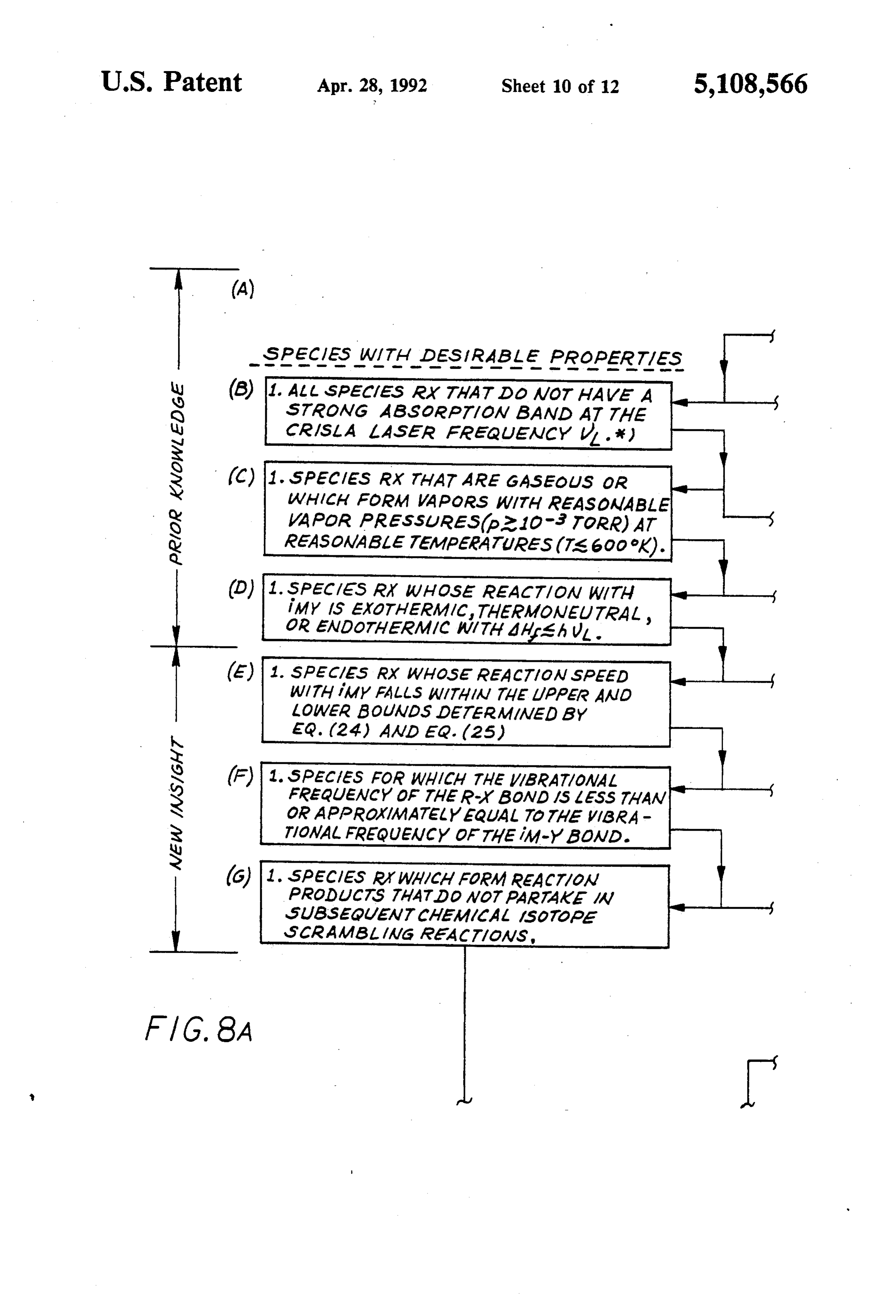
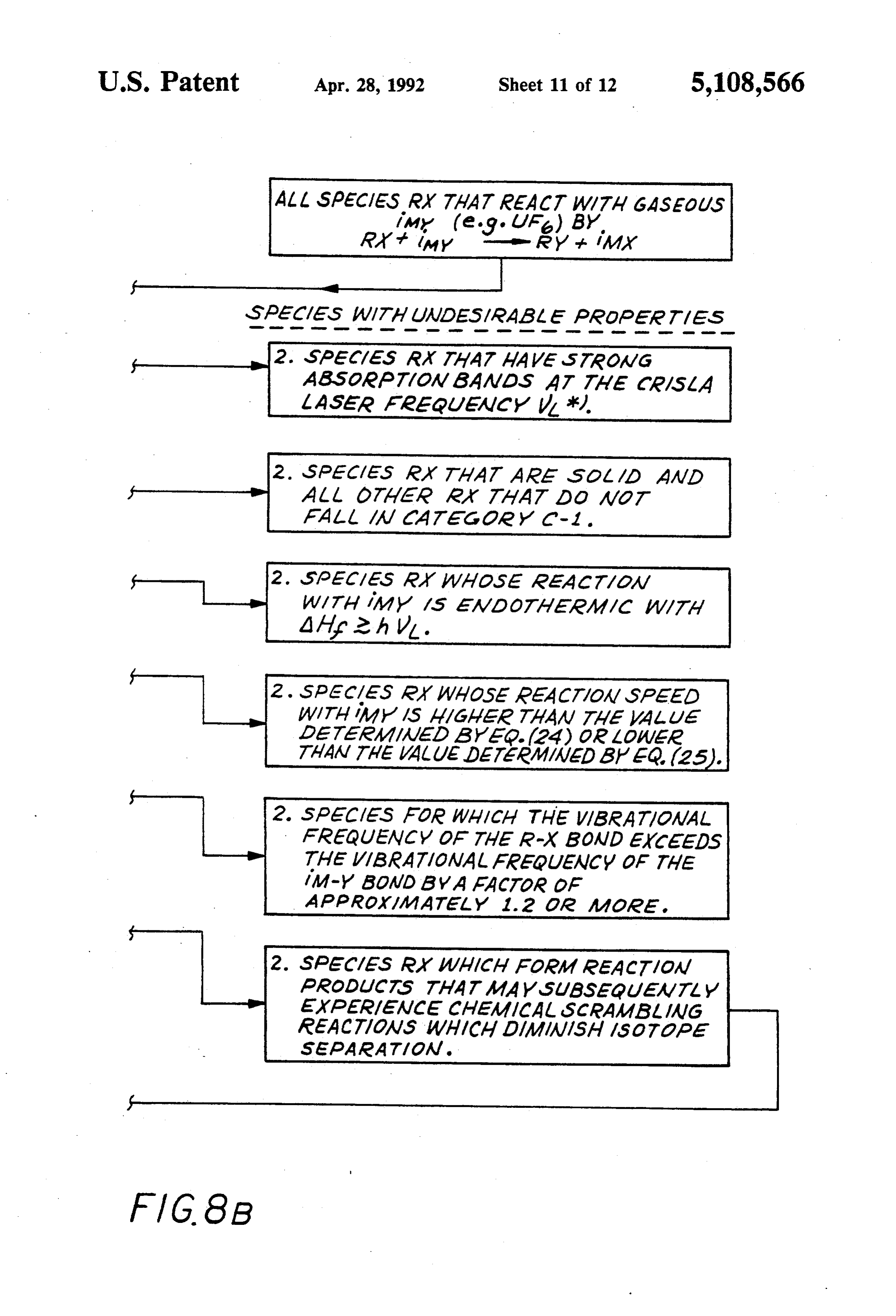
of photon-induced ionization and dissociation used in cited in the complex (MY":RX") to cause significant AVLIS and MOLIS rely on straight-forward extrapo reaction except for certain particular cases. It is clear lations of earlier developed scientific knowledge. For that the coreactant RX must perform efficiently as indi this reason, investigations of these laser isotope enrich cated by the overall reaction (III), or else the resulting ment processes were completed earlier than CRISLA. isotope separation will be poor. For example, if the The desired coreactant in the CRISLA process is a reaction is too slow or if other reactions dominate, the coreactant RX which in its complexed state with a resulting isotope effects will be uninteresting. For an Uranium-bearing laser-excited molecule UY", that is in improved CRISLA process it is therefore desirable to the molecular complex UY":RX, shows a high reaction . choose an efficient coreactant RX.
sensitivity to the vibrational excitation of the bond O The first four criteria for choosing a suitable RX U-Y. In certain particular cases, the photon energy molecule are defined in U.S. Pat. No. 4,082,633 and El=hVL pumped into UY is insufficient to overcome constitute a preselection process. The remaining three the reaction barrier energy Ea, that is ELCEa. How criteria are applied after the preselection process of the ever, if in this case ELCE C2EL, it is essential that the first four steps.
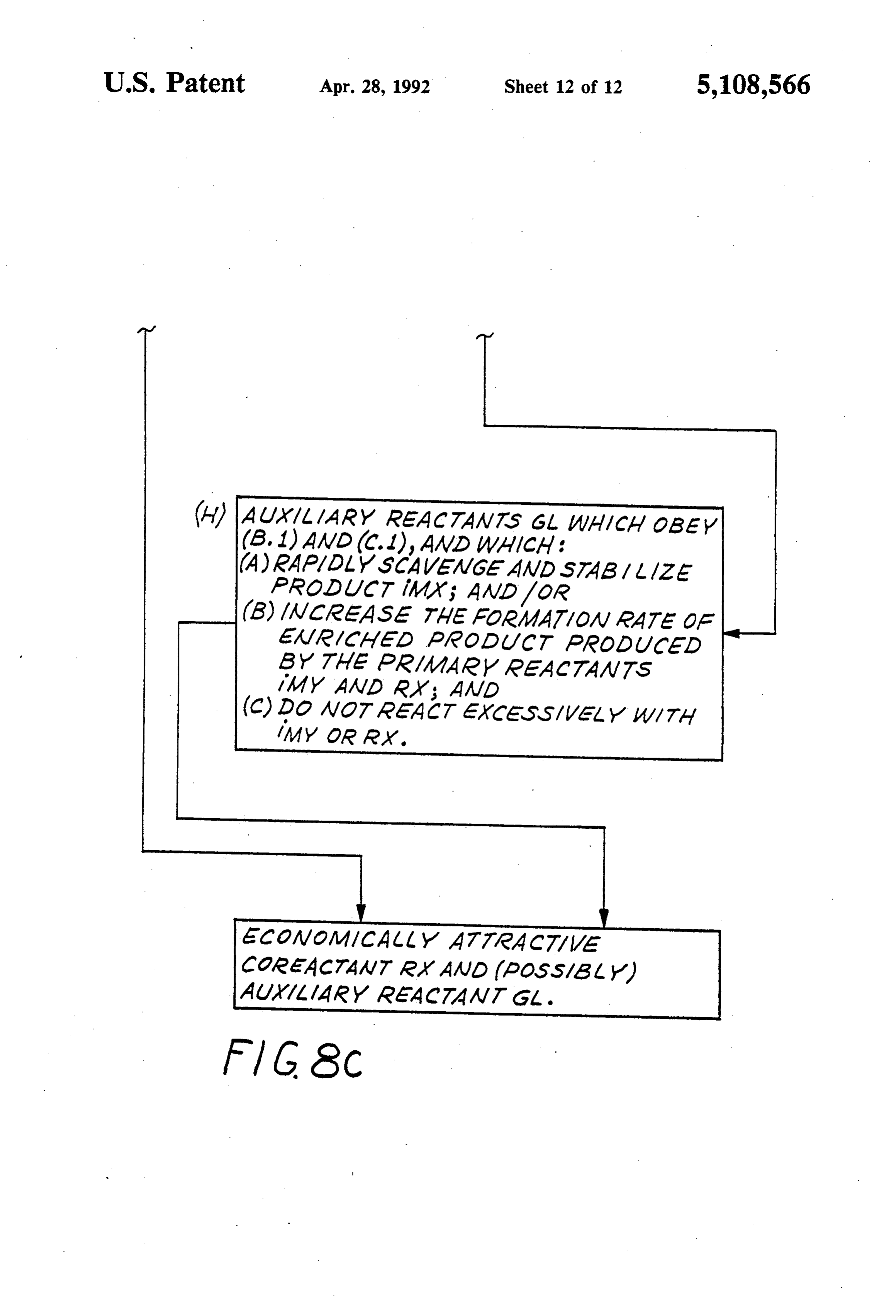
coreactant RX also absorb a laser photon EL =hvL so 15 As indicated in step (A) of FIG. 8, in choosing RX that the total pumped energy in the complex UY":RX" one must begin with the group of chemicals that do is doubled to 2EL and reaction is promoted. In addition react with MY. For example, for MY=UF6, mole to reaction sensitivity, it is important that the isotope cules such as N2, O2, CO2, etc. do not react and can be carrying product formed in a CRISLA reaction does left out in the first RX population selection. A more not engage in subsequent chemical scrambling. There 20 severe restriction is criterion (B), which eliminates all fore, it has long been desired to define certain essential molecules RX from population "A" that strongly ab molecular properties and selection criteria for RX that sorb photons at the laser wavelength to be sued for the will ensure efficient isotope-selective laser-induced re CRISLA process. However, according to the princi actions of the complex UF6":RX or UF6:RX" and the ples of the present invention, in some applications a mild formation of UF5X products that undergo little or no 25 absorption by RX may sometimes be advantageous. subsequent chemical scrambling. Application of these Step (C) rejects species RX that are totally solid, selection criteria to all reactable RX molecules, greatly having vapor pressures well below 10-3 torr at room restricts the number of RX molecules that are useful in particular applications of the CRISLA process. Thus, temperature. This selection step is necessary since the by employing coreactants from this limited predefined 30 substitution reaction (II) must take place in the gas group, considerable improvements in the CRISLA pro phase to be effective. Step (D) eliminates RX molecules cess result. The selection criteria can be equally applied that could react with MY but would require an amount to the CRISLA enrichment of isotopes other than Ura of energy injection for the activated complex 1. (MY:RX) which exceeds the energy EL pumped into the MY molecule alone or 2El pumped by the laser into
SUMMARY OF THE INVENTION MY" and RX both. Laser-induced gas-phase reactions Accordingly, it is an object of the present invention of MY" with RX must, of course, obey the law of en to provide improvements in the application of the ergy conversation. At the end of step (D), one still has CRISLA laser isotope separation process. a very large class of possible coreactants RX, a few of It is another object of the present invention to pro 40 which are listed in Table l.
vide a process for the selection of chemical coreactants TABLE RX that will lead to an improved CRISLA isotope SOME STEP "D" (FIG. 8) REACTANTS RX separation process when used with an isotopic molecule FOR REACTION WITH UF iMY.
Illustrations are provided for the application of the 45 TiC)
BCls
SiBra
HBr
RX selection criteria to the isotope separation of NOC) AsC3 CrO2Cl HCl 235UF6/238UF6 (that is for M-Y=UFs-F) and spe NOBr. SnCl4 SO2Cl SiH4 cific molecules RX are identified which yield improved
CRISLA enrichments of Uranium. However, the crite The elimination of inefficient species RX from Step ria are general and can be applied equally well to the "D' reactants such as those shown in Table 1, is one of separation of other isotopic molecules such as Zrfa, 50 the objects of the present invention. ZrCl4, ZrBra, WF6, and many other volatile halides. It has been found that reactants whose thermal rates As utilized herein, the presuperscript 'i' is used on an of reaction kT exceed the value given by equation (24) aton to indicate that different isotopes exist which one below, are poor candidates for an efficient CRISLA wishes to separate.
As discussed below in greater detail, there are seven enrichment process. Typical values of (kT)nax for the
criteria which must all be satisfied by a coreactant RX (kr)nax at 1 secisotope case of UF6 per enrichment with a CO laser are
UF6 molecule. The rate constant in order to achieve an improved CRISLA process uti kTshould not be too small either or the production rate lizing the steps: of enriched product becomes unattractively small. For the CRISLA enrichment of UF6 with a CO laser this lower limit on kTis typically (kT)minas 10-3 secl. Thus as applied to the CRISLA enrichment of UF6 with a
CO laser, Step (E) in FIG. 8 states that 10-3:Sks 1s-1. This criterion eliminates the first col 65 umn and the species H2 and CH4 in the last column of
Here hull represents the laser photon and photon coreactants listed in Table 1 because kris larger than 1 energy with frequency vL. As explained heretofore, sil for species in the first column and kT is less than Step (II) may not be required and RX need not be ex 10-3s-1 for coreactants in the last column with desir
Page 16
able coreactant partial pressures of prxS 1 torr. The
thermal reaction rates kT of Ash 3 and Geha in the last column of Table 1 as well as SiH4 are usually also less (UFssiBrF(*)' ->UF.Br.) + siBrF.() than 103s-1. However, these reactants may be laser excited by reaction (II) causing their effective rate of 5 up, SB.F.' s > reaction with UF6 to be increased to an acceptable
(VII)
level.
The upper value of kTas 1 s for the CRISLA en (UFssiBrF(*) -> UFsBr(r) + siBrFs() richment of UF6 is only an example and depends on the (VII laser power and UF6 absorption cross-section as indi O UF - SiBrF(*) - > (VIII) cated by equation (24). For higher laser powers and absorption cross-sections (attainable at lower tempera tures), the maximum allowable value for kT may be as (UFssiBrF(*)" -> UFsBr(r) + siF.() much as 103s-1 or higher. FIG. 4 illustrates the bound aries of allowable thermal reaction rates of suitable 15 It has been found that k <<k2, k3, k4 so that for each CRISLA coreactants to be used for the enrichment of isotope-selective laser-excited UF6' in (V), three non UF6. For the CRISLA enrichment of other isotopes isotope-selective products UF5Br are produced in Steps iMY, other upper and lower limits for kT apply of (VI) through (VIII). For this reason, SiBrF3 is a better course as determined by equations (24) through (26) set coreactant for Uranium enrichment than SiBra, since forth below. 20 only one product UF5Br can be formed in the laser-con Even with a value of the rate constant kT that falls in trolled reaction:
the right range defined by Step "E," many coreactants still within Step "E" fail to provide isotope-selective (IX) reactions. The usual reason is that these coreactants fail to satisfy Step "F" of FIG. 8, namely that the vibrations 25 of the bonds to be broken are in excess of the laser In conclusion, it is necessary in the final selection Step "G' to consider all subsequent chemical isotope scram excited largest bond vibration of MY. As mentioned bling most H-bonds have high dissociation energies and vi effects of both the products MX and RY. In the brational frequencies ury 2000 cm which are more 30 example of the pre-selected UF6--SiBrm.F4-m reac than three times larger than v UF6 = 625 cm. For that tions, this leads to SiBrF3 as the final preferred coreact reason, the molecules RX=HBr and HCl in Table 1 are antInchoice. some applications, an even more efficient separa poor contenders for use in a UF6 --RX CRISLA en richment process. tion process may be achieved, according tot the princi Of the remaining molecules also satisfying Step "F," 35 ples of the present invention, by utilizing an auxiliary it is found that their employment in a CRISLA reaction reactant. Step "H" in FIG. 8 illustrates the criteria of does generate an isotope effect, but in the case of UF6 such an auxiliary reactant. Briefly, the auxiliary reactant the primary product UFs)x in reaction (III) often ex GL is selected as one which complies with Steps "B" changes efficiently with the depleted UF6 molecules: and "C" of FIG. 8, as described above, and which: (a) Rapidly scavenges and stabilizes the product MX;
UFs)x +UF-UF6+UFsk (IV) and/or (b) Catalytically increases the formation rate of en
This is particularly true if X = Clin reactions (III) and riched product produced by the primary reactants MY (IV). Thus the isotope separation produced in (III) is and RX via brief Vanderwaals attachments to either quickly undone in (IV) unless one can remove UF5x 45 one of them or to the complex UF6':RX() and/or by (but not UF6) from the UF6/RX/UF5X/RF mixture interactive collisions with UF6":RX"); and more rapidly than reaction (IV). It has been found that (c) Do not react excessively with MY or RX. in some cases, the problem arising from (IV) is less It will be appreciated that the molecules RX may or severe if X=Br in (III) and (IV) since the product may not be laser-excited depending on the particular UF5Br is unstable and decomposes quickly to UFs and parameters and products utilized and the particular Br2 with retention of most of the isotope specificity. 50 application. A high degree of photon absorption by the Thus the last Step "G" of FIG. 8 requires an investiga reactant RX at the laser frequency vL is not desired tion of the product MX whose result reflects itself in (Step "B," FIG. 8). However, some absorption by the the selection of the compound RX. reactant RX may be desirable in particular cases. In addition to isotope scrambling exchange reactions 55 The selection process outlined by FIG. 8 and dis such as (IV), other chemical reaction mechanisms can be at work that promote isotope scrambling. For exam cussed in more details below, greatly diminishes unnec essary and costly experimentation to find an efficient ple, investigations of the reactant SiBra reveals that coreactant RX and, if desired, an auxiliary reactant GL, products of this coreactant can initiate chemical scram for use in the CRISLA separation of MY. The applica bling of isotopes through the steps: tion of criteria (A) through (G) or "A" through "H" to the CRISLA enrichment of UF6 has resulted in the
UFs(hvi) -- SiBra-I-D (V) selection of several coreactants such as Sibrfs and the combination SiH4 (primary)--HBr (auxiliary) that make the CRISLA process commercially competitive with
UFssibralt - GUFsbr(s) + siBrF() other laser-isotope separation processes.
k Certain aspects of the CRISLA process particularly UF64. SiBrF()--> (VI) and laser-isotope separation characteristics in general have been described in:
Page 17
(a) U.S. Pat. No. 4,082,633, "High-Mass Isotope Sep aration Process and Arrangement," by J. W. Eerkens; and.
(b) "Laser Isotope Enrichment of Uranium by the UFs.F"--QBr3.Br-UFs.Br.--QBrs.F (4) CRISLA process (Vol. I)," by J. W. Eerkens; Report For Q= Si, Ge, or Sn, the reaction speed is moderate IT-87-006, Isotope Technologies; September 1987;
(c) "Lifetimes, Populations, and Absorptions of the v3 while for Q = C, the reaction is endothermic and no and 3v3 Vibrations in UF6, " by J. W. Eerkens; Report reaction occurs at room temperature. For Q = Ti, the IT-88-010, Isotope Technologies; August 1988; reaction is fast. Instead of QX4, mixed halogenated (d) "Uranium Enrichment using the CRISLA Process," 10 species are also possible in (3) and (4) like QF3Cl. by J. W. Eerkens, Nuclear Engineering International
(Great Britain); June 1989 issue, p. 48; QFBrCl2, QF2CBr, etc. In addition, the substitution of (e) "Dinner Formation in Gases and Gas Mixtures,' by I for Br in these compounds might constitute a possible J. W. Eerkens, Report IT-88-003R, Isotope Technolo coreactant. However, many iodated gaseous molecules gies; March 1988; 15 are unstable at room temperature and dissociate giving (f) "Laser Spectroscopy and its Applications," edited by off I2 or IX.
L. J. Radziemski, R. W. Solarz, and J. A. Paisner; Mar Other much-studies exothermic reactions as indicated cel Dekker, Inc. N. Y. (1987). in U.S. Pat. No. 4,082,633 are:
DESCRIPTION OF PREFERRED
EMBODIMENTS
1. Introduction
Prior to a description of the preferred embodiments 'UFs--QH-UFsh--QHiF-UF4:HF-QHsF (6b) of the present invention, a discussion is given of the physical and chemical processes associated with the In equations (6a) and (6b), Q is Si or Ge. Additional practice of the invention. Such a discussion provides a halogen-exchanging reactions with UF6 exist involving more comprehensive understanding of the techniques coreactants such as QO2X2 and QOX2. Some of these associated with the practice of the present invention so will be discussed later. Instead of halogens, in other that those skilled in the art may be more fully appraised 30 CRISLA schemes, Y and X might represent -H, -CO thereof. (carbonyls), -BH4, -NH2, -SH3, -SiOH, -CH3, Generally for successful CRISLA isotope separa -COH (ketones) or other moieties in addition or in tions, a gas-phase chemical substitution or exchange place of the halogens.
reaction is desired which can be written: Aside from X/Y substitutions reactions (1b) or (2b), other possible gas-phase reactions are:
(laser Excitation)
(Y-stripping reaction)
40 M-RZ-('MY":RZ) iMYR-X (8)
(Y/X Exchange Reaction)
(R-stripping reaction)
Additionally, as noted above, it may also be advanta MY--RZ-(MY:RZ) -MYRZ" (9) geous to have laser photon excitation of the reactant 45 (Permanent Attachment/Rearrangement Reaction) RX. In such applications, there would also be the reac tion defined by the equations: Examples of reactions (7) through (9) with MY=UF6
MY"+Rx'-(MY".Rx")-MX+RY (2b) 50 UF6-NO-UFs-i-NOF (10)
The photon absorption strength of reaction (2.a) should not greatly exceed and preferably be of the same order UF6--Asf-UF4- AsF5 (1b) of magnitude as the absorption strength in reaction (1a) in such application. In these relations M is part of the 55 UF6--NOF-NOUF (12a) molecule that contains the isotope to be separated (e.g.
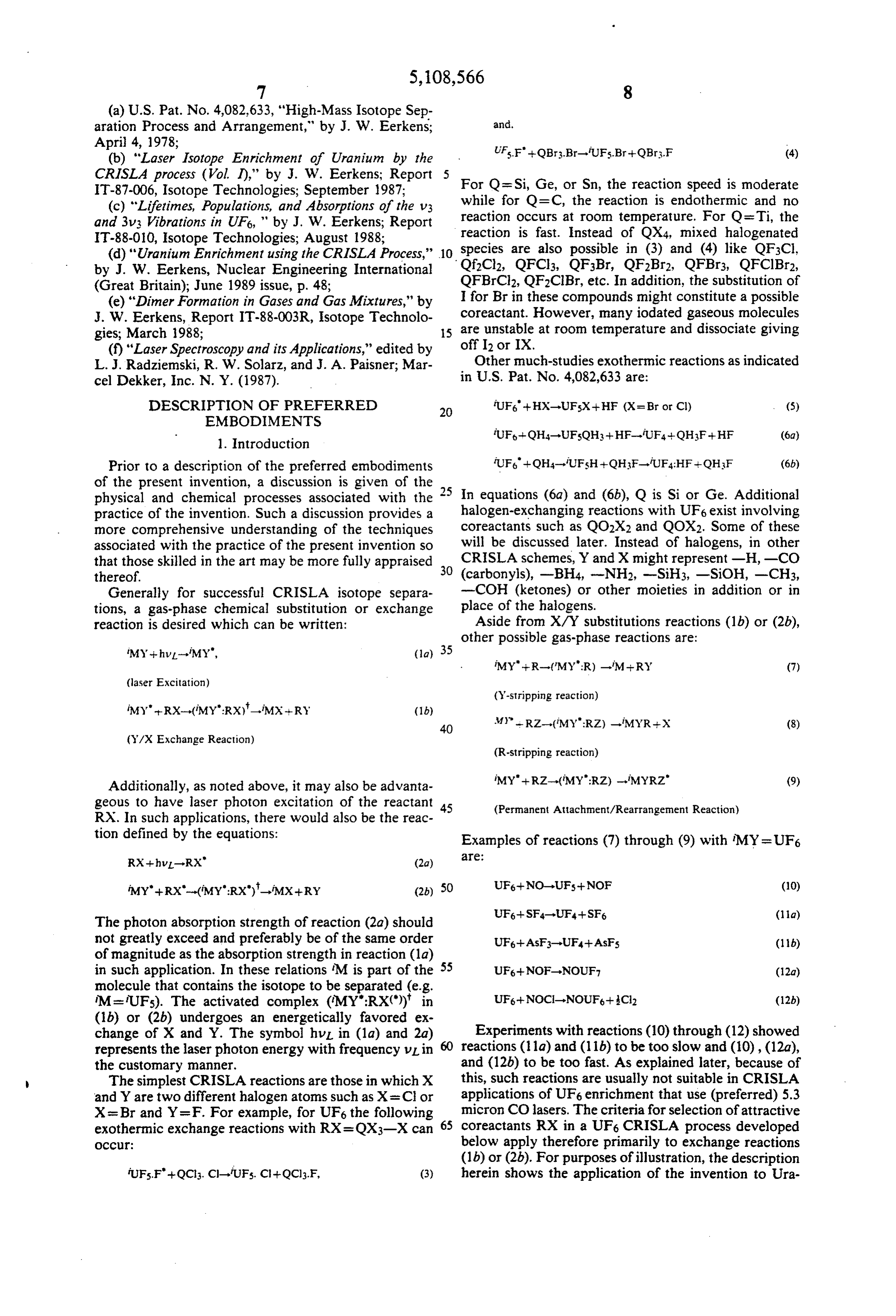
M=UFs). The activated complex (MY":RX(') in UF6--NOC-NOUF6- Cl (12b) (1b) or (2b) undergoes an energetically favored ex change of X and Y. The symbol hul in (1a) and 2a) Experiments with reactions (10) through (12) showed represents the laser photon energy with frequency vLin reactions (1a) and (11b) to be too slow and (10), (12a), the customary manner. and (12b) to be too fast. As explained later, because of The simplest CRISLA reactions are those in which X this, such reactions are usually not suitable in CRISLA and Y are two different halogen atoms such as X= C or applications of UF6 enrichment that use (preferred) 5.3 X=Br and Y=F. For example, for UF6 the following micron CO lasers. The criteria for selection of attractive exothermic exchange reactions with RX=QX3-X can 65 coreactants RX in a UF6 CRISLA process developed OCC: below apply therefore primarily to exchange reactions (1b) or (2b). For purposes of illustration, the description herein shows the application of the invention to Ura
Page 18
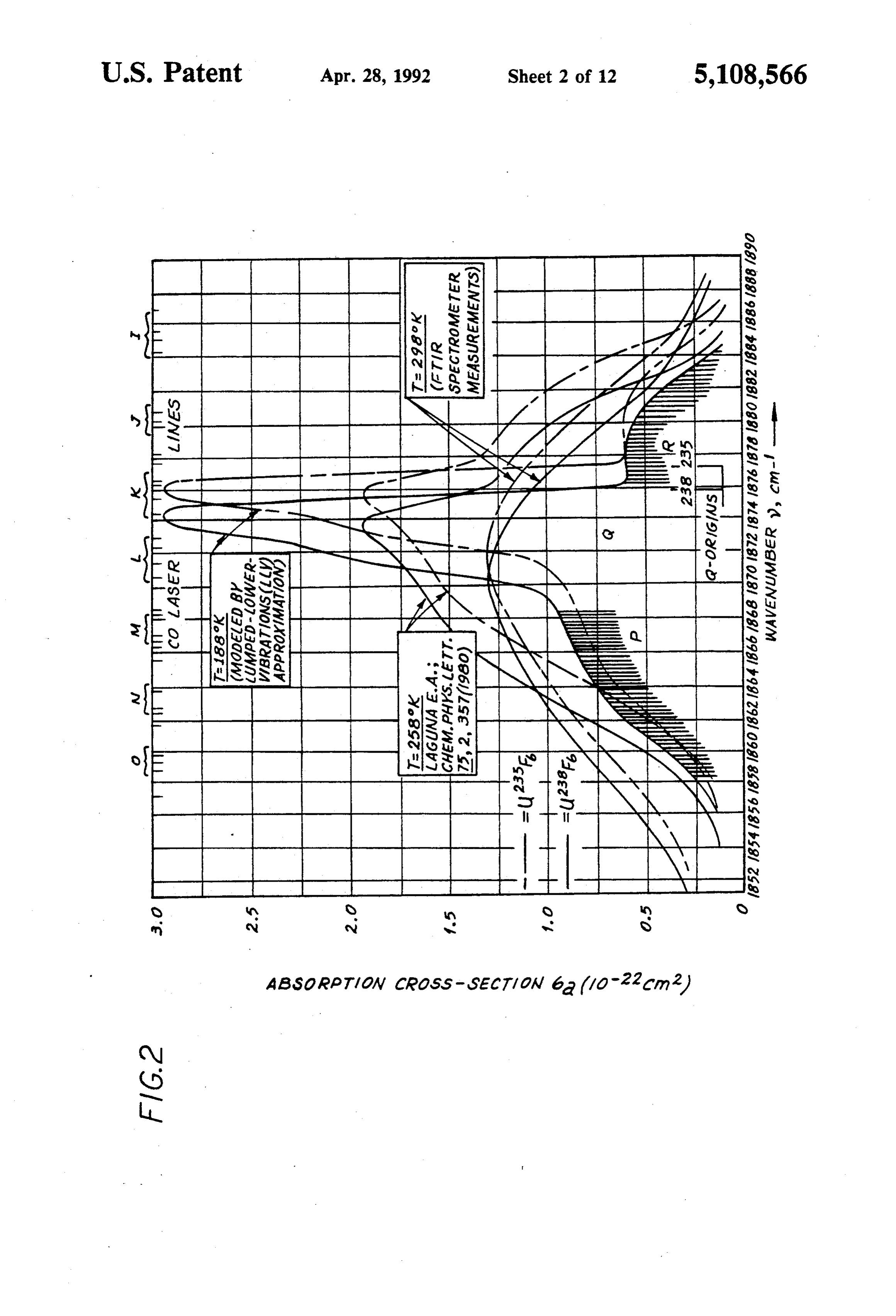
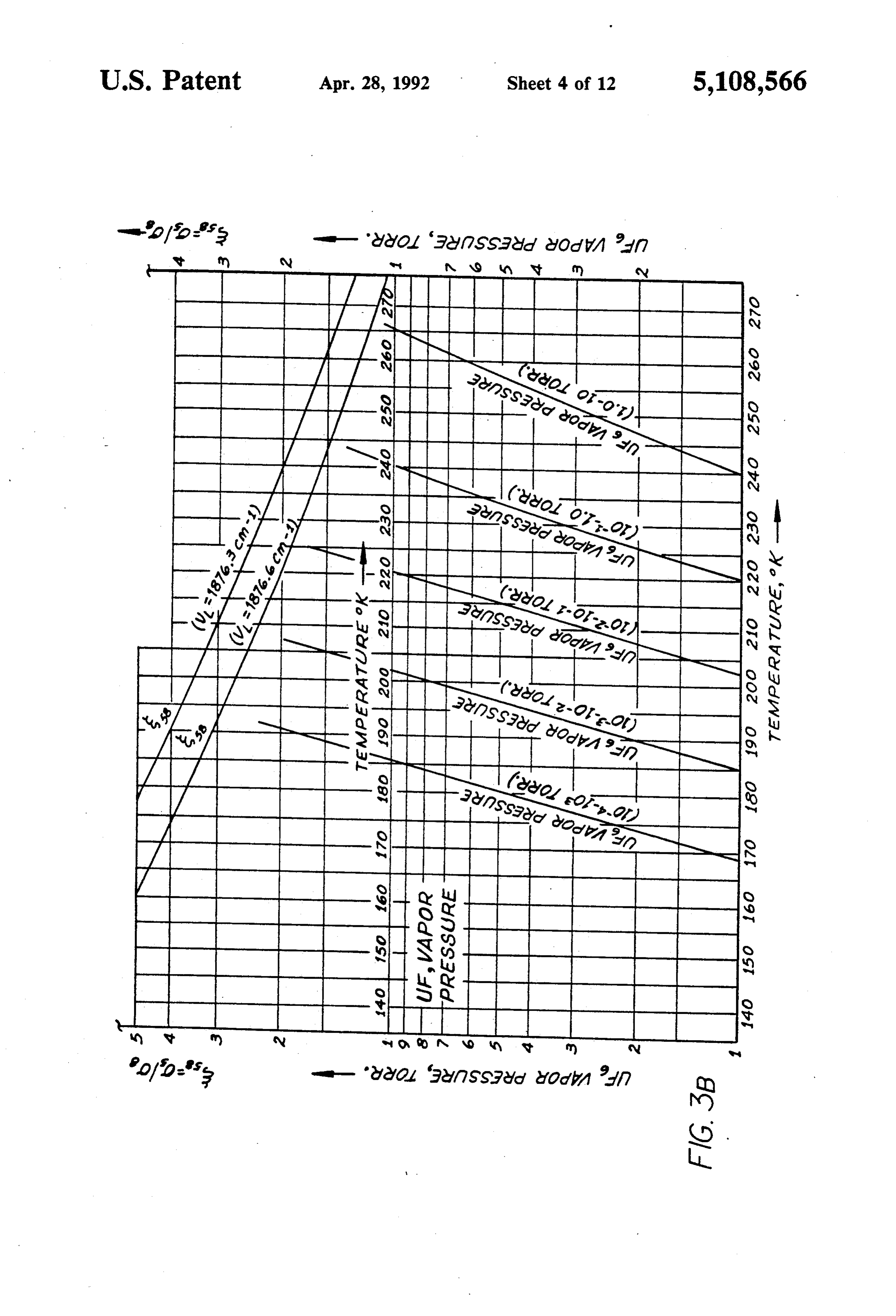
nium isotope separation of UF6. However, it should be tion cross-section ratio differs by a factor of 2 to 5 de understood that the RX selection criteria can be readily pending on temperature. In general, the colder the gas, extended to the CRISLA separation of other natural or the higher the cross-section ratio is. FIG. 3 shows the radioactive isotopes such as Pu, Zr, and I, using suit calculated variation of 858= o(235UF6)/o (238UF6), as a able volatile molecules MY or MXY where X and function of temperature using a lumped-lower-vibration Mor Y are halogens (F, Cl, Br, I), -H, -CO (carbon (LLV) band model that was fitted to experimental mea yls), -BH4, -NJ2, -CH3, -COH (aldehydes), surements. This calculated value of 858 is based on -SiOH (siloxanes), or any other suitable atom or group smoothed absorption band contours. The real value of of atoms. 58 may be higher, particularly at the lower tempera To determine the type of coreactant RX which will 10 tures, due to sharp holes in the actual band spectra and lead to a commercially attractive CRISLA process, it is the fact that the IC exerts fine-filtering action. As de necessary to examine CRISLA physics in some detail. scribed in U.S. Pat. 4,082,633, this can force lasing ac As described below, the upper and lower limits for the tion to breakout at those frequencies of the many al thermal reaction rate of RX--UF6 are established by an lowed ultra-monochromatic reasonator lines of the CO analysis of the expression for the enrichment factor a, laser where 238UF6 absorption peaks are avoided and This greatly limits the class of gaseous molecules RX where 238UF6 spectral holes exist.
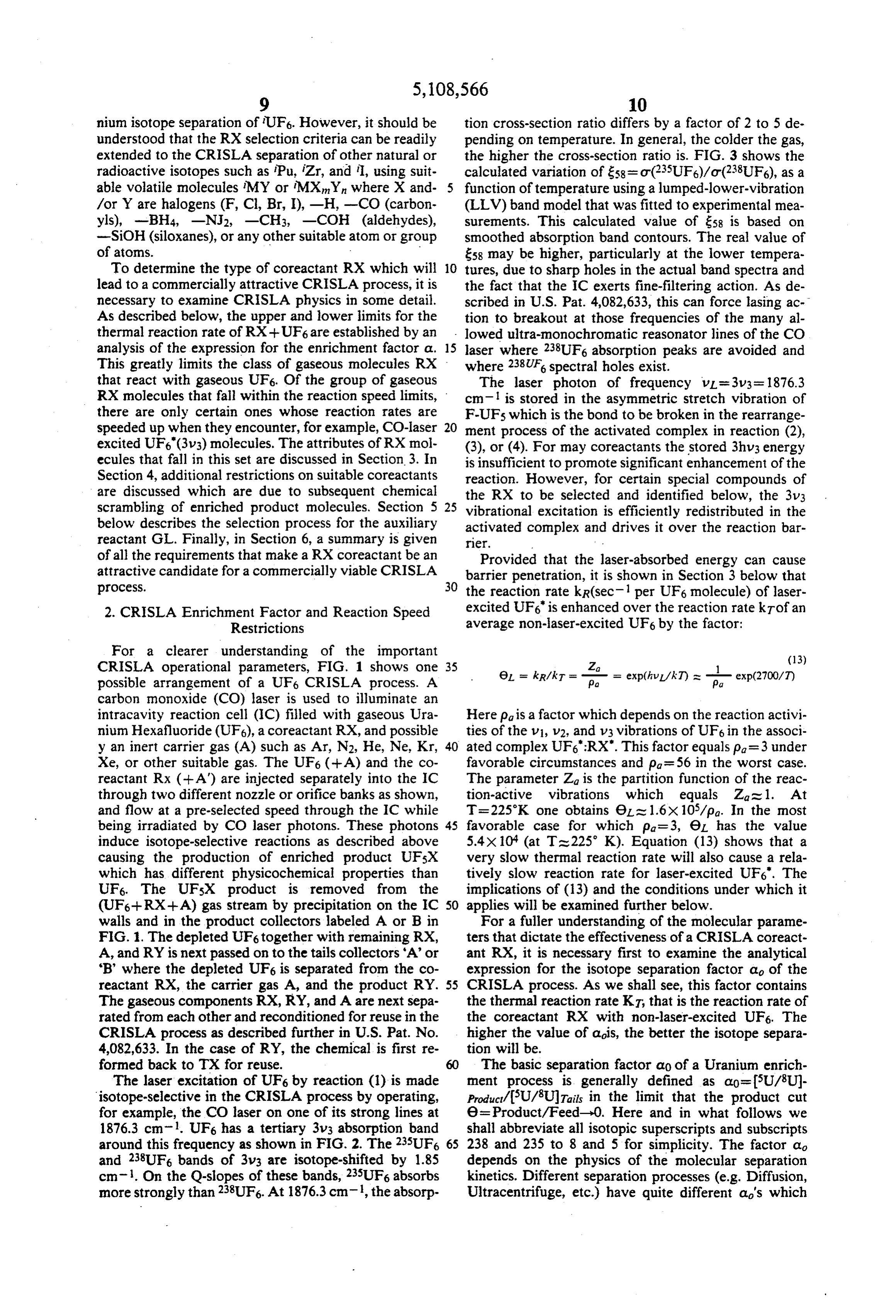
that react with gaseous UF6. Of the group of gaseous The laser photon of frequency vL=3v3 = 1876.3 RX molecules that fall within the reaction speed limits, cm is stored in the asymmetric stretch vibration of there are only certain ones whose reaction rates are F-UFs which is the bond to be broken in the rearrange speeded up when they encounter, for example, CO-laser 20 ment process of the activated complex in reaction (2), excited UF6(3v3) molecules. The attributes of RX mol (3), or (4). For may coreactants the stored 3hu3 energy ecules that fall in this set are discussed in Section. 3. In is insufficient to promote significant enhancement of the Section 4, additional restrictions on suitable coreactants reaction. However, for certain special compounds of are discussed which are due to subsequent chemical the RX to be selected and identified below, the 3v3 scrambling of enriched product molecules. Section 5 25 vibrational excitation is efficiently redistributed in the below describes the selection process for the auxiliary activated complex and drives it over the reaction bar reactant GL. Finally, in Section 6, a summary is given rier. - of all the requirements that make a RX coreactant be an Provided that the laser-absorbed energy can cause attractive candidate for a commercially viable CRISLA barrier penetration, it is shown in Section 3 below that process. 30 the reaction rate kR(sec per UF6 molecule) of laser 2. CRISLA Enrichment Factor and Reaction Speed excited UF6' is enhanced over the reaction rate kT of an Restrictions average non-laser-excited UF6 by the factor:
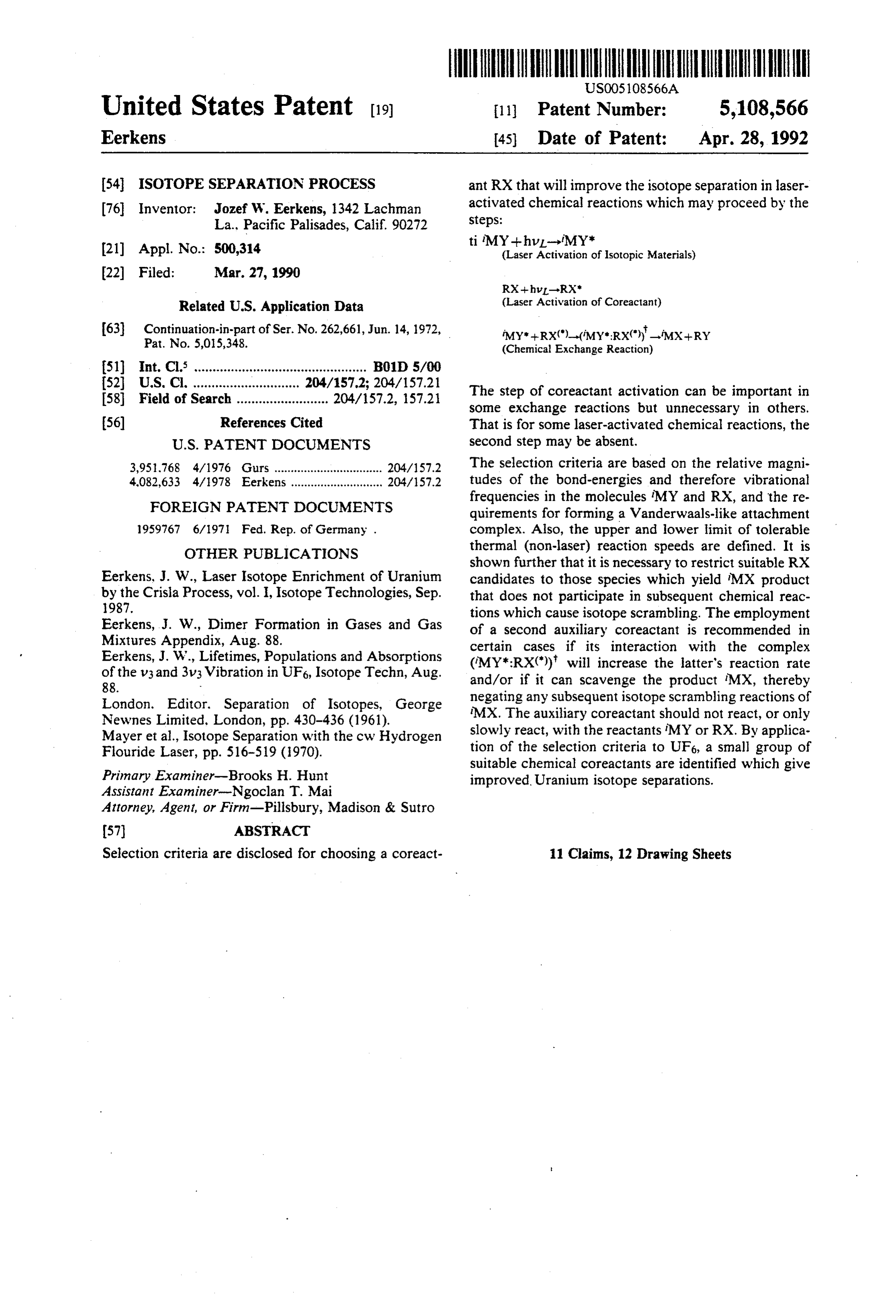
For a clearer understanding of the important Z (13) CRISLA operational parameters, FIG. 1 shows one 35 6 s kRakT = -- = exp(hu L/kT) as -- exp(2700/T) possible arrangement of a UF6 CRISLA process. A carbon monoxide (CO) laser is used to illuminate an intracavity reaction cell (IC) filled with gaseous Ura Here pais a factor which depends on the reaction activi nium Hexafluoride (UF6), a coreactant RX, and possible ties of the u, v2, and v3 vibrations of UF6 in the associ y an inert carrier gas (A) such as Air, N2, He, Ne, Kr., 40 ated complex UF6":RX". This factor equals pa=3 under Xe, or other suitable gas. The UF6 (+A) and the co favorable circumstances and pa=56 in the worst case. reactant Rx (-t-A") are injected separately into the IC The parameter Za is the partition function of the reac through two different nozzle or orifice banks as shown, tion-active vibrations which equals Zaat 1. At and flow at a pre-selected speed through the IC while T=225K one obtains eLast 1.6X 10.5/pa. In the most being irradiated by CO laser photons. These photons 45 favorable case for which pa=3, 6L has the value induce isotope-selective reactions as described above 5.4x 10 (at Tat 225 K). Equation (13) shows that a causing the production of enriched product UFs)x very slow thermal reaction rate will also cause a rela which has different physicochemical properties than tively slow reaction rate for laser-excited UF6. The UF6. The UFs)x product is removed from the implications of (13) and the conditions under which it (UF6--RX--A) gas stream by precipitation on the IC 50 applies will be examined further below. walls and in the product collectors labeled A or B in For a fuller understanding of the molecular parame FIG.1. The depleted UF6 together with remaining RX, ters that dictate the effectiveness of a CRISLA coreact A, and RY is next passed on to the tails collectors 'A' or ant RX, it is necessary first to examine the analytical 'B' where the depleted UF6 is separated from the co expression for the isotope separation factor a of the reactant RX, the carrier gas A, and the product RY. 55 CRISLA process. As we shall see, this factor contains The gaseous components RX, RY, and A are next sepa the thermal reaction rate KT, that is the reaction rate of rated from each other and reconditioned for reuse in the the coreactant RX with non-laser-excited UF6. The CRISLA process as described further in U.S. Pat. No. higher the value of acis, the better the isotope separa 4,082,633. In the case of RY, the chemical is first re tion will be.
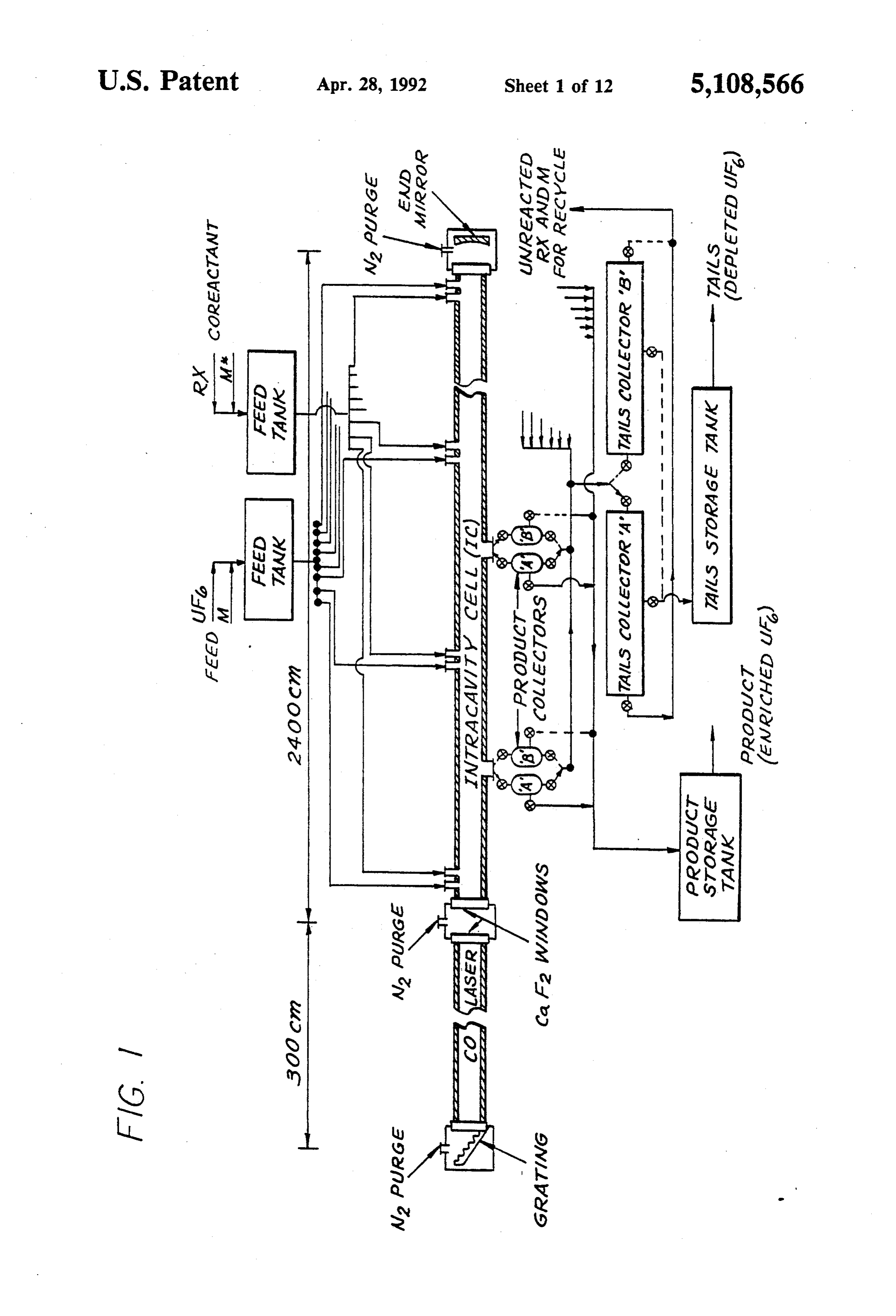
formed back to TX for reuse. The basic separation factor ao of a Uranium enrich The laser excitation of UF6 by reaction () is made ment process is generally defined as alo=5U/8U isotope-selective in the CRISLA process by operating, Product/U/UTails in the limit that the product cut for example, the CO laser on one of its strong lines at 6=Product/Feed-s0. Here and in what follows we 1876.3 cm-l. UF6 has a tertiary 3v3 absorption band shall abbreviate all isotopic superscripts and subscripts around this frequency as shown in FIG. 2. The 235UF6 65 238 and 235 to 8 and 5 for simplicity. The factor a and 238UF6 bands of 3v3 are isotope-shifted by 1.85 depends on the physics of the molecular separation cm-1. On the Q-slopes of these bands, 235UF6 absorbs kinetics. Different separation processes (e.g. Diffusion, more strongly than 238UF6. At 1876.3 cm, the absorp Ultracentrifuge, etc.) have quite different a's which
Page 19
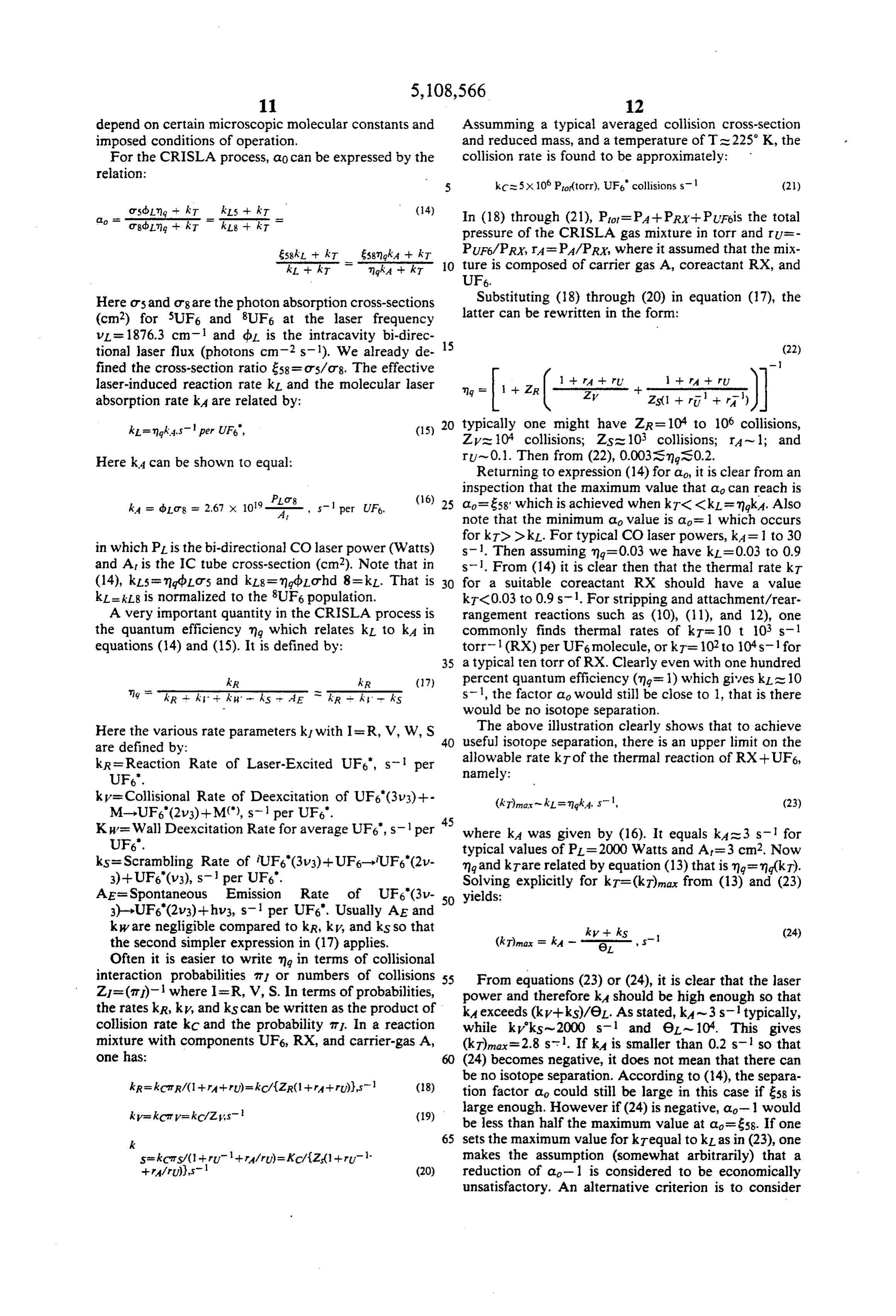
depend on certain microscopic molecular constants and Assumming a typical averaged collision cross-section imposed conditions of operation. and reduced mass, and a temperature of Tat 225 K, the For the CRISLA process, a0 can be expressed by the collision rate is found to be approximately: relation:
In (18) through (21), Pot-PA--PRI-PUF6is the total pressure of the CRISLA gas mixture in torr and rus 558kl t kT 658 skat KT PUF6/PRX, ra=PA/PR, where it assumed that the mix kL + kr nkA + kT ture is composed of carrier gas A, coreactant RX, and
Here ors and or 8 are the photon absorption cross-sections Substituting (18) through (20) in equation (17), the (cm) for UF6 and 8UF6 at the laser frequency latter can be rewritten in the form:
vL = 1876.3 cm and dL is the intracavity bi-direc tional laser flux (photons cm-2 s.1). We already de 15 -
fined the cross-section ratio 858 = ors/o8. The effective laser-induced reaction rate kL and the molecular laser absorption rate kA are related by: " - Z. 1 - r -- rty
typically one might have ZR = 10 to 106 collisions, kL=nk.4.s' per UF6, (15) Zvast 10 collisions; Zsat 10 collisions; ra-1; and Here k4 can be shown to equal: ru ~0.1. Then from (22), 0.0035n50.2. Returning to expression (14) for ao, it is clear from an inspection that the maximum value that a can reach is
Af , is per UF6.
(6) 25 ag=858' which is achieved when kT<<k.L=mkA. Also note that the minimum a value is a = 1 which occurs for kT>>kL. For typical CO laser powers, k4 = 1 to 30 in which PL is the bi-directional CO laser power (Watts) s. Then assuming m=0.03 we have kl=0.03 to 0.9 and A is the IC tube cross-section (cm2). Note that in s. From (14) it is clear then that the thermal rate kT. (14), kl5 = midblos and kills = midblohd 8=kL. That is 30 for a suitable coreactant RX should have a value kL-kL8 is normalized to the UF6 population. kT<0.03 to 0.9s. For stripping and attachment/rear A very important quantity in the CRISLA process is rangement reactions such as (10), (11), and 12), one the quantum efficiency m which relates kill to kA in commonly finds thermal rates of kT = 10 t 103 s-l equations (14) and (15). It is defined by: torr (RX) per UF6 molecule, or kT = 102 to 10's-1 for 35 a typical ten torr of RX. Clearly even with one hundred kR kR (17) percent quantum efficiency (m=1) which gives klas 10 n = . . . . . . a. s. sl, the factor a would still be close to 1, that is there would be no isotope separation.
The above illustration clearly shows that to achieve
Here the various rate parameters ki with Is R, V, W, S 40 useful are defined by: isotope separation, there is an upper limit on the kR = Reaction Rate of Laser-Excited UF6, s- per allowable namely:
rate kT of the thermal reaction of RX-UF6,
kw=Collisional Rate of Deexcitation of UF6(3v3).--- (kT)nax ~ kL=ngk4, ST 1, (23)
Kw-Wall Deexcitation Rate for average UF6, s- per 45 where kA was given by (16). It equals k4 at 3 s for UF6. typical values of PL=2000 Watts and A=3 cm2. Now ks=Scrambling Rate of UF6(3v3)--UF6-UF6"(2u mand kT are related by equation (13) that is m= m(kT). 3) --UF6"(v3), s1 per UF6". Solving explicitly for kT=(kT)nax from (13) and (23) AE=Spontaneous Emission Rate of UF6(3u 50 yields:
kware negligible compared to kR, kw, and kS so that 24 the second simpler expression in (17) applies. (kr)nax = kA - (24) Often it is easier to write m in terms of collisional interaction probabilities arr or numbers of collisions 55 From equations (23) or (24), it is clear that the laser Z1=(arl) where I = R, V, S. In terms of probabilities, power and therefore kA should be high enough so that the rates kR, kw, and kS can be written as the product of kA exceeds (kv--ks)/eL. As stated, k4-3s typically, collision rate kic and the probability TI. In a reaction while kwks-2000 sl and 6L-10. This gives mixture with components UF6, RX, and carrier-gas A, (kT)nax=2.8 s. If k is smaller than 0.2 s so that one has: 60 (24) becomes negative, it does not mean that there can be no isotope separation. According to (14), the separa tion factor do could still be large in this case if 858 is large enough. However if (24) is negative, ao-1 would be less than half the maximum value at ass=858. If one 65 sets the maximum value for kTequal to kL as in (23), one makes the assumption (somewhat arbitrarily) that a reduction of ao-1 is considered to be economically unsatisfactory. An alternative criterion is to consider
Page 20
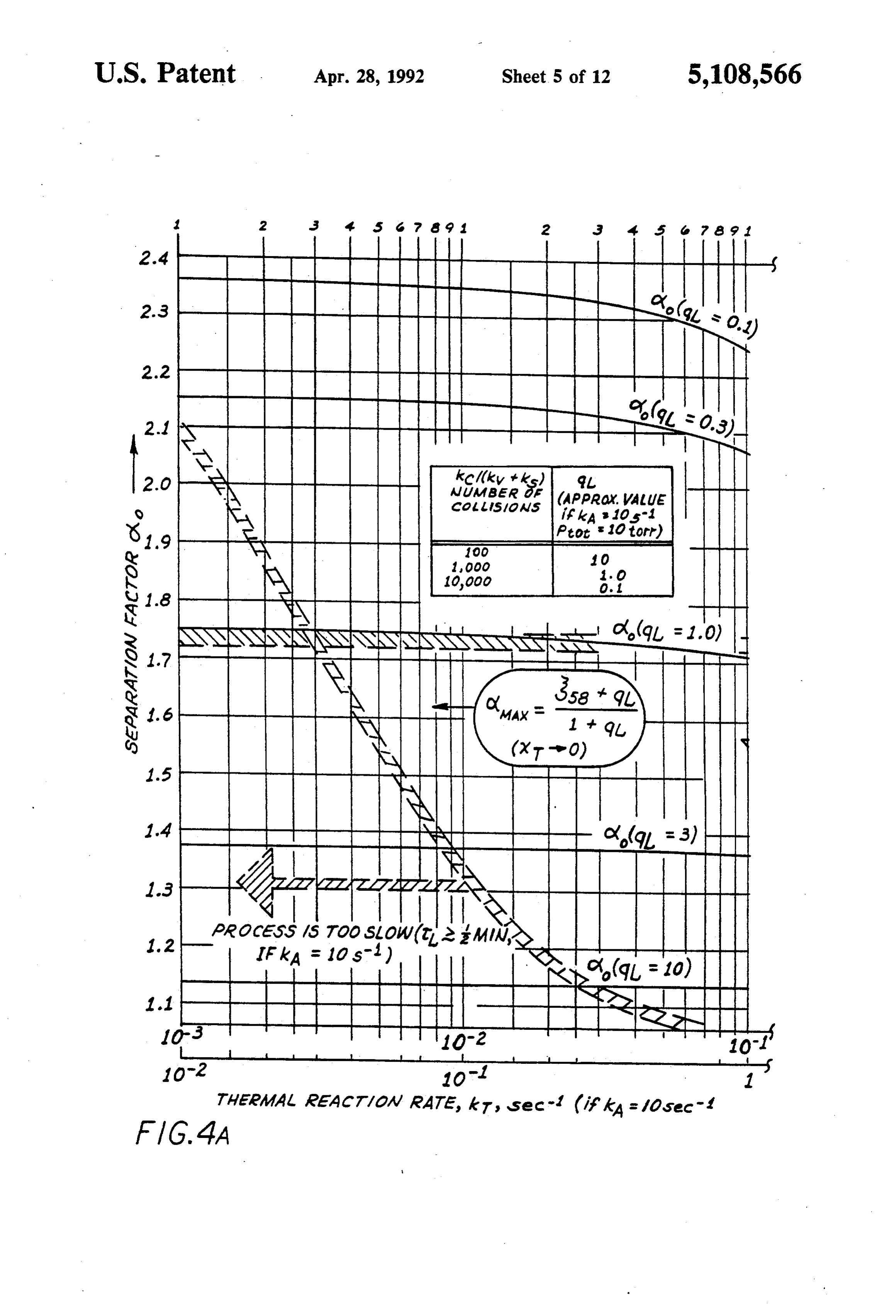
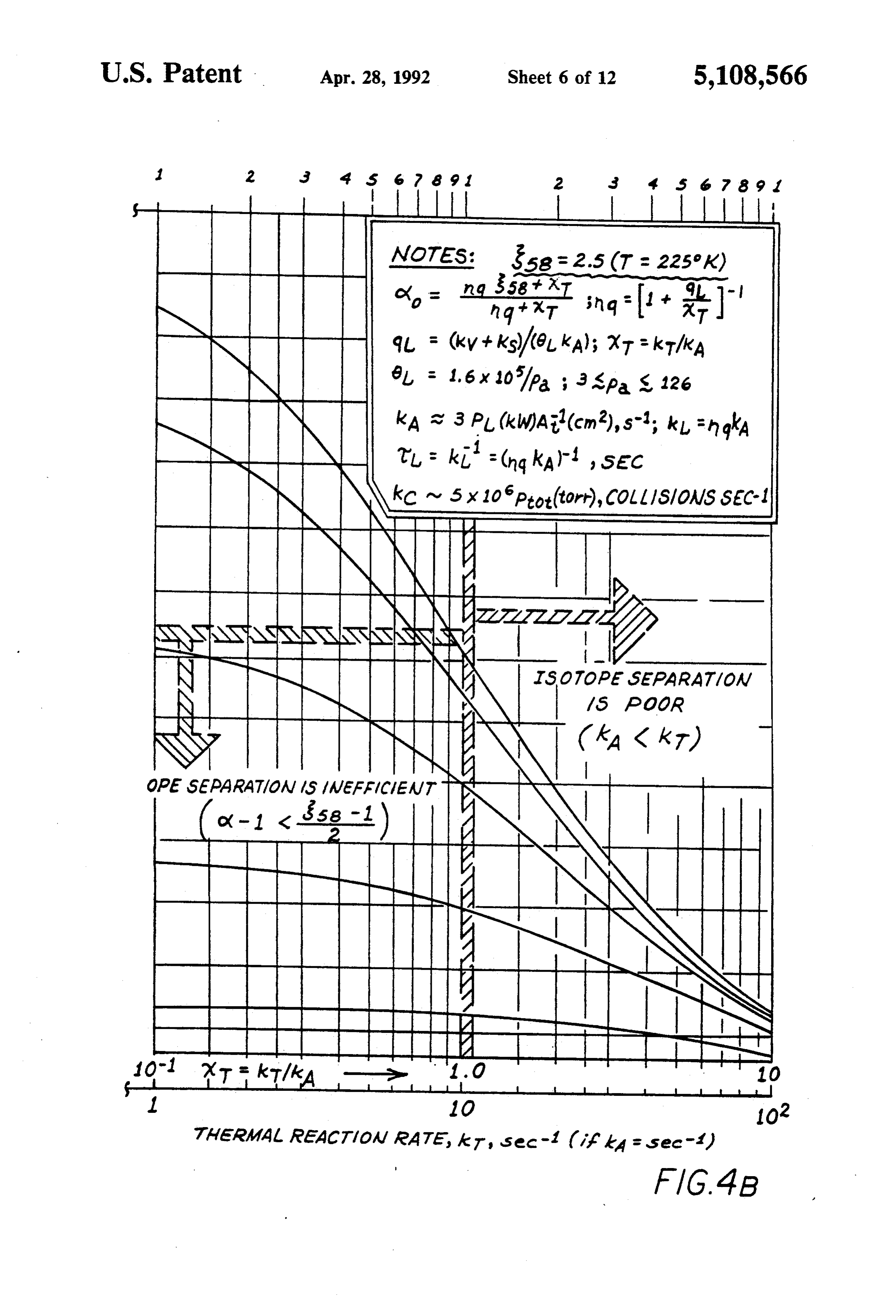
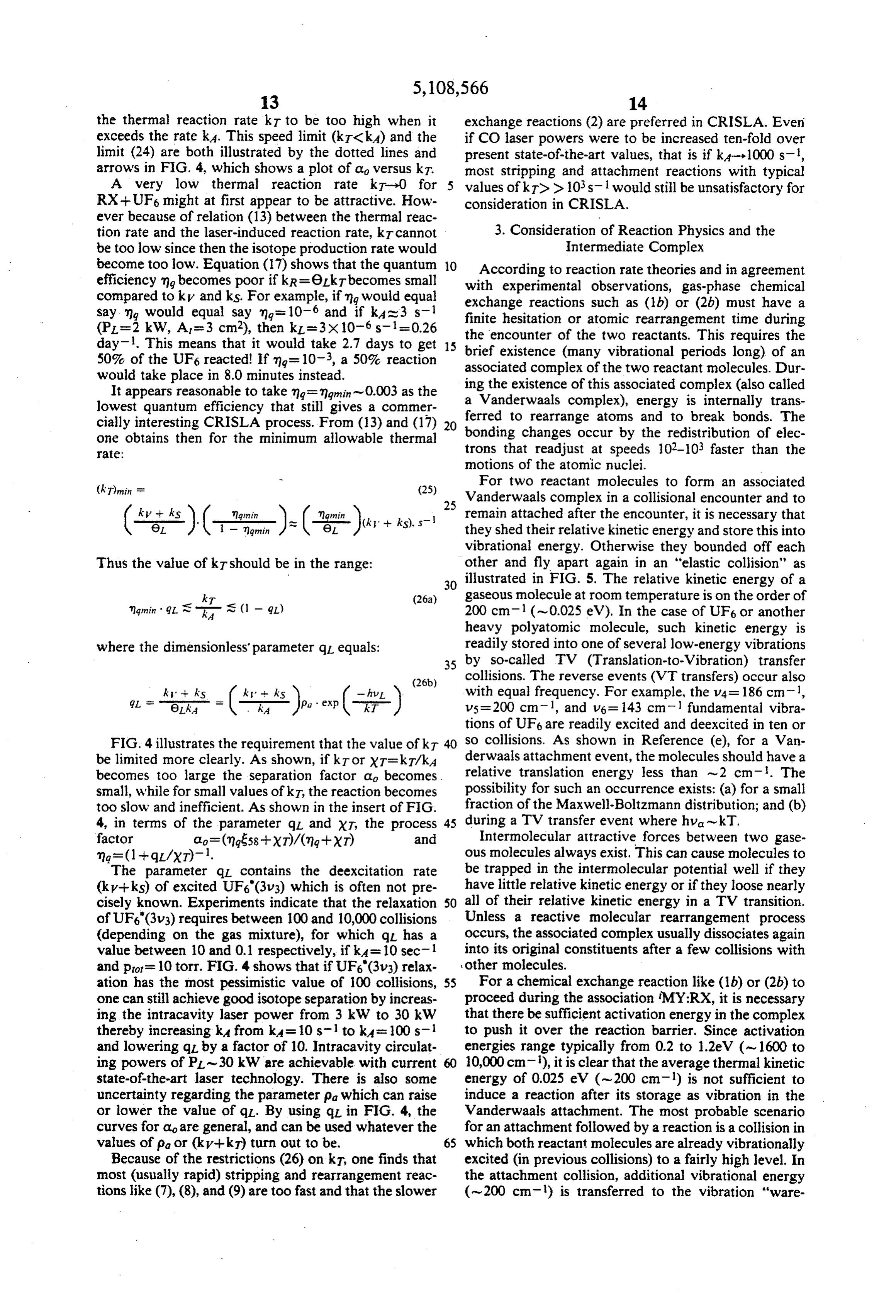
the thermal reaction rate kT to be too high when it exchange reactions (2) are preferred in CRISLA. Even exceeds the rate k4. This speed limit (kT (k4) and the if CO laser powers were to be increased ten-fold over limit (24) are both illustrated by the dotted lines and present state-of-the-art values, that is if k 4-1000 sil, arrows in FIG. 4, which shows a plot of a versus kT. most stripping and attachment reactions with typical A very low thermal reaction rate kT-0 for 5 values of kT>> 10s would still be unsatisfactory for RX--UF6 might at first appear to be attractive. How consideration in CRISLA.
ever because of relation (13) between the thermal reac tion rate and the laser-induced reaction rate, kT cannot 3. Consideration of Reaction Physics and the be too low since then the isotope production rate would Intermediate Complex become too low. Equation (17) shows that the quantum 10 According to reaction rate theories and in agreement efficiency m becomes poor if kR=eLkT becomes small with experimental observations, gas-phase chemical compared to kv and ks. For example, if m would equal say in would equal say m=10-6 and if kAs3 s exchange reactions such as (lb) or (2b) must have a (PL=2 kW, A=3 cm2), then k=3x10⁻⁶s-1 = 0.26 the encounter ofortheatomic finite hesitation two rearrangement time during reactants. This requires the day. This means that it would take 2.7 days to get 15 brief existence (many vibrational periods long) of an 50% of the UF6 reacted! If n=10-3, a 50% reaction associated complex of the two reactant molecules. Dur would take place in 8.0 minutes instead. ing the existence of this associated complex (also called It appears reasonable to take m=namin -0.003 as the lowest quantum efficiency that still gives a commer aferred
Vanderwaals complex), energy is internally trans to rearrange atoms and to break bonds. The cially interesting CRISLA process. From (13) and (17) 20 bonding changes occur by the redistribution of elec one obtains then for the minimum allowable thermal late: trons that readjust at speeds 102-103 faster than the motions of the atomic nuclei.
(kT)min = (25)
For two reactant molecules to form an associated
Vanderwaals complex in a collisional encounter and to
gmin 25 remain attached after the encounter, it is necessary that
they shed their relative kinetic energy and store this into vibrational energy. Otherwise they bounded off each
Thus the value of kT should be in the range: other and fly apart again in an "elastic collision" as 30 illustrated in FIG. 5. The relative kinetic energy of a kT (26a) gaseous molecule at room temperature is on the order of ignin L. s- S (1 - qL) 200 cm (~0.025 eV). In the case of UF6 or another heavy polyatomic molecule, such kinetic energy is where the dimensionless parameter qL equals: readily stored into one of several low-energy vibrations 35 by so-called TV (Translation-to-Vibration) transfer (26b) collisions. The reverse events (VT transfers) occur also ki + ks ki’ - ks - hvi Y with equal frequency. For example, the v4 = 186 cm-1, qL = - a -= p, expt vs=200 cm, and V6= 143 cm fundamental vibra tions of UF6 are readily excited and deexcited in ten or
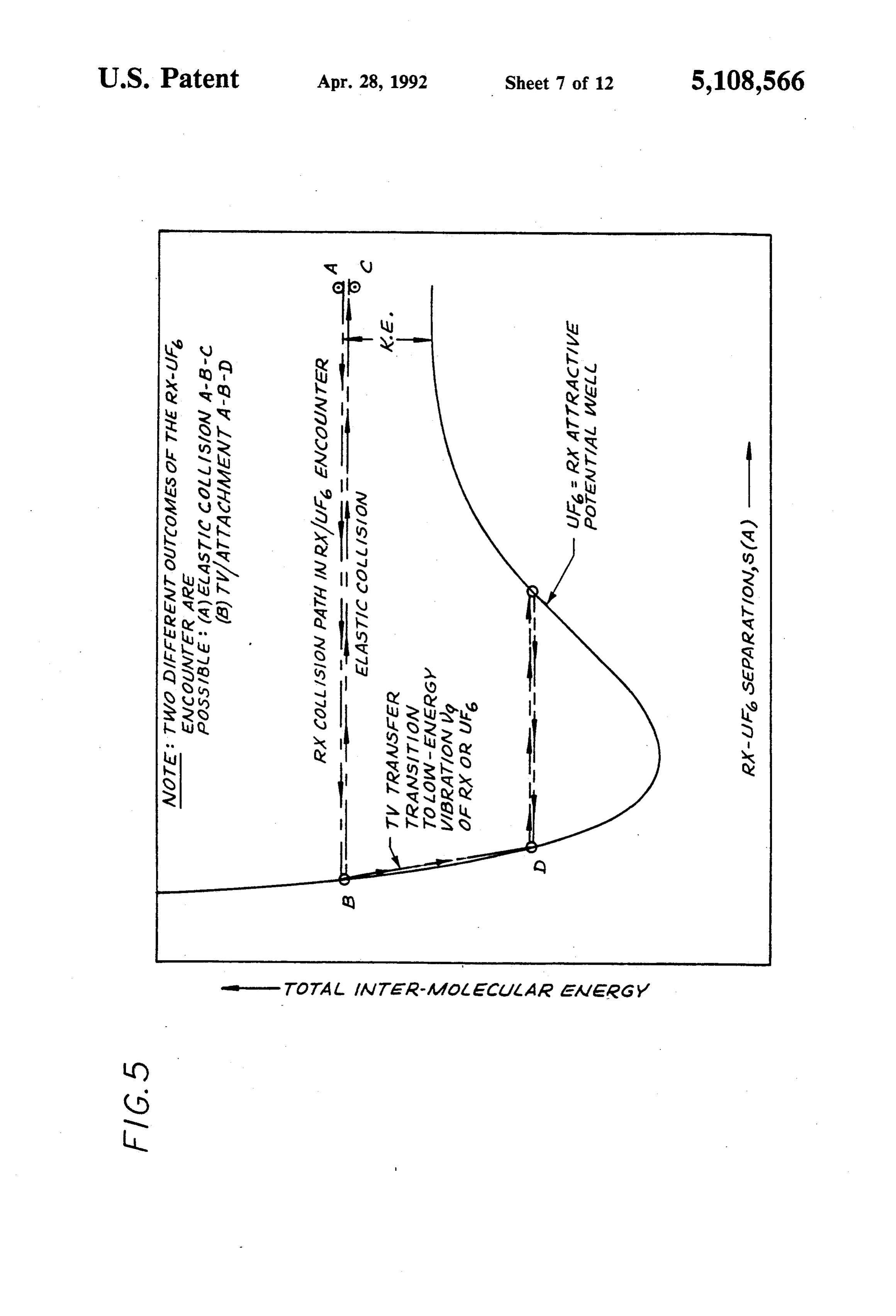
FIG. 4 illustrates the requirement that the value of kT 40 so collisions. As shown in Reference (e), for a Van be limited more clearly. As shown, if kT or XT=kT/kA derwaals attachment event, the molecules should have a becomes too large the separation factor a becomes. relative translation energy less than -2 cm. The small, while for small values of kT, the reaction becomes possibility for such an occurrence exists: (a) for a small too slow and inefficient. As shown in the insert of FIG. fraction of the Maxwell-Boltzmann distribution; and (b) 4, in terms of the parameter qL and XT, the process 45 during a TV transfer event where hu-kT. factor ao= (mas8+XT)/(m+XT) and Intermolecular attractive forces between two gase ma=(1+qL/XT). ous molecules always exist. This can cause molecules to The parameter qL contains the deexcitation rate be trapped in the intermolecular potential well if they (kv--ks) of excited UF6'(3u3) which is often not pre have little relative kinetic energy or if they loose nearly cisely known. Experiments indicate that the relaxation 50 all of their relative kinetic energy in a TV transition. of UF6'(3v3) requires between 100 and 10,000 collisions Unless a reactive molecular rearrangement process (depending on the gas mixture), for which qL has a occurs, the associated complex usually dissociates again value between 10 and 0.1 respectively, if k4 = 10 sec-l into its original constituents after a few collisions with and pro= 10 torr. FIG. 4 shows that if UF6'(3v3) relax other molecules.
ation has the most pessimistic value of 100 collisions, 55 For a chemical exchange reaction like (1b) or (2b) to one can still achieve good isotope separation by increas proceed during the association MY:RX, it is necessary ing the intracavity laser power from 3 kW to 30 kW that there be sufficient activation energy in the complex thereby increasing ka from ka=10 s-1 to k=100s-1 to push it over the reaction barrier. Since activation and lowering qL by a factor of 10. Intracavity circulat energies range typically from 0.2 to 1.2eV (-1600 to ing powers of PL-30 kW are achievable with current 60 10,000 cm), it is clear that the average thermal kinetic state-of-the-art laser technology. There is also some energy of 0.025 eV (-200 cm) is not sufficient to uncertainty regarding the parameter pa which can raise induce a reaction after its storage as vibration in the or lower the value of qL. By using qL in FIG. 4, the Vanderwaals attachment. The most probable scenario curves for ao are general, and can be used whatever the for an attachment followed by a reaction is a collision in values of pa or (kv--kT) turn out to be. 6S which both reactant molecules are already vibrationally Because of the restrictions (26) on kT, one finds that excited (in previous collisions) to a fairly high level. In most (usually rapid) stripping and rearrangement reac the attachment collision, additional vibrational energy tions like (7), (8), and (9) are too fast and that the slower (~200 cm) is transferred to the vibration “ware
Page 21
house" of the complex, but, as stated, this quantity is In the discussion up to this point, there has not been small and insignificant compared to the vibrational en considered the effect of possible degeneracies of the ergy that was already present. vibrations. It can be expected that reaction of RX with The probability of finding reactant molecules with a molecule UF6" that has vibrational excitation various levels of birational excitation is as set forth 3u3=u3+-usb-- v3 distributed over the three different below. The result also provides the probability that two axes a, b, c of UF6, will be different than reaction with coreactant molecules which collide and attach have UF6" with 3v3=3v3 in which all of the v3 vibrational sufficient total vibrational energy E to induce a chemi energy is stored along one axis in UF6. In accounting cal reaction. Thermal (non-laser-induced) reactions for such differences, it is convenient to relabel the de such as (1b) are studied first and then reactions with O generate vibrations and enumerate them separately. laser-excited molecules will be examined. The main That is, for the six vibrations of UF6 and the four vibra goal is to establish the relationship between the average tions of SiCl4 (of which many are degenerate) the 24 thermal reaction rate kT and the reaction rate kR of vibrations (v1, v2a, V2b, v3a, v3b, v3c, v4a, V4b, V4c, vsa, laser-excited species which have been pumped to a 15 v5b, vsc, v6a, v6b, v6cluF6, and v1, v2a, v2b, v3a, v3b, V3c, particular vibrational level. v4a, v4b, V4c siCl4 shall be relabeled V1, V2, . . . , v24. The probability of finding a polyatomic molecule in Instead of 610 combinations there are 62 = 4.74x10⁸ the gas which is excited to the va-th vibrational level of combinations, if the v6o are restricted to voo's 5. the a vibration with fundamental frequency Veo is By treating all degenerate vibrations as separate vi given by:
20 brations, the probability of finding molecule MY with total vibrational energy Ealand molecule RX with total (27) vibrational energy Eb may be expressed as:
In equation (27), w(v60) is the statistical weight of the f(Ea) = Z. exp (- (vahva)/(kn ) v60 vibration level and Zavis the vibrational partition function of MY. For brevity E60 = Vohva will be writ (31) ten for the energy stored in the a vibration of the first f(E) = Z exp (- i (vahva)/(kT) ) reactant molecule MY, and Egghug for that stored 30 in the second molecule RX. The total vibrational en ergy stored in a molecule MY is then: Then the probability f(E) of finding total energy Ei =Eaj-i-Ebin the associated complex is:
Ea = X Ea = h X (va Va) (32)
Similarly for molecule RX one has: fE) = f(Ea). (F) = Z. Zi exp ( - alX (vahva)/(kT) Eb = X Eg = h > (vgg) (29) 40 It is assumed that low-energy TV attachment probabili a PB = naveral ties are uneffected by the internal excited states of the collision partners. Theoretically this is a good first
Here the voo nd V62 have one of the values 0, 1, 2, 3, . order assumption. In (32), the summation a' is over all . . The total vibrational energy of two reactant mole the renumbered vibrations a from MY and 6 from RX cules that form a complex is of course Ea--Eb. of the combination set j. Degenerate vibrations are Clearly there are many possible values for Ea and Eb 45 counted separately in this sum as discussed in the UF6'- depending on what combinations of Va and v6 are :SiCl4' example. By doing this, the statistical weight present. The va and v3 of a particular combination of w(vso) of each vibrational level is unity in equation (27), v60's and vig's in an encounter of a particularly excited thus permitting the evaluation of simple sums in the molecule MY" and a particularly excited molecule RX" exponentials of (30)-(32). The Zavand Zvin (30)-(32) are designated by va, and v62. For example for MY 50 are the vibrational partition functions of molecules MY =UF6 and RX=SiCl4, one might have vi=0; v2=3; and RX.
v3= 1; V4=5; vsj=2; v6=4 for the six normal vibra If all atomic bonding interactions were precisely tions in UF6, and v'svij=1; v'2=vsj=0; v'3=v9j=1; known in the complex UF6:SiCl4, there could be con v'4=v10=3 for the four normal vibrations in SiCl4. 55 structed so-called LEPS (=London-Eyring-Polanyi Here we relabeled the four vibrations u, v2, v3, V4 in Sato) potential surfaces as a function of the separation SiCl4 to V7, V8, V9, V10 to avoid confusion when we and relative orientation of the atoms in the molecules examine all ten vibrations in the associated complex UF6 and SiCl4, and the complex UF6':SiCl4', for exam UF6':SiCl4'. The corresponding total energies with ple. Then, in principle, there could be calculated on a these sets of vibrations j are clearly computer the outcome of possible Cl/F substitution reactions for various relative kinetic velocities of UF6
Ej = Eaj + Ej = de (Eaj + Eaj). and SiCl4 and different vibrational loadings j in the UF6':SiCl4' complex. To date, such computer calcula tions of a reaction have only been done for one vibra
If the vibrational quantum numbers were restricted to 65 tional mode and a total of three atoms (Reactions AB--- say vsos 5 and vô2S5, one would have C-AC+B), using estimated LEPS surfaces. The ex (5-1) 0-60,466,176 combinations j for the ten vibra tension to twelve atoms with (originally) twenty-four tions. non-degenerate vibrational modes is far beyond the
Page 22
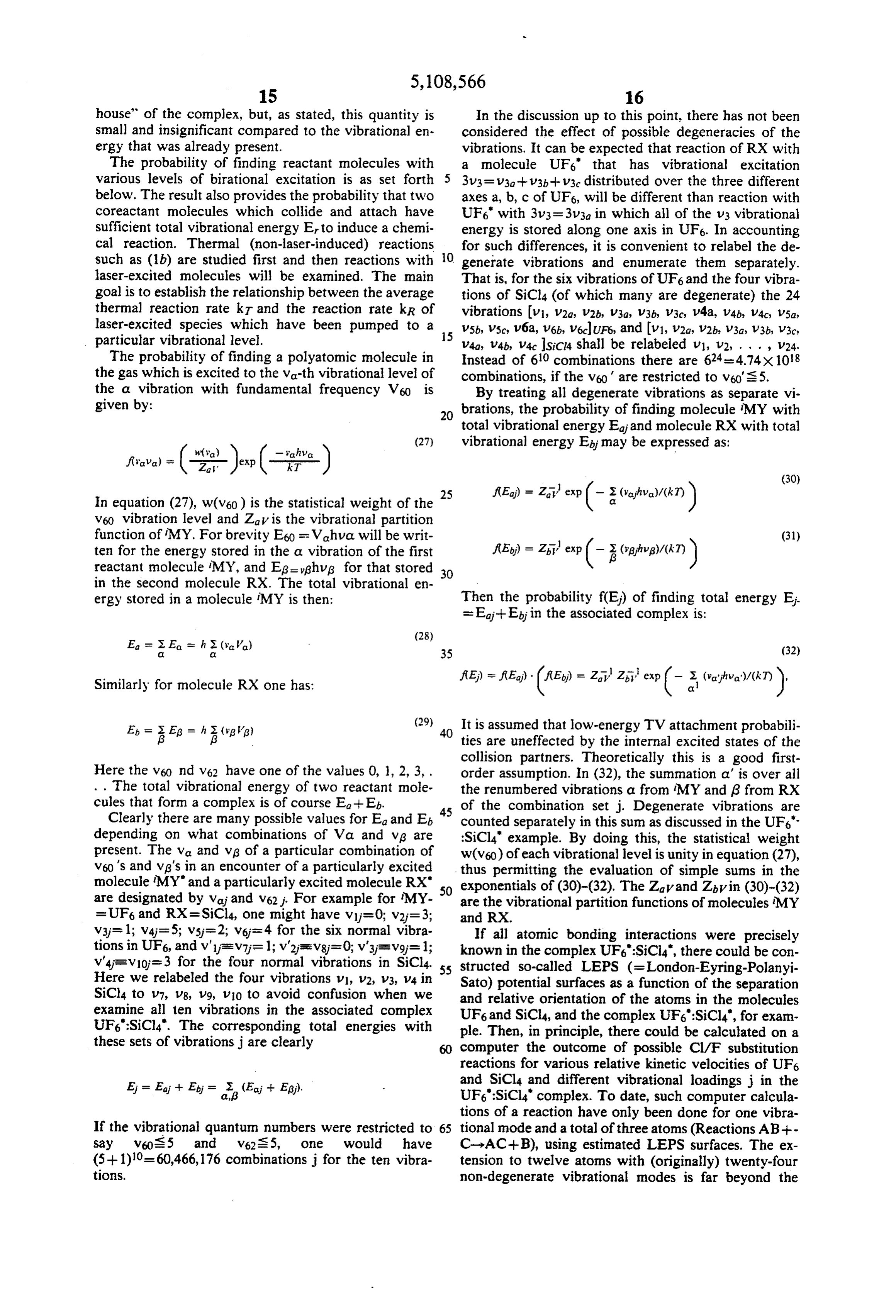
scope of present computer models, even if many simpli increasing number of vibrational quantum changes (by fying assumptions are made. factors of 10-100 for each additional quantum change). If there were some rule which predicted what combi Since in a chemical rearrangement of the associated nations j would proceed to reaction and if these were complex, internal VV quantum transfers occur also labeled as the reactive combinations j=r, the total ther- 5 mal reaction rate of the substitution reaction MY--RX (together with changes in bond strengths with attendant ->MX--RY would be given by: changes in the vibrational frequency), one can expect that the most efficient reaction-promoting energy load ings are those with the fewest number of vibrational kT = f(E) trickT). (kory, - (33) 10 quanta while still satisfying the condition Ei-Ec. For Here f(E) is given by (32) (with j=r) and (k)RY is the the UF6--SiCl4 case this means that multi-level excita collisional encounter rate of MY and RX. For the case tions of the V1, v2, v3 vibrations of UF6 and the v1, v3 that MY=UF6, (kc)RY is given by (21) with pot re vibrations of SiCl4 will be much more effective than placed by the RX partial pressure prx. at T(kT) is the multi-level excitations of V4, v5, V6 in UF6 and v2, v.4 in attachment probability or TV transfer probability for 15 SiCl4.
storage of the relative kinetic energy kT between the Because exact LEPS-based reaction calculations for colliding coreactants into a low-level vibration of UF6 two attached vibrationally-loaded polyatomic mole or SiCl4 as discussed above. For UF6:RX reactions, cules are presently impossible, educated approximations at TysO.01-0.1 typically. will be made based on the above discussions. The con There is one rule which greatly limits the number of 20 binations j=r are limited to sets of vibrations that con reactable combinations j= r. This is the condition (sug gested by reaction rate measurements and by Eyring's tain only the high-energy vibrations. Then the thermal reaction rate kr for a case such as UF6--SiCl4 can be theory) that a certain minimum activation energy (E)- estimated from the expression: min=E is required for an associated complex to pass over the energy barrier and to proceed to an atomic 25 rearrangement. This means that in the finite sum (33), only terms with Eater need to be considered, and kTT = = kah X. exp kTEsk
because of the exponential dependence of f(E) on E, only terms with E-Ec need to be retained in the sum. where:
There are many setsj with total energy Ethat would 30 meet the condition Ei-E but which do not belong to TrTw (35) the reactable group j=r. In principle, LEPS-based kab = ZZ (kc)Rx. sper MY computations would be able to determine which combi nations of j with Ei-E can react. For a X/Y substitu tion reaction (1b) or (2b), it is reasonable to assume that 35 The parameter pah in (34) is the effective statistical weight of all reactable combinations of excited levels.
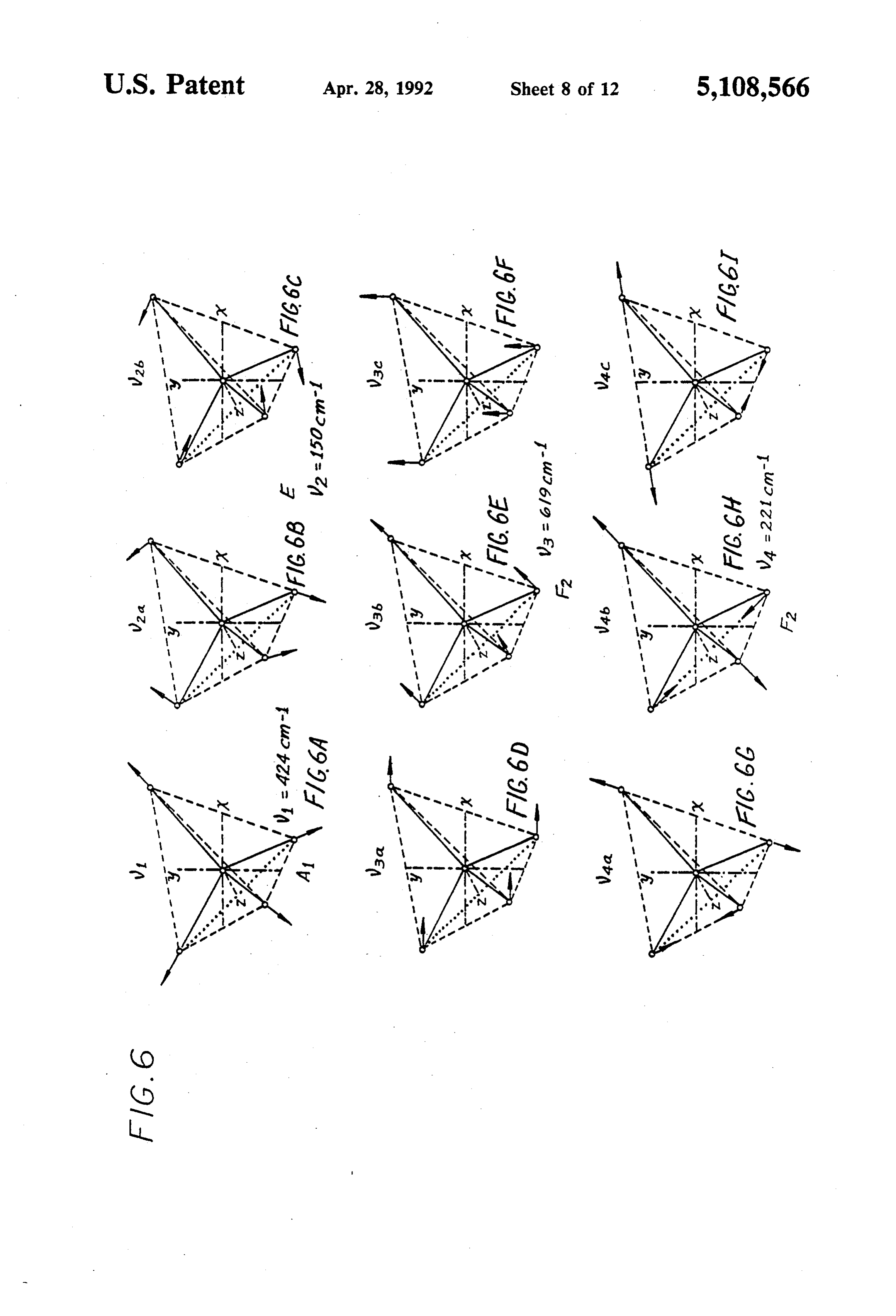
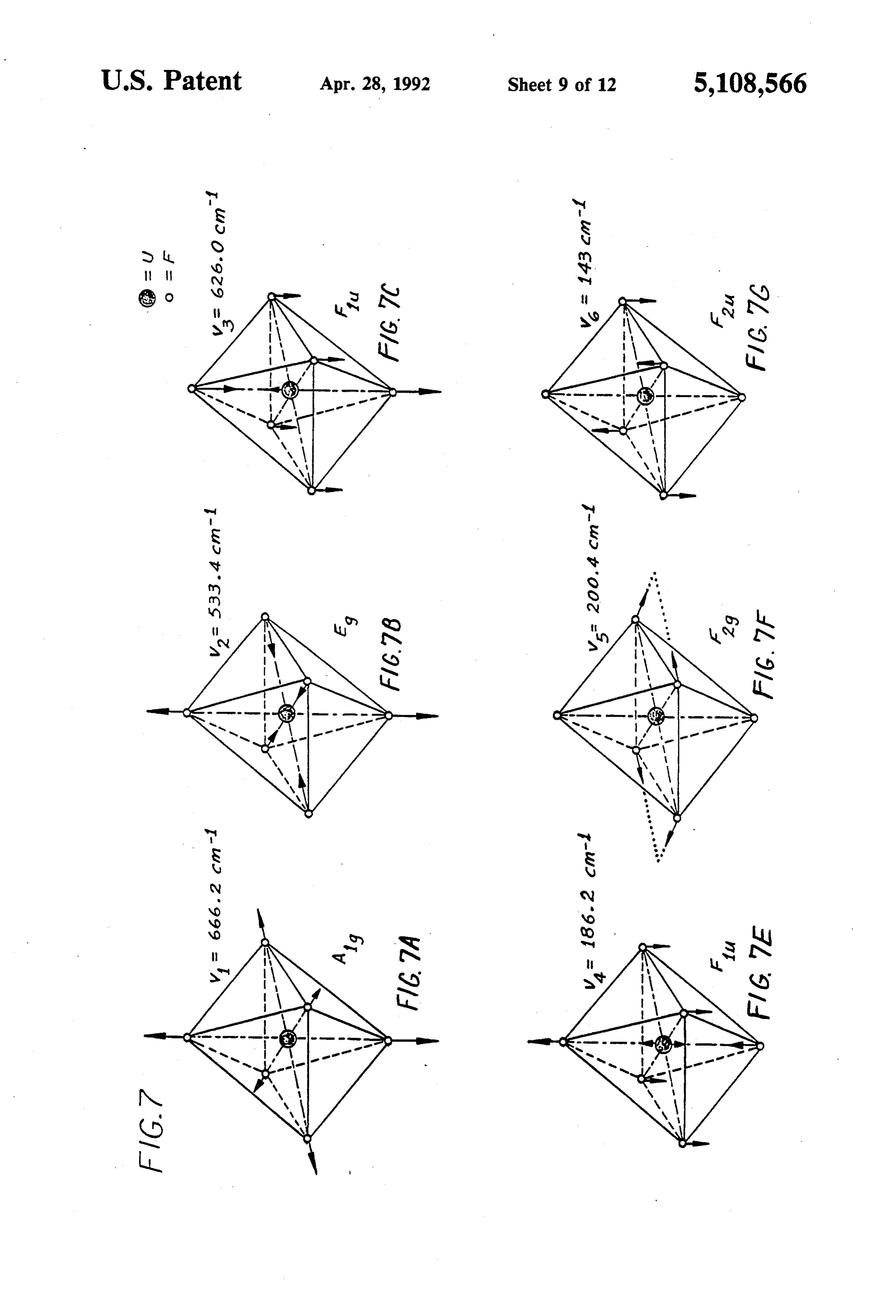
vibrational energy Ea concentrated along the bond Approximate expressions for pab under various limiting M-Y and vibrational energy Ebstored along the bond assumptions are given below. R-X is most effective. For example for UF6, the vibra The activation energy E in (34) can usually be ob tion v3 with fundamental frequency v3= 625 cm pro vides most energy along one of three possible axes that 40 tained experimentally. Theoretically it should equal: contain the bond UFs-F, while for SiCl4 most vibra Ec= Ea--Eb-hyamar- vbnva), (36) tional energy for possible severance of a Cl atom would be provided by the v3=619 cm fundamental. These bond vibrations are illustrated in FIGS. 6 and 7 for where van is the minimum number of quanta of the SiCl4 and UF6, respectively Thus, if E is the measured 45 highest-energy reaction-generating vibration a in MY (or estimated) activation energy for the UF6--SiCl4 that yields hvamvarat Ea. Similarly, V62 m is the mini reaction, the sets j=r with Eji=hvava --Vejvel where mum number of quanta in RX such that hven vgrate. a=4, 5, or 6 and gi=19, 20, or 21, and for which Ei. If there exist several reaction-promoting vibrations a -Ec, are expected to be most effective. Here we used with energies close to each other, then Vin (36) is the the expanded numbering system in which v3a=v4, 50 averaged value of the fundamental frequencies of these v35EVs, V3cs v6 for UF6, and v3as v19, v3bs V20, vibrations (e.g. v1=666 cm, v2=533 cm, v3=626 v3cae v21 for SiCl4. cm1 in UF6 with var=608 cm-1). Similarly, for RX, It is possible that certain wagging and scissoring vi an average value Var may apply (e.g. v1=424 cm, brations like v4, vs, v3 of UF6 and V2, V4 of SiCl4 will v3=619 cm-1 in SiCl4 with va-522 cm-1). Experi help (or hinder) the Cl/F exchange reaction in the asso- 55 mentally, only Ec=Ea--Eb are usually measured and ciated complex in which V3 of UF6 and/or V3 of SiCl4 is not E and Eiseparately. In principle Ea and E can be multiply excited. For temperatures Tat 150 K, the low quite different and without additional information, one energy vibrations (v5200 cm) in UF6 and SiCl4 are can have several fits of the sum of their values and of almost always excited (to 15V6055) and their effect on van and vbn to the measured value for Ec. For example, the reaction is averaged. (The same comment applies to 60 if it is found that the experimental activation energy rotational states.) This holds also for laser-pumped reac tions. The possibility does exist that high-level excita East0.35 eV at 2800 cm, and Vat 600 cm, tions (v60, v625) with Ei-E of combinations of v4, vers500 cm, then a possible fit is van=3, vibn=2. vs, vein UF6 and v2 and V4 in SiCl4 (with no excitations The problem of how to estimate E and Eb separately is of V1, u2, v3 in UF6 and v, v3 in SiCl4) can contribute to 65 discussed below.
the chemical reaction rate, but these contributions are The statistical weight pat of reactable combinations probably small. From V,V-T transfer theory (Ref.2c), of vibrational excitations can under one approximation it is found that VV transfer probabilities decrease with (Case A) be expressed by:
Page 23
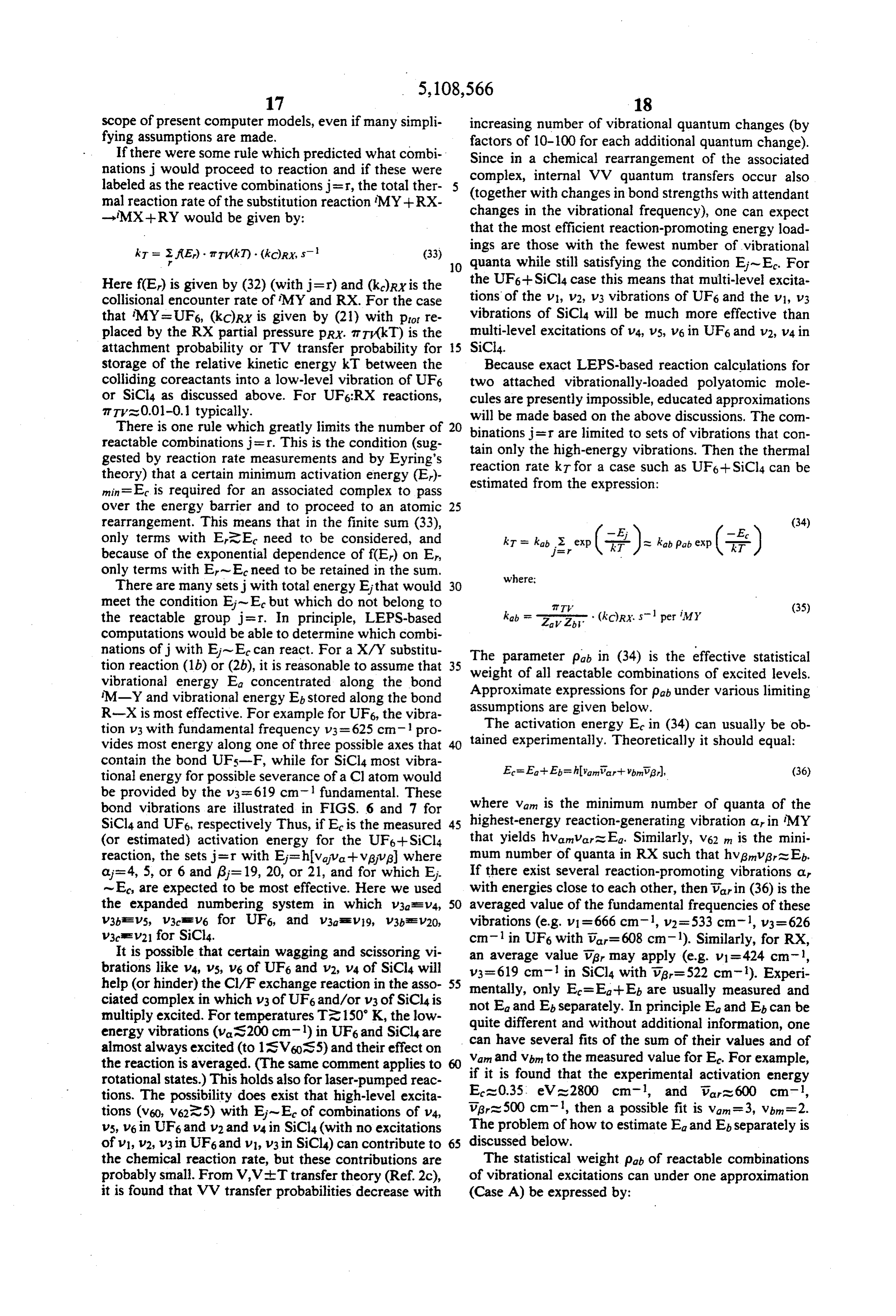
where dar and d6 are the degeneracies of vibrations a (37) and g. For example, there could be a3a; d. 3 in UF6 and g= 1; d1 = 1 in SiCl4 so that pab3. In this last case
(i. -- ng -DJ,r) (which shall be called Case C), the statistical weight pat,
(Case A) is independent of the vibrational levels van and ven.
The partition functions Za and Zb to be used in equa tion (35) depend also on whether Case A, B, or C is
In equation (37), as before, van and vbn are the mini applicable in a particular reaction. Since it is assumed in mum number of vibrational quanta in the vibrations a these three cases that low-energy vibrations have little and (3 oi MY and RX that can induce reaction, when 10 or no effect on reaction, it is necessary that the partition present in the associated complex MY":RX". The nar function for the vibrations a is used in the presence of are the total number of high-energy vibrations a in any quantum-level combinations of the low-energy cluding degeneracies, that can cause reaction with Van vibrations (Reference (e)). In such a situation, for the number of quanta. For example, if for UF6 we assume Cases A, B, and C:
cm) vibrations can all contribute to reaction, we have (40a) nr=1-2-3 = 6 since the v1 vibration has degeneracy d = 1, v2 has d2=2, and v3 has d=3. That is, under this Za = (25), assumption, vibrational combinations like (Case A) v1-2u2a--v3b; V3a--V3b-213c, 3 v1+12b; 4v32, etc. have 20 Z =z < (40b) an equal probability of inducing reaction if the energy (Case B) criterion Easthvamilar requires van=4. In this case, pa in (37) would equal pa=126. Thus, pa is the statistical Za = Zar (40c) (Case C) weight or total number of possible different combina tions of storing four quanta in the vibrations v1, va, 25 with similar expression for Zh with g substituted for a.
If the UF6 reaction were able to proceed via excita The partition function Zaris given by: tion of a number of quanta Vor= V3 of the triple degener ate v3 vibration only and by no other vibrations, it -1 (41)
which is equal to the usual statistical weight of a triply degenerate vibration excited to level v. If similarly only Since in most cases of interest hvat 3kT, one particular vibration in RX would be effective for 35 Zast ZaS 1.05 as 1. Thus, as was done in equation (13), reaction, there would be obtained for the general Case 1. Similarly, usually Zhat 1. B: It is very difficult to determine. in general, which of the above three possible expressions (Cases A, B, or C)
for pab applies in a particular reaction. It would appear that Case A is too inclusive, while Case C is probably 40 too restrictive. As shown below, it is very important to pab --= pa - p = ( (var - a,da -in1) )J. (i. +adB -by1): )J. know what pa is in a CRISLA reaction. Unless hard data are available, the best that can be done is to calcu one (degenerate) a only one (degenerate) g, only late pa for the three Cases A, B, and C in order to estab (Case B) lish an upper and lower limit. For example, if ven=3, it 45 would be found for reactant UF6' that pa=56 in Case where dar and der are the degeneracies of the reaction A; pa=10 in Case B; and pa=3 in Case C, assuming that sensitive vibrations a and (3. For example, if u= v3 in var=V3 for Cases B and C. If, instead, vrm=4, it is UF6 and ver- v3 in SiCl4, and if v3(UF6)=4, and found that pa=126 for Case A; p = 15 for Case B; and v3(SiCl4)=3 is required for a reaction, one would have pa=3 for Case C. For SiCl 4' there is obtained, simi pa=15 and pb = 10 so that pahs 150. 50 larly, (assuming v1=424 cm and v3=619 cm-1 to be Even more restrictive assumptions may be made than reaction-active) pb=20 in Case A, pb = 10 Case B, and (38) about the reactability of a loaded vibration, such as pb=3 in Case C if ven=3; and pb=35 in Case A, assuming that only "stacked' quanta in one vibrational pb= 15 in Case B, and pb=3 in Case C if vign=4. Here axis can be operative. That is, it can be postulated that we assume that in Cases B and C only the triply degen only say Ea=3hv3 with v3a=3 is effective to cause a 55 erate V3 vibration of SiCl4 is reaction-active. reaction, and not say Ea-h(v3a+ v3b--v3c) with v3a=1, As mentioned above, the low-energy wagging and w3= 1, v3= 1 in which each of the three F-U-F axes scissoring vibrations v4, vs, v6 of UF6 which are almost has one quantum of vibrational energy. If the same always excited in an average UF6 molecule at tempera restriction of one reaction-active vibration vein mole tures above 100 K., probably promote the reaction of cule RX is assumed, the weight pab would be, in this 60 an activated complex (with sufficient energy E from CaSC: the high-energy vibrations), by providing bending mo tions that help the X for Y substitution. Thus, even pab=papb=dardBr, (39) though the energy quanta in v4, vs, v6 are insufficient to give adequately high (and directed) activation energies, stacked vibration of a only 65 they probably help to increase the possible reaction stacked vibration of A, only channels of the activated complex (UF6:SiCl4) by their (Case C) motions. It will be appreciated that UF6 and SiCl4 have been utilized for purposes of illustration. Similar consid
Page 24
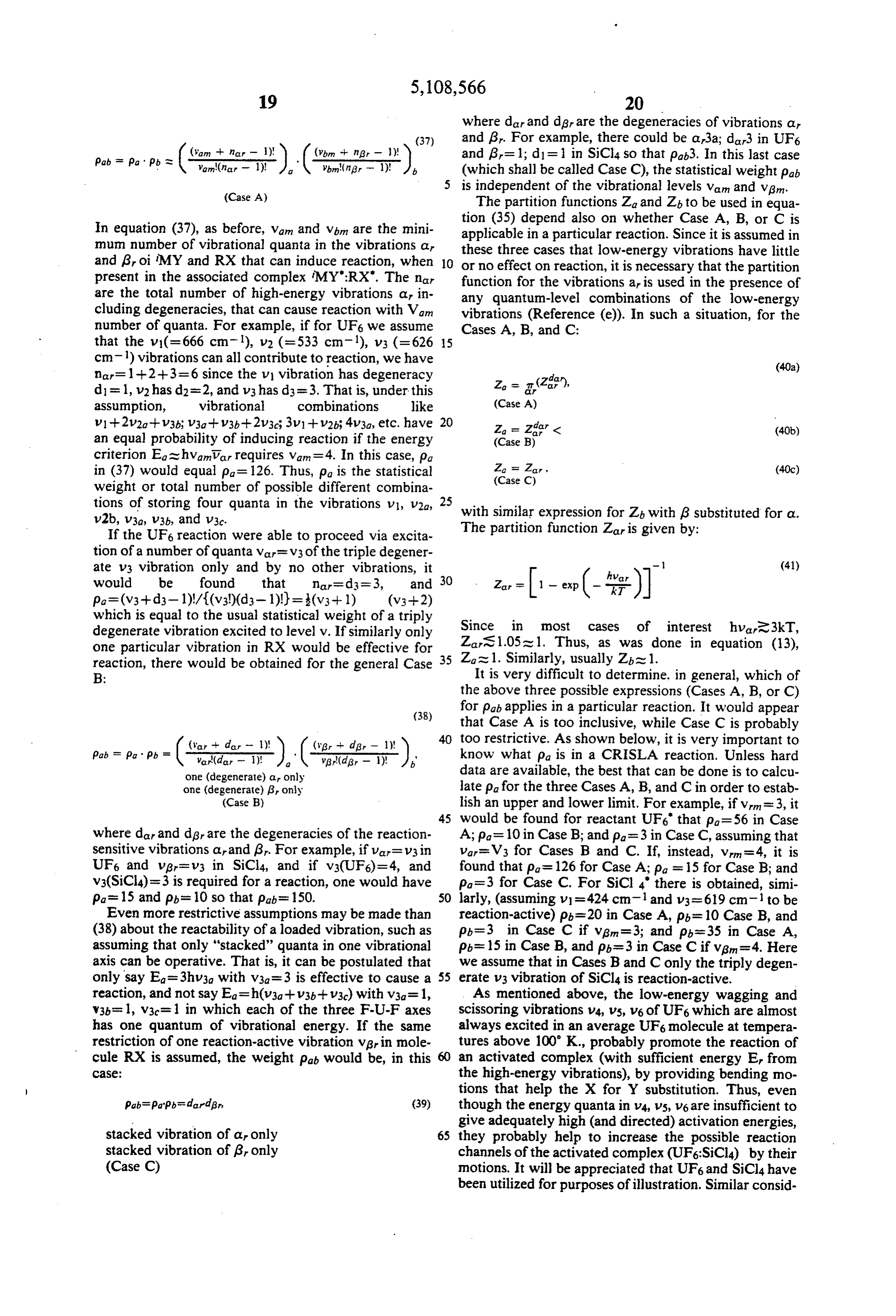
erations would apply for utilization of coreactants other than SiCl4 and/or other isotopic molecules. exp(h V3/kT) (43) In the case that a laser excites a reaction MY (for are = - - as 0.2 exp(899/T) at , for T = 225 K example, the 3v3 excitation of UF6 with a CO laser), the reaction rate kR of laser-excited MY" must be known. Here it is assumed that Case A applied, (with van = 1, Assuming that the laser energy hyl-Ea and that it is nar=6), so that pa=5 according to equation (37). If, in places in a reaction-active vibration (e.g. v3 of UF6), this the UF6+HX reaction, a minimum of three high-en rate can be found from the thermal rate by dividing kT. ergy quanta were needed in UF6 and one in HX, this by the fraction f(hul)=f(vahva) in the thermal popu- 1 O ratio would instead equal kR/kT = (1/56) exp(3hv lation that has energy hull= whiva. One obtains: ar/kT) at 707 at T=225 K., since for van=3, mass 6, one has pa=56. Experimental data on UF6--HX reac (42) tions with X= Br or Ci suggest, however, that only one or two high-energy vibrational excitations
pa(val) kTT atst 5 (v1 = V2= v3 = 1 or 2) in UF6 are sufficient to induce reaction, provided HX in the complex UF6:HX is once
(ef)); st per iMY(hut), If (43) applies and if 3v3 is excited in UF6 by a CO laser in a UF6--HX reaction mixture, the effect on the isotope-specific reaction rate is equivalent to providing
Laser photons excite optically-active molecular vibra 20 only liv3 excitation if van = 1 and Eas 1hv3. Multiple tions along only one molecular axis (e.g. 313 in UF6) and quantum excitations of the v3 vibration in one UF6 will no other (degenerate) vibrations, whereas the rate kT is not increase its reaction rate in this case. In fact, each based on collision-produced populations that can excite 3v3 laser-excitation of UF6 to UF6'(3v3) can, in subse all degenerate vibrations of a reactable one (e.g. v3v3, 25 quent VV scrambling transfers, produce two non v3bv3b, v3clv3c in UF6) as well as other (possibly non isotope-selective excited UF6(v3) molecules. That is, optically-active) reactive vibrations (e.g. viv, v2av2a, each isotope-specific UF6'(3v3) that decays to v2.sv2 in UF6). With T=225 K., p.10, and hul-1876 UF6(v3) and reacts is accompanied by two reacting cm, equation (42) yields, for example, UF6'(v3)'s which are not isotope-specific. Thus, not kR/kT = 1.6X 10. 30 only is mg very small because of (43), but a parasitic The result (42) which can also be expressed as equa scrambling term ksat 2858kL must be added to the de tion (13), shows that the reaction rate of laser-pumped nominator and numerator of equation (14). Unless UF6 molecules can be increased by several orders of that 858) > 2, equation (14) shows that in this case a-1 so magnitude, provided that the laser-excited vibration is 35 It there is no isotope separation. may also be possible in some reactions that the dominant reaction-active vibration in the activated complex and Easthu L. For fluorine-substitution reac Ea=4hva=4hv3 say, and that hvil falls short of E by tions of UF6, it is clear from FIG. 7, that the V3 vibra one quantum hu=hu3. In that case, the reaction rate of tion should be the most reaction-active. This has indeed 3v3-laser-excited UF6' molecules is given by: been borne out by experiments on the reactions 40 kR exp(E/kT) (44) UF6--RX-UF5X-RF in which the normal vibra - = g(Avavav L) - - tional quanta hug2 of RX were of the same order of magnitude and not larger than twice the quantum hus= 625 cm of UF6. For example, the coreactants hut Avahva. exp-f
QXF4- with Q= Si, Ge, or Sn and X = Cl, Br, H, or 45 g(Ava VaivL) - exp - - ). Pa I (if stable) which have normal vibrations vs C2v (va = v3 for UF6), show, indeed, laser-enhanced reactions Here g(Avalvo;ul) is the fraction of UF6 molecules in when the v3 vibration of UF6 is multiply excited. In the the gas that are resonant to the photon absorption tran dimer complex, the original monomer vibrational fre sition Avava-VL-- Avalva, and EashvilAvahva. Often quencies are shifted due to orbital bonding changes. If 50 (fortuitously), the factor g(Avavul)-exp(-Avov (vg) dimer -(vo) dimer, near-resonant quantum trans a/kT) and in that case one finds that kr/kT again re fers between the or and A3 vibrations can occur. duces to (13).
If, on the other hand, the R-X bond normal vibra From the considerations presented above and from tion vigof RX is much larger than twice the normal 55 experimental data, it appears that the most efficient vibration vav3 of UF6, which is laser-pumped, it is laser-induced CRISLA reactions occur when vibra found that (multiple) quantum excitation of the v3 vibra tional frequencies of the bonds to be broken in R-X do tion in UF6 does not effectively promote reaction in the not exceed the normal vibrational frequencies of bonds UF6:RX complex. For example, for RX=HCl or HBr, to be broken in the molecule M-Y by more than a ve=2991 cm-1 and 2649 cm-1, respectively, which factor of 2. It is known from VV transfer theory that vibrational quantum exchanges inside the activated compares to v3=625 cm-l of UF6, which is CO laser complex are most efficient in that case because of near excited to 33 (= VL). The thermal reaction UF6 resonance. Since X-for-Y atom exchanges should be --HX-UFs)K--HF with X=Cl or Br appears to be enhanced if internal VV transfers are promoted, reac controlled by collisionally excited HX'(v= 1) and not tion should also be most efficient then. The pumped by UF6(3v3 or v3). If it is assumed that 65 laser energy hull should preferably be deposited in the Ea-hv3~hv2-hu1 and van = 1, while Ebishvswith highest-energy bond-breaking vibration of the reaction vbn=1, it is found for laser-excited UF6'(v3) reactions complex (MYRX) and one should have hulls Ea. with HX that: This means that if one wishes to separate the isotope M
Page 25
via the CRISLA technique, the highest vibration vain -continued M-Y whose bond is to be broken should be of the (46) same order of magnitude (not more than a factor of 2) as the vibration vgof the coreactant R-X bond. That is, H =- ,- -= - ,- (-)-
the more suitable CRISLA partners RX for use with
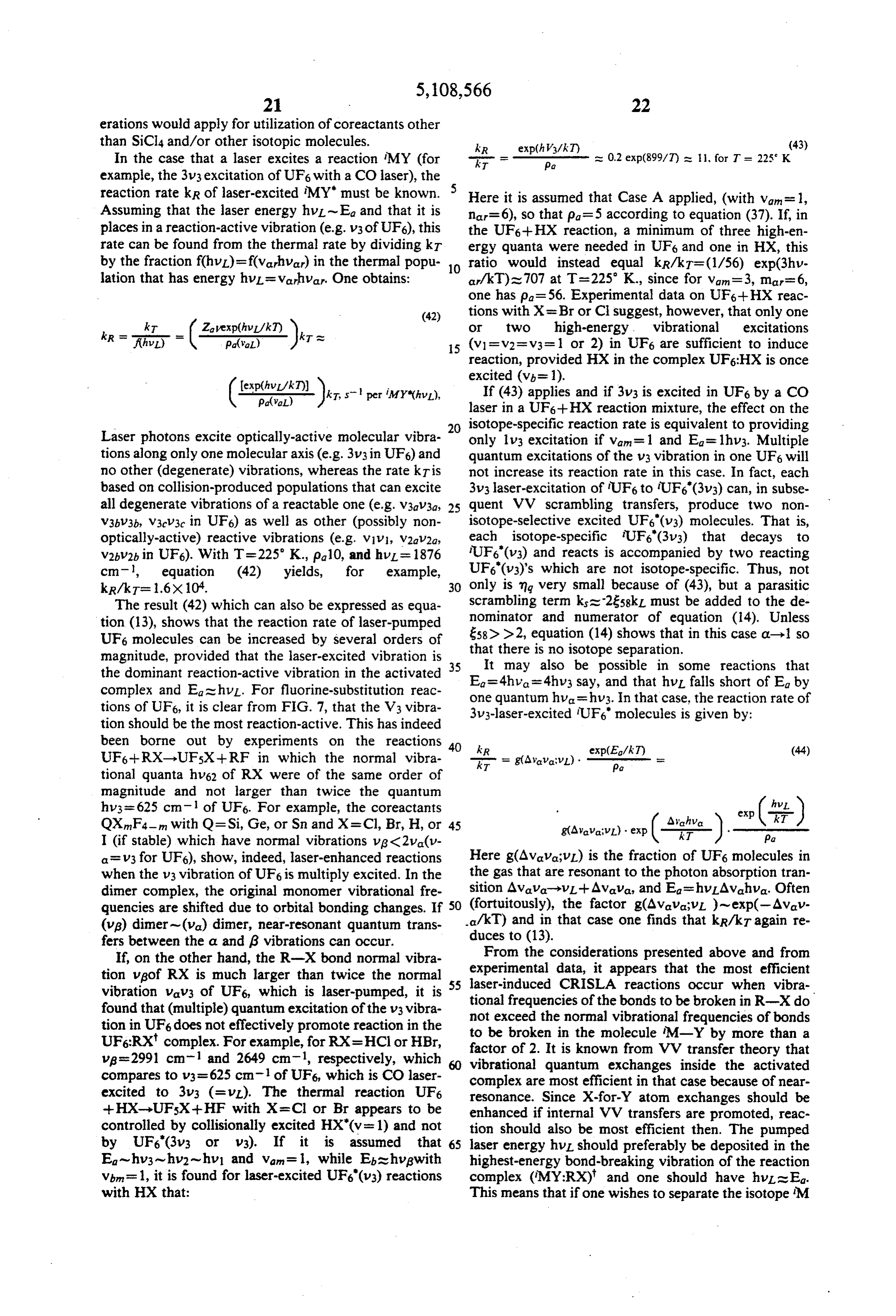
UF6 have ve-va(= v3) or Et-Ea. This also means that k kR -- k - ks ES2East2hul. Then approximately half (or less) of the required activation energy E is provided by colli (i- ). (baits. )- cL'/8L, sionally-prepared RX" and half (or more) by laser and: excited UF6'(3v3), if RX does not absorb any laser O photons (see below). cL' = (kR" -- kv + kS)/kA (47) Hydrogen bonds in compounds such as HX (X = Cl,
Br) have vibrations up>2000 cm. Therefore, from Here kT is the reaction rate of laser-excited RX with the rule va-ve, the simple two-component HX--UF6 non-laser-excited UF6 and kR" is the rate of RX" with reaction with laser-excited UF6'(3v3) and vo- v3=625 15 laser-excited UF6". The superscripts" in the above ex cm 1 is not expected to be very efficient, as borne out pressions denote conditions with laser-excited RX" (as by experiment. Of course, one or more hydrogen atoms well as UF6, of course) and no superscript refers to (e.g. a -QH2 or -QH3 group with Q = C, Si, Ge) can reactions with RX.
be present as part of a larger coreactant molecule. A Usually eL' =kR"/kTatei=kR/kT (see equation single Q-H bond then need not be directly involved in 20 (13)) since both kT and kR' will increase by the same the rearrangement reaction with UF6 if bond changes factor pil exp(hvL/kT) if the same laser photons hul occur through collective motions and/or in another can be absorbed by RX and by UF6, and if E - E part of the coreactant molecule. For such coreactants, ~ E/2-hvL. However, the factor cl’s (kR+kv--ks the comments about the inefficiency of H-bond coreact )/ka in equation (47) could increase undesirably...so that ants do not apply. 25 u">u if kR">> (kv--ks). For high values of ao, one As mentioned, the most suitable CRISLA coreactant wants u or u to be as small as possible, of course. Thus, partners RX for UF6 provide half of the activation unless kA(CPL) is increased correspondingly or kR" is energy which is collisionally prepared. Instead, a sec lot too large in comparison with kv--ks, there is no ond laser, or the same CO laser that prepares isotope 30 advantage gained by laser-excitation of the coreactant specifically excited UF6, could be used to produce and RX is the objective is only to increase ao. enhance the desirable excited RX' population for use in The assumption that kT and kR' increase by the same the reaction of the activated complex (UF6:RX). factor pb exp(hvL/kT) is only correct if the total This is particularly true if the total activation energy Ec threshold energy Ec for reaction by the activated com is closer to 2hul and hul. The laser-generated reaction 35 plex UF6:RX satisfies the condition E-2huL and rate kR and the quantum efficiency m would, in this Ea-Eb-E/2. It is assumed that the laser photon en case, be enhanced and laser controlled. An interesting ergy for resonant excitation of RX and UF6 are the same example is DBr which does absorb at several CO laser or of about the same magnitude. If E - hul, that is, if wavelengths near 1876 cm l. Two different laser fre the chemical reaction can be promoted equally well by quencies obtainable from the same CO laser, that is a a laser-excited RX" as by a laser-excited UF6, then "two-color" CO laser would be needed in this case, 6L'<6L since portion of the laser-induced reactions since the 1876.3 cm line which is best for UF6 misses would no longer be isotope-specific. Particularly if the DBr mines. However, the CO laser lines at 1872.3 there is more RX than UF6 in the CRISLA reaction cm 1 and 1880.3 cm 1 coincide with the R-3 and R-4 mixture and/or if the laser photon absorption cross-sec lines of DBrand could be used to prepare a DBr" (v= 1) tion foreL'->1
RX is much larger than that for UF6, one can background gas. Other examples are SiH4, SiBrF3, and 45 itcause is clear that if RX is also laser-excited. In conclusion, laser-excitation of RX should be avoided
SiClF3 whose binary bands (v2--v4), (v1--v4), and (v1--v4) respectively absorb the same 1876.3 cm1 CO withif RX"(hvL) reacts equally well with unexcited UF6 as laser line used to excite UF6'(3v3). laser-excited UF6".
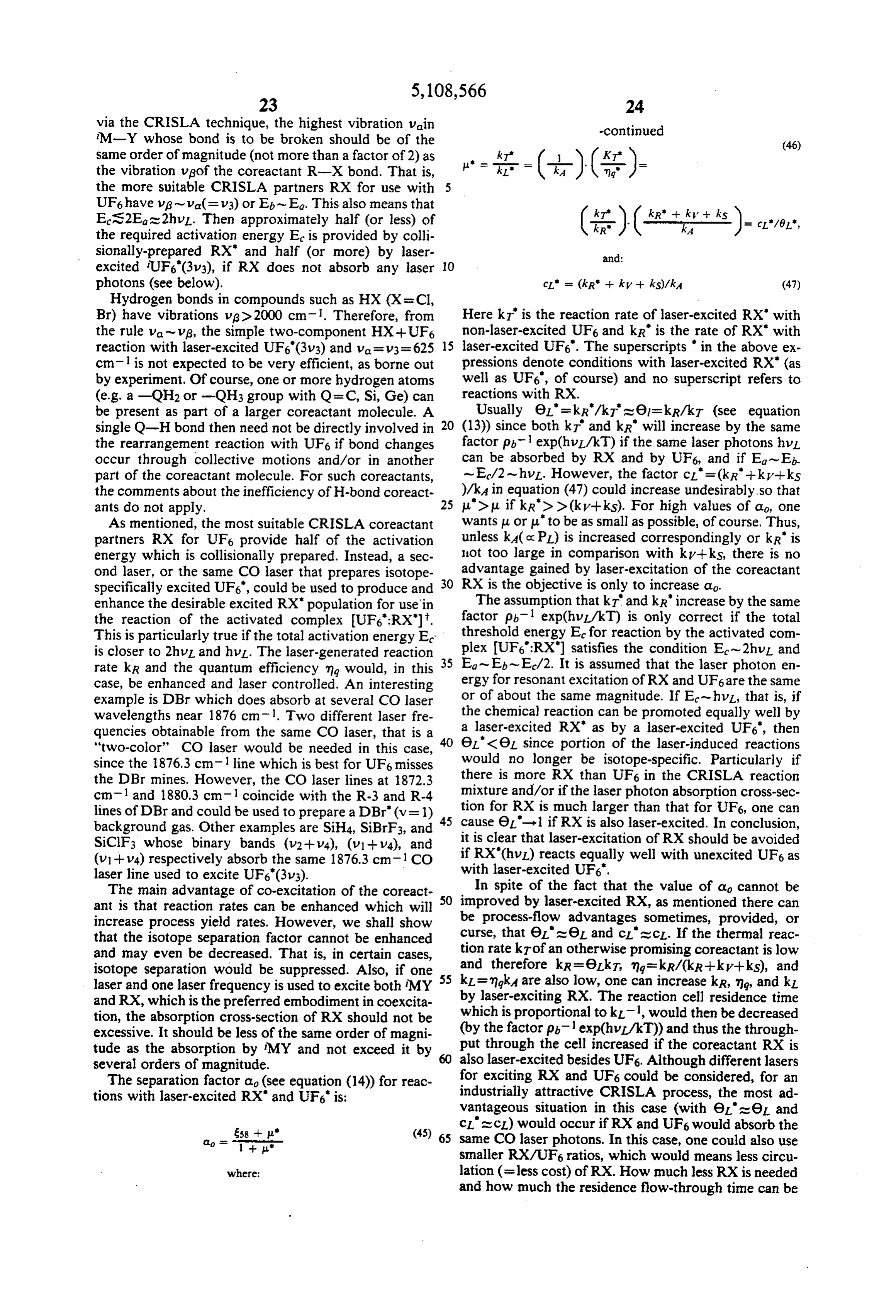
The main advantage of co-excitation of the coreact 50 In spite of the fact that the value of a cannot be ant is that reaction rates can be enhanced which will improved by laser-excited RX, as mentioned there can increase process yield rates. However, we shall show be process-flow advantages sometimes, provided, or that the isotope separation factor cannot be enhanced curse, that eLateL and clascL. If the thermal reac and may even be decreased. That is, in certain cases, tion rate kT of an otherwise promising coreactant is low isotope separation would be suppressed. Also, if one 55 and therefore kR=eLkT, n=kR/(kR+kv--ks), and laser and one laser frequency is used to excite both MY kL=nkA are also low, one can increase kR, m and kL and RX, which is the preferred embodiment in coexcita by laser-exciting RX. The reaction cell residence time tion, the absorption cross-section of RX should not be which is proportional to kill, would then be decreased excessive. It should be less of the same order of magni (by the factor pb exp(hul/kT)) and thus the through tude as the absorption by MY and not exceed it by put through the cell increased if the coreactant RX is several orders of magnitude. also laser-excited besides UF6. Although different lasers The separation factor a (see equation (14)) for reac for exciting RX and UF6 could be considered, for an tions with laser-excited RX and UF6' is: industrially attractive CRISLA process, the most ad vantageous situation in this case (with 6L'sel and
cLatcL) would occur if RX and UF6 would absorb the (45) 65 same CO laser photons. In this case, one could also use
Smaller RX/UF6 ratios, which would means less circu where: lation (=less cost) of RX. How much less RX is needed and how much the residence flow-through time can be
Page 26
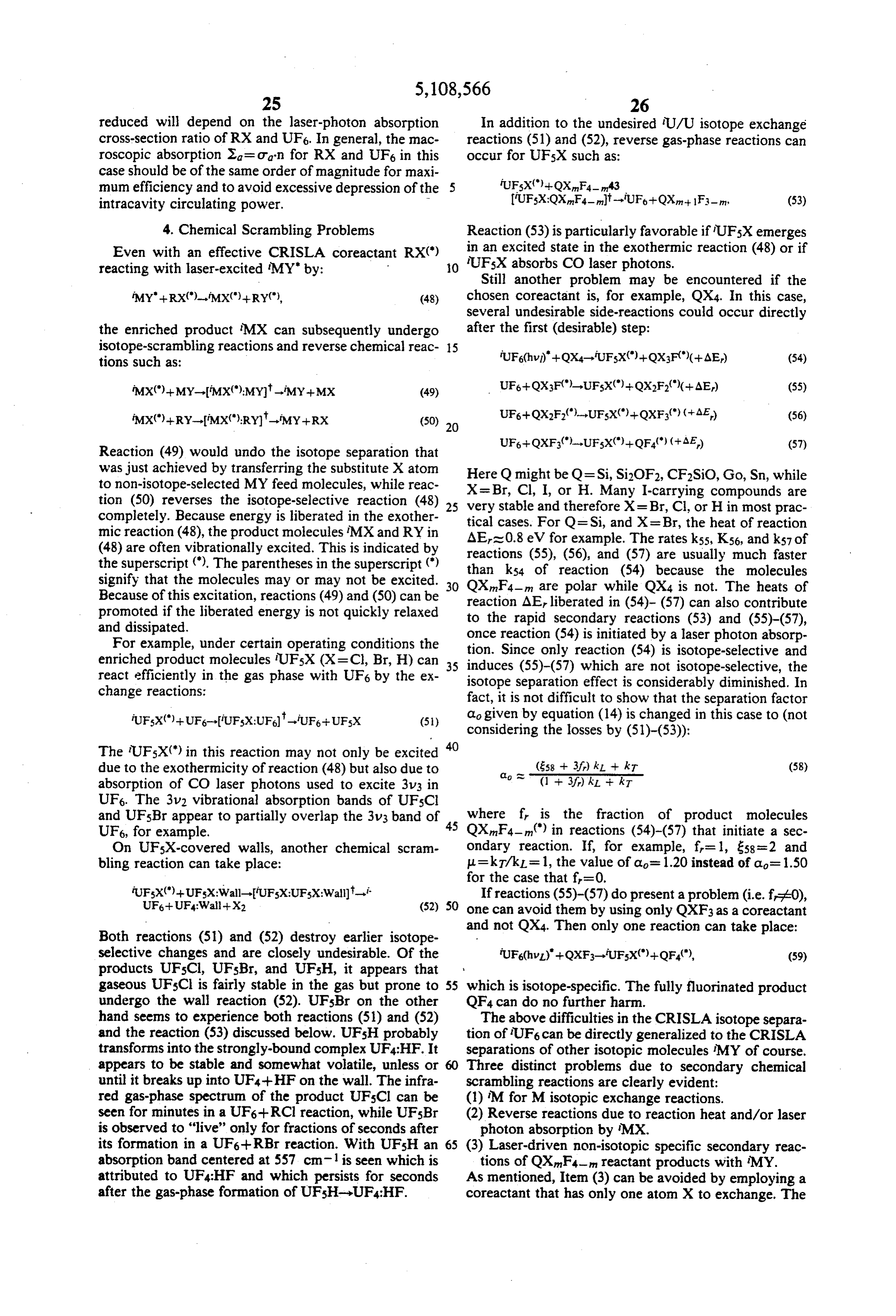
reduced will depend on the laser-photon absorption In addition to the undesired U/U isotope exchange cross-section ratio of RX and UF6. In general, the mac reactions (51) and (52), reverse gas-phase reactions can roscopic absorption Xa=oan for RX and UF6 in this occur for UF5X such as:
case should be of the same order of magnitude for maxi mum efficiency and to avoid excessive depression of the UF5X')--QXmlF4-43 intracavity circulating power. - UFsk:QXF4-)t-UF6+ QXm+1F3-m. (53) 4. Chemical Scrambling Problems Reaction (53) is particularly favorable if UF5X emerges Even with an effective CRISLA coreactant RX(") in an excited state in the exothermic reaction (48) or if reacting with laser-excited MY" by: O UF5x absorbs CO laser photons. Still another problem may be encountered if the iMY"RX()-iMX(")--RY(), (48) chosen coreactant is, for example, QX4. In this case, several undesirable side-reactions could occur directly the enriched product MX can subsequently undergo after the first (desirable) step: isotope-scrambling reactions and reverse chemical reac 15 tions such as:
Reaction (49) would undo the isotope separation that was just achieved by transferring the substitute X atom Here Q might be Q= Si, Si2OF2, CF2SiO, Go, Sn, while to non-isotope-selected MY feed molecules, while reac tion (50) reverses the isotope-selective reaction (48) 25 X= Br, Cl, I, or H. Many I-carrying compounds are very stable and therefore X= Br, Cl, or H in most prac completely. Because energy is liberated in the exother mic reaction (48), the product molecules MX and RY in ticalAEast cases. For Q= Si, and X= Br, the heat of reaction 0.8 eV for example. The rates k55, K56, and k57 of (48) are often vibrationally excited. This is indicated by reactions the superscript ("). The parentheses in the superscript () than k54 (55),
(56), and (57) are usually much faster reaction (54) because the molecules signify that the molecules may or may not be excited. 30 QXF4- are polar while QX4 is not. The heats of Because of this excitation, reactions (49) and (50) can be reaction AE liberated in (54)- (57) can also contribute promoted if the liberated energy is not quickly relaxed to the rapid secondary reactions (53) and (55)-(57), and dissipated. once reaction (54) is initiated by a laser photon absorp For example, under certain operating conditions the tion. Since only reaction (54) is isotope-selective enriched product molecules UFs)x (X = Cl, Br, H) can 35 induces (55)-(57) which are not isotope-selective, and the react efficiently in the gas phase with UF6 by the ex isotope separation effect is considerably diminished. In change reactions: fact, it is not difficult to show that the separation factor UFx")+UF6-(UF.X:UFs) - UF6+UF:X (51) a given by equation (14) is changed in this case to (not considering the losses by (51)-(53)):
The UF5X(") in this reaction may not only be excited 40 due to the exothermicity of reaction (48) but also due to (858 + 3f) kl -- kT (58)
absorption of CO laser photons used to excite 3v3 in (1 + 3f) kit -- kT
UF6. The 3v2 vibrational absorption bands of UF5Cl and UFsBr appear to partially overlap the 3v3 band of 45 where f is the fraction of product molecules UF6, for example. QXmlF4-m") in reactions (54)-(57) that initiate a sec On UF5X-covered walls, another chemical scram ondary reaction. If, for example, f= 1, 858=2 and bling reaction can take place: L =kT/kl= 1, the value of do= 1.20 instead of a=1.50 for the case that f=0.
If reactions (55)-(57) do present a problem (i.e. fs/40), (52) 50 one can avoid them by using only QXF3 as a coreactant
Both reactions (51) and (52) destroy earlier isotope and not QX4. Then only one reaction can take place:
selective changes and are closely undesirable. Of the UFs(hut)'--QXF-UFX')--QF), (59) products UFsCl, UFsBr, and UFsh, it appears that gaseous UFsCl is fairly stable in the gas but prone to 55 which is isotope-specific. The fully fluorinated product undergo the wall reaction (52). UFsBr on the other QF4 can do no further harm.
hand seems to experience both reactions (51) and (52) The above difficulties in the CRISLA isotope separa and the reaction (53) discussed below. UFsh probably tion of UF6 can be directly generalized to the CRISLA transforms into the strongly-bound complex UF4:HF. It separations of other isotopic molecules MY of course. appears to be stable and somewhat volatile, unless or 60 Three distinct problems due to secondary chemical until it breaks up into UF4--HF on the wall. The infra scrambling reactions are clearly evident: red gas-phase spectrum of the product UFsCl can be (1) M for M isotopic exchange reactions. seen for minutes in a UF6--RCl reaction, while UFSBr (2) Reverse reactions due to reaction heat and/or laser is observed to "live' only for fractions of seconds after photon absorption by MX.
its formation in a UF6--RBr reaction. With UFH an 65 (3) Laser-driven non-isotopic specific secondary reac absorption band centered at 557 cm 1 is seen which is tions of QXmlF4-m reactant products with MY. attributed to UFA:HF and which persists for seconds As mentioned, Item (3) can be avoided by employing a after the gas-phase formation of UFsh-UF4:HF. coreactant that has only one atom X to exchange. The
Page 27
first two scrambling reactions may be unimportant in UF6":QXmlF4-m"). This is, it appears that in the case some cases if the product molecule MX quickly under of HBr additive, the following steps take place: goes a second different (not reverse) reaction with the coreactant RX. For example, in the case of UF5X('), the latter may in addition to (or instead of) reaction (53) experience the reaction:
UFX2+M or Wall-UF4-1-X2+M or Wall (61) (HBr UFs":QXF-()' < (65b) Here the unstable molecule UFAX2 decays rapidly or UFXBr + QX-Fs-n + HF ultrastable solid UF4 and X2 either in a gaseous collision 5 or on the wall. Unfortunately, reaction (60) is usually In these reactions X= H, Br, or Cl, or some other radi not very much faster than reactions (51), (52), or (53). cal group mentioned above. The strong dipolar field of Only if ko) >k51, k52, k53, would the undesirable reac HBr superimposed in the new complex of (65) speeds tions (51), (52), and (53) be suppressed. the reaction. Because the complex (UF6':QXF4-m") formed in (63) by laser-excited UF6' and QXmlF4-m"), 5. Auxiliary Reactants lives through some 10 collisions, it is very likely that it Instead of relying on the primary coreactant RX or will encounter several HBr molecules (if HBr/UF61 QXmlF4- to provide satisfactory removal and physical to 10) during its lifetime. It then can undergo a Van separation of the enriched product MX of UF5X via derwaals attachment collision such as (64) followed by reactions (60) and (61), it has been found advantageous 25 the decays (65a) or (65b), or it experiences a local elec to employ a second coreactant such as HBr or QBra to tric field excursion during one collisional encounter speed up the product formation rate and the product with HBr resulting in its dissociation by routes (65a) or scavenging function. Two possible reaction effects can (65b). Without interaction with the highly polar HBr be envisioned by adding a secondary reactant like, for molecule, the complex UF6':QXmlF4-m") will disso example, HBr. One effect is that (with sufficient HBr) ciate by the following possible pathways after about 10 the following reaction is promoted: collisions:
HBr +UFSX'-[HBr:UFsw-HF-UFXBr, (62) (66a) Here UFXBr subsequently decays quickly to solid 35 (UF6":QXF-n() (Therinoneutral) UF4 and BrX (X=H, Cl, Br) by (61). Thus, isotope N UFs)x) + QX-F5-m)(66b) scrambling and other secondary chemical reactions of
UFs)x is preempted. For this secondary reactant ap (Exothermic) proach to be successful, it is essential that the secondary reactant can act speedily on UF5X, but does not react Without HBr, the probability for the desired pathway excessively with UF6. A CRISLA process using UF5X (66b) may only be on the order of 0.01 to 0.1, while instead of UF6 and HBr, in which CO laser photons avenue (66a) occurs 90%) to 99% of the time. In the preferentially excite UF5 X might also be considered. presence of HBr on the other hand, the initial complex However, it has been found that UF5X (generated di in (66) may be "kicked' by the HBr electric field pulse into the exothermic reaction (66b) with almost 100% rectly upstream of the IC from UF6 and TiX4, for exam 45 certainty.
ple) quickly reconverts to a large extend to UF6 because of reaction (52). In addition, as discussed in Section 3, The reason why the presence of, for example, HBr is coreactants in which H bonds are to be broken appear believed to exert the effects described by (64), (65), and not to be very sensitive to the 3v3 excitation in UF6. It by (b. 62), is that both the rate of production of enriched is possible that this may be different from the 3v2 excita 50 UFs)x (and/or UF4) product as well as the degree of tion in UF5x. However, exploratory CRISLA experi isotopic separation are enhanced when some HBr is ments with UFs)x-HBr mixtures have shown virtually added to UF6'--QXmlF4-m) reaction mixtures. If reac no isotope-selective effects. In place of HBr, another tion (66b) is efficiently induced by HBr, it is possible coreactant such as QX4-mm may give better results. that reaction (65a) followed by (62) is not very active. Here Q= Si and X= Br, Cl, or H, for example. 55 In other words, it is possible that UF4 is formed almost Although HBr reacts moderately fast with UF6, it is directly from the UF6":QXF4-():HBr complex by expected to react almost a hundred times faster with (65b) and decomposition of UFXBrby (61) with UF4 UFs)KC). This is because the fluorine bonds in UFs)K are and BrX as final products.
weaker than in UF6 and because UFs)x is polar which Instead of the secondary attachment of HBr to the will enhance the attachment rate. Particularly if UF5X activated complex UF6:QXmlF4-m()), it is possible =l JF-5Br, the rate ke2 of reaction (62) appears to exceed that the following alternate steps leading to the triple the rates k51, k52, and k53 of (51), (52), and (53) in the complex (HBr:UF6':QXF4-m can occur as well: presence of sufficient HBr. Thus, before freshly formed
UFsbr' can undergo reactions (51)-(53), HBr will quickly scrub it out by reaction (62). 65
The second effect of a secondary reactant such as
HBr is believed to be a speed-up or enhancement of the rate of reaction of the activated complex o
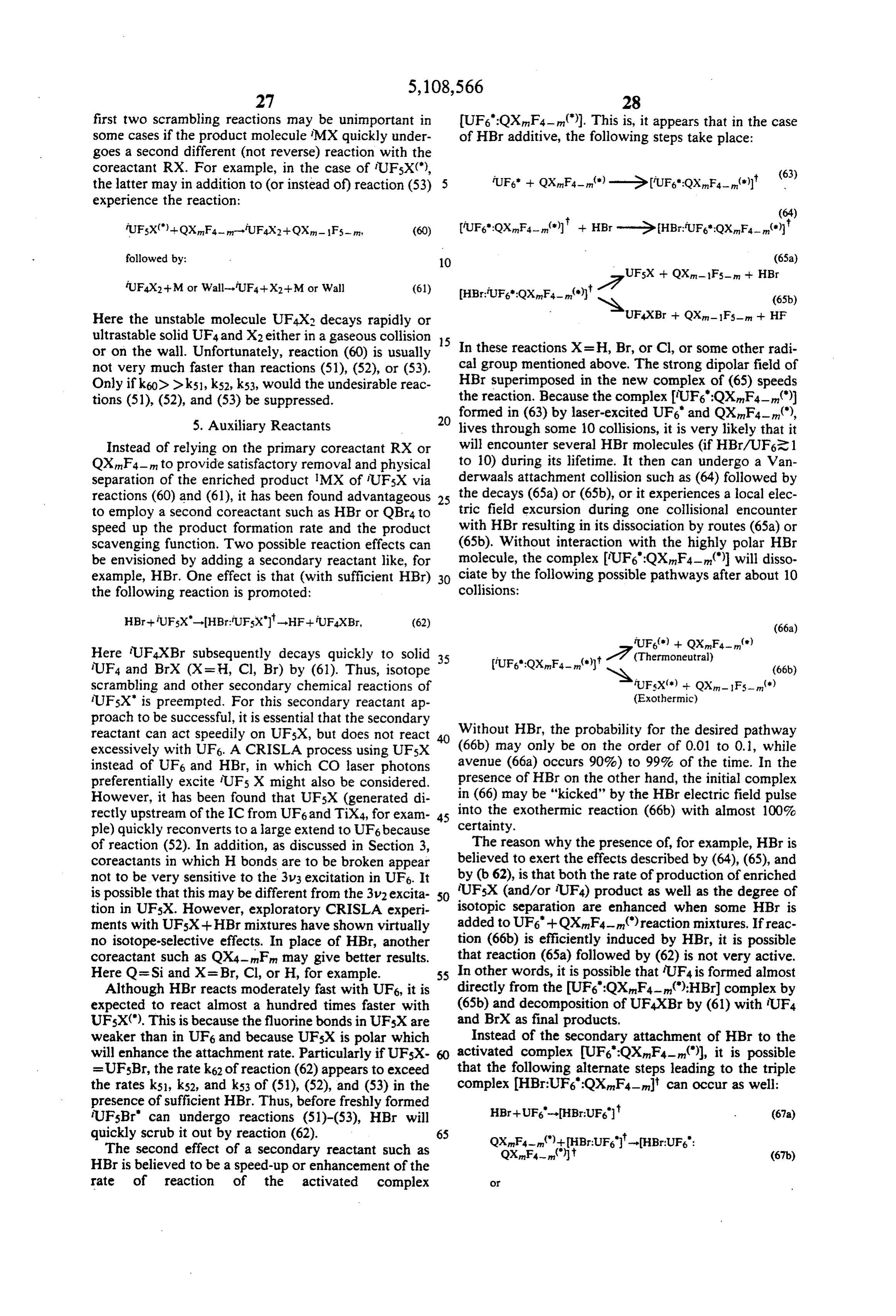
Page 28
mately mixed with MY and RX to effectively suppress reaction like (51)-(53), even if it does not participate in reactions like (64) and (65).
6. Conclusions
Steps (67b) and 68b) yield the same final complex step Some general conclusions can be drawn that follow (64), and the ensuing decays should be as described by from the analytical review of UF6 CRISLA reactions (65a) and (65b). Again it is possible that Steps (67b) and given above. One important finding is that coreactant (68b) only occur during the lifetime of one collisional molecules HX can be expected to give unsatisfactory encounter without the formation of a longer-lasting O UF6 enrichments if the CRISLA process is driven by Vanderwaals complex prior to the decays (65a) and only one laser quantun with energy 3 hu3=huLC 1876 (65b). cm (CO laser). This is because of the fact that the We have used HBr only as an example. Many other frequency of the hydrogen bond vibration auxiliary reactants GL such as, for example, QBra, 15 (vii)-Ha2000 cm. Consequently, if this bond is to QBrmH4-m, QCl4, QClimH4-m, QBrnF4-m or be broken in the activated complex of a rearrangement QClF4- with Q= Si, Ge, Sn, may be equally effec reaction such as (2), the necessary energy can usually ve. not be quickly and efficiently channeled to it from the In conclusion, the CRISLA enrichment of MY with v3=625 cm vibrational quanta that are pumped up in a suitable coreactant R may sometimes be considerably 20 UF6 through two-quantum (the most probable) inter improved if a secondary coreactant GL is added to the nal VV transitions. The minimum number of quantum CRISLA gas mixture which catalyzes or enhances the changes in a VV-transfer is two since at a minimum one rate of formation of isotopically enriched product after quantum is lost by one vibration while a second quan an attachment complex is formed or by electric field tum is gained by another vibration. Only in pure VT or impulse kicks of the complex MY":RXC) in collisions TV transitions is there a one-quantum change in the with GL and/or which rapidly scrubs out the enriched 25 product chemical MX, before the latter can undergo "warehouse would be of vibrations.” Multi-quantum transfers required to feed the vet2000 cm-1 vibration.
any undesirable secondary scrambling reactions. Such multi-quantun transfers are less probable by fac Whereas, the best coreactant RX is selected on the basis tors of 100-10,000 over two-quantum transitions. Thus, of its reactability given in Sections 2 and 3, the second it is found that the slow gas-phase reactions of UF6 with ary reactant GL must be chosen so as to aid the rate of 30 HX molecules which would appear to be attractive production and removal of the enriched product MX. candidates according to equation (24), are not attrac It should not significantly react with pure MY alone.
If the scrambling agent GL only acts to remove prod ment that activation energy be providedtoby tive. The slowness of the reaction is due the require uct MX by reactions like (62) and is not involved in the higher) thermally excited HX"(vg21) species inonce (or reaction complex such as reaction (64), GL may be 35 whose population is approximately equal to thethesmall gas injected into the outflowing laser-irradiated CRISLA fraction exp(-vghv6/kT). Since excited molecules reactants stream outside the intracavity irradiation cell
(IC), as this gas mixture leaves the IC. In this way there HX"(v621) control the reaction with UF6, only laser would be no interference of the action of the GL with pumping of HX could cause the reaction to become the laser-induced reaction. Also in this case, instead of 40 laser-driven. The laser-pumping of UF6 (necessary if adding gaseous GL to the primary CRISLA reactant one wishes to enrich U) appears rather ineffective in mixture, another approach is to operate at low IC pres promoting the reaction of UF6--HX. Also, 6L is prob sures (PIC (0.1 torr) and to use a surface agent for scav ably small for this reaction (see the discussion surround enging MX. That is, back reactions or chemical scram ing equation 43). Many early attempts to promote bling of the product MX can be inhibited on the IC 45 CRISLA enrichment with UF6--HX reactions gave walls by use of a specially prepared wall material or disappointing results.
surface agent such as activated Ni, Cu or C which The rule that emerges is that only if the vibrations in quickly converts MX to a more stable chemical form a coreactant molecule RX can easily accept quanta (e.g. UF4). By keeping the IC pressure low, the product from UF6 in the activated complex UF6':RX, can MX can diffuse to the wall with little or no obstruction 50 laser excitation of UF6 be effective in promoting a and is immediately converted there to the more stable reaction. This is the case when va-v3(UF6)-vg(RX) chemical form. Like a gaseous auxiliary agent GL, a or Ea-Eb-E/2 which means that RX must be a mole surface agent should, of course, have no or little effect cule with fairly heavy atoms. This also means that some on the feed molecules MY (e.g. UF6) and primarily act of such preselected reactants RX may fortuitously have on product molecules MY (e.g. UFs)K). Instead of 55 one or more vibrations (3, 32,..., such that one of its collection in the IC, the desired surface action may be binary or tertiary absorption bonds has effected outside the IC by rapid passage of the irradi (hve1+hva2)-hull or (hugi --hve2--hug3)-hull. Here ated CRISLA gas mixture of MX, MY and RX through hurl=3hv3 at 1876 cm, for example, for the CO-laser a scrubber with plates, tubes, or saddles whose surfaces driven isotopic excitation of UF6. Such an accidental contain the special agent that quickly reduces MX (e.g. coincidence of a weak absorption of hut by RX occurs, UFsk) to a more stable form (e.g. UFX2). for example, for SiH4 with (hu2+hv4)-1876 cm l. If, on the other hand, the auxiliary agent GL is criti This may be used advantageously to improve the effec cal in promoting a reaction like (62), it must be present tive reaction rate of SiH4 by promoting reaction over in the IC and be thoroughly mixed with MY and RX the complex UF6':SiH4 during laser irradiation in while this mixture is being irradiated. Usually it is desir stead of UF6:SiH4 as discussed above. able to have high throughputs, and, therefore, higher IC In addition to the desirability that vo-ve, the con operating pressures (pic)0.1 torr). In that case, it is plex formation rate which is controlled by the Van also necessary that the agent GL be gaseous and inti derwaals attachment probability of UF6/RX collisions
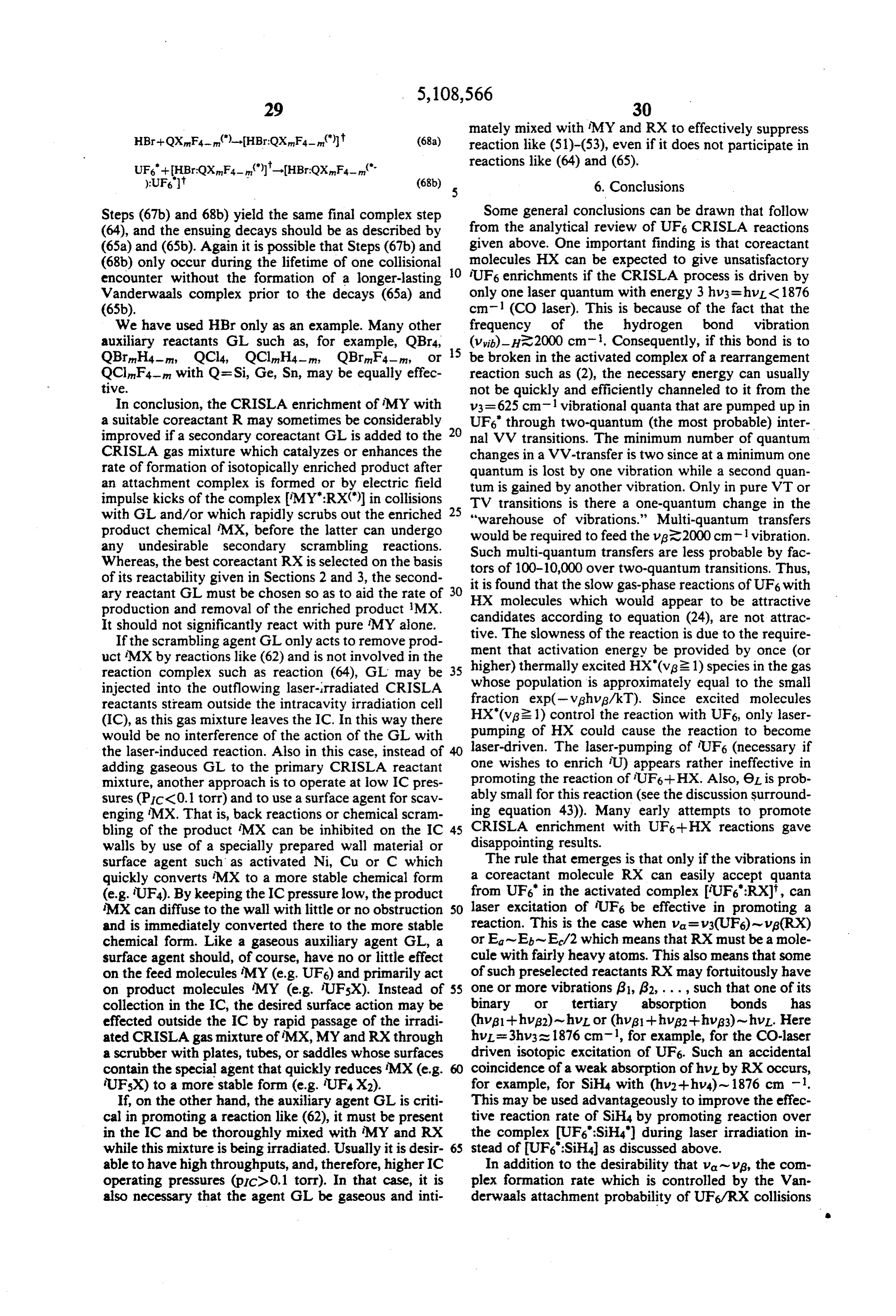
Page 29
should be reasonably high. This condition is usually isotopic molecules in one embodiment of the present satisfied automatically since most heavy polyatomic invention;
molecules have wagging or scissoring vibrations with FIG. 7A-7F are graphical representations of the frequencies close to room temperature (T=290 molecular vibration characteristics associated with the K. at 200 cm; see also FIGS. 6 and 7). Although the coreactant molecules in one embodiment of the present intermolecular potential well depth controls the attach invention; and ment rate (see Reference e), the frequent loss (~ 10 FIG. 8A-8C are schematic diagrams illustrating the collisions) of most of kT in TV collisions will enhance selection procedure required to obtain effective and the Vanderwaals attachment rate considerably. suitable coreactants RX auxiliary coreactants GL for Another general conclusion is that coreactants RX 10 use in a commercially attractive CRISLA isotope en suitable for CRISLA enrichment of UF6 should not richment process. W react too fast under thermal conditions, but also not be What is claimed:
too slow. The criteria of what constitutes a reaction that 1. In a process for separating predetermined isotopic is "too fast" or "too slow" were defined by equations molecules from a mixture of chemically identical but (24), (25), and (26). FIG. 4 illustrated the speed limits. 15 isotopically different molecules, to obtain a concentra Finally, it is often found to be beneficial to use a tion of the predetermined isotope wherein the mole secondary reactant labeled GL. The reactant GL must cules comprising the mixture have a lower rovibrational rapidly remove the enriched product molecules MX by converting MX further to a more stable species before energy with state and a higher rovibrational energy state photon-inducible transitions between the lower it can back-react or scramble the desired M isotopes by rovibrational energy state additional chemical exchange reactions. GL should not energy state, and the photonand the high rovibrational react excessively with MY or RX, of course. Some inducible transitions between the lowerforrovibrational frequency the photon highly polar coreactants GL (such as HBr) may also energy state and the higher rovibrational energy state of promote and speed up the desired reaction of the attach the ment complex RX"):MY by kicking it during a colli 25 the predetermined isotopic molecules is different from sion with its strong dipolar or quadrupolar electric field tions between the lowerforrovibrational photon frequency the photon-inducible transi energy state and or by superimposing such a strongfield in the new transient complex (GL:RX"):MY" formed after a the higher rovibrational energy state of the other chem collisional encounter. A triple complex may alterna ically identical but isotopic different molecules in the tively be produced by a first association of GL with 30 mixture, the improvement comprising the step of: selectively reacting the predetermined isotopic mole
RX(') to form IGLRX() followed by the latters at cules having a preselected vibrational frequency in tachment to or interaction with UF6.
The restrictions on RX discussed in the previous a first physicochemical state and at the higher rovi sections allows one to narrow the number of economi brational energy state with a first chemically-reac cally attractive coreactants to a relatively small group. 35 tive agent to provide a chemical compound at a FIG. 8 summarizes the selection process that leads to a second physicochemical state different from the commercially suitable coreactant RX. The first four first physicochemical state and containing atoms of section steps (A)-(D) shown in FIG. 8 are relatively the predetermined isotope, said step of selectively obvious and were discussed earlier in Reference (a). reacting the predetermined isotopic molecules fur Steps (E) and (F) are newer discoveries which, taken ther comprises the step of selectively said first together with Steps (G) and (H), yield an efficient pri chemically-reactive agent to have: mary CRISLA coreactant and possibly a secondary a first predetermined reaction speed range with said auxiliary reactant. isotopic molecules bounded by a maximum speed of said first chemically-reactive agent which is not
BRIEF DESCRIPTION OF THE DRAWINGS 45 greater than (kT)nax where (kT)nax is determined The above and other embodiments of the present by:
invention may be more fully understood from the fol lowing description and the accompanying drawings kiv -- kS -1. wherein similar reference characters refer to similar (kT)nax = kA - 8t , st";
FIG. 1 is a schematic diagram of the process equip a minimum reaction speed not less than (kT)in where ment associated with one embodiment of the present (kT)nin is determined by:
invention;
FIG. 2 is a graphical representation of the photon absorption characteristics associated with the isotopic 55 k ky - kS: ) ( -igningmin ) as a set grow easamis molecules in one embodiment of the present invention; (kTomin ( 6L
FIG. 3A-3B are additional graphical representations of the photon absorption characteristics associated with ignin the isotopic molecules in one embodiment of the present e. (ky + ks), st; invention;
FIG. 4A-4B are graphical representations of the and isotope separation factor as a function of chemical reac a first predetermined vibrational frequency; tion rate in one embodiment of the present invention; and in which said second physicochemical state is FIG. 5 is a graphical illustration of the pre-reaction substantially free of scrambling reactions of the attachment process of coreactant RX with UF6 in one 65 chemical compound, kA being the laser absorption embodiment of the present invention; rate of the most abundant isotopic molecule, ky FIG. 6A-6 are graphical representations of the mo being the collisional (vibrational to translational lecular vibration characteristics associated with the energy transfer) rate, ks being the scrambling rate
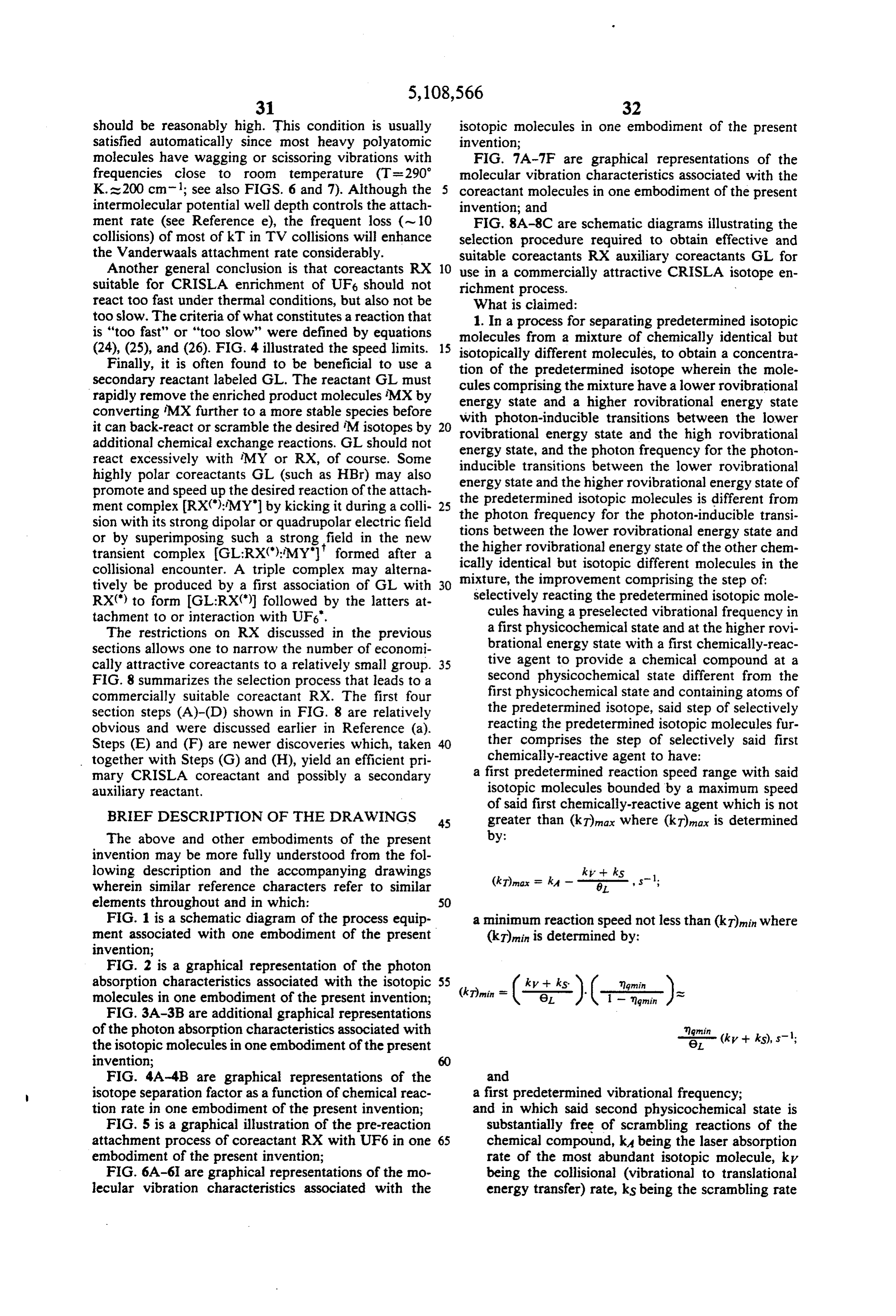
Page 30
which takes place in vibrational to vibrational en energy state, and the photon frequency for the photon ergy exchanges between similar molecules of dif inducible transitions between the lower rovibrational ferent isotopic composition, eL is the ratio of the energy state and the higher rovibrational energy state of reaction rate of a particular laser-excited molecule the predetermined isotopic molecules is different from with a co-mixed reactant to the reaction rate of an the photon frequency for the photon-inducible transi average possibly thermally-excited molecule with tions between the lower rovibrational energy state and the same reactant, and minin is the lowest tolerable the higher rovibrational energy state of the other chem quantum efficiency of a laser-induced isotope sepa ically identical but isotopically different molecules in ration process. the mixture, the improvement comprising the step of: 2. The process defined in claim 1 wherein said first 10 selectively reacting the predetermined isotopic mole predetermined vibrational frequency of said first chemi cules having a preselected vibrational frequency in cally-reactive agent does not exceed, by a factor greater a first physicochemical state and at the higher rovi than about 2, the preselected vibrational frequency of brational energy state with a first chemically-reac said rovibrational energy states with said photon induc tive agent to provide a chemical compound at a ible transitions of said predetermined isotopic mole 15 second physicochemical state different from the cules.
3. The process defined by claim 1 and further com first physicochemical state and containing atoms of prising the step of: the predetermined isotope in the presence of polar reacting said chemical compound at said second molecules, said first chemically-reactive agent hav physicochemical state with a second chemically 20 ing:
reactive agent capable of rapidly scavenging said a first predetermined reaction speed range with chemical compound at said second physicochemi said isotopic molecules bounded by a maximum cal state. speed of said first chemically-reactive agent 4. The process defined in claim 3 wherein said second which is not greater than (kT)nax where (kT)nax chemically-reactive agent is chosen to be capable of 25 is determined by:
stabilizing said chemical compound at said second phys icochemical state.
5. The process defined in claim 3 wherein said second chemically-reactive agent is chosen to be capable of increasing the formation rate of said chemical com 30 a minimum reaction speed not less than (kT)min pound at said second physicochemical state. where (kT)min is determined by: 6. The process defined in claim 4 wherein said second chemically-reactive agent is chosen to be capable of increasing the formation rate of said chemical com pound at said second physicochemical state.
7. The process defined in claim 4 wherein said second
gmin - qmin chemically-reactive agent is chosen to be substantially Tignin free of excessive reaction with said first chemically el. (ki + ks), s: reactive agent and substantially free of excessive reac tions with said predetermined isotopic molecules at the 40 and first physicochemical state. a first predetermined vibrational frequency in which 8. The process defined in claim 5 wherein said second said second physicochemical state is substantially chemically-reactive agent is chosen to be substantially free of scrambling reactions of the chemical com free of excessive reaction with said first chemically pound, ka being the laser absorption rate of the reactive agent and substantially free of excessive reac 45 most abundant isotopic molecule, Kw being the tions with said predetermined isotopic molecules at the collisional (vibrational to translational energy first physicochemical state. transfer) rate, ks being the scrambling rate which 9. The process defined in claim 6 wherein said second takes place in vibrational to vibrational energy chemically-reactive agent is chosen to be substantially exchanges between similar molecules of different free of excessive reaction with said first chemically 50 isotopic composition, 6L is the ratio of the reaction reactive agent and substantially free of excessive reac rate of a particular laser-excited molecule with a tions with said predetermined isotopic molecules at the co-mixed reactant to the reaction rate of an average first physicochemical state. possibly thermally-excited molecule with the same 10. A process for separating predetermined isotopic reactant, and manin is the lowest tolerable quantum molecules from a mixture of chemically identical but 55 efficiency of a laser-induced isotope separation isotopically different molecules, to obtain a concentra process.
tion of the predetermined isotope wherein the mole 11. The process as defined in claim 10 wherein the cules comprising the mixture have a lower rovibrational polar molecules are chosen from a group consisting of: energy state and a higher rovibrational energy state QX4, QXH4-n, and HY, where Q= Si, Ge, or Sn, with photon-inducible transitions between the lower 60 X= Br, Cl, or F,k Y =. Br,. I, .Cl, . and m = 1, 2, 3, or 4. rovibrational energy state and the higher rovibrational
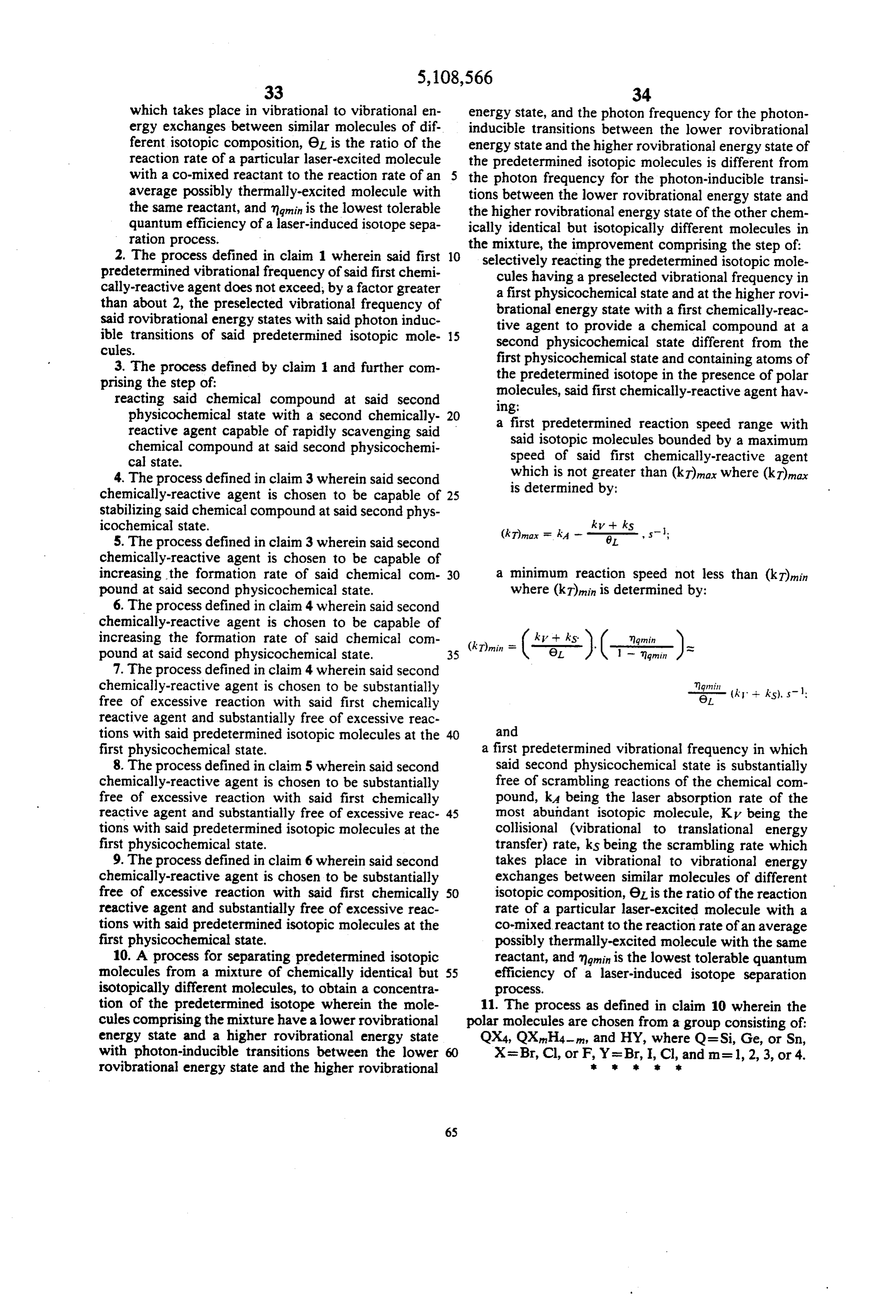
Page 31
UNITED STATES PATENT AND TRADEMARK OFFICE
CERTIFICATE OF CORRECTION
PATENT NO. : 5,108,566 Page 1 of 13
INVENTOR(s): Jozef W. Eerkens
It is certified that error appears in the above-indentified paterit and that said Letters Patent is hereby Corrected as shown below:
The title page should be deleted to appear as per attached title page. The Drawings consisting of pages 1-12 should be deleted and substituted with the attached Drawing sheets consisting of pages 1-11.
Signed and Sealed this
First Day of April, 1997
BRUCE LEHMAN
Attesting Officer Commissioner of Patents and Trade inctrks
Page 32
Page 2 of 13
United States Patent (19) (1) Patent Number: 5,108,566 Eerkens (45) Date of Patent: Apr. 28, 1992 (54) ISOTOPE SEPARATION PROCESS ant RX that will improve the isotope separation in laser 76) Inventor: Jozef W. Eerkens, 1342 Lachman activated chemical reactions which may proceed by the a. Pacific Palisades. Calif. 90272 steps:
(21) Appl. No.: 500,314 ti MY-hut-e MY
(Laser Activation of isotopic Materials)
Related U.S. Application Data (Laser Activation of Coreactant) (63) Continuation-in-part of Ser. No. 262,661. Jun. 14, 1972. MY-RX)O (MYP:Rx) st
(Chemical Exchange Reaction) (5) Int. C. ............................................... BOD S/00
58) Field of Search ......................... 204/157.2, 57.2 The step of coreactant activation can be important in (56) References Cited some exchange reactions but unnecessary in others. That is for some laser-activated chemical reactions, the
3.95.76S 4/1976 Gurs ................................. 204/1572 The selection criteria are based on the relative magni 4.082.633 4/978 Eerkens ............................ 2O4/1572 tudes of the bond-energies and therefore vibrational FOREIGN PATENT DOCUMENTS frequencies in the molecules MY and RX, and the re
quirements for forming a Vanderwaals-like attachment complex. Also, the upper and lower limit of tolerable
OTHER PUBLICATIONS thermal (non-laser) reaction speeds are defined. It is Eerkens. J. W., Laser isotope Enrichment of Uranium shown further that it is necessary to restrict suitable RX by the Crisla Process, vol. 1. Isotope Technologies. Sep. candidates to those species which yield MX product 1987. that does not participate in subsequent chemical reac Eerkens, J. W., Dimer Formation in Gases and Gas tions which cause isotope scrambling. The employment Mixtures Appendix. Aug. 88. of a second auxiliary coreactant is recommended in Eerkens. J. W., Lifetimes. Populations and Absorptions certain cases if its interaction with the complex of the v3 and 3v3 Vibration in UF6. Isotope Techn. Aug. (MY":RX()' will increase the latter's reaction rate 88. and/or if it can scavenge the product MX, thereby London. Editor. Separation of Isotopes. George negating any subsequent isotope scranbling reactions of Newnes Limited. London. pp. 430-436 (1961). MX. The auxiliary coreactant should not react. or only Mayer et al. Isotope Separation with the cw Hydrogen slowly react, with the reactants MY or RX. By applica Flouride Laser, pp. 516-519 (1970). tion of the selection criteria to UF6, a small group of Primary Examiner-Brooks H. Hunt suitable chemical coreactants are identified which give Assistant Examiner-Ngoclan T. Mai improved Uranium isotope separations. Attorney. Agent, or Firm-Pillsbury, Madison & Sutro
Selection criteria are disclosed for choosing a coreact 11 Claims, il Drawing Sheets
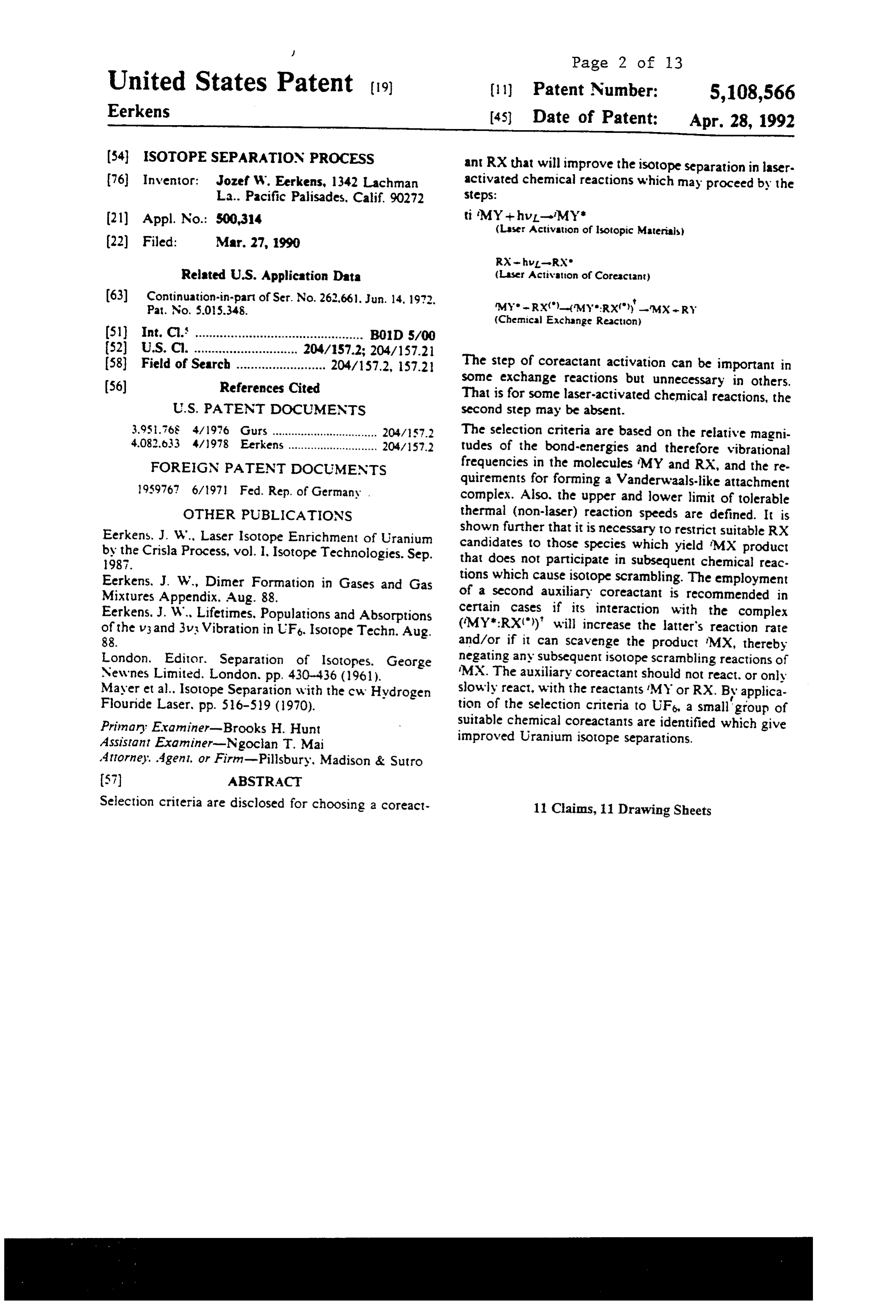
Page 33
Drawing sheet — no readable text.
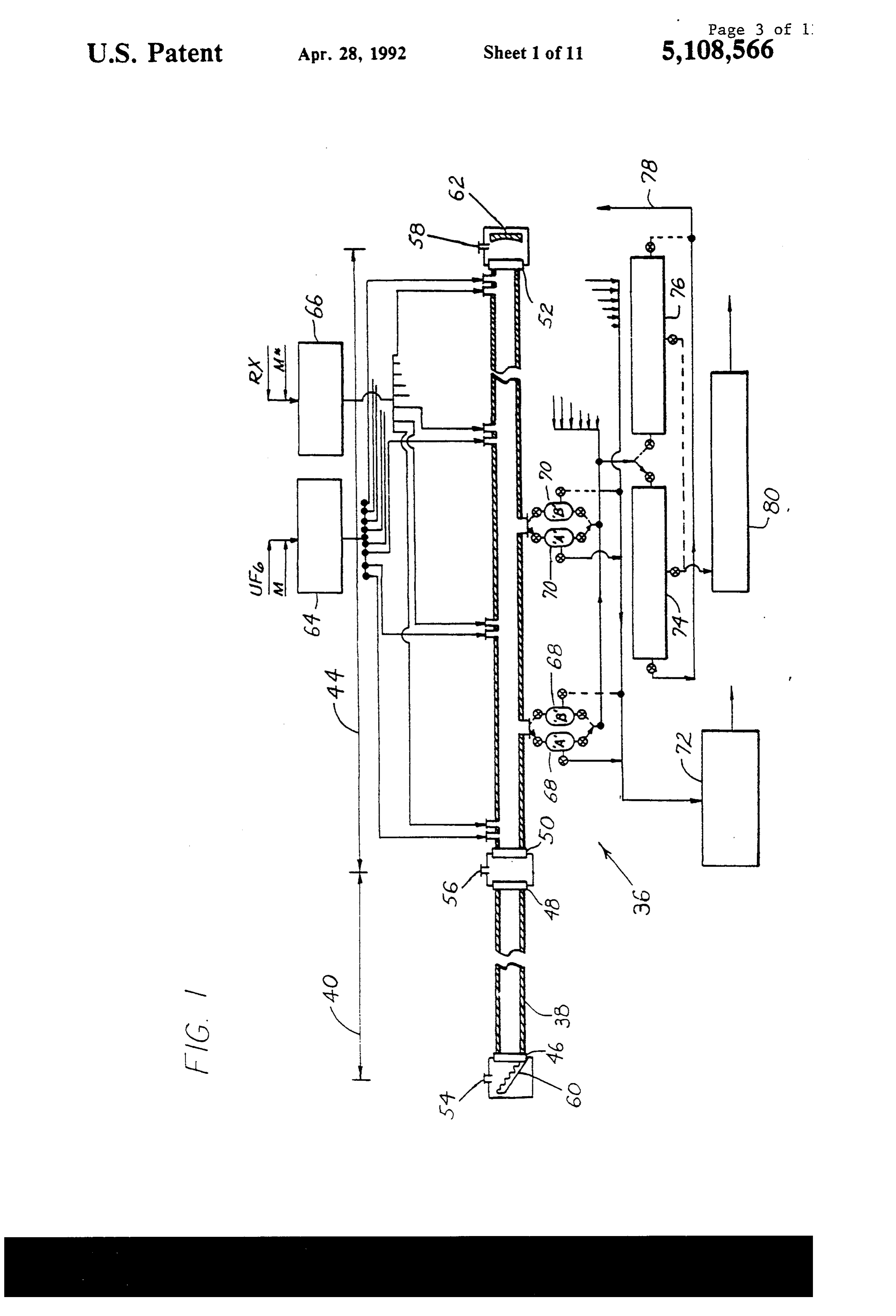
Page 34
Drawing sheet — no readable text.
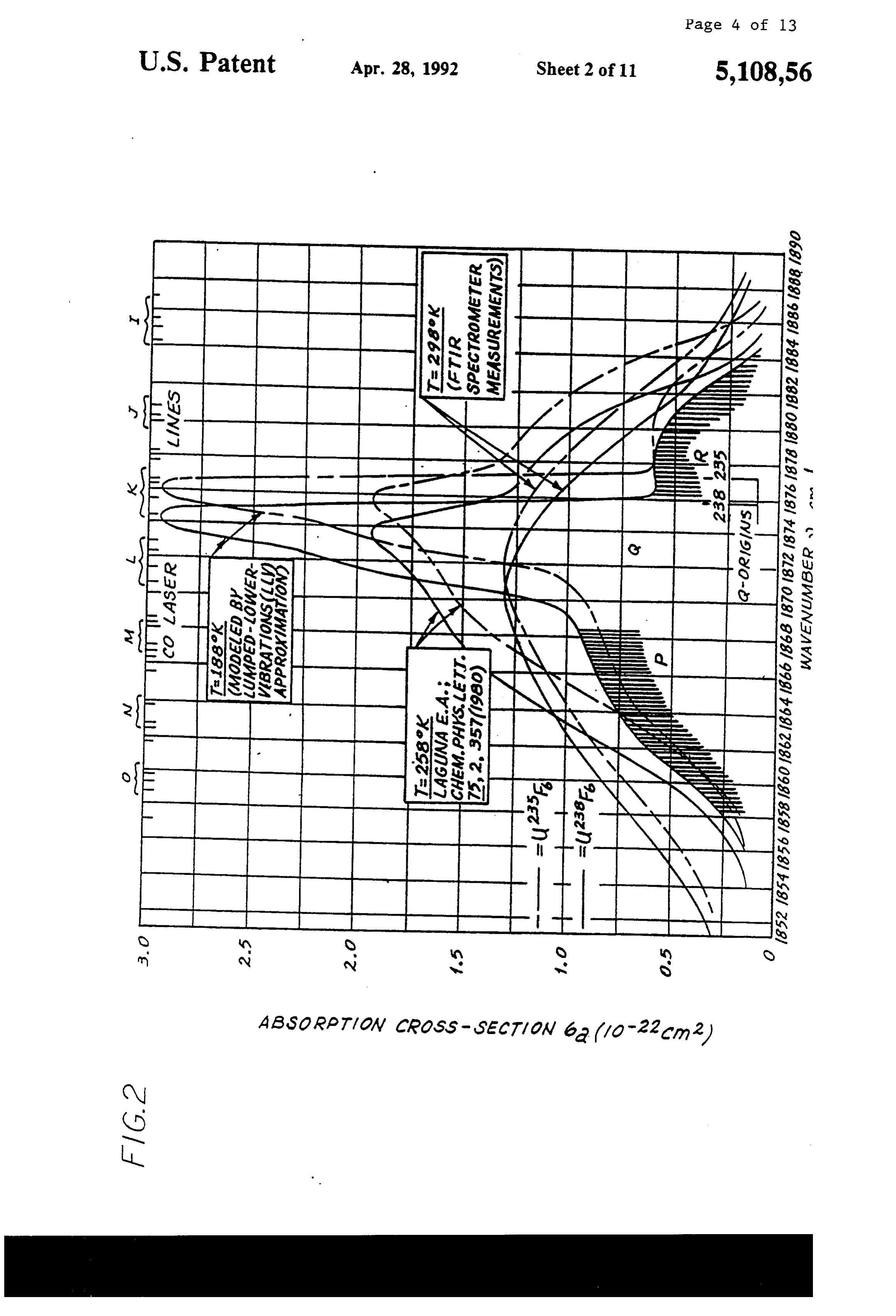
Page 35
Drawing sheet — no readable text.
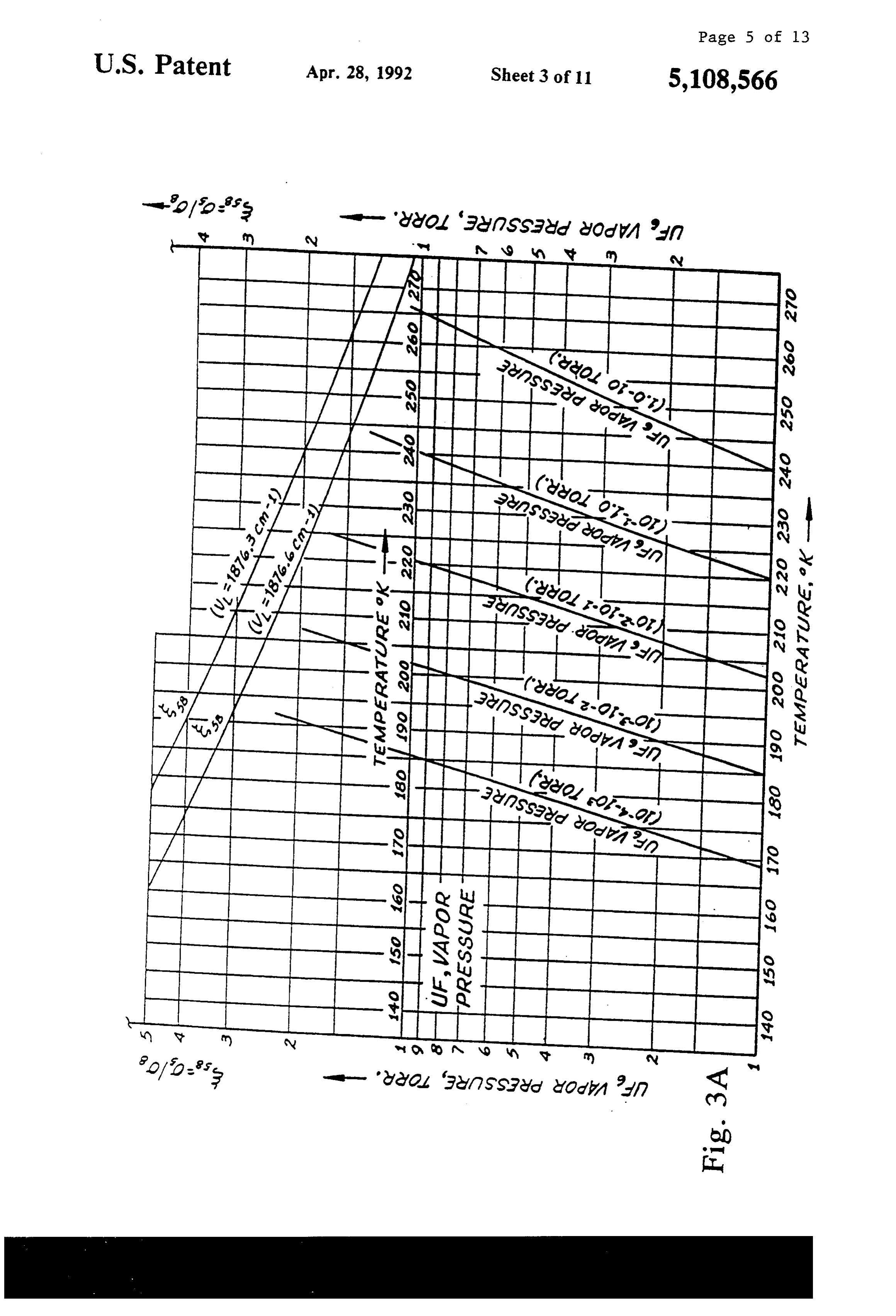
Page 36
Drawing sheet — no readable text.
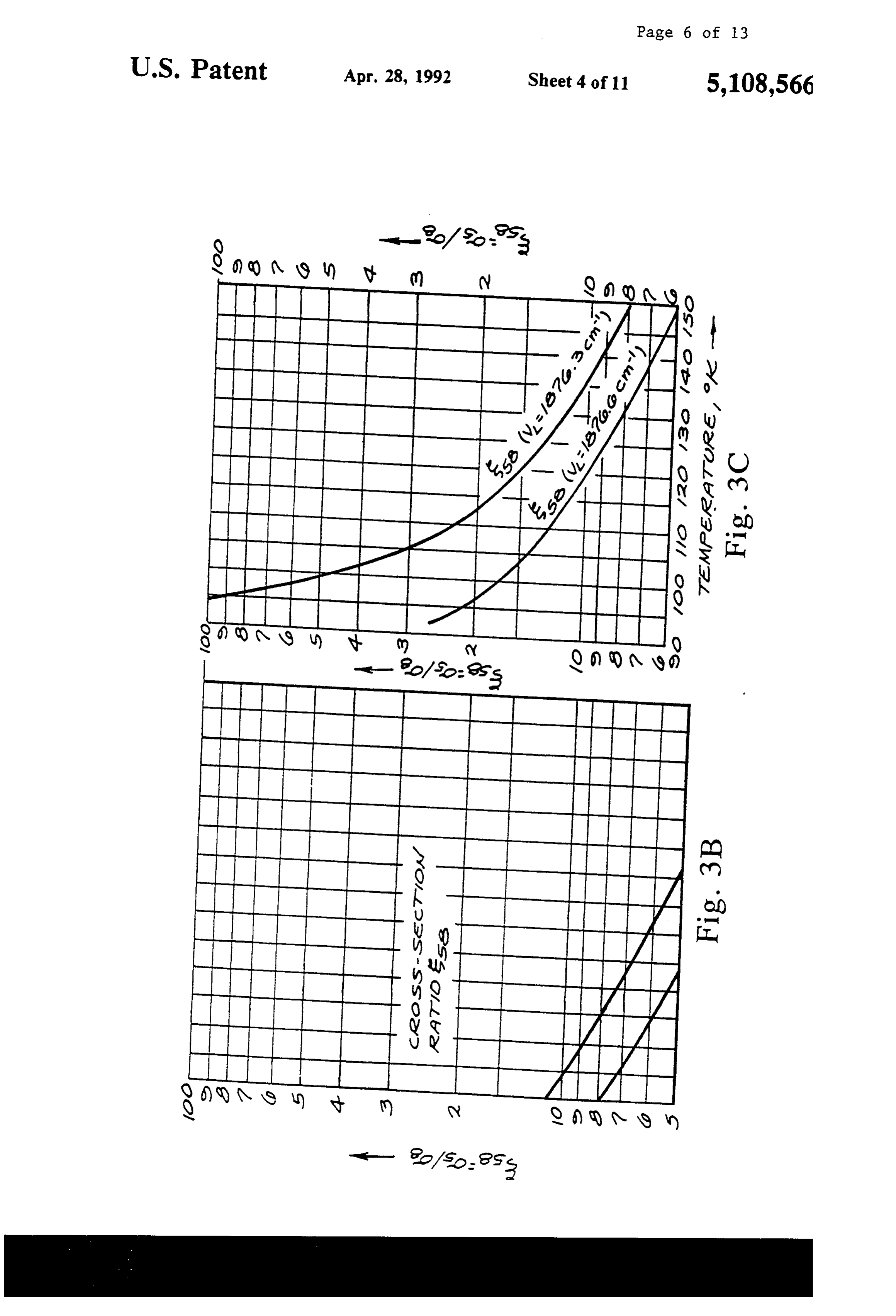
Page 37
Drawing sheet — no readable text.
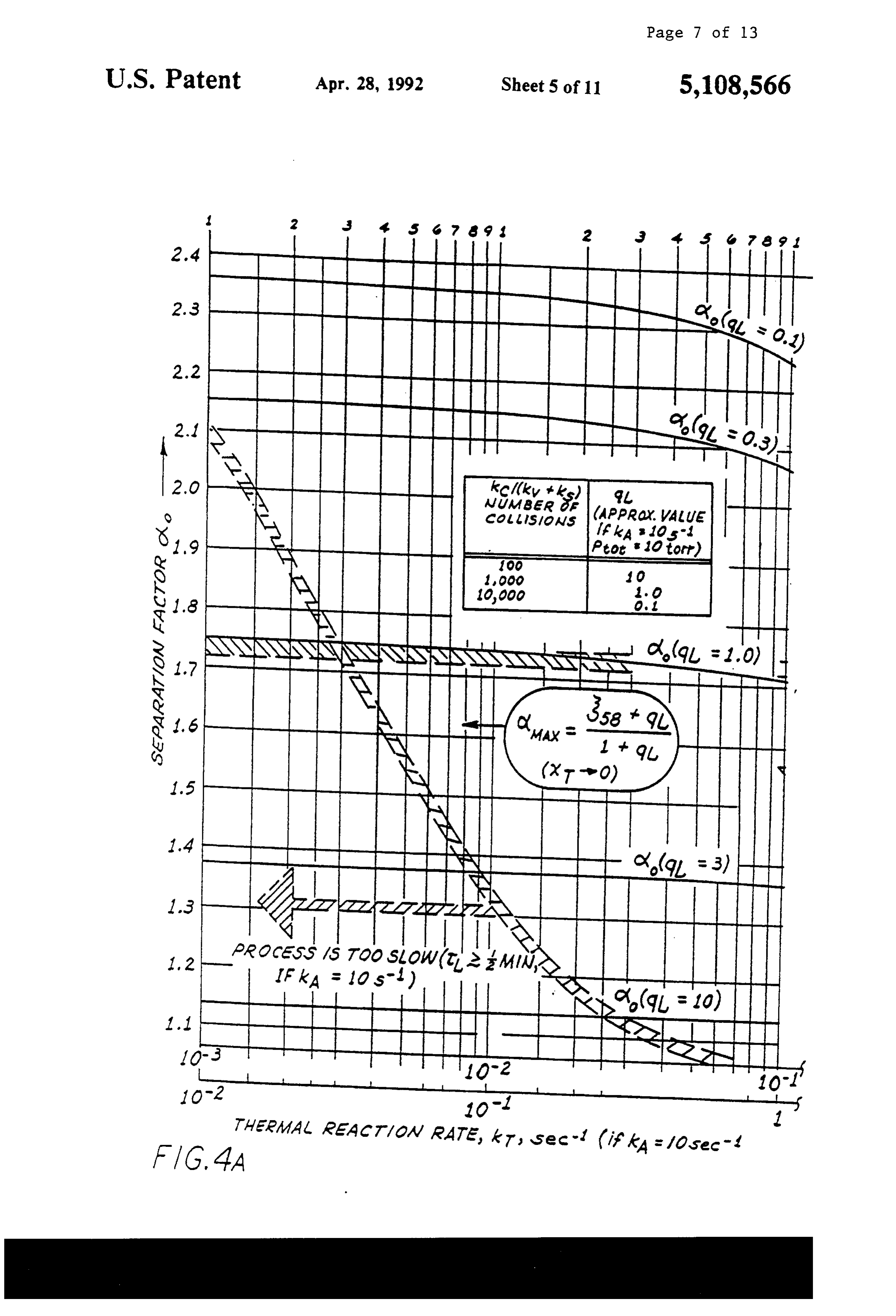
Page 38
Drawing sheet — no readable text.
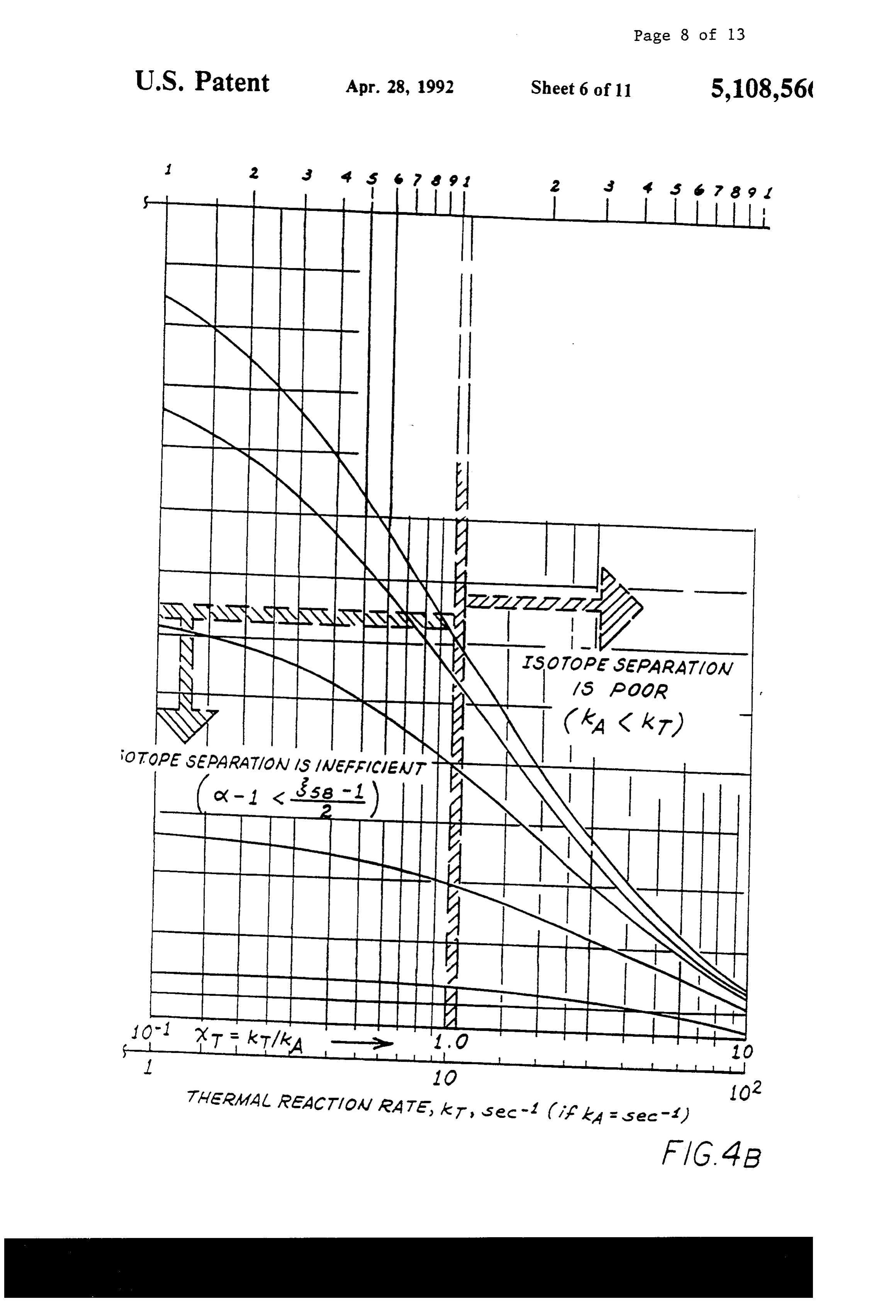
Page 39
Drawing sheet — no readable text.
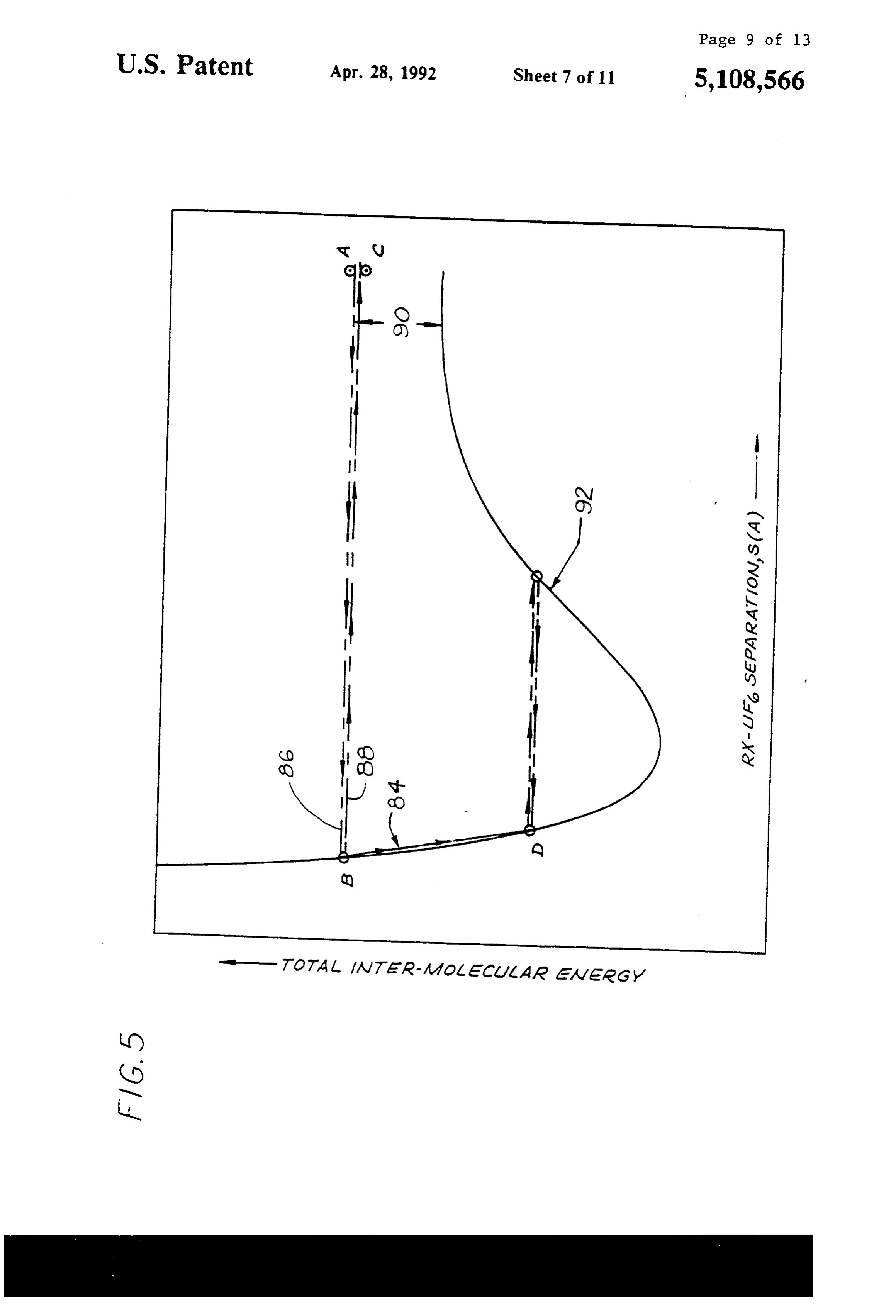
Page 40
Drawing sheet — no readable text.
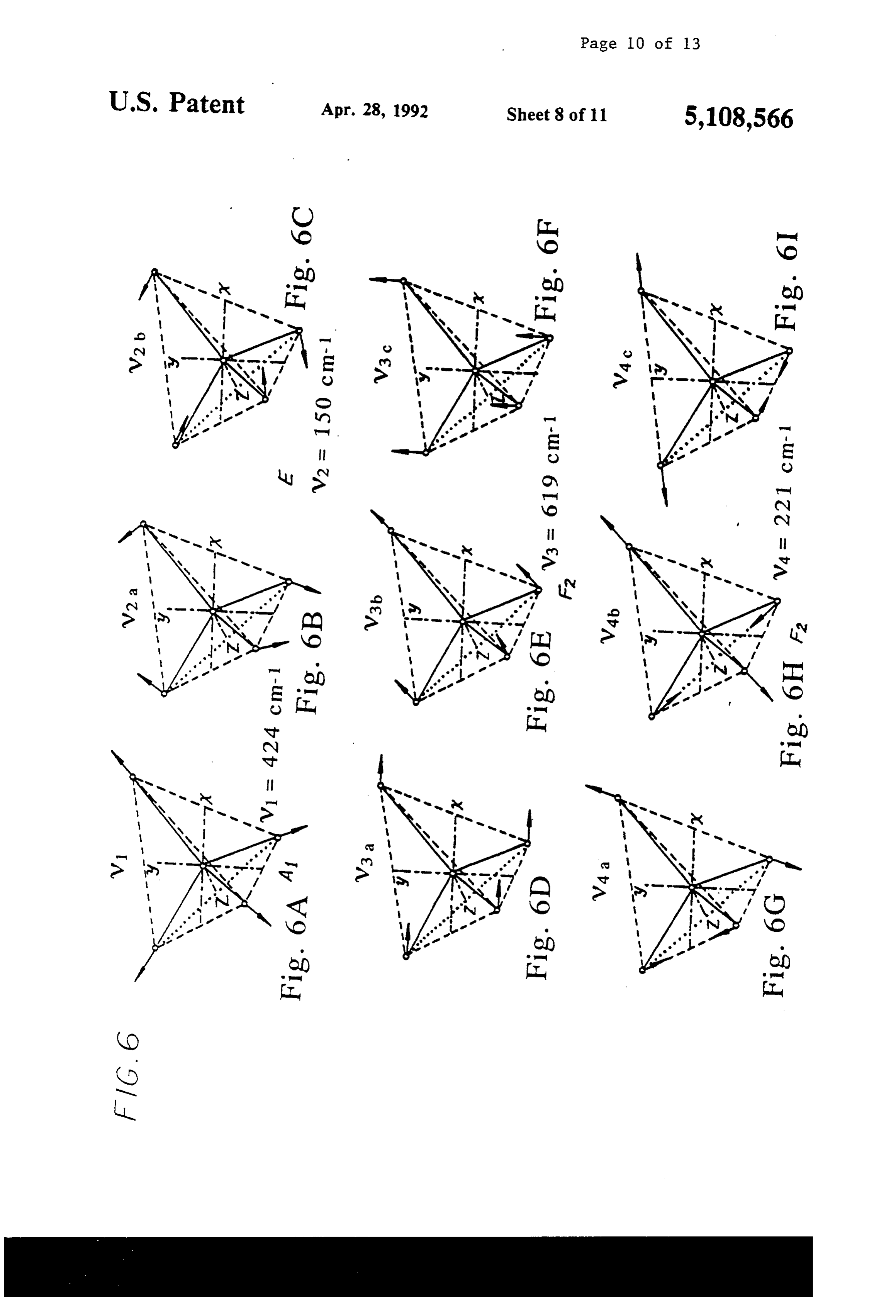
Page 41
Drawing sheet — no readable text.
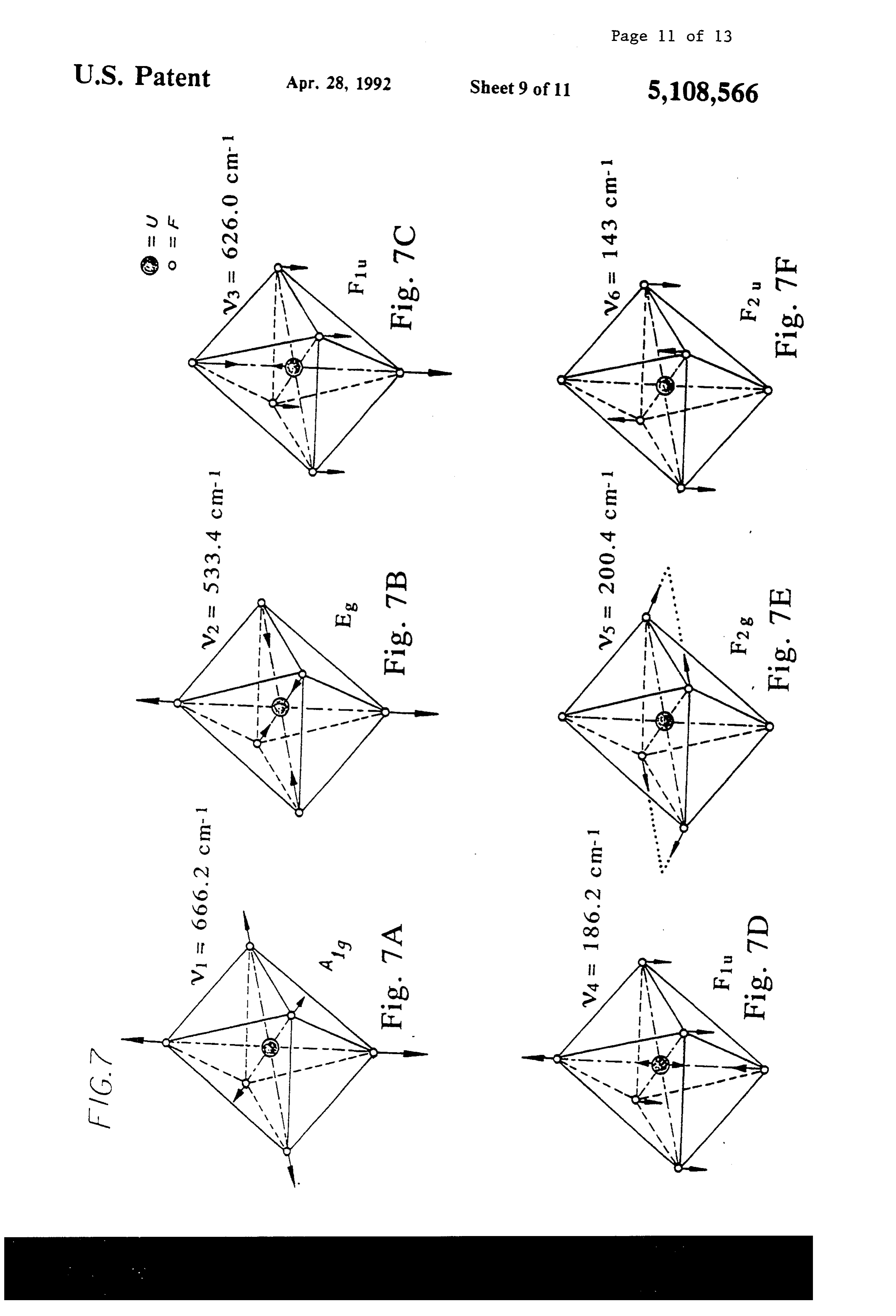
Page 42
Drawing sheet — no readable text.
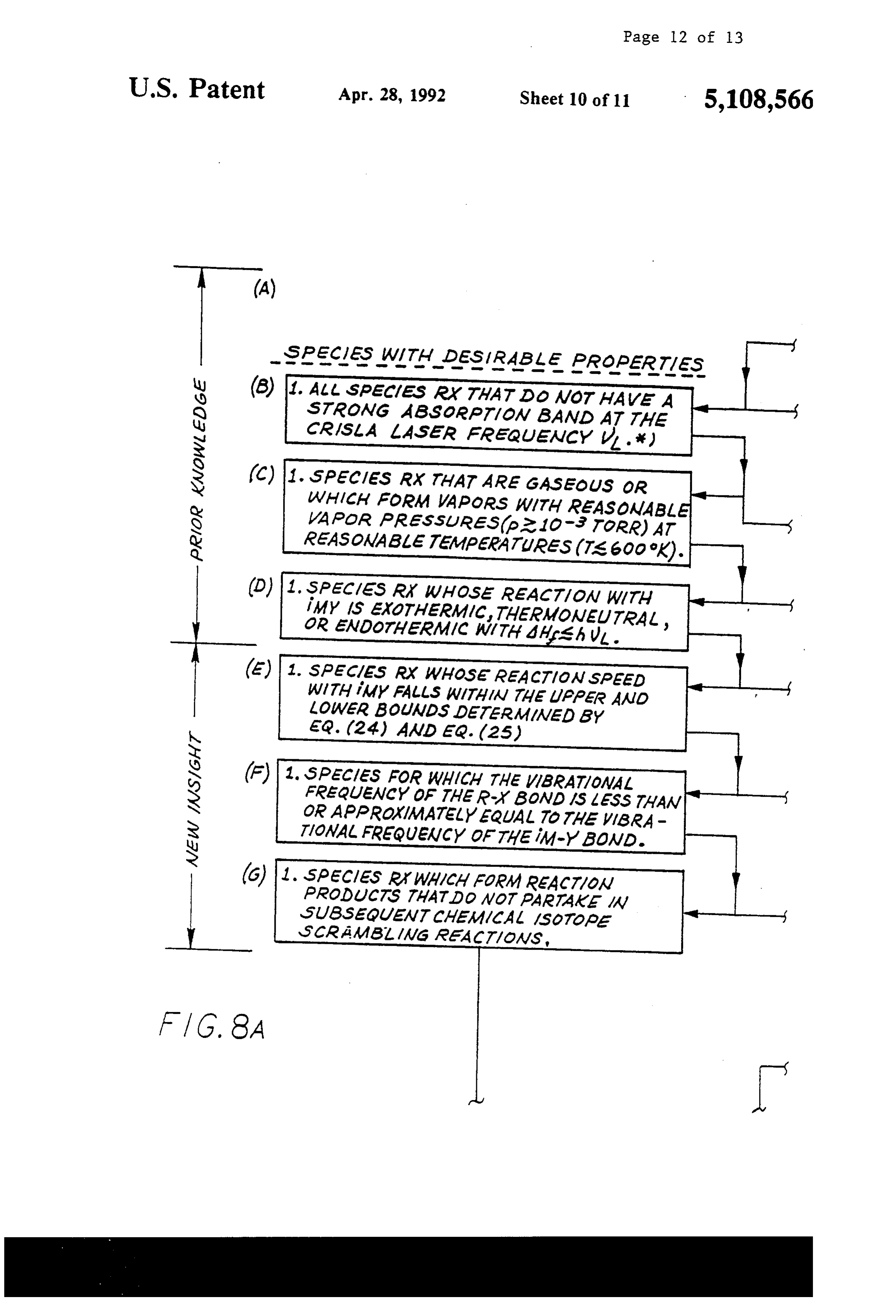
Page 43
Drawing sheet — no readable text.
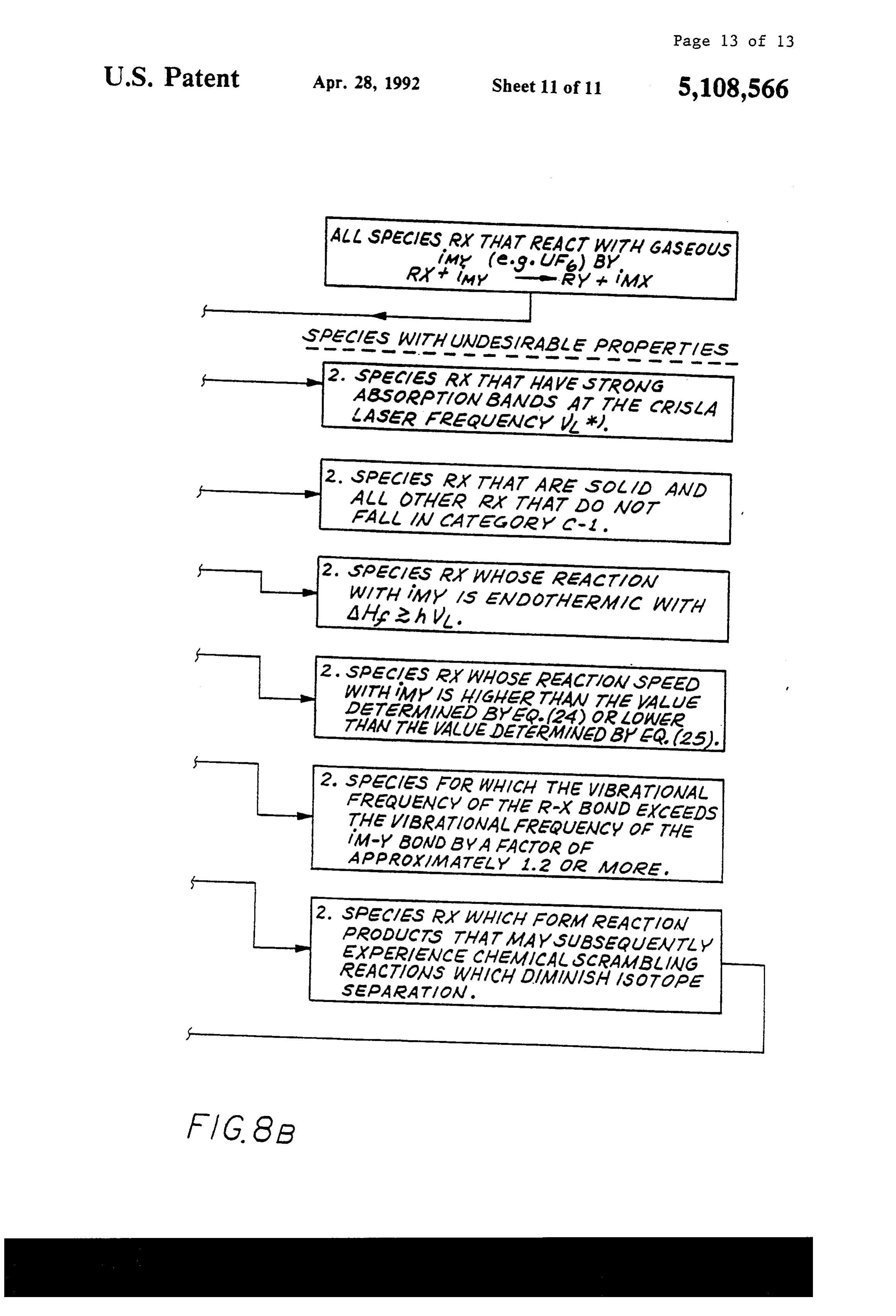
Provenance
- Collection
- Cited prior art
- Original PDF
- patentimages.storage.googleapis.com →
- Filed
- 1990-03-27
- Pages
- 43
- Method
- pdftotext (the PDF's own text layer) + pdftoppm 300dpi page scans
- Source
- Google Patents bibliographic record
- Granted
- 1992-04-28
- Inventors
- Jozef W. Eerkens; ISOTOPE TECHNOLOGIES
- Transcribed from
- patentimages.storage.googleapis.com →